Showing posts with label Werner Herzog. Show all posts

Saturday, November 04, 2023

The Eight Mountains

I recently watched The Eight Mountains which I'd been looking forward to since reading Peter Bradshaw's review in The Guardian:

This rich, beautiful and inexpressibly sad film is about the friendship between men who can’t talk about their feelings and about winning and losing at the great game of life. It is set in the breathtaking and wonderfully photographed Italian Alpine valley of Aosta, which includes the slopes of Mont Blanc and the Matterhorn. But the “eight mountains” of the title refers to the eight highest peaks of Nepal: a mysterious symbol of worldly ambition and conquest. Belgian film-makers Felix van Groeningen and Charlotte Vandermeersch have adapted the award-winning 2016 novel by Italian author Paolo Cognetti and have created a deeply intelligent meditation on our capacity for love, and how it is shaped by the arbitrary, irreversible experiences of childhood, and by our relationship with the landscape. The Aosta valley is depicted with magnificent sweep, and van Groeningen and Vandermeersch find a stratum of sadness under it, a kind of water table of tears.

Unfortunately, although I did quite enjoy it, I was disappointed - my view of the film was closer to Richard Brody's review in The New Yorker. In this he describes a scene that echoes a central dilemma of landscape appreciation I've referred to often on this blog. 'By far the best scene in the film is one in which the adult Pietro (Luca Marinelli) brings a trio of Turin friends to the mountains; in response to their rapturous enthusiasm for “nature,” Bruno (Alessandro Borghi) explains that the people who live in the mountains never use that “abstract” word but rather speak lovingly of the physical specifics—“forest, meadow, river, rock, path: things you can point at, things you can use.”' 

However, 

that line of dialogue conveys more of the essence of the movie’s alpine setting than does the cinematography. Much of the action there takes place outdoors; Pietro’s father (Filippo Timi) is an enthusiastic hiker and climber who takes the two boys with him on his expeditions, and Pietro, in his many returns to the region, delights in the peaks, in the clear water of the lake, in the rock formations. The movie presents these landscapes as cinematic abstractions, with drones and Steadicams and cameras perched on high to show the small figures of humans overwhelmed by, yes, nature, and to show the spectacular sights that surround the characters. But it stints on the visual point of view of the characters, voids itself of contemplative poise and analytical precision, hardly stays still long enough, looks in detail long enough. It doesn’t pay enough closeup, hands-on attention to soil and stone and water and snow, to wood and fire, to flesh and fabric, to suggest that the characters have any more of a physical connection to the settings than they have a perceptual one.

We used to exclaim "oh no, not a drone shot!" whenever they appeared on TV documentatries or movies, until they became almost ubiquitous. But complaining about the drone shot cliché has itself become a cliché, so I won't labour the point here. A New York Times article on the phenomenon did note some highly effective examples - Werner Herzog 'opens his remarkable 2016 picture “Into the Inferno” with an astounding aerial sequence that soars up a mountain and then into the volcano at its center.' Maybe we could just have some more drone shots that are grainy or misty or flawed in some way, rather than being taken on smooth glides over perfect landscapes that are not as awe-inspiring as they should be, because they look almost computer-generated. 

Another review of The Eight Mountains notes that 'some obvious drone shots are included, but much of the hiking sequences appear to have been done with Steadicams, following the men through their treacherous treks. Andrea Rauccio is listed as the Steadicam operator, but the credits for camera operators are lengthy, and the entire crew deserves credit.' Richard Brody may be being a bit harsh on all this, but I do know what he means when he says that in these scenes it's hard not to 'hear and see the crew, the walkie-talkies, the muffled clamor that goes into turning raw experience into overcooked and denatured images.' 

I feel I should end on a more positive note though. So here are a few more quotes from reviews (ending back with Peter Bradshaw), where the temptation to use mountain metaphors has proved irresistible.

  • 'Stately and serene from a distance, but up close riven with the fissures and follies of a friendship that costs both men so much but gives them even more, the movie, too, is a mountain.' (Variety)
  • 'Luca Marinelli and Alessandro Borghi put in mountain-sized performances to offset the film’s silences and propensity for postcard shots, bringing heart and guts to the chilliest scenery. A worthwhile hike through many obstacles to friendship.' (Irish Times)
  • 'A movie that seems to grow before your eyes, leaping across continents as years go by, all the while slowly accruing power. By the end it has scaled a peak, offering a bracing perspective on life experience.' (FT)
  • Much like climbing a mountain, the two-and-a-half-hour runtime may occasionally feel arduous, but the emotional release is worth it once you reach the peak.' (Time Out)
  • 'This film has mystery and passion, it climbs mountainous heights and rewards you with the opposite of vertigo: a sort of exaltation.' (The Guardian) 

Friday, October 16, 2020

Look into the cataract


I've been a bit short of time recently so here is just a brief post to share a clip from YouTube of the beginning of Werner Herzog's Heart of Glass (1976). Embedded clips like this usually disappear after a while so I am also including some still images from the film too. The Rückenfigur looking over the Bavarian Alps is the herdsman Hias, a character based on the legendary Bavarian prophet, Mühlhiasl who had Nostradamus-like visions of the future.  The second one shows clouds flowing over the mountains, a scene Herzog and his crew filmed frame-by-frame.  These mountains formed the landscape of Herzog's childhood, living until the age of twelve in a remote village which his mother had taken their family to after the house next door to theirs in Munich was bombed in an Allied raid.


After these views of the mountain landscape where the film's story is set (just after the end of the clip embedded here), there is a sequence of stranger, more dream-like images of flowing water. These are supposed to put the viewer into a kind of trance, like the villagers in the story who talk and act as if in a waking dream - Herzog got all his actors to perform under hypnosis, with the exception of Josef Bierbichler who plays Hias (for more on this, see the book Werner Herzog and the making of 'Heart of Glass'). Over the waterfall footage you hear a voice in German: "I look into the cataract... I feel an undertow... It draws me, it sucks me down..."  As this is happening, Popul Vuh's music gently plays in the background.  Herzog described the effect of concentrating intensely on this imagery.  It "gives you a lift as if the waterfall was standing still and you start to float upwards. It's a little but like the effect of staring from a bridge into a river and all of a sudden you start to float..."   

Sunday, November 19, 2017

The stiff-feathered pines shed their darkness


Six years ago I wrote about The Peregrine (1967) and its elusive author, J. A. Baker.  I was prompted in part by the airing of a radio play about him, written by Helen MacDonald.  The book she subsequently published, H is for Hawk, contrasts T. H. White's The Goshawk (1951) with Baker's bleaker vision, his 'awful desire for death' disguised as an elegy for the peregrine.  I also referred to a new edition of Baker's complete works, edited by John Fanshawe, which included the diaries used as source material for The Peregrine.  Fanshawe has been chiefly responsible for assembling the Baker archive at Essex University and in Robert Macfarlane's recent book, Landmarks, he describes the experience of encountering this collection of notebooks, manuscripts, annotated maps and binoculars.  One more thing I mentioned in that earlier post, an album by Lawrence English, is described in an appreciation of Baker, written earlier this year by Robert Macfarlane to mark the fiftieth anniversary of The Peregrine.  Apparently, English sent a copy of The Peregrine to Werner Herzog, who was gripped by it:
'Herzog describes The Peregrine as inducing “ecstasy” in the radical sense of the word: not just entranced or frenzied, but literally beside oneself. There are moments, he notes, “where you can tell that [Baker] has completely entered into the existence of a falcon. And this is what I do when I make a film: I step outside of myself into an ekstasis; in Greek, to step outside of your own body.”  ... The puzzle to me, for years, was why Herzog had not yet filmed The Peregrine. In 2015, I wrote to ask if he was planning to do so. “If anyone can, it should be you,” I said. I sent him a photograph of my local peregrine perched on a church spire, part-gargoyle. Herzog replied within a few hours, generous about my own writing on Baker, but adamant about the book’s adaptability: “A feature film would be very wrong. There are texts that should never be touched. Georg Büchner’s Lenz is one of these cases. In fact, whoever tries to make a feature film of The Peregrine should be shot without trial.”
This story got retold at an LRB Bookshop event last Wednesday.  The event was compèred by the sans pareil Gareth Evans and featured John Fanshawe, Robert Macfarlane and his former student, Hetty Saunders, who got inspired by Baker after taking a course on post-pastoral literature.  She has catalogued the Baker archive and written a fascinating short biography based on what can be gleaned from it.  This book, My House of Sky, includes an evocative selection of archive photographs that take you directly into Baker's world (these pages, incidentally, reminded me of Nick Drake: Remembered for a While, which also reproduced archival material on another intriguing cult figure from the late sixties).  Here is just one example of these pages, a bird watching diary from 1955, the year after J. A. Baker first saw a peregrine falcon.


The archive features a set of photographs that were taken of J. A. Baker's bookshelves.  Only one is included in the biography, along with a brief list of authors he is known to have read (J. G. Ballard is mentioned, but no specific titles).  However, the archive refers to a catalogue John Fanshawe made from the photographs and this can be found online at the Essex University Special Collections website.  His spreadsheet has gaps - for example, he lists as a blank what looks to me, from the indistinct image in My House of Sky, to be the spine of Arthur C. Clarke's Four Great SF Novels (I'm not certain of this identification, but I did spend my youth hunting for SF novels rather than goshawks and peregrines...)  The Ballard books are in the spreadsheet, although not all are named; there were quite a few, from The Drowned World through Crash to Empire of the Sun.  However, aside from these there aren't any startling titles that stand out and the collection is largely as you would expect.  I was slightly surprised in the LRB Bookshop talk when Robert Macfarlane likened Baker to H.D and the Objectivists - there's no evidence in this list of him reading these or any other post-Poundian poets.

My House of Sky also includes photographs of the annotations Baker made to proof-copies of his books, returning to them after they were published to study the effectiveness of his prose.  There are two pages from The Hill of Summer (the less-successful second and final book that he published), showing where he marked metaphors and similes and counted up the verbs and adjectives.  As these are landscape descriptions, it seems fitting to conclude a post on this blog with an example.  Here is the first paragraph of 'May: the Pine Wood', showing Baker's 'M's, 'S's and underlinings.
'The pine wood hides the sun, like a dark northernS god rising in menaceM above the white road that falls steeply to the west, and the small green hills beyond are recedingM into a grey autumnal haze.  The high town silvers in sunlight, and its sky is barbed with curvingM swifts.  But already the night's simplicity is settling uponM the valley.  Under the exoticM flowering of the early lights, a blue Venetian duskM laps at the windows of the shadowed houses.  As I watch, the high townM is extinguished, and its shiningM sky ascends.  The stiff-featheredM pines shed their darkness into the still air.'

Sunday, January 08, 2017

Terra Incognita


Sara Wheeler's Terra Incognita was published twenty-one years ago, before the hundredth anniversaries of the expeditions led by Scott, Shackleton and Amundsen.  Reading it recently, I wondered if we have been living through a golden age of artistic exploration, with a new series of 'firsts', as writers, filmmakers, sound artists and photographers have followed in the footsteps of the explorers and scientists, recording the environment or making site-specific work on the ice.  Perhaps this pioneering period can be said to have come to an end with the first Antarctic Biennale.  According to an article in Slate, 'the current plan is for the artists to construct installations in Antarctica that will be documented and removed, and then to show some of the works later in Venice. The culturati have officially reached the end of the world.'

For most of her stay in 1994-5, Sara Wheeler was hosted by the US National Science Foundation's Antarctic Artists & Writers Programme.  Their website provides a fascinating insight into the range of cultural work that has taken place under its auspices.  There are very few household names - the most famous is Werner Herzog, who made his enjoyable documentary Encounters at the End of the World there in 2006 (the shot of a penguin walking in the wrong direction to certain death has become famous).  Herzog's musical collaborator Henry Kaiser had already been there and it was footage he had taken on his trip that persuaded Herzog to take on the project.


The list of people who preceded Sara Wheeler on the program is not long - some historians and science writers, illustrators and photographers (who must all go south highly conscious of the heroic efforts of Ponting and Hurley) and one poet, Donald Finkel, who wrote two books about Antarctica.  Barry Lopez went too - the program's website lists two articles, published in 1989 and 1994, and "future book." Wheeler mentions Lopez once or twice in Terra Incognita.  She recalls how Ranulph Fiennes had scoffed at the idea that the Antarctic can provide a transcendental experience: "I prayed for help there, but I would have done so in Brixton.  Mr Lopez writes about it but he's hardly been there at all." Wheeler's footnote to this: 'Lopez is an established and highly respected author who has visited Antarctica five times.  His trips were not exercises in seeing how dead he could get - he went to see, and to learn.'

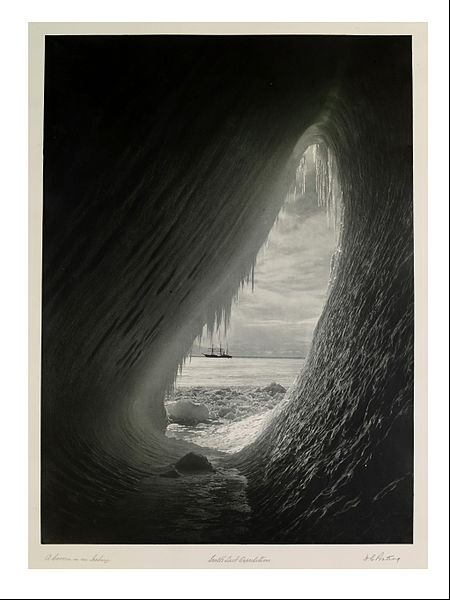
Herbert Ponting, A Cavern in an Iceberg, 1910
Source: Wikimedia Commons

Interestingly, according to the list, Kim Stanley Robinson was in Antarctica at the same time as Sara Wheeler.  I rather wish they had encountered each other because she is quite amusing on cultural differences between America and Britain.  Her book was conceived and written in the tradition of British travel writing (her favourite is The Road to Oxiana) whilst Robinson was researching his science fiction novel Antarctica.  The one other artist she did spend time with on her second trip, which coincided with the end of the Antarctic winter, was a watercolourist called Lucia deLeiris.  They shared a hut on the frozen sea and there, she writes, 'the landscape spoke to me so directly that it no longer seemed to be made of corporeal ice.'


At the end of the book, before leaving Antarctica, Wheeler returns to the Dry Valleys where she had experienced a memorable hike the previous summer.  On that earlier occasion she had been visiting scientists studying Lake Fryxell, its surface 'filled with tiny white bubbles and twisted into apocalyptic configurations - a fall might land you face down on a sword reminiscent of Excalibur.'  The opportunity arose to take a walk up the valley, the passing Suess and Canada Glaciers, where she noted a mummified seal on the moraine, and coming eventually to Lake Bonney, where 'ribboned crystals imprisoned in the ice glimmered like glowworms.  It was swathed in light pale as an unripe lemon.'  Now, months later, after the long polar night and a brief return to England, she was back.  
'I knew this landscape, but I had never seen the pink glow of dawn over the Canada Glacier, or the panoply of sunset over the Suess, or in between, sunlight travelling from one peak to the next and never coming down to us on the lake.  We lived in a bowl of shadow during those days.  One morning the sun appeared for ten minutes in the cleft between Canada and the mountain next to it, and everyone stopped working to look up. The lake was carpeted with compacted snow, and from the middle, where the Canada came tumbling down in thick folds, the Suess was cradled by mountains like a cup of milky liquid.'

Tuesday, November 03, 2015

Zona


I seem to have written rather often about Andrei Tarkovsky on this blog, but perhaps it's not so surprising - how many other directors made two major films about possibly-sentient landscapes?  Last week I went to watch one of them, Stalker, at the BFI Southbank, where there is currently a 'Mirroring Tarkovsky' season.  It is some years since I last saw the film - this was the first time since having read Geoff Dyer's book about Stalker, Zona (2013), which was fun to turn to again after seeing the film.  One scene I had forgotten about is where the three men have come to a temporary halt on their journey and the earth seems to undulate like waves.  In my memory of Stalker the landscape of the Zone was mysterious but entirely free of any special effects.  This strangely rippling ground prompts from Dyer a couple of the many humorous digressions that make up much of his book and which some readers will find self-indulgent (on quicksand and LSD trips).  But he also provides the interesting background information that this footage came from an earlier stage of filming, when there were more science fiction elements than appeared in the final cut.  However, he doesn't fully explain what is going on here...
'The little islands of grass do not ripple.  The trees in the background do not ripple: it's just the boggy-looking dried earth that ripples and then, gradually, stops rippling.  How does Tarkovsky do this, how does he achieve these effects?  Or are they not effects?  Was it simply luck that he came across a patch of ripply quicksand and then it started snowing where, a few seconds earlier, it had been dusting and blossoming?  Is this part of the random magic of cinema that Herzog discovered in a sequence of footage shot by Timothy (Grizzly Man) Treadwell?  Treadwell plunges into and then out of shot, leaving the camera to record only the wind-whipped bushes and foliage. 'In his action-movie mode Treadwell probably did not realise that seemingly empty moments have a strange beauty,' Herzog explains as the bushes and trees bend and sway in the wind as if in unconscious homage to Tarkovsky*.
'* Or, of course, to Herzog himself, specifically the famous epigraph - 'Don't you hear the terrible screaming all around you?  The screaming that men call silence' - and shot of wheat swaying in the wind at the opening of The Enigma of Kaspar Hauser.'

Friday, February 13, 2015

Of Walking in Ice

A few days before Bruce Chatwin's death in January 1989 he asked Werner Herzog to visit him.  They shared a belief in the restorative powers of walking and Chatwin was convinced that Herzog had healing powers.  Too weak now to rise from his bed, Chatwin nevertheless longed to be out on the road again.  Herzog's account of their conversation appears in Nicholas Shakespeare's biography Bruce Chatwin (1999).  'He looked down at himself and he saw the legs were only spindles and he looked at me in this very lucid moment and he said: "I'm never going to walk again." He said: "Werner, I'm dying." And I said, "Yes I am aware of that." and then he said: "You must carry my rucksack, you are the one who must carry it."  And I said: "Yes, I will proudly do that."'

In 1978 Herzog had published a short book, Vom Gehen im Eis (Of Walking in Ice) that had particularly impressed Chatwin.  'At the end of November 1974', Herzog wrote in its preface, 'a friend from Paris called and told me that Lotte Eisner was seriously ill and would probably die.  I said that this must not be, not at this time, German cinema could not do without her now, we would not permit her death.  I took my jacket, a compass and a duffel bag with the necessities.  My boots were so solid and new that I had confidence in them.  I set off on the most direct route to Paris, in full faith, believing that she would stay alive if I came on foot.'  Herzog set off from Munich and arrived twenty days later, exhausted, to sit by her bedside.  Lotte Eisner made a recovery and lived on until 1983. 

I have created a map that tries to give a visual impression of this elemental journey, through snow and ice (white), rain and water (blue), mist and fog (grey) and the occasional burst of sunshine (yellow).  You can click on each square for a short quote from the book and imagine them read in Herzog's familiar voice: 'The snow lies wet on the fields, darkness comes, all lies barren...'  The black circles record the places he found to sleep: a barn, a stable, a few inns, abandoned buildings and empty holiday homes.  It would of course be possible to derive many alternative maps from the text, marking, for example, moments of physical pain and exhaustion, or fleeting, strange encounters with Herzogian characters, or those points in the narrative where the account of his walk dissolves into descriptions of dreams.


'A rainbow before me all at once fills me with the greatest confidence.  What a sign it is, over and in front of him who walks.  Everyone should walk.'
- Werner Herzog, Thursday 5th December, 1974

Sunday, February 26, 2012

Mountainous Valley with Fenced Fields


Werner Herzog has been invited to exhibit at the Whitney Biennial this year and, as you can see from the short interview above, he will be mounting an installation devoted to a landscape painter whom 'nobody knows': Hercules Segers.  In 1678 Samuel van Hoogstraten, writing forty years or so after the death of Segers, characterised him as an artist unrecognised by his contemporaries. 'According to him Segers's despair over his failure to achieve success drove him to drink and he died after falling downstairs while drunk' (Seymour Slive, Dutch Painting, 1600-1800).  But Segers did achieve some degree of fame in his day - one of his works was offered to the King of Denmark for example - and Rembrandt owned eight of his paintings.  There is an etching by Rembrandt of the Flight into Egypt (c1653) which he made by scraping away the figures of Tobias and the Angel and keeping the poetic landscape in a plate Segers had made (Segers himself had copied an engraving by Hendrick Goudt which was in turn based on an original painting by Adam Elsheimer...)  Nevertheless, according to Slive, few Dutch painters who came after Segers 'explored the haunting world he discovered, and only Rembrandt and Jacob van Ruisdael evoke moods similar to his.'

Rembrandt, Flight into Egypt, c1635
Etching reworked on Segers' plate

Paintings by Hercules Segers (note that his name is often spelt Seghers) are rare.  Only about a dozen were known and one imaginary landscape thought by some to be by him was destroyed in a fire five years ago.  His prints are more numerous and include intriguing studies of a skull and a pile of books.  Characteristic features of his landscape etchings, according to Slive, are 'lonely, lunar-like rocks and decayed pine trees.  His vigorous and somewhat grainy line is well suited to suggest weather-worn surfaces of rocks and ruins.  A crumbling edifice which reminds viewers of the transitory nature of their life and accomplishments was one of his favourite motifs.'   According to Hoogstraten, Segers 'printed paintings' and this is evident, for example, in the landscape below, where Segers pulled the sheet of paper through the printing press with a piece of cloth to giving it the feel of a painting on canvas.  He would create a set of radically different impressions from the same plate using different inks and unusual effects, cropping his prints like a modern photographer. Werner Herzog's installation, Hearsay of the Soul, will feature twenty of these etchings, projected to the accompaniment of music by Ernst Reijseger (who composed the soundtrack for Cave of Forgotten Dreams).

Hercules Segers, Mountainous Valley with Fenced Fields, c1620-30

Thursday, June 01, 2006

Fata Morgana


There was a trend in the sixties and seventies for directors (Godard, Tarkovsky, Marker) to use real locations in science fiction films to emphasise, in J.G. Ballard’s words, that earth is the alien planet. However, it was Werner Herzog who took this approach furthest in Fata Morgana (1971), jettisoning the science fiction plot altogether and retaining only a sequence of images that convey a strange world seen for the first time: strange cities and abandoned structures, deserts like the surface of other planets, mysterious landforms. In one sequence shot in Algeria, tower like structures are visible in the haze of the horizon, arranged like the soft forms in a Giorgio Morandi painting. In another, the desert rolls past in sharply defined abstract curves, like the dunescapes of Edward Weston. These landscapes were all real locations, unfamiliar to Western cinema goers. But stranger still were the mirages that Herzog filmed in the desert: floating lakes, blurred rocks and mysterious moving vehicles, none of which were there. Here, in his search for new images, Herzog went beyond the idea of locating rarely seen locations and found landscapes that only existed as atmospheric phenomena.