Friday, October 30, 2009

Well Head and Mountains

A half term trip to York this week included a look round York City Art Gallery which houses the Milner-White Collection.  Eric Milner-White, Dean of York, was one of the great 20th century collector-clerics; his contemporary Walter Hussey, Dean of Chichester, amassed another impressive collection now displayed at the Pallant House Gallery.  Among the Milner-White acquisitions on display is Bernard Leach's panel of tiles Well Head and Mountains (1929).  In A Potter's Work, Leach wrote of this that 'the design is imaginary but derived from things seen and felt in the mountains of Japan, although the various elements had, to me a long-term significance of a pictorial kind.'  Another account makes clear that this is a kind of personal oneiric vision, resembling others I've mentioned here before (like Kafka's Amerika), where the distorted and simplified landscape, imagined at a distance, has its own poetic truth.  Leach wrote in Beyond East and West, 'the peaks of the high Japan Alps became part of a dreamland which I often drew or even painted on pots.  That picture has remained with me all through life.' 


Bernard Leach, Well Head and Mountains, 1929

Saturday, October 24, 2009

A Canaletto day

'And sometimes, in the Venetian spring, you awake to a Canaletto day, when the whole city is alive with sparkle and sunshine, and the sky is an ineffable baby-blue. An air of flags and freedom pervades Venice on such a morning, and all feels light, spacious, carefree, crystalline, as though the decorators of the city had mixed their paints in champagne, and the masons laced their mortar with lavender.'
- Jan Morris, Venice


Canaletto, Return of the Bucintoro to the Molo on Ascension Day, 1732

Saturday, October 17, 2009

Where the beauty of the landscape will give pleasure

While I've got Martin Warnke's book Political Landscape to hand (see previous post), here's an interesting quotation from the start of Chapter 4.

'"When founding a city, one should choose a location where the beauty of the landscape will give pleasure to the inhabitants", asserts St. Thomas Aquinas: 'For they are unlikely to leave a pleasant place, and it is equally unlikely that inhabitants will flock to a place devoid of all natural charm, for people cannot live for long wihout a certain measure of beauty.  The site should be extensive, with level fields and trees, and hills nearby to afford a pleasing prospect; the landscape should be fringed by woodlands, and everywhere there should be streams flowing through it.  However, because excessive amenity inclines man to immoderate pleasure, which is extremely harmful to the state, amenity must be enjoyed in moderation."

'The appreciation of the beauty of the landscape that Aquinas shows in this advice, proferred c. 1265 to princes intending to found cities, is immediately blocked by the fear that attractive surroundings might tempt the citizens to devote themselves to worldly pleasures.'

The quotation is from De Regimine principum (Book 2) and you can see it in context at Joseph Kenney's site.  Reading further there, Aquinas goes on to explain that 'pleasure is, by its very nature, greedy, and thus on a slight occasion one is precipitated into the seductions of shameful pleasures just as a little spark is sufficient to kindle dry wood; moreover, indulgence does not satisfy the appetite for the first sip only makes the thirst all the keener. Consequently, it is part of virtue’s task to lead men to refrain from pleasures.'  He concludes that it is 'harmful to a city to superabound in delightful things, whether it be on account of its situation or from whatever other cause. However, in human intercourse it is best to have a moderate share of pleasure as a spice of life, so to speak, wherein man’s mind may find some recreation.'

Monday, October 12, 2009

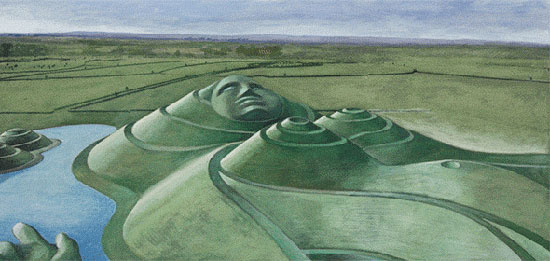
Northumberlandia

"Goddess with 100ft breasts to rival Angel of the North" was how The Times reported Charles Jencks' plans for Northumberlandia, a vast sculpture and park to be created from land owned by a mining company.  Jencks said, "when finished you will see the most incredible curvaceous woman lying there with her left leg over the right and her hair spread out.”  Melvyn Bragg said tactfully that "the idea of walking over a reclining woman may not appeal to everyone’s tastes."

As the Telegraph reported a few months ago, 'plans for the sculpture, which will be visible from the A1, were originally blocked by Northumberland County Council in 2006 after 2,500 people objected to the proposals.  But after a successful appeal to the Government by the Durham based The Banks Group, which runs the mine, the Goddess will now be able to go ahead.'  The article goes on to say that 'Northumberland County Council was unable to comment, but county councillor Wayne Daley told the BBC the Goddess was "ridiculous". "If we wanted something like this why didn't we just ask Jordan to open a theme park," he said.  "It really is ridiculous to think that something like a naked woman, who is only there as a result of all of the slag and the coal from the mine, is a good way of attracting people to Cramlington."

At the News Post Leader site I read:
'Q) In light of the north east's position near the top of UK league tables for teenage pregnancies and one-night stands, how can Banks justify sanctioning the land-sculpting of a naked pagan goddess, calling it Northumberlandia and claiming it as a "gateway to Northumberland"? (Morag Forsyth, Cramlington).
A) Speaking about the inspiration behind Northumberlandia, Charles Jencks said: "Northumberlandia does not relate to a particular goddess or religion, it is a landscape which incorporates references to the human body towards which we have a natural empathy. The landform can be enjoyed in parts and within many different contexts including the distant landscape, the causeways, lakes and willow islands, and viewing pavilions."'

You can see artist impressions of Northumberlandia at designboom. The conical terraced breasts of Jencks' proposal reminded me of the image of Germania below, one of Martin Warnke's examples of giant figures in his rich and fascinating book, Political Landscape.  In the presence of the all-powerful mother Germania, 'only adulation or death is admissable'.  Giants like Germania represent the state as an active figure, unleashing 'traumas associated with all-consuming power.'  But standing figures can be unstable, as we know from the Colossus of Rhodes, which collapsed after an earthquake.  Warnke quotes the scultpor Ludwig Schwanthaler, whose Bavaria (1837) is another giant personification of place, confidently asserting "no earthquake will cast this down... the Bavaria is the greatest statue ever cast."
 
One People - One Reich
Austrian propoganda poster, 1928

Warnke finds earlier examples of giants in art that took a more horizontal form - passive figures seen lying on their back.  For example, there is the body of a city depicted as a resting giant in the Bizarreries of G. B. Braccelli (1624).  Or Joos de Momper's Head-Landscape (before 1635) over which people are seen happily walking.  Or a profile of the coastline of Brazil, in the travel journal of J. B. Debret (1834), which is 'reminiscent of a dead Christ and so reinforces the impression of paralysed power'.  Northumberlandia resembles these images, and in a region once known for the power of its mining industry, this giant recumbert nude will be another example of a political landscape.

Friday, October 09, 2009

The landscape of the bland


Ni Zan, Landscape, 1372
National Museum of Taipei (Source: Wikimedia Commons)
 
'Trees on the riverbank, an expanse of water, some nebulous hills, a deserted shelter.  The artist, Ni Zan (fourteenth century), painted virtually the same landscape throughout his life.  He did this not, it seems, because of any particular attachment to these motifs but, on the contrary, to better express his inner detachment regarding all particular motifs and all possible motivations.  His is the monotonous, monochromatic landscape that encompasses all landscapes - where all landscapes blend together and assimilate each other.'

This interesting description of the Ni Zan painting shown here is by François Jullien and comes from his book In Praise of Blandness: Proceeding from Chinese Thought and Aesthetics.  'Bland' is translator Paula M. Varsaro's rendering of the French word 'fadeur', which in turn is Jullien's approximation to the Chinese term dan.  Varsaro notes that readers familiar with Chinese literature will recognise in the book the Song dynasty ideal of pingdan (the 'plain and bland'), but will 'see their understanding recast in  broader and more significant framework, as Jullien demonstrates the philosophical udnerpinnings of the label'.  It is impossible to summarise Julien's book briefly, but the following sentences from his fourth chapter may give you a flavour...
 
'While flavor establishes opposition and separation, the bland links the various aspects of the real, opening each to the other, putting all of them in comunication.  The bland renders perceptible their shared character and, through this, their primordial nature.  Blandness is  the color of the whole, as it appears to the eyes who look farthest into the distance; it makes us experience the world and existence itself beyond the narrow confines of the individual's point of view - in their true dimension.'

The first great poet of the bland was the subject of my previous post, Tao Yuanming (apologies for my perennial inconsistency in the Chinese translation conventions but I tend to go with whichever writer I'm currently quoting, so here it's the Pinyin system).  In the Tang dynasty, the 'canonical' bland poets were Wang Wei, Wei Yingwu and Liu Zongyuan.  Poetic blandness involves a balancing of the senses, with nothing overwhelming our attention.  Language resembles what happens when, 'in the Azure Fields beneath the warmth of the sun, a hidden piece of jade emanates a vapor: one can contemplate it, but one cannot fix it precisely with one's gaze.'

At the end of the book Jullien returns to Ni Zan, reproducing another of his 'bland' landscapes and, by way of complete contrast, the painting by Wang Meng shown below.  In the latter, 'topography reveals itself convulsively before our eyes like some mountainous mass in the process of solidifying.  Matter is at work everywhere: twists and folds push at each other; everything pierces through and retracts.  The space is saturated; the turmoil of the scene has reached an extreme.'  Despite the vast difference in their attitude to landscape, the two artists were friends and Ni Zan praised the vitality of Wang Meng's style.  During the upheavals at the end of the Mongolian occuption, Wang Meng remained involved in politics and died in prison. Ni Zan, artist of the 'bland', gave up his estates and freed himself from worldly concerns.


Wang Meng, Lin-wu Grotto at Chu-ch'u, 1378
National Museum of Taipei (Source: Wikimedia Commons)

Monday, October 05, 2009

The Peach Blossom Spring

Having described the poetry of Hsieh Ling-yün last time, I now feel the need to refer to his contemporary T'ao Yüan-ming (also known as T'ao Ch'ien or Tao Qian), who is traditionally seen as the founder of 'fields-and-gardens' poetry.  According to David Hinton, both poets 'embody the cosmology that essentially is the Chinese wilderness, and as rivers-and-mountains is the broader context within which fields-and-gardens operates, it seems more accurate to speak of both modes together as a single rivers-and-mountains tradition.' (see his introduction to Mountain Home: The Wilderness poetry of Ancient China).


Portrait of Tao Qian by Chen Hongshou

In The Columbia Book of Chinese Poetry (1984) Burton Watson devotes a whole chapter to T'ao (whereas Hsieh only gets three poems).  Watson writes that the poetry of T'ao is ambiguous - 'exclamations upon the beauties of nature and the freedom and peace of rustic life, set uneasily alongside confessions of loneliness, frustration, and fear, particularly of death.  He sought solace in his zither, his books, and above all in wine, about half of his poems mentioning his fondness for "the thing in the cup," though in one of the poems he wrote depicting his own funeral, he declares that he was never able to get enough of it.'

T'ao Yüan-ming is probably most famous for the 'Peach Blossom Spring', a story told first in a preface and then as a short poem.  It concerns a fisherman who lost his way in a valley stream and came upon a forest of blossoming peach trees.  At the end of the forest was a hill with a spring, and an opening through which the fisherman squeezed, coming out onto a broad plane with houses, rich fields, pretty ponds, mulberry and bamboo.  Everyone he saw seemed happy and when they noticed the fisherman in their midst they invited him for a meal.  The villagers explained that people had first come to this secluded place during the troubled times of the Ch'in dynasty and had been cut off from the world since then.  The fisherman stayed several days before taking his leave, whereupon the villagers asked him not to tell the people outside about them.  However after making his way home, the fisherman did tell the local governor about the Peach Blossom Spring, who sent men to find it only to have them return unsuccessful.  Nobody since then has been able to find it.

Among later poets inspired by this tale was Wang Wei, who wrote his 'Song of the Peach Tree Spring' at the age of 19.  He tells the same story as T'ao, but ends with the fisherman mistakenly thinking he will be able to find the place again (from G. W. Robinson's translation):
He was sure of his way there
                             could never go wrong

How should he know that peaks and valleys
                             can so soon change?

When the time came he simply remembered
                             having gone deep into the hills

But how many green streams
                             lead into cloud-high woods -

When spring comes, everywhere
                             there are peach blossom streams

No one can tell which may be
                             the spring of paradise.

Sunday, October 04, 2009

On a Tower Beside the Lake

Hsieh Ling-yün (Xie Lingyun) lived from 385 to 433 and initiated the shan-shui ("rivers-and-mountains") tradition in Chinese poetry. An intellectual in government service, he was exiled in 422 to Yung-chia on the southeast coast where he recovered his strength and grew to love the wild scenery. Here's part of 'On a Tower Beside the Lake', translated by David Hinton:

Too simple-minded to perfect Integrity
and too feeble to plow fields in seclusion,

I followed a salary here to the sea's edge
and lay watching forests bare and empty.

That sickbed kept me blind to the seasons,
but opening the house up, I'm suddenly

looking out, listening to surf on the beach
and gazing up into high mountain peaks.

From 423, Hsieh lived at Shih-ning 'in a comfortable mountain-side house, which included an enormous library and vast landscape gardens, and a smaller retreat atop Stone-Gate Mountain that could be reached only after a long hike from the main house'. There he tried to find peace:

My thoughts wander Star River distances.
A single shadow alone with forgetfulness,

I swim in a lake down beneath cliff-walls
or gaze up at gibbons haunting treetops,

listen as evening winds buffet mornings
and watch dawn sunlight flare at sunset.

Slant light igniting cliffs never lasts long,
and echoes vanish easily in forest depths:

letting go of sorrow returns us to wisdom,
seeing the inner pattern ends attachment.

Hsieh lived in the mountains until 431, meditating, walking, talking with friends.  He would head off for days at a time, wearing special hiking shoes of his own invention, a knapsack and peasant's hat.  He wrote his best poems there, describing both the landscape as seen and the emptiness of nonbeing from which it emerges, an approach that has influenced both poets and painters down the years.  But Hsieh remained an enemy of the emperor, who banished him again to Nan-hai. 'There, beyond the southern fringes of Chinese civilisation, his intransigence apparently continued until he was finally executed in 433'.


Some sample translations by David Hinton from The Mountain Poems of Hsieh Ling-yün can be found on his website.  And you can read more about Hsieh at The Hermitary, a useful web resource on hermits and solitude which includes articles on some of the Chinese nature poets along with Saigyo, Basho, Thoreau and several other writers of interest from a landscape perspective.

Friday, October 02, 2009

The ride to Stone Court


Margaret Drabble has published a new edition of her 1979 book, 'A Writer's Britain'.  Like other books I've discussed here - Edward Thomas's The Literary Pilgrim in England and the Phaidon Companion to Art and Artists in the British Isles - it offers a chance to view the whole country through the lens of culture and the lives of writers.  And as The Metro's three star review says, 'A Writer’s Britain will get you walking'!

In The Guardian Margaret Drabble lists her Top Ten Literary Landscapes. There is an unsurprising emphasis on Romantic poets (four mentions for Wordsworth) and sublime locations: Goredale Scar, Stonehenge. The one that was new to me (never having read Arnold Bennett) is Burslem, and it sounds like an interesting place to visit. 'The Potteries still have some of the picturesque pot banks Arnold Bennett made famous in his Five Towns novels. It's a weird post-industrial landscape now, with a haunting poetic dereliction. The draper's shop from The Old Wives Tale is still there on the street corner in Burslem, and was for sale last time I saw it (in June this year).'

There is an interview with Margaret Drabble on Woman's Hour in which she says that British authors write a lot about landscape in preference to sex (compare, for example, Wordsworth to Romantic poets on the continent...)  She also feels that Wordsworth is fundamental to the link between landscape and memories of childhood.  Gillian Clarke is on the programme too and says that before she writes any poetry she looks out at the surrounding landscape from a room with two walls made of glass (as I type this I can see the terraced houses opposite, and the next terrace beyond, and the chimneys of the one beyond that...)  She regrets that Drabble included no poetry by Dafydd ap Gwilym or more scenes of the Welsh valleys.  The clip starts with a reading from George Eliot's Middlemarch, a landscape with which I'll conclude this post:

'The ride to Stone Court, which Fred and Rosamond took the next morning, lay through a pretty bit of midland landscape, almost all meadows and pastures, with hedgerows still allowed to grow in bushy beauty and to spread out coral fruit for the birds. Little details gave each field a particular physiognomy, dear to the eyes that have looked on them from childhood: the pool in the corner where the grasses were dank and trees leaned whisperingly; the great oak shadowing a bare place in mid-pasture; the high bank where the ash-trees grew; the sudden slope of the old marl-pit making a red background for the burdock; the huddled roofs and ricks of the homestead without a traceable way of approach; the gray gate and fences against the depths of the bordering wood; and the stray hovel, its old, old thatch full of mossy hills and valleys with wondrous modulations of light and shadow such as we travel far to see in later life, and see larger, but not more beautiful. These are the things that make the gamut of joy in landscape to midland-bred souls -- the things they toddled among, or perhaps learned by heart standing between their father's knees while he drove leisurely.'

Monday, September 28, 2009

Paper City

I was at the Royal Academy today for the Anish Kapoor exhibition which has received quite a lot of media coverage.  The kind of mirrored sculptures that I talked about here before in reference to landscape are inside the gallery where they focus attention very much on the viewer.  The exception to this is Tall Tree and the Eye, sited outside, which provides multiple images of the RA courtyard.  Among the other works on display is Yellow (1991), one of Kapoor's monochrome optical illusions designed to evoke the Sublime: 'overwhelming in scale, this vast landscape of yellow hovers between apparition and surface.'

In addition to this exhibition, the RA currently has a nice little show called Paper City: Urban Utopias which 'showcases a selection of extraordinary drawings, collages and photomontages that have been produced for Blueprint as part of their back-page ‘Paper City’ commissions over the past three years.'  They're the kind of images familiar to readers of Pruned and BLDGBLOG.  Visitors can take copies home; the AJ describes the decision to give out printed images as a 'U-turn for the YouTube generation'... 

Shown below are some that I picked up: cityscapes by Marc Atkins, Emily Allchurch, Peter Cook with Gavin Rowbotham, Paul Williams, Duggan Morris, Javier Mariscol and James Wines.  I particularly liked James Wines' image of post-global warming structures rising from the submerged towers of an old city.  Wines is the creative director of SITE and his writing on environmental architecture argues for sustainable buildings that also harmonise with the surrounding landscape.


Thursday, September 24, 2009

The South Country

Another good source for free access soundscape recordings: the British Library Sound Archive.  They have various atmospheric recordings of the English countryside and some specific soundscapes from East Poland, Hungary, and locations further afield, like 'An Afternoon at Mayam Lake'.

But in addition to soundscapes the archive also has recordings taken from a series of old Linguaphone 78s called 'English Landscape Through Poets' Eyes'.  This was 'compiled by Stephen Usherwood, MA, Oxford, July 1958'.  Here are the poems and links:

And finally, 'Lines from 'The South Country' by Hilaire Belloc - from which the following three verses are taken:

The men that live in North England
I saw them for a day;
Their hearts are set upon the waste fells,
Their skies are fast and grey;
From their castle-walls a man may see
The mountains far away.

The men that live in West England
They see the Severn strong,
A-rolling on rough water brown
Light aspen leaves along.
They have the secret of the rocks
And the oldest kind of song.

But the men that live in the South Country
Are the kindest and most wise,
They get their laughter from the loud surf,
And the faith in their happy eyes
Comes surely from our sister the Spring
When over the sea she flies;
The violets suddenly bloom at her feet,
She blesses us with surprise.

Source: British Library

Sunday, September 20, 2009

Iron wind

My previous post described Peter Cusack's recordings of the sounds of nature at Chernobyl.  Jacob Kirkegaard's Four Rooms project, in contrast, sought to capture the atmosphere of the site's abandoned spaces: 'The sound of each room was evoked by sonic time layering: In each room, he recorded 10 minutes of it and then played the recording back into the room, while at the same time recording it again. This process was repeated up to ten times. As the layers got denser, each room slowly began to unfold a drone with various overtones.'

In J.G. Ballard's story 'The Sound Sweep', extraneous ultrasonic noise can be swept up, leaving only the most  beautiful vibrations of earlier sounds, like those emanating from the fragments of a thirteenth century church pediment.  Kirkegaard's amplification of the hidden sounds in resonant spaces like Chernobyl seems predicated on the idea that they hold a sonic memory of past events.  He has recently been working at Belchite, a village destroyed by Franco in the Spanish Civil War, making a book and CD in collaboration with Lydia Lunch. (I note in passing that Lydia Lunch is one of many post-punk musicians involved in one way or another with environmental sound art - Chris Watson and Jem Finer, for example, have been discussed here previously).

The Wire magazine had a feature on Kirkegaard earlier this year and their website includes 'images from Nagaras, a series of eight photographs shot on an expedition into the deserts of Oman in December 2008. The work explores a sonic phenomenon which only occurs in a few deserts around the world: The Singing Sands. The photographs aim to capture momentary visual fragments of the millions of sand grains which, in joint movement, emit such "marvelous" sounds. The seemingly chaotic patterns generated on the desert dunes during the sands' sonic emissions offer a visualization of sound in the making, through movement in matter.'

Here are some other examples on Kirkegaard's website that use recordings made out in the landscape:
  • Tide (2006) - '16-channel sound installation located at the tidal sea shore of the Danish west coast, Vadehavet. The sounds are processed water sounds recorded in the area'.
  • Iron Wind (2006) - 'recordings of iron fences stretching along the Cologne Rhine river in Germany. The movement of water, wind and passing ships make the iron fences vibrate and thereby to emit subtle tones. Attaching highly sensitive contact microphones (accelerometers) on the iron Jacob Kirkegaard recorded the hundreds of meters of fences throughout a period of four years. Unfolding the resonating body of the fences is the immense force of the Rhine river acoustically brought to life.'
  • Sphere (2007) - 'a collection of VLF (very low frequency) recordings of the Northern Lights (Aurora Borealis). It was captured during travels in Iceland in the year of 2004. Kirkegaard used electromagnetic antennas in order to pick up the electric and magnetic oscillations of the solar winds.'

Saturday, September 19, 2009

Autumn leaves

Gruenrekorder's Autumn Leaves is a really good survey of current work in environmental soundscape composition and it can all be dowloaded for free from their website.  It ranges from the pastoral to the decidedly anti-pastoral, as exemplified by two of Ari Koivumäki '100 Finnish soundscapes':
  • 'Throwing small pebbles on thin ice': "When I was ten I remember going to the lake with my friends. There we would throw small pebbles on the thin ice, just after the first frosty night." The recording was made at Tesoma lake in Tampere . Ducks are heard in the foreground, ice hockey is being played in the background
  • 'Parolannummi': "The soundscape of Parolannummi garrison is from the winter of 2006 and is mixed with archive sounds of Finnish Proto Sisu lorries, BTR 60 armoured cars that has been reassembled from old Russian Zil and Gaz vehicles, and T 55 and T 72 battle tanks."
Among other recordings of most interest in the context of this blog (i.e. which seem closest to 'landscapes', broadly defined) are Lasse-Marc Riek's 'Storm' and 'Waves' recorded in Boltenhagen, Germany in 2007; Charlie Fox's 'Four Wild Places' in Canada (open prairie, wetlands, rainforest and the transition zone between foothills and mountain); and Robert Curgenven's 'Silent Landscape No. 2' - 'nightfall by a riverside camp near Wollumbin (Mt Warning), walking in dry grass, the sharp call of a single insect emerges...'

How important is to know where such sounds have been recorded?  It depends, but some of the compositions are specifically about their sites, such as Peter Cusack's 'Chernobyl Dawn' and 'Chenobyl Frogs' - beautiful Arcadian soundscapes which belie their source. He writes: 'Since the nuclear catastrophe of April 26 1986, and in complete contrast to human life, nature at Chernobyl is thriving. The evacuation of people has created an undisturbed haven and wildlife has taken full advantage. Animals and birds absent for many decades – wolves, moose, black storks – have moved back and the Chernobyl exclusion zone is now one of Europe’s prime wildlife sites. Radiation seems to have had a negligible effect. The increase in wildlife numbers and variety means that the natural sounds of springtime are particularly impressive. For me the passionate species rich dawn chorus became Chernobyl’s definitive sound.  Chernobyl is also famous for its frogs and nightingales. Nighttime concerts were equally spectacular.'

Wednesday, September 16, 2009

Clearing

Gert Jonke's novel Homage to Czerny describes a garden party in which reality and representation, perception and memory become confused in various ways.  It opens with the hanging of 'a cycle of garden pictures done especially by the painter Florian Waldstein for this park and the summer garden parties held in it - precision work whose complexity could hardly be grasped by an outsider: the individual pictures portrayed exactly those parts of the garden that were covered by the surfaces of the respective pictures, and the portrayals were so lifelike that they were constantly being confused from every angle with the respective parts of nature itself.'  As the pictures are being hung, the characters hear a radio lecture talking about the possibility of a picture that 'exactly represents the world in which it hangs' and the possibility it opens for the viewer that they themselves are perhaps not in a world at all, 'but rather  picture of the world within a world or within a picture of the world, etc.'

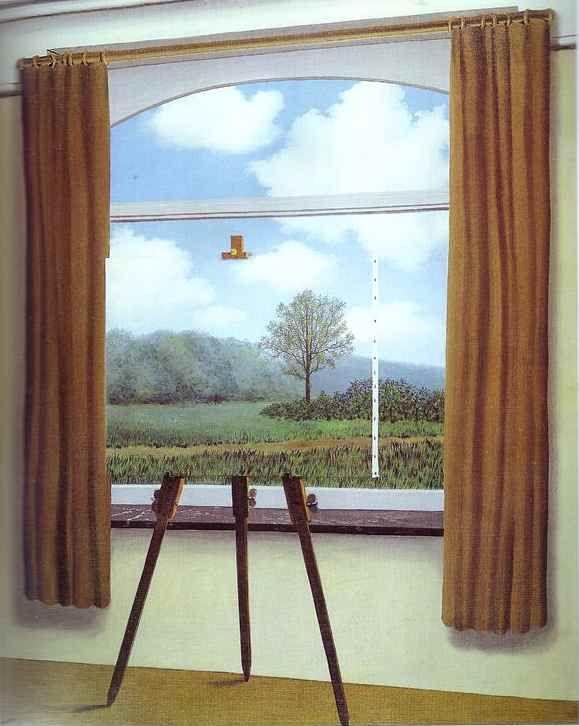
I thought about the fictional painter Florian Waldstein while reading an article about trompe l'œil in the new edition of Tate etc.  In his article, Michael Diers discusses Thomas Demand's Clearing (2003): 'a poster-like photo-installation of a colourful woodland scene. Although this picture-wall was strikingly large (192 x 495 cm), it was perfectly possible to overlook it, because it was presented without any frame.   From a distance one already had the impression that the image was of the trees in the immediate surroundings - in fact, of the very trees that it was obscuring. Games of this kind, toying with reality, are already familiar from the paintings of Magritte. One of the most famous, La Condition Humaine (1933), is a depiction of the view from a window, partly hidden by a painting on an easel. The painting, a landscape, fills in almost seamlessly the view of the real countryside outside the window - on the same scale, in the same colours and with the same perspective - so that picture and reality seem to have become one: an illusion that gives (visual) form to a long (art-) philosophical discussion.'

As the article explains, Clearing is more complex than the fictional paintings of Gert Jonke's novel.  Viewers of the work discovered that 'the thousands upon thousands of leaves in the picture had in fact been made from paper, carefully positioned as foliage and only then photographed. Viewers found themselves contemplating a three-dimensional, superbly-lit paper world, captures on film as a photographic image, printed on a scale of 1:1 and mounted on a board - a large-format image behind plexiglas of a sculpture made from coloured paper and card, presented as a hoarding of sorts; a lengthy, technically complex process of reproduction that had ultimately returned the image to exactly the same spot where it had started.'

Friday, September 11, 2009

Belegaer the Shoreless

It is hard not to believe there is something atavistic in the powerful emotions stirred by the sight of the sea, come upon suddenly after a long journey.  There is a description of this that I've always remembered in Tolkien, where he writes 'Of Tuor and his Coming to Gondolin':

'In this way Tuor passed into the borders of Nevrast, where once Turgon had dwelt; and at last unawares (for the cliff-tops at the margin of the land were higher than the slopes behind) he came suddenly to the black brink of Middle-earth, and saw the Great Sea, Belegaer the Shoreless. And at that hour the sun went down beyond the rim of the world, as a mighty fire; and Tuor stood alone upon the cliff with outspread arms, and a great yearning filled his heart. It is said that he was the first of Men to reach the Great Sea, and that none, save the Eldar, ever felt more deeply the longing that it brings.'

I'm conscious that it seems a bit odd to follow a posting on Deleuze and Guattari with one that quotes Tolkein, but that's the rhizomic nature of blogs...  Anyway, while I'm on the subject of Tolkien, here's part of a good (partial) defence of his work and its appeal to teenage readers (of which I was one) by Jenny Turner, which I read in the LRB a few years ago:

'Studying and researching - the everyday activities of the scholar - are deeply pleasurable. They're fun and they're more than fun. All sorts of visceral needs and desires are involved, with all the obvious psychosexual analogues: controlling the material; penetrating appearances; consuming the primary sources, and so on. Tolkien, I think, felt all these things acutely, whether or not he was aware of it. And so, in his fiction, he created a machine for the evocation of scholarly frisson. The thrills are the thrills of knowledge hidden, knowledge uncovered, knowledge that slips away.

'This or something like it is what Freud called the Unheimlich, 'the uncanny': 'the over-accentuation of psychical reality in comparison with material reality'. Isn't that what being a bookish adolescent is all about? Children, Tolkien wrote, don't know enough about the world to be able always to distinguish between reality and fantasy. Their boundaries are blurred. And Tolkien played those boundaries like a master. The kicks I used to get from Lord of the Rings were sensual, textural, almost sexual, a feeling of my mind being rubbed by the rough edges of the different layers. And the elegiac, valedictory aspect of the novel perhaps speaks with particular power to the swotty teenager, sorry to be leaving the figments of childhood, but itching to get to a university library. All those lists and footnotes. All those lovely books.'

Sunday, September 06, 2009

All landscapes are populated by a loved or dreamed-of face

"All faces envelop an unknown, unexplored landscape; all landscapes are populated by a loved or dreamed-of face, develop a face to come or already past. What face has not called upon the landscapes it amalgamated, sea and hill; what landscape has not evoked the face that would have completed it, providing an unexpected complement for its lines and traits?" - Gilles Deleuze and Félix Guattari, A Thousand Plateaus (1980, trans. Brian Massumi)

In responding to a comment on an earlier posting I said I would try to get round to the subject of faciality and landscape, which Deleuze and Guattari discuss in the section of A Thousand Plateaus entitled 'Year Zero: Faciality'.  They describe the face as a surface and a map, 'overcoding' the head so that it is no longer simply part of the body, indeed this process of 'facialisation' can extend to the whole body. The face is to the body what the 'landscape' is to the world.  'Architecture positions its ensembles - houses, towns, or cities, monuments or factories - to function like faces in the landscape they transform.' The close-up in film treats the face as a landscape.  Painting positions landscape as face and vice versa. 

Landscape, as we know, is an artificial construct, whether political or aesthetic.  Deleuze and Guattari associate the face and landscape with 'certain social formations' - 'the face is not universal.  It is not even that of the white man; it is White Man himself, with his broad white cheeks and the black hole of the eyes.  The face is Christ.'  They therefore see the face in abstract terms as a white screen with black holes (after landscape painting, 'when painting becomes abstract, all it does is rediscover the black hole and the white wall').  And in medieval and Renaissance art, Christ presides over 'the facialisation of the entire body (his own) and the landscapification of all mileus (his own)'.

I was reminded of faciality last week, reading about the weeping ice cap photographed by Michael Nolan.  Here are black holes on a white surface apparently showing the face of a mother ('mother nature in tears').  The concept of faciality is linked to the image of the mother - Deleuze and Guattari trace the importance of the black eyes and white screen to the face perceived by breast feeding infants.  But they also warn that faciality is not just about resemblances and anthropomorphism.  The process of facialisation could therefore be seen to lie behind many artists' images of the arctic landscape.

Friday, September 04, 2009

Sadness of the Gorges

Triple Gorge one thread of heaven over
ten thousand cascading thongs of water,

slivers of sun and moon sheering away
above, and wild swells walled-in below,

splintered spirits glisten, a few glints
frozen how many hundred years in dark

gorges midday light never finds, gorges
hungry froth fills with peril. Rotting

coffins locked into tree roots, isolate
bones twist and sway, dangling free,

and grieving frost roosts in branches,
keeping lament's dark, distant harmony

fresh. Exile, tattered heart all scattered
away, you'll simmer in seething flame

here, your life like fine-spun thread,
its road a trace of string traveled away.

Offer tears to mourn the water-ghosts,
and water-ghosts take them, glimmering.

These are some lines from David Hinton's translation of Meng Chiao's Laments of the Gorges.  It is a frightening vision of nature, a world away from the contemplative landscapes found in other Tang dynasty poems.  This poem (the third of Meng's ten laments) appears on David Hinton's website - I like his description of the poet there: "Late in life, Meng Chiao (751-814 C.E.) developed an experimental poetry of virtuosic beauty, a poetry that anticipated landmark developments in the modern Western tradition by a millennium. With the T'ang Dynasty crumbling, Meng's later work employed surrealist and symbolist techniques as it turned to a deep introspection. This is truly major work, work that may be the most radical in the Chinese tradition."


There is another translation of this poem by Matthew Flannery, under the title 'Sadness in the Gorges' ('...Hungry maw foamed with danger its naked curling roots encoffin jumbled bones that hang and swing while monkeys whine from icy trees faint unhappy elegies...')  However, I think my favourite translation remains the first one that I read, A. C. Graham's in Poems of the Late T'ang (1965).  Graham's punctuation is clearer than Hinton's, which I makes it seem less avant garde, but allows some memorable phrases to stand out - 'The shock of a gleam, and then another, / In depths of shadow frozen for centuries.'

The Indiana Companion to Traditional Chinese Poetry describes Meng's poem as an encounter with cosmic malice embodied in the landscape.  David Hinton writes that Laments of the Gorges articulates 'nonbeing as a murderous furnace at the heart of change.' A. C. Graham remarks upon the violence of the imagery, e.g. 'the spray on rocks compared with the spittle of the hungry ghosts of the drowned'.  Meng Chiao acknowledged the bleakness of his style, especially in comparison to that of his friend Han Yü.  He wrote: 'The bones of poetry jut in Meng Chao, / The waves of poetry surge in Han Yü.'  The great Song dynasty poet Su Shih described Meng Chao's verse as a 'cold cicada's call'.

The title of Meng's poem has an added poignancy today.  His imagery reflected the dangers of the upper Yangtze river, but the inexorable progress of the Three Gorges Dam has gradually been flooding these gorges.

Thursday, August 27, 2009

View on the Oise

The National Gallery's ‘Corot to Monet’ exhibition charts 'the development of open-air landscape painting up to the first Impressionist exhibition in 1874.'  It is an excuse to display the superb collection of oil sketches they hold from the Gere Collection (which I first saw there ten years ago in the exhibition 'A Brush With Nature').  They have also taken the opportunity to display some new research on Corot paintings; the NG website includes a lengthy Corot bibliography.  In addition to the familiar names in landscape painting they highlight less well known artists like Georges Michel and Paul Huet.  The rooms are full of wonderful paintings of course, but I have some sympathy with the view that a bit more could have been done to give the exhibition focus with a few loans from elsewhere.

 
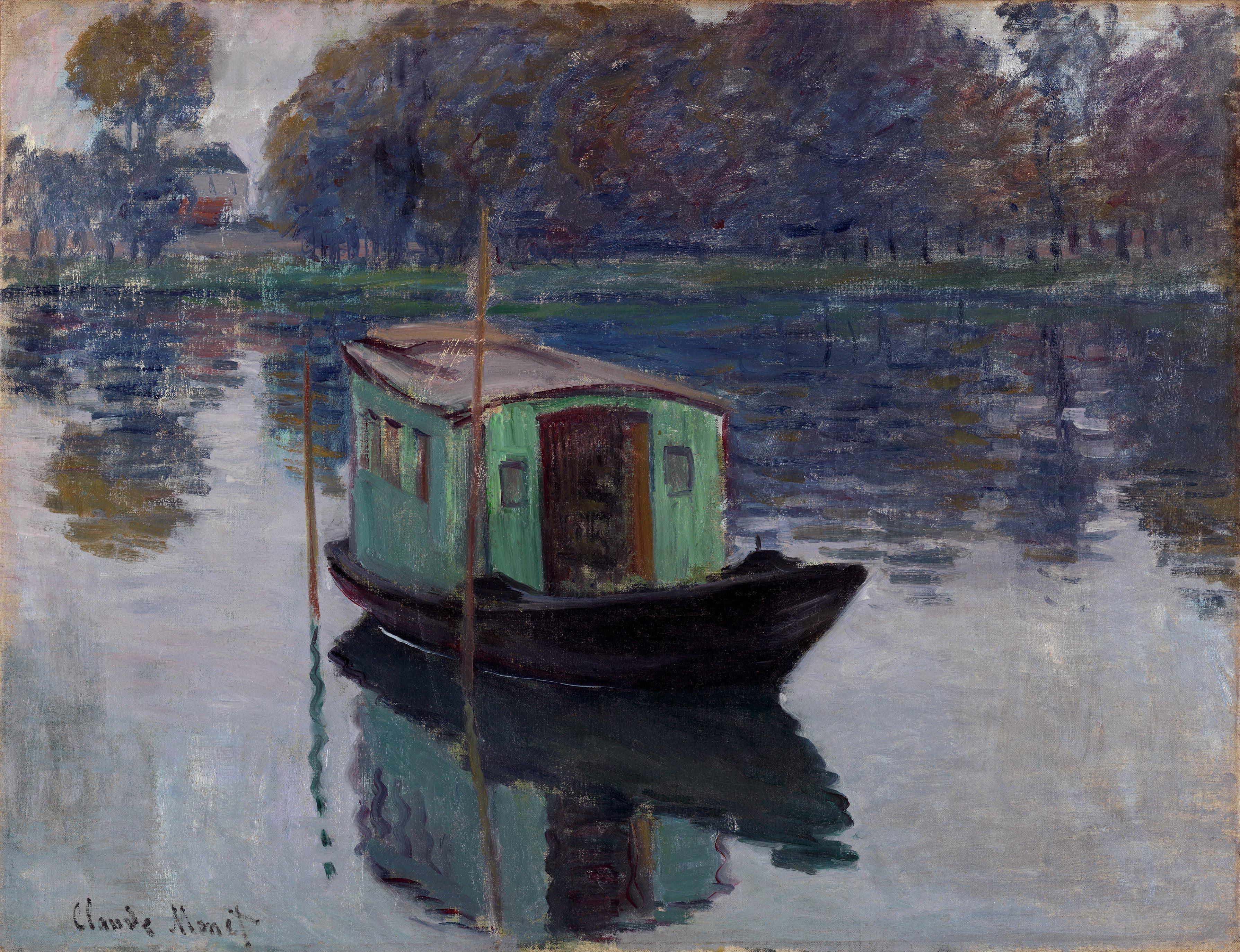
Claude Monet, The Studio-Boat, 1874

'Corot to Monet' includes two artists who worked from studio boats: Monet himself, who obtained one in 1872, and Daubigny, whose boat Le Botin had given Monet the idea.  Daubigny's View on the Oise (1873), showing the river with no foreshore, was probably painted from his floating studio (the successor to Le Botin - Daubigny had two boats).  A year later, in 1874, Manet famously painted Monet in his studio boat.  It would be nice to imagine other landscape painters in floating studios, but the idea seems very much of its time.  Artists before and since have sought inspiration on boats, but the notion of painting directly on the water was a rather poetic manifestation of nineteenth century naturalism.  Nowadays the boat itself would be very much part of the art work (indeed, we the public would probably be invited aboard).  Nevertheless, even in the 1870s the fact that a work like View on the Oise was painted on the Oise by M. Daubigny would have been something to distinguish it from the other plein air landscapes being produced at the time.

Saturday, August 22, 2009

Killeberg

Tate Modern's decision to devote a big exhibition to Per Kirkeby has been questioned but I was pleased to see a good spread of his yesterday - there are several reasons why he's an interesting artist for this blog:
  • Kirkeby's paintings may be abstract and neoexpressionist but they refer to natural forms and real landscapes 
  • Like other recent artists (Robert Smithson most obviously), he is fascinated by geology, but in Kirkeby's case this is based on his early training as a geologist
  • He continues to seek inspiration in nature, particular Greenland - the Tate show includes watercolour sketches made there
  • He engages with art history and has produced numerous books and short critical studies on painters like Munch and Gauguin - Tate Modern has a beautiful display of these
  • His brick sculptures have been placed in landscapes across Europe - there are no photographs of these in the exhibition, but see below for some examples 
Adrian Searle's review of the exhibition talks about the way landscape influences Kirkeby's painting: 'the colours are blackened army greens, earthy browns and ochres, greys from skies that don't move for days; there are snatches of white, dead blues, reds. The landscape is both there and not there. When the painter turns to the canvas, the weather outside disappears; but like history it insists on being felt anyway, like rain at the window or wind in the chimney. In the Danish painter's work there are rocks and sodden patches, waterfalls, huts, wood-grain, all sorts of geological fissures, strata and lumps.'

And here's Robert Storr discussing this element of Kirkeby's art: 'If northern light is to be taken as the hallmark of Scandinavian art, then Kirkeby is among the handful of Scandinavian artists who, although he himself rarely paints landscape as such, have captured that light in all hours of the day (such as those sudden changes in weather that can turn a radiant sky into a dense wall of clouds and back again). Presently, there seems to be little enthusiasm among people with advanced taste or ideas for such naturalism, even when translated into abstract terms as Kirkeby does. This, and the fact that he didn’t use painting to undertake a re-examination of history’s horrors as Anselm Kiefer, Jörg Immendorff, Richter and his German contemporaries did – being Danish spared him the daylight nightmares they suffered – leaves him odd man out of the group of painters that claimed the stage at the beginning the 1980s. Perhaps a “greening” of art will change things and put him back in the mix thematically. In any event, he holds his own simply as a painter, and ultimately it is the freshness of his work in that medium upon which his reputation will primarily – and securely – rest.'

Kirkeby's practice is obviously contemporary in many respects but it sometimes reminded me of the abstract, expressionistic landscape art painted in America and St Ives in the fifties: works inspired by nature and the spirit of place, sometimes titled with a location (e.g. Killeberg, 1983), but providing no means to visualise specific landscapes.  There are hints of forms in the swirls and patches of colour making up works like Twilight (Skumring) (1983-4) but they are ambiguous and, as with Howard Hodgkin, you feel that these are not paintings that the viewer should try to decipher.  Still, titles matter and I prefer Killeberg and Twilight to Kirkeby's paintings in a similar style with grand historical titles like The Flight Into Egypt.  

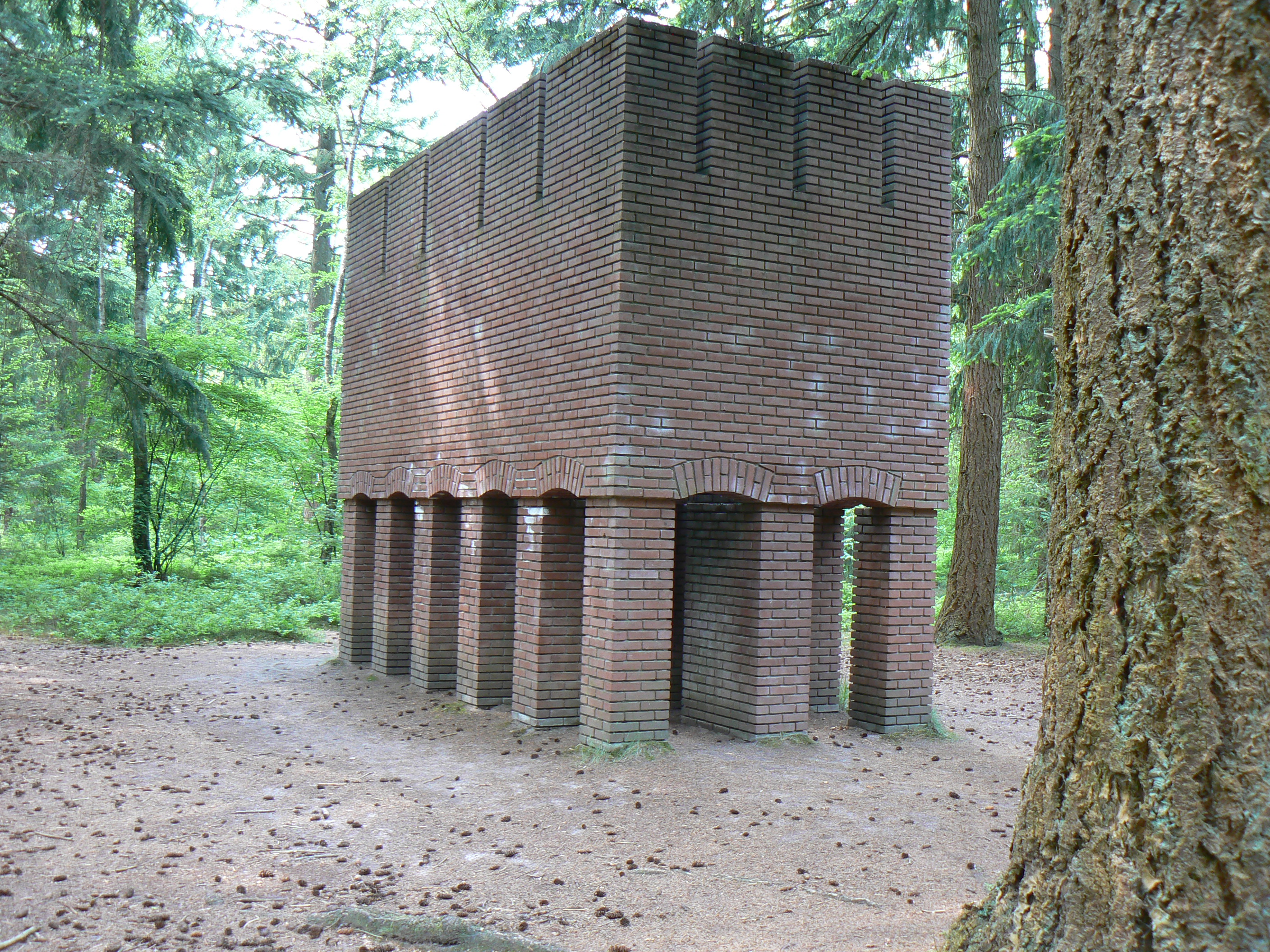
It seems quite possible that Kirkeby's brick sculptures will have a longer life than his paintings.  They seem well-suited to become ruins, although I think their uncanny quality derives now from the pristine perfection of their purposeless construction.  I've reproduced a few below but you can easily find others online.


Per Kirkeby, Backsteinskulptur, sculpture park KMM
Source: Wikimedia commons


Per Kirkeby, Backsteinskulptur, Gießen
Source: Wikimedia Commons


Per Kirkeby, Backsteinskulptur, Groningen

Wednesday, August 19, 2009

Garden and Cosmos

The British Museum are currently showing Garden and Cosmos: The Royal Paintings of Jodhpur, an exhibition previously at the Smithsonian.  The paintings have been loaned by the Mehrangarh Museum Trust and I should think images are copyright, but you can see some online here. The exhibition begins with a striking painting of Markandaya's ashram and the Ocean of Milk, its two halves prefiguring the predominant themes of later rooms - one shows activity in a lush landscape and the other a peaceful floating figure in a semi-abstract vision of the sea.  This makes it sound a bit like the Western equivalent of splicing together a Douanier Rousseau jungle and a Whistler seascape, which would look horrible... Laura Cumming has written a good description which will give you the idea:

'On the left, two distraught pilgrims have arrived at an ashram in a sylvan landscape of sage, peach, sherbet and every shade of green where the trees quiver with strange fruit and long-haired ascetics dream in leafy bowers - the dream of their leader, cross-legged in the middle consoling the pilgrims, being so vast it takes up the whole of the panel on the right.  And what a vision it is: the universe before consciousness and matter, the infinite nothingness before time. This is not portrayed as a void, or even the obliterating darkness William Blake imagined. The anonymous Indian master, also working in the late 18th century, has painted instead an expanse of deep indigo blue roiled by electric silver whorls: not quite water, not quite air, but some quasi-element between the two. The effect on the eye is stimulating yet faintly hypnotic - you might even call it cosmic.'

Unsurprisingly there are no independent landscapes or garden views in the exhibition - nature is a backdrop to scenes of court life and mythology.  But I think the curators rightly stress the importance of flowers, trees and running water in these scenes painted for the rulers of an arid land - Jodhpur is on the edge of the Thar desert.  Here is a description from the exhibition wall texts that I noted down, describing a series of paintings of sacred sites from 1827: 'Lush groves with starburst leaves, silver rivers and coloured peaks pervade these monumental paintings.  Jodhpur artists emphasised the otherworldly intensity of these sacred landscapes through colour, surface seen [do they mean sheen?] and the hypnotic repetition of motifs.'  Outside the British Museum there is small 'Indian landscape', which provided little respite today from the fierce city sun.  Relief from the heat came inside, where we were able to enjoy the paintings of Bakhat Singh (1725-1751) in his fort-palace at Nagaur (its lush gardens surrounded by flowering forest), bathing with beautiful women or savouring a moonlit evening.

Monday, August 17, 2009

Landscapes of melancholy emptiness


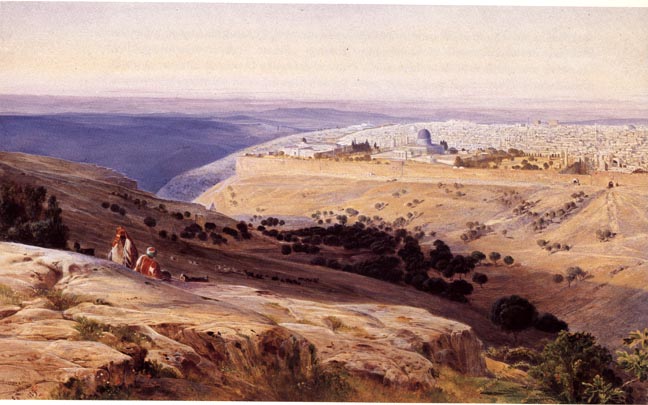
Edward Lear, Jerusalem from the Mount of Olives, Sunrise, 1859

I have mentioned Edward Lear briefly before - specifically the habit he developed of annotating his sketches.  In reading Robert Harbison recently I came upon an excellent description of Lear's landscape paintings with their 'droll notations'.  Lear's life was 

'spent mostly abroad simply because the English climate disagreed with him and he could find nothing to do at home.  So he became the sketcher and painter of exotic views, taking himself unhappily over big stretches of southern Europe and the middle East.  Much of his interest lies in his misplacement, a man who would be the truest homebody but for some flaw, who now converts preposterous places to clever mechanical tracery.  To someone familiar with his books of nonsense the landscapes are disappointingly uneccentric.  For an artist to confine himself to forms other than human is usually significant of something, and Lear provokes the suspicion that he is in these places because there are few Englishmen to meet or paint.  His earlier zoological and ornithological work is revealing because he invests every subject with personality, but the later, more refined landscapes leave out, as do all accounts of his life, the essential facts.  The most individual things about them are the droll notations in a springy script, which are painted out by the colors they describe; Lear erases the glimpse of himself he gives.  And the compositions are of such slender substance, the solidities of the picture often vacating to the back center, evading near-sighted eyes, echoing the flight from the self.  These landscapes of melancholy emptiness, faraway places seen from far away, are only a distinctive case of a Victorian genre - romantic topographical sketches of Near Eastern scenes.'

Harbison says here that 'for an artist to confine himself to forms other than human is usually significant of something.'  His suspicion that Lear was running away from people echoes a concern sometimes expressed that landscape art is an escape from the body - see the earlier post I did on this in connection with D. H. Lawrence. The paragraph on Lear forms part of his discussion of 'Dreaming Rooms: Sanctums', those spaces of safety in which the mind is free to travel.  Exotic topographical landscapes like Lear's 'exemplify a special nineteenth-century indecision between the literal and the imaginary, functioning like an invented imagery, but located on a particular page of the atlas.'

These observations form part of Harbison's Eccentric Spaces (1977), a consciously eccentric book that begins in the garden, moves inside to the sanctum (see above), then out into the world of machines and cities before spending a good deal of space discussing literature - topographical and architectural fictions - and concluding with the increasingly abstract spaces of maps, museums and catalogues. The book's preface describes the difficulty Harbison had in publishing this interdisciplinary, digressive book.  You can see why editors might have worried about sentences like this: 'A map seems the type of the conceptual object, yet the interesting thing is the grotesquely token foot it keeps in the world of the physical, having the unreality without the far-fetched appropriateness of the edibles in Communion, being a picture to the degree that that sacrament is a meal.'  But the book has several illuminating passages for those interested in landscape: much of the gardens chapter of course, descriptions of Ruskin in Venice, an argument for the important role of landscape in Mrs Radcliffe's Mysteries of Udolpho, and an appreciation of the detailed, almost cartographic paintings of Breugel in which significant and insignificant scenes are balanced and a spatial order replaces the moral.