Showing posts with label Peter Cusack. Show all posts

Saturday, September 19, 2015

The abandoned city of Prypiat

Not long ago, camping on the edge of a field, a passing child saw me reading Tim Dee's Four Fields (it's cover a flat grey landscape) and pronounced "that looks boring".  If he had stopped to listen I might have explained that the Fens are a lot more interesting than they appear and furthermore that the book's other 'fields' involve drowning wildebeest, Custer's Last Stand and the aftermath of a nuclear explosion.  At Chernobyl, Tim spends five days with scientists Tim Mousseau and Anders Pape Moller and is given the task of capturing grasshoppers in a bag ('the clicks of their legs against the plastic like the ticks of the radiation meter next to them').  He describes a forest so poisoned that for a time even microbial life was destroyed, a village where uncollected scrap metal, remnants of civilisation, slowly rots, an old military airfield which had been intended as a base for the Soviet space shuttle.  The journey ends in the abandoned city of Prypiat, where trees have engulfed everything and the roads are almost all impassable...
'The asphalt surface is split as if rotten, and welters around strapping trunks.  Every two- and three-storey building has been overgrown and is deep in tree shade.  Leaf ghosts camouflage grey concrete panels, where last year's emulsified foliage has printed itself on to the walls,  This year's leaves are adjacent and ready.  In other places the concrete is veined with green deltas of moss and water runs up as well as down.  The buildings seep...' 
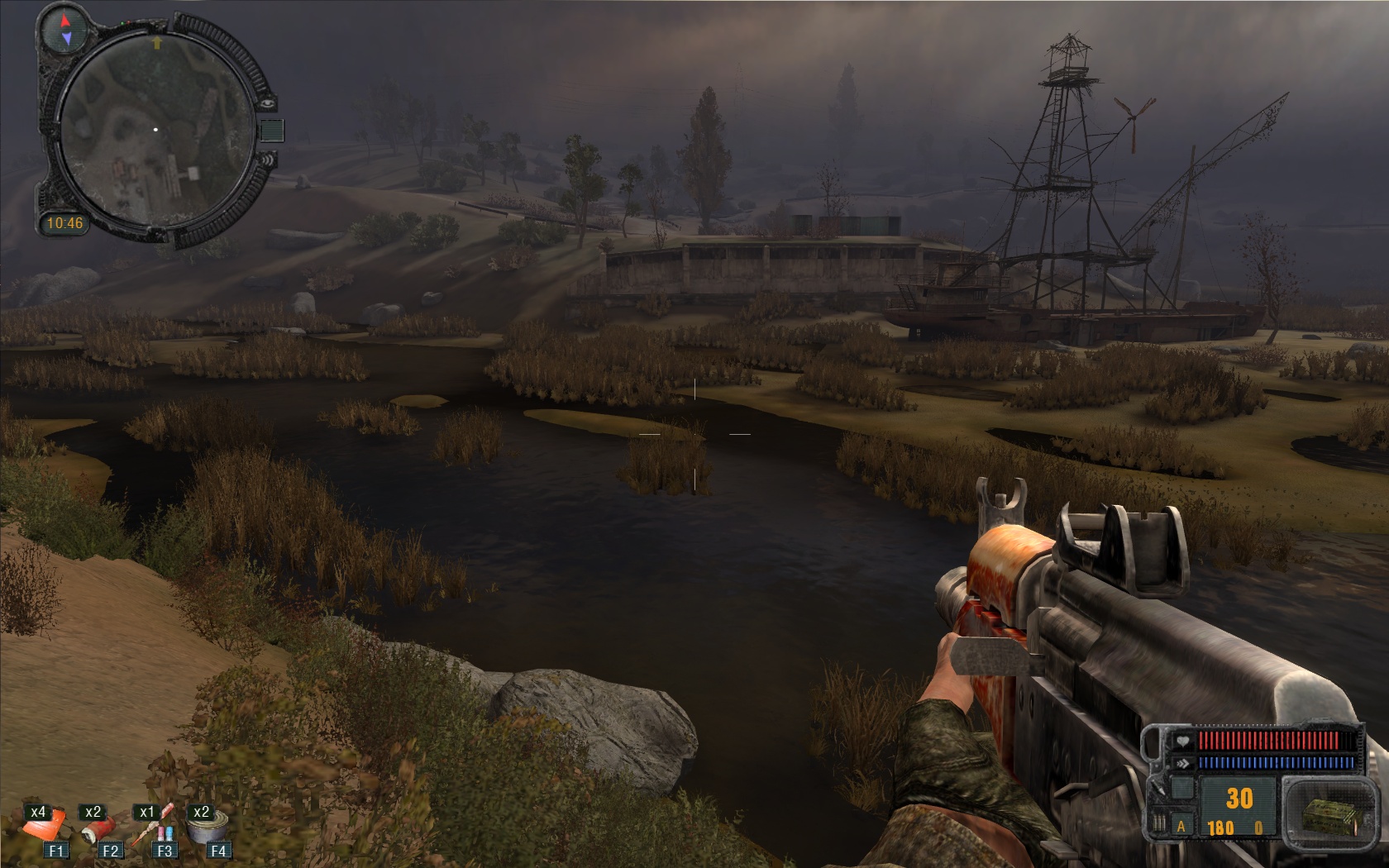
Prypiat was the U.S.S.R.'s ninth nuclear city, built in 1970 to service the workers at Chernobyl.  Its ruins are increasingly well-explored and photographed and are possibly too rich in symbolism to offer much scope for artists.  They have appeared in music videos and TV programmes (an episode of Top Gear), fictionalised in novels, movies and video games like S.T.A.L.K.E.R.  It is now possible to go on tourist trips to see the dead city but restrictions on access have allowed some non-professional artists to receive attention for their work.  The Daily Telegraph published a set of photographs by 'Michael Day, 29, an air traffic controller from London' who 'visited the disaster scene with a Ukrainian government escort to photograph the ghost town'.  The drone footage in Postcards from Pripyat (above) was put together in his spare time by a photographer working for CBS.  In a crowd-funded project, Prypyat mon Amour, Alina Rudya has returned to the city her parents left in 1986 to take ghostly photographs of herself in and around what remains of their old apartment block; a book is due out next year to coincide with the thirtieth anniversary. 

S.T.A.L.K.E.R.: Call of Pripyat

Tim Dee mentions trying to record birdsong in the Zone, but it was so quiet in September that he gave up trying.  All he could hear on playback were the buzzes and clicks of the machine.  When I read this I thought of sound artist Peter Cusack: on his Sounds from dangerous places site you can listen to recordings like 'Cuckoo and radiometer, Pripyat'.  As I wrote here back in 2009, Cusack found nature thriving at Chernobyl: 'radiation seems to have had a negligible effect. The increase in wildlife numbers and variety means that the natural sounds of springtime are particularly impressive. For me the passionate species rich dawn chorus became Chernobyl’s definitive sound'.  Tim Dee, working with the biologists, saw things very differently: 'one in ten of all birds of all species are afflicted in the Zone.'

Research continues.  Tim Mousseau was interviewed in the New York Times last year about new research on adaptation in some bird species.  He still 'dismisses the idea that the Zone is some kind of post-apocalyptic Eden.  But the latest study has given him pause, he said, because it shows the kind of adaptations that may allow some creatures — chaffinches and great tits in this case, though not barn swallows or robins — to thrive in the Zone. However, it remains to be seen whether these species are truly thriving...'  Mousseau is broadening and deepening his research around Chernobyl, but he now has to divide his time.  Since 2011 he has made more than ten trips to Fukishima.

(Note: The name of the city is spelt differently by different writers: In 'Four Fields' it is 'Prypiat'.)

Sunday, February 17, 2013

In the Field


I spent Friday and Saturday at In The Field, a symposium on the art and craft of field recording. During the two days we heard about a diversity of methods - from undersea hydrophone recordings made by Jana Winderen to impressions of the Hong Kong soundscape written for Salomé Voegelin's Soundwords project - and approaches ranging from the collective educational audio projects Claudia Wegener develops in Africa to the solo expeditions made by Simon Elliott to capture the intimate sounds of ospreys and peregrines.  Chris Watson came along briefly to talk about an installation he created at the London Children's Hospital in which patients remixed recordings he made on each of the seven continents.  He also mentioned In Britten's Footsteps, a collaboration with cellist Oliver Coates performed at Aldeburgh last week, which involved 'twenty speakers, split between the floor, head height and ceiling, developed to give an accurate spatial representation of the environment in which Watson had recorded the sounds' (The Liminal).  I think the weekend's highlight for me was a presentation by Christina Kubisch, whose Electrical Walks I wrote about here in 2010.  A recording she played of the beats made by different security gates sounded like the kind of music Chris Watson was making with Cabaret Voltaire all those years ago.

Reverberant flats on Peter Cusack's favouritesounds.org site

The most relevant talks from a landscape perspective were those that dealt with sound mapping, a subject I wrote about here last year, following a Wire Salon.  That event featured Ian Rawes, who modestly took on the job at this symposium of roving microphone holder, a role he could be seen as holding for the city itself in his work compiling the London Sound Survey.
  • Peter Cusack started his talk with a quote from The Peregrine: 'the hardest thing to see is what is really there', and suggested that the same is true for sound.  He therefore focused on just one recording: children playing in a reverberant space created by a semi-circle of flats, which would surely leave its residents with "a particularly strong sonic memory".  The block of flats' shape reminded me of the garden designed to produce echoes that John Evelyn observed in Paris and I wondered if Cusack had sought it out deliberately for its acoustic properties.  But  he had been there as part of a project to document sounds under the flight path to Tegel Airport: every four minutes the children's voices have to compete with the noise of aircraft overhead.  This too will be form part of their memory of living in these flats, a sound that will disappear when the airport is eventually closed.
  • Udo Noll, who has recorded sounds with Peter Cusack in Germany, talked about radio aporee, his global soundmap project. Various contributors had mentioned the importance of striving for the highest possible fidelity in their recordings but radio aporee is participative and welcomes all recordings of a reasonable standard.  Noll has now developed a radio aporee app, although he remains somewhat sceptical: "I don't like phones much and apps even less".  Is this augmented reality experience really progress?  Well, if artists don't work in this space, he argued, other commercial interests will.  Given that the non-mediated world is increasingly "a lost country", it seems better to have the option of coming upon a GPS-generated poem than some piece of corporate marketing.  This is also a way of inscribing a landscape without altering it - better, perhaps, to have the option of tuning in to a Simon Armitage stanza as you walk over the West Yorkshire moors, than coming across it carved into a rock.
  • Francesca Panetta described the creation of a similar sound app, Hackney Hear.  This sadly doesn't stretch as far as Stoke Newington, otherwise I could hear it as I type this, but it can't be long before we get one - she has also created Soho Stories, Kings Cross Streetstories and, most recently, an app to accompany Rachel Lichetenstein's Diamond Street.  Users of Hackney Hear have actually preferred its field recordings to the interviews and commissioned texts (Iain Sinclair, inevitably).  The talk concluded with an introduction to The Guardian's new interactive panorama from the top of the Shard, which incorporates clips from The London Sound Survey.  As she zoomed out, the sound of swirling wind and distant sirens gave way to more immersive soundtrack.  She clicked on various sound samples across the city to show us how it worked, but time was running short.  The final sound we heard was 'Land of Hope and Glory' emanating from the Albert Hall and for a moment it seemed as if the whole symposium was about to end with an echo of the Last Night of the Proms.  
 
 The Guardian's interactive view from the top of the Shard

Finally I should mention that In the Field is also the title of a new book of interviews with field recordists, edited by Cathy Lane and Angus Carlyle, who co-organised the weekend's event with Cheryl Tipp.  I may have more to say about this in a future post. 

Friday, December 14, 2012

Landscapes surge into consciousness

(1) from Thomas Köner's Novaya Zemlya

This is my third annual survey of landscape music, following an initial list covering 2010 and another for 2011.  Last year I noticed that I was talking as much about record labels as artists: Ghost Box, Hundred Acre, Another Timbre, Gruenrekorder and, of course, Touch Music who this year celebrated their thirtieth birthday.  Touch have produced a compilation of new material with the slightly underwhelming title Thirty Years and Counting that includes people I've featured on this blog previously: Fennesz, Jana Winderen, Chris Watson...  Robert Macfarlane, author of The Old Ways, actually got the chance to collaborate with Chris Watson this year on a record called The Sea Road, based around sections of his book.  The Touch album I've been listening to a lot this year is Thomas Köner's Novaya Zemlya, although as The Liminal's review points out, it doesn't work very well as background music.  'Landscapes surge into consciousness on the back of deep, reverberating drones and cavernous low-end pulsations: ice and glaciers drift on the Bering strait, machines can be heard releasing their toxic radium under the islands’ rocks, and sheets of constrained white noise evoke the howling winds that whip and slam against this far-off no-man’s land.'


(2) From Jez riley French's instamatic: snowdonia

Earlier this week I asked Cheryl Tipp, curator of A World of Sound and reviewer for The Field Reporter, to recommend the best field recordings of 2012.  The Sea Road was one of her nominations, along with two releases on Gruenrekorder, Jhirni Jali by Peter Caeldries and Estonian Strings by Jez riley French.  You can hear sound samples by clicking on those links - 'Savera' for example, from Jhirni Jali was recorded at daybreak in a tiger reserve in the north of India ('savera' is the Hindi word for morning). The Jez riley French samples are completely different - contact microphone recordings of "transmitter cables, long chimney support cables, disused piano wires stretched across old farm utensils, rust covered fences – each one a surprise, a discovery and a joy to listen to."  In Estonia he found that "the molasses hued mirrored lakes offered up some fascinating hydrophone recordings ... whilst the sound of trees cracking together and grain barns rattling themselves from sleep in the occasionally strong winds provided some richly charged moments of deep listening."  In the absence of an embeddable clip I've included instead sounds from another Jez riley French release this year, instamatic: snowdonia.  It is the latest in a series of 'instamatic' recordings, completely unprocessed aural photographs that record particular soundmarks he encounters on his travels.

(3) From Olan Mill's Home

Journeys have inspired other forms of music this year, such as Road to Palios by Ryan Francesconi (who did the arrangements for Joanna Newsom's Have One on Me) and Australian violinist Mirabai Peart.  According to The Line of Best Fit, their album has its moments, but 'gentle seascapes and pleasant rural imagery just do not do justice to the musicianship of these two artists.' Alex Smalley is another artist composing what might be seen as the aural equivalent of travel writing.  His music has been likened to Richard Skelton's and his earlier releases as Olan Mill had the Skeltonesque titles Paths and PineThe new collection emerged from his travels in South America, from ‘Isla Del Sol’, the birthplace of the Incan sun god on Lake Titicaca, conveyed in soaring vocals and strings, to the darker sounds of ‘Camino De Las Yungas’, the world's most dangerous road.  He has called the album Home because that is where it was recorded - distant scenes and memories recollected in tranquility.

(4) From The Magnetic North's Orkney Symphony

Other British musicians stayed closer to home this year to investigate their local landscapes: Sheffield's David Newman, for example, with Beneath Peaks.  According to the Hibernate label website, its sounds 'were harvested from hikes and camping trips around the region’s hills, meadows, streams and bracken edged pathways. In the opening track ‘Asleep Beneath Nests’ you can even hear David snoring at Fieldhead campsite as he lay asleep in a tent!'  The Magnetic North's Erland Cooper was also sleeping one day when he was visited in a dream and told to make a record about his home islands. The resulting songs on Orkney Symphony reflect the islands' geography and culture (including the poetry of Edwin Muir).  In reviewing it, Amy Liptrot observes that 'just as the accents of the island peoples reflect their surroundings - rolling cadences like soft hills - the landscape affects the sound and attitude of the music. Three times a day, Northlink ferry MV Hamnavoe arrives from Scrabster and, in opening track Stromness, a trombone emulates the sound of the ship's horn coming into harbour, a defining characteristic of the town. The first of three songs named after Orkney beaches, 'Bay of Skaill', has a spare arrangement like a deserted beach, with a solitary figure walking across in a melody. A single note sustains - as if carried in the wind, and the driving rhythm is the ocean relentlessly arriving on the shore.'

(5) From Barbara Monk Feldman's The Northern Shore

Barbara Monk Feldman's The Northern Shore is a half hour composition for violin, piano and percussion.  "At the Gaspé peninsula in Quebec where the St. Lawrence river widens into the sea, the opposite shore appears across the water as a mirage that is either enhanced or diminished by the intensity of the light on the water during the day. I kept the memory of this light in my mind during the composing of The Northern Shore … some aspect of the light and horizon might be intimated in the way differing registrations of the violin are sustained in relation to the percussion and piano."  It is pared with another landscape-related piece, In the Small Time of a Desert Flower.  The composer Lou Harrison apparently said to her on hearing this “The rhythm of the piece seems to come from the geography of a landscape — something I have never heard before!”  According to the Guardian, the record is 'all quite beautiful in a passive way' but Julian Cowley in The Wire described the compositions as 'luminously beautiful', engaging 'with the sculpting, generative action of time, reflecting in that process landscape stretched across the horizon or etched into a parched expanse.'


(6) From Barbara De Dominicis and Julia Kent's Parallel 41

Modern ruins continue to attract musicians and sound artists, not to mention writers: earlier this year I mentioned Robert Macfarlane's collaboration with bass player Arnie Somogyi, Untrue Island, written and performed among the decaying Cold War listening stations, watch towers and blast-chambers of Orford Ness.  I've also talked before here about Peter Cusack's Chernobyl recordings and these feature in a double CD released this year called Sounds from Dangerous Places.  The importance of finding the right resonant spaces in which to record comes over in an interview with Barbara De Dominicis, where she discusses her recent Parallel 41 project with cellist Julia Kent. "In the Trentino Alto Adige, Vanja Zappetti a stoic historian of the region took us to an old abandoned fort. Once we got there we found out they had recently started restoring it so we ended up recording in an abandoned tunnel on the outskirts of Bolzano where they held illegal raves. It was a beautiful location next to the mountains with a creek running nearby and we made ample use of the natural sounds, recording and processing them live."  Reading this reminded me of Tempo di Viaggio, the film that documented Tarkovsky's search for the locations he would use in Nostalghia.  The clip above is an extract from a film Davide Lonardi made to accompany the Parallel 41 album.

(7) From Darren Hayman's Lido

I featured James Brooks' Land Observations project here earlier this year (there are also a few words from me on his site, drawing parallels between his Roman Roads compositions and the walks of Richard Long).  Darren Hayman's Lido was a similar combination of art and instrumental music that came out around the same time, and perhaps there are thematic links too: outdoor urban swimming pools as Modernist descendants of the communal thermae and balneae of Roman cities.  The Kings Meadow lido in Reading has become as much of a ruin as the Baths of Caracalla, or the Appian Way.  Both these albums also happen to start their journey in Hackney, near where I'm writing these lines: Land Observations with 'Before the Kingsland Road' and Darren Hayman with 'London Fields'.  The earliest memories Hayman has of visiting a lido are in Brentwood (track 8): "such a hazy, distant, blurred image. It closed in 1976 so the oldest I could have been was five or something. I went back to the site to make sound recordings and there was a faint echo of the place in the stretch of grass that covered. I recorded, literally, the absence of it and buried it in the recording." Another of his projects this year, The Violence, was about the 1645 Essex witch trials, and it completed an Essex trilogy that began with Pram Town, on the creation of new towns like Harlow, and continued with Essex Arms

(8) From The Eccentronic Research Council's 1612 Underture

Hauntologists and psychogeographers will have be aware that 2012 was the four hundredth anniversary of another famous set of witch trials at Pendle in Lancashire (a place I mentioned here before in connection with a poem by Geraldine Monk).  This was the subject of an enjoyable collaboration between The Eccentronic Research Council and actress Maxine Peake, 1612 Underture.  There was a great short film to accompany this viewable on Youtube but it now seems to have been taken down, so I've made do with an audio clip above.  Another anniversary recording, Pendle 1612, was released recently by Lancashire's Folklore Tapes, co-curated by David Chatton-Barker and Rob St John.  In an interesting interview with The Liminal St John cites the influence of Patrick Keiller, particularly in 'the way he assembles such a constellation of – at times seemingly ephemeral – information, and traces a line made by walking through it all. To me, his work is encouragement to delve into the history of places and landscapes important to you, that through putting all this information that others have perhaps disregarded together, the most important thing is that you become connected to these places and landscapes in your own individual way.'

(9) From Simon Scott's The Sounds Below Sea Level

Pendle 1612 came 'in a screen printed heritage library buckram box which houses information and ephemera related to the trials: a map, photographs, an essay by the curators, and a dried nettle in glassvine envelope as well as a download code.' It is reminiscent of the approach taken by Richard Skelton and Autumn Richardson, whose writings I discussed a couple of weeks ago (I neglected to mention then that the texts collected in The Flowering Rock accompany a new sequence of music, Verse of Birds).  Clearly there is a demand for music as collectible objet de vertu - Olan Mill's Pine was available in a deluxe heavy vinyl edition 'wrapped in luxury soft tissue' and 'scented'.  But nettles and photographs are surely included with the hope of connecting the listener more directly to the landscape as it was experienced by the composer.  In an interview to discuss The Sounds Below Sea Level, an album based on field-recordings made at Holme Fen (the lowest place in Britain), Simon Scott explains that he was actually asked by his label boss to make a limited edition book to accompany the music.  After seeing Scott's photographs, "he also asked, do you have any notes, odd scraps of paper that you were putting together when you were writing your essay? I had! Most of it was at the bottom of my rucksack scrunched up. The book costs a lot of money to print, but if you’re interested in that side of things, then it’s a nice piece of art.”


(10) From Azurazia's Lowering the Mediterranean

My final selection here is a Julian Cope recommendation.  Back in July (or July 2012CE, as the Arch-Drude has it) the Head Heritage site's Vinyl of the Month was Azurazia's Lowering the Mediterranean. Over 'four sides of environmental feedback, field recordings, social commentary and cultural tamperings' this album tells 'the tale of the failed attempt to bring water to the Sahara Desert via several ill-fated white elephant dam ideas. Like many such Third World projects, this dystopian nightmare has left vast machinery and partially-completed civil engineering projects strewn around the north African landscape, each emitting enough residual sound FX to permeate all four sides of vinyl with alternately mind-numbing, then mind-irrigating sounds. Messrs Chromium and Moulin have corralled these chaotic sound titans splendidly; bringing forth a Soviet-sized music concrète that will most assuredly strike a compelling chord with anyone who accidentally interfaces with the stuff.' Side D is explicitly Ballardian: 'Hunting shipwrecks along sublimed lakes - Invocation of my terminal beach brother.'  Lowering the Mediterranean is the fourth release from Grautag records who specialise in 'music for wasted tomorrows.'
Friday, October 08, 2010

The Mosques of Tanger

Last night I sat in a room full of people listening intently to the sound of an egg being fried.  We were at Cafe Oto for The Wire Salon, Environmental Agents: The Art of Field Recording, and  Lee Patterson was playing some of the sounds he has recorded in and around his home in Prestwich.  Using cheap contact mics and home made hydrophones, he explores the unheard sounds around us, staging experiments that transmit a kind of magical realism - the sonic equivalent of writers like Bruno Schulz whose characters perceive the strangeness of ordinary rooms, streets and gardens.  The evening ended with Patterson's unnerving recordings of pondweed, apparently shrieking in pain, although the noises result from the release of thousands of tiny oxygen bubbles.

The panel discussion started with Peter Cusack playing us two field recordings from specific locations.  One turned out to be the buzzing of a hoverfly, captured inadvertently in Prague whilst trying to record the sound of a rail as a train passed over it.  The other documented an encounter with the London transport police, who were suspicious of the recording equipment he was using at London Bridge station. (I've just checked and this recording doesn't appear on Cusack's Sound Data Base - click on London Bridge and you just hear trains and announcements).   Asked about the politics of sound recording and acoustic ecology, he described his work, with a sonic metaphor, as political 'in a muted way'.  He also modestly put the activities of sound artists in perspective, reminding us of the huge range of environmental recordings constantly being made but not presented to the public as aesthetic objects - by scientists, the military, archeologists, geographers, anthropologists, planners and so on. 


The third speaker was Justin Bennett, sound artist and member of BMB con., who played an extract from Sundial, the closest thing we heard to a sonic landscape.  The aim of the piece was to analyze the daily rhythm of a particular city over 24 hours from one single location. Listening to 'Istanbul' and imagining the sights took me back to the opposite experience watching Berlin: Symphony of a Great City (1927) and imagining the missing soundscape.  Bennett also makes urban sound walks and praised the work of Dutch artist Cilia Erens who gets people to walk around a landscape while listening to noises from a contrasting location.  At Justin Bennett's website you can download a different work made in Istanbul, The Well: 'voices, machines, footsteps, tunnels, but also bronze cymbals and electric guitars ... a personal journey through layers of narrative, memory, sounds and music - an attempt to uncover the secret well that lies deep under the city.' And as I write this I'm listening to another of his soundscapes, The Mosques of Tanger, of which Wire writer Clive Bell says: 'it begins and ends with Mediterranean dawn ambience, cicadas and cockerels. We hear the first call, maybe a mile away; gradually other calls are layer in, but the best moments are to do with the eerie beauty of sound heard at a great distance.'

Saturday, September 19, 2009

Autumn leaves

Gruenrekorder's Autumn Leaves is a really good survey of current work in environmental soundscape composition and it can all be dowloaded for free from their website.  It ranges from the pastoral to the decidedly anti-pastoral, as exemplified by two of Ari Koivumäki '100 Finnish soundscapes':
  • 'Throwing small pebbles on thin ice': "When I was ten I remember going to the lake with my friends. There we would throw small pebbles on the thin ice, just after the first frosty night." The recording was made at Tesoma lake in Tampere . Ducks are heard in the foreground, ice hockey is being played in the background
  • 'Parolannummi': "The soundscape of Parolannummi garrison is from the winter of 2006 and is mixed with archive sounds of Finnish Proto Sisu lorries, BTR 60 armoured cars that has been reassembled from old Russian Zil and Gaz vehicles, and T 55 and T 72 battle tanks."
Among other recordings of most interest in the context of this blog (i.e. which seem closest to 'landscapes', broadly defined) are Lasse-Marc Riek's 'Storm' and 'Waves' recorded in Boltenhagen, Germany in 2007; Charlie Fox's 'Four Wild Places' in Canada (open prairie, wetlands, rainforest and the transition zone between foothills and mountain); and Robert Curgenven's 'Silent Landscape No. 2' - 'nightfall by a riverside camp near Wollumbin (Mt Warning), walking in dry grass, the sharp call of a single insect emerges...'

How important is to know where such sounds have been recorded?  It depends, but some of the compositions are specifically about their sites, such as Peter Cusack's 'Chernobyl Dawn' and 'Chenobyl Frogs' - beautiful Arcadian soundscapes which belie their source. He writes: 'Since the nuclear catastrophe of April 26 1986, and in complete contrast to human life, nature at Chernobyl is thriving. The evacuation of people has created an undisturbed haven and wildlife has taken full advantage. Animals and birds absent for many decades – wolves, moose, black storks – have moved back and the Chernobyl exclusion zone is now one of Europe’s prime wildlife sites. Radiation seems to have had a negligible effect. The increase in wildlife numbers and variety means that the natural sounds of springtime are particularly impressive. For me the passionate species rich dawn chorus became Chernobyl’s definitive sound.  Chernobyl is also famous for its frogs and nightingales. Nighttime concerts were equally spectacular.'

Friday, December 21, 2007

Soundwalk, Queen Elizabeth Park, Vancouver

Writing the last entry made me dig out the excellent survey of acoustic ecology in The Wire 226, which describes the original World Soundscape Project at Simon Fraser University (SFU). Their work varied from activities that might be considered broadly as a kind of landscape art, recording soundcapes across Canada and in five European villages, to more practical work on noise abatement, reviewing legislation and mounting an international car-horn count. Phil England interviewed Hildegard Westercamp for the article, an original member of the SFU team, assistant to R. Murray Schafer, and the person responsible for re-launching the soundscape movement in 1991 with the first Soundscape Newsletter. Asked why she thought the movement arose in Vancouver, Westercamp pointed to the experimental cultural environment in Canada in the early seventies, but also to the influence of the Canadian wilderness. "There's a huge silence out there. And when you experience that silence against what urban environments are like, there's a major difference. I was walking through London today and I thought, my god, how far away the Earth is at King's Cross."

As someone who waits for a bus at Kings Cross several times a week, I can only agree... But then, as noted in the last entry here, the sounds of the city have their own beauty and emotional charge. Peter Cusack is quoted in the same Wire article describing his CD Your Favourite London Sounds, which includes a list encompassing traffic, trains, aeroplanes, buskers, people chatting, even the sound of breaking glass. Cusack goes on to suggest that the use of sounds recorded in a landscape for music or sound art is diverging from the more direct approach where soundscapes are recorded to investigate or dramatise social or ecological issues. Here, I am more interested in the former approach, typified by someone like Chris Watson.

There is a whole dissertation by Andra McCartney on Hildegard Westercamp available online here. The site also includes a soundwalk McCartney took with Westercamp in Queen Elizabeth Park, 'Vancouver's Oasis'. You can listen, for example, to a recording of a creek, described by McCartney as follows: "We spent more time at the creek than anywhere else. Westercamp is fascinated by the endless variety of water voices, and her approach to close-up recording articulates them well. She shifted from one stepping-stone to another, moving the stereo microphone to highlight how the water found its way through crevices, over boulders, around branches in its path, illustrating the architecture of the creek bed, and the dance of the water through its sculptural forms..."

Sunday, December 16, 2007

Baorittaolegainuoer - Natural Booming

I've been listening to the environmental recordings compiled on a CD for Uovo 14 by David Toop. In his notes, Toop says that the origins of this kind of modern sound art lie in 'a complex network of specialist and esoteric activities: scientific research into animal communication and bioacoustics; oral history and radio drama; birdwatching, trainspotting and similar ocular pursuits; documental filmmaking; exotic sonic backgrounds; post-Cageian environments; and the soundscape studies pioneered in Vancouver in the early 1970s by R. Murray Schafer and the World Soundscape project. Because of these origins, many of them located in looking as much as listening, and an uneasy relationship to landscape as visual spectacle, in the past, field recording as an art practice has tended towards the picturesque, benign and static.'

I've observed in various entries here how visual art and poetry have shifted over time from traditional views of 'landscape' to more complex ideas about 'place'. In the same way, Toop suggests that field recording suffered from an 'unspoken anti-urbanism which would exclude people, motor vehicles, industry, and all other interventions that could be considered the audio equivalent of telegraph poles in a beautiful landscape. Sounds have been recorded for specific human purposes, such as the melodic beauty of a particular birdsong that somehow reflects the structure of human music. This has been changing for some time, however, with more concentration given to sound environments that Murray Schafer might once have described as an 'earsore', and more focus on the sonic ecology in which we actually live.' Typical of this modern approach would be Lee Patterson's 'Ox Bow Pool & Airliners', or unpromising sounding soundscapes like Jeph Jerman's 'Clarkdale Slag Heap', recorded in Arizona, or Peter Cusack's 'Oil Field Soundwalk', recorded in Azerbaijan.

Clive Bell's review of the Uovo compilation in The Wire notes that the hypnotic song of Chris Watson's tree frogs triggers 'thoughts about human tribal music, just as the deep-throated humming of Rob Mullender and Isobel Clouter's Mongolian sound mountain inevitably recalls the local overtone singing.' Far fetched I suppose, but there's an appeal to the idea that natural sounds have embedded themselves in local musical forms.

Incidentally, the Mullender / Clouter piece,'Baorittaolegainuoer - Natural Booming', is an example of the way artists have been recording singing sands, as discussed here before. In a paper here, Clouter writes about the importance of preserving the sounds of these sands, which have always provoked stories, as in the account she quotes by the monk Hiuen Tsang from 629: 'At times sad and plaintive notes are heard and piteous cries, so that between the sights and sounds of the deserts, men get confused and know not whither they go. Hence there are so many who perish in the journey. But it is all the work of demons and evil spirits.'

Sunday, February 04, 2007

Cannon River Eddies

Environmental sound artist Philip Blackburn has an interesting website called Music and Nature featuring various soundclips and interviews. For example, there is video footage of his own Cannon River Eddies, 'a performance installation in Northfield, Minnesota, to bring attention to the role of water and the presence of the river in the town center'. There is also a survey of wind music by Rene Van Peer and features on animal music, ranging from bird song to the performances of the Thai elephant orchestra.

Postscript: September 2015
This Music and Nature website still exists, although much has been written about music and nature in the ten years since it was created.  As the post above is a bit short I thought I would summarise that survey of wind music by listing his examples...
  • Chris Watson says that "Wind, wherever the sound recordist operates, is an obvious nuisance".  But in a recording made at Glen Cannich, he "could walk through the foci of these wind sounds within a few paces, as if being part of some great instrument..."
  • By contrast wind can be a gentle backdrop as in a forest recording by Jonathon Storm...
  • Wind in the trees sounds differently depending on the leaf cover. A Peter Cusack recording 'captures the spirit of late autumn, when most trees are bare, and leaves that are still clinging to the branches have a very distinctive brittleness.'
  • Gordon Hempton devoted a whole album to the winds of North America, which vary according to the local landscape
  • A Francisco López, 'Wind from Patagonia' demonstrates 'layers of sound, suggestiveness and a subtle musicality.'
  • Geoff Sample recorded a spring gale whistling around ta metal gate
  • 'In Guadalcanal, one of the Solomon Islands, people used to erect bamboo poles on the easternmost beaches of the island when someone had died. Holes and slits were cut out in the canes, which were played by the wind'
  • The Japanese sound artist Akio Suzuki recorded the wind blowing across his Analapos instrument
  • Scott Smallwood recorded the wind around a pile of scrap and refuse left at an abandoned airfield in the Utah desert.
  • Eric La Casa collects wind and wind-based recordings and adds a church organ to the mix