Monday, April 30, 2007
Rain drops on maple leaves
The Sarashina Nikki was translated in 1971 by Ivan Lewis with the evocative title As I Crossed A Bridge of Dreams. Its author’s name, like those of other women writers of the Heian dynasty, is unknown, but he calls her Lady Sarashina (in Japan she is often called Takasue no Musume). Her short book, composed in about 1060, begins with an account of the journey she made with her family as a twelve-year old from Kazusa to Kyoto. Although her descriptions are brief, it still conveys, as Lewis says, ‘a vivid picture of how the Japanese countryside appeared to an observant young girl at the time of King Canute.’ For example: ‘we reached Kiyomi Barrier by the sea. On the beach were some huts belonging to the barrier keepers, and the palisades went all the way to the water. The spray from the huge waves mingled beautifully with the smoke from the keepers’ huts.’
The Nikki format is highly selective and Lady Sarashina chooses to record beautiful or poignant moments in a landscape rather than dwell on domestic detail or the rituals of court and religion. The way she remembers various pilgrimages makes them seem a form of nature worship rather than Buddhist retreats. Her trip to Kurama for example (section 21 in the Lewis translation) begins with recollection of an earlier spring visit when mists veiled the mountainside. Returning in the autumn she admires the crystal streams and the mountain slopes coloured like rich brocade. And when she reaches the presbytery she is overcome by the beauty of rain drops on maple leaves.
Friday, April 27, 2007
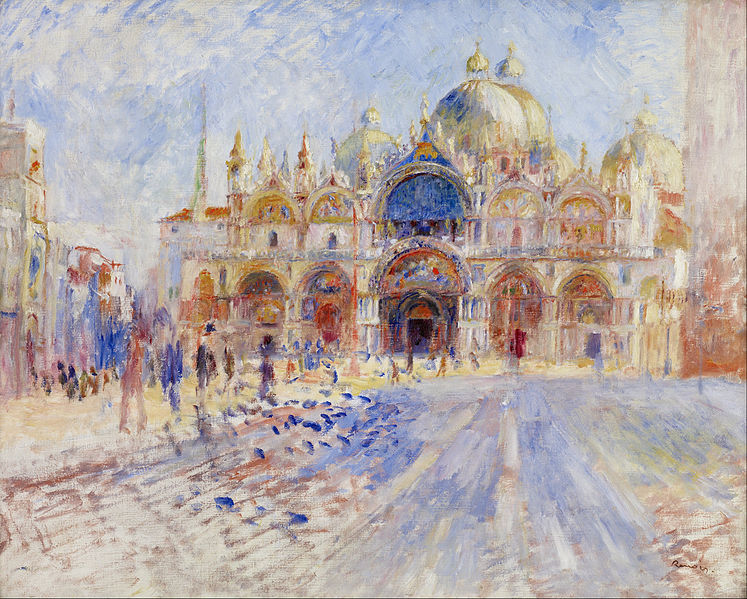
Piazza San Marco, Venice
Some artists seem hard to like initially, but you grow to appreciate them over time: Rubens for example. With others, the praise given them always remains mystifying. For me, Renoir remains the one Impressionist that I’ve never been able to fathom. The best I think I can say for him is that the scenes in his paintings can evoke a sense of their time and that the brushwork can give a pleasing sense of wind blurring the foliage and light shimmering over people’s clothes. I was therefore only mildly intrigued by the idea of the National Gallery’s Renoir Landscapes exhibition, and not sufficiently interested to want to pay to see it (especially at the unbelievable price of £12). Fortunately I have the chance of getting in free, but I’m still hesitating. Might the exhibition be so poor that the opportunity cost of attending is too high, even though the actual cost is nothing? The reviews are not exactly encouraging...
Brian Sewell (whose views I do not normally agree with) is pretty persuasive in his review, which includes some marvelous invective that I can’t resist quoting: ‘In restricting the exhibition to landscapes, these directors and their appointed curators have dealt Renoir an almost mortal blow. Most of these landscapes are appalling... Smudge, smear and ineptitude is the best that can be said of them; greasy too, and occasionally dollopy, for Renoir's handling of paint in these landscapes is often physically repellent. The kindest thing that the curators could have done for his reputation would have been to abort the exhibition when they realised how dire and dreadful it would be; that they did not, suggests that such a realisation dawned on not one of them, nor on their associated essayists, nor on their directors, none of whom, it seems, has the slightest eye for quality. Had LS Lowry set out to forge a late Utrillo, he could not have matched the sheer nastiness of Renoir's Piazza San Marco, Venice, of 1881...’ And so it goes on!
Tuesday, April 24, 2007
The Road from Orizaba to Acultzingo
The book describes the travels of German painter Johann Moritz Rugendas (1802-58) and centres on the moment in 1837 when he suffers a disfiguring accident while sketching in Argentina. I know little about Rugendas and therefore spent most of the book wondering where the line between fact and fiction had been drawn, a question that might be applied to the paintings of Rugendas. According to Aira, Rugendas was influenced by the theories of Alexander von Humboldt, in particular the aim of depicting nature in its ‘physiognomic totality’ (which I suppose is ironic in view of the fracturing of the artist’s own physiognomy). Humboldt believed that artists like Rugendas could uncover the unity of a landscape. Furthermore, as Aira says, the Humboldtian naturalist was ‘not a botanist but a landscape artist sensitive to the processes of growth operative in all forms of life.’
An Episode in the Life of a Landscape Painter is interesting but left me feeling slightly unsatisfied, perhaps because of its brevity and the way even the two central characters remained somewhat sketchy. There are some full reviews on-line, e.g. here, here and here. The paperback has as its cover both the original drawing and the oil painting of The Road from Orizaba to Acultzingo (1831). Here is one of the Rugendas images freely available on-line, a landscape in Chile.
Johann Moritz Rugendas, Two Riders Resting
Source: Wikimedia Commons
Friday, April 13, 2007
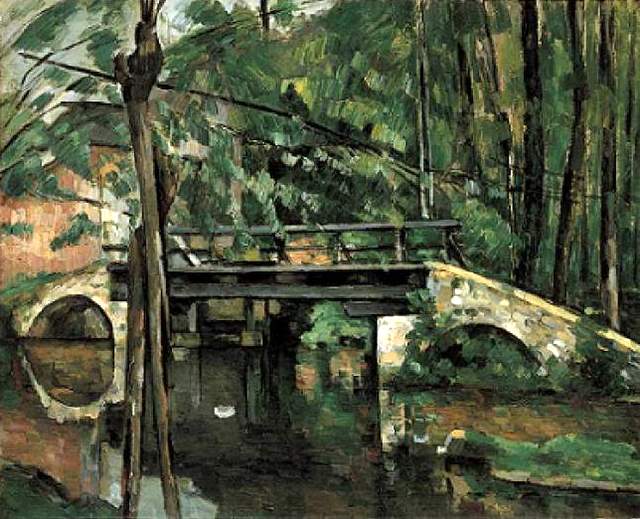
The Bridge at Maincy
Source: Wikimedia Commons
Monday, April 09, 2007
Dreamer in a Landscape
Malcolm Yorke’s The Spirit of Place: Nine Neo-Romantic Artists and Their Times (1988) discusses the art of Paul Nash, John Piper, Graham Sutherland, John Minton, Michael Ayrton, Robert Colquhoun, Keith Vaughan, Prunella Clough and John Craxton. He begins the book by discussing the label Neo-Romantic, which was already being used in the 1940s, e.g. by Raymond Mortimer (for whom it covered Piper, Sutherland, Henry Moore, Frances Hodgkins and Ivon Hitchens). Yorke writes that a 1983 exhibition, ‘The British Neo-Romantics 1935-1950’, attempted to include Bacon and Freud, both of whom refused to be included. He questions this exhibition’s inclusion of Hitchens, who did paint the English landscape but in a style far removed from the influence of original Romantics like Palmer, and of David Jones, who could be seen as too idiosyncratic to be part of a movement. A later Barbican Art Gallery exhibition, ’A Paradise Lost: The Neo-Romantic Imagination in Britain 1935-1955’, included various minor figures and two more artists that Yorke considers too individual to be part of a movement: Cecil Collins and Ceri Richards (the latter’s ‘explorations of the sexualisation of landscape were rightly given prominence’).
All this goes to show that beyond Piper and Sutherland there is no real consensus as to who was a ‘Neo-Romantic’. Which is why I suppose it is not surprising to find the on-line Encyclopedia of British Neo-Romanticism has such a wide coverage... Although you have to wonder about a site that manages to include under this term Genesis P. Orridge, Vivienne Westwood, J.R.R. Tolkein and Peter Ackroyd. Strange bedfellows!
The Tate site has a definition that is close to Malcolm Yorke’s conception of Neo-Romanticism. They illustrate this with John Craxton’s Dreamer in a Landscape (1942), noting his explanation for including shepherds or poets: 'as projections of myself they derived from Blake and Palmer. They were my means of escape and a sort of self protection. A shepherd is a lone figure, and so is a poet'. This notion of self-protection recalls the point made by Andrew Motion, that English poetic landscapes have a ‘defended’ feel to them.
Saturday, April 07, 2007
Visions of little dells
In The Guardian today Andrew Motion writes about the exhibition ‘Poets in the Landscape: The Romantic Spirit in British Art’, at Pallant House Gallery, Chichester. In discussing William Blake’s illustrations to Virgil’s Eclogues, he cites a beautiful description by Samuel Palmer, who saw the woodcuts as "visions of little dells, and nooks, and corners of Paradise; models of the exquisitest pitch of intense poetry. I thought of their light and shade, and looking upon them I find no word to describe it. Intense depth, solemnity, and vivid brilliancy only coldly and partially describes them. There is in all such a mystic and dreamy glimmer as penetrates and kindles the innermost soul, and gives a complete and unreserved delight, unlike the gaudy daylight of this world."
However, Andrew Motion wants to emphasise the darkness lurking in these pastoral visions, many of which were made in time of war and political uncertainty. They are ‘not so much escapist as defended’, a ‘form of opposition to the threats that circle them’. He cites, for example, John Piper’s set designs for the ballet Job (1948), which on the surface seem to be simple pastoral landscapes, but in which he sees ‘an optimism that is too determined to be entirely convincing.’ These set designs are, incidentally, a nice example of the interconnectedness of the English Romantic landscape traditions. The ballet is based on Blake’s illustrations to the Book of Job and composed by Ralph Vaughan Williams, following a proposal by Geoffrey Keynes (essayist and brother of the economist) and wood engraver Gwen Raverat (who was related to both Keynes and Vaughan Williams, and whose prints, including various landscapes, can be seen on-line here).
Tuesday, April 03, 2007
The Cliffs at Étretat
Monday, April 02, 2007
On Quantock’s grassy Hills
The gate in Dorset was the one Coleridge vaulted in his enthusiasm to see the Wordsworths. ‘Coleridge’s impetuous arrival that afternoon – exuberant, bounding, breaking the barriers, “leaping through the corn”’ presaged a three week period in which their friendship was formed, and eighteen months of discussion and composition that culminated in the lyrical ballads. It was a time recalled by Wordsworth in The Prelude: ‘that summer, when on Quantock’s grassy Hills / Far ranging, and among the sylvan Coombs, / Thou in delicious words, with happy heart, / Didst speak the Vision of that Ancient Man, the bright-eyed Mariner...’ (The equivalent lines from the 1850 Prelude are reprinted, with photographs of the Quantocks, on the appropriately named Friends of Coleridge site).
(Incidentally, I’m typing this in Word and its grammar checker has just said to me “Fragment – consider revising”, which made me smile: Holmes says that Coleridge’s ‘idea of the creative fragment became one of his greatest contributions to the aesthetics of Romanticism.’)
Holmes speculates on the nature of literary partnerships and suggests an interesting twentieth century parallel: Ted Hughes = Wordsworth, Sylvia Plath = Coleridge. He also reproduces an Irish joke noted by Coleridge in 1833 and recently published in the Coleridge Bulletin (Winter 2006). It could be seen as a surreal allegory of the friendship between the two famous poets:
Dan Hennesay’s story – passing over Black Friar’s whom should I see (coming from t’other end of the Bridge) but my old Chum, Pat Mahoney – and at the same moment he saw me – We ran towards each, & when we met, just in the middle of the Bridge – by Jasus! – it was neither of us.
Sunday, April 01, 2007
Hare, Blood and Snow
‘For some years now British landscape artists such as Goldsworthy, David Nash and Richard Long have been looked down upon by many in the art establishment. They have been regarded, despite their wide appeal and international success, as latter-day 1960s renegades, too metaphysical, too intense, too lyrical and unapologetically moral. This is an age that is more comfortable with cynicism than with the stench of dung and death. Yet never has there been a time when these artists' work was more resonant, as the planet warms and old landscapes are destroyed.’
I probably won’t get to go to this retrospective but I would be interested to see the new works that incorporate blood and human hair, which seem less reminiscent of the beautiful ephemeral images in his ‘coffee table books’ and closer to post pastoral art that acknowledges and incorporates the real violence in nature. For example, there is Hare, Blood and Snow, made from a dead hare by mixing its blood with snow and putting this into ‘the hare's stomach, hanging the animal up so that the melting liquid dripped from its mouth and nostrils on to sheets of paper’. Sue Hubbard thinks these works relate to ‘the cycles of death, putrefaction and renewal, with an uncompromisingly elemental beauty. Goldsworthy is to environmental art what Ted Hughes was to poetry.’
Saturday, March 24, 2007
Saint Anthony in a landscape
Saturday, March 17, 2007
Amwell
Cook’s favourite prospect poem is John Scott’s description of Amwell which I couldn’t locate on-line – maybe someone else can find a link? There are some other Scott poems are here. John Scott (1730–1783) was known for his pastoral verse and friendship with Dr Johnson, but he also dabbled in some fashionable garden design at the family home, now Amwell House – the grotto was recently restored. According to the Hertfordshire literary map, ‘the name Amwell is derived from 'Emma's Well', now a dried up hollow alongside the New River which broadens around two small islands there. The well has a stone enscribed with part of John Scott's poem "Emma" at the entrance.’
Postscript September 2015:
I have now found Scott's poem online. Here is the moment when the prospect reveals itself:
Scott's grotto now has a website.By winding pathways through the waving corn,
We reach the airy point that prospect yields,
Not vast and awful, but confin'd and fair;
Not the black mountain and the foamy main;
Not the throng'd city and the busy port;
But pleasant interchange of soft ascent,
And level plain, and growth of shady woods,
And twining course of rivers clear, and sight
Of rural towns and rural cots, whose roofs
Rise scattering round, and animate the whole.
Friday, March 09, 2007
The shapely figured aspect of chalk-hills
Gilbert White's The Natural History of Selborne is a cultural landmark in the development of English attitudes to nature, but it is a book of observations about animals (mainly birds) rather than a book about landscape. When he does occasionally looks at the scenery, White shows a pre-Romantic taste in the countryside of southern England. However, in this interesting description of the South Downs written in 1773 from Ringmer (near Lewes), admiration for the forms of the hills moves away from the conventional language of 'the beautiful' to something more ecstatic and bodily: naturalist John Ray is 'ravished', White himself senses an 'air of vegetative dilation and expansion':
'Though I have now travelled the Sussex-downs upwards of thirty
years, yet I still investigate that chain of majestic mountains with
fresh admiration year by year; and think I see new beauties every
time I traverse it. This range, which runs from Chichester eastward
as far as East-Bourn, is about sixty miles in length, and is called the
South Downs, properly speaking, only round Lewes. As you pass
along you command a noble view of the wild, or weald, on one
hand, and the broad downs and sea on the other. Mr. Ray used to
visit a family* just at the foot of these hips, and was so ravished
with the prospect from Plumpton-plain near Lewes, that he
mentions those scapes in his Wisdom of God in the Works of the
Creation with the utmost satisfaction, and thinks them equal to
anything he had seen in the finest parts of Europe.
(* Mr. Courthope, of Danny.)
For my own part, I think there is somewhat peculiarly sweet and
amusing in the shapely figured aspect of chalk-hills in preference
to those of stone, which are rugged, broken, abrupt, and shapeless.
Perhaps I may be singular in my opinion, and not so happy as to
convey to you the same idea, but I never contemplate these
mountains without thinking I perceive somewhat analogous to
growth in their gentle swellings and smooth fungus-like
protuberances, their fluted sides, and regular hollows and slopes,
that carry at once the air of vegetative dilation and expansion.... Or
was there ever a time when these immense masses of calcareous
matter were drown into fermentation by some adventitious
moisture; were raised and leavened into such shapes by some
plastic power; and so made to swell and heave their broad backs
into the sky so much above the less animated clay of the wild
below?'
Tuesday, March 06, 2007
Le Paysage historique
Charles Baudelaire’s reviews of the Salons of 1845 and 1846 both have sections on landscape. In the 1845 review Baudelaire defends Corot against those who claim he cannot paint because his work looks unfinished. The 1846 review identifies different types of landscape painters:
il y a des paysagistes coloristes, des paysagistes dessinateurs et des imaginatifs; des naturalistes idéalisant à leur insu, et des sectaires du poncif, qui s’adonnent à un genre particulier et étrange, qui s’appelle le Paysage historique.
un arrangement de patrons d’arbres, de fontaines, de tombeaux et d’urnes cinéraires. Les chiens sont taillés sur un certain patron de chien historique; un berger historique ne peut pas, sous peine de déshonneur, s’en permettre d’autres. Tout arbre immoral qui s’est permis de pousser tout seul et à sa manière est nécessairement abattu; toute mare à crapauds ou à têtards est impitoyablement enterrée.
an arrangement of stereotyped patterns of trees and fountains, of tombstones and funeral urns. The dogs are cut out on a certain pattern of historical dog; a tragic shepherd cannot, on pain of dishonour, have any other kind of dog. Any immoral tree which had the cheek to grow independently and according to its own nature is necessarily cut down forthwith; any pond full of toads and tadpoles is mercilessly filled in. (trans P.E. Charvet).
M. Rousseau a le travail compliqué, plein de ruses et de repentirs. Peu d’hommes ont plus sincèrement aimé la lumière et l’ont mieux rendue. Mais la silhouette générale des formes est souvent ici difficile à saisir. La vapeur lumineuse, pétillante et ballottée, trouble la carcasse des êtres. M. Rousseau m’a toujours ébloui ; mais il m’a quelquefois fatigué. Et puis il tombe dans le fameux défaut moderne, qui naît d’un amour aveugle de la nature, de rien que la nature ; il prend une simple étude pour une composition.
Monday, March 05, 2007
Two rams fighting
- From the late 1290s, a Persian translation of Ibn Bakhtishu’s Manafi’ al-hayawan, a book that describes birds, insects and animals and includes 94 illustrations. Some of the paintings integrate the animals into landscapes of ‘gnarled trees, convoluted clouds , and rocky mountains’ which suggest an awareness of Chinese painting. There are examples in the Pierpoint Morgan Library, e.g. Two Rams Fighting.
- Another manuscript with animal illustrations from the mid-fourteenth century is a copy of the animal fables, Kalila and Dimna (now in Istanbul University Library). There is an extraordinary illustration to the story of Kardana and the Tortoise, with a blue swirling twisted tree and lush green vegetation; in many of the paintings, ‘landscape elements spill out of the confines of the picture frame’.
- Finally, in contrast to this densely painted image, there is a simple line drawing from 1406-10 showing a flock of geese flying over a Pastoral Scene (now in the Freer Gallery of Art). The illustration was made to accompany a poem by sultan Ahmad Jalayir, although the landscape does not seem to relate directly to the verse. It may well have been the work of ‘Abd al-Hayy who was particularly renowned for his line drawing.
Thursday, March 01, 2007
Suo (The Marsh)
Saturday, February 24, 2007
Landscape on a Chinese fan
'Useless landscapes like those that circumscribe Chinese teacups, starting out from the handle and abruptly ending at the handle. The cups are always too small... Where would the landscape continue and with what (...) of porcelain, if it could continue past the teacup handle?
Certain souls are able to feel a profound sorrow because the painted landscape on a Chinese fan isn't three dimensional.'
Friday, February 16, 2007
Two-Way Mirror Hedge Labyrinth
Graham talked quite a lot about his influences, among whom he mentioned John Constable (especially with reference to the cloud paintings) and the Hudson River School. He has written an article for Tate magazine which explains his interest in the apocalytic landscapes of John Martin. In an interesting recent interview with Graham, Pietro Valle observed: "You seem to be more and more interested in landscapes. However, there's a difference between landscaping, i.e. the production of specialized areas in the suburban culture (often segregating buffer zones), and the landscape that you try to unveil with your pavilions." Graham's response: "In my Two-Way Mirror Hedge Labyrinth I combine the hedges that are typical of Baroque garden labyrinths with the glass that is typically used for corporate buildings. That specific pavilion was built for the home of a collector and the hedge is the extension of the fence of the existing garden. Hedges have become a means to mark the boundary between public and private in the single-family residential culture. I try to mix urban greenery elements with elements taken from the corporate areas but in a different way compared with the halls in skyscrapers where the greenery is imprisoned inside the building."
Monday, February 12, 2007
Water falling, drop by drop
Michaux, like Fenollosa and Pound, sees in the origins of Chinese script a direct response to nature. The idea of natural signs (which of course also figures in Western thought, e.g. Plato's Cratylus) seems to offer the possibility of presenting and combining actual elements of landscape, rather than simply evoking a scene in a succession of abstract signs. Michaux (translated by Gustaf Sobin) describes the recovery of ancient Chinese writing (c. 120 CE) by scholars who compiled a 'dictionary of orginal signs', so that a written page could be full of 'everything to be found in the world': 'full of water falling, drop by drop, out of clouds / of ferryboats crossing from one side to another / full of earth embankments / of furnaces... scenes that lend themselves to reflection / scenes of all sorts... clustered that they might end in ideas / or unravel as poetry.'
Despite these efforts, the subsequent development of Chinese writing led further and further from nature, towards abstraction. However, as Richard Sieburth says in his afterword: 'if calligraphy enables the material body of the sign to be transfigured into pure spirit, the very activity of this scriptura scribens nonetheless plunges us back (by a kind of dialectical reversal) into the immanent energies of a natura naturans. Freed from imitating nature, signs may now signify it...' And so writing itself can become a kind of habitable landscape. Michaux ends his poetic essay with a final observation on Chinese writing: 'Calligraphy around which - quite simply - one might abide as next to a tree, or a rock, or a source.'
Tuesday, February 06, 2007
The fortress at Qalat-i Gird
Some of the most interesting photographs show natural processes at work, like the sand dunes threatening the ancient field system visible at Kharga Oasis, Egypt. Gerster photographed another dune landscape at Sistan, Iran, where the Wind of 120 Days seems to have obliterated everything beneath the sands, except for the circular shape of Qalat-i Gird fortress. According to Dietrich Huff, this 'much-feared' wind determines the angles of trees and buildings and creates 'bizarrely beautiful and distinctly shaped shifting dunes.' The fortress probably dates from the 13th century, after the composition of Firdausi's Shahnama in which the legendary hero Rustam was depicted as the saviour of Sistan, but early enough to have witnessed the conquest of Tamburlaine and his wounding at the siege there.
Sunday, February 04, 2007
Cannon River Eddies
Postscript: September 2015
This Music and Nature website still exists, although much has been written about music and nature in the ten years since it was created. As the post above is a bit short I thought I would summarise that survey of wind music by listing his examples...
- Chris Watson says that "Wind, wherever the sound recordist operates, is an obvious nuisance". But in a recording made at Glen Cannich, he "could walk through the foci of these wind sounds within a few paces, as if being part of some great instrument..."
- By contrast wind can be a gentle backdrop as in a forest recording by Jonathon Storm...
- Wind in the trees sounds differently depending on the leaf cover. A Peter Cusack recording 'captures the spirit of late autumn, when most trees are bare, and leaves that are still clinging to the branches have a very distinctive brittleness.'
- Gordon Hempton devoted a whole album to the winds of North America, which vary according to the local landscape
- A Francisco López, 'Wind from Patagonia' demonstrates 'layers of sound, suggestiveness and a subtle musicality.'
- Geoff Sample recorded a spring gale whistling around ta metal gate
- 'In Guadalcanal, one of the Solomon Islands, people used to erect bamboo poles on the easternmost beaches of the island when someone had died. Holes and slits were cut out in the canes, which were played by the wind'
- The Japanese sound artist Akio Suzuki recorded the wind blowing across his Analapos instrument
- Scott Smallwood recorded the wind around a pile of scrap and refuse left at an abandoned airfield in the Utah desert.
- Eric La Casa collects wind and wind-based recordings and adds a church organ to the mix