Friday, October 28, 2011

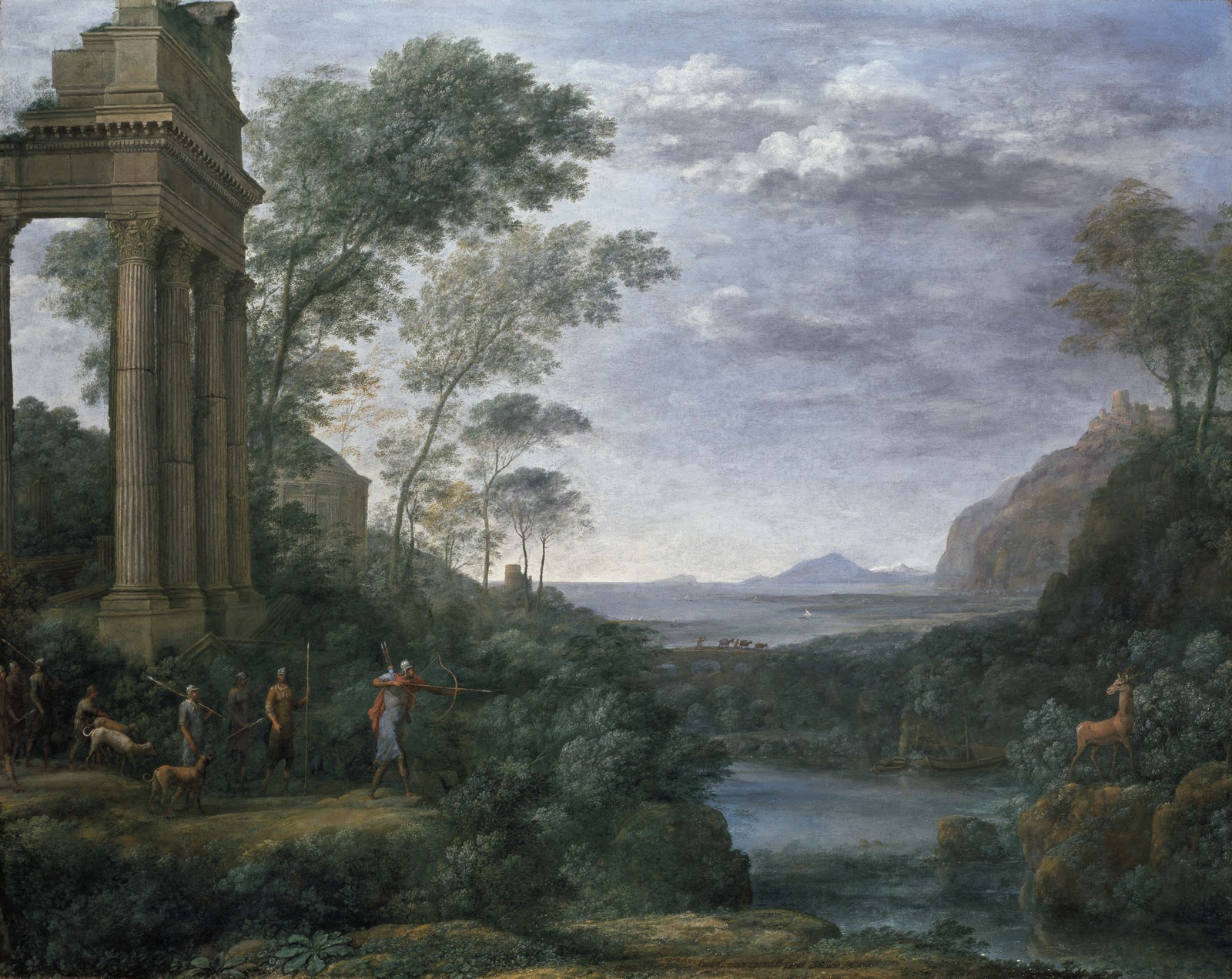
Landscape with Ascanius shooting the Stag of Sylvia

The Ashmolean Museum's exhibition Claude: The Enchanted Landscape, which I looked round yesterday, provides a good opportunity to compare the artist's drawings and sketches.  A preparatory sketch for Claude's last painting, Ascanius shooting the Stag of Sylvia, shows the foreground figures standing out from their background and Ascanius (the son of Aeneas) just left of centre.  Trees, portico and people are all on a more realistic, less monumental scale.  In the painting, as Martin Sonnabend and Jon Whiteley point out in the catalogue, 'everything has been suffused with an air of fantasy.  The hunters are impossibly elongated - Ascanius, in particular, is absurdly top-heavy - but even they are overwhelmed by the landscape, lit by a silvery sky, which arches over them and recedes far back into the blue, snow-capped hills.'

Claude Lorrain, Ascanius shooting the Stag of Sylvia, 1682

I was curious to compare the two figures of Ascanius directly and so had a play on Photoshop, as you can see below.  It would seem facile to say this shows Claude could have painted more naturalistic figures if he'd wanted to, but the point is worthwhile because contemporaries criticised this aspect of his painting and Claude himself reportedly joked that when he sold his landscapes he threw the figures in for nothing.  Of course the figures in Ascanius shooting the Stag of Sylvia can't be seen in isolation (or cut out from their setting); the painting's harmonius colours and soaring forms combine to convey a legendary time and place, dreamed from the poetry of Virgil.  Goethe summed up the nature of landscapes like this in 1829, when he said that Claude's paintings 'possess the highest truth, but no trace of reality.' 

Wednesday, October 26, 2011

The Valley of the Ladies

"Do not hold back," I cried, "I beg you, by Zeus and by Eros himself!  It will give me all the more pleasure if your tale is indeed like fiction."
And with these words, I took him by the hand and led him to a neighbouring grove, where the plane trees grew thick and plentiful, and the water flowed by cool and clear, just as it comes from freshly melted snow.  I sat him down there on a low bench, and sat myself next to him.
"Well, it is time to hear your story," I said, "A setting such as this is delightful, and just right for erotic fiction."
- Achilles Tatius, Leucippe and Clitophon, Book 1, 2nd century CE (trans. Tim Whitworth)
What is the best kind of landscape in which to listen to a story?  I suppose it may vary according to genre, as Achilles Tatius implies, but a grove like the one Clitophon is led to, a locus amoenus of comfort, privacy and natural beauty, would seem ideal.  Here landscape is a gentle backdrop, not a distraction or a subject for discourse itself. 


In Plato's Phaedrus Socrates is taken to a similar location, but makes a point of reminding Phaedrus as they walk there: 'I am a lover of knowledge, and the men who dwell in the city are my teachers, and not the trees or the country.'  He is nevertheless very pleased with the quiet location they find by the cooling water of the Ilissus, 'full of summer sounds and scents. Here is this lofty and spreading plane-tree, and the agnus castus high and clustering, in the fullest blossom and the greatest fragrance; and the stream which flows beneath the plane-tree is deliciously cold to the feet. Judging from the ornaments and images, this must be a spot sacred to Achelous and the Nymphs. How delightful is the breeze:--so very sweet; and there is a sound in the air shrill and summerlike which makes answer to the chorus of the cicadae. But the greatest charm of all is the grass, like a pillow gently sloping to the head. My dear Phaedrus, you have been an admirable guide.'

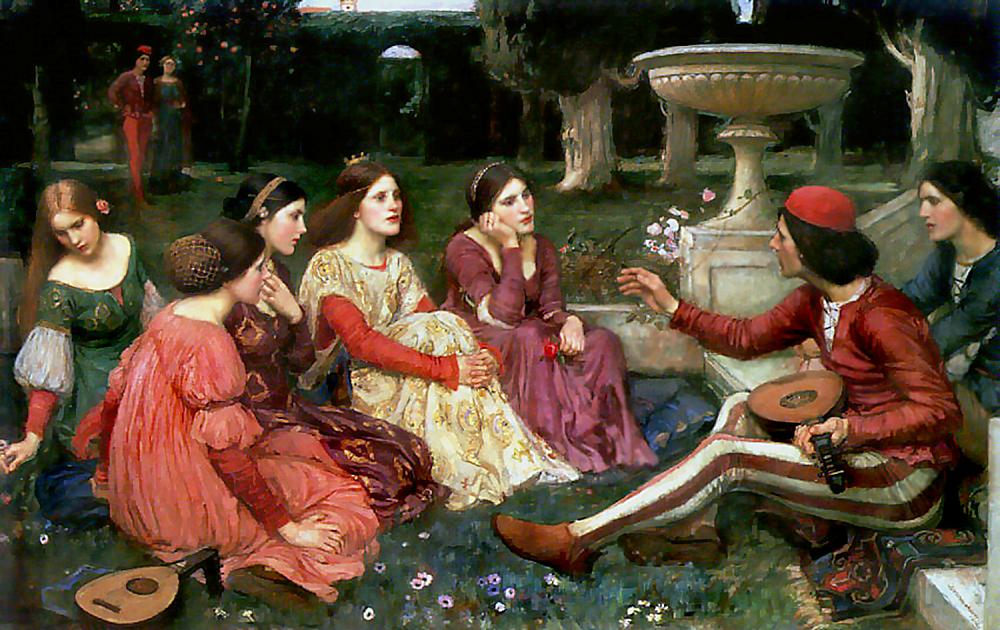
John William Waterhouse, A Tale from the Decameron, 1916

The history of literature is full of frame stories but the most famous to be set in a locus amoenus is surely The Decameron.  In fact Boccaccio's ten young Florentines find refuge from the plague in three such locations: two gardens, described on the first and third days, and then a garden-like landscape, The Valley of the Ladies, which they explore on the sixth.  Despite being outside the protecting walls of country villa, this valley has the essential element of seclusion - the only means of entry is a narrow path, beside which flows a clear stream.  The valley floor is so circular it seems to have been drawn with compasses, 'though it seemed the work of nature', and the valley's sides are terraced like a natural amphitheatre.  Vines and fruit trees grow on the south side, thick trees on the north.  The stream feeds a tiny lake so transparent that you can count the stones in it.  On discovering it the ladies are unable to resist a swim, the water concealing 'their chaste white bodies no better than a thin sheet of glass would conceal a pink rose.'  You can well imagine one of them echoing the words of Achilles Tatius, "a setting such as this is delightful, and just right for erotic fiction."  And it is on a grassy spot by this lake that they resume their storytelling the following day.

Sunday, October 23, 2011

Two Years at Sea

Ben Rivers' first feature film Two Years at Sea (2011) follows the solitary life of Jake Williams in his ramshackle house in the woods of Aberdeenshire.  It has a wonderful landscape sequence where Jake floats slowly across the frame on a home-made raft.  The film was shot using reclaimed 16mm Bolex cameras on Kodak Plus-X (which, if I remember rightly, was what Grant Gee used in Patience: After Sebald) and processed in the film-maker's own kitchen.  This film stock seems to add extra layers of fog to the low hills and fir trees.  Watching it on Friday, I was conscious at one point that I was seeing a view successively filtered through falling rain, a car windscreen, an old camera lens being shaken around as Jake drove up a track, and the grainy black and white film itself, hand-processed and then re-projected onto the cinema screen. The Q&A session after this London Film Festival screening revealed the extent to which the film constructs its own version of the real Jake.  Jake himself was there answering questions, dispelling some of the films' mysteries and revealing how far it was a collaboration: the raft idea, for example, had been a long-standing idea of Jake's but it was the presence of the camera that prompted him to construct it and paddle out onto that grey, misty lake.

Image from David Bordwell's site.

Friday, October 21, 2011

The Jack Pine

Painting Canada: Tom Thomson and the Group of Seven is another superb exhibition at Dulwich Picture Gallery, following others I've described on this blog: Salvator Rosa, Paul Nash, Adam Elsheimer.  Reviewers (like Brian Sewell) will inevitably have to provide some background information on the Group of Seven, whose work has not often been seen in the UK.  In Canada, as Ian A. C. Dejardin says in the catalogue, their work has been endlessly discussed 'to the point of exhaustion.  Yet their visual legacy remains supremely powerful: many Canadians, raised with reproductions of the Group of Seven's most famous paintings on their classroom walls, still see their own country through the Group's eyes ... Few of us in Europe could point more than vaguely on a map to any of the locations these artists depicted.  These are painted woods, trees, lakes and mountains only.  Nonetheless, non-Canadians should be aware: we are on holy ground.'  As I know some readers of this blog are Canadian (see comments on my last post...) I'd better admit that a lot of these paintings were completely new to me.  

Tom Thomson in Algonquin Provincial Park, 1914-16
Source (all images here): Wikimedia Commons 

At the start of the exhibition, there is a quotation from Fred Housser, who wrote the first book about the Group of Seven in 1926: "This task [of expressing the spirit of the Canadian landscape in paint] demands a new type of artist; one who divests himself of the velvet coat and flowing tie of his caste, puts on the outfit of the bushwacker and prospector; closes with his environment; paddles, portages and makes camp; sleeps in the out-of-doors under the stars; climbs mountains with his sketch box on his back."  The idea of an artist who 'closes with the environment' reminds me of recent British land artists who have walked in Algonquin Park and other landscapes explored by the Group of Seven.


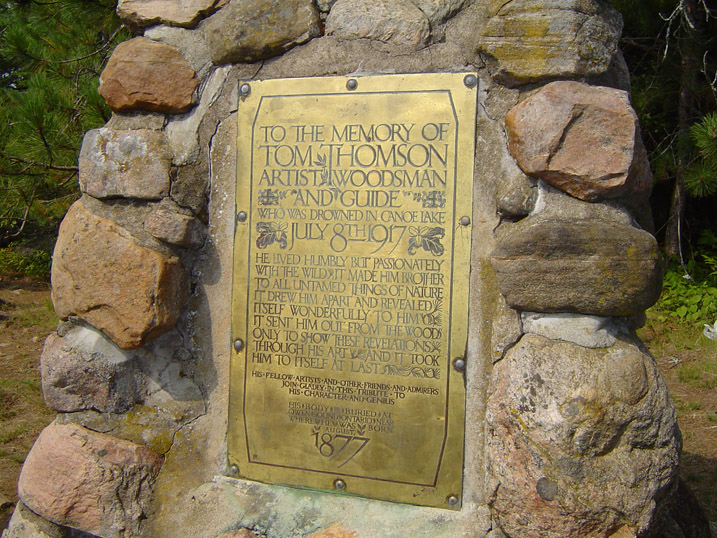
When Tom Thomson died in 1917, his memorial described him as 'artist woodsman and guide'.  Photographs show him fishing and canoeing; one of these was the basis for Peter Doig's White Canoe (1992) (see also my earlier post on Doig's Figure in a Mountain Landscape paintings).  However, as Dejardin points out in the catalogue, Thomson was actually rather a snappy dresser when out and about in Toronto and he made a point of adding some expensive cobalt blue to the marine grey used in painting his canoe.  In 1919 the wealthiest of the group, Lawren Harris, had a boxcar fitted out as a travelling studio for a trip north on the Algoma Central Railway.  It sounds more comfortable than the floating studios of the Impressionists, but this didn't detain some of the artists: as A. Y. Jackson observed, sitting in the boxcar, 'the other chaps are all out sketching under umbrellas.  They are all trying to turn out four a day and can't stop if it rains.'

 Tom Thomson, The Jack Pine, 1916

Tom Thomson's most famous paintings, The Jack Pine and The West Wind, are shown alongside their original sketches in the exhibition's first room.  Each is a majestic landscape visible behind the drooping form of a pine tree, its branches seemingly surrounded by a faint aura.  Pine trees seem to have inspired poets and artists all over the world so it seems surprising in retrospect that (according to Housser) the Canadian artistic establishment, unable to see beyond European and Hudson River landscape visions, considered their native Jack Pine trees unpaintable before Thomson came along.  There is a Pine Island in Georgian Bay (part of Lake Huron) and this exhibition includes two 1914 sketches of it by Thomson and a night scene by Jackson, where the trees stand over a pool of deep blue in which you can see the reflections of stars.
 
Six of the Group of Seven, plus their friend Barker Fairley, in 1920
From left to right: Frederick Varley, A. Y. Jackson, Lawren Harris,
Fairley, Frank Johnston, Arthur Lismer, and J. E. H. MacDonald.

In 1925 a critic noted that the Group had been 'tree mad', but also, successively, 'lake-lunatic, river-ridden, birch-bedlamed, aspen addled, and rock-cracked.  This year they are mountain mad.'  The exhibition's room of mountain views includes Frederick Varley's Hodleresque The Cloud, Red Mountain (1927-8) and Lawren Harris's stylised, almost art deco Mt Lefroy (1930), although I preferred the more direct, less abstract approach of J. E. H. MacDonald, especially a view of a small turquoise lake in the gathering snow with the Japanese-sounding title, Mountain Solitude (Lake Oesa) (1932).  The final room collects more of Harris's Theosophically-inspired landscapes from the late twenties - radically simplified mountains and ice bergs under grey skies, sometimes parted with shafts of light, reflecting his search for those 'moments in the North when the outward aspect of nature becomes for a while full luminous to her informing spirit - and man, nature and spirit are one.'
Sunday, October 16, 2011

Cloud and light

Toshio Hosokawa's new opera Matsukaze, based on a Noh play by Zeami, has received a lot of praise this year.  The New York Times review explains that it begins with some field recordings: 'the tranquil sound of waves washing up on a beach, which he recorded off the coast near Tokyo in January. Two months later, when the cast assembled in Berlin to begin preparing for the opera’s premiere in Brussels, the waves had acquired an entirely different significance. “We heard those water and wind sounds, and we remembered at once the tsunami...”' 
Last month ECM issued a new set of Hosokawa recordings, Landscapes.  Despite the title this only includes one of his early 90s 'Landscape' chamber pieces (some of which are currently viewable on Youtube - see below).  It features a new expanded version of  'Landscape V' for shô and string orchestra; the other tracks are 'Sakura für Otto Tomek', 'Cloud and Light', and 'Ceremonial Dance'.  The Independent's Andy Gill pronounces the album 'exquisite' but The Guardian's Andrew Clements thinks it 'exquisite in a self-conscious way ... for a few minutes the effect is entrancing, but after that it begins to pall'.  In his liner notes Paul Griffiths says 'The interplay of shô and strings, and in particular their mutual imitation, is the driving force – or perhaps one should say ‘drifting force’, given that the music carries itself so lightly ...  its effect is of observing clouds in a largely peaceful sky, clouds that are mostly white but occasionally show shadows and briefly stir into more turbulent action.”

Saturday, October 15, 2011

Daphnis and Chloe

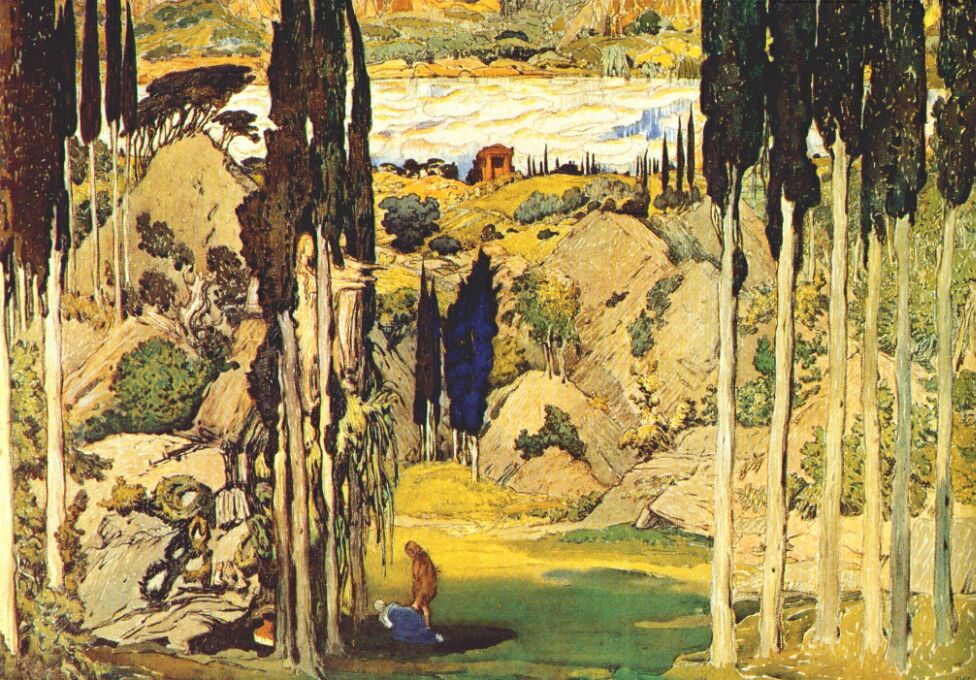
There is a delightful sense of freedom in the lives of Daphnis and Chloe, as the young goatherd and shepherdess grow to love each other in the woods and fields of Lesbos.  Daphnis (Δάφνις) is named after the laurel bush and Chloe (χλόη) means the fresh green grass of spring.  They herd their animals together, share their food and milk and wine; Chloe picks stems of asphodel to make little cages for grasshoppers, Daphnis binds together slender reeds and learns to play the pan pipes.  In the summer they listen to the singing of rivers, the wind in the pines and the sound of the cicadas.  Two places in particular are special to them: a statue of Pan underneath a pine tree and, nearby, a cave dedicated to the Nymphs, from which a spring rises whose stream nourishes a meadow of soft grass. There is some hard work - for Chloe the wearisome job of churning milk - but after it is done the lovers have time to bathe, pick fruit and lie together kissing under an oak tree. 

Léon Samoilovitch Bakst, set design for Ravel's Daphnis et Chloë, 1912

As you read about the passing of the seasons and the growing love of Daphnis and Chloe, it is easy to forget that the landscape Longus is describing is actually made up of the estates of rich men, living away in the city, and that Daphnis and Chloe are actually slaves.  Daphnis works on 'a very splendid property: it had mountains abounding in game, plains fertile in wheat, gentle slopes with vineyards, pastures with flocks, and a long stretch of shore where the sea broke on the softest sand.'  The last part of the novel, Book 4, begins with the news that the Master is returning to look over his property, including a large pleasure ground, containing cypresses, laurels, pines, and plane trees, fruit trees (apple, pear, pomegranate), beds of roses, lilies and hyacinths, and wild flowers: violets, narcissi, pimpernels.  In a description which reads like a blueprint for eighteenth century landowners, Longus writes that 'from there, a wide prospect opened over the plain and the sea beyond, and it was possible to see the peasants minding their flocks and herds, and the ships scudding across the bay - that view was another of the delights afforded by the pleasure-ground' (trans. Ronald McCall).

In the end, it turns out (to no great surprise) that Daphnis and Chloe are not the children of peasants - both had been exposed at birth by their real parents, suckled by a goat and a sheep, discovered and then brought up in the countryside.  But after they marry they return to their rustic idyll and own sheep and goats in great number.  They name their children Philopoeman ('friend to shepherds') and Agele ('herd').  It is a happy ending but to a modern reader it seems a shame that they go on to 'beautify' the Nymphs' cave with pictures and 'let Pan have a temple for his home instead of the pine tree'.  Such artifice is of course in keeping with the pastoral genre and indeed the entire novel is a kind of ekphrasis: its preface explains that Daphnis and Chloe is a story the author saw one day while he was out hunting in Lesbos, depicted in a painting, hanging in a grove sacred to the Nymphs.

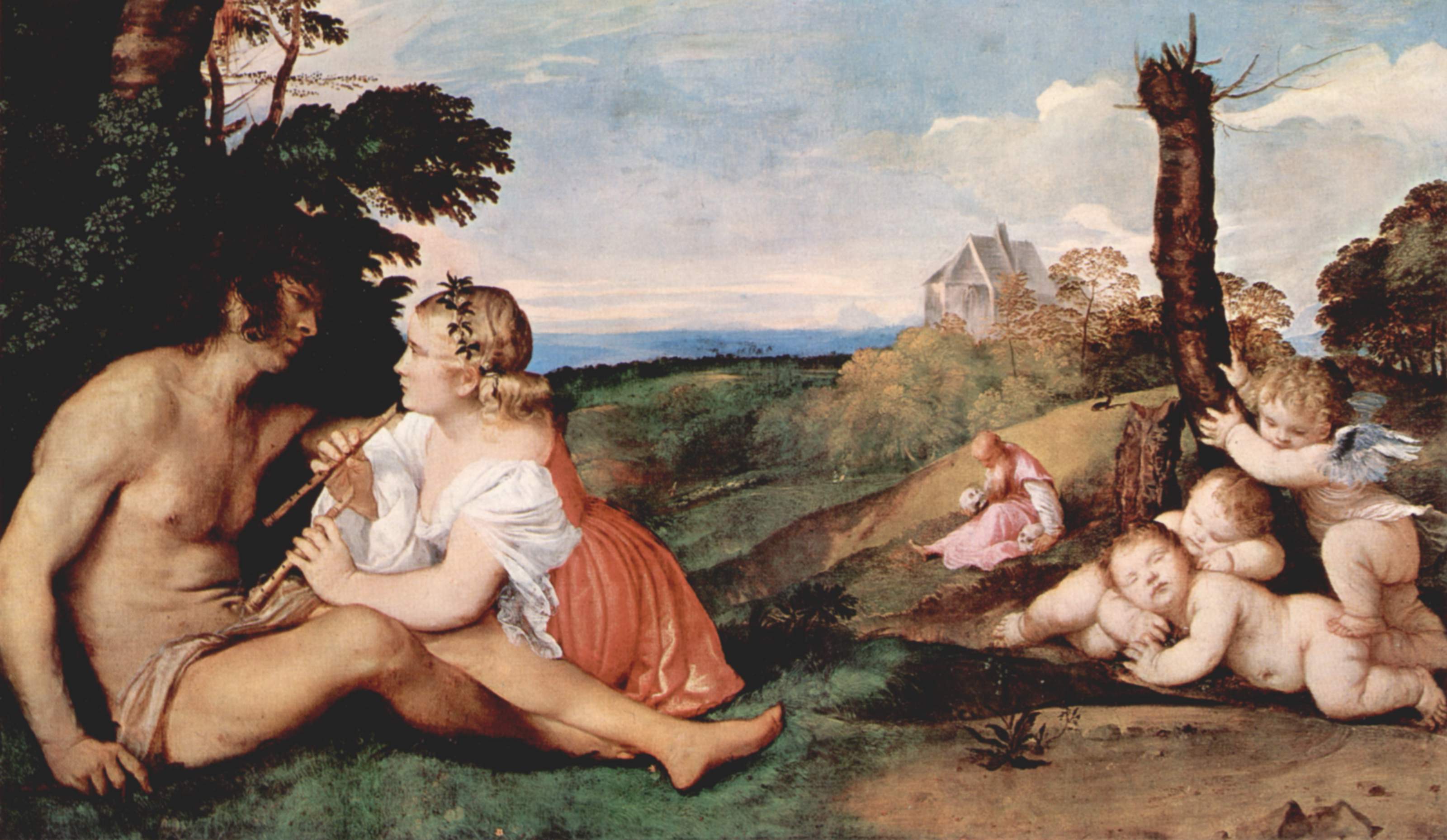
Titian, The Three Ages of Man, c1512
It has been suggested that this may show scenes from Daphnis and Chloe

There are other things I could say about landscape in relation to this book, but I'll confine myself to noting that there are three points in the story where aetiological myths are poetically retold to explain natural phenomena: the call of the wood pigeon, the origin of pan-pipes and the source of echoes. Chloe first experiences an echo while listening with Daphnis to the singing from a passing boat, down below them in a deeply curving bay.  Behind the level pasture where they stand there is a hollow coomb which receives the sounds and 'like a musical instrument' repeats them back again.  Chloe promises Daphnis ten kisses if he will tell her the origin of this phenomenon and so he begins his story, explaining that 'there are many kinds of nymphs - ash-tree nymphs, called Meliae, oak-tree nymphs, called Dryads, and nymphs of the marshes, called Heleioi. All are fair, all are makers of music.  Echo was born the daughter of one of these ... the Muses taught her to play the pan-pipes and the flute, to sing to the lyre and the cithara.'  She shunned mankind but Pan grew jelous and drove the shepherds and goatherds mad so that they tore her to pieces, still singing.  Earth gave these shreds of music shelter and now they are able to portray the sounds of people and animals, just as Echo once had done.  'When Daphnis ended his story, Chloe gave him not ten but ten-score kisses - for the echo had all but repeated what he said, as though to witness that he told no lie.'

Friday, October 07, 2011

To go out and walk far in the forest

Badelunda, Sweden

I was glad to hear that Tomas Tranströmer has won the Nobel Prize and have been looking today through my copy of his New Collected Poems, translated by Robin Fulton.  Here is my guide to some of the imagery you'll find in his poetry.
  1. Snow.   In an earlier post I talked about a poem, 'From March 1979', in which Tranströmer goes to a snow-covered island and sees in the tracks of the deer 'language but no words.'  Language itself suffers in the still, cold February of another poem, 'Face to Face', where there is deep snow and 'footprints grew old out on the crust. / Under a tarpaulin language pined.'  But the onset of a snowfall can seem as joyful as music ('C Major') and when winter ends eventually, as in the poem 'Noon Thaw', the world has a new language: 'the vowels were blue sky and the consonants were black twigs and the speech was soft over the snow.'
  2. Stillness.   In that dead winter of 'Face to Face', 'living stood still' and 'the soul / chafed against the landscape.'  But eventually, one day, colours flared and 'everything turned around. / The earth and I sprang towards each other'. Elsewhere in Tranströmer there are moments of quiet contemplation, 'Weather Picture' for instance, where the October sea glistens coldly and all sounds are 'in slow flight'.  'Breathing Space July' contains three moments of stillness, lying under a tree, looking into the water, and sleeping.  And in 'Slow Music' he writes of a day down by the water, 'among large stones with peaceful backs', where 'you can stand in the sun with your eyes shut / and feel yourself being slowly blown forward.'
  3. Summer.   In a prose poem, 'The Blue House', Tranströmer stands in a dense forest under 'a night of radiant sun.'  'A ship's engine far away on the water expands the summer-night horizon.  Both joy and sorrow swell in the dew's magnifying glass.'  But those sunlit Swedish summers will eventually fade until the sounds of the forest flow 'into a single melancholy murmer' ('The Cuckoo'). In 'Lament' the writer notices the slow coming of night. 'The moths settle on the window pane: / small pale telegrams from the world.'
  4. Song.   In 'Song' Tranströmer recalls the legend of Väinämöinen, the eternal bard of the Kalevala, riding over the sea.  He also listens at nightfall to the abortive music of gulls on a dark skerry.  You can hear birdsong in many of his poems - 'Ringing', 'Morning Birds', 'Memories Look at Me', 'Early May Stanzas', 'The Nightingale in Badelunda'. The last of these describes a moment when time stopped as he listened to 'the raw resonant notes that whet the night sky's gleaming scythe.' 
  5. Stars.  'Orion hangs above the ground-frost...'; 'Silent constellations.  And the cold ocean.' Tranströmer poems often take place at night, although the stars may merely be glimpsed, up through the grating of winter.  In an early poem, 'Epilogue', he describes the evening star like an X-ray, developing a hidden landscape of houses, trees and fences.  And then a storm comes in and the stars seem to signal for help, 'lit and quenched by headlong clouds / that only when they shade the light betray / their presence.'
  6. Sleep.   In 'Tracks' a train stops in the middle of a plain - 'bright moonlight, few stars' - and far away there are the lights of a town.  It is like a dream that the sleeper will not remember. Sleep and dreams recur throughout Tranströmer's poetry and indeed the opening lines of the first poem in his first collection describe that moment of awakening when 'consciousness can grasp the world / as the hand grips a sun-warmed stone.'  'The Man who Awoke with Singing over the Roofs' evokes that same feeling, when the sleeper 'begins / groping for attention's instruments'. 
  7. Storms.  Sometimes the poet is woken by a storm.  In 'Autumnal Archipelago' he listens in the darkness to 'constellations stamping inside their stalls, high over the tree-tops'.  Similarly, 'A Winter Night' begins with this memorable image: 'the storm put its mouth to the house / and blows to produce a note.'  These experiences suggest a simile in 'Agitated Meditation': 'a storm drives the mill sails wildly round / in the night's darkness, grinding nothing. - You / are kept awake by the same laws...'
  8. Silence.   Other times the nights are quiet: in 'Nocturne', the trees keep 'silence in concord with each other.'  In 'Five Stanzas to Thoreau', Tranströmer talks of silence slowly spiralling from the earth to grow 'with its burgeoning crown to shade his sun-heated doorstep.'  Thus silence seems sought after at times - in 'Along the Radius' he sits by an ice-bound river on an upturned boat 'swallowing the drug of silence'.  But in 'April and Silence' Spring lies desolate and 'the only thing I want to say / glitters out of reach / like the silver / in a pawnbrokers.'
  9. Solitude.   In 'Alone', Tranströmer says 'I must be alone / Ten minutes in the morning / and ten minutes in the evening / without a programme.'  Earlier in this poem he is walking on the frozen fields of Östergötland and doesn't see a single person.  Other solitary artists appear in his poems - Thoreau 'disappearing deep in his inner greenness' and Grieg in his work-cottage, 'shut in with silence.'  In 'Solitary Swedish Houses' everything seems to stand alone and summer comes with 'flaxen-haired rain / or one solitary thunder-cloud / above a barking dog.'
  10. Sunlight.  Finally, the transformative effect of sunlight is evident in poems like 'Landscape with Suns', where the poet takes the memory of a glowing sun back to 'the half dead grey forest /  where we have to work and live.'  'Further In' describes an evening when he is driving through thick traffic.  A low red sun streaming in through his windscreen makes him feel transparent, so that 'writing becomes visible / inside me'.  Right then, he knows he must 'get far away / straight through the city and then / further until it is time to go out / and walk far in the forest.'

Sunday, October 02, 2011

At the Loch of the Green Corrie

Andrew Greig is a Scottish novelist, poet and mountaineering writer who I think I first read in Alec Finlay's anthology The Way to Cold Mountain (2001).  There he had a short prose piece called 'By the Loch of the Green Corrie' about a quest to find and fish in the loch that the poet Norman MacCaig (1910-96) had considered his favourite spot in the world.   The loch's location is revealed by an old friend of MacCaig and Grieg then heads off, accompanied by two friends (better fishermen than he) to try to find it.  'It's a gem all right.  Yes, green rough grass and screeds of grey scree.  Held in a bowl, secluded, quiet, its own world.  Quinag in the distance.  Nothing else.'  They fish all day but get no catches.  The mist comes in.  'Sounds of water, wind over grass, occasional shrill keek of a lone bird of prey.  The Loch of the Green Corrie began to sink into me.'  They stay for another day but still no luck. They pack up and leave.  'We're grubby, fish-free but feeling very alive, in touch, refreshed.  The homage is done, for this year.'


'The slope opposite rises like a breaking frozen wave of grey and green' 
Screen dump showing my own attempt to locate the Loch of the Green Corrie, whilst sitting here using Google Earth

A book-length homage, expanded from this original essay, appeared last year, the centenary of MacCaig's birth.  The account of the fishing trip is fuller and longer, with the addition of an extra day and digressions on poetry, geology, land-ownership and the right way to live.  I felt quite envious, never having myself camped out in the Highlands or experienced a Hemingwayesque fishing holiday (or even, come to think of it, met anyone who owns a fishing rod), but I did smile to myself when the trip ended with the three friends abandoning their tents to head off for some posh hotel food.  There they raise a glass to MacCaig, whose own poems and observations on the landscape are scattered through this book.  In 'Descent from the Green Corrie', for example, MacCaig describes the walk down 'on screes or boggy asphodel. / And the elation that for a moment fills you / Beside the misty cairn's that lesser thing, / A memory of it.'


The book ends with an account of Andrew Greig's return to the area in 2008, to interview some of Norman MacCaig's surviving friends and have one more go at catching the fish.  Again he spends hours there, until the far side of the corrie begins to lose colour and 'a pale spiral swirls and flattens, coming this way.  A rattling sound, then in a drenching blow the hail squall hits.'  So he leaves empty handed, but on his way home manages at last to catch a fish, in a loch of his own choosing.  And there the book ends, although Greig was back again last year, this time with Billy Connolly, fiddler Aly Bain and a BBC film crew.  A brief clip shows it to have been extremely bracing weather; after a massive overnight snowstorm Connolly is trying to put a fly on his rod and is heard to complain "Could Norman no'like Jamaica or something?"

Friday, September 30, 2011

City Links

I used to imagine, sitting at a screen in the city, some kind of remote aural connection to a wild landscape.  Perhaps this is now possible - some durable, unobtrusive, solar-powered device hidden in the cliffs at Zennor for example, transmitting the sound of waves to my computer here.  As long ago as 1967 the composer and sound artist Maryanne Amacher set up microphones that could feed sounds back from five sites round the city of Buffalo.  Later she installed 'a microphone on a window overlooking the ocean at the New England Fish Exchange in Boston Harbour, transmitting the sound into her home studio continuously, sometimes using it as an element in other performances or exhibitions of City Links. “I would come in and it would be different according to different weather and changes,” Amacher told interview Leah Durner in 1989 ... She lived with the live transmission for three years. “I actually miss coming home to it,” she says now, some 20 years later.'  This quote comes from a 1999 Wire article; you can see a few photographs on the Maryanne Amacher Archive Project website (sadly it looks as if this has not been updated recently and a year ago they were asking for more funds).

It seems paradoxical to go to the trouble of listening to the world but played over the top of the 'real' soundscape surrounding you.  I wonder what John Cage thought of this?  Amacher worked with Cage on his Lecture on the Weather (1975), a composition 'for 12 speaker-vocalists (or instrumentalists), preferably American men who have become Canadian citizens, each using his own sound system given an equalization distinguishing it from the others ... The performance starts with the reading of the preface. In it Cage expresses his disgust with the institutions of American government. After that the work starts, the 12 men reading and singing text fragments by Henry David Thoreau, and/or play instruments (ad lib.). In part 1 this is accompanied by sounds (on tape) of wind and in part 2 by sounds of rain. In the third part the lights in the performance-space are dimmed and the performers are accompanied by the film and the sounds of thunder. The film consists of Thoreau drawings, printed in negative, the projection resembling lightning (white on black).'  Lecture on the Weather goes well beyond the simple notion of a soundscape.  It represents (in the words of Joan Retallack) a collision of political and environmental climates, like ' the complex chaotic condition of interpenetration and obstruction in which we live, a fragile balance of order and disorder, clarity and cacophony.'

Sunday, September 25, 2011

High Arctic


I've talked here before about the ongoing Cape Farewell project which takes a group of artists and scientists each year to the Arctic.  Last year's trip sailed around Svalbard and among those on board were poet Nick Drake and artist Matt Clark of United Visual Artists.  They have now collaborated on an installation for the National Maritime Museum: High Arctic. It is described as 'an exhibition with no touchscreens, no static photographs, and no panels with text: instead High Arctic is a genuinely immersive, responsive environment. Ultraviolet torches unlock hidden elements, constantly shifting patterns of graphics and text that react to visitors approaching; an archipelago of thousands of columns fills the gallery space, each representing a real glacier in Svalbard; an artificial horizon borders the gallery as a seamless canvas of light, shifting in intensity and colour. A Max Eastley and Henrik Ekeus-designed generative soundscape flows through the gallery, weaving in the voices of arctic explorers across the centuries as well as the poetry of Nick Drake.'


The exhibition looks into a future where we will have to imagine the Arctic as it once was.  As you walk on what seem to be pristine snowfields dark patches spread around you, and ice-floes break up as if melted by your torch.  When the voices are silent you can hear the bleak sound of wind whistling over the ice.  Each ice column has the name of one of Svalbard's disappearing glaciers on it, which appears and then vanishes when you move the light over it.  These minimal white blocks and their arrangement in the museum space reminded me of Rachel Whiteread's Embankment at Tate Modern, which was a response to her own Cape Farewell trip in 2005.  I took my sons along to High Arctic today and they really enjoyed interacting with the lights and exploring the labyrinth of ice blocks.  I see that, according to an article in Wired, the scale of these was 'based on Lego models because, as team member Ben Kreukniet explains, “Lego is awesome.”'

Friday, September 23, 2011

Before the melt-waters


My copy of The Oxford Companion to the Literature of Wales has a landscape by David Jones on the cover, painted in the twenties when he went to live with Eric Gill and others at Capel-y-ffin in the Black Mountains.  The book describes Jones' long poem The Anathemata (1952) as 'at once devotional and commemorative, a celebration of Christian mysteries and a recalling of the making - both geological and cultural - of Britain ... The poem draws its material mainly from Celtic, Latin and Teutonic 'deposits' underlying London and Wales, and from English literature.'  Peter Ackroyd and Iain Sinclair have followed a similar path in their recent writings (London Orbital quotes 'The Lady of the Pool' section of The Anathemata, in which Jones uncovers the mythic strata of the City).  But before the poem reaches London, before following the waves of ship-borne settlers whose culture has shaped Britain, there is a section called 'Rite and Fore-Time' which describes the formation of the land itself.  What I like about these lines is the way they too contain 'Celtic, Latin and Teutonic 'deposits'', projected back onto Ice Age Britain, 'before the melt-waters / had drumlin-dammed a high hill-water for the water-maid / to lave her maiden hair.'

He says for example, that it is long ages since these melt-waters 'troughed, in solid Ordovician / his Bala bed for Tacitus. / Long, long ago they'd turned the flow about. / But had they as yet morained / where holy Deva's entry is? / Or pebbled his mere, where / still the Parthenos / she makes her devious exit?' A footnote explains some of these etymological references: Bala is also called Pimblemere, and in Welsh, Llyn Tegid, the Lake of Tacitus.  Jones adds that 'it may be noted that Tacitus was the name of Cunedda's great grandfather' (the kind of fact that these days we can find instantly and then pursue as far as we like).  He also explains in the footnote that the lake 'is formed of solid rock but the S. W. end at least is thought to have been influenced by morainic deposits.  At some remote geological period the outflow was southward whereas now the Dee flows northward through the lake, but, says immemorial tradition, the two waters never mingle.'


Lake Bala

The poem goes on to describe the movement south of glacial material, 'heaped amorphous / out of Caledonia / into Cambria.' It was from the Southern Uplands, Jones notes, that 'geological deposits of the Ice Age and certain legendary and historical deposits of the sub-Roman age came to Wales.'  At the same time ice sheets from Ireland, Scotland and the Lake District converged into the depression of the Irish Sea and moved south, 'part thrust against the land mass of North Wales' (here Jones' footnote quotes Brit. Reg. Geol. N. Wales pp77-8).  Microgranites and clay-bonded erratics were wrenched away and carried 'with what was harrowed-out in via, up, from the long drowned out-crops, under, coalesced and southed by the North Channel.'  And then the description of glacial action ends with the strange image of St Brendan on his sea horse.  A footnote explains that glaciation extended 'just beyond the waters between South Wales and Ireland, which very many millenia later became associated with the marvel-voyages of the Celtic ascetics; such as the navigation-saint, Brendan, who in the legend rides the narrow channel on a marine creature and hails Finbar, mounted on David's swimming horse, with the words 'God is marvellous in his saints.''

Saturday, September 17, 2011

Soft pink landscape

Earlier this week I was sad to read Waldemar Januszczak tweet 'Oh no, Richard Hamilton died this morning. That is a HUGE loss. Probably Britain's most important post-war artist.'  But, as he went on to say, 'Richard Hamilton was working on a big touring retrospective when he died. So at least there is that to look forward to.' Back in 1992 I went to a sizable retrospective at the Tate Gallery and have just been re-reading the catalogue. This reminded me that five years before his famous collage, Just What Is It That Makes Today's Homes So Different, So Appealing?, Hamilton was helping to make large map-models of New Towns (Harlow, Basildon and Speke) for the Festival of Britain's Exhibition of Architecture, Town Planning and Building Research.  There is a small black and white photograph of one of these in the catalogue (like a Ghost Box album cover), where it is contrasted with Landscape (1965-6).  This later work is mixed media added to an enlarged postcard image of the South Downs - panoramic landscape as a 'self-reflexive, game-playing switching of representational codes, rather than as a mimetic, miniaturised simulation of the new Socialist Britain.'

In the early sixties Hamilton was struck by a new advertising campaign for Andrex toilet paper that featured photographs of girls posed in a forest glade.  He described the scene: 'Nature is beautiful.  Pink from a morning sun filters through a tissue of autumn leaves.  Golden shafts gleam through the the perforated vaulting of the forest to illuminate a stage set-up for the Sunday supplement voyeur.'  It is a masturbatory fantasy: 'the woodland equipped with every convenience.  A veil of soft-focus vegetation screens the peeper from the sentinel.  Poussin?  Claude?  No, more like Watteau in its magical ambiguity.'  In Soft pink landscape (1971-2) he reproduces this scene in misty paint, as if seen through half-closed eyes, with a roll of Andrex placed on the ground.

In 1975 Hamilton exhibited Andrex-inspired work at the Serpentine Gallery along with other landscape views derived from postcards.  Some of these show Miers, the French spa noted for the laxative properties of its waters.  There were also nine pastel images of sunsets, each with a giant turd in the foreground.  One further view was of sunrise over Cadaqués with a turd blotting out its church, and Hamilton linked this with Jung's account of a dream he had: 'the cathedral, the blue sky, God sits on his throne, high above the world - and an enormous turd falls upon the sparkling new roof, shatters it, and breaks the walls of the cathedral asunder.'  Hamilton's interest in the Andrex adverts continued and in 1980 he completed Soft blue landscape (the cover of the Tate's 1992 exhibition catalogue, below, shows a detail from this painting, omitting the toilet roll).  It was at this point that Hamilton discovered the rather surprising identity of an artist who had actually worked on the original 1960s Andrex campaign... Bridget Riley.

Sunday, September 11, 2011

One streak of dying light


Landscapes, finished in 1949 and premiered by the San Francisco Symphony in 1953, is the earliest work for orchestra by Chinese-American composer Chou Wen-chung.  It uses three traditional Chinese melodies to create three different 'landscapes': 'Under the Cliff in the Bay,' 'The Sorrow of Parting,' and 'One Streak of Dying Light.'  The titles come from poems by Cheng Hsieh (1693-1765), Ting P’eng (c. 1661) and Liu Chi (1311-75).  You can read the full poems and see the score on the composer's excellent website.  The third one, for example, reads: 'Green, green the grass west of the pavilion,/ The clouds low, the cries of the wild geese faint,/ Two lines of sparse willows, /One streak of dying light, /Hundreds of homing ravens dotting the sky.'

In the years following Landscapes Chou worked as student and assistant to Edgard Varèse (the manuscript for Déserts was written out by him).  He also continued to compose his own landscape-inspired music; in 1956 for example came And the Fallen Petals, based on a poem by Meng Hao-jan (689-740).  He says 'in this work I have tried to convey through sound the emotional qualities of Chinese landscape painting and to achieve this end with the same economy of means ...  In this as well as in my other works to date, I am influenced by the philosophy that governs every Chinese artist, whether he be poet or painter; namely, affinity to nature in conception, allusiveness in expression, and terseness in realization.'  The music is in three sections: 'Part 1: Against a quiet and mysterious landscape, budding blossoms dance the praise of life in the Spring wind', 'Part 2: A storm breaks and the furious wind drives the dazed petals far and wide,' 'Part 3: Against a quiet and mysterious landscape, the fallen petals are being swept away and fresh blossoms on the branches dance in the Spring wind.'

Chou's long career continues and his most recent piece is from 2009, Ode to Eternal Pine, dedicated to Elliott Carter (who is still going strong in his second century).  He says of this that 'in East Asian cultures, the pine, often seen on mountain peaks, is a symbol of longevity and the eternity of nature. “Meditating on Eternity” is a reflection on the fundamental esthetic principle of East Asia, as expressed in the Chinese terms tian di ren, heaven, earth and humanity. It suggests human emotion within the timelessness of the universe and the physical constraints on earth, the two axes symbolized by the subsequent movements, “Lofty Peaks” and “Profound Gorges.”'  I was reminded of these two axes while reading an interesting interview with Chou, where he says that back in 1977 he had been responsible for selecting a traditional Chinese zither piece called 'Flowing water' for inclusion on the Voyager golden records - music that has now left behind the physical constraints of earth on its journey out into the universe.

Saturday, September 10, 2011

A falcon flew across the marsh, weaving through the wind

On Thursday Radio 4 are broadcasting a new play by Helen Macdonald about that classic of English nature writing, J. A. Baker's The Peregrine (1967).  It will be, I'm told, "a strange thing", comparing Baker's pursuit of wild falcons with Helen's own experiences keeping a goshawk called Mabel.  The play has been produced by Tim Dee, who wrote in his own bird memoir, The Running Sky, about his fascination with the book and its strange author, who seemed to lose himself in a quest to follow the peregrine wherever it took him: 'earthed, haggard and self-loathing, traipsing through marshes, crouching in ditches and lurking on field edges.'  Whether Helen ended up in this state too we shall be able to hear next week.


Robert Macfarlane's preface to the 2005 NYRB edition of The Peregrine noted that little is known of Baker's life beyond what is recorded in his book.  This mystery has added to the aura surrounding him over the years (in a way reminiscent to me of Robert Johnson, who in 1961 could be described on King of the Delta Blues Singers as 'little, very little more than a name on aging index cards and a few dusty master records in the files of a phonograph company that no longer exists').  But (as with Johnson) investigators have now unearthed more information and it turns out that when he wasn't on the trail of falcons or composing his visionary masterpiece, Baker managed the Chelmsford branch of the AA.  This new biographical material has been included in the introduction to The Complete Works of J. A. Baker, published earlier this year.  In addition to The Peregrine this volume has a selection of diary entries devoted to bird watching, The Hill of Summer (Baker's second, almost-forgotten book) and an essay, On the Essex Coast.


'Detailed descriptions of landscape are tedious,' writes Baker at the start of The Peregrine, and indeed he never needs to amass detail to convey a vivid and original sense of place.  By omitting all reference to identifiable locations (500 of which actually appear in the newly published diary selections), Baker strips his landscape down to the shapes and colours and sensory impressions that a falcon might experience.  Mark Cocker (in his introduction to The Peregrine) says that 'for Baker devotees this compositional device has given rise to a kind of sport, as they try to tease out a real geography behind the otherwise anonymous descriptions.'  But equally, it has the effect of transforming Baker's corner of Essex into a universal landscape.

The Peregrine draws on observations made over a ten year period but is written as if they all took place in one year.  I have quoted below some of the opening lines to convey a sense of the way Baker often sets the scene with a distilled, imagistic landscape description. The first entry in the book is for October 1st, when he finds a peregrine and watches as it picks off a jay (too vivid and conspicuous against the green water-meadows) and vows to follow him all winter, sharing 'the fear, and the exultation, and the boredom, of the hunting life.' The last entry is on April 4th, when he pursues the peregrine until he is able to crawl to a position five yards away, right in front of the bird, whose eyes look into his but seem to see something beyond 'from which they cannot look away.' 
October 14th: One of those rare autumn days, calm under high cloud, mild, with patches of distant sunlight circling round and rafters of blue sky crumbling into mist...
October 30th: The wind-shred banner of the autumn light spanned the green headland between the two estuaries...
November 2nd: The whole land shone golden-yellow, bronze, and rusty-red, gleamed water-clear, submerged in brine of autumn light...
November 11th: Wisps of sunlight in a bleak of cloud, gulls bone-white in ashes of sky...
November 16th: The valley was calm, magnified in mist, domed with a cold adamantine glory...
November 21st: A wrought-iron starkness of leafless trees stands sharply up along the valley skyline...
December 8th: Golden leaves of sunlight drifted down through the morning fog...
December 15th: The warm west gale heaved and thundered across the flat river plain, crashed and threshed high its crests of airy spray against the black breakwater of the wooded ridge...
January 5th: Broken columns of snow towered over lanes dug from ten foot drifts.  Roads were ridged and fanged with white ice, opaque and shiny as frozen rivers...
February 10th: This was a day made absolute, the sun unflawed, the blue sky pure...
March 10th: Towering white clouds grew in the marble sunlight of the morning.  The wind eroded them to falling weirs of rain.  The estuary at high tide brimmed with blue and silver light, then tarnished and thinned to grey.  A falcon flew across the marsh, weaving through the wind...

Friday, September 02, 2011

Bless all ports.

Well, summer is over - the coldest for eighteen years apparently and, as The Tate's Vorticism exhibition also comes to an end, it is perhaps excusable to curse the English climate 'for its sins and infections'.  The Vorticist Manifesto blasts our 'flabby sky that can manufacture no snow, but can only drop the sea on us in a drizzle like a poem by Mr. Robert Bridges.'  But at the same time, claims that 'the English Character is based on the Sea' and blesses England's

PORTS, RESTLESS MACHINES OF    | scooped out basins
                                                               | heavy insect dredgers
                                                               | monotonous cranes
                                                               | stations
                                                               | lighthouses, blazing
                                                               |     through the frosty
                                                               |     starlight, cutting the
                                                               |     storm like a cake
                                                               | beaks of infant boats,
                                                               |     side by side,
                                                               | heavy chaos of
                                                               |     wharves,
                                                               | steep walls of
                                                               |     factories
                                                               | womanly town
                                                                                                                  
There follows a list of the great ports, including Newcastle, which is portrayed a few pages later in a Vorticist woodcut by Edward Wadsworth.  The Tate exhibition includes a similar print, called simply Port, and it was a subject Wadsworth would return to throughout his career (although his later harbour views are much less interesting).  During the First World War Wadsworth was involved in the application of dazzle camouflage to allied ships and used this experience in what may be his most famous port scene, Dazzle-ship in Drydock at Liverpool (1919).  Roy Behrens has recently unearthed a photograph of Wadsworth painting this - you can see it on his Camoupedia blog.

 Newcastle, 1914
Edward Wadsworth,

Monday, August 29, 2011

Rain-saturated, churning, chanting thunder

The education in Latin shared by English gentlemen was obviously an influence on their landscape gardening.  As Tim Richardson puts it in The Arcadian Friends, 'from the schoolroom to the garden, Virgil set the scene, Horace set the tone, Cicero inspired the political iconography, Pliny extolled the creature comforts, and Ovid directed the sensual fantasy narrative.' Beyond this basic pantheon it is interesting to consider any other writers who touched on landscape themes or inspired future landscape thinking.  One example, less well-known today, was Persius (Aulus Persius Flaccus) who lived in Rome and died young (his dates were 34-62).  His Sixth Satire was translated by Dryden in the 1690s.  In it, a land-owner rejoices in his life free from the concerns of business and state: 'here I enjoy my private Thoughts' and do not care if crops fail or neighbouring farmers have 'a larger Crop than mine.' However, the poem is not concerned with farming or landscape specifically, its general theme is 'an admirable common-place of Moral Philosophy; Of the true Use of Riches'.

The erudite Joseph Addison had read more widely than these Latin writers and in a piece for The Spectator in 1712 showed off his knowledge of Greek: 'my compositions on gardening are altogether after the Pindarick manner, and run into the beautiful wildness of nature, without affecting the nicer elegancies of art.'  According to Richardson, 'Pindar's verse mingles an admiration of the grandeur of raw nature with an ability to complement its changefulness and variety through elegant expression.'  This makes him sound like an interesting wilderness poet, although as with Persius there is no direct writing on landscape in his Odes.  Addison was probably thinking more about the way Pindar wrote. Horace, for example, compared Pindar's writing to a wild landscape: 'a river bursts its banks and rushes down a mountain with uncontrollable momentum, rain-saturated, churning, chanting thunder – there you have Pindar's style...'

Pindar (Roman copy after a Greek original of the 5th century BCE)

Sunday, August 28, 2011

The Valley of the Shadow of Death

Jonathan Tyers, the owner of Vauxhall Pleasure Gardens, had his own private estate at Denbies in Surrey.  There he named an 8-acre woodland 'Il Penseroso' after Milton's poem - perhaps, as Tim Richardson says in his book The Arcadian Friends, Tyers 'viewed Vauxhall Gardens as its equivalent, the more jocund L'Allegro' and the melancholy woodland as 'a kind of penance for the jolly hedonism of Vauxhall.'  In this wooded part of the garden there was a hermitage called the Temple of Death which contained, in addition to a memorial to garden designer Lord Petre, a model of a white raven and a clock that chimed every minute, to remind visitors of the transience of life.  Black leather-bound copies of Edward Young's Night Thoughts and Robert Blair's The Grave were available for perusal on a table.  Beyond the hermitage was a gateway with posts made from upright coffins, 'its arch surmounted by a pair of human skulls (reputedly real - one belonging to a highwayman, the other a prostitute's)'.  This was the entrance to the Valley of the Shadow of Death.  Here the two artists Tyers had previously employed at Vauxhall were asked to decorate the interior of a temple.  Either side of an allegorical statue by Louis-François Roubiliac were paintings by Francis Hayman: The Death of a Christian (peaceful and accompanied by an angel) and The Death of an Unbeliever (about to be speared by a leering skeleton).  Richardson concludes that 'any visitors who arrived thinking they might have an amusing time with the happy-go-lucky proprietor of Vauxhall Gardens were in for a disappointment.'

William Blake, illustration intended for the 1805
publication of Blair's poem 'The Grave'

Wednesday, August 17, 2011

The Back Bay Fens

Frederick Law Olmsted, Plan for the Back Bay Fens, 1887

Within the essays and conversation that make up Landscape Theory (see my previous post), there are many interesting comments that could serve as the basis for posts here, but I'll just pick one example for now.  In the course of the seminar Anne Whiston Spirn observed that we no longer perceive some works of landscape art as having been designed and constructed.  Frederick Law Olmsted's plan for the Back Bay Fens, for instance, was 'the first attempt, so far as I know, to construct a wetland.  Olmsted proposed the Fens as a combination of utility and beauty, a restoration of polluted tidal marsh flats to serve human needs.  The power of that restoration wasn't lost on people in Boston at the time, but within a generation people forgot that it was constructed.'  So, Spirn asked, 'how did Olmsted move from the pastoral, pictorial style he had used in Central Park, to the idea of reconstructing a marsh?  Well, Martin Johnson Heade had been painting coastal marshes north of Boston.  Perhaps his paintings influenced Olmsted.  Certainly they must have contributed to public acceptance of Olmsted's revolutionary proposal.'  

Martin Johnson Heade, Marsh with a Hunter, 1874

Tuesday, August 16, 2011

Theoryscapes


Landscape Theory (2008), edited by Rachael Ziady DeLue and James Elkins, is Volume Six in the 'Art Seminar' series, which addresses current issues in writing about art through roundtable discussions and invited contributions.  It is a really rich and readable anthology of writing about landscape; the theory doesn't get too heavy despite the forbidding cover - an empty seminar table rather than a picturesque landscape.  Interestingly, one contributor to the book, Jill H. Casid, noticed the way that the general preface to the whole series, written by Elkins, is actually 'implicated in the discourse of landscape with its rehearsal of what we might call the metaphorics of theoryscaping.  Current writing on the visual arts is compared to a "trackless thicket" in order to assert that it is "not a wilderness."  Instead, visual graphs (that are given the look of geological formations [they are 3D area charts]) convert "theory in art history" into a "landscape of interpretive strategies" through which the series offers a well-blazed and navigable trail.'

I thought it might be interesting here to try to summarise briefly the seminar discussion (70 pages in the book!) and in doing so add links to some relevant earlier posts on this blog.  The event took place in June 2006 at the Burren College of Art in Ireland and brought together art history, geography and landscape architecture academics (plus an independent scholar - Rebecca Solnit).  James Elkins opened the discussion by remarking that in the years since the original publication of Denis Cosgrove's influential Social Formation and Symbolic Landscape (1984), it has become increasingly possible to move beyond the idea of landscape-as-ideology. There was general agreement to this, including from Cosgrove himself, who nonetheless recalled that his book had been a reaction against two then-prevalent ways of thinking about landscape: as the romantic, aesthetic response to nature or as more scientific, geographical analysis. Elkins introduced a third notion, landscape as a work of physical production, leading to discussion of the etymology of 'landscape' - the OED defines it in relation to art but another root is the Old English 'landscipe', which concerns the shaping of a place.  A fourth version of landscape, the representation of space and time ('landscope') provoked discussion of the priviledged position of the observer in art history and those 'timeless' landscapes without figures, like Ansel Adams' photographs of Yosemite.

The problems of separation - either by framing a view or more generally from the unbridgable distance between observer and those actively shaping the landscape - led to the first mention of phenomenology as a way of thinking more about our experience of landscape. Jessica Dubow talked about the recent turn to phenomenology in cultural geography, which has moved beyond the study of images (or images-as-texts) to a more direct encounter where the subject is inside the landscape. There was some further discussion of ideology and whether it is helpful to think of 'landscapes' in the postmodern global cultural economy (Arjun Appadurai's notions of 'finance-scapes', 'techno-scapes' and so on).  But the last words of the morning session were Denis Cosgrove's, concluding that a focus on virtual spaces 'raises issues in relation to the materiality of landscape that phenomenology emphasizes.'

The conversation recommenced with discussion of the extent to which landscape became less central to twentieth century art.  David Hays referred to a different trend in landscape architecture, where art has become less influential: ecological concerns now dominate and 'art' is seen as almost a dirty word (although there are exceptions -  Anne Whiston Spirn mentioned Martha Schwartz's Splice Garden). The discussion then turned to maps, panoramas and their military origins and from map-making to the distinction between cartography, the conceptual visualisation of the landscape, and chorography, a more sensory, descriptive approach.  But in the midst of this I was struck by Denis Cosgrove's comment that 'mapping removes us a little from the suffocating embrace of ecology when thinking about the natural world and places and our relations to them.'  Trenchant stuff - just as well no ecocritics had been invited!  The absence of any ecological discussion in this seminar was interesting to me (since this blog has always focused on forms of landscape art, rather than environmental art) but disappointing too, given the natural expectation that there would be cutting edge theoretical thinking in this area.

At this point in the seminar James Elkins intervened to change the subject and ask whether it is possible to imagine landscapes outside of their representation in art.  The subsequent discussion touched on the way tourists see Yosemite through the lens of Muybridge and Adams, partly because the park's infrastructure leads them to specific viewpoints. These photographs are social acts - people rarely take a view without posing in front of it - but such views are still based (for Elkins) on the late-Romantic Western tradition of painting and photography. This view has been put forward in Joseph Leo Koerner's writings on Friedrich and indeed one participant, Michael Newman, suggested that Friedrich's hyperreal style clearly pre-figures our contemporary digital landscapes. I was surprised there wasn't more exploration at this point of different perspectives, although participants did mention the Silent Traveller books, written in England by Chiang Yee, and the landscape architect Nicholas Brown, who 'walks somewhat in the spirit of Richard Long.'  But time was obviously running short and after a few more questions from the audience Elkins closed the seminar, inviting participants to head out for a hike 'in what we persist in pretending is the actual landscape'.
The Burren landscape

Friday, August 05, 2011

Landscape from Finnmark

This week I popped into the National Gallery to see an interesting new exhibition: 'Forests, Rocks, Torrents: Norwegian and Swiss Landscapes from the Lunde Collection'.  These two countries were in many ways very different in the nineteenth century - Switzerland prosperous, independent and rapidly industrialising, Norway poor, dominated by Denmark and Sweden and dependent on exporting its natural resources.  Swiss artists tended to stay in Switzerland whereas the Norwegians tended to travel. The importance of getting away from the familiar is illustrated in the case of Peder Balke (1804-87) who studied art in Christiania and Stockholm and began his career painting conventional landscapes.  In 1832, as Christopher Riopelle and Sarah Herring write in the catalogue, he travelled by ship to the North Cape, 'a rugged and largely inaccessible area of the country.  There he found bleak and original motifs which allowed him to define his highly individual painting style.  He continued to explore these motifs in increasingly austere images throughout his career.'  The exhibition includes Landscape from Finnmark (about 1860), an icy view across snow-covered rocks to distant grey mountains, dominated by a single tree, leaning at an angle as if battered by the elements.  The painting reproduced below is another of Balke's Finnmark scenes.

Peder Balke, From Hammerfest, 1851

On entering the exhibition, the first thing you see is a large map on the wall, reproduced from an 1873 Baedecker on Switzerland, with pins showing locations of the paintings: The Wetterhorn, Lake Lucerne, the Valley of Lauterbrunnen and so on.  There are also pin maps of Norway, based on Thomas B. Wilson's 'Handy Guide' to the country of 1888.  These reminded me of another thing I've been doing this week: working on the Some Landscapes Timeline and Map.  I am still compiling this so the screenshots below represent work in progress.  The map shows a selection of places connected to my blog posts - I shall now be able to add a little Google pin on Finnmark.  The timeline, similarly, is no more than another way of viewing the blog, but I suppose you could see it as a rather eccentric history of landscape and culture.  So far it stretches from Sargon II's park at Ninevah (715 BCE) to Hamish Fulton's Everest ascent (2009).   Some of the dates relate to paintings or publications but many involve encounters with landscape: Wang Po at the Pavilion of the Prince of T'eng, Dorothy Wordsworth in Scotland, Olivier Messiaen in Utah, and here, Peder Balke in Finnmark.