Friday, March 28, 2014

When the brush moves, water flows from a spring

'Consider that when the brush moves, water flows from a spring, and when the brush stops, a mountain stands firm' -  Sun Guoting (648-703)
Sun Guoting, part of the Treatise on Calligraphy, 687
 
In Tim Ingold's book Lines: a Brief History he quotes two writers on the history of Chinese calligraphy (Yen and Billeter) who describe the importance that has been attached to emulating nature - not in its forms, but in its movements.  Sun Guoting, for example asked his readers to consider the difference between two strokes - the 'suspended needle' and the 'hanging-dewdrop' - and to draw inspiration from rolling thunder, toppling rocks, flying geese, animals in flight, dancing phoenixes, startled snakes, sheer cliffs, crumbling peaks, threatening clouds and cicadas wings.  An earlier Jin Dynasty text, Lady Wei's Chart of Brush Manoeuvres (quoted by Yen, but not by Ingold), suggests that 'an elongated horizontal line should convey the openness of an array of clouds stretching for a thousand miles' whilst a dot should 'contain the energy of a rock from a mountain peak.'  A sweeping stroke (na) should contain the 'orgiastic vigour of rolling waves, or crushing thunder and lightning.'

From Billeter's The Art of Chinese Writing Ingold gives five more examples:
  • A thirteenth-century master who compared the moment the brush makes contact with the paper to ‘the hare leaping and the hawk swooping down on its prey’
  • Another who in writing two particular characters tried to move his hand like a flying bird, and for two others imitated the 'somersaulting of rats at play'
  • The Sung Dynasty calligrapher Lei Chien-fu who 'described how he heard a waterfall, and imagined the water swirling, rushing and tumbling into the abyss. ‘I got up to write’, he recalled, ‘and all that I had imagined appeared beneath my brush''
  • Another Sung Dynasty calligrapher, Huang T’ing-chien (Huang Tingjian, 1045–1105), who only mastered a particular stroke after observing the way boatmen on the Yangtze River angled their oars 'as they entered the water, pulled through in the development of the stroke, and lifted them out at the end, and how they put their whole body into the work'.
  • And a treatise on painting from the same period describing the way Wang Hsi-chih (or Wang Xizhi, 321-79) drew inspiration from geese, whose necks undulate like the wrist of the calligrapher
 Qian Xuan, Painting of Wang Xizhi (and geese), thirteenth century.

Friday, March 21, 2014

The Stones of Chamonix

 
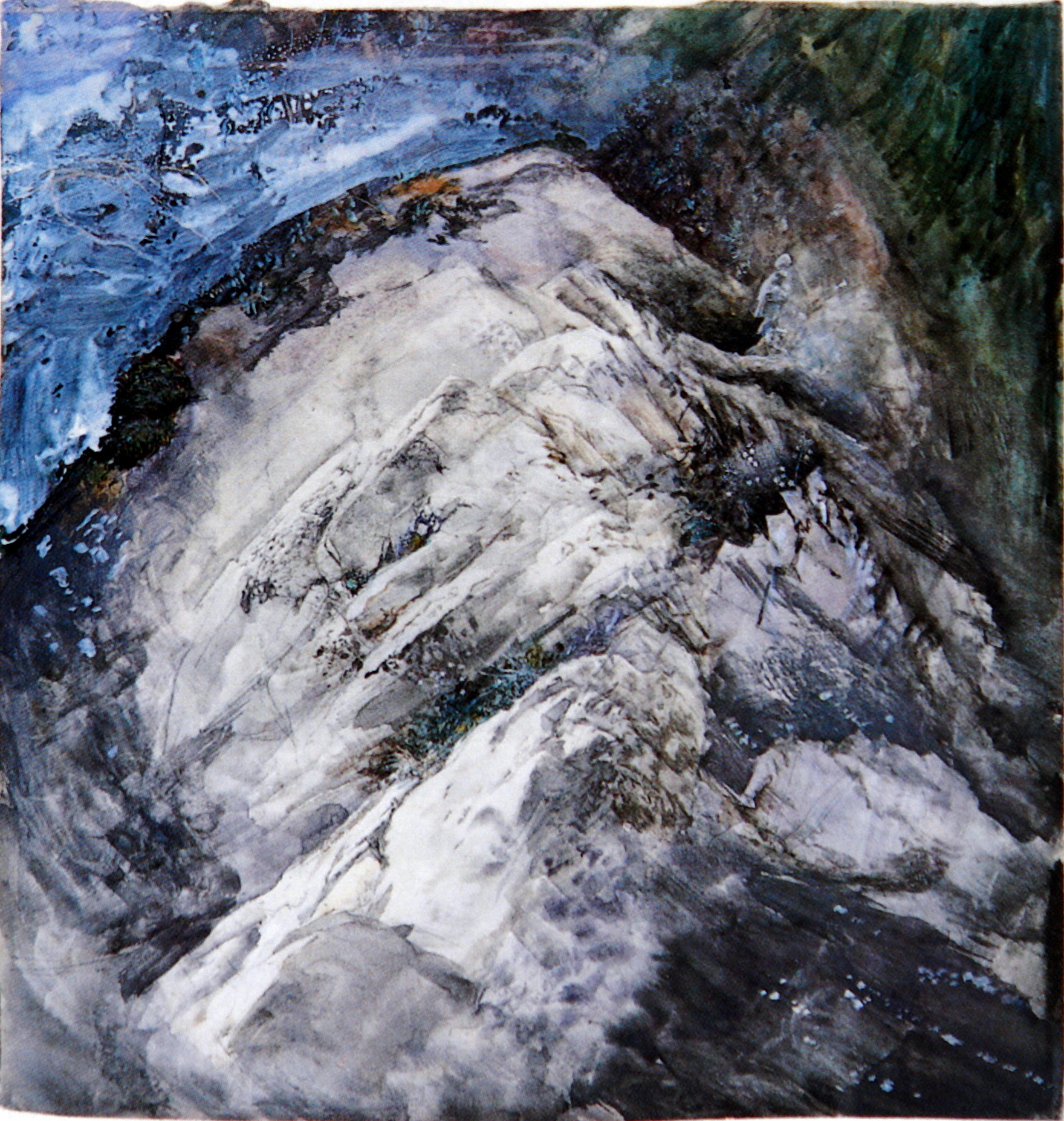
John Ruskin, View from my Window at Mornex, c. 1862-1863
Images from Wikimedia Commons

If you're in Edinburgh this summer you'll be able to see the National Gallery of Scotland's exhibition John Ruskin: Artist and Observer, an in depth look at his often-underrated paintings and drawings.  Gary Wills, writing in the New York Review of Books, puts their relative neglect down to the fact that Ruskin 'rarely completed pictures of a conventional sort', focusing instead on details and fragment, painting the landscape as he saw it rather than conjuring up sublime scenes or sentimental vignettes.  Wills regrets that the exhibition does not do more to acknowledge Ruskin's political interests: 'there are many drawings of Gothic architecture in the show—yet no mention of his connection between Gothic and workmen. There are obsessive tracings of sky and clouds—yet his ecological concerns for a coal-darkened England are nowhere mentioned.'  Instead, Ruskin's mental health and famously anguished attitude to women are foregrounded.  'His sexual repression is expressed, we are told, in compensatory fixations on mountain clefts and caverns as vaginas. Well, sure enough, there are some split rocks here—how could Ruskin have drawn hundreds of mountain scenes and avoided them?'

John Ruskin, Rocks and Vegetation, Chamonix, c. 1854
 
John Ruskin, The Casa d'Oro Venice, 1845
 
Looking to see what other reviewers in Canada made of it, I came upon the Ottawa Magazine, whose 'Artful Blogger' finds Ruskin's private life far more intriguing than his art and concludes with a reference to his 'steamy landscapes' in which there is a hidden sexual element.  Much more useful is a review on The Victorian Web, that venerable website which is clearly still putting up valuable and interesting material.  And the short video tour with curator Christopher Newall that I've embedded below is well worth a watch.  In it he describes Ruskin's fascination with the individuality and craftsmanship of the Byzantine capitals used in building St Mark's, and horror at plans to reconstruct the facade of the basilica, which were fortunately thwarted.  He talks about Ruskin's intricate sketch of glacial rocks in Scotland and his passion for stones in both architecture and landscape (Ruskin said that had he not discovered the art of Tintoretto, he would have written a book called The Stones of Chamonix).  He also refers to Ruskin's bipolarity, but in a way that illuminates the painting - a vivid sketch of winter sunset on the Venetian lagoon conveys the delight Ruskin clearly felt at the time, but writing later in his diary, Ruskin regretted that he had felt the beauty of the place so intensely that he was now 'suffering the consequences'.

Sunday, March 16, 2014

The Ice Palace


'How simple this novel is. How subtle. How strong. How unlike any other. It is unique. It is unforgettable. It is extraordinary.'  It would be hard to imagine higher praise than Doris Lessing's, writing thirty years after the publication in 1963 of Tarjei Vesaas' The Ice Palace (Is-Slottet).  I think it is a remarkable book and Lessing's review gives a clear account of why it is so memorable and moving.  The Norwegian winter landscape is integral to the plot, which Lessing partly summarises as follows: 'One little girl, the orphan Unn, has a secret, something terrible - we never know what it is - which she promises to tell her new friend Siss; but instead, the very day after the promise, she is impelled to explore the caves of a frozen waterfall, further and deeper into the shining heart of the ice ... There she dies. The whole community searches for her, and some even clamber over the surface of the frozen fall, but it is only her friend Siss who catches a glimpse of her, like an apparition inside the ice palace, looking out through the ice wall. In the spring the frozen river melts, and all is swept away in the floods, the secret too.'


The Ice Palace was recently turned into a ballet with music by Terje Isungset, whose ice music I described here in an earlier post.  A film adaptation was made in 1987, which someone has loaded in sections onto YouTube - the clip above shows Unn walking into the frozen waterfall.  I'll close here with a brief quotation from this moment in the novel, translated in 1966 by Elizabeth Rokkan.  'There was a ravine with steep sides; the sun would perhaps reach into it later, but now it was an ice-cold shadow.  Unn looked down into an enchanted world of small pinnacles, gables, frosted domes, soft curves and confused tracery.  All of it was ice, and the water spurted between, building it up continually.  Branches of the waterfall had been diverted and rushed into new channels, creating new forms.  Everything shone.  The sun had not yet come, but it shone ice-blue and green of itself, and deathly cold.'

Saturday, March 15, 2014

riverrun


We pass through grass behush the bush to. Whish! A gull. Gulls. Far calls. Coming, far! End here.
On the final page of Finnegans Wake, the River Liffey enters the ocean.  But the book is circular and its last words, spoken by Anna Livia Plurabelle, the personification of the river - 'A way a lone a last a loved a long the' - point back to its opening - 'riverrun, past Eve and Adam's, from swerve of shore to bend of bay, brings us by a commodius vicus of recirculation back to Howth Castle and Environs.'  I was listening to these words at the National Theatre last night in riverrun, a solo performance in which the Irish actor Olwen Fouéré embodies the voice of the river.  Based on the trailer (see above) I imagined this could involve riverine footage and field recordings, but there was just Fouéré and a microphone, carefully lit, with ambient sound designed to immerse you in the experience rather than signify flowing water directly.  Her extraordinary performance has received good write-ups (e.g. in the Telegraph and the Independent), although reviewers have been honest about the inaccessibility of the text - none has claimed to be able to follow exactly what they heard.

'A river is not a woman / ...  Any more than / A woman is a river', wrote Eavan Boland in 'Anna Liffey', a poem published in a collection twenty years ago.  'Anna Liffey' is the name the river has sometimes gone by, an anglicisation of Abhainn na Life.  'It rises in rush and ling heather and / Black peat and bracken and strengthens / To claim the city it narrated. / Swans. Steep falls. Small towns. / The smudged air and bridges of Dublin.'  One of these bridges is now called Anna Livia and the city has also recently acquired a James Joyce Bridge, facing the house where his story 'The Dead' was set.  In a park by the Liffey you can see a sculpture depicting Anna Livia Plurabelle.  She was originally sited on O'Connell Street with water flowing around her long limbs and became known as The Floozy in the Jacuzzi.  However, her presence was insufficient to turn the tide of economic decline and as part of a new plan to regenerate the street she was replaced by a millennium monument, The Spire of Dublin (aka The Stiletto in the Ghetto).  But as the city continues to change around it, the Liffey flows on, from swerve of shore to bend of bay, always back to the ocean.

Sunday, March 02, 2014

Like a crystal flood

The story of Acis and Galatea is rooted in the landscape of Sicily.  When the sea-nymph sees her lover killed by a great rock, thrown by the jealous Cyclops Polyphemus, she transforms his blood into the river Acis. Polyphemus tries to lure Galatea away from the sea with descriptions of life on the island.  'Here there are bays, and here slender cypresses, / Here is sombre ivy, and here the vine's sweet fruit / Here there is ice-cold water which dense-wooded Etna / Sends from its snows - a drink fit for the gods.'  These lines are given him by Theocritus in Idyll 11 (trans Anthony Verity), whilst in Virgil's ninth Eclogue the Cyclops tells her 'Coloured spring is here.  The river banks are spangled / with flowers of many hues.  Above my grotto a silvery / Poplar sways, and vines cast a shifting lace of shadow.' (trans. C. Day Lewis).

Nicholas Poussin, Landscape with Polyphemus, 1648

Landscape imagery is used in a different way in Ovid's Metamorphoses, where Polyphemus climbs to the apex of a hill on a spur jutting out into the sea and sings in praise of Galatea, listing her qualities in terms of the beauties of nature.  She is

whiter than the snowy columbine
a sweeter flower than any in the meadows 
taller and more stately than alder
more radiant than crystal
friskier than a tender kid
smoother than shells polished by the sea
more welcome than sun in winter or summer shade
more choice than apples
lovelier to see than the tall plane trees
more sparkling than ice
sweeter than ripe grapes
softer than swansdown or creamy cheese
fairer than a watered garden

But also

wilder than an untamed heifer
harder than an ancient oak
more treacherous than the sea
tougher than willow-twigs or white vine branches
as immovable as the rocks
more turbulent than a river
vainer than the much-praised peacock
fiercer than fire
harsher than harrows
more truculent than a pregnant bear
deafer than the waters
crueler than a trodden snake

What Polyphemus most regrets however, is her ability to outrun him, for she is 'swifter than the deer, driven by loud barking, swifter even than the winds, and the passing breeze'.

Claude Lorrain, Landscape with Acis and Galatea, 1657

As you can see above, Claude and Poussin both based beautiful paintings on the myth, one a view looking out to sea, the other looking back into the island's rocky interior.  Acis and Galatea are small figures in the foreground and Polyphemus is barely distinguishable from the landscape.  In Poussin's painting his back merges into the rocks where he sits, turned away from the lovers, playing his flute.  In Claude's, the Cyclops is barely visible - you can just glimpse him (right) sadly watching from the wooded slope, his view of the lovers obscured by the sheet they have put up to afford them some privacy.  Of course not all artists put emphasis on the landscape and Poussin himself did a version with additional cherubs and embracing lovers in which Polyphemus looks on like the sad guy at a particularly riotous party.


It was at a hunting party that Jean-Baptiste Lully's opera Acis et Galatée saw its first performance in 1686.  Elaborate artificial sets of the kind he had previously specialised in were no longer an option now that he was out of favour with Louis XIV (who had become increasingly religious and less tolerant of Lully's openly homosexual lifestyle).  It is tempting to imagine this being successfully performed with very little scenery, perhaps even outside amid 'natural' scenery.  After Lully there are a few more steps in the operatic story before we get to Handel's Acis and Galatea.  There was an English version by John Eccles and P.A. Motteux in 1701, which depressingly included 'a subplot concerned with the quarrel of rustic couple Roger and Joan, introduced to “make the piece the more dramatical.”'  Then came Giovanni Bononcini's Polyfemo (1702) and an Italian version by the young Handel himself, Aci, Galatea e Polifemo (1708).  Ten years later Handel had moved to England and was employed by James Brydges, 9th Baron Chandos, the 'Apollo of the Arts', and it was for him that Acis and Galatea, was composed, with a libretto by John Gay (aided by two more poets, John Hughes and Alexander Pope).


Acis and Galatea was first performed on a summer's day at Cannons, the house Brydges was then still building at vast expense (and which would be razed to the ground in 1747 when the family fortune gave out).   Pleasingly this does seem to have taken place in the open air, although The Grove Book of Operas is a bit sniffy about this 'local tradition', remarking that the discovery of piping to supply an old fountain "might fancifully be invoked as support".  If true, the audience would have been within earshot of the water features designed by John Theophilus Deaguliers, another remarkable individual patronised by Brydges, who combined the roles of local priest and hydraulic engineer.  Perhaps the sound of water would have been a constant reminder of Galatea, the sea nymph loved by both Acis and Polyphemus. At the end of the opera, as you can hear in the clip embedded below, when Galatea transforms Acis into a river, she sings
Heart, the seat of soft delight,
Be thou now a fountain bright!
Purple be no more thy blood,
Glide thou like a crystal flood.
Rock, thy hollow womb disclose!
The bubbling fountain, lo! it flows;
Through the plains he joys to rove,
Murm'ring still his gentle love.

Saturday, February 22, 2014

What soever delightfull view the Eye takes pleasure in

Paul Bril, Self-Portrait, c1595-1600
Source for images: Wikimedia Commons

Edward Norgate's Miniatura; or The Art of Limning, composed probably in the late 1620s and revised two years before his death in 1650, contains an interesting early account of landscape painting.  Landscape, he writes, is 'an Art soe new in England, and soe Lately come a shore, as all the Language within our fower Seas cannot find it a Name, but a borrowed one, and that from a people that are not great Lenders but upon good Securitie, the Dutch'.  And in addition to giving us the word 'landscape', the Dutch (Flemish) provided the best examples of this new kind of art: 'viz. Paulo Brill, a very rare Master in that Art, Liveing in Trinita del Monte in Rome and his Contemporary, Adam Elshamer, termed by the Italians Diavolo per gli cose piccole [a devil for little things], Momper, Bruegel, Coningslo, and last but not least Sir Peter Rubens, a Gentleman of great parts and abilities (over and above his Pencill) and knighted by the best of Kings or Men.'

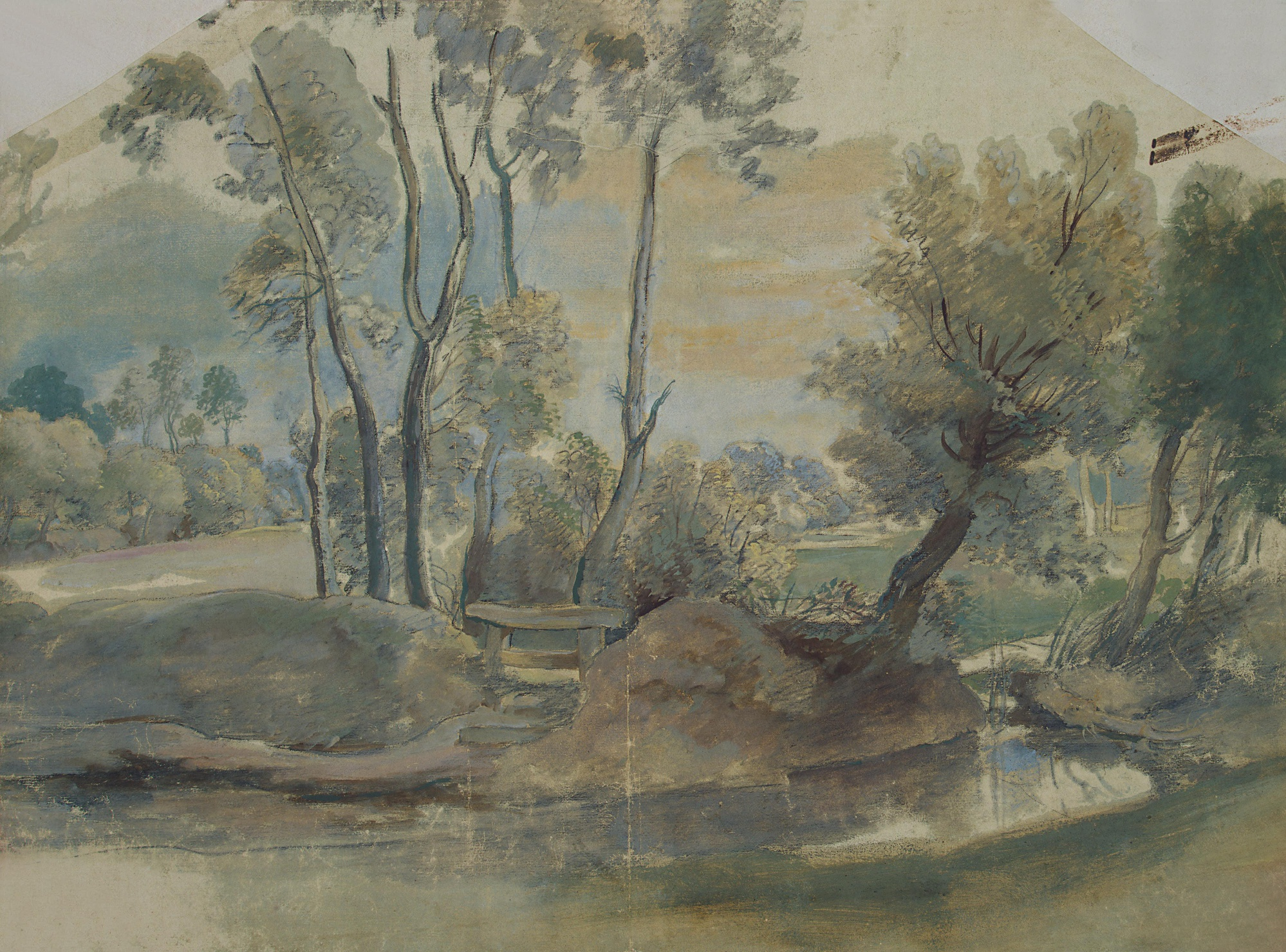
 Peter Paul Rubens, Landscape, c. 1635-40

Rubens was actually knighted twice, by both Philip IV of Spain and Charles I of England, but we can safely assume Norgate was referring to the latter since he was the King's adviser on art.  He started out as a calligrapher and limner and may have worked in the studio of Nicholas Hilliard.  Subsequently, as the editors of Art in Theory explain, 'he was to earn his living as a cultured civil servant' and became a herald at the College of Arms.  His knowledge of Flemish landscape painting would have come partly from visits to the Low Countries on behalf of the King and the Earl of Arundel, who were each building up great art collections.  Norgate defined 'landscape' as 'nothing but a picture of Gli belle Vedute, or beautifull prospect of Feilds, Cities, Rivers, Castles, Mountaines, Trees or what soever delightfull view the Eye takes pleasure in.'  The examples he gives suggest a taste for what later writers would see as aspects of the Sublime: inaccessible mountains, precipices and 'Torrents about the Alpes that with a roaring noise make hast to breake their necks from those fearfull Rocks into the Sea'.  In earlier times such scenes had been used only to set off the figures in history painting or in 'filling up the empty Corners'.  But this new art, though 'a Noveltie', was 'yet a good one, that to the Inventors and Professors hath brought honour and profit.' 

 Joos de Momper, Rocky Landscape, c 1610-30

I will conclude here with the story Norgate says he heard abroad about the creation of the very first independent landscape painting:
'A Gentleman of Antwerpe being a great Liefhebber [Lover of Art] returning from a long Journey he had made about the Countrey of Liege and Forrest of Ardenna, comes to visit his old friend, an ingenious painter of that Citie, whose House and Company he useually frequented. The Painter he finds at his Easill - at worke - which he very dilligently intends, while his newcome friend, walking by, recountes the adventures of his long Journey, and with all what Cities he saw, what beautiful prospects he beheld in a Country of a strange Scitiation, full of Alpine Rocks, old Castle, and extrordinary buildings &c. With which relation (growing long) the prompt and ready Painter was soe delighted as, unregarded by his walking friend, he layes by his worke, and on a new Table begins to paint what the other spake, describing his description in a more legible and lasting Character then the others words. In short, by that time the Gentleman had ended his long Discourse, the Painter had brought his worke to that perfecton, as the Gentleman at parting, by chance casting his eye that way, was astonisht with wonder, to see those places and that Countrey soe lively exprest by the Painter as if hee had seene with his eyes or bene his Companion in the Journey.'
Adam Elsheimer, Landscape with Wayfarer, unknown date

Friday, February 14, 2014

Cities express the human will

'And how can it be,' asked Georges Bataille, 'that a landscape, formed of interrelated appearances without any meaning, can, according to the position of the eye, in one place be empty and without charm, and in another be a breach opened upon a dazzling world?'  Patterns in nature - laws of affinity and contrast - are enough to distract us from the void.  Even cities, 'the expression of the human will, show the opposition of the noble world of rich stone monuments and the abject and wild world of the slums.'  When we see such contrasts of light and shadow it is impossible to imagine the world as empty. 'But the screen on which light and shadow are happily composed dissipates and is decomposed sometimes as quickly as a dream-image. Then apathy, apathy without a heart and without disgust takes hold of the space occupied by the will to live — hard and cold apathy which reduces fountains, summits and beautiful landscapes to what they are.'  In this state of realisation, a man 'looks at the world of illusions with slow anger. He shuts himself into an oppressive silence, and as he places his naked foot on the humid earth, feeling himself sinking into nature and being annihilated by it, it is with anguished joy.'

At the excellent Art Cornwall Site you can read the full translation by Patrick ffrench of Bataille's text, Le paysage (1938), along with a useful explanatory note.  In this piece, he writes, Bataille is suggesting that 'our projections of beauty or horror onto the landscape, which constitute what we think of as ‘landscape’, are necessary illusions, without which man confronts a world without meaning, which rejects him, as long as he does not consider himself part of it and destined to return to it. But this identification with the earth is also disallowed him, since his consciousness of the world forever separates him from it.'  And yet Bataille concludes that there is 'a joy in being subsumed by nature, which looks forward to the moment when the thin crust of human industry will be submerged under the rising oceans of the planet ... It is from the hypothesis of such a strange perspective that the fragile constructions man has erected on the surface of the earth can be looked upon now, with ‘slow anger’.' 

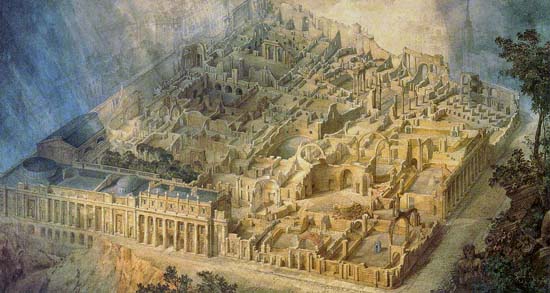
Joseph Gandy, The Bank of England as a ruin, 1830

The images we are seeing on the news of towns sinking under flood water certainly underline the fragility of our constructions.  Here in London the long rains have left us largely unaffected, but the constant ebb and flow of people and the ever-changing cityscape make it feel like a 'world of illusions', built on shifting power relations and unseen channels of commerce rather than solid ground.  There is a poem by Allen Fisher called 'After Georges Bataille's 'Landscape'' in his book 'Becoming' (part of the Place sequence which he worked on throughout the 1970s).  It begins with a version of the words I quote above - 'Cities express the human will' - and describes London's transformation into the Bank of the World, its pursuit of money and the extraction of profit ('it pays / to cyanide gold').  All this activity leaves us with a greater loss, of 'love, / work and knowledge / in the light without shade.'  Whilst Bataille ends his text with a man feeling himself sinking into nature, Fisher's poem closes with the image of 'a concrete that separates city from land / laid by men unaware they will soon not breathe.'

Friday, February 07, 2014

Sea of Ink

Bada Shanren, Fish and rocks, 1696

In Meer der Tusche (2005), Swiss writer Richard Weihe tells in 51 short chapters the life story of the great seventeenth century Chinese painter Bada Shanren.  Sea of Ink, an English translation by James Bulloch, is available from Peirene Press, a recently established 'boutique publishing house' that runs literary salons in north London.  In the Peirene Experience clip below you can see Weihe talking about one particular incident in the childhood of Zhu Da (Bada Shanren, 'man on the mountain of the eight compass points', was one of the many names he assumed in later life).  Zhu's father, also an artist, 'made him step barefoot into a bowl full of ink and then walk along the length of a roll of paper.  To begin with, Zhu's footprints were wet and black; with each step they became lighter until they were barely visible any more.'  This reminded me of the Bada Shanren scroll I mentioned here last year, and naturally too of Richard Long.  Next to Zhu's footprints his father wrote these words: 'A small segment of the long path of my son Zhu Da.  And further down: A path comes into existence by being walked on.'


Sea of Ink is punctuated with vivid descriptions of the artist creating his work, the paintings emerging as a short sequence of inspired brushstrokes.  We read about the composition of Fish and Rocks (above) for example, whilst Bada Shanren is living alone on the shore of a lake.  It is a work that the Met website describes as 'profoundly unsettling. Were it not for seven tiny fish that swim beneath the two rock forms, transforming the blank paper into a body of water, the image would be unrecognisable. Six of the fish are shown in profile, but the seventh appears as if seen from above, leaving the viewer disoriented; the absence of a horizon line adds to the unsettling effect.'  In Sea of Ink, Bada hangs this finished work from his ceiling beams and watches as a gust of wind catches it, so that the fish seem to be floating in the air.

A few years later Bada was returning in the rain to his fisherman's hut when he senses his life fading away.  Wiehle imagines him looking at the view that will become Landscape with hut (1699): 'Was it the trees dripping in the mist which made the world appear like that, or was it the tears in his eyes?  No sooner was he back in his abode than he took a large piece of paper and wiped it with the wet sleeve of his robe.  He hurriedly poured water into the rubbing stone and prepared the ink...'  First, he described his hut in seven vertical and diagonal strokes.  Then he took a new brush with cropped bristles and transformed the damp paper into a landscape of half seen hills.  The small solitary house had the appearance of having turned its back to the world.  'Fine streams of ink ran down the mountain; indeed the entire mountain seemed to flow away as if it were nothing more than a large wound of the world.'

Friday, January 31, 2014

Watching a herd of grazing cows

 Frederik de Moucheron, Mountain Scene with Herd of Cattle, second half of the 17th century

In the course of one of those long conversations in Robert Musil's The Man without Qualities, Ulrich tries to convince his sister Agathe that a profound mystical experience can be had whilst "sitting on a fallen tree or a bench in the mountains, watching a herd of grazing cows."  But, he cautions, "what's normal is that a herd of cattle means nothing to us but grazing beef.  Or else a subject for a painting, with background.  Or it barely registers at all."  Our minds tend to focus on merely practical questions and minor deliberations - we don't see the paper, only the calculations that appear on it.  Agathe interrupts him: "And suddenly the paper tears!"  When this happens the landscape is no longer paintable and the pictorial plane becomes, in Ulrich's words, "an ocean swell of sensations ... everything somehow flows over into you, all boundaries gone."

From there the conversation turns away from the imaginary view to consider broader questions on the nature of goodness and love.  But a few pages later (page 833 of the Sophie Wilkins and Burton Pike translation), Ulrich turns the conversation back to those cows and asks Agathe to imagine "some high bureaucrat" sitting there (I meet a lot of high bureaucrats in my work so can imagine the scene).  "When he looks at the herd of cows he neither counts them, classifies them, nor estimates the weight on the hoof of the animals grazing before him; he forgives his enemies and thinks indulgently of his family."  But regrettably such a feeling only lasts as long as his vacation.  "Mysticism, on the other hand, would be connected with the intention of going on vacation permanently.  Our high official is bound to regard such an idea as disgraceful and instantly feel - as in fact he always does towards the end of his vacation - that real life lies in his tidy office.  And do we feel any differently?" Ulrich is a scientist and sceptical by nature, but concludes that even religious people "are so infected with the scientific way of thinking that they don't trust themselves to look into what is burning in their innermost hearts..."

Sunday, January 26, 2014

Soft Estate


I mentioned Edward Chell's art of the motorway verges in an earlier post on Paul Farley and Michael Symmons Roberts' book Edgelands.  Since then he has had an AHRC grant to make new work and research the parallels between motorway design and historic theories of landscape appreciation. Edward has kindly sent me a copy of the resulting book, Soft Estate, handsomely produced by The Bluecoat gallery in Liverpool, where his paintings and sculptures have been exhibited alongside work by ten other contemporary artists of the edgelands.  His own work focuses on the plants to be found in this 'soft estate', the name given by the Highway Agency to the 22,000 hectares of land it manages as part of the national system of motorways and trunk roads.  Silhouettes of thistle and hairy bittercress, buttercup and dandelion, lady's bedstraw and yellow rocket are printed on paper in a mixture of ink and road dust, or onto blue reflective aluminium panels resembling roadsigns.  There is a sad sense of isolation in these monochrome images, abstracted from photographs of plants that are growing in places nobody visits.  Some of them are coated in lacquer and would resemble pressed flowers except that they are painted in black, like shadows or carbon traces.

 Edward Chell, Yellow Rocket or winter cress Barbarea vulgaris, 2013

In the book's main essay, Edward describes efforts made over the years to landscape the motorway network and quotes the official Design Manual for Roads and Bridges encouraging 'visual variety' in a tone reminiscent of the original Picturesque theorists.  Nearly 10 million trees and shrubs were planted in the decade up to 1974 are now maturing and the wild grass areas have been left to evolve in their own way.  There is an interesting contrast here with the tidier appearance of French motorways, reflecting national differences in landscape design that have been apparent for over three hundred years.  Soft Estate also contains an essay by Richard Mabey, author of The Unofficial Countryside and Weeds, who describes the way various plants (including the wild daffodils celebrated by Wordsworth) have colonised the motorway cuttings and verges.  Back in the early eighties Mabey actually wrote a Motorway Nature Trail, sponsored jointly by the Nature Conservancy Council and Gulf Oil.  'I'm still unsure whether I ought to feel embarrassed about this.  It happened before carbon emissions became the critical issue they are today, but I was still giving my backing to a resource-guzzling and polluting car culture.'  The rationale at the time was that passengers would get something out of a guide to the ecology of the regions through which their car was passing.  Even so, looking back, he finds it surprising that nobody felt it worth emphasising that this was not something the driver should be concentrating on: 'the programme of peripheral observation it outlines, downloaded into a driver's brain, could be as distracting as a mobile phone conversation.'

I should probably admit that as a very infrequent and unconfident driver myself I have always avoided motorways.  They seem to me a kind of inverse of the Sublime - instead of viewing an awesome natural phenomenon from a place of safety, you pass through miles of banal terrain whilst having to safely negotiate the torrents of cars and looming juggernauts.  Everything seems to conspire against aesthetic pleasure in the environment, from the constant pressure to keep up speed to the need to seal yourself in from the wind and noise.  I wonder how different the motorway would feel if you had it all to yourself and could concentrate on the experience of the unfolding roadscape.  In his essay, Edward mentions a formative childhood incident: 'I secretly rode my Raleigh on the M62 after it was constructed across the Pennines at Outlane near Huddersfield but before it was open to the public.'  It sounds like Wordsworth's 'act of stealth / And troubled pleasure' in stealing a boat to row out onto a lake, as recollected in The Prelude.  I am reminded too Tony Smith's much discussed account of the moment when he realised that traditional art could not compete with the feeling of driving along the unfinished New Jersey Turnpike, a text that became central to debates about the future of art in the late sixties.

Nothing can be appreciated from a motorway that cannot be taken in at speed.  The individual plants that Edward paints are never glimpsed, unless traffic grinds to an unscheduled halt.  However, as Richard Mabey argues, the fact that they are there is important, 'and enough have grown into significant features to become part of the foreground of the motorway landscape.'  He ends his essay with a description of the way Danish scurvy grass began to appear along the edges of roads thirty years ago.  'There are many reasons for the plant's spread throughout the UK road system - the turbulent slipstream of traffic whirling the seeds along; the similarity between its native strandline habitat and the stone edges of the road.  But there is little doubt that the major factor is the saltiness of the modern road - that shoreline tang sprayed from gritting lorries on icy evenings even in the landlocked heart of Britain.  Seen close to, Danish scurvy grass is an undistinguished plant.  Streamed by at speed, it is a ribbon of dazzling white at the motorway's edge, a traveller's joy.' 

Saturday, January 18, 2014

Out of Ice


Last Saturday The Independent had an 'In the Studio' feature on Scottish environmental artist Elizabeth Ogilvie and found her 'experimenting with blocks of melting ice suspended over a small pool, to be shown near to projections of glaciers in her forthcoming show.'  Today we went to see this exhibition, Out of Ice, and spent some time watching the dripping ice, lit by theatre lights so as to create beautiful ripples and waves on the surrounding walls (as you can see from my photographs below).  By this afternoon there were only a few of these blocks left unmelted and two actually splashed down into the water whilst we were there (when I heard the first one go behind me, I looked back expecting to see one of our sons in the water...)  The exhibition also includes footage on four screens of Inuits the artist met on a trip to Northern Greenland, talking about the impact of climate change.  Under the circumstances these were a bit harder to engage with - it was actually difficult to drag ourselves away from the main installation as we waited in hope of another block falling.  I found myself thinking that there must be a sad beauty in the way ice is changing as it retreats, in spite of the environmental damage it signifies.


Another reason to visit today was an enjoyable wind drawing workshop for kids, run by Katie Fowlie with Jacob Bee and Rob St. John (whose music I have referred to here before).  Sadly it was confined to the interior of the exhibition space, underneath the University of Westminster, and so wind had to be generated by vigorous use of a fan.  This resulted in a kind of expressionist action drawing which it would be interesting to compare to something generated by the swirls and eddies of 'real' breezes. I had thought we might be using contraptions like Chris Welsby's Wind Vane, only with pens and paper rather than a film camera.  In fact various types of writing sculpture had been built and our boys both went for a feather-based approach.  It inspired me to to try something similar outdoors next time we all go to Epping Forest, although as we left the boys were more interested in building a recreation of Elizabeth Ogilvie's installation, with slowly melting ice cubes suspended over a tray of water.

Friday, January 17, 2014

Koyaanisqatsi

If we associate landscape with slow cinema it is partly because we are used to seeing scenery framed statically, like a photograph, focusing our attention on small movements or gradual change.  Speeding things up by using time-lapse photography would feel inauthentic, like nature on fast forward, a concession to our diminishing attention spans.  We have all now seen footage of clouds chasing over a landscape or a city of lights flickering off and on as day follows night, they have become visual clichés.  And yet I wonder if there are still unexplored possibilities in what may seem a rather over-used technique?  There are certainly moments in Godfrey Reggio's Koyaanisqatsi, filmed in the late seventies and released in 1982, that still look extraordinary.  Every kind of sublime is explored - natural, industrial, digital - and time-lapse sequences include shadows lengthening over a desert wilderness, rivers of cars heading into Los Angeles and the constant motion of factory production lines.  I think it would be interesting to see similar techniques deployed more often on a modest scale by contemporary landscape filmmakers (see for example my earlier post on Jeffrey Blondes' Length of Days).  


Koyaanisqatsi may be best known for its Philip Glass score (at the time minimalism and time-lapse must have felt right together as Michael Nyman composed a piece called 'Time Lapse' for Peter Greenaway's A Zed & Two Noughts).  Glass's music for Reggio captured 'both the calm of nature and the ferocity of technology run amok', as K. Robert Schwarz writes in his book on the minimalist composers.  However, their sequel Powaqqatsi (which I've not seen) was less successful according to Schwarz - 'a simplistic comparison of idealized third-world agrarian societies with dehumanized Western urban ones, accompanied by a score overburdened with exotic instruments of every variety'. Glass and Reggio have recently collaborated again on a film called Visitors.  Introducing this in September at the Toronto International Film Festival, Steven Soderbergh said (according to Filmmaker Magazine) that “if, 500 years ago, monks could sit on a beach and make a movie, this is what it would look like.”  Meanwhile the Philip Glass title music for Koyaanisqatsi was used in the opening sequence of another film released last year: Alan Partridge: Alpha Papa.

Friday, January 10, 2014

A cold coming


John Akomfrah's film The Nine Muses (2010) is a poetic essay film on the immigrant experience, based on archival documentary footage and structured around The Odyssey and the muses of Greek mythology.  The reason I'm writing about it here is that it also includes, as Peter Bradshaw put it in The Guardian, 'mysterious images of people in different coloured coats with their back to the camera, in stark and snowy Alaskan landscapes: I wondered if he intended an allusion to Caspar David Friedrich's painting Wanderer above the Sea of Fog.'  I wondered this too - it is hard to tell precisely what these beautifully shot landscape sequences are for and I was expecting some more direct connection to be made (perhaps at the end) with the disorientation and dehumanising solitude of the immigrant.  The DVD we watched had an interview with Akmofrah but he makes no mention in it of these Alaskan landscape scenes.

Looking now online I have come across a Press Pack with an interview in which Akomfrah explains that in 2009 he had gone to Alaska to do a film about the Exxon Valdez Oil Spill for the BBC.  'And I fell in love with the place. So the bulk of this stuff came from Cordova, Anchorage.'  But he also says that 'what I wanted to do initially was a piece on T.S. Eliot's The Wasteland. That's what I shot the material for.'  So the landscape element of The Nine Muses was not filmed with the subject of immigration in mind.  Some viewers are therefore likely to find, like the Telegraphs's critic, that 'Akomfrah’s staged wanderings around chilly Alaskan landscapes' unsuccessfully integrated with the rest of the material.  On reflection I thought they worked surprisingly well, partly as a result of Trevor Mathison's impressive sound design.  In some ways though, the film's most interesting landscapes were those glimpsed in the old black and white footage of 1950s Britain - a kind of wasteland of dingy shopping streets, back-to-back terraces, bare trees and grey winter roads on which the snow seems unable to settle.

Friday, January 03, 2014

The Forest's Song


I was hoping to interest the family in a trip to Epping Forest today for a bit of new year Shinrin-yoku (restorative 'forest bathing'), but the heavy rain and fierce wind have put us all off. Instead I have been reading We Own the Forest and Other Poems by Hans Børli (1918-89), the Norwegian woodsman who spent his days as a lumberjack and put down his poems 'at night while the other forest workers slept, exhausted after a hard day's work.'  He wrote one entitled 'I Like Bad Weather', seeing it as a release or as a kind of forgetting: rain, like tears, drumming on the birch bark roof of a hay barn whilst the forest drifts in grey mist. In other poems like 'The Forest's Song', 'Have You Listened to the Rivers in the Night?' and 'The Forest Rustling' he conveys a sense of the truth and beauty to be found among the trees. Børli also wrote political poems: 'I have never owned a tree', he says in 'We Own the Forests', and those who do, rich men with their 'stock in Borregaard timber company ... can't buy the sunset / or the whisper of the wind / or the joy of walking homeward / when the heather blooms along the path.'


In his introduction to the book, translator Louis Muinzer wrote of being encouraged in his task by the Finnskogen singer-composer Sinikka Langeland, who asked for some English versions of the poems she had set to music.  I have embedded one of these from YouTube above - 'Langt innpå skoga' ('Deep in the woods').  In 2007 ECM released her collection of Børli songs, Starflowers - translations of the poems she used can be read on the blog That's How the Light Get's In.  They give a sense of the landscape Børli experienced, resting in the quiet of night when 'starlight smells of fallen snow': the softly swinging sprigs of pine, mist resting white above the brook beds, the sound of rivers that give the impression that 'your soul is mysteriously remembering its future'There we can imagine him finally closing his eyes on the forest and falling asleep, only to find that 'the dream is a tree that grows upside down', its roots among the stars,
while its crown spreads out its branches as
a resting place for the birds
in the boundless spaces of the human heart

Wednesday, January 01, 2014

Our level pastures

Paul Nash, The Rye Marshes (1932) as a Shell Poster

A pretty miserable rainy day so we went this afternoon down to the London Museum and on our way popped into the Whitechapel Gallery to have a look at 'East Coast: Damn Braces: Bless Relaxes'.  This is a small assemblage of artworks relating to landscape and the politics of place on the East Coast of England, ranging from the watercolours and sketches of the Norwich School to the activities of artists associated with the Humberside College of Art in Hull during the 1990s.  I was pleased but a bit surprised to see Paul Nash's The Rye Marshes, until I reflected that Rye is at the point where the South Coast starts to bend into the East Coast (and the painting itself is normally in Hull, at the Ferens Art Gallery).  I was reminded a bit of Patrick Keiller's recent exhibition at Tate Britain: works have been selected not for their own sake but to illustrate or hint at historical and contemporary questions of land use and ownership.  A small pencil drawing by Cotman, for example, has been chosen because it shows Kett's Castle (Robert Kett led a rebellion against enclosure in 1549 and was captured, held in the Tower and then hanged from the walls of Norwich Castle).  Cotman also painted a view of Mousehold Heath, in which a small area of the common land can be seen enclosed and ploughed up.

The pleasure in curating an exhibition like this must come in making links across time and different media (as I often try to do here).  So, opposite the Cotman are two paintings by Peter De Wint showing the Lincolnshire Wolds at the time of the early nineteenth century enclosures.  Printed next to them on the wall is a poem by that great champion of the commons, John Clare, praising De Wint for his unassuming subject matter: 'No rocks, nor mountains, as the rich sublime, / Hath made thee famous; but the sunny truth / Of Nature, that doth mark thee for all time, / Found on our level pastures: spots, forsooth, /Where common skill sees nothing deemed divine.'  In a case in front of the De Wints is the notebook of another poet, Alfred Tennyson, opened to the lines of 'In Memoriam' in which he writes of finding 'no place that does not breathe / Some gracious memory of my friend ... No gray old grange, or lonely fold, / Or low morass and whispering reed, / Or simple stile from mead to mead, / Or sheepwalk up the windy wold.'  The landscape here again is Lincolnshire, where Tennyson grew up and later spent time with Arthur Hallam, and where, in 1833, he received the letter telling him that his friend had died suddenly of a stroke at the age of 22.

Thursday, December 26, 2013

Three-Mountain Pass


'Autumn Landscape'
A sample page from Spring Essence: The Poetry of Hồ Xuân Hương 
made available on translator John Balaban's website.

When the Copper Canyon Press published Spring Essence: The Poetry of Hồ Xuân Hương, the New York Times discussed it in its Technology section.  'A nearly extinct ideographic script known as Nôm, similar to Chinese but representing Vietnamese, was painstakingly put into a computer program, and thus did the works of Hồ arrive in Western bookstores. Considered one of Vietnam's greatest poets, Hồ was born in the late 1700's and wrote with unusual irreverence and shockingly erotic undertones for her time.  Hồ's work really ''jumped from woodcut to digitization, skipping the whole Gutenberg process,'' said John Balaban, the North Carolina poet who translated her folk poems and helped oversee their presentation in the strikingly designed book. Each poem is presented in three versions, across facing pages: in the original Nôm, in modern romanized Vietnamese, and in English.'  One of these is shown above; another translation is reprinted in full at the Smith College Poetry Center site, so hopefully it is OK to include it here:
Three-Mountain Pass
A cliff face. Another. And still a third.
Who was so skilled to carve this craggy scene:

the cavern’s red door, the ridge’s narrow cleft,
the black knoll bearded with little mosses?

A twisting pine bough plunges in the wind,
showering a willow’s leaves with glistening drops.

Gentlemen, lords, who could refuse, though weary
and shaky in his knees, to mount once more?
At first site this is a simple landscape poem but as the New York Times notes, Hồ's poems tend to have 'shockingly erotic undertones'.  This is partly facilitated by the tonal nature of Vietnamese - words can take on second meanings depending merely on the pitch of each syllable.  In John Balaban's notes to accompany 'Three-Mountain Pass', he says that Maurice Durand, a French-Vietnamese scholar whose edition of  Hồ's poems remained incomplete at his death in 1966, thought that the poem probably describes the Đèo Tam Điệp mountains, 'but, he adds innocently, "l'on n'a pas de grotte avec une grande ouverture."  While an actual landscape may have suggested this poem ... the particular contours, the active pine and willow constitute a sexual landscape as well. Pines traditionally stand for men; willows for women.'  'Three-Mountain Pass' is about the compulsion to explore both the landscape and the body - perhaps, it suggests, the differences are no more than a matter of tone.

Monday, December 23, 2013

Sketch of Anacapa Island

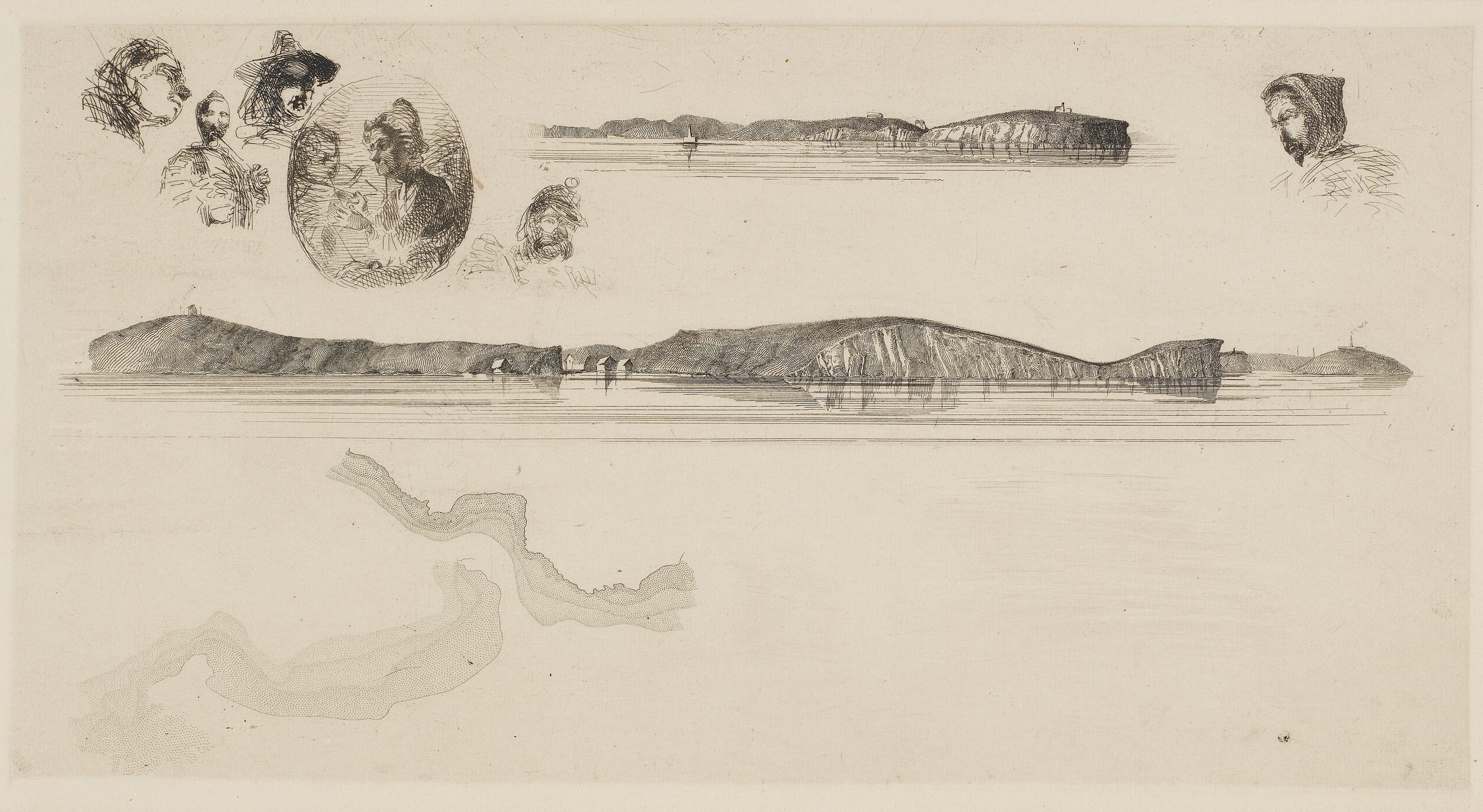
James McNeill Whistler, Sketch of Anacapa Island, 1854

It could be said that we owe those vivid etchings currently on display in the Dulwich Picture Gallery's exhibition Whistler and The Thames to the United States Coast Survey, who employed the young artist as a draftsman on $1.50 a day for two months in the winter of 1854-5.  It was there that he made his first etching under the eye of a 'kindly, genial Irishman' Mr McCoy, as John Ross Key another young artist employed by the Survey recalled years later.  Whistler at that time 'was a slender young man of medium height, with dark, curly hair and a small mustache. A Scotch cap was set well forward over his eyes, and he wore a shawl of dark-blue and green plaid thrown over his shoulders, as was the fashion of the day. He was assigned to a room on the third floor, adjoining the one where I was employed as a draftsman, and we soon became good friends. It was reported about the office that Whistler had been at West Point, and that his disinclination to obey rules, chief of which had been his lack of promptness, had led to his retirement.'  Whistler did not readily appreciate the drier aspects of his new work and so 'when, after many trials, it was plain that he would not take to map-drawing, it was suggested that he might etch the little views of entrances to harbors that were then engraved upon the lower part of coast-maps' (Recollections of Whistler, Century Magazine, April 1908).

Key describes Whistler's first experiment in etching.  'I watched him with unabated interest from the moment he began his work until he completed it, which took a day or two.  At intervals, while doing the topographical view, he paused to sketch on the upper part of the plate, the vignette of "Mrs. Partington" and "Ike," a soldier's head, a suggestion of a portrait of himself as a Spanish hidalgo, and other bits, which are the charm of the work.'  These characters, contrasting oddly with the precise landscape below them, were drawn from a humorous story by Benjamin Penhallow Shillaber, the Life and Sayings of Mrs Partington (1854).  'I have heard it stated that he lost his position because of the drawings on this plate, but there is no foundation for this report. As I have explained, this plate was merely an experiment, intended as such.'  Key later found this plate and kept it, intending to return it to Whistler when he was in London, but they never managed to meet again.  The rocky coastline with its doodled characters can be seen in engravings made from this plate; the other sketch surviving from Whistler's time with the survey, showing Anacapa Island, is reproduced above. 

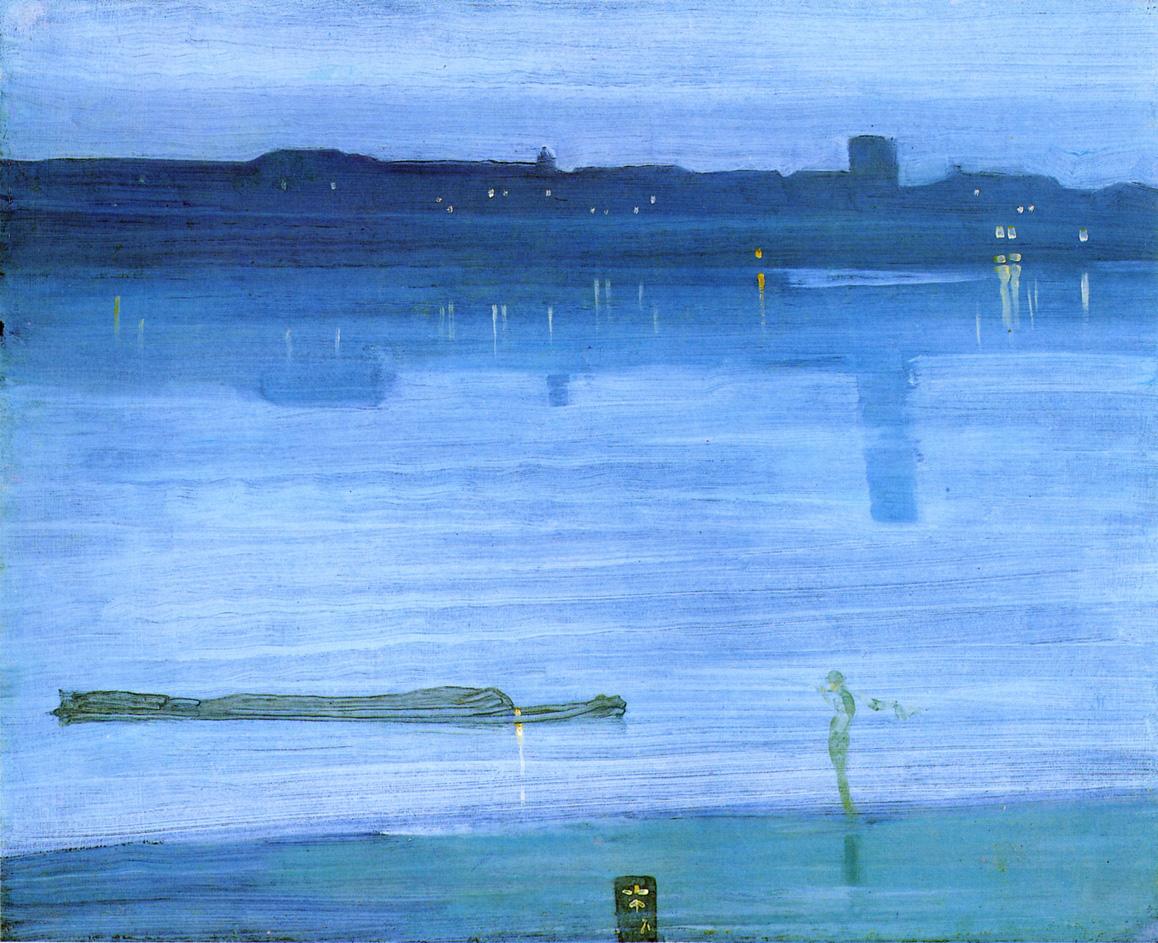
Key's recollections of Whistler are disappointingly short of good anecdotes.  'He had no bad habits, and did not smoke. His manners were quiet and sedate ... and he was not interested in young ladies.'  His evident facility in portraying coastal features was not motivated by an enthusiasm to explore and understand the surrounding landscape.  It is easy to imagine here the future painter of Nocturnes, exercises in atmosphere and colour inspired more by the Japanese prints in Whistler's room than the precise topography of the river outside.  Key remembered that 'one of the draftsmen, an old Englishman, was then in the habit of taking long walks to sketch the woods and to fish in the streams near the city. I often went with him, and did my best to persuade Whistler to join us, but he could not be induced to make the exertion. He was the most indolent young man I have ever known.'

James McNeill Whistler, Nocturne in Blue and Silver: Chelsea, 1871

Friday, December 20, 2013

Where sea-grass tangles with shore-grass

The hard sand breaks,
And the grains of it
Are clear as wine.
Far off over the leagues of it,
The wind,       
Playing on the wide shore,
Piles little ridges,
And the great waves
Break over it.

These are the opening lines of H.D.'s poem 'Hermes of the Ways', which was published in Ezra Pound's anthology Des Imagistes almost a hundred years ago.  It was one of the poems Pound had been shown in 1912 by the 'ardent young Hellenists', H.D. and Richard Aldington and which he sent in to Harriet Monroe's Poetry.  It was, he thought, "objective - no slither - direct - no excess of adjectives. etc.  No metaphors that won't permit examination. - It's straight talk - straight as the Greek!"  In The Pound Era Hugh Kenner describes the first three lines of this poem: 'perception slides over perception, each line the natural unit of the process ... one line of statement, its narrative implication (feet crushing salty dried shore) compressed to the uttermost; one line of microscopic attention, discerning the grains; one line of arresting comparison, casual and evaluative (like wine, this shore is welcome; like sand, the benison is equivocal).'

Hermes, Orator - Roman copy from the late 1st century CE-early 2nd century CE
 after a Greek original of the 5th century BC

In H.D.'s poem a statue of Hermes - the god of travellers, transitions and boundaries - stands 'where sea-grass tangles with / shore-grass.'  Nearby there is an orchard with twisted trees and small hard apples ripened late by 'a desperate sun / that struggles through sea-mist.'  The statue 'fronts the great dunes' where the wind rushes through coarse grass, crusted in salt.  A small white stream flows underground from a poplar-shaded hill and emerges on the sands.  'Hermes of the Ways' (as you can see at the Modernist Journals Project site) was published in the January 1913 edition of Poetry under the title 'Verses, Translations and Reflections from 'The Anthology''.  This is a reference to The Greek Anthology which has a group of epigrams by Anyte, including the one that H.D. adapted and expanded for her poem.  This prose translation of Anyte's poem is by Richard Aldington and was first published in 1915:


HERMES OF THE WAYS

I, Hermes, stand here at the cross-roads by the wind-beaten orchard, near the hoary-grey coast;
And I keep a resting-place for weary men. And the cool stainless spring gushes out.


Anyte of Tegea lived in Arcadia in the early third century BCE.  She seems to have been, as it says in my Penguin edition of The Greek Anthology, 'the first poet to write epitaphs on animals, and to introduce bucolic themes into epigram.'  Her epigram 'Hermes of the Ways' interests me both as a condensed landscape poem (orchard, coast and spring) and as the evocation of a landscape sculpture.  Another (given in Aldington's translation below) provides a contrasting image of a statue by the sea. In poems like this, Marylin B. Skinner has suggested that Anyte offers an 'introspective' approach to ekphrasis, in contrast to male poets' detached way of reporting a visual experience (see 'Ladies' Day at the Art Institute: Theocritus, Herodas and the Gendered Gaze'). 'Aphrodite's benevolent mood is mirrored in the translucent expanse of water viewed from her headland and transmuted into concern for the mariners she beholds from afar. In the third line, there is an abrupt switch in perspective to the reverent tremor of the water as it, in turn, observes the goddess' glistening statue.'


ENGRAVED ON A STATUE OF APHRODITE

This is the land of Kypris, since it pleases her to gaze for ever from land over the glittering sea.
So that she may bear the sailors safe to land; and the sea quivers, looking upon her shining image.


The Cyprus Mail reported earlier this year on plans to build a four-metre tall bronze statue of Aphrodite on a rock in the sea. Ten years ago a more controversial proposal for a hundred-foot statue based on Botticelli's Venus was stopped. 'Artists and environmentalists branded published photographs as ‘ugly’, and reminiscent of Hollywood and Las Vegas kitsch.  One artist said it looked like a cake.  The Chamber of Fine Arts (EKATE) said the idea of a Statue of Liberty sized goddess of love was “base, barbaric, morbid, bizarre, provocative, flashy, grotesque, monstrous, out of proportion, over the top, tacky, cheap, pointless and offensive”'.  Planning for the new project is in its early stages so it is not yet clear whether this bronze Aphrodite will one day be gazing over the glittering sea.  There are no such statues of gods in the other two 'landscape poems' of Anyte that survive in The Greek Anthology: just trees and spring waters and a cool breeze.  I think Ezra Pound's advice to poets in 'A Few Don'ts By an Imagiste', written for the March 1913 edition of Poetry, should be heeded by all those commissioning public artworks: 'Use either no ornament or good ornament'. 


TO A GIRL

Sit beneath the beautiful leaves of this laurel, and draw the sweet water from the fresh spring:
You are breathless from the heat; rest your dear limbs and let the breath of Zephyros touch them.


FOR A FOUNTAIN

O wanderer, rest your tired limbs under this elm; the breeze murmurs in the light-green branches. Drink a cool draught from the spring. This resting place is dear to wayfarers in the hot summer. 

Saturday, December 14, 2013

A landscape built of pure life

Among the Convolutes of Walter Benjamin's Arcades Project (translated by Howard Eiland and Kevin MacLoughlin), one section is devoted to 'Ancient Paris, Catacombs, Demolitions, Decline of Paris.'  There, Benjamin observes that 'few things in the history of humanity are as well known to us as the history of Paris':
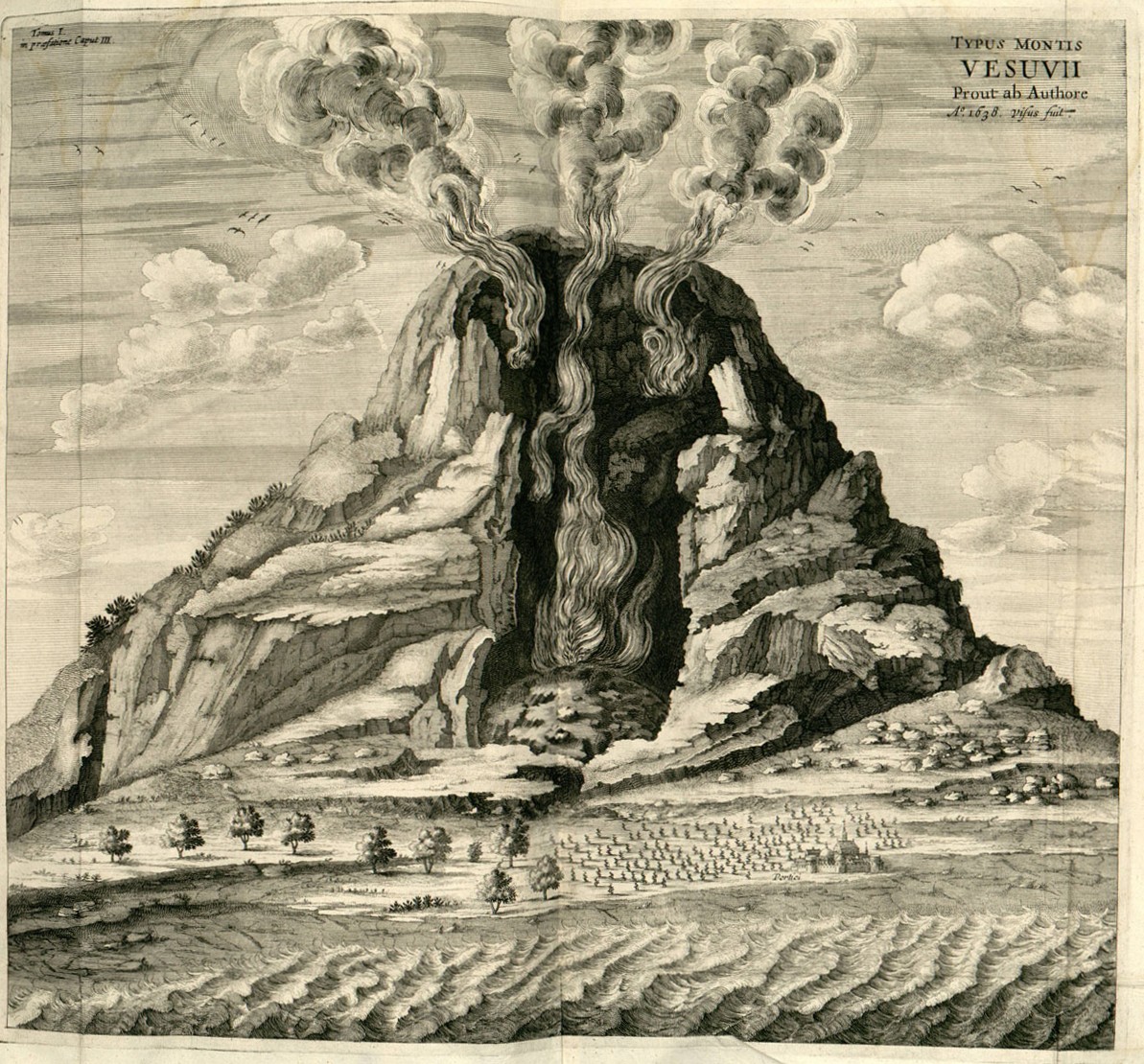
'Many of the main thoroughfares have their own special literature, and we possess written accounts of thousands of the most inconspicuous houses.  In a beautiful turn of phrase, Hugo von Hofmannsthal called [this city] 'a landscape built of pure life:' And at work in the attraction it exercises on people is the kind of beauty that is proper to great landscapes - more precisely, to volcanic landscapes.  Paris is a counterpart in the social order to what Vesuvius is in the geographic order: a menacing, hazardous massif, an ever-active hotbed of revolution.  But just as the slopes of Vesuvius, thanks to the layers of lava that cover them, have been transformed into paradisal orchards, so the lava of revolutions provides uniquely fertile ground for the blossoming of art, festivity, fashion.'

Vesuvius, from Mundus Subterraneus by Athanasius Kircher, 1664

Wednesday, December 11, 2013

Field of Reeds


This is my annual post on landscape music - the earlier ones (with apologies for a few dead links now) are here: 2010, 2011, 2012.  I discussed a couple of excellent records earlier in the year so won't linger over these here: My Garden State by Glenn Jones and In St Cuthbert's Time by Chris Watson (I also wrote about Hiroki Sasajima's work but neglected to mention Circle Wind, sounds recorded at night around Tokyo and other urban locations).  Many of the themes I observed in 2012 were present this year too: encounters with mountains, rivers and islands; the search for politically charged sites and landscapes haunted by history; continuing attempts to expand field recording beyond simple notions of soundscape; music composed in studios or outdoors as an offshoot of wider artistic endeavours and then sold in a range of collectible formats.  Particularly noticeable this year, I think, has been the way some musicians and sound artists have engaged in different forms of field work, walking the landscape and documenting their findings in film and text as well as recorded sound.  The finished compositions are therefore the product of a period of research: digging in archives and libraries, investigations of particular sites or topographical features, close observation of natural phenomena and acoustic experimentation.      

Typical of this trend is an album by The Memory Band, on whose website you can read a series of Stephen Cracknell's Field Reports.  They were made whilst exploring the South Country and composing On the Chalk (Our Navigation of the Line of the Downs).  Cracknell explains that his steps were guided by old topographical writings - Belloc, Massingham, R. Hippisley Cox’s Green Roads Of England, Ancient Trackways Of Wessex by H.W. Timperley & Edith Brill.  On the day the record was complete he set off again on The Harrow Way, a semi-legendary ancient path: 'I walked the best part of sixty miles in those three days ending at Stonehenge, blistered and hobbled but elated.'  There is a Caught by the River review of the album by Rob St. John in which he describes On the Chalk as a place 'where the pastoral meets the produced, where machines (whether cars, planes or drum machines) plough patterned furrows through rich and partially-obscured landscapes. As Cracknell puts it in the sleeve notes: It is an album about change, the power of human will and our relationship with the landscape as we pass through it’.'


Place and its relationship to history have been the subject of another ongoing investigation by lo-fi duo Way Through.  Last year I mentioned here seeing them play at Cafe Oto, supporting James Brooks / Land Observations, whose own landscape project was dedicated to Roman Roads (and who contributed this year to Simon Fisher Turner's new soundtrack for The Epic of Everest).  Way Through's latest album, Clapper is Still, includes ‘Dedham Vale’ and 'Eyam', songs about two very different villages preserved as heritage sites, 'Sipson', on a site that is, in contrast, under threat from the expansion of Heathrow Airport, and ‘Imber and Tyneham’, referring to places that were cleared of their inhabitents during World War Two (the latter is Patrick Wright's 'Village that Died for England').  Rob St. John has reviewed this one as well for Caught by the River: 'lyrics cribbed from local history leaflets, information boards and bus stop graffiti become spoken and sung invocations of the sublime, the suburban and the specific. Chiming, often-dissonant guitar gusts off into post-punk angles: plotting new cartographical soundings over old ground.'


Rob St. John himself has been exploring Edinburgh's waterways, documenting his researches as a 7" single with accompanying essays and prints. This was part of the Year of Natural Scotland, for which numerous artists seem to have been making work in 2013, navigating a system of funding streams as complex as the lochs, drains, springs and sewers of the city.  Chris Dooks was another sound artist involved in this, with a film, Tiny Geographies and accompanying soundtrack; he has also recently completed Ciga{r}les, a set of treated field recordings made partly for therapeutic reasons (I think the looped voices on the former and combination of bagpipes and cicadas on the latter may not appeal to everyone).  Although the Natural Scotland projects sound interesting, they make you wonder how far records themselves can be appreciated out of context.  To stand on its own, a set of sound recordings need to be reorientated: Geoff Mullen's Filtered Water for example, is two long pieces derived from a 'multi-channel sound installation in the backwoods of Hudson Valley', converted into a mono recording.  Similarly, Jem Finer and Andrew Kötting's Visionary Seascapes is more than simply the soundtrack to the film they made last year with Iain Sinclair, Swandown.  


Pilgrim Chants & Pastoral Trails by Sharron Kraus is another album dedicated to a specific landscape.  One sunny day, she writes, whilst driving through the Welsh countryside, "I had the overwhelming sense that there was music contained in the landscape, waiting to be discovered. I decided to move to Mid-Wales, to a quiet place just north of that valley and try to tap into that music and draw it out."  The resulting compositions couldn't be less like Way Through; Joseph Stannard in The Wire praised their 'wild magic and windswept beauty.'  Kraus cites Richard Skelton as an influence, and this year he has been re-visiting music inspired by the landscape of Ulpha, in south-west Cumbria.  These kind of recordings, like field notes or diaries, can be returned to and developed in new ways.  He and Autumn Richardson describe the composition of Succession in almost scientific terms: 'the process of recovering these fragments and threading them into song is analogous to the work of palynologists, reconstructing images of past landscape ecologies from the layers of sediment. It is a kind of archaeology, a work of archivism.' 


Swiss sound artist Marcus Maeder has been leading 'trees', a research project conducted by the Institute for Computer Music and Sound Technology (ICST) in collaboration with the Swiss Federal Institute for Forest, Snow and Landscape Research (WSL).  Their aim is to 'combine field recordings of meteorological phenomena, recordings of acoustic emissions in trees and acoustic representations (sonifications) of ecophysiological data in one single auditory experience and make their correlation acoustically and aesthetically experienceable and explorable.'  Some of this sounds like the old dream of listening to the landscape directly, an idea I have often referred to here (see for example my post from earlier this year, Shoreless River).  Maeder's own CD, topographie sinusoïdale, constructs music as if it were a landscape: 'arranged in space, defining upper and lower boundaries of spatial objects, cliffs, edges, slow passages from one scene to another, at times focusing on details of a larger group of objects.'  Reviewing it recently in The Wire, Richard Pennell found it 'a very pretty, gently fluid piece of music, but a little too anodyne, an overlong watercolour wash.'  


The same could not be said for Emptyset - Paul Purgas and James Ginzburg - who specialise in subjecting resonant sites to noise at high volumes and frequencies and recording the results.  At the start of the year they had an installation at Tate Britain as part of the Performing Architecture series.  Here's what Boomkat had to say about their latest release, Material: 'In what has become the dominant theme of Emptyset's work, the cavernous architecture of the different settings - Trawsfynydd Nuclear Power Station in Snowdonia, Ambika P3 in London, and Chislehurst Mine in Kent - becomes a component of the music itself, the duo's bowel-shaking low frequencies responding to every nook, curve and surface texture of these man-made caves. When you think of the uses these spaces have historically been put to (chalk and flint mining, Magnox nuclear reaction, concrete testing), it's hard to think of Material as anything but industrial music in its purest, or at least most literal, form.'


Touch always feature in my annual surveys, and a new BJ Nilson album coming out shortly sounds interesting - 'a somewhat surreal audio rendition of the sounds of The City of London.'  Earlier in the year they released Diluvial, a collaboration between Wire's Bruce Gilbert and Beaconsfield ArtWorks on the theme of rising sea levels. Another album of note was Burkhard Stangl's Unfinished. For William Turner, painter, inspired by the artist's extraordinary late work (Tate Britain has an exhibition planned for next year, Late Turner: Painting Set Free, so I expect to see this CD on sale in their shop).  Then there was Stromboli, a collection of field recordings by Geir Jenssen, better known as Biosphere for his 'arctic techno' - most recently N-Plants (2011), an album inspired by the Japanese nuclear industry and recorded a month before the Fukashima disaster.  Jenssen has also been active in mountaineering and in 2001 climbed the Himalayan peak Cho Oyu.  The sounds he assembled on that expedition were released a few years later as Cho Oyu 8201m – Field Recordings from Tibet.  The new album for Touch consists of a Stromboli soundscape on the first side and a 'dub version' (subtly different) on the other.


Another volcanic area, Lyttelton, on the South Island of New Zealand, has been explored by Jo Burzynska, who records as Stanier Black-Five.  For her album Avast! 'sounds were captured at sites around the natural amphitheatre of this extinct caldera: from abandoned wartime bunkers on the top of the crater rim to the port and its cacophony of cargo ships, tugs and workshops.'  This area was also the epicentre of the earthquake that hit Christchurch in 2011.  Burzynska 'grabbed a recording device as she ran from her home, leaving it running on her doorstep capturing the aftershocks that ricocheted though her house and the disaster unfolding on the street outside.'  These sounds were then used in the album Body Waves, a collaboration with Malcolm Riddoch (whose exotic pseudonym is Zeug Gezeugt).  Reading about some of these sound artists, I sometimes end up thinking I'm in the wrong line of work... Jo Burzynska manages to combine field recording with being a wine writer and this summer created a 'multi-sensory sound and wine installation' for an event called Oenosthesia in Auckland.


It is impossible here to cover all the significant field recordings released in 2013 - hopefully The Field Reporter will put together a survey like they did last year.  However, I'd like to mention two of the organisers of In the Field, the symposium I attended in February, who have releases out this year: Cathy Lane, who has brought together interviews, archive recordings and natural sounds in The Hebrides Suite (see 'On the Machair', above) and Ian Rawes, who has put together together a record of some highlights from his London Sound Survey.  Last year Ian's British Library colleague Cheryl Tipp gave me some suggestions for notable releases to mention here.  This year she has drawn my attention to Luis Antero's project O Rio / the RiverThe first part is a confluence of water sounds recorded along the Alvoco river in Portugal.  The newly issued second instalment documents the memories of  an old river-keeper and three villagers who talk about the disused watermills.  The Impulsive Habitat label that put out Antero's recordings (run by David Velez, who set up The Field Reporter) has dealt in a diverse range of soundscapes this year: the Madagascan rainforest, the Parque Nacional Natural Los Nevados in Columbia, the Crack of Humahuaca in Argentina, the road between Takasaki and Tokyo, the platforms of Union Station in Kansas City, and the 'grimy laneways' of inner Sydney Camperdown


Back in 2010 I devoted a post here to the music of John Luther Adams, including Inuksuit, a composition designed to be played and heard out in the landscape.  Cantaloupe, the label run by Bang on a Can, have now put this out on CD for the first time: a recording made in the forest surrounding Guilford Sound in Guilford, Vermont.  Back in July, Ivan Hewitt interviewed Adams and it is worth reading his account of experiencing Inuksuit among the beech trees at the University of Richmond.  Having reached a crescendo the music subsided, the musicians went their separate ways and the audience 'ambled out into the trees and along the lake, pausing to listen to a vibraphone player here, a flautist there. Waves of sound rose, changed colour very slowly, and passed through the trees. Eventually they dispersed, but one couldn’t be sure for some time that the music was finally over.'


There are still composers writing more traditional programmatic music inspired by nature: Jennifer Higdon for example, whose An Exaltation of Larks and Sky Quartet appeared this year (she can be heard on the Q2 music Soundcloud site introducing her music, including other landscape related compositions like 'City Scape', 'Summer Shimmers', 'Autumn Reflexions' and 'Dooryard Bloom', a setting of Walt Whitman). There is landscape too in the poetry of Ted Kooser, whose words were put to music this year by Dawn Upshaw and Maria Schneider for their song cycle Winter Morning Walks.  Personally I would rather listen to Hirta Songs, a collaboration between Alasdair Roberts and Robin Robertson (whose poetry and compelling voice I have referred to here before).  Robertson has written self-deprecatingly in The Guardian that the poem he wrote after visiting the island of St Kilda was 'really just a list of place names' - 'although it gave some sense of the scale of the place, and allowed for the sea-rhythms, the poem had lots of topography, but no real narrative.'  So he got together with Roberts to work up a set of folk songs and tell the island's stories, but that original poem, 'Leaving St Kilda', remains in the middle of the album, read to the accompaniment of Corrina Hewat's gentle harp.


Musical collaboration increasingly occurs remotely over the internet: one example from 2013 was Temperament as Waveform by field recordists Lee Patterson and Vanessa Rossetto.  It was interesting therefore to read that Taylor Deupree and Australian Cameron Webb (Seaworthy) deliberately went to great lengths to meet and walk together  the snow before composing Wood, Winter, Hollow.  Deupree prefers 'the human interaction and local landscapes over the soulless exchange of sound files.'  So 'the pair struck out in a New York February to a 4,000 acre nature preserve near Deupree’s studio called Ward Pound Ridge, a park rich in history that supports a diverse range of plant and animal life. While the cold of winter kept most of the animals quiet the landscape nonetheless teemed with sounds.'  They recorded raindrops on stone, wind in the beech trees and a creak slowly flowing through ice.  Later, in the warmth of the studio, these were combined with bells, sticks, melodica, analog synthesiser and the gentle sound of Seaworthy's guitar.  The result (see below) is quite different from 'Rusted Oak', Deupree's ambient soundscape that I featured in my 2010 Landscape Music round-up.


Field of Reeds, These New Puritans' follow-up to Hidden (NME's album of the year for 2010) has been a difficult one for reviewers to get their heads round.  It has been interesting to see it described by some critics as if it were another exploration of Essex (the 'new English landscape', according to Ken Worpole's recent book).  Here is Luke Turner, writing for The Quietus... 'The estuarine landscape of Field Of Reeds is best seen in two ways: in grand panorama from an aircraft banking over London, when sun glints off the water of the Thames widening toward the North Sea. Or, on the other hand, oozy intimacy along the rough shoreline, traditionally a site for dumping the waste of London. Here, alongside creeks where air bubbles rattle from the mud with the ebbing tide, a rutted horizon offers up gifts of ancient marmalade pots, broken clay pipes, fused and rusted metal. It's a landscape that refuses, like memory or dreams, to be defined or contained, that forever shifts and opens itself up to new narratives and fresh explorations.'


With both musicians and reviewers taking inspiration from the new nature writers and psychogeographers, it was no real surprise earlier this year to come across a project directly influenced by W. G. Sebald.  I can't now recall the exact circumstances in which I initially read The Rings of Saturn back in 1995, but it would have been in my first flat, at the top of a house in Tufnell Park.  I imagine my concentration was occasionally broken by the sound of baselines throbbing from the flat below, owned by record producer Dilip Harris.  Now, all these years later, I see that he and Rob Gallagher of Galliano have assumed the joint identity William Adamson and recorded Under An East Coast Moon, an album that draws 'inspiration from the Suffolk landscape – ancient burial grounds, fortifications against Nazi invaders, sea defences now inadequate against global warming and forests felled by the great storm of 1987.' Its 'cautionary tales of fallen women, folk songs and gothic legends fuse with reflections and refractions from W. G. Sebald’s book The Rings of Saturn.'


Well that'll probably do for now, but feel free to comment below on the interesting landscape related music I have neglected to mentioned. I'll end this post with the trailer for The Epic of Everest, scored by Simon Fisher Turner.