Saturday, August 24, 2013

The wild pastimes of the cliff

View of Árainn Mhór from Inis Meáin

Yesterday we sat on a cliff on the Aran Island of Inis Meáin, looking out over a perfect blue sea.  It was here that J. M. Synge used to come whilst writing his book The Aran Islands - 'as I lie here hour after hour, I seem to enter into the wild pastimes of the cliff, and to become a companion of the cormorants and crows.'  Hardly anyone was around and although quiet contemplation of the Atlantic Ocean stretching away to the west was not easy with two small boys climbing about, I could see why Synge used to go to sit sheltered by the stones on what is now called Cathaoir Synge (Synge's Chair), to be alone with his thoughts.  In his book Stones of Aran: Labyrinth, Tim Robinson mentions the coincidence that both Synge and Lady Gregory first visited the islands in May 1898, when 'Aran was still unfrequented enough to afford the luxury of solitude and the excitements of anthropological pioneering.'  As she wrote later, 'I first saw Synge in the north island of Aran.  I was staying there, gathering folklore, talking to the people, and felt quite angry when I passed another outsider walking here and there, talking also to the people.  I was jealous of not being alone on the island among the fishers and sea-weed gatherers.'

  Wave-pounded cliffs in Robert Flaherty's Man of Aran (1934)

Looking across to the north island, Árainn Mhór (Inishmore), it was hard to reconcile it with my memories of the turbulent black and white seascapes Robert Flaherty shot in Man of Aran.  There are calmer moments in the film, but even they have a sense of life lived on the edge; one I'm glad my sons hadn't seen involves the Man of Aran's young boy sitting with his legs dangling over a high cliff, playing out a line of string baited with crab in order to catch fish.  He abandons all thought of this fishing when he glimpses down in the sea below a basking shark, and the film cuts to the fishermen who are already heading out in a boat, armed with a harpoon.  The ensuing scenes staged by Flaherty were anachronistic, as sharks had not been hunted in this way for fifty years when the film was made.  After toiling to bring in one shark, the men go out again, but the weather changes and the film becomes a total submersion in the aesthetics of the Sublime, with storm waves crashing over dramatically lit cliffs and the tiny figures of the mother and her son looking anxiously out to sea.  Eventually the men make it back, but the boat is smashed to pieces.  There will be more to say here inspired by our short holiday in Ireland, but I will end here with two clips from British Sea Power's 2009 soundtrack to Man of Aran: the first, 'Boy Vertiginous', accompanies the cliff-top fishing scene and the second, 'Man of Aran', works particularly well with the film's opening sequence.


Friday, August 09, 2013

The tide withdraws from around the island


Work took me to Durham yesterday and gave me the opportunity to see the Lindisfarne Gospels exhibition.  I was surprised that the curators made no use of Chris Watson's new collection of field recordings, In St Cuthbert's Time (I anticipated a small installation where you could listen whilst watching a sequence of Maggy Watson's atmospheric photographs).  However, when I went into the cathedral I saw that you could listen to it in the Holy Cross Chapel, which I found through the cloisters in a quiet area away from tourists.  Nobody was around except for an attendant standing on the grass outside.  She warned me that only the front speakers were working, so I am not sure if I experienced the intended effect.  Nevertheless, I sat for a while alone, listening to the birds and the surf breaking on the island shore... 

Then, as I emerged with thoughts of Cuthbert and the contemplative life, the peace of the place was suddenly shattered by an exaggerated cockney voice shouting "Roll up! Roll up!" and dissolving into laughter.  It was the celebrity cricketer Phil 'Tuffers' Tufnell doing a piece to camera on the fourth Ashes test that will be played shortly in Durham. Perhaps he was going to go on to make some kind of link between veneration of the 'ashes of English cricket' and the shrine of St Cuthbert, but I didn't stay to find out.


In St Cuthbert's Time is a simple idea beautifully executed.  Each track corresponds to a season and is a self contained natural soundscape, ending with the gentle but insistent ringing of a monks handbell.  Of course it is a work of imagination rather than a historical reconstruction: no attempt is made to include the sounds of the monks going about their religious observances or the craftsmen and labourers who worked on the island.  Watson has said that he incorporated the cuckoo because it is mentioned in a 7th century source but could not include the great auk, whose bones have been excavated on Lindisfarne.  No doubt some will view these recording as an idealisation of a lost time, but I would happily listen to more echoes of the past in sound art and field recordings.  Perhaps there are not many historical figures as attached to the landscape as Cuthbert, who loved the island's birds and animals and gave special protection to the Eider duck.  History is a sequence of noisy events but I can imagine listening, say, to a summer's morning in the New Forest, just before the arrival of William Rufus and his hunting party, or the sounds of Glencoe after the massacre, wind sighing off the mountains and snow dripping from the trees.

Listen to the clips I've embedded here but buy the CD too: its booklet, among other things, includes descriptions of the four tracks that read like short landscape poems.  Here is 'Winter':

The tide withdraws from around the island to a distant horizon marked by a line of breaking
                           Anser anser - Branta bernicia - Cygnus cygnus
waves and the deep tones of surf rolling into far distant sands.  Greylag geese fly over a
gathering of ducks and wading birds in the tidal margins of the freshly revealed causeway.
                          Anas penelope - Numenius arquata - Pluvialis squatarola
Brent geese and whooper swans pass between a flock of wigeon which are alarmed by a fox
stalking through the mud.  Slowly, as a the tide turns to flow, ravens assemble by their roost site
                          Vulpes vulpes - Corvus corax
over on the mainland.


Friday, August 02, 2013

Five minutes on even the nicest mountain is awfully long


Winds, Woods, Mountains, Lakes, Islands, Plains and Streams: each are addressed in turn in W. H. Auden's 'Bucolics' (1953).  Glyn Maxwell, writing in 1994 (the year he was a New Generation Poet) thought them 'the supreme poems of a broad and balanced education in this century'. He appreciated the way Auden managed to generalise without abstracting and simplifying.  In 'Mountains', for example, which you can hear Auden read in the embedded clip above, he asks whether he must accept that the Lake District is merely a bourgeois invention like the piano.  But the reality of the landscape cannot be reduced to this.  'I wish I stood now on a platform at Penrith', he thinks - waiting for a local train and anticipating the moment when 'you smell peat or pinewood, you hear / your first waterfalls.'  'Mountains', as Maxwell says, touches on crime, farming and archaeology, as well as the relationship between geography and psychology, but concludes with something personal and idiosyncratic: 'For an uncatlike / creature who has gone wrong, / five minutes on even the nicest mountain / is awfully long.'

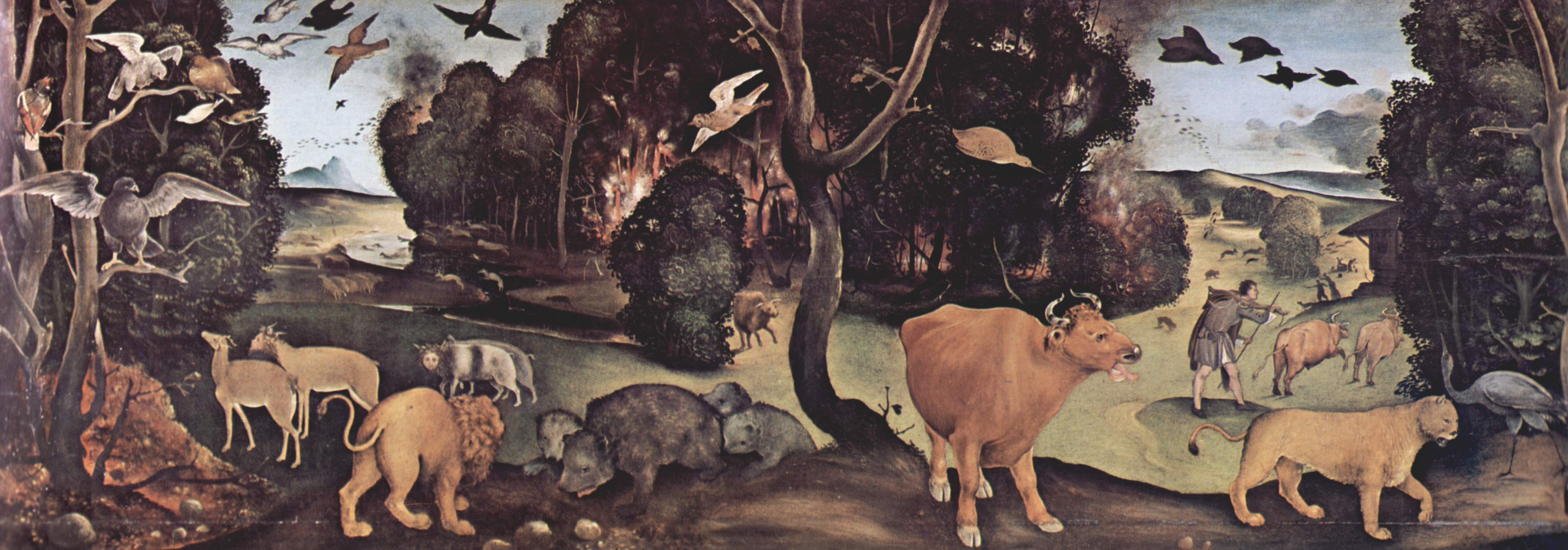
Piero di Cosimo, The Forest Fire, 1505

The second clip below is 'Woods', which begins in Piero di Cosimo's primal forest, where none of the creatures 'thought the lightning-kindled bush to tame / but, flabbergasted, fled the useful flame.'  That was before civilisation had taught them 'to abhor the license of the grove.'  Nowadays it can be said that 'the trees encountered on a country stroll / reveal a lot about that country's soul.'  The poem ends with what seems like a premonition of the disease that has lately infected our woods: 'a small grove massacred to the last ash...'  And so neither woods or mountains are places Auden feels fully comfortable in; indeed none of the landscapes in the central five poems 'really get his vote', as Maxwell puts it.  'Plains' fill him with horror, 'Islands' seem a place of joyless exile and 'Lakes' are for other people ('It is unlikely I shall ever keep a swan / or build a tower on any small tombolo').  It is only in the final section, 'Streams', that Auden seems to find peace and contentment.  'It is fitting.' Maxwell concludes, 'that he ends up by water, 'the aboriginal pilgrim, / at home in all sections', timeless and free yet chained like us to the actualities of gravity and stone.'

Saturday, July 27, 2013

That vast horizon, those thick clouds, that raging sea are all but a picture


The first description of a landscape photograph was written in 1760, almost eighty years before the invention of photography.  In Giphantie, Charles-François Tiphaigne de la Roche relates the experiences of a traveler in the land of Giphantia, a fertile place in the centre of Africa 'given to the elementary spirits the day before the Garden of Eden was allotted to the parent of mankind.'  After seeing various wonders he is led by the Prefect of Giphantia into a subterranean hall, 'not much adorned', but with a window opening out onto 'a sea which seemed to me to be about a quarter of a mile distant.  The air, full of clouds, transmitted only that pale light which forbodes a storm: the raging sea ran mountains high, and the shore was whitened with the foam of the billows which broke on the beach.'  Astonished to see the ocean in the center of Africa, the traveler rushes forward to put his head out of the window, but knocks his head 'against something that felt like a wall.  Stunned with the blow, and still more with so many mysteries, I drew back a few paces.'  His guide explains:  'That window, that vast horizon, those thick clouds, that raging sea are all but a picture.'  And the means by which this light painting was made can be read now as a remarkable anticipation of the photographic process:
'The elementary spirits (continued the Prefect), are not so able painters as naturalists; thou shalt judge by their way of working. Thou knowest that the rays of light, reflected from different bodies, make a picture and paint the bodies upon all polished surfaces, on the retina of the eye, for instance, on water, on glass. The elementary spirits have studied to fix these transient images: they have composed a most subtile matter, very viscous, and proper to harden and dry, by the help of which a picture is made in the twinkle of an eye. They do cover with this matter a piece of canvas, and hold it before the objects they have a mind to paint. The first effect of the canvas is that of a mirrour; there are seen upon it all the bodies far and near whose image the light can transmit. But what the glass cannot do, the canvas, by means of the viscous matter, retains the images. The mirrour shows the objects exactly; but keeps none; our canvases show them with the same exactness, and retains them all. This impression of the image is made the first instant they are received on the canvas, which is immediately carried away into some dark place; an hour after, the subtile matter dries, and you have a picture so much the more valuable, as it cannot be imitated by art nor damaged by time. We take, in their purest source, in the luminous bodies, the colours which painters extract from different materials, and which time never fails to alter. The justness of the design, the truth of the expression, the gradation of the shades, the stronger or weaker strokes, the rules of perspective, all these we leave to nature, who, with a sure and never-erring hand, draws upon our canvases, images which deceive the eye, and make reason to doubt whether, what are called real objects, are not phantoms which impose upon the sight, the hearing, the feeling, and all the senses at once.'
(anonymous English translation 1761)

Friday, July 19, 2013

The Pastel City

Robert Macfarlane recently wrote an appreciation of M. John Harrison that made me want to seek out his novel Climbers when I have more time.  It also reminded me of Harrison's Viriconium stories, set far in the future, which were being brought to a conclusion at the time I was at school and reading a lot of science fictionThis, from The Pastel City, is the kind of strange entopic landscape I used to enjoy: 'in the water-thickets, the path wound tortuously between umber iron-bogs, albescent quicksands of aluminium and magnesium oxides, and sumps of cuprous blue or permanganate mauve fed by slow, gelid streams and fringed by silver reed and tall black glasses.  The twisted, smooth-barked boles of the trees were yellow-ochre and burnt orange; through their tightly woven foliage filtered a gloomy, tinted light.  At their roots grew great clumps of multifaceted translucent crystal like alien fungi.'


Other landscapes in these books are more recognisable, like the glacial moor that the characters traverse later in The Pastel City, a place 'of bright green moss, and coarse, olive-green grass, and delicate washed-out winter flowers discovered suddenly in the lee of low, worn drumlins - of bent thorn and withered bullace, of damp prevailing winds that searched for voices in stands of birch and pine; of skylines, wrinkled with ridges; of heather and gorse, grey cloud and weather - of sudden open stretches of white water that would swell in Spring, dwindle and vanish with the coming of Summer - mysterious waterways...' 

An interview Harrison once gave to Foundation: The Review of Science Fiction lodged in my mind; his obvious frustration with genre limitations and the difficulty of writing books that fully satisfied him seemed very honest and unusual.  I have just dug this out again to reread it.  Harrison was talking in December 1980 and the interview concludes with the wish that some 'young science fiction punks' would emerge and shake things up (six months later I was reading a striking short story in Omni called 'Johnny Mnemonic' by a writer new to me, William Gibson).  Here is how Harrison described the role of landscape writing in the two Viriconium novels he had then written.
'The landscapes of The Pastel City and A Storm of Wings are quite obviously the landscapes of upland Britain: the Peak District, the Derbyshire moors, the tops of the Lake District.  The landscapes in A Storm of Wings in particular have references to the Derbyshire moors, because on top of hills like Kinder Scout the landscape really is rotting and falling to pieces.  It's a genuine desert, drying up and blowing away on the wind every summer.  It has dreadful bogs in which you can sink without trace on a Sunday afternoon only nine miles from Sheffield.  They are the landscapes I now live in, and they obsess me.  Hilary Bailey said of many of the landscapes in A Storm of Wings that though they were bleak and awful, one had this sneaking suspicion that the author would like to go on his holidays there.  Hilary is very acute.'

Friday, July 12, 2013

Willow Mill

'For truly art is embedded in nature, and he who can extract it, has it.'
- Albrecht Dürer

Albrecht Dürer, Willow Mill, 1496-8
A view from the north bank of the River Pegnitz on the outskirts of Nuremburg

The latest LRB carries a piece on Dürer by Christopher S. Wood, who twenty years ago published possibly my favourite work of art history, Albrecht Altdorfer and the Origins of Landscape. This new article is a review of The Early Dürer, an exhibition catalogue edited by Daniel Hess and Thomas Eser.  What he says about their self-imposed academic caution made me reflect on the freedom that blogs provide to break rules and go off on unusual tangents.  'The professional habitus of many art historians is negative, debunking, normalising,' he writes.  On Dürer's sexuality,
'the catalogue simply cuts short any inquiry by invoking a normalising historical context. A drawn profile portrait of a laughing Pirckheimer, for example, signed by Dürer, is supplemented by a Greek phrase, written in Pirckheimer’s own hand: ‘with a cock up the ass’. The exhibition catalogue approvingly cites two scholars who tried to explain this inscription either as an erudite comment on the unflattering likeness or as a parody of conventional humanist epigrams. But there is surely more to be said. The catalogue comes across as pedantic if not priggish when it dismisses other scholars’ attempts to relate the inscription to Dürer’s and Pirckheimer’s sexuality as ‘methodologically problematic’'.

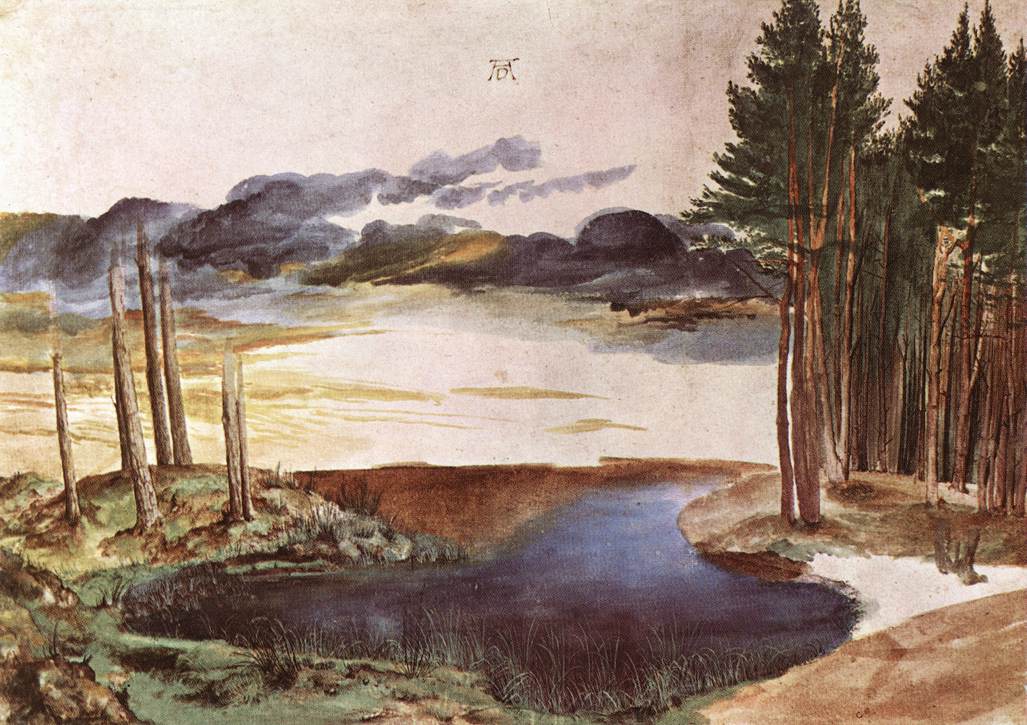
Albrecht Dürer, Pond in the Woods, c. 1496
Probably depicting a view of the sandy heathland near Nuremburg

When it comes to landscape, the catalogue's contributors are 'unwilling to read Dürer’s works as directly registering his experience.'
'The watercolour landscapes, for example, have traditionally been seen as impressions of real places created on site during day trips or longer journeys. Rather, it is argued here, the landscapes were carefully contrived exempla or demonstration pieces, designed to establish their maker as an authority or to provide evidence of his travels: they functioned as tokens in a social game. According to the catalogue, we should not read the watercolours as engagements with the natural world because there is no evidence in written sources that artists in this period thought about landscape in such terms. One might well wonder why the authors don’t have more confidence in the drawings themselves as sources. The catalogue frequently strikes such notes of caution, as if there were a danger that the public might succumb to a thoughtless cult of genius.' 
Wood, on the contrary, concludes that 'Dürer’s landscape watercolours remain emblems of a new concept of artistic authorship grounded in curiosity, desire and attentiveness to the real.'

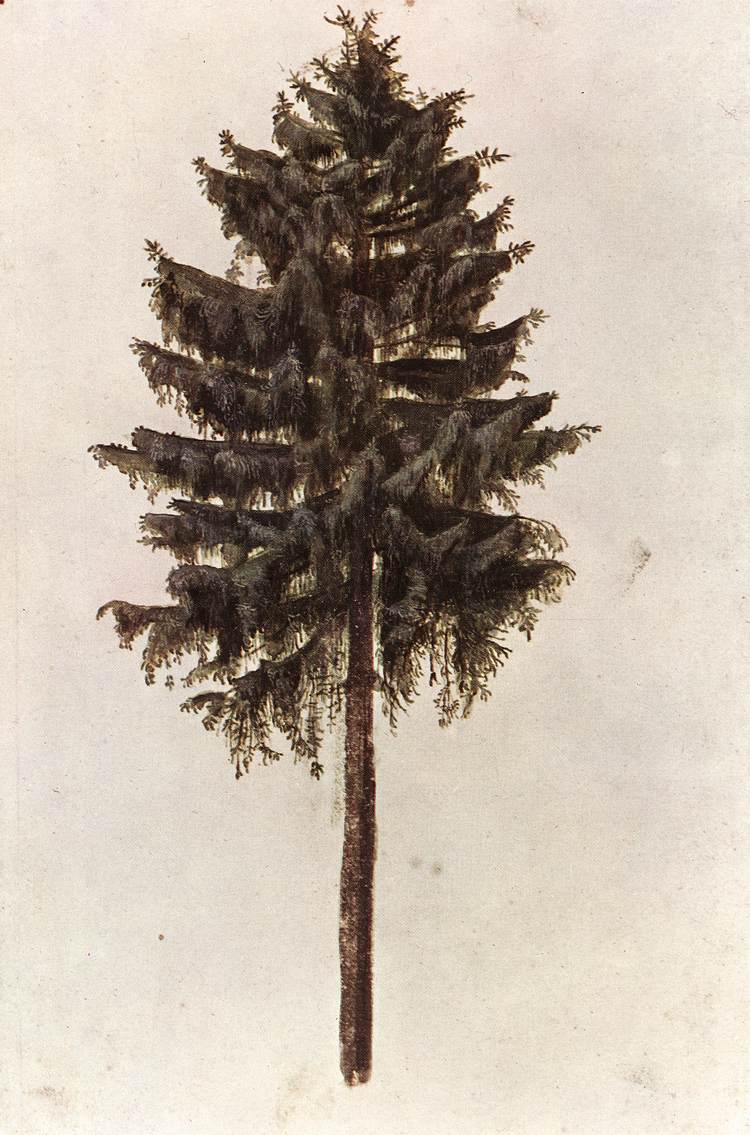
 Albrecht Dürer, Pine, 1495-7

Monday, July 08, 2013

Black dying trees ooze and sweat and the shells never cease


Outline: an autobiography and other writings was published three years after the death of Paul Nash, in 1949.  The autobiography was unfinished and only takes him up to the age of twenty-five, just before the First World War, although there are tantalising notes covering later years. The book also contains seven short essays (including 'Unseen Landscapes' and 'Swanage, or Seaside Surrealism') but its most vivid pages are a selection made by his wife Margaret of the letters she received from the Front in 1917.  On February 20th Nash's regiment left for France: "Went with my brother officers of the Hampshires to the dullest cinema I have ever watched; returned to the docks, re-embarked, mist fell again.  Stopped.  About 6 o'clock, however, great noise of whistles, hoots, electric bells, guttural shouts - off - we are going to sail. Men break into a sort of cheer and a number in the stern begin to sing "Tipperary" rather doubtfully.  Mist gradually blots out the screeching cranes and bulky pens and the long shapes of dock sheds, and slowly we push up Southampton water towards the sea."

Having arrived safely at Le Havre, they sailed down the Seine towards Rouen and the letters provide a lyrical description of the landscape slipping by.  Rouen itself was "quite diverting" and he managed a walk out to a neighbouring village, the wind fresh and larks singing.  On March 7th he wrote from the trenches of the new grass pushing up through the sandbags, "while clots of white dandelions, clover, thistle and twenty other plants flourish luxuriantly, brilliant growths of bright green against the pink earth."  The letter lists some of the sketches he has completed and asks Margaret to send him a copy of the volume of poems just published by another member of the Artists' Rifles, Edward Thomas.  Just over a month later Thomas was killed and Nash knew that the same thing could happen to him.  "But if I am hit it does not matter, and I can think of you at the last and forever after till we meet again." 

We are Making a New World  
Paul Nash, We are Making a New World, 1918

At several points Nash describes the kind of landscape conveyed so powerfully in paintings like We are Making a New World (1918).  In a letter written on Good Friday 1917, he asks Margaret to "imagine a wide landscape flat and scantily wooded and what trees remain blasted and torn, naked and scarred and riddled.  The ground for miles around furrowed into trenches, pitted with yawning holes in which the water lies still and cold or heaped with mounds of earth, tangles of rusty wire, tin plates, stakes, sandbags and all the refuse of war.  In the distance runs a stream where the stringy poplars and alders lean about dejectedly, while farther a slope rises to a scarred bluff the foot of which is scattered with headless trees standing white and withered, hopeless, without any leaves, dead."  Shells pass overhead all day and as the sun sinks "the shapes of the trench stand massy and cold, the mud gleams whitely, the sandbags have a hard, rocky lock, the works of men look like a freak of nature ... Twilight quivers above, shrinking into night, and a perfect crescent moon sails uncannily below pale stars."

The last letter in the selection concludes with regret that his drawings cannot convey this "frightful nightmare of a country more conceived by Dante or Poe than by nature ... The rain drives on, the stinking mud becomes more evilly yellow, the shell holes fill up with green-white water, the roads and tracks are covered in inches of slime, the black dying trees ooze and sweat and the shells never cease.  They alone plunge overhead, tearing away the rotting tree stumps, breaking the plank roads, striking down horses and mules, annihilating, maiming, maddening, they plunge into the grave which is this land; one huge grave, and cast up on it the poor dead.  Is is unspeakable, godless, hopeless.  I am no longer an artists interested and curious, I am a messenger who will bring back word from the men who are fighting to those who want the war to go on for ever.  Feeble, inarticulate, will be my message, but it will have a bitter truth, and it may burn their lousy souls."

Wednesday, July 03, 2013

Shoreless River


Reading this new Corbel Stone Press journal I was fascinated by a selection of short extracts from Fluss ohne Ufer (Shoreless River), a novel by Hans Henny Jahnn that has yet to be fully translated into English.  The article, 'Landscape as the Origin of Music' is a collaboration between editor Richard Skelton and translator Noor de Winter and touches on 'birch trees, music and the "artist-as-listener"'. Richard told me he encountered Noor de Winter's translation project through a blog post that draws a parallel between the music he makes out in the landscape (see my earlier post 'Threads Across the River') and the way Jahnn's character draws inspiration from nature.  flowerville is an impressively erudite blog (today's post is a quotation from Hans Blumenberg on the impossibility of grasping existence through metaphor), written in brief, fragmentary prose that leaves a lot unsaid: "jahnn writes in the april chapter that he got the idea for his music from the pattern of a bark of birch, materials which he used to start making a fire. He did set this pattern for a pianola and later for other instruments. the birchpiece is called dryad-quintet."  So is this Jahnn or his fictional character?  Does this composition actually exist outside the fragment given in Shoreless River?

Despite my lack of German I couldn't resist getting an old yellow hardback copy of Fluss ohne Ufer out of the British Library to see if I could piece together anything more from the novel itself.  It was easy enough to find the musical notation Noor de Winter includes on her post, but I soon realised Jahnn's text was just a river of words to me.  I'm left therefore with what is contained in Reliquiae - here for example is how the character Anias is described as having the idea for composing music from the harmonies to be found in birch bark.  'In the following days I worked in wonderful simplicity on a new piano roll.  Ever-changing interpretations braided themselves into each other, appeared like a deluge of strange harmonies, suddenly dissolving, falling apart to lamenting antiphonies.  Other pieces of bark became the basis for the composition having no end.  My obsession went so far that I derived different and oppositional temperaments from my archive of birch bark.  Because I had no instrument with which to bring this composition to a recital, I reworked my sketches to a complete score.  When I had played this music I knew it didn't originate in me, it came to me.  A miraculous telluric power of disclosure had used me.'

(In addition to 'Landscape as the Origin of Music', Reliquiae contains poems, myths, nature writing, two brief stories and some Canadian landscape paintings by Mark Brennan that reminded me of the Group of Seven).  

Saturday, June 29, 2013

In the foggy forest


Amy Cutler emerged recently from the groves of Academe where she is completing a PhD to organise ‘Time, the deer, is in the wood of Hallaig’, an exhibition on the theme of 'forests, history, and social and environmental memory'.  I have written a piece about it for EarthLines Review but wasn't able to describe there everything that had been brought together for this show (a full list with photographs is now available in an online catalogue).  What I want to do here though is highlight the work of one artist I omitted from my review, Katsutoshi Yuasa.  His image of a deer in the woods displayed prominently at the back of the old belfry (see above) looks like an illustration of the Sorley Maclean poem 'Hallaig' from which the exhibition took its name, although it is actually called See you in the Foggy Forest.  The fogginess of the image is not simply the result of enlarging an old photograph or repeated photocopying (a process W. G. Sebald apparently used to arrive at some of his mysterious embedded images).  Yuasa's method is to monochromise photographs on a computer, carve them onto wooden panels using traditional chokokutou knives and then hand print them onto paper.

  Katsutoshi YuasaSee you in the Foggy Forest, 2010

Writing about Yuasa on her blog, Amy says that 'the amount of visual feedback in Katsutoshi Yuasa’s woodcuts reminds me of some research I’m doing now on memory and ideas of oral transmission and lexical feedback in the forest: ‘All of the problems and possibilities of oral thought and transmission are present in the forest’ (Martyn Hudson).'  Yuasa's titles 'persistently follow themes of noise, communication, and illegibility, with print titles including Listen, nature is full of songs and truth, The world without words, Made in the conversation, Slow screaming and Quotations from nature (while his first major solo exhibition in London was called Echoes from Nature).'  For me there are echoes of Akira Kurosawa's Rashomon, a film about the unreliability of memory that is set in a Japanese forest.  However, as I have not actually watched this film in twenty-five years, all I can say reliably now is that Yuasa's woodcuts are like the foggy memories I retain of Rashomon's woodland setting, details of its plot having long since been forgotten.

Saturday, June 22, 2013

Across the Tappan Zee


'Sligo River Blues' has always been my favourite song on John Fahey's Blind Joe Death (1959), the album which defined a new genre: American primitivism.  Other rivers flowed through his subsequent work: 'Sunflower River Blues', 'On the Banks of the Owchita', 'Revelation on the Banks of the Pawtuxent' (all feature on the recent Four Men With Beards compilation, The Transcendental Waterfall: Guitar Excursions 1962-1967).  I'm not sure how important landscape was for Fahey but a sense of place is evident in a lot of the music he put out on Takoma Records.  His friend Robbie Basho, who made his Takoma debut in 1965, was, like the Beat writers, inspired to transplant aspects of Asian culture, including the ragas of Ravi Shankar.  Landscape obviously inspired songs like Song of the Snowy Ranges, Rocky Mountain Raga and Green River Suite, although I must admit I do find his singing a bit hard going.  After Robbie Basho's untimely death in 1986 (following a freak chiropractor accident) his mantle was assumed by the East German guitarist Steffan Basho-Junghans.  This passing on of the name might seem less of an affectation if you bear in mind that the original Bashō only assumed this haigō (haiku name) in 1680 after disciples planted for him a bashō (banana tree).  The video clip below is an interview with Steffan Basho-Junghans in which he talks about the importance of nature and mountain landscapes for his music and painting. 


One of the most prominent figures in the revival of American primitivism over the last decade has been Glenn Jones, whose new record My Garden State I've been listening to this week.  It was written on extended trips to look after his mother in northern New Jersey, where he grew up.  The album begins and ends with 'field recordings of insect chorus and chimes, evoking baking hot days in the burgeoning fields of a market farm' (Nick Southgate in The Wire).  The tune Jones plays with Laura Baird in the clip below is named after the Tappan Zee bridge that spans the Hudson River.  Other tracks are based on specific experiences, as Grayson Currin explains in Pitchfork: ''The Vernal Pool', for instance, is an improvisation Jones played shortly after Baird showed him the farm habitat of spadefoot toads, which use the “spades” of their feet to dig into their subterranean lairs for a season’s rest. When it rains in the spring, they dig their way out and become “explosive breeders.” Jones saw the toads in the fall, when they still lurked underground. This piece starts with listless hibernation, his slow notes languishing inside their own decay. Across its five minutes, though, it builds into a bustle, with a thumbed bass line muscling its way through a raga-like flurry of sound. Even at its most vibrant and vivid, 'The Vernal Pool' reveals a constant vein of anxiety, as if to acknowledge at once the world’s forever-chained wonder and worry while celebrating it, too.'

Friday, June 21, 2013

Recording Britain

"I need not tell you what terrible distress the war is causing among artists", Sir Kenneth Clark, Director of the National Gallery, wrote to an official at the Ministry of Labour in October 1939.  "The situation is so serious that I have been wondering if it would not be desirable for the Government to take some action."  The result was Recording Britain , a project that eventually comprised more than 1500 paintings and drawings, some commissioned from leading lights of the Royal Watercolour Society others by new artists who were paid a small fee for each painting accepted.  As the V&A who own the collection explain, 'Recording Britain was intended to boost national morale by celebrating the country’s natural beauty and architectural heritage, but it was also a memorial to the war effort itself. The earliest pictures show the landscapes of southern England which were under immediate threat from bomb damage and invasion; in due course the remit was expanded to include those landscapes, buildings and ways of life that were vulnerable to the destructive forces of ‘progress’ – urban expansion, housing developments, road-building and so on.'

Why isn't the art of Recording Britain better known?  As Gill Saunders writes in her introduction to the V&A's book Recording Britain, received opinion was that the venture was 'characterized by monotonous mediocrity'.  When she first looked at the collection in the early 1980s the pictures seemed 'muddy or washed-out, second rate, and in their brittle yellowing card mounts, they gave off an air of neglect.'  The only catalogue was 'a shabby typescript on cheap paper bound in the ubiquitous dark blue of Her Majesty's Stationary Office.'  The emphasis on 'recording' meant that more experimental landscape painting was out and although Clark favoured the neo-Romantic artists and secured the involvement of John Piper, the rest of the committee had conservative tastes.  Nevertheless, Gill Saunders writes of finding among the dross some 'thrilling revelations': paintings by Piper, Kenneth Rowntree, Stanley Badmin, Barbara Jones, Enid Marx, Michael Rothenstein, Phylis Dimond, Charles Knight and William Russell Flint (whose rather abstract watercolours a Times reviewer of the first Recording Britain exhibition felt 'perhaps come nearer to landscape than to true topography.')  You can view these on the V&A site.

Another problem with Recording Britain, as Charles Hind explains in his essay 'Recording Britain: Architecture', is that it left large parts of the country unrecorded. In particular, it was 'woefully inadequate in terms of buildings and landscapes that were destroyed or damaged in the war ... Virtually none of the towns and cities targeted by the Luftwaffe during the Baedecker Raids was considered worthy of inclusion, and those that were got only the scantiest coverage ... German radio announced on 4 May [1942]: 'Exeter was a jewel.  We have destroyed it.'  Pevsner recorded that the German bombers 'found Exeter primarily a medieval city, they left it primarily a Georgian and early Victorian city.'  Recording Britain is of little help here in providing images of the lost urban fabric.'  In contrast, 63 paintings were made in the Kingston-Petersham-Richmond-Kew area but these areas have never been under threat, remaining 'in demand for those wealthy enough to want rural amenities within a short car drive of London, and all survive.'  Although Recording Britain provided 'a swansong to the great tradition of English topographical watercolours, the task of recording the vanishing architectural heritage of England belonged to photographers rather than painters.'

Sunday, June 16, 2013

The winter sun shines in

                                                                mikan hagu
                                                                tsuma-saki ki nari
                                                                fuyugomori

                                                                Through the glass door
                                                                the winter sun shines in -
                                                                sickroom
- 1899


One of the most poignant books I know, Burton Watson's anthology of poems by Masaoka Shiki begins with haiku written in the summer of 1891 and ends with Shiki's death from tuberculosis at the age of thirty-four, just eleven years later.  He first showed signs of the illness in 1889 and his family and friends were convinced he would die when he suffered a severe hemorrhage on returning from the Sino-Japanese War, where despite his ill health Shiki had volunteered to work as a war correspondent.  From that time he was mainly confined to bed and could only concentrate on writing when the morphine he needed to relieve the pain took effect.  In December 1899 one of his disciples arranged to have glass installed in the sliding doors of Shiki's room, so that he could see out into the garden (glass was still rare in Japan).  His later haiku focus on what he could experience from his bed: apples on a table, sparrows among the pines, a winter moon seen above bare trees, the sound of scissors clipping roses. He writes of reaching the summit of Mount Fuji, but only in a dream. In his youth Shiki enjoyed baseball and took walking trips through different parts of Japan, but confined to the house, landscape is something he could only imagine by fusing memories and sense impressions: 'Summer grass - / in the distance / people playing baseball.'  Here is one of his last haiku:

                                                                  kubi agete
                                                                  ori-ori miru ya
                                                                  niwa no hagi

                                                                  Now and then
                                                                  lifting my head to look -
                                                                  bushclover in the garden

- 1902
 

Friday, June 14, 2013

Romney Marsh


In October 1899 a new journal appeared in Germany called Die Insel, 'The Island' and carried four poems by an interesting new writer, Robert Walser (I discussed Walser's poetry here last year).  The magazine only lasted two years but gave rise to a publishing company, Insel-Verlag.  In 1912 they launched a series of distinctively designed short books with Rilke's The Lay of the Love and Death of Cornet Christoph Rilke.  Over time this Island Library series evolved and diversified, introducing marble paper covers, for example, in 1927 (above).  It was these books that inspired the King Penguins which were published over a twenty year period from 1939, eventually comprising 76 volumes.  The first one was on the subject of British birds and many of them focused on aspects of nature or art: roses, shells, mosses, moths, fungi (one volume on the edible kind, another on the poisonous), Egyptian paintings, Greek terracotta, Dürer woodcuts, the medieval carvings of Exeter cathedral and so on.  A few were rather quirky topographical studies: A Prospect of Wales (1948) with text by Gwyn Jones and illustrations by Kenneth Rowntree, The Isle of Wight by Barbara Jones (1950 - one illustration depicted a topiary boat), and Romney Marsh (1950), illustrated and described by John Piper.


Romney Marsh begins by quoting four ‘Earlier Views’: an 1879 address by the Bishop of Dover to the Kent Archaeological  Society, an extract from George Clinch’s Memorials of Old Kent (1907), another from Basil Champneys' A Quiet Corner of England (1875) and this, from an autobiographical article written by Paul Nash c. 1940:
‘I have stayed at Romney Marsh and have watched the eastern sky darken across the dyked flats to Dymchurch and the Channel towards the French coast as the sun sat at my back, and have noticed the strange unity of sea, sky and earth that grows unnoticed at this time and place.’
There is nothing quite as poetic as this in Piper's book, but there are occasional reminders that the author is a painter (‘water lies in light-coloured snatches and loops that reflect a winter sky'...) Mainly however he combines visual description with factual information: 'in winter the reeds still blow in the dykes, showing a pale-yellow flank of close stalks with feathery crowns of grey or purple-black fronds, and there are pea-stacks, built on a tripod of sticks for aeration, as well as the many dyke-side potato and swede clamps.’  The main text is followed by some 'Notes on the Churches of the Marsh and the Cliff' (St Mary Marsh church is said to resemble 'a rural Norfolk church as drawn by Cotman.')  But all this is a prelude to the book's sixteen colour prints, showing a sequence of churches and landscapes (I say 'colour', but they are almost all done in an austerity palette of grey, browns and camouflage green).  You can see a few of them along with Piper's preparatory sketches in the video I have embedded below.  At one point its narrator, admiring the interior of Old Romney church, which Piper painted and described, is apparently caught by surprise when Sir Donald Sinden suddenly appears from behind a curtain, with a copy of the King Penguin in his pocket.  "You've got one of these haven't you?" he says. "I have indeed, wonderful!" she replies.

Saturday, June 01, 2013

A cowscape without cows


In The Guardian last week Blake Morrison wrote an appreciation of Sons and Lovers, marking the hundredth anniversary of its publication.  My failure over the years to derive much pleasure from Sons and Lovers and Lawrence's other novels had until recently put me off reading Out of Sheer Rage, Geoff Dyer's account of his failure to write a book about D. H. Lawrence.  This was a mistake though, because apart from being very amusing, Out of Sheer Rage includes two memorable and contrasting descriptions of the English landscape.  One is by Lawrence himself, in a letter to his hostess at Garsington Manor, Ottoline Morrell - a piece of writing described by Dyer as 'a synthesis in prose of Blake, Constable and Turner'.  Its structure reminded me slightly of the accumulative imagery I described here recently in relation to Francis Ponge: 'each paragraph pulses into life from the seed of the preceding one; each version enters more deeply into the experience.'  I won't quote the whole text (which can be read in Herbert Read's anthology The English Vision) but two paragraphs should give you an idea:
    the wet lawn drizzled with brown sodden leaves; the feathery heap of the ilex tree; the garden-seat all wet and reminiscent:
     between the ilex tree and the bare, purplish elms, a gleaming segment of all England, the dark plough-land and wan grass, and the blue, hazy heap of the distance, under the accomplished morning.
Sadly such accomplished mornings are rarely encountered and here is Dyer, bad tempered (as so often in this book) after a dispiriting pilgrimage to Lawrence's birthplace at Eastwood, looking for the ruins of Haggs farm that featured in Sons and Lovers.
I couldn't find this farm but I stopped the car and looked across the fields, taking in that grazing English countryside I have never cared for: mud, tractor marks, hedgerows, scrubby land, brambles.  A scene which generated its own weather, which dragged the sky down to its own level.  A cowscape without cows.  A BSE landscape.  Farm weather: everything damp and giving off a dank sense that it had never dried out, would never dry out except in recollection, except in memory ... The puddles by the roadside offered no reflection: the water was too old for that, was no longer sensitive to light.  There was no wind: it was so still you wondered how the trees dispensed with their leaves.  Did these trees ever have leaves, or did they just grow like that?  Every now and then there was a break of birds from one bare tree to the next.  The sky was moving towards rain.  I felt cramped, hemmed-in, as if I were still indoors: a desolate, wall-less version of the indoors where the sky was a low, damp ceiling that leaked.  It was not just the rain.  The sea was seeping up through the foundations, coming through the earth.

Friday, May 17, 2013

Hills are all that is necessary, with a few trees for shade

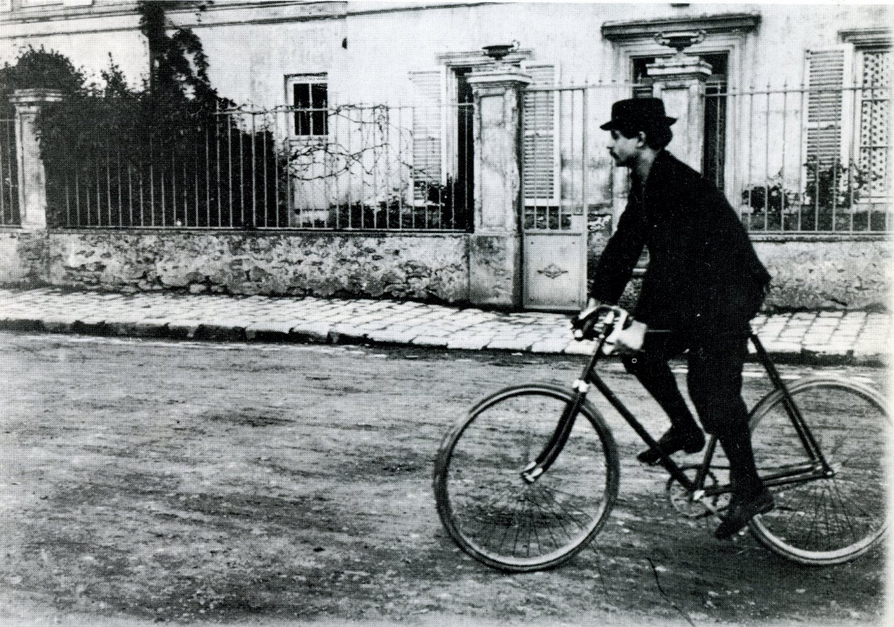
Alfred Jarry on his bicycle
 
In his essay 'Of the Futility of the 'Theatrical' in the Theatre' (1896) Alfred Jarry offered 'a few words on natural decors, which exist without duplication if one tries to stage a play in the open air, on the slope of a hill, near a river, which is excellent for carrying the voice, especially when there is no awning, even though the sound may be  weakened.  Hills are all that is necessary, with a few trees for shade ... Three or four years ago Monsieur Lugné-Poë and some friends staged La Gardienne at Presles, on the edge of the Isle-Adam forest.  In these days of universal cycling it would not be absurd to make use of summer Sundays in the countryside to stage a few very short performances (say from two to five o'clock in the afternoon) of literature which is not too abstract.'

Photograph of Maurice Pottecher's Théâtre du Peuple at Bussang in 1895

Jarry seems more interested in the idea of making theatre accessible to people than he is in the artistic possibilities of staging drama in real landscapes.  As Arnold Aronson notes in The History and Theory of Environmental Scenography, an open-air Theatre of the People had in fact recently been established by Maurice Pottecher, with a stage backing onto a hillside.  Discussing a performance there in 1896 the editor of the Mercure de France expressed a wish that 'some audacious young director - M. Lugné-Poë, for example - would take the opportunity to present plays in the parks around Paris.'  However, that year M. Lugné-Poë was busy inciting a riot with the first performance of Jarry's Ubu Roi...

Aurélien-François Lugné-Poë was the director of the Théâtre de l'Œuvre, which had opened in 1893 with Maeterlink's Pelléas and Mélisande.  The following year he staged Henri de Régnier's La Gardienne, the play Jarry mentions in the context of outdoor theatre.  Régnier's words were recited from the orchestra pit whilst the actors moved silently on stage, partly hidden by a green gauze veil.  The backdrop was a Symbolist landscape of blue trees with a purple palace, painted by Édouard Vuillard.  According to the critic Jules Lemaître it was like 'a Puvis de Chavannes fresco imitated by the unsteady hand of a colour-blind baby.'  All this did not go down well with audiences, who were particularly baffled by the lack of synchronisation between speech and actions.  It is easy to imagine Régnier's poetry casting more of a spell under the trees of a real forest.

Friday, May 10, 2013

The Arrière-pays


'I have often experienced a feeling of anxiety, at crossroads.  At such moments it seems to me that here, or close by, a couple of steps away on the path I didn't take and which is already receding – that just over there a more elevated kind of country would open up, where I might have gone to live and which I've already lost.'  This unattainable country is the subject of Yves Bonnefoy's beautiful aesthetic reverie, The Arrière-pays (1972), recently translated by Stephen Romer.  Certain landscapes seem almost to speak 'like a language, as if the absolute would declare itself, if we could only look and listen intently.' But it remains out of reach: 'it is as if from the forces of life, from the syntax of colours and forms, from dense or iridescent words that nature perennially repeats, there is a single articulation we cannot grasp.'   And yet 'there are certain works that can, for all that, give us a fair idea of the impossible potential.  The blue in Nicolas Poussin's Bacchanalia with Guitar Player has that stormy immediacy, that non-conceptual clear-sightedness for which our whole consciousness craves.' 

Last night in the school hall of the Lycée Français, introducing an event dedicated to The Arrière-pays, Stephen Romer said he often recollected that image of the blue in Poussin's sky.  When he entered the room of Claude landscapes in Oxford that I mentioned here a couple of years ago for example, the arrière-pays was suddenly present in their blue distances.  As I listened to this I peered at a reproduction of Poussin's painting, dimly projected onto a screen behind the speakers, but the blue was hard to discern.  If 'the absolute' failed to declare itself on this occasion, it was partly because there were so many distractions in the room - temporary seats rattling, bored students whispering to each other and an organiser who spent her time coming in and out and interrupting proceedings to tell the speakers how to use microphones.  Still, we had come to experience the aura of the great Yves Bonnefoy, now ninety years old, who seemed unfazed by his surroundings.  He talked vividly about the way his childhood imagination was stirred by the names on a radio dial, the memory of summers spent in the country near the River Lot and his first impressions in Italy of the real landscape he had gazed at in the paintings of the Quattrocento.

Just before the event came to an unexpected end, Bonnefoy was talking with Romer and Anthony Rudolf about an old photograph of an Armenian church that appears in one of the later essays appended to  this edition of The Arrière-pays.  They made a link with the poetic images Sebald used in his books - both have a mysterious, disconnected quality.  This is attributable in part to their grainy light which seems to fall like a "metaphysical snow", directing our thoughts away from the objects depicted and taking us back to early childhood, before our minds had started to impose a structure on the world.  They are mirages, seducing us into dreams that deny the reality of the world.  'I have suffered much, myself, from the lure of images,' Bonnefoy writes in this essay, and it was partly to counteract this that he took up the study of art history.  In Poussin he eventually found 'a painter who could guide me into a self-acceptance of our finite nature.'  As he writes at the end of The Arrière-pays, 'Poussin searches long for the key to the 'music of knowledge', to a return to the wellspring of the real by the power of number; but he is also the man who gathers a handful of earth and says Rome is that.'

Nicolas Poussin, Moses Saved from the Waters, 1647

Monday, May 06, 2013

Mountain Rhythm and Mountain Plateau


When I mentioned Xu Bing in a post here three years ago I referred to installations I could not see, in New York and Sydney, so it was a pleasure on Saturday to enter the portico of the Ashmolean for an exhibition devoted to his art.  Ideally the Tate would put on a full retrospective, including his celebrated Book from the Sky (1991), but the Ashmolean's Landscape/Landscript was fine from the perspective of this blog, tracing as it did the artist's engagement with landscape and language.  This story, from student sketches to four lithographs completed last autumn, The Suzhou Landscripts, is outlined briefly in the notes below.
Xu Bing was born in 1955 to parents who both worked at Peking University, but during the Cultural Revolution his mother was demoted and his father paraded through the streets and jailed.  School was suspended and so Xu Bing taught himself calligraphy and engraving.  In 1974 he was sent to a mountain village north of the Great Wall to do agricultural labour, as part of an 'educated youth' detachment.  The exhibition includes a winter view of farm buildings drawn on wrapping paper in which the white children's crayon used to depict snow shows signs of having frozen in the cold and then melted.       
In 1977 the Central Academy of Fine Arts reopened and Xu Bing was among its first intake.  His training included trips to work alongside rural labourers and industrial workers - the exhibition has a drawing of a timber yard in northeast China whose stacks of logs foreshadow Xu Bing's later compositions based on notions of repetition.  His sketching became simpler and more abstract as he left behind the influence of academic art (the Ashmolean has a case of nineteenth century French drawings to show how this shaped first Soviet and then Chinese socialist realism).  Now employed as a teacher at the Academy, Xu Bing's developed his own vocabulary of 'shaping lines' for increasingly experimental woodblock prints.    
Two of the most interesting landscapes in the exhibition, Mountain Rhythm and Mountain Plateau were made in July 1986 near the hydroelectric power station on the Yellow River at Longyang Gorge.  As the catalogue says, 'the process was unusual.  Xu Bing took with him to Qinghai copper plates that had been waxed in Beijing.  In the open air he scratched through the wax to create the image, using a needle from the travelling printmaking kit he customarily used for his peripatetic teaching.  He added the acid in the evening on his return to the workers' housing where he was staying and the images were printed on his return to Beijing.'      
In 1987 he started his Repetitions series, which you can see on Xu Bing's website'for these works, he made an impression of each state - beginning with a solid black print from an uncarved block and ending with a blank white ''print'' representing the block after the raised surface had been completely carved away.'  The example in the exhibition resembles blocks of newsprint in an unknown script and shows the Ziluidi system of agriculture in which each family was allowed to retain one plot for their own use.   
The exhibition skips over the next ten years, when Xu Bing was establishing his international reputation after moving to the US in 1990.  The idea for the Landscripts came to him in 1999 whilst sketching in the Himalayas.  'I sat on a mountain and, facing a real mountain, I wrote 'mountain' (you might also say I painted a mountain, as for Chinese people to write mountain and to paint a mountain are the same thing).  Where there was river water I wrote the character for 'water'.  The clouds shifted, the mountain colours changed, the wind blew and the grasses moved ... At this point I could set aside completely the historical theories of style and brushstroke and allow myself to be entirely in the feeling of that moment.'   
For me the best kind of Landscript is composed purely of text, and there is a beautiful example in this exhibition from 2002, executed in ink on Nepalese paper with the characters for rock, rain, pine and so on.  In the four new Suzhou Landscripts Chinese characters are less conspicuous, incorporated within the brush strokes of traditional landscapes (versions of paintings by Liu Jue, Zhai Da Kun, Zheng Yuan Xun and Wang Shi Min).  The forms of ancient pictographs are also overlayed in red and the landscapes are surrounded with inscriptions in Xu Bing's Square Word Calligraphy (which turns English words into the shapes of Chinese characters).
The final room in the exhibition has works from Xu Bing's 2005 contribution to UNESCO's Human/Nature project and a 2010 adaptation of The Mustard Seed Garden Manual of Painting (1679), which is discussed in a short MFA Boston video.   The latter illustrates Xu Bing's belief that 'a core characteristic of Chinese painting is its semiotic nature': the manual is a dictionary of signs (some of which I have mentioned here before) and an artist need only memorise them, like a language, in order to piece together a world.

Sunday, April 28, 2013

The Jardin Monceau


Among the distant ancestors of television, the eighteenth century rouleaux transparents of Louis Carrogis (known by the name of Carmontelle) have a particular interest for landscape historians.  As the handles of the box were turned, viewers were taken on a stroll through a succession of scenes with titles like The Four Seasons, Landscapes of France and The Banks of the Seine.  The clip embedded above shows a surviving example, Figures Walking in a Parkland, which featured in the Getty Museum's 2006 exhibition, Carmontelle's Transparency: An 18th-Century Motion Picture.  Carmontelle, a cobbler's son, was employed as tutor, engineer and master of entertainments by various French aristocrats - the Duc de Chevreuse, the Duc de Luynes, the Comte Pons de Saint-Maurice, and from 1763, Louis Philippe I, Duke of Orléans.  He wrote plays, designed sets and painted portraits of illustrious guests, including Rameau, d'Holbach, Sterne and the young Mozart.  In the 1770s Carmontelle was given the opportunity to create a real landscape, when he was commissioned to design the Jardin Monceau for the Duc de Chartres, Louis-Philippe's son.  The resulting garden was, according to Carmontelle, 'a land of illusions.'

Carmontelle, Carmontelle Giving the Keys of the Parc Monceau to the Duke of Chartres, c. 1790

The spectacle of the Jardin Monceau is conveyed by John Dixon Hunt in his book The Picturesque Garden in Europe.  'There was, according to Carmontelle's own commentary in Jardin Monceau près de Paris (1779), a specific itinerary through its 'quantity of curious things', and later commentators have plausibly attributed to his route a Masonic subtext.  Visitors entered by a Chinese gateway, next door to a gothic building that served as a chemical laboratory, and passed through greenhouses and coloured pavilions.  Upon pressing a button, a mirrored wall opened into a winter garden painted with trompe-l'œil trees, floored with red sand, filled with exotic plants, and containing at its far end a grotto in which summer parties were held while music was played in the chamber above.  Outside was a farm.  Then there were a series of exotic 'locations': a Temple of Mars, a winding river with an island of rocks and a Dutch mill, a dairy, two flower gardens, a Turkish tent poised, minaret-like, above an icehouse, a grove of tombs (still there today), and an Italian vineyard with a classical Bacchus at its centre, regularly laid out to contrast with an irregular wood that succeeded it.  The final stretches of the itinerary included a Naumachia or Roman water-theatre (still there), more Turkish and Chinese effects, a ruined castle, yet another water-mill, and an island on which sheep grazed.' 

Friday, April 26, 2013

The Pine Woods Notebook


After the defeat of the French army and the German occupation, Francis Ponge set out, travelling by foot and bicycle, to reach the Free Zone.  It was a month and a half before he reached a small village in the Haute-Loire and there, reunited with his family but with no access to books, he began writing in the only paper that was available to him.  Over the course of a month, this pocket notebook recorded his repeated attempts to express the essence of the landscape he now found himself in.  The pine woods, like this part of unoccupied France, were a shelter, 'where one can roam about at ease, without underbrush, without branches grazing the head, where one can stretch out on dry ground, not spongy, quite comfortably.  Each pine wood is like a natural sanatorium, also a music hall... a chamber, a vast cathedral for meditation (fortunately a cathedral without a pulpit) open to all winds, but through so many doors it's as though they were closed.  For winds hesitate before them.'
August 7th: The wood is like a room - 'A carpet prevails over it.  A few stray rocks supply furnishings' 
August 8th: The pine tree is mostly dead wood and 'flares up only at the very peak: something like a candle'
August 9th: The masts of the trees are 'crinkled, lichen-cloaked like an elderly Creole'
August 12th: Pine needles are like bristles, 'hard as the teeth of a comb.'
August 13th: 'These woods are of a type of structure that has a very high ceilinged ground floor and above that an extremely complicated framework of upper floors, ceiling and roof.'  
August 17th: Within the wood there is 'perfect dryness.  Assuring vibrations and musicality.  Something metallic.  The presence of insects.  Fragrance.'
August 20th: The pine is 'the elemental idea of a tree.  It is an I, a stalk, and the rest matters little.'

August 21st: The wood is like a hairdressing salon - 'aromatic brushery in an overheated atmosphere' and 'fragments of sky like shards of mirrors.'

August 22nd: It is a 'temple of caducity'

August 24th: 'Above all, it is a slow production of wood.'

As Ponge walked and wrote he assembled the elements for a poem with the tentative title 'Sunlight in the Pine Woods.'  But what he eventually published a decade later in La rage de l'expression (translated for Archipelago Books by Lee Fahnestock) was not this poem, or even the kind of short prose pieces that brought acclaim when Le parti pris des choses appeared in 1942, but the notebook entries themselves.  The observations quoted above are found among lists and dictionary definitions, rewritings, plans and half formed ideas ('would it be possible to disentangle a forest...?')  For Ponge poetry is always imperfect, but a reader of The Pine Woods Notebook can follow him into the trees and witness poetry in the making.

Friday, April 19, 2013

KA MOUNTAIN AND GUARDenia TERRACE

 
 Still from Ka Mountain by OpenEndedGroup

In 1972 Robert Wilson and his avant-garde theatre group the Byrd Hoffman School of Byrds staged a seven-day non-stop performance across an entire mountain landscape in Iran, called KA MOUNTAIN AND GUARDenia TERRACE: a story about a family and some people changing.  Maria Shevtsova describes it in her book on Robert Wilson as 'a site-specific fantasia, a ritual and a pilgrimage across the seven hills of the arid rocky terrain of the Haft Tan Mountain.' It 'involved an old man's journey up one of these hills while a host of unconnected events occurred simultaneously on all seven.  Every day a different Byrd played the old man as if to suggest, by the change of actor, the idea of he seven stages through which human life supposedly passes.  The old man paused at various stations identified by cut-outs of such symbols of Western civilisation as Noah's Ark, the Acropolis and the New York skyline.  These served as relay points for the performers and were where the spectator-participants could stop and rest, if they had not dropped out already.  (Indeed, few managed to last the week.)'  A dinosaur stood at the summit and the performance ended with the face of a giant ape going up in flames.  But 'the mountain itself with its searing heat during the day and intense cold at night could be said to be the prime actor in this epic whose greatest significance probably lay in the personal inner journeys undergone by its makers.'

 Still from Ka Mountain by OpenEndedGroup

In an animated film made recently by the OpenEndedGroup, Robert Wilson describes his design for KA MOUNTAIN AND GUARDenia TERRACE.  The image above shows a sketch of the setting for the 'Overture' to the performance: an oasis-like Sufi garden with a view up to the mountain.  This was where, as Osia Trilling, wrote in The Drama Review (June 1973), 'the audience was able to get a foretaste of some of what was to follow later.  Here they caught their first glimpse of the livestock Wilson had collected, some of them in uncomfortably small cages, including a bear, a lion, various horses, donkeys, poultry, deer, goats and an elephant.'  If this sounds a bit dodgy from the perspective of 2013, consider Wilson's unrealised plan to blow up the top of the mountain at the end of the seven-day pilgrimage...  'At this, the Shiraz Festival authorities, who had proved unusually accommodating until then, drew the line.'  How playful this proposal was is not clear: Trilling tried to elicit information from him in an amusingly unhelpful interview ("What is the meaning of Ka in your title?" - "I dunno.")  In the end Wilson was content to set an emblematic Chinese pagoda on fire - its cut-out form can be seen on the left next to the burning ape in the photograph below.  Basil Langton recalled the scene in, 'Journey to Ka Mountain': the landscape on this last night became 'a fiery torch that burned all night over the sleeping town of Shiraz - by accident or design, a symbol of "mountain theology" and the fire-worship of ancient Persia.'

Basil Langton's photograph of the burning ape on Ka Mountain
See The Drama Review, Vol 17, No. 2, June 1973

Footnote:
Paul Kaiser of OpenEndedGroup has alerted me to 'a huge new work we're making about a cross-section through the broken city of Detroit', which sounds like it will appeal to readers of this blog.  Their site includes earlier artworks and some fascinating writings, including something on the background to their film Ka Mountain.