Showing posts with label W. H. Auden. Show all posts

Sunday, November 24, 2013

Landscape with the Rape of Europa


The Wallace Collection has several fine pageant shields with dramatic mythological scenes, but this one is unusual: its dark steel surface is inlaid with a classical landscape.  You might just be able to make out Europa and the Bull at the bottom of the shield, but they are not the focal point: instead the eye is drawn to buildings and bridge, woods and mountains, clouds and birds.  The action is overshadowed by its setting, and by a pervading darkness that gives this picture the appearance of a night scene (dramatic nocturnal light effects were being used by artists like Tintoretto at about this time).  The collection's inventory notes that this composition is 'curiously but accidentally reminiscent of the Chinese willow-pattern.'  The story of the Chinese lovers turned into a pair of doves has the structure of one of Ovid's tales, although in the story on this shield Europa is herself the victim of a metamorphosis and is taken by Zeus, disguised as a bull, over the sea to Crete. 

The elaborate decoration of pageant shields inevitably brings to mind the Shield of Achilles, described in detail by Homer in classical literature's most famous example of ekphrasis.  The shield, wrought by Vulcan, seems to contain the whole world, from the ocean and the heavens: cities at peace and war, a wedding, a trial, people working the fields and enjoying the wine harvest.  Here, in Pope's translation, is a glimpse of landscape: 'Next this, the eye the art of Vulcan leads / Deep through fair forests, and a length of meads, / And stalls, and folds, and scatter'd cots between; / And fleecy flocks, that whiten all the scene.'  W. H. Auden wrote a poem called 'The Shield of Achilles' which contrasts the Sublime imagery of Homer with a featureless modern landscape of weeds, barbed wire and bored officials.  Here is the opening verse:
She looked over his shoulder
For vines and olive trees,
Marble well-governed cities
And ships upon untamed seas,
But there on the shining metal
His hands had put instead
An artificial wilderness
And a sky like lead. 
The Academy of American Poets site has a little introduction to ekphrasis which concludes with lines from another Auden poem, 'Musée des Beaux Arts', and William Carlos Williams' equally well known 'Landscape with the Fall of Icarus', both of which describe Bruegel's painting (below).  Here, as in the Wallace Collection's shield, myth is reduced to a detail.  Icarus and his father Daedalus fly from the palace where they had been imprisoned by Europa's son, King Minos.  And then, as Williams puts it: 'unsignificantly /  off the coast / there was a splash / quite unnoticed / this was / Icarus drowning'.  Bruegel's landscape glittering in the fatal spring sunshine, where 'the whole pageantry / of the year was / awake tingling', distracts us from the fate of Icarus.  It is interesting that Williams uses the word 'pageantry' here; what, you wonder, was happening unnoticed as those sixteenth century nobleman processed in their elaborate armour and the sunlight flashed off a damascened shield and its landscape with the Rape of Europa? 

Pieter Bruegel the Elder, Landscape with the Fall of Icarus, 1560s

Monday, September 02, 2013

The Burren


Seamus Heaney has died and, if I may borrow some links from Arts & Letters Daily, you can read tributes everywhere: NY Times, Irish Times, Boston Globe, Telegraph, Dan Chiasson, Chronicle of Higher Ed, Poetry, Sean Brady, Daily Beast, Guardian, LA Times, Henri Cole, Boston Review...  Back in January I wrote here about the treatment of landscape in some of his poems.  One of these was  'Postscript', which describes a drive to the Flaggy Shore: 'the ocean on one side is wild / With foam and glitter, / and inland among stones / The surface of a slate-grey lake is lit / By the earthed lightning of a flock of swans.'  A fortnight ago we were on this very road, led by Heaney's poem in the hope of experiencing a landscape epiphany, although when we stopped the car (ignoring the poet's advice) it was spitting with rain and the swans looked forlorn under dark clouds, floating around on the muddy brown water.  But our few days in the Burren also yielded moments of joyous surprise, like the realisation that we had a sunlit limestone pavement all to ourselves, stretching away to the sea, a moment to 'catch the heart off guard and blow it open.'


The Burren, as Robert Macfarlane says in The Wild Places, 'rises, silver, in the north of County Clare, on the mid-west coast of Ireland.  Its name comes from the Gaelic boireann, meaning 'rocky place', and the region is so called because most of its surface is made up of smoothed limestone, intercut with bands of clay and shale.'  I think one of the reasons we went there this summer was that it has featured so often on this blog, as the subject of film, art, music and literature.  I thought therefore I would return here to those old posts, beginning with the most recent, Field Notes, on the writings of Richard Skelton and Autumn Richardson.  There I mentioned The Flowering Rock, 'a new collection of poems describing the landscape of the Burren: madder and thrift, eyebright and hart's tongue living in the seams between the shattered rocks; beneath them, arterial passages where the 'wailing notes / of water and wind' create 'hollow songs / of hollow hills.''  As I write this I'm listening to 'Of the Sea' from Verse of Birds, the album that was composed in response to this landscape.


Last October, in Wild Track, I talked about Pat Collins' film Silence in which the protagonist, a field recordist, sets up his microphone at Mullaghmore (above) before moving on to locations further north.  The film recently came out on general release and has received muted praised, although Philip French, in one of his last reviews for the Observer, saw nothing in it that that would stick in his memory.  The most fatuous comment I've seen was the FT''s suggestion that you 'think of Brian De Palma’s Blow Out, then imagine it refilmed by a team of Trappist monks.'  Look instead at the BFI site, which has a Sight and Sound review by Mark Sinker and an appreciative article by Geoff Andrew
 

In a post about Jeremy Deller's inflatable Stonehenge last summer I mentioned that there had been some controversy over its resemblance to 'a 2010 work by Jim Ricks, the Poulnabrone Bouncy Dolmen, a twice-scale replica of the megalithic portal tomb in the Burren; but it all got sorted out amicably.  Perhaps we need more of these structures, hyperreal bouncy simulacra at every prehistoric site, leaving the actual stones to become poetic, overgrown ruins again.'  As you can see (below) we got to see the real Dolmen, albeit roped off.  Running round it proved almost as much fun as the bouncy Stonehenge, although it is easy to lose your footing among the clints and grykes (there were tears before we left).

 
There is another passing reference to this part of the world in my post Theoryscapes, describing a seminar on landscape theory that was held in 2006 at the Burren College of Art.  The focus of discussion was on culture and geography generally, rather than the specific qualities of the Burren.  However, it is relevant to distinctions between land and landscape: the participants recognised that there has been a long history of habitation here - it is not simply a starkly beautiful wilderness - and that this part of Ireland has been important in resisting British rule and preserving the language. Nevertheless the seminar leader, art writer James Elkins, detected in his colleagues an intoxication in their experience of the Burren that he ascribed to 'our not-so-secret addiction' to 'ideas of landscape articulated by the romantics, and more directly to second-, third-generation, regional, local and belated romantic Western landscape painters, filmmakers and photographers.'


Rebecca Solnit was one of the participants in that seminar, but she had visited the area previously, as described in A Book of MigrationsOn that earlier trip she couldn't fail to be struck by the Burren's strange hills, resembling topographical maps, 'eroded into ledges or sills as regular as elevation lines'.  However, she obviously had miserable weather and felt that the influence of tourism and the efforts of environmental campaigners was turning an old 'local' place into something 'almost exclusively exotic'.  In my post I quoted what she had to say about the Cliffs of Moher, just to the south of the Burren, seeing there, 'a deeper blue than my own churning gray Pacific, blue as though different dreams had been dumped into it, blue as ink.  I imagined filling a fountain pen with it and wondered what one would write with that ocean.'  This passage had slipped my mind when we visited the cliffs, but I was so struck by the colour of the Atlantic there that I took a photograph of it...


Finally, back in 2007, in The Wildness of the Gryke, I quoted a review of Robert Macfarlane's Wild Places and made a connection with Auden and his poem
‘In Praise of Limestone’ (1948).  In his chapter on the Burren, Macfarlane talks about the special qualities of its rock.  'Limestone's solubility in water means that any fault-lines in the original rock get slowly deepened by a process of soft liquid wear.  In this way, the form into which limestone grows over time is determined by its first flaws. For Auden, this was a human as well as a geological quality: he found in limestone an honesty - an acknowledgement that we are as defined by our faults as by our substance.'


All photographs from our holiday, August 2013

Friday, August 02, 2013

Five minutes on even the nicest mountain is awfully long


Winds, Woods, Mountains, Lakes, Islands, Plains and Streams: each are addressed in turn in W. H. Auden's 'Bucolics' (1953).  Glyn Maxwell, writing in 1994 (the year he was a New Generation Poet) thought them 'the supreme poems of a broad and balanced education in this century'. He appreciated the way Auden managed to generalise without abstracting and simplifying.  In 'Mountains', for example, which you can hear Auden read in the embedded clip above, he asks whether he must accept that the Lake District is merely a bourgeois invention like the piano.  But the reality of the landscape cannot be reduced to this.  'I wish I stood now on a platform at Penrith', he thinks - waiting for a local train and anticipating the moment when 'you smell peat or pinewood, you hear / your first waterfalls.'  'Mountains', as Maxwell says, touches on crime, farming and archaeology, as well as the relationship between geography and psychology, but concludes with something personal and idiosyncratic: 'For an uncatlike / creature who has gone wrong, / five minutes on even the nicest mountain / is awfully long.'

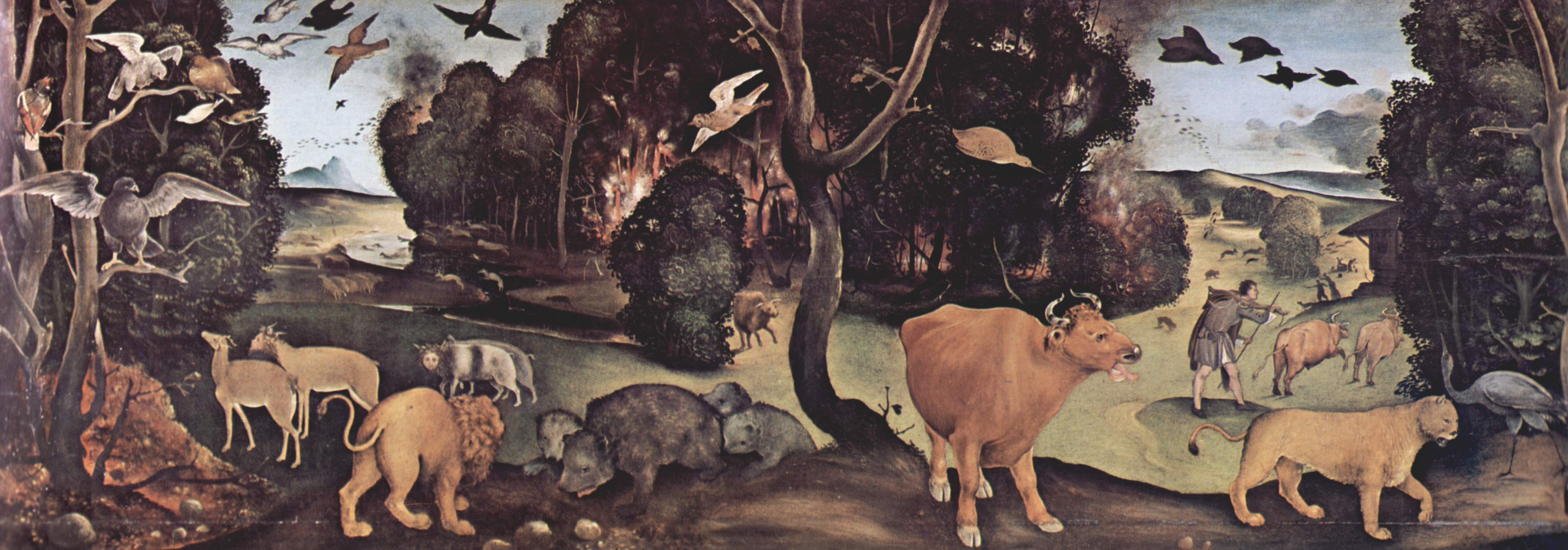
Piero di Cosimo, The Forest Fire, 1505

The second clip below is 'Woods', which begins in Piero di Cosimo's primal forest, where none of the creatures 'thought the lightning-kindled bush to tame / but, flabbergasted, fled the useful flame.'  That was before civilisation had taught them 'to abhor the license of the grove.'  Nowadays it can be said that 'the trees encountered on a country stroll / reveal a lot about that country's soul.'  The poem ends with what seems like a premonition of the disease that has lately infected our woods: 'a small grove massacred to the last ash...'  And so neither woods or mountains are places Auden feels fully comfortable in; indeed none of the landscapes in the central five poems 'really get his vote', as Maxwell puts it.  'Plains' fill him with horror, 'Islands' seem a place of joyless exile and 'Lakes' are for other people ('It is unlikely I shall ever keep a swan / or build a tower on any small tombolo').  It is only in the final section, 'Streams', that Auden seems to find peace and contentment.  'It is fitting.' Maxwell concludes, 'that he ends up by water, 'the aboriginal pilgrim, / at home in all sections', timeless and free yet chained like us to the actualities of gravity and stone.'

Thursday, February 24, 2011

The bracing glories of our clouds


I have enjoyed reading Romantic Moderns, which has much to say about the revival of interest in the English landscape before and during the war.  Alexandra Harris acknowledges her debt to Kitty Hauser, whose Shadow Sites: Photography, Archaeology and the British Landscape, 1927-1955 begins with a discussion of the 'topophilia' characteristic of writers and artists in this period.  In 1947 Auden defined this topophilia as having 'little in common with nature love.  Wild or unhumanized nature holds no charms for the average topophil because it is lacking in history' (cf. Sebald vs. Mabey in my recent 'After Nature' post).  What unites 'topophils', Hauser writes, 'is an interest, sometimes amounting to an obsession, with local landscapes marked by time, places where the past is tangible.  For some, such as Betjeman, John Piper and Geoffrey Grigson, this topophilia - as Auden suggests - is eclectic, including medieval churches, Gothic and mock Gothic architecture, Regency terraces and ancient sites.  Some topophils of this generation, such as Paul Nash with his fascination with the genius loci, made atmospheric prehistoric landscapes a particular focus. Others, like painter Graham Sutherland, were attracted to scarred nature and geological vistas.  In the Four Quartets, T. S. Eliot looked for redemption and history in an English village: 'History is now and England'.  And with an eye to continental Surrealism, photographers and film makers including Bill Brandt, Humphrey Jennings, Michael Powell and Emeric Pressburger found in pockets of the British landscape curious and moody survivals from the past.' 

All of these writers and artists feature in Romantic Moderns, along with others less directly concerned with landscape but whose work looked nostalgically at a fast vanishing world of country houses and village traditions.  The Bright Young Things, for example - Evelyn Waugh, Cecil Beaton, Rex Whistler, the Sitwells -  whose work has never appealed much to me, are discussed alongside Eric Ravilious and Edward Bawden in an interesting chapter on the 1930s Georgian Revival.  Kathryn Hughes in The Guardian, praises the book's 'tactful generosity towards people and places, sights and sounds, that have tended to get written off as embarrassing or just plain wrong. Never has this seemed more important than now, as we work through our own complicated millennial feelings about the romance of the past. Thanks to Harris it no longer seems entirely shaming to admit to a secret Cath Kidston habit. Taking tea in the stable block of a National Trust property becomes a dignified activity, rather than something to pretend to find a chore.'

I'm no stranger to National Trust tea shops but have always been constrained in where I could go by not owning a car.  Motorists of the 1930s were encouraged to discover the landscape of Britian by the posters for Shell-Mex designed by artists like Vanessa Bell, Graham Sutherland and Frank Dobson (whose depiction of the Cerne Abbas giant is reproduced in Romantic Moderns - the giant's most famous feature is obscured by the shadow of a strategically placed cloud).  In 1934 Cyril Connolly titled his review of an exhibition of Shell-Mex commissioned artwork 'The New Medici'.  He observed that it was 'not the awe-inspiring or exceptional which now seems important, but what is most cheerful and genuine in our countryside - England is merry again - farewell romantic caves and peaks, welcome the bracing glories of our clouds, the cirrus and the cumulus, the cold pastoral of the chalk.'  The Shell County Guides that John Betjamen commissioned also looked beyond the obvious - a fact typified by John Piper's Oxon which deliberately excluded the city of Oxford.  As Alexandra Harris says, 'Piper's Oxfordshire is not a land of touristic sensation.  Old England is allowed to be almost a modern lived-in country.  A photograph of clustered advertisements which would have troubled purist preservationists is captioned 'a tree of knowledge', and an oval photograph with faded edges evokes nostalgia only to affront it with a big sign advertising a 'super cinema.''  It almost sounds like a journey through Oxfordshire's edgelands, prompting the thought that we could have a new series of county guides for the psychogeographically inclined pedestrian, written by Iain Sinclair, Rachel Lichtenstein, Patrick Keiller and so on.

Romantic Moderns won the Guardian First Book Award and Alexandra Harris can be seen talking about it on the Guardian website.  Thames and Hudson have now signed her up for two more books - a short biography of Virginia Woolf and another one, The Weather Glass, which I am looking forward to as it will apparently 'explore the British preoccupation with the weather, from Beowulf onwards'.  In Romantic Moderns these interests come together in a chapter called 'The Weather Forecast', where there is a discussion of Woolf's unfinished history of literature, 'Reading at Random'.  She makes this sound fascinating: it was to be a book 'shaped by views from windows and stretches of country ... a passionate exercise in literary geography.'  Harris argues that the twentieth century threatened to alienate people from the weather, as Modernist art looked beyond the incidentals of atmosphere to uncover clear cut shapes and colours.  She contrasts this with the rain-filled lithographs of her book's other main protagonist, John Piper (of whose drawings of Windsor George VI said, "You seem to have very bad luck with your weather, Mr. Piper").  Working outside, Piper 'loved the odd splashes that arrived unexpectedly in his paintings.'  These blots have the effect of confirming 'the allegiance between art and the world beyond the painting.  And, like the sand found in a half-read book, they are the souvenirs of a time and place, nature's signature added next to that of the artist.'

Thursday, August 30, 2007

The wildness of the gryke

Following on from my previous posting, I see the new Robert Macfarlane book is now out: there was a review by Andrew Motion in The Guardian last weekend. I was interested in what he has to say about one episode in Macfarlane’s search for wild landscapes, accompanied by the late Roger Deakin. ‘As they lie face down on the limestone Burren, peering into a gryke (a fissure) in the surface, Deakin points out that what they can see below them is just as "beautiful and complex ... as any glen or bay or peak. Miniature, yes, but fabulously wild". As Macfarlane broods on this, he recovers some of the optimism about his subject that had been challenged on the high peaks. "Down in the gryke ... I had seen another wildness at work: an exuberant vegetable life, lusty, chaotic and vigorous. There was a difference of time-scheme between these kinds of wildness, too. My sense of a landscape's wildness had always been affected by the gravitational pull of its geological past - by the unstillable reverberations of its earlier makings by ice and fire. The wildness of the gryke, though, was to do with nowness, with process. It existed in a constant and fecund present."

Coincidentally, the very next day I was myself looking into grykes on the limestone pavement at Malham Cove. We had the place almost to ourselves in the early evening as the sun cast long shadows (see my photograph below). It’s true that there are miniature worlds in these fissures, although you can’t help noticing the odd bottle or sweet wrapper too.

Limestone pavement, Malham Cove

Back in Skipton I discussed with my friend who the ideal poet of limestone landscapes would be and he suggested Auden, thinking of ‘In Praise of Limestone’ (1948) which talks about ‘the one landscape that we, the inconstant ones, are consistently homesick for.’ Peter Davidson, in his book The Idea of North starts his list of features that make up the Audenesque landscape: ‘Limestone moors, high fields enclosed by stone walls, lonely pubs, upland farms, isolated junction stations...’ The poet Blake Morrison, reminiscing about his childhood, has written of Malham Cove and the Dales: ‘What I love is the dry stone walls, the sheep, the limestone that inspired WH Auden's poems. It's not a straightforward love. I've made my life elsewhere, but the Dales will always be the source of my imagination.’