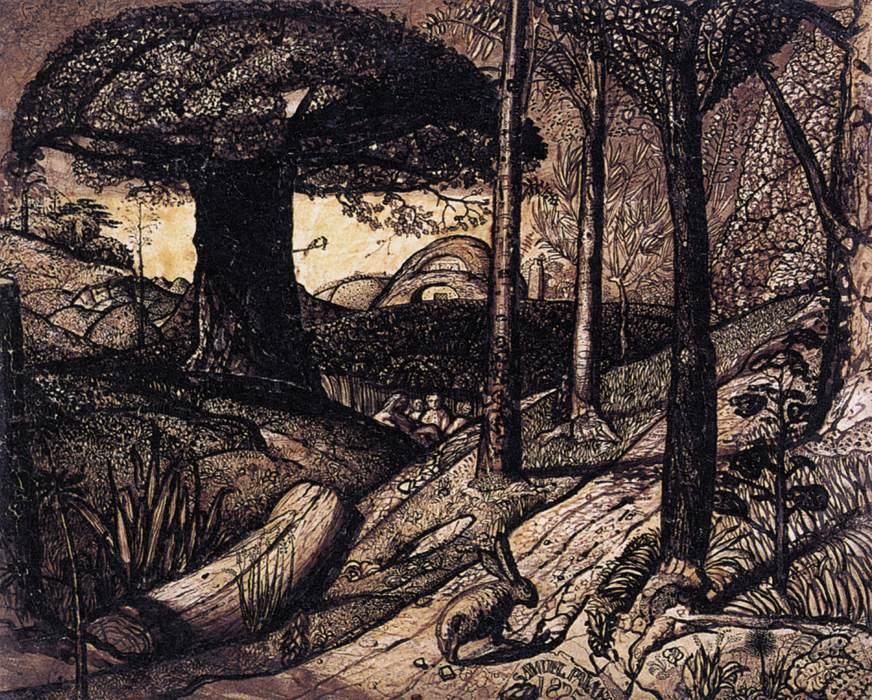
Samuel Palmer, Early Morning, 1825
There is still time to see the British Museum New York Oxford
A Rustic Scene: lines from Virgil’s Georgics evoking the autumnal equinox
Libra die somnique pares ubi fecerit horas
et medium luci atque umbris iam dividit orbem,
exercete, viri, tauros, serite hordea campis
usque sub extremum brumae intractabilis imbrem;
et medium luci atque umbris iam dividit orbem,
exercete, viri, tauros, serite hordea campis
usque sub extremum brumae intractabilis imbrem;
The Valley with a Bright Cloud: lines from Shakespeare’s As You Like It:
This is our life, exempt from public haunt,
Finds tongues in trees, books in ye running brooks,
Sermons in stones, and good in everything.
Finds tongues in trees, books in ye running brooks,
Sermons in stones, and good in everything.
Early Morning: lines from the poem A Complaint of the Black Knight thought by Palmer to be by Chaucer but now believed to have been written by John Lydgate:
I rose anone and thought I would be gone
Into the wode, to hear the birdes sing,
When that misty vapour was agone
And cleare and fair was the morning.
Into the wode, to hear the birdes sing,
When that misty vapour was agone
And cleare and fair was the morning.
Late Twilight: a line from Macbeth, oddly misattributed to
The west yet glimmers with some streaks of day
The Skirts of Wood: no quotation is given
The Valley Thick with Corn: a quotation from Psalm 65:
Though crownest the year with Thy goodness: and Thy clouds drop fatness. They shall drop upon the dwellings of the wilderness; and the little hills shall rejoice on every side. Thy folds shall be full of sheep, the valleys also shall stand so thick with corn that they shall laugh and sing.
Even without the images these quotations evoke the mood of Palmer’s work. The lines for Early Morning by Lydgate were new to me and have a timeless simple beauty. As William Vaughan explains in the exhibition catalogue, these quotations became associated with the pictures sometime during Palmer’s life, possibly well after they were painted. However, the practice of exhibiting landscapes with accompanying poems was common in
It is interesting to compare the effect of these paintings with that of Chinese landscapes currently on display at the Royal Academy where poetry also accompanies the image, for example the twelve Scenes Described in Poems of Du Fu by Wang Shimin (1592-1680) or the Eight Scenes of Yangzhou by Gao Xiang (1688-1754) that are accompanied by quatrains by different authors.



.jpg/1920px-Auch_das_ist_Schloss_Heidelberg%2C_Ruine_des_Biliotheksbaus_von_1520_--_This_too_is_Heidelberg_Castle%2C_ruin_of_library_from_1520_(10978961934).jpg)


