Monday, June 07, 2010

The grey sea and the long black land

This time last year I wrote about the BBC's poetry season, contrasting a documentary on Gawain and the Green Knight by Simon Armitage with the excellent Owen Sheers' series, ‘A Poet’s Guide to Britain’. Since then, the two writers have edited anthologies of nature poetry - Sheers with one based on his series, Armitage with The Poetry of Birds.  The Armitage is a joint effort with bird-watching author Tim Dee, who provides fascinating descriptions of the birds at the end of the book.  This approach contrasts with Sheers' - he provides minimal editorial material, letting the poems speak for themselves and saying nothing about the landscapes or the authors (the poems are not even dated so the uninitiated will have no idea whether they are reading something recent unless they investigate the copyright information at the back or google the name of the writer).  It's a bit if a shame because the television programmes were full of fascinating material; I have some sympathy for the Amazon reviewer who "was looking forward to a 'book of the series'. There are some beautiful poems in this book but it's not what I was expecting so I'm disappointed with my purchase."

Having said this, I enjoyed Owen Sheers' selections and the way he strings poems in each section together, like a renga sequence or a carefully constructed compilation tape, where each 'speaks to the next and, in some way, listens to the one before.'  So, for example, the last part, 'Coast and Sea', begins with 'Dover Beach', then moves to another Victorian vision of the moonlit sea, Browning's 'Meeting at Night'.  This introduces the theme of lovers which continues in Hardy's 'Beeny Cliff' and from there it's an easy segue into another Hardy, 'To a Sea-Cliff (Durleston Head)'.  The cliff theme continues with Charlotte Smith's 'Beachy Head', Shakespeare's 'King Lear, Act 4, Scene 6', and Anne Ridler's 'Bempton Cliffs'.  So it goes on, taking in poems by Hopkins, Keats and Edward Thomas along with contemporaries like Carol Rumens, Daljit Nagra and Menna Elfyn.  He also includes a second poem by Anne Ridler, this time describing the sea at Zennor in Cornwall (I mention this because I was on this sea, in a boat heading to Seal Island near Zennor, only last week).

I'll end this post by reproducing one of these poems of Coast and Sea: Robert Browning's 'Meeting at Night' (1845)

I.

The grey sea and the long black land;
And the yellow half-moon large and low;
And the startled little waves that leap
In fiery ringlets from their sleep,
As I gain the cove with pushing prow,
And quench its speed i' the slushy sand.

II.

Then a mile of warm sea-scented beach;
Three fields to cross till a farm appears;
A tap at the pane, the quick sharp scratch
And blue spurt of a lighted match,
And a voice less loud, thro' its joys and fears,
Than the two hearts beating each to each!

Sunday, June 06, 2010

Landscape with the Penitent St Jerome


Leonardo da Vinci, Landscape, 1473

The British Museum's 'Fra Angelico to Leonardo: Italian Renaissance Drawings' exhibition includes three landscapes.  The first is Leonardo's famous drawing of the Arno valley dated August 5th 1473, which I mentioned in an earlier post on the link between panoramic landscape drawing to topographical maps.  We do not know if this sketch was drawn in situ, but as A. Richard Turner writes in The Vision of Landscape in Renaissance Italy, 'these quick lines have all the quality of a spontaneous reaction to a living model.'  The next artist discussed in Turner's book is Piero di Cosimo, whose highly artificial and literary paintings he contrasts with Leonardo's.  Piero's main contribution to landscape art came in panels like Forest Fire, Hunt and Return from the Hunt but the British Museum exhibition has one of his drawings: Landscape with the Penitent St Jerome (c1490-1500).  The curators say of this that 'the intricacy of the landscape compels the viewer to unravel it slowly, a visual equivalent to the pilgrim's slow and difficult ascent to the church in the background.'

The third landscape drawing on show at the BM is a simple pen and brown ink study of travellers journeying to a village, made c1495-1508: one of the fifty or so landscape drawings that survive by Fra Bartolommeo.  He doesn't feature in Turner's book, possibly because Fra Bartolommeo's importance for landscape history wasn't fully realised until after the rediscovery of forty-one landscape sketches in 1957.  Some of the views drawn by the artist have now been identified with specific Dominican buildings, but the Christies site, describing a sketch the artist made of a tree (which sold for $996,000), suggests that 'trees rather than buildings are central to the structure of Fra Bartolommeo's landscapes.  By focusing on trees, a new analysis of these compositions is possible. There are no mountains, only gentle hills and small rocky outcrops. In most compositions elongated trees reach to the sky and shrink the buildings into insignificance as they appear to be engulfed by the undergrowth. Either sketched lightly in swirling calligraphy, or carefully outlined, the trees punctuate the scene. As in the Tuscan woods at La Verna where Saint Francis experienced his vision, Fra Bartolommeo's trees are often seen growing in between rocks. Trees, for Fra Bartolommeo, are thus the essence of landscape.'

Sunday, May 23, 2010

River Sounding

I bought a new camcorder this week and we took it with us yesterday on a trip to Somerset House for a look round the Bill Fontana installation, River Sounding.  Installed under the main courtyard in parts of the building usually closed to the public, the art work consists of audio and video recorded at various sites above and below the surface of the Thames.  You can see the footage I took below (it features my son Torin near the start - he soon went back up to the sunlight finding it "too spooky").  I hope this conveys some of the atmosphere of these subterranean spaces - the light wells, dark entrances and hidden Dead House, where 17th century graves can be found that predate the current building.  It would be quite hard not to make an impressive installation in a setting like this, but the way Fontana connects these silent old basements to the sounds of the river that flows outside is very effective.


I'm also embedding below a much more professional film about River Sounding that includes an interview with the artist.  It has footage of some of the sites and soundscapes Fontana used - Tower Bridge, Richmond Lock, Southend Pier and the mournful Whistle Buoy, which you can see floating up and down on a wall at the end of my video.


Friday, May 21, 2010

Artesian

This is a shout out (can't believe I just wrote that) for Go Together Press, which is nearly three years old now, and its excellent magazine Artesian, edited by Tereza Stehlíková and Gareth Evans.  I just caught up with their second issue, themed around water - the first had 'earth' as its 'informal frame'.  They include a lot of landscape-related material in the magazine, including some artists and writers I've discussed here before (links to my old posts):
  • a half page on Chris Drury's book Algonquin
  • a good article on Thomas Joshua Cooper, following his Haunch of Venison exhibition last year
  • extracts from Gary Snyder's 'Necessary Steps Towards a Future Worth Living' (accompanied by some images from  Nadine Barth's anthology Vanishing Landscapes)
  • and a feature on the recent sculptures of Heather Ackroyd and Dan Harvey who have been imprinting images on grass via photosynthesis.
Some other water and landscape articles in this issue of Artesian are:
  • poetry by Elizabeth Bletsoe taken from her collection Landscape from a Dream
  • a 'spirit of place' piece by Graeme Hobbs, describing the rainswept landscape of the Scottish Borders
  • an article on the cameraless photography of Susan Derges, including images like Full Moon Cloud Shoreline, 2008
  • and Czech composer Ilja Hurnik's reflections on water music: Debussy, Chopin, Smetana and Vitezslaw Novak.
Here is a Youtube clip of Novak's cantata The Storm, which Hurnik associates with the particular sound qualities of the North Sea.

    Monday, May 17, 2010

    Soaring Flight

    This is my 500th post!

    To mark the occasion I'm including some extended thoughts here on Peter Lanyon, his landscape-inspired art and his persona as an artist-glider.  Lanyon died, following an accident bringing his glider in to land, in August 1964. Since joining the Cornish Gliding Club in 1959 he had made 385 flights and around a dozen paintings and assemblages directly inspired by gliding. His reputation at this point was based on a body of work stretching back twenty years, in which he sought the genius loci at sites around his native St. Ives. Pushing himself to seek the 'edge of landscape' in various forms and testing out his own limits in the process, he would then struggle in the studio to translate these experiences into paint.  Lanyon's artistic identity was clearly influenced by gender, class and his local Cornish roots, but when he took to the air his work as a painter took on a new dimension.

    In general terms I think there two opposing tendencies fundamental to Lanyon's artistic project, established early on and captured in a pair of photographs taken for the Central Office of Information in 1947. In the first one, "Constructivist Peter Lanyon demonstrates the theory of mass within space; argues against critics that art should progress not stand still."  Here Lanyon is portrayed as a scientist, involved in challenging, technical work. In the other photograph, Lanyon poses as a Romantic visionary silhouetted against the sky, described simply as 'The Artist': "as the sun sets the rocks jut from the sea and take on shapes of human forms, becoming living things to the abstract artist." For Lanyon, the formal rigour of Constructivism allowed him to reconcile the aims of progressive modern art with the urge to paint the Cornish landscape. It was also a way of distinguishing himself from the older generation of neo-Romantic landscape painters.

    Now, flight is of course a Romantic trope.  Arguing against Romanticism and for rigour and classical purity in modernism, T.E. Hulme observed that 'the whole of the romantic attitude seems to crystallise in verse round metaphors of flight. Hugo is always flying, flying over abysses, flying up into the eternal gases.' But Lanyon said himself that 'the highly technical problems of soaring flight together with the sensational range of experience it offers combine both sides of my character' . As a pilot, it was necessary to forge a direct relationship with the air, 'trying to understand it in all its moods; to learn its flow, its laws, and to try to use this knowledge to his own ends.' A glider is not simply a platform for looking down on the landscape, it is a machine requiring practical know-how.  Lanyon once said of Patrick Heron that 'he can take a poem to pieces and rebuild it, while I can take an engine to pieces and rebuild it.'

    In his dual nature Lanyon was to some extent following the example of Naum Gabo, who had arrived in St Ives in 1939.  Artist Lionel Miskin once said that in Gabo's constructions 'every single joint was superbly made but it was done by a man of extreme romanticism.' Lanyon soon began building assemblages himself, experiments in articulating space which can be seen as foreshadowing his gliding experiences (Gabo had made a work called Construction in Space: Soaring in 1930). In an interview with Michael Canney, Lanyon said that gliding offered the chance 'to get actually into the air itself and get a further sense of depth and space into yourself, as it were, into your own body, and then carry it through into a painting. I think this is a further extension of what Turner was doing.' This statement relates Lanyon's art back to the vortex compositions employed by Turner, whilst signalling a greater understanding of space than earlier earthbound artists could have achieved.


     J.M.W. Turner, Snow Storm 1842

    Lanyon's emphasis on the experience of space through the body reflects the importance he placed on the artist's subjective role in painting. Thus, although he said that 'the whole purpose of gliding was to get to a more complete knowledge of the landscape,' he was doing more than simply making detached 'scientific' observations, like Constable's cloud studies, or the experiments of aviators like Wilber Wright, who spent hours suspended in a glider over the beach at Kitty Hawk.  The way he portrayed his own experiences in gliding paintings like Cross Country (1960) is similar to his earlier practice in exploring landscapes like Trevalgan (1951).  Other St. Ives artists could walk or drive through the Cornish countryside, but once Lanyon started gliding, his experiences set him apart from them (and from those of us looking at his paintings safely on the ground).

    In a recent post on music I mentioned Debussy paying a fisherman to take him out in a storm off the coast of Brittany as part of his preparation for writing La Mer.  Turner was allegedly lashed to the mast of a ship for four hours in order to paint Snow Storm. And the same story had earlier been used to enhance the reputation of Joseph Vernet, whose grandson Horace depicted the scene in a dramatic canvas (see below). Vernet's billowing red cape in this picture reminds me of Peter Lanyon's red glider, a signal of the artist's presence in works like Soaring Flight (1960), the colour suggesting both vitality and danger. In both paintings, the threatened body which creates a sense of the Sublime is that of the artist himself. However, while Vernet is shown putting his trust in the boat's crew, Lanyon was in charge of his own destiny and his ability to overcome danger was linked directly to his understanding of landscape.


    Horace Vernet, Joseph Vernet Tied to a Mast in a Storm, c. 1822

    Lanyon had long been seeking 'to explore the region of vertigo and of all possible edges where equilibrium is upset and I am made responsible by my own efforts for my own survival.' He had written of seeing 'an image of his own existence' in the vertiginous view from a cliff top down to the sea. In his excellent book on the artist, Chris Stephens makes the link with Heidegger, for whom identity was defined by placing oneself at risk (Peter Lanyon: At the Edge of Landscape, 2000, p152). The gliding paintings therefore represent a statement about 'being-in-the-world' and can be viewed within the context of post War Existentialist art. The approach of many artists at this time could be typified by Jean-Michel Atlan's assertion in 1950 that 'the creation of a work of art… is an adventure in which a man commits himself to struggle with the fundamental forces of nature. To see this through to the bitter end, some of us today risk our necks.' In a similar vein, Lanyon described landscape painting as 'a true ambition like the mountaineer who cannot see a mountain without wishing to climb it or a glider pilot who cannot see the clouds without feeling the lift inside them. These things take us into places where our trial is with forces greater than ourselves, where skill and training and courage combine to make us transcend our ordinary lives.'

    The struggles of the Existentialist artist (described for example in Merleau-Ponty's marvelous 1945 essay 'Cézanne's doubt') turn painting into a tortuous experience. Writing of Lulworth (1956) Lanyon said 'I have been reduced to more misery and distress by such paintings than any human being can make for me.'  Lanyon suffered periodic depressions, but he came to see them as necessary preludes to artistic creation.  Paintings like Lulworth seem to reflect their agonising conception in the scratched and heavily worked paint. Andrew Causey, in contrast to Chris Stephens, has suggested that gliding led to 'greater serenity' in Lanyon's art and recognition that the 'existential period' of post War art was over (in his book Peter Lanyon, 1991, p12). Soaring Flight, with its calming layers of diaphanous pale blue sky, fit such a reading, but other glider paintings, like Solo Flight (1960) with its jagged red flight path through dirty white clouds, seem to retain a sense of anxiety.

    Lanyon had been developing a freer handling of paint before he started gliding, but it is tempting to identify a more 'airborne' style in the late works. Marinetti, describing the new art inspired by flight in 1929 for the Manifesto dell'Aeropittura, said, 'every aeropainting simultaneously contains the double movement of the aeroplane and of the painter's hand'.  Flying in loops and arcs through the empty sky, Lanyon was Harold Rosenberg's Action Painter with the sky for a canvas. But Lanyon was suspicious of some recent abstract expressionism, complaining that 'the gesture made in desperation or joy is not enough, it is scything in the air.' This 'scything' was very different from the control and skill required in gliding, it was 'to mistake for art that which is a mark of human pride, greed and ambition.'

    In spite of these reservations, Lanyon's work was increasingly associated with Abstract Expressionism. After his New York exhibitions in 1957 and 1959, Lanyon got to know Rothko, Motherwell and other leading artists. Subsequently, Lanyon's move to thinner paint and sheets of colour, as in Soaring Flight, kept pace with stylistic developments in abstract painting, although his insistence on the need for specific subject matter was fundamentally at odds with Post-Painterly Abstraction. However, his paintings of weather systems and flight loosened the connection to Cornwall and it makes you wonder whether, in part, Lanyon took to the air in flight from the perceived limitations of 'provincial' landscape painting.


    Lanyon's Quoit, Cornwall
    Photographed by me, January 2009

    Peter Lanyon was proud of his family's Cornish roots and took pleasure in the coincidence of an ancient dolmen near St Ives called Lanyon's Quoit (which I went to visit on a windy winter's day last year).  In a 1957 autobiographical note he described himself as 'proud of the host of artists colonising West Penwith particularly his own contemporaries, but considers himself to be THE HOST'.  In 1961 Lanyon was actually made a Bard of the Cornish Gorsedd for services to Cornish art.  The same year Lanyon opposed Patrick Heron's successful campaign to stop a new tin mine near Zennor. Lanyon saw welcome job opportunities in the proposal and complained that 'opponents of the scheme talk of beauty and the magnificence of scenery as if nature were incapable of wrath that would touch them.' Aloft in his glider, Lanyon felt a new sense of detachment, but he still felt anger at the harsh history of the mining and farming communities visible below . His sympathies reflect an embarrassment with his privileged class background - although gliding itself was a resolutely middle class hobby. Lanyon did not stop painting the Cornish landscape, but gliding gave him the chance 'to experience my county from outside returning to land rather than emerging from inside.'

    Gliding may represent only a partial disengagement from Cornwall, but it served to emphasise Lanyon's independence from the other St Ives artists. In 1950 he had resigned from the Penwith Society of Arts, mainly over Ben Nicholson's attempt to divide artists into two groups, 'abstract' and 'representational', a division which would have undermined Lanyon's own artistic project, which fell within both camps. The break with Nicholson has been seen as an Oedipal revolt against an artistic father-figure (Lanyon had lessons with Nicholson in 1940).  The split was a significant step in establishing Lanyon's own unique identity away from the Nicholson-Hepworth circle: ten years later, he painted his first gliding picture and called it Solo Flight. The idea that a person is responsible for creating their own identity was particularly prevalent in the Existentialist fifties (with its Rebels and Outsiders). In his book The Beauty of Gliding, published in 1960, a leading glider pilot Philip Wills wrote that gliding represented 'individualism in excelsis'.


    In the twentieth century mythology of flight, women and domesticity were often threats to the freedom of the pilot. Antonie de Saint-Exupéry, in Night Flight, describes the pilot's wife thus: 'she remained behind, gazing sadly at the flowers, the books, the tender souvenirs - for him a mere ocean bottom.' Lanyon's use of household objects in his construction Field Landing (1963-4), suggests both relief in the return to domestic safety and a sense that such items are absurdly trivial after experiencing the 'ocean' of the sky.  His domestic circumstances were crowded and occasionally strained: by the time Lanyon took up gliding he had a wife and six children. He had various semi-open affairs and his method of painting landscapes based on direct experiences led him to incorporate references to actual encounters (referring to his mistress from about 1956, Lanyon told a friend that 'Lulworth is a portrait of Susan' ).  This projection of the human body onto the landscape is something I've discussed here before but I don't think it's that relevant to Lanyon's glider paintings.  There is nothing equivalent, for example, to the sculpture by Lucio Fontana called The Mistresses of Pilots (1931) which seems to project an aviator's memories or fantasies onto the smooth, rounded forms of the Italian countryside below.  Rather than gazing down on the landscape, Lanyon's vision is of his own body in an encounter with the Sublime - something traditionally gendered as masculine in landscape aesthetics.

    I can imagine that in choosing to pilot a glider Lanyon was partially setting his art apart from the iconography of aeroplanes, since the optimistic response to flight in art just prior to the first World War had given way to paintings showing the destructive potential of aircraft (Guernica being only the most famous). Gliders were also used in wartime, but they were not associated with air battles or bombing missions, and in the fifties, the sport had a therapeutic appeal to many ex-servicemen. As one prominent glider put it: 'the silence, the beauty, and the individualness of it, had been magnified in people's minds as the antithesis of the war itself' (see Ann Welch and Lorne Welch, The Story of Gliding p147).  For Lanyon, gliding was a partial reaction to the frustrations of his experiences in the RAF, where migraines prevented him from flying until the end of the war.

    Of course until the turn of the last century gliding a few feet above the ground was the nearest anyone had come to flight. By 1910, the rapid development of aeroplanes rendered gliding redundant and the sport was left to develop among amateur enthusiasts. Gliding competitions in the fifties and sixties in many ways resembled the early contests between pilots, with attempts to set records for speed and distance. As aeroplanes had become more automated, gliding was a way of recapturing the excitement of the aviation pioneers. For an artist, like Lanyon, gliding could provide the sense of wonder in flight that had originally inspired Picasso, Braque and Delaunay, all of whom went to watch the early aeroplanes flying at Issy-les-Moulineaux near Paris. However, the fascinated engagement of the public in such events was entirely missing from the sport of gliding. When the Futurist poet Vasily Kamensky learned how to fly in 1912 he immediately went on a tour of Poland, demonstrating the miracle of flight to the inhabitants of provincial towns; Lanyon's gliding in contrast was a private affair. The absence of spectacle was consistent with Lanyon's views on the purpose of gliding; whilst various forms of performance art were emerging in the early sixties, Lanyon never started to see gliding as a form of art in its own right.

    Yves Klein, a herald of the new art, suggested that the painter of space 'must go there by himself, by means of individual, autonomous force, in a word, he ought to be capable of levitating,' Lanyon actually managed this in his own way, but remained committed to the idea of advancing the practice of oil painting, something that Klein and other artists in the ensuing decade were increasingly uninterested in attempting. Klein's ascension in Leap into the Void (1960) questioned the way God-like powers have been ascribed to artists, whilst simultaneously contributing to his own myth. Lanyon was content to joke about his artistic persona in private postcards - one sent to Margaret Matilde in 1960 grafts a photograph of the artist (pipe in mouth) onto the image of a starling; another, sent to his dealers, superimposes the artist in his glider onto a postcard of a seagull.  Lanyon's identification with birds actually went back a long way - his 1940 Triangle Construction was apparently inspired by weekly trips to Bosigran where he watched the seagulls 'moulding the space between the rock and shore'.  In the RAF he saw spitfires as 'graceful birds' - a far cry from Marinetti and the idea of planes embodying speed and power.  In a BBC interview Lanyon spoke of choosing to paint a cliff 'as it would be experienced by a bird', in terms of thermal currents rather than as a view of white rocks offset by the sea.

     
    Source: Arnold Paul, Wikimedia Commons

    Barbara Hepworth, interviewed about Lanyon's death, described him as 'a unique spirit - a spirit that was perhaps airborne.' Spiralling upwards in a thermal, the glider pilot resembles Icarus, whom Gautier took to symbolise the over-ambitious Romantic artist.  It's hard not to make the connection, but worth resisting easy comparisons.  I remember reading a review of the Tate St Ives exhibition 'Coastal Journey' in which Amber Cowen wrote: 'ultimately, it was Lanyon’s obsession with capturing his visions that led to his death in 1964. He began hang-gliding to explore the air currents around the Cornish headlands but fell over Perranporth' (The Times, 11 November 2000).  The distortion of the facts here is telling. Lanyon was in a gliding plane, and rather than 'falling' to his death, Icarus-like, over his beloved Cornwall, he crashed on landing near Honiton in Devon.

    Lanyon made works inspired by classical myths - Europa (1954), Antigone (1962), Orpheus (1961) - but none used the Icarus legend.  Instead he compared himself to Orpheus, who was 'like the artist searching for his image, for the meaning of what he is doing' . Orpheus's search for Euridyce took him underground rather than into the air. Lanyon himself descended below ground to explore old tin mines, testing out the limits of his claustrophobia just as in gliding he pushed the limits of his vertigo. However, Lanyon did not place any particular emphasis in his writings on mythic prototypes for the artist and it has been left for others to draw comparisons between Lanyon and Icarus.

    Lanyon's death lends his gliding paintings a heightened sense of danger that may have been less apparent at the time. The biggest gliding centre in England had run 100,000 flights during the fifties without injuries to either pilots or passengers. Lanyon's own injuries were not felt to by life threatening and his death came as a result of an unsuspected blood clot caused by a cut in his leg. The red paint denoting Lanyon's glider may signify an element of danger, but it also simply records the colour of the gliders Lanyon actually used. However, Lanyon's awareness of the dangers may have been heightened by the knowledge that Ben Nicholson's architect brother, Kit, had died in a gliding accident in 1948. Kit Nicholson, who designed and built the London Gliding Club building at Dunstable (1935-6), was a serious competitive glider and set a British distance record in 1938. Like Lanyon, Nicholson's artistic impulses were combined with practical know-how and an urge to test his skills in risky situations . Nicholson's fatal last flight over the Swiss Alps represented the kind of endeavour Lanyon felt landscape painting should aspire towards.

    As far as I can see, hardly any critics in Britain have attempted to sensationalise the crash or let it influence their reading of his work. Andrew Graham-Dixon (writing in the Independent, 30/4/91)  has identified a very British reluctance to use the fact to promote Lanyon's work, in contrast to the kind of 'publicity drive' that followed the deaths of Pollock and Rothko . One possible reason for downplaying Lanyon's accident would be to keep his gliding in proper perspective. Having written this lengthy post on the subject, I should emphasise that focusing on Lanyon's brief period as an artist-glider may cast a misleading light on his career - to a large extent his flying simply extended elements of the identity he had already established by the 1940s.  The six major gliding paintings all date from 1960-62 and it is possible that at the time of his death Lanyon had largely worked through his interest in painting the flight of the body through space.  However, Glide Path, which incorporates elements of assemblage, dates from 1964 and suggests a continuing interest in the subject. Sadly we'll never know what soaring flights the art of Peter Lanyon would have taken next.


    A final word on sources.  As usual I've not attempted to footnote this post in detail as it's not supposed to be an academic article.  The best book on Peter Lanyon is the monograph by Chris Stephens (see above), which includes many of the quotes from Lanyon and information on sources.  I would also recommend a series of beautifully produced books by Andrew Lanyon, the artist's son, if you can track them down, such as 'Peter Lanyon 1918-64' (Newlyn, 1990). Lanyon obviously features strongly in the many general surveys on St Ives Art.  The Tate Archive has good original material - texts by Lanyon (e.g. 'Landscape Coast Journey and Painting', 1959, TGA TAV216AB), interviews (e.g. 'An Unfamiliar Land: Interview with Lionel Miskin', 1962, TGA TAV211AB) and letters (e.g. Sheila Lanyon's moving letter to Ben Nicholson on 25 September 1964, TGA 8717.1.2.2170).  Finally I would recommend W. S. Graham's poem 'Thermal Stair' which, like Lanyon's paintings, I can't reproduce here for copyright reasons, but which you can read at the Poetry Archive.
    Friday, May 14, 2010

    A cliff so white it stood like frozen air

    Andrew Young (1885-1971) isn't a household name but you often come upon his work in collections of nature poetry.  Geoffrey Grigson, for example, was an admirer and I think I first encountered 'A. J. Young' (as he called himself early in his career) in one of Grigson's anthologies.  I remember a particular line - 'a cliff so white / It stood like frozen air'.

    Young should be an ideal poet for me, writing about Sussex and other familiar landscapes in vivid short poems that he made as concise as possible. Sometimes his poems seem as simple as nature, but there are times when his insistent rhythms and well-worn vocabulary are off-putting - 'The Swans', for example, begins 'How lovely are these swans, / That float like high proud galleons', and 'The Roman Wall' starts 'Though moss and lichen crawl / These square set stones still keep their serried ranks.' But read through the Carcanet Selected Poems and you end up making allowances for lines like 'owls in drowsy wisdom sit' and concentrate on the images that take you directly to the landscape: 'ivy trickling in green waterfalls', or 'rain-buds' in the mist, or thistledown - 'ghosts of day ... silver against blue sky'.


    The book's contents pages read in places like an exhibition of eighteenth century landscape paintings - 'Prospect of a Mountain', 'The Ruined Chapel', 'The Falls of Glomach'.  Young's poems also include rustic scenes - 'Ploughing in Mist', 'Snow Harvest' and 'The Shepherd's Hut' (which begins, like a painting, with a dab of colour: 'The smear of blue peat smoke / That staggered on the wind and broke...').  He obviously appreciated the English landscape tradition and in 'Winter Morning' refers directly to it, conflating art and nature - 'the hill a picture of a hill', like a painting 'by Cotman or Old Crome'.  One could make a link too with his neo-Romantic contemporaries - a site dedicated to Young makes connections with Paul Nash.  The Carcanet anthology includes illustrations alongside the poems - woodcuts that Joan Hassall made for Young's Collected Poems in 1950. 

    I should point out that many of Young's nature poems focus on details - stones, dunes, daisies, pine trees, swallows, frogs, haystacks.  But a lot of them describe the experience of places and the thoughts prompted by views seen on the poet's walks.  From among his Selected Poems, here are some of these Andrew Young landscapes:
    • 'Essex Salt-Marsh', where sunset lights up the gullies made by runnels in the mud
    • 'Fenland', where the tops of distant trees can be seen like half-sunk vessels
    • 'Pevensey', where he walks across the flats, listening to his footsteps on the 'desert beach'
    • 'Culbin Sands' in Moray, another flat landscape, where old buildings now lie buried under the sand
    • 'The Cuillin Hills' on Skye, where each step loosens a 'cataract of stones'
    • 'The Black Rock of Kiltearn', a gorge in the Scottish Highlands into which the poet imagines slipping
    • 'Dundonnel Mountains', another misty Highlands landscape where one false step would end in death
    • 'Loch Luichart', seen in pale blue cloud and white snow, surrounded by silver hills
    • 'The Loddon', a tributary of The Thames, winding through stunted willows, their roots like eels in the water
    • South Downs', waterless, quiet in the mist except for the sound of sheep-bells, and
    • 'Wiltshire Downs', where you could still hear cuckoo song and see the ancient long barrow, but not, I think, the stable-boys and shepherd of Young's poem.
    This is, by my reckoning, the 499th post on this blog.  My 500th will be a special extended post on Peter Lanyon, artist and glider pilot.

    Saturday, May 01, 2010

    Moons of the Iapetus Ocean

    'Empty peaks, silence: Among sparse stars,/ not yet flawed, it drifts.'  Tu Fu's short poem 'Full Moon' describes the strange effect of a landscape at night, 'all light'.  In David Hinton's translation the 'twice-sized moon ... scatters restless gold across waves' and it transforms the garden and house in which Tu Fu sits - 'on mats, it shines richer than silken gauze.'


    Ando Hiroshige, Autumn Moon on Ishiyama Temple, c. 1834

    Hiroshige used moonlight for landscapes, as above, for figure scenes like Trout Fishing in the Tamagawa in the Autumn Moonlight, and for animal paintings, such as Two Rabbits under a Full Moon.  His prints were an inspiration for Whistler's Nocturnes.  As a post about this at the Princeton blog says, 'Whistler’s Nocturne in Blue and Gold: Entrance to Southampton Water bears striking similarity to Night View of Kanazawa under the Full Moon, depicting a moonlit bay done in a binary color scheme of blue and gray.'  Whistler got the idea of calling his moonlit scenes 'nocturnes' from a Chopin-admiring patron.  He wrote ‘I can’t thank you too much for the name ‘Nocturne’ as a title for my moonlights!...You have no idea what an irritation it proves to the critics and consequent pleasure to me – besides it is really so charming and does so poetically say all that I want it to say and no more than I wish.’

    Among contemporary artists, Darren Almond has shown a particular interest in the way landscapes look under a full moon.  For his Fullmoons series he has traveled the world photographing the landscape at night, using a 15 minute exposure so that they shine with a strange luminosity.  A couple of years ago he exhibited some of these photographs, taken around Britain, in a show called ‘Moons of the Iapetus Ocean’.  The title is reference to the sea between England and Scotland 400-600 million years ago; Almond's frozen moonlight takes these places outside measurable time.  All these sites take on an unreal quality and, as a Times review said, images like Fullmoon@Gairloch or Fullmoon@Wester Ross seem to show 'the mossy, ferny landscapes of bygone British folklore.'  More recently, at the Tate's Altermodern exhibition, Almond showed three full moon images that recall the poem by Tu Fu: still, misty views of the mountains of Huang Shan - 'empty peaks, silence...'

      Friday, April 23, 2010

      Toward the Sea

      I've only just spotted an excellent article published in January on 'Music and Landscape' by Tom Service. It discusses some of the composers connected with particular landscapes, but cautions against seeing a direct link with the form of their music.  'You can find the musical things that supposedly tie Elgar to the Malverns in thousands of other pieces of music: if it's undulating melodies and harmonic lushness you're after, then Richard Strauss or Gustav Mahler might as well be composers of Worcestershire as of Bavaria or Austria.'  Music inspired by landscape tends to be personal and derived from experience, rather than straightforwardly illustrative.  Connections between music and landscape are ultimately based on 'their shared temporality. To walk in a landscape – or even to drive through it – is not just to physically place yourself in it, it's to imagine it, as well; to listen to a piece of music isn't just to experience the vibrations of frequencies and overtones, it's to imagine what the music is, how it makes you feel.'  

      The article centres on the description of a walk on the beach at Sanday, the island in Orkney, with Sir Peter Maxwell Davies.  Just as Wordsworth composed poetry while he walked, Maxwell Davies ('Max') uses the beach as a three-dimensional stave.  'Looking at a dune a mile or so ahead of us, he explained that he says to himself: "OK, I need to get from B major to A flat major in the time it takes me to walk there." In his musical imagination, Max slows time down, and a harmonic transition that might take only seconds in performance is extended exponentially so that he can analyse and experience the notes from any angle, ironing out any infelicities he hears with the tread of his feet in the sand. The beach, its forms and its flotsam, are also part of his pieces. He told me that if a seagull mews overhead, or if he sees a sea-sculpted piece of kelp on the beach, they may nudge his imagination in a direction he hadn't considered and be written into the fabric of the music.'  I see I included a similar quotation from Maxwell Davies in a post I did on him here three years ago (if you look back you'll see I was frustrated that his website wasn't working - I'm glad to report it is now.)

      Tom Service also wrote about his visit to Maxwell Davies on The Guardian's music blog in September last year, and in the following post, 'Composing the Sound of the Sea', he mentioned him again, speculating that the composer's second symphony, 'inspired by the wave-forms he saw in the sea beneath him' on the cliffs at Hoy, 'is up there with music's most successful evocations of the sea.'  His other contenders are:
      • Debussy - La Mer ('Debussy paid a fisherman to take him out in a storm off the coast of Brittany as part of his preparation for this piece; like Turner before him, he wanted to experience the violence of the sea before he represented it')
      • Sibelius - The Oceanides ('A seductive round-dance of waves, nymphs, and orchestral colour')
      • Britten - Peter Grimes ('The sea as psychology')
      • Bax - Tintagel ('The sea as big tune – nothing wrong with that')
      • Xenakis - Kyania  ('Without risking your own life in the teeth of a Mediterranean storm, listening to Kyania puts you at the centre of a sonic surge of massive, implacable intensity')
      There are not many alternative suggestions in the comments underneath the article, although one person mentions Takemitsu's Toward the Sea ('moonlit sea, suggestion of bloody great whales beneath' - this is a reference to the fact that it was written for Greenpeace's Save the Whales campaign).  Nice also to see someone refer to Ocean by my favourite band, The Velvet Underground.

      Sunday, April 18, 2010

      A Prospect of Vapourland


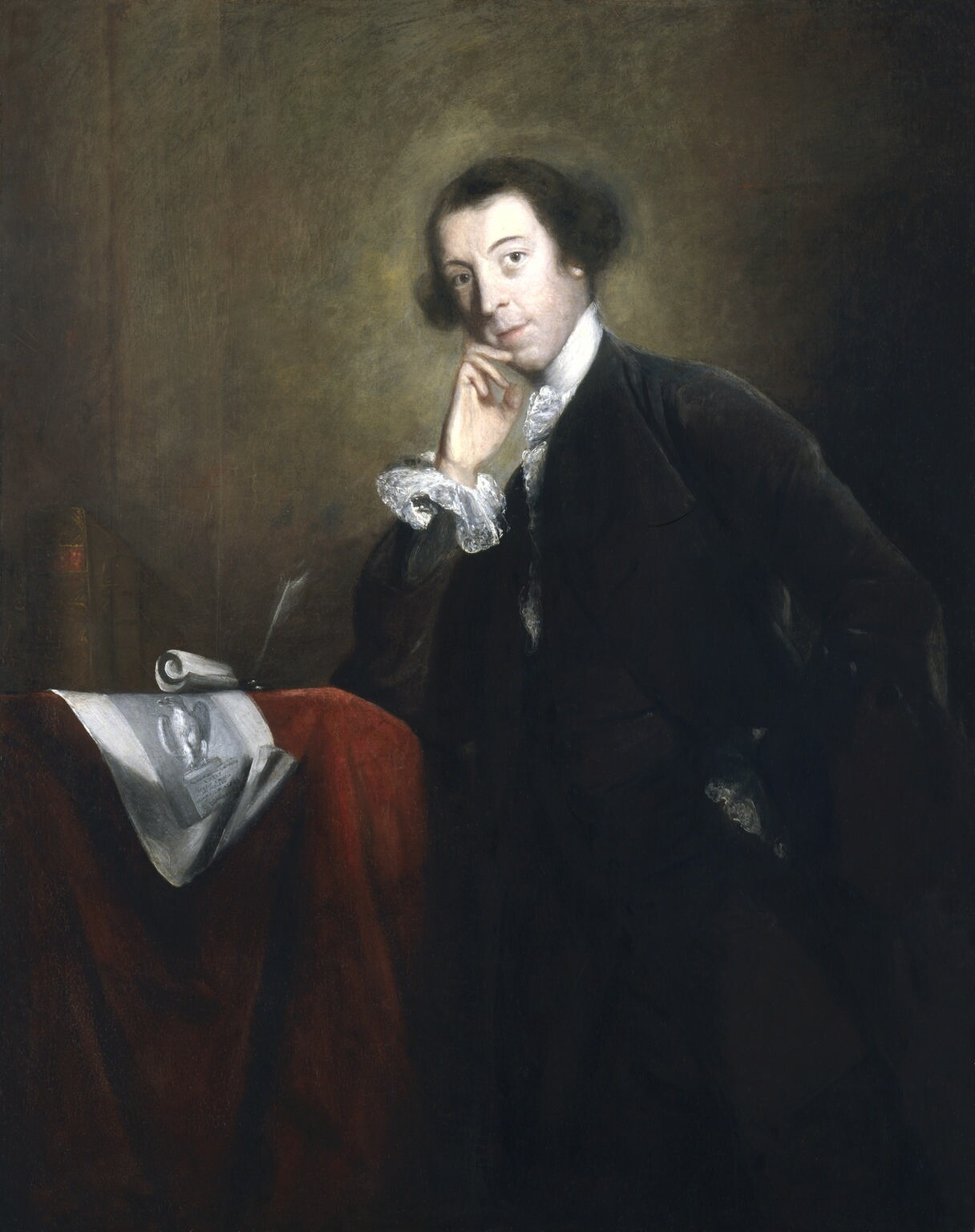
      Sir Joshua Reynolds, Horace Walpole, c. 1756-7

      You have to love Horace Walpole - aesthete, antiquary, art historian, man of letters, man of enthusiasms, inventor of the Gothic novel and designer of the extraordinary house at Strawberry Hill.  Simon Schama has a good story in Landscape and Memory about the young Walpole seeking out picturesque scenery in the Alps.  Walpole wrote, "I had brought with me a little black spaniel of King Charles’s breed, but the prettiest, fattest, dearest creature! I had let it out of the chaise for the air, and it was waddling along, close to the head of the horses, on top of one of the highest Alps, by the side of a wood of firs. There darted out a young wolf, seized poor Tory by the throat, and before we could possibly prevent it, sprung up the side of the rock and carried him off."  As Schama says, 'Walpole was the son of the formidable Whig prime minister Sir Robert Walpole, and until the lamentable encounter with the wolf had obviously enjoyed having a silk-eared, sycophantic ‘Tory’ in his lap.'

      Tory wasn’t the only pet of Walpole’s that met a sticky end. When his cat drowned in a goldfish bowl it prompted Thomas Gray, Walpole’s traveling companion in the Alps, to write his ‘Ode on the Death of a Favourite Cat’ (1748):

      ‘Twas on a lofty vase’s side,
      Where China’s gayest art had dyed
      The azure flowers, that blow;
      Demurest of the tabby kind,
      The pensive Selima reclined,
      Gazed on the lake below…

      When Selima reached out for a fish she ‘tumbled headlong in. Eight times emerging from the flood / She mewed to every watry god, Some speedy aid to send.’ But all in vain. And thus Gray warned ‘ye beauties’ (women!) ‘not all that tempts your wand’ring eyes / And heedless hearts is lawful prize; Nor all that glisters gold.’

      This Chinese vase can be seen in a wonderful exhibition currently showing at the V&A, along with other items from Walpole's collection: Renaissance maiolica, medieval coins, a French suit of armour, an Italian shield, old master paintings, portait miniatures (he was an expert on these), a sixteenth century book of swan marks, Cardinal Wolsey's hat, Dr Dee's mirror, a lock of Mary Tudor's hair and a carved limewood cravat which Walpole wore, together with the 'gloves of James I', to greet a party of guests to Strawberry Hill in 1769.  Some exhibits reminded me of objects I've considered on this blog before.  For example, there were two views of Strawberry Hill by Paul Sandby, part of a Sheldon tapestry, and a cup and saucer in the style of Wedgwood's Green Frog Service with delicate painted views of Richmond Castle, the Mausoleum at Castle Howard and Stoke Gifford in Gloucestershire.  Walpole, like Bruce Chatwin, loved the stories connected with objects.  It's easy to see how desirable, for example, he would have found Alexander Pope's own copy of The Iliad, the very book used to make Pope's celebrated translation.  This small volume has a sketch on the flyleaf drawn by the poet himself, showing Twickenham seen from Pope's Grotto.

      Last week I wrote about landscapes viewed from a specific house, where the real subject of the painting is the house itself.  Walpole commissioned sketches of this kind, including a striking View from the Holbein Chamber by Joseph Charles Barrow, in which two figures are seen approaching through a strange tunnel of trees, like characters in a Gothic novel.  However, the most unusual painting in the exhibition is a dream landscape in which a distant hill takes on the form of a lion and a nearby tree is full of snakes. Painted in 1759 by Walpole's friend Richard Bentley, who helped design the Gothick rooms of Strawberry Hill, its title is A Prospect of Vapourland.


      Johann Heinrich Müntz, Strawberry Hill, c. 1755-59

      Friday, April 16, 2010

      The bright sun was extinguish'd


      With flights grounded following the eruption of Eyjafjallajokull and a cloud of volcanic ash covering the country, causing spectacular sunsets, it seems a good moment to recall Jonathan Bate's account of the impact another eruption had on Romantic poetry.  In 1815, the volcano of Tambora, in Indonesia, blasted dust into the stratosphere and cooled global temperatures.  'The effect lasted for three years, straining the growth-capacity of life across the planet. Beginning in 1816, crop failure led to food riots in nearly every country in Europe. Only in 1819 were there good harvests again'. (The Song of the Earth, 2000 p97).  It 'rained in Switzerland on 130 out of the 183 days from April to September 1816. The average temperature that July was an astonishing 4.9º Fahrenheit below the mean for that month in the years 1807-24'.  And it was during that gloomy summer that Lord Byron composed his poem ‘Darkness’ on the shores of Lake Geneva: 

      I had a dream, which was not all a dream.
      The bright sun was extinguish'd, and the stars
      Did wander darkling in the eternal space,
      Rayless, and pathless, and the icy earth
      Swung blind and blackening in the moonless air;
      Morn came and went--and came, and brought no day...

      John Keats wrote his 'Ode to Autumn’ in September 1819.  Jonathan Bate argues that this poem celebrates the end of the failed harvests caused by the eruption of Tambora. In August Keats wrote to his sister Fanny:  "The delightful Weather we have had for two Months is the highest gratification I could receive--no chill'd red noses--no shivering--but fair atmosphere to think in..."  And here's the famous opening stanza of Keats' poem:

      Season of mists and mellow fruitfulness!
      Close bosom-friend of the maturing sun;
      Conspiring with him how to load and bless
      With fruit the vines that round the thatch-eaves run;
      To bend with apples the mossed cottage-trees,
      And fill all fruit with ripeness to the core;
      To swell the gourd, and plump the hazel shells
      With a sweet kernel; to set budding more,
      And still more, later flowers for the bees,
      Until they think warm days will never cease,
      For Summer has o'erbrimmed their clammy cells.

      1819 was Keats' great year, when he composed his other major odes, finished 'The Eve of St Agnes' and wrote 'La Belle Dame Sans Merci.'  He also fell in love with Fanny Brawne.  Wentworth Place, where Keats lived next door to the Brawnes, has been newly restored.  We paid it a visit last week and found its grey rooms, lit by the spring sunshine, less melancholy than might have been expected.  After such a long bleak winter it was a relief to enjoy the garden in "delightful Weather" that would have gladdened the poet.  This garden is a lovely spot to sit in and read, or play hide and seek, or admire the old mulberry tree that Keats himself would have seen as he looked out on the orchard. 


      The old mulberry tree in the garden at Keats House,
      photographed last week

      Wednesday, April 14, 2010

      The North Gate of the Citadel

      Back in 2007 I wrote briefly here on my return from Copenhagen about the landscapes of Christen Købke. On Sunday I was able to see more of the artist's work at an exhibition here in London, Christen Købke: Danish Master of Light.  In the context of the National Gallery it was easy to draw parallels with oil sketches on show there by other once-underrated artists: Thomas Jones, Pierre-Henri de Valenciennes et al.  Købke followed in the footsteps of Jones and others, making the trip to south to Naples, but his best work was done in and around Copenhagen.  Wherever he worked, he seems to have followed the advice of his artistic mentor, Christoffer Wilhelm Eckersberg: "paint from nature, no matter what it might be."


      My earlier post included his painting Frederiksborg Palace in the light of evening, 1835, which shows a famous national landmark full on.   In contrast, the view below is dominated by just one of the palace towers.  The tower is a synecdoche for the palace which is a synecdoche for Denmark itself (the Danish kings and queens were crowned there).  Another larger painting, Roof Ridge at Frederiksborg, is mostly empty sky, making it seem almost abstract.  Again it shows the landscape outside the palace, rather than the palace itself, but the location is clear from the presence of one of these signature towers in the bottom left.  I suppose the owner of such a painting would be able to imagine themselves living in and looking out from the palace itself.  Købke's paintings reminded me of the view we used to have from our old flat (although this was hardly a palace and the tower outside was nineteenth century decoration).

      Christen Købke, One of the Small Towers on Frederiksborg Castle,
      c. 1834-5


      View from the window of our old flat, Tufnell Park

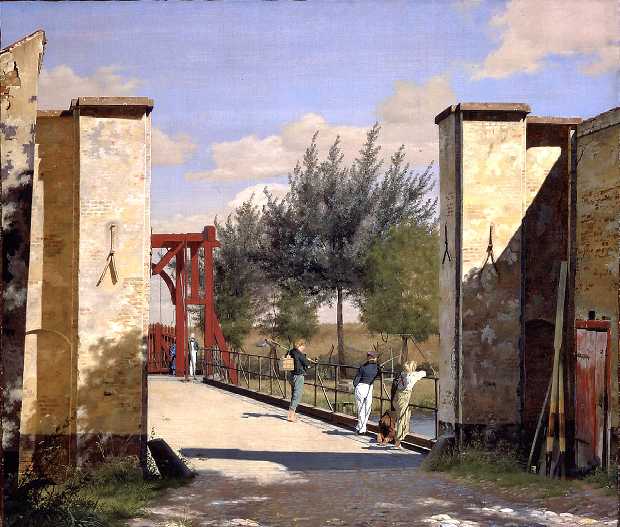
      Many of Christen Købke's paintings depict the Citadel - the kind of unusual, politically charged landscape that would draw the interest of contemporary artists (not to mention BLDGBLOG and Pruned).   The Citadel (Kastellet) is a series of fortifications near Copenhagen originally designed in 1626 for King Christian IV (who was also responsible for building most of Frederiksborg palace). In Købke's time it was a barracks with its own church, mill and bakery, a self sufficient community that included both soldiers and prison labourers.  Købke doesn't devise idealised scenes - the view below with its cropped figures and precise lighting looks like a photograph - but the paintings all feature his warm palette and soft Vermeer lighting. Købke grew up in the Citadel (his father was a master baker there) and these views of gateways, bridges and embankments clearly had a strong personal significance for him.


      Christen Købke, The North Gate of the Citadel, 1834

      Thursday, April 08, 2010

      Paddle to the Sea

      I have written here before about David Nash's Wooden Boulder which took twenty-five years to be carried from a Welsh river to the open sea.  Nash documented its slow progress through the landscape, but has now lost sight of it.  "The wooden boulder was last seen in June 2003 on a sandbank near Ynys Giftan. All creeks and marshes have been searched so it can only be assumed it has made its way to the sea. It is not lost. It is wherever it is.”

      I've just been watching with my three year old son the short film, Paddle to the Sea, made in 1966 by Bill Mason. It follows the journey of a small wooden canoe, carved by a lonely boy in the woods of west Ontario, as it is carried by currents through lakes and rivers until eventually being found at the sea by a lighthouse keeper.  He releases it back into the Atlantic Ocean where, like Nash's boulder, its ultimate destination is unknown.


      How different they are - a huge wooden boulder that Nash was unable to transport, slowly pushed to the sea when the currents are powerful enough to move it, and a light model canoe floating at the mercy of the elements.  One makes its way down to the Atlantic through the river Dwyry, the other is carried across twenty-two thousand miles of the vast Canadian landscape.  Paddle to the Sea was immediately lost to its creator, whilst the Wooden Boulder became a constant presence for Nash over a period of twenty five years.  Nash's work was accidental and its narrative unfolded by chance, whilst Mason's film is fictional, based on an original picture book by Holling C. Holling, published in 1941.

      On the Criterion site Michael Koresky gives a good description of the film and describes the efforts Mason went to, taking 'the exact route through the Great Lakes and down the Saint Lawrence River illustrated in the book—both a visualization of Holling’s work and a pilgrimage. ...  The most dangerous part of the shoot was, unsurprisingly, at Niagara Falls, where Mason dropped his 16 mm camera, secured by a line anchored to a telephone pole, eighty feet down the fierce waterfall.  The filmmaking adventures notwithstanding, Paddle to the Sea is perhaps more remarkable for the patience and contemplative silences of its storytelling, beautifully typified in the placid exterior of its impervious main character. Though it’s never fully anthropomorphized by the film’s narration, the piece of wood becomes a character in its own right. Even when threatened by curious wildlife, including sea snakes, gulls, and frogs, or the looming machinery and pollution of mankind, Paddle simply smiles, an oasis of serenity amid nature’s unstoppable, alternately merciless and merciful, flow. In one of Mason’s most extraordinary moments, the tiny carved figure floats, still and upright as ever, silhouetted against a sky of blooming Fourth of July fireworks in Detroit harbor; he’s either oblivious to these odd, man-made pleasures or watching intently with alien awe, but the narrator refuses to impose a reading.'

      Tuesday, April 06, 2010

      Harbour and Room

      There is a beautiful watercolour from 1935 in the Dulwich Picture Gallery's Paul Nash: The Elements, called Empty Room.  It shows an ordinary space with a wooden floor, simple skirting board and a Victorian door, just like the room in which I'm writing this.  But a tree stump rises from the floor, cliffs make up the wall to the left, the ceiling merges into a grey sky and a cold sea is visible in the distance.  It is one of several paintings Nash did in which a landscape appears like a dream inside an empty room.  The opening out of an enclosed space seems to imply escape and release, although in this case, as James King has observed, the dead tree and white cliffs are a premonition of death.

      In an earlier watercolour shown in the exhibition, Harbour and Room (1931), part of the floor is made up of water and again we are looking not at a blank wall but at the view out to some stationary boats and beyond them the sea.  Nash's wife Margaret recalled that this harbour was Toulon and the idea came from the reflection of a ship in a large mirror in front of their hotel bed.  Andrew Causey has associated this image with a kind of death: 'the waters of unconsciousness invade the room; they are the kind of death that happens at night when the conscious self is resigned to sleep and dream' (1971, quoted in this exhibition catalogue).

      A third example, Three Rooms (1937) depicts, sky, forest and water in the midst of three different rooms.  The symbolism in Nash is never straightforward - Andrew Causey sees the top room, with its ceiling open to the sky as having 'a sense of liberation' and the claustrophobic wooded room in the middle as 'a point of birth' - the lowest room, in which the floor leads out towards a setting sun, links to the other two.  James King has also had a go at explaining it: 'the dominant force is the rising sun. ... the sea can invade and bring destruction to any human life; the presence of the sun here, nevertheless, suggests that such forces can be conquered. ... there is a realm of existence beyond the forest depicted in the interpenetration of room and sky; the emphasis on the aerial in the top image points to a realm 'beyond' - the forces of undoing can be conquered' (1987, quoted in this exhibition catalogue).

      Paul Nash, Three Rooms, 1937
      Source: Tate Gallery - public domain (image added 2017)

      Is there a wider subgenre of landscapes merging with interior space?  Surrealists like Max Ernst and René Magritte combined interior and exterior elements in a similar fashion to Nash.  They and Nash were working in the wake of Giorgio de Chirico, whose Wooded Interior (1926) can be likened to the second of Paul Nash's Three Rooms.  You can see Wooded Interior at the Christie's website, where they describe it thus: 'the setting of the room contains detailed architectural moldings and patterned wallpaper; a mysterious, densely wooded landscape, rooted in the floorboards and pushing upward into the ceiling intrudes on one side of the room; yet most amazing of all are the sea waves that roll in from some unseen horizon.'  However, for me the difference is that de Chirico's painting deploys landscape elements in a surreal interior collage whilst Nash's rooms seem to open onto abstract dream landscapes.

      It was a short step from collages on canvas to collages in actual rooms and one of the Surrealist exhibitions prefigures later installation art by including what appeared to be part of a landscape.  For the 1938 'Exposition Internationale du Surréalisme' in Paris, Marcel Duchamp ('generator-arbitor' of the exhibition) designed part of the room as a pool with water-lilies and reeds (Wolfgang Paalen was put in charge of 'water and brushwood').  Looking backwards from the Surrealists, there is an engraving mentioned as an influence by de Chirico, a Symbolist precursor to the convergence of room and seascape in Nash: Max Klinger's Accorde, from his Brahmsphantasie (1894), a set of illustrations inspired by the music of Brahms.

      The idea that a room could become a landscape has inspired trompe l'œil wall paintings since Roman times (see my recent post on the Garden Room at Prima Porta).  I gather mural painting has come back into vogue recently, although modern building technology has created glass walls with the potential to 'bring the landscape' into a living room.  But looking at Nash's paintings I wasn't really imagining these architectural landscape rooms.  The images that came immediately to mind immediately were from Maurice Sendak's Where the Wild Things Are, where a forest grows in hero Max's bedroom.  The idea that a world might lie behind a room is found in other children's literature - who hasn't fantasised about a snowy wood reachable by entering their wardrobe?  But I'll end here with Ray Bradbury's chilling reversal of the idea in his story 'The Veld', where a high-tech children's nursery is installed with 'crystal walls' showing a three dimensional view of the African landscape, its ceiling 'a deep sky with  hot yellow sun'.  The simulation is enhanced with realistic heat, smells and sounds, and in the distance can be seen a pride of lions... 

      Postscript: The YouTube clips originally embedded here are no longer available...  However, Nash's paintings are now out of copyright so I have added one of the images to this post.

      Saturday, April 03, 2010

      The Ascent of Mount Ventoux

      Ten years ago we spent a pleasant few days in Avignon and I remember wandering around trying to picture the city in the time of Petrarch - not easy with Jeff Koons' giant floral puppy installed in the middle of the Papal Palace.  We had rather cloudy weather but on the last day the sky was somewhat clearer and we suddenly became aware of Mount Ventoux, its summit visible, floating in the hazy distance.  Then it was easy to imagine Petrarch's desire to climb the mountain, a feat he apparently achieved one day in 1336, his only motive 'the wish to see what so great a height had to offer.'

      Petrarch's letter describing the ascent draws moral lessons from his tendency to vacillate and climb by the easiest paths: he who ascends by the most direct route will reach the spiritual heights more quickly.  Nevertheless, there is a moment at the summit where Petrarch, like a modern climber, stops to admire the landscape.  He gazes far off towards the mountains around Lyon, the bay of Marseilles, and 'the sea that beats against the shore of Aigues-Mortes'.  It is at this point, however, that he reaches for his trusty copy of Augustine's Confessions and opens it by chance at a passage that makes him feel ashamed and decide to start down the mountain again.  'And men go about admiring the high mountains and the mighty waves of the sea and the wide sweep of rivers and the sound of the ocean and the movement of the stars, but they themselves they abandon.'


      Francesco Petrarch, Justo de Gante, C15

      Petrarch's Italian poems, the Canzoniere, show in certain images a real feeling for landscape - certainly this is the impression I get from Mark Musa's translations (which were read through before publication by Charles Tomlinson, the author of many landscape poems.)  The most notable example is number 129, ‘Di pensier in pensier, di monte in monte’ which begins 'From thought to thought, mountain to mountain top / Love leads me on.'  A full translation by A. S. Kline is given below (as the website says it "may be freely reproduced"). Note the way Petrarch projects an image of Laura onto the landscape: 'Many times I have seen here vividly / (now, who will believe me?) in clear water / and on green grass, and in a beech trunk, / and in a white cloud...'  This is a good example of the phenomenon I've mentioned a few times recently in connection with the Deleuze/Guattari theory of faciality.

      Love leads me on, from thought to thought,
      from mountain to mountain, since every path blazed
      proves opposed to the tranquil life.
      If there is a stream or a fountain on a solitary slope,
      if a shadowed valley lies between two hills,
      the distressed soul calms itself there:
      and, as Love invites it to,
      now smiles, or weeps, or fears, or feels secure:
      and my face that follows the soul where she leads
      is turbid and then clear,
      and remains only a short time in one mode:
      so that a man expert in such a life would say
      at the sight of me: ‘He is on fire, and uncertain of his state.’

      I find some repose in high mountains
      and in savage woods: each inhabited place
      is the mortal enemy of my eyes.
      At every step a new thought of my lady
      is born, which often turns the suffering
      I bear to joy, because of her:
      and, as often as I wish
      to alter my bitter and sweet life,
      I say: ‘Perhaps Love is saving you
      for a better time:
      perhaps you are dear to another, hateful to yourself.’
      And with this, sighing, I continue:
      ‘Now can this be true? And how? And when?’

      Sometimes I stop where a high pine tree or a hill
      provides shade, and on the first stone
      I trace in my mind her lovely face.
      When I come to myself, I find my chest
      wet with pity: and then I say: ‘Ah, alas,
      what are you come to, and what are you parted from!’
      But as long as I can keep
      my wandering mind fixed on that first thought,
      and gaze at her, and forget myself,
      I feel Love so close to me
      that my soul is satisfied with its own error:
      I see her in many places and so lovely,
      that I ask no more than that my error last.

      Many times I have seen here vividly
      (now, who will believe me?) in clear water
      and on green grass, and in a beech trunk,
      and in a white cloud, so made that Leda
      would surely have said her daughter was eclipsed,
      like a star the sun obscures with its rays:
      and the wilder the place I find
      and the more deserted the shore,
      the more beautifully my thoughts depict her.
      Then when the truth dispels
      that sweet error, I still sit there chilled,
      the same, a dead stone on living stone,
      in the shape of a man who thinks and weeps and writes.

      I feel a sole intense desire draw me
      where the shadow of no other mountain falls,
      towards the highest and most helpful peak:
      from there I begin to measure out my suffering
      with my eyes, and, weeping, to release
      the sorrowful cloud that condenses in my heart,
      when I think and see,
      what distance parts me from her lovely face,
      which is always so near to me, and so far.
      Then softly I weep to myself:
      ‘Alas, what do you know! Perhaps somewhere
      now she is sighing for your absence.’
      And the soul takes breath at this thought.

      Song, beyond the mountain,
      there where the sky is more serene and joyful,
      you will see me once more by a running stream,
      where the breeze is fragrant
      with fresh and perfumed laurel.
      There is my heart, and she who steals it from me:
      here you can only see my ghost.

      Friday, April 02, 2010

      Stony ground and trees, with a pool

      The heroines of nineteenth century novels are often seen drawing - a desirable accomplishment of course, but also one that could be used to symbolise or demonstrate important attitudes and character traits.  Elinor in Sense and Sensibility, whom I mentioned here recently, is one example.  In addition to being sceptical of picturesque landscape, her admirer Edward is criticised for being insuffiiently appreciative of Elinor's sketches: 'I am afraid, Mamma, he has no real taste. Music seems scarcely to attract him, and though he admires Elinor's drawings very much, it is not the admiration of a person who can understand their worth.'  Then there is Margaret Hale in Elizabeth Gaskell's North and South (1855), a book which I think reads like a Jane Austen novel until the moment Margaret travels from London to her home in the New Forest in a train. Here we see her out sketching with an admirer, the lawyer Henry Lennox, who surreptitiously introduces figures into his picturesque landscape:

      Margaret brought out her drawing materials for him to choose from; and after the paper and brushes had been duly selected, the two set out in the merriest spirits in the world.

      'Now, please, just stop here for a minute or two, said Margaret.  'These are the cottages that haunted me so during the rainy fortnight, reproaching me for not having sketched them.'

      'Before they tumbled down and were no more seen. Truly, if they are to be sketched--and they are very picturesque--we had better not put it off till next year. But where shall we sit?'

      'Oh! You might have come straight from chambers in the Temple,' instead of having been two months in the Highlands! Look at this beautiful trunk of a tree, which the wood-cutters have left just in the right place for the light. I will put my plaid over it, and it will be a regular forest throne.'

      'With your feet in that puddle for a regal footstool! Stay, I will move, and then you can come nearer this way. Who lives in these cottages?'

      'They were built by squatters fifty or sixty years ago. One is uninhabited; the foresters are going to take it down, as soon as the old man who lives in the other is dead, poor old fellow!  Look--there he is--I must go and speak to him. He is so deaf you will hear all our secrets.'

      The old man stood bareheaded in the sun, leaning on his stick at the front of his cottage. His stiff features relaxed into a slow smile as Margaret went up and spoke to him. Mr. Lennox hastily introduced the two figures into his sketch, and finished up the landscape with a subordinate reference to them--as Margaret perceived, when the time came for getting up, putting away water, and scraps of paper, and exhibiting to each other their sketches. She laughed and blushed. Mr. Lennox watched her countenance.

      'Now, I call that treacherous,' said she. 'I little thought you were making old Isaac and me into subjects, when you told me to ask him the history of these cottages.'

      'It was irresistible. You can't know how strong a temptation it was. I hardly dare tell you how much I shall like this sketch.'


      Elizabeth Gaskell's friend Charlotte Bronte, who died two months after the final installment of North and South was published, also created a heroine accomplished at drawing.  However, Jane Eyre's life is more constrained and she cannot simply walk out and paint picturesque scenes.  Her powerful Romantic imagination is evident in drawings that Mr Rochester asks her to show him.  He finds them 'for a school-girl, peculiar.  As to the thoughts, they are elfish':

      These pictures were in water-colours.  The first represented clouds low and livid, rolling over a swollen sea: all the distance was in eclipse; so, too, was the foreground; or rather, the nearest billows, for there was no land.  One gleam of light lifted into relief a half-submerged mast, on which sat a cormorant, dark and large, with wings flecked with foam; its beak held a gold bracelet set with gems, that I had touched with as brilliant tints as my palette could yield, and as glittering distinctness as my pencil could impart.  Sinking below the bird and mast, a drowned corpse glanced through the green water; a fair arm was the only limb clearly visible, whence the bracelet had been washed or torn.

      The second picture contained for foreground only the dim peak of a hill, with grass and some leaves slanting as if by a breeze.  Beyond and above spread an expanse of sky, dark blue as at twilight: rising into the sky was a woman’s shape to the bust, portrayed in tints as dusk and soft as I could combine.  The dim forehead was crowned with a star; the lineaments below were seen as through the suffusion of vapour; the eyes shone dark and wild; the hair streamed shadowy, like a beamless cloud torn by storm or by electric travail.  On the neck lay a pale reflection like moonlight; the same faint lustre touched the train of thin clouds from which rose and bowed this vision of the Evening Star.

      The third showed the pinnacle of an iceberg piercing a polar winter sky: a muster of northern lights reared their dim lances, close serried, along the horizon.  Throwing these into distance, rose, in the foreground, a head,—a colossal head, inclined towards the iceberg, and resting against it.  Two thin hands, joined under the forehead, and supporting it, drew up before the lower features a sable veil, a brow quite bloodless, white as bone, and an eye hollow and fixed, blank of meaning but for the glassiness of despair, alone were visible.  Above the temples, amidst wreathed turban folds of black drapery, vague in its character and consistency as cloud, gleamed a ring of white flame, gemmed with sparkles of a more lurid tinge.  This pale crescent was “the likeness of a kingly crown;” what it diademed was “the shape which shape had none.”'

      This is getting to be quite a long post, but I can't resist ending with one final heroine, Dorothea from Middlemarch, who we see early in George Eliot's novel in a situation that reverses the gender roles of Sense and Sensibility.  It is the occasion of her first meeting with the attractive Will Ladislaw, who will end up as Dorothea's husband, though for now she is still under the sway of dry old Casaubon, and professes not to understand the art of landscape sketching.  Ladislaw is self deprecating about his efforts but Mr Brooke, admires the drawings in Ladislaw's sketch book: 

      "Oh, come, this is a nice bit, now. I did a little in this way myself at one time, you know. Look here, now; this is what I call a nice thing, done with what we used to call brio." Mr. Brooke held out towards the two girls a large colored sketch of stony ground and trees, with a pool.

      "I am no judge of these things," said Dorothea, not coldly, but with an eager deprecation of the appeal to her. "You know, uncle, I never see the beauty of those pictures which you say are so much praised. They are a language I do not understand. I suppose there is some relation between pictures and nature which I am too ignorant to feel—just as you see what a Greek sentence stands for which means nothing to me." Dorothea looked up at Mr. Casaubon, who bowed his head towards her, while Mr. Brooke said, smiling nonchalantly— 

      "Bless me, now, how different people are! But you had a bad style of teaching, you know—else this is just the thing for girls—sketching, fine art and so on. But you took to drawing plans; you don't understand morbidezza, and that kind of thing. You will come to my house, I hope, and I will show you what I did in this way," he continued, turning to young Ladislaw, who had to be recalled from his preoccupation in observing Dorothea. Ladislaw had made up his mind that she must be an unpleasant girl, since she was going to marry Casaubon, and what she said of her stupidity about pictures would have confirmed that opinion even if he had believed her. As it was, he took her words for a covert judgment, and was certain that she thought his sketch detestable. There was too much cleverness in her apology: she was laughing both at her uncle and himself. But what a voice! It was like the voice of a soul that had once lived in an AEolian harp...


      No doubt somebody has written a thesis on the role of outdoor sketching in nineteenth century fiction - there must be many other interesting examples...