Monday, February 12, 2007

Water falling, drop by drop

My copy of the New York Review of Books arrived today and I whiled away a dismal bus journey reading an article about James Laughlin, whose enviable life combined the roles of rich playboy, ace skier and founder of New Directions, publisher of many of the most interesting twentieth century writers. A complete list of these would be lengthy, but would include: Pound, cummings, Bishop, H.D., Zukofsky, Levertov, Snyder, Dylan Thomas, Henry Miller, Lorca, Neruda, Borges, Rilke, Ungaretti, Nabokov and Sebald. As many of these had other publishers in England, I don't have many New Directions books on my shelves, but looking just now I realised those I do have are particularly choice items it would be hard to imagine appearing from a publishing house not bankrolled by someone like Laughlin (or benefitting from the profits New Directions earned on Hermann Hesse's Siddhartha). I think my favourite is Henri Michaux's Ideograms in China, a slim volume originally written in 1971 that shares many of the preoccupations of Ernest Fenollosa's The Chinese Written Character as a Medium for Poetry (a seminal text for Ezra Pound and some post-Poundian poets).


Michaux, like Fenollosa and Pound, sees in the origins of Chinese script a direct response to nature. The idea of natural signs (which of course also figures in Western thought, e.g. Plato's Cratylus) seems to offer the possibility of presenting and combining actual elements of landscape, rather than simply evoking a scene in a succession of abstract signs. Michaux (translated by Gustaf Sobin) describes the recovery of ancient Chinese writing (c. 120 CE) by scholars who compiled a 'dictionary of orginal signs', so that a written page could be full of 'everything to be found in the world': 'full of water falling, drop by drop, out of clouds / of ferryboats crossing from one side to another / full of earth embankments / of furnaces... scenes that lend themselves to reflection / scenes of all sorts... clustered that they might end in ideas / or unravel as poetry.'

Despite these efforts, the subsequent development of Chinese writing led further and further from nature, towards abstraction. However, as Richard Sieburth says in his afterword: 'if calligraphy enables the material body of the sign to be transfigured into pure spirit, the very activity of this scriptura scribens nonetheless plunges us back (by a kind of dialectical reversal) into the immanent energies of a natura naturans. Freed from imitating nature, signs may now signify it...' And so writing itself can become a kind of habitable landscape. Michaux ends his poetic essay with a final observation on Chinese writing: 'Calligraphy around which - quite simply - one might abide as next to a tree, or a rock, or a source.'

Tuesday, February 06, 2007

The fortress at Qalat-i Gird

The British Museum has an exhibition of Georg Gerster's aerial photographs of historical sites, The Past From Above. The images that struck me initially were those with an unexpected formal beauty, like the long oval of the Stadium of Aphrodisias in Turkey, or a burial mound in the Niger inland delta (with its superficial resemblance to Smithson's Spiral Jetty), or the contrast between the ancient ruins at Ebla in Syria and the intricate and beautifully coloured field pattern that now surrounds it. Some of the photographs show landscapes that would be spectacular even without a historical trace, particularly those associated with religious sites: tombs built onto the side of Cerro de los Metates, a volcanic chimney in Mexico; or the Dabra Damo monastery, built on a table mountain in Ethiopia; or the wave-battered island of Skellig Michael, site of another monastery.

Some of the most interesting photographs show natural processes at work, like the sand dunes threatening the ancient field system visible at Kharga Oasis, Egypt. Gerster photographed another dune landscape at Sistan, Iran, where the Wind of 120 Days seems to have obliterated everything beneath the sands, except for the circular shape of Qalat-i Gird fortress. According to Dietrich Huff, this 'much-feared' wind determines the angles of trees and buildings and creates 'bizarrely beautiful and distinctly shaped shifting dunes.' The fortress probably dates from the 13th century, after the composition of Firdausi's Shahnama in which the legendary hero Rustam was depicted as the saviour of Sistan, but early enough to have witnessed the conquest of Tamburlaine and his wounding at the siege there.

Sunday, February 04, 2007

Cannon River Eddies

Environmental sound artist Philip Blackburn has an interesting website called Music and Nature featuring various soundclips and interviews. For example, there is video footage of his own Cannon River Eddies, 'a performance installation in Northfield, Minnesota, to bring attention to the role of water and the presence of the river in the town center'. There is also a survey of wind music by Rene Van Peer and features on animal music, ranging from bird song to the performances of the Thai elephant orchestra.

Postscript: September 2015
This Music and Nature website still exists, although much has been written about music and nature in the ten years since it was created.  As the post above is a bit short I thought I would summarise that survey of wind music by listing his examples...
  • Chris Watson says that "Wind, wherever the sound recordist operates, is an obvious nuisance".  But in a recording made at Glen Cannich, he "could walk through the foci of these wind sounds within a few paces, as if being part of some great instrument..."
  • By contrast wind can be a gentle backdrop as in a forest recording by Jonathon Storm...
  • Wind in the trees sounds differently depending on the leaf cover. A Peter Cusack recording 'captures the spirit of late autumn, when most trees are bare, and leaves that are still clinging to the branches have a very distinctive brittleness.'
  • Gordon Hempton devoted a whole album to the winds of North America, which vary according to the local landscape
  • A Francisco López, 'Wind from Patagonia' demonstrates 'layers of sound, suggestiveness and a subtle musicality.'
  • Geoff Sample recorded a spring gale whistling around ta metal gate
  • 'In Guadalcanal, one of the Solomon Islands, people used to erect bamboo poles on the easternmost beaches of the island when someone had died. Holes and slits were cut out in the canes, which were played by the wind'
  • The Japanese sound artist Akio Suzuki recorded the wind blowing across his Analapos instrument
  • Scott Smallwood recorded the wind around a pile of scrap and refuse left at an abandoned airfield in the Utah desert.
  • Eric La Casa collects wind and wind-based recordings and adds a church organ to the mix

Thursday, February 01, 2007

When Faith Moves Mountains

Among the interesting works of landscape art in Tacita Dean and Jeremy Millar's book Place is one they describe as having 'great simplicity and poetic richness': When Faith Moves Mountains by Francis Alÿs. The artist was struck by the hardship of life on the edge of Lima, where seventy thousand people live in shanty towns without running water or electricity. Displaced from the city by social unrest and economic crises, they came to live on the Ventanilla dunes, slowly moving hills of sand that seem like metaphors for the forces acting on the people of Lima. On April 11 2002, Alÿs organised an action he describes as 'at once futile and heroic, absurd and urgent.' Five hundred volunteers formed a line at the foot of a dune and working only with shovels managed to mve it about four inches from its original position.

There is an Artforum article in which Alÿs discusses this work. "When Faith Moves Mountains is my attempt to deromanticize Land art. When Richard Long made his walks in the Peruvian desert, he was pursuing a contemplative practice that distanced him from the immediate social context. When Robert Smithson built the Spiral Jetty on the Salt Lake in Utah, he was turning civil engineering into sculpture and vice versa. Here, we have attempted to create a kind of Land art for the land-less, and, with the help of hundreds of people and shovels, we created a social allegory. This story is not validated by any physical trace or addition to the landscape. We shall now leave the care of our story to oral tradition, as Plato says in the Republic. Only in its repetition and transmission is the work actualized. In this respect, art can never free itself from myth. Indeed, in modem no less than premodern societies, art operates precisely within the space of myth."

Monday, January 29, 2007

Wittgenstein's cottage

There is an excellent new 'exhibition in a book' on the theme of Place put together by Tacita Dean and Jeremy Millar, published by Thames & Hudson. Their introduction doesn't try to place 'place' precisely, but among other things they remark that 'one might say that 'place' is to landscape as 'identity' is to portraiture'. For example, they mention Guy Moreton's photograph, Wittgenstein's Cottage (2002-4), taken as part of Alec Finlay's Wittgenstein project. Both the photograph and the site itself might be seen as beautiful landscapes, but the ruins of Wittgenstein's cottage give the landscape a particular identity.

The book discusses place under the headings 'urban', 'nature', 'fantastic', 'myth / history', 'politics / control', 'territories', 'itinerancy' and 'heterotopias and non-places.' There is also a postcript which gives a four way conversation on place and its relationship with space and landscape, involving the two authors and two art historians: Joseph L. Koerner and Simon Schama. Here are some points they make:
  • That we now tend to reject the framed view (even though it is hard to escape - the painting having been replaced by the TV screen), in favour of a wider sense of experience and possibility.
  • That limitless space, as in the ocean, remains frightening, but that grids of latitude and longitude have made this kind of abstract space knowable (Deleuze and Guattari).
  • That obviously historical change means that places mutate, and that people can value both the monumental and the transient, e.g. landscapes seen through the car window like the frames of a film (Walter Benjamin).
  • That society only has a sense of place when it is no longer rooted. Urban dwellers looking at rural society and feeling their own rootlessness start to value 'place'.
  • That in the modern world place can be fixed with linear perspective and abstract thinking, and yet do we really know that their was a different sense of place in the pre-modern world?
  • That places can be experienced and recalled through all the senses (e.g. smells and sounds), but space may be something that can only be imagined.
  • That the forces of globalisation may be destroying the specificity of places, and yet those forces may themselves result from the 'staggering boredom' of life in the countryside and the possibilities of the modern city.
  • That we understand place emotionally, through memory, and ultimately find it much more difficult to explain than space.

Friday, January 26, 2007

The Lake of Albano and Castel Gandolfo

When art historians read changes in style as reflecting broader political changes it is often possible to argue from both ‘sides’. For example, Ann Bermingham in her essay ‘English Landscape Drawing around 1795’ argues that the impact of the French Revolution was seen in a rejection of earlier forms of landscape composition, based on the idealised classical landscapes painted in seventeenth century Italy, in favour of more naturalistic drawings where the forms of nature took on a more individual character. From a liberal perspective, this would be consistent with an appreciation of the real qualities of the English countryside, rather than the kinds of views sought on the Grand Tour. However, from a conservative point of view, the change in landscape painting could equally be seen as a rejection of the systematic abstractions of theory and the open intellectual spaces of the prospect view, in favour of local scenes demonstrating the timeless qualities of the native landscape.

Thomas Hearn, A Brownian Landscape Garden and A Picturesque Landscape Garden, 
illustrations for Richard Payne Knight's 'Landscape'

These political differences reflect contemporary changes in picturesque theory. The conservative position was essentially that taken by Uvedale Price and Richard Payne Knight in their criticisms of the gardens of Capability Brown and the picturesque theories of William Gilpin. Both Brown and Gilpin had imposed the harmonious compositions of painters like Claude onto the real landscape. Thomas Hearne provided the illustrative etchings of Brownian and Picturesque gardens for Knight’s didactic poem 'The Landscape' (1795) - see above.  Ann Bermingham sees the new style embodied in Hearne’s art. She contrasts Hearn’s detailed view of Oak Trees (c. 1786) with a slightly earlier view of The Lake of Albano and Castel Gandolfo (c 1783-5) by John Robert Cozens. So Cozens’ older painting could be either a comforting conservative souvenir of an idealised Italy or a liberal artistic expression of the eighteenth century’s expanding horizons. Take your pick.

John Robert Cozens, The Lake of Albano and Castel Gandolfo, c. 1783-5

Thomas Hearne, Oak Trees, c. 1786

Saturday, January 20, 2007

Wind vortex on the ice cap

Landscape artist Chris Drury is currently working in Antarctica and writing a blog (which looks rather like this one... except that he has lots of nice photos!) However, as he says: "I expected to be out in the landscape most of the time. But in truth Antarctica is a dangerous and unpredictable place and I am here as part of a large organisation who have to ensure everyone’s safety... So for these first 3 weeks the experience has been primarily a social one." Furthermore, "the land itself and the experience of it is absolute. It is so stunningly beautiful, that in the face of it art has no place. As a result I am increasingly reluctant to do anything much in it, apart from make marks with my feet or a skidoo in the snow. I have no wish to use other resources to make a futile impression on what is absolute. I will be content to record on film and photograph what is here and to let the experience of place; land, weather, people and science, become embedd[ed] deep within me." However, in his most recent post he does say he has plans to "make a drawing of a wind vortex" on the ice cap, so we can look forward to some new land art as a result of the trip.

Friday, January 19, 2007

The Bridlepath is Filled with Clouds

Certain Trees was the title of an exhibition of 'the constructed book, poem and object 1964-2006' held at the Centre des livres d'artistes last year. It focused on a loosely connected group of artists and poets who have presented their own work through small presses and exhibition spaces: Simon Cutts, Stuart Mills, Brian Lane, Les Coleman, Thomas A. Clark and others. In his essay for the catalogue, John Bevis sees these artists as inhabiting the (relatively narrow) space between Robert Lax, the American minimalist poet (working in a line that runs from Emily Dickinson through William Carlos Williams and the Objectivists), and Ian Hamilton Finlay, maker of concrete poems.

It is interesting how often these artists work with landscape themes. Bevis himself is represented by works called Cloud Study (1981), The Foliage Society (1984), and An A-Z of Birdsong (1995). The catalogue describes Bevis as pursuing a 'dialogue between the natural world and its classification and presentation through the idiom of language'. This is a description that could be also applied to works by Thomas A. Clark, Ian Hamilton Finlay and other books and objects: Simon Cutts' After John Clare (2002-4), Stuart Mills' The Bridlepath is Filled with Clouds (1970), Fridjof Nansens's Fog Log (1978) by Brian Lane. Some of the names of the small presses also suggest an affinity with the natural world: Moschatel, Wild Hawthorn, Coracle.

The title 'Certain Trees', with its own hint of landscape, comes from a Roy Fisher poem 'Epitaph: Lorine Neidecker' (evoking her best known poem, 'My Friend Tree', which was published in Ian Hamilton Finlay's magazine 'Poor. Old. Tired. Horse', which was in turn named after a line in a Robert Creeley poem...) The lines by Roy Fisher are juxtaposed in the catalogue with a Simon Cutts poem from 1968, 'The Menagerie goes for a Walk': '.... shade from your tree / touch from my wood. A wood full of trees / a tree full of wood.'

Finlay, Fisher and Neidecker all feature in another exhibition, 'The possibility of poetry: from Migrant magazine to artists' books' currently on at the British Library, which celebrates Gael Turnbull's 1960s little magazine, Migrant.

Tuesday, January 16, 2007

Four Stones and Castle Tomen

There is an interesting Tate Paper by Stephen Daniels on the photographer, antiquarian and promoter of ley lines, Alfred Watkins. It notes a link with the work of land artists Richard Long and Hamish Fulton, but focuses mainly on Watkins' career and the way photography shaped his archaeological theories.

Watkins was a member of Hereford's Woolhope Club and wrote articles for them 'on various antiquarian subjects, chapels, wayside crosses, city walls and ancient pottery, accompanied on his excursions by the manager of the Meter Works, W.M. McKaig, who assisted with the field work including the photography. Nothing, it seems, prepared members for Watkins’s astonishing contribution to field archaeology, his systematic idea of ley-lines, at the Club’s autumn meeting on 29 September 1921. This was an afternoon excursion and evening lantern slide lecture in the Club’s rooms in Hereford Free Library and Museum, reported the following year in the Club’s transactions as a paper on ‘Early British Trackways, Moats, Mounds, Camps and Sites.' His book, Early British Trackways appeared in 1922 and, following further research and elaboration of his theories, a more substantial book, The Old Straight Track (1925) became a popular success.


Daniels reproduces some of Watkins' illustrations, including the frontispiece to Early British Trackways, showing the alignment of the Four Stones and Castle Tomen. 'This takes the form of a collage, with three photographs of the sites, one a telephoto shot of Castle Tomen, superimposed on a woodland glade marking a ley.' However, neither Watkins' ideas nor the illustrations had a strong impact on contemporary art. Instead painters like Paul Nash and John Piper were more influenced by Antiquity, a journal started in 1927 by O.G.S. Crawford, who considered Watkins a crank and refused to accept an advertisement for his book, The Old Straight Track.

Sunday, January 14, 2007

The fields of Ennor

Artists trying to find a new way of seeing the landscape may need to try something more unusual than standing and gazing at the view or walking and taking notes. I always think of Peter Lanyon, driving round Cornwall trying to find new angles and eventually taking to the sky in his glider. Roger Deakin's book Waterlog might also be seen in this way: he chose a cold, wet option - swimming in rivers, ponds, lakes and seas around Britain. Literally immersed in these places he not only got a different perspective, he was also sometimes able to see landscapes that would be otherwise inaccessible, like the submerged fields of Ennor...

Deakin's swimming journey started off the coast of Cornwall, where he swam between the Scilly Isles of Bryer and Tresco. He explains: 'The Scilly Isles are the last outcrop of a ridge of volcanic granite that forms the backbone of Cornwall and they were, until about 4000 years ago, the high points of a big island called Ennor. But the melting of the polar ice caps that began after the last Ice Age meant that Ennor’s lowland valleys and fields were gradually submerged. I donned the wetsuit, mask and snorkel, and swam out into the shallow sandy bay. It was high tide and about thirty yards off the shore I looked down at a pair of stone walls meeting at a right angle, and a circle of stones that must once have been a sheep pen. With seaweed hedges growing from the stones, these are the patterns and remains of the patchwork of old fields that once stretched all the way across the valley to Tresco. They are really just a continuation of the remaining field boundaries on shore. This may be why some stretches of water around the Scillies still have names from Before the Flood that are literally outlandish, like Garden of the Maiden Bower or Appletree Bay.'

There are many obituaries and memories of Deakin (who died last year) on line: see here for example. Ken Worpole pays tribute to Deakin on the Open Democracy site (one of several short pieces he has written there on Landscape and Identity). There are also various texts by Deakin, like this one about orchards on the Common Ground site. And the Radio 4 site has a programme Deakin made on a canoe journey from Redgrave Fen in Suffolk to Geldeston Lock in Norfolk, along with another about his garden.

Sunday, January 07, 2007

Boden Sea, Uttwil

There is a nice exhibition of Hiroshi Sugimoto photographs at the Hirshhorn Museum site. Here is how he introduces some of his seascapes: "One New York night in 1980, during another of my internal question-and-answer sessions, I asked myself, "Can someone today view a scene just as primitive man might have?" The images that came to mind were of Mount Fuji and the Nachi Waterfall in ages past. A hundred thousand or a million years ago would Mount Fuji have looked so very different than it does today? I pictured two great mountains; one, today's Mount Fuji, and the other, Mount Hakone in the days before its summit collapsed, creating the Ashinoko crater lake. When hiking up from the foothills of Hakone, one would see a second freestanding peak as tall as Mount Fuji. Two rivals in height—what a magnificent sight that must have been! Unfortunately, the topography has changed. Although the land is forever changing its form, the sea, I thought, is immutable. Thus began my travels back through time to the ancient seas of the world."

"Immutable", but never the same... as you look at the different seas you wonder if he has captured essential differences in them - the hazy shimmer of Boden Sea, Uttwil (1993), the firm horizon of Tyrrhenian Sea, Conca (1994) or whether in different atmospheric conditions these images could be reversed.

In an interview here Sugimoto says: "The first portfolio of seascapes I published was entitled 'Time Exposed' because time is revealed in the sea.... People have a lot of strange ideas about my seascapes - they think these photographs were done using very long exposures, but they are in fact very fast because I wanted to stop the motion of the waves, which are constantly moving. You heard I took some photographs using a camera speed of zero ASA? That's impossible."

Postscript 2015:
I was wondering if it might be possible to include a fair use / non-copyright image with this now and I see that since I wrote this post the photograph Boden Sea, Uttwil has been used for two album covers.  The first, below, was Specification.fifteen (2006) by Richard Chartier and Taylor Deupree.  Three years later U2 used the same image for No Line on the Horizon.

The Owl's Map


I have been listening to The Owl's Map, an album on Ghost Box by Belbury Poly. It is is based on the fictitious 'ancient market town of Belbury' which, according to the sleeve notes, 'is an uneasy mix of ancient and modern': Iron Age ramparts and a 'picturesque 11th century church', but also 'some notable modernist architecture', including the Polytechnic which gives its name to the group. The album is labelled 'Field Guides to British Towns and Villages Volume 7'. It contains murky photographs which, like the images in W.G. Sebald's books, invite you to peer at them trying to work out the boundary between truth and fiction. Most seem to have been taken in the 1970s (see here for example), a time when such towns were uneasily facing both backwards and forwards (before the homogenisation of identical chain stores and the re-branding of polytechnics as universities). The music itself sounds futuristic and pastoral at the same time, whilst the design is inspired by old school textbooks and Penguin paperbacks.

Simon Reynolds has investigated Ghost Box and other strands of 'haunted audio' in contemporary music for an article in Wire and his Blissblog features outtakes from this, including some thoughts on 'The Owl's Map' as a title: 'the owl: the perfect Ghost Box bird-mascot, where the wholesome (children's story books from Winnie the Pooh onwards, bird-watching guides, owl as symbol of wisdom etc) collides with the umheimlich (spooky creature with ultra-acute nightvision). Nature studies meets the supernatural... the map: likewise collides the scientific / precise / diagrammatic / official-bureaucratic-governmental-landsurveying (all those symbols indicating building types, gradients, terrain, natural features and man-made monuments) with the more magical evocations (parchment scrolls, the manuscript illuminating occult path-ways, routes to the treasure…)'

In his interview with Reynolds, Jim Jupp, the man behind Belbury Poly, says that The Owl's Map concept derived partly from old tourist guides ("you know the sort of thing, murky old photos of Chichester Cathedral") and that the colour scheme for the album was inspired by the "those brown road signs that point the way to Roman ruins, falconry centres or stately homes." Jupp's partner in Ghost Box, Julian House, plans to start making films about Belbury (which is named, incidentally, after the fictional town in C S Lewis's That Hideous Strength.)

Friday, January 05, 2007

Deluge

Leonardo da Vinci, Deluge over a City, 1517-18

The V&A exhibition Leonardo da Vinci: Experience, Experiment and Design brought together some of the most inspiring pages from his notebooks, and actually animated some of them. It included one of Leonardo's Deluge drawings from the Royal Collection, described thus: 'Spiral cataracts of air, spray and dust wrench water and even rocks into the air, while a tree (which gives scale to the cataclysm) bends to breaking point as the storm approaches.' The drawing is set in the context of his scientific studies of motion, flow and natural forces. It is so much about the properties of the storm that it feels perverse to try to make sense of the Deluge as a landscape, but the power of the wind and water seem particularly real if you imagine them transforming the view of an actual place.

 Leonardo da Vinci, Deluge, 1519

It made me think about where artists or writers have created landscapes of deluge. I recalled a Ray Bradbury story, 'The Long Rain' (1950), which is not about a storm but does describe perpetual heavy rain. It starts like this: 'The rain continued. It was a hard rain, a perpetual rain, a sweating and steaming rain; it was a mizzle, a downpour, a fountain, a whipping at the eyes, an undertow of the ankles; it was a rain to drown all the rains and the memory of rains. It came by the pound and ton, it hacked at the jungle and cut the trees like scissors and shaved the grass and tunnelled the soil and moulted the bushes...' Bradbury's science fiction story is set on 'the rain world of Venus', which by the time he wrote it was a poetic idea rather than a scientific possibility.

Sunday, December 31, 2006

Carrigskeewaun

Carrigskeewaun in County Mayo is a key landscape for the poet Michael Longley. There is a page on the Teachnet Ireland site that includes his poem 'Carrigskeewaun' and some teacher's notes explaining how it contrasts 'wild natural scenery and the domestic images of picnics, children at play by the sea and boiling kettles'. The site also has a long list of Michael Longley links and some quotes from the poet, including this justification for his landscape poetry: 'The most urgent political problems are ecological: how we share the planet with the plants and the other animals. My nature writing is my most political. In my Mayo poems I am not trying to escape from political violence. I want the light from Carrigskeewaun to irradiate the northern darkness. Describing the world in a meticulous way is a consecration and a stay against damaging dogmatism.'

There is another site for 'Carrigskeewaun' here and a further poem inspired by the landscape, 'Remembering Carrigskeewaun', is at the Poetry Archive.

Postscript: 2011

With the publication of his new collection, Kate Kellaway in The Guardian interviewed Michael Longley.  He told her "I don't go to Carrigskeewaun for escapist reasons. I want the beauty, the psychedelic wild flowers, the calls of the wild birds. I want all of that shimmering beauty to illuminate the northern darkness. We have peace of a kind, but no cultural resolution – the tensions which produced the Troubles are still there. It is important for me to see beautiful Carrigskeewaun as part of the same island as Belfast. I might be most a Belfast man when I am in Carrigskeewaun."  And then a bit later, in the same interview, he envisaged his own death.  "There is a headland as you approach Carrigskeewaun and that is where I want my ashes scattered. And I just want one little stone, with my name on it, to be blown around by the wind and to mingle with the sand grains."

Tuesday, December 26, 2006

The Monk by the Sea

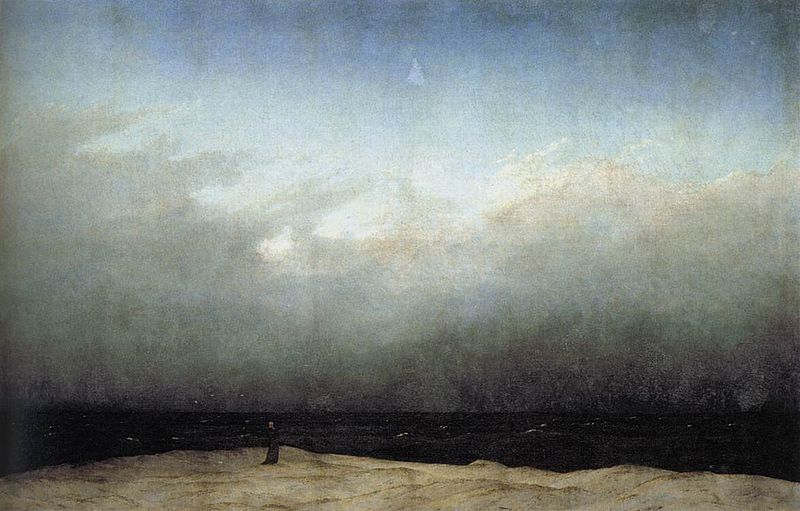
Among the many fascinating readings in Harrison, Wood & Geiger's Art in Theory 1648-1815 are two versions of a short article on the famous Friedrich painting, The Monk by the Sea, which was exhibited at the Berlin Royal Academy of Art in 1810. These texts clearly show the style of two (possibly three) of the great German Romantic writers. The first is by Clemens Brentano (although 'it is likely' that Achim von Arnim 'contributed towards the composition'): a piece called 'Various Emotions before a Seascape by Friedrich', submitted to the Berliner Adendblatter journal, edited by Heinrich von Kleist. However, this version only appeared in 1826; in 1810 Kleist actually published a cut-down version re-written by himself. Brentano's original is light-hearted and witty, featuring various characters overheard discussing the painting. Kleist's version is much darker ('the painting stands there with its two or three mysterious objects like the apocalypse'); it is a voice instantly recognisable if you've read his stories (Penguin publish an excellent anthology).


Caspar David Friedrich, Monk by the Sea, 1809
Source: Wikipedia Commons

One thing the two articles share almost word for word is this memorable opening sentence: 'It is splendid, in infinite loneliness by the shore of the sea under a cheerless sky, to stare at a limitless expanse of water; in part, this is due to the fact that one has gone there, that one must return, that one would like to cross over, that one cannot do so; that everything belonging to life is missing and that one hears one's own voice in the roar of the tide, in the billowing of the wind, in the passing of the clouds and in the lonely cry of the birds; in part it is due to a demand which is made by the heart and by the withdrawal of nature...'

Sunday, December 24, 2006

Route 128 by the power lines

Jonathan Richman has celebrated the landscape of New England in various songs over the years. For example, 'Twilight in Boston' is like one of those solitary, Romantic walking poems, although when you look at the words in isolation from the music they are little more than a simple itinerary: "Now we're walking up Beacon Street / Through the back bay there / Few clouds, heading for Kenmore Square.." The names acquire an aura for those of us who don't know Boston, and we want to believe that those who do know the city would recognise the poetry of the place in these bare phrases.


Perhaps the most effective of Jonathan Richman's landscape evocations is the moment in some versions of 'Roadrunner' where he breaks off to describe the way the world seems from his car:

'Can you feel it out in Needham now?
out in route 128 by the power lines
it's so exciting there at night
with the pine trees in the dark
it's so cold here in the dark
with 50,000 watts of power
we go by faster miles an hour
with the radio on...' 

A friend and fellow Jonathan Richman fan once went to Boston and brought back a photograph of a sign with those magic words 'Route 128'. Looked at here in England I knew it was a resonant metonym for something, but of what I wasn't quite sure: Jonathan Richman? Rock & Roll? American road songs, road movies, road stories...? Or just a sense of freedom?

Saturday, December 23, 2006

A famine road on the borders of Connacht

There is a recording of Eavan Boland reading her poem 'That the Science of Cartography is Limited' on the Norton site. There is also an essay by Boland in the Literary Review in which she taks about her boarding school in England:
"There were no maps in our house when I was growing up, none that I remember. At least not in the obvious places where I saw them in other houses--on the walls, framed, or as pages open on a table. If there were I have no image of them. But there were maps at school... Every day I sat there--six years old, then eight, then ten--always coming back to the same classroom for history, for science, for English, for religion. Always seeing a teacher in front of the map, speaking with certainty and precision. Often entering the strange illusion and that the teacher was mute and the map was speaking through her. Look what I own it said. See what you have lost... I was certainly aware, long before I wrote this poem, that the act of mapmaking is an act of power and that I--as a poet, as a woman and as a witness to the strange Irish silences which met that mixture of identities--was more and more inclined to contest those acts of power. The official version-and a map is rarely anything else--might not be suspect as it discovered territories and marked out destinations."
In 'That the Science of Cartography is Limited', Boland writes about an incident where she came upon an Irish famine road in a wood. This road is not on the map. As she explains in the later essay, "the fact that these roads, so powerful in their meaning and so powerless at their origin, never showed up on any map of Ireland seemed to me then, as it does now, both emblematic and ironic."

Tuesday, December 19, 2006

Charnwood Forest

I have started adding labels to these posts, relating them to different types of landscape. This is not necessarily very helpful because, despite the titles for each entry, Some Landscapes is not an inventory of actual landscapes. But I like the idea of clicking on the word and getting up all entries which refer to mountains by way of highlighting some aspect of landscape in culture, or something about the work of a particular artist.

Of course only a subset of cultural landscapes are likely to give insights into particular places, and this is true for all periods of art. For example, I could boost the number of postings on forests by mentioning Charnwood in Leicesterhire, which features in Michael Drayton's Poly-Olbion (The Sixe and Twentieth Song). But being written in 1622 it sounds like this:
'No tract in all this isle, the proudest let her be,
Can show a sylvan nymph for beauty like to thee:
The satyrs and the fauns, by Dian set to keep,
Rough hills, and forest holts, were sadly seen to weep,
When thy high-palmed harts, the sport of bows and hounds,
By gripple borderers' hands, were banished thy grounds.
The dryads that were wont thy lawns to rove...'
And so on. It is possible to strip out the classical allusion here and focus on what the satyrs were weeping about: greedy (gripple) cottagers killing off the deer. But the dryads provide further distraction: they rove to Sharpley and Cademon, real places which are not described, and on Bardon Hill we are merely told that they are joined by 'harmless elves.' To be fair, there are brief bursts of description in this poem but it does not engage directly with the Leicestershire landscape.

There is a useful on-line summary of the Poly-Olbion by William Moore. His description of the twenty-sixth song from which the lines above are taken is as follows:
'Topographical competition continues in Nottinghamshire, Leicestershire, and Derbyshire. The Vale of Bever (Belvoir) matches herself with previous boasting valleys. The Muse defends the slowness of the Soar River, by analogy to a young girl visiting a sumptuous palace for the first time. The Soar praises its Charnwood Forest for containing all the best features of every other forest. The Trent River, comparing herself favorably with the Thames and the Severn, catalogues her fish. Sherwood Forest, in competition with Charnwood, tells the story of Robin Hood and his bowmen. The Peak, a "withered Beldam," tells of her seven wonders (caves, wells, a hill of sand, and a forest) before the song flows down from the hills along the Darwin (Derwent) River.'

Saturday, December 16, 2006

Mountains of the Mind

Oslo's National Museum is organised very well on thematic grounds. There was a lot of criticism when Tate Modern opened with a Richard Long right opposite a Monet, and to some extent I agreed that this tended to diminish both works, but the idea of juxtaposing responses to landscape from different eras is something that I do enjoy (as should be evident from this web log). In Oslo there is an excellent room with striking contemporary works like Marianne Heske's Mountains of the Mind (1988), Per Bernsten's View No. 4, Eggedal 1985 and Hiroshi Sugimoto's Norwegian Sea, Veseralen (1990), placed among nineteenth century Norwegian landscape paintings. Among the latter are Kitty Kielland's beautiful Summer Night (1886), a small Friedrich-like painting by Thomas Fearnley, Old Birch at the Sognefjord (1839), and Johan Christian Dahl's vast and detailed, View from Stalheim over Naerodalen (1842), parts of which are like a hyperreal Chinese mountain landscape.

Johan Christian Dahl, View from Stalheim over Naerodalen (1842)
Source: Wikipedia Commons

I bought a postcard of the Marianne Heske work, a video image of a mountain scene with what appear to be heat-sensitive colours. I can't find the exact image on line but there is a similar one here and a different video image here. Another example in a similar style is Full Moon Mountain (1987). I had not encountered Heske's work before. It says here that Heske created "canvases made up of enlargements of video photograms which had registered the emergence of lava in a volcanic eruption" - I am not sure if this is a reference to Mountains of the Mind? Visually Heske's work brought to mind the more extreme Symbolist and Expressionist landscape paintings - the design of the National Museum invites such comparisons.

Friday, December 15, 2006

Vinterbillede

Hooray the blog is back! I now seem to be able to get access to Beta Blogger through a Mozilla browser... anyway here's a quick post to resume normal service.


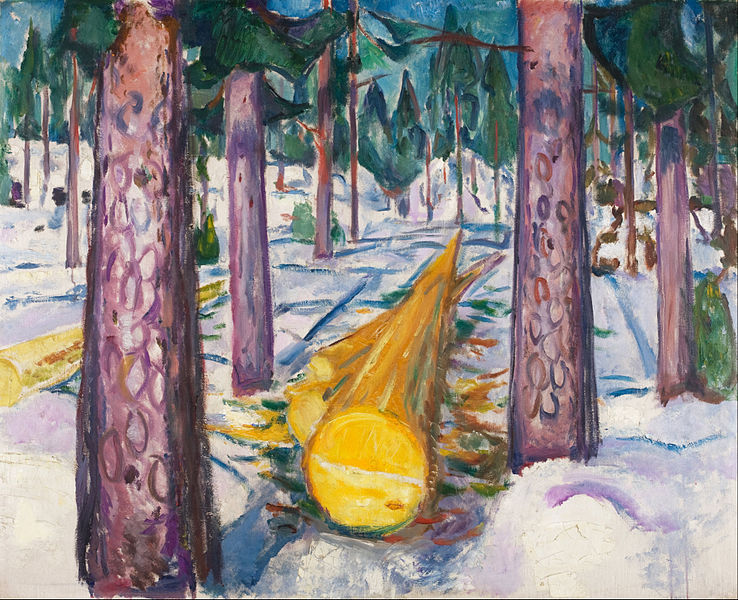
Edvard Munch, The Yellow Log (1911)

I went to Oslo at the start of the month. I was really disappointed by the Munch museum, more notable now for the extraordinarily high level of security than the art: airlock doors, whirring cameras, silent security guards watching your every move. Two landscapes were on display, Winter in Kragero (1912) which looks a bit like a Cézanne hillside suddenly covered in snow, and The Yellow Log (1911) in which a woodland scene is given some ostranenie with the prominent log of the title, a shining Symbol like a felled sunbeam. These two post-date most of Munch's best, and best known, paintings. There is an earlier landscape in the Nasjonalgalleriet which I much preferred: Vinterbillede (1899), a simple image of winter that achieves an atmosphere of oppressive stillness through heavy paint and a cropped view of dark trees in the snow.

Sunday, December 03, 2006

Suspension of Blog due to Beta Blogger Problems

As I am continuing to have problems logging in with the new Beta Blogger, I am having to suspend this blog. I cannot now access the Blog through either Internet Explorer or Firefox. I can only get past the login prompt by using Safari (which is what I'm doing now), but then, once in, the options for actually writing an entry seem to be severely limited. I cannot use text formats or include links and I can't copy and paste from other packages. The only thing I seem able to do is type plain text, which is not really much better than nothing. I'll try to work out how to get round these problems and hope that Blogger sort some of them out.

Sunday, November 19, 2006

Landscape mosaics of the Omayad Mosque


In The Road to Oxiana (1937) Robert Byron visits the Omayad Mosque in Damascus. 'Originally, its bareness was clothed in a glitter of mosaics. Some remain: the first landscapes of the European tradition. For all their Pompeian picturesqueness, their colonnaded palaces and crag-bound castles, they are real landscapes, more than mere decoration, concerned inside formal limits with the identity of a tree or the energy of a stream. They must have been done by Greeks, and they foreshadow, properly enough, El Greco's landscapes of Toledo. Even now, as the sun catches a fragment on the outside wall, one can imagine the first splendour of green and gold, when the whole court shone with those magic scenes conceived by Arab fiction to recompense the parched eternities of the desert.'


Images: Wikimedia Commons

Saturday, November 18, 2006

Brighton in stitches

In a new exhibition, Running Stitch, Jen Southern and Jen Hamilton are 're-configuring Brighton & Hove by 'capturing' its space through the movement of its inhabitants'. Visitors are given a special mobile phone that tracks their movements and allow their paths through the city to be 'projected live in the gallery to disclose aspects of the city unknown to the artists. Each individual route will then be sewn into a hanging canvas to form an evolving tapestry that reveals a sense of place and interconnection.'

It will be interesting to see a tapestry mapping the sort of places favoured by the kind of people that visit Brighton's Fabrica gallery. However, when I saw it this afternoon, the pattern of stitches was already starting to look like conventional maps of the city. I was hoping visitors would deliberately subvert the city's network of main roads and shops, or employ the kind of chance procedures used in situationist dérives. So will Brighton be re-configured or end up stitched in a conventional pattern? We'll probably know before the exhibition finishes on 17 December.

Sunday, November 12, 2006

Hudson River Landscape

Hudson River Landscape (1951) can be seen in the excellent David Smith retrospective at Tate Modern. A 'drawing in space', it has affinities to those abstract landscapes made by painters in the fifties, in which a place is suggested through some recognisable elements that merge with more mysterious expressive gestures, suggesting the difficulty of capturing time, memory and the different views that make up any space. Smith said it 'came in part from drawings made on a train between Albany and Poughkeepsie. A synthesis of drawings from ten trips over a 75 mile stretch...' On one of these drawings displayed in the exhibition you can read the words 'spring snow partially settled.' For a moment the whole sculpture becomes a set of contours in a white landscape, the walls of Tate Modern standing in for the snow and the sky. Then you remember that the sculpture evokes travel in different times and weather conditions, but there lingers an impression that aspects of the sculpture (like the oval with an irregular centre resembling the edge of a snowdrift in a hollow) arise from the memory of early spring referred to in the drawing.

Saturday, November 11, 2006

Decorative landscapes at Norbury Park

The Irish painter George Barret (1732-84) was a regular visitor to the house of William Lock of Norbury. As the Redgraves put it in their survey A Century of British Painters, this house 'situated on the summit of a hill in the midst of a park, commands a noble view both up and down the valley. On the slopes of the hill are giant trees, oak and ash and beeches, together with a grove of ancient yews, existing before the Conquest, which may have sheltred the dark rites of the pagan Druids. Around the base of the hill flows the curious river Mole, while distant hills close in the prospect. Such a country must ever be a paradise to the landscape painter.' The Redgraves note that Barret decorated one of Lock's rooms 'from the skirting to the ceiling with a series of scenes' and that this room (in 1866) 'is still in existence and, after some cleaning and repairing, seems to have stood well, and to retain much of its first brilliancy.'

There is a study for a scene in the room in the Courtauld: Decorative landscape - study for a room at Norbury Park. But are the actual landscape decorations mentioned by the Redgraves still there? I'd be interested to know. The house is privately owned and not open to the public...

Source: Wikimedia Commons, Vox Humana 8

The house and park at Norbury have an interesting history. An old guidebook called Picturesque England by L. Valentine that has been made into an e-book has the following to say:
Edward the Confessor found the remains of a Roman stronghold at Norbury. He converted it into a district lordship held direct from the Crown. At the Conquest it was given to Richard of Tunbridge, and from him was inherited by Gilbert de Clare, Earl of Gloucester. He - the earl - may have taken hither the lovely little princess Joanna, when, after their marriage, she loved to visit his noble castles before settling down in their rural home of Clerkenwell. For many generations the Husee family were tenants of the Earls of Gloucester, and at length they purchased Norbury. A daughter received it as her portion when she married Wymeldon in the reign of Henry VI. Heirs male failing, Norbury passed to the Stidolphs, an old Kentish family. In time the Stidolphs also died out, and Norbury was sold to a man by the name of Chapman, who bought it to make money out of it, and cut down every saleable tree. Beautiful Norbury would have been destroyed had not Mr. Lock bought it of him in 1774.
He was a man of great taste, and restored and improved the place, building a fine house on the crest of the hill. The windows commanded an exquisite view, and the decorations of his saloon were so fine that they became the talk of the time.
He entertained here Dr. Johnson, Sir Joshua Reynolds, Burke and Gibbon, and all the most distinguished characters in England.
When the French Revolution and the Reign of Terror drove the noblesse of France into emigration the fame of Mr. Lock's house and hospitality, which had long before reached Paris, brought some remarkable exiles to Surrey. At Juniper Hill Madame de Stael established her menage with Talleyrand, the Comte de Narbonne, the Duc de Montmorency, Monsieur Sicard and General D'Arblay; they were all entertained at Norbury. Fanny Burney, the novelist, used to stay at the house, and there fell in love with General D'Arblay. They were both very poor, hut Miss Burney had a pension of a hundred a year from Queen Charlotte, in whose hard service she had spent the best of her life, and she made money by her pen, though not to any great amount. However, they married, and Mr. Lock gave them "a piece of ground in his beautiful park," she writes, "upon which we shall build a little neat and plain habitation." Her novel "Camilla" furnished the funds for building the house, which was finished in 1797, and called after the book, Camilla Cottage. It is now Camilla Lacey. Her diary contains amusing and graphic accounts of their residence here, of General D'Arblay cutting down asparagus with his sword, etc., etc.
At Norbury, in 1819, Mr. Lock's son died, and the property was sold to a Mr. Robinson, then to Mr. Fuller Maitland, who exchanged it with Mr. Speding. At length it was bought, in 1848, by Mr. Grissell, grandson of the builder of the new Houses of Parliament, who has greatly improved the grounds. There is a grove of yews here that are a perfect show, and Sir Joseph Paxton has been seen to embrace and kiss the bark of a magnificent beech here: he declared that the yews and beeches of Norbury were the finest in England.

Saturday, November 04, 2006

Ryoanji


John Cage composed a series of works inspired by Ryoan-ji, the Zen garden in Kyoto, starting with a version for oboe and adding other versions for flute, double bass, trombone, voice and orchestra. For each composition Cage traced the outlines of stones onto staves, creating ascending or descending glissandi for the lead instrument. It is quite easy to hear the shapes of the stones after listening for a while, and the simple percussion accompaniment fills the surrounding spaces like gravel in the garden. The music thus outlines a kind of sparse landscape and the path taken on the page by Cage's pencil is like the flow of air pressing against and swirling around a group of rocks, turning them into a a wind instrument. Listening this morning to versions of Ryoanji for flute (played by Dorothy Stone) and trombone (James Fulkerson), I was also reminded of the sounds of birds and animals, heard in the depths of the forest or high among the mountains in Japanese poems.

I took the photograph of Ryoan-ji below in 1998. It shows how the rocks appear quite isolated in the sea of gravel. One of the things I remember being particularly moved by was the beauty of the old wall framing the garden.


Postscript 2015: Youtube clips come and go and so I have replaced the one I originally had with a new one.

Wednesday, November 01, 2006

Spiral Jetty

The Guardian has started an artsblog with a list of 20 artworks "to see before you die". It includes two landscape paintings - Vermeer's View of Delft (c.1660-61) (for which you need to visit the Mauritshuis in The Hague) and Cézanne's Mont Sainte-Victoire from Les Lauves (1904 - 6) (entailing a trip to the Pushkin Museum of Fine Arts, Moscow). The choice of Vermeer reminds me of Proust's character Bergotte who makes the effort to see the View of Delft before he dies, and then dies looking at the painting. I think if I had to contribute to global warming with twenty flights to see landscape art I'd be tempted to visit more site specific works: gardens and landscape architecture, landscape-themed furnishings and frescos, environmental and land art.

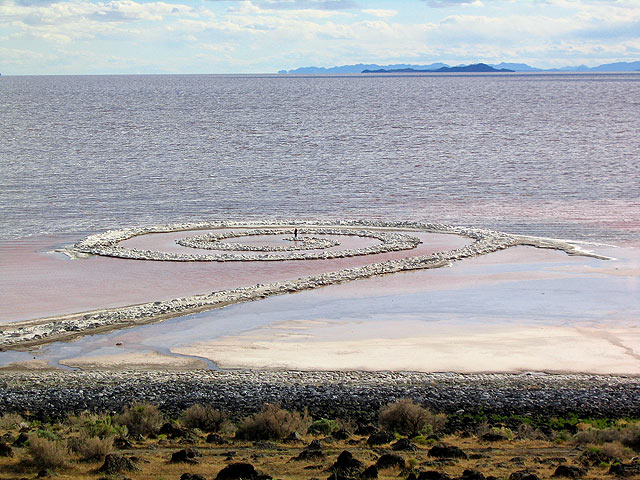
Following the recent Robert Smithson retrospective in New York and the re-emergence of Spiral Jetty, there seems to be an ever growing number of people making the pilgrimage to Rozel Point. A quick search reveals several recent accounts of journeys: Jerry Saltz, Contemporary-Pulitzer, Mike Owens... I can imagine going all the way to Utah and finding the place full of land art Grand Tourists (next stop De Maria's Lightning Field). Already the trip Tacita Dean made in Trying to Find Spiral Jetty (1997) seems to belong to another age. In the artsblog Jonathan Jones says "I think a work of art worth travelling to see has to be a really great statement about serious things. Something not just to fill your life but deepen it." Perhaps Spiral Jetty doesn't really fulfil these criteria, but I wouldn't really know as I've not yet seen it...

Robert Smithson, Spiral Jetty, 1970
Source: Wikimedia Commons

Monday, October 30, 2006

Dream of the Vallüla massif

Tacita Dean is an artist who pursues coincidences. I bought the new Phaidon book about her at the weekend and reading it last night I realised she had quoted the same incident in Antoine de Saint-Exupéry's Wind, Sand and Stars which I had written about here earlier in the day... It comes in an article about Tristan da Cunha (published in Artforum in Summer 2005).

The Phaidon contemporary artists series includes an 'Artist's Choice' section and Tacita Dean has selected a poem by W.B. Yeats and a brief extract from W.G. Sebald's The Rings of Saturn in which the author gazes across the sea at a retreating cloudbank. This cloud formation, glistening 'like the icefields of the Caucasus', reminds Sebald of a dream in which he had walked a mountain range that had felt strangely familiar, and which later he placed as the view from a bus of the Vallüla massif, seen once on a childhood outing. 'I suppose it is submerged memories that give dreams their curious air of hyper-reality. But perhaps there is something else as well, something nebulous, gauze-like, through which everything one sees in a dream seems, paradoxically, much clearer. A pond becomes a lake, a breeze becomes a storm, a handful of dust a desert...'


Incidentally, the Artist's Choices in Phaidon's contemporary artists series make up a great reading list: Louise Bourgeois - Francois Sagan; Luc Tuymans - Andrei Platanov; Doug Aitken - Jorge Luis Borges; Uta Barth - Joan Didion; Mark Dion - John Berger; Richard Deacon - Mary Douglas; Jimmie Durham - Italo Calvino; Olafur Eliasson - Henri Bergson; Tom Friedman - Robert Walser and Timothy Leary; Antony Gormley - Saint Augustine; Dan Graham - Philip K. Dick; Paul Graham - Kazuo Ishiguro and Haruki Murakami; Mona Hatoum - Piero Manzoni and Edward Said; Jenny Holzer - Samuel Beckett and Elias Canetti; Roni Horn - Clarice Lispector; Ilya Kabakov - Anton Chekhov; Alex Katz - New York School Poets; Mike Kelley - Charles Fort; Mary Kelly - Julia Kristeva and Lynne Tillman; Paul McCarthy - Jean Paul Sartre; Cildo Meireles - Jorge Luis Borges; Raymond Pettibon - George Puttenham, Laurence Sterne and John Ruskin (what would Ruskin have made of Pettibon!); Pipilotti Rist - Anne Sexton and Richard Brautigan; Doris Salcedo - Paul Celan and Emmanuel Levinas; Thomas Schütte - Seneca; Lorna Simpson - Suzan Lori Parks; Nancy Spero - Stanley Kubrick and Alice Jardine; Jessica Stockholder - Julian Jaynes and Cornelius Castoriadis; Lawrence Weiner - W.B. Yeats and Kenneth Patchen; and Franz West - Kathryn Norberg.

Sunday, October 29, 2006

Sand and stars

In Wind, Sand and Stars (Terre des hommes) Antoine de Saint-Exupéry describes flying over the desert and seeing high plateaux shaped like truncated cones where the pilots on the Casablanca-Dakar line would occasionally have to make emergency landings. On one occasion he touches down on one of these plateaux, rising from the sand like a polar ice-floe. Leaving the plane, it is clear that he must be the first human being to tread there. 'That white surface, I thought had stood open only to the stars for hundreds of thousands of year.' And yet, looking round he is puzled to see a black pebble lying on the ground... How could this be? 'I was standing on shells to the depth of a thousand feet. The vast structure, in its entirety, was in itself an absolute ruling against the presence of any stone. Flints might be sleeping deep down within it, born of the planet's slow digestive processes, but what miracle could have brought one of them to this all-too-new surface?' As he picks the heavy black stone up he realises what it is - a meteorite. Looking around he finds others, lying undisturbed from where they had fallen, perhaps thousands of years ago. 'And thus did I witness, in a compelling compression of time high up there on my starry rain-gauge, that slow and fiery downpour' (trans. William Rees).

Saturday, October 28, 2006

Red and Yellow Houses in Tunis

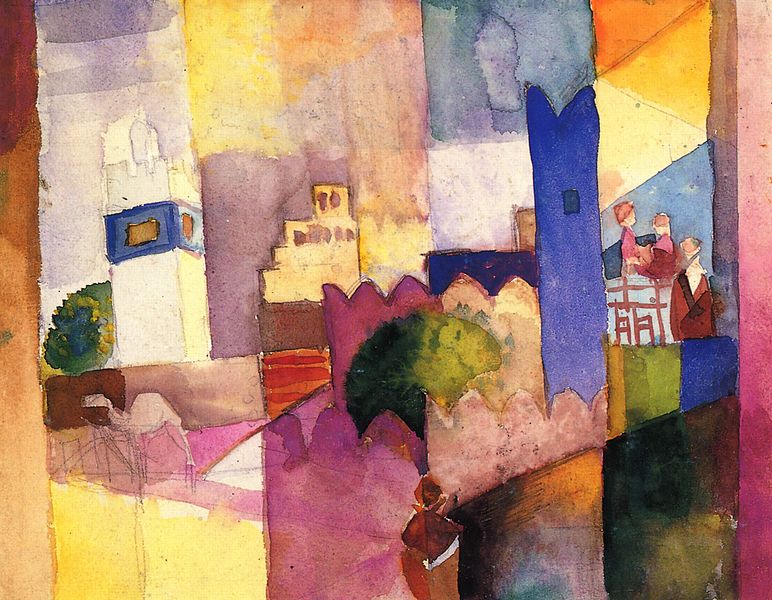
No two artists will see the same colours in a landscape. In 1914 Paul Klee and August Macke travelled to Tunisia. Klee immediately noted the pervasive 'green-yellow-terracotta' but his watercolours also included the white of the houses, the blue of the sky and the pinks and oranges seen in the unpolluted, gentle light of dawn and dusk. Although there are similarities in the two artists' approaches, Macke emphasised 'the blue and white contrast in his Tunisian works' while Klee's watercolours like Red and Yellow Houses in Tunis have 'a warm undercurrent of ochre' and 'a pervasive sand colour'. This, at least is the view of Robert Kudielka in Paul Klee: The Nature of Creation, but it is a subjective judgement: perhaps no two critics will see quite the same colours in a painting...

August Macke, Kairouan (III), 1914
Source: Wikipedia Commons

Monday, October 23, 2006

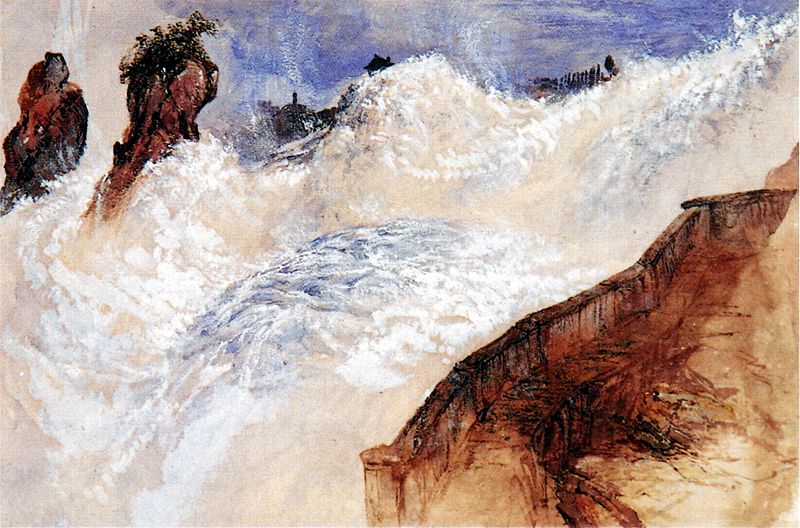
The Fall of Schaffhausen

John Ruskin, Falls of Schaffhausen, 1842

John Ruskin's description of the famous waterfall in Modern Painters (Vol. I, Part II) is itself a torrent of language:

“Stand for half an hour beside the fall of Schaffhausen, on the north side, where the rapids are long, and watch how the vault of water first bends, unbroken, in pure velocity, over the arching rocks at the brow of the cataract, covering them with a dome of crystal twenty feet thick, so swift that its motion is unseen except when a foam-globe from above darts over it like a fallen star; and how the trees are lighted above it under all their leaves, at the instant that it breaks into foam; and how all the hollows of that foam burn with green fire like so much shattering chrysopase; and how, ever and anon, startling you with its white flash, a jet of spray leaps hissing out of the fall, like a rocket, bursting in the wind and driven away in dust, filling the air with light; and how, through the curdling wreaths of the restless crashing abyss below, the blue of the water, paled by the foam in its body, shows purer than the sky through white rain-cloud; while the shuddering iris stoops in tremulous stillness over all, fading and flushing alternately through the choking spray and shattered sunshine, hiding itself at last among the thick golden leaves which toss to and fro in sympathy with the wild water; their dripping masses lifted at intervals, like the sheaves of loaded corn, by some stronger gush from the cataract, and bowed again upon the mossy rocks as its roar dies away; the dew gushing from their thick branches through drooping clusters of emerald herbage, and sparkling in white threads along the dark rocks of the shore, feeding the lichens which chase and chequer them with purple and silver.”

Sunday, October 15, 2006

Circles of Time

Alan Sonfist, Time Landscape, 1978

What landscape questions are asked by Alan Sonfist’s artworks? The obvious answer is that they ask environmental questions by creating sanctuaries for pre-industrial landscapes within cities. As the Green Museum puts it: ‘for almost 40 years, Sonfist has dedicated his work to linking city-dwellers and suburbanites to a nature that civilization has destroyed, with the hope that a greater appreciation of nature would encourage them to protect its future.’ His best known work is Time Landscape in Greenwich Village, proposed in 1965, realised in 1978, which creates an urban oasis based on the pre-colonial landscape. Sonfist has been criticised for mere preservationism which disguises present environmental issues by ‘fixing an image of the landscape frozen in the past, privileging one moment in ecological history over all others, and including more complex interactions with various inhabitants, native or other’ (Brian Wallis in Land and Environmental Art). However, this historical aspect of his work may also be one of the things that make it interesting.

Sonfist’s art can take the form of simple works about reclamation, e.g. Pool of Virgin Earth (1975), a circle of ‘pure’ earth on a chemical dumping ground in Lewiston, New York, designed to attract windblown seeds. However, in some larger scale works he has been able to question (or at least illustrate) the way landscapes evolve over time and space. For example, Time Landscape not only uses ‘pre-colonial’ trees and grasses: it also involved planting them on the original land elevations. In Circles of Time (1986-89) Sonfist traces the history of the Tuscan landscape in concentric rings: primeval forest, first settlers, Greeks, Romans and finally a ring linking the sculpture to the surrounding farmland. And his Secret Garden (2001) in Ontario used rocks arranged according to their position in geological time. Judged purely on environmental grounds some of these works may be inadequate, but then it might be asked what kinds of art intervention could ever be consider genuinely adequate to address current environmental concerns?

Saturday, October 14, 2006

The Hill of Howth


Kenneth Hurlstone Jackson’s A Celtic Miscellany (originally published fifty-five years ago) contains a whole section on Nature, something the early Celtic writers treated with particular freshness. There are poems on the changing seasons, on rivers, mountains and woodlands, on snow and mist and stars. A few of them describe specific landscapes, like the Hill of Howth, ‘the peak that is the loveliest throughout the land of Ireland.’ The anonymous fourteenth century author of this piece describes the hill in terms that now seem like oxymoron: a ‘vine-grown pleasant warlike peak’ and ‘the hill full of swordsmen, full of wild garlic and trees, the many-coloured peak, full of beasts, wooded.’ It is as if the beauty of this ‘bright peak above the sea of gulls’ can only be enhanced by the part it played in the battles of Irish legend, as the place where ‘Finn and the Fianna used to be.’

Friday, October 13, 2006

The grebes of Lake Biwa

Basho by Sugiyama Sanpû (Source: Wikimedia Commons)

The keiki (landscape) style of Haikai was dominant in the period Basho was writing, with its fusion emotion and the external scene. Some of Basho’s verse appears to consist solely of a brief landscape description. For example, Haruo Shirane quotes a hokku written in January 1691: kakurekeri shiwasu no umi no kaitsuburi (hiding in the water – the grebes of Lake Biwa – at year’s end). However the wider context for this poem is provided by the season word ‘shiwasu’ which literally means “teacher running” and has associations of ‘the end of the year, when everybody is rushing about cleaning up and settling their financial accounts’, so that the author of the poem appears in contrast to be ‘a carefree, reclusive person, someone who has the leisure to observe grebes at the busiest time of the year… At first glance, the hokku seems focused on a seemingly minor, if not insignificant, detail, but it gradually expands in the eye of the beholder, creating a tension between the smaller object and the implied landscape, or between the specific moment and the larger river of time.’ (Haruo Shirane’s Traces of Dreams p49).

Sunday, October 08, 2006

Landscape with Hunters

Yesterday’s autumn sunshine gave the views on Hampstead Heath a harmonious classical beauty. At Kenwood, where the grass slopes lead the eye down to the tree-fringed lake and its pair of swans, it seemed easy to gaze over the prospect with the eyes of an eighteenth century landscape connoisseur. Inside Kenwood, the famous Rembrandt and Vermeer paintings are accompanied by a Gaspard Dughet Landscape with Hunters (c1639). However, on first sight the painting looks like a dull expanse of murky brown, a shadow of the sunlit vista outside. Poor Dughet’s paintings often seem to be tucked away, unfashionable and unloved; this one is hung high on the wall so that the title on the frame is actually not even visible. He seems as unappealing to modern tastes as some other great enthusiasms of the eighteenth century, like James Thomson’s poem The Seasons (which Michael Schmidt’s history of English poetry describes as ‘dead pastoral’). The brown-ness of old landscape paintings went out of fashion in the nineteenth century as Constable and others altered the way they underpainted to create more vivid colours. But the Landscape with Hunters is a dawn scene and therefore naturally full of shadows. Paintings that strive for subtle light effects may be most harmed by the passage of time (the same may be true of photographs and films we currently admire). What did Dughet’s painting look like 350 years ago?

Apparently the Louvre does not own a single painting by Dughet. However, there is at least one place where Dughet is honoured: Rome’s Doria Pamphilj Gallery. There they have a Poussin Room entirely full of his paintings (Dughet is also known as Gaspard Poussin after his better known brother in law). It is an amazing space - a total immersion in classical landscape.

Postscript: January 2014
Kenwood has recently re-opened after refurbishing.  The Dughet Landscape with Hunters is still high up but better lit than when I wrote this post in 2006... 

Saturday, October 07, 2006

Lac d’Annecy

Paul Cézanne, Lac d’Annecy, 1896
Source: Wikimedia Commons

I first saw the paintings at the Courtauld Institute when they were still in their old location, stuck out of the way on the top floors of the Warburg Institute building. I went unprepared for the shock of so many outstanding works, in these grey, unimpressive surroundings but the one moment I will never forget was seeing Cézanne’s Lac d’Annecy (1896). Richard Verdi (in Cézanne) has described this painting, simple in form but highly complex in its prismatic colours, ‘with no two strokes of blue or green appearing exactly the same in size hue or direction’. Verdi notes, for example, that ‘while house and château on the distant shore are clearly delineated, the landscape around them appears in an inchoate state, as though still awaiting further resolution.’ This illustrates a general feature of the artist’s approach: rather than distinguishing foreground from background through the degree of detail applied to forms, Cézanne concentrated attention on objects at different points in space. While Cézanne saw in this his difficulty in realizing the full complexity of nature, the result was paintings that have ‘an unparalleled vitality and lay bare the formative process of painting as few other works of art do.’

Wednesday, October 04, 2006

Paisaje Plastico

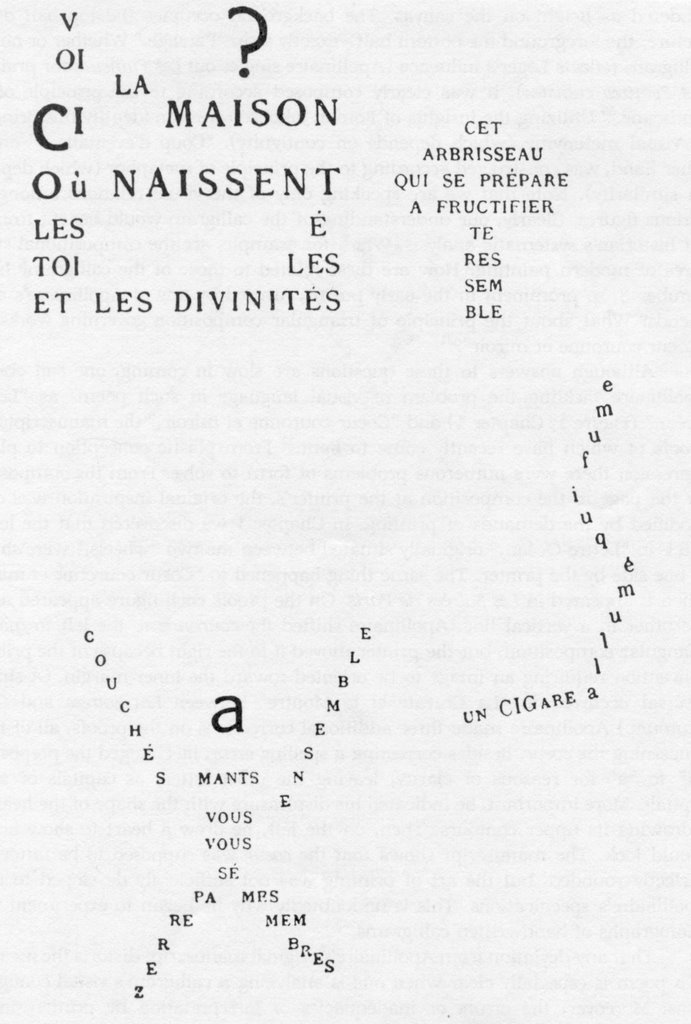
Two examples of landscape visual poetry: Guillaume Apollinaire's 'Paysage' and Guillermo de Torre's 'Paisaje Plastico'.


Apollinaire's poem (below) features a building, a tree and a man smoking. The four elements are themselves individual 'calligrammes', but are united in a landscape composition with a simply delineated foreground and background. Torre published his 'Plastic Landscape' in 1919, a year after Apollinaire's posthumous Caligrammes (it is described in Willard Bohn's book The Aesthetics of Visual Poetry, 1914-1928). It is a longer poem than Apollinaire's, depicting the countryside in the heat of midday ('Mediodia igniscente') and ending with a squadron of aeroplanes flying overhead, to somehow harvest the fields of wheat. Only some of the text resembles landscape elements visually - there is a river flowing diagonally through the poem and a curved line of text describing the gleaners, which may relate to the physical action of their work. Much of the rest of Torre's poem uses typography only for visual emphasis, like the words that stand out in capitals: 'SOL', 'SIESTA', 'LA SED' etc. The two works are ostensibly similar but operate on a different balance between word and image: Apollinaire's poem is easier to see on the page, but Torre's landscape is easier to picture in the mind.