Saturday, April 30, 2011

Top Withens

OK third time lucky. I've written this post twice now and both times it's been deleted - I don't know if other blogspot users are having the same difficulties (basically just as you're editing something it wipes a whole paragraph or, the first time it happened, the whole post, and then instantly saves it so you cannot recover the earlier version).  Anyway, what I've been trying to write something about is Bill Brandt’s Literary Britain (1951), a collection of photographs he had taken of the places associated with British writers from Chaucer to Lawrence.  The montage below gives you an idea of the book’s layout (without reproducing directly the actual photographs) and shows Brandt’s elemental landscapes: George Crabbe’s Aldeburgh, Thomas Hardy’s Egdon Heath, William Langland’s Malvern Hills, where Piers the Plowman went to rest ‘under a brode banke bi a bornes side.’  But this is a little misleading because many of Brandt’s images are writers’ homes – after Richard Jefferies’ Marlborough Downs, for example, you turn to the birthplace of Samuel Johnson and it is tempting to move swiftly on to the next page, illustrating Johnson’s journey to the Western Isles of Scotland with the desolate moorland on Skye where Sir James Macdonald tried in vain to plant a forest, ‘expecting, doubtless, that they would grow up into future navies and cities,’ but resulting only in a ‘useless heath.’


The next photograph after that is another house: Wentworth Place, where John Keats live.  We visited it on a sunny Spring day last year but in Brandt’s photograph all is dark, except for one partially open window - Keats's room.  The accompanying text quotes a letter to Fanny - 'come round to my window for a moment when you have read this' - and lines from 'Ode to Psyche': 'A bright torch, and a casement ope at night, To let the warm love in.'  Looking at this I started to feel that the photographs of houses were just as interesting as the landscapes in their own way.  Turning back to the image of Johnson's house, you see the same aesthetic of simplified forms and strong shadows that Brandt uses in his landscapes, and notice details that start to seem suggestive of the writer - a sturdy white structure with three classical pillars but an asymmetric roof and a set of windows with small rectangular panes that resemble rows of books.

In Romantic Moderns Alexandra Harris writes about the pains Brandt took to get just the right conditions, travelling with heavy equipment and waiting for the perfect weather conditions.  ‘Reclaiming the pathetic fallacy, he ensured that each writer got the weather he deserved … Literary Britain is a catalogue of English weather: D. H. Lawrence’s Eastwood terrace is slushy with half-thawed snow, menacing clouds hang suspended over Horace Walpole’s Strawberry Hill, and an ecstatically illuminated mist fills Anthony Trollope’s cathedral.’  The last image of the six above is Top Withens, the supposed location of Wuthering Heights, which Brandt first tried to capture in 1944.  “I went to the West Riding in summer, but there were tourists and it seemed quite the wrong time of year.  I liked it better misty, rainy, and lonely in November.  But I was not satisfied until I saw it again in February.  I took the picture just after a hailstorm when a high wind was blowing over the moors.”  And yet even this was insufficient, so Brandt superimposed a sky from a different photograph, ‘over-exposing both negatives so that the moorland earth became impenetrably black, pitted with the spectral white of the settled hailstones.’

Saturday, April 23, 2011

Sonorous stones

In one of my earliest posts here I talked about the wide range of landscapes on show at the Royal Academy's 2005 exhibition China: The Three Emperors, but I didn't mention one of the most memorable exhibits, dating from 1764: a set of sixteen sonorous stones, hung from a gold-lacquered frame three and a half metres high.  According to the catalogue 'sonorous stones made of dark green nephrite, such as those in this chime, were reserved for Grand Sacrifices performed at the Altar of Heaven and the Altar of Land and Grain, whereas the sonorous stones used in other state rites were made of limestone.'  Examples of these stone chimes (bianqing) exist going back thousands of years - the earliest were made of marble.  Similar instruments have been constructed in many different countries: rock gongs in Kenya, stone church bells in Ethiopia, castanets made of basaltic lava in Hawaii and the rarely heard Mongolian lithophone known as the shuluun tsargel.  In England a rock harmonicon, built by the Richardson family, was played in front of Queen Victoria in 1848 and she was apparently so impressed she requested two further performances.  A photograph of Neddy Dick with his rock instrument features in Rob Young's Electric Eden (see my previous post) and it can be seen on Mike Adcock's excellent Lithophones.com website, which I am drawing on here.

From a landscape perspective, I am particularly interested in the way certain locations provide particularly musical rocks.  This was the case in England, where 'in the eighteenth century rocks found on the river bed in Skiddaw in the Lake District were found to possess a particularly sonorous quality.  Peter Crosthwaite, who had opened his own museum in Keswick assembled a set of musical stones in 1785, some of which were already in perfect tune, the rest he tuned himself by chipping away at the stone.  In the years following a number of people began to make musical instruments using the stone, known as hornfels or spotted schist, meticulously tuning them by cutting them into different length slabs and laying them horizontally.'  One of these was the Richardsons' rock harmonicon and another was commissioned by John Ruskin (now in the museum at Coniston - see below).


Carl Orff used a lithophone in his opera Antigonae (1949) and Lithophones.com lists many contemporary sound artists and musicians who have made use of stone - from Sigur Rós to Stephan Micus (see clip below). There are also examples of stone instruments being made and sited in the landscape as musical sculptures, like Paul Fuchs' Garden of Sound in the Italian village of Boccheggiano.  Lithophones have been constructed using agate, marble, basalt and sonorous stones “gathered from the shores of Lake Superior”. Terje Isungset, who recently played his ice instruments here in London,has also performed on blocks of Norwegian granite. It would be good to know more about performances using stone that have taken place outside, like John Luther Adams' Inuksuit which I discussed here previously (there is a Youtube clip where you can see stones being rubbed together).  And it would also be nice to know more about cases where rock forms have been played directly in situ - an ancient practice, as evinced by the marks of use on stalactites found near prehistoric cave paintings in the Dordogne.  However, on his website Mike Adcock points out that 'in many parts of the world there is sometimes a reticence about talking about ringing stones, possibly because of their sacred quality, and even their whereabouts remains a local secret.'

Friday, April 22, 2011

Electric Eden


Britain's rural landscape is a constant presence in Rob Young's exploration of visionary folk music, Electric Eden. His prologue follows Vashti Bunyan as she sets out from London in 1968 on the road to Skye, where Donovan was hoping to set up a 'Renaissance Community' of artists (it was the same year that Paul McCartney introduced Linda Eastman to his farm on the Kintyre peninsula).  At the same time groups like the Incredible String Band and Fairport Convention were retreating to cottages and developing psychedelic folk music with a shifting cast of like-minded musicians and artists.  Some of this is familiar history, like the recording of Liege and Lief at Farley Chamberlayne, where Fairport Convention reinvigorated songs from the archives of the English Folk Dance and Song Society whilst recovering from the M1 crash that killed Richard Thomspon's girlfriend and drummer Martin Lamble.  But Young also discusses forgotten groups like Heron, who went to seek inspiration in rural seclusion for their two albums at a farmhouse in Berkshire and a cottage in Devon.  Their lyrics are infused with what Rob Young describes as a 'Wordworthian hippy mood'; 'Lord and Master' for example, 'a reverie sung by a pantheistic nature-god whose being is entwined with the seasonal cycles he describes: 'I am the maker of everything and I soar with the birds in the sky'.'


I have described two examples here recently of recordings made en plein air - Richard Skelton's Landings and Movietone's The Sand and the Stars - but Heron pursued this approach forty years ago, as can be heard from the birdsong at the end of the clip above.  For their first album, the band played their songs outside on a circle of chairs, whilst an additional microphone was set up some distance away to capture the surrounding ambience, as if Nature were a fifth member of the group.  For their follow-up, Twice as Nice & Half the Price (1971), a local RAF base commander was persuaded to suspend flights so that the outdoor recording would not be sullied with the sounds of jet fighters.  Later in the book Young gives another example of outdoor recording from what he calls 'the final bright bloom in the garden of British folk-rock' - John Martyn's One World (1977).  Sitting overlooking the lake on Chris Blackwell's Berkshire estate, Martyn played his guitar through amplifiers floating on the water. 'Time seems arrested; the music is the still centre of a turning world of surging waves and intermittent bird calls.'

Wednesday, April 13, 2011

Rough Seas

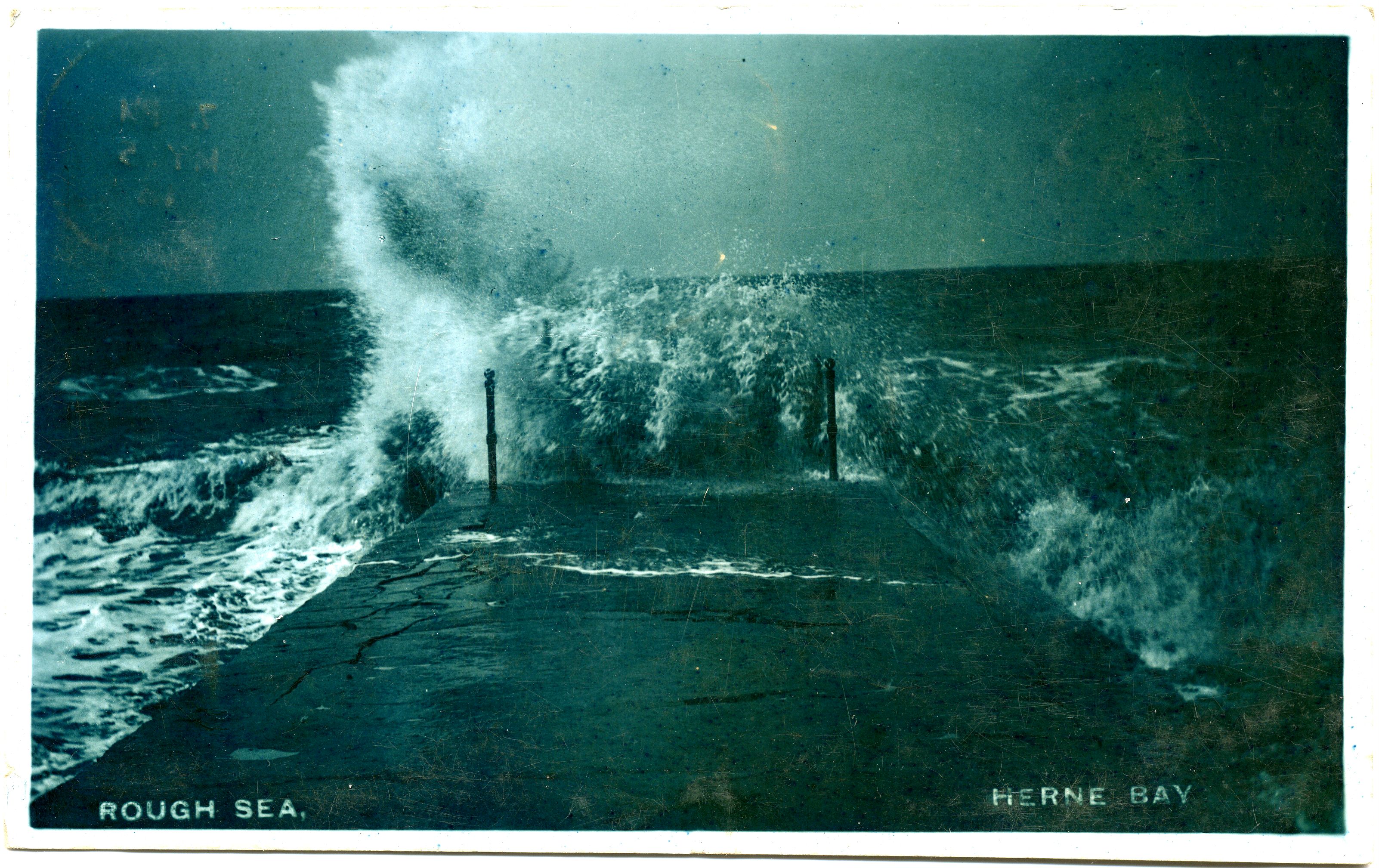
The Tate's Susan Hiller exhibition begins with Dedicated to the Unknown Artists (1972-76) an installation first shown at the Gardner Centre, Sussex University, when she was artist in residence there (I wonder if I saw it there at the time as I was being taken to one of the pantomimes they used to put on for children).  Rachel Withers has described it well: 'several hundred vintage and contemporary "rough sea" postcards: visually seductive views purporting to show gigantic waves bombarding British beaches, piers, and esplanades. The piece marshals these in grid formation, systematically logging details of the cards' locations, captions, and message content ("We had a storm today, just like this one," and so on), and evidencing generations of British natives themselves colluding in the anthropological myth of the "British love affair with lousy weather" ... Its postcard images reiterate the ideologically saturated motif of the Sublime--reason's battle with cosmic chaos. In parallel, the work's King Canute-like "empirical" sorting system threatens to be swamped by the morass of material it strives to tame and contain.'

Fred C. Palmer of Tower Studio, Herne Bay - postcard, 1913
Source: Wikimedia Commons

According to Brian Dillon in Tate Etc. 'something of the same semantic exchange between image, text and unseen history circulates in The J. Street Project (2002–2005): a film, photographic series and wall display which record the 303 thoroughfares (streets, alleyways, modest paths) in Germany that are still named for the Jewish communities that once resided, worked or traded there. “Still named” is not exactly the phrase here, of course, because what Hiller has archived is a series of places that lost their names in the Nazi era and have since had them reinstated ... As Hiller’s film demonstrates, contemporary life carries on around these traumatic inscriptions as though they were not there: the memorial name becomes just another textual element (ignored by passers-by) in the street furniture of the modern city, so that it is entirely unclear if it functions as a means of recall or amnesia.' I sat and watched the film for a while and noticed the way that she classified and ordered the material, just as she had earlier devised a typology of rough sea imagery, except that the sequencing here seemed to be based more on the people passing the camera than the specifics of the view.  The section I saw edited together footage of streets being entered by children, giving way to further scenes with old people - the places might have been interchangeable, but in each case the street signs were visible reminders of the contrast between past and present.

The final room of the Susan Hiller exhibition includes Voyage on a Rough Sea: Homage to Marcel Broodthaers from last year - the latest of various various works that have returned to the theme of rough seas.  She says she actually met Broodthaers in 1972 at a London exhibition: 'in the pub afterwards I shyly mentioned that I was working with postcards of rough seas, and he told me something about his own postcard projects'.   Broodthaers was himself concerned with classification and curation - that year in Düsseldorf he organised a display of eagles 'From the Oligocene to the Present', mixing together valuable sculptures with worthless modern objects like product labels and old champagne bottle corks.  His film A Voyage on the North Sea (1974) (below) is often cited as a key work in the history of conceptual art and is explicitly referred to in Hiller's montage of re-coloured postcard images.  His work has also inspired Tacita Dean (whose approach often resembles Susan Hiller's) and she paid tribute to him in Section Cinema (Homage to Marcel Broodthaers) (2002).  Dean also made two of her large blackboard drawings derived from Broodthaers' film Chère petite soeur (1972), which was itself based on a found postcard from 1901, depicting a boat in a rough sea. Broodthaers used the postcard's message as subtitles, leaving  the viewer to wonder (as in Hiller's rough sea installation) why people choose to send these particular postcard images... 'Dear little sister, this is to give you an idea of the storm which we had yesterday.  I'll give you more details about it, best wishes and see you soon, Marie.' 
 

Sunday, April 10, 2011

Atlasov Island


I read Judith Schalansky's Atlas of Remote Islands: Fifty Islands I have not visited and never will last month, but keep flicking back through it and looking at the maps.  They are all printed on the same scale and as you can see from the examples above, each island seems to possess a uniquely satisfying shape.  Various reviews will give you the background on this book, which won the German Arts Foundation Prize for the Most Beautiful Book of the Year (a version of which it would be good to have here) - there's an excellent piece about it on John Self's blog, for example, and another by Robert Macfarlane in The Guardian.  The short prose pieces accompanying each map reminded me, as they have others, of Calvino's Invisible Cities. The island of Tikopia, for instance, has 1,200 inhabitants who believe in zero population growth; then there is Pingelap, where a significant minority are colour blind but insist they can see things hidden from the others, like dark shoals of fish in the moonlit sea; and Takuu, where the old people build dykes to combat rising sea levels and the young spend their time drinking the juice of the coconut palm but, either way, 'Takuu will sink - next month, next year...'

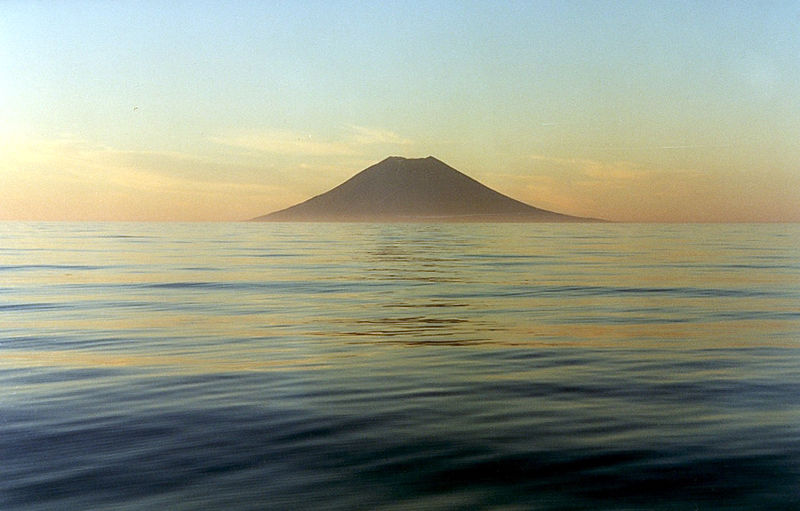
Not all the islands are inhabited though, and one I thought I would highlight in this landscape blog is Atlasov Island, known in Japanese as Araido-tō and 'more beautiful than Mount Fuji.'  Apparently haiku have been written in praise of it, but I have not managed to track any down.  Schalansky notes that in the early 1950s a 'women's penal colony was set up', but no one lives there now.  There is a myth that the mountain was forced to move from its original home in the middle of Lake Kurile on the Kamchatka peninsula, where its perfect beauty made the surrounding peaks jealous.  'So it started out on a long journey, finally settling itself down in a peaceful spot far away in the sea. ... The river Ozernaya flows in the tracks of the mountain's reluctant journey.  When the mountain lifted itself from its place, the water of the lake rushed after it.  It is a thin blue umbilical cord that will always bind the exiled mountain to its homeland.'

Atlasov island
Source: Wikimedia Commons

Thursday, April 07, 2011

High in the gorges a rock dam will rise

I have been reading about contemporary Chinese artists this week - disturbing news of the detention of Ai Weiwei and an interesting survey of recent art questioning Chinese state power in David Clarke's book Water and Art.  Clarke traces the importance of water control schemes in modern China: the Yangtze river bridge at Wuhan linking north and south for the first time, the bridge at Nanjing built in 1968 entirely by Chinese engineers, the South-North Water Transfer Project and most recently The Three Gorges Dam which has flooded a landscape celebrated in Chinese literature.  Whilst earlier artists celebrated these achievements (Wei Zixi's The Yangtze River Becomes a Thoroughfare, 1973), recent artists have been freer to depict their human cost (Liu Xiaodong's Three Gorges: Displaced Population, 2003).  In 1995, a year after the Three Gorges Dam was given the go-ahead, Zhuang Hui made a series of transitory marks at locations that would soon be submerged, had them photographed and exhibited as Longitude 109.88 E and Latitude 31.09 N.  These were among the works in a show in Chicago a couple of years ago called 'Displacement: The Three Gorges Dam and Chinese Contemporary Art.'

Wang Jin's Fighting the Flood - Red Flag Canal (1994) involved a trip to another famous Mao era water-control project.  There the artist released 50kg of red pigment into the water, transforming the colour of communism into an agent of pollution, as well as a memorial to the blood sacrificed by those who built the canal.  David Clarke relates this work to Olafur Eliasson's similar Green River works, in which green dye has been poured into various rivers around the world and the artist has waited to observe people's reactions.  In an interview Eliasson recounted how in Tokyo 'a lot of people stopped and looked... And of course they were stunned. I did it in a spot where the cherry blossom comes out a month later. It's well known as a beautiful place. Actually the police came and. basically I ran away. And the police then put up posters asking anybody who had seen somebody suspicious to contact them.'  Incidentally, both of these river dying projects were preceded by an attempt by Denis Oppenheim and Peter Hutchison in 1969 to paint the irregular shape of Highway 20 onto the waters of a Caribbean cove, using magenta dye and gasoline.  Unfortunately the dye seeped ashore, impregnated beach towels and then, through the hotel washing machines, contaminated other laundry so that "everything was pink".  Oppneheim said later that he considered the outcome a better work than the one he had originally envisaged.

Some of the contemporary Chinese artists discussed in Water and Art have been producing work that challenges the Chinese cult of swimming, typified by Mao, who developed it into a public spectacle (see clip below).  This was not about immersion in nature or a Daoist sense of going with the flow; Mao said that 'swimming is an exercise of struggling with nature', and 'the current going against you can train your will and courage to be stronger.'  Mao's swim across the Yangtze in 1956, with its emphasis on the body and endurance, in some ways 'strangely prefigures aspects of Chinese performance art.' An earlier chapter of Clarke's book is devoted to Fu Baoshi, who specialised in rainswept landscapes but also painted On the Theme of Mao Zedong's 'Swimming'.  'Swimming' was the poem Mao wrote after crossing the Yangtze, but its emphasis on the mastery of nature is barely felt in Fu's painting, which seems to show Mao's head marooned in a vast expanse of water.  Painted in 1958, this work could not be directly critical but was hardly heroic either.  And in adding calligraphy to the painting, Fu chose to ignore those lines in which Mao looked to the future: 'high in the gorges a rock dam will rise, / cutting off Wu Mountain's cloud and rain. / A still lake will climb in the tall gorges.'

Friday, March 25, 2011

Fore-edge painting of the Pont a la Carraia

Specimens of the early English poets, 1790, bound by Edwards of Halifax. 
Fore-edge painting of the house of Sir Thomas Claverings, Oxwell Park, Northumberland

The Boston Public Library has a most excellent online collection of fore-edge book paintings.  Anne C. Bromer's short essay there explains the development of this art form after the sixteenth century, when 'a Venetian artist, Cesare Vecellio, devised a way to enhance the beauty of a book by painting on its edges. The images, mostly portraits, were easily viewed when the covers of the book were closed. A century later in England, Samuel Mearne, a bookbinder to the royal family, developed the art of the “disappearing painting” on the fore-edge of a book. ... In the late eighteenth and early nineteenth centuries, fore-edge painting reached its height in England. The famous bookbinding firm, which is always referred to with “the territorial suffix” Edwards of Halifax, was responsible for this surge of interest. Artists were employed to paint landscape scenes with country estates on the fore-edges of books, which were then handsomely bound in painted vellum covers or in exotic leather bindings.'

The Poetical Works of Thomas Moore, 1865
Fore-edge painting of the Pont a la Carraia, Florence

The river scene in Florence above is actually one of two landscapes on this edition of Thomas Moore's poems.  It is an example of a double fore-edge - when the pages are bent to the right instead of the left, a different scene appears, showing Enniscorthy in Wexford.  Sometimes fore-edge landscapes were directly related to the book's contents, like the edition of Oberon below, or William Rae Wilson's Travels in the Holy Land, Egypt &c. &c. (1831), volume 1 of which shows a view of Joppa and volume 2 a view of Corfu.  Others seem to have no obvious link - a four volume edition of Homer features views of Eton from the river, Hampton Court Place, Oystermouth Castle and the city of Bath.

Oberon : a poem, from the German of Wieland by William Sotheby, 1798.
Fore-edge painting of a scene from the book - "Go hence to Bagdad'"

I've written here before about our fascination with the 'homes and haunts' of writers, in books like Gilbert Highet's Poets in a Landscape and Edward Thomas's The Literary Pilgrim in England.  Looking through the Boston Public Library collection you can see how often fore-edge paintings provided picturesque views of the author's home.  Examples include Robert Burns' cottage, Alexander Pope's villa, William Cowper's house at Weston and the childhood home of John Wesley to accompany A collection of Hymns, for the use of the people called Methodists (1825).  Mary Brunton, author of Emmeline, was born on the Island of Burray, giving the bookbinders scope for a view of blue-grey mountains and sea.  Milton's birthplace in Bread Street, London, may have been harder to idealise, but the school he attended, St Paul's, provided a splendid vista, while other editions of his work featured a view of London Bridge and the cottage at Chalfont St Giles to which he retired during the Great Plague of London.

Thursday, March 24, 2011

The falls of Cora Linn

The Clyde at New Lanark, March 2011

On Saturday August 20th 1803, Coleridge and the Wordsworths arrived in Lanark.  William headed off immediately to look at the celebrated waterfalls, leaving the others to find an inn.  Rejecting the Black Bull, whose 'genteel apartments' turned out to be 'the abode of dirt and poverty', they opted for the New Inn, where they sat in the parlour (tables unwiped, floor dirty and the smell of liquor 'most offensive'), grateful for a rest.  Dorothy's diary records that 'poor Coleridge was unwell', struggling with withdrawal symptoms, but she set off after William, hoping to meet him by the falls.  Evening was drawing in though, and she found that 'the Falls of the Clyde were shut up in a gentleman's grounds, and to be viewed only by means of lock and key'. Next day however, all three were able to see the falls of Cora Linn, where they sat on a bench placed specially for the view.  Dorothy was struck with astonishment, 'which died away, giving place to more delightful feelings; though there were some buildings that I could have wished had not been there, though at first unnoticed.'

'A lady and gentleman, more expeditious tourists than ourselves, came to the spot; they left us at the seat, and we found them again at another station above the Falls.  Coleridge, who is always good-natured enough to enter into conversation with anybody whom he meets in his way, began to talk with the gentleman, who observed that it was a majestic waterfall.  Coleridge was delighted with the accuracy of the epithet, particularly as he had been settling in his own mind the precise meaning of the words grand, majestic, sublime etc., and had discussed the subject with William at some length the day before.  'Yes, sir,' says Coleridge, 'it is a majestic waterfall.'  'Sublime and beautiful,' replied his friend.  Poor Coleridge could make no answer, and, not very desirous to continue the conversation, came to us and related the story, laughing heartily.'

Cora Linn Falls

I mentioned in a previous post that 'the 'astounding flood', as William described the falls of Cora Linn, appears less impressive now that hydroelectric power has been introduced to the Clyde.' This is evident in the photograph above which I took on Saturday.  The site today is a nature reserve, part of the New Lanark world heritage site, and the sign at Cora Linn explains that the electricity produced there 'is important not only for people, but also for wildlife'.  Other notices nearby warn visitors to stick to the path and be aware that the hydroelectric power station can cause water levels in the river to suddenly change.  Not that I was planning to have a dip - the walk itself was rewarding enough - and half way between Cora Linn and the falls of Bonnington Linn I stood for a while watching a peregrine falcon (its nesting site well signposted).  It is a steep walk back up to Lanark and I had a train to catch back to Glasgow and thence to London.  Dorothy Wordsworth and the poets returned for one more night at the New Inn where they 'ate heartily' of a 'true Scottish' dish: 'boiled sheep's head, with the hair singed off.'

Hydroelectric pipes near Cora Linn

Sunday, March 20, 2011

Threads Across the River

Richard Skelton is interviewed by Clive Bell in the latest issue of The Wire, talking about landscape and loss and photographed on Anglezarke Moor, standing alone by a dry stone wall near a recumbent (dead?) sheep. There is a fascinating discussion of Skelton's music making en plein air, as they walk the moors and visit places that feature on Landings - an album I discussed here in an earlier post.  The clip below features 'Scar Tissue', which was 'the result of a single encounter with a particular place', and 'Threads Across the River', 'an accretion of different times and different places ... a weave of sounds recorded in the two ruins which straddle the river Yarrow: Old Rachel's and Simms.'


The interview moves on to talk about ways in which the landscape has permeated Skelton's musical instruments - grasses and leaves intertwined around a fretboard, balsam leaves threaded into the sound hole of a mandola, bits of bark used as plectra.  "Because I was using really cheap instruments, I could leave them out in the wood and cover them in leaves.  It didn't matter if they got knackered.  I was coming to terms with a process of decay."  I've written here before about Ross Bolleter's pianos, left exposed in the landscape until 'all the damp and unrequited loves of Schumann, Brahms and Chopin dry out, degrading to a heap of rotten wood and rusting wire'.


The article also touches on a third way in which Skelton makes direct connections with the West Pennine Moors, in addition to exposing his instruments to the elements and recording himself in the wider soundscape (you can hear birdsong at the end of the clip above - 'Pariah', another track from Landings).  Discussing Box of Birch, Skelton says he has sometimes tried to play the environment directly: bowing barbed wire and playing trees to get a 'grating, rattling undercurrent'. "The barbed wire stretched across the landscape was like the strings on an instrument" he says, a comment that reminded me of my recent post on the aeolian telephone wires of Australia. I suppose the trouble with attempting to 'play a landscape' is the risk of seeming to possess and use it, rather than amplify its natural sounds. Of course it should be possible to making sounds from a living tree without harming it, and yet I wonder if the clip below (which I came upon via Twitter) would seem less acceptable if it involved a tree located out in some 'wild' location. 


Finally, I should return to Richard Skelton and mention his latest release, Wolf Notes, which was 'inspired by the landscape, place-names, flora and fauna of Ulpha, in Cumbria'.  There is a useful review at The Liminal which describes Skelton's use of 'the place names, the roots, of Cumbria ...  Wolf Notes derives from the etymological root of ‘ulpha’, understood to mean “the hill frequented by wolves,” from the Old Norse ulfr, “wolf”, and haugr, “hill or mound.”' The limited first edition (now sold out) came with a book of poems, a glossary and a 'phial of specially prepared, hand-mixed incense made from birch leaves, yarrow, wild grasses and a selection of resins.'

Friday, March 11, 2011

The storm runs forth on several seas

Harriet Tarlo's anthology of radical landscape poetry The Ground Aslant, which I previewed in an earlier post, has now been published.  Shearsman have made the book's introduction available to download on their website, so there's no real need for me to summarise its contents.  Here instead is an unrepresentative sequence of quotations (copyright prevents the inclusion of whole poems), chosen to provide 'some landscapes' from each of the sixteen poets, starting with the editor:

Black Combe crest

       over ridges                      shale spit line
                                         pale marram dunes           (their small sea-bright
                                                                                  trefoils and succulents) ...

- from 'Outcrops at Haverrig', by Harriet Tarlo


                                    ...between loss and consolidation
                                       in the hollow of the dune slack

- from the second short poem in Thomas A. Clark's sequence 'The Grey Fold'
            

                                   ... the new salt marsh
                                       no more freshwater
                                       the salt line
                                       grey grass
                                       bleached trees
                                       byre useless ...

- from the April section of 'Myne' by Frances Presley, on a walk from Greenaleigh to Porlock Bay


                                     ... I hear mud rustle
                                     ducks come in to land
                                     tide recedes in intensity

                                     blood filled hands
                                     I mean lands
                                     the duck glides
                                     and lands

- from 'lights' by Ian Davidson, whose afterword to his collection At a Stretch worries that 'there may be too much landscape' in his poetry...


                  ...  At Kingwater the stream plashes
     kingcups over the green ironbridge, pupae to dust wedges
     and rust coloured reflections of trees in water.
     Flag irises, rhododendrons.  Out of focus pine trees, lacking their bitmap,
     alive only in geological time. ...

- from 'The Stars Have Broken in Pieces' in which Nicholas Johnson passes through the landscape of northern England, from Derbyshire to Cumbria


                       through white trees nothing said
                                     the edges grow sharper the hills
                                                     farther away with each degree

- from 'Gwydyr Forest' by Zoë Skoulding


                    ...This is a wood you increase by coming-out-of-it -
                       out into the snow with a sawing motion of it -
bear-lope        muskrat-ramble     badger-trundle            marten-amble...

- from 'Carcajou' by Colin Simms, poet and naturalist who was the subject of an earlier post here


Trees pale in knot but nowhere in cooped flux of them, not-bending swivels a sky foldlessly relenting.  Leaning skyward can't suffer on the slant, only drawn off slope by the unholdable intimacy of vertical separation.

- from 'Lean Earth Off Trees Unaslant, 3' by Peter Larkin


... a little light at dusk by which to sit and read the blanched white ash-stems reaching sky
       ward the steep woody tangle above the tumbling stream each stem gleams in the January dull ...

- from Wendy Mulford's 'Alltud: 'exile'', part of a description of the Wye valley at Erwood in Powys


                    Snow has settled in the lines
                    Of an old ridge-and-furrow system
                    Striping the gently sloping dark
                    Green fields, engrossed script
                    Of duration, repetition, authority...

- from 'Prelude' by Peter Riley


                   the feeding of one into the landscape results
                   in a climbing to infinity this opens the labour of a day
                   the task is to find a distribution of fields
                   and from these the truth of this place ...

-  the first lines of Carol Watts' Zeta Landscape, which the author has described as "lyric nature poetry put under pressure"

                      scarp    along Don's arc shall   ow hanging
                      loops of pow   er-line   pylons   dull silvery
                      frames holding   dead space live   to shock oak

                      leaves pat drips & drop   rain through fractal
                      cascades...                                           

- from 'Rurban Membrane, A Sheffield Rim, North East' by Mark Goodwin


                                       ... Eyes

                                    pull on
                    contours held in common:
                 plough through   brick, steel, steads
                       under cooling towers, the soils
              worn thin for nitrogen ...

- from 'aurals' by Tony Baker, a landscape seen on 'the journey toward Mansfield'       

                                   ... seductive flowertrails
                                       penetrate the hills where we confront
                                       the ambiguity of wayposts &
                                       clouds that distil a thin
                                       gleet ...


    - from 'Lady's Bedstraw (Gallium verum) / Quantocks' by Elisabeth Bletsoe, who, as reported here, I saw at the second Re-Enchantment event last year


                            The storm runs forth on several seas whose manner is
                            the hard edge of a clamber down gneiss...

    - the opening words of 'Dale' by Helen Macdonald 


                                          Ripples take
                                          mackerel from
                                          con-
                                          trail
                                          imbues dew.

                                          Dew jewels more
                                          obviously ground.

                                          no shadow but
                                          wisp-
                                          errs
                                          the arc
                                          amongst crystals
                                          of
                                          ice.

    - from the 'High clouds base >20,000 feet' column of a tabular poem, one of a sequence called The Speed of Clouds by Mark Dickinson

      Saturday, March 05, 2011

      The Morning Sea

      There is a short poem by C. P. Cavafy, 'The Morning Sea' (1915), in which the poet stops and gazes out from the yellow shore on the brilliant blue of the sea.  'Let me stand here.  And let me pretend I see all this' he says, but what he actually sees are 'memories, those sensual images.'  It is an example of one kind of poetry where the themes of landscape and love intersect: the poet tries to concentrate on the beauty of nature but only sees a reflection of his own feelings.  English literature includes the example below, where Sir Philip Sidney concludes that 'infected minds infect each thing they see.' However, I'm sure there must also be poems that work the other way round, where landscape infects desire and strong memories of a place overshadow the sight of a loved one...

      In wonted walks, since wonted fancies change,
      Some cause there is, which of strange cause doth rise:
      For in each thing whereto mine eye doth range,
      Part of my pain, me-seems, engraved lies.

      The rocks, which were of constant mind the mark,
      In climbing steep, now hard refusal show;
      The shading woods seem now my sun to dark,
      And stately hills disdain to look so low.

      The restful caves now restless visions give;
      In dales I see each way a hard ascent:
      Like late-mown meads, late cut from joy I live;

      Alas, sweet brooks do in my tears augment:
         Rocks, woods, hills, caves, dales, meads, brooks, answer me;
         Infected minds infect each thing they see.

      Friday, March 04, 2011

      Without Colours

      The exterior panels of Northern Renaissance altarpieces were sometimes painted in what my computer would call 'grayscale' but what art historians refer to as 'grisaille' (a term invented in the seventeenth century to describe stained glass in different shades of grey).  As Susie Nash points out in her book Northern Renaissance Art, these grey panels would also have provided a 'suitably less materially-rich image for Lent and ordinary feast days, and a more durable protective covering, easier to repaint and with no colours to fade.'  Typically these would show Biblical figures as if they were statues and would contrast dramatically when opened with the 'real' figures painted inside.  No wooden altarpiece could have supported the weight of actual stone sculpture and so painting 'made possible the impossible, and painters developed and complicated the idea further by representing sculpture that would have been near-impossible to carve, or in which there is ambiguity about whether what is represented is a sculpted or living form.'  Once artists had developed this practice of painting disconcertingly life-like stone figures, it was not too great a step to replace their sculptural niche with a natural setting - a grisaille landscape.

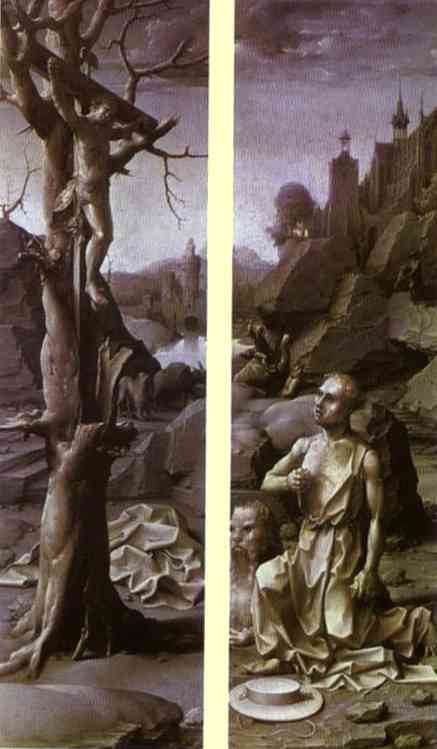
      Jan Gossaert, Saint Jerome Penitent, ca. 1510

      The panels above showing Saint Jerome in the wilderness have clearly left the idea of painted sculpture behind - but for the grisaille they are fairly traditional depiction of the story (showing two earlier episodes in the saint's life in the background).  In other media, frescoes and illuminated manuscripts were also being produced at this time in monochrome or with deliberately reduced palettes, emphasising form over colour.  But looking at this painting on a grisaille winter's day last week, in the National Gallery's new exhibition Jan Gossaert's Renaissance, I was still struck by the scene's uncanny resemblance to a world turned to stone. Perhaps it is because Saint Jerome himself is holding a rock, as he kneels in the rocky landscape with a great stone city in the background, whilst on the other panel, the statue-like figure of Christ is set on a petrified tree beneath an ash-coloured sky.    

      Hieronymus Bosch, The Garden of Earthly Delights outer wings, c1490-1510

      Possibly the best known grisaille outer panels from this period are those of Hieronymus Bosch and those for The Garden of Earthly Delights show the earth as it was on the third day of creation.  This is a world before colour, where land is only just emerging from the misty sea under dark rain clouds, and newly formed trees are seen alongside other stranger growths, half-vegetable, half-mineral.   Italo Calvino's story 'Without Colours', in Cosmicomics, describes the the beauty of the grey earth before an atmosphere has formed to filter the light of the sun.  Here 'trees of smoke-colored lava stretched out twisted branches from which hung thin leaves of slate.  Butterflies of ash flying over clay meadows hovered above opaque crystal daises...' Calvino's hero Qfwfq, who yearns for contrast, colour and sound, falls in love with the beautiful Ayl, 'a happy inhabitant of the silence that reigns where all vibration is excluded'.  When the world begins to change Ayl takes fright at the disruption to her beloved neutral landscape and they are parted.  As Qfwfq looks sadly out on the 'canary-yellow fields which striped the tawny hills sloping down to a sea full of azure glints, all seemed so trivial...'  He realises Ayl could never have been happy here among 'those gilded and silvered gleams, those little clouds that turned from blue to pink, those green leaves that yellowed every autumn, and that Ayl's perfect world was lost forever.' 

      The Brothers Quay, cover for Italo Calvino's Cosmicomics, 
       a photographic collage grisaille landscape.

      Thursday, February 24, 2011

      The bracing glories of our clouds


      I have enjoyed reading Romantic Moderns, which has much to say about the revival of interest in the English landscape before and during the war.  Alexandra Harris acknowledges her debt to Kitty Hauser, whose Shadow Sites: Photography, Archaeology and the British Landscape, 1927-1955 begins with a discussion of the 'topophilia' characteristic of writers and artists in this period.  In 1947 Auden defined this topophilia as having 'little in common with nature love.  Wild or unhumanized nature holds no charms for the average topophil because it is lacking in history' (cf. Sebald vs. Mabey in my recent 'After Nature' post).  What unites 'topophils', Hauser writes, 'is an interest, sometimes amounting to an obsession, with local landscapes marked by time, places where the past is tangible.  For some, such as Betjeman, John Piper and Geoffrey Grigson, this topophilia - as Auden suggests - is eclectic, including medieval churches, Gothic and mock Gothic architecture, Regency terraces and ancient sites.  Some topophils of this generation, such as Paul Nash with his fascination with the genius loci, made atmospheric prehistoric landscapes a particular focus. Others, like painter Graham Sutherland, were attracted to scarred nature and geological vistas.  In the Four Quartets, T. S. Eliot looked for redemption and history in an English village: 'History is now and England'.  And with an eye to continental Surrealism, photographers and film makers including Bill Brandt, Humphrey Jennings, Michael Powell and Emeric Pressburger found in pockets of the British landscape curious and moody survivals from the past.' 

      All of these writers and artists feature in Romantic Moderns, along with others less directly concerned with landscape but whose work looked nostalgically at a fast vanishing world of country houses and village traditions.  The Bright Young Things, for example - Evelyn Waugh, Cecil Beaton, Rex Whistler, the Sitwells -  whose work has never appealed much to me, are discussed alongside Eric Ravilious and Edward Bawden in an interesting chapter on the 1930s Georgian Revival.  Kathryn Hughes in The Guardian, praises the book's 'tactful generosity towards people and places, sights and sounds, that have tended to get written off as embarrassing or just plain wrong. Never has this seemed more important than now, as we work through our own complicated millennial feelings about the romance of the past. Thanks to Harris it no longer seems entirely shaming to admit to a secret Cath Kidston habit. Taking tea in the stable block of a National Trust property becomes a dignified activity, rather than something to pretend to find a chore.'

      I'm no stranger to National Trust tea shops but have always been constrained in where I could go by not owning a car.  Motorists of the 1930s were encouraged to discover the landscape of Britian by the posters for Shell-Mex designed by artists like Vanessa Bell, Graham Sutherland and Frank Dobson (whose depiction of the Cerne Abbas giant is reproduced in Romantic Moderns - the giant's most famous feature is obscured by the shadow of a strategically placed cloud).  In 1934 Cyril Connolly titled his review of an exhibition of Shell-Mex commissioned artwork 'The New Medici'.  He observed that it was 'not the awe-inspiring or exceptional which now seems important, but what is most cheerful and genuine in our countryside - England is merry again - farewell romantic caves and peaks, welcome the bracing glories of our clouds, the cirrus and the cumulus, the cold pastoral of the chalk.'  The Shell County Guides that John Betjamen commissioned also looked beyond the obvious - a fact typified by John Piper's Oxon which deliberately excluded the city of Oxford.  As Alexandra Harris says, 'Piper's Oxfordshire is not a land of touristic sensation.  Old England is allowed to be almost a modern lived-in country.  A photograph of clustered advertisements which would have troubled purist preservationists is captioned 'a tree of knowledge', and an oval photograph with faded edges evokes nostalgia only to affront it with a big sign advertising a 'super cinema.''  It almost sounds like a journey through Oxfordshire's edgelands, prompting the thought that we could have a new series of county guides for the psychogeographically inclined pedestrian, written by Iain Sinclair, Rachel Lichtenstein, Patrick Keiller and so on.

      Romantic Moderns won the Guardian First Book Award and Alexandra Harris can be seen talking about it on the Guardian website.  Thames and Hudson have now signed her up for two more books - a short biography of Virginia Woolf and another one, The Weather Glass, which I am looking forward to as it will apparently 'explore the British preoccupation with the weather, from Beowulf onwards'.  In Romantic Moderns these interests come together in a chapter called 'The Weather Forecast', where there is a discussion of Woolf's unfinished history of literature, 'Reading at Random'.  She makes this sound fascinating: it was to be a book 'shaped by views from windows and stretches of country ... a passionate exercise in literary geography.'  Harris argues that the twentieth century threatened to alienate people from the weather, as Modernist art looked beyond the incidentals of atmosphere to uncover clear cut shapes and colours.  She contrasts this with the rain-filled lithographs of her book's other main protagonist, John Piper (of whose drawings of Windsor George VI said, "You seem to have very bad luck with your weather, Mr. Piper").  Working outside, Piper 'loved the odd splashes that arrived unexpectedly in his paintings.'  These blots have the effect of confirming 'the allegiance between art and the world beyond the painting.  And, like the sand found in a half-read book, they are the souvenirs of a time and place, nature's signature added next to that of the artist.'

      Saturday, February 19, 2011

      Scarp

      I have been tipped off (thanks Hayden) to the rather surprising appearance on Thursday's Newsnight of a piece about Nick Papadimitriou and the deep topography of London's Edgelands.  You can watch it here until Thursday 24 February. You can also see it on the blog dedicated to John Rogers’ film The London Perambulator, which appears to have inspired the Newsnight feature. The London Perambulator 'looks at the city we deny and the future city that awaits us. Leading London writers and cultural commentators Will Self, Iain Sinclair and Russell Brand explore the importance of the liminal spaces at the city’s fringe, its Edgelands, through the work of enigmatic and downright eccentric writer and researcher Nick Papadimitriou - a man whose life is dedicated to exploring and archiving areas beyond the permitted territories of the high street, the retail park, the suburban walkways.'


      Yes, Russell Brand (who now gets his second mention on this blog) is an admirer of the way Papadimitriou  'sees magic in everything'.  He says 'it takes an interesting mind to look at, like, sort of say, oh I saw this power station in Middlesex and, like, thinks it's Kubla Khan.' Some further insights are provided by Iain Sinclair, who puts Papadimitriou in the 'very British tradition' of topographical literature, engaging 'in a really heavy duty way with a single piece of landscape and digging into it'.  Sinclair goes on to say that this kind of writing 'doesn't come with French philosophical baggage' - cue footage of the Situationists, which leads on to some discussion of J.G. Ballard and then Richard Mabey, interviewed saying that terms like 'psychogeography' and 'deep topography' are merely confusing verbal jargon.  We get to see Mabey both as he is now and in the documentary based on his 1973 book The Unofficial Countryside.  Looking through binoculars at the overlooked wild nature in outer London's industrial landscape, he looks like a long-haired version of Robert Macfarlane in The Wild Places of Essex (see my previous post).  It would be great to see this programme re-broadcast; The Unofficial Countryside itself has been republished recently with a new foreword by Iain Sinclair.  In a re-reading of it for The Guardian, Sinclair refers to Nick Papadimitriou as 'a solid invisible, tramping and haunting Mabey's familiar turf, the Colne valley: the canals, reservoirs and sewage farms of the Watford-to-Heathrow corridor.'


      Scarp from fugueur on Vimeo.

      The Newsnight feature mentions a 'lucrative contract' for Nick Papadimitriou's forthcoming book, Scarp.  This will be an investigation of the North Middlesex/South Hertfordshire Escarpment, which he says has been overlooked in landscape literature compared to the more famous escarpments of the Downs and Chilterns.  This book also features in Episode 3 of Ventures and Adventures in Topography, a series of broadcasts John Rogers and Nick Papadimitriou have been making for Resonance FM which looks 'at the rich tradition of early 20th century topographical walking guides to London and the South East and explores what use they might be to us today. Each episode takes a trip through the pages of a different book as if we are embarking on a wayward topographical ramble, and includes contemporary field reports from walks in the areas described in these classic texts.'  You can download these as podcasts (and while you're at it, you might also be interested in Resonance FM's  Edible Landscape field recording podcasts.) Their walks take them to Brent Cross Shopping Centre (prompting a reading from The Arcades Project), the buried and forgotten Philly Brook in Leytonstone, the lost pleasure gardens of Finsbury and Pentonville and the Southern Outfall Sewer: 'guided by The Lure and Lore of London’s River by A.G. Linney (1920′s) they perambulate the raised path that follows the final journey of south London’s sewage to its terminus at the sewage colony at Cross Ness Point, ‘the place where all things end’'.

      Saturday, February 05, 2011

      After Nature

      We made our way to Suffolk last weekend for the third manifestation of the Re-Enchantment project, dedicated to W.G. Sebald and landscape.  The events at Snape Maltings began on Friday with the premiere of Grant Gee's film Patience (After Sebald), which retraces the walk taken by the narrator of The Rings of Saturn and examines the book through the responses of artists and writers like Iain Sinclair, Tacita Dean and Adam Phillips.  Saturday's symposium opened with Stephen Watt's poem, 'For My Friend, Max Sebald', and gave a platform to various writers on place: Rachel Lichtenstein, Richard Mabey, Robert Macfarlane, Alexandra Harris and Dan Gretton. Although each discussed their own work rather than Sebald's, their contributions provided a context for thinking about Sebald and landscape, picked up in the round table discussion that ended the afternoon.  The talks were all stimulating and enjoyable but did leave me wanting to get back to Sebald's writing, so it was a pleasure to end the day with a Patti Smith concert in which she performed sections of Sebald's poem After Nature. The more committed Sebaldians stayed on for some guided walks to Orford Ness on Sunday, but we decided to head home - put off by the prospect of the fierce winter wind blowing in off the German Ocean.

      The temptation to walk in Sebald's footsteps is strong (as I have mentioned in an earlier post about Sebald), but several contributors to Grant Gee's film remark on the futility of this endeavour.  In an interview with The Guardian Gee describes Robert Macfarlane's attempt to retrace Sebald's walk. '"He arrived in Lowestoft," laughs Gee, "and saw everybody was happy, that the weather was lovely, and then he went and had a swim in the sea. He realised he was having too much fun – that what he was doing was unSebaldian – so he packed it in after two days."'  Gee filmed the locations in grainy black and white, like Sebald's embedded images, giving us the sense of a landscape refracted through the memory of the narrator (voiced by Jonathan Pryce).  The film is unobtrusively soundtracked by The Caretaker (James Kirby), whose music has often dwelt on memory and amnesia.  It is an essay film rather than a conventional documentary, so we do not get to hear about Sebald from people who were close to him, or hear the views of a succession of literary critics - the emphasis is on Sebald's artistic legacy and influence.  His humorous side comes through too - fans of the Lowestoft fish-eating incident will be pleased to see this 'sorry wreck' of a meal makes a brief appearance.  Gee also managed to persuade two actors to lie on the beach at Covehithe and recreate the sight that so disturbed the narrator, looking down from the cliff at a couple resembling 'some great mollusc washed ashore', her legs spreadeagled, his feet twitching 'like those of one just hanged'.

       Robert Macfarlane introduces The Wild Places of Essex

      After the screening Grant Gee was interviewed by Robert Macfarlane whose own recent film The Wild Places of Essex was shown as part of Saturday's programme.  This was made for the BBC's Natural World series and in complete contrast to Patience (After Sebald) it was shot in high definition colour.  The camera lingers on bluebells and badgers in the woods near Billericay, deer leaping somewhere in Epping Forest and seals stained rusty orange by the iron in the Thames estuary.  However, Macfarlane, like Sebald, was also making a literary journey, and we see him reflecting on the nature of wildness and the way industry and nature conflict and interact.  It made me want to visit Rainham Marshes, and even Jaywick, where crumbling streets are named after coastal plants that have long since disappeared (I thought of the poems in H.D.'s Sea Garden).  Essex also featured in Rachel Lichtenstein's talk, which drew on her books Rodinsky's Room (1999) and On Brick Lane (2007) and illustrated the way history has shaped the inhabitants of these places.  Like Sebald, she has listened to the accounts of people marooned by time or who hold memories of worlds that have disappeared forever.  Another Sebaldian character, Fred Zentner, emigrant and bookshop owner, is the subject of a Grant Gee short film, seen packing up to leave after forty years selling specialist cinema books.  Among the other short Gee films shown in Snape I was particularly struck by The Western Lands and have included an extract below because of its landscape subject.


      Looking back, I think the day's main talking point was provided by Richard Mabey, who criticised Sebald's lack of respect for the Suffolk landscape in The Rings of Saturn. His particular concern was with Dunwich Heath, which the narrator found to be a 'melancholy region', forlorn above the sea.  Sebald writes of the prehistoric settlers who burned off the forests, saying the scene must have resembled those palls of smoke now visible above the jungles of Brazil and Borneo.  Mabey explained that it could not have happened - Suffolk's deciduous woods would not have burned in this way.  The criticism had added force as part of an ecocritical plea to see the natural world more clearly and resist the pathetic fallacy (Mabey's concerns reminded me that the Climategate controversy had centred on Sebald's University of East Anglia).  Does it matter?  Sebald ends his book with an explicitly unreliable anecdote, based on a passage in Sir Thomas Browne's Pseudodoxia Epidemica 'that I can no longer find'.  He says that  in Holland 'it was customary, in a home where there had been a death, to drape black mourning ribbons over all the mirrors and canvasses depicting landscapes or people or the fruits of the fields, so that the soul, as it left the body, would not be distracted on its final journey, either by a reflection of itself or by a last glimpse of the land now being lost forever.' Sebald's melancholy world view may have obscured the details of the landscape and people he encountered, but perhaps this helps us see the journey we are on more clearly.

      Snape Maltings: landscape framed by
      a hole in the Family of Man
      (Barbara Hepworth) 

      In defence of The Rings of Saturn, Robert Macfarlane asserted that there are many different ways of writing about a landscape.  Sebald's publishers found it hard to categorise Sebald's work, a unique mix of memoir, fiction, history, travel; similar confusions had surrounded Bruce Chatwin, whose books had nevertheless opened up new space for writers like Sebald.  Richard Mabey continued to question the need for 're-enchantment' and argued that we are still too conditioned to see landscapes as prospects, viewed through the eyes of a surveyor or landowner.  He would like more artists to follow John Clare, immersing themselves in the natural world and able to see the landscape from a non-human perspective.  Alexandra Harris (whose Romantic Moderns I'm currently enjoying) put in a word for the continuing importance of the framed view, which slows us down and directs our attention.  The neo-Romantics in her book depicted places that had been closely observed, but worked on by the imagination - like Suffolk in The Rings of Saturn.  Sebald sees things through the eyes of an artist rather than a naturalist and his books concern visions of landscapes, like Grünewald's in the Basel Crucifixion: 'behind a group of mourners / a landscape reaches so far into the depths / that our eyes cannot see its limits.'  The strange dark sky may seem unreal but may still have been painted 'after nature', inspired by memories of the eclipse of 1502, a 'catastrophic incursion / of darkness, the last trace of light / flickering from beyond.'

      These lines were read by Patti Smith at the concert that evening, accompanied by her daughter Jesse on piano and Michael Campbell on xylophone, guitar and percussion.  Among the songs they performed were 'My Blakean Year', 'Ghost Dance', and 'Birdland', which she said had been composed in an associative way reminiscent of After Nature.  They encored with 'Because the Night', introduced as Sebald's "favourite Patti Smith song", the least reliable assertion of the day.  She read an unfinished poem written in tribute to Sebald, but it was her emotionally charged performance of texts from After Nature that made the greatest impression, filling the hall with Sebald's own verse.  Think of the way Patti Smith songs like 'Land', written as prose poetry, begin with gentle accompaniment, then take off, soaring faster and louder until finally getting resolved on a new note of calm. Sebald's poetry lent itself to this treatment, especially the closing lines of After Nature, which she read with gathering momentum until the last sentence, where the sun sets on a distant landscape. The poem describes a dream in which Sebald sees far below him his own house and 'the shadows falling / on the East Anglian landscape'.  He flies over the North Sea and the Rhine's alluvial plain, 'cities phosphorescent / on the river bank, / industry's glowing piles waiting / beneath the smoke trails...'  Time seems to stretch out and speed up and he finds himself looking into Altdorfer's great painting: Alexander's army, Darius 'in flight / towards the sickle moon' and finally, beyond them, 'the evening glow / and a city on the shore ... The Nile Delta can be made out, / the Sinai Peninsula, the Red Sea / and, still farther in the distance, / towering up in dwindling light, / the mountain ranges, / snow-covered and ice-bound, / of the strange, unexplored, / African continent.'


      Albrecht Altdorfer, The Battle of Alexander at Issus (detail) 1529
      Source: Wikimedia Commons

      Friday, January 21, 2011

      From the canyons to the stars...

      As I write this I'm listening to the London Sinfonietta recording of Messiaen's Des canyons aux étoiles..., which was inspired by various locations in Utah - Cedar Breaks, Bryce Canyon and Zion Park (movements 5, 7 and 12 respectively).  'Cedar Breaks', writes Alex Ross in The Rest is Noise, 'is the music of the bedrock.  Orations for brass in unison alternate with pulsing dissonant chords, rugged writing for piano and quasi-jazzy episodes, replete with wah-wah trumpet and glissando trombone. "Bryce Canyon" recycles certain of those motifs of geological violence, but they give way to a series of mighty chorales, in which the splendor of the canyon resonates within the observer's mind.'

      Bryce Canyon, Utah
      Photo: Luca Galuzzi

      In the photograph above the canyon looks like a huge natural organ.  The red-orange rock formations are evoked in the music itself - Messiaen associated the colour red with E major. In a 1979 interview he said “Bryce Canyon was of special interest to me. That’s because it had all those wonderful colours, and I wanted to put them into music. So, the piece I composed about Bryce Canyon is red and orange, the colour of the cliffs.”  Quite a lot has been written about Messiaen's synaesthesia - if you're interested, check out the three dimensional maps of Messiaen's colour space in a paper by Paul E. Dworak. 

      Des canyons aux étoiles... was composed after Messiaen's trip to Utah in 1972 and premiered in 1974.  According to Alex Ross the New York arts patron Alice Tully had 'asked Messiaen to write a work in commemoration of the upcoming American bicentennial.  It was an unlikely assignment, since Messiaen had little love for American culture and a special antipathy for New York.  His reluctance gave way when Tully, well briefed on the composer's vulnerabilities, served him a sumptuous repast capped with "an immense cake crowned with pistachio frogs spewing crème Chantilly."'  Here is an example of the celestial music facilitated by this delicious-sounding cake, the third movement of Des canyons aux étoiles..., 'Ce qui est écrit sur les étoiles' - 'What is written in the stars'.


      Postscript 2016: Alex Ross has just posted a story about the St. Louis Symphony orchestra's principal horn Roger Kaza who in 1982 played the solo-horn movement in a branch of the Grand Canyon and sent a recording to the composer. Here's a short extract describing the performance out in the landscape made with a group of friends including trumpeter Tim Morrison.
      'Fern Glen Canyon is a tributary of the Colorado, with hundred-foot vertical walls thirty to fifty feet across. Dripping springs create grottoes of ferns, greenery, and delicate wildflowers. Tim and I hiked up the canyon, played a few notes, and immediately reveled in the lush echo resounding off the ancient stone. This was the place to record the Messiaen.  [... ]
      [The following day they assembled to perform it.]  By now it was dark and the crickets were chirping. The strange tritone-infused music, with its weird lilting rhythms, seemed perfectly suited to this hallowed place of rock and time. Because my chops were weak, I had to record it piecemeal. Fortunately, the music contains many long pauses and lends itself to such an approach. After an hour or two of retakes, I decided that everything should be covered. We packed up the sand-infested Walkman and hiked back to camp.'