Thursday, December 06, 2007

Chinese rock gardens


We were at the Museum of Childhood last weekend and the photograph here shows my older son walking past a pair of interesting Chinese landscapes. Their caption reads as follows:

'The Chinese Rock Gardens together with two other landscapes were gifts for the French Empress Josephine, wife of Napoleon Bonaparte. They were sent by Chia Ch'ing, Emperor of China (1796-1820). It is said that the ship carrying these gifts was captured by an English warship. They were offered back to the French after the Treaty of Amiens in 1802. The offer was declined. It is recorded that the models arrived at the East India Company's India Museum in 1809. They passed to the Victoria and Albert Museum, then the South Kensington museum, in 1880.'

I'm not sure why these miniature landscapes are in the Museum of Childhood - the implication is that they were toys, but they look more like decorative art works, not dissimilar to the jade mountain I've described here before, showing the The Nine Elders of Huichang. I would love to know more about them. It is hard to imagine Napoleon drawing any inspiration from these little Chinese rock gardens...

Friday, November 30, 2007

To Place: Verne's Journey

In a 1995 interview with Claudia Spinelli, Roni Horn discusses her book To Place: Verne’s Journey (1995), with its photographs of the Icelandic landscape described by Jules Verne in Journey to the Centre of the Earth (1864). She says she wanted to reveal Verne’s fictional narrative “as the reality it is. Up to that point I was working with an intuition about the paradox of fiction. In the book the opening shot is an aerial photograph of the glacier which covers the entrance to the center of the earth. I zoomed in on the ice and cut to ground-level. At ground level you see all of these extraordinary geologic events. Now these are all things that just happen as a part of the mundane in Iceland. Verne's fiction is not a fiction at all. What he described, the entrance, the journey and I estimate the center of the earth as well, actually exists. But he was never in Iceland. So for him it was pure fiction.”


Journey to the Centre of the Earth (like the science fiction that followed it) is a blend of realism and fantasy. Verne’s descriptions of the geology of Iceland create the conditions for suspension of belief as Professor Lidenbrock and his nephew Axel begin their descent. In the OUP translation of Verne’s novel, they arrive in Iceland on page 47 and begin their descent into Snaefells on page 86, so almost a fifth of the book involves their journey through the ‘real’ landscape of lava flows and mountains. Eventually, when they reach the peak of Snaefells after an arduous climb, Axel looks down at the island spread out below him, with its deep valleys, endless glaciers and over to the west, the vast ocean. At the site of all this he ‘plunged into that high-blown ecstasy produced by lofty peaks’, his ‘dazzled eyes bathed in the clear irradiation of the sun’s rays...’ (trans. William Butcher)

In her survey of Roni Horn’s art in the Phaidon book I’ve talked about here before, Louise Neri quotes William Butcher’s introduction to Journey to the Centre of the Earth, where he describes Verne’s worldview in terms that fit Horn’s art practice: ‘An anthropomorphization of the Earth and a mechanization of the human, with the biological often acting as a go-between; an attempt at sensual “totalization” of the world; a constant scepticism; the undermining by juxtaposition, humour, and irony of any dogmatic view of existence; a metaphorization of everyday objects and ideas, which are often re-metaphorized or even de-metaphorized; a distinctive rhythm, made up of repetitions, silences, minor and major keys, counterpoint, and slow movements leading to explosive crescendos; and an innovative narrative technique, whether in the use of tense, person, point of view, voice or structure.’

Friday, November 23, 2007

Siluetas

I never got round to writing about the Antony Gormley show in London earlier this year. The body casts he positioned in Event Horizon on the buildings and streets around the gallery were, among other things, a form of landscape art: marking out a section of the city and drawing attention to a skyline that might otherwise go unregarded. In an earlier work, Another Place, installed on the sands of Crosby Bay, Gormley had similarly inserted his own body into the landscape, by creating its bronze trace and placing multiples over a wide area.

It might be interesting to compare these Gormley sculptures with the ephemeral body imprints made in the seventies by Cuban-American artist Ana Mendieta. In her Siluetas series Mendieta 'inserted her naked figure (or its outline or contours) in a natural setting,' fusing 'aspects of Conceptual, process, performance, body, feminist, and land art.' There are currently photographs of these on line here, here, here and here (this last one to illustrate 'feminism and the sublime'.)

Ana Mendieta, Untitled: Siluetas Series, 1978 (printed 1991)

In London, Gormley's masculine sculptures were placed on the commanding heights, made of solid material and were... how can I put this... impressively well-endowed. Mendieta's Siluetas in contrast were overtly feminine. Indeed, as Michael Duncan notes , one critic Mira Schor, 'faults the bond that Mendieta sought to establish between her own body and that of "Mother Earth," seeing in it a kind of feminist essentialism. She claims that Mendieta's approach reveals "a problematic lack of ambivalence that seems a relic of the first years of feminist art."'

All discussions of the Siluetas acknowledge the important influence of Afro-Cuban Santeria myths, along with Mandieta's explanation that the works symbolised her own sense of uprootedness. Michael Duncan explains how 'they transcend any simple celebration of nature. The Siluetas evoke a variety of emotional states; there is the apocalyptic bleakness of a Silueta composed of burnt gunpowder and charred ash, the magical transience of another work that is seemingly blown together with tufts of hay, and the stolid sobriety of a form molded out of earth... An uncanny filmed performance of 1974, Yagul (Burial Pyramid), presents a Silueta formed from a mound of rocks in a Mexican landscape. Slowly the rocks begin to twitch, pulsing with seemingly primordial life; finally, Mendieta herself gradually shakes off her rocky sepulcher. Yet she remains prone, as if her new visibility is enough.'

Postscript 2026: I have added an image above from the 2026 Tate Modern Ana Mendieta retrospective.

Thursday, November 22, 2007

Concerning scenes

William Shenstone's house The Leasowes in 1765

Ian Hamilton Finlay started writing his Detatched Sentences on Gardening after Stephen Bann lent him an edition of William Shenstone's 'Unconnected Thoughts on Gardening' (1764).  Shenstone's book is reprinted on line.  Here is an extract:
Concerning scenes, the more uncommon they appear, the better, provided they form a picture, and include nothing that pretends to be of nature’s production, and is not. The shape of ground, the site of trees, and the fall of water, nature’s province. Whatever thwarts her is treason.

On the other hand, buildings and the works of art, need have no other reference to nature than that they afford the ευσεμνον [beautiful] with which the human mind is delighted.

Art should never be allowed to set a foot in the province of nature, otherwise than clandestinely and by night. Whenever she is allowed to appear here, and men begin to compromise the difference: night, gothicism, confusion and absolute chaos are come again.

To see one’s urns, obelisks, and waterfalls laid open; the nakedness of our beloved mistresses, the naiads, and the dryads, exposed by that ruffian winter to universal observation; is a severity scarcely to be supported by the help of blazing hearths, cheerful companions, and a bottle of the most grateful burgundy.

The works of a person that builds, begin immediately to decay; while those of him who plants begin directly to improve. In this, planting promises a more lasting pleasure, than building; which, were it to remain in equal perfection, would at best begin to moulder and want repairs in imagination. Now trees have a circumstance that suits our taste, and that is annual variety. It is inconvenient indeed, if they cause our love of life to take root and flourish with them; whereas the very sameness of our structures will, without the help of dilapidation, serve to wean us from our attachment to them.

It is a custom in some countries to condemn the characters of those (after death) that have neither planted a tree, nor begat a child.

Sunday, November 18, 2007

Landscape with a Man Killed by a Snake

A few months ago I did a search on Scholars Resource.com for paintings with titles starting ‘Landscape with…’ I was curious to see some of the subjects that gave artists as excuse to paint landscapes. There were landscapes ‘with’ each of the following:
Animals, Aqueduct, Artist Drawing, Baptism of Christ, Baptism of Christ and St. John the Baptist Preaching, Birds, Board Fence, Boat, Bowlers, Bridge, Bridge and Castle, Buildings, Castle, Castle and Inn, Castle on Lake Shore, Cephalus and Procris, Chateau (Le Chateau au Crepescule), Christ Carrying Cross, Christ on the Road to Emmaus, City and River, City on the Sea, Classical Ruins, Clay Pipe, Cow Drinking, Cows, Cows and Duck Hunters, Dead Tree, Deer Hunt, Domestic Animals and Children, Figures, Figures and Rainbow, Finding of Moses, Fishermen, Fishing Boats, Flight into Egypt, Footbridge, Ford, Gallows, Good Samaritan, Green Corn, Grove of Trees, Gushing River, Gypsies, Hermit (St. Fulgentius), Hunters, Inn, Inn and Skittles, Ironworks, Loaded Boats, Man and Trees, Mill, Peasants, Pythagoras, Rest on Flight into Egypt, Rising Moon, River, Road to Emmaus, Robbers, Ruins, Ruins of Monastery, Satyr, Saw Mill, Scenes from Life of St. John the Baptist and Christ, Shepherds, Shepherds and Countryfolk, Shipwreck, Square Tower, St. Anthony the Hermit, St. Christopher, St. Francis, St. Jerome Penitent, St. Paul the Hermit, Stormy Sea, Thamar and Juda, the Fall of Icarus, Tower, Trees (Rocks and Trees), Trees and Village, Two Trees, Viaduct, Mont Saint-Victoire, Village, Village by the River, Washerwomen, Waterfall, Wild Horses, Windmill, Woman Washing Her Legs, and Women in the Foreground.

There is an interesting essay in the posthumous Louis Marin collection, Sublime Poussin (trans. Catherine Porter), called ‘Description of an Image’ which talks about the ways titles like these operate. Marin notes that ‘Landscapes with a subject’ are a subgenre of landscape painting and as the list above indicates, the subject can itself come from different genres. Marin discusses Nicolas Poussin’s Landscape with a Man Killed by a Snake (c1648), where the subject may be a myth, story or contemporary event: the title is not explicit. If it were called Landscape with Cadmus and the Snake, as it has been in the past, it would take its place more firmly in the genre of mythological paintings.

Nicolas Poussin, Landscape with a Man Killed by a Snake, c1648

The trees, sky, lake and pathway which take up most of this picture can be expressed in just one word ‘Landscape’, but the human subject needs more words to pin it down. Marin notes that this may reflect the opposition between ‘timeless’ static landscape which can be shown pictorially, and sequential narrative which is easier to relate in words. But it is more complex than this. The landscape is like the setting for a drama, and Marin distinguishes between decor, the backdrop which has no link to the human action, and stage which is the situation for the story: actors tread the stage but do not interact with the decor. In Poussin’s painting, the stream at the bottom is tied in to the action: this is where the man lies killed by the snake, perhaps after going to draw water. However, the sky, the trees and the mountains in the distance are more like decor, a (welcome) distraction from the events unfolding at the front of the stage.

Friday, November 09, 2007

A picturesque view of Llyn Padarn

Here is one of Thomas Rowlandson’s aquatints from The Tour of Doctor Syntax in Search of the Picturesque (1809) showing the hapless cleric tumbling into the water while attempting to sketch a Gothic landscape:


A heap of stones the Doctor found,
Which loosely lay upon the ground,
To form a seat, where he might trace
The antique beauty of the place:
But while his eye observ’d the line
That was to limit the design,
The stones gave way, and sad to tell,
down from the bank he headlong fell.
This first tour, written by William Combe and published in Rudolph Ackermann's Poetical Magazine (great title!) also included scenes of Dr Syntax sketching a 'sepulchral ground', a rustic group of animals, and a lake (he inevitably ends up getting wet). However, most of it as an opportunity for picaresque adventures rather than picturesque satire - the basic framework of a tour in the manner of William Gilpin provides plentiful opportunity for bathos and comic misadventures.

Rowlandson's Dr Syntax was not his only satire on the art of landscape. In his book The Search for the Picturesque Malcolm Andrews reproduces his earlier painting An Artist Travelling in Wales, in which the 'wretched, determined artist' is weighed down by a large sketch book, a tripod easel, a palette, a water-flask and a palette knife. 'Such is his dedication to the Picturesque that the rest of his luggage for sustaining himself on the tour is proportionately insignificant.'

Rowlandson knew what he was painting because he had himself gone out in search of picturesque landscapes. The National Library of Wales has a selection of Rowlandson's sketches here. they say 'Perhaps the finest composition in the series is the large watercolour of Dolbadarn where Rowlandson contrasts the genteel tourists embarked upon Picturesque discoveries on Llyn Padarn with the peasants who, to a man, can only gaze across at the visitors in wonder.' There is perhaps a subtle element of satire in this contrast.

Friday, November 02, 2007

The Emperor Ming-huang's Journey to Shu

The five traditional colours in China are white, black, red, yellow and blue-green. These correspond to metal, water, fire, earth and wood. The blue-green colour, qīng (青), is discussed in a footnote to John Minford's translation of the Pu Songling story 'The Snake Charmer'. Minford says that qīng is defined in dictionaries as "the colour of nature, a dark neutral tint, green, bluish-green, greenish-blue, blue, grey, black etc... when used of bamboo, hemp, peas, plums, moss, grass, olives, dragons, flies and tea, it is green; of the sky, the collar, orchids and porcelain, it is blue; of oxen and foxes, horses, cloth and hair, it is black." The word qīng is used to describe the moss in Wang Wei's poem 'Deer Park.'

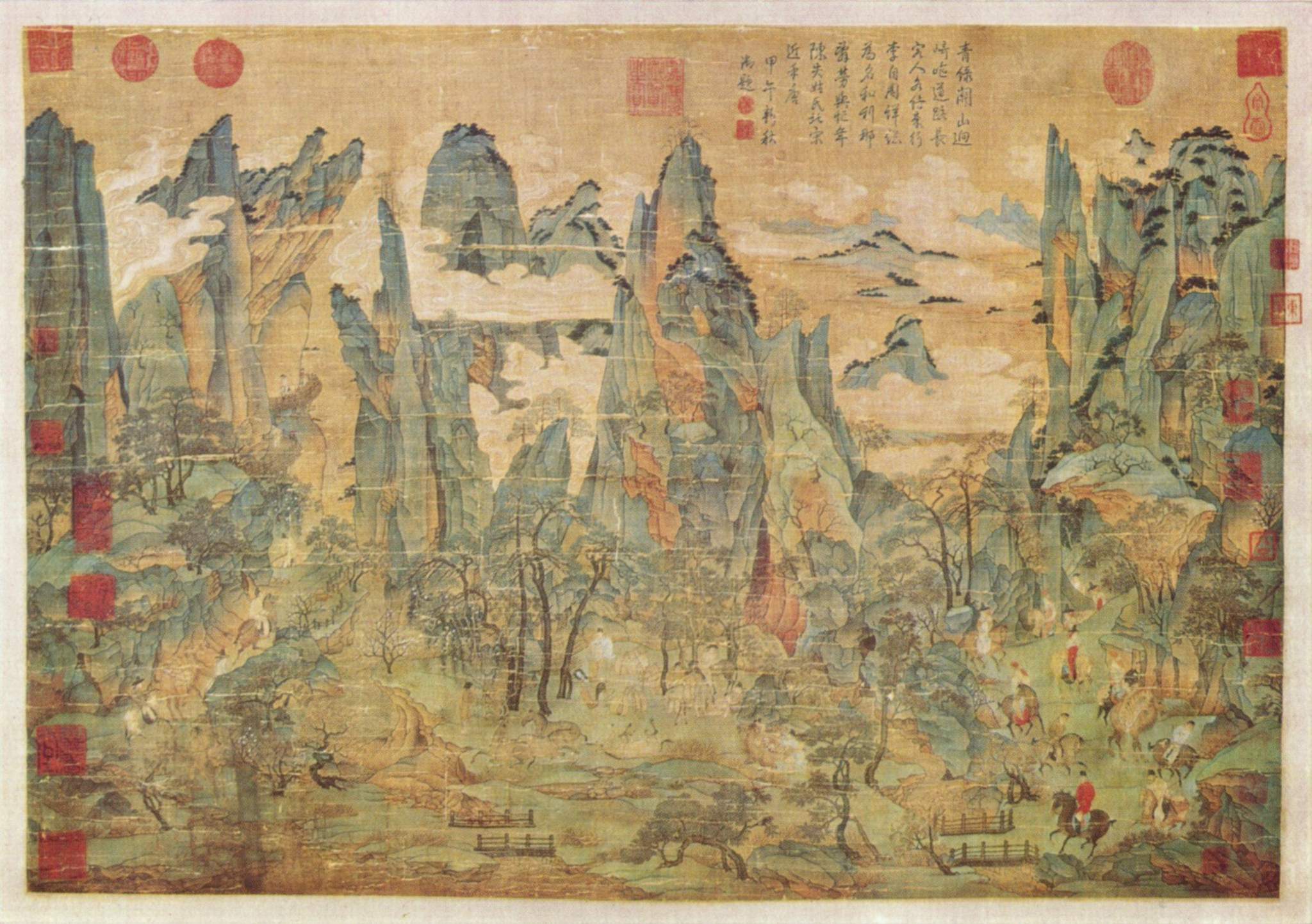
The painter Li Zhaodao (Li Chao-tao) was a contemporary of Wang Wei in early eighth century China. He was one of the originators of the qinglu (blue and green) style of landscape painting, which the JAANUS site describes as 'heavily colored with mineral pigments, especially blue azurite *gunjou 群青 and green malachite *rokushou 緑青' and 'which pays much attention to realistic detail rather than seeking to create an atmospheric impression.' Perhaps the most famous Tang dynasty blue and green landscape is The Emperor Ming-huang's Journey to Shu, a copy of a composition sometimes attributed to Li Zhaodao.


The Emperor Ming-huang's Journey to Shu (copy) attributed to Li Zhaodao
Source: Wikimedia Commons

Saturday, October 27, 2007

An undulating country of clouds


A book I never tire of dipping into (and always end up re-reading more than I intended) is John Suiter's Poets on the Peaks. It describes the experiences of Gary Snyder, Jack Kerouac and Philip Whalen in the North Cascades where they all worked as lookouts, watching for fires from the summits of Crater Mountain, Sourdough Mountain and Desolation Peak. It is a most beautiful book to read, thanks to Suiter's black and white photographs of the key sites and landscapes. Some of these can be seen at the Poets on the Peaks website, along with extracts from the text. The section there that quotes from the book's Epilog gives a sense of how brief and special this episode in American literary culture was: the isolated lookout cabins that gave these poets the chance to experience wild nature, hard work and solitude, along with space to cultivate their poetry and Buddhism, are mostly no longer used. 'Fittingly, the last two operational fire-watch cabins on the Upper Skagit today are Kerouac’s on Desolation and Snyder’s and Whalen’s on Sourdough.'


Here are three Poets on the Peaks links:
Incidentally, there is a John Suiter photograph here in a similar style to those used to illustrate Poets on the Peaks, this one showing a nineteenth century version of the lookout stations, Thoreau's cabin at Walden. Suiter starts Poets on the Peaks with a quotation from Thoreau which could be describing the landscapes experienced by Snyder, Kerouac and Whalen:

'As the light increased I discovered around me an ocean of mist, which by chance reached up exactly to the base of the tower, and shut out every vestige of the earth, while I was left floating on this fragment of the wreck of a world, on my carved plank, in cloudland... All around beneath me was spread for a hundred miles on every side, as far as the eye could reach, an undulating country of clouds, answering in the varied swell of its surface to the terrestrial world it veiled. It was such a country as we might see in dreams, with all the delights of paradise.'

- from "Tuesday" in A Week on the Concord and Merrimack Rivers

Sunday, October 21, 2007

Poems of moon and breeze

Yesterday we went to look at the Korean moon jar on show at the British Museum. It was bought in 1935 in an antique shop in Seoul by Bernard Leach and subsequently lent to Lucie Rie. As the BM site says, ‘When Leach saw the jar in Rie's studio, he decided that it should remain there.’ There is an article about the exhibition at the London Korean Links site.
  
One of the wall captions mentions the particular significance of the moon in Korean culture. I put “Korean Moon Poem” into google and the first thing that came up was “we are very pleased to advise that... Brigitte Bardot has taken up the cause of Korea's moon bears...” Turning instead to my copy of Peter H. Lee’s Columbia Anthology of Traditional Korean Poetry, I had a look through to see how the moon had been treated in the nature poetry of Korea. It doesn’t seem to me to be a dominant theme, but it is a strong element in many of the poems. For example, there is Songs of Five Friends by Yun Sondo (whose verses making up The Angler’s Calendar (1651) I have mentioned here before); the five friends are water, stone, pine, bamboo and the moon. For Yun the moon’s appeal lies in the way it sees everything, but says nothing.

The moon also features in some of the poems of scholarly retreat written by Neo-Confucian philosophers in the previous century. The moon’s brightness and the wind’s freshness provide the setting for peaceful thought, far from the cares of the city. Kwon Homun mentions the clarity provided by ‘the windy air and bright round moon’, while Song Hon says ‘a clear breeze has no price, the bright moon no lover.’ Yi I (1536-84) writes ‘my study by the water, how cool and clean! Here I will discuss learning and make poems of moon and breeze.’ These lines are in the fifth of his Nine Songs of Mount Ku, which describe a series of inspirational landscapes: Crown Rock, Flower Rock, Emerald Screen, Pine Cliff, Hidden Screeens, Fisher’s Gorge, Maple Rock, Zither Shoal and Mount Mun.

Moon Jar in the National Museum of Korea

Friday, October 19, 2007

The True Line

Last weekend I went to the Small Publishers Book Fair at the atmospheric Conway Hall to see Eugen Gomringer talk about and read some of his concrete poems. While there I bought a couple of intriguing books from Colin Sackett. They both use illustrations from old geography books - charming relics from before the quantitative revolution and rise of critical geography, now recontextualised and given a second life as artist books. In this new form there is a more direct focus on the beauty of patterns and forms in the landscape. The books now raise questions rather than provide explanations, prompting thoughts about place, documentation, text and image, science and art.

The first of these two books is a little version of F. J. Monkhouse's Landscape from the Air, with a selection of aerial photographs featuring British locations. The pages of the original have been shrunk to about 8cm high so that the eye focuses on the images rather than the explanatory text. The white border frames each image and gives them the appearance of the documentary artworks created by people like Robert Smithson and Douglas Huebler. The retrieval and reconfiguring of an old book in this way partly would seem to reflect the 'archival impulse' behind many recent art projects. The images recall a time when British culture, under threat, was preoccupied with ideas of landscape; they are also a reminder of the aerial photographs taken during the war.


The other book I bought was
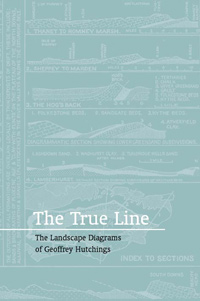
The True Line, a compilation of drawings by Geoffrey Hutchings. Colin Sackett writes: 'Geoffrey Hutchings published just a handful of books, all addressing the search for geographical and topographical truths, and for the ways of recording and depicting these truths precisely and economically by the handwritten word and line. In addition to his contribution to the development of the teaching of field studies in Britain in the late 1940s, with its emphasis on the direct observation and interpretation of landscape, he achieved a masterly ability to ‘read’ and transcribe a place in a graphic composition—be it a sketch-map or a plan, a tabular profile or a section, or an annotated panoramic drawing. In all of these compositions he integrated line and text in a perfect balance of brevity and detail.'

Saturday, October 13, 2007

A good prospect will ease melancholy


In his great compendium, The Anatomy of Melancholy, Robert Burton includes a ‘Digression of Air’ in which he talks about the healthy properties of different climates and concludes in general that ‘variety of actions, objects, air, places, are excellent good in this infirmity, and all others, good for man, good for beast.’ Here is an extract describing the benefits of looking out on a good landscape...
'A good prospect alone will ease melancholy, as Comesius contends, lib. 2. c. 7. de sale. The citizens of Barcino, saith he, otherwise penned in, melancholy, and stirring little abroad, are much delighted with that pleasant prospect their city hath into the sea, which like that of old Athens besides Aegina Salamina, and many pleasant islands, had all the variety of delicious objects: so are those Neapolitans and inhabitants of Genoa, to see the ships, boats, and passengers go by, out of their windows, their whole cities being situated on the side of a hill, like Pera by Constantinople, so that each house almost hath a free prospect to the sea, as some part of London to the Thames: or to have a free prospect all over the city at once, as at Granada in Spain, and Fez in Africa, the river running betwixt two declining hills, the steepness causeth each house almost, as well to oversee, as to be overseen of the rest. Every country is full of such delightsome prospects, as well within land, as by sea, as Hermon and Rama in Palestina, Colalto in Italy, the top of Magetus, or Acrocorinthus, that old decayed castle in Corinth, from which Peloponessus, Greece, the Ionian and Aegean seas were semel et simul at one view to be taken. In Egypt the square top of the great pyramid, three hundred yards in height, and so the Sultan's palace in Grand Cairo, the country being plain, hath a marvellous fair prospect as well over Nilus, as that great city, five Italian miles long, and two broad, by the river side: from mount Sion in Jerusalem, the Holy Land is of all sides to be seen: such high places are infinite: with us those of the best note are Glastonbury tower, Box Hill in Surrey, Bever castle, Rodway Grange, Walsby in Lincolnshire, where I lately received a real kindness, by the munificence of the right honourable my noble lady and patroness, the Lady Frances, countess dowager of Exeter: and two amongst the rest, which I may not omit for vicinity's sake, Oldbury in the confines of Warwickshire, where I have often looked about me with great delight, at the foot of which hill I was born: and Hanbury in Staffordshire, contiguous to which is Falde, a pleasant village, and an ancient patrimony belonging to our family, now in the possession of mine elder brother, William Burton, Esquire. Barclay the Scot commends that of Greenwich tower for one of the best prospects in Europe, to see London on the one side, the Thames, ships, and pleasant meadows on the other. There be those that say as much and more of St. Mark's steeple in Venice. Yet these are at too great a distance: some are especially affected with such objects as be near, to see passengers go by in some great roadway, or boats in a river, in subjectum forum despicere, to oversee a fair, a marketplace, or out of a pleasant window into some thoroughfare street, to behold a continual concourse, a promiscuous rout, coming and going, or a multitude of spectators at a theatre, a mask, or some such like show.'

Friday, October 12, 2007

Return to Songshan

There's a promising site called Mountain Songs that "connects ancient (and some modern) Chinese poetry to the sites where the poetry was written or written about. It enables you to experience the same sights that the poets themselves viewed hundreds of years ago." It's not all that clear yet - for example when I looked up Wang Wei I wasn't sure what landscape is shown in the photograph. But you can look up a few of the mountains that Wang Wei wrote about in his poems, such as Mount Sung or Sōngshān: "Setting sun floods autumn mountains. Sōngshān towers high in the distance, / Coming back, I shut my door on the world..."

Postscript 2023

Mountain Songs, with the links I included above, has disappeared from its original place and is now harder to find, but it does still exist at a new address: https://mountainsongs.mishanghai.org/index.php

The 'About Us' tab gives no information on the authors and still says the site is under construction. However, Bill Porter wrote about Mountain Songs in his 2016 book about a thirty day journey round the sites of Chinese poetry, Finding Them Gone (p361). The site was created by Gary Flint, who travelled all over China photographing mountains and compiling translations. His 'technical adviser' was Robin Chang (Chang Ch'i). Flint sadly died of cancer in 2009, three years after I wrote this post on my blog. He had been a classmate at Reed College of Gary Snyder, whose translations of Han Shan first got me interested in Chinese poetry. 

In 2011 Mountain Songs was the fifth recommendation for classical Chinese poetry by Qiu Xaolong, on the Five Books site. Here's what he says of Gary Flint:

For a few years he worked and lived in Shanghai, where I met him. We would talk about poetry and poetry translation over dim sum, but he passed away over a year ago. I chose his website because he so selflessly dedicated his time, energy and money to create it. He collected translations by other translators, and also published some of his own. The website is still available because a friend of his, in memory of him, is keeping it up. Poetry translation is difficult, and he did it simply because of his passion for it. Anybody who loves Chinese poetry can go to the website. So I felt I had to mention it in his memory.

Saturday, October 06, 2007

Landscape of the Vernal Equinox


Landscape of the Vernal Equinox (1944) is the last painting discussed in Roger Cardinal’s book The Landscape Vision of Paul Nash (1989). It seems to capture perfectly the qualities of Nash’s approach, because ‘the equinoctial arrangement of the total picture space is like the simultaneous presentation of an actual landscape and its dream-like mirror-image.’ The actual landscape was the Wittenham Clumps, which Nash had first visited in 1909 and which now, in declining health, he could see again, twelve miles distant from the house at Boar’s Hill near Oxford where he was staying. Roger Cardinal describes this landscape as the ‘ultimate Place’ for Nash, full of personal meaning, ancient history (they were a Neolithic burial site) and symbolic resonances: resembling breasts, pyramids or clouds, depending on the painting. In this painting, ‘taking equinoctial light as a general metaphor for his poetic revisualisation of the world, Nash invests this ancient setting with all the atmosphere of the surreal. Both real and unreal, lit up and mysterious, the magical landscape hovers before us, as we before it, suspended in a zone of pleasurable confusion wherein the familiar brushes against the unfamiliar, and the intangible floats silently into our embrace.’

Friday, October 05, 2007

The Porlingland Oak

Following on from the last posting about ‘The Printed Path’ - a few more words about Simon Pope, who provided a landscape-related performance piece just before lunch. The idea was that he would stand up and “recall” a John Crome painting in the Tate collection, The Poringland Oak (see below). He ignored the figures in the painting and tried to describe the tree itself, speaking in a hesitant, indefinite fashion which gave his monologue a vulnerable quality and left me, at least, feeling slightly uneasy. It seemed to be about the impossibility of re-presentation, of understanding what it was the painter saw, either in reality or in his mind’s eye. Watching him I was reminded of an occasion when I was hunting for a slide to illustrate a talk and, not finding it, was advised by a passing art historian that I would “have to ekphrate!” The performance last weekend would certainly have qualified as ekphrasis, which, after all, comes in many different forms.


John Crome, The Porlingland Oak (c1818-20)
Source: Wikimedia Commons

The Waterlog exhibition featured The Memorial Walks in which Simon Pope asked writers to memorise landscape paintings, walk out into the real landscape and then try to recall them. In the gallery, the paintings were ‘draped with black silk, reminiscent of the ancient Dutch ritual practiced in homes in which there had been a death, whereby landscape paintings and mirrors were draped with mourning ribbons in order that the departing soul would not become distracted upon its final journey’.

Sunday, September 30, 2007

The Printed Path

I spent the day yesterday at an interesting Tate event: ‘The Printed Path: Landscape, Walking and Recollection’: ‘taking the late German-born writer WG Sebald as their guide, artists and writers consider our relationship to place and its recollection’. The event was linked to the Sebald-inspired Waterlog exhibition which is now on in Lincoln (I probably won’t get to it but I can say that the catalogue is quite good). Waterlog includes a superb new film by Tacita Dean, Michael Hamburger (2007), in which the poet and translator of Hӧlderlin (who features in Sebald’s Rings of Saturn) is seen talking about his apple trees. So inspired were we by seeing this that today we headed straight for Apple Day at Fenton House to buy a selection of unusual apples... Anyway, Waterlog also features Alec Finlay, Jeremy Millar, Simon Pope, Matthew Hollis, critic Brian Dillon and George Szirtes, poet and friend of Sebald’s, all of whom were at Tate Britain for ‘The Printed Path’. Robert Macfarlane is also in Waterlog but was not at the Tate – hardly surprising given how busy he seems to be... Having published The Wild Places, he is now apparently working on a biography of Sebald.

The Sebaldian sense of a landscape haunted gave an opportunity for the ‘Printed Path’ organisers to include Mark Fisher talking about hauntological music, with extracts from Brian Eno and the Belbury Poly, both of whom I have talked about here before. The Tate event also included Iain Sinclair (always good value), Geoff Dyer (also excellent), Marina Warner and her colleague from Essex University, Philip Terry, who has taken an Oulipian strategy from Queneau’s Morale Élémentaire and applied it to landscape. Terry’s Elementary Estuaries are a string of brief descriptors like a text piece by Fulton or Long - they can be seen at the V&A site.

One of the themes of the day was the notion of travelling the landscape in the footsteps of a writer. This is what Macfarlane is now doing in the case of Sebald and he’s hardly the first - I myself once went on a trip to Suffolk searching for Sebaldian locations like Dunwich beach (see my photograph below). At the Tate, Iain Sinclair talked about the walk he wrote about in The Edge of the Orison, following John Clare’s ‘journey out of Essex’, Geoff Dyer described his disappointment on finally finding D H Lawrence’s house in Sicily, Alec Finlay read a poem about his trip to the remains of Wittgenstein’s home in Norway, and Brian Dillon related his attempt to trace Robert Smithson’s Monuments of Passaic. Dillon’s article describing this trip is referred to in an interesting blog, New Jersey as an Impossible Object. I may expand in this blog on some of the themes covered in ’The Printed Path’ when I have a bit more time...

Friday, September 28, 2007

Like a wet pebble

The thought of a Millais retrospective hardly sets the pulse racing, but as I was in Tate Britain on Wednesday I had a look around. The last room covers ‘The Late Landscapes’: ‘Millais’s affection for the Highlands of Perthshire was most brilliantly expressed in a series of twenty-one large-scale landscapes that he painted outdoors from 1870 to 1892’. He said: “Scotland is like a wet pebble, with the colours brought out by the rain.” In the opinion of the curators these paintings ‘represent new approaches to landscape: through poetic references, novel compositions, celebrations of autumnal scenery and light, and unresolved narratives’. They are indeed interesting, although perhaps not quite as interesting as this description implies; the exhibition is rather marked by hyperbole and I note that an article in the Telegraph earlier this year was headlined ‘Tate plans retrospective to rehabilitate Millais’.

Wordsworth, Tennyson, Shakespeare, Donne and Cardinal Newman are all quoted in the titles or subtitles of these late landscapes; The Sound of Many Waters, for example, is a reference to The Dream of Gerontius. One of the paintings that struck me particularly was Dew-Drenched Furze (1890), which reminded me of a morning walk I once took in the Cairngorms (see photograph below). The title comes from Tennyson’s In Memoriam:

And on these dews that drench the furze, 
And all the silvery gossamers
That twinkle into green and gold 

Sunday, September 23, 2007

The quiet of the sky

In his chapter on 'The Picturesque Environment' in The Song of the Earth, Jonathan Bate quotes Adorno: 'If you exclaim "what a sight!" in some natural setting, you detract from the beauty by violating the silence of its language'.

For Bate, 'the impossible task of the ecopoet is to speak the silence of the place'. He thinks Wordsworth got close in 'Lines written a few miles above Tintern Abbey' which goes 'beyond the enumeration of picturesque beauties to a wholly felt, but perforce not fully describable sense of 'the indeterminate quality of things.'' (The last phrase is Valery's, quoted by Adorno: 'the beautiful may require the slavish imitation of the indeterminable quality of things.') In the lines below, Wordsworth sees the landscape but connects it to the silence of the sky:

Once again
Do I behold these steep and lofty cliffs,
That on a wild secluded scene impress
Thoughts of more deep seclusion; and connect
The landscape with the quiet of the sky.

As Jonathan Bate says, 'the picturesque looks, the ecopoetic connects.'

Saturday, September 15, 2007

Light and shadow in a far north landscape

One of my favourite writers on landscape is the prolific John Dixon Hunt. There is a short US radio programme, 'Milestones of the Millenium' in which he talks Lisa Simeone through the history of pastoral music. The recording is a bit odd as some of the recordings are cut short, but you get a few bursts of nature, like the sheep in Richard Strauss's Don Quixote, and music inspired by landscapes like Tales from the Vienna Woods by Johann Strauss.

Peter Maxwell Davies gets a brief mention near the end of this programme, which set me thinking about landscape elements in his work. He is described here as a "probing, meditative, ecological symphonist " whose work changed "in the 1980s in conjunction with his move from London to the Orkney Islands in the North Sea... Davies has developed a sense of musical pulse, long illusive melodic line, and textural counterpoint, within the context of sweepingly architectured movements, which seeks to find musical representations for the actions of waves, winds, clouds and the startling effects of light and shadow in a far north landscape." The music is not easy to get to grips with at first, but "on repeated returns and further listenings, like the northern landscapes that so intensely ground the entire sound world Davies is evoking, slowly-ever so grudgingly-ever so stingily-the rich textural beauties, the haunting whiffs of melodic line, the luxuriant soundscapes of kaleidoscopic colors reveal themselves."

In an interview here Maxwell Davies describes the effect of the isolated landscape: 'With nobody around, he says, "you can project the structure of what you're working on out of your head and on to the landscape. You're walking through a three-dimensional architecture of your music. You hear the whole thing happening in slow motion, and you can shift things around."'

What I really wanted to do here was give a link to his website and see what he has to say about landscape there. There are tantalising mentions of it online e.g.: 'he has a pretty good website .... In addition to the usual bio stuff he has info and photos of the Orkneys, his adopted home.... A few years ago he traveled to Antarctica to write his Symphony no.8 "on location" and the account he wrote is quite fascinating, especially for his description of the unique sonic landscape he experienced there.' But sadly these links don't seem to work! I'll leave them here though in case its a temporary problem and they are restored.

Postscript 2014: I have just revisited this post and see that the Maxwell Davies website is now working.  I have can't see a set of Orkney photographs but the Antarctic Diary is there.  There is a stern copyright warning at the end so I'm a bit nervous about fair-use quoting it at all, but here is one sentence to give you an idea...  "There is almost no wind, but occasionally an astonishing sound whistles gently from the peaks to the south, almost subliminal at first, but growing into an alto-flutish lament that resonates somewhere between your ears, then reveals its true origin when a high and complex counterpoint, suggesting ghostly oriental flutes, creates a sonorous wandering difference - tone, softly pulsing across the whole ice shelf."

Thursday, September 13, 2007

Autumn Morning on Lake Sortedam

I have been in Copenhagen where I took a look at the Danish Golden Age landscapes in the Carlsberg Glyptotek. The galleries start with Eckersberg ("the father of Danish painting") and then move onto the oil sketches and paintings by his pupils and successors, where one can't help gloomily noticing how young many of the artists were when they died (Eckersberg outlived most of them). Christen Købke for example (who died in 1848 age 37) painted some really striking landscapes in a palette of pale peach and plum (I'm afraid these adjectives don't do justice to the paintings' melancholy moods). Two are on show at the Glyptotek: Autumn Morning on Lake Sortedam and Autumn Landscape. Frederiksborg Castle in the Middle Distance. I see from this blog that the former has been assigned to the Danish canon of 'monuments of national importance and priceless value for Danish culture'... Another of Købke 's autumn paintings is reproduced below.


Christen Købke, Frederiksborg Palace in the light of evening, 1835
Source: Wikimedia Commons

Sunday, September 02, 2007

The Fault Series

If I'd had more time I could have photographed the grykes at Malham (see previous posting) and come up with something like Olafur Eliasson's The Fault Series (2001). This is one of several sets of photographs where Eliasson comes close to 'traditional' landscape art: others can be seen on his website. Of course Eliasson is keen not to be seen as simply the latest kind of Scandinavian nature worshiper and his works, including the popular Tate Modern installation, The Weather Project, are just as much about science, technology the phenomenology of space. For me Eliasson's photographs are reminiscent of Roni Horn's, a fairly obvious observation given that they both use the landscape of Iceland. There is a review of an exhibition of his photographs here: ''Eliasson says his work is about people -- an assertion that's obvious in his installations but less so in his largely unpopulated photographs. But the photo series are about the artist moving through the landscape and sharing his experience with the viewer, which is similar to the way his installations construct an environment to be experienced."