Sunday, July 22, 2007

Landscapes at Kalumpiwarra, Yalmanta and Ngulalintji

Among Australian Aboriginal artists, the work of Rover Thomas (1926-98) particularly appeals to me, perhaps because there are some superficial similarities with Mark Rothko, as noted here. However, in an article on Thomas, Wally Caruana remarks on their differences: ‘if Rothko's paintings mirror the human form, then Thomas' are firmly embedded in the landscape.’

Postage stamp from 1993: Kalumpiwarra-Ngulalintji by Rover Thomas

Rover Thomas’s Landscapes at Kalumpiwarra, Yalmanta and Ngulalintji (1984), in the National Gallery at Canberra, commemorates an old woman killed by a car accident at Turkey Creek airstrip. It shows, according to Howard Morphy in his book Aboriginal Art, a place on the woman’s spirit journey with identifiable locations: Blackfellow Creek, the rock at Ngarkalin, grass at Yalmanta, a wooded area, Ashburton Hill, Bow River. ‘Although Thomas’s landscapes echo some contemporary Euro-American paintings in style, they come directly out of the art of the Kimberleys... the underlying theme is the spiritual value of the land and the connections between places.’

I couldn’t see Landscapes at Kalumpiwarra, Yalmanta and Ngulalintji on-line but here are some links to other Rover Thomas paintings: Yari Country (1989), Cyclone Tracy (1991), Paruku (Lake Gregory) (1991), Kankamkankami, (1998). And there’s a Rover Thomas painting, All that big rain coming from top side, on Les Murray’s site accompanying Murray’s poem ‘Two Rains’. This work was bought by the Australian National Gallery in 2001 with the record sum for an indigenous Australian painting: $778,750.

Saturday, July 21, 2007

Above the frenzied sea

Some years ago we visited the Cinque Terra, a group of five villages on the Ligurian coast of Italy. One day we did the coast walk between them, starting at Riomaggiore and ending at Monterosso (see photo below). I remember the curves of the landscape, the glittering sea, the wind blowing in the pine trees... but I also remember a harsher side to the place: the crumbling, dusty path, a relentless sun overhead and dense brambles hiding the view. Soon afterwards I read Eugenio Montale’s first book Ossi di Seppia (Cuttlefish Bones) and found all these elements in poems set in the Liguria of his childhood and youth. In 1900 Montale’s family had built a villa at Fegina, near Monterosso. As Jonathan Galassi says in his notes to Collected Poems 1920-1954, ‘here Montale will spend long summer holidays until he is nearly thirty, and absorb the elemental landscape – hallucinatory sun, agitated sea, barren cliffs and shoals – that is the primary material of his first poetry.’ The Ossi di Seppia poems were first published in 1925, when Montale was 29.


The path to Monterosso

To get a sense of the Ligurian landscape in Ossi di Seppia you need to read the poems. What I’ve attempted to do below is give a flavour by extracting some phrases from Galassi’s translations, starting with the orchard of ‘In limine’ and ending with the flight of swifts in ‘Riviere’.

the wind inside the orchard ... among the lemon trees ... whispering of friendly branches ... the fragrance of lemons ... the golden horns of sunlight ... the copper horizon ... the livid sea ... swallowed by the haze ... the rock that shimmers with salt ... old-silver shimmer on the walls ... the bitter scent of the sea ... fired reflections ... the plain of the sea ... a blistering garden wall ... among the thorns and brambles ... throb of sea scales ... cicadas’ wavering screaks ... the shade of that green thicket ... wavering mother-of-pearl haze ... the stillness of the country ... my field parched by the salt sea wind ... the sunflower crazed with light ... the statue in the drowsiness of noon ... the trees give up no shade ... walking in dry, glassy air ... butterflies danced fleetingly ... among thin reeds and brush ... the well’s pulley creaks ... the owl darts ... wet smoke hangs heavy on roofs ... the arc of the sky ... slanting shadows of cluster pines ... the sight of the sea ... foam raining back on the rocks ... the sun bakes ... mosquitoes cloud the air ... cork and seaweed and starfish ... the dry cliffs ... the rocks that edged the road ... shaking tufts of thirsty cane ... briny gusts ... rivers of rainwater ... the sea’s lashing ... the wind’s erratic gales ... air so blue it goes dark ... the sun in darkened courtyards ... a throbbing sea hatched with furrows ... tangled seaweed and drifting tree trunks ... scarlet houses built of ancient brick ... the thin hair of tamarisks ... vines and pine groves ... the bald, hunched backs of hillocks ... steep embankments ... bramble thickets ... a wisp of breeze ... the house by the sea ... shivering tamarisks ... false calm over carved waters ... sirocco gale that burns ... the sky alive with pale lights ... the choppy sea talks in the rocks ... a few seabirds are flying ... clouds pressed between the branches ... among the silver blades of tender leaves ... a patch of sky burns overhead ... the rumble of a train ... the solemn cicadas ... the dusty streets ... tops of elders shiver ... the sea that shudders ... the windy gorge ... the branches of dwarf pines ... a lead stormcloud high above the riptide ... a salty, roiling maelstrom ... thunder rolls with a struck-metal clang ... the apprehensive sky starts spattering ... among the stones ... the sun hides in the clouds ... hazy afternoon ... the gentle breakers ... copper water riffled by a breeze ... the swarm of bats that sunset scatters ... a fisherman lets down his line ... tranquil afternoon ... the excess of light stuns ... edges go abstract ... tendrils of the low vines ... an eddy of deepening blue ... assiduous, slow waves ... sluggish mists ... the sigh of the breaker ... someone hangs out nets ... a curve of flayed horizon ... the whistle of the tugboat ... the offshore wind’s hot eddies ... a cormorant’s wing beats up above ... the rivermouth, waterless, but alive with rocks and lime ... a roadway of dried mud ... a dense fog ... glancing light ... a few blades of agave ... above the frenzied sea ... a pair of pale camellias ... shuddering olive trees and staring sunflowers ... the cuttlefish bone ... a stone smoothed by the sea ... the arcs of shifting branches ... rocks brown in the foam ... arrows of roving swifts.


The 'copper horizon', Riomaggiore

Monday, July 16, 2007

Drosscape

The latest Frieze, a ‘summer ecology special’, is a hefty 265 pages, so I was glad to see the editorial reflecting on the carbon footprint of magazine production. In a review of the Sharjah Biennial (‘Still Life: Art, Ecology, and the Politics of Change’), Christy Lange writes that ‘a number of works only superficially grazed the subject of the fate of our environment (confusing it instead with the genre of landscape or the literal act of recycling).’ With this in mind, as we’re concerned here with the ‘genre of landscape’, I’m not going to discuss the interesting work of environmental artists like Tue Greenfort, who feature in this special edition of Frieze, but I’d recommend looking at the Frieze website, now expanded to include more content, thus ‘saving more trees’. It includes a survey of the field by Max Andrews, author of LAND, ART: A Cultural Ecology Handbook.

A couple of interesting landscape-related things on this site worth drawing particular attention to:

  • There is a review of Alan Berger’s new book, Drosscape. In this book ‘Berger classifies drosscape sites into landscapes of dwelling (LODs – voids of land in housing developments), landscapes of transition (LOTs – temporary storage facilities), landscapes of infrastructure (LINs – transportation rights of way), landscapes of obsolescence (LOOs – junkyards and landfills), landscapes of exchange (LEXs – abandoned malls) and landscapes of contamination (LOCOs – military bases and other brown fields).’ There are various other reviews on-line, e.g. at Terrain.org.
  • A review of a new Mike Marshall exhibition mentions an interesting new work. ‘In Spoil (2007) Marshall retouched a black and white image of a mountain of debris in a way that both restored original colour to the monochrome image and mimicked, in deliberately debased form, a landscape painting of the Sublime. It’s Caspar David Friedrich crossed with Peter Fischli & David Weiss: by turns meditating on the transcendent qualities of art’s capacity to represent nature, expressing shyness towards art as representation and a love, instead, for the beauties of the commonplace. There are things that are consistently wonderful – flowers, the sun breaking through clouds, the roll of thunder – yet which lose all their power in mediation. Marshall considers how to tackle this problem.’

Wednesday, July 11, 2007

Coalbrookdale by Night

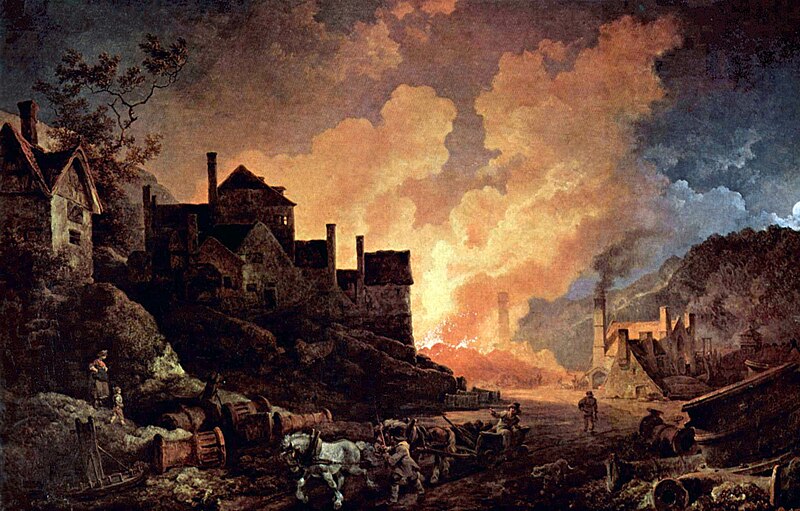
The last posting got me thinking about the idea of the industrial sublime, and the painting below which is often used to illustrate it. The Royal Academy has a Loutherbourg etching of the Ironworks, Coalbrook Dale which is much less menacing, and, going further back to 1777, there is a painting, Morning View of Coalbrook Dale by William Williams, where the industrial smoke is just a baleful presence in the distance... But with Coalbrookdale by Night the delightful horror of the new industry is evident in a fiery drama, set, according to this article, at a place called Bedlam Furnaces.


Philip James de Loutherbourg, Coalbrookdale by Night, 1801
Source: Wikimedia Commons

In his book Beauty and the Contemporary Sublime Jeremy Gilbert-Rolfe describes the way the industrial revolution changed the nature of the sublime. ‘The limitlessness once found in nature gives way, in technology, to a limitlessness produced out of an idea which is not interested in being an idea of nature, but one which replaces the idea of nature.’ The Coalbrookdale furnace is a new force in the world, but for ‘the industrial subject’ this kind of sight will henceforth be ‘part of the landscape. The landscape potentially now has in it forces comparable in power with nature, but products of reason rather than forces that just are...’

Monday, July 09, 2007

St Louis zinc smelting establishments

I can't resist including another piece from The Poet's Eye. Geoffrey Grigson includes the whole of Walt Whitman's 'Plate Glass Notes', a diary entry for November 1879, published in November Boughs. In the extract I've reproduced here, Whitman returns from the plate glass works where he had seen 'vast, rude halls, with immense play of shifting shade, and slow-moving currents of smoke and steam, and shafts of light, sometimes sun, striking in from above with effects that would have fill’d Michel Angelo with rapture'. These sights prepare him for another sublime scene when he arrives at St Louis: the zinc smelting establishments...
'Coming back to St. Louis this evening, at sundown, and for over an hour afterward, we follow’d the Mississippi, close by its western bank, giving me an ampler view of the river, and with effects a little different from any yet. In the eastern sky hung the planet Mars, just up, and of a very clear and vivid yellow. It was a soothing and pensive hour—the spread of the river off there in the half-light—the glints of the down-bound steamboats plodding along—and that yellow orb (apparently twice as large and significant as usual) above the Illinois shore. (All along, these nights, nothing can exceed the calm, fierce, golden, glistening domination of Mars over all the stars in the sky.)

As we came nearer St. Louis, the night having well set in, I saw some (to me) novel effects in the zinc smelting establishments, the tall chimneys belching flames at the top, while inside through the openings at the facades of the great tanks burst forth (in regular position) hundreds of fierce tufts of a peculiar blue (or green) flame, of a purity and intensity, like electric lights—illuminating not only the great buildings themselves, but far and near outside, like hues of the aurora borealis, only more vivid...'

Saturday, July 07, 2007

Sandy Flora


As you can see, I have borrowed a copy of The Poet's Eye (1944), Geoffrey Grigson's anthology which I mentioned a few weeks ago. Of course it is John Craxton's lithographs that strike the reader immediately, ranging from small black and white images of shells, stones and trees to full page landscapes in colour, like the illustration below. But the writings themselves are also fascinating, bringing together 'visionary' poems and prose and covering 'generalised vision, descriptive vision cut from its application, vision conceived simply for its own sake, and vision of the intense kind...’ It is full of surprising choices, from its opening version of Rabelais’ ‘Inscription Above the Entrance to the Abbey of Theleme’ by Sir Thomas Urquhart, to the short extract from Moby Dick which closes the book. In between there are many landscape poems and descriptions. The writers who feature most often are William Barnes, John Clare, George Crabbe, R.W. Dixon, John Dryden, Coventry Patmore and Walt Whitman. It is an eclectic and very individual selection, although clearly in sympathy with the period’s Neo-Romantic sensibilities: poems and prose by both William Blake and Samuel Palmer are included.


Of course it’s quite impossible to convey the pleasures of such an anthology with just one example, but I’ll try anyway. At one point there is a little cluster of George Crabbe ‘visions’, starting with part of his poem, ‘The Ancient Mansion’. Then, after an extract from William Barnes, Grigson moves to some more of Crabbe’s verse, a description of ‘Sandy Flora’ taken from ‘The Village’ (1783) which I’ve reproduced below. And then he moves immediately to a third piece, prose this time, headed ‘Seaside Fen’ and apparently a footnote to ‘The Lover’s Journey’ (from Crabbe’s Tales). There are various other Crabbe selections dotted through the book (I like, for example, ‘Moonlight and Jelly-Fish or Sea Nettles’, which describes them: ‘Soft brilliant, tender, through the Wave they glow, / And make the Moon-beam brighter where they flow...’) Grigson says in the introduction that ‘all the truest and deepest poets, if they do not always remain there, go, at least, through a stage of vision in the very straightforwardness of the word: they have good eyes.’ George Crabbe, it is safe to say, never lost his ‘good eyes’.

Lo! where the heath, with withering brake grown o'er,
Lends the light turf that warms the neighbouring poor;
From thence a length of burning sand appears,
Where the thin harvest waves its wither'd ears;
Rank weeds, that every art and care defy,
Reign o'er the land, and rob the blighted rye.
There thistles stretch their prickly arms afar,
And to the ragged infant threaten war;
There poppies nodding, mock the hope of toil,
There the blue bugloss paints the sterile soil;
Hardy and high, above the slender sheaf,
The slimy mallow waves her silky leaf;
O'er the young shoot the charlock throws a shade,
And clasping tares cling round the sickly blade.
With mingled tints the rocky coasts abound,
And a sad splendour vainly shines around.

Friday, July 06, 2007

San José Canyon: A Quality of Dancing

I stumbled upon a little online exhibition of Thomas Joshua Cooper photographs at the Ingleby Gallery site: ‘rock, water, tree’. It covers ‘the places and subjects that have been most present in his work for the past 30 years.’ Elsewhere, in an interview with David Bellingham, Cooper talks of his early approach, choosing sites like the San José Canyon in accordance with “ongoing concerns which included how both physical and emotional aspects of place, that were highly interiorised in their physical surround and emotionally charged in the gestural conditions of their object matter (grass, rocks, leafless-branches, etc.), helped me to recognise and then picture the 'symbolic field' that was and still is important to me.” In the photographs, he was “consciously removing the traditional elements that allow for a recognition of place” so as to “intensify what is now an abstracted 'symbolic field' for visual reference and location.”

In general terms it could be said that Cooper’s photographs forestall a rapid perception of landscape so as to embroil the viewer in more complex processes of thought and feeling. In his 1992 essay, ‘Poetry and the Space Beyond’, Thomas A. Clark discusses the way a Thomas Joshua Cooper photograph operates in three stages. First we admire its scale and intensity, the 'deep blacks and velvety whites' of its surface. Secondly we penetrate to the place itself - not some famous site, just an assemblage of trees, foliage, water. Finally the viewer starts to feel the spirit of the place, which ‘will always be alien, unhuman, beyond our preconceptions.’ In this way Clark looks at the photograph ‘San José Canyon: A Quality of Dancing’ and sees not just morning light on a hillside, but an evocation of first light and first things, ‘a world cleansed of history’.

Saturday, June 30, 2007

First light, Moscow, 1812

I’ve been reading the new Milan Kundera book on the novel, The Curtain: An Essay in Seven Parts, which talks among many other things about Henry Fielding’s idea that the novelist should probe human nature with ‘a quick and sagacious penetration into the true essence of all the objects of our contemplation.’ Thus, rather than framing and contemplating a landscape, the novelist actively moves in and explores it. Indeed, some of the great novelists hardly stop to describe a particular view. I read somewhere recently that War and Peace has memorable descriptions of Russia in winter, but does it? There are soldiers suffering frostbite and, in earlier happier times, young people sledging through the snow, but in these cases it is people’s actions and perceptions that are being described. War and Peace is like a series of history, genre and portrait paintings, but I don’t recall much that could be described as landscape. On the other hand, Tolstoy, ‘quick and sagacious’, writes with such economy that he didn’t really need to stop the action to dwell on a particular vista. If you look, for example, at that sledging scene (Vol 2, Part 4, Chapter 10) you find fleeting but evocative sentences like these: ‘As they drove down past the garden, the leafless trees, sometimes cast their shadows right across the road and hid the bright moonlight. But once they were out of the gates, the snowy plain, glittering with diamonds on a wash of midnight-blue, opened out on all sides, quiescent and bathed in moonlight.’ (Anthony Briggs translation, p576)

Here is one rare moment when a character in War and Peace does stop to look at the view. The prose reads like topographical poetry (or a cinematic panning shot), but appears naturally in the narrative to symbolise a turning point for Russia and a re-birth for Tolstoy’s character, Pierre.
‘On that first morning, when he had got up at first light, come out of the shed and seen the dark domes and crosses on the Novodevichy Convent, then the grass with its dustings of hoar-frost, then the slopes of the Sparrow hills and the wooded river-banks meandering away into the purple distance, when he had felt the chill touch of the morning air and heard the cawing of jackdaws flying across the fields away from Moscow, and then seen a sudden glint of light in the east followed by the sun’s rim rising majestically from behind a cloud, and the domes and crosses, the hoar-frost, the horizon and river all merrily sparkling in the new light – Pierre had felt a new surge of strength and vitality, the like of which he had never known before.’ (p1126)

Thursday, June 28, 2007

A Vista, Furness Abbey

I was looking at ‘A Vista, Furness Abbey’ (1860) by Roger Fenton in Tate Britain’s How We Are exhibition today. The abbey itself looks rather as I imagine it looks today - what’s interesting are the three figures, backlit and semi-posed, creating a Romantic atmosphere that doesn’t really emerge from the stones themselves. They look, and were no doubt meant to look, like characters in a story, and now the passage of time has turned the ‘actors’ themselves into characters.

I made a note of some of the landscapes in the exhibition, listed here with links to earlier posts where I’ve talked before about some of the photographers. In the first room, apart from Fenton, there are early photographs by William Henry Fox Talbot, picturesque countryside scenes by Benjamin Brecknell Turner (1815-94), photographs to accompany the Ordnance Survey by Sir Henry James (1803-77), and commercial landscape photographs by Francis Frith (1822-98) – Frith established a family firm that lasted until 1971 and whose images are viewable online at the Francis Frith site.

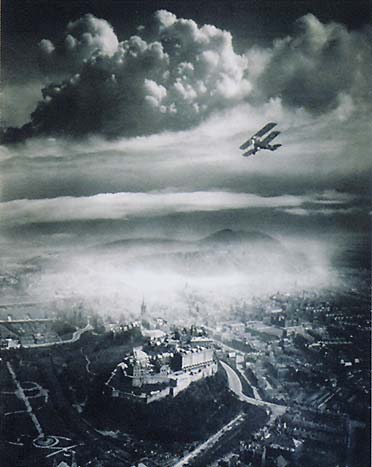
Moving into the twentieth century there are two striking aerial photographs of London and Edinburgh by Alfred George Buckham (complete with superimposed images of an aeroplane). In a room on the ‘new Britain’ covering the post-war period, the curators include more aerial views, from geographer J.A. Steers’ book The Coast of England and Wales (1946), along with some Country Life Picture Books, colour guide book photographs by Walter Arthur Poucher and W.G. Hoskins’ The Making of the English Landscape (although I’m not sure why this last book was particularly relevant to a photography exhibition). Geoffrey Grigson always crops up in anything to do with mid-century British landscape, and he makes an appearance here as editor of An English Farmhouse and its Neighbourhood (1948), with photographs by Percy Hennell.

Among more recent photographers, the exhibition includes some post-industrial scenes by John Davies - he has a homepage with various landscape photographs and images of Rachel Whiteread’s House. There is a neat (too neat?) juxtaposition of ghastly modern suburban houses photographed by Fergus Heron and David Spero’s shots of hopeful but rather fragile looking eco-houses from his Settlements project (which were discussed in a Guardian article here). There are some of Jonathan Olley’s sea wall pictures and two of Jem Southam’s intriguing large format photographs of The Pond at Upton Pyne – a fuller set of these can be seen at the V&A site. Finally there is one of Dan Holdsworth’s ‘Machine for Living’ non-spaces and a rather stunning photograph of a ‘slight disturbance of the sea’ by Simon Norfolk (the first image reproduced in this BLDGBLOG post).

Sunday, June 24, 2007

Lightning Field

Looking at the archives of the excellent Cabinet Magazine today I came upon some artists’ impressions of Walter De Maria’s Lightning Field (1977), under the title ‘Please Draw That Famous Photograph of The Lightning Field From Memory’. The 'photograph' they are trying to remember is one of the most iconic in recent art, and certainly one of the images that defines ‘land art’, although the resulting pictures suggest they are not all remembering one specific photograph.  Nobody is allowed to photograph the site - restrictions placed long before circulation of images on the internet could be imagined.  [Update 2014: It would be interesting if Lightning Field came increasingly to be appreciated through artist's impressions, imprecise enough to avoid copyright restrictions.  I just commissioned my young son to provide his own version, below].


The Lightning Field site itself, like Smithson’s Spiral Jetty, is now a place of pilgrimage, as described for example on Todd Gibson’s blog: 'As the sun drops in the sky when evening approaches, the field becomes different. A shadow grows from the base of each pole, giving it additional definition. The more veiled, angled light of evening begins to reflect off the poles, bringing into view the whole mile-long by kilometer-wide field. Watching this happen, it’s as if your vision suddenly sharpens. The field emerges from the landscape in its totality. If you happen to be there on a night that is not overcast and you get a brilliant orange sunset, the effect is stunning. The poles reflect that light, flashing orange, setting the field ablaze with color.'

I’ve always been intrigued by De Maria for his connection to the New York avant garde music scene - he was briefly in an early version of the Velvet Underground, as he recalls in an old interview at the Archives of American Art. Ubuweb has two sound recordings by De Maria: ‘Cricket Music’ (1964) and ‘Ocean Music’ (1968). [Update 2014: De Maria sadly died last year and The Independent's obituary emphasises the music link, 'Walter De Maria: Artist who forsook a career with The Velvet Underground to create electric, enigmatic installations'.  Other obituaries appeared in the New York Times, and Los Angeles Times.]

Saturday, June 23, 2007

A yew on the chalk downs

'In England the light presses from above. It is not the clear white light of warmer countries, but it is dominant; there is a glitter at midday on glabrous leaves and lustrous glimmering flowers which drain the life from the colour so that only under a leaden sky or at twilight can a planned effect achieve its fullest value... Take for example, the nebulous shape of a yew on the chalk downs, where it appears sporadically and grows to greater perfection than many evergreens. Against rolling light green grassland it has no connection, no vital link of similarity or even of contrast to weld it to the surrounds. The grass lifts up, the yew tree weighs it down; there is a lack of balance in colours and forms. See the same tree against the jagged whiteness of a chalk-pit, and the aesthetic effect is at once satisfactory.'

This is Christopher Tunnard, writing with an appealing old-fashioned self-confidence about the aesthetics of landscape in his book Gardens in the Modern Landscape (1938). He concludes with recommendations that 'the yew tree on a lawn is less powerful emotionally than one placed in relationship to buildings; from the grey stones of a churchyard it draws the necessary illumination to enhance its form.' Soon after writing this Tunnard left the English light behind to take up a post at Harvard, and then after the war he rather drifted away from landscape design, concentrating instead on urban planning.

Thursday, June 21, 2007

Unfamiliar Wind (Leeks Hills)

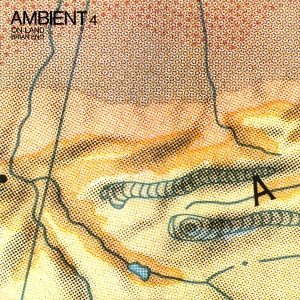
There's often precious little useful information on the internet about poets and artists who have involved themselves in landscape, but one thing the web is usually good for is popular music. Brian Eno, for instance, is unsurprisingly well served by various sites - most obviously Enoweb, which contains, for example, these comments from the sleeve notes to a reissue of On Land (1982).


Eno writes that "from Another Green World [1975] onwards I became interested in exaggerating and inventing rather than replicating spaces, experimenting in particular with various techniques of time distortion. This record represents one culmination of that development and in it the landscape has ceased to be a backdrop for something else to happen in front of; instead, everything that happens is a part of the landscape. There is no longer a sharp distinction between foreground and background.
In using the term landscape I am thinking of places, times, climates and the moods that they evoke. And of expanded moments of memory too... One of the inspirations for this record was Fellini's Amarcord (I Remember), a presumably unfaithful reconstruction of childhood moments. Watching that film, I imagined an aural counterpart to it, and that became one of the threads woven into the fabric of the music.
 
What qualified a piece for inclusion on the record was that it took me somewhere, but this might be somewhere that I'd never been before, or somewhere I'd only imagined going to. Lantern Marsh, for example, is a place only a few miles from where I grew up in East Anglia, but my experience of it derives not from having visited it (although I almost certainly did) but from having subsequently seen it on a map and imagining where and what it might be. We feel affinities not only with the past, but also with the futures that didn't materialize, and with the other variations of the present that we suspect run parallel to the one we have agreed to live in."

In a subsequent interview he explained the need to avoid New Age pastoral landscape music by providing a texture of more dissonant sounds. "Texture is information. Texture is only form looked at from a distance. If you look at this carpet, you perceive it as texture, but if you looked closer, you would see that it's actually a whole lot of forms. If you take birdsong -which is one of the aural textures of being in the country - the fact of it is that much of it is the sound of alarms and distress and attack.

"Landscape is a funny word for me, because it does conjure up pictures of nice little paintings with little paths going down them, but landscape really is and always has been a depiction of a psychological space, often of psychological cataclysm. it doesn't imply peacefulness, not to me.
"On the whole On Land is quite a disturbed landscape: some of the undertones deliberately threaten the overtones, so you get the pastoral prettiness on top, but underneath there's a dissonance that's like an impending earthquake."

As I write this entry I'm listening to a particularly effective track from the album, 'Unfamiliar Wind (Leeks Hills)'. According to the Wikipedia entry on the album, Eno explained that "Leeks Hills is a little wood (much smaller now than when I was young, and this not merely the effect of age and memory) which stands between Woodbridge and Melton. There isn't a whole lot left of it now, but it used to be quite extensive. To find it you travel down the main road connecting Woodbridge and it lies to your left as you go down the hill"

Sunday, June 17, 2007

Somewhere near Allonville

Spring in the Trenches, Ridge Wood, 1917 
Paul Nash, Spring in the Trenches, Ridge Wood, 1917

An interesting article in the LRB a few weeks ago by Brian Dillon included a quote from Paul Nash describing the strange beauty of no-man's land: 'The mud is dried to a pinky colour and and upon the parapet, and through sandbags even, the green grass pushes up and waves in the breeze, while clots of bright dandelions, clover, thistles and twenty other plants flourish luxuriantly, brilliant growths of bright green against the pink earth.' Dillon was reviewing Defiant Gardens: Making Gardens in Wartime, by Kenneth Helphand, which discusses the attempts of soldiers and prisoners to find ways of cultivating small patches of beauty, or catching a glimpse of a better world, like the 'pair of Australians lounging in a meadow picking wildflowers, somewhere near Allonville. The image is purest pastoral: an aesthetic that flourished in soldiers' presentations of themselves to the camera, or to their own journals.'

There is more on this book at the National Public Radio site, including a photograph of a Japanese stone garden made at the Manzanar Internment Camp in California.

 Photographs are now on Wikimedia Commons, this by Davefoc.

Towards the end of his life, during the Second World War, Paul Nash again saw flowers, this time in the air.  In his posthumously published essay Aerial Flowers he wrote

'When the war came, suddenly the sky was upon us all like a huge hawk, hovering, threatening. Everyone was searching the sky, expecting the terror to fall: I among them scanned the low clouds … hunting the sky for what I most dreaded in my imagining. It was a white flower. Ever since the Spanish Civil War the idea of the Rose of Death, the name the Spaniards gave to the parachute, had haunted my mind, so that when the war overtook us I strained my eyes always to see that dreadful miracle of the sky blossoming with these floating flowers.'

Paul Nash, Flight of the Magnolia, 1944
Source: Tate Gallery - public domain (image added 2017)

Sunday, June 10, 2007

Ocean Surface

Still thinking about John Cheever’s the Swimmer... if I were to curate an art exhibition on the theme of this story I would certainly want to include Ed Ruscha’s Nine Swimming Pools. I was looking at this last week in an exhibition at Tate St Ives inspired by Brian Wilson, where it is included along with Ruscha’s Thirty-Four Parking Lots (which I wrote about here). The exhibition has the poetic title If Everybody Had an Ocean, which is the first line of ‘Surfing USA’ (I now realise I always heard this as ‘everybody had a notion’ – which sounds pretty lame in comparison!) Of course Brian Wilson didn’t write the Beach Boys’ lyrics so the exhibition’s quotations from their songs are themselves the work of people inspired by Wilson’s music – Tony Asher, Van Dyke Parks etc. Anyway, it’s a nice exhibition which we saw on a beautiful sunny day when the sea was as blue as a Californian swimming pool.

One of the other artists featured in the exhibition is Vija Celmins, a favourite artist of Mrs Plinius, who enjoyed the exhibition of Celmins prints like Ocean Surface Wood Engraving (2000) at the Met a few years back. Celmins’ seascapes remind me of the Roni Horn river water images mentioned last week, as well as the seas photographed by Hiroshi Sugimoto (which I discussed briefly here). The PBS site explains that ‘Celmins received international attention early on for her renditions of natural scenes—often copied from photographs that lack a point of reference, horizon, or discernable depth of field. Armed with a nuanced palette of blacks and grays, Celmins renders these limitless space—seascapes, night skies, and the barren desert floor—with an uncanny accuracy, working for months on a single image.’ I was interested to read in the PBS interview how Celmins relates herself to Cézanne, whom she sees as having had ‘a really gutsy relationship between the image and the plain flat object. He has such a wonderful way of pointing that out to you in every stroke. And also the fact—which I think was a great part of the twentieth century—that this is an invented thing, you know? That it’s not like a copy of nature, or a copy of photograph. It’s an invented thing that you have in front of you, you know? So I think I kind of have that in me somewhere, this relationship.’

Saturday, June 02, 2007

Hot Pot at Strútur

The new issue of Tate etc. includes a piece by Roni Horn. Few artists write as well and I think we can assume she didn't come up with the silly title for the article! She discusses her footnoted photographs of the River Thames, which I've mentioned here before and which I think must be one of the best contemporary art works about London. She also talks about Iceland and relates her experiences to The Swimmer, played by Burt Lancaster in the film of John Cheever's story. On a simple level, the way the character experiences his environment is bound to be inspiring for landscape artists, and was the basis for the Roger Deakin book Waterlog. But Roni Horn also talks about the vulnerability of the swimmer and the way the Icelandic landscape offers a mixture of bleak emptiness and sheltering protection.

"I first went to Iceland in 1975. I travelled with a tent, hitchhiking and walking, then on a motorcycle, but still with a tent. So I was outside most of the time, and I often found myself heading for the hot springs. They became a kind of shelter. They took the form of hot pots or swimming pools. Sometimes they are located in remote places, so I found myself pool-hopping to these exquisite faraway places and spending a lot of time in the middle of nowhere, outside, in hot water. It struck me at the time as a great combination. When I look back, I am reminded of Burt Lancaster in the film called The Swimmer. He is divorced and having had the time of his life for years, he now wants to go home; he's alone. And so he is swimming home, pool-hopping home, and home is somewhere in suburban Connecticut. And you watch him going from one backyard to the next. He was in a swimsuit throughout the whole film and you felt his sensitivity to everything, and his vulnerability. So here I am, looking for shelter. and those pools were a great form of shelter. I was in these amazing settings, way out there in the thick of it, so to speak, alone but protected. Sometimes in the middle of a desert. For me, a desert is confrontational in a way, because it's so dogmatic. But here it was a totally sensual experience. And that happened a lot in Iceland, where you were in places that you would normally associate with difficult, aggressive things and they became alluring and attractive, comforting really."


The cover of the excellent Phaidon book on Roni Horn, showing the Hot Pot at Strútur (1991)

Sunday, May 27, 2007

Landscape near Felpham

I have already mentioned here the exhibition in Chichester, ‘Poets in the Landscape’, and I have now been to see it. It is like three little exhibitions in one.

The first room focuses on the local poet William Hayley (1745-1820) who was a friend of artists such as Blake, Romney and Joseph Wright of Derby. Hayley is not well known now and the catalogue quotes a letter from Southey to Coleridge in 1802 – ‘everything about that man is good, except his poetry.’ He does however provide an interesting figure from which to view the links between poetry and painting at the end of the eighteenth century. The highlight in this room is an unusual watercolour by Blake that I don’t recall seeing before (although it is in the Tate) – a pale, unfinished sketch with a hint of Turner about it: Landscape near Felpham (c1800).

The second room is a fascinating display of engravings and etchings, encompassing the familiar pastoral poetry of Blake, Palmer and the Ancients, and their followers in the 1920s: Goldsmiths students Graham Sutherland, Robin Tanner, Paul Drury, their teacher F.L. Griggs, and contemporary Joseph Webb. Sutherland saw his first Palmer etching when a fellow student bought one in a shop on the Charing Cross Road (those were the days!) He, Tanner and Drury made a pilgrimage to Shoreham and ‘even wore cloaks in imitation of the Ancients’.

The third room includes Neo-Romantic artists like Sutherland, John Piper and Paul Nash, with particular reference again to their links with poetry, through book illustration and work for Horizon, Penguin New Writing and Poetry London. There is Geoffrey Grigson’s The Poet’s Eye, for example, with illustrations by John Craxton: the first in a series of seven anthologies, New Excursions into English Poetry, whose general editors were Sheila Shannon and Walter James Turner. Other volumes included English, Scottish and Welsh Landscape, illustrated by Piper with verse chosen by John Betjeman and Geoffrey Taylor, and Sea Poems chosen by Myfanwy Piper and illustrated by Mona Moore. Walter James Turner was the general editor of Britain in Pictures, a series covering various aspects of Britishness, including Romanticism: John Piper’s British Romantic Art traced the tradition from Wilson, Blake and Constable through to Nash and Sutherland. Other volumes included Grigson’s English Landscape, Betjeman’s English Churches, Vita Sackville-West’s English Country houses, Lord David Cecil’s English Poets and Stephen Bone’s British Weather.

Saturday, May 26, 2007

Floating Island at Hawkshead

In 1188 Gerald of Wales and Archbishop Baldwin went on a preaching tour to gain support for the Third Crusade. Their travels were written up in Gerald's The Journey Through Wales, which includes a good example of pre-Romantic description of mountains. When Gerald reached Snowdonia his interest centred not on the snowy peaks and cataracts, but on their usefulness as extensive grazing-grounds (illustrated with a quotation from Virgil) and some of the marvels you could apparently see there:
  • A lake with a floating island, blown around by the winds
  • Another lake in which the eels, perch and trout all had only one eye
  • An eagle that waited to feed on men killed in battle, perched on a particular stone with a hole pierced through it where the eagle would clean and sharpens its beak.
Gerald repeats his facts about the lakes and the extensive pasture lands in a later work, The Description of Wales. Although there is no direct reaction to the mountain landscape in these books, the inclusion of these marvels gives a sense of how Snowdonia could still have been a source of some fascination even in the Middle Ages. And later on marvels like these might easily have inspired Romantic tales or poems. There is for example, a floating island in a poem by Dorothy Wordsworth. Here are some lines from 'Floating Island at Hawkshead: An Incident in the Schemes of Nature' (1820):
Once did I see a slip of earth
By throbbing waves long undermined,
Loosed from its hold--how no one knew,
But all might see it float, obedient to the wind;
Might see it from the verdant shore
Dissevered float upon the lake,
Float with its crest of trees adorned
On which the warbling birds their pastime take...

Sunday, May 20, 2007

Dover Beach

‘Dover Beach’ is one of the most famous poems in English, not for the landscape, ‘where the sea meets the moon-blanched land’, nor even the soundscape, ‘the grating roar / of pebbles which the waves draw back, and fling, / At their return, up the high strand...’, but for the metaphor prompted by the poet’s impression of the tide receding:

The Sea of Faith
Was once, too, at the full, and round earth's shore
Lay like the folds of a bright girdle furled.
But now I only hear
Its melancholy, long, withdrawing roar,
Retreating, to the breath
Of the night-wind, down the vast edges drear
And naked shingles of the world.

Matthew Arnold’s poem was the starting point for an interesting edition of In Our Time on ‘Victorian Pessimism’. (I have spent the last week doing little but listen to old programmes in this series following an eye injury on Tuesday – today I feel just about able to look at the screen again.) The In Our Time survey of pessimism in nineteenth century culture also included Thomas Hardy’s poem ‘In A Wood’ where landscape clearly lacks the redemptive qualities it had for the Romantics. ‘Dreaming that sylvan peace / Offered the harrowed ease— / Nature a soft release / From men’s unrest’, Hardy finds in the wood only ‘great growths and small... to men akin— / Combatants all!’

Sunday, May 13, 2007

Pale aspens grew, and yews ever dark

Talking of Polish literature, I recently read a translation of the Witold Gombrowitz novel Cosmos in which, among other things, a strange young man strangles the pet cat that belonged to a young woman he is obsessing about . Oddly enough, the next book I read was Knut Hamsun’s Mysteries in which another strange young man poisons the pet dog of the young woman he is obsessing about. Maybe it is not so unlikely a coincidence given that both novels belong to what James Wood, in an excellent article on Hamsun, describes as ‘the kind of Modernist novel which largely ended with Beckett - of crepuscular states, of alienation and leaping surrealism, and of savage fictionality’.

Drawing by Vladimiro Elvieri. 

In Cosmos the action shifts late in the book from a claustrophobic pension in southern Poland to the expansive landscape of the Tatra Mountains. After a journey by carriage the characters ‘turned a corner, and came to towering walls and pinnacles, contorted piles of rock and deep chasms...’ However, the book’s protagonist (a student described in the blurb as ‘seedy, pathetic and witty’) cannot help perceiving all this Sublimity in the same way he dissected the microscopic landscapes of the pension’s hot rooms and scruffy back yard. The mountains seemed ‘too much, too much, too much. Weight, mass, piles rising into the sky, piles collapsed, general chaos, huge, swelling mastodons that appeared and a moment later vanished in unruly confusion into a thousand details and then suddenly reassembled again into majestic edifices. It was just as in the thicket or looking at the wall or the ceiling or the rubbish where the pole was, or in Katasia’s room, or looking at the walls and cupboards and shelves and curtains where things also formed themselves into shapes and configurations. But there they had been only little things, here there was a mighty storm of matter...’ (trans. Eric Mosbacher).
 
The way the action moves outside whilst the characters maintain the strange obsessions of their indoor life reminded me of other Modernist works (of the kind described by James Wood in the quote above). For example, there is the strange landscape garden surrounding the house of Mr Knott in Samuel Beckett’s Watt. ‘In it pale aspens grew, and yews ever dark, with tropical luxuriance, and other trees, in lesser numbers. They rose from the wild pathless grass, so that we walked much in shade, heavy, trembling, fierce, tempestuous. In winter there were the thin shadows writhing, under our feet, in the wild withered grass...’ It is not exactly a pastoral idyll: ‘Birds of every kind abounded, and these it was our delight to pursue, with stones and clods of earth. Robins, in particular, thanks to their confidingness, we destroyed in great numbers.’ The garden is surrounded by barbed wire and ‘through this fence, where it was not overgrown by briars and giant nettles, similar gardens, similarly enclosed, each with its own pavilion, were on all sides distinctly seen.’

Then of course there is Franz Kafka, whose novel Amerika, if read after The Trial and The Castle, has the same kind of effect – liberated from the Kafkaesque city, the protagonist nevertheless wonders through a dreamlike landscape still characterised by the illogical traps and obstacles found in those other books. There is a similar sense of constrained freedom in Mervyn Peake’s Titus Alone, where we at last encounter the landscape beyond Gormenghast castle. And one can go on to imagine other places transfigured in this way - say, a sequel to Robert Walser’s Jacob von Gunten set in the mountains of Austria, or a follow-up to Pinter’s The Birthday Party where all that menacing weirdness is somehow transferred outside the boarding house to the beach or the sea...

Friday, May 11, 2007

View of Kósciuszko Mound, Krakow

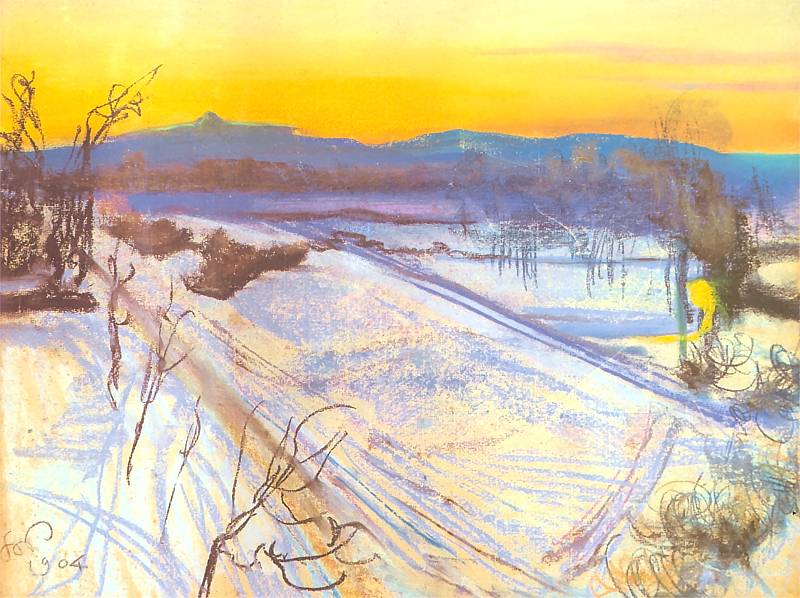
Looking through the Polish landscape paintings in Warsaw’s Muzeum Narodowe there are examples of topography, Claudian idyll, the sublime (a dramatic Mountain Landscape with Waterfall (c1820) by Franciszek Ksawery Lampi), Impressionism, Symbolism... It’s difficult to get very excited about some of these and perhaps a Polish visitor to Britain would feel the same about paintings by, say, Richard Wilson. There seems to be more scope for unfamiliar artists to leave a distinct impression when you reach the late nineteenth century, even when they’re relatively derivative, e.g. Józef Pankiewicz’s striking Whistler-style Nocturne – Swans in the Saski Garden in Warsaw at Night, 1894. I am thinking here in particular of the pastel landscapes drawn by Stanislaw Wyspianski (1869-1907), like his View of Kósciuszko Mound, Krakow (1905). These have a certain calm harmony but at the same time a creeping sense of unease in the slightly discordant colours and shadowy, skeletal trees; you have a sense of someone trapped in their studio and looking out with a sense of quiet desperation. 
 
Stanislaw Wyspianski is actually much better known as a writer and ‘founder of modern Polish drama’, so has much in common with that other painter of strange landscapes, August Strindberg. The excellent Adam Mickiewicz Institute which I visited in Warsaw has an article about him. (Incidentally, among the fascinating artefacts on display at the Institute was a volume of Byron poems given with a dedication by Mickiewicz to his friend Pushkin – ah, heady times...) There is a Wyspianski museum in Krakow and an image of one of the pastel landscape views at a Katowice museum site.

 Stanislaw Wyspianski, View of Kósciuszko Mound, Krakow (1905)
Source: Wikimedia Commons


Postscript, July 2023

We have just been to Krakow and from its royal castle, the Wawel, were able to look over the river and beyond the city centre to the distant Kósciuszko Mound (see first photograph below). Intrigued to see it up close, we took a tram and climbed a hill until we emerged at what appeared to be a nineteenth century brick fortress. Rising above its walls was the mound itself, a monument to Polish national leader Tadeusz Kościuszko. With its artificial shape and winding path it looks like a work of land art or something Charles Jencks might have considered for his Garden of Cosmic Speculation. As you can see below, the Ukrainian flag, yellow and blue like Wyspianski's drawing, was flying alongside two Polish ones.

Wednesday, May 09, 2007

Scenes from the Life of Christ and the Virgin

Warsaw’s National Museum (Muzeum Narodowe) has an impressive collection of ‘medieval’ art, most notably some dramatic and occasionally gruesome wooden sculptures, my favourites being a set of scenes from the Childhood of the Virgin (early C16) full of expressive faces and a joyful Coronation of the Virgin (c1370), both from Silesia. Among the paintings there is polyptych from Legnica by Nikolaj Obilman (1466) showing Scenes from the Life of Christ and the Virgin in which landscape elements are prominent. 

 Who was Obilman? He was active in Wroclaw - beyond that I know nothing. A bit of googling fails to yield anything about him and sadly no image of the polyptych I can link to. Nobody online seems too bothered about 15th century Silesian artists... well, here’s my little contribution for what it’s worth. When I encountered the Obilman polyptych, I immediately thought ‘landscape’ because the dominant colour was green. But the fields on which the action takes place are no more than a vivid ground to set off the figures. There are strange little rocks and cloud-shaped bushes spaced over the grass like a rather unimaginative piece of wallpaper. The compositions are tapestry-like and the fields have a very artificial feel to them.  

Does this mean the landscapes are unimportant - green space left by an artist without the resources to provide a more interesting or realistic foreground? Or are they a decorative device to attract the eye without distracting it from the stories of Christ and the Virgin? All I can say now is that they made an impression on me, although without a reproduction available I am already struggling to remember exactly what the paintings looked like.

Postscript 2017

Wikimedia Commons now does have images available and I have included one below.  There is also a short article about Obilman on the Polish version of Wikipedia explaining that he lived in Wroclaw.  Indeed the Silesian Museum of Fine Arts in WrocÅ‚aw owned these pictures from 1925 until the end of the war, when they moved to Warsaw.

Nikolaus Obilman, Christ in the Garden, 1466

Monday, May 07, 2007

View of Warsaw from Praga

Bernardo Bellotto left Italy for Dresden in 1747. His uncle Canaletto, whose pupil he had been and whose name he often used, had departed a year earlier, for England. After twenty years painting landscapes in German cities, Bellotto set off for Russia but never arrived, stopping in Warsaw where he worked for King Stanislas Poniatowski and remaining there until his death in 1780. His views of the city can be seen in the recently restored Bellotto room of the Royal Palace, where I happened to be this time yesterday. Like everyone else, I was struck by the precision of detail in these paintings, which was very useful in the reconstruction of Warsaw’s old town after the Second World War. The clarity in which distant houses and figures are delineated does not seem to diminish the overall impression of a harmoniously composed view. As you stand there, your eyes can zoom in and out as they would in looking at the actual city. Works like the View of Warsaw form Praga below are an eloquent argument for the art of topographical landscape painting, famously disparaged by Fuseli as merely the ‘tame delineation of a given spot’.

 
Bernardo Bellotto, View of Warsaw from Praga, 1770

Monday, April 30, 2007

Rain drops on maple leaves


The Sarashina Nikki was translated in 1971 by Ivan Lewis with the evocative title As I Crossed A Bridge of Dreams. Its author’s name, like those of other women writers of the Heian dynasty, is unknown, but he calls her Lady Sarashina (in Japan she is often called Takasue no Musume). Her short book, composed in about 1060, begins with an account of the journey she made with her family as a twelve-year old from Kazusa to Kyoto. Although her descriptions are brief, it still conveys, as Lewis says, ‘a vivid picture of how the Japanese countryside appeared to an observant young girl at the time of King Canute.’ For example: ‘we reached Kiyomi Barrier by the sea. On the beach were some huts belonging to the barrier keepers, and the palisades went all the way to the water. The spray from the huge waves mingled beautifully with the smoke from the keepers’ huts.’

The Nikki format is highly selective and Lady Sarashina chooses to record beautiful or poignant moments in a landscape rather than dwell on domestic detail or the rituals of court and religion. The way she remembers various pilgrimages makes them seem a form of nature worship rather than Buddhist retreats. Her trip to Kurama for example (section 21 in the Lewis translation) begins with recollection of an earlier spring visit when mists veiled the mountainside. Returning in the autumn she admires the crystal streams and the mountain slopes coloured like rich brocade. And when she reaches the presbytery she is overcome by the beauty of rain drops on maple leaves.

Friday, April 27, 2007

Piazza San Marco, Venice

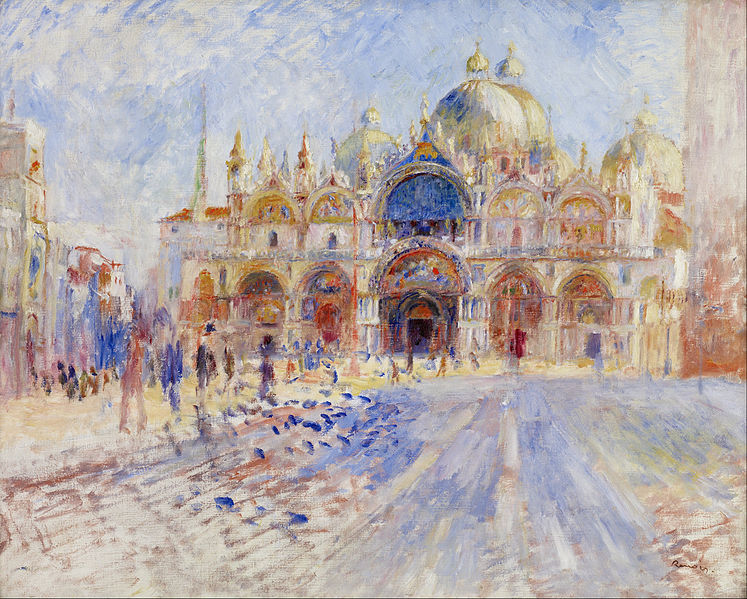
Pierre Auguste Renoir, The Piazza San Marco, Venice, 1881

Some artists seem hard to like initially, but you grow to appreciate them over time: Rubens for example. With others, the praise given them always remains mystifying. For me, Renoir remains the one Impressionist that I’ve never been able to fathom. The best I think I can say for him is that the scenes in his paintings can evoke a sense of their time and that the brushwork can give a pleasing sense of wind blurring the foliage and light shimmering over people’s clothes. I was therefore only mildly intrigued by the idea of the National Gallery’s Renoir Landscapes exhibition, and not sufficiently interested to want to pay to see it (especially at the unbelievable price of £12). Fortunately I have the chance of getting in free, but I’m still hesitating. Might the exhibition be so poor that the opportunity cost of attending is too high, even though the actual cost is nothing? The reviews are not exactly encouraging...

Brian Sewell (whose views I do not normally agree with) is pretty persuasive in his review, which includes some marvelous invective that I can’t resist quoting: ‘In restricting the exhibition to landscapes, these directors and their appointed curators have dealt Renoir an almost mortal blow. Most of these landscapes are appalling... Smudge, smear and ineptitude is the best that can be said of them; greasy too, and occasionally dollopy, for Renoir's handling of paint in these landscapes is often physically repellent. The kindest thing that the curators could have done for his reputation would have been to abort the exhibition when they realised how dire and dreadful it would be; that they did not, suggests that such a realisation dawned on not one of them, nor on their associated essayists, nor on their directors, none of whom, it seems, has the slightest eye for quality. Had LS Lowry set out to forge a late Utrillo, he could not have matched the sheer nastiness of Renoir's Piazza San Marco, Venice, of 1881...’ And so it goes on!

Tuesday, April 24, 2007

The Road from Orizaba to Acultzingo

New Directions have published a translation of César Aira’s novella, An Episode in the Life of a Landscape Painter, first published in 2000 in Argentina by Beatriz Viterbo Editora (a small press named after the Borges character). There is a preface by Roberto Bolaño which makes Aira sound really interesting – he has written a novel about the cloning of Carlos Fuentes and a great short story called ‘Cecil Taylor’ (whether it is about Cecil Taylor I have no idea). Bolaño says that Aira’s writings can be compared to Macedonio Fernandez (1874-1952 – the mentor of Borges) and, more recently, Enrique Vila-Matas (author of ‘Bartlby & Co.’), neither of whom I’ve read.

The book describes the travels of German painter Johann Moritz Rugendas (1802-58) and centres on the moment in 1837 when he suffers a disfiguring accident while sketching in Argentina. I know little about Rugendas and therefore spent most of the book wondering where the line between fact and fiction had been drawn, a question that might be applied to the paintings of Rugendas. According to Aira, Rugendas was influenced by the theories of Alexander von Humboldt, in particular the aim of depicting nature in its ‘physiognomic totality’ (which I suppose is ironic in view of the fracturing of the artist’s own physiognomy). Humboldt believed that artists like Rugendas could uncover the unity of a landscape. Furthermore, as Aira says, the Humboldtian naturalist was ‘not a botanist but a landscape artist sensitive to the processes of growth operative in all forms of life.’

An Episode in the Life of a Landscape Painter
is interesting but left me feeling slightly unsatisfied, perhaps because of its brevity and the way even the two central characters remained somewhat sketchy. There are some full reviews on-line, e.g. here, here and here. The paperback has as its cover both the original drawing and the oil painting of The Road from Orizaba to Acultzingo (1831). Here is one of the Rugendas images freely available on-line, a landscape in Chile.


Johann Moritz Rugendas, Two Riders Resting
Source: Wikimedia Commons

Friday, April 13, 2007

The Bridge at Maincy

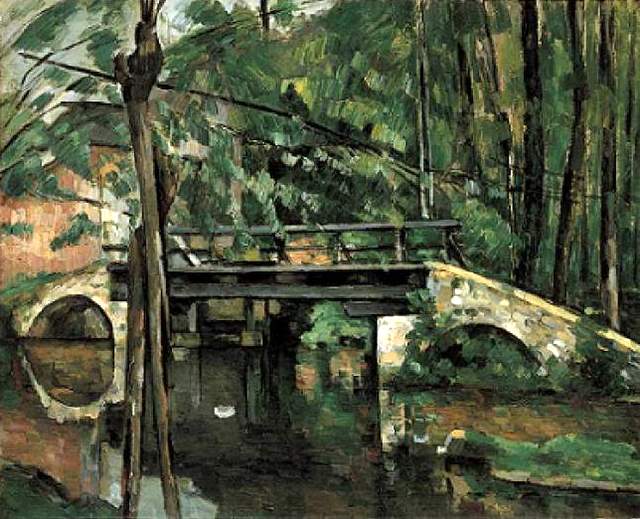
Cézanne famously aimed to ‘re-do Poussin over again according to nature’. Comparing the two painters, Richard Verdi has written that Poussin’s classicism ‘evolved in the studio, through the joint efforts of the intellect and imagination, Cézanne’s had to be won directly from nature. In this respect it was a kind of instinctive – or ‘spontaneous’ – classicism, one which was found rather than made.’ In The Bridge at Maincy (1879) for example, the vividness of the foliage is matched by the solid structure of bridge and trees.

Paul Cézanne, The Bridge at Maincy, 1879
Source: Wikimedia Commons

Last week I was in Hampstead and thought I would take a look at the Vale of Health, a poetically named cluster of houses on the Heath where various famous writers have lived, including Tagore and D. H. Lawrence. It was a quiet morning and I felt a bit like a trespasser – it was a almost a relief to turn off the road and wonder down to a bench looking out over the pond which some of the houses back onto. The trees framed the lake in angles that reminded me of the triangular compositions of landscape painters like Cézanne. I found myself thinking that what often seems to be order imposed by an artist may simply be the natural angles assumed by trees growing from the same slopes and subject to the same winds. Then again maybe I was just instinctively classicising. After all, someone probably chose to position that bench in such a way that the diagonals of the birch trunks would strike the viewer just so...

Monday, April 09, 2007

Dreamer in a Landscape

Malcolm Yorke’s The Spirit of Place: Nine Neo-Romantic Artists and Their Times (1988) discusses the art of Paul Nash, John Piper, Graham Sutherland, John Minton, Michael Ayrton, Robert Colquhoun, Keith Vaughan, Prunella Clough and John Craxton. He begins the book by discussing the label Neo-Romantic, which was already being used in the 1940s, e.g. by Raymond Mortimer (for whom it covered Piper, Sutherland, Henry Moore, Frances Hodgkins and Ivon Hitchens). Yorke writes that a 1983 exhibition, ‘The British Neo-Romantics 1935-1950’, attempted to include Bacon and Freud, both of whom refused to be included. He questions this exhibition’s inclusion of Hitchens, who did paint the English landscape but in a style far removed from the influence of original Romantics like Palmer, and of David Jones, who could be seen as too idiosyncratic to be part of a movement. A later Barbican Art Gallery exhibition, ’A Paradise Lost: The Neo-Romantic Imagination in Britain 1935-1955’, included various minor figures and two more artists that Yorke considers too individual to be part of a movement: Cecil Collins and Ceri Richards (the latter’s ‘explorations of the sexualisation of landscape were rightly given prominence’).

All this goes to show that beyond Piper and Sutherland there is no real consensus as to who was a ‘Neo-Romantic’. Which is why I suppose it is not surprising to find the on-line Encyclopedia of British Neo-Romanticism has such a wide coverage... Although you have to wonder about a site that manages to include under this term Genesis P. Orridge, Vivienne Westwood, J.R.R. Tolkein and Peter Ackroyd. Strange bedfellows!

The Tate site has a definition that is close to Malcolm Yorke’s conception of Neo-Romanticism. They illustrate this with John Craxton’s Dreamer in a Landscape (1942), noting his explanation for including shepherds or poets: 'as projections of myself they derived from Blake and Palmer. They were my means of escape and a sort of self protection. A shepherd is a lone figure, and so is a poet'. This notion of self-protection recalls the point made by Andrew Motion, that English poetic landscapes have a ‘defended’ feel to them.

Saturday, April 07, 2007

Visions of little dells

In The Guardian today Andrew Motion writes about the exhibition ‘Poets in the Landscape: The Romantic Spirit in British Art’, at Pallant House Gallery, Chichester. In discussing William Blake’s illustrations to Virgil’s Eclogues, he cites a beautiful description by Samuel Palmer, who saw the woodcuts as "visions of little dells, and nooks, and corners of Paradise; models of the exquisitest pitch of intense poetry. I thought of their light and shade, and looking upon them I find no word to describe it. Intense depth, solemnity, and vivid brilliancy only coldly and partially describes them. There is in all such a mystic and dreamy glimmer as penetrates and kindles the innermost soul, and gives a complete and unreserved delight, unlike the gaudy daylight of this world."

However, Andrew Motion wants to emphasise the darkness lurking in these pastoral visions, many of which were made in time of war and political uncertainty. They are ‘not so much escapist as defended’, a ‘form of opposition to the threats that circle them’. He cites, for example, John Piper’s set designs for the ballet Job (1948), which on the surface seem to be simple pastoral landscapes, but in which he sees ‘an optimism that is too determined to be entirely convincing.’ These set designs are, incidentally, a nice example of the interconnectedness of the English Romantic landscape traditions. The ballet is based on Blake’s illustrations to the Book of Job and composed by Ralph Vaughan Williams, following a proposal by Geoffrey Keynes (essayist and brother of the economist) and wood engraver Gwen Raverat (who was related to both Keynes and Vaughan Williams, and whose prints, including various landscapes, can be seen on-line here).

Tuesday, April 03, 2007

The Cliffs at Étretat

The Royal Academy’s exhibition, ‘The Unknown Monet’, generally avoids oil paintings and focuses on pastels and drawings, which form a small but interesting part of the artist’s oeuvre. The drawings are not particularly striking but there are several pastel landscapes which are worth seeing, with similar qualities to Monet’s Impressionist paintings. For example, Waterloo Bridge, Fog (1901) which is barely more than a haze of grey and turquoise, executed in pastels, is as atmospheric as the unfinished painting Charing Cross Bridge (c1900), with its curls of pink smoke that unfurl like flowers, pointing forwards to Monet’s pastel-like water lily paintings, two of which are positioned opposite it in the exhibition.
  
In 1885 Monet drew several pastel landscapes of the rocks at Etretat which have a Symbolist feel to them, enhanced by the medium and choice of colours: dove grey and fading purple. Evening light softens the rock formations and illuminates the sea. The exhibition describes Etretat, the Needle Rock and Parte d’Aval as reflecting ‘his introspective mood. This unique vertical scene framed by shadows and cloud, with the famous ‘needle’ and rock arch beyond, is sombre and slips into reverie.’ Although some of the well-known oil paintings made at Etretat resemble these pastels, others, like The Cliffs at Etretat (below) are quite different, full of the sparkling light of Impressionism.

Claude Monet, The Cliffs at Etretat, 1885
Source: Wikimedia Commons

Incidentally, Etretat is one of those landscapes that have been seen as a challenge to artists. The Royal Academy site notes that: ‘Etretat had already been painted by both Delacroix and Courbet; Monet in fact owned a Delacroix watercolour of the area. The Courbet retrospective at the Ecole des Beaux-Arts in 1882 featured a group of Etretat seascapes. Monet visited Etretat in 1883 with plans to create his own Normandy seascapes: “I reckon on doing a big canvas on the cliff of Etretat, although it’s terribly audacious of me to do that after Courbet who did it so well, but I’ll try to do it differently.”’

Monday, April 02, 2007

On Quantock’s grassy Hills

The latest The New York Review has an article on the friendship between Coleridge and Wordsworth. You might think this would be a worthy but dull read on a pretty well-worn topic, but here’s how it starts: ‘Coleridge once said that people should take time to lean on gates. There is a wooden gate above a field in Dorset which is well worth leaning on...’ Ah... unmistakably Richard Holmes, who has never written a dull essay.

The gate in Dorset was the one Coleridge vaulted in his enthusiasm to see the Wordsworths. ‘Coleridge’s impetuous arrival that afternoon – exuberant, bounding, breaking the barriers, “leaping through the corn”’ presaged a three week period in which their friendship was formed, and eighteen months of discussion and composition that culminated in the lyrical ballads. It was a time recalled by Wordsworth in The Prelude: ‘that summer, when on Quantock’s grassy Hills / Far ranging, and among the sylvan Coombs, / Thou in delicious words, with happy heart, / Didst speak the Vision of that Ancient Man, the bright-eyed Mariner...’ (The equivalent lines from the 1850 Prelude are reprinted, with photographs of the Quantocks, on the appropriately named Friends of Coleridge site).

(Incidentally, I’m typing this in Word and its grammar checker has just said to me “Fragment – consider revising”, which made me smile: Holmes says that Coleridge’s ‘idea of the creative fragment became one of his greatest contributions to the aesthetics of Romanticism.’)

Holmes speculates on the nature of literary partnerships and suggests an interesting twentieth century parallel: Ted Hughes = Wordsworth, Sylvia Plath = Coleridge. He also reproduces an Irish joke noted by Coleridge in 1833 and recently published in the Coleridge Bulletin (Winter 2006). It could be seen as a surreal allegory of the friendship between the two famous poets:
Dan Hennesay’s story – passing over Black Friar’s whom should I see (coming from t’other end of the Bridge) but my old Chum, Pat Mahoney – and at the same moment he saw me – We ran towards each, & when we met, just in the middle of the Bridge – by Jasus! – it was neither of us.

Sunday, April 01, 2007

Hare, Blood and Snow

Some recent newspapers have had big features on Andy Goldsworthy, coinciding with his new retrospective at Yorkshire Sculpture Park. They seem to be very positive reviews and often make an effort to convince the wary reader by addressing the potentially embarrassing fact that Goldsworthy is extremely popular and makes work with appeal to children (like the daughter of The Observer’s Tim Adams) and those with no knowledge of contemporary art. This quote from Sue Hubbard’s review in the New Statesman is interesting in this respect, implying that the ‘art establishment’ are missing the environmental importance of Goldsworthy’s brand of landscape art:
‘For some years now British landscape artists such as Goldsworthy, David Nash and Richard Long have been looked down upon by many in the art establishment. They have been regarded, despite their wide appeal and international success, as latter-day 1960s renegades, too metaphysical, too intense, too lyrical and unapologetically moral. This is an age that is more comfortable with cynicism than with the stench of dung and death. Yet never has there been a time when these artists' work was more resonant, as the planet warms and old landscapes are destroyed.’
Reviewers often try to convince us of the authenticity of Goldsworthy’s installations and sculptures, contrasting their simple beauty with the cynicism and shock value of some contemporary art. A good way of doing this is to contrast Goldsworthy’s life in the landscape with the contemporary cliché of the trendy East London artist, e.g. Channel 4 News: ‘Not for him the chic but shabby studio in one of London's most fashionable artists' quarters. Andy Goldsworthy creates his work in the open air...’ Tim Adams says ‘it is as impossible to imagine Goldsworthy living in Hoxton as it is Gilbert and George in the Dales. He is a man of nature, and part of him wants to remind us, somewhere deep down, that we all are.’

I probably won’t get to go to this retrospective but I would be interested to see the new works that incorporate blood and human hair, which seem less reminiscent of the beautiful ephemeral images in his ‘coffee table books’ and closer to post pastoral art that acknowledges and incorporates the real violence in nature. For example, there is Hare, Blood and Snow, made from a dead hare by mixing its blood with snow and putting this into ‘the hare's stomach, hanging the animal up so that the melting liquid dripped from its mouth and nostrils on to sheets of paper’. Sue Hubbard thinks these works relate to ‘the cycles of death, putrefaction and renewal, with an uncompromisingly elemental beauty. Goldsworthy is to environmental art what Ted Hughes was to poetry.’