Showing posts with label John Martin. Show all posts

Sunday, April 21, 2024

The Fountain of Arethusa

 There is sweet music in that pine tree's whisper...

- Theocritus, Idyll 1, trans. Anthony Verity

Last week I was in Syracuse, the home of Theocritus and, by extension, pastoral poetry. The first of his Idylls begins with two comparisons of nature and music. The words above are spoken in the poem's opening line by Thyrsis, praising the music of a goatherd's pan pipes. The goatherd replies 'shepherd, your song sounds sweeter than the water tumbling / over there from the high rock.' Thyrsis is persuaded to sing The Sufferings of Daphnis, the lament of a dying Sicilian cowherd (the reasons for his death are left mysterious). I have described here before Virgil's references to Daphnis in his Eclogues, and also the ancient novel Daphnis and Chloe, although in that story Daphnis tends goats on Lesbos. Re-reading Theocritus after visiting Sicily reminded me that many of his poems are set in the wider Greek world, although Idyll 16, is addressed to the tyrant of Syracuse, Hieron II. Both Idyll 16 and Idyll 1 refer to Arethusa, a spring that you can still visit on the island of Ortygia (the old centre of Syracuse). It is just be the sea and walled in to create a pond inhabited by fish and ducks.  


In Greek mythology, Arethusa was a nymph who fled from her home in Arcadia, emerging eventually as a fresh water fountain on Ortygia. The predatory male in this story was Alpheus, a river god, who pursued her until she prayed to be transformed into a cloud. But Alpheus wouldn't let up and, perspiring with fear, she turned into a stream and flowed through the sea until she reached safety in Syracuse. Ovid called her Alpheius - the name of a Greek river (it is said that a wooden cup thrown into the Alfeiós will eventually turn up in the Spring of Arethusa). Virgil alludes to this story when Aeneas reaches Sicily: 'an island lies over against wave-washed Plemyrium, / stretched across a Sicilian bay: named Ortygia by men of old. / The story goes that Alpheus, a river of Elis, forced /a hidden path here under the sea, and merges / with the Sicilian waters of your fountain Arethusa.' Virgil addresses his tenth Eclogue to Arethusa and refers to the story of Daphnis told by Theocritus, relocating the setting from Sicily to (an imaginary) Arcadia.


John Martin, Alpheus and Arethusa, 1832


Unsurprisingly Arethusa gets frequently mentioned in later pastoral poetry, right up to Wordsworth, who wonders in The Prelude whether 'that fountain be in truth no more'. Milton had referred to it in his elegy Lycidas, along with Mincius, a river in Italy that features in Virgil's Eclogue 7. 'O fountain Arethuse, and thou honour'd flood, / Smooth-sliding Mincius, crown'd with vocal reeds, / That strain I heard was of a higher mood.' But Samuel Johnson was not impressed with poetry of this kind. 'It is not to be considered as the effusion of real passion; for passion runs not after remote allusions and obscure opinions. Passion plucks no berries from the myrtle and ivy, nor calls upon Arethuse and Mincius, nor tells of rough satyrs and fauns with cloven heel. Where there is leisure for fiction there is little grief.'

Thursday, December 28, 2017

Primeval world

 
Josef Kuwasseg, The Period of the Muschelkalk, c. 1850

This remarkable vision of a prehistoric shoreline was painted by an Austrian landscape painter, Josef Kuwasseg (1799-1859).  The paleobotonist Franz Xaver Unger who commissioned a series of lithographs from him said that such paintings had "that mysterious charm which belongs to the contemplation of the distant past, and to the memory of our dreams."  This painting is reproduced in a sumptuously illustrated (and pricey) new book that I was given for Christmas, Paleoart: Visions of the Prehistoric Past.  It traces the ways artists have portrayed scenes from the distant past over the last two centuries, incorporating stylistic elements from Romanticism, Impressionism, Fauvism and Art Nouveau.  The author, New York art critic Zoë Lescaze, also reads into these old pictures of dinosaurs, flying reptiles and neanderthals the politics of paleontology (ongoing battles between rival scientists) and our wider anxieties about war and apocalypse. 

Josef Kuwasseg, Primeval world, c. 1850

I have referred briefly here before to paleoart, in describing an exhibition of John Martin's paintings at Tate Britain.  Martin imagined plesiosaurs attacking an ichthyosaur as if they were engaged in fierce naval combat.  But, 'if Martin's vision of prehistory is a nightmare, Kuwasseg's is a subtle and mysterious dream.  Water appears in every painting, not as a seething arena for reptilian combat, but in flowing rivers, mangrove deltas, jungle waterfalls, and luminous green lagoons.'  It is easy enough to find examples of Joseph Kuwasseg's 'real' landscape painting online, like the one I have included below, a view of the Leopoldsteinersee, a mountain lake in Styria.  Zoë Lescaze writes that in his more conventional landscape art,
'Kuwasseg frequently includes illuminated corridors - rivers, paths, or gaps in the trees - framed by darker houses, rocks, or foliage.  He incorporates these same visual tunnels in his prehistoric vistas, leading the viewers into carboniferous swamps as though they were inviting stretches of the Austrian countryside.'

Josef Kuwasseg, Leopoldsteinersee, no date
Source: Wikimedia Commons

Another landscape painter featured in Paleoart is Heinrich Harder (1858-1935), who designed the remarkable mosaics for the aquarium at Berlin Zoo which were destroyed by Allied bombing in 1943 and then painstakingly restored in 1982.  Examples of his paintings of the German countryside on various auction websites give no indication of the Jugendstil influence in his mosaic designs, with their Hokusai waves and Hodler skies.  The painting of sea lilies below is from a set of collectible cards, 'Animals of the Prehistoric World' (it is atypical as most show examples of megafauna wandering through ancient landscapes).  Several paleoartists have worked on such cards - Harder's were made for a chocolate manufacturer.  When I was growing up we used to get PG Tips tea for the cards, so one of the sources of my own knowledge on dinosaurs was their series Prehistoric Animals (1972). 

Heinrich Harder, Sea Lilies, c. 1920
Source: Wikimedia Commons

Recalling now my childhood fascination with dinosaurs, I would say it was stimulated by a range of sources, from films like The Land That Time Forgot to trips to see the skeletons at the Natural History Museum and Benjamin Waterhouse Hawkins' wonderful old sculptures in Crystal Palace Park (see below).  When it came to paleoart though, my main inspiration was Dinosaurs and Other Prehistoric Reptiles (1960), illustrated by Rudolph Zallinger, an artist best known for The Age of Reptiles, a fresco for the Peabody Museum's Great Hall.  There are scanned images from this book at the blog Love in the Time of Chasmosaurs (I try not to include in copyright stuff here).  By the 1960s Zallinger was working on a new fresco for the Peabody, completed the year I was born, called The Age of the Mammals.  'In this sixty-foot mural,' Zoë Lescaze writes, 'the pumpkin-orange earth crackles against a brilliant blue sky. Trees run the autumnal gamut with red, green and golden foliage.  The animals, pounce, stalk, scavenge, forage, and flee.'
 
Benjamin Waterhouse Hawkins, Iguanadons at Crystal Palace, 1854
My own photograph from a visit in 2008

Friday, September 01, 2017

Crags, upon whose extreme edge I stand...

And thou fresh breaking Day, and you, ye Mountains,
Why are ye beautiful? I cannot love ye.
And thou, the bright eye of the universe,
That openest over all, and unto all
Art a delight—thou shin’st not on my heart.
And you, ye crags, upon whose extreme edge
I stand, and on the torrent’s brink beneath
Behold the tall pines dwindled as to shrubs
In dizziness of distance; when a leap,
A stir, a motion, even a breath, would bring
My breast upon its rocky bosom’s bed
To rest for ever—wherefore do I pause?

Lord Byron's poetic drama, Manfred, begun in 1816 when he was living in Switzerland, was published two hundred years ago.  Although its hero resembles Faust, the poem was, Byron claimed, more influenced by his impressions of the mountain landscape than his reading of Goethe.  There are no lengthy descriptions of scenery in Byron's poem, just enough to convey a sense of the high peaks where it is set (the quotation above is from Act 1 Scene 2: 'The Mountain of the Jungfrau.—Time, Morning. MANFRED alone upon the Cliffs.')  Instead, it is the entire poem that has the sublimity of the Alps, its themes of loss and despair echoing the spectacular but lonely isolation experienced on their heights.  Reading Manfred reminded me that works of art infused with a spirit of place are far more numerous than the ones I tend to restrict myself to here, that describe the actual appearance of a landscape.

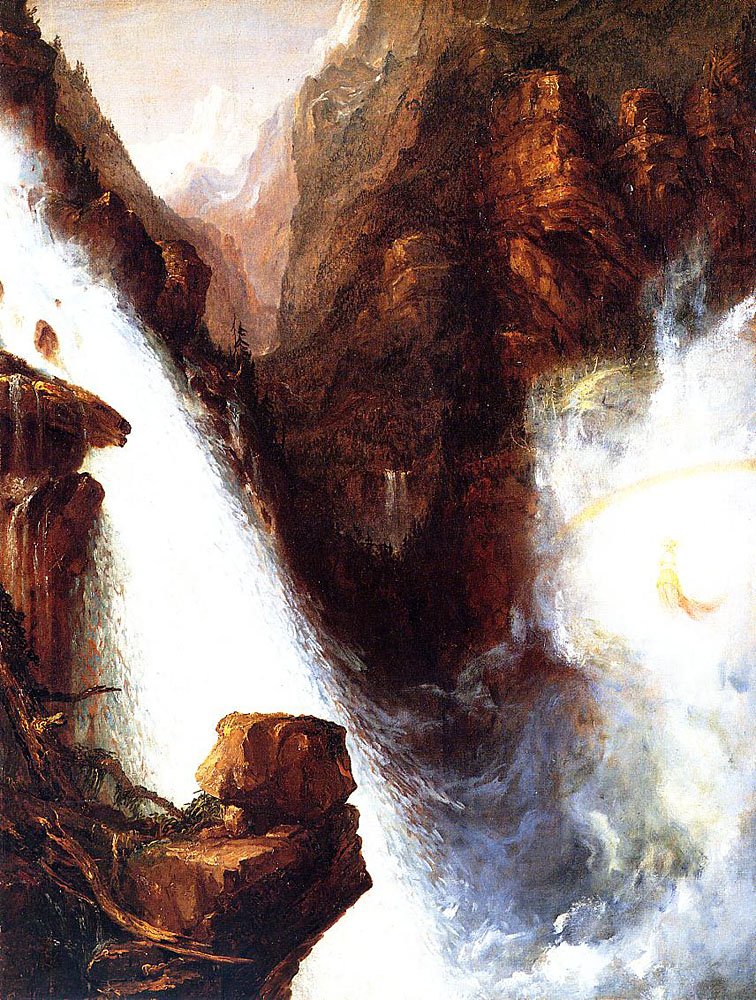
Thomas Cole, Scene from 'Manfred', 1833
Source: Wikimedia Commons
 
There is one reference in Manfred to a natural phenomenon that is based on what Byron saw on 22 September, 1816.   He and his travelling companion John Cam Hobhouse were in the Lauterbrunnen Valley, looking up at the The Staubbach Fall.  Byron wrote in his journal that the torrent reminded him of the tail of a pale horse, such as Death might ride at the Apocalypse.  The next day they returned and Byron noted 'the Sun upon it forming a rainbow of the lower part of all colours – but principally purple and gold – the bow moving as you move – I never saw anything like this – it is only in the Sunshine.'  These impressions were used to set the scene for Act 2 Scene 2, with Byron also including a footnote on the rainbow.
It is not noon; the sunbow’s rays1 still arch
The torrent with the many hues of heaven,
And roll the sheeted silver’s waving column
O’er the crag’s headlong perpendicular,
And fling its lines of foaming light along,
And to and fro, like the pale courser’s tail
The Giant steed, to be bestrode by Death,
As told in the Apocalypse.
1This Iris is formed by the rays of the Sun over the lower part of the Alpine torrents. It is exactly like a rainbow come down to pay a visit, and so close that you may walk into it. This effect lasts till Noon.

A rainbow in the Trümmelbach Falls
Photographed by me, August 2017

We were in the Bernese Oberland ourselves last month and observed one of these rainbows in a waterfall near the one Byron visited.  We also ascended to the top of the Schilthorn, to look as he and Hobhouse had, across to the summit of the Jungfrau.  Byron saw clouds gathering on one side - 'curling up perpendicular precipices – like the foam of the Ocean of Hell during a Springtide – it was white & sulphery – and immeasurably deep in appearance.'  We picked a beautiful clear day, so clear that we could see Mont Blanc.  The downside of this was that the summit was pretty crowded with other tourists.  Even Byron could not enjoy the sight of the Jungfrau in solitude.  'Lying down for a few minutes to contemplate these wonders, Hobhouse and Byron were irritated by the sudden appearance of two or three female tourists on horseback when they had imagined they had the mountain to themselves' (Fiona MacCarthy, Byron: Life and Legend).

The Eiger, Mönch and Jungfrau
Photographed by me, August 2017

Byron's hero has to get away from other people: 'my nature was averse from life; / And yet not cruel; for I would not make,  / But find a desolation.'  Manfred thinks he is alone on the summit of the Jungfrau, but he too is disturbed - by the unexpected appearance of a passing chamois hunter.  Death may be Manfred's inevitable fate at the end of the poem, but now, in its opening scene, this hunter prevents him from jumping into the void and leads him back down to safety:
The clouds grow thicker—there—now lean on me—
Place your foot here—here, take this staff, and cling
A moment to that shrub—now give me your hand,
And hold fast by my girdle—softly—well—
The Chalet will be gain’d within an hour.

John Martin, Manfred on the Jungfrau, 1837
Source: Wikimedia Commons

Saturday, January 07, 2012

Apocalypse

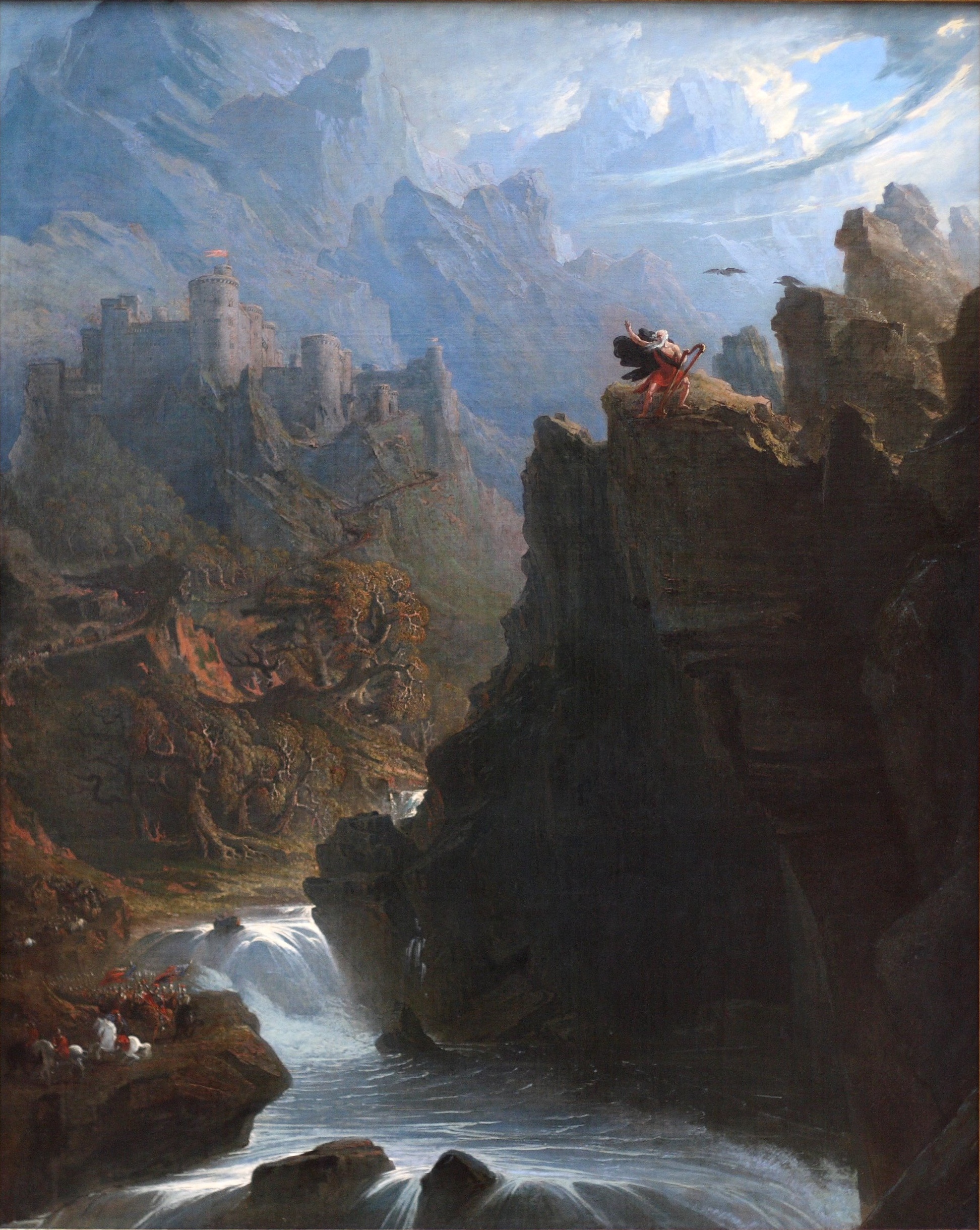
John Martin, The Bard, c1817

As the Tate Britain exhibition John Martin: Apocalypse comes to the end of its run, it would be interesting to know how well it has done.  There was talk beforehand of the way that Martin's critical reputation has risen and that his spectacular paintings should appeal in a world of 'proliferating IMAX cinemas and giant plasmas' (Ian Christie in Tate Etc. magazine) and contemporary photography framed on a Sublime scale - Edward Burtynsky, Florian Maier-Aichen, Andreas Gursky (Jonathan Griffin also in Tate Etc.)  The Tate's familiar Last Judgement Triptych was accompanied by a new 'theatrical display' intended to evoke the way these paintings were seen around the world in the late nineteenth century.  Looking round the exhibition I found it easy to see why John Martin's work has been mocked - "huge, queer and tawdry" was the verdict of William Makepeace Thackeray.

Martin's shortcomings are more evident when you see the paintings up close: The Bard for example often gets reproduced in books about Romanticism but I'd not previously been able to see how unconvincing some of its details are - Edward I's army a line of little tin soldiers trailing all the way back to the castle gate.  Yet there's still something awesome about these blockbuster paintings (at least that's what the adolescent Chris Foss fan I used to be was telling me) and the exhibition was also fascinating for the way it highlighted Martin's less well known activities - as a decorator of plates, an illustrator of prehistoric creatures (Gideon Mantell's The Wonders of Geology) and a painter of modest topographical water colours, like some views of Richmond Park where, like Edmund Spenser in Ireland, he had an oak tree named after him (how many writers and artists are commemorated in this way I wonder?)

Perhaps the most surprising exhibits were two examples of his schemes to improve the city of London.  The first, which might have been drawn by a 1970s land artist or a 1990s psychogeographer, was his plan for a London Connecting Railway - a beautiful curving form superimposed on a map, like the outline of an octopus.   The other was a drawing of a sewer housed in a new Thames embankment, stretching from 'the Ranelagh Outlet to the Engine Station': a proposal considered seriously at the time but easy to view as one more facet of Martin's capacity to dream up imaginary cities. (It made me think of today's urban explorers, uncovering tunnels like these and scaling buildings to view the city below from a John Martin perspective.)  An excellent article in The Guardian by the John Martin expert William Feaver mentions these engineering projects and claims that Martin 'was ecologically prophetic. In his 1833 A Plan for Improving the Air and Water of the Metropolis he raised an issue such as had been dismissed by the scoffers who ignored divine warnings and were swept away in Noah's flood: "Is it not probable that a too ignorant waste of manure has caused the richest and most fertile countries such as Egypt, Assyria, the Holy Land, the South of Italy etc to become barren as they now are?"'

John Martin, Pandemonium, 1841