Tuesday, July 31, 2012

Earth has not anything to shew more fair


I was going to photograph the view from Westminster Bridge this morning but we've been asked to work from home during the Olympics period, so I took the snaps above with my phone last week.  Two hundred and ten years ago today, Wordsworth admired the city from this same spot, although he dated his famous sonnet September 3rd.  His sister's diary briefly records the moment, a vision of the city seen from the Dover coach, en route to Calais where they would meet Annette Vallon and Wordsworth would see his daughter Caroline for the first time. 'It was a beautiful morning.  The City, St Pauls, with the River & a multitude of little Boats, made a most beautiful sight as we crossed Westminster Bridge.  The houses were not overhung by their cloud of smoke & they were spread out endlessly, yet the sun shone so brightly with such a pure light that there was even something like the purity of nature's own grand Spectacles.'

Upon Westminster Bridge, Sept. 3, 1802

EARTH has not anything to show more fair;
  Dull would he be of soul who could pass by
  A sight so touching in its majesty.
This city now doth like a garment wear
The beauty of the morning: silent, bare,        
  Ships, towers, domes, theatres, and temples lie
  Open unto the fields, and to the sky,—
All bright and glittering in the smokeless air.
Never did sun more beautifully steep
  In his first splendour valley, rock, or hill;
Ne'er saw I, never felt, a calm so deep!
  The river glideth at his own sweet will:
Dear God! the very houses seem asleep;
  And all that mighty heart is lying still!

Ten years ago, Shakespeare's Globe and The Wordsworth Trust published a commemorative volume, Earth has not any thing to shew more fair, edited by the Trust's director Peter Woolf and the writers Alice and Peter Oswald.  The book contains thirty-seven poems inspired by Wordsworth's, including a couple of re-writes from the point of view of Dorothy.  Most of the poets write about the modern view, which can now be enjoyed from the London Eye (as in Charles Tomlinson's poem) or, from even higher up, in an aeroplane coming in to land (Kona McPhee).  By contrast, 'Composed Underneath Westminster Bridge' (Denise Riley) looks down at the river itself: barges, pigeons and brown particles 'churning through the tide.'  I first read Wordsworth at school in A Choice of Poets and none of us taught from this to compare and contrast Wordsworth's 'sight so touching in its majesty' with Blake's bleak 'London' would be surprised to encounter a poem here like Matthew Caley's 'No Bulwark', which asks us to 'behold the tableau, two crackheads and their spoonlit underchins / 'neath the doubled alcove of a riverbridge.'  Language itself has become degraded in Peter Finch's 'N Wst Brdg', a re-write of Wordsworth's lines as an extended text message. Edwin Morgan looks into the future in 'Sometime upon Westminster Bridge' and sees a swollen Thames, shattered Barrier and the city left to drown.

Westminster Bridge on the cover of A Choice of Poets

In some of the book's other poems, parallels are drawn with different bridges or historical moments on the Thames.  Ciaran Carson makes the link with Monet (who came to England in the autumn of 1870 to escape the Franco-Prussian War), contributing a brief imagistic poem entitled 'Claude Monet, The Thames Below Westminster, 1871', which reproduces in words that famous painting of the Houses of Parliament in the mist. Perhaps unsurprisingly those who work in the Houses of Parliament receive short shrift in this collection: Sean O'Brien imagines the bridge 'speaking truth to power' and Alice Oswald stares at 'the regular waves of apparently motionless motion / under the teetering structures of administration.'  She seems to have little time for the people who work round here... 'the weather trespasses into strip-lit offices / through tiny windows into tiny thoughts'. Peter Oswald is equally bleak, imagining  that 'trickles of thinking mingle with the flow / from pipes of every kind' and seep into the river - 'the squeezed out city's boil of poisons / stirred to one colour by the rush to ocean.'  But it doesn't always feel like this, and those of us who love London, despite everything, will always love Wordsworth's poem for the way it conveys the beauty of certain sunlit mornings, when dull would he be who would pass by such a sight, so touching in its majesty.

Detail of the plaque on Westminster Bridge

Sunday, July 22, 2012

Fog Tropes


I've embedded above two versions of Fog Tropes, the original for brass sextet and a second version for strings commissioned by the Kronos Quartet.  Ingram Marshall explained the origins of his best known work in an interview with Frank J. Oteri: 'A friend of mine was a performance artist in San Francisco, that's where I was living at the time, asked me to put together what she called a sound score. Not really a piece of music, so much as a bunch of environmental sounds and some electronic music that she could use for a performance piece she was putting together, which had to do with the weather in San Francisco ... So I recorded all of these fog horns and went back to my studio and started making tape loops and basically created a kind of collage of different pitches of fog horns. And some other sounds got in there, you know some buoy ringing, some birds. Lots of birds. Wind sounds.'  Marshall kept a ten minute section to play as a stand-alone tape piece, but the following year, 1981, John Adams suggested he 'juice it up with some trombones and tubas'.  The resulting composition has been performed many times since - 'somebody once did it on a barge floating down a canal in Germany. When the brass players were on the barge and I guess the audience was on the bank. I don't know where the speakers were for the tape part. It's had an interesting history.'

Fog Tropes featured in a recent survey by The Wire of great bass sounds, along with recordings by some of the other environmental sound artists I've mentioned here before: Alan Lamb, Chris Watson, Jana WinderenOne contributor actually chose a recording of foghorns, having searched the internet for examples of their lonely calls echoing across the water.  Fog Tropes was selected by Brian Morton, who writes that it reminds him of Ray Bradbury's story 'The Beast From 20,000 Fathoms' in which a dinosaur falls in love with a lighthouse. 'It's possible to hear the pneumatic voices of Fog Tropes as the minimalist love songs of a forgotten species, but the music is also admonitory and vaguely threatening, suggesting Alcatraz island in a sea mist, imminent shipwreck, phantom disappearance.'  Alcatraz itself was the subject of another Ingram Marshall project: a 1982 collaboration with the photographer Jim Bengston which evolved into a two hour performance piece.  In liner notes for the resulting record, Marshall says that he visited the island to record 'the sounds of buoys, birds and fog horns as well as singing and gambuh flute playing in some of the resonant spaces of the prison. I also captured the famous roar of the cell doors' mechanized closings - this chorus of metal echoing through the wildly reverberant spaces of Alcatraz is probably the perfect sound print of the desolation and utter finality of the place.'

Saturday, July 21, 2012

London's nocturnal beauty vanishes

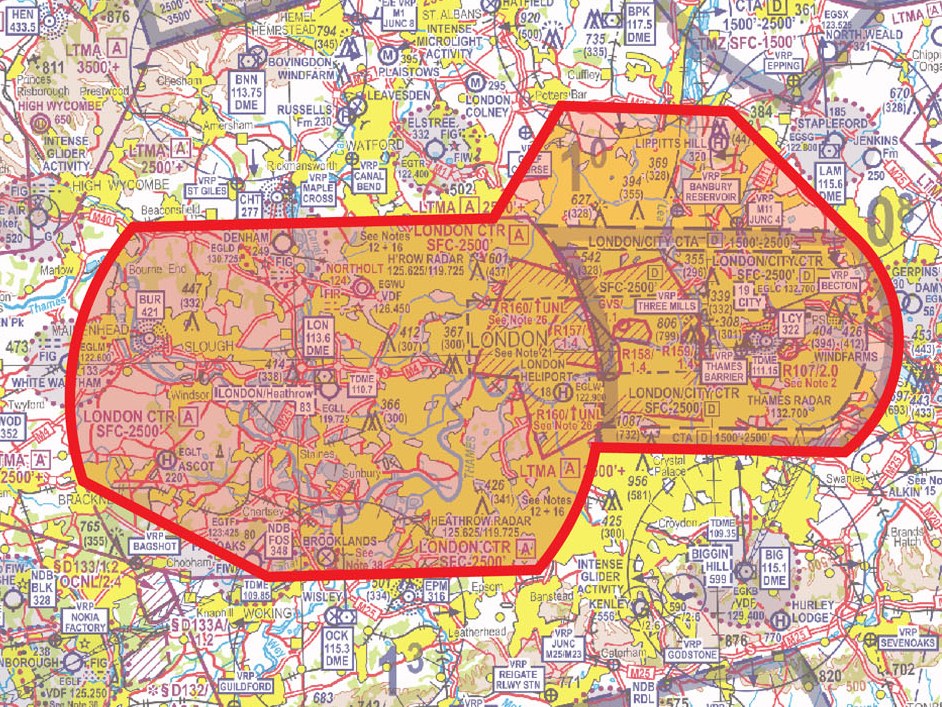
We went along today to see the Olympics torch procession through Stoke Newington, but the big story this week has been around security, with the army drafted in to cover for those G4S guards who have failed 'to materialise'.  Earlier this month residents of a tower block in Leytonstone lost their court case to prevent high velocity missiles being installed on their roof.  There are five other missiles sites, from Epping Forest to Shooter's Hill, along with a helicopter carrier moored on the Thames, Typhoon jets at RAF Northolt, and sniper-carrying Puma helicopters in Ilford. At the Olympics Airspace site you can download a 100-page manual which 'navigates pilots through the various security and operational airspace restrictions in place for the duration of the Games'  A map shows the prohibited zone for model aircraft, which covers the entire city.


All this makes me wonder how the Met's Air Support Unit, the 'avian police' that Sukhdev Sandhu interviewed for Artangel's Night Haunts project, will fit into the Olympics operations.  He asked one of them to describe the most beautiful thing he had seen at night.  "Oh, where do you begin?  The mist lying in the valleys takes your breath away.  The orange glow of the breaking dawn.  Or sometimes when there's a full moon you can see its reflection in the Thames..."  But these visions are reduced to black-and-white heat traces in the thermal imaging cameras used to scour the city for security threats.  'The thermal imagers themselves, though they're designed to help the police protect the city, produce images that resemble Baghdad, Vietnam - bombing zones for Allied troops. For a moment, London's nocturnal beauty vanishes: the forests seem ash-charred, lit-up areas ghostly apparitions.'

Thursday, July 19, 2012

Oppressive Light


Two new translations of the poetry of Robert Walser have been published this year. Christopher Middleton's slim volume for New Directions is a beautiful thing, but highly selective (it eschews all of Walser's early lyrics).  The Black Lawrence Press have issued Oppressive Light, a fuller collection of translations by Daniele Pantano starting with 'In the Office' from 1897/8 ('The moon peers in on us. / He sees me as a miserable clerk / languishing under the strict gaze / of my boss...'), and ending with 'Contemplation' (1930), written in the Waldau asylum ('...Life lay by the riverside like a boat / no longer able to sway, to drift.')  Carolyn Forché's introduction to Oppressive Light can be read at Ready Steady Book: 'one enters his language to be enveloped in gentle agonies, dark praise, rays of bright pleasure and the tumult of recognitions regarding selfhood and the fog of self, an ich ohne ich.'  More straightforwardly, Hans Bethge, writing in 1920, found 'lovely, inward-looking, and frequently quite ironic poems that are dreamy and spellbinding'.  He was describing early verse like the title poem, 'Oppresive Light', first published in 1904 while Walser was still living in Switzerland:  'How small life is here / and how big nothingness. / The sky, tired of light, / has given everything to the snow.'


The last time I wrote about Robert Walser, I described the way nature in his novel The Assistant seems able to speak to a lonely young man, unsure of his place in this world.  In his early poems, Walser can be found walking home, looking down at the snow, recalling his 'delusional and awkward' conversation, or passing through trees with their pleading hands under a sky 'rigid with fear', or wanting to stop but finding that 'the green of the meadows laughed / the smoke rose smiling like smoke, I carried onwards.'  And yet nature can also be a comfort: 'gently the meadows draw / the dead fear out / of my heart, then / everything is still again.'  If these early poems are reminiscent of The Assistant, the later verse reminds me more of Walser's Microscripts, those strange texts written in a radically miniaturised form of a Germanic script, so small that a whole story could fit on the back of a business card.  Landscape remains an important presence - the first poem in this collection from his years in Berne is called 'How the Small Hills Smiled' (1925).  Among these poems' smiling hills, white clouds and green meadows, flags and boats and laughing children, there is always a whisper of sadness.  Nature, he writes in 'Sensation', is a riddle, cheering but failing to calm him.  He can do without it, but would miss the brilliance of its sounds and colours, enshrining them in memory.  The poem concludes on a note of hope: 'it's beautiful everywhere, / as long as we see beauty from within ourselves.'

Friday, July 13, 2012

Untrue Island

"We really have to listen..."  Alice Oswald was talking on Tuesday evening about the need to get away from "a gentlemanly way of viewing the world" and experience landscape free from nostalgia and picturesque convention.  She thinks we concern ourselves too much with mapping and naming, that sometimes it is better just to observe.  Of course many nature writers have been written about the need to preserve and revitalise the language of landscape - I mentioned here recently, for example, the Home Ground project and Robert Macfarlane's essay 'A Counter-Desecration Phrasebook' - and Oswald does not doubt the value of a rich vocabulary for nature.  But she cautions against the tendency to see this as simply another field for the aquisition of knowledge.  Poetry, she said, is a kind of music in which silences are essential: "language must have its opposite next to it."  The form of the landscape can shape the structure and syntax of a poem, and at the same time poetry itself needs to leave some space for the world beyond.

On Location: Writers, Sounds and Places was an event organised as part of the Writing Britain exhibition, in collaboration with The Guardian and In the Dark.  In addition to Alice Oswald, it featured Rachel Lichtenstein, who we last encountered here sailing down the Thames estuary, Madeleine Bunting, who wrote the biography of an English acre in The Plot, and the 'writer and mythographer' (and, I'm tempted to add, 'national treasure') Marina Warner.  It was great to have an all-woman panel as some nature writing events I've seen advertised seem rather male dominated.  At one point Rachel Lichtenstein was asked how she'd broken into the 'all-male psychogeographers club', reminding me of a recent Matthew Sweet remark that psychogeographers tend to be 'literary men in desperate search for a respectable excuse to escape their childcare responsibilities at the weekend.'  Alice Oswald spoke positively about her domestic ties and of her mental and physical immersion in the tidal landscape of Devon.  She reminded me of an occasion when Robert Macfarlane, questioned about the greater challenge for women in 'wild' places, pointed to the example of Nan Shepherd, who slept out so as to be woken 'by the sharp press of a robin's claw upon her bare arm or the snuffle of a grazing deer.'


Robert Macfarlane's short film on Orford Ness, embedded above, was shown as part of the On Location event.  He has been working there on a commission, Untrue Island, with bass player Arnie Somogyi and has written about being given 'access to off-limits areas into which I'd long wished to pry: flooded and collapsing laboratories, abandoned control rooms. We came to know the site and its resonant place-names off by heart: Cobra Mist, Lab Three, the New Armoury, the Bomb Ballistics Building.'  Ever since reading The Rings of Saturn I've wanted to visit Orford Ness, drawn by the idea of those enigmatic ruins, which are fast becoming a kind of Tintern Abbey for the post-industrial Romantic (the closest I've managed to get is the distant glimpse you can see below).  Those making the trip to the Ness this month for a perfomance of Untrue Island will be 'ferried over the Ore, and then walk for a mile through the site – past sculptures by the artists Jane and Louise Wilson – to reach the New Armoury. The piece is an hour in length, consisting of part improvised jazz and part pre-composed music, the text part-spoken and part-sung, all by Arnie and his fellow musicians. But because the Armoury is open to the weather – doorless at both of its vast and ruined ends – the other performer will, of course, be the Ness itself.'


[As a postscript I should mention that Madeleine Bunting has interviewed Robert Macfarlane at Orford Ness for the first in a series of Guardian podcasts on Landscape and Literature.  In the second she walks the streets of Whitechapel with Rachel Lichtenstein.  A third, not yet available as I write this, will feature Alice Oswald.]

Friday, July 06, 2012

No trace of Cold Mountain


Cold Mountain, Red Pine, Copper Canyon.  The Copper Canyon Press publish a beautiful edition of  the complete poems of Cold Mountain (Han-shan) by Bill Porter, who translates Chinese literature under the name Red Pine. Nobody knows Han-shan's real name, but it is said that he called himself after the location of the cave which he made his home.  In his introduction Red Pine describes visiting this cave, 'located in Chekiang province at the base of Hanyen, or Cold Cliff, a two-day walk from the East China Sea ... Even now, Cold Mountain's old home attracts few visitors.  In May of 1989 and again in October 1991, Layman Fang of Kuoching Temple arranged for a motorized rickshaw to take me and two friends there.'  The road was poor and when they got there they found a roofless hut inside the cave, owned by an old farmer.  After sharing with them his lunch of noodles and red pepper paste, the farmer guided them around the area.  'In the centuries that followed Cold Mountain's disappearance, Buddhists built a monastery just beyond the base of the cliff.  It had since been replaced by terraced field of corns and peanuts but our host told us he still dug up the occasional temple tile.'

Red Pine's search reminded me of Gilbert Highet, seeking traces of Poets in a Landscape (1957): guided by the descriptions in Virgil, Pliny and Sextus Propertius, for example, he finds the Springs of Clitumnus still a source of 'cool copious fresh water, absolutely clean, rising out of dry earth under a hot sun' but is drawn back to the present when he notices 'in one of the fountain-beds, half a dozen Coca-Cola bottles set to cool for possible sale to tourists.'  Robert Macfarlane has just written an article about artistic pilgrimage, including his own attempt to follow W. G. Sebald (seemingly not yet abandoned when I did a post called The Printed Path in 2007).  In his new book The Old Ways, the guiding spirit is Edward Thomas, but he also travels in the footsteps of Eric Ravilious and Nan Shepherd.  Macfarlane's experience of the pine forests of the Siete Picos (described in my last post) reminded me of Richard Holmes on the trail of Robert Louis Stevenson in Footsteps (1985): 'I slept out that night under an outcrop of pines, facing east on a slight incline, with the light of the Costaros far way to my left. The turf was springy, and the pine needles seemed to discourage insects. As I lay in my bag, a number of late rooks came winging out of the gloaming, and settled in the pine branches, chuckling to each other. They gave me a sense of companionship, even security: nothing could move up through the trees below me without disturbing them. Once or twice I croaked up at them (it was the wine) and they croaked back: 'Tais-toi, tais-toi.' This night I fell asleep quickly. Only once, waking, I drank two ice-cold mouthfuls of water from my can and, leaning back, saw the Milky Way astonishingly bright through the pine tops, and felt something indescribable - like falling upwards into someone's arms.'

I seem to have become side-tracked...  'People ask the way to Cold Mountain,' Han-shan wrote, 'but roads don't reach Cold Mountain / in summer the ice doesn't melt / and the morning fog is too dense...'  In a footnote to this poem, Red Pine observes that a road does reach Cold Mountain, even though it is only wide enough for one cart and its condition is very variable, depending on the rain.  Furthermore, although the fog can drift inland from the nearby ocean in spring, 'ice and snow appear only briefly during the winter.  But then, this poem is about a different mountain.'  Han-shan's mountain poems are no more topographically specific than Petrarch's spiritual narrative, The Ascent of Mount Ventoux.   Petrarch descends after reading this passage in St. Augustine: 'And men go about admiring the high mountains and the mighty waves of the sea and the wide sweep of rivers and the sound of the ocean and the movement of the stars, but they themselves they abandon.'  Han-shan took the opposite path, abandoning himself to the landscape and remaining in the Tientai Mountains writing poems until one day, it is said, he disappeared into the rocks themselves, squeezing into a crevice which then closed around him.  Red Pine is shown this spot by the old farmer.  'Several vines led down from the spot, and we pulled ourselves up to a fine view of the hills to the south but no trace of Cold Mountain.'

Saturday, June 30, 2012

The Library of the Forest

In 1980 Miguel Angel Blanco retired to the woods of the Fuenfría Valley, in the Guadarrama Mountains outside Madrid.  One winter's day, returning from a long walk, he decided to place the objects he had found in the snow into a small glass-lidded box and bound it together with pages to create a book-box, the first in what was to become an ever-expanding library of the forest.  Each book is the indexical trace of a walk, using 'ink-sprinklings, positive or negative imprints of the materials used in the box, fire lines, water marks or different engraving techniques.'  The box itself, he writes, 'is a small recondite sanctuary, a sancta sanctorum. Sealed with glass, hermetic, to preserve its contents, it is at the same time ark, essence-container, shrine and crucible. Moss, lichen, barks, needles, pine cones, pollen, brambles, fungi, wax, roots, earth, minerals or resins are some of the materials I have collected. Materials that liberate secret images. Unfathomable abysses, deep lakes, infinite spaces, storms, creeks, fires... may open inside a small box ... The Library is a pine grove, where the variable scale of the trees is reflected in the different formats of the books.'


Miguel Angel Blanco, La Biblioteca del Bosque 
Image used with permission of the artist

In The Old Ways, Robert Macfarlane describes a visit to the artist and his library, which now covers the ground floor and basement of an apartment building in Madrid.  Blanco and his wife talk quietly, watching while he browses through this archive of landscape and memory: 'they had seen the magic of the library work on people before.  The last box I looked at was entitled Luz Eterna, 'Eternal Light'.  It was arrestingly beautiful.  The inside of the book was covered in gold leaf, over which had been poured a layer of pine resin, tapped from a Guadarraman pine and honeyish in lustre.'  The box seems to brighten the dim room - closing the book feels like turning off a light.  The next day Macfarlane sets out with Blanco to walk through the pine woods towards the mountains.  On an old Roman road, they pass 'among granite boulders fleeced with green and grey moss that was as soft to the touch as jewellery-box velvet.'  The monks in the nearby monasteries used this moss for pillows, 'to draw away bad thoughts from the mind.'  Eventually they part company, but not before finding a strange feather on the path (from an azure-winged magpie): '"Caminar es atesorar!"', says Blanco: '"To walk is to gather treasure!"' 

Miguel Angel Blanco is one of several walking companions who accompany Robert Macfarlane on The Old Ways (another is Raja Shehadeh, whose writing I have described here before).  But many of the book's most beautiful passages describe moments of solitude: striking out for the high pass over the Guadarrama, he is 'glad to have had Miguel's company but glad also now to be alone in the forest'. From a clearing he watches a black vulture, its shadow gliding over the treetops, and after resting at the pass he climbs on, up a zig-zag path towards the first of the Siete Picos (Seven Peaks).  To the north he can see ochre plains stretching away and the distant city of Segovia seemingly floating above the heat haze.  The white quartz mountain-top paths eventually lead him to a sleeping place in a natural cave.  'When dusk came I lit my candles, and my shadows flickered of the rock interior.  The night: a milk-white half moon, cool air. Owls in the forests below, their hoots pushing through the dusk.  The light soughing of wind in the pines.  Sound drifting, two shooting stars.  Dawn was dewless and dry.  When the sun came it was a storm of gold, rich on the face, Miguels' luz eterna pouring through the air.  I ate apples, bread and cheese, and watched the light flood the land.  Where it reached the dark pines across the valley they appeared to shake.  I felt uncomplicatedly happy to be in that place and at that time.'

Friday, June 22, 2012

Pine Barrens: Trees

In 1969 Robert Smithson was invited to exhibit in an ICA show, ‘When Attitudes Become Form’, and so he and Nancy Holt took the opportunity to come over and make their own kind of picturesque tour of England and Wales.  In an interview in Tate etc. magazine, Holt talks about their route, taking in Chesil Beach, Old Sarum, Pentre Ifan, Stone Henge and the Cerne Abbas Giant.  But 'besides the books on prehistoric monoliths in Europe and England that we had brought with us, Bob also had a book on Welsh mines. We visited many gravel pits and quarries, often quite out of the way. One place labelled Ash Hill on one of the slides is likely where Bob made a mirror piece called Untitled (Zig-Zag Mirror Displacement), probably on the outskirts of Tredegar. We found these abandoned, edge-of-the-world places intriguing; mines that had at one time railroad tracks and tunnels to transport rock. These structures are now overgrown and broken down. Bob and I both grew up in northern New Jersey, where you could find hidden quarries, forbidden places, scattered throughout the landscape. The coal mines in Wales were like that too. These socalled depressing, forgotten places that fall within the gaps of one’s consciousness are often described negatively. But if you look at them with a neutral eye, you start to see them differently; you begin to see a beauty in their entropic condition.'

Nancy Holt currently has a really nice exhibition of photo works at Haunch of Venison (five minutes' walk away from the Burtynsky show covered in my last post).  You can see in it two works made on her trip with Smithson: Wistman's Wood and Trail Markers.  I've mentioned Wistman's Wood here before - Smithson and Holt were stunned by it and Holt made her first Buried Poem piece there. She says in the interview, 'a site evokes a person, and I bury a poem for that person and later the person a booklet including maps, detailed directions and a list of equipment (such as a compass and shovel) in order to find it. To me, Wistman’s Wood conjured up Bob’s persona in a striking way…' Trail Markers is a set of photographs of Dartmoor rocks, each distinguished by an orange paint spot, used to identify a route across the moor.  As I looked at these I felt a strange sense of recognition, perhaps recalling other trails like this from childhood holidays in the seventies: was this how most such trails were marked out before the spread of wooden sign posts?  Holt says 'I hadn’t seen markers like these before. I didn’t know if they were unique to this place or not, but in any case they lent themselves to my project.'


The exhibition includes other works derived from the trips Holt and Smithson made together: Ruin View (1969), for example, showing the Temple of the Sun at Palenque (Smithson used photographs of the dilapidated Hotel Palenque to illustrate his notion of a 'ruin in reverse').  Her best known work, Sun Tunnels, is represented by photographs of light and shadow, taken at half hour intervals one summer's day in 1976.  These are hung near a very different work about sunlight - California Sun Signs (1972) - eighteen colour shots of garish signs in which the sun is word or symbol signifying some kind of retail opportunity.  The same year, at the other end of the country, she made View Through a Sand Dune, inserting a piece of pipe into the sand of Narragansett Beach, Rhode Island, and photographing the sea through it.  The circular view created by this pipe-frame has a curious distancing effect, like a seascape seen through an old stereoscope.  After seeing this I promised myself I would pack a bit of piping with the bucket and spades next time we head for the seaside... 

Not everything in the exhibition relates to landscape (there is, for example, a beautiful series of Light and Shadow Photo-Drawings), but I'd like to end this post by mentioning Pine Barrens: Trees (1975), a seven by four grid of video stills showing solitary stunted pine trees in a wilderness area of New Jersey.  In the original film local people can be heard describing the area and its local myths, but here the images are stark and silent, their transfer from the original 16mm film giving them a slightly blurred quality that reminded me of Chinese ink paintings.  In her Tate etc. interview Nancy Holt traces the origin of this piece to that 1969 trip with Robert Smithson.  'Looking back, I feel that the Pine Barrens film may have been seeded in our visit to Wistman’s Wood. Walking on that Dartmoor trail was a pivotal experience. Not long before our visit there, we had seen Stonehenge, Avebury and Silbury Hill. It all works on the psyche.'

Saturday, June 16, 2012

Oil fields


I last wrote about Edward Burtynsky here four years ago, after seeing Manufactured Landscapes. Some of the images in that film, like the Chittagong shipbreaking beach in Bangladesh, have appeared subsequently in various exhibitions entitled Burtynsky: Oil.  The series continues to develop: in May 2010 Burtynsky flew to the Gulf of Mexico to take some extraordinary aerial shots of the BP oil spill.  These feature in a new version of the exhibition that marks the re-opening of London's Photographer's Gallery.  I was there yesterday, reflecting on how hard it is here in England to even imagine landscapes like Highway #1, Intersection 105 & 110, Los Angeles, California, USA or Oil Fields #22," Cold Lake, Alberta, CanadaWriting about these photographs for the LRB, Tony Wood notes that sometimes their scale is so vast that any actual humans are too small even to register.  He describes Alberta Oil Sands #6: 'a massive installation for extracting oil from tar sands. The picture is dominated by two huge yellow rectangles that seem like abstract forms drawn onto the landscape – but then you realise they are vats of sulphur hundreds of metres wide and hundreds more long.'  Such images prompted another reviewer to conclude: 'Turner might have believed the landscape to be an ineffable manifestation of God, but Burtnysky proves that, post-industrially, it’s in the firm grip of the devil.'

A similar set of Burtynsky: Oil photographs is currently also on display at the Nevada Museum of Art (such things are possible in the age of mechanical reproduction...) Linked to this, there was an interesting conversation between Burtynsky, Geoff Manaugh and Nicola Twilley - the first manifestation of Venue, a travelling 'pop-up interview studio and multimedia rig'. Their discussion touches on Burtynsky's preference for photographing during “the shoulders of the day" (early morning and late evening), his desire not to frame the work in an activist or political terms, and his difficulties in gaining access to certain sites, like the Ghawar oil field in Saudi Arabia.  But the most interesting exchange occurs when Geoff asks him, "Do you see a time when you’re not going to be riding in a helicopter over Los Angeles but, instead, piloting a little drone that’s flying around up there and taking photographs for you?" Burtynsky: "I’m already doing it." Twilley: "You have a drone?" Burtynsky: "Yeah. I use it to go into places where I don’t have any air space. I work with a team. One guy runs the chopper, one guy runs the head, and I take the shutter release and compose. For example, there is no civil aviation space in China, so I was using it there. I used it to shoot the big dam area, and I used it to photograph agriculture."

Friday, June 15, 2012

A Natural Gallery


On Saturday, the only rain-free day so far this month, we headed across London to see David Nash At Kew: A Natural Gallery.  Looking now at the website I see it suggests capturing 'a lasting memory of your visit to the exhibition with one of our exclusive products. Each item in our very special collection reflects the spirit and ethos of David Nash.'  We failed to buy any of the Nash-inspired homeware, but I'm hoping instead to retain a lasting memory of our visit by uploading a few photographs here.  The sculptures on show were much as you would expect, some more striking than others, but the location for each was well chosen to echo or contrast with the surrounding trees and buildings.  In her review Laura Cumming thinks Nash suffers by comparison: 'a park filled with so many stunning variations on the essential tree form is bound to throw an emphasis on beauty (and variety) that is not always kind to this artist, whose work is so much the result of conspicuous labour.'  Ultimately, none of the sculptures were as interesting to me as the film of Wooden Boulder, which you can see along with Nash's drawings and photographs in Kew's Shirley Sherwood Gallery of Botanical Art.  I have described here before this floating sculpture and its eventual disappearance in the sea, although I was writing prior to the boulder's brief rediscovery in 2009.  The film begins with grainy images of the boulder entering the river and ends with beautifully shot and recorded footage of it floating and resting along the estuary among the reeds and sandbanks.


The photograph above shows the Wood Quarry, where David Nash is making sculptures at Kew Gardens using old or diseased trees.  Kew's head of trees Tony Kirkham has taken comfort from seeing a victim of "acute oak decline" gradually transformed by Nash into an artwork.  'The neighbouring tree was also poorly, but has recovered dramatically. "Saying to it 'Buck up or there's a man coming for you with a chainsaw' seems to have worked," Kirkham said.'  As artist in residence, Nash has welcomed the chance to reveal to visitors how he goes about his work as a sculptor.  'I’ve often felt that in the shows I’ve done before, much of the process is hidden. What’s unique about Kew is to make the process part of the exhibition.’  Unfortunately there was no sign of him last Saturday, but you can see him working among the upended trees in the video clip below.  I would like to have seen how he interacts with members of the public (in a recent post I mentioned the group walk Hamish Fulton organised to accompany his Margate exhibition - no talking allowed...)  It is quite hard to imagine Nash chatting with bystanders, but I imagine many would in any case be shy of striking up conversation with someone wearing ear protectors and wielding a chainsaw.  


Monday, June 11, 2012

The Cataract of Lodore

The Robert Southey poem I mentioned in my previous post is 'The Cataract of Lodore'.  It was written in 1820 for his children and begins '"How does the Water / Come down at Lodore?" / My little boy ask'd me...' Sadly the little boy, Herbert, had died in 1816, so the playful tumbling water that ends 'all at once' could be read in part as a poignant memory of his son.  Southey's poem traces the water 'from its sources which well / In the Tarn on the fell', 'through meadow and glade, / In sun and in shade', until 'it reaches the place / Of its steep descent.'  There, the second part of the poem describes the cataract itself in onomatopeiac rhymes.  I've reproduced below its last 37 lines and, as you can see, the line lengths seem to take on the form of the waterfall itself. Thus the poem could be compared, for example, to John Hollander's mountain-shaped verse, 'A View of the Untersberg', which I discussed here recently. 

... flowing and going,
And running and stunning,
And foaming and roaming,
And dinning and spinning,
And dropping and hopping,
And working and jerking,
And guggling and struggling,
And heaving and cleaving,
And moaning and groaning;
And glittering and frittering,
And gathering and feathering,
And whitening and brightening,
And quivering and shivering,
And hurrying and scurrying,
And thundering and floundering,
Dividing and gliding and sliding,
And falling and brawling and sprawling,
And diving and riving and striving,
And sprinkling and twinkling and wrinkling,
And sounding and bounding and rounding,
And bubbling and troubling and doubling,
And grumbling and rumbling and tumbling,
And clattering and battering and shattering;
Retreating and beating and meeting and sheeting,
Delaying and straying and playing and spraying,
Advancing and prancing and glancing and dancing,
Recoiling, turmoiling and toiling and boiling,
And gleaming and streaming and steaming and beaming,
And rushing and flushing and brushing and gushing,
And flapping and rapping and clapping and slapping,
And curling and whirling and purling and twirling,
And thumping and plumping and bumping and jumping,
And dashing and flashing and splashing and clashing;
And so never ending, but always descending,
Sounds and motions for ever and ever are blending,
All at once and all o'er, with a mighty uproar,
And this way the water comes down at Lodore.

If you converted the rhythms and rhymes of this poem to music, you might hear echoes of the way water sounds change as they cascade down the rocks.  I was more intrigued by its shape, and so I erased the poem's words entirely and superimposed an image of the waterfall.  The shape below is formed from the full 71 lines describing the cataract and the photograph of the Lodore Falls I used appears on the Footless Crow site, where it accompanies the text of a letter Samuel Taylor Coleridge wrote to Sara Hutchinson in 1802.  'Lodore' he says 'is beyond all rivalry the first and best thing of the whole Lake Country.'   It is 'broad and wide, and from top to bottom it is small waterfalls, abreast, and abreast'; so, not actually like the picture below at all... In fact, to convey a visual impression of the falls, the poem would need several columns of text cascading down the page, joining and dividing at various points.  But Southey's goal was to trace the water's course rather than capture it in a sketch, and if there is music in the words it is not the sound of the falls at one particular place, but the noises the water makes on its journey down the rocks: moaning, groaning, rumbling, tumbling, clapping, slapping and ending in a mighty uproar.

Friday, June 08, 2012

Wastelands to Wonderlands


This J. G. Ballard poster can be seen outside the British Library, advertising the exhibition Writing Britain: Wastelands to Wonderlands, which 'examines how the landscapes of Britain permeate great literary works.'  It is quite an ambitious aim and you'll have no trouble spotting omissions in the list of exhibits, including people I've written about here (The Anathemata by David Jones, for example). There is an understandable emphasis on the visual - so a whole case is devoted to Remains of Elmet and there is no place for, say, Charles Tomlinson's Stoke poems or Roy Fisher's City.  The writers are mostly British, so we don't get Sebald on Suffolk, and the language is almost always English, although one notable exception is a reading of Edwin Morgan's 'The Loch Ness Monster's Song' (my five-year-old son's favourite exhibit).  'Britain' is taken to extend as far as the Ireland of Yeats, Joyce and Heaney but there is quite a large focus on the city and suburbs of London, the River Thames and the M25.  Perhaps this reflects the 'London 2012' tie-in and the site of the exhibition.  I was puzzled by the inclusion of Harry Potter and the Philosopher's Stone among these 'great literary works' permeated by the British landscape, but it may have something to do with the fact that the British Library is next door to the refurbished Kings Cross Station, with its newly sited mock-up of Platform 9 ¾.

As with earlier British Library exhibitions, the main pleasures are to be had from simply looking at books as objects - from fine art editions like Auden Poems, Moore Lithographs, to well-remembered paperbacks (Susan Cooper and Alan Garner) - and seeing original manuscripts like the 14th century copy of Sir Gawain and the Green Knight, or a poignant letter from John Clare asking for help from the Royal Literary Fund, or the heavily annotated typescript of J. G. Ballard's Crash.  There may be time to say more in later posts here about some of the specific exhibits - one listed simply as 'Robert Southey poem', for example, is much more interesting than it sounds. The texts are complemented by readings and sound clips: in addition to the Loch Ness Monster you can hear Ballard on Crash (it was not easy convincing my son he wouldn't want to listen to this exciting-sounding book).  There is also Ezra Pound performing his translation of The Seafarer, which John Woolrich wrote amusingly about some years ago: an attempt to fuse poetry with the sound of kettle drums, 'it would have been "magnificent", someone said, "with a rehearsal."'  Several short videos were made to accompany Writing Britain and I have included three of these below.  In the first clip Simon Armitage says "if I had to choose one thing that characterised British literature - both prose and poetry - I would have to say it was geography and, more widely, I would say: landscape."


Sunday, June 03, 2012

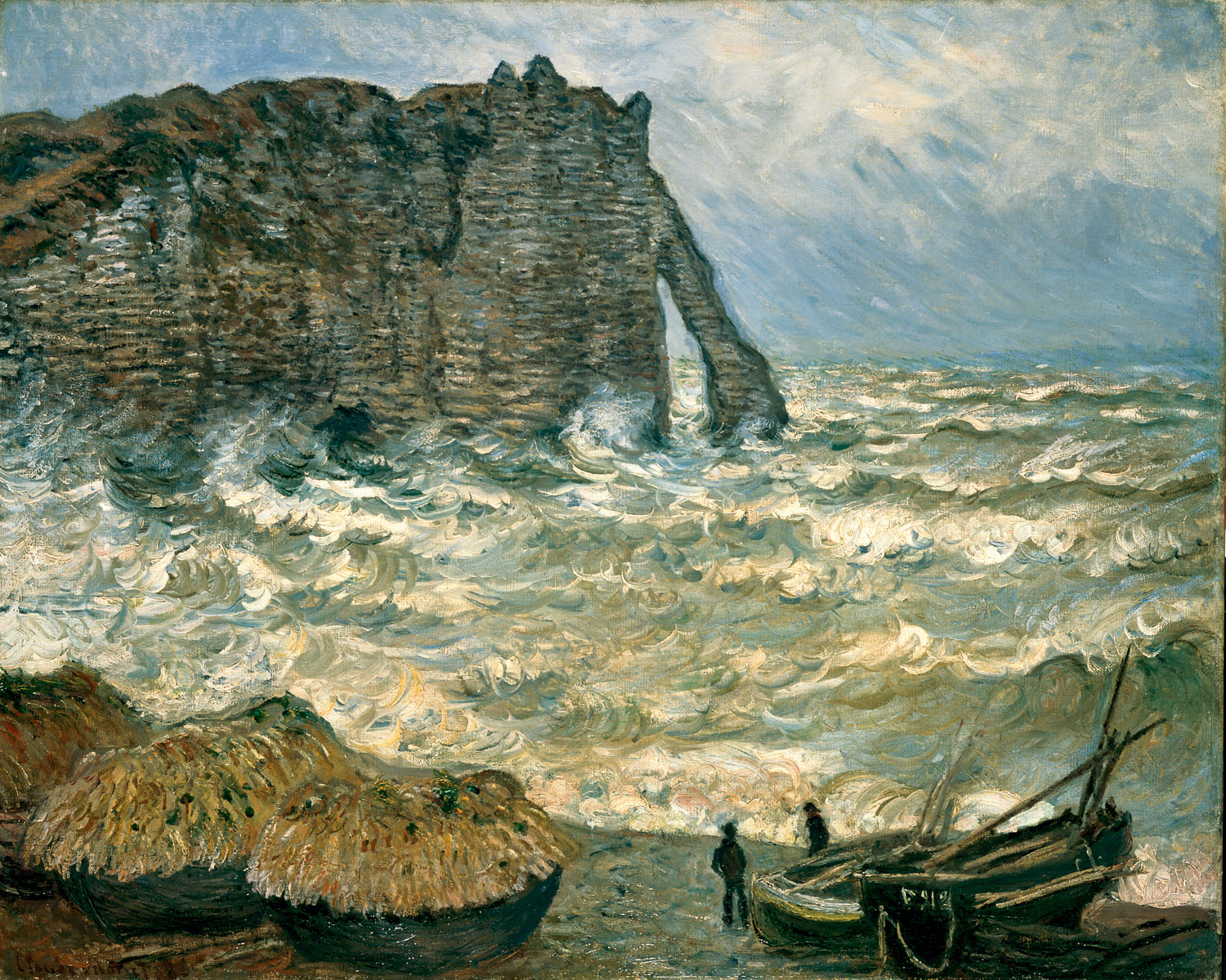
Agitated Sea at Etretat

There may be unexpected dangers in the gentle art of plein air painting, as is evident in a letter Monet wrote to his future wife Alice Hoschedé from Etretat on the evening of November 27th 1885.  'I was hard at work beneath the cliff, well sheltered from the wind, in the spot which you visited with me; convinced that the tide was drawing out I took no notice of the waves which came and fell a few feet away from me.  In short, absorbed as I was, I didn't see a huge wave coming; it threw me against the cliff and I was tossed about in its wake along with my materials!  My immediate thought was that I was done for, as the water dragged me down, but in the end I managed to clamber out on all fours, but Lord, what a state I was in! My boots, my thick stockings and my coat were soaked through; the palette which I had kept a grip on had been knocked over my face and my beard was covered in blue, yellow etc.'

Claude Monet, Agitated Sea at Etretat, 1883

Four years later Monet was in central France, painting the Creuse river and writing to Alice from Fresselines about the 'damnable' spring weather (the translation here is, again, by Bridget Stevens Romer).  'It will be a gloomy series.  A few have some sunlight in them but they were started so long ago that I'm very much afraid that when the sun finally re-emerges I shall find my effects considerably altered.'  It was changes in the weather that really frustrated his efforts.  'The weather's wearing me down, a terrible cold wind which wouldn't have bothered me in the slightest if I'd captured my effect, but the endless succession of clouds and sunny intervals couldn't be worse, especially when I'm getting to the end; but the thing that is upsetting me the most is that with the drought the Creuse is shrinking visibly and its colour is altering so radically that everything around it is transformed.'

Claude Monet, Valley of the Creuse at Sunset, 1889

You would think an artist averse to fluctuations in the weather might stay clear of England but in March 1900 he was here, complaining to Alice of the effects of the fog. 'I've never seen such changeable conditions and I had over 15 canvases under way, going from one to the other and back again, and it was never quite right; a few unfortunate brushstrokes and in the end I lost my nerve and in a temper I packed everything away in crates with no desire to look out of the window...'  This blog post is being written on a cold and misty morning, with the weather forecasters promising a very British day of rain showers for the Queen's Diamond Jubilee Pageant on the Thames.  Monet himself witnessed a royal spectacle whilst in London - the funeral procession for Victoria - and pronounced it superb: a 'feast of gold and colour'.  He was still in a good mood the following day as the sun rose dazzling over the river and the joys of impressionism seemed to outweigh its frustrations.  'I can't begin to describe a day as wonderful as this.  One marvel after another, each lasting less than five minutes, it was enough to drive one mad.  No country could be more extraordinary for a painter.'     

 Claude Monet, Waterloo Bridge. Effect of Fog, 1903

Thursday, May 31, 2012

Like clouds accompanying the rising summer sun

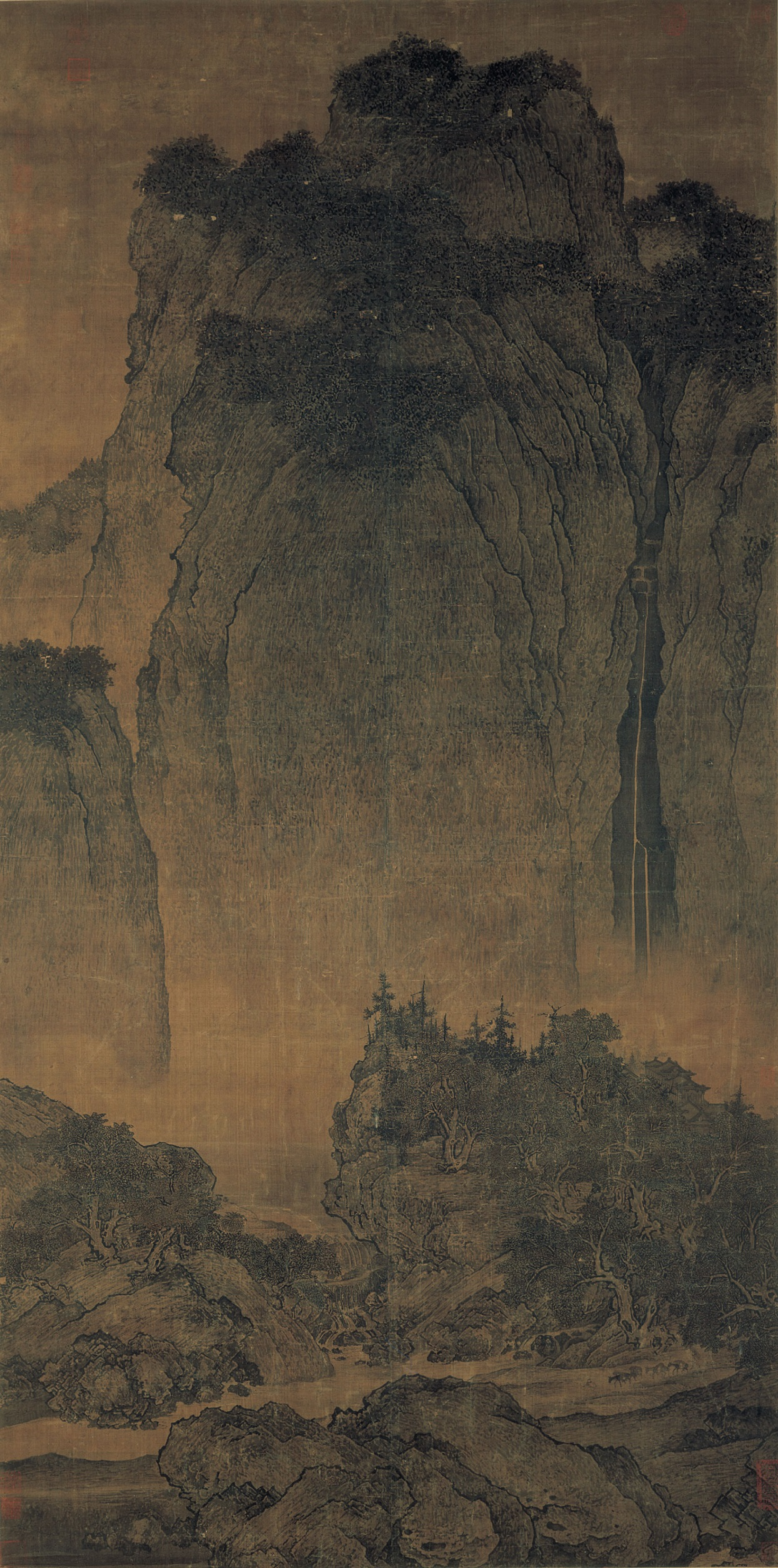
Here's an idea for an art installation.  You pass into a room between the trunks of two pine trees that show signs of having been cut into with a large axe and smaller one.  In front of you is a pond covered with lotus plants, lit so that the veins in their leaves stand out.  Placed on low plinths around the room are a torn net, hemp stalks, frayed rope, oxen fur and a lump of alum.  Vitrines contain horses teeth, thorns, split beans and broken bands.  And on the three walls facing you, video projections show silent footage of an eddying whirlpool, falling rain and roiling clouds. This installation would (as some readers will have recognised) be inspired by the various types of shaping lines (ts'un) used in traditional Chinese landscape painting.  For example, expand the image of Fan Kuan's Travellers among Mountains and Streams below and you can see his use of the 'rain dot stroke', which one source characterises as 'many perpendicular, forceful, short lines executed under a quick brush. Collectively, they look like the marks left by a heavy rain on a mud wall. This type of stroke is suitable for depicting the pocked appearance of the eroded loess plateaus of northern China.'  There are various lists of these brush strokes and the one I've reproduced below is in Fritz van Briessen's The Way of the Brush: Painting Techniques of China and Japan.

 Fan Kuan, Travellers among Mountains and Streams, c.1000
Luan ma ts’un – like tangled hemp stalks
     (also called luan ch’ai ts’un, like tangled bundles of brushwood)
Ho yeh ts’un – like the veins of lotus leaves
Chieh so ts’un – like unravelled hemp rope
P’i ma ts’un – like spread out hemp fibres
Ma p’i ts’un – like a tangled ball of hemp fibres
Luan yün ts’un – like rolling billows of cloud
Niu mao ts’un – like cow hair
P’o wang ts’un - like a torn net
Fan t’ou ts’un – like lumps of alum
Tan wo ts’un – like eddies of a whirlpool
Kuei mien ts’un – like the wrinkles on a demon’s face
Hsiao fu p’i ts’un – like the cuts made by a small axe
Ta fu p’i ts’un – like the cuts made by a big axe
Che-tai-ts’un – like broken bands
Ma ya ts’un – like horses teeth
Tou pan ts’un – like two halves of a bean
Yü tien ts’un – like raindrops
Tz’u li ts’un – like thorns
Mi tien ts’un – like the dots used by Mi Fei
In that imaginary installation I drew upon (rather than drawing with) all of these ts'un, except two which don't correspond directly to things we might encounter out in the landscape - the wrinkles on a demon's face and the brush stroke named after a specific artist, Mi Fei. The others all suggest ways in which the motion of the hand is akin to a natural process and seem to situate the artist in direct connection with animals, plants, rocks or water whilst in the very act of shaping a landscape painting.  I like the fact that these links are indirect and metaphorical - mountains, for example, can be constructed from clouds (with a luan yün ts’un, the brush is 'moved in an orbit, like clouds accompanying the rising summer sun.')  Placed in a gallery all objects prompt metaphorical readings: it would be hard to view a torn net or a pile of thorns as nothing more than signifiers of themselves, or reminders of how particular brush strokes have been termed. So it is with a painting like Travellers among Mountains and Streams, a Taoist vision of nature rather than a strictly topographical one: a symbolic journey through high mountains, their rocky sides mottled like the aftermath of a rain shower. 

The codification of style in painting manuals like The Mustard-seed Garden and the way landscapes could be built up from simple forms has prompted modern computer programmers to simulate the small axe cut, the hemp-fibre stroke and so on.  A paper by Way and Shih, for example, describes work on the synthesis of rock textures in Chinese landscape painting, aiming to provide tools for digital artists and allow the automatic rendering of Chinese-style landscapes.  Their mathematical models have no connection to physical objects or natural processes; but then it is also possible to imagine Fan Kuan dabbing his brush onto the silk scroll oblivious to the rain drops falling outside.  Can this gap between art and the world be closed?  In his New River Watercolours, John Cage took stones from a river and drew round them to create marks not unlike roiling cloud strokes: "with the involvement of the rock, the line is not so much me as it is the rock." And Brice Marden (as I was saying a couple of weeks ago) uses sticks in his calligraphic drawing to produce natural variations in the line.  These objects restrict the artist to a type of gesture whilst releasing the expressive potential of the brush stroke.  Cage said that as he traced the stones, "a slight turning of the brush on my part makes a big difference in the line. So, it's hard to explain, but I'm moving toward a freedom of gesture while at the same time using gesture."

Wednesday, May 23, 2012

Lipstick Traces


Earlier this month I received an email from cultural geographer Hayden Lorimer tipping me off to a Radio 4 programme he had written called 'The Perfumed Mountaineer': "Listeners are promised a potent brew: photography and perfumery, lipstick and landscape.  All of it beribboned in the story of one man's life-world."  This turned out to be an exploration of the 'double life' of Walter Poucher (1891-1988), a pioneer mountain photographer who also worked for perfumers Yardley, where he invented the Bond Street fragrance.  Producer Tim Dee describes his experience making the programme on the Radio 4 blog: 'Hayden does know his hills, he runs up and down Scottish ones for pleasure, he has also always seemed properly fragrant, so, I was very pleased to set off with him into the English Peaks and Scottish Highlands but also down Jermyn Street in central London to the back rooms of a perfumery in pursuit of people who either knew the man himself or knew about the life and works of Walter Poucher.'  The programme is no longer available to listen to but Hayden has sent me the script from which I quote below.

'The print titles of Walter Poucher’s photographic books run down their spines, and they’re just irresistible, toying with the topographical imagination: A Camera in The Cairngorms, The Backbone of England, Peak Panorama, The Surrey Hills, Highland Holiday, Lakeland Through the Lens. At the height of his photographic career, Walter Poucher functioned as the Great British viewfinder. Prolific and bestselling, across 50 books, most appearing in the 1940s and 50s, he compiled a picturesque geography of mountains, high hills and summit panoramas. If he had the magic eye, success didn’t tempt him to widen his range. "I was never interested in taking pictures of nudes, towns or churches because many people do it. I’ve never wanted to photograph anything but mountains"' Poucher used that iconic twentieth century camera, the Leica, but he was as precise at noting down and recommending viewpoints as an eighteenth century follower of the Rev. William Gilpin. 'At the back of each book appear technical notes and photographic data: what month of the year, what time of day, lens, exposure, aperture, filter. Even exactly where to stand: Click. Click. Click.'

So, Walter Poucher has a significant place in the history of British landscape photography, and his work for Yardley produced the three volume Perfumes, Cosmetics and Soaps (1923), now in its 10th edition. But what intrigues Hayden is the way Poucher didn't separate the two halves of his life: as he hiked over the uplands of Britain he would wear the make-up he had worked on - 'an extreme form of field-testing, and out of pure enthusiasm for Yardley’s products.'  The programme highlighted the funny side of this and re-told the story of Poucher's encounter with Liz Taylor, who 'wished more men took as much trouble with their appearance.'  But it also hinted at interesting questions around our assumptions concerning appropriate or expected behaviour out in the landscape.  In his academic work Hayden has been a key figure in cultural geography's 'performative turn', a shift from the study of representations (the kind of analysis that would highlight the absence of people in Poucher's wilderness vistas) towards an investigation of experiences and ways of being in the landscape.  He sees Poucher as 'someone who made the staging of self into his life’s work; even when it was mountain scenery that was his subject.'  And this is the context for Poucher's appearance in one of the most frequently repeated clips in British television history.  When Grace Jones attacks the chat show host Russell Harty it is for paying too much attention to his other guest: an elderly mountain photographer, seemingly from a different era, until you notice that he is wearing golden gloves and sky-blue eyeliner. 


Friday, May 18, 2012

Cold Mountain

I was at Tate Modern on Monday for the inaugural talk in a new American Artist Lecture Series, organised by the US embassy.  The ambassador's wife Marjorie Susman provided one of the four introductions that preceded Brice Marden's talk and Q&A with Sir Nicholas Serota.  Later in the week she was interviewed with Marden on Radio 4's Front Row, at the ambassador's official residence in an ornate state banqueting room: mahogany table, gilt decorations and, thanks to the State Department's ART in the Embassies programme, a large painting from Marden's Cold Mountain series.  This had recently served as the backdrop to a dinner in which the Obamas met the Queen.  Marden acknowledges that financial and political power can negate the effect of an artwork but thinks that this painting is 'in a position where it's allowed to try to do its work'.  I'm always intrigued by the choice of art works in places of power (No. 10 Downing Street for example) and in this case the choice seems at odds with the inspiration for Marden's painting, that mysterious T'ang Dynasty poet-hermit Han-shan ('Cold Mountain'), an inspirational figure for later Zen poets and painters.  In a brief digression on Monday, Nick Serota recalled showing the Queen around Tate Modern: when she got to the Rothko room she asked, to his surprise, whether "this artist was into Zen".  I like to imagine her at that state banquet, sitting under Brice Marden's painting thinking of Han-shan.  'The Cold Mountain trail goes on and on/ ... Who can leap the world's ties / And sit with me among the clouds?'

Gary Snyder's translations of Cold Mountain, 
A Tokyo National Museum postcard showing a scroll painting of Han-shan and Shih-te,
A Serpentine Gallery postcard showing Brice Marden's Cold Mountain 2 (1989-91).

In addition to Cold Mountain, Brice Marden mentioned on Monday his admiration for Chinese calligraphy, the landscape painter Shitao's treatise on painting, and the tradition of scholar's rocks, several examples of which he now owns.  He has also been inspired by Chinese and Japanese gardens, with their capacity to distill "the energy of the landscape".  A recent canvas uses a shade of blue used in 11th century Chinese pottery, the "colour of sky after rain." It is a colour he may well glimpse here in wet and windy London: a bit of a shock after the Greek island of Hydra, where he has been spending time relaxing at his studio, sitting in the sun and reading Cavafy and Seferis.  He described to Serota another of his studios in upstate New York, at Tivoli, not far from Olana, the former home of Frederic Edwin Church.  Marden was unapologetic about his admiration for the Hudson River landscape, despite its familiar place in American art history: "going through Spring up there is so incredible you just have to make paintings of it."  He said "I love going out drawing in nature, although I don't draw trees and stuff".  Instead he uses trees and stuff: sticks dipped in ink which allow accidental marks and natural variations in the line.  Harder ones are best - it is, he said with a twinkle in the eye, a drag when your stick goes soft.

Thursday, May 10, 2012

Margate Walk


We made it to Margate on Monday for the last day of the Hamish Fulton exhibition.  As you can see from the picture above, it was paired with 'Turner and the Elements'.  I won't say anything about the Turners aside from concurring with the views of Iain Sinclair on Front Row: "magnificent paintings worth crawling on your hands and feet to Margate to see" (although you only have three more days to see it, so you may need to start crawling now). Turner's late period will be examined in another show this year at Tate Liverpool, alongside late works by Twombly and Monet.  Whether Hamish Fulton's recent art could be described as a late period may depend on how his practice develops - I should think he is so fit from the walking that he'll be literally scaling new heights for many years to come.  But there's certainly a sense in some of the pieces that he is looking back over a lifetime's work, as in 'WALKING COAST TO COAST COAST TO RIVER RIVER TO COAST RIVER TO RIVER 31 WALKS 1971-2010'.  Other recent text works look back to his earliest hitchhiking and group walking experiences (which I discussed in an earlier post).

For this exhibition Fulton organised a participative walk on Margate Sands around the rectangular Marine Bathing Pool wall.  Imagining I suppose that Fulton might have mellowed into a kind of conceptual art scout leader, my wife wondered if the participants were allowed to talk to each other - but the instructions were strict: to 'walk slowly, in silence'. The point of this was to focus attention on the process of walking itself and the video of the event conveys this contemplative quality, with silhouettes constantly moving whilst the outline of the walk and the mirror-like surface of the water remain still.  It made me reflect on the shapes Fulton has himself traced over the landscapes he has visited, lines visualised for example criss-crossing the map of Europe in 'WALKING COAST TO COAST...' The Margate walk participants interviewed in the video clip below describe the experience as 'cold', 'interesting', 'Zen-like', 'mesmerising', 'therapeutic', 'disorientating', 'cold'...  One says that all he could look at was the bloke in front's shoes, and then spent the whole walk wanting to tell him that his laces had come undone.

Sunday, May 06, 2012

Gone fishing

I've been getting interested in the work of Finnish artist Caroline Slotte, who aims to reveal 'the poetry of everyday objects' by reworking found objects, mainly second hand ceramic items. In the examples below, she has cut into and sanded down the dream-like ideal landscapes to be found on discarded plates.  Writing on the V&A blog, Glenn Adamson describes her work as evoking 'the sense of loss and memory that old china often carries in our lives, as it sits silent and half-forgotten in the cupboard.' The museum has an example of her Rose Border Multiple series, in which a set of plates has been cut through and stacked to evoke the 'historical recession of time'.  Looking into these tiny stage sets, like paper theatres, an awareness of their history as mass-produced objects gives way to early childhood memories in which blue and white china plates were an exotic and unfathomable feature of the dining room, with figures that seemed capable of coming to life and landscapes that might allow themselves to be entered into.


Caroline Slotte, Rose Border Multiple, Double Blue II,
reworked second hand object, 2007 
Source: Caroline Slotte, used with permission

Other Caroline Slotte pieces work through a process of erasure, leaving only boats in the Gone Fishing series and cloud patterns in Under Blue Skies.  The former are particularly poignant, where seemingly everything has been forgotten but the presense of a fishing boat. They seem to have sailed into the kind of misty emptiness we associate with Chinese landscape painting, a Taoist void.  In the example below, the tiny vessel appears to be heading past a stain on the plate resembling a low sun seen through fog. (Writing this reminds me that in the previous post here I referred to Leonardo's comment that the artist could turn stains into imaginary landscapes...)  But in Gone Fishing, the landscape, which was nothing more than in fantasy in the first place, has disappeared, and any memories of the plate itself and the story of how it sustained that crack are unrecoverable.


Caroline Slotte, Gone Fishing,
reworked second hand object, 2007 
Source: Caroline Slotte, used with permission

Caroline Slotte is one of several contemporay ceramic artists re-working found objects.  Another is Paul Scott who (like Slotte) features in  Edmund De Waal's The Pot Book, with a piece called Cumbrian Blue(s) Trees in a Fenced Garden (made in collaboration with Ann Linnemann).  The trees are on two porcelain cups and look as if they could come from a Willow pattern landscape but for the small silhouette of an aeroplane above.  The fenced garden is a tray printed with a rolling landscape but surrounded by the kind of railings you would expect to find in a municipal park.  This kind of anti-pastoral pastiche has been used in recent years by designers in various media: the toile wallpaper patterns, for example, of Timorous Beasties and Jessica Smith.  Paul Scott's other designs include Foot and Mouth, Dounreay and Three Gorges After the Dam - a theme addressed by other artists I've mentioned here, in which a Spode bone china Willow pattern plate is mostly submerged beneath the waves.  Pieces like these may provoke a reaction in the spirit of eighteenth century satire, but they have little of the haunting quality to be found in Slotte's reworked objects.  As Edmund De Waal says, her work is engaged in uncovering a mystery, whilst simultaneously contructing a new one.

Tuesday, May 01, 2012

Strange ridges and shadowy craters

In 1973 Gerhard Richter made a series of paintings based on close-up photographs of oil paintings.  According to Mark Godfrey in 'Damaged Landscapes' (an essay I've referred to before) Richter 'chose images where the swirls of paint seemed to recede from the plane of the painting.  These Details therefore appear like fictitious landscapes with strange ridges and shadowy craters.'  Leonardo da Vinci famously suggested in his Notebooks that 'when you look at a wall spotted with stains, or with a mixture of stones, if you have to devise some scene, you may discover a resemblance to various landscapes, beautified with mountains, rivers, rocks, trees, plains, wide valleys and hills in varied arrangement.'  In an earlier post I wondered whether Thomas Jones' A Wall in Naples could be considered a landscape painting, but perhaps I wasn't looking closely enough.  As you can see from the detail below (another sketch made from the roof terrace above the rooms he rented in Naples), the crumbling masonry painted by Jones starts to assume the semblance of a landscape.  But Richter's Details provoke the thought that landscapes might be discerned at some level of magnification in the folds of a velvet dress, the shadow beneath a bowl of fruit or an angel's wing. And I can almost imagine a kind of fractal landscape painting that would depict a view simultaneously at the level of the canvas, the brush stroke and the pigment (which would then need to be exhibited outside, in front of the landscape itself).

Thomas Jones, Rooftops in Naples (detail), 1782

Thomas Girtin, The White House at Chelsea (raking light detail), 1800

The terrain of the paper underneath Thomas Girtin's The White House at Chelsea becomes visible at close range, in raking light (see Peter Bower's essay 'Tone, Texture and Strength: Girtin's Use of Paper' in the Tate's 2002 Girtin retrospective catalogue).  Curators often show us explanatory photographs that resemble geological sections through the paint layers of old masterpieces.  Microscopic images of pigment return us to the basic stuff of landscape - ochre, sienna, umber. Of course this 'thingly substructure', as Heidegger called it in 'The Origin of the Work of Art', should not be confused with the the actuality of the art work.  The quality of the paper in Girtin's painting need not especially interest us (although it is less easy to argue that appreciation of an actual landscape requires no interest in its natural history, an issue I've discussed here before).  Nevertheless, the scrutiny of both detail and overall effect has always been one of the pleasures of landscape art.  In the paintings of Girtin's friend, Turner, the image always seems to be both abstract and naturalistic, however you crop it.  His View of the Arsenal (below) is a vivid reminder of how artists release colour from pigment, so that it comes, in Heidegger's phrase, to shine forth. It is through this process that an art work 'lets the earth be the earth.'
 
J. M. W. Turner, View of the Arsenal (detail), c1840