Last night I watched Michelangelo Frammartino's film Le Quattro Volte on DVD and have been boring people all day trying to convince them how wonderful it is. Reviewing it last year in The Independent, Jonathan Romney wrote that Le Quattro Volte 'will set you musing on
matters natural and metaphysical, using little more than some Calabrian
hillsides, a stack of logs, some snails and a herd of goats – and barely
a syllable of dialogue. The film is an extraordinary achievement –
beautiful, moving, mysterious, and, at times, extremely funny. In its
self-effacing way, it's nothing short of a miracle – one of those rare
works that break all the rules about what cinema "should" be in order to
demonstrate what it can be.' He goes on to explain that 'the title – literally, the four "turns"or "phases" – refers to the world
as described by Pythagorean philosophy, with its theory of a cycle of
eternal transformation and reincarnation. What this means in practice is
that Le Quattro Volte isn't about story, or character, or even action.
Rather, this is a contemplative film about things changing into other
things – like trees into logs into smoke – and about the cycle of
natural changes, the internal clock by which the universe keeps time.'
In an interview for the DVD, Frammartino said, "I've tried to make the landscape the protagonist. I tried not to use it simply as background but to make it become something more important, to bring it out and elevate it to the level of protagonist. For example, in the film there's a moment in the first part, when our protagonist is still a man, an old shepherd. He's lying in the grass minding his own business when an ant starts walking over his face, over his cheekbones and up towards his eyes. The ant steals the scene and the man's face, in close-up, becomes a landscape. There's this reversal of roles. And then, a few scenes later, there's a landscape with the roofs of the village and a big tree emerging, the protagonist of the scene, with a little man climbing up it, as tiny as an ant. The man is like an insect and the landscape reminds us of a man's face. This game, this shifting of levels, which can provoke laughter, I've tried to employ it in the relationship between close-up and landscape, this game of scale, this reversal of importance."
In the video clip embedded above the environmental philosopher David Abram talks about the way landscape no longer speaks directly to us. In his book The Spell of the Sensuous, he writes that in oral cultures, ‘human eyes and ears have not yet
shifted their synaesthetic participation from the
animate surroundings to the written word.
Particular mountains, canyons, streams, boulder-strewn fields, or groves
of trees have not yet lost the expressive potency and dynamism with which they
spontaneously present themselves to the sense.
A particular place in the land is never, for an oral culture, just a
passive or inert setting for the human events that occur there. It is
an active participant in those occurrences.’ These conclusions come after a description of the importance of location for Western Apache
storytelling. An ‘agodzaahi narrative always begins
and ends with a statement explaining where it happened, using one of the
language’s evocative place names (which read like compressed poems). Abram cites the work of linguistic
anthropologist Keith Basso, who found that these place names
occur with remarkable frequency in Apache discourse. I was intrigued by this, so I looked up the
original Basso article (in Cultural
Anthropology, May 1988), where photographs of specific
locations are reproduced to demonstrate how well their Apache place names fit: “Water flows inward underneath a cottonwood tree”; “White rocks lie above
in a compact cluster”; “Water flows down on top of a regular succession of flat
rocks.”
According to Basso, ‘the great majority of Western Apache place names currently in use are believed to have been
created long ago by the “ancestors” (nohwizá’ yé) of the Apache people. The ancestors, who had to travel constantly
in search of food, covered vast amounts of territory and needed to be able to
remember and discuss many different locations.
This was facilitated by the invention of hundreds of descriptive place names that were intended to depict their referents in
close and exact detail.’ What's particularly interesting about these names (for readers of this blog) is that they assume a
specific point of view, like a landscape: 'Western Apache place names
provide more than precise depictions of the sites to which the names may be
used to refer. In addition, place names implicitly identify positions for viewing these
locations: optimal vantage points, so to speak, from which the sites can be
observed, clearly and unmistakably, just as their names depict them. To picture a site from its name, then,
requires that one imagine it as if standing or sitting at a particular spot,
and it is to these privileged positions, Apaches say, that the images evoked by
place names cause them to travel in their minds.’ This travel is both “forward” (bidááh) into space, and, following the memory of their ancestors' wanderings, “backward” (t’ aazhi’) into time.
Landscape can be a solace to the exile, but it can be hard to contemplate the beauty of lakes and mountains without thinking of home, or the bitter circumstances and long journey that have led from there. When the An Lu-shan rebellion broke out in 756, the poet Li Po travelled south to Kiukiang to escape the turmoil and fighting. There he made an ill-fated decision to join Prince Lin, the Emperor's sixteenth son, whose flotilla was making its way down the Yangtze. Instead of heading off to fight the rebels, Prince Lin was aiming to set up his own independent regime. According to Arthur Waley (in The Poetry and Career of Li Po) it seems unlikely that the rather unworldly Li Po knew what the Prince intended - he would later claim to have been virtually kidnapped: "I allowed myself to be deceived by false pretences and was forced by threats to go on board a transport." At the time though, he wrote poems like 'Watching the dancing-girls at a banquet on board Marshal Wei's transport; written while with the Fleet', indicating that he was thoroughly enjoying himself on this adventure. This pleasant time came to an end near Yangchow, where Prince Lin's forces were met by government troops and his generals abandoned him - Li Po probably jumped ship as well at this point (the prince was captured and executed). On his return to Kiukiang, Li Po was arrested as a traitor and imprisoned for several months. After being set free he made his way to Wu-ch'ang, near Hankow, where he stayed for a while, hoping for a pardon, before continuing again, north, to Yo-chou, near the famous Tung-t'ing (Dong-ting) Lake. There he met two friends, both exiles like himself. Chia Chih was a writer (he had actually composed the Emperor's deed of abdication in 756) and former Governor of Ju-chou who had been demoted after being judged to have fled south from the rebels too hastily. Li Yeh was a relative of Li Po's, banished to the south after being charged with perverting the course of justice. One day, the three friends decided to take an evening boating excursion on the lake...
Hermit Fisherman on Lake Dong-ting, Wu Zhen, 14th century
'The bright moon, the autumn wind / the waters of Lake Dong-ting, / a lone swan, the falling leaves, a tiny skiff.' Thus Chia Chih conveys the beauty and the underlying sadness of the occasion. In his Anthology of Chinese Literature Stephen Owen provides translations of the poems that resulted from this outing. Li Po 'wrote a series of five of his most famous quatrains celebrating the beauty of the moment.' But Chia Chih's are 'every bit as memorable. Both poets called to mind echoes of exile and death beyond the edges of the vast lake, places like Chang-sha, where the Han intellectual Jia Yi was banished.' Li Po imagines riding the currents in the water up into the night sky and buying 'some wine / beside the white clouds.' In the centre of the lake there is a mountain called Jun-shan (the source for one of China's ten famous teas) which Li Po pictures on a 'mirror of jade' - the 'bright lake, swept calm and clear.' Chia Chih describes more turbulent waters, swollen with autumn floods. The friends let the waves guide their light boat, 'no care whether near or far.'
So in eight short poems we have a record of an evening in the autumn of 759, a moment of reflection before events, like waves on the lake, swept these men up again. Climbing Pa-ch'iu Shan that autumn, Li Po glimpsed another fleet mustering and wrote in one of his poems of the rebel forces approaching Lake Tung-t'ing. It was only near the end of the year that peace was restored to the Yangtze region and the poet was finally able to leave, making for Wu-ch'ang where he again expressed his hopes of one day being given a posting back in the capital. But by this time Li Po knew that any such post would be his last. He fell ill while traveling to Nanking and in 762 made his final journey to see the great calligrapher, Li Yang-ping near T'ai-p'ing. Meanwhile Chia Chih had also made his way back and, a year later, on the accession of Emperor Tai-tsung, regained his former position, going on to serve as Vice Minister of War before his death in 772. Li Po seems to have died at the home of Li Yang-ping, to whom the poet entrusted what writings he still had after his years of wandering in exile. According to the well known story, he took another nighttime boat excursion, and this time, drunk on wine, fell into the river and drowned whilst trying to embrace the reflection of the moon.
Note: As always the sources vary in spelling Chinese words and here I've generally stuck to the older Wade-Giles system - for me the poet will always be Li Po rather than Li Bai. The pinyin version of Chia Chih is Jia Zhi. As noted above, Lake Tung-t'ing is now generally called Lake Dong-ting.
The Fitzwilliam museum in Cambridge is going to mount a small exhibition later this year, showing prints by two of the artists mentioned in Paul Farley and Michael Symmons Roberts' book Edgelands. 'George Shaw's
series, Twelve Short Walks, 2005, is drawn from revisited scenes of his
childhood on the Tile Hill council estate in the suburbs of Coventry.
Michael Landy's Nourishment, 2002, features life-sized images of weeds,
or 'street-flowers' - the overlooked and neglected vegetation of
Edgelands.' Shaw's Humbrol-painted views (which made him the favourite to win last year's Turner Prize) and Landy's equally painstaking illustrations of groundsel, toadflax and thale cress represent two different approaches to the edgelands - one an attempt to depict the visual experience of these elusive, marginal spaces, the other an investigation into a particular defining feature: electricity pylons, cooling towers, sheds, containers, litter.
Among the artists who, like George Shaw, convey a sense of the actual landscape, there is David Rayson, who has executed a set of canal path paintings, From Ashmore Park to Wednesfield, where 'there are no people about, just their
traces in the old leaden water, the missing railing, the litter...' Then there are the motorway verges that Edward Chell has made the focus for his paintings, even going so far as to exhibit them in Little Chefs. And there are the photographs Keith Arnatt made after leaving behind performance art in the early seventies: Abandoned Landscapes, A.O.N.B., The Forest. In the tradition of Samuel Palmer's detailed jewel-like images, Arnatt has made a series of 'polythene Palmers' - colour images of a rubbish-strewn path, Miss Grace's Lane. But unsurprisingly it is easier to name artists who have chosen to isolate details, like Michael Landy's weeds, than show a wider prospect, since the edgelands tend to fail to live up to even our post-industrial ideas of the picturesque.
Of course some parts of the edgelands have themselves been landscaped, as Farley and Symmons Roberts observe of a new university campus and various retail sites and housing estates. They visit an East Midlands business park where 'shrubs and flowers don't just decorate perimeters, they read like spreadsheets. Thriving businesses have bigger teams of gardeners' and one software company has a lake surrounded by bulrushes. At this point, after a digression on poets and the sub-genre of deer roadkill
poems, the authors imagine a wild stag wandering into the business park and ask
'Who would notice? Who would write the poem?' Well, why not one of those software company employees, I wondered. This was one of those moments where the authors seemed to look down on the inhabitants of the landscape rather like eighteenth century tourists (as Robert Macfarlane noted in his review). But aside from that, Edgelands is an engrossing read, scattered with memorable images - like the railway embankment (to pick just one example) which they compare to a glacier, its litter 'caught like till in the ice, inching slowly towards earth with the general tumble of each season's growth.' I also find it impossible not to like a book that references Mark E.
Smith's magnificent (and overtly misanthropic) 'Container Drivers'... on which note I'll end this post, playing out with the mighty Fall: '... Look at a car park for two days / Look at a grey port for two days
/ Train line, stone and grey
/ RO-RO roll on roll off...'
As the Tate Britain exhibition John Martin: Apocalypse comes to the end of its run, it would be interesting to know how well it has done. There was talk beforehand of the way that Martin's critical reputation has risen and that his spectacular paintings should appeal in a world of 'proliferating IMAX cinemas and giant plasmas' (Ian Christie in Tate Etc. magazine)
and contemporary photography framed on a Sublime scale - Edward Burtynsky, Florian Maier-Aichen, Andreas Gursky (Jonathan Griffin also in Tate Etc.) The Tate's familiar
Last Judgement Triptych was accompanied by a new 'theatrical display'
intended to evoke the way these paintings were seen around the world in
the late nineteenth century. Looking round the exhibition I found it easy to see why John Martin's work has been mocked - "huge,
queer and tawdry" was the verdict of William Makepeace Thackeray.
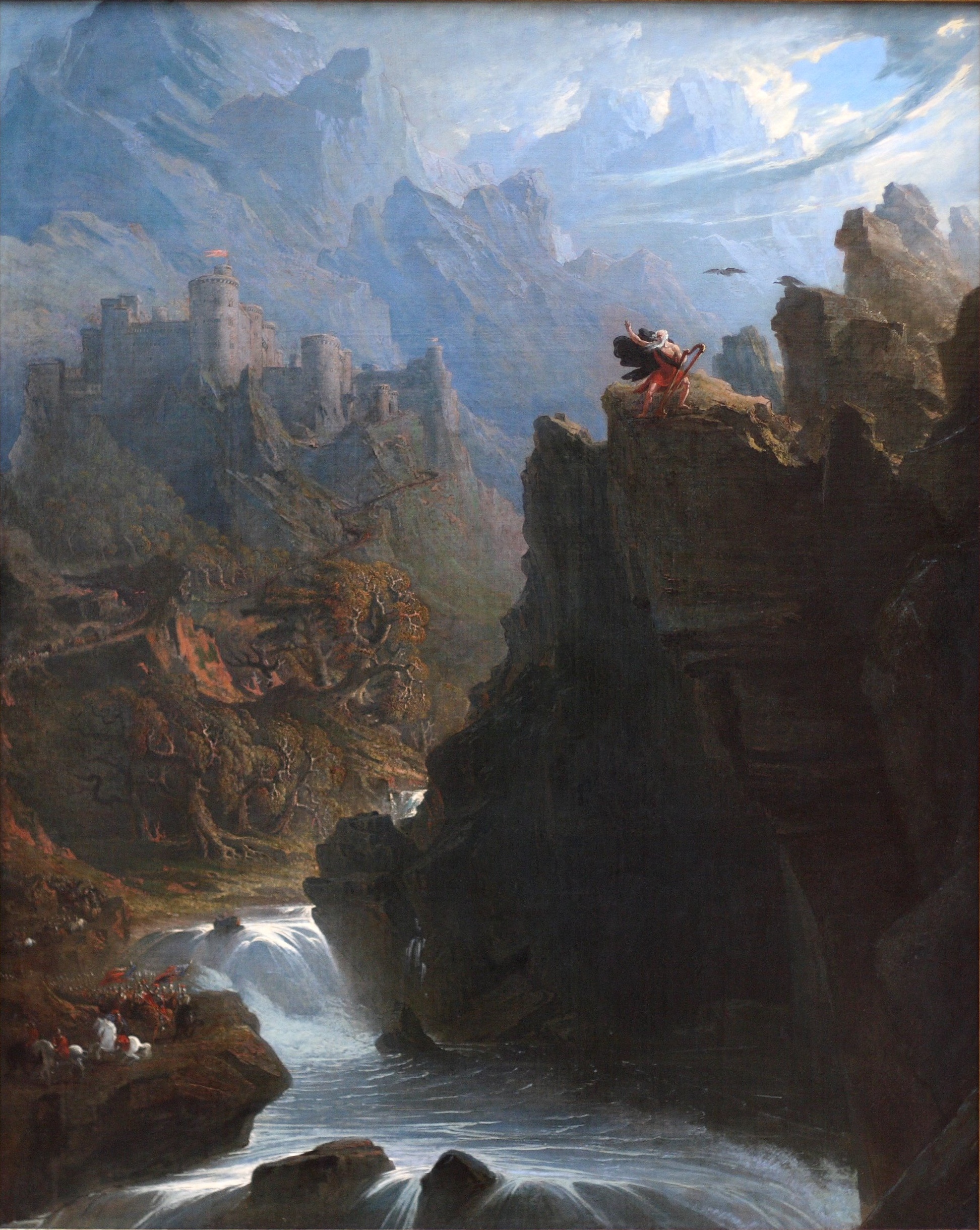
Martin's shortcomings are more evident when you see the paintings up close: The Bard
for example often gets reproduced in books about Romanticism but I'd
not previously been able to see how unconvincing some of its details are - Edward I's army a line of little tin soldiers
trailing all the way back to the castle gate. Yet there's still something awesome about these blockbuster paintings (at least that's what the adolescent Chris Foss fan I used to be was telling me) and the exhibition was also fascinating for the way it highlighted Martin's less well known activities - as a decorator of plates, an illustrator of prehistoric creatures (Gideon Mantell's The Wonders of Geology) and a painter of modest topographical water colours, like some views of Richmond Park where, like Edmund Spenser in Ireland, he had an oak tree named after him (how many writers and artists are commemorated in this way I wonder?)
Perhaps the most surprising exhibits were two examples of his schemes to improve the city of London. The first, which might have been drawn by a 1970s land artist or a 1990s psychogeographer, was his plan for a London Connecting Railway - a beautiful curving form superimposed on a map, like the outline of an octopus. The other was a drawing of a sewer housed in a new Thames embankment, stretching from 'the Ranelagh Outlet to the Engine Station': a proposal considered seriously at the time but easy to view as one more facet of Martin's capacity to dream up imaginary cities. (It made me think of today's urban explorers, uncovering tunnels like these and scaling buildings to view the city below from a John Martin perspective.) An excellent article in The Guardian by the John Martin expert William Feaver mentions these engineering projects and claims that Martin 'was ecologically prophetic. In his 1833 A Plan for Improving the Air and Water of the Metropolis
he raised an issue such as had been dismissed by the scoffers who
ignored divine warnings and were swept away in Noah's flood: "Is it not
probable that a too ignorant waste of manure has caused the richest and
most fertile countries such as Egypt, Assyria, the Holy Land, the South
of Italy etc to become barren as they now are?"'
I recently came upon a nice short essay by Kyle Gann called 'American Romanticism: Music vs. Painting'. It discusses nineteenth century music in relation to the paintings of artists like Frederic Edwin Church and Martin Johnson Heade, mentioning in particular three early orchestral works inspired by landscapes: 'The Ornithological Combat of Kings (1836) by Anthony Philip Heinrich (1781-1861), the Niagara Symphony (1854, though it doesn’t seem to have been performed before the current decade) by William Henry Fry (1813-1864), and Night in the Tropics
(1861) by Louis Moreau Gottschalk (1829-1869). All three were based on
New World subject matter – South or Central America in Heinrich’s and
Gottschalk’s cases, like so many of Church’s and Heade’s best paintings.
All three offer effects unknown to European music of the time –
particularly Gottschalk’s pop-music syncopations and the rumble of
eleven timpani with which Fry evokes Niagara’s cascade. All three are
marked by a technical ineptitude that any sensitive amateur could
pinpoint – Heinrich’s marching-band momentum badly needs a rest now and
then, Gottschalk’s harmonic rhythm is deadeningly predictable, and Fry
lapses into Wagnerian banality whenever he’s not being onomatapoetically
athematic. They seem today like brave but Quixotic figures, would-be
heroes whom the passage of time reduces to clowns.'
Frederick Edwin Church, Niagara Falls, 1857
Anthony Philip Heinrich is a particularly interesting figure: a Bohemian wholesale dealer in linen, thread, wine, and other goods who settled in America and only decided to take up music after the failure of his business and death of his wife. According to David Barron, he travelled to Kentucky and in the spring of 1818, where, in a move that anticipates Thoreau, 'he withdrew from the musical society of Lexington, Frankfort, and Louisville and went to live in a log cabin in the woods around Bardstown. This was a significant moment in Heinrich's life, for here he paused to study and instruct himself in the art of music by improvising on the violin, and finally to write down these expressions as vocal, piano, and violin compositions.' His first major publication, a collection of songs and pieces for violin and piano, was called The Dawning of Music in Kentucky or the Pleasures of Harmony in the Solitude of Nature (1820). Like William Henry Fry, he composed a noisy piece inspired by the Niagara Falls, The War of the Elements and the Thundering of Niagara. He was friendly with John James Audubon and in addition to the The Ornithological Combat of Kings mentioned above, composed The Columbiad, or Migration of American Wild Passenger Pigeons. Heinrich's music was performed to acclaim in New York in the 1840s and there were successful concerts back in Prague in 1857, but four years later the old man died in poverty.
John James Audubon, Passenger Pigeon, from Birds of America (1827-38)
The article by David Barron quoted above includes an amusing description of an occasion on which Heinrich was introduced to President Tyler, written by John Hill Hewitt, the piano teacher to Tyler's daughter:
'The composer labored hard to give full effect to his weird production; his bald pate bobbed from side to side, and shone like a bubble on the surface of a calm lake. At times his shoulders would be raised to the line of his ears, and his knees went up to the keyboard, while the perspiration rolled in large drops down his wrinkled cheeks.
The ladies stared at the maniac musician, as they, doubtless, thought him, and the president scratched his head, as if wondering whether wicked spirits were not rioting in the cavern of mysterious sounds and rebelling against the laws of acoustics. The composer labored on, occasionally explaining some incomprehensible passage, representing, as he said, the breaking up of the frozen river Niagara, the thaw of the ice, and the dash of the mighty falls. Peace and plenty were represented by soft strains of pastoral music, while the thunder of our naval war-dogs and the rattle of our army musketry told of our prowess on sea and land.
The inspired composer had got about half-way through his wonderful production when Mr. Tyler restlessly arose from his chair, and placing his hand gently on Heinrich's shoulder, said;
“That may all be very fine, sir, but can't you play us a good old Virginia reel?”'
Rebecca Solnit's A Book of Migrations (1997) was reissued this year and classified as history/memoir rather than travel, though it is ostensibly about a month spent in Ireland. The book circles round the themes of landscape and memory, place and identity, journey and exile, as Solnit ranges across the history and culture of Ireland from the flight of the cursed King Sweeney to the bitter experiences of Travellers in contemporary Ireland. The ways in which Ireland has been viewed through the prism of English cultural attitudes are illuminated by the frequent reminders of her own radically different experiences growing up in California, with its arid landscapes and long, straight roads, short historical memory and assumptions about the possibility of an unpeopled wilderness. At the Cliffs of Moher she looks out at the sea, 'a deeper blue than my own churning gray Pacific, blue as though different dreams had been dumped into it, blue as ink. I imagined filling a fountain pen with it and wondered what one would write with that ocean.'
Cover photo by Dave Walsh who reviews the book on his website.
I'll try to convey here just one of the many interesting points she makes on landscape and culture, although I should stress that the elegance of her argument is difficult to convey out of context. In describing the sixteenth century suppression of Ireland by English colonists and its deforestation for shipbuilding and metal smelting, she also talks about the concurrent campaign to suppress the
Gaelic poets, whose rhymes in praise of military successes were seen as a
kind of propaganda. But 'what is most peculiar about the war against
the poets and trees in Tudor era Ireland is the close involvement of the
two greatest English poets of the age, Sir Philip Sidney and Edmund
Spenser.' Furthermore, these were the two writers who practically created the
English tradition of pastoral poetry. You might think, she wryly observes, that 'a country of
wandering poets and pastoralists should have enchanted the English
rather than appalled them.'
Sir Philip Sidney's father was Lord Deputy of Ireland and urged the English to 'spoil' and take the goods of any 'rhymers' they caught. Sidney himself would later go on diplomatic missions to Ireland for Queen Elizabeth. Spenser went over in 1580 as secretary to Sir Henry Sidney's successor Lord Grey and wrote a lengthy report A View on the Present State of Ireland, which recommends subduing the Irish by starving them. He took over an estate in County Cork, formerly the seat of the Desmond family, and 'immediately became unpopular with the neighbours'. It was targeted by rebels in 1598 - Spenser was lucky to escape to England, where he died later that year. Back in 1589, when Sir Walter Raleigh visited him, Spenser's home 'was surrounded with woods of "matchless height"; a few years later only bare fields surrounded the castle.'
The remains of Spenser's Kicolman Castle, County Cork
For Solnit the shadows of Spenser and Sidney's political lives in Ireland lie across their artistic merit. 'The exquisite poetry of Spenser's masterpiece The Faerie Queene is inextricably linked to his brutal prose A View on the Present State of Ireland ... Should the magical trees he celebrated in the poem be weighed against the trees he uprooted in County Cork? Can one have the latter without the former, since Ireland's lack of a landscape tradition is rooted in its scarred landscape? Can one understand the presence of English literature without the absences of Irish literature? Are the presences in the former, at some level, bites taken out of the latter? Is England gardenlike because Ireland was prisonlike? Does the English pastoral, and the security and abundance it represents, depend on the impoverished land and people of other lands?'
It is ten years since the untimely death of W. G. Sebald and earlier this month there was a special event to celebrate his work and launch Across the Land and the Water: Selected Poems, 1964-2001. There were contributions from Iain Sinclair, A. S. Byatt, Andrew Motion and others who knew him (like poet Will Stone, whose recollections of studying with Sebald were particularly poignant). It was sad to reflect that the last time I had seen translator Anthea Bell on stage it was next to Sebald himself, reading from the recently-published Austerlitz. The crumbling Victorian Wilton's Music Hall was a particularly resonant setting for the readings, and for the performance of songs from Schubert's Winterreise by Ian Bostridge. Hearing the Winterreise in this context prompted thoughts of all the journeys and sadness in Sebald's writings.
There are many clips online of Ian Bostridge performing the Winterreise - the one I've included above is the opening song in the sequence. I thought it would be interesting to provide here short summaries of the cycle's twenty-four songs, to show how many of them start with some aspect of the winter landscape - the rustling sound of linden trees, ice on a frozen river, a tree's last few leaves trembling in the wind. Many of these natural elements are evoked in Schubert's piano score (for example, in 'Der Lindenbaum', 'the piano’s fluttering triplet figuration in E major which opens the song evokes the gentle breezes and whispering leaves of summer: the figure returns later, altered with chromatic harmonies, to depict the cold wind and eerie rustling of the tree in winter, and the young man’s growing sense of delusion'.) Rather than do a plain synopsis I've turned the Winterreise below into a set of tanka-style verses - I know this is a complete travesty (as Mrs Plinius was quick to point out when she saw what I was doing) but I just found it more fun than writing a set of bullet points... I've based this on the English translation at the Lied, Art Song and Choral Text Archive, using Arthur Rishi's titles; you can follow the link to read proper translations, or the original German poems by Wilhelm Müller.
The British Library's Royal Manuscripts exhibition includes books made from the ninth to the sixteenth centuries but begins with the extraordinary collection of Edward IV, including this copy of a French historical chronicle lying open at 'one of the earliest known European paintings in
which landscape is the principal subject.' I've just found that this image also appears in a list of mill images at the Medieval and Renaissance Material Culture site - a good source for other glimpses of landscape in the Middle Ages. What I like about this sort of list is the way it ignores the subject of the picture in favour of an unobtrusive detail - yes, there's an interesting windmill in the illustration below, but you have to drag your eyes away from the gruesome murder to see it (the windmill here nicely balances the clump of trees in a V-shaped composition pointing to the heart of the Roman Emperor). In other images on the site, mills are quietly grinding corn in the background whilst Narcissus looks down at his reflection, King David kneels before God, Elisha raises a woman's son from the dead, Arthurian knights go head to head in a tournament, Priam inspects the reconstruction of Troy, the Romans colonise Latium and ships navigate the coastal waters of Britain.
The assassination of Vitellius in De casibus, first quarter of the 15th century
Writing in The Sunday Telegraph last month, Andrew Graham-Dixon gave a four star review to the British Museum's Landscape, heroes and folktales: German Romantic prints and drawings, an exhibition 'drawn entirely from the holdings of an extremely discerning English private collector, Charles Booth-Clibborn.
On this showing, if his collection could be kept together and perhaps, one day, found a permanent home here, it would transform the representation of German art in Great Britain.' A week later Richard Dormer left the exhibition 'fuming', disappointed not to find 'passion, excess, sweeping
emotion' and regretting that the display left 'what must be enormous gaps': his review for The Telegraph gave it just two stars. I found it fascinating, even though I only had a brief amount of time to look round, and like Andrew Graham-Dixon I was particularly intrigued by the work of Carl Wilhelm Kolbe (1759-1835).
Carl Wilhelm Kolbe, Woodland pool with a man fishing and bystander, detail, 1793
Kolbe was born in Berlin (his father was a gold thread embroiderer) and pursued a career in philology alongside his artistic activities, composing a long book on the French and German languages. It wasn't until 1789 that he decided to train in art at the Berlin Academy and had to put up with being 'a bearded man in his thirties among a flock of boys, ten to twelve years in age'. He then obtained a post as court engraver in Dessau, publishing prints in Leipzig and Berlin and acquiring the nickname Eichenkolbe (Oak Kolbe) because he was so fond of depicting oak trees (he said 'trees have turned me into an artist'). The exhibition includes several examples of pastoral and woodland scenes with some impressive oak trees My photograph above shows a detail from an early etching with some doodles in the margins (the face in profile is possibly a self-caricature).
Carl Wilhelm Kolbe, Et in Arcadia Ego, 1801
Source: Wikimedia Commons
I've always thought it would be fascinating to compile a dictionary of the many sub-genres of landscape art - sous-bois for example, the French term for woodland scenes of the kind shown above. Such a book might include micro-genres particular to specific artists and one of the strangest of these would be Kolbe's Kräuterblätter (cabbage-sheets) - scenes featuring over-sized plant life, like his 1801 version of Et in Arcadia Ego. As Andrew Graham-Dixon writes, these etchings 'plunge
the eye into vertiginous screens of foliage, spectacularly sculptural
blasted trees and writhing, threateningly enlarged clumps of wild
vegetation. It is hard to say if these are dreams of oneness with nature or fantasies of
being consumed by it.' Kolbe himself came to rather regret these later in life, admitting in his autobiography that he had invented these plants 'completely out of my head, and I acknowledge that I was wrong - very wrong - to do so. Their perhaps not entirely unattractive forms may seduce the eye of the unlearned; the critical gaze of the naturalist cannot bear them.'
Between 1968 and 1970 Gerhard Richter painted a remarkable range of 'damaged landscapes', as they are termed by Mark Godfrey, the curator of Tate Modern's Gerhard Richter: Panorama. These include aerial views of cities in thick grey paint, the colour of ash and rubble, that Richter later likened to images of the destruction of Dresden but which might equally be seen as warnings of some future apocalypse. One of these, Townscape Paris (1968), is a painting I referred to rather tentatively in one of my very first blog posts here. At the same time Richter was also painting a very different kind of townscape, reproducing details of architectural models, and these too seem dystopian - windowless blocks showing no sign of life, casting shadows over empty white roads that resemble the patterns on a circuit board.
Another monochrome aerial view from 1968, Clouds, provides glimpses of an abstracted version of the German countryside - imagery that Godfrey compares to the opening sequence (above) of Leni Riefenstahl's Triumph of the Will (1935). Two years later Richter began a very different series of cloud paintings, this time treating them as isolated objects, white against featureless blue-green skies. They resemble Alfred Stieglitz's famous cloud photographs, Equivalents
(1927), which in turn (as Rosalind Krauss points out in that
weighty tome Art Since 1900) could be viewed as Duchampian readymades - uncomposed and
detached from their environment. Alps II (1968) might be a close-up of a storm cloud and is barely recognisable as a landscape painting, certainly a long way from the heroic image of German mountains celebrated in those early Reifenstahl films.
Seascape (Sea-Sea) (1970) is described in the exhibition as a 'collage of two
photographs of the sea, one inverted to appear as the sky. The painting
creates a momentary illusion of a coherent seascape, until it becomes
clear that the ‘clouds’ in the upper half of the painting are waves. It
creates a sense of discontinuity and suggests Richter’s acknowledgement
of the gulf separating him from the moment of Romanticism.' It made me think of Rothko's grey paintings, with the patterns of waves replacing Rothko's brushtrokes. Mark Godfrey views them as a cross between Capar David Friedrich and Blinky Palermo: an attempt at the kind of radical abstract statement Palermo was making in his Cloth Paintings using the traditional medium of a seascape. Another point of comparison is Vija Celmins and, like her, Richter also produced images of black and white fields of stars.
In 1971 an exhibition of Richter's recent work, painted in flat colour rather than black and white, prompted various critics to compare him with Friedrich. Landscape near Hubbelrath (1969), for example, shows an empty view with a road sign where we expect to see, in Friedrich, a church spire. Richter said that his art lacked the spiritual underpinnings of Romanticism: 'for us, everything is empty'. However, Mark Godfrey argues that Richter and Friedrich both aimed to create a sense of unfulfilled desire (readers of this blog may recall an earlier post on the way Friedrich composed 'obstructed views'). This approach may have seemed particularly appropriate to a post-war German artist working at a time when the purpose of painting itself was being called into question.
There is one more interesting example of Richter's engagement with Friedrich later in the exhibition, a painting called Iceberg in Mist(1982). I have mentioned various artists here before who went north to paint the Arctic seas - Peder Balke, Lawren Harris, Per Kirkeby - and Richter made his own trip in 1972, looking for a motif as powerful as Friedrich's The Sea of Ice. Mark Godfrey mentions that on his return Richter made 'an extraordinary and little-known book of black and white photographs of icebergs', printed, like the two halves of Seascape (Sea-Sea), both upside down and right side up. In this way Richter rejected the single sublime image and arranged the photographs in such a way that 'their overt subject became more or less irrelevant.' Richter's urge to thwart our desire for spectacular landscapes is also evident in the later painting, where we cannot even glimpse the tip of the iceberg as the whole view is shrouded in mist.
About this time last year, influenced by all those end of year lists, I posted ten examples of landscape music
released in 2010, along with accompanying YouTube clips (nine of which still work). Here is
a similar list for 2011 and once again it is not supposed to be definitive; I'd certainly be interested in any additional comments and suggestions. I did a post earlier this year on Toshio Hosokawa's Landscapes so am not including that. And, as I have discussed it before, I'm excluding Richard
Skelton's Landings, another version of which appeared this year (the expansion
of this project reminds me of the way Robert Burton kept adding material to The
Anatomy of Melancholy).
(1) The obvious place to
begin is with Chris Watson, whose El Tren Fantasma, based on recordings of
the old Mexican ghost train, has been widely praised. The
soundscape is not restricted to the railway tracks, as you can hear from the
SoundCloud extracts below (sections 3 and 5, 'Sierra Tarahumara' and 'Crucero La
Joya'). A BBC review describes the wild countryside through
which the train passes: 'brushwood and tall grass sway beneath the breeze
crossing canyon slopes, while constant cicada chatter is punctuated by the
distinctive calls of woodpecker and crow.' This was not the only Chris
Watson release this year - Cross-Pollination, also on Touch, includes 'The
Bee Symphony', created with Marcus Davidson, and 'Midnight at the Oasis' - recorded out in the Kalahari desert and nothing to do with the 1974 Maria Muldaur
hit.
(2) Water
Beetles of Pollardstown Fen, was released by Gruenrekorder
shortly before they announced the premature death of its creator, sound
artist Tom Lawrence. This is a very specific take on a landscape; as one
reviewer says, 'Pollardstown Fen is an ancient, 500-acre,
spring-fed alkali marsh in County Kildare, 30 miles west of Dublin, but to
listen to these hydrophone recordings by Irish musicologist Tom Lawrence, you’d
think it was a well-stocked video arcade circa 1985.' Whilst Chris Watson's El
Tren Fantasma was directly inspired by Pierre Schaeffer's musique concrète,
the sense in which a record like this qualifies as 'music' is quite debatable. Richard Pinnell has written
that 'aside from some tastefully simple crossfades there isn’t any editing,
enhancements or attempts to sculpt these recordings into anything more than the
remarkable audio photographs that they are.'
(3) On a
different scale entirely, I think it is relevant here to mention Björk's Biophilia,
a multi-media project of cosmic ambition based on elements of
nature and the landscape, like the sound of thunder and the cycles of the moon.
(I think it would be too much of a stretch to include in this list Kate
Bush and her fifty words for snow...) Björk's live shows have featured new instruments devised for the project - the track 'Solstice' for example
evokes the rotation of the Earth through the rather beautiful sound of a pendulum
harp. The accompanying iPad apps makes me wonder
how far these could be used to develop new genres of landscape art. But despite the involvement of Sir
David Attenborough, no less, these still sound limited: the app for
'Crystalline' for example comes with 'a game, in which you
collect crystals in a tunnel as the song plays.' We just stuck to buying the
actual album.
(4) Earlier this year I wrote here about J. A. Baker's book The Peregrine but had not then listened to the Lawrence English album inspired by it. Matt Poacher reviewed it for The Liminal and identified the way the music seeks to imitate the movement of the hawk: 'the roar of the surface drones do have
the feel of the upper air, and the granular detail becomes like the
murmarations of desperate starling or lapwing flocks, banking and
swarming in the viciously cold winter wind. ‘Frost’s Bitter Grip’ and
‘Grey Lunar Sea’ also manage to portray, using a mixture of high thin
metallic and broader cloud-like drones (not dissimilar in texture to
some of the sounds Basinki captures in the warping tape recordings of
the Disintegration Loops), the shattering cold of the winter of 1962/3,
during which countless birds died and significant parts of Essex’s North
Sea coast froze for months on end.'
(5) Canadian ambient composer Scott Morgan (who records as Loscil) has named all
the tracks on his new album after features of the Coast Arc Range. Although he uses field recordings the music is mainly built up from slow waves of synthesiser. Appropriately enough it was released by the Glacial
Movements label, whose mission statement may sound better in the
original Italian but certainly makes clear what they are aiming for in their artists' 'glacial and isolationist ambient' music: "Places that man has forgotten...icy landscapes...fields
of flowers covered eternally with ice... Icebergs colliding amongst
themselves..The boreal dawn that shines upon silent white valleys in the Great
Northern lands...an explorer lost among the Antarctic glaciers looking for the
way home..."
(6) Guitarist Jon Porras records drones with Evan Caminiti as Barn Owl and has put out solo recordings as Elm. Undercurrent is the first release under his own name and is described as 'California Gothic set to the tidal rhythms of the Pacific and tuned into the metabolic pathways of the northwest coast ... a love poem to the mist, a prayer cast in ghostly reflected guitar and deep pools of distortion'. Opening with 'Grey Dunes' (clip below), the album moves on to tracks with titles like 'Seascape', 'Shore' and ends gently with 'Land's End' and 'Gaze'.
(7)
Following last year's round-up, Matt Poacher (whose blog Mountain 7
takes a particular interest in landscape and music) left a comment referring me to The
Lowland Hundred. I was therefore interested to read his
comprehensive review this year of Diffaith, a project by The Lowland
Hundred's Tim Noble. 'East of Aberystwyth is a tract of wild country, windblown and empty.
Colloquially it is known as the desert of Wales – not because of a lack of
rainfall but because of this character of emptiness...' Diffaith (Welsh for 'wilderness') comprises six
tracks and three complimentary short films (you can explore it further on Tim Noble's website).
According to Matt,
the album's centrepiece 'is a vast, monstrous thing, named for the blasted
valley floor of ‘Llawr-y-cwm-bach’. The track is dominated by long periods of
near-silence, punctuated with huge walls of Stephen O’Malley-like guitar that
threaten to tear the fabric of the track apart. If Noble’s aim was to make it
sound as if the very land were voicing some primeval shriek then he has
succeeded. Christ alone knows what went on down there, but this sounds like a
howl from the void.'
(8) Tim Noble , The Lowland Hundred (whose new album Adit has just been released) and Hallock Hill (whose music Matt locates 'at the intersection between landscape and memory') release their records through Hundred Acre Recordings. Another small label whose name would lead you to anticipate music with a landscape theme is Wayside and Woodland Recordings, run by epic45, who been recording pastoral indie pop for some years now and this year released an album called Weathering. Tracks like 'With Our Backs to the City' (below) have reminded reviewers of Mercury Rev's Deserter's Songs - 'yet where Mercury Rev seemed to find what they were looking for in the
Catskill Mountains, the best epic45 offer is a fleeting glimpse of
salvation; the occasional burst of sunlight through a blackened sky.'
(9)
It is now five years since I first discussed the Ghost Box
label on this blog and excellent new releases continue to appear - this year's highlight was As the Crow Flies, an album by Jon Brooks (The Advisory Circle). Also this year, Jim Musgrave, who works with Ghost Box's Belbury Poly, put out an album as Land Equivalents called Let's Go Orienteering which he describes as 'half-remembered educational films, imagined landscapes, foreboding
woodland trails and a last minute dash towards a promised utopia'. This combination sounds very familiar now but there are still more musicians wanting to follow these foreboding woodland trails. The Ley Hunter's Companion by Sub Loam for example is packaged as another piece of aural psychogeography and described as 'two extended synthesiser and sequencer trips
over the summer countryside.'
(10) As I reach the end of this post I realise it's as much a list of record labels as artists, and the final label I want to mention is Another Timbre. Their recent releases featuring field recording include Tierce, with Jez riley French, and a CDr from Anett Németh ('A Pauper’s Guide to John Cage' and 'Early Morning Melancholia
Two') which Richard Pinnell praised highly on his excellent website. But the album I'm highlighting here is Droplets by the trio of Dominic Lash, Patrick Farmer and Sarah Hughes because it includes a performance of Maria Houben's 'Nachtstück' recorded out in the landscape (a wood near Hathersage in Derbyshire to be precise). Dominic Lash says that they didn't anticipate in advance accompanying the sound of a rainstorm: 'The plan was simply to record the piece outdoors; we were hoping for a rain-free
window. But when the rains came, some way into the piece, they weren't especially
heavy so I decided to keep on playing, hoping it would just be a brief shower. It
turned out to be a little bit more than that...'
On Tuesday I attended the dedication of the memorial to Ted Hughes in Poet's Corner. Poems were read by Juliet Stevenson, Seamus Heaney and Daniel Huws (the Welsh writer who knew Hughes at Cambridge); there is a Channel 4 news clip which gives a sense of the atmosphere there. The readings took place in front of Chaucer's tomb, which brought to mind that poem in Birthday Letters where Hughes remembers Sylvia Plath declaiming Chaucer to a field of cows, who seemed enthralled, 'ears angling to catch every inflection.'. Perhaps it would have felt more apt to have heard Hughes's poems out in the landscape, but there in the Abbey, he was connected to a tradition of English poets that began with Cædmon, who found his voice whilst caring for the animals at the monastery of Streonæshalch. Seamus Heaney made a short speech in dedication, invoking the closing lines of Beowolf where a memorial mound, high on a headland is built for the dead hero, 'far-famed and beloved'. The inscription on this new memorial comes from one of the poems in River (1983), 'That Morning', in which Hughes recalled standing solemnly 'in the pollen light / Waist-deep in wild salmon.' It seemed a moment of blessing, as if the fish had let the world as it is pass away: 'there, in a mauve light of drifted lupins, / They hung in the cupped hands of mountains...'
"As my work was often compared to the French Impressionist movement, I decided to follow their traces in Normandy. Filming on the same spots where Monet or Corot used to paint, I will create a kind of Impressionism 2.0" - Jacques Perconte
Impressions: Voyage en Normandie is the latest in a series of digitally manipulated landscape films made by Jacques Perconte. The 'actual' view (at least as seen through the camera lens) gradually pixelates and transforms into something more strange. The films enter a kind of 'Impressionist' phase where light patterns and subtle motion in nature are slowed and attended to. But the moving images soon start to resemble Symbolism, Fauvism and eventually Abstract Expressionism - trees turned into jagged patches of colour like a Clyfford Still painting, the horizon flickering like a Barnett Newman zip line. 'We no longer see the image of the landscape, we see the landscape of the image' Perconte says. Violaine Boutet de Monvel has written of a moment in Après le feu, filmed from the back of a train, where a gap appears to open up under the tracks, transforming the real topography. Perconte is interested in this re-imagining of the familiar - as he followed in the footsteps of the Impressionists, he sensed that their landscape was still present, despite the constant movement of clouds and restless activity of the sea. This process tends towards the dissolution of familiar landscape elements into a vision of pure colour. In Perconte's notes on Impressions he quotes Rousseau, losing himself in a reverie and feeling objectes slip away so that he feels nothing but the whole: 'Alors tous les objets particuliers lui échappent; il ne voit et ne sent rien que dans le tout.'
The artist has posted numerous Vimeo clips, photographs, production notes and comments on his own site and his technart blog. I'll end here with a recent film I'll be thinking of on my next train journey: a view of nondescript fields under a grey sky which briefly disappears as the train enters a cutting, only to re-emerge partially smeared away, as if to reveal the software behind this fake landscape of tree forms and wind farms, then progressively changes until we are left with just a few remnants of distorted colour before the screen goes white.
Three years ago the Folio Society published a new edition of William Daniell's A Voyage Round the Coast of Great Britain. The original book came out in eight volumes between 1814 and 1825, contained 308 hand-coloured aquatints and sold for £60 ('one and a half times what a fisherman or sailor aboard a merchant ship could expect to earn in a year at the time'). A second hand copy of the Folio version (in the excellent Much Ado Books shop) cost me rather less than this. It includes only 114 of the best aquatints and cuts out almost all of the rather dry commentary Daniell wrote, replacing it with extracts from the writings of contemporary travellers. The original intention was for Richard Ayton, an aspiring writer and friend of the family, to accompany Daniell on his travels. But the two of them parted acrimoniously after the first year, having got as far as southern Scotland (the Voyage commenced at Land's End). Daniell pressed on alone, returning to his coastal journey every summer, delayed only by famine in Scotland (1816) and economic crisis and fear of revolution in England (1819). Ayton never did become a successful author and his short life came to a sad end the year Daniell finally completed his great project. The cumulative achievement of the Voyage was recognised by the Royal Academy, who elected Daniell a full member in 1822 - as C. J. Shepherd notes in his introduction, 'the artist that he beat to secure his lifetime's ambition was John Constable'.
Among the texts assembled to accompany Daniell's aquatints in this edition, the most vivid impressions of the coastal landscape are provided by writers like Keats, Southey, Scott and Dorothy Wordsworth (whose travels in Scotland I have discussed here before). But the book encompasses many other interesting voices - Joanna Schopenhauer at Lancaster, Jane Austen at Lyme, the 'exquisitely fashionable' Hermann von Pückler-Muskau in Brighton, James Johnson, author of 'An Essay on Indigestion; or Morbid Sensibility of the Stomach and Bowels', in Liverpool, a gentleman called Charles Cochrane who for some reason went to Margate disguised as an itinerant Spanish gypsy guitarist, the ornithologist Charles Fothergill who visited Flamborough Head 'resplendent in 'white and green hat; a Belcher neckcloth with my short collar appearing over it; a dark green jacket with silver buttons; [and] sky blue pantaloons'', composer Felix Mendelssohn, who sent home a few bars of music which would become the Hebridean Overture, and the 'excitable young Polish tutor and future revolutionary' Krystyn Lach-Szyrma, who was so overwhelmed by Fingal's Cave, a 'glorious cathedral made by nature's hand', that he threw himself into the sea.
Cover by David Eccles,
after William Daniell's In Fingal's Cave, Staffa
In his Preface to A Voyage Round the Coast of Great Britain, Robert Macfarlane writes that seeing Daniell's aquatints leads us to imagine Britain only by its outline. 'The interior falls away, and all that is left is the frame. And what a frame it is! Some 7,500 miles of coastline, forming a continuum from storm-crashed headlands to beach-front amusements, from salt-marsh to heathland, from 400-million-year-old gneiss to endlessly recast mudflats.' With this in mind it is clearly impossible to pick out a typical view - the two shown below I liked for the non-naturalistic regularity of their rock formations and the precisely distributed seabirds and grazing sheep. Yet despite their variety all of Daniell's aquatints have the same harmonious, muted palette of slate blue, grey green and pale browns. He may, as Macfarlane says, portray all kinds of meteorological conditions - 'a doldrummish sea day in Ilfracombe, sails drooping in the heat, gives way to a Force 7 off Holyhead' - but the weather somehow always looks British.
Near view of one of the Shiant Isles
Needles Cliff and Needles, Isle of White
William Daniell's journeys coincided with the rise of picturesque tourism and bathing resorts, the Napoleonic Wars, the Highland Clearances and the rapid development of industry and infrastructure. Robert Southey, for example, toured the Highlands with Thomas Telford, whom he nicknamed Pontifex Maximus, the great bridge builder. In one of this book's extracts from Southey's Journal of a Tour in Scotland in 1819, the conversion of the Marquess of Stafford's estate's into extensive sheep-farms is criticised: 'a quiet, thoughtful, contented, religious people' forcefully transplanted from the glens to the sea coast. At the other end of Britain, Dover had recently been scarred by vast new fortifications to keep out the French, a fact that William Cobbett found perplexing - 'what the devil should they come to this hill for, then?' He concluded bitterly that 'more brick and stone have been buried in this hill than would go to build a neat new cottage for every labouring man in the counties of Kent and of Sussex!' Shakespeare's Cliff (which I have written about here before) was also visited by artist Benjamin Robert Hayden who stood looking at it, 'almost lost in the embruno tint of twilight'. There he imagined 'a Colossal Statue of Britannia' built on top of it, 'surveying France with a lofty air.'
I could go on, but I'll end this post at Lulworth Cove, where Daniell painted the rocky outcrop of Stair Hole with its striking recumbent folds. The book includes an extract from the recollections of the Irish playwright John O'Keeffe who spent a summer at Lulworth with his children. As soon as he arrived, O'Keeffe set off with his son, called Tottenham, to explore the Cove itself and the craggy rocks above. At the end of the day 'we returned to our abode with appetites sea-sharpened, and sat down to a roast loin of lamb, delicate boiled chickens, tongue, green-peas, young potatoes, a gooseberry pie, thick cream, good strong home-brewed ale and a glass of tolerable port-wine.' Next morning they were off again, climbing Hanbury Hill where O'Keeffe recorded two of the local landscape terms - patches of land called 'knaps, larger or smaller, each divided from the other by a grassy rising, termed a launchet.' Tired from the climb, he and Tottenham sat down to look at the view - 'before us, the great expanse; above, the blue serene; around, the melody of birds; scarce a breath from the still bosom of the deep, and the vertical sun shedding his glories on the scene. Neither the scream of sea-gulls, crows, and puffins, could prevent me falling into a slumber, and, in a sort of sweet demi-dream, I could hear the rushing pinions of birds that must have flown by very near me, and felt the rabbits that I fancied ran over me.'
I came across Derek Watkins' excellent map, showing the distribution across America of different toponyms for 'river', on the Spatial Analysis blog (where James Cheshire has added his own UK version). It reminded me that I have been meaning for some time to do a post here about Home Ground: Language for an American Landscape, edited by Barry Lopez and Debra Gwartney and compiled by a team of writers between 2002 and 2006. Robert Macfarlane described this book in a wonderful essay published last year ('A Counter-Desecration Phrasebook'): 'Its ambition was to retrieve, define and organise nearly 1,000 terms and words for specific spects of landscape. Its ethical presumption was that having a language for natural places is vital for two reasons: because it allows us to speak clearly about such places, and because it allows us to fall into the kind of intimacy with such places which might also go by the name of love or enchantment, and out of which might arise care and good sense.'
So what does Home Ground have to say about these river terms? For the first one, BRANCH, the reader is referred to FORK and the entry, written by Bill McKibben, describes some of the geographical variation evident in Derek Watkins' map. Easterners are likely to call forks branches, tributory is used elsewhere, 'and those in west Texas would call smaller forks prongs.' His example of a 'prong' is the North Prong of the Little Red River Fork in Briscoe County Texas. RUN, according to Kim Barnes, always denotes movement and 'can refer to any small stream, brook, creek, rivulet, channel, overflow, or swiftly flowing watercourse.' Early Virginian settlers, naming the landscape, came to think in terms of a hierarchy by size: rivers > creeks > runs. BROOK needs no explanation, but KILL? It is the Dutch word for brook and appears in the name of landforms of the Hudson and Deleware Valleys, most famously the Catskill Mountains. The term is not seen in the lower Hudson Valley, probably because, as Jan DeBlieu explains in Home Ground, the Dutch colony was subsumed into the surrounding English speaking culture after the capture of New Netherland in 1644.
Often the authors of Home Ground include illustrative quotations from American literature, like the 'dark stream shooting along its dismal channel' in
Melville's Typee. Gretel Ehrlich's entry on STREAM describes it as a dynamic force that 'receives, and thus reflects, the abuses that have taken place on the land.' The next few terms, BAYOU, SWAMP and SLOUGH, sound aything but dynamic. 'The bayous are spaces of open water, sluggish or stagnant' and a slough 'is a narrow stretch of sluggish water in a river channel'. The city of Chicago is built on filled sloughs. The word bayou is derived from the Choctaw word for a small stream, bayuk. Okefenokee Swamp gets its name from a Creek Indian word meaning 'Land of the Trembling Earth'. A Harry Crews quote explains why: 'most islands in the swamp - some of them holding hundreds of huge trees growing so thick that their roots are matted and woven as closely as a blanket - actually float on the water; and when a black bear crashes across one of them, the whole thing trembles.'
With the word WASH we move into the American Southwest : Carrizo Wash in Arizona, Hunter's Wash in New Mexico. These are areas of land over which 'subtle contours allow water to flow, or "wash", from elevated to lower zones.' ARROYO can be used to describe the same general feature, or, more specifically, a steep-walled, flat-bottomed creek. Either way it is ephemeral, 'carrying water only briefly during such events as spring runoff or the summer monsoons.' Two more Spanish terms complete the map: RIO and CAÑADA, 'a wetland rich with river reeds'. The words RIVER and CREEK are also included but, are so common that they have been coloured grey. Here in Britain, a creek is a saltwater inlet or the estuary of a stream. In the entry for 'creek' in Home Ground, novelist Charles Frazier explains that the term spread to mean any flow smaller than a river. 'In a few places, though, a distinction was retained. M. Schele DeVere, in his 1872 Americanisms: The English of the New World, put it succinctly: "The kill of New York is a brook in New England, a run in Virginia and alas! a crick or creek, almost everywhere else."'