Showing posts with label Barry Lopez. Show all posts

Sunday, January 08, 2017

Terra Incognita


Sara Wheeler's Terra Incognita was published twenty-one years ago, before the hundredth anniversaries of the expeditions led by Scott, Shackleton and Amundsen.  Reading it recently, I wondered if we have been living through a golden age of artistic exploration, with a new series of 'firsts', as writers, filmmakers, sound artists and photographers have followed in the footsteps of the explorers and scientists, recording the environment or making site-specific work on the ice.  Perhaps this pioneering period can be said to have come to an end with the first Antarctic Biennale.  According to an article in Slate, 'the current plan is for the artists to construct installations in Antarctica that will be documented and removed, and then to show some of the works later in Venice. The culturati have officially reached the end of the world.'

For most of her stay in 1994-5, Sara Wheeler was hosted by the US National Science Foundation's Antarctic Artists & Writers Programme.  Their website provides a fascinating insight into the range of cultural work that has taken place under its auspices.  There are very few household names - the most famous is Werner Herzog, who made his enjoyable documentary Encounters at the End of the World there in 2006 (the shot of a penguin walking in the wrong direction to certain death has become famous).  Herzog's musical collaborator Henry Kaiser had already been there and it was footage he had taken on his trip that persuaded Herzog to take on the project.


The list of people who preceded Sara Wheeler on the program is not long - some historians and science writers, illustrators and photographers (who must all go south highly conscious of the heroic efforts of Ponting and Hurley) and one poet, Donald Finkel, who wrote two books about Antarctica.  Barry Lopez went too - the program's website lists two articles, published in 1989 and 1994, and "future book." Wheeler mentions Lopez once or twice in Terra Incognita.  She recalls how Ranulph Fiennes had scoffed at the idea that the Antarctic can provide a transcendental experience: "I prayed for help there, but I would have done so in Brixton.  Mr Lopez writes about it but he's hardly been there at all." Wheeler's footnote to this: 'Lopez is an established and highly respected author who has visited Antarctica five times.  His trips were not exercises in seeing how dead he could get - he went to see, and to learn.'
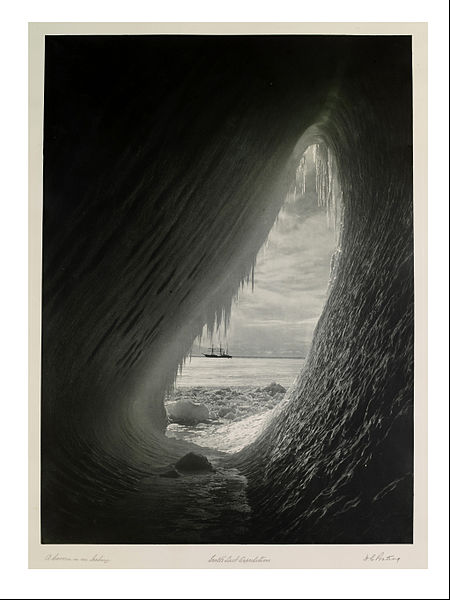
Herbert Ponting, A Cavern in an Iceberg, 1910
Source: Wikimedia Commons

Interestingly, according to the list, Kim Stanley Robinson was in Antarctica at the same time as Sara Wheeler.  I rather wish they had encountered each other because she is quite amusing on cultural differences between America and Britain.  Her book was conceived and written in the tradition of British travel writing (her favourite is The Road to Oxiana) whilst Robinson was researching his science fiction novel Antarctica.  The one other artist she did spend time with on her second trip, which coincided with the end of the Antarctic winter, was a watercolourist called Lucia deLeiris.  They shared a hut on the frozen sea and there, she writes, 'the landscape spoke to me so directly that it no longer seemed to be made of corporeal ice.'


At the end of the book, before leaving Antarctica, Wheeler returns to the Dry Valleys where she had experienced a memorable hike the previous summer.  On that earlier occasion she had been visiting scientists studying Lake Fryxell, its surface 'filled with tiny white bubbles and twisted into apocalyptic configurations - a fall might land you face down on a sword reminiscent of Excalibur.'  The opportunity arose to take a walk up the valley, the passing Suess and Canada Glaciers, where she noted a mummified seal on the moraine, and coming eventually to Lake Bonney, where 'ribboned crystals imprisoned in the ice glimmered like glowworms.  It was swathed in light pale as an unripe lemon.'  Now, months later, after the long polar night and a brief return to England, she was back.  
'I knew this landscape, but I had never seen the pink glow of dawn over the Canada Glacier, or the panoply of sunset over the Suess, or in between, sunlight travelling from one peak to the next and never coming down to us on the lake.  We lived in a bowl of shadow during those days.  One morning the sun appeared for ten minutes in the cleft between Canada and the mountain next to it, and everyone stopped working to look up. The lake was carpeted with compacted snow, and from the middle, where the Canada came tumbling down in thick folds, the Suess was cradled by mountains like a cup of milky liquid.'

Friday, September 16, 2016

The New West

Robert Macfarlane recently chose Arctic Dreams by Barry Lopez as 'the book that changed my life'.  He says 'it struck me with the force of revelation the first time I read it, aged 21 and walking the West Coast Trail on Vancouver Island alone over several days.'  Ten years ago he wrote an appreciation of Lopez for The Guardian which perceptively defines him as 'a postmodern devout. His prose - priestly, intense, grace-noted - carries the hushed urgency of the sermon.'  
'Throughout his writings, Lopez returns to the idea that natural landscapes are capable of bestowing a grace upon those who pass through them. Certain landscape forms, in his vision, possess a spiritual correspondence. The stern curve of a mountain slope, a nest of wet stones on a beach, the bent trunk of a wind-blown tree: these abstract shapes can call out in us a goodness we might not have known we possessed. "In a winter-hammered landscape," he writes, "the light creates a feeling of compassion ... it is possible to imagine a stifling ignorance falling away from us."' 
One thing this article doesn't mention, something you wouldn't necessarily realise if Lopez hadn't written about it in his 1998 essay 'Learning to See', is that for fifteen years from the mid-sixties, along with his writing and scientific pursuits, Lopez actually worked as a landscape photographer.  Why did he stop?  A combination of factors: the accidental loss of a portfolio of his best work, the problem of achieving the kind of detail and colour balance he was after, the realisation that he was too focused on focusing his camera to fully experience what he was observing.  He also became uncomfortable with the way nature photography was heading: dazzling images of animals that were no more realistic than the images in Playboy.  However, some wildlife photographers did manage to approach their work with integrity; he lists Frans Lanting, Michio Hoshino, Gary Braasch, Tui De Roy, Jim Brandenburg, Flip Nicklin, Sam Abell, Nick Nichols, Galen Rowell.

Cover of The New West by Robert Adams (1974)

'Learning to See' begins with a surprise invitation from the Amon Carter Museum in Fort Worth to write an essay on the photography of Robert Adams.  Lopez learns that Adams had suggested his name, despite the fact they'd never met, because he admired his writing.  They have subsequently become friends - an artistic relationship which is discussed in a new book  Other Country: Barry Lopez and the Community of Artists ('for both Lopez and Adams, a worthy artistic expression serves the cultural memory of a community, reminding us how to behave properly toward other people and the land.')  The short essay Lopez wrote for the Fort Worth exhibition suggests that Adams has tried in his images of the American West to get us to consider where we are, and whether we want to be here.  It is evident that we are in a difficult place.  But Adams 'urges us to overcome anger and bitterness, he urges us to be present in the present.  Not to be aloof, unseeing and uncaring.'  This writing certainly has what Robert Macfarlane called the 'hushed urgency of the sermon'.  And Lopez could be referring to his own writings when he says that 'to speak of Adams's work is to speak of faith, of hope, of compassion, of that which is sacred.'

Monday, August 13, 2012

The green chaos

'Always the green chaos rather than the printed map' - John Fowles 

The Tree, the sea, the Cobb

Last week in Lyme Regis I sought respite from the sweltering heat and hard labour of a sandcastle competition by escaping to The Sanctuary Bookshop, where I bought a copy of the original 1979 edition of John Fowles' The Tree with Frank Horvat's photographs.  Horvat is not known primarily as a landscape photographer and his first published books had the unpromising sounding titles, 'J'aime la Télévision' and 'J'aime la Strip-Tease'.  But in 1976, he writes, "I emerged from a long period of self-doubt, which had led me to question my very involvement in photography, both as a photo-journalist and as a fashion photographer. I spent part of that summer in my small property in Provence, pruning trees and putting on paper the few memories of my childhood that I could recollect. At some point, I realised that most of my memories were somehow connected with branches and leaves, and this gave me the idea of a photographic essay about trees."

The text John Fowles wrote after seeing Horvat's photographs also begins in childhood, with memories of the fruit trees crammed into his father's suburban garden.  But his father's expertise in cultivating specimens and Horvat's predilection for 'the single tree, the tree in itself' are at odds with Fowles' experience that truth lies 'beyond the canopy and exterior wall of leaves, and beyond the individual.'  Looking through the book you notice that when Horvat shows trees in combination they have a distinctive formal beauty - the intricate overlapping pattern of bare grey plane tree branches, a group of green poplars arranged like a still life.  But Fowles reminds us that real woodland is 'like the sea, sensorily far too various and immense for anything but surfaces or glimpses to be captured.'  He dismisses the paintings of Hobbema as merely 'townscapes composed with trees instead of houses.'  Art, of course, has 'no special obligation to be realistic and naturalistic' but its reluctance to see and portray the world's interconnectedness 'is symptomatic of a long and damaging doubt in man.'

Meindert Hobbema, Marshy Woodland, c1660

The book ends with the walk through Wistman's Wood that I've referred to here before.  There Fowles experiences the old urge to classify: 'the botanist in me notices a colony of woodrush, like a dark green wheat among the emerald clitter; then the delicate climbing Corydalis claviculata, with its maidenhair-fern leaves and greenish-white flowers.'  But he sits down among the silent trees and concludes that such a place cannot be described in language: 'it can be known and entered only by each, and in its now; not by you through me, by any you through any me; only by you through yourself, or me through myself.'  More than thirty years later the limits of language are still being discussed and The Tree remains, I think, well worth reading. Barry Lopez, in a recent interview about the book, praises Fowles' understanding of the way 'things are held together': 'When you really immerse yourself in the natural world, no matter how many bird guides or explanations you’ve got about what it is you’re seeing, you’re going to be overwhelmed. And the message is, step into it. Don’t try to define nature. It is not definable or controllable. One of life’s great ecstasies is to step into it.'

Saturday, November 19, 2011

The kill of New York is a brook in New England


BRANCH – RUN – FORK – BROOK – KILL – STREAM – BAYOU – SWAMP – SLOUGH – WASH – CAÑADA – ARROYO - RIO 

I came across Derek Watkins' excellent map, showing the distribution across America of different toponyms for 'river', on the Spatial Analysis blog (where James Cheshire has added his own UK version).  It reminded me that I have been meaning for some time to do a post here about Home Ground: Language for an American Landscape, edited by Barry Lopez and Debra Gwartney and compiled by a team of writers between 2002 and 2006.  Robert Macfarlane described this book in a wonderful essay published last year ('A Counter-Desecration Phrasebook'): 'Its ambition was to retrieve, define and organise nearly 1,000 terms and words for specific spects of landscape.  Its ethical presumption was that having a language for natural places is vital for two reasons: because it allows us to speak clearly about such places, and because it allows us to fall into the kind of intimacy with such places which might also go by the name of love or enchantment, and out of which might arise care and good sense.'

So what does Home Ground have to say about these river terms?  For the first one, BRANCH, the reader is referred to FORK and the entry, written by Bill McKibben, describes some of the geographical variation evident in Derek Watkins' map.  Easterners are likely to call forks branches, tributory is used elsewhere, 'and those in west Texas would call smaller forks prongs.'  His example of a 'prong' is the North Prong of the Little Red River Fork in Briscoe County Texas.  RUN, according to Kim Barnes, always denotes movement and 'can refer to any small stream, brook, creek, rivulet, channel, overflow, or swiftly flowing watercourse.'  Early Virginian settlers, naming the landscape, came to think in terms of a hierarchy by size: rivers > creeks > runs.  BROOK needs no explanation, but KILL?  It is the Dutch word for brook and appears in the name of landforms of the Hudson and Deleware Valleys, most famously the Catskill Mountains.  The term is not seen in the lower Hudson Valley, probably because, as Jan DeBlieu explains in Home Ground, the Dutch colony was subsumed into the surrounding English speaking culture after the capture of New Netherland in 1644.

Often the authors of Home Ground include illustrative quotations from American literature, like the 'dark stream shooting along its dismal channel' in Melville's Typee.  Gretel Ehrlich's entry on STREAM describes it as a dynamic force that 'receives, and thus reflects, the abuses that have taken place on the land.'  The next few terms, BAYOU, SWAMP and SLOUGH, sound aything but dynamic.  'The bayous are spaces of open water, sluggish or stagnant' and a slough 'is a narrow stretch of sluggish water in a river channel'. The city of Chicago is built on filled sloughs. The word bayou is derived from the Choctaw word for a small stream, bayuk.  Okefenokee Swamp gets its name from a Creek Indian word meaning 'Land of the Trembling Earth'.  A Harry Crews quote explains why: 'most islands in the swamp - some of them holding hundreds of huge trees growing so thick that their roots are matted and woven as closely as a blanket - actually float on the water; and when a black bear crashes across one of them, the whole thing trembles.'

With the word WASH we move into the American Southwest : Carrizo Wash in Arizona, Hunter's Wash in New Mexico. These are areas of land over which 'subtle contours allow water to flow, or "wash", from elevated to lower zones.'  ARROYO can be used to describe the same general feature, or, more specifically, a steep-walled, flat-bottomed creek.  Either way it is ephemeral, 'carrying water only briefly during such events as spring runoff or the summer monsoons.'  Two more Spanish terms complete the map: RIO and CAÑADA, 'a wetland rich with river reeds'.  The words RIVER and CREEK are also included but, are so common that they have been coloured grey.  Here in Britain, a creek is a saltwater inlet or the estuary of a stream.  In the entry for 'creek' in Home Ground, novelist Charles Frazier explains that the term spread to mean any flow smaller than a river.  'In a few places, though, a distinction was retained.  M. Schele DeVere, in his 1872 Americanisms: The English of the New World, put it succinctly: "The kill of New York is a brook in New England, a run in Virginia and alas! a crick or creek, almost everywhere else."'

Tuesday, November 22, 2005

Salt sea wind


One of Eugenio Montale’s most famous poems, in his first collection Ossi di seppia (‘Cuttlefish Bones’) describes a sunflower, which the narrator wants to plant in a field ‘parched by the salt sea wind’. This phrase is Jonathan Galassi’s translation of ‘bruciato dal salino’ and in his note to the poem he explains that ‘salino’ is a dialect term in Liguria for the wind impregnated with salt from the sea. There seems to me to be so much condensed poetry in that word ‘salino’…

The beauty of local language is not just a question of individual words. In Arctic Dreams (1986) Barry Lopez says that young people struggle to be fluent in Inukituk because it really only comes alive out on the land. For Lopez, language is not imposed on the landscape, it evolves from a conversation, and “a long-lived enquiry produces a discriminating language”.