Saturday, June 28, 2008

A crater formed by a one-ton bomb, or an acre of bluebonnets

Visiting somewhere like Orsanmichele in Florence, we are grateful for the opportunity to see the combined talents of artists like Donatello, Nanni de Banco and Ghiberti, who were each commissioned to provide sculptures for the site. Land art nearly had a special place of this kind: the Dallas-Fort Worth airport. If things had gone differently in 1966-7, the airport could now have had pioneering Earthworks by Robert Smithson, Carl Andre, Sol LeWitt and Robert Morris. Here’s how Robert Smithson described the project at the time:

‘The object of this proposal is to “program” the landscape and define the limits of the air terminal site in a new way. Such a project would set a precedent and create an original approach to the esthetics of airport landscaping. All these works will be close to ground level (the highest being 3 feet). Robert Smithson and Robert Morris will build forms that will be visible to aircraft as they take off and land. Sol LeWitt and Carl Andre will provide works that will deal with the “sub-site,” and exist as underground landmarks.’

The story of the airport project is told in Suzaan Boettger’s book Earthworks: Art and the Landscape of the Sixties. Walther Prokosch, an architect with the Manhattan firm T.A.M.S., had heard Smithson give a talk in June 1966, in which he described the city as a “crystalline network”, an idea similar to the modular design being developed for the airport by T.A.M.S. Smithson was taken on as a consultant and began thinking about the kind of sculpture necessary for an airport. First there could be ‘aerial art’ – large, flat, low lying works placed between the runways and building and visible from the air. Second, there were works inside the terminal but linked to the sites outside – these interior works were ‘non-sites’. Smithson’s proposals include Aerial Map – Proposal for Dallas-Fort Worth Regional Airport (1967), an obvious pre-cursor to Spiral Jetty. In June 1967 he published ‘Towards the Development of an Air Terminal Site’ in Artforum, but that same month funding for Smithson via T.A.M.S. from the airport board ceased and the project never came to fruition.

For his contribution, Robert Morris created a Model and Cross-Section for Project in Earth and Sod (1966). It is a neat, minimal elevated disk, depicting an outdoor sculpture which clearly pre-figures later Earthworks, although not the work pursued in the late sixties by Morris himself, like the pile of soil and industrial detritus made for the EARTH WORKS show two years later.

Carl Andre’s proposal was a crater 12 inches deep and 144 inches in diameter, created by an explosive charge ‘detonated by the sculptor, Carl Andre.’ Smithson published the proposal (with echoes of Vietnam and flower power) as: ‘A crater formed by a one-ton bomb dropped from 10,000 feet, or, An acre of bluebonnets (state flower of Texas)’.

Sol LeWitt proposed to Smithson a kind of anti-monument: ‘encase a six-inch wooden cube containing something in an eighteen inch cement cube and bury it someplace on The Tract. The precise spot would not be designated...’ There is some irony to this given the monumental scale of later Earthworks and the increasing importance of land art sites for cultural tourism. The airport lost its chance to host this early work by Sol LeWitt, but it naturally now has a public art programme, including a piece by LeWitt.

Sunday, June 22, 2008

The Forest of Fontainebleau

Here's a movie quote you'll remember...
"Well, all right, why is life worth living? That's a very good question. Well, there are certain things I guess that make it worthwhile. Uh, like what? Okay. Um, for me... oh, I would say... what, Groucho Marx, to name one thing... and Willie Mays, and... the second movement of the Jupiter Symphony, and... Louis Armstrong's recording of 'Potatohead Blues'... Swedish movies, naturally... 'Sentimental Education' by Flaubert... Marlon Brando, Frank Sinatra... those incredible apples and pears by Cézanne... the crabs at Sam Wo's... Tracy's face..."

Among many reasons why Woody Allen might consider L'Éducation sentimentale one of the things that make life worthwhile are Flaubert's beautiful, precise descriptions of people, things and places. Douglas Parmée has listed some of the landscapes Flaubert includes: Nogent (dull and domesticated), Auteuil (pretty but with a touch of autumn melancholy) and various views of The Seine, which 'flows through throughout the novel, sometimes beautiful but indifferent, sometimes charmingly delicate.' However, the most striking example in the book is the extended sequence describing a brief time of happiness for Frédéric and Rosanette in the Forest of Fontainebleau. According to Parmée it 'has all the immediacy of notes taken on the spot: solemnity and exhilaration, painterly chiaroscuro with cinematic long shots and close-ups, lurking danger (monstrous rocks, smells of decay, leafless branches in midsummer), the delicacy of gossamer and butterflies, glittering water and greenery of every shade, sun and sudden showers, hills and valleys, low bushes and towering trees...' This extract from the French text describes the effect of light on the forest trees:
'La lumière, à de certaines places éclairant la lisière du bois, laissait les fonds dans l'ombre ; ou bien, atténuée sur les premiers plans par une sorte de crépuscule, elle étalait dans les lointains des vapeurs violettes, une clarté blanche. Au milieu du jour, le soleil, tombant d'aplomb sur les larges verdures, les éclaboussait, suspendait des gouttes argentines à la pointe des branches, rayait le gazon de traînées d'émeraudes, jetait des taches d'or sur les couches de feuilles mortes ; en se renversant la tête, on apercevait le ciel, entre les cimes des arbres. Quelques-uns, d'une altitude démesurée, avaient des airs de patriarches et d'empereurs, ou, se touchant par le bout, formaient avec leurs longs fûts comme des arcs de triomphe ; d'autres, poussés dès le bas obliquement, semblaient des colonnes près de tomber.

Cette foule de grosses lignes verticales s'entrouvrait. Alors, d'énormes flots verts se déroulaient en bosselages inégaux jusqu'à la surface des vallées où s'avançait la croupe d'autres collines dominant des plaines blondes, qui finissaient par se perdre dans une pâleur indécise.'

And here's a depiction of the forest trees by one of Woody Allen's favourite artists...

Paul Cézanne, The Forest of Fountainebleau, 1879-82

Source: Wikimedia Commons

Friday, June 20, 2008

Whiling Away the Summer


This is a detail from Whiling Away the Summer (1679) a handscroll by Wu Li (1632-1718). What an enticing image of scholarly retreat! As the Met's curators say, 'there is a dreamlike quality about the painting: birds, trees, bamboo, mist, and even rocks dance joyously around the hermit-scholar, who sits quietly reading in his idyllic domain.' Wu Li wrote that he had painted this landscape 'one clear morning after a rainfall, sitting alone in his studio thinking of an absent friend'.

This work is labelled 'Landscape as Self-Portrait' in the Met's exhibition How to Read Chinese Paintings. Some other highlights:
  • Scholar Viewing a Waterfall by Ma Yuan (act. ca. 1190–1225) where the "one corner" composition contrasts the solidity of rocks and trees, to the misty emptiness beyond the falls. It is similar to Watching the Deer by a Pine-Shaded Stream, which I referred to in an earlier post.
  • Twin Pines, Level Distance by the artist-calligrapher Zhao Mengfu (1254–1322), a landscape which one might describe as having been written... Zhao advocated different writing styles for different landscape elements - unmodulated seal script for trees, 'flying white' cursive script for rocks.
  • Poet Strolling by a Marshy Bank by Liang Kai (act. 1st half C13) in which the inaccessibility of the distant landscape is emphasised by a massive overhanging cliff, partially obstructing the poet's view.
  • Old Trees, Level Distance by Guo Xi (c 1000-90), a misty 'landscape of emotion' according to the Met, who quote from the impressively titled treatise Guo Xi wrote, Linquan gaozhi (Lofty Ambitions in Forests and Streams): 'after the outlines are made clear by dark ink strokes, use ink wash mixed with blue to retrace these outlines repeatedly so that, even if the ink outlines are clear, they appear always as if they had just come out of the mist and dew.'

Monday, June 16, 2008

Paterson

Here's an extract from the interview Robert Smithson gave to Paul Cummings in 1972:

"CUMMINGS: Would you like to say something about your visit with William Carlos Williams?
SMITHSON: Yes. Well, this took place I think in either 1958 or 1959. William Carlos Williams was going to do an Introduction for Irving Layton's book of poems. So I went out to Rutherford with Irving Layton... He talked a lot about Allen Ginsberg coming out at all hours of the night, and having to spring poets out there. Allen Ginsberg comes from Paterson, New Jersey. I guess the Paterson area is where I had a lot of my contact with quarries and I think that is somewhat embedded in my psyche. As a kid I used to go and prowl around all those quarries. And of course, they figured strongly in Paterson. When I read the poems I was interested in that, especially this one part of Paterson where it showed all the strata levels under Paterson. Sort of proto-conceptual art, you might say. Later on I wrote an article for Artforum on Passaic which is a city on the Passaic River south of Paterson. In a way I think it reflects that whole area. Williams did have a sense of that kind of New Jersey landscape."

The strata levels section Smithson is referring to comes towards the end of Paterson Book Three (1949). Williams included an extract from William Nelson's History of the City of Paterson which lists the materials found at various depths when an artesian well was bored at the Passaic Rolling Mill, Paterson. At an initial depth of 65 feet there was "Red sandstone, fine". Then we encounter mostly shale and sandstone at other depths until we reach 2,100 feet down: "Shaly sandstone". The most interesting part of this vertical, one-dimensional landscape seems to occur around 1,170-1,370 feet, with some selenite, pyrites and quicksand. Williams also quoted the conclusion that beyond 2,100 feet there was no point in further digging as water would be unfit for use. This text is juxtaposed in Paterson with extracts from a letter by Ezra Pound exhorting Williams to do more reading, e.g. Golding's Ovid and "all the Gk tragedies" (Pound's canon of good writing as literary historical strata to dig down into...)

Paterson covers many subjects - art, poetry, love, religion, economics... However it starts in the New Jersey landscape: an image of the city lying like a man with his head near the Paterson Falls. Williams quotes his dictum, no ideas but in things, and then describes the view: 'From above, higher than the spires, higher / even than the office towers, from the oozy fields / abandoned to grey beds of dead grass, / black sumac, withered weed-stalks, / mud and thickets cluttered with dead leaves - / the river comes pouring in above the city / and crashes from the edge of the gorge / in a recoil of spray and rainbow mists...' You can hear Williams read these lines here.

In another 1972 interview, with Gianni Pettena, Robert Smithson said "I like landscapes that suggest prehistory. As an artist it is sort of interesting to take on the persona of a geologic agent where man actually becomes part of that process rather than overcoming it - rather than overcoming the natural processes of challenging the situation. you just go along with it, and there can be a kind of building that takes place this way. I did an article once, on Passaic, New jersey, a kind of rotting industrial town where they were building a highway along the river. It was somewhat devastated. In a way, this article I wrote on Passaic could be conceived as a kind of appendix to William Carlos Williams' poem Paterson. It comes out of that kind of New Jersey ambience where everything is chewed up. New Jersey like a kind of destroyed California, a derelict California."

Saturday, June 14, 2008

Toward Albuquerque

While I was in Chelsea (see last post) I popped into the new Chelsea Art Museum. I was practically the only person there - you have to pay to get in whereas all the other galleries are free... I was drawn by the rather ostentatiously titled exhibition Oh ChiGyun: Defining Landscape.

These days landscape painters often seem to need some means of justifying the pursuit of what may seem an exhausted art form. I've remarked here before, how a novel technique may be one way through this problem, and in Oh Chigyun's case the most distinctive element is his method of applying paint by hand. As the CAM site says: 'Some of the things that distinguish Oh ChiGyun's approach to painting are his strong yet sensitive palette, pictures that are highly textured from pigment being amply applied to their surfaces, and his use of other support material other than canvas including found and discarded doors and windows. But the most unique aspect of Oh ChiGyun's art is his technique in which he applies paint to his pictures directly with his hands rather than by brush. Oh ChiGyun's idiosyncratic métier creates an immediacy and intimacy between imagination, subject matter, and artistic execution.'

In addition to his methods, there is the artist's cross-cultural background, coming from South Korea and painting American landscapes. Does this give his paintings a unique flavour, or is this just background information in comparison to the artist's personal vision? A brief essay on the Oh Chigyuan (오치균) website certainly suggests that his art is a fusion of Asian and Western influences. I find his paintings of small details of the urban scene like doorways or rail tracks more impressive than his cityscapes. However, his light effects can be quite startling and simple views of the highway, like Toward Albuquerque (2004), stay in the memory.

Friday, June 13, 2008

A lake at Essen

I had to go to New York last week and once work was over I took myself over to Chelsea to look round the galleries. Matthew Marks has a Katharina Fritsch exhibition (it finishes tomorrow) in which her sculptures are displayed against silkscreen landscapes. For example, there are images of a lake at Essen and rocks in Franken. The White Cube had a similar exhibition in 2006 in which 'Fritsch created a site-specific installation, transforming the exhibition space into a municipal park, or at least the memory of a park that she frequented as a child in the town of Essen. To create these mental landscapes Fritsch created works from postcards sent to her by her grandfather in the 1970s and 80s. These romanticized scenes are set within the industrial landscape of the Ruhr district, referred to by the artist as her 'heimat' or homeland. Transferred onto large, individually silk-screened panels, the single-colour matt painted surface is the result of a meticulous and extremely precise handcrafted printing process that appears deceptively simple. Each panel depicts the scene in a single colour, as if the other colours in the spectrum have faded, over time, by the bleaching of the sun to leave a trace, or a melancholic memory as if viewing the picturesque scene at twilight.'

Landscapes in old postcards inevitably have a sense of poignancy and ghostly nostalgia but there's no reason to suppose contemporary artists can't avoid cliche and make use of them in various interesting ways. Tacita Dean, for example, has pursued a similar approach in works like Crowhurst (2006) - see below (photography is allowed at MOMA!) The MOMA site says that 'a series in which Dean painted out the backgrounds of old postcards depicting trees led her to her own photographs of famous or ancient trees in her native England.' Jonathan Jones has described one of these trees as appearing to 'bulge out of its setting and press forward into the empty air of the gallery, as if the rotten, grey hulk of a graveyard tree she has found in a postcard were reaching towards you on the sticks that prop it up, tapping you on the shoulder, telling its tale. Dean has brushed white gouache, an opaque watercolour, over huge areas of an enlarged black and white photograph to create this bizarre effect. The tree, isolated, stands proud - a solitary survivor, an aged outcast, a watcher over the dead. In terms of its emotional and intellectual impact, this a truly monumental work, and yet this is just a piece of paper pinned to the wall.'

Tacita Dean, Crowhurst, 2006
photographed at MOMA, New York

Friday, May 30, 2008

A Sound Map of the Danube

Annea Lockwood's A Sound Map of the Danube has just been released. The New Music Box has an excellent interview conducted with Lockwood in 2004 in which she describes working on this project. One of the main problems was actually recording sounds that convey a riverscape when the Danube flows through cities that 

"pave its banks with stone and rock. All of them run roads right along the bank [laughs] I haven't recorded the Danube in any of them. I haven't recorded the Danube specifically in Vienna. I went up in the Vienna woods and recorded a tributary. I haven't recorded it in Budapest. I went south of Budapest to an island and found a great recording about a half an hour south of Budapest. Where else have I not recorded the Danube? [laughs] I didn't record it in Belgrade. I wanted to very much. So I went to where the Sava River flows into the Danube thinking, perfect spot, major tributary, major confluence, and there wasn't a peep. Not even a little wave action. I'm recording in tiny little spots, really out of the way places, and finding really wonderful sounds."

In her notes to the album she describes how the landscape 'composes itself': 

"I recorded from the banks, finding a great variety of water sounds as the gradient and bank materials changed, often feeling that I was hearing the process of geological change in real time. Towards the end of the final field trip, while listening to small waves slap into a rounded overhang the river had carved in a mud bank in Rasova, Romania (CD 3 track 2), I realised that the river has agency; it composes itself, shaping its sounds by the way it sculpts its banks."

Lockwood's Sound Map of the the Danube was preceded by her Sound Map of the Hudson River, a brief watery extract of which can be heard here. However, she began recording rivers in the sixties: 

"I started recording rivers back in the '60s, again when I was in England, because I was interested in trying to discover why they are so magnetic to us, why people love to go to river banks, what their ears are reaching for as well as their eyes, and what our bodies respond to in rivers. At the same time I was aware that for city people—many of the world's major cities are on rivers, right—for city people, rivers are usually entirely visual. They're not sonic entities. They're not sound worlds. I wanted to bring a river into the body in a different way than through the eyes."

Postscript April 2021

 This is a screen grab from a short film, 'Annea Lockwood / A Film About Listening' which I watched this week on the Counterflows website. In the thirteen years since I wrote this post Lockwood has made further landscape-related recordings, including A Sound Map of the Housatonic River.


Tuesday, May 27, 2008

Manufactured landscapes


It's a very long way from the subject of my last posting to the industrial landscapes of modern China, explored in Jennifer Baichwal's film Edward Burtynsky: Manufactured Landscapes. Then again, Burtynsky's photographs are still a Western take on China - the exotic Rococo dream replaced by a nightmare of environmental apocalypse...

I tend to agree with Mark Sinker's verdict: "visually, the film is rich and subtle - Burtynsky finds an eerie beauty in the starkest, most poisoned, emptied vistas; what's deathly here is also potent and haunting. The words and music are less successful - the former somewhat diffident and unspecific, perhaps tactically, the latter rather off-the-peg, an Eno-esque soundtrack to an arch suspension of judgement. And the problem of the cliché of the Chinese as a teeming, purposeful yet inscrutable ocean of humanity is perhaps not quite pushed back against as much as it might be."

Sinker may be hinting here that the 'diffident and unspecific' commentary was necessary to get agreement to shoot the film. I suppose I was expecting something more creative, like the poetic science fiction of Herzog's Lessons of Darkness. The relative banality of the narrative in Manufactured Landscape does allow you to focus on the visual imagery, but it left me pondering (no doubt unfairly) whether the photographer and film maker had sufficiently reflected on what they were filming. Sinker provides an example in highlighting the Ballardian landscape of the Chittagong shipbreaking beach in Bangladesh, "where huge rusting tankers sit stranded on otherwise naked mudflats, scavenged and dismantled by local teenagers. We're told almost nothing about this set-up - except that it's very poorly paid and very dangerous - but Burtynsky perhaps judges the force of the image more effective than any lecture about economics or sociology."

How far would the emotions felt two hundred years ago in front of a painting like Coalbrookdale by Night have differed from those experienced by a modern viewer of Manufactured Landscapes. There is the same frightening power to alter landscapes and replace natural with manufacturing forces, and the same human and environmental costs (which were, of course, evident to poets like Blake and Wordsworth). But the sense of scale is far greater in this film - there is something of Kant's mathematical sublime in Burtynsky's photograph of seemingly endless mountains of coal, or in Baichwal's long opening shot of a vast factory floor. The enormity of the Three Gorges Dam, where Burtynsky photographed a city about to be drowned, is difficult to grasp. This awesome construction seems to have been unscathed by the recent Sichuan earthquake, in which terrifying natural forces have created new lakes through landslides, as well as weakening dams built by the Chinese (including one that is over 2000 years old).

Saturday, May 24, 2008

Fishermen in a gorge


Chinoiserie's motifs include chrysanthemums, dragons, pearls, pagodas, Chinese warriors, pigtailed boys and mustachioed monks. Looking round the exhibition 'Chinese Whispers: Chinoiserie in Britain 1650-1930' today, it was clear that in general, landscapes tend to feature as the settings for figures - drinking tea, fishing or walking under parasols. Nevertheless, Stella Beddoe notes in the catalogue that by 1800 the more picturesque figurative subjects illustrating Old Cathay had almost disappeared from mass-produced china in favour of more simple views of gardens, land and waterscapes. The most famous design of all, dating from 1790, features two lovers fleeing a stern father through a landscape that includes a weeping willow and pagoda. It is still ubiquitous - only last week I was eating cake from a willow pattern plate at my mother-in-law's. My grandparents had rows of them all around their dining room.

The catalogue to the exhibition is described here as 'useless', which is harsh, but I would like it to have had a bit more detail in places. For example, it would be good to learn more of William Alexander's drawings, made in Peking in 1793 whilst he was part of the unsuccessful mission to China (the emperor said to the British ambassador "we have never valued ingenious articles, neither do we have the slightest need of your country's manufactures.") The British Library has Alexander's images in their on-line gallery here. And it would also be nice to have had more information on some early (c. 1696) chinoiserie attributed to the engraver, publisher and scenery designer Robert Robinson (?1651-1706): works probably inspired by Chinese export paintings and the illustrations in Johan Niehof's Embassy (trans. 1669). The panel in the exhibition shows a misty and mysterious looking gorge with a fishing boat and figures picking their way along the rocks. There are more of these panels in the V&A.

Sunday, May 18, 2008

Landscapes and Silences

The last two posts have discussed glimpses of landscape in nature poetry and poems of place, history and memory. In contrast, the Irish poet Geoffrey Squires describes landscapes directly but in much more general terms. In Landscapes and Silences (1996) for example, there are only vague clues as to the location: 'ancient stone houses', 'a government hotel' (which government?), 'metal barns on stilts'. And the poet is equally disinclined to pin down details of the natural world: 'on the house a blue climbing plant / whose name I forget', 'the scent of thyme or some other herb', 'some small animal or bird rooting around in the dead leaves.' It seems 'impossible to gather into perception' the 'tangle of nearness', although the mind's 'seeming inability to fix on anything... is itself an advantage'. He writes about a psychological landscape where 'pale white light... seems to drain things of themselves / leaving no substance no solidity'.

The excellent Shearsman Books site includes two free e-books by Geoffrey Squires: Lines (2006) and So (2007). It's worth also looking on their site at a collaboration between Kate Ashton and Gerrit Offringa, Waddenzee (2006), which describes the landscape of Friesland.

Postscript: there is now a French translation of Landscape and Silences...


Thursday, May 15, 2008

The edges of rainflood

Colin Simms is a naturalist and much of his poetry describes landscape incidentally, through the experience of birds and animals. In 'Gos in Autumn' for example, one of the seasonal poems in Goshawk Lives (1995), set 'mainly in Northumberland and North Yorkshire in Northumbria', Simms describes the bird in flight over Crosscliffe and Raincliffe, with the crossgraining of 'leaf and light light leaf light light green light'. The poem soars over hills and dales, noting 'the edges of rainflood', 'anvil clouds on unstable air', 'horizontalling wind', 'ditches white in powderice and ice on old leaves.' There are lines like this: 'mist across rich edges music moving the beginnings of taken ideas and moods dancing on air.' Basil Bunting's influence is clear in the writing, and the last poem in Goshawk Lives describes the arrival of a pair of goshawks on Bunting's birthday, 1st March, 1985.

There is a review of a more recent collection dedicated to the gyrfalcon here and another review of Otters and Martens here - "my problem with this collection of excellent poems is the very strict theme. Every poem is about otters, or martens. It’s true the title is a bit of a giveaway, but even so…" Well I have to admit I wouldn't recognise a goshawk if one ever flew down to Stoke Newington, but I like the idea of a whole volume dedicated to one type of bird. There are five examples of Colin Simms poems online here. And Simms gets a couple of recommendations on this recent thread about nature writing.

Tuesday, May 13, 2008

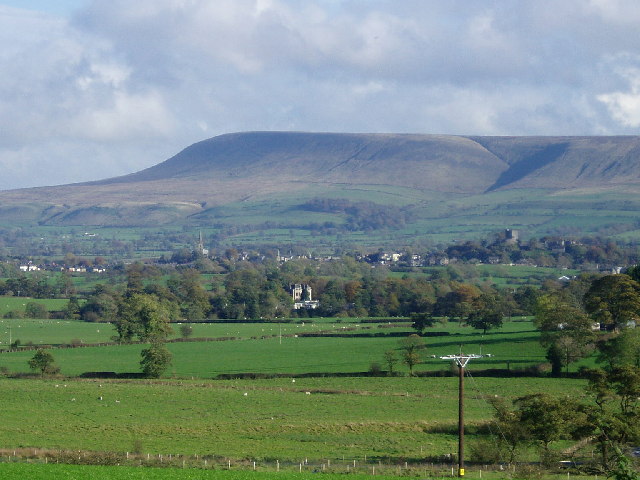
Pendle Hill

Harriet Tarlo’s essay ‘Radical Landscapes’, published last year in Jacket 32 lists linguistically innovative poets who ‘have complex and thought-provoking slants on locality, pastoral, land politics and ecology/environment. A non-definitive list of such writers would include Allen Fisher, Peter Larkin, Tony Baker, Richard Caddel, Alan Halsey, Maggie O’Sullivan, Frances Presley, Elaine Randell, Gavin Selerie, Tilla Brading, Jennifer Chalmers, Thomas A. Clark, Martin Corless-Smith, Ian Davidson, Harry Gilonis, Giles Goodland, Ian Hamilton Finlay, Bill Griffiths, Randolph Healy, Nicholas Johnson, Trevor Joyce, Peter Larkin, Helen MacDonald, Barry MacSweeney, Billy Mills, Geraldine Monk, Wendy Mulford, Peter Philpott, Peter Riley, Jeremy Prynne, Maurice Scully, Colin Simms, Geoffrey Squires and Catherine Walsh.’

You wouldn’t necessarily think of some of these writers as ‘landscape poets’ in the sense of having continually written observational poetry about their environment. Geraldine Monk, for example is someone whose writing, according to Tarlo in another essay, ‘'Home-Hills': Place, Nature and Landscape in the Poetry of Geraldine Monk’, treats landscape indirectly and critically, challenging the ‘idealising and pastoral tendencies common in ‘nature poetry’. Monk’s Interregnum is about Pendle in Lancashire, connecting the present day landscape to its dark history as the scene of the Witch Trials of 1612. It includes a series of modern encounters with Pendle Hill - by hikers, bikers, ‘Born Agains’ and ‘Pagans’, each of whom seem to claim the site for themselves. The poem then turns to a fox (hunted like the witches) and looks down on the human elements in the landscape through the eyes of a bird, soaring ‘across uncontrolled / airspace and / forests’. Here we see another feature of contemporary post-pastoral poetry, a rejection of the anthropocentric and an embrace of the ecocentric.

Pendle Hill
(source: Wikimedia Commons)

So far the only poets in Harriet Tarlo’s list who have been discussed on this site are Ian Hamilton Finlay and Thomas A. Clark. So in my next two posts I intend to say something briefly about two more: Colin Simms (whose ‘Rushmore Inhabitation’ is quoted in the ‘Radical Landscapes’ article) and Geoffrey Squires.

Sunday, May 11, 2008

Ebbsfleet Landmark

An interview in yesterday’s Guardian with Rachel Whiteread is headlined ‘Will Rachel Whiteread, unshowy as she is, be the Britartist who stands the test of time? As her haunting new work is unveiled, Simon Hattenstone reports’. When I read this I did a double take – haunting new work? Then I realised it was referring to an installation based on her collection of dolls houses, rather than her proposal for the Ebbsfleet landmark, which Adrian Searle strongly criticised earlier in the week: ‘Rachel Whiteread's concrete cast of the interior of a house - apparently one she used to live in - stands on a fake mountain replete with chalk escarpments, romantic crags and overhangs. It will be built from the recycled rubble of the emerging new town. I wish she hadn't done this. The whole thing feels recycled and unnecessary, and actually diminishes Whiteread's most famous sculpture, her 1993 House in east London.’ Still, the fact that Whiteread is up for this does suggest we’ve come a long way since Tower Hamlets council demolished House – an action which reminds me of those people who scrub off some Banksy graffiti only to realise they’ve inadvertently thrown away a whole lot of money...

Like Georges Perec in his Species of Spaces, Whiteread has worked her way outwards from the most intimate space of the bed, to the room, to the house and beyond to spaces in the wider world. Now the demands of scale (the Ebbsfleet commission was to make something bigger than the Angel of the North) have taken her a step beyond site specific constructions like the Holocaust Monument in Vienna and into the realm of land art. The use of rocks and rubble in her Ebbsfleet proposal points directly to the work of Robert Smithson. As Jonathan Jones points out, ‘in an age when anxiety about humanity's impact on the planet has never been deeper, it's strange to see statues casually slapped on to seashores and commissioning bodies competing to create the most immense "landmark" to rival Antony Gormley's Angel of the North. The five artists who this week unveiled their proposals for the Ebbsfleet Landmark... are aware of the dangers, and one, Rachel Whiteread, has proposed a sculpture that's explicitly about waste.’

Rachel Whiteread discusses her proposal here. She says “to me, the Ebbsfleet valley is the closest thing we have to America in this country, in terms of industrial landscape - this long flat expanse with buildings that merge into the distance. It's a place I can really relate to.” I’ve not been to Ebbsfleet but it sounds the kind of place Smithson would have been at home in. It also seems to be one of those Ballardian landscapes much loved by English psychogeographers.

Who will get the Ebbsfleet commission? If I were a betting man I’d put my money on Mark Wallinger’s horse to win this particular race. He seems the most popular with the public (at least on this Guardian blog). However, if Rachel Whiteread’s “precipitous, craggy mountain and monument to a generic home and castle” remains no more than a papier maché model, it will still be interesting to see if she if she continues to develop proposals for large scale works in the landscape or returns to more intimate installations and sculptures.

Postscript 2015
Mark Wallinger did indeed win the commission but by 2011 Jonathan Jones was lamenting that his 'wildly ambitious sculpture has been delayed repeatedly because of a lack of money'.  It was apparently costed at £2m originally but the bill rose to £12m, including a budget for removing graffiti over the course of 80 years.  There is still no sign of it being built. Rachel Whiteread's latest public art commission is 'a cast concrete structure resembling an abandoned shed' for Governors Island, New York.

Friday, May 09, 2008

The Zone

Rembrandt, The Three Trees etching, 1643

I was at Tate Modern today for an all day symposium on The Art of Andrei Tarkovsky. It began with a talk by Evgeny Tsymbal who worked on Stalker (1979) and who was partly responsible for the famous dream sequence which you can see in this Youtube clip. After about 45 seconds in this clip some trees appear. I thought these were reflections but they are actually an upside-down image of Rembrandt’s engraving The Three Trees. Tsymbal said he had recalled Tarkovsky’s use of Renaissance art in earlier films and gone to look for some art reproductions in a Tallinn bookshop. All he found that was suitable was this Rembrandt and an image of John the Baptist from Van Eyck’s Ghent Altarpiece.

Three years ago artist Jeremy Millar was also in Estonia to see and film the locations for Stalker. He too found inspiration in a bookshop – a copy of Ajapeegel by Tatjana Elmanovitsh (1980), one of the first books about Tarkovsky. ‘Ajapeegel’ means ‘Time Mirror’ in Estonian and it is the title of a film Millar is making using footage he shot of what must be one of the most memorable landscapes in modern cinema, ‘The Zone’ through which the Stalker leads his two companions. To be honest I was a bit disappointed with the film in its current state – a series of panning shots and a voice over with echoes of Patrick Keiller and W.G. Sebald. Millar and his excellent interlocutor Brian Dillon had both been at the Sebald symposium I reported on last year.

The rest of the day was quite a mixed bag. I was expecting more artists who were explicitly working with Tarkovskian material – it would have been interesting to hear from the University of Westminster’s David Bate, for example, who has also made the pilgrimage to Tallinn to photograph The Zone. The other artists who did attend (in addition to Jeremy Millar) were Hannah Collins, who has recently done some slow tracking shots and long takes in the style of Tarkovsky, and Hannah Starkey, whose interesting photographs didn’t really appear to have been directly influenced by Tarkovsky. Of the other speakers, Toby Litt was entertaining and film critic James Quandt was the most interesting, pointing out Tarkovsky elements, for example, in Bela Tarr’s Damnation (rain, ruin, entropy), in Turkish director Nuri Bilge Ceylan (windblown grass, a muddy path, church bells) and in Carlos Reygadas (a tree and a road straight out of Tarkovsky’s Nostalghia).

One final reflection on landscape and Tarkovsky: in talking to Jeremy Millar, Brian Dillon used an interesting verb to describe the way the Stalker approaches The Zone and contemporary artists deal with place: they try to ‘incite something from the landscape’.

Friday, May 02, 2008

One particular spot in the King's-field


Gilbert White was intrigued by echoes and in A Natural History of Selborne considered the means whereby 'any gentleman of fortune' could create the conditions for listening to echoes in his park by erecting an appropriate structure 'on the gentle declivity of an hill, with a like rising opposite to it... From a seat at the centrum phonicum he and his friends might amuse themselves sometimes of an evening with the prattle of this loquacious nymph.' The text here is from Letter XXXVIII, February 12th, 1778 (the Latin at the end means ‘answering echo, who has yet to learn / To keep her peace when spoken to, or speak the first in turn’):
In a district so diversified as this, so full of hollow vales, and hanging woods, it is no wonder that echoes should abound. Many we have discovered that return the cry of a pack of dogs, the notes of a hunting-horn, a tunable ring of bells, or the melody of birds, very agreeably: but we were still at a loss for a polysyllabical, articulate echo, till a young gentleman, who had parted from his company in a summer evening walk, and was calling after them, stumbled upon a very curious one in a spot where it might least be expected. At first he was much surprised, and could not be persuaded but that he was mocked by some boy; but, repeating his trials in several languages, and finding his respondent to be a very adroit polyglot, he then discerned the deception [...]
All echoes have some one place to which they are returned stronger and more distinct than to any other; and that is always the place that lies at right angles with the object of repercussion, and is not too near, nor too far off. Buildings, or naked rocks, re-echo much more articulately than hanging wood or vales; because in the latter the voice is as it were entangled, and embarrassed in the covert, and weakened in the rebound.
The true object of this echo, as we found by various experiments, is the stone-built, tiled hop-kiln in Galleylane, which measures in front 40 feet, and from the ground to the eaves 12 feet. The true centrum phonicum, or just distance, is one particular spot in the King's-field, in the path to Nore-hill, on the very brink of the steep balk above the hollow cart way. In this case there is no choice of distance; but the path, by mere contingency, happens to be the lucky, the identical spot [....]
Should any gentleman of fortune think an echo in his park or outlet a pleasing incident, he might build one at little or no expense. For whenever he had occasion for a new barn, stable, dog-kennel, or the like structure, it would be only needful to erect this building on the gentle declivity of an hill, with a like rising opposite to it, at a few hundred yards distance; and perhaps success might be the easier ensured could some canal, lake, or stream, intervene. From a seat at the centrum phonicum he and his friends might amuse themselves sometimes of an evening with the prattle of this loquacious nymph; of whose complacency and decent reserve more may be said than can with truth of every individual of her sex; since she is
… quae nec reticere loquenti, Nec prior ipsa loqui didicit resonabilis echo.

Saturday, April 26, 2008

Greta Bridge

John Sell Cotman, Greta Bridge c1805

In 1980 Phaidon published a Companion to Art and Artists in the British Isles which divides the country into regions and discusses the places with which artists have been associated. I’ve used it here to consider the connections between art and landscape in one of the books’ nine regions, the North.
  • Many northern artists left to work in London and elsewhere, but there are artists born in the region of who seem to have been strongly influenced by the local landscape. There was John Martin, for example, for whom ‘the wild scenery around Haydon Bridge, especially Allendale Gorge, had undoubtedly helped foster his lifelong fascination for the terrifying and the spectacular.’ Henry Moore and Barbara Hepworth were born in Castleford and Wakefield respectively – Moore later recalled the influence of a sculptural rocky outcrop called Adel Crag. The urban landscape also influenced artists, like Vorticist Edward Wadsworth, whom Wyndham Lewis described as a genius of industrial England just as much as John Crome was a genius of agricultural England. In its caption for View of a Town (c1918) the Tate says that Wadsworth ‘took Wyndham Lewis on a tour of some of Yorkshire’s cities including Halifax. Lewis recalled, ‘He stopped the car and we gazed down into its blackened labyrinth. I could see he was proud of it. “It’s like Hell, isn’t it?” he said enthusiastically’
  • Other artists stayed in the North and became associated with particular landscapes, the most famous I suppose being L.S. Lowry in Manchester. Lowry was taught by the Frenchman Auguste Valette whose ‘impressionistic canvases show loney, stylized figures set against a foggy gloom.’ Other notable local painters include Atkinson Grimshaw, who lived in Leeds all his life and specialised in moonlit scenes, the Liverpool pre-Raphaelites William J. J. C. Bond and William Davis, who painted Wirral landscapes, and Ethel Walker, based at Robin Hood’s Bay in North Yorkshire. But one of the most interesting is one of the first English landscape painters, Francis Place, who lived mostly in York. As the Tate site says, Place ‘made various sketching tours of the north of England. He often travelled on foot, and worked outdoors on the spot... Such activity was so unusual at the time that he was arrested as a spy, suspected of involved in a Catholic plot.’
  • Then there are artists who came to live in the north, like landscape painter Julius Caesar Ibbotson, who moved to Masham in Yorkshire in 1805, near the home of his patron William Danby. John Ruskin first visited the Lakes at the age of five and eventually moved north to live in Coniston Water in 1871. Another more surprising resident of Cumbria was Dadaist Kurt Schwitters who painted some local scenes to make money while working on his Merzbarn. The best known artists’ colony in the region was at Staithes, a fishing village ‘discovered’ in the 1880s by Gilbert Foster.
  • The Companion’s authors Michael Jacobs and Malcolm Warner note with some surprise that the Romantic landscape painters were more attracted to the Yorkshire landscape than the Lake District. Thomas Girtin, for example, was one of many to depict Kirstall Abbey, Turner used to stay at Farnley with his patron Walter Ramsden Hawkes, and James Ward painted the famous view of Gordale Scar now in the Tate. Another visitor to Yorshire was John Sell Cotman, who stayed at Rokeby Hall in 1805 (in 1814 the owner of this Palladian manor, classical scholar John Morritt, would purchase a Velazquez painting that’s now known as The Rokeby Venus). Here Cotman discovered the landscape around Greta Bridge and painted some of the most celebrated watercolours in the history of art.
  • Finally, there is the modern trend for sculpture parks and site-specific works. The Companion mentions David Nash’s carvings and constructions along the Silurian Way in Grizedale Forest. However, the Yorkshire Sculpture Park had only just been set up when the book was written and the Angel of the North wasn’t even a gleam in Antony Gormley’s eye...
James Ward, Gordale Scar (A View of Gordale, in the Manor of East Malham in Craven, Yorkshire, the Property of Lord Ribblesdale) c1812-14
The Tate exhibition A Picture of Britain had a similar aim to the Companion and it included a section on ‘The Romantic North’ which features some of the same artists.
I was wondering what a 2008 edition of the Companion would need to include. Not just landscape art of course – it would have to feature art about the people and history of the north, like Jeremy Deller’s The Battle of Orgreave. But in terms of landscape, the safest bet would be Andy Goldsworthy, surely the best-known northern artist working in the diffuse modern field of 'land art'. Photographers like Fay Godwin and John Davies spring to mind too, but it occurred to me that there were hardly any photographs in the original Companion (no Roger Fenton, for example, whose image of Furness Abbey I have mentioned here). Photography now seems inseperable from art, but perhaps this was still not quite the case when the Companion was compiled.

Friday, April 25, 2008

The Three Philosophers

The life and writings of Denis Cosgrove (1948-2008) are celebrated in some recent obituaries: The Telegraph, The Times and David Lowenthal’s in The Independent. Lowenthal was Cosgrove’s external thesis examiner back in 1976 and “had the privilege of upgrading this remarkable synthesis of architectural enterprise, land management and regional history from a BLitt to a PhD. He refined and amplified it in The Palladian Landscape: geographical change and its cultural representations in sixteenth-century Italy (1993).” The Times obit says: “If today it is much more common to find questions of geography - place, landscape, experience and imagination - treated within the arts and humanities, it needs to be recalled just how exotic this appeared in the academic world of the 1970s, when it was geography's utilitarian promise as a tool of planning or development that held sway. One of Cosgrove's principal achievements as a scholar was to provide a coherent rationale for geography as a humanities discipline, concerned as much with the emotional texture of places as with their spatial structure, with the worlds of the imagination as well as lived experience.”

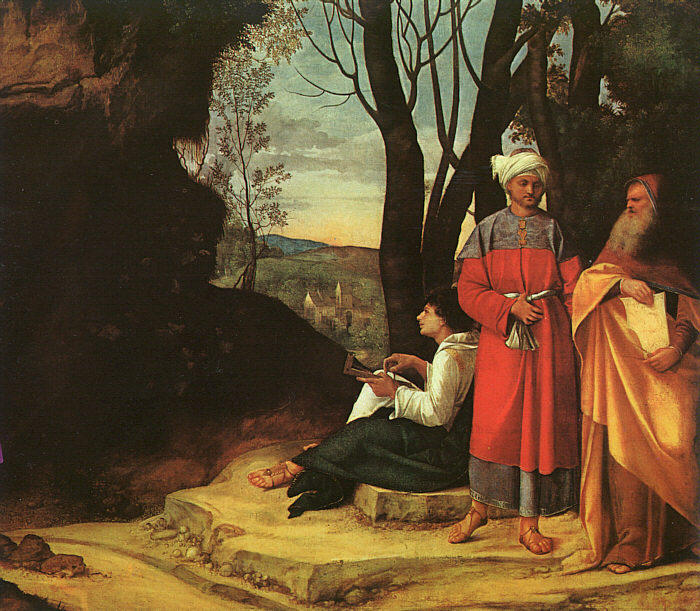
Giorgione, The Three Philosophers, c1500
Source: CFGA

I see I referred to one of Cosgrove’s essays in an earlier post in the context of mapping and landscape art. The full title of the essay I quoted is ‘The geometry of landscape: practical and speculative arts in sixteenth-century Venetian land territories.’ His starting point is classic human geography: the fortification, irrigation, and agricultural development of Venice’s terraferma. He then describes the importance of practical geometry in surveying and mapping this territory. It is possible to link this with the Venetian vision of landscape, in the art of Bellini, Giorgione and Titian, in the architecture of Palladio, and in the pastoral poetry of Bembo and Tasso. However, to provide a fuller connection, Cosgrove goes further and describes the concurrent interest in ‘speculative geometry’, which along with number theory underlay the esoteric culture, mystic symbolism and cosmology popular with Venetian humanists. It was therefore the combination of ‘practical chorography and a speculative philosophy’ which influenced the iconography of landscape in Venice and its territories. Cosgrove ends the essay by describing Giorgione’s The Three Philosophers, which seems to portray the different seasons in one landscape, along with the setting sun, magi and a quadrant, ‘the archetypal geometrical instrument.’ It combines the obscure intellectual poetry of Venetian culture with ‘the practical world of survey and mapping then spreading a new rational order across the fields of the terraferma.’ Denis Cosgrove’s work similarly bridged ideas of landscape as art and landscape as terrain, an approach that has created such a fruitful field of enquiry in cultural geography.

Sunday, April 20, 2008

The lost gardens of Richmond Palace


Those detailed scenes visible through a window behind the sitter in Renaissance portraits often seem like glimpses of lost landscapes. Here is a specific example, from the portrait of Henry Prince of Wales (1594-1612) by Robert Peake. The youthful heir to James I was a patron of the arts who sought to create a spectacular garden at Richmond.


In the words of James Maxwell:
To plant and build he had a great delight,
Old ruins his sole presence did repair;
Orchards and gardens forthwith at his sight
Began to sprout and spring, to flourish fair...
However, almost before these gardens had had a chance to flourish, Henry died, and work on it was halted.

Roy Strong, in The Renaissance Garden in England, discusses the evidence we have on the appearance of these lost gardens, which ‘must have constituted a remarkable spectacle, conceived as they seem to have been on a vast scale.’ The Works Accounts refer to the creation of three artificial islands, one of which may be discernable in the garden vista within Peake’s portrait of Henry. It is possible that one of the islands was created in the shape of a vast river god, modelled on Giambologna’s giant at Pratolino. A contemporary described the erection of a ‘great figure... three times as large as the one at Pratolino, with rooms inside, a dove-cot in the head and grottoes in the base.’ Salomon de Caus, the chief designer at Richmond, included a couple of illustrations of giants in his Les raisons des forces mouvantes (1615). The one here has an old bearded head like the giant of Giambologna and a rugged but strangely feminine body.


Like the vague and tantalising view in the portrait of Henry, there may be echoes and memories of the lost gardens at Richmond in the literature of the time. Roy Strong wonders whether Inigo Jones’ scenery for Ben Jonson’s Pleasure Reconciled to Virtue recalls an island giant: ‘The scene was the mountain Atlas, who had his top ending in the figure of an old man, his head and beard all hoary and frost as if his shoulders were covered with snow; the rest wood and rock.’ And then there is The Tempest, where we seem ‘to be wondering through a garden by de Caus where we are suddenly confronted by dreamlike monsters, or entering a wild grotto to be struck suddenly, at the turn of a stopcock, with surprise and wonder at moving statues and magical music, as gods and goddesses spring to life and enact an intermezzo.’

Friday, April 18, 2008

The sea's waves' sheaves

Ian Hamilton Finlay, Sheaves, 1970

Now showing at the V&A in London - Certain Trees: The Constructed Book, Poem and Object (an exhibition I discussed last year after it had been in Paris), which features artists engaged in a 'dialogue between the natural world and its classification and presentation through the idiom of language'. The approach is illustrated here by Ian Hamilton Finlay's poem-book, 'the SEA'S WAVES' SHEAVES' shown above, a 'small folder with 3 leaf concertina-folded card', published by the artist's Wild Hawthorn Press. Works like this and the kinetic poem below are easy to imagine in an exhibition entitled 'Certain Landscapes'. Some other Ian Hamilton Finlay pieces in Certain Trees are 'Stonechats', 'Wave', 'A Woodland Flute', 'A Butterfly Garden', 'Two Trees', 'Wildflower' and 'Landscape / Interior'.


Ian Hamilton Finlay, Canal Stripe Series 4, 1964

Writing in The Independent, Tom Lubbock has praised Certain Trees, contrasting it with the often 'vain and thoughtless' approach of the famous artists gathered together in the V&A's concurrent exhibition Blood on Paper – The Art of the Book. He writes that the Certain Trees artists 'never forget where books come from: there's natural gravitation toward the subject of wood and trees. The artists dwell wittily on their materials – on letters, typefaces, inks, paper, printing, the way books work. Steve Wheatley's Over the Hills and Far Away is a book whose leaves are cut in the shapes of dipping hills; overlapped, they become a receding valley. Thomas Clark prints the words "small grey bird of dusk" in deep blue letters, but the vowels are printed in grey, like birds in an evening sky. The five vowels, you notice, run a e i o u ... Stuart Mills' booklet The Bridle Path is Filled with Clouds has a photo of puddles, brimming with reflections. The page opens and reveals. There's a knack for making imaginative leaps from the physical world of the book to the larger universe.'


Stuart Mills, Three Swallows in the River Meadows, 1969

Thanks to Colin Sackett, whose books/poems/artworks feature in the exhibition, for alerting me to the arrival of Certain Trees at the V&A and pointing me to the Tom Lubbock article.

Thursday, April 10, 2008

The stones and shadows sigh breaths of amorous fire

The Met has an exhibition at the moment called ‘Poussin and Nature: Arcadian Visions’. The excellent Ionarts blog has an article on it with links to other reviews. I learned from this that Poussin's Landscape with Three Monks (La Solitude) is showing 'outside Serbia for the first time since 1934. One of the curators of the exhibit claims to have seen it hanging in Tito's office'.

There is an interesting description of Poussin’s sensual style of landscape painting in a review by Andrew Butterfield. Poussin originally moved to Rome after the Italian poet Giambattista Marino, based in Paris at the court of Marie de Medici, recognised and encouraged his talent. In Poussin’s paintings in this early period, where the figures still dominate the composition, ‘landscape elements seem to smolder with intense ardor. He achieved this effect by applying the upper layers of paint in relatively thin and rough brush strokes that allowed the red-brown ground layer of paint to show through, giving the entire image a warm and sensual glow. In European poetry the tradition of describing nature with amorous metaphors was an ancient one going back all the way to the Homeric hymns.... Poussin was extremely familiar with this tradition thanks to his friendship with Marino, whose poem L'Adone is a rich repository of the same vein of imagery. The artist read the book with the author, even making illustrations of it at his request, and Marino and Poussin also discussed how to translate the power of poetic language into the visual forms of painting. In L'Adone Marino wrote descriptive passages such as "Even the stones and the shadows of the place/sigh breaths of amorous fire." In his early mythic landscapes Poussin sought to capture the same sense of pathos and inspiration as is conveyed by lush and elevated writing of this kind.’

Nicolas Poussin, Nymph Spied on by Satyrs, c 1627
Source: Wikimedia Commons