Showing posts with label Ma Yuan. Show all posts

Saturday, November 11, 2017

Clouds Rising from the Green Sea

Clouds Rising from the Green Sea

Ten Thousand Riplets on the Yangzi

The Waving Surface of the Autumn Flood

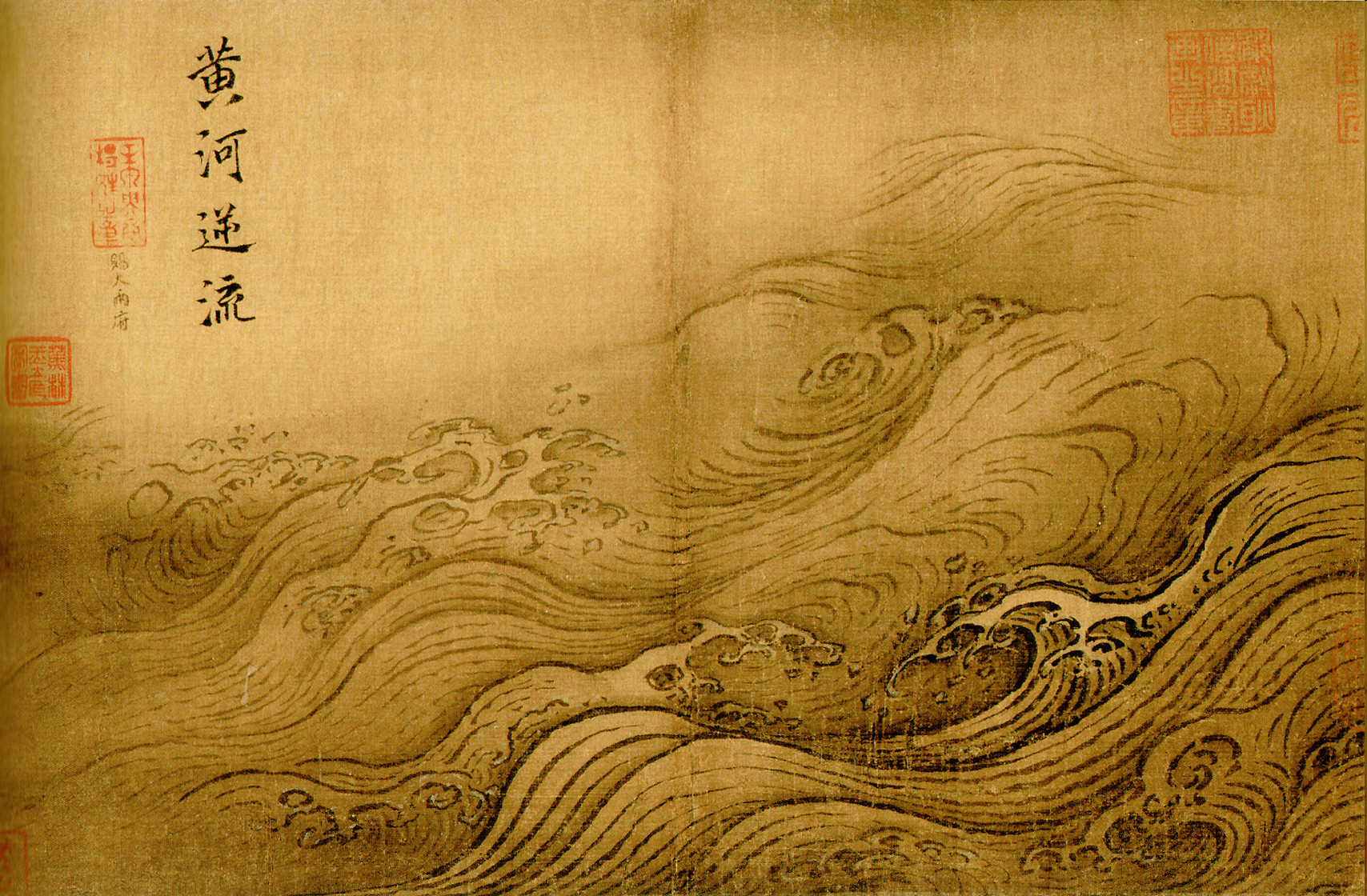
These beautiful images are from the Water Album, twelve studies made by the great Southern Song  painter Ma Yuan (c. 1160–65 – 1225).  They have always been admired and were adorned with admiring colophons by various Ming Dynasty connoisseurs from the late fifteenth century.  They were recently 're-made' by an artist, Zhang Hongtu, whose paintings question whether Ma Yuan would have been able to paint such views now, standing 'before today's rivers and lakes, fouled by chemical toxins and industrial waste.'  As Richard Edwards points out in The Heart of Ma Yuan: The Search for a Southern Song Aesthetic, Ma Yuan's calligraphic depictions of water are all based on a contradiction - lines alone are used to convey an ever changing, constantly moving element that seems impossible to describe in this way.  The titles of each one were added to the album by Empress Yang and dated 1222.  Edwards lists them in his book in a slightly different translation from the one used online for these images, but both sound good.  In sequence they resemble a poem on the properties of water as it forms pools and lakes, passes through rivers and enters the 'vast blue sea'.

Waves Weave Winds of Gold
Light Breeze over Lake Dongting
Layers of Waves, Towering Breakers
Winter Pool, Clear and Shoal
The Yangzi River - Boundless Expanse
The Yellow River - Churning Currents
Autumn Waters - Waves Ever Returning
Clouds Born of the Vast Blue Sea
Lake Glow, Rain Suffused
Clouds Unfurling, A Wave Breaking
A Rising Sun Warms the Mountains
Gossamer Waves - Drifting, Drifting


The Yellow River Breaches its Course

Wednesday, February 20, 2013

Ice on the Yellow River

Ma Yuan (1160–1225), The Yellow River Breaches its Course

It would be impossible to summarise the career of Liu Tieh-yün (1857-1909) briefly.  In addition to writing and scholarship (he was a pioneer in the study of Shang dynasty oracle bones), Liu got involved in traditional Chinese medicine, printing, politics and numerous failed commercial ventures, ranging from a a handicraft weaving shop in Shanghai to a steel refinery in Chuchow.  This admirable breadth of interests was evident from an early age.  According to Harold Shadick, in his introduction to Liu's novel, The Travels of Lao Ts'an, 'he studied the Sung philosophers with his father and spent much time with a group of friends who formed a sort of club with the intention of preparing themselves to help the country in her hour of need.  They discussed questions of military science, economics, and mathematics, and practiced boxing.  Liu T'ieh-yün himself specialised in the study of flood control and also showed great interest in music, poetry, astronomy, and medicine.'  His research into river conservancy stood him in good stead when the Yellow River flooded in 1887.  Liu was given charge of work to repair a breach in the dike, and on the strength of this spent three years as an adviser to the Governor of Shantung.  However, when his fictional alter ego, Lao Ts'an, is offered a similar position he politely declines, having no intention of settling into official life.  'That night he wrote a letter thanking Governor Chuang [and] before daylight he cleared his account at the inn, hired a wheelbarrow, and left the city.'

Later in the novel, Lao Ts'an arrives at another inn, at Ch'ihohsien on the banks of the Yellow River.  There he is told that the town is full of people unable to cross the partially frozen river, with its drifting blocks of ice as big as a house.  Li Ts'an wanders down to the river dike to look at this spectacle.  There follows one of the descriptive passages for which this novel is renowned in China: a precise depiction of the way the ice is gradually packed together and wedged solid.  'The ice from above kept coming down block after block, until at this point it was caught by the ice in front, couldn't move, and came to a standstill.  More ice came and pressed it with a rustling sound, ch'ih-ch'ih, until the ice behind, pressed harder by the flowing water, simply jumped on top of the ice in front.  Pressed down in this way the ice in front gradually went under...'  As night is falling, Li Ts'an returns to the inn; 'each willow tree on the dike cast a shadow of moving threads on the ground, for the moon was already shining brightly.'  But after supper he goes out again and watches the boatmen still hard at work, breaking the ice.  Eventually, he raises his head from the river and looks up at the hills.  'The snow-white line reflected the light of the moon; it was extraordinarily beautiful. The mountain ranges rose tier on tier, but they could not be clearly distinguished.  A few white clouds lay in the folds of the hills so that you could hardly tell cloud from hill unless you looked intently. ... The hills stretched away to the east farther and farther until gradually the sky was white, the hills were white, and the clouds were white, and nothing could be distinguished from anything else.'


(This post uses Wade-Giles spellings.  Liu Tieh-yün is Liu Tieyun, the courtesy name for Liu E.  The novel is also spelled The Travels of Lao Can.  The YouTube clip above shows a news item about ice on the Yellow River this year - it is still a regular occurrence.)

Friday, June 20, 2008

Whiling Away the Summer


This is a detail from Whiling Away the Summer (1679) a handscroll by Wu Li (1632-1718). What an enticing image of scholarly retreat! As the Met's curators say, 'there is a dreamlike quality about the painting: birds, trees, bamboo, mist, and even rocks dance joyously around the hermit-scholar, who sits quietly reading in his idyllic domain.' Wu Li wrote that he had painted this landscape 'one clear morning after a rainfall, sitting alone in his studio thinking of an absent friend'.

This work is labelled 'Landscape as Self-Portrait' in the Met's exhibition How to Read Chinese Paintings. Some other highlights:
  • Scholar Viewing a Waterfall by Ma Yuan (act. ca. 1190–1225) where the "one corner" composition contrasts the solidity of rocks and trees, to the misty emptiness beyond the falls. It is similar to Watching the Deer by a Pine-Shaded Stream, which I referred to in an earlier post.
  • Twin Pines, Level Distance by the artist-calligrapher Zhao Mengfu (1254–1322), a landscape which one might describe as having been written... Zhao advocated different writing styles for different landscape elements - unmodulated seal script for trees, 'flying white' cursive script for rocks.
  • Poet Strolling by a Marshy Bank by Liang Kai (act. 1st half C13) in which the inaccessibility of the distant landscape is emphasised by a massive overhanging cliff, partially obstructing the poet's view.
  • Old Trees, Level Distance by Guo Xi (c 1000-90), a misty 'landscape of emotion' according to the Met, who quote from the impressively titled treatise Guo Xi wrote, Linquan gaozhi (Lofty Ambitions in Forests and Streams): 'after the outlines are made clear by dark ink strokes, use ink wash mixed with blue to retrace these outlines repeatedly so that, even if the ink outlines are clear, they appear always as if they had just come out of the mist and dew.'

Thursday, December 27, 2007

Sunset Landscape

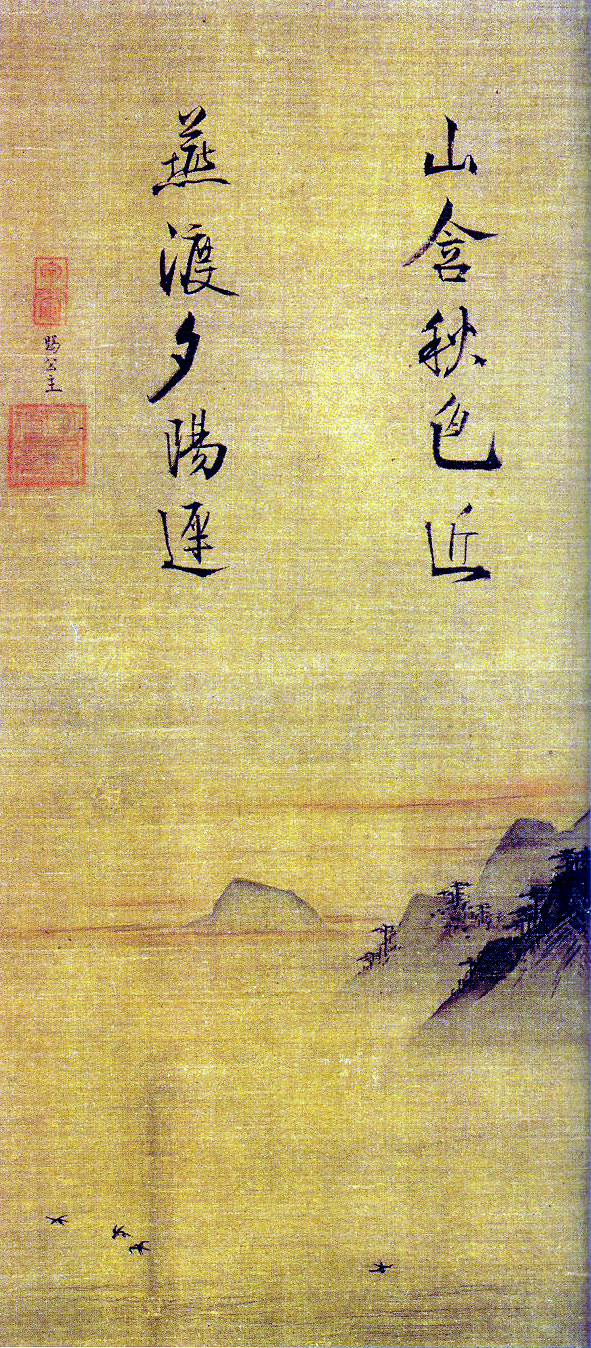
I have mentioned the Southern Song landscape painter Ma Yuan here before in connection with a Wallace Stevens poem. I’ve just been reading about the Ma family in Richard M. Barnhart’s chapter of Yale’s Three Thousand Years of Chinese Painting. They served Chinese emperors for five generations, starting with Ma Ben (Fen) in the early twelfth century and ending with Ma Lin, who was active in the early to mid thirteenth century. Ma Lin’s ‘touching Sunset Landscape seems almost to be an elegy for his dynasty, so preoccupied is it with the end of light and vision.’ It is a minimal landscape set beneath two lines by Wang Wei, “Mountains hold the autumn colour near / Swallows cross the evening slowly.” Barnhart notes that many scholars have detected a melancholy mood in Ma Lin’s paintings, but, since it was the emperor that commissioned these works, their poignancy cannot solely be attributed to the artist. In Ma Lin, the doomed Song dynasty court ‘found the perfect voice to sing their sad songs for them as they presided over the end of a great empire.’

Ma Lin, Sunset Landscape, 1254

Friday, February 17, 2006

By a pine-shaded stream

The first of Wallace Stevens’ ‘Six Significant Landscapes’ depicts an old man in China, sensing the wind blowing a pine tree, blue and white larkspur and his own beard, their movement like water running over weeds. According to Zhaoming Qian, Stevens’ poem is reminiscent of landscape painting from the Ma-Xia school, named after Ma Yuan (active ca. 1189-1225) and Xia Gui (active ca. 1180-1224). For example, Ma Yuan’s Watching the Deer by a Pine-shaded Stream has a scholar gazing at a landscape in which pine trees wave and water streams over rocks. Stevens may not have had a specific painting in mind, but he was certainly influenced by Chinese painting he had read about and seen in exhibitions. In 1909 Stevens had been captivated by the Chinese paintings he saw in New York and wrote to his fiancée Elsie about them, compiling a “private exhibition” from their colours:

pale orange, green and crimson, and white,
and gold, and brown;
deep lapis-lazuli and orange, and opaque
green, fawn-color, black, and gold;
lapis blue and vermilion, white, and gold
and green.

In Stevens’ exhibition Chinese handscrolls have been distilled into abstract landscapes of pure colour. This is an approach that would be taken by many Western painters later in the century.