Friday, January 25, 2008

Denbigh castle ruins


How does inscape relate to landscape?  For Gerard Manley Hopkins, inscape was that which gives something its own special identity.  We come to feel and perceive these qualities through what he called instress.  J.R. Watson: ‘the inscape of an elm tree is the property by which we recognize it: but it is not just its shape or ‘scape’: it is its ‘inscape’, its inner being or self-hood, the thing itself in its own special nature.’

However, inscape is not necessarily about the qualities of a particular tree.   For example, on May 18 1870, Hopkins noted in his diary “great brilliancy and projection: the eye seemed to fall perpendicular from level to level along our trees, the nearer and further Park; all things hitting the sense with double but direct instress.”  Here the instress is a force from within the trees which gives this landscape its particular intensity.

W. H. Gardner describes instress as ‘the sensation of inscape – a quasi-mystical illumination, a sudden perception of the deeper pattern, order and unity which gives meaning to external forms.’ Hopkins experienced instress as he walked in the landscape, studying bluebells and horned violets, looking at the moon and the sky or the waves of the sea, even, as here, in encountering an old stone pointed arch:
'The day was bright, the sun sparkling through a frostfog which made the distance dim and the stack of Denbigh hill, as we came near, dead mealy grey against the light: the castle ruins, which crown the hill, were punched out in arches and half arches by bright breaks and eyelets of daylight. We went up to the castle but not in: standing before the gateway I had an instress which only the true old work gives from the strong and noble inscape of the pointed arch...'
- from Gerard Manley Hopkins’ diary, February 4th 1875

Saturday, January 19, 2008

An aerial view of the Val de Bièvre


Before photographs could be taken from aeroplanes, aerial landscapes had to be captured by other means:

  • The first aerial photograph from a balloon was Nadar’s image of the Val de Bièvre near Paris, taken in December 1858. (as depicted in the Daumier cartoon above). However, the result was not a great success. Soon, however, clear images were being taken, like the aerial view of Boston taken in 1860 by James W. Black using the balloon, Queen of the Air.
  • In 1869 John A. Scott invented the Ophthalmos, where a camera was sent up in an unmanned balloon on the end of rope. Inspired by this, Arthur Batut in France devised a kite from which aerial photographs could be taken, publishing them in La photographie aérienne par cerf-volant (1890).
  • Finally, in 1903 Julius Neubronner devised a lightweight camera which could be attached to a carrier pigeon, the shutter being released every sixty seconds, thus enabling birds to create landscape images... A Nature Conservancy site refers to the photographs taken by the Bavarian Pigeon Corps: “while their images (that sometimes included wingtips in the frame) were of limited use, the birds looked great in uniforms”. They do indeed look very smart and I rather like their photographs too.

Sunday, January 13, 2008

Figure in a Mountain Landscape

Peter Doig is coming to Tate Britain for a talk next month. I was told the tickets all went within 30 minutes of going on sale, so sadly I won't be able to report on what he says, but I'll try to get to the exhibition. Doig tends to re-work his themes, one of which is Figure in a Mountain Landscape, examples of which are here, here and here (this last one is subtitled, for no clear reason, 'I Love You Big Dummy', which is presumably a Captain Beefheart reference..?) The original for Doig's cowled figure en plein air is a 1935 photograph of Franklin Carmichael, one of the Canadian Group of Seven painters, sketching at Great Lake Nortern Ontario. Rather than paint and repaint a landscape from nature, Doig paints and repaints a photograph of someone painting a landscape from nature.

There is a short article about Doig in the latest issue of Tate etc. by the Brooklyn-based critic Lyle Rexer (great name!) He says that Doig benefits from "a certain Richter effect, that is from anti-Platonist critiques, when it came to be understood that he, too, often preferred two-dimensional images as models to the common reality of the breathing world." When I said in a previous post of Gerhard Richter's landscapes "there is little comfort to be had in these highly artificial paintings, based on photographs or picture postcards" I was of course referring to those who would seek spiritual solace in Nature or desire a painting that transmits the artist's feeling for a particular place. But of course many contemporary viewers will want precisely to be reassured that this is not what is happening. Rexer says that one of Doig's curators, for example, "went so far as to assure us that there is no nature painting here, no plein air, only good studio conceptualism." However, in a sense Peter Doig simply approaches painting in a traditional way. It's just that instead of painting, say, Cadmus and a snake in a landscape, like Poussin, Doig paints Berry Oakley and a canoe in a landscape.

Friday, January 11, 2008

Gone – the narrow copse


Earth Shattering: Eco Poems is the latest anthology from Bloodaxe editor Neil Astley, following recent successes like Staying Alive, Being Alive, and Pleased to See Me: 69 Very Sexy Poems. It is full of interest and I’m sure I’ll draw from it in future postings, but here I’m going to concentrate on the introduction where Astley sets his collection in context, discussing recent anthologies and critical writing on ecopoetics. Here are some of the chief sources for Earth Shattering:


  • J. Scott Bryson’s Ecopoetry: A Critical Introduction (2002) defines ecopoetry as a subset of nature poetry with three main characteristics. These are (1) an awareness of interdependence and connectiveness (as in Denise Levertov’s poem ‘Web’); (2) humility in the face of nature; (3) scepticism of hyper-rationality which is usually linked to concern about ecological catastrophe.
  • I have talked here before about Terry Gifford’s definition of post-pastoral, which has similar attributes to Bryson’s ecopoetry. Astley describes Gifford’s 1995 study Green Voices: Understanding contemporary nature poetry as the first comprehensive British study of ecopoetry (the essays in Bryson focus on US poets).
  • I've also referred to John Elder’s Imagining the Earth: Poetry and the Vision of Nature (1985) before here, e.g. in relation to William Everson, and Astley notes its importance as a relatively early study in the field.
  • Then of course there is Jonathan Bate’s The Song of the Earth (1990), which Astley praises for presenting ‘ecology and poetry together as one body of thought and feeling.’ I’ve only used this book once here so far, but it's worth saying in passing that The Song of the Earth is one of the best books on landscape in the arts I have read. Jonathan Bate writes so well that you almost feel disappointed when you turn from himto consult the actual books he discusses: a case in point would be William Henry Hudson’s Green Mansions, which was less interesting to me as a novel than the extracts Bate used in The Song of the Earth
The majority of the poetry in Earth Shattering is modern, even though the anthology starts with some of David Hinton’s ‘wilderness poets of ancient China’. But I’ll end this posting with an 'ecopoem' that will be out of copyright, and which provides a link to the previous posting: ‘First Known When Lost’ by Edward Thomas:
I never had noticed it until
‘Twas gone, - the narrow copse
Where now the woodman lops
The last of the willows with his bill
It was not more than a hedge overgrown.
One meadow's breadth away
I passed it day by day.
Now the soil is bare as bone,
And black betwixt two meadows green,
Though fresh-cut faggot ends
Of hazel made some amends
With a gleam as if flowers they had been.
Strange it could have hidden so near!
And now I see as I look
That the small winding brook,
A tributary's tributary, rises there.

Sunday, January 06, 2008

Roads shining like river up hill after rain

The final entry in the war diary of landscape poet Edward Thomas is dated 8 April 1917 – he was killed the next day at 7.36 am by a shell blast:


'8. A bright warm Easter day but Achicourt shelled at 12.39 and then at 2.15 so that we all retired to the cellar. I had to go over to battery at 3 for a practice barrage, skirting the danger zone, but we were twice interrupted. A 5.9 fell 2 yards from me as I stood by the f/c post. One burst down the back of the office and piece of dust scratched my neck. No firing from 2-4. Rubin left for a course.'
The Faber ‘Collected Poems’ also reproduces these brief notes Thomas made on the last pages of the diary:
'The light of the new moon and every star

And no more singing for the bird...

I never understood quite what was meant by God

The morning chill and clear hurts my skin while it delights my mind Neuville in early morning with its flat straight crest with trees and houses – the beauty of this silent empty scene of no inhabitants and hid troops, but don’t know why I could have cried and didn’t'
Loose inside the diary there was a photograph and a slip of paper with several addresses and these words:
'Where any turn may lead to Heaven

Or any corner may hide Hell

Roads shining like river up hill after rain.'

Tuesday, January 01, 2008

This is Lagos


This is Lagos (2002) by Olu Amoda - welded scrap steel.

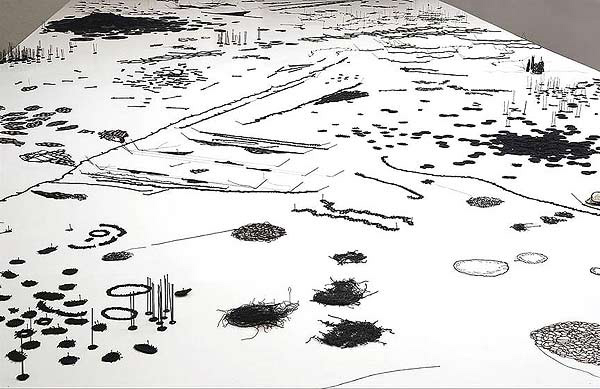
One of my New Year's resolutions is to include a few more images in 'Some Landscapes'. The one above is, I have to admit, a rather inauspicious start: a murky snapshot of some metal on a table, framed by lumps of coal. It was taken at the V&A's 'Out of the Ordinary: Spectacular Craft' exhibition yesterday. Normally I don't have images of contemporary art works for copyright reasons but nobody seemed to mind photographs being taken at the V&A. This is Lagos is a metal cityscape seen from above, where it is impossible to discern what is signified by each of the individual scraps of metal, or what they originally were before the artist found them. I thought the way Amoda creates a semi-abstract topography was reminiscent of Anne Wilson's piece earlier in the exhibition, which can be seen in another poor quality photo below. Some of her arrangements of lace and pins look like winter trees in a snowy landscape, whilst other features are more mysterious. There is a better photograph of a 2002 version of Topologies here.


Topologies (2007) by Anne Wilson - lace, thread, cloth, pins, painted wood support.

Of course craft is by definition skillful, but it can still be surprising to encounter really intricate beauty or objects you would not have thought possible. Annie Cattrell's Conditions for example, (see third and least-bad photo below) seem to imprison real clouds in blocks of glass. I wonder what John Constable, some of whose cloud studies are owned by the V&A, would have made of them? I suppose one difference is that he wanted to capture the whole sky rather than an individual cloud, as in a 5 September 1822 sketch: "looking S.E. noon. Wind very brisk. & effect bright & fresh. Clouds. moving very fast. With occasional very bright openings to the blue."


Conditions (2006) by Annie Cattrell - subsurface etching in glass

So, as I said, I will try to put some more images into this blog in 2008, and maybe add a few retrospectively to earlier postings. I'll also try to provide more labels to help navigate certain themes and find quickly the entries on some key figures (like Constable - see label below). And at some point I'll get round to adding links and a decent blog roll...

Thursday, December 27, 2007

Sunset Landscape

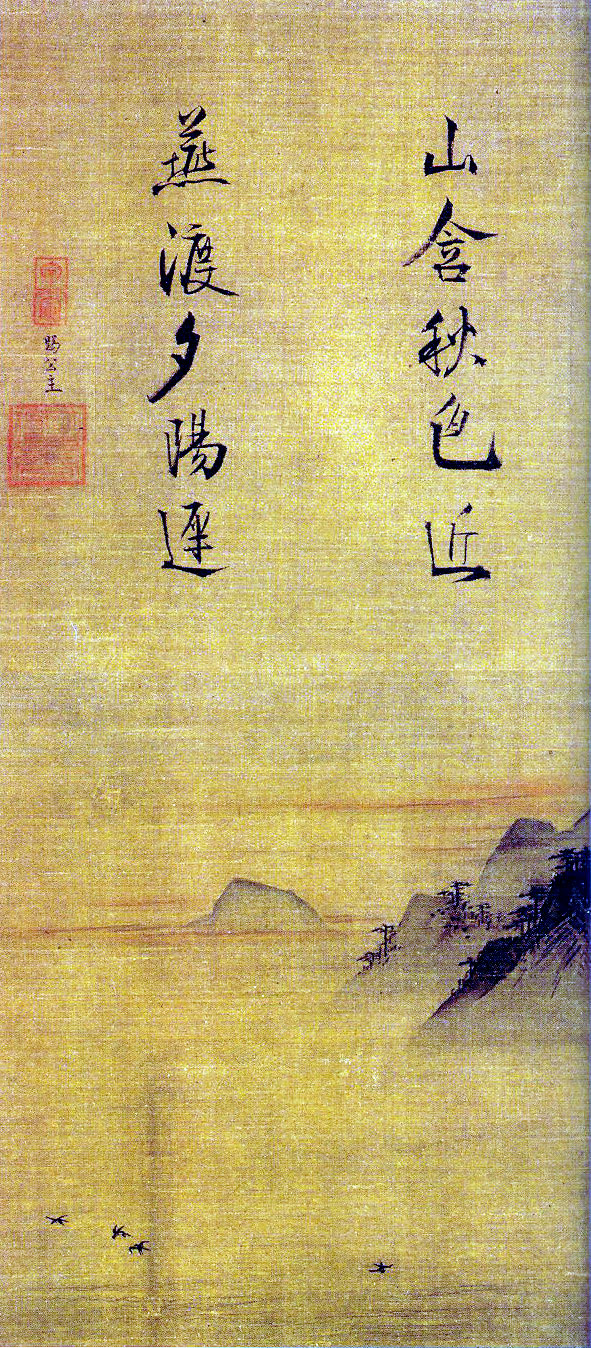
I have mentioned the Southern Song landscape painter Ma Yuan here before in connection with a Wallace Stevens poem. I’ve just been reading about the Ma family in Richard M. Barnhart’s chapter of Yale’s Three Thousand Years of Chinese Painting. They served Chinese emperors for five generations, starting with Ma Ben (Fen) in the early twelfth century and ending with Ma Lin, who was active in the early to mid thirteenth century. Ma Lin’s ‘touching Sunset Landscape seems almost to be an elegy for his dynasty, so preoccupied is it with the end of light and vision.’ It is a minimal landscape set beneath two lines by Wang Wei, “Mountains hold the autumn colour near / Swallows cross the evening slowly.” Barnhart notes that many scholars have detected a melancholy mood in Ma Lin’s paintings, but, since it was the emperor that commissioned these works, their poignancy cannot solely be attributed to the artist. In Ma Lin, the doomed Song dynasty court ‘found the perfect voice to sing their sad songs for them as they presided over the end of a great empire.’

Ma Lin, Sunset Landscape, 1254

Sunday, December 23, 2007

Things seen at Mabillon Junction

An alternative to soundwalks is to stay in one place and record the sounds heard over a period of time. Or, one could enumerate things seen... Georges Perec's Tentative de description de choses vues au carrefour Mabillon le 19 mai 1978 was a two-hour edited condensation of a day in which the writer used a mobile recording studio at Place Mabillon in Paris to describe everything he saw over the course of a day. I've never heard this, but David Bellos describes the finished product, broadcast on French radio in February 1979, as 'a hallucinatory audio experience' where repetition turns into rhythm: 'no one but Perec could have had the combination of self-restraint (he never comments on what he sees, he just says, another 68 bus, three red cars, a lady with a dog...), modesty, and sheer gall to carry on for hours on end, to the end.' (Georges Perec: A Life in Words p640).

While on the subject of Perec, I can't resist noting on a landscape theme that the main character in his magnum opus, Life A User's Manual, spent twenty years travelling the world painting watercolours of sea ports. Having completed each one in to an identical format, the artist, Percival Bartlebooth, sent them to a craftsman, Gaspard Winckler, to have them made into increasingly complex jigsaws. For another twenty years, Bartlebooth would complete these jigsaws at the same rate at which he had painted the original seascapes, one a fortnight. As he went along, each painting was removed from its backing, returned to the original spot at which it had been painted twenty years earlier, and then erased so that the final product was a fresh sheet of watercolour paper. However, Bartlebooth died (on the night the novel is set) before he could complete the great project. The puzzle he was working on at the end depicted 'a little port in the Dardenelles, at the mouth of the river which the Ancient Greeks called Maiandros, Meander.' As David Bellos remarks, 'the story of Meander figures both the tortuousness of attempts to defer the moment of dying and the impossibility of doing so forever.'

Friday, December 21, 2007

Soundwalk, Queen Elizabeth Park, Vancouver

Writing the last entry made me dig out the excellent survey of acoustic ecology in The Wire 226, which describes the original World Soundscape Project at Simon Fraser University (SFU). Their work varied from activities that might be considered broadly as a kind of landscape art, recording soundcapes across Canada and in five European villages, to more practical work on noise abatement, reviewing legislation and mounting an international car-horn count. Phil England interviewed Hildegard Westercamp for the article, an original member of the SFU team, assistant to R. Murray Schafer, and the person responsible for re-launching the soundscape movement in 1991 with the first Soundscape Newsletter. Asked why she thought the movement arose in Vancouver, Westercamp pointed to the experimental cultural environment in Canada in the early seventies, but also to the influence of the Canadian wilderness. "There's a huge silence out there. And when you experience that silence against what urban environments are like, there's a major difference. I was walking through London today and I thought, my god, how far away the Earth is at King's Cross."

As someone who waits for a bus at Kings Cross several times a week, I can only agree... But then, as noted in the last entry here, the sounds of the city have their own beauty and emotional charge. Peter Cusack is quoted in the same Wire article describing his CD Your Favourite London Sounds, which includes a list encompassing traffic, trains, aeroplanes, buskers, people chatting, even the sound of breaking glass. Cusack goes on to suggest that the use of sounds recorded in a landscape for music or sound art is diverging from the more direct approach where soundscapes are recorded to investigate or dramatise social or ecological issues. Here, I am more interested in the former approach, typified by someone like Chris Watson.

There is a whole dissertation by Andra McCartney on Hildegard Westercamp available online here. The site also includes a soundwalk McCartney took with Westercamp in Queen Elizabeth Park, 'Vancouver's Oasis'. You can listen, for example, to a recording of a creek, described by McCartney as follows: "We spent more time at the creek than anywhere else. Westercamp is fascinated by the endless variety of water voices, and her approach to close-up recording articulates them well. She shifted from one stepping-stone to another, moving the stereo microphone to highlight how the water found its way through crevices, over boulders, around branches in its path, illustrating the architecture of the creek bed, and the dance of the water through its sculptural forms..."

Sunday, December 16, 2007

Baorittaolegainuoer - Natural Booming

I've been listening to the environmental recordings compiled on a CD for Uovo 14 by David Toop. In his notes, Toop says that the origins of this kind of modern sound art lie in 'a complex network of specialist and esoteric activities: scientific research into animal communication and bioacoustics; oral history and radio drama; birdwatching, trainspotting and similar ocular pursuits; documental filmmaking; exotic sonic backgrounds; post-Cageian environments; and the soundscape studies pioneered in Vancouver in the early 1970s by R. Murray Schafer and the World Soundscape project. Because of these origins, many of them located in looking as much as listening, and an uneasy relationship to landscape as visual spectacle, in the past, field recording as an art practice has tended towards the picturesque, benign and static.'

I've observed in various entries here how visual art and poetry have shifted over time from traditional views of 'landscape' to more complex ideas about 'place'. In the same way, Toop suggests that field recording suffered from an 'unspoken anti-urbanism which would exclude people, motor vehicles, industry, and all other interventions that could be considered the audio equivalent of telegraph poles in a beautiful landscape. Sounds have been recorded for specific human purposes, such as the melodic beauty of a particular birdsong that somehow reflects the structure of human music. This has been changing for some time, however, with more concentration given to sound environments that Murray Schafer might once have described as an 'earsore', and more focus on the sonic ecology in which we actually live.' Typical of this modern approach would be Lee Patterson's 'Ox Bow Pool & Airliners', or unpromising sounding soundscapes like Jeph Jerman's 'Clarkdale Slag Heap', recorded in Arizona, or Peter Cusack's 'Oil Field Soundwalk', recorded in Azerbaijan.

Clive Bell's review of the Uovo compilation in The Wire notes that the hypnotic song of Chris Watson's tree frogs triggers 'thoughts about human tribal music, just as the deep-throated humming of Rob Mullender and Isobel Clouter's Mongolian sound mountain inevitably recalls the local overtone singing.' Far fetched I suppose, but there's an appeal to the idea that natural sounds have embedded themselves in local musical forms.

Incidentally, the Mullender / Clouter piece,'Baorittaolegainuoer - Natural Booming', is an example of the way artists have been recording singing sands, as discussed here before. In a paper here, Clouter writes about the importance of preserving the sounds of these sands, which have always provoked stories, as in the account she quotes by the monk Hiuen Tsang from 629: 'At times sad and plaintive notes are heard and piteous cries, so that between the sights and sounds of the deserts, men get confused and know not whither they go. Hence there are so many who perish in the journey. But it is all the work of demons and evil spirits.'

Friday, December 14, 2007

The Dead Sea

Last night some friends were showing me photographs of Bonneville Salt Flats. I immediately dredged from childhood memory the name of Gary Gabelich, who set the land speed record there in 1970. Bonneville was in fact the site for all the land speed records from 1935 (Malcolm Campbell) to 1970: most of the earlier record breaking attempts took place on beaches like Daytona Beach (which has always sounded highly glamorous to me) and Pendine Sands in Wales (which doesn't). The most recent records have been set in Black Rock desert, which may look less spectacular than Bonneville, but which is still a fairly extreme landscape. Water speed records have also taken place in spectacular places of maximum flatness: Malcolm Campbell, for example, sped across the Romantic settings of Lake Maggiore (1937) and Coniston Water (1939).

The Bonneville photographs also reminded me of a trip I once made to the Dead Sea where I convinced our host to keep driving and driving in the hope of finding some spectacular salt landforms (no luck). I had in mind the kind of thing Michel Tournier describes towards the end of his novel Four Wise Men (1982): 'the blue surface of the water was sprinkled with white dots... they were great mushrooms of white salt, rooted in the bottom and emerging at the top like reefs.' Tournier goes on to tell of elephants spraying each other with the salt water and inadvertently crystallising themselves (the kind of thing that makes you question where, in a landscape like The Dead Sea, realism ends and magical realism begins). Salt's tendency to encrust and transform has always lent itself to metaphor (Stendhal's description of love, for example). The transformation of Lot's wife in the Bible seems like a story straight out of Ovid's Metamorphoses, except that the mention is all too brief: "But his wife looked back from behind him, and she became a pillar of salt."


Geological formation overlooking the Dead Sea, called Lot's Wife (from Wikimedia Commons)

The growth of salt deposits has continued to affect the appearance of Robert Smithson's Spiral Jetty. Smithson chose to work at the Great Salk Lake partly for the blood-red colour of the water. However, it wasn't his first artwork based on a salt landscape: Mono Lake Nonsite (Cinders Near Black Point) brought some rocks collected at "The Dead Sea of the West" into the gallery. There is a film of the 1968 trip Smithson made to the lake with Nancy Holt and Michael Heizer, described by Lennie Bennett here as "guileless and optimistic, a self-portrait of three young artists on the brink of fame, scrambling around the ancient landscape with voiceovers by Smithson and Heizer reading passages from books about the lake. Smithson picks up handfuls of rocks that he later incorporated into an installation, along with his famous mirrors. At the end, they set fire to a map of the area; Smithson also used the cinders as part of that installation."

In one of his conversations with Denis Wheeler, Smithson talked about Mono Lake and pointed Wheeler to Mark Twain's Roughing It (1872). There Twain says "This solemn, silent, sailless sea—this lonely tenant of the loneliest spot on earth—is little graced with the picturesque. It is an unpretending expanse of grayish water, about a hundred miles in circumference, with two islands in its centre, mere upheavals of rent and scorched and blistered lava, snowed over with gray banks and drifts of pumice stone and ashes, the winding sheet of the dead volcano, whose vast crater the lake has seized upon and occupied." But Twain does find something of the picturesque in the some landforms that recall Tournier's description of the Dead Sea: "all around its shores stand picturesque turret-looking masses and clusters of a whitish, coarse-grained rock that resembles inferior mortar dried hard; and if one breaks off fragments of this rock he will find perfectly shaped and thoroughly petrified gulls' eggs deeply imbedded in the mass. How did they get there? I simply state the fact—for it is a fact—and leave the geological reader to crack the nut at his leisure and solve the problem after his own fashion."
Monday, December 10, 2007

Buried rivers of mercury

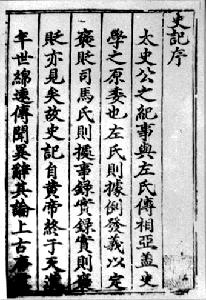
Yesterday I got to see the British Museum's Terracotta Warriors exhibition, The First Emperor. There is more than just an army buried down there: there are bronze birds, musicians, civil servants - everything an emperor might need to make the afterlife more agreeable. In his Shiji (Records of the Grand Historian) Sima Qian had written (c90 BCE) of 'Palaces, scenic towers, and the hundred officials, as well as rare utensils and wonderful objects were brought to fill up the tomb... Mercury was used to fashion the hundred rivers, the Yellow River and the Yangtze, and the seas in such a way that they flowed. Above were the heavenly bodies, below, the features of the earth' (trans. Burton Watson). Now it seems this description may not have been hyperbole. Intriguingly, tests have shown high levels of mercury at the site, so perhaps there really is a whole buried landscape under there. Chinese archaeologists are proceeding cautiously, searching for non-invasive ways of uncovering the past without a full excavation, so it could be some years before we know.


The first page of Sima Qian's Shiji (source: Wikimedia Commons)

Update: April 2015
From The Guardian today: 'An archaeologist has discovered liquid mercury at the end of a tunnel beneath a Mexican pyramid, a finding that could suggest the existence of a king’s tomb or a ritual chamber far below one of the most ancient cities of the Americas.'  It's fascinating that a similar idea was in use on the other side of the world.  Apparently the ancient Mesoamericans could produce liquid mercury by heating mercury ore (cinnabar) which they also used for its blood-red pigment.   According to Annabeth Headreck, an expert on central American art, the mercury “could be a sort of river, albeit a pretty spectacular one.”  Shiny and scintillating materials seem to have been particularly important: many ritual objects were made reflective with mica and in 2013 'archaeologists using a robot found metallic spheres which they dubbed “disco balls” in an un-excavated portion of the tunnel, near pyrite mirrors. “I wish I could understand all the things these guys are finding down there,” Headrick said, “but it’s unique and that’s why it’s hard.”'

Saturday, December 08, 2007

The Olympic Park

A few weeks ago, at The Printed Path event, I heard Iain Sinclair describing his walk to the 2012 Olympics site in the company of writer Robert Macfarlane. Sinclair spoke amusingly of Macfarlane's youthful enthusiasm and described his attempt to climb the sculpture of Alfred Hitchcock at Gainsborough Studios, thwarted by security, noting that climbing seems to be the way Macfarlane 'gets to grips' with a landscape. I have thought of going up with my camera to take a look at the Olympic site myself - I once did a Sinclair-influenced walk up the Lea Valley, before the Olympics came to town - but my opportunities for psychogeographical wandering are limited these days. I imagine it's quite a popular destination at the moment... Sinclair said that he and Macfarlane had encountered at least one photographer with 'art pretensions'...

In his talk, Iain Sinclair praised Stephen Gill's photographs of the Olympic Park site, and in today's Guardian, Robert Macfarlane discusses these, as well as giving his own account of the walk with Sinclair. When they reach the construction site Sinclair says "Are you ready for the zone? From here on in it's pure Tarkovsky." But beyond the 'light-industrial spaces, car-wrecker's yards, square-windowed studios, haulage depots' there is the perimeter fence 'designed to exclude not only access, but also vision. There are no viewing windows built into it, no portholes for the curious stakeholder. To see inside the zone, you must ascend a Stratford towerblock, hire a helicopter, or - the desideratum - visit the ODA's website, which provides stills of the construction process and mocked-up futuramas of the park.' Images of the future like this one really do have an eerie quality...

Robert Macfarlane refers to the The Manor Gardens Allotments, a green oasis and vital part of the area's history, which has now been demolished despite the efforts of a strong campaign. A lot of people will be reading about the allotments in Moro East, the latest cookbook from Moro restaurant (you can see a clip here). But sadly they will never now be able to see the allotments that have inspired the cooks at Moro and so many other local people over the years.

Thursday, December 06, 2007

Chinese rock gardens


We were at the Museum of Childhood last weekend and the photograph here shows my older son walking past a pair of interesting Chinese landscapes. Their caption reads as follows:

'The Chinese Rock Gardens together with two other landscapes were gifts for the French Empress Josephine, wife of Napoleon Bonaparte. They were sent by Chia Ch'ing, Emperor of China (1796-1820). It is said that the ship carrying these gifts was captured by an English warship. They were offered back to the French after the Treaty of Amiens in 1802. The offer was declined. It is recorded that the models arrived at the East India Company's India Museum in 1809. They passed to the Victoria and Albert Museum, then the South Kensington museum, in 1880.'

I'm not sure why these miniature landscapes are in the Museum of Childhood - the implication is that they were toys, but they look more like decorative art works, not dissimilar to the jade mountain I've described here before, showing the The Nine Elders of Huichang. I would love to know more about them. It is hard to imagine Napoleon drawing any inspiration from these little Chinese rock gardens...

Friday, November 30, 2007

To Place: Verne's Journey

In a 1995 interview with Claudia Spinelli, Roni Horn discusses her book To Place: Verne’s Journey (1995), with its photographs of the Icelandic landscape described by Jules Verne in Journey to the Centre of the Earth (1864). She says she wanted to reveal Verne’s fictional narrative “as the reality it is. Up to that point I was working with an intuition about the paradox of fiction. In the book the opening shot is an aerial photograph of the glacier which covers the entrance to the center of the earth. I zoomed in on the ice and cut to ground-level. At ground level you see all of these extraordinary geologic events. Now these are all things that just happen as a part of the mundane in Iceland. Verne's fiction is not a fiction at all. What he described, the entrance, the journey and I estimate the center of the earth as well, actually exists. But he was never in Iceland. So for him it was pure fiction.”


Journey to the Centre of the Earth (like the science fiction that followed it) is a blend of realism and fantasy. Verne’s descriptions of the geology of Iceland create the conditions for suspension of belief as Professor Lidenbrock and his nephew Axel begin their descent. In the OUP translation of Verne’s novel, they arrive in Iceland on page 47 and begin their descent into Snaefells on page 86, so almost a fifth of the book involves their journey through the ‘real’ landscape of lava flows and mountains. Eventually, when they reach the peak of Snaefells after an arduous climb, Axel looks down at the island spread out below him, with its deep valleys, endless glaciers and over to the west, the vast ocean. At the site of all this he ‘plunged into that high-blown ecstasy produced by lofty peaks’, his ‘dazzled eyes bathed in the clear irradiation of the sun’s rays...’ (trans. William Butcher)

In her survey of Roni Horn’s art in the Phaidon book I’ve talked about here before, Louise Neri quotes William Butcher’s introduction to Journey to the Centre of the Earth, where he describes Verne’s worldview in terms that fit Horn’s art practice: ‘An anthropomorphization of the Earth and a mechanization of the human, with the biological often acting as a go-between; an attempt at sensual “totalization” of the world; a constant scepticism; the undermining by juxtaposition, humour, and irony of any dogmatic view of existence; a metaphorization of everyday objects and ideas, which are often re-metaphorized or even de-metaphorized; a distinctive rhythm, made up of repetitions, silences, minor and major keys, counterpoint, and slow movements leading to explosive crescendos; and an innovative narrative technique, whether in the use of tense, person, point of view, voice or structure.’

Friday, November 23, 2007

Siluetas

I never got round to writing about the Antony Gormley show in London earlier this year. The body casts he positioned in Event Horizon on the buildings and streets around the gallery were, among other things, a form of landscape art: marking out a section of the city and drawing attention to a skyline that might otherwise go unregarded. In an earlier work, Another Place, installed on the sands of Crosby Bay, Gormley had similarly inserted his own body into the landscape, by creating its bronze trace and placing multiples over a wide area.

It might be interesting to compare these Gormley sculptures with the ephemeral body imprints made in the seventies by Cuban-American artist Ana Mendieta. In her Siluetas series Mendieta 'inserted her naked figure (or its outline or contours) in a natural setting,' fusing 'aspects of Conceptual, process, performance, body, feminist, and land art.' There are currently photographs of these on line here, here, here and here (this last one to illustrate 'feminism and the sublime'.)

In London, Gormley's masculine sculptures were placed on the commanding heights, made of solid material and were... how can I put this... impressively well-endowed. Mendieta's Siluetas in contrast were overtly feminine. Indeed, as Michael Duncan notes , one critic Mira Schor, 'faults the bond that Mendieta sought to establish between her own body and that of "Mother Earth," seeing in it a kind of feminist essentialism. She claims that Mendieta's approach reveals "a problematic lack of ambivalence that seems a relic of the first years of feminist art."'

All discussions of the Siluetas acknowledge the important influence of Afro-Cuban Santeria myths, along with Mandieta's explanation that the works symbolised her own sense of uprootedness. Michael Duncan explains how 'they transcend any simple celebration of nature. The Siluetas evoke a variety of emotional states; there is the apocalyptic bleakness of a Silueta composed of burnt gunpowder and charred ash, the magical transience of another work that is seemingly blown together with tufts of hay, and the stolid sobriety of a form molded out of earth... An uncanny filmed performance of 1974, Yagul (Burial Pyramid), presents a Silueta formed from a mound of rocks in a Mexican landscape. Slowly the rocks begin to twitch, pulsing with seemingly primordial life; finally, Mendieta herself gradually shakes off her rocky sepulcher. Yet she remains prone, as if her new visibility is enough.'

Thursday, November 22, 2007

Concerning scenes

William Shenstone's house The Leasowes in 1765

Ian Hamilton Finlay started writing his Detatched Sentences on Gardening after Stephen Bann lent him an edition of William Shenstone's 'Unconnected Thoughts on Gardening' (1764).  Shenstone's book is reprinted on line.  Here is an extract:
Concerning scenes, the more uncommon they appear, the better, provided they form a picture, and include nothing that pretends to be of nature’s production, and is not. The shape of ground, the site of trees, and the fall of water, nature’s province. Whatever thwarts her is treason.

On the other hand, buildings and the works of art, need have no other reference to nature than that they afford the ευσεμνον [beautiful] with which the human mind is delighted.

Art should never be allowed to set a foot in the province of nature, otherwise than clandestinely and by night. Whenever she is allowed to appear here, and men begin to compromise the difference: night, gothicism, confusion and absolute chaos are come again.

To see one’s urns, obelisks, and waterfalls laid open; the nakedness of our beloved mistresses, the naiads, and the dryads, exposed by that ruffian winter to universal observation; is a severity scarcely to be supported by the help of blazing hearths, cheerful companions, and a bottle of the most grateful burgundy.

The works of a person that builds, begin immediately to decay; while those of him who plants begin directly to improve. In this, planting promises a more lasting pleasure, than building; which, were it to remain in equal perfection, would at best begin to moulder and want repairs in imagination. Now trees have a circumstance that suits our taste, and that is annual variety. It is inconvenient indeed, if they cause our love of life to take root and flourish with them; whereas the very sameness of our structures will, without the help of dilapidation, serve to wean us from our attachment to them.

It is a custom in some countries to condemn the characters of those (after death) that have neither planted a tree, nor begat a child.

Sunday, November 18, 2007

Landscape with a Man Killed by a Snake

A few months ago I did a search on Scholars Resource.com for paintings with titles starting ‘Landscape with…’ I was curious to see some of the subjects that gave artists as excuse to paint landscapes. There were landscapes ‘with’ each of the following:
Animals, Aqueduct, Artist Drawing, Baptism of Christ, Baptism of Christ and St. John the Baptist Preaching, Birds, Board Fence, Boat, Bowlers, Bridge, Bridge and Castle, Buildings, Castle, Castle and Inn, Castle on Lake Shore, Cephalus and Procris, Chateau (Le Chateau au Crepescule), Christ Carrying Cross, Christ on the Road to Emmaus, City and River, City on the Sea, Classical Ruins, Clay Pipe, Cow Drinking, Cows, Cows and Duck Hunters, Dead Tree, Deer Hunt, Domestic Animals and Children, Figures, Figures and Rainbow, Finding of Moses, Fishermen, Fishing Boats, Flight into Egypt, Footbridge, Ford, Gallows, Good Samaritan, Green Corn, Grove of Trees, Gushing River, Gypsies, Hermit (St. Fulgentius), Hunters, Inn, Inn and Skittles, Ironworks, Loaded Boats, Man and Trees, Mill, Peasants, Pythagoras, Rest on Flight into Egypt, Rising Moon, River, Road to Emmaus, Robbers, Ruins, Ruins of Monastery, Satyr, Saw Mill, Scenes from Life of St. John the Baptist and Christ, Shepherds, Shepherds and Countryfolk, Shipwreck, Square Tower, St. Anthony the Hermit, St. Christopher, St. Francis, St. Jerome Penitent, St. Paul the Hermit, Stormy Sea, Thamar and Juda, the Fall of Icarus, Tower, Trees (Rocks and Trees), Trees and Village, Two Trees, Viaduct, Mont Saint-Victoire, Village, Village by the River, Washerwomen, Waterfall, Wild Horses, Windmill, Woman Washing Her Legs, and Women in the Foreground.

There is an interesting essay in the posthumous Louis Marin collection, Sublime Poussin (trans. Catherine Porter), called ‘Description of an Image’ which talks about the ways titles like these operate. Marin notes that ‘Landscapes with a subject’ are a subgenre of landscape painting and as the list above indicates, the subject can itself come from different genres. Marin discusses Nicolas Poussin’s Landscape with a Man Killed by a Snake (c1648), where the subject may be a myth, story or contemporary event: the title is not explicit. If it were called Landscape with Cadmus and the Snake, as it has been in the past, it would take its place more firmly in the genre of mythological paintings.

Nicolas Poussin, Landscape with a Man Killed by a Snake, c1648

The trees, sky, lake and pathway which take up most of this picture can be expressed in just one word ‘Landscape’, but the human subject needs more words to pin it down. Marin notes that this may reflect the opposition between ‘timeless’ static landscape which can be shown pictorially, and sequential narrative which is easier to relate in words. But it is more complex than this. The landscape is like the setting for a drama, and Marin distinguishes between decor, the backdrop which has no link to the human action, and stage which is the situation for the story: actors tread the stage but do not interact with the decor. In Poussin’s painting, the stream at the bottom is tied in to the action: this is where the man lies killed by the snake, perhaps after going to draw water. However, the sky, the trees and the mountains in the distance are more like decor, a (welcome) distraction from the events unfolding at the front of the stage.

Friday, November 09, 2007

A picturesque view of Llyn Padarn

Here is one of Thomas Rowlandson’s aquatints from The Tour of Doctor Syntax in Search of the Picturesque (1809) showing the hapless cleric tumbling into the water while attempting to sketch a Gothic landscape:


A heap of stones the Doctor found,
Which loosely lay upon the ground,
To form a seat, where he might trace
The antique beauty of the place:
But while his eye observ’d the line
That was to limit the design,
The stones gave way, and sad to tell,
down from the bank he headlong fell.
This first tour, written by William Combe and published in Rudolph Ackermann's Poetical Magazine (great title!) also included scenes of Dr Syntax sketching a 'sepulchral ground', a rustic group of animals, and a lake (he inevitably ends up getting wet). However, most of it as an opportunity for picaresque adventures rather than picturesque satire - the basic framework of a tour in the manner of William Gilpin provides plentiful opportunity for bathos and comic misadventures.

Rowlandson's Dr Syntax was not his only satire on the art of landscape. In his book The Search for the Picturesque Malcolm Andrews reproduces his earlier painting An Artist Travelling in Wales, in which the 'wretched, determined artist' is weighed down by a large sketch book, a tripod easel, a palette, a water-flask and a palette knife. 'Such is his dedication to the Picturesque that the rest of his luggage for sustaining himself on the tour is proportionately insignificant.'

Rowlandson knew what he was painting because he had himself gone out in search of picturesque landscapes. The National Library of Wales has a selection of Rowlandson's sketches here. they say 'Perhaps the finest composition in the series is the large watercolour of Dolbadarn where Rowlandson contrasts the genteel tourists embarked upon Picturesque discoveries on Llyn Padarn with the peasants who, to a man, can only gaze across at the visitors in wonder.' There is perhaps a subtle element of satire in this contrast.

Friday, November 02, 2007

The Emperor Ming-huang's Journey to Shu

The five traditional colours in China are white, black, red, yellow and blue-green. These correspond to metal, water, fire, earth and wood. The blue-green colour, qīng (), is discussed in a footnote to John Minford's translation of the Pu Songling story 'The Snake Charmer'. Minford says that qīng is defined in dictionaries as "the colour of nature, a dark neutral tint, green, bluish-green, greenish-blue, blue, grey, black etc... when used of bamboo, hemp, peas, plums, moss, grass, olives, dragons, flies and tea, it is green; of the sky, the collar, orchids and porcelain, it is blue; of oxen and foxes, horses, cloth and hair, it is black." The word qīng is used to describe the moss in Wang Wei's poem 'Deer Park.'

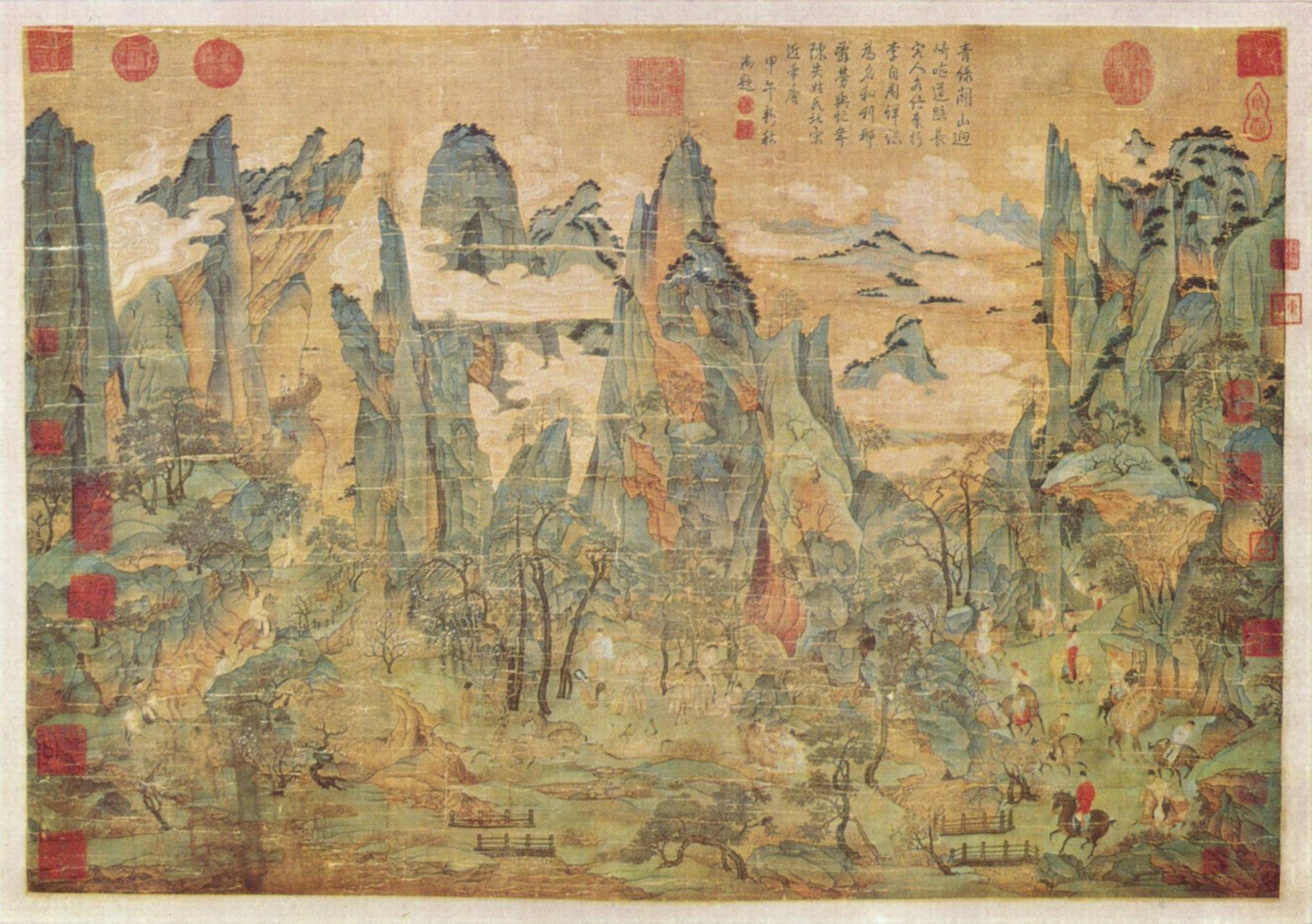
The painter Li Zhaodao (Li Chao-tao) was a contemporary of Wang Wei in early eighth century China. He was one of the originators of the qinglu (blue and green) style of landscape painting, which the JAANUS site describes as 'heavily colored with mineral pigments, especially blue azurite *gunjou 群青 and green malachite *rokushou 緑青' and 'which pays much attention to realistic detail rather than seeking to create an atmospheric impression.' Perhaps the most famous Tang dynasty blue and green landscape is The Emperor Ming-huang's Journey to Shu, a copy of a composition sometimes attributed to Li Zhaodao.


The Emperor Ming-huang's Journey to Shu (copy) attributed to Li Zhaodao
Source: Wikimedia Commons