Thursday, June 15, 2006

View of Toledo


El Greco’s View and Plan of Toledo (c1610-14) is interesting because it encompasses both a map and a landscape. The landscape of the city is accurate and reflects the details on the map held up by the young man. However, as the painted view does not have the burden of carrying all the topographical information it can also give an artistic impression of the city, spread out over the rocky slopes under a dramatic sky. And yet this view remains constrained by the real layout of Toledo. El Greco’s own vision of the city might be better seen in the Met’s View of Toledo (c 1597-99) where the artist alters the position of buildings (moving the cathedral to the left of the Alcázar palace) and the dark, writhing forms create an extraordinary expressionist landscape. 

 Images: Wikimedia Commons

Wednesday, June 14, 2006

A stone in Woncumb

The desire to uncover and celebrate the English landscape that inspired so much poetry, music and painting in the first half of the twentieth century, also led to a flowering of academic studies. A fiftieth anniversary edition of W. G. Hoskins’ The Making of the English Landscape was published last year, and in his introduction Keith Thomas places the book in the context of a post-War boom in scholarly landscape studies: Jacquetta Hawkes’ A Land (1951), Pevsner’s architectural guides, launched the same year, H. C. Darby’s Domesday Geography of England (1952), O. G .S. Crawford’s Archaeology in the Field (1953) and Maurice Beresford’s Lost Villages of England (1954). Hoskins’ work began as five radio talks in 1954 which were turned into a book the following year.

One of the charms of Hoskins’ book is the way he encourages the reader to get out and discover the history of the landscape for themselves. For example, ‘armed with a copy of a Saxon charter’ and a map, anyone can uncover an Anglo-Saxon estate boundary. He describes his own search for these boundaries in Devon and Somerset, scrambling over hedges, leaping across streams and walking ‘along high airy ridges’. He also describes a discovery of Mr G. M. Young on the edge of Wiltshire’s Vale of Pewsey where a charter of 825 records the granting of land by King Egbert to the church of St Peter and St Paul. The charter says that the boundary ran up to a stone in Woncumb with a distinctive hole in it. When Mr Young looked for this boundary he found the very stone, exactly where the Saxon surveyors had recorded it. 

Here are two of my favourite passages from the book, first on the pleasures of maps:
'There are certain sheets of the 1-inch Ordnance Survey maps which one can sit down and read like a book for an hour on end, with growing pleasure and imaginative excitement. One dwells upon the infinite variety of the place-names (and yet there is a characteristic flavour for each region of England), the delicate nerve-like complexity of roads and lanes, the siting of the villages and hamlets, the romantic moated farmsteads in deep country, the churches standing alone in the fields, the patterns made by the contours or by the way the parish boundaries fit into one another. One dissects such a map mentally, piece by piece, and in doing so learns a good deal of local history, whether or not one knows the country itself.'
And here, his knowledge of place names allows him to imagine how the landscape appeared before the English settlement:
'Inland, especially in the far west and north, there still remained millions of acres of stony moorland haunted only by the animal creation, where the eagle and the raven circled undisturbed. The villages of Earnwood in Shropshire and Yarnscombe in Devon commemorate former ‘eagles’ wood’ and ‘eagles’ valley’; while far up in the West Riding of Yorkshire the limestone crags above Littondale provided eyries for these noble birds, and in due course the Old English village of Arncliffe took its name from the ‘eagles’ cliff.'

Monday, June 12, 2006

The village of Zweeloo

There is an excellent Webexhibits site containing English translations of the letters of Vincent Van Gogh. The site allows you to search for words; I tried putting in Daubigny, the Barbizon landscape painter whom Van Gogh often mentions, and the site yields 58 results and a timeline showing each of these letters. The first is from 23 July 1873, when Van Gogh was in London and writing to his brother about English art: “Among the old painters, Constable was a landscape painter who lived about thirty years ago; he is splendid - his work reminds me of Diaz and Daubigny.” The last letter to talk about Daubigny is Van Gogh’s final letter, written from Auvers-Sur-Oise a few days before his death, exactly seventeen years after the letter from London: “Perhaps you will take a look at this sketch of Daubigny's garden - it is one of my most carefully thought-out canvases. I am adding a sketch of some old thatched roofs and the sketches of two size 30 canvases representing vast fields of wheat after the rain.”
 
Van Gogh wrote some beautiful descriptions of landscape. A favourite of mine is the letter of 2 November 1883 from Drenthe, describing a visit to Zweeloo which started before dawn. As the first light appeared “everything, the few cottages we passed - surrounded by wispy poplars whose yellow leaves one could hear falling - a stumpy old tower in a little churchyard with an earth bank and a beech hedge, the flat scenery of heath or cornfields, everything was exactly like the most beautiful Corots. A stillness, a mystery, a peace as only he has painted it...”
“The ride into the village was so beautiful. Enormous mossy roofs of houses, stables, covered sheepfolds, barns. The very broad-fronted houses here are set among oak trees of a superb bronze. Tones in the moss of gold-green, in the ground of reddish or bluish or yellowish dark lilac-greys, tones of inexpressible purity in the green of the little cornfields, tones of black in the wet tree trunks, standing out against the golden rain of swirling, teeming autumn leaves, which hang in loose clumps - as if they had been blown there, loose and with the light filtering through them - from the poplars, the birches, the limes and the apple trees. The sky smooth and bright, shining, not white but a barely detectable lilac, white vibrant with red, blue and yellow, reflecting everything and felt everywhere above one, hazy and merging with the thin mist below, fusing everything in a gamut of delicate greys.”
As the description continues, Van Gogh’s enthusiasm for this humble landscape becomes genuinely moving. “Journeying through these parts for hour after hour, one feels that there really is nothing but that infinite earth, that mould of corn or heather, that infinite sky. Horses and men seem as small as fleas. One is unaware of anything else, however large it may be in itself; one knows only that there is earth and sky.”

Quotations are from Webexhibits, which gives permission to use the letters under Creative Commons.

Sunday, June 11, 2006

Deer Park

The most famous landscape poems of Wang Wei (699-761) are contained in the Wang River Sequence, or as David Hinton’s recent translation calls it, the WheelRim River Sequence. One of these poems, ‘Deer Park’ briefly evokes the solitude of the mountains, with no sound but ‘hints of drifting voice, and in the wooded slopes, a beautiful detail – light falling on moss. It is the subject of an engaging book by Eliot Weinberger and Octavio Paz, Nineteen Ways of Looking at Wang Wei: How a Chinese Poem Is Translated, containing versions by Burton Watson, Gary Snyder and Kenneth Rexroth among others. There are interesting ‘Further Comments’, in which Paz discusses his own version of ‘Deer Park’, and a postscript with a translation by an American professor that Weinberg describes as ‘Gerard Manley Hopkins on LSD’. In the subsequent twenty years there have of course been more translations, including Hinton’s and a version by Vikram Seth. These are discussed in an interesting article at textets.com.


All this critical interest in ‘Deer Park’ seems to be detaching it from its original sequence and the landscape of Wang Wei’s estate. It is not so much that the poem itself has peculiar resonance, like a song that invites endless cover versions or a painting that is continually referenced. It is more that the process of translations have turned the poem into a challenge, like a mountain peak which must be scaled, while the translators hear the attempts of earlier poets like the ‘hints of drifting voice’ in Deer Park.

Friday, June 09, 2006

Landscape with Apollo killing the Cyclops

Domenichino and assistants, Apollo Killing the Cyclops, c. 1616-18

There are eight frescoes designed by Domenichino (1581-1641) in the National Gallery, all showing scenes from mythology set in classical landscapes. They originally decorated a garden pavilion at the Villa Aldobrandini in Frascati, built in 1615 as the rural retreat of Cardinal Pietro Aldobrandini. They fall into the Roman and Renaissance tradition of landscape frescoes: realistic depictions of idealised versions of the real countryside surrounding the villa. However, these frescoes have an interesting further layer of complexity: they are actually trompe l’oeil depictions of tapestries, as can be seen clearly in Apollo killing the Cyclops, where the tapestry is lifted up at one corner and the bars of a window can be seen behind the leg of the cardinal’s dwarf. So in Aldobrandini’s garden pavilion, the real landscape was behind a wall, behind a fake window, behind a fake tapestry and behind a landscape that never really existed.

 Apollo and Neptune advising Laomedon on the Building of Troy

Thursday, June 08, 2006

Poplars on the Epte

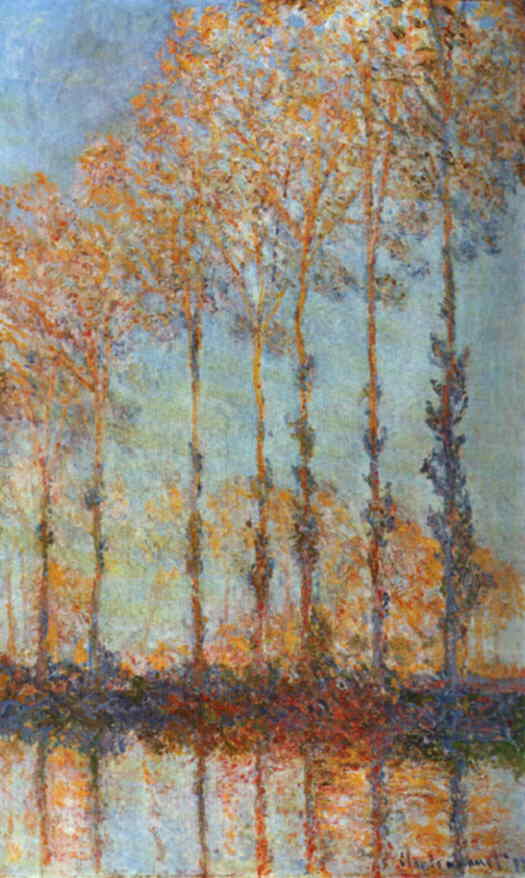
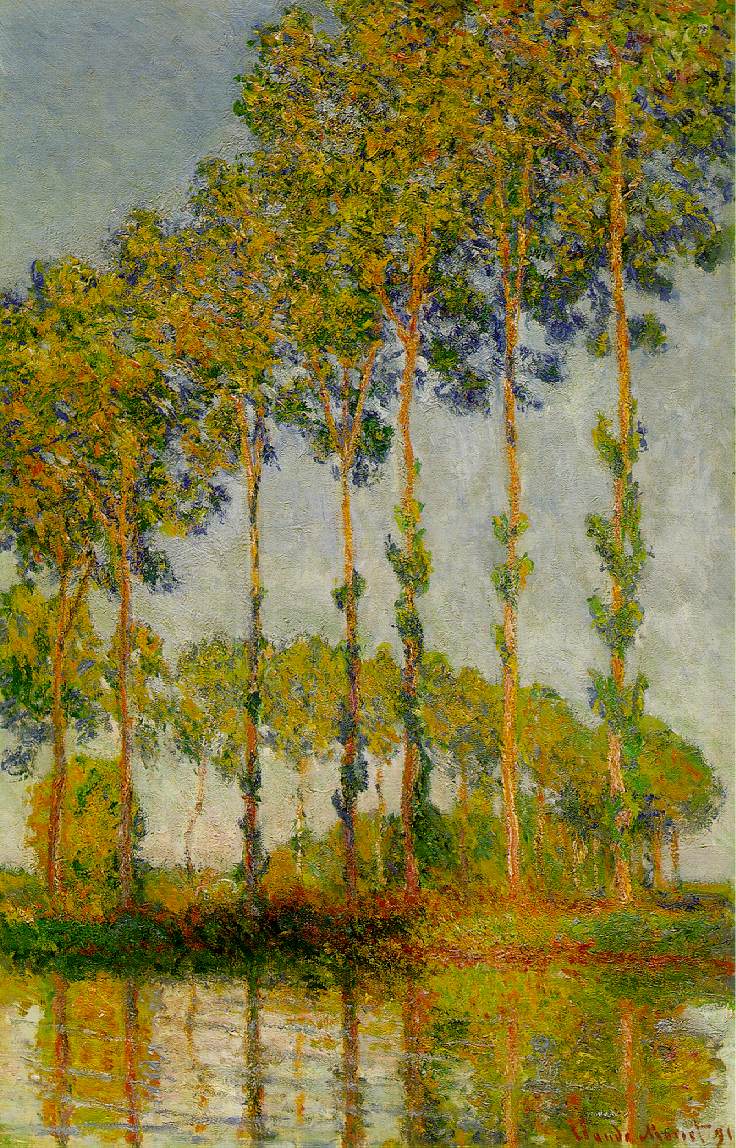
Claude Monet, Poplars on the Banks of the Epte, 1891

In 1891 Claude Monet painted Poplars on the Epte, Poplars along the River Epte, Autumn and several other views of the same landscape, working outside at specific times of day. He claimed he could only work on each painting for seven minutes at the most, ‘until the sunlight left a certain leaf’. These snapshots of a fixed view in different lighting conditions came to mind recently when I was looking at the images of a webcam on a hotel in Cornwall, which takes hourly photographs of Mawgan Porth Beach. But these webcam images are machine landscapes with no artistic personality, just the disembodied viewpoint of a hotel building. They do not claim to be more than a simple means of checking the local weather. The importance of the viewpoint might be seen in a comparison with another camera set up to film the sea, in Tacita Dean’s Disappearance at Sea II (1997). The views may be similar (and very different from a painted seascape) but in Tacita Dean’s film the role of the artist is clear in the choice of a resonant location for the camera, mounted in the position of the lighthouse bulb, gradually swivelling and gazing out to sea.

Tuesday, June 06, 2006

The Moselle

Has every river had its poet? The poet of the Moselle is Decimus Magnus Ausonius (c. 310-395), born at Burdigala (Bordeaux), who celebrated the river and its surrounding countryside in his Mosella. Ausonius was a poet who liked lists and the Mosella includes a description of the river’s fish: chub, trout, salmon, perch, pike... However, as this article on the Mosella fish catalogue by Vincent Huninck suggests, Ausonius is unlikely to have observed these fish directly, drawing instead upon “a marginal, almost forgotten tradition in ancient didactic poetry, the subgenre of 'poetry on good food' of which the Greek Archestratus was the founder.”

Postscript:

This original post was rather short so I am adding here a few extracts from a Loeb English translation avilable online by Hugh G. Evelyn White M.A., sometime scholar of Wadham College, Oxford.  Here, Ausonius wonders what the river thinks of itself...
'Thyself how often dost thou marvel at the windings of thine own stream, and think its natural speed moves almost too slowly! Thou with no mud-grown sedge fringest thy banks, nor with foul ooze o'er-spread'st thy marge; dry is the treading down to thy water's edge.'
Here he describes the transparency of the water.
'Thou through thy smooth surface showest all the treasures of thy crystal depths a river keeping naught concealed: and as the calm air lies clear and open to our gaze, and the stilled winds do not forbid the sight to travel through the void, so, if our gaze penetrates thy gulfs, we behold things whelmed far below, and the recesses of thy secret depth lie open, whenas thy flood moves softly and thy waters limpid-gliding reveal in azure light shapes scattered here and there: how the furrowed sand is rippled by the light current, how the bowed water-grasses quiver in thy green bed: down beneath their native streams the tossing plants endure the water's buffeting, pebbles gleam and are hid, and gravel picks out patches of green moss.'
And here is a river landscape, where the water reflects the trees (Hesperus is the evening star).
'Yon is a sight that may be freely enjoyed : when the azure river mirrors the shady hill, the waters of the stream seem to bear leaves and the flood to be all o'ergrown with shoots of vines. What a hue is on the waters when Hesperus has driven forward the lagging shadows and o'erspreads Moselle with the green of the reflected height! Whole hills float on the shivering ripples: here quivers the far-off tendril of the vine, here in the glassy flood swells the full cluster.'

Monday, June 05, 2006

Eight Views of the Hsiao and Hsiang Rivers

Muqi Fachang, A fishing village at sunset, c. 1250
Source: Wikimedia Commons

In the eleventh century Sung Ti painted Eight Views of the Hsiao and Hsiang Rivers. His example inspired many subsequent Chinese painters to depict the same views (one example is given above):
 
  1. Clear-weather mists above a mountain market-village
  2. A fishing village at sunset
  3. A sailboat returning to a distant inlet
  4. The confluence of the Hsiao and Hsiang rivers in the rain
  5. A temple bell in the evening mist
  6. The autumn moon over Tung-t’ing Lake
  7. Geese descending to a sandbar
  8. Snow falling on a river at dusk.
As Hiroyuki Suzuki has pointed out in his essay ‘The Garden of Shisendo’, in Japan a similar set of eight views was eventually established which closely parallels the original of Sung Ti - The Eight Views of Omi:
 
  1. The town of Awazu on a clear and windy day
  2. The village of Seta at sunset
  3. A sailboat returning off the shore of Yabashi
  4. Karasaki in the night rain
  5. The evening bell at Mii temple near Biwa
  6. The autumn moon over Ishiyama temple near Lake Biwa
  7. Geese landing near Katada
  8. Snow falling at dusk from Mount Hira, overlooking Lake Biwa.
Japanese artists took to the idea of ‘Eight Views’ and established similar lists for other landscapes at Kyoto, Nara, Fukagawa and elsewhere. And, as Suzuki notes, ‘during the Edo period it was fashionable to select eight views inside the gardens of feudal lords. For instance, there were eight views in the Rikugien garden at Komogome and of the Yuin’en garden in Ichigaya, both in Edo’. In the twentieth century official lists of the best eight views were still being drawn up, and Dazai Osamu referred to the tradition in the title of his novel Eight Views in Tokyo.
 
Neither of the lists of eight views here relate purely to location. The descent of geese and the falling snow relate to specific moments in time. Temporary effects of weather, season or time of day bring out the poetic qualities of the landscapes.

Note that in modern pinyin, Sung Ti is Song Di, and the rivers are Xiao and Xiang. An example of an early Chinese painting in the tradition is the scene of a returning sailboat by Mu Xi in Kyoto National Museum. There is a Korean version of the Xiao and Xiang scenes by Kim Tuk-sin in the National Museum of Asian Art-Guimet. In Japan, Ando Hiroshige made three versions of the Eight Views of Omi, which can be seen at the Woodblock Prints of Ando Hiroshige site.

Thursday, June 01, 2006

Fata Morgana


There was a trend in the sixties and seventies for directors (Godard, Tarkovsky, Marker) to use real locations in science fiction films to emphasise, in J.G. Ballard’s words, that earth is the alien planet. However, it was Werner Herzog who took this approach furthest in Fata Morgana (1971), jettisoning the science fiction plot altogether and retaining only a sequence of images that convey a strange world seen for the first time: strange cities and abandoned structures, deserts like the surface of other planets, mysterious landforms. In one sequence shot in Algeria, tower like structures are visible in the haze of the horizon, arranged like the soft forms in a Giorgio Morandi painting. In another, the desert rolls past in sharply defined abstract curves, like the dunescapes of Edward Weston. These landscapes were all real locations, unfamiliar to Western cinema goers. But stranger still were the mirages that Herzog filmed in the desert: floating lakes, blurred rocks and mysterious moving vehicles, none of which were there. Here, in his search for new images, Herzog went beyond the idea of locating rarely seen locations and found landscapes that only existed as atmospheric phenomena.

Tuesday, May 30, 2006

Scandinavian Landscape with a Waterfall

Jacob van Ruisdael’s Scandinavian waterfall paintings are partly remarkable because, as Seymour Slive says in his guide to the Royal Academy’s Jacob van Ruisdael exhibition, Ruisdael “never laid eyes on such scenes. His motifs for them were derived from Allart van Everdingen, a Dutch artist who visited Norway and Sweden in 1644 and returned to Holland with a stock of Nordic themes for use in his works. In the late 1650s and early 1660s, when Ruisdael began to paint rushing torrents in rocky mountainous northern valleys studded with conifers, he followed Everdingen’s example closely.” The exhibition includes the large Waterfall in a Mountainous Landscape with a Ruined Castle (c1665-70), which is in a private collection. The Fogg Art museum has another famous example, Waterfall with a Half-Timbered House and Castle.
 
On his trip to Scandinavia Allaert van Everdingen (1621-75) visited the south-eastern coast of Norway and the area of western Sweden around Göteborg. As Slive writes in Dutch Painting 1600-1800, there is no reason to believe he ever returned, even though he received a commission to paint the Trip family’s Cannon Foundry at Julitabroeck in Södermanland, Sweden. An example of the kind of Scandinavian landscape by Everdingen that inspired Ruisdael is the Munich Alte Pinakothek’s Scandinavian Landscape with a Waterfall (1650) (unfortunately the image doesn’t seem to be available on-line - PS: since writing this post the image below has become available).

Allaert van Everdingen, Swedish Landscape with Waterfall, 1650-1675
 
Everdingen’s work would also have an influence on Scandinavian landscape painting: another later artist who admired him was the Norwegian painter Johan Christian Dahl (1788-1837). Contemporary critics described Dahl as ‘the new Everdingen’. According to Andrew Graham-Dixon, Dahl’s training involved “seven years in the Danish capital, where he was taught principally by Christian August Lorentzen, a run-of-the-mill painter who encouraged him to study the many Dutch masterpieces in the Danish royal collection. 'The landscape painters I learn from are Ruisdael and Everdingen,' Dahl wrote in 1812. 'But first and foremost I study nature - a pity there are no cliffs and water here, but then one has to do with fountain water.'”

Monday, May 29, 2006

View of Haarlem with Bleaching Grounds

 
Jacob van Ruisdael, View of Haarlem with Bleaching Grounds (c1665) 

At the Royal Academy’s Jacob van Ruisdael exhibition there are several landscapes showing the local bleaching grounds, where lengths of cloth cover the ground, like abstract collages, blank canvases or (at a stretch) Christo wraps. In the Zurich View of Haarlem with Bleaching Grounds (c1665) for example, the cloth emphasises the light falling in the middle of the wide flat vista, an effect you often see in Ruisdael’s panoramic landscapes. Here is a description of a similar view from the Timken museum site: “Haarlem linen had a great reputation in the seventeenth century, and the linen industry was enormously important to the city's economy. Clothing and uncut cloth were bleached in the fields around the city in a process that took several months. Ruisdael, one of the most important seventeenth-century Dutch landscape painters, completed about fifteen views of Haarlem showing the linen-bleaching fields. In this richly textured canvas, as in other landscapes of the subject, the artist arranges the buildings and rows of linen to lead the eye diagonally through alternating areas of shadow and light.” Whether these paintings could be criticised or praised for transforming scenes of industry into harmonious pictorial compositions is, perhaps, ultimately a matter of taste.

The RA magazine has an article by Jenny Uglow on Ruisdael to accompany the exhibition here.

Sunday, May 21, 2006

A couple of breaks of sunshine

Kenneth Goldsmith’s The Weather is a sort of post-modern version of James Thomson’s The Seasons, based entirely on New York area one-minute weather report transcripts. It begins with ‘Winter’: ‘A couple of breaks of sunshine over the next couple of hours, what little sunshine there is left. Remember, this is the shortest day of the year. Looks like the clear skies hold off till later on tonight. It will be brisk and cold, low temperatures will range from twenty-nine in some suburbs to thirty-eight in midtown. Not a bad shopping day tomorrow, sunshine to start, then increasing clouds, still breezy, with a high near fifty…’

Kenneth Goldsmith has said: “The piece itself is a master narrative of a year, a sub-narrative of the four chapters, and several micro-narratives within the chapters. Storms approach from afar; they get closer; they occur; they pass. Weather, that most organic of phenomenon, is framed as a transaction. Quantified, narrativized, and capitalized, the weather either aids or abets our drive time.” The way weather is treated seems to convey a sense of contemporary landscape, where natural phenomena are present as background noise, like the sound of the radio. Marjorie Perloff has written an interesting essay about The Weather on Ubuweb.

Nothing to do with landscape, but there are some Goldsmith songs here based on cultural theory, for example text by Frederic Jameson sung to the tune of John Coltrane’s My Favorite Things. Not, I think, on this evidence a musical genre likely to flourish.

Saturday, May 20, 2006

Winter Landscape with a Gypsy Encampment

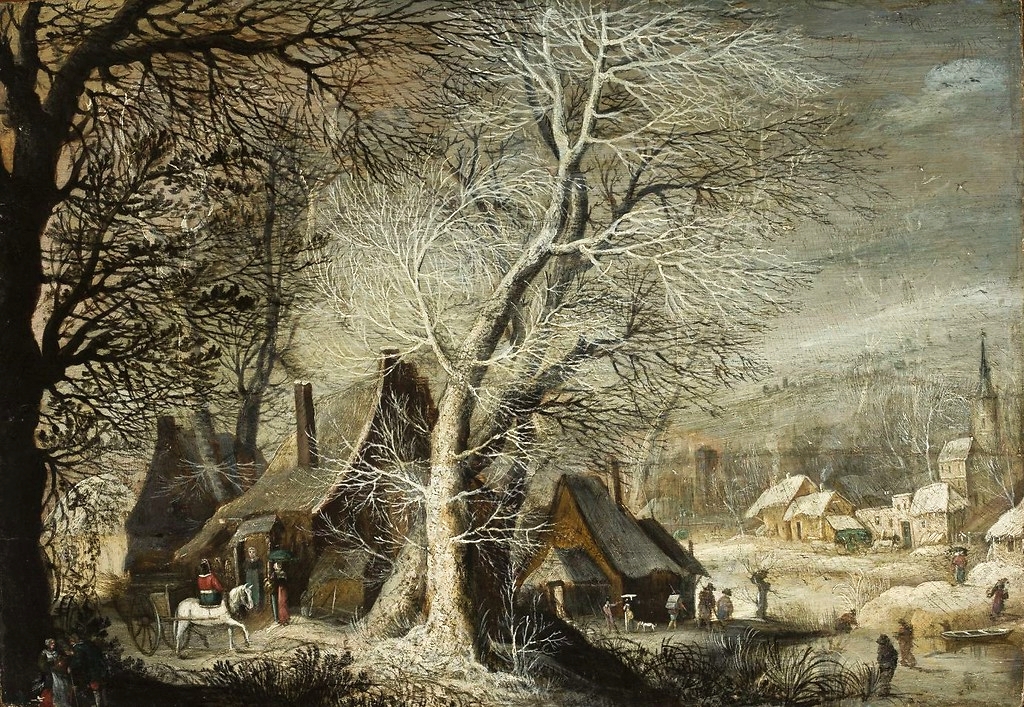
We think of modern artists as obsessively returning to certain types of landscape, whether for their symbolic value or formal qualities. In earlier centuries it is easier to imagine artists merely cornering particular sections of the landscape market. For instance, among early seventeenth century Flemish landscape painters, there were several in Antwerp specialising in woodland scenes, and among these Gijsbrecht Leytens (1586-1643/56) was the master at painting woodlands in winter. In Winter Landscape with a Gypsy Encampment there is a striking contrast between the dark foreground and the silvery-white branches beyond, the wood’s deep shadows and the golden winter light glimpsed through tunnel-like paths between the trees. The Bridgeman library has several other ‘Winterkens’ by Leytens: The Flight into Egypt, The Massacre of the Innocents, Winter Landscape. All these diverse scenes are covered in Leytens’ fine powder snow.

Postscript 2015 It is now possible to embed images in a way that was difficult when I wrote this brief post, so here are a sequence of Gijsbrecht Leytens images on Wikimedia Commons (dates are not given):  

Winter Landscape

A Winter Landscape with Woodcutter
Winter landscape with people strolling on the banks of a frozen river where children play

Friday, May 19, 2006

Valois mists

‘There was a slight stretch of open country to cover before reaching Othys. The village spire was already visible on the bluish hills that extend from MontmĂ©liant to Dammartin. The Thève was once again burbling over rocks and pebbles as it dwindled to a narrow stream near its source – where it rests among the meadows forming a small pond amid irises and gladioli’.  
This is a landscape in the Valois described by the narrator of Gerard de Nerval’s ‘Sylvie’ (1854). The translation is by Richard Sieburth, who observes that Nerval worked like a plein air painter: Nerval’s ‘limpid landscapes have often been compared to those of his friend Corot’. However, as with Corot, there is more to Nerval than mere description – this simple landscape quoted out of context conveys almost nothing of what makes ‘Sylvie’ so special (for me ‘Sylvie’ is one of the most perfect works of literature). Sieburth writes that ‘Sylvie’ is not simply ‘a regionalist roman champĂŞtre in the bucolic manner of George Sand’. It has affinities with Poe and Proust: a shifting landscape of memory and ghosts. The Valois of Nerval’s youth merges with that of Rousseau, Catherine de Medici and Charlemagne. So perhaps a more representative landscape is from a dream in which the narrator sees a castle lit by the setting sun, its green lawn framed by elms and limes and on it young girls dancing. The shadows descend and ‘thin clouds of mist drifted over the lawn, spreading tufts of white upon the tips of the grass. We thought we were in paradise.’

For more on ‘Sylvie’ see this French Nerval site.

Monday, May 15, 2006

Memory of Marcoussis

Jean-Baptiste Camille Corot, Souvenir of Coubron, 1872

Like Howard Hodgkin, Jean-Baptiste Camille Corot was an artist who, at least in his later work, painted memories of landscapes rather than views. This is suggested in titles like Memory [Souvenir] of Coubron (above) and many others: Souvenir de Mortefontaine, de Sologne, de Toscane, du lac d'Albano, de Castelgandolfo...   Michael Clarke (Corot and the Art of Landscape) calls such painting an art of ‘reflection and reminiscence’ and compares it to the poetry of Lamartine and de Musset, who also used the term ‘Souvenir’ in their titles. Indeed ‘Corot’s The Shepherd Star of 1864 was possibly inspired by lines by de Musset, of whom the artist recalled "Ah! Musset what a poet… He also has greatly suffered. He took notice of me in the past when none recognized me. I owe him a debt of gratitude."’

Sunday, May 14, 2006

Venice / Shadows


The Green Château, In Central Park, Bombay Sunset… Howard Hodgkin sometimes chooses titles that would suggest landscapes, but the paintings themselves never do more than suggest landscapes. House Near Venice (1984-88) includes what appears to be a house reflected in water, but other Venice pictures are no more than blurred hazes of colour. Venice / Shadows (1984-88) suggests the idea of a cool doorway or the pattern of sunlight and Venice Grey Water (1988-89) gives a sense of the lagoon – not grey but shifting greens and blues. Hodgkin’s Venice, like Turner's, is a city of memory and floating forms. Rather than landscapes, these paintings are about passing time, with its moments of clarity and confusion. As Andrew Graham-Dixon has written, they are works in which ‘topography is displaced by metaphor.’

Friday, May 12, 2006

Pier and ocean

Franz Marc, Tirol (1914)
Source: Wikimedia Commons

Robert Rosenblum has succinctly described some of the ways in which artists turned away from landscape at the start of the twentieth century (in his essay ‘The Withering Greenbelt’, published in Denatured Visions: Landscape and Culture in the Twentieth Century edited by Stuart Wrede and William Howard Adams). This included
  • landscape reduced to exquisite, almost abstract detail in the paintings of Monet and Augusto Giacometti;
  • landscape sanctified or mystical, archaic or primordial, as in the work of symbolists like Ferdinand Hodler;
  • unreal expressionist landscapes, both pastoral and apocalyptic, like Franz Marc’s gentle Horse in Landscape (1910) and violent Tirol (1914);
  • landscape reduced to fragments in the Modernist city, in the work of artists from Seurat to Leger, and symbolised by Corbusier’s Pavilion de l’Esprit Nouveau (1925) in which a single tree integrated into the design points to the containment and absence of nature.
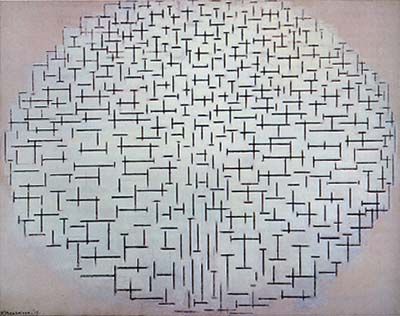
However, for Rosenblum it is Piet Mondrian who best exemplifies the process, going ‘from an espousal of nature and its mysteries, to a rejection of it in favour of an imagery rooted in the utopian city.’ Indeed Mondrian’s gradual artistic rejection of landscape and nature paralleled his own personal movement in 1909-11 ‘to the dunes on the cold northern shores where he felt he could immerse himself in the void.’ The simplified dune landscapes he painted there would be followed by The Sea (1912) and Composition No 10, Pier and Ocean (1915), from which it was a short step to complete abstraction.

Wednesday, May 10, 2006

The Holy Mountain

Arnold Fanck, the director whose work defined the Bergfilm genre, was born in 1889 and first encountered mountains at Davos as a child while recovering from asthma. He became a professional geologist, but also found time to become a skier and amateur photographer. Fanck’s debut film was The Wonders of Skiing (1919) and subsequent films celebrated the mountains through a mixture of documentary and narrative elements. In 1924 Mountain of Destiny so impressed the young dancer Leni Riefenstahl that she got in touch with Fanck to ask if she could appear in his next film. The Holy Mountain (1926) was the first of six mountain films they made together.

The Holy Mountain’s full title was Der heilige Berg: Ein Heldenlied aus ragender Högbenwelt. ‘Heldenleid’ means ‘heroic song’ and the film features a Nietzschean hero (Luis Trenker) who climbs the Alps to find himself, and to escape the rabble below. These elements of the story are undoubtedly difficult to take in light of the subsequent careers of actors and director under the Nazis. Trenker’s tormented Romantic idealist contrasts with the light-hearted young skier Vigo (Ernst Peterson) who features in the joyous and visually beautiful footage of the winter sports. The uneasy blend of fiction and winter sports in the film mirror the divided characters of the two men, who both desire the dancer played by Riefenstahl. Whilst The Holy Mountain is marred overall by Romantic clichĂ© and a proto-Fascist aesthetic, there are certain scenes where the beauty and excitement of mountains is vividly captured.

Mountain landscapes in The Holy Mountain are filmed in dramatic black and white. There is a memorable long-shot of skiers descending a slope, carving patterns in virgin snow. In the opening scenes Riefenstahl is silhouetted against the sea, and in the climactic scene on the mountain, the two climbers are fragile dark figures making their way up, as wind-blown snow cascades down the slope. Riefenstahl developed a similar visual sense in the later films she directed. In Tiefland, filmed during the Second World War at a time when colour films had become the norm, she explicitly set out to show what could still be achieved by black and white photography. And back in 1926, in Fanck’s temporary absence, Riefenstahl had directed one of the best scenes in The Holy Mountain, in which night skiers glide along carrying flares, their moving images reflected in water.

Monday, May 08, 2006

Sahara line

Among critical writing dealing with the origins of land art, Rosalind Krauss’s essay ‘Sculpture in the Expanded Field’ is particularly interesting (it is reprinted in her stimulating collection The Originality of the Avant-Garde and Other Modernist Myths). She argues that for most of its history sculpture was site specific, but that increasingly Modernist sculpture (the kind of work made by artists like Brancusi and Caro) was site-less and self-referential, no longer directly connected to buildings or landscapes. Sculpture had become implicitly defined as not-landscape and not-architecture, but all this started to change in the late sixties when artists began to seek an expanded field of possibilities.
 
To describe these developments Krauss uses a structuralist diagram based on the Piaget group. Sculpture is in one corner, but there are three other options. The opposite of sculpture is art that is both landscape and architecture: site-constructions like Robert Smithson’s Partially Buried Woodshed (1970). Ian Hamilton Finlay’s garden Little Sparta would seem to fit this category (Krauss saw Japanese gardens as an example of non-Western art that is both architecture and landscape). The architecture but not-architecture category covers various kinds of interventions into real buildings - Gordon Matta-Clark’s work springs to mind. Then there is art that is both landscape and not-landscape, which Krauss identifies as the marked sites of land art, including the work of Richard Long. A work like Long’s Sahara Line (1988) can thus be seen as art in the landscape that is nevertheless, like sculpture, an autonomous art work separate from any landscape.

Sunday, May 07, 2006

Views of Suma

Utagawa Hiroshige, The Beach at Suma, 1853

In the preface to his book on Japanese Linked Verse Earl Miner discusses the way Japanese poems are affective - responses in words to something moving – and that recipients of poems would in turn be moved by the way these emotions had been expressed. The same principle applies to landscape paintings. For example, in The Tale of Genji, the sketches and poetic descriptions Genji made during his exile in Suma move Prince Hotaru almost to tears. Miner relates this affective-expressive mode to two terms: 
‘”kokoro” means heart, mind, or spirit – the human capacity to be affected and to understand. “Kotoba” means words, languages, signs, or techniques – the human capacity to make known to others what has been gained by kokoro… Not to possess kokoro was to be barbarian, worse than animals. The warbler among plum blossoms, the frog in summer waters, the stag crying for a mate in autumn – all were poets. All gave voice to experience. Thus being moved and being led to expression defined poetic activity. In addition these animal singers and criers moved one to respond in poetry, just as would the poem of a friend.’
So it is not simply that landscape views provoke an emotional response; the possessor of kokoro will literally be spoken to by the natural world.