Friday, October 31, 2014

When the soft wind turns bitter


The Natureingang, 'nature opening', is found in many forms of Medieval poetry: the Latin verse of the clerici vagantes and Goliards, the songs of the Troubadours and Minnesingers, lyric poetry in French, English, Irish.  Spring would be the setting for songs of love and pastoral dialogues, whilst the end of summer and the onset of winter would signify loss and mourning.  Such poetry can therefore be grouped according to mood, like books of haiku arranged according to their season word (kigo).  The sleevenotes to one recording of songs by the early thirteenth century German poet Neidhart explain that he tended to classify them 'into “summer” and “winter” songs, according to which season he employed in the Natureingang (nature introduction) that opens nearly every song. Here he establishes an emotional backdrop for the lyrics: “Winter” symbolizes a melancholic atmosphere and is well suited to introducing topics that strongly refer to classical Minnesang, while descriptions of the approaching summertime are generally used for lighter subjects, often containing dance descriptions.'  You can hear one of these, 'Welcome the Sweet Summer Weather', in the clip embedded above.  The lines below begin another, sadder song:
Everything that all summer long was full of joy
turns to sadness with this winter-long, arduous time.
The birds have everywhere fallen silent with their singing.
Flowers and grass are utterly withered.
Look, how much cold frost covers the forest canopy.
The heath lies pale for good reason...
It occurred to me that it might be possible to string together nature openings to form a seasonal cycle, beginning now, in autumn, at a turning point in the year.  Here, for example, are lines are from some troubadour poems:

When the soft wind turns bitter
And the leaf falls from its branch                              
[Cercamon]

For I see the oaks reft of their leaves,
While nightingale, thrush, woodpecker and jay
Shiver with cold, and from the chill retreat               
[Peire d'Alvernhe]

When the ice and cold and snow retreat
And warmth creeps back into the land                      
[Guiraut de Bornelh]

Such sweetness spreads through these new days
[Guillem de Peitus] 

When tender grass and leaves appear
While buds along the branches throng                      
[Bernart de Ventadorn]

Now high and low, where leaves renew,
Come buds on bough and spalliard pleach               
[Arnaut Daniel]

In April when I see all through
Mead and garden new flowers blow                         
[Peire Bremon lo Tort]

When the days grow long and warm with May,
How sweet the birds' song sounds afar                      
[Jaufre Rudel]

(Translations from Lark in the Morning: The Verses of the Troubadours, ed. Robert Kehew)

The Natureingang was not only used in lyric and love poems.  As K. H. Jackson points out (in a book I quoted earlier this month), it also served to set the scene for longer poems like the Canterbury Tales and Vision of Piers Plowman.  I will end here therefore with Chaucer's opening lines; as we head towards winter, they offer a sweet reminder of spring... 
Whan that Aprille with his shoures soote,
The droghte of March hath perced to the roote,
And bathed every veyne in swich licóur
Of which vertú engendred is the flour;
Whan Zephirus eek with his swete breeth
Inspired hath in every holt and heeth
The tendre croppes, and the yonge sonne
Hath in the Ram his halfe cours y-ronne,
And smale foweles maken melodye,
That slepen al the nyght with open ye,
So priketh hem Natúre in hir corages,
Thanne longen folk to goon on pilgrimages...

Friday, October 24, 2014

The Jewelled Garden

Before him there were trees of precious stones,
And he went straight to look at them.
The tree bears carnelian as its fruit,
Laden with clusters (of jewels), dazzling to behold,
It bears lapis lazuli as foliage,
Bearing fruit, a delight to look upon.

[25 lines are missing here, describing the garden in detail.]

... cedar
... agate
... of the sea ... lapis lazuli,
Like thorns and briars ... carnelian,
...
Rubies, hematite, ...
Like... emeralds (?)
... of the sea,
...
- The Epic of Gilgamesh Tablet IX, trans. Maureen Gallery Kovacs

This is the earliest known literary depiction of a garden.  Time wore away the clay tablet on which it was written so that we no longer have a view of the whole, just these imagistic fragments, a few imperishable precious stones separated by ellipses.  The jewelled plants in the Epic of Gilgamesh remind me of the crystal flowers in J. G. Ballard's story 'The Garden of Time' which, while they last, are able to keep at bay the progress of time.  There is an analogy with the nature of a garden too, as Donald Dunham pointed out in his essay, 'Architecture without Nature': 'just as evidence of an untended garden's existence slips gracefully back into the earth, so too elemental nature has eroded the ancient tablet's legibility.'

The Gilgamesh tablets were found in the buried Library of Ashurbanipal, the Assyrian king who I described here in an earlier post, dining in the garden at Nineveh whilst a tree nearby hung not with jewels, but with 'the decapitated head of the conquered king of the Elamites.'  When Nineveh was sacked and burned, the library's contents were fired and thus, ironically, made more durable.  Over the years, as Egypt's papyrus libraries crumbled away or went up in flames, the clay tablets preserving the Gilgamesh Epic lay unknown under a mound near Mosul.  Heat had transformed a story originally written on wet clay with with a blunt reed into a part of the landscape, awaiting rediscovery.

This process came to mind when I read last week about a 100-foot Gillian Clarke poem written in clay onto the landscape of North Wales.  The BBC reported that
'a giant mural of a poem on a rock face in Snowdonia for an outdoor theatrical production has been likened to graffiti after attempts to remove it failed.  Rain was supposed to wash the writing off the slab near Gladstone Rock but there are worries it has been baked on due to the warm September weather.  National Theatre Wales has apologised and said it will rectify the problem. ... A spokesperson explained that Clarke's poem had been written on "bare rock with a non harmful clay-based product designed to wash away in the rain".  The spokesperson added: "However, the unseasonably dry weather in September has meant that her powerful words have remained visible longer than expected. With autumn now upon us nature can take its course and continue to wash away the poem."'

 
The Epic of Gilgamesh Tablet XI

I wonder whether any traces of this poem will remain after the autumn rains, or if all efforts will be made to eradicate its words completely.  The Gilgamesh fragment shown above comes after the garden episode and describes a great deluge when the gods caused humankind to be almost entirely washed away.  In the nineteenth century, at a time when Biblical history was under intense scrutiny, the 'powerful words' of this ancient text were capable of provoking extreme excitement.  According to the British Museum site, 'this Assyrian version of the Old Testament flood story was identified in 1872 by George Smith, an assistant in The British Museum. On reading the text he ... jumped up and rushed about the room in a great state of excitement, and, to the astonishment of those present, began to undress himself.''

Friday, October 17, 2014

Sweeney's Bothy

Sweeney's Bothy

One of Alec Finlay recent projects, Sweeney's Bothy, was built last year on the Isle of Eigg as part of The Bothy Project.  'The bothy belongs within a new contemporary movement – identified by Finlay as ‘hutopian’ – in which artists create huts and viewing platforms in the Scottish wilderness, proposing them as ecological, technological, architectural, and social models.'  Some interesting artists and writers have already stayed there, as you can see from the Bothy blog: Kathleen Jamie, Hannah Devereux, Oran Wishart.
'The bothy is based on Finlay’s design, inspired by the 7th Century Gaelic King Sweeney (Shuibhne). Cursed, Sweeney fled into a wilderness, surviving for a decade among the trees and birds, living on sorrel, berries, sloes and acorns, and enduring ‘the pain of his bed there on the top of a tall ivy-grown hawthorn in the glen, every twist that he would turn sending showers of hawy thorns into his flesh’ (Flann O’Brien, At Swim, Two Birds). Sweeney’s poetry from that period describes the austere beauty of the remote glen where he lived naked, communed with animals, and existed beyond convention. The myth of Sweeney conceals remnants of shamanic animism within pre-Christian culture. Like Han Shan, Basho, and Thoreau, Sweeney is a visionary hermit rejecting ‘feather beds and painted rooms,’ engaging with nature, the irrational, overturning accepted knowledge.'

View from Sweeney's Bothy with thorn bowl

Residents at Sweeney's Bothy can enjoy 'sorrel, berries, sloes and acorn' from bowls with a scratched thorn decoration, made by my wife.  The original poem Buile Shuibhne gives a vivid sense of the way Sweeney was able to live off the land.  I have written here before about the wonderful English version by Seamus Heaney, which was inspired by Kenneth Jackson's earlier translations.  Jackson's first book, Studies in Early Celtic Nature Poetry (1935), has recently been reprinted and it contains this marvellous description of natural foods in Irish poetry (the numbers refer to poems translated in the first part of the book).
'The variety of the plants and animals found in the countryside and eaten by the early Irish on the testimony of the poems is quite astonishing to a twentieth-century town-dweller, to whom "living on berries and nuts" seems such an improbable kind of existence.  No. V mentions apples, yew-berries, rowan-berries, sloes, whortleberries, crowberries, strawberries, haws, hazel-nuts, mast, acorns, pignuts, water-cress, herbs, wild marjoram, onions, leeks, eggs, honey, salmon, trout, water, milk and beer.  No. XVI speaks of deer, swine, mast, hazel-nuts, blaeberries, blackberries, sloes, trout.  No. XV has cress, brooklime, mast, trout, fish, wild swine, stags, fawns.  In no. XIX are blaeberries, blackberries, apples, sloes, strawberries, acorns, nuts, pig fat, porpoise steak, birds, venison, badger fat, fawns, salmon, fish.  No. XVII mentions blackberries, haws, hazel-nuts, bramble shoots, "smooth shoots", garlic, cress, meadhbhán, dilisk, birds, martens, woodcocks, otters, salmon, eels, fish.  Suibhne Geilt gives his "nightly sustenance" as blaeberries, apples, berries, blackberries, raspberries, haws, cress, watercress, brooklime, saxifrage, seaweed, herbs, sorrel, wood-sorrel, garlic, wild onions and acorns ... The diet is then one of flesh of animals and birds, fruit, berries, nuts, herbs, shoots, and waterplants, eggs, honey and fish, an impressive and intriguing menu.'


Earlier this year the Corbel Stone Press published Alec's Sweeney on Eigg which 'leaps off' from Seamus Heaney's version of  Buile Shuibhne.  It imagines the outcast Suibhne wandering as far as the island of Eigg.  Fleeing over crags and burns, sheltering among sheep, passing over moss and moorgrass, through birch and tares, blackthorn and brambles, he comes at last to a stop. 
I will sing
with peewits, cuckoos, & throstles
making the moor ring
from Druim na Croise.

I will hide Rum
with my hand
and stroke the fine down
on my arms.

Then, when the sunsets
drive me mad
with their beauty,
Suibhne will be gone.

Sunday, October 12, 2014

The Rhine (Melancholia)

Like the Turner exhibition I went to a couple of weeks ago, the Royal Academy's Anselm Kiefer retrospective is full of landscapes that are also history paintings.  The Morgenthau Series, for example, are ostensibly romantic depictions of nature, but the title is a reference to the wartime American plan to deindustrialise Germany.  The Guardian's Jonathan Jones was beguiled by them: 'we seem to fall into nature, to be immersed in it. Giant threads of light waft in the wind, dwarfing the spectator, who gets lost in the reverie of a rural hike right in the middle of London.'  He doesn't mention that one of these paintings has a rusty mantrap attached to it (a vagina dentata - the painting is named after Courbet’s ‘L’Origine du Monde’).  But it is true that these are less sombre than most of Kiefer's work, their extraordinary colours enhanced with gold leaf and lead that has been turned emerald green through a process of electrolysis.  Kiefer himself seems to have had some doubts about their beauty, as he told Jackie Wullschlager of the FT. “I so much like flowers and I painted so many flower pictures that I had a very bad conscience, because nature is not inviolate, nature is not just itself. So what to do with this beauty? I thought, ‘I will call it Morgenthau’." It sounds cynical but he was probably joking.  As with his close contemporaries from southern Germany, Werner Herzog and W. G. Sebald, there is often an undercurrent of dark humour in what he says.


I took the photographs above on the way in to the Royal Academy.  They show one of two installations in the courtyard dedicated to the Futurist poet Velimir Khlebnikov, who developed an esoteric theory on the cyclical nature of naval warfare (a few years ago Kiefer devoted a whole exhibition of sea paintings at the White Cube to Khlebnikov).  It would be impossible to do justice to everything I saw inside the exhibition - there is far too much to write about even if I just stick to landscape-related work: an early watercolour of a bleak winter landscape with a severed head in the sky dripping blood onto the snow, a huge wall-sized vitrine containing a painted forest with real roses and brambles (owned by the sister of Alain de Botton), a nightscape with real diamonds set into the paint that reminded me of what I wrote here only two days ago about mountains and stars...  I will quote instead two more critics, writing about artworks made nearly forty years apart, one in a case at the beginning of the exhibition, the other taking up the whole of its last room.
The Burning of the Rural District of Buchen IV (1975): Martin Gayford in RA Magazine explains that this 'documents an imagined conflagration and destruction of the area where he was then living and working. The later pages of the book are burnt, encrusted with charcoal, just as much of Germany itself had been during the war. But fire, while terrifying and annihilating, can also be healing, as Kiefer’s title hints. The German word he used for ‘burning’, ausbrennen, also means ‘cauterisation’. This is how the traditions of Friedrich and Schinkel looked and felt to Kiefer in the aftermath of the Third Reich: burnt out, haunted by overpowering, terrible events.'
The Rhine (1982-2013): Alastair Sooke in The Telegraph writes that 'the show ends on a high, with a beautiful installation called The Rhine, a collage of black-and-white woodcuts on canvas with acrylic and shellac compiled over more than two decades, between 1982 and 2013. The various gigantic canvases of this compelling artwork have been arranged as interlocking screens, so that the viewer enters a maze-like forest with the waters of the Rhine visible in the distance.  In between the tree trunks stand the touchstones of Kiefer’s imagination: wartime bunkers, a blaze of fire, the polyhedron from Durer’s famous print Melancholia. It is as if one of Kiefer’s lead books has come to life and is embracing us within its pages.'

Friday, October 10, 2014

In the Sierra

All day cloud shadows have moved over the face of the mountain,   
The shadow of a golden eagle weaving between them   
Over the face of the glacier.
At sunset the half-moon rides on the bent back of the Scorpion,   
The Great Bear kneels on the mountain.
Ten degrees below the moon
Venus sets in the haze arising from the Great Valley.
- from 'Fall, Sierra Nevada' in 'Toward an Organic Philosophy' (1940) by Kenneth Rexroth (the full poem can be read at the Poetry Foundation)


In the Sierra: Mountain Writings collects the poems Kenneth Rexroth wrote about his years exploring the Sierra Nevada, along with extracts from his autobiography, newspaper columns and a practical guide to camping in the Western Mountains.  Its editor Kim Stanley Robinson is well known for science fiction that explores environmental themes, often involving mountain climbing - similar in some ways to M. John Harrison, the British science fiction writer and climber I talked about here last year.  Robinson provides endnotes that try to place the poems, speculating on the trails Rexroth must have taken and the vantage points from which he describes the landscape.  There is also a short piece at the end of the book by another Californian SF writer and 'amateur astronomer' Carter Scholz, that tries to locate the poems in time using Rexroth's frequent references to stars and planets.  For example, using information in the poem quoted above he deduces that Rexroth was camping on September 28th 1938 'at Lake Catherine, from which the San Joaquin ("Great") Valley is also visible; from this vantage Ursa Major would have been "kneeling" above Mount Davis to the northwest."

For me this astronomical detective work only serves to emphasise what becomes evident when you read through these poems, that for Rexroth the mountain landscape extends out into space.  Camping out on a high trail he already had a long view: 'Looking out over five thousand / Feet of mountains and mile / Beyond mile of valley and sea.'  Then, as night falls, he could lie back and study the stars.  This poem is 'The Great Nebula of Andromeda', one of a group called 'The Lights in the Sky are Stars', written for his young daughter Mary.  The Poetry Centre Digital Archive has a recording of Rexroth reading these poems in 1955 (he breaks off to tell his listeners what they could see if they looked up at the constellation of Hercules, apologising that 'the finer details of astronomy may escape a miscellaneous audience.') The final poem in this sequence is 'Blood on a Dead World', describing Mary's excitement at viewing an eclipse (Carter Scholz pins this to 6:30pm on January 18 1954).  Earlier this week the same phenomenon, a 'blood moon', was visible over America and Asia.  Rexroth stands in wisps of fog and watches with his daughter as the moon slowly darkens.
        "Is it all the blood on the earth  
        Makes the shadow that color?"  
        She asks. I do not answer.

Friday, October 03, 2014

Tusculan's romantic groves


Olafur Eliasson's Turner Colour Experiments (2014) at Tate Britain

As reviewers of Tate Britain's Late Turner – Painting Set Free have pointed out, there is much more to the artist's final years than the 'sublimely empty pictures' that regularly get compared to the work of abstract artists.  The last Turner show I went to, at Margate earlier this year, paired him with Helen Frankenthaler and two years ago the Tate itself mounted an exhibition that made the link with Cy Twombly's later paintings.  Visiting this new exhibition last weekend, I came ready to enjoy the art anachronistically: the abstract expressionism of Turner's Rough Sea (1840-5), the minimalist sequence of blue and grey sky studies (similar to those in the Channel Sketchbook viewable at Google Art) and of course those famous visions of Venice dissolved in light.  The temptation to forget Turner's subject matter and see his work in terms of pure colour was also encouraged by the presence of Olafur Eliasson's Turner Colour Experiments (for a discussion of these, see BLDGBLOG).  But ultimately I found I was just as interested in the way Turner persisted with history painting, where his spectacular effects seem often to magnify rather than overshadow the incidents they depict, drawn from Shakespeare, the Bible and the classics.  For this post I want to focus on one of these, Cicero at his Villa, which Turner exhibited in 1839.

J. M. W. Turner, Cicero at his Villa, 1839

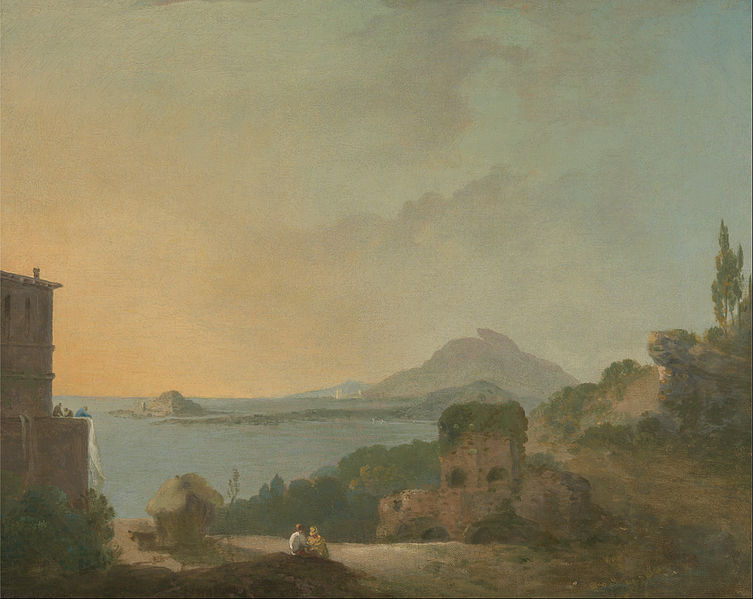
I have written here before about the appeal of bringing the work of Latin writers to life by imagining them in their setting, as Gilbert Highet did in his classic study Poets in a Landscape (1957).  In 1819 Turner was in Italy, sketching at Frascati, which, according to a travel book he owned, was the site of  Roman Tusculum.  There he would have pictured Marcus Tullius Cicero, who wrote Stoical essays there (the Tusculan Disputations, 45 BCE) on such cheerful topics as grief of mind, bearing pain and contempt of death, two years before being killed as an enemy of the state.  However, Turner was approaching Cicero through the lens of art, because, as his sketchbook makes clear, he was looking for the site where his admired predecessor, Richard Wilson, had set Cicero and his Friends at his Villa.  This painting, first exhibited in 1770, is usually identified with Arpinum, but Turner would have seen another version (see below) which its owner called Cicero at Tusculum.  Another source for Turner's painting may have been 'The Pleasures of Memory', a long poem that brought Samuel Rogers literary celebrity when it appeared in 1792, which mentions Cicero at Tusculum.  Thus there are various paths that lead from Turner's picture back to its classical source and the three texts below (all referred to in a 1981 article by William Chubb) show how art drawn from landscape leads back to art again.

Richard Wilson, Cicero with his friend Atticus and brother Quintus,
 at his villa at Arpinum, c.1771-75

(1) First there is Turner himself, drawing a parallel between Wilson and Cicero in a lecture called 'Backgrounds, Introduction of Architecture and Landcape' which he delivered in February 1811.  This can be found in an old edition of the Journal of the Warburg and Courtauld Institutes - the reason it is not widely published is presumably that it is not very well written (Roger Fry tried to transcribe it and gave up saying that "it would be unfair to Turner to publish work that only shows his weaknesses").  Towards the end of the lecture, Turner regrets the fact that Zuccarelli's 'meretricious' paintings
'defrauded the immortal Wilson of his right and snatched the laurel from his aged brow. In vain did ...  the Cicero at his Villa sigh for the hope, the pleasure of peaceful retirement, or the dignified simplicity of thought and grandeur, the more than solemn solitude that told his feelings.  In acute anguish he retired, and as he lived he died neglected.'
(2)  Then there is the passage on Cicero that Turner marked in his own copy of Rogers' Poems (1827).  Turner knew the poet and illustrated the long poem Italy that Rogers based on his travels (fit was from Italy that Rogers wrote to a friend: 'Oh if you knew what it was to look upon a Lake which Virgil has mentioned & Catullus sailed upon, to see a house in which Petrarch has lived.')  In 'The Pleasures of Memory', Rogers describes 'the charm historic scenes impart' and refers to the time Cicero (Tully) visited Syracuse a hundred and sixty years after the death of Archimedes, to find the Sage's grave unregarded and overgrown.
'So TULLY paus'd, amid the wrecks of Time,
On the rude stone to trace the truth sublime;
When at his feet, in honour'd dust disclos'd,
The immortal Sage of Syracuse repos'd.
And as his youth in sweet delusion hung,
Where once a PLATO taught, a PINDAR sung;
Who now but meets him musing, when he roves
His ruin'd Tusculan's romantic groves?'
(3)  Finally, Cicero.  At various times he owned villas at different locations, so that Wilson was able to paint another Cicero-related view (below) that combines Italian light and classical allusion.  Cicero's Arpinum villa was used as the setting for his book on law, De Legibus.  This begins with the scene Wilson depicts in the painting shown above, where Cicero (Marcus), his brother Quintus and friend Atticus are looking at an old oak tree associated with the Consul Gaius Marius (157-86 BCE).  Thus the poignant capacity of landscape to preserve fragments of culture, which Wilson, Rogers and Turner experienced in Italy and exemplified in their art and poetry, can be found in De Legibus described by the writer who inspired them.  Cicero's dialogue refers to his own earlier poem, and to a palm tree on Delos that takes us all the way back to Homer. 
'Atticus. —This is the very grove, and this the oak of Arpinum, whose description in your poem on Marius, I have often read. If, my Marcus, that oak is still in being, this must certainly be it, but it appears extremely old.
Quintus Cicero. —Yes, my Atticus, my brother’s oak tree still exists, and will ever flourish, for it is a nursling of genius. No plant can owe such longevity to the care of the agriculturist as this derives from the verse of the poet.
Atticus. —How can that happen, my Quintus? How can poets bestow immortality on trees? It seems to me that in eulogising your brother, you flatter your own vanity.
Quintus. —You may rally me as much as you please, but as long as the Latin language is spoken, this oak of Marius will not lose its reputation; and as Scævola said of my brother’s poem on Marius, it will “Extend its hoary age, through countless years.” Do not your Athenians maintain that the olive near their citadel is immortal, and that tall and slender palm tree which Homer’s Ulysses says he beheld at Delos, do they not make an exhibition of it to this very day? and so with regard to other things, in many places, whose memorial endures beyond the term of their natural life. Therefore this acorn-bearing oak, on which once lighted “Jove’s golden Eagle, dazzling as the sun,” still flourishes before us. And when the storms of centuries shall have wasted it, there will still be found a relic on this sacred spot, which shall be called the Oak of Marius'
Richard Wilson, Cicero's Villa and the Gulf of Pozzuoli, 1770-80

Saturday, September 27, 2014

How gloomily glaring!

'The Claude Glass was an optical device which took various forms, of which perhaps Thomas Gray's was the most typical: 'a Plano-convex Mirror of about for inches diameter on a black foil, and bound up like a pocket-book.'  The convexity miniaturised the reflected landscape.  Except in the foreground, details were largely lost, and something like a beau ideal emerged, freed from particularities and deformities. [...] Its 'complex view' helped the apprentice painter; and, for the non-painting tourist, its darker tinting and distortion helped to superimpose something like a Claudean idiom on British landscape.' - Malcolm Andrews The Search for the Picturesque
Claude Lorrain mirror, rectangular of black glass  
Claude Glasses in The Science Museum

I have been reading Arnaud Maillet's The Claude Glass: Use and Meaning of the Black Mirror in Western Art.  It originally appeared in France in an edition of just a hundred copies, but was translated and published as a Zone Book at the instigation of Jonathan Crary (whose Techniques of the Observer has been a key text in visual studies).  That small initial print run may reflect the surprising fact that, according to Maillet, 'in France, these instruments are virtually unknown, even by art historians'; whilst it is relatively easy to see them on show here (e.g. in the Science Museum), there are none in French collections.  The scope of Maillet's book goes well beyond the instrument used by Picturesque tourists and artists in the late eighteenth century.  In addition to covering earlier uses of convex mirrors in art, he considers the association of black mirrors with the dark arts and their use in catoptromancy and hypnotism.  He also finds black mirrors in more recent art (Boltanski, Richter, Perrodin) - abstractions and reflective surfaces that call into question what we are seeing - and he explores their association with loss, melancholy and mourning.

John Dee's scrying mirror in The Science Musuem

The term 'Claude Glass' has also been used for another viewing instrument sold to Picturesque tourists: a set of tinted viewing lenses.  These lenses could create the kind of tonal harmony we encounter only rarely in real life - in mist, at sunset or in the smoke of a fire.  Like the filters available now on photographic apps, they allowed the viewer to perceive the landscape in different lights.  For example, 'through the hoar-frost tinted lens, distant corn stooks become snow drifts.  The tourists could rationalise these fancies by claiming that such artifice was, after all, only a means of anticipating what Nature herself would be doing in a few hours' or a few months' time with the same landscape' (Andrews). The leading theorist of the Picturesque, William Gilpin, tried these Claude Glasses while riding in a chaise and saw a dream-like succession of 'high coloured pictures'.  Their usage was easy to satirise though, as Maillet points out, and I will end here with the quotation he uses from James Plumptre's comic opera The Lakers (1797).  Miss Veronica Beccabunga is looking through her 'Claude Lorraine Glasses' at the landscape between Derwent Water and Borrowdale.
'Speedwell, give me my glasses.  Where's my Gray?  (Speedwell gives glasses.)  Oh! Claude and Poussin are nothing.  By the bye, where's my Claude-Lorrain?  I must throw a Gilpin tint over these magic scenes of beauty.  (Looks through the glass.) How gorgeously glowing!  Now for the darker. (Looks through the glass.)  How gloomily glaring!  Now the blue.  (Pretends to shiver cold.)  How frigidly frozen!  What illusions of vision!  The effect is unspeakably interesting.'
Later Miss Beccabunga uses her glasses on her prospective husband.
 'I'll throw a Gilpin tint on him.  (Looks through the glass.)  Yes, he's gorgeously glowing.  I must not view him with the other lights, for a husband should not be either glaringly gloomy, or frigidly frozen; nor should I like to be haunted by a blue devil.'

Friday, September 19, 2014

Fort Process

Musical performance and sound art installation come together in site-specific festivals like the one I attended on Saturday at Newhaven Fort, 'Fort Process', or the TÖNE Festival in June, originally planned for Chatham Dockyard (the review in this month's Wire magazine explains that it ended up split over several venues).  From the perspective of this blog, what interests me in these is the way invited artists work with the structure and history of a site and the extent to which the wider soundscape is incorporated in the audience's experience.  Newhaven Fort is a defensive structure - one of Palmerston's follies, completed in 1871 - and as such it encloses you from the wider landscape.  Sound pieces were located underground and many of the performances took place in enclosed, bunker-like enclosed spaces.  The small main stage was set up on the parade ground in the centre of the fort, surrounded on all sides by grass embankments, giving a sense of containment and isolation.  To see out we had to climb these slopes and stand where the guns once pointed seawards, the vantage point where Eric Ravilious sketched Newhaven's coastal defences in 1940 (a few months after he had been stationed at Chatham).  

Eric Ravilious, Coastal Defences, 1940

John Butcher's contribution to Fort Process felt symptomatic of the way the site's remnants of fortification influenced the sounds we heard.  I wrote here eight years ago about an outdoor performance he did at the Standing Stones of Stenness, when the local sheep joined in with their bleating and the wind played tunes on his amplified soprano saxaphone.  Based on this I had imagined we might watch him perform on the ramparts of the fort, blowing his horn towards the English Channel while sea birds wheeled above.  Instead, while the sun set over the Downs on what had been a beautiful warm day, we gathered to listen to his improvisations on the cold concrete floor of a room once used to store gunpowder and shells.  Earlier, one of the artists (Sara Jane Glendinning) tried to entice seagulls to land on switch pads connected to sound samples, but they were strangely resistant to landing near the old gun emplacements.  At the end of the day we were in an old World War II hut, watching the start of an explosive set by Steve Noble and Peter Brötzmann (best known for his 1968 free jazz album Machine Gun). As the sound clattered off the corrugated iron roof it was easy to imagine the soldiers stationed here during World War II, listening to the bombers heading out to sea. 

As a collection of disparate artists linked only be location, this kind of event inevitably differs from an immersive theatre performance or the kind of multimedia environmental drama pioneered by Robert Wilson.  It was impossible to see everything - in addition to the sound art and performances there were talks and some interesting-sounding film works (sadly the projector broke down before we could see any of these).  The photograph below was taken during a performance of Fourfleckflock, a graphical score based on the motion of starlings.  I was interested in music like this with a landscape/nature connection (Thomas Köner showed that you don't need drums when you've sampled the sound of thunder) but was just as happy listening to Ex-Easter Island Head and Part Wild Horses Mane on Both Sides.  There was time to wander round and look at the art, installed inside tunnels and gun towers - some new, some versions of existing work so that the interest for the artist will have been in seeing how their pieces were transformed in this particular setting.  Sarah Angliss brought a collection of little mobile robots to the Fort's Laboratory, where live shells were once constructed.  Their bells, rung in alarm when they encountered walls and doorsteps, had a pleasing, gentle quality when heard from a distance.  Not something you could say of Noble and Brötzmann, whose gunfire followed us for some distance as we headed out of the fort during their set to get the train back to London... 

Friday, September 12, 2014

American Smoke


It was the season of autumn ghosts, a dampness in the soul.  November 2013.  I stopped outside the sea cadets building in Stoke Newington's Church Street, now re-purposed as an exhibition space: 'building-F'.  In the old bricks there were ghost traces of a painted sign: S S OKE.  The roof was an abandoned deck with white railings and a solitary flag pole.  Looking down at the street, a life-size photograph of J. G. Ballard.  In the new front window, a neat stack of Iain Sinclair's American Smoke.  Inside I was hoping to encounter the man himself, having heard that he would be selling off his old books for a limited period.  But there was no sign of him: just framed artwork and a bookcase filled almost entirely with his own publications, signed and annotated, with prices to match. Ridiculous, I now realise, to imagine he would be there in person, presiding over tables stacked with the remnants of his book selling days: paperbacks by overlooked London writers, pulp novelists, underground poets.  I lingered awhile - not buying anything felt like an affront to the couple from Test Centre who politely stood by as I looked at the shelves.  Eventually I left with a book of poems: Firewall.


American Smoke begins in Gloucester, Massachusetts, where Sinclair went to deliver a lecture on Charles Olson, 'poet, scholar and last rector of Black Mountain College'.  There he met Henry Ferrini, whose film on Olson I included in a post here on the Maximus Poems back in 2010.  He visited Dogtown, where Olson came and walked in the woods 'to refine the art of getting creatively lost'.  He even booked a tourist whale-watching cruise (assuring us that 'the excursion was being made for my wife'). Olson's first book, published in 1947, was a study of Moby Dick.  The boat trip cancelled, he headed for the local library, looking for Olson's marginalia in books that had found their way onto the stacks after his death.  He says he found rough notes for a poem in the endpapers of one volume (much harder to decipher than the text Sinclair added to his own books for the pop-up shop in Stoke Newington).  Back in London he was pleased to have 'absorbed some of the weather of the place' but realised in watching Ferrini's film again that Olson can only be experienced in the energy field of his poems.

My landscape interest in American Smoke had been kindled by Sinclair's account of a journey to see Gary Snyder, published initially as an essay in the LRB.  Snyder evaded discussion of poetics but was happy to talk about logging, ecological threats and the day-to-day work needed to maintain the land he bought cheaply in 1966: 'a hundred acres of manzanita thickets, with open stretches of ponderosa pine, black oak, cedar, madrone, Douglas fir, bunchgrass...'
'Taking responsibility for a portion of Sierra ridge, once occupied, river valley to densely forested upper slopes, by Indian tribes, was a major statement of intent from Snyder. ‘We were cash poor and land rich,’ he said. ‘And who needs more second-growth pine and manzanita?’ Alexander Pope, in his upstream exile at Twickenham, laid out garden and grotto as a conceit, an extension of his work into the world, and a powerful attractor for patrons and lesser talents. To fund the Sierra reinhabitation, as Snyder saw it, he took on reading tours and an academic position at UC Davis, fifty miles down the road near the state capital, Sacramento. He called his land Kitkitdizze, after the Wintu Indian name for the aromatic shrub known as bear clover. ...  This Thoreau-inspired wilderness encampment, real as it appears, is underwritten by the requirement to represent itself as a topic for thesis writers, a reluctant paradigm.  A magnet for approved visitors, students, localists, or anyone needing to understand if this thing can be managed: a self-funding, functioning centre that is not a retreat, but a resettlement...'
The whole book is structured around these encounters with writers, living and dead: Corso in New York, Burroughs in Kansas, the grave of Malcolm Lowry in Sussex.  From Vancouver, Sinclair goes to the Burrard Inlet in search of the shack Lowry and his wife constructed from driftwood and sawmill lumber.  It was a kind of idyll - described as such in some beautiful passages in Under the Volcano - and Sinclair visits the spot on a crystalline morning.  He is led along a winding path through resinous woodland, down to the shore.  Lowry had enjoyed the view here, across the water to an oil refinery where the S had fallen from the word SHELL.  Sinclair is tempted to go in - 'I'd like to swim, the water is strobing gold' - but he paddles instead in the cold, sharp-stoned shallows.  There is an old bottle top glinting in the water - not Lowry's, but something to pick up and take away.

Friday, September 05, 2014

A Journey to Avebury


There are two days left on the iPlayer to listen to an episode of Stuart Maconie's Radio 6 show on 'West Country Freaks' which includes some music specifically inspired by the landscape of Southwest England.  A few days before the broadcast I was actually in the West Country myself, about to visit the Avebury stone circle on our way back to London.  We stuck to our plan despite forecast heavy rain because I had worked it all out in advance with pleasing symmetry, to echo the stop-off at Stonehenge on our earlier journey west.  There had been rain in the air then too, giving some dramatic skies over the old stones, as you can see in my photograph above. Ah, Sonehenge... 'where a man's a man and the children dance to the Pipes of Pan'.  Spinal Tap's classic song was included in 'West Country Freaks', along with Coil's soundtrack to the early Derek Jarman film A Journey to Avebury (embedded from YouTube below).


Another band featured on the programme were Neil Mortimer's Urthona, whose blog records various visits to stone circles.  'From The Godless Erme Valley' was an outtake from their 2008 release via Julian Cope's Head Heritage, 'I Refute It Thus.'  This comprised 'three long tracks of primitive noise guitar freakouts inspired by the windswept-tor landscape of mighty Dartmoor, and a retort to the doom-laden cultural landscape of 21st century Britain.'  It came 'packaged in a unique organic fold-out cover plus inserts and highfalutin liner notes with nods to William Blake, Richard Jefferies and Walt Whitman.'  Their latest album is inspired by the great storm of 1703 ('no pen could describe it, nor tongue express it, nor thought conceive it unless by one in the extremity of it', according to Daniel Defoe).  In his review for Wire Joseph Stannard likens it to Flying Saucer Attack's 'Rainstorm Blues', which I mentioned in a post here a few years ago.

FSA were based in Bristol and their 'Sea Corpus', from the limited edition 1996 release 'In Search Of Spaces', was also included in 'West Country Freaks'.  Two other tracks on the show are worth highlighting: 'Somerset' by the prolific ambient composer and artist Rutger Zuydervelt (Machinefabriek) and 'Piperspool' from John Surman's 1990 ECM album The Road to St Ives.  I had not checked out this St Ives album before, despite having visited several times in recent years and written here about the town's art and landscape. However, after returning from the Lake District a few months ago, I was listening to Ambleside Days - another John Surman album where each track relates to a specific place. I think these gentle jazz tunes were insufficiently experimental to feature on an earlier place-themed Freakier Zone covering the North West, which included a great interview with Richard Skelton.  Given Stuart Maconie's enthusiasm for fell walking and landscape, it would be worth looking out for more of these programmes in the future.

Wednesday, September 03, 2014

Stourhead


When we arrived at our Somerset B&B en route to Wales I told the owner we had chosen to break our journey there to visit the landscape garden at Stourhead.  "That's it over there" she said, pointing out of our bedroom at a distant tower rising above the trees on the horizon.  While the garden itself was hidden from view on the other side of the hill, this outlying folly 'took dominion everywhere', turning the wider countryside in the warm evening light of late August into the kind of ideal Claudian landscape admired by the tower's creator, Henry Hoare II.  The following morning we drove the short distance to see it.  King Alfred's Tower was completed in 1772, having been conceived a decade earlier with multiple patriotic intentions: to mark the end of the Seven Year's War, the succession of George III and the place where Alfred rallied his Saxon army to defeat the Danes at the Battle of Ethandun.  I was not that surprised to find the door locked, preventing us climbing its 205-step staircase to admire the view - I mentioned here a similar experience at Hadrian's belvedere in Tivoli earlier this year.  It was frustrating though, and I fantasised about returning, kitted out like an urban explorer, to just break in and climb up anyway.  Perhaps I should start travelling the country at weekends, 'place hacking' other National Trust properties...?  Just as I was starting to imagine the possibilities I was subjected to urgent requests for coffee and cake, and so we drove off to find the tearooms.


In his book The Arcadian Friends Tim Richardson describes Stourhead in terms of the circuit one was expected to take in the eighteenth century.  The first viewpoint provided 'a vista across the lake to the circular, domed Temple of Apollo high above, its tall columns accentuating its height, with the medieval church and village of Stourton in the middle ground below, and to the left on smooth sward.'  The eclecticism of the landscape was therefore apparent immediately - Gothick and classical in one view.  Stourhead has no overriding narrative and while there clearly is symbolism in some of its statues and inscriptions, the design more closely resembles a painting - 'a charming Gaspd picture' in the words of Henry Hoare.  Setting off on my own circuit of the garden I found myself experiencing a gallery of views framed in foliage, like the one I photographed below, where the eye is drawn across the lake to the temple of Apollo and then beyond to the distant countryside.


After descending to the lake, the garden's original visitors would have continued over a mildly perilous fretwork bridge (no longer extant) and then through a woodland path to the grotto.  This rather dank 'house of the nymphs' inevitably recalls Dr Johnson's quip that a grotto was indeed am appealingly cool habitation in the summer, "for a toad".  Within it you can still admire the landscape, where gaps resembling the mouths of caves create views over the lake to the Temple of Flora.  Emerging from the semi-darkness you ascend to the Pantheon, a remarkably beautiful design that must have improved with age (all Stourhead's temples are mottled with patches of lichen - the example below is from the Temple of Apollo).  The Pantheon was shut up so we were unable to go in and see the statue of Hercules, whose biceps were modelled by sculptor Michael Rysbrack on studies of the eighteenth-century prize fighter Jack Broughton, but we were able to admire the Callipygian Venus in a niche outside.  This figure, the 'Venus of the beautiful buttocks', is derived from an old Greek story of two sisters who asked a man to assess which of them had the finer bottom.  It is a timeless story, recently replayed for the digital age in online newspaper reports of the competing 'belfies' posted on Instagram by Kelly Brook and Kim Kardashian.


Walking the garden circuit and then picnicking by the water, it was very apparent to me how important the lake is to Stourhead's landscape design.  You can see this in the first photograph below - a view taken from the convex slope leading up to the Pantheon - where my son seems to be watching the drama of the clouds play out on the screen of the lake.  Ripples break the reflections of trees into horizontal strokes, as if the planting had been arranged to create a painting in light on the lake surface.  In Arcadian Friends Tim Richardson says that eighteenth century visitors would have been able to experience the garden from the lake itself, an option not normally available now, 'presumably for reasons of health and safety.  I had the opportunity of boating on the lake at Stourhead and it does constitute a completely different way of seeing a garden, as you bob along at the lowest level possible, enjoying constantly shifting perspectives of the temples and landscape scenes around.'   


The only person out on the lake when we were there was a man on a small dredger, clearing the water of pond weed.  He seemed unwilling to take a rest and the relentless noise of the engine made me wonder what the soundscape would have been like in Henry Hoare's day, with nothing louder than birdsong, fountains and the faint strains of music and conversation emanating from one of the temples.  Every few minutes, or so it seemed, a plane flew overhead; it would be impossible now to think of designing an arcadia secluded from the wider world.  Coming to the end of my circuit I re-entered the woods where I had left the others, following the happy sound of children's voices.  It was 'Forest Friday' and my sons were queueing to climb up ropes into the canopy of the old trees.  Equipped with hard hats they slowly made their way up as I watched, a little enviously, from the 'soft mossy turf' (as novelist Samuel Richardson described the grass here in 1757).  And so, after finding ourselves prevented from ascending King Alfred' tower, the boys at least were permitted a privileged  prospect of the garden.

Wednesday, August 27, 2014

A hedge of rain to hinder my good fortune


I was reading Dafydd ap Gwilym in a Welsh wood last week.  Many of his nature poems were addressed to a llaitai - love-messenger - like the seagull or the skylark.  As Jay Griffiths wrote in her essay, 'The Grave of Dafydd', 'he sung himself into the land, asking birds, animals and the wind to carry messages to all his well-beloveds.  More yet: the now-printed words echo the print of his body on the land, as he tells of the way that the places where he made love, the crushed leaves and grass, the bed-shapes under the saplings, will remain imprinted on the landscape forever, and on the landscapes of the heart.'

Those trysting places were not always accessible though - sometimes nature thwarted Dafydd's desires.  Finding the River Dyfi in spate he composed a song in its praise in the hope that it would allow him to cross.  On another day it was mist that descended just as the poet was setting out for a liaison with a slender maid.  Here are some lines from the translation of Y Niwl ('The Mist') by Rachel Bromwich (from my book, pictured above, sadly no longer in print).  Even in English I think they convey a vivid sense of fog on the Welsh landscape.


But there came Mist, resembling night,
across the expanse of the moor,
a parchment-roll, making a black-cloth for the rain,
coming in grey ranks to impede me
like a tin sieve that was rusting,
a snare for birds on the black earth,
a murky barrier on a narrow path,
an endless coverlet to the sky,
a grey cowl discolouring the ground,
placing in hiding every hollow valley,
a scaffolding that can be seen on high,
an enormous bruise over the hill, a vapour on the land,
a thick and pale-grey, weakly-trailing fleece,
like smoke, a hooded cowl upon the plain,
a hedge of rain to hinder my good fortune,
coat-armour of the oppressive shower.