Monday, October 30, 2006

Dream of the Vallüla massif

Tacita Dean is an artist who pursues coincidences. I bought the new Phaidon book about her at the weekend and reading it last night I realised she had quoted the same incident in Antoine de Saint-Exupéry's Wind, Sand and Stars which I had written about here earlier in the day... It comes in an article about Tristan da Cunha (published in Artforum in Summer 2005).

The Phaidon contemporary artists series includes an 'Artist's Choice' section and Tacita Dean has selected a poem by W.B. Yeats and a brief extract from W.G. Sebald's The Rings of Saturn in which the author gazes across the sea at a retreating cloudbank. This cloud formation, glistening 'like the icefields of the Caucasus', reminds Sebald of a dream in which he had walked a mountain range that had felt strangely familiar, and which later he placed as the view from a bus of the Vallüla massif, seen once on a childhood outing. 'I suppose it is submerged memories that give dreams their curious air of hyper-reality. But perhaps there is something else as well, something nebulous, gauze-like, through which everything one sees in a dream seems, paradoxically, much clearer. A pond becomes a lake, a breeze becomes a storm, a handful of dust a desert...'


Incidentally, the Artist's Choices in Phaidon's contemporary artists series make up a great reading list: Louise Bourgeois - Francois Sagan; Luc Tuymans - Andrei Platanov; Doug Aitken - Jorge Luis Borges; Uta Barth - Joan Didion; Mark Dion - John Berger; Richard Deacon - Mary Douglas; Jimmie Durham - Italo Calvino; Olafur Eliasson - Henri Bergson; Tom Friedman - Robert Walser and Timothy Leary; Antony Gormley - Saint Augustine; Dan Graham - Philip K. Dick; Paul Graham - Kazuo Ishiguro and Haruki Murakami; Mona Hatoum - Piero Manzoni and Edward Said; Jenny Holzer - Samuel Beckett and Elias Canetti; Roni Horn - Clarice Lispector; Ilya Kabakov - Anton Chekhov; Alex Katz - New York School Poets; Mike Kelley - Charles Fort; Mary Kelly - Julia Kristeva and Lynne Tillman; Paul McCarthy - Jean Paul Sartre; Cildo Meireles - Jorge Luis Borges; Raymond Pettibon - George Puttenham, Laurence Sterne and John Ruskin (what would Ruskin have made of Pettibon!); Pipilotti Rist - Anne Sexton and Richard Brautigan; Doris Salcedo - Paul Celan and Emmanuel Levinas; Thomas Schütte - Seneca; Lorna Simpson - Suzan Lori Parks; Nancy Spero - Stanley Kubrick and Alice Jardine; Jessica Stockholder - Julian Jaynes and Cornelius Castoriadis; Lawrence Weiner - W.B. Yeats and Kenneth Patchen; and Franz West - Kathryn Norberg.

Sunday, October 29, 2006

Sand and stars

In Wind, Sand and Stars (Terre des hommes) Antoine de Saint-Exupéry describes flying over the desert and seeing high plateaux shaped like truncated cones where the pilots on the Casablanca-Dakar line would occasionally have to make emergency landings. On one occasion he touches down on one of these plateaux, rising from the sand like a polar ice-floe. Leaving the plane, it is clear that he must be the first human being to tread there. 'That white surface, I thought had stood open only to the stars for hundreds of thousands of year.' And yet, looking round he is puzled to see a black pebble lying on the ground... How could this be? 'I was standing on shells to the depth of a thousand feet. The vast structure, in its entirety, was in itself an absolute ruling against the presence of any stone. Flints might be sleeping deep down within it, born of the planet's slow digestive processes, but what miracle could have brought one of them to this all-too-new surface?' As he picks the heavy black stone up he realises what it is - a meteorite. Looking around he finds others, lying undisturbed from where they had fallen, perhaps thousands of years ago. 'And thus did I witness, in a compelling compression of time high up there on my starry rain-gauge, that slow and fiery downpour' (trans. William Rees).

Saturday, October 28, 2006

Red and Yellow Houses in Tunis

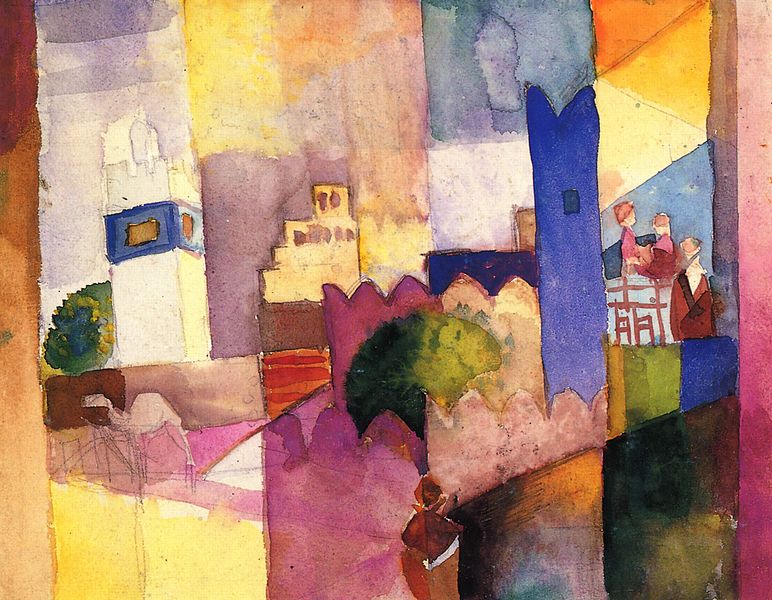
No two artists will see the same colours in a landscape. In 1914 Paul Klee and August Macke travelled to Tunisia. Klee immediately noted the pervasive 'green-yellow-terracotta' but his watercolours also included the white of the houses, the blue of the sky and the pinks and oranges seen in the unpolluted, gentle light of dawn and dusk. Although there are similarities in the two artists' approaches, Macke emphasised 'the blue and white contrast in his Tunisian works' while Klee's watercolours like Red and Yellow Houses in Tunis have 'a warm undercurrent of ochre' and 'a pervasive sand colour'. This, at least is the view of Robert Kudielka in Paul Klee: The Nature of Creation, but it is a subjective judgement: perhaps no two critics will see quite the same colours in a painting...

August Macke, Kairouan (III), 1914
Source: Wikipedia Commons

Monday, October 23, 2006

The Fall of Schaffhausen

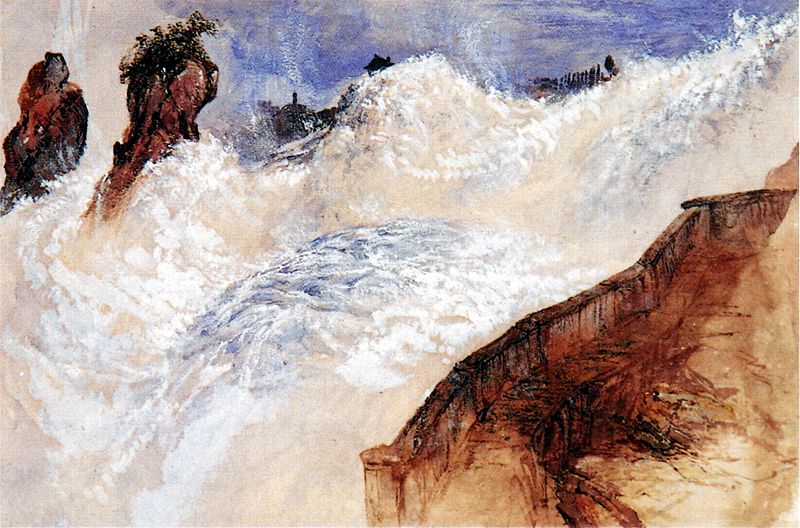
John Ruskin, Falls of Schaffhausen, 1842

John Ruskin's description of the famous waterfall in Modern Painters (Vol. I, Part II) is itself a torrent of language:

“Stand for half an hour beside the fall of Schaffhausen, on the north side, where the rapids are long, and watch how the vault of water first bends, unbroken, in pure velocity, over the arching rocks at the brow of the cataract, covering them with a dome of crystal twenty feet thick, so swift that its motion is unseen except when a foam-globe from above darts over it like a fallen star; and how the trees are lighted above it under all their leaves, at the instant that it breaks into foam; and how all the hollows of that foam burn with green fire like so much shattering chrysopase; and how, ever and anon, startling you with its white flash, a jet of spray leaps hissing out of the fall, like a rocket, bursting in the wind and driven away in dust, filling the air with light; and how, through the curdling wreaths of the restless crashing abyss below, the blue of the water, paled by the foam in its body, shows purer than the sky through white rain-cloud; while the shuddering iris stoops in tremulous stillness over all, fading and flushing alternately through the choking spray and shattered sunshine, hiding itself at last among the thick golden leaves which toss to and fro in sympathy with the wild water; their dripping masses lifted at intervals, like the sheaves of loaded corn, by some stronger gush from the cataract, and bowed again upon the mossy rocks as its roar dies away; the dew gushing from their thick branches through drooping clusters of emerald herbage, and sparkling in white threads along the dark rocks of the shore, feeding the lichens which chase and chequer them with purple and silver.”

Sunday, October 15, 2006

Circles of Time

Alan Sonfist, Time Landscape, 1978

What landscape questions are asked by Alan Sonfist’s artworks? The obvious answer is that they ask environmental questions by creating sanctuaries for pre-industrial landscapes within cities. As the Green Museum puts it: ‘for almost 40 years, Sonfist has dedicated his work to linking city-dwellers and suburbanites to a nature that civilization has destroyed, with the hope that a greater appreciation of nature would encourage them to protect its future.’ His best known work is Time Landscape in Greenwich Village, proposed in 1965, realised in 1978, which creates an urban oasis based on the pre-colonial landscape. Sonfist has been criticised for mere preservationism which disguises present environmental issues by ‘fixing an image of the landscape frozen in the past, privileging one moment in ecological history over all others, and including more complex interactions with various inhabitants, native or other’ (Brian Wallis in Land and Environmental Art). However, this historical aspect of his work may also be one of the things that make it interesting.

Sonfist’s art can take the form of simple works about reclamation, e.g. Pool of Virgin Earth (1975), a circle of ‘pure’ earth on a chemical dumping ground in Lewiston, New York, designed to attract windblown seeds. However, in some larger scale works he has been able to question (or at least illustrate) the way landscapes evolve over time and space. For example, Time Landscape not only uses ‘pre-colonial’ trees and grasses: it also involved planting them on the original land elevations. In Circles of Time (1986-89) Sonfist traces the history of the Tuscan landscape in concentric rings: primeval forest, first settlers, Greeks, Romans and finally a ring linking the sculpture to the surrounding farmland. And his Secret Garden (2001) in Ontario used rocks arranged according to their position in geological time. Judged purely on environmental grounds some of these works may be inadequate, but then it might be asked what kinds of art intervention could ever be consider genuinely adequate to address current environmental concerns?

Saturday, October 14, 2006

The Hill of Howth


Kenneth Hurlstone Jackson’s A Celtic Miscellany (originally published fifty-five years ago) contains a whole section on Nature, something the early Celtic writers treated with particular freshness. There are poems on the changing seasons, on rivers, mountains and woodlands, on snow and mist and stars. A few of them describe specific landscapes, like the Hill of Howth, ‘the peak that is the loveliest throughout the land of Ireland.’ The anonymous fourteenth century author of this piece describes the hill in terms that now seem like oxymoron: a ‘vine-grown pleasant warlike peak’ and ‘the hill full of swordsmen, full of wild garlic and trees, the many-coloured peak, full of beasts, wooded.’ It is as if the beauty of this ‘bright peak above the sea of gulls’ can only be enhanced by the part it played in the battles of Irish legend, as the place where ‘Finn and the Fianna used to be.’

Friday, October 13, 2006

The grebes of Lake Biwa

Basho by Sugiyama Sanpû (Source: Wikimedia Commons)

The keiki (landscape) style of Haikai was dominant in the period Basho was writing, with its fusion emotion and the external scene. Some of Basho’s verse appears to consist solely of a brief landscape description. For example, Haruo Shirane quotes a hokku written in January 1691: kakurekeri shiwasu no umi no kaitsuburi (hiding in the water – the grebes of Lake Biwa – at year’s end). However the wider context for this poem is provided by the season word ‘shiwasu’ which literally means “teacher running” and has associations of ‘the end of the year, when everybody is rushing about cleaning up and settling their financial accounts’, so that the author of the poem appears in contrast to be ‘a carefree, reclusive person, someone who has the leisure to observe grebes at the busiest time of the year… At first glance, the hokku seems focused on a seemingly minor, if not insignificant, detail, but it gradually expands in the eye of the beholder, creating a tension between the smaller object and the implied landscape, or between the specific moment and the larger river of time.’ (Haruo Shirane’s Traces of Dreams p49).

Sunday, October 08, 2006

Landscape with Hunters

Yesterday’s autumn sunshine gave the views on Hampstead Heath a harmonious classical beauty. At Kenwood, where the grass slopes lead the eye down to the tree-fringed lake and its pair of swans, it seemed easy to gaze over the prospect with the eyes of an eighteenth century landscape connoisseur. Inside Kenwood, the famous Rembrandt and Vermeer paintings are accompanied by a Gaspard Dughet Landscape with Hunters (c1639). However, on first sight the painting looks like a dull expanse of murky brown, a shadow of the sunlit vista outside. Poor Dughet’s paintings often seem to be tucked away, unfashionable and unloved; this one is hung high on the wall so that the title on the frame is actually not even visible. He seems as unappealing to modern tastes as some other great enthusiasms of the eighteenth century, like James Thomson’s poem The Seasons (which Michael Schmidt’s history of English poetry describes as ‘dead pastoral’). The brown-ness of old landscape paintings went out of fashion in the nineteenth century as Constable and others altered the way they underpainted to create more vivid colours. But the Landscape with Hunters is a dawn scene and therefore naturally full of shadows. Paintings that strive for subtle light effects may be most harmed by the passage of time (the same may be true of photographs and films we currently admire). What did Dughet’s painting look like 350 years ago?

Apparently the Louvre does not own a single painting by Dughet. However, there is at least one place where Dughet is honoured: Rome’s Doria Pamphilj Gallery. There they have a Poussin Room entirely full of his paintings (Dughet is also known as Gaspard Poussin after his better known brother in law). It is an amazing space - a total immersion in classical landscape.

Postscript: January 2014
Kenwood has recently re-opened after refurbishing.  The Dughet Landscape with Hunters is still high up but better lit than when I wrote this post in 2006... 

Saturday, October 07, 2006

Lac d’Annecy

Paul Cézanne, Lac d’Annecy, 1896
Source: Wikimedia Commons

I first saw the paintings at the Courtauld Institute when they were still in their old location, stuck out of the way on the top floors of the Warburg Institute building. I went unprepared for the shock of so many outstanding works, in these grey, unimpressive surroundings but the one moment I will never forget was seeing Cézanne’s Lac d’Annecy (1896). Richard Verdi (in Cézanne) has described this painting, simple in form but highly complex in its prismatic colours, ‘with no two strokes of blue or green appearing exactly the same in size hue or direction’. Verdi notes, for example, that ‘while house and château on the distant shore are clearly delineated, the landscape around them appears in an inchoate state, as though still awaiting further resolution.’ This illustrates a general feature of the artist’s approach: rather than distinguishing foreground from background through the degree of detail applied to forms, Cézanne concentrated attention on objects at different points in space. While Cézanne saw in this his difficulty in realizing the full complexity of nature, the result was paintings that have ‘an unparalleled vitality and lay bare the formative process of painting as few other works of art do.’

Wednesday, October 04, 2006

Paisaje Plastico

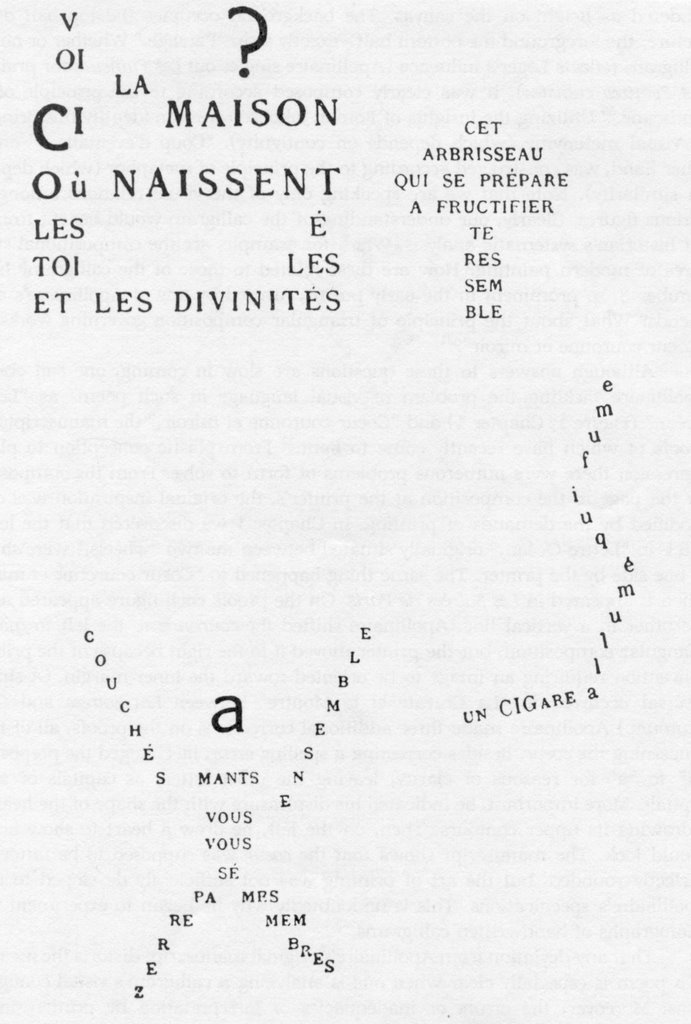
Two examples of landscape visual poetry: Guillaume Apollinaire's 'Paysage' and Guillermo de Torre's 'Paisaje Plastico'.


Apollinaire's poem (below) features a building, a tree and a man smoking. The four elements are themselves individual 'calligrammes', but are united in a landscape composition with a simply delineated foreground and background. Torre published his 'Plastic Landscape' in 1919, a year after Apollinaire's posthumous Caligrammes (it is described in Willard Bohn's book The Aesthetics of Visual Poetry, 1914-1928). It is a longer poem than Apollinaire's, depicting the countryside in the heat of midday ('Mediodia igniscente') and ending with a squadron of aeroplanes flying overhead, to somehow harvest the fields of wheat. Only some of the text resembles landscape elements visually - there is a river flowing diagonally through the poem and a curved line of text describing the gleaners, which may relate to the physical action of their work. Much of the rest of Torre's poem uses typography only for visual emphasis, like the words that stand out in capitals: 'SOL', 'SIESTA', 'LA SED' etc. The two works are ostensibly similar but operate on a different balance between word and image: Apollinaire's poem is easier to see on the page, but Torre's landscape is easier to picture in the mind.

Monday, October 02, 2006

A View near Volterra

In his 1960 essay 'Notes on Corot', the poet James Merrill writes about the transition from Corot's early Italian sketches to his later poetic landscapes, with their woodland glades and stretches of water that 'speak of relinquishment, of escape' . We can escape too among Corot's early views of Rome, investing their simple naturalism with our dreams of Italy. 'Italy - like youth, a simple word for a complicated, often idealized experience. No one would resist its appeal, as rendered in these little paintings. But each of us knows, in his way, what happens when it is over. Corot knew too. A View near Volterra (in the Chester Dale Collection) shows it happening in a scene so ravishing that it emerges unscathed from the jaws of allegory: the artist-prince, in peasant dres, heads his white horse (!) straight into the trees. Slowly it dawns on us what awaits him there, when he dismounts and sets up his easel. A change of light, a corresponding change of sensibility; in short, the paintings of Corot's maturity.'


A View near Volterra, 1838
Source: Wikipedia Commons

Sunday, October 01, 2006

Landscape with Satyr Family

The catalogue to the current Adam Elsheimer exhibition is published by Paul Holberton. Holberton himself knows a lot about early landscape painting and it would be good if he could publish a book based on his own PhD researches in this subject. One of the many interesting things in his thesis is a classification of images according to the characteristics of the figures in the landscape, arguing that a typology based on format or place would be less practicable. So for example Albrecht Altdorfer's Landscape with Satyr Family (1509) would come under the heading of landscapes featuring satyrs and centaurs. Other possibilities are landscapes featuring: hermits and anchorites; lovers at odds with society; vagrants or the homeless (including Biblical examples like Adam and Eve after the expulsion); woodsmen or woodhouses; 'natives' on the borders of the known world (e.g. Scythians or New World Indians); and primitives before the rise of civilisation. These varoius characters might all be termed 'landscape beings.'

Albrecht Altdorfer, Landscape with Satyr Family, 1509
Source: Wikimedia Commons

Promisingly, it says on his website, 'Paul Holberton is currrently writing a book on the history of Arcadia in art and literature (working title: Sex in the Bushes).'

Saturday, September 30, 2006

Aurora

Adam Elsheimer, Aurora, c. 1606
Source: Wikimedia Commons

To Dulwich today for the Adam Elsheimer exhibition, a welcome break from computing woes which are partly to blame for infrequent postings at the moment. The Dulwich Picture Gallery is a good place for classical landscape painting anyway: Claude, Canaletto &c. but also less renowned artists like Herman Saftleven, painter of a lovely misty View on the Rhine. Adam Elsheimer fits perfectly in this company – a forerunner who is, according to the exhibition leaflet, ‘little known today’, but was ‘recognised in his own time as a genius.’ There still doesn’t seem much danger of him suddenly becoming very popular and the exhibition was relatively quiet even on a Saturday. Three highlights:
  • The series of Saints and Figures from the Old and New Testaments from the Egremont Collection at Petworth House show Elsheimer’s amazing gift for creating poetic landscapes on a tiny scale. The pictures are 9 x 7 cm each (like playing cards) and the landscape details are much smaller. An example is Saint John the Baptist (c. 1605), which can be seen on the National Galleries of Scotland site (the exhibition was on in Scotland before coming to Dulwich).
  • Aurora (c. 1606) started as one of Elsheimer’s paintings after Ovid but was left as a nearly pure landscape. A print of it made by Hendrick Goudt was an influence on later Dutch landscape painting. As you look at the painting your eye drifts away from the figure and off into the distant vista of a golden morning in the Roman Campagna.
  • The Flight Into Egypt (1609) is the last painting in the exhibition and is extraordinary for the realistic full moon and stars. There is an ongoing discussion about the extent to which Elsheimer was painting a particular night sky - astronomers have examined the position of the stars and suggested it was painted on 16 June 1609. It is thought Elsheimer may have used a telescope – he was in contact with scholars in Rome who were familiar with the new methods and ideas pursued by astronomers like Galileo . In some ways the sky is almost too accurate to seem realistic and the figures, glimmering by the light of a torch and a fire, have an unreal quality to them. Rembrandt’s Flight into Egypt (1647) is similar in composition but much more believable, although it is difficult to imagine it without the example of Elsheimer's original vision.

Sunday, September 24, 2006

View from Yarmouth Bridge

John Sell Cotman, Beach Scene, c. 1820

In a recent New York Review of Books, tucked in among the articles on various depressing Middle Eastern political issues, there was an article by Sanford Schwartz about John Sell Cotman. Schwartz regrets that ‘there is still no volume of good reproductions of his pictures in all the mediums he tackled’. Although famous for his watercolours - to the extent that Winsor & Newton use his name as a trademark (they introduced the ‘Cotman’ brand of sable watercolour brushes in 1906) – Cotman’s ‘far less known oils, and to a slightly lesser extent his pencil drawings and etchings often exist on the same level of uncanny harmony and order’.
  
Among its collection of Cotman watercolours, the Tate has an oil painting, Seashore with Boats (c1808), of which they say ‘the scene here is possibly Cromer beach. Anne Miles, whom Cotman married in 1809, lived two miles away from Cromer and Cotman exhibited four Cromer subjects between 1808 and 1810.’ In this painting Cotman reduces the busy beach to a set of simple flat forms in a manner familiar from his watercolours. Perhaps even more striking for its modern-seeming abstraction is another oil painting in the Tate: Wherries on Breydon (c1808).
 
Cotman returned to oil painting in the 1820s. There are examples in the Norwich Castle Museum: Dutch Boats off Yarmouth and View from Yarmouth Bridge, looking towards Breydon, just after Sun-set. In connection with the latter, there is a good example of prevailing attitudes to artists like Cotman in a piece written for the Norwich Mercury describing an exhibition at the Norwich Society in 1824. The reviewer felt the landscape had been ‘quitted prematurely by the artist’ and declared rather pompously ‘we are no friends of “sketches” in oil painting’ (quoted by David Blayney Brown in Romantic Landscape: The Norwich School of Painters).

Friday, September 22, 2006

Hestercombe landscape garden

Source: Wikimedia Commons

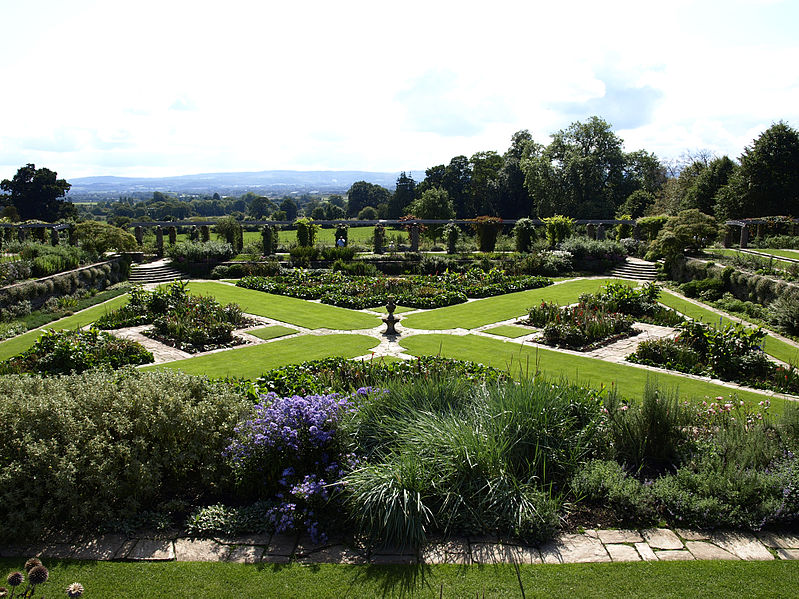
At Hestercombe Gardens they have been rebuilding some of the eighteenth century features. So for example, it is now possible to admire a 1996 replica of the 1770s replica of a Tuscan Doric temple. The landscape garden was designed by the owner of Hestercombe, Coplestone Warre Bampfylde, between 1750 and 1786. It is an anthology of eighteenth century themes – a Great Cascade, a Gothic Alcove, a Witch House and a Temple Arbour – but with some very beautiful views both within the garden and out to the Vale of Taunton. When we visited we stood for some time admiring the sunlit Box Pond, humming with dragonflies and reflecting the surrounding wooded slopes. There was a small group of people sitting on the opposite bank who we assumed were sketchers, but who turned out to be having a break from work renovating the garden. This misconception felt a bit like a lesson in the perils of the picturesque… but it was hardly a glimpse of what John Barrell would call the ‘dark side of the landscape’: the labourers we saw looked like volunteers having a thoroughly rewarding time bringing the old garden back to life.

Tuesday, September 12, 2006

The Housatonic at Stockbridge


Whenever I read about Charles Ives I find myself intrigued by the stories of his father George. As a seventeen year old, George’s musical talents were noticed by Ulysses S. Grant, who told Lincoln that the band of the First Connecticut Heavy Artillery led by Ives senior was the ‘best in the Army.’ Some of the ways in which George Ives went on to influence his son’s music are described here. A good example is the second of Ives’ Three Places in New England, ‘Putnam’s Camp, Redding, Connecticut’ which was inspired by an experiment of George Ives in which he arranged for his band and another one to march in opposite directions around the town square playing conflicting tunes. In Alan Rich’s book American Pioneers, there is a memorable image: ‘George Ives held a lifelong fascination with the notion of experimentation, spending long hours playing musical instruments across a nearby pond to study the nature of echoes…’

The third of Ives’ Three Places, ‘The Housatonic at Stockbridge’ records the memory of a walk that Ives took with his wife, Harmony, along the banks of the Housatonic River. As critic Alex Ross notes, ‘there are dissonances and ambiguities in the river’s flow. This is the New England landscape that generated not only Norman Rockwell’s small-town idylls but also the American apocalypse of “Moby-Dick.”’ There is a Robert Underwood Johnson poem that accompanies the music but more interesting perhaps is a brief note that Charles Ives himself wrote (quoted from a Charles Ives site):

… River mists, leaves in slight breeze river bed--all notes and phrases in upper accompaniment . . . should interweave in uneven way, riverside colors, leaves & sounds--not come down on main beat . . .

Monday, September 11, 2006

After the Summer Rain

Art of the States is a website that includes a range of free music samples from American composers. One of these is sound artist Jorge Boehringer, whose Fresnel Lens Ø7: An Awkward Squad was inspired by the landscape at Point Reyes, California. Boehringer explains that “Point Reyes (which, incidentally, resides on a different tectonic plate than the rest of California) is a place of awe for human beings. Attempts to civilize this place repeatedly have failed. Fog at night often makes driving along the thin strips of land a potentially fatal undertaking; lighthouses tumble into the sea one after the other, unable to withstand the presence of the dialogue between ocean and rock...” The title of this piece “refers to the type of lens on the lighthouse at Point Reyes National Seashore, and the 'awkward squad' is the name given to a group of pelagic cormorants, but carries with it the connotation of stumbling movement.”

Other compositions with a landscape link at this site are Okkyung Lee’s On a Windy Day, which recalls the sound of Korean temple bells blowing in gusts of wind, Zhou Long’s four Poems from Tang, including a setting of Wang Wei’s Hut Among the Bamboo, and Hideko Kawamoto’s After the Summer Rain, a Rilke-inspired evocation of “a summer forest, including rain pouring onto trees, shiny silver spider webs, and dark wet ground.”

Sunday, September 10, 2006

Monument Valley

There is an excellent new reader on Landscape and Film edited by Martin Lefebvre. Lefebvre’s own essay in the collection, ‘Between Setting and Landscape in the Cinema’, draws on art history to illuminate the ways in which landscapes can be used in film. There are genuine ‘autonomous landscapes’, similar to the kind we associate with painters from Altdorfer to Turner to Cézanne, but such films tend to be experimental (e.g. David Rimmer) or semi-documentary (e.g. Walter Ruttmann). Most cinema is structured around narrative and to analyse landscape in these films, Lefebvre (like Gombrich and other art historians) argues that landscape is in the eyes of the beholder. Just as sixteenth century connoisseurs could see Flemish biblical scenes as ‘landscapes’ because the quality of the setting seemed to dominate the ostensible subject, so the spectator of a film can watch sections of a narrative film as if they were viewing landscape art.
 
Within narrative cinema, Lefebvre distinguishes between (1) those films where the film maker (often a modernist auteur) deliberately structures the film to shift the viewers gaze from subject to setting, and (2) those films in which landscape is used less overtly by the director. Among examples of the first type he discusses the work of Michelangelo Antonioni, e.g. L’avventura which begins on a rocky island which the camera lingers over in a way that is more than simply a function of the need to establish where a woman disappears. Examples of the second type are John Ford’s nine westerns filmed in Monument Valley, a location that is not integral to the plots but which nevertheless comes to dominate the films in many viewers’ imaginations.

In his discussion of Ford, Lefebvre notes that The Searchers was filmed in Monument Valley despite being set in Texas, and that this risks implausibility (the settlers have set up a farm but Monument Valley is a desert). Nevertheless, the strength of the narrative in this film (in contrast to L’avventura for example) means that the viewer is never forced to contemplate the landscape or notice the discrepancy between film location and fictional setting. This means that it is up to the viewer to see Ford’s films as landscapes, perhaps drawing on their own knowledge of the West as seen by painters (Frederic Remington) or photographers (E. S. Curtis). Ironically the viewer’s knowledge of autonomous landscapes in art can turn pure narrative films like The Searchers into a form of ‘impure’ landscape cinema.

Saturday, September 09, 2006

Sayreville Strata

Edward S. Casey, an American philosophy professor, has written a book about recent American landscape art called Earth-Mapping: Artists Reshaping Landscape. It covers the work of Robert Smithson, Margot McLean, Sandy Gellis, Michelle Stuart, Eve Ingalls, Jasper Johns, Richard Diebenkorn, Willem De Kooning and Dan Rice. However, as will be clear from this list, ‘mapping’ is used in a fairly loose sense, and indeed the author spends a lot of time explaining why some of the work discussed cannot under any definition be described as a ‘map’.

I found it a hard book to enjoy - sentences like this soon becomes wearisome: ‘perhaps the quintessential Stuart of this period, however, is an instance of what Heidegger might call “the two-fold” (die Zweifach), in this case, the combination of distinct image and indeterminate rubbing.’ It often reads like a strange mix of the pretentious and the naïve: little ‘jokes’ signalled with exclamation marks, snippets of context (‘thus was born pop art’) and gushing praise.: ‘the central nervure of Michelle Stuart’s immense evolving oeuvre… is to be found in her decided gift for plumbing paradoxical extremes of medium, presentation, and subject matter, thereby confounding her critics and delighting her devotees.’
 
Michelle Stuart actually worked briefly as a cartographer for the US army while at art school and her early works used the same basic material: muslin-mounted rag paper. For example, in Sayreville Strata (Quartet) (1976) she rubbed earth from a New Jersey quarry onto four parallel sheets of rag paper. Casey notes how the work shows that ‘the earth itself is far from dull in its colorations!’ He sees the effect ‘as numinously dazzling as certain late paintings of Rothko’. They remind him of Cézanne’s studies at Bibemus quarry ‘but the French master’s colors are approximations of the natural hues of quarried rock, while Stuart’s colors are those of the earth itself.’ Well, yes.

Postscript 2019: I was thinking back on this post as I've been tempted to read Edward S. Casey's latest book on the phenomenology of edges, which might have been useful for my study of cliffs, 'Frozen Air'.  I was also wondering about Michelle Stuart's more recent work over the last decade.  This has dealt with bigger themes of space, time and evolution, e.g. 'These Fragments Against Time' (2018), an installation shown in a New York exhibition earlier this year. You can read an Apollo interview from last year which looks back over her career. There is also now a photograph of  'Sayreville Strata (Quartet)' available on Wikimedia Commons.

Wednesday, September 06, 2006

The sea at Balbec

À la recherche du temps perdu includes some memorable seascapes. You get the impression that Proust’s descriptions would be much more impressive than the paintings he describes by his fictional seascape painter, Elstir. Here for example is one of Proust’s sentences on the view from his narrator’s window at Balbec, where he notes the way the waves recede to that point in the distance where they resemble the glaciers one sees in the backgrounds of the Tuscan Primitives:


'Fenêtre à laquelle je devais ensuite me mettre chaque matin comme au carreau d'une diligence dans laquelle on a dormi, pour voir si pendant la nuit s'est rapprochée ou éloignée une chaîne désirée, -- ici ces collines de la mer qui avant de revenir vers nous en dansant, peuvent reculer si loin que souvent ce n'était qu'après une longue plaine sablonneuse que j'apercevais à une grande distance leurs premières ondulations, dans un lointain transparent, vaporeux et bleuâtre comme ces glaciers qu'on voit au fond des tableaux des primitifs toscans.'

(from Project Gutenburg)


Marcel Proust’s first book, Les Plaisirs et les Jours (1896) includes a beautiful passage headed ‘Seascape’. He thinks of the sea at Normandy, or rather ‘the wooded paths from which you occasionally catch sight of it and where the breeze mingles together the smell of the salt, damp leaves and milk…. Suddenly I would see her; it would be on one of those days of somnolence beneath a dazzling sun, when she reflects the sky that is as blue as she is, only paler. Sails white like butterflies would be dotted over the motionless water, happy not to move any more, almost swooning in the heat. Or alternatively, the sea would be rough, yellow in the sunlight like a great field of mud, with swells that, from such a distance, would appear stationary and crowned with dazzling snow’ (trans. Andrew Brown). The last two sentences are like paintings, but the first part of the quotation here hints at the full power of words, with the subject moving through the landscape and the different senses engaged.

Monday, September 04, 2006

Ebb at Evening


William Everson (1912-94) was a very Californian poet. Part of the San Francisco Renaissance, he was known as the Beat Friar, having become a Dominican monk in 1951, and it was as Brother Antoninus that he wrote one of his best known poems, ‘A Canticle to the Waterbirds’. However he was also a literary critic: the author of Archetype West: The Pacific Coast as a Literary Region. The Modern American Poets site has a description by Everson of the Californian landscape.  Here are some brief excerpts:
'It is early morning. The sun, peering over Mescal Ridge, leaves its near flank in shadow. The giant redwoods that line Bear Trap Canyon, huddled together without distinction, are deep in shade.'
'A slight haze has thickened against Mescal Ridge, but the cool of the morning is not all dispelled. The distant redwoods, as I anticipated, stand out like phallic flames, each green cone thrust at the sun. Bear Trap Canyon kinks its wrinkle up the groin of Bixby Mountain. Time seems to hang over the world, suspended.'
'Pausing in my writing I look out over the vast expanse of Bixby Canyon. It is mid-afternoon. The sun is beginning to slant down toward the western rim, but the solar intensity is still at crescendo. Down below me a redtail hawk circles and dips, his remorseless gaze searching for prey on the slopes beneath. After a time he gives up and cries angrily, disturbed by something intruding below him which I can't see. In the redwoods over my head a jay answers the hawk feebly, only a scrawny imitation of the master he cannot rival.'
In his book Imagining the Earth, John Elder discusses poetry in which there is a genuine identification with nature. Of William Everson’s poem ‘Ebb at Evening’, he says ‘in such a gathered moment, to identify the human body with the ocean is to gain a power of participation in nature beyond all ideas of its goodness and beauty.’ Elder believes that ‘many of our most valuable poems of integration are set at evening and the ebb. With the grey light, things that seemed distinct in the strong outlines of noon begin to merge… The tide’s ebb and sunset are two times attentiveness to the earth can guide us to the peace of presentness.’ He provides a further example in a Denise Levertov poem ‘The Coming Fall’ in which the eye and mind retreat and bodily impressions take over. As Levertov says, ‘In the last sunlight / human figures dark on the hill / outlined- / a fur of gold / about their shoulders and heads, / a blur defining them.’

Saturday, September 02, 2006

Walking from Lake Como

The other day I was talking to a friend about the fashion for participative art works. This kind of relational aesthetics opens up many interesting possibilities for artists (or ‘semionauts’ as Nicolas Bourriaud calls them…) And yet there’s also a risk of it leading to worthy and banal institutional art, especially when funding for an installation is predicated on the idea that it will ‘engage’ with local people in some way. There are incentives for landscape artists to devise conditions in which art can be created in collaboration with the public: sound walks, mapping projects, artistic renovation and reclamation activities, and so on. How much of this activity will have lasting aesthetic value is an interesting question.
 
One of the more recent developments in Hamish Fulton’s work has been the organization of group walks. For example, in 1998 Fulton took 25 artists from 15 countries on group walks in the hills around Lake Como in Italy (commemorated in Pilgrims’ Threads). In 2002 he got 25 people to walk 10 kilometres backwards on footpaths at the Domaine de Chamarande (see photograph on his website). A group walk is entirely different to a solo walk, leaving behind associations with Romantic individualism and linking instead to traditions of protest and pilgrimage. Nevertheless in making increasingly extreme and testing walks (Fulton suffered frostbite in Tibet in 2000) he still sometimes gives the appearance of the Modern Artist seeking out his own existential limits. For this kind of climbing though, Fulton has needed to join commercial expeditions. Above a certain altitude, walking has to be collaborative.
 
It should be pointed out that Fulton has not always walked alone. Between 1972 and 1990 he made eleven trips in the company of Richard Long. Back in 1967 Fulton and Long organised a slow group walk from Greek Street to St Martin’s College which can be seen in a similar light to the recent collaborative walks. Rather than responding to the fashion for collaborative art, Fulton has returned to the type of performance that characterised his earliest experiments in the art of walking. How interested he is in the idea of engaging with the wider public might be gauged from his reaction to an interviewer (in the catalogue to his Tate Britain show) who asked whether he wanted to encourage others to make walks. Fulton replied: “For the first twenty years I didn’t really consider it. But in more recent times I’ve been thinking that it’s not a bad idea. It’s a potentially interesting by-product.’

Thursday, August 31, 2006

Red Arch Mountain, Utah

In Berlin Childhood around 1900 Walter Benjamin relates his childhood immersion in watercolours to the story of an old Chinese painter. The old man invited friends around to see his most recent picture. They were shown a landscape with a footpath leading along a stream and through a grove to a small cottage. When they turned around and looked for the painter, he had gone. They saw that he had entered the picture and was walking up the path to the door, where he paused ‘quite still, turned, smiled and disappeared through the narrow opening.’

Reading Benjamin’s book it is difficult not to reflect on one’s own childhood memories. Benjamin describes the streets, parks and monuments of Berlin but he also dwells on the landscapes of furniture and household objects that a child negotiates. He remembers the power of postcards and the old Imperial Panorama where ‘one afternoon, while seated before a transparency of Aix, I tried to persuade myself that, once upon a time, I must have played on the patch of pavement that is guarded by the old plane trees of the Cours Mirabeau.’ On reading this I went down to our cellar and found my father’s old stereoscope which had enchanted me as a child. The image below, for example, is Red Arch Mountain, Utah, probably photographed in about 1947 (some of the discs have this date). An anonymous photographer’s tiny image in Kodachrome “natural colour”, it now has the time capsule qualities of a miniature landscape in a Book of Hours. What seemed a strange, distant mountain to me as a child is now potentially accessible, but the world that produced the stereoscope is irretrievable, along with the imaginative space of childhood.

Wednesday, August 30, 2006

150 ft Seaskape, Largiebeg

Bruce McLean designed the café-bar at the newly refurbished Arnolfini gallery in Bristol. It is bright and colourful, like his paintings and prints. Not really my cup of tea (although the coffee they serve is good!) It seems a far cry from the late sixties when McLean was dabbling in a kind of land art. For 150 ft Seaskape, Largiebeg (1969) he laid a huge sheet of sensitised paper on the shore hoping for an indexical print of the landscape, but it floated out to sea. Another piece, 2 Rock and Shoreskapes, Largieberg (1969) required only 33 ft of white paper, laid on a rocky shore and covered with watercolour paint, leaving the landscape to tear and stain its presence onto the work.

The Arnolfini is one of the sites in Bristol currently hosting the sixth British Art Show. One of the works on show at the Bristol City Museum and Art Gallery, created by Juneau/Projects/, seems to update McLean’s attempts to record the landscape directly: a scanner was pulled along the ground and the resulting images pinned to the gallery wall. However, it is clear from the artists’ installation that the intention here was not simply to facilitate a work of landscape art in which nature is the creator. Their focus is on technology (other works involve microphones, walkmans etc.), the idea being to take them outside and let natural forces demolish them. The British Art Show notes explain that ‘in good morning captain (2004) a scanner is dragged along a forest floor, documenting its own destruction with a series of blurred scans.’
 
Nevertheless, artists will no doubt continue to seek ways to allow landscape itself to create or adapt their work: kinetic sculpture, sound art or variations on photography (“the pencil of nature”). Outside the art world, simple indexical signs like weather vanes and sun dials let nature signify something (time, wind direction), whilst the landscape itself is full of natural signs that can be read by animals. However, as we know from modernism, art need not point in this way to something specific; signs that give a general sense of an actual landscape may turn out to be more interesting.

Monday, August 28, 2006

Þer as claterande fro þe crest þe colde borne rennez


In Sir Gawain and the Green Knight (c1380), the poet describes the landscape through which the hero rides with sufficient detail that R.W.V. Elliott has been able to situate the story in the area of Leek in Staffordshire. Here are lines describing the increasingly inhospitable conditions as winter draws in:
For werre wrathed hym not so much þat wynter nas wors,
When þe colde cler water fro þe cloudez schadde,
And fres er hit falle my3t to þe fale erþe;
Ner slayn wyth þe slete he sleped in his yrnes
Mo ny3tez þen innoghe in naked rokkez,
Þer as claterande fro þe crest þe colde borne rennez,
And henged he3e ouer his hede in hard iisse-ikkles.
In Bernard O’Donoghue’s new translation for Penguin, the second and third lines relate that ‘ice-cold water poured from the clouds / and froze before it hit the grey ground’. And Gawain is described sleeping in the naked rocks ‘where cold streams clattered down from the heights / or hung over his head in hard spears of ice.’ 

Simon Armitage is also currently working on a translation, due from Faber in 2007. However, an extract has already been included in Wild Reckoning: An anthology provoked by Rachel Carson’s ‘Silent Spring’ (2004). Armitage has ‘clouds shed their cargo of crystallized rain / which froze as it fell to the frost-glazed earth’ and describes Gawain ‘bivouacked in the blackness’, ‘where melt-water crashed from the snow-capped peaks and high overhead hung chandeliers of ice.’

Sunday, August 27, 2006

Hyperborea

The National Maritime Museum is showing three sets of photographs by Dan Holdsworth: At the Edge of Space (1999), The Gregorian (2005) and Hyperborea (2006). Images can be seen at the artist’s website. For me the most impressive were the last of these, a series of photographs of the Northern Lights taken in Reykjavik and the Andoya Rocket Range above the Arctic Circle in Norway. The eerie light that dominates these images casts strange colours on the snow: often a sort of faintly luminous grey-green, here and there a quartz-like pink. The rocks and ice lie inert, looking almost unreal beneath these lurid pulsing skies, although in a few of the images an orange glow seems to emanate from the ground from some artificial light sources. Holdsworth’s long exposures leave traces of stars: arcs of varying intensities in delicate shades of turquoise or orange-green. Rather than isolate views, these photographs manage to convey a sense of planetary motion and connect the landscape with a wider view of space and time.

Saturday, August 26, 2006

Scattered Stones at Nikko

Yesterday I came upon a blog which reproduced the Hamish Fulton work we have hanging above our computer: The Life of Scattered Stones: Seven One Day Walks in the Rain, Nikko, Japan April 1990. The difficulties of reproduction are at the heart of Hamish Fulton’s work. Our Hamish Fulton print is a record of his walks, but cannot reproduce the experience. It is number 9 of 250 and I sometimes wonder who has the other 249 and what Fulton would think of us all. We bought the print partly in memory of a special day spent at Nikko in 1998, when the old stones and mossy trees glistened in the mist just as they do in Fulton’s rain-washed photograph. Fulton made his walks at Nikko in April, the same month Basho passed through on his Narrow Road to the Deep North, three hundred and one years earlier. Basho felt wary of writing too much about the temple at Nikko and instead recorded his simple awe at seeing green leaves shining brightly in the sun.

There is monument to Basho which is away from the main tourist area and therefore possible to enjoy in solitude.


Nikko, August 1998

Wednesday, August 23, 2006

A view of Çatalhöyük

An article in the June issue of Natural History magazine explains how excavations at the Neolothic site of Çatalhöyük in Turkey during the early 1960s revealed a wall painting that seems to show a town with a double-peaked volcano in the background. Archaeologist James Mellaart drew a reconstruction to convey more clearly what the painting depicts; the town may be Çatalhöyük itself and the volcano may Hasan Dağ. I suppose this might be described as an 8,500 year old landscape painting…

Tuesday, August 22, 2006

The Tatsuta River in Autumn

In the Shotetsu monogatari, Shotetsu (1381-1459) wrote ‘If someone asks you in which of the provinces Yoshino may be found, you should answer this way: When I write my poems I simply remember that for blossoms one goes to Yoshino, for red leaves to Tatsuta. Whether those places are in Ise or wherever is not my concern.’ (trans. Steven D. Carter in The Road to Kamatsubara). As this quotation shows, knowledge of poetic geography and the associations of Famous Places were essential for Japanese poets, but familiarity with the real locations was quite unnecessary. As Steven D. Carter puts it, ‘the essence (hon’i) of any Famous Place is defined in terms of a history of poetic treatment; such places occupy poetic rather than physical space’.

There is a song Sasa no Tsuyu composed by Kikuoka Kengyo (1791-1847) which includes the words ‘Yoshino blossoms and Tatsuta leaves - without sake they would be ordinary places.’ Despite this, Yoshino and Tatsuta Park still promote themselves as ideal locations for viewing cherry blossoms and red maple leaves.

Hokusai included a print of the Tatsuta River in Autumn from his series One Hundred Poems (1835-6). The print illustrates a poem by Ariwara no Narihira (825-80) which states that even in ancient days, when the gods held sway, no water shone red like Tatsuta. (Ariwara no Narihira was a contemporary of Minamoto no Toru, whom Hokusai had depicted, talking in the landscape garden he had designed to resemble Shiogama Bay, in his series A True Miror of Chinese and Japanese Poems).

One of the stories told about Hokusai is that when ‘told to paint red maple leaves floating on the Tatsuta River, Hokusai supposedly drew a few blue lines on a long sheet of paper and then, dipping the feet of a chicken in red paint, chased it across the scroll, making the bird's red footprints his maple leaves.’ (Sandy Kita and Takako Kobayashi). This story features in a 1983 poem by the Czech writer Jan Skácel.

Saturday, August 19, 2006

The Bay of Shiogama

Katsushika Hokusai, The Minister Toru, c. 1833-4

Among the miniature landscapes reproduced in Japanese gardens, one of the more elaborate was created in the late ninth century by Minamoto no Toru (822-95), Minister of the Left and a son of Emperor Saga. His Kyoto garden recreated the Bay of Shiogama and even included a salt kiln because the famous kiln at Shiogama was believed to be the first place salt had been made in Japan. As Ivan Morris describes it in his book The World of the Shining Prince, the Minister ‘ordered gallons of water to be brought daily from the coast and, while it was being boiled, he and his friends would sit and imagine themselves in the far-of northern region – a region which, of course, nothing short of a ukase would have induced them to visit in person.’ Royall Tyler also describes the creation of this garden. Why was Toru admired, to the extent that a No play was written about him by Zeami? Tyler thinks there are two reasons: (1) he transmuted the raw landscape into an aesthetic object, bringing the hinterland into the capital; (2) his gesture was at the same time respectful and transmitted recognition back onto the original landscape.

Friday, August 18, 2006

The Springs of Clitumnus


Sometimes there’s nothing more pleasurable than the lucid prose of a scholar of the old school. A particular favourite of mine is Gilbert Highet’s Poets in a Landscape (1957) which brings alive the Roman poets through vivid translations and an imaginative evocation of their environment. There is, for example, Sextus Propertius, one of whose elegies includes the line
among the woods where the Clitumnus hides its lovely
springs, and white oxen bathe in the cool stream
Highet gets underneath this brief description by quoting other writings by Virgil and Pliny the younger; Pliny says in a letter to his friend Romanus: ‘There is a fair-sized hill, dark with ancient cypress-woods. Beneath this the spring rises, gushing out in several veins of unequal size. After the initial flow has smoothed out, it spreads into a broad pool, pure and clear as glass, so that you can count the coins that have been thrown into it and the pebbles glittering at the bottom.’

Highet himself provides his own description of the site, as he follows in the footsteps of the Roman writers: ‘the springs are about three feet deep. Their bed is creamy white gravel mixed with fine sand. Even in the smallest inlet, a pool the size of a little table, the gravel is constantly stirring, and the surface quivers every fifteen seconds with a tiny explosion of water… All water in motion is wonderful. Cool copious fresh water, absolutely clean, rising out of dry earth under a hot sun, is very wonderful…Willows hang over the wells, gazing into them with a soft narcissus melancholy. Poplar trees, lifting heads and arms to the sky, disdain their own reflections. Between their trunks we see the glinting sides of white oxen, and the timbre of church bells drifts faintly over the water. There is no noise: but there is, in the water and in the air, a ceaseless happy whisper, as though kind spirits inhabited the place.’

He is glad the springs are off the tourist trail and thus little-frequented, ‘… even so it was depressing to see, in one of the fountain-beds, half a dozen Coca-Cola bottles set to cool for possible sale to tourists. Only the charm and quiet of the scene made us forget the profanation’.

Tuesday, August 15, 2006

View of Notre Dame

Back in 1999 Art News did a list of the ’25 Most Influential Artists’ of the twentieth century. These were: Beuys, Bourgeois, Brancusi, Dali, Duchamp, De Kooning, Judd, Kandinsky, Le Corbusier, Malevich, Man Ray, Matisse, Mies Van Der Rohe, Mondrian, Nauman, Monet, Paik, Picasso, Pollock, Rauschenberg, Sherman, Smithson, Stieglitz, Warhol and Frank Lloyd Wright. It seems a reasonable list to me, although worth bearing in mind perhaps that Louise Bourgeois was much talked about when the list was compiled. It is possible to find some connection to landscape in any of these artists, but here are a few specific links mentioned in the Art News article:

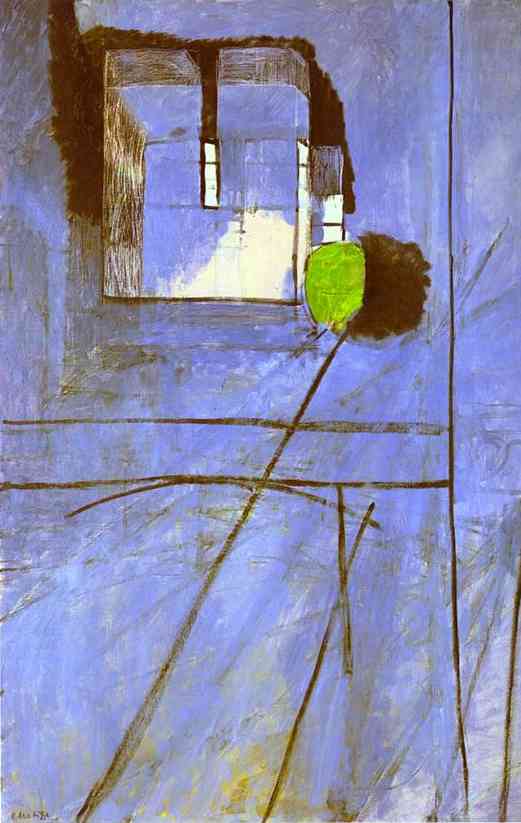
  • Henri Matisse’s View of Notre Dame (1914) was a source for some of Robert Motherwell’s Open series. Matisse was also an inspiration for Richard Diebenkorn’s Ocean Park series.
  • Similarly, Claude Monet’s landscapes and water lilies led towards semi-abstract and abstract paintings, although his Water Lilies can also be seen as precursors of the sensory spaces created by artists like Walter De Maria and James Turrell.
  • Constantin Brancusi’s minimalist sculptures and his monuments at Târgu Jiu prefigure more recent art in the landscape, like Carl Andre’s Secant installation and the lines walked by Richard Long.
  • Clearly Frank Lloyd Wright has influenced landscape architecture, for example the environmentally sensitive designs of William McDonough.
  • Finally, Robert Smithson’s multi-facetted work leads to and from landscape in various ways. Projects by Mel Chin (Revival Field), Mierle Ukeles (Flow City) and Michael Singer and Linnea Glatt (Phoenix Solid Waste Management Facility) all relate back to Smithson’s proposals for an art of land reclamation.
Robert Smithson, Spiral Jetty, 1973 

Sunday, August 13, 2006

The Standing Stones of Stenness

Living in the city I don’t get to see many musicians interacting directly with the landscape, but reading reviews I get the impression that there are now few remote islands and windswept shores that don’t get a visit from passing sound artists – the twenty-first century equivalent of the late Romantic landscape painters. And yet despite all the activity, it seems it’s not always easy to make experimental music in hostile environments… even when the audiences are receptive, the landscapes can remain unresponsive. Take, for example, Biba Kopf’s description in The Wire of the Resonant Spaces events in Scotland this summer, featuring saxophonist John Butcher and sound artist Akio Suzuki. At the Standing Stones of Stenness, Butcher found the ancient stones difficult to work with: “the echo effects were definitely there… I tried short, piercing, rapid attacks on the tenor, and that was interesting for sounding out the stones. But I couldn’t see a way of working musically with that.” However, the high-pitched multiple tones of his amplified soprano produced the morning’s first breakthrough. “The surprising thing was that the previously reasonably silent sheep, who were gathered in the far corner of the Stones area, recognised qualities in those sounds and they started bleating,” smiles Butcher. Eventually things did come together, when Butcher stopped blowing and allowed the wind to play his amplified soprano (there is a photograph here).

The strong wind at the Standing Stones also did its best to drown out Akio Suzuki’s analopos (an acoustic echo instrument). However, he can be seen here playing it at another concert in Smoo Cave, Durness. The Resonant Spaces site has samples of Suzuki playing the analapos and stone flute. Suzuki’s flutes are actually fragments of landscape: naturally eroded stones (a posting on BLDGBLOG speculates that one day Europe’s fossilised reef could form a vast musical landform along similar lines). Suzuki has spent many years making sound art in the landscape using natural forces like the wind. For example, in 1988 he created a space in the mountains of Aminocho near Kyoto so as to spend an entire day listening to the sounds of nature. He built ‘two parallel walls of sun dried bricks which produce a unique echo effect similar to the famous “roaring dragon” walls at Tosuga Shrine in Nikko’ (quoted in David Toop’s Haunted Weather). In 1996 his contribution to the Berlin Sonambiente Festival was to walk the city and mark with a special listening symbol any spot where he heard an interesting sound, creating an alternative to the traditional itinerary. He made a similar work the following year, mapping the town of Enghien-Les-Bains to locate the areas where echoes were most resonant.

Saturday, August 12, 2006

The Green Line

The Magnum site currently has an exhibition of war photography from Lebanon, 1972-2005, with images of “the civil war, the reconstruction of Beirut, the Palestinian refuge camps, the influence of Hezbollah, Israeli incursions / pullouts and the relatively carefree life that civilians were enjoying before the eruption of the latest conflict”. Some of the most striking cityscapes are by the Iranian photographer Abbas. In 2004 he photographed pristine new buildings in Beirut with the Holiday Inn towering behind them, still scarred by shrapnel. What would this view look like today? It seems as if the city is returning to the ruins Abbas photographed in 1977 - a partially-collapsed building watched by an injured man.
The strangest and most compelling of Abbas’s images shows the Green Line demarcation zone between Christian East and Muslim West Beirut in 1982. It vividly demonstrates how a line coloured green on the map of Beirut became a literal ‘green’ zone, with post-apocalyptic vegetation reclaiming the streets and obliterating the scars of war. The evolution of the Green Line is explained here by Michael F. Davie: “the first two years of the war also saw the creation of the "Green Line" (a term borrowed from Israeli military mapping vocabulary), the demarcation line between the main opposing militias. This no-man's land slowly widened and spread thanks to military action, became overgrown with vegetation, then extended to the city's suburbs then to the ridges and valleys overlooking Beirut.” More images of the Green Line can be found here.

Thursday, August 10, 2006

Lake Superior


Lorine Niedecker’s poetry might be thought too spare, too minimal to give a true sense of landscape. And yet, as Charles Tomlinson has written, ‘the space of an environment, sparse in detail and mocking the trite inadequacy of the names that American locations so often bear, stands at the back of Miss Niedecker’s terse formulations – they are fragments shorn against long winters, spring floods and literary isolation.’ In a 1961 essay Jonathan Williams described her house at Black Hawk Island and observed that ‘the river is a major fact in her life – lying there sparkling and running, often flooding and worrying people. It’s in the poems.’ Niedecker herself said, ‘the Brontes had their moors, I have my marshes.’

In fact Niedecker did write longer poems that convey the watery expanses of Wisconsin. ‘Paean to Place’, for example, where we read of her father sculling through marsh fog and her mother helping him with the nets. Then there is ‘Lake Superior’, in which fragmentary facts and quotations mingle with elements of the landscape: granite, iron-ore, blue ice, birch bark and water. And there is her poem ‘My Life by Water’, which can be read here

A slightly muffled but engrossing recording of Niedecker from November 1970 can be heard here. In it she reads from her last collection Harpsichord & Salt Fish. There is a real poignancy in hearing her reading these poems a month before she died, at the age of 67, on the last day of the year.

Tuesday, August 08, 2006

Elter Water

What makes for a spontaneous looking landscape? One might imagine paint applied directly and confidently, in broad, vigorous strokes, as in the sketches of Constable or Turner. But this was not the only route to a lively image, as the watercolours of Francis Towne (1739-1816) demonstrate. Towne started with a pencil sketch, followed this with the application of paint, and then a further process of drawing in which the original sketch re-emerged. As Timothy Wilcox has pointed out in his book on Towne, the ‘initial drawing is retained by being recreated, like a repeat performance, within the painted image, line and colour preserved together in a perpetually resolved tension. The line was the very stuff of the ‘on the spot’ experience: Towne did not want to lose it when he added colour to his drawing.’ This approach can be seen in his Lakeland views, like Elter Water (1786). In fact Wilcox sees Towne’s procedure in five stages: write – draw – paint – draw – write. The writing stages comprised the initial note and the final record of the time, place and conditions of the landscape.

The Wilcox book also includes a fascinating inventory of the contents of Francis Towne’s library in 1816. There are dictionaries and maps from his trips abroad, along with travel books (Gilpin, Addison) and guide books to the Lakes. There are, unsurprisingly, books on art (Hogarth, De Piles) and Reynolds’ discourses, but also compositions by Handel and ‘2 Written Books of Music bound in Calf’. Literature includes Don Quixote, The Beggars Opera, Metamorphoses and Gil Blas. Other titles include New Heraldry in Miniature, The Wild Irish Girl, The Provok’d Wife – A Comedy and Bona Mors – or the Art of Dying happily.

Francis Towne, Windermere at Sunset, 1786

Sunday, August 06, 2006

Hurricane before Saint Malo

The BBC website has an enjoyable virtual exhibition, ‘Painting the Weather’, with an audio tour in which you can hear the soothingly authoritative voice of Neil MacGregor describing some of the pictures. However, the site also has some no-nonsense comments by weather forecaster, Bill Giles, which are well worth a listen. Looking at Canaletto’s Old Walton Bridge Over the Thames (1754), for example, Giles imagines himself there with his family, forecasting a rain shower on the evidence of the cloud pattern above the bridge. Whistler’s Green and Silver: The Great Sea (1899) reminds him of winter walks after a big Sunday lunch. Sometimes he is a doubtful about the artists’ meteorological accuracy: Louis-Gabriel-Eugène Sabey’s Hurricane before Saint Malo (1860) actually shows a storm giving “hurricane force winds” rather than an actual hurricane (these tropical revolving storms not being found off the Brittany coast).

My favourite Bill Giles contribution is his analysis of Courbet’s L’Eternité (c1865). This painting is described on the site as ‘intense and melancholy… painted over a dark ground (or underlayer) which explains its sombre tone; as Courbet himself said: ‘Nature without the sun is also dark and black. I do as the light does, I illuminate the parts that project and the picture is done’. The title (Eternity) draws our attention to the vast expanse of sea and sky, its timelessness and our own relative inconsequence.’ In splendid contrast, here’s how Bill Giles describes this brooding seascape.

Friday, August 04, 2006

Moon Quay

After the War, Peter Lanyon returned to Cornwall and developed his semi-abstract paintings which recreate his experience of the local landscape in time and space. Meanwhile Terry Frost, who had begun painting as a P.O.W., settled in St. Ives and met Lanyon there. Between 1947 and 1950 Frost was studying under Victor Pasmore at Camberwell and developed an abstract style based on geometric shapes. Back in Cornwall, he got to discover the landscape with Lanyon, who drove Frost ‘all over the place, along the coast and up the moors.’ In a 1993 interview Frost explained how Lanyon ‘taught me to experience landscape… so you lay down in the landscape, you looked up in a tree… you walked over the landscape so that you understood its shape, you looked behind rocks so that you knew what their shape was all the way round and what lay behind them...’ The resulting paintings resemble Lanyon’s work at the time, but Frost’s are generally more precise and less expressionist, with the canvases divided into coloured shapes that seem to represent fragments of landscape - an example is Moon Quay (1950), based on the experience of walking from his house on Quay Street in St Ives. Frost was self-deprecating about his approach. Whereas, Lanyon ‘roared into his drawing’, Frost himself ‘was very tight-arsed because of Camberwell… I walked round and round, trying to draw the experience of the landscape in a single moving line’ (quotes from Chris Stephens’ book Terry Frost). It is intriguing to compare these two painters’ approaches as they looked for ways to fix in two dimensions their memories of four-dimensional landscape experience.

Thursday, August 03, 2006

Ocean Park

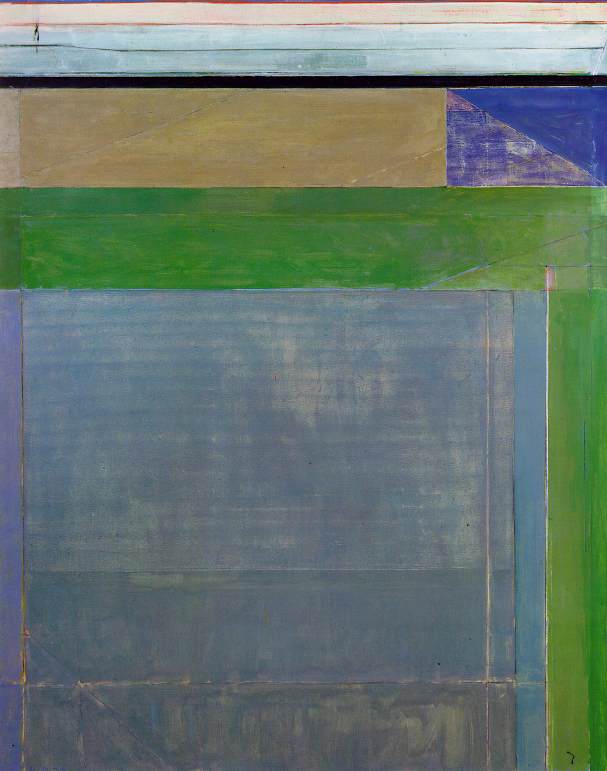
It is fifteen years now since the Whitechapel Gallery held its Richard Diebenkorn retrospective. My memories of the exhibition - walking in from the grey city streets to experience the space and light of Diebenkorn’s Ocean Park paintings - now seem like the distant recollections of a sunlit summer. Abstract works like Ocean Park No. 115 (1979), shown here, can only represent a landscape the way it feels, through selected elements of the way it looks. Never having been to California I imagine these paintings to be distillations of the essence of the place. I'm happy to believe Robert Hughes when he says ‘there is a kind of light on Diebenkorn’s stretch of coastline – mild, high and ineffably clear, descending like a benediction on the ticky-tacky slopes just before the fleeting sunset drops over Malibu – that is all but unique in north America, and Diebenkorn’s paintings always appear to be done in terms of it.’

Source: Mark Harden

But is there really much trace of landscape in the Ocean Park paintings? Hughes sees ‘pale-blue Pacific air, cuts and slices of gable, white posts by the sea, sudden drop-offs of hill or thruway'. 'These images of the California coast have found their way into his works, but in a condensed and fully digested idiom whose sources, far back in the early twentieth century, are Henri Matisse and Piet Monrian.’ However, Arthur Danto may be nearer the mark when he writes: ‘in my view, Diebenkorn's paintings are less about the bright skies and long horizons of Ocean Park than about the act of painting, as if the works had become more and more their own subjects and the external references stand at best as indications of what the painting is not about- Ceci n'est pas un paysage!’

Tuesday, August 01, 2006

Stratford Mill

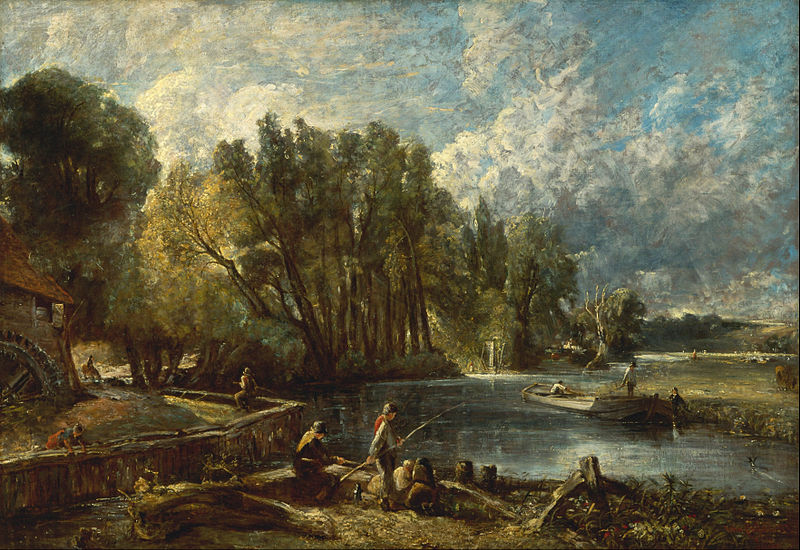
John Constable, Stratford Mill, 1820

To the Tate’s Constable exhibition, where the six-footers have been hung with their full-size sketches. Looking at the sketch for Stratford Mill (1820), I was taken with the powerful shaft of light hitting the water in the middle of the painting – absent from the finished work, which is serene, harmonious, calm and maybe a little bit dull. In moving from sketch to exhibited painting, Constable took out the central figure of the fisherman with his eye-catching red scarf, whose prominence may, I suppose, have detracted from the landscape, and also found no room for a duck that skitters across the water in the original composition. The clouds are less rough and turbulent too, although they remain a dramatic counterpoint to the trees – and it was with reference to this painting that Constable made his comment that the sky in a painting is the ‘chief organ of sentiment.’ In fact the more you look at the clouds and trees in the finished painting, the more you realise they are both highly composed and expressive. The sketches may be freer and more direct, but the six-footers themselves were startling in their day.

As I write this peering at frustrating little jpegs on the screen, I’m reminded why I found a visit to the exhibition worthwhile even though the six-footers are so familiar. Revisiting them is like going back to reread nineteenth century literature – I tend to think of Constable’s succession of large-scale major works as resembling a sequence of books, perhaps the equivalent in painting of Thomas Hardy’s novels. The first two rooms of the exhibition are crowded, but it is possible to enjoy the six-footers in an atmosphere of relative calm, both as paintings in their own right and in pairs with their full-size sketches.