Sunday, March 28, 2010

Ben Lomond, View near Dumbarton


Portrait of Paul Sandby, Francis Cotes, 1761 

Upstairs at the Royal Academy, away from the throngs enjoying the Van Gogh exhibition, the Sackler Rooms are a haven of quiet - there's not much danger of having to peer over a crowd of heads there to see Paul Sandby's watercolours.  I hope they get reasonable numbers of people going because it is a fascinating exhibition if you are interested in the history of landscape art.  Sandby lived from 1731 to 1809 and his career covered the whole of the second half of the eighteenth century: in the 1750s he was working in London and publishing etchings on The Analysis of Deformity, a satire on Hogarth's The Analysis of Beauty (1753), and he was still alive to see the new generation of watercolourists at the start of the nineteenth century, outliving poor Thomas Girtin by seven years.  He is also a gift to art historians writing about the politics of landscape, as he started out in 1747 working for the Board of Ordnance on the Military Survey of North Britain, depicted army encampments in London parks in the wake of the Gordon Riots, and spent much of his career working on estate portraits for patrons like the Duke of Cumberland, the 3rd Earl of Bute and James Watman, a paper mill owner, whose premises can be seen below, naturalised within an idyllic rural setting.


A View of Vintners at Boxley Kent, 
with Mr Whatman's Turkey Paper Mills (detail), Paul Sandby, 1794
Source: Austenonly

The exhibition begins with Sandby's map making and you can see how he used pen-and-ink to describe the mountains of Scotland.  He also painted the activity of the surveying party and made some panoramic views of the landscape, such as Ben Lomond, View near Dumbarton (c1747).  One of the pleasures of an exhibition is seeing the physical objects themselves - the full map spread out and the view of Ben Lomond, consisting of several sheets pasted together, attached to a copy Thomas Pennant's Tour of Scotland (1772).  The reason why Sandby's sketch is now inside this book is that it has been 'grangerised'.  Grangerising was the practice of illustrating a book by clipping out and adding pictures taken from other published sources - named after James Granger (1723-1776), whose two volume Biographical History of England (1769) included blank pages for readers to add their own illustrations.

Nowadays it is possible to grangerise electronically - just find your favourite old text on Project Gutenberg and use a Google image search.  One could for example, produce a nice new edition of William Mason's  influential The English Garden: A Poem in Four Parts (1772-82) - Mason lived in Yorkshire and may have introduced Paul Sandby to the ruins of Roche Abbey, the subject of a particularly serene watercolour from c.1780.  Another of Sandby's paintings of antiquities, showing the ruins of Roslin Castle, Midlothian, is interesting because it depicts the amateur artist Lady Frances Scott sketching from nature using a portable camera obscura.  Sandby's interested in technique extended from optical devices to the processes of reproduction and one of his innovations was the introduction of aquatint print-making, which is especially good for lighting effects, as can be seen for example in Chepstow Castle in Monmouthshire, one of his XII Views in South Wales (1775).

Of the estates pictured in the exhibition, Windsor Great Park features most often and the castle can be seen from various angles and at different times of day, including a dramatic storm scene with a streak of lightning and terrified horse.  This was of course the great age of landscape gardening and in his estate portraits Sandby was illustrating the work of famous contemporary designers and architects.  Among those involved in the design of Nuneham, where Sandby painted views of the garden, were a trio who sound like they would have made a great jazz combo: Stiff Leadbitter (house), 'Athenian' Stuart (interiors) and 'Capability' Brown (grounds).  In addition, poet-gardener William Mason created the flower garden there in 1771 (Thomas Love Peacock would later write: 'O'er Nuneham Courtnay's flowery glades / Soft breezes wave their fragrant wings, / And still, amid the haunted shades, / The tragic harp of Mason rings'.)

Sandby also painted the natural features of estates, including their old trees, which could symbolise a family's long ownership of the land.  He was thus one of the first British artists to paint individual species like oak and beech trees, but these too can be seen in wider political terms, as Linda Colley noted last year in an article about the exhibition when it was on show in Scotland. 'Morning, an extraordinary painting of a massive, venerable beech tree set firm in a Shropshire landscape, is, for instance, a powerfully loyalist testament. Exhibited at the Royal Academy in 1794, five years after the fall of the Bastille and in the midst of war, the painting would have been understood as an allusion to contemporary conservative celebrations of an ancient, organic British constitution as against the recent republican outgrowths of revolutionary France.'


Morning, Paul Sandby, 1794
(Is this the right image?  I think so but my memory is hazy and I'm writing this without access to the catalogue...)

Thursday, March 25, 2010

Passievaart, a huge marsh

I finally made it to the Royal Academy's Van Gogh exhibition last weekend - I think it is the first exhibition devoted just to Van Gogh that I've ever been to.  I hadn't anticipated quite how overwhelmingly impressive some of it would be, given the familiarity of the work - it's well worth queuing and braving the crowds to see, if you haven't done so already.  There are about 35 letters, 65 paintings and 30 drawings and I was hooked from the first sketch, which dates from June 1881.  Looking up the relevant letter to Theo on the amazing Van Gogh Museum website, I see he wrote: "I must tell you that Rappard [an artist] was here for 12 days or so, and has now left.  Naturally he sends you his regards.  We went on a fair number of excursions together, several times to the heath at Seppe, among other places, and the so-called Passievaart, a huge marsh."  Although the emphasis in this first room of the exhibition is on Van Gogh's efforts to teach himself drawing, A Marsh seemed to me an impressive enough achievement in itself, combining experiments in mark making with a composition that conveys the misty poetry of the landscape.


Vincent van Gogh, A Marsh, 1881
National Gallery of Canada, Ottawa

In his review of the exhibition Adrian Searle traces a connection with landscape in the materials van Gogh used. 'Often the artist drew with a pen that he cut himself from the reeds that grew at the margins of Dutch waterways and roadside ditches in Province. He noted that the reeds in the south were better for drawing. For finer work, he also picked up feathers for the quills he cut to make nibs.  It's more than coincidental that reeds and birds also appear in Van Gogh's drawings. I wonder if he ever used river water to dilute his inks, and for the somewhat less successful watercolours that he made. Even the charcoal he used in his early drawings have a connection to the earth itself. Those pollarded willows that appear in his work time and again also provide the charcoal that he used.  Such connectedness would have suited his pantheist view of the world.'

Sunday, March 21, 2010

On a Journey, Lodging Beneath the Blossoms

A few posts back I discussed The Maximus Poems of Charles Olson which explore the landscape and history of Gloucester, Massachusetts.  An English reader unfamiliar with the geography of these poems cannot help being struck by the references to familiar place names in unfamiliar settings: starting with Gloucester itself, an ancient landlocked city here but a coastal port in New England.  I wonder how many of these English towns and cities reborn in a new landscape simply referred back to the homes of the colonists without much though to the sites' physical similarities.  Massachusetts has a Dover located in its county of Norfolk, a Lincoln in Middlesex, a Northampton in Hampshire and Olson's Gloucester in Essex.

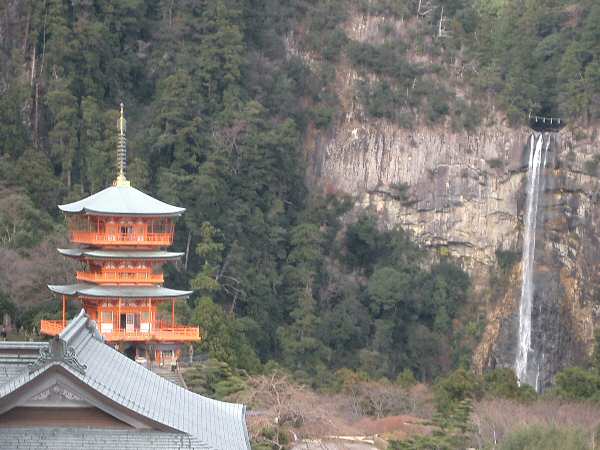
I was thinking about this after reading a passage in Burton Watson's translation of The Tales of the Heike, which describes the exile of three conspirators to the remote island of Kikai-ga-shimam off the southern coast of Satsuma.  Two of them, Naritsune and Yasuyori had been devotees of the Kumano Shrine and to make their exile bearable they went looking round the island to find a landscape that resembled the Kumano area.  'They found a wonderful spot of woodland and water, festooned here and there with tree leaves the colour of crimson brocade or embroidery; of splendid cloud-topped peaks, seeming as though draped in various shades of blue green gauze; with the mountain scenery, the stands of trees far surpassed anything found elsewhere.  Gazing south one could see a vast expanse of ocean, its waves deeply shrouded in clouds and mist, while to the north, from the soaring mountain crags, a hundred-foot waterfall came cascading down.  The awesome thundering of its waters and the pine winds imparting an aura of holiness made it seem like the waterfall of Nachi, the seat of one of the Kumano deities.  They decided to call this place the mountain shrine of Nachi.'


The Waterfall of Nachi

And so they continue, labeling one of the peaks Shingū and another Hongū, and naming various other spots after subsidiary shrines in the Kumano area.  Then each day the two exiles 'would carry out their "pilgrimage to Kumano", praying for a return to the capital.'  The prayers work - they are pardoned and leave the island (although their companion, Shunkan, who would not take part in their religious activities, is left behind and dies there).  The Kumano shrine area is now a World Heritage Site, but the location of Kikai-ga-shimam is not clear, so it's hard to know how much poetic license was taken in this re-imagining of a religious landscape.  Three islands boast graves of Shunkan: two called Iōjima, in Kagoshima and Nagasaki, one called Kikai in Kagoshima.  I should add that the actions of Naritsune and Yasuyori in establishing a version of the Kumano site for themselves can be seen in the context of the process of propagation called bunrei which has led to the establishment of over 3000 Kumano shrines throughout Japan.

The Tales of the Heike exists as a text in various versions; the one translated by Burton Watson is the famous Kakuichi text, set down by a biwa hōshi (lute playing minstrel-priest) called Kakuichi in 1371. It describes the defeat of the Heike (also called the Taira Clan) by the Minamoto (or Genji) during the Genpei wars of 1180-85.  Many subsequent stories, plays and films have been based on it, including my favourite Kenji Mizoguchi film, Tales of the Taira Clan (1955).  Although it focuses on power struggles and has some great battle scenes, The Tales of the Heike includes many quieter episodes, like the visit of the retired emperor GoShirakawa to the retreat of Kenreimon'in, daughter of the Taira ruler Kiyomori but now reduced to living in a remote Buddhist retreat.   GoShirakawa looks at the little hall, the Cloister of Tranquil Light, with its garden overflowing with flowers, and composes a poem: 'Cherries on the bank have strewn the pond with petals - / wave-borne blossoms now are in their glory.'

It is not surprising that some of the warlike historical characters in The Tales of the Heike composed poetry.  At this same time the king of England, Richard the Lion Heart, was writing songs and poems (the legend of his rescue by the minstrel Blondel could easily be re-imagined as an episode from the Japanese epic).  One episode in The Tales relates the story of deputy commander in chief Taira Tadanori risking his life by traveling to the capital to try to convince the poet Fujiwara Shunzei, then engaged in compiling the poetry anthology Senzaishū, to include one of his poems. This was politically difficult for Shunzei, but he did publish one of Tadanori's poems anonymously.  I think it captures the longing for nature's timeless beauty in this warlike period - Geoffrey Bownas and Anthony Thwaite translated it in their Penguin Book of Japanese Verse thus: 'The capital at Shiga / Shiga of the rippling waves, / Lies now in ruins: / The mountain cherries / Stay as before.'  Tadanori died in 1184, fighting in the Battle of Ichi-no-tani.  After he had been killed one final poem was found lodged in his quiver, entitled 'On a Journey, Lodging Beneath the Blossoms'.

Friday, March 19, 2010

In a Treeless Place, Only Snow


Alex Ross has featured John Luther Adams more than once in his excellent blog, most recently giving notice that the composer's 'wide-open Alaskan soundscapes are about to descend on the urban jungles of New York and Chicago. On Sunday night, the American Contemporary Music Ensemble plays “In a Treeless Place, Only Snow” and “The Farthest Place.”'  The video below is a short documentary made for The New Yorker about Inuksuit (2009) 'a work for percussion ensemble that is designed to be played outdoors. The title refers to a type of stone marker that the Inuit and other native peoples use to orient themselves in Arctic spaces. The arrangement of rhythmic layers in the score mimics the shape of these lonely sentinels, which sometimes resemble the monolithic shapes of Stonehenge'.


For an earlier profile piece Ross went to meet Adams, taking in a visit to the Museum of the North, where there is an installation (see clip below) called The Place Where You Go to Listen, a 'kind of infinite musical work that is controlled by natural events occurring in real time'. This is inspired by a place on the coast of the Arctic Ocean called Naalagiagvik where, 'according to legend, a spiritually attuned Inupiaq woman went to hear the voices of birds, whales, and unseen things around her. In keeping with that magical idea, the mechanism of “The Place” translates raw data into music: information from seismological, meteorological, and geomagnetic stations in various parts of Alaska is fed into a computer and transformed into an intricate, vibrantly colored field of electronic sound.'


Reading the profile I was particularly interested in how Adams hears the landscape.  Ross writes: 'I noticed that Adams was listening closely to this seemingly featureless expanse, and kept pulling information from it: the fluttering of a flock of snow buntings, the low whistle of wind through a stand of gaunt spruce, the sinister whine of a pair of snowmobiles. He also noted the curiously musical noises that our feet were making. Tapping the crust of snow atop the ice, under which the wind had carved little tunnels, he compared the sounds to those of xylophones or marimbas.'  At another point, 'Adams recalled the Yukon River trip that led him to write “Strange and Sacred Noise” and other tone poems of natural chaos. “When the ice breakup comes, it makes incredible sounds,” he said. “It’s symphonic. There’s candle ice, which is crystals hanging down like chandeliers. They chime together in the wind. Or whirlpools open up along the shore or out in the middle of the river, and water goes swirling through them. Or sizzle ice, which makes a sound like the effervescent popping you hear when you pour water over ice cubes.'

Wednesday, March 17, 2010

Double Tide


In recent editions of Sight and Sound Jonathan Romney has written about the trend for Slow Cinema - 'a cinema that downplays event in favour of mood, evocativeness and an intensified sense of temporality'.  Nick James, in his editorial for the April 2010 issue, sounds a cautionary note.  'Watching a film like the Berlin Golden Bear-winner Honey - a beautifully crafted work that, for me, suffers from dwelling too much on the visual and aural qualities of its landscape and milieu - there are times, as you watch someone trudge up yet another woodland path, when you feel an implicit threat: admit you're bored and you're a philistine.  Such films are passive-aggressive in that they demand great swathes of our previous time to achieve quite fleeting and slender aesthetic and political effects...'  Nevertheless, later in this same issue, Jonathan Romney, reporting from the Berlin Film Festival, praises two 'minimalist explorations of landscape', Alexej Popogrebski's How I Ended This Summer and Sharon Lockhart's Double Tide.


Popogrebski's film, made over three months on location at an Arctic weather station is not Slow Cinema - it is more of an 'adventure in outward-bound film-making in the Flaherty-Herzog tradition'.  But Double Tide is as slow as it gets, consisting as it does of two fifty-minute takes from a fixed camera, framing a view of misty mudflats on the Maine coast.  Romney writes that this 'is as close to a picture of nothing as a representational film can get: by comparison, Kiarostami's Five is pure Jerry Bruckheimer.' During the course of the film a single figure is seen gathering clams while the mist thickens and clears.  This arduous, repetitive work made Romney uncomfortable, although a reviewer for LA Weekly writes: 'it’s awful, backbreaking work, but through the lens of Sharon Lockhart’s camera, it’s also magnificent.' This puts me in mind of those old landscape paintings with picturesque labourers, and makes me wonder whether it would be as easy to overlook their exertions if one were compelled to watch them patiently working for a hundred minutes...

Still from Sharon Lockhart's Double Tide

Saturday, March 13, 2010

A Lunar Landscape

Chesley Bonestell was born in 1888, studied architecture in San Francisco and was involved in the design for the Golden Gate Bridge.  He went on to provide matte paintings for movies like Citizen Kane and Only Angels Have Wings before turning to astronomical painting in the early 1940s.  He collaborated with Willy Ley on The Conquest of Space (1949), worked on science fiction films with George Pal and created a huge mural of the lunar landscape for the Boston Museum of Science.  This is now in the Smithsonian and you can see it at their website.  As they explain, 'just as 19th–century artists created huge paintings to help Americans envision the scenic wonders of the West, A Lunar Landscape helped viewers imagine what it would be like to stand on another world. And just as those painters had taken artistic license to enhance the western landscape’s grandeur, Bonestell presented a dramatically lit moonscape with sharp peaks, jagged canyons, and precipitous crater walls.  Photos taken by the first lunar probes showed a very different place. They revealed a gentler, far less dramatic world than Bonestell had envisioned. Recognizing that the mural could no longer be considered accurate, museum officials removed it from display in 1970.'  Which is how it ended up at the Smithsonian.

 
There is a detailed account of Bonestell's career by Ron Miller which discusses the question of why he over-dramatised the lunar landscape and explains some of his methods, including a technique of spherical perspective to show planetary surfaces from high altitudes, and the use of plasticine models, photographed using a pin hole camera to achieve maximum depth of field and then mounted on board to be painted using oil glazes. The Visual Index of Science Fiction Cover Art, VISCO, has in its archive images that Bonestell painted from 1947.  The first of these (above) is not actually a landscape but is so striking that I can't resist including it here.  A few more, showing the landscapes of other worlds, are given below.  Apparently Bonestell himself disliked science fiction and "never read the stuff" but his art works continued to appear on the covers of Astounding and Fantasy and Science Fiction until the late seventies. 

Tuesday, March 09, 2010

Landscripts

The art works in the Museum of Art and Design show that I mentioned last time involve the transformation of 'organic materials and objects that were once produced by or part of living organisms-insects, feathers, bones, silkworm cocoons, plant materials, and hair-to create intricately crafted and designed installations and sculptures'.  It looks like another landscape-related highlight will be an installation by Xu Bing, who 'will make a shadow version of a 24-foot Song Dynasty painting using only vegetable detritus, weeds, leaves, and roots'.  Xu Bing has also made a series of works called Landscripts which develop ideas I've discussed here before of the Chinese written character and the depiction of a landscape through patterned words. For example, a 2003 version in Sydney's New South Wales Museum was created 'on the large plate-glass windows of the museum lobby' where 'Xu wrote out an image of the landscape visible through them by using Chinese characters to represent the individual landscape elements: for example, a clump of trees was represented by a clump of the Chinese character for tree. When the viewer stood on a marked point on the floor the calligraphy and the objects seen through the window overlapped, resulting in a conflation of text and objects.'

Monday, March 01, 2010

Landscape on the face of Levi Van Veluw

As you can see, the latest edition of Crafts features a man with a landscape on his head.  This is Dutch artist Levi Van Veluw's Landscape I (2008), one of three works he has in the New York Museum of Art and Design's forthcoming exhibition Dead or Alive.  Van Veluw's website includes three others (corresponding to the other seasons) and describes the rationale for his Landscapes series: 'removing plots of grass, clusters of trees, babbling brooks from their intimate 2 dimensional formats and transposing them onto the 3 dimensional contours of his own face. Thus a fresh twist is given to the obsession inherent in the romantic landscape of recreating the world and simultaneously being part of it.'


Van Veluw covers his face in modeling scenery of the kind used for making train sets; no surprise then to see a small train makes its way through a landscape in this video clip.  It made me think that he could transform his head into a live metaphysical painting, with facial features standing in for the enigmatic objects in the foreground of a De Chirico like Ariadne (1913).  Now I think of it there are lots of far fetched possibilities for Landscape-Head series from the history of art - Monet's variations on the same view (something like Roni Horn's You are the Weather), a Salvator Rosa face contrasted to a Claude, Altdorfer's early independent landscapes recreated and re-connected to the figure.  Imposing landscapes on other people's heads would recall eighteenth century landscape parks or idealised views of colonised territory. Or perhaps something exploring landscape and desire, recalling the words of Deleuze and Guattari: "all faces envelop an unknown, unexplored landscape; all landscapes are populated by a loved or dreamed-of face."

Friday, February 26, 2010

Polis Is This


Here's something really good if you haven't already seen it: Polis Is This: Charles Olson and the Persistence of Place (the film, in six parts, is embedded below).  It includes reflections on the way Olson wrote about space and place, interviews with poets like Robert Creeley, Amiri Baraka and Jonathan Williams, and Olson's own words spoken by John Malkovich and sung by Ed Sanders of the Fugs.  It's not an experimental film - in some ways it's a fairly typical documentary, with talking heads, archive footage and scenic shots synced to the soundtrack.  The film's website, with a nice sense of humour, describes it's subject in heroic terms: 'Charles Olson the "original aboriginal" fights to save his town from so-called progress as the bullzoder of change rumbles down Main Street USA.  His challenge to us? We must either rediscover the earth or leave it. Have we all become estranged from that which is most familiar? See Polis Is This before the cultural wetlands are completely drained and maybe you can save the place where you live.'

One of the interviewees in Polis Is This is John Stilgoe from Harvard University who says that “the local environment is the prism through which anyone’s understanding of the cosmos is filtered; to look at the outer world from a vantage point in the local. For many people the local landscape was very uninteresting and ordinary, but for him, it was the threshold to the world.”  The documentary actually begins by addressing the viewer on the subject of landscape, asking whether we really see "not just the present surface, but what came before".  Charles Olson wrote about Gloucester, Massachusetts as it was in the fifties and sixties, as it had been in his childhood, and how it had developed and changed since the seventeenth century. His Maximus Poems contain a lot of detail on 'what came before' - some of it rather hard going if you are not that interested in New England history, although another interviewee, poet Robin Blaser says that Olson told him not to bother trying to get his head round all the local detail: "don't do that... this is my place.  Go do it for yours."  (Maybe I will... "I, Plinius of Stoke Newington, to You" etc. etc.)


The complete Maximus Poems that we now have consists of three volumes: The Maximus Poems, published in 1960 (see picture above), Maximus Poems IV, V and VI which appeared in 1968, and The Maximus Poems: Volume 3, published posthumously in 1975.  As you read through them you build up a strong visual picture of Gloucester, past and present, from fragments of description, but it's not really until the very end of the Volume VI that you get what might be called an actual landscape poem: 'The River Map and then we're done'.  It is a fine poem to read and look at, tracing the river like an old chart (Olson based it on a 'Plan of Squam River from the Cut to the Lighthouse' drawn up in 1822), and ending at a seeming oxymoron: 'Rocky Marsh'.  This is Volume VI's penultimate poem: the last consists of just two lines ('I set out now / in a box upon the sea').

It is in Volume 3 of  The Maximus Poems that you'll find some landscape poems reminiscent of others I've discussed here before (Olson sometimes reminds me, for example, of Lorine Niedecker and Guillevic).  On August 6th 1964, Olson wrote a short poem I could imagine stenciled onto the wall of Thomas A. Clark's Cairn Gallery: 'the sky, / of Gloucester / perfect bowl / of land and sea.'  On December 22nd 1965, he described a winter view with high tide and light snow, 'rocks melting into the sea', '... the whole / full landscape a / Buddhist / message...'  Two poems further on he writes of the late afternoon sun and its effects on the landscape - whitening out parts of the view, glistening on the water, bestowing a 'split second of monumentalness' on Stage Head and Tablet Rock. And so it goes on, through the winter of 1966, with Olson meditating on the view out to sea:  Ten Pound Island, Shag Rock, Dog Bar, Half Moon, Round Rock Shoal.  The rest of the sequence returns mainly to history and myth, 'Time's / unbearable complexity', the landscape's deep past: 'Gloucester herself when Earth Herself was One / Continent'.  But in these last poems Olson also continued to write about what he saw and the sad alterations that had made Gloucester 'a mangled mess' - 'now indistinguishable from / the U.S.A.'


Friday, February 19, 2010

Pruitt-Igoe Falls

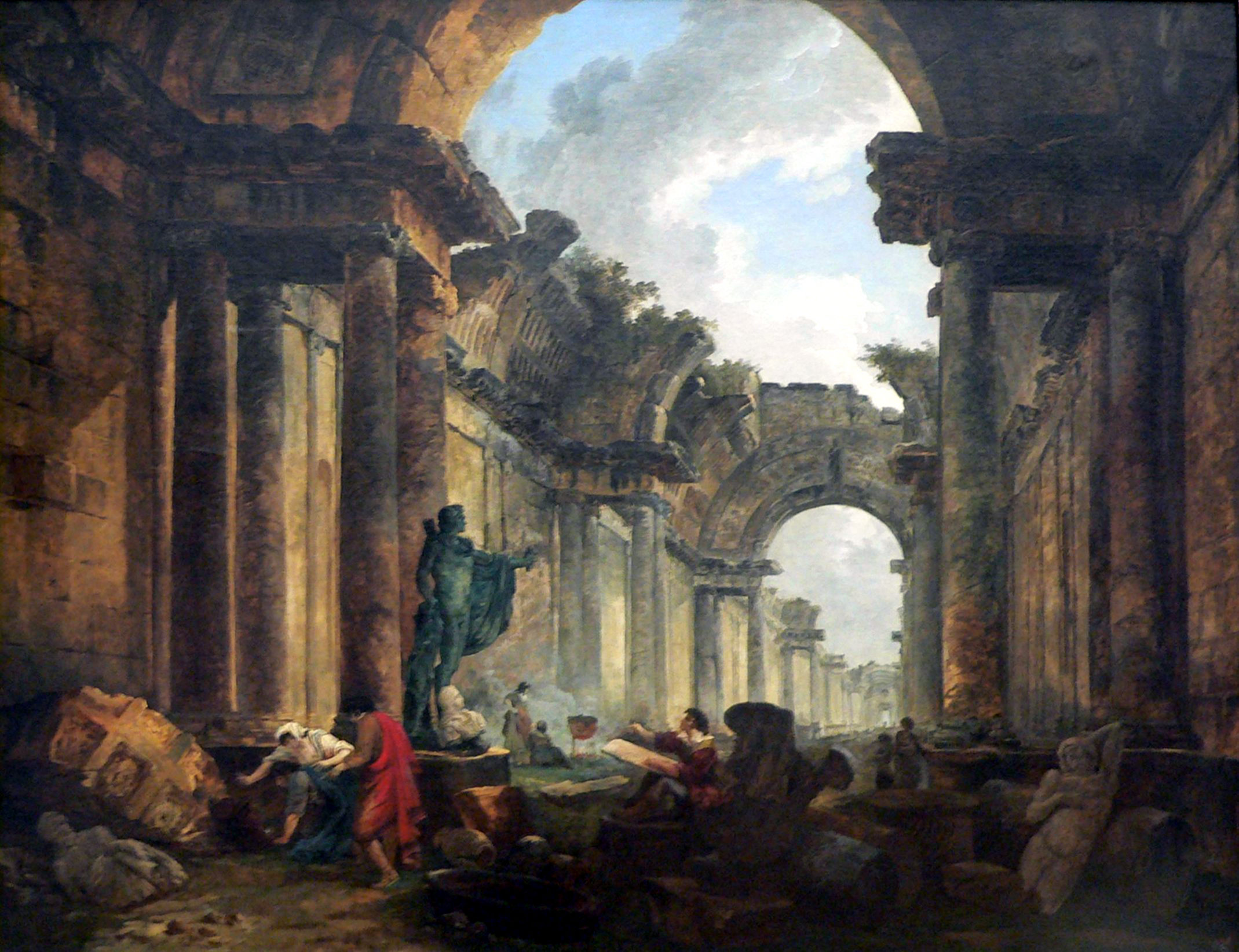
Cyprien Gaillard's art seems to be getting quite a lot of attention at the moment.  I see that one of his works is included in the new Gagosian Gallery exhibition of art inspired by J. G. Ballard, along with other artists I've discussed here before like Ed Ruscha, Tacita Dean and Dan Holdsworth. Gaillard specialises in showing contemporary architecture as ruins - in this respect the Bugada and Cargnel gallery compares him to '18th century French 'ruiniste' painter' Hubert Robert.  'Whether he commissions a traditional landscape painter to paint colourful views of housing projects in Swiss suburbs, surrounded by their luxurious natural environment (Swiss Ruins, 2005), or introduces a view of a tower-block into a 17th Century Dutch landscape etching (Belief in the Age of Disbelief, 2005), Gaillard shows contemporary architecture as a modern ruin on the verge of being taken over by nature'.


Hubert Robert, Imaginary View of the Grand Gallery of the Louvre in Ruins, 1796

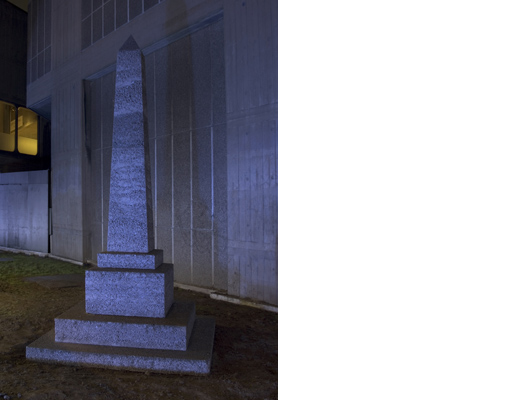
This gallery site goes on to describe his ongoing project for a 'parc aux ruines', scattering monuments across the world: 'a monumental bronze sculpture of a duck taken from a derelict Modernist neighbourhood of high rise buildings in Paris' taken to the terrace of Berlin's Modernist Neue Nationalgalerie, 'crushed concrete remains of a tower block from the suburban city of Issy-les-Moulineaux laid out on the main ally of a Renaissance castle' and the concrete from a demolished social housing project in Glasgow, 'recycled into a 4 meter high obelisk (Cenotaph to 12 Riverford Road, Pollokshaw, Glasgow, 2008)'.

In an interview with Alix Rule, Gaillard said "You know how the London bridge or some French castles have been moved, rock by rock, and reconstructed? My main project, the work of my life, is to do the same for towerblocks. I mean, they cost a fortune to demolish - if I could somehow use the money (and then find more money), I would relocate them on a big piece of land in the south of France and create a park. There would be a few from Glasgow and Sheffield, and a few from Paris and from Marseille, and a few from Kiev, the same way Piranesi would make a caprice. The place would become a 21st-century park of ruins as well as my sculpture park."

I've included a link below to the video Pruitt-Igoe Falls (2009) which shows the destruction of a Glasgow tower block along with a nocturnal view of Niagara Falls.  Gaillard is quoted in Interview as saying: "When the building fell, the dust from the destruction made its way through the graveyard below us like a ghost, slowly coming to the camera until everything went black. It becomes a natural monument, just like Niagara Falls at night-both subjects are falling, both slowly bring you to obscurity."  The title comes from the failed urban housing project, Pruitt-Igoe in St Louis, which was completed in 1955 and demolished in 1972.

Tuesday, February 16, 2010

Garden in Sochi

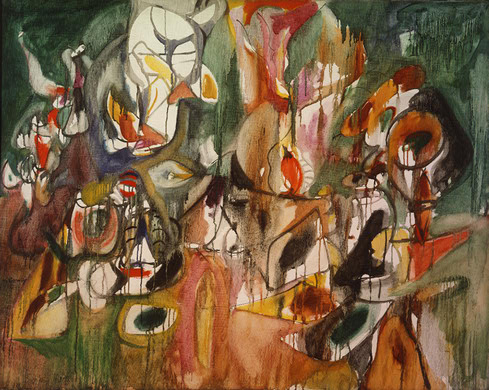
Arshile Gorky, One Year the Milkweed, 1944
Image added here in 2019 following expiry of copyright

The Tate's impressive and moving new Arshile Gorky retrospective includes a room entitled 'Landscape', with paintings like One Year the Milkweed and Cornfield of Health (both 1944).  André Breton said of these works (for which he provided some of the titles) that they reveal the rhythm of life through Gorky's way of decoding nature.  Gorky had begun working in the Connecticut and Virginia countryside in the early 1940s, improvising drawings and developing his abstract paintings, like the Tate's own Waterfall (1943).  The exhibition guide says of these paintings that they 'combine the immediate with buried memories of childhood.'  I think it is these buried memories (rather than our knowledge of Gorky's suicide in 1948) that give the paintings in the exhibition such poignancy - whether indirectly in paintings like One Year the Milkweed or directly in The Artist and His Mother, that remarkable memorial to his mother who had fled with the rest of the family from the pograms in Armenian Turkey only to starve to death in Russia in 1919.

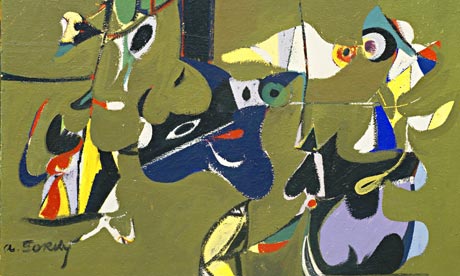
Arshile Gorky, Garden in Sochi Motif, 1942
Image added here in 2019 following expiry of copyright

Earlier in the exhibition there is a room devoted to the Garden in Sochi series.  This is based on Gorky's memories of childhood, specifically his father's orchard at Khorkom.  He said in 1942 that "there was a ground constantly in shade where grew incalculable amounts of wild carrots, and porcupines had made their nests.  There was a blue rock half buried in the black earth with a few patches of moss placed here and their like fallen clouds."  This description (which reminds me of Bruno Schulz) provides an obvious starting point for a biomorphic composition in the style of Arp or Miró, which is what the Garden in Sochi works resemble.  However, William Feaver quotes another more extravagant explanation for these paintings, where Gorky relates them to The Garden of Wish Fulfillment:  "Often I had seen my mother and other village women opening their bosoms and taking their soft and dependable breasts in their hands to rub them on the rock. Above all this stood an enormous tree all bleached under the sun the rain the cold and deprived of leaves. This was the Holy Tree. I myself did not know that this tree was holy but I had witnessed many people whoever did pass by that would voluntarily strip off their clothes and attach this to the tree."

Saturday, February 13, 2010

A lake beneath the weightless morning sky

'Why do we wish to see a charming landscape reproduced in a picture?  Is it just for the sake of pleasure?  No, we are hoping this image will explain something - but this is a something that will surely always remain inexplicable.'  - Robert Walser, The Tanners, 1907 (Der Geschwistern Tanner, trans. Susan Bernofsky)

I think I first heard about Robert Walser through an interview in March 1992's Sight & Sound with the Brothers Quay, who went on to film Walser's novel Jakob von Gunten.  About the same time I bought The Walk and other Stories, with its introduction by Susan Sontag, in Camden's much-missed Compendium Bookshop.  After enjoying the Quay Brothers' film Institute Benjamenta (1995) at the ICA (which may soon be going the way of Compendium), I taped it when it came on TV and remember showing it to one or two people, none of whom seemed as impressed as I was.  I thought that both Walser and the Quays would remain a minority taste, but now we seem to be in the midst of what one review calls a miniature Walser renaissance.  New translations are appearing and I have just finished reading Susan Bernofsky's translation of The Tanners (you can read an excerpt at The Brooklyn Rail).  I'm once again going round trying to tell people how great Walser is - it would be a marvellous book anyway but it also happens to have a cool cover design and Sebald essay for an introduction.


Google The Tanners and you'll find plenty of reviews, so I won't say much here about the novel itself.  My excuse for mentioning it at all is Kaspar Tanner, a landscape painter, brother of the book's main character Simon.  The quote above comes from a passage where Simon is looking at his brother's pictures.  He goes on to say: "It cuts so deeply into us when we, lying at a window, dreamily watch the setting sun; but that's nothing at all compared to a street when it's raining and the women are daintily raising their skirts, or to the sight of a garden or lake beneath the weightless morning sky or to a simple fir tree in winter or to a boat ride at night, or a view of the Alps."  These images made me think of haiku, and a few sentences further on Simon refers to his sister's friend, a poet thus: "people are saying he's built himself a hut up in the high pastures so he can worship nature undisturbed, like a Japanese hermit."  Sadly we don't get to see this hut (if indeed it exists) in the novel.

Susan Sontag wrote that Walser's stories and sketches reminded her of 'the free, first person forms that abound in classical Japanese literature.'  The story that most impressed me in that first Walser anthology I read was 'Kleist in Thun' (1913), about the great German writer who took his own life in 1811.  In it, Walser (to quote W. G. Sebald) 'talks of the torment of someone despairing of himself and his craft, and of the intoxicating beauty of the surrounding landscape.'  'Time and again I have immersed myself in the few pages of this story' wrote Sebald, in the essay 'Le Promineur Solitaire: A Remembrance of Robert Walser' which appears as the introduction to The Tanners.  He quotes Walser's description of the lake and the Alps dipping 'with fabulous gesture their foreheads into the water.'  At another point in the story Walser pictures Kleist on a skiff, looking out at the clear morning lake.  'The mountains are the artifice of a clever scene painter, or look like it; it is as if the whole region were an album, the mountains drawn on a blank page by an adroit dilettante for the lady who owns the album...'  (trans. Christopher Middleton).


Thun c. 1900 (source: Wikimedia Commons)

I visited Thun once as a child (see photograph below), on a family holiday to Switzerland, and I still have the travel diary I kept.  "Today it was even wetter than yesterday, really pouring.  So we went to Thun by train.  At Thun Mum and Dad bought a cow bell and we went in a castle/museum - boring."  Oh dear.  In the afternoon, from Thun, we took a boat trip to Spiez - "it was freezing...  The scenery spoilt by the weather."  Walser closes the story with his own recollection of Thun, "the region is considerably more beautiful than I have been able to describe here, the lake is twice as blue, the sky three times as beautiful".  He says that Thun is visited every year by thousands of foreigners who can read if they wish the words carved onto a marble plaque commemorating Heinrich von Kleist.  I don't think we went to look at this (if it still exists).  The long last paragraph of Walser's story begins in Kleist's mind - music and radiant shafts of light flickering about his senses - and ends Walser's comments on Thun. Susan Sontag thought it 'an account of mental ruin as grand as anything I know in literature.'

Tuesday, February 09, 2010

Alpine Symphony

Apparently, 'the first commercial CDs pressed were The Visitors by Abba and a recording of Herbert von Karajan conducting the Alpine Symphony by Richard Strauss'. I'm afraid we're not interested in Abba here, but Strauss is another matter - as his tone poem (not really a symphony) is a famous example of landscape programme music (following others I've mentioned here before like Beethoven's Pastoral Symphony and Mendelssohn's Hebrides Overture.)  It was completed in 1915 (an earlier version, written in memory of Swiss portrait painter Karl Stauffer, was begun and abandoned in 1899).  The Alpine Symphony is divided into twenty-two sections as follows:

1. Nacht (Night)
2. Sonnenaufgang (Sunrise)
3. Der Anstieg (the Ascent)
4. Eintritt in den Wald (Entry into the Woods)
5. Wanderung neben dem Bache (Walking along the Brook)
6. Am Wasserfall (at the Waterfall)
7. Erscheinung (a Visual Feature)
8. Auf blumigen Wiesen (on Flowery Meadows)
9. Auf der Alm (on the Pasture)
10. Durch Dickicht und Gestrüpp auf Irrwegen (Wrong Path through the Thicket)
11. Auf dem Gletscher (on the Glacier)
12. Gefahrvolle Augenblicke (Moments of Danger)
13. Auf dem Gipfel (at the Summit)
14. Vision (Vision)
15. Nebel steigen auf (the Fog Rises)
16. Die Sonne verdüstert sich allmählich (the Sun is Gradually Obscured)
17. Elegie (Elegy)
18. Stille vor dem Sturm (Calm before the Storm)
19. Gewitter und Sturm, Abstieg (Thunder and storm, Descent)
20. Sonnenuntergang (Sunset)
21. Ausklang (the Journey Ends)
22. Nacht (Night)

Here are some of the landscape motifs (I'm basing this on an article in Wikipedia that draws on Norman Del Mar's Richard Strauss: A critical commentary on his life and works and on Marc Mandel's 'Richard Strauss: An Alpine Symphony, Op. 64,'):
  • The mountains - a solemn motif played by trombones and tuba; the 'peak motive', is shaped like a mountain (upward leaps of fourths and fifths) and resembles Strauss' Also Sprach Zarathustra
  • The sun - this has its own theme, a descending A Major scale
  • Woods -the 'instrumental tones deepen as thick foliage obscures the sunlight'
  • Birdsong - heard in the upper woodwinds and a solo string quartet leads the transition into the next musical section
  • Brook and waterfall - a rushing passage gives way to cascading scale figures in the winds and strings and marks the beginning of the section which takes place 'At the Waterfall'
  • Flowering Meadows - suggested by a gentle backdrop of high string chords, with a marching theme heard softly in the cellos and isolated points of color (short notes in the winds, harp, and pizzicato in the violas) 
  • Alpine Pasture - cowbells, bird calls, a yodeling motive, and the bleating of sheep (depicted through flutter tonguing in the oboe and E-flat clarinet) 
  • Rain and storm - a drum roll, isolated raindrops (short notes in the upper woodwinds and pizzicato in the violins), flashes of lightning (piccolo) and then the storm itself, using a thunder machine and organ
It is interesting to think how far this kind of composition can reasonably be taken.  Birdsong, thunderstorms and flowing water are pretty standard, but the attempt to convey musically an alpine meadow is more unusual.  The orchestra offers a wonderful range of possibilities - just looking at the list above we have variations in instrumentation, tone, volume, duration, rhythm, pitch and so on, in any possible combination.  But would it be possible to move away from the sublime and the picturesque, to convey more unusual settings or simply nondescript landscapes through purely orchestral sound?


Friday, February 05, 2010

Music with Roots in the Aether


In the early seventies, Robert Ashley produced and directed a 14-hour television opera/documentary about the work and ideas of seven American composers, Music with Roots in the Aether, which premiered at the Festival d'Automne à Paris in 1976. It comprises seven films, each two hours long, most of which have a live performance preceded by an interview in a 'landscape':
  • Landscape with David Behrman
  • Landscape with Philip Glass
  • Landscape with Alvin Lucier
  • Landscape with Gordon Mumma
  • Landscape with Pauline Oliveros
  • Landscape with Terry Riley
  • Landscape with Robert Ashley
Robert Ashley is quite self deprecating about the interviews, saying they were "casual and desultory. They had to be, because of the manner in which they were made. They were made in front of a video camera, with the rule that there would be no video editing." But the landscapes more than compensate for this (some of them are interior landscapes) - the location and natural sounds integral to each conversation.  As I write this I'm watching Terry Riley on another part of my screen, bathed in sunlight, on a grassy slope above a pond. The camera sometimes gets distracted by the surroundings - see for example 35 minutes into Landscape with Terry Riley, where he is talking about Indian ragas whilst we watch a bird washing its feathers.

In an article about Music with Roots in the Aether, Arthur J. Sabatini notes the importance of Philip Makanna's camerawork, which 'functions to structure, comment upon, and provide an alternative take on the conversations and musical performances. He handles the camera gracefully and settles it in on telling images, settings, and moments of dialogue during the performances. With noticeable still photographic technique, he frames scenes and selects perspectives and angles that metaphorically enhance the conversations. For example, as Ashley and David Behrman stand on a hillside overlooking the San Franciso Bay remarking on music across cultures and history, Makanna leaves their voices in the background and pans the Golden Gate Bridge from shore to shore. At another point, when the discussion turns to technology, he follows the microphone wires and video cables trailing the speakers. Thus, Makanna's cinematography and camerawork underscores the musicality of each composers' voicings and their relationship to the landscape.'

Kenneth Goldsmith (the poet who runs Ubuweb) has written a short piece for The Brooklyn Rail about Robert Ashley's films.  It includes an interesting digression on aether with which I'll conclude this post, well off the topic in question but sailing into fascinating waters... "Aether, then, is a loaded word, full of dreams and secrets— a fluid, transmissive medium, ready to heap its treasures upon those who approach her with the right state of consciousness. Antiphanes told of a certain city where words congealed with the cold the moment they were spoken, and later, as they thawed out, people heard in the summer what they had said to one another in the winter. Similarly, Rabelais, writing in 1532, alludes to this phenomenon in his frozen-sounds episode of Gargantua and Pantagruel, where out at sea, with little in sight, a strange assortment of sounds are heard. The captain of the boat explains that the boat is passing by the Frozen Sea, which was the site of a bloody battle between the Arimaspians and the Nephelibates. During the battle, it was so cold that the sounds froze and the whole battle was silent. Now that it is springtime, all these sounds— long inaudible— are being released and creating a racket, although not in their original temporal sequences of action."

Sunday, January 31, 2010

I like a fine prospect, but not on picturesque principles

Talking of William Gilpin (as I was in my previous post), I remember years ago looking in vain for his books in various second hand bookshops and eventually giving up (I still don't own any).  Now it is possible to read them all online in digitised form:
I was thinking of him this week because I've been listening to Sense and Sensibility on my iPod and it includes a well-known exchange on the Picturesque.  I've mentioned Jane Austen's satire of Picturesque taste here before, but it's worth noting that, according to her brother's memoir, she was "at a very early age enamoured of Gilpin on the Picturesque; and she seldom changed her opinions either on books or men."  
Edward returned to them with fresh admiration of the surrounding country; in his walk to the village, he had seen many parts of the valley to advantage; and the village itself, in a much higher situation than the cottage, afforded a general view of the whole, which had exceedingly pleased him. This was a subject which ensured Marianne's attention, and she was beginning to describe her own admiration of these scenes, and to question him more minutely on the objects that had particularly struck him, when Edward interrupted her by saying, "You must not enquire too far, Marianne—remember I have no knowledge in the picturesque, and I shall offend you by my ignorance and want of taste if we come to particulars. I shall call hills steep, which ought to be bold; surfaces strange and uncouth, which ought to be irregular and rugged; and distant objects out of sight, which ought only to be indistinct through the soft medium of a hazy atmosphere. You must be satisfied with such admiration as I can honestly give. I call it a very fine country—the hills are steep, the woods seem full of fine timber, and the valley looks comfortable and snug—with rich meadows and several neat farm houses scattered here and there. It exactly answers my idea of a fine country, because it unites beauty with utility—and I dare say it is a picturesque one too, because you admire it; I can easily believe it to be full of rocks and promontories, grey moss and brush wood, but these are all lost on me. I know nothing of the picturesque."


"I am afraid it is but too true," said Marianne; "but why should you boast of it?"

"I suspect," said Elinor, "that to avoid one kind of affectation, Edward here falls into another. Because he believes many people pretend to more admiration of the beauties of nature than they really feel, and is disgusted with such pretensions, he affects greater indifference and less discrimination in viewing them himself than he possesses. He is fastidious and will have an affectation of his own."

"It is very true," said Marianne, "that admiration of landscape scenery is become a mere jargon. Every body pretends to feel and tries to describe with the taste and elegance of him who first defined what picturesque beauty was. I detest jargon of every kind, and sometimes I have kept my feelings to myself, because I could find no language to describe them in but what was worn and hackneyed out of all sense and meaning."

"I am convinced," said Edward, "that you really feel all the delight in a fine prospect which you profess to feel. But, in return, your sister must allow me to feel no more than I profess. I like a fine prospect, but not on picturesque principles. I do not like crooked, twisted, blasted trees. I admire them much more if they are tall, straight, and flourishing. I do not like ruined, tattered cottages. I am not fond of nettles or thistles, or heath blossoms. I have more pleasure in a snug farm-house than a watch-tower—and a troop of tidy, happy villagers please me better than the finest banditti in the world."

Marianne looked with amazement at Edward, with compassion at her sister. Elinor only laughed.
Gilpin would have preferred banditti to happy villagers, and on aesthetic grounds favoured a landscape peopled by those not actively interfering with it.  As he wrote in his tour of the Lakes, 'in a moral view, the industrious mechanic is a more pleasing object than the loitering peasant.  But in a picturesque light it is otherwise.'

    Friday, January 29, 2010

    Grongar Hill

    So how do you describe a landscape?  Normally by selecting the most interesting features to which the reader's attention should be drawn, and this after having selected that particular view in the first place. Plus there's the time dimension - describing the landscape at a particular time on a particular day, describing temporal phenomena like the wind in the trees, referring to the landscape's history and future.  But what if your aim is more restricted or objective - to try to describe literally what is in front of you, like a photograph?  Where do you start?  How much detail do you include?  Do you give each arbitrary section of the visual field equal weight?  How do you convey relative distance?  Do you include ephemeral effects?  How much time is encapsulated in this 'snapshot'?

    In The Search for the Picturesque Malcolm Andrews describes some of the difficulties eighteenth century tourists encountered in trying to record in writing their impressions of the landscape.  He quotes one J. Grant, writing his 'Journal of a Three Weeks Tour, in 1797, Through Derbyshire to the Lakes': "About to enter on the most beautiful scenery, I shall, hereafter, in describing, fix one spot in a landscape, whence the best bird's eye view of the whole is to be had, and beginning in front, shall go round to the right hand, and returning by the left, make a complete sweep."  Andrews sees the influence here of advice for painters, e.g. William Sanderson's Graphice (1658), which recommended that the painter of landskip take his station on high ground, divide his tablet into three sections and then start drawing in the middle before turning first to the right and then the left.  But the extent to which a writer followed the practice of an artist would influence the choice of details in a landscape description.  Andrews provides an interesting case: William Gilpin's criticism of John Dyer's poem Grongar Hill (1726).

    Below me trees unnumber'd rise,
    Beautiful in various dyes:
    The gloomy pine, the poplar blue,
    The yellow beech, the sable yew,   
    The slender fir, that taper grows,
    The sturdy oak, with broad-spread boughs;
    And, beyond, the purple grove,
    Haunt of Phyllis, queen of love!
    Gaudy as the op'ning dawn,   
    Lies a long and level lawn,
    On which a dark hill, steep and high,
    Holds and charms the wandering eye!
    Deep are his feet in Towy's flood,
    His sides are cloth'd with waving wood,  
    And ancient towers crown his brow,
    That cast an aweful look below;
    Whose ragged walls the ivy creeps,
    And with her arms from falling keeps;
    So both a safety from the wind
    In mutual dependence find.

    In the extract above Dyer (who trained as a watercolourist under Jonathan Richardson) clearly describes the foreground trees and their colours, as you would expect in a landscape painting.  But Gilpin was worried about what comes next, the 'purple grove' in the middle ground - purple objects ought to imply distance - and criticised the detail apparently visible on the distant castle.  Instead of being fainter than the purple grove, 'you see the very ivy creeping upon the walls.'  He contrasts this with a famous couplet from Milton's L'Allegro, 'Towers, and battlements he sees / Bosomed high in tufted trees', where the colouring is indistinct and 'we do not see the iron-grated window, the portcullis, the ditch or the rampart.  We can distinguish a Castle from the tree; and a tower from a battlement' (Observations on the River Wye, and several parts of South Wales, &c. relative chiefly to picturesque beauty; made in the summer of the year 1770, 1782).  For Gilpin the picturesque description was not a simple inventory of what was before the tourist, it had to express the character of the place.  But rather than make use of the power of language to shift focus and capture the view in three or four dimensions he aimed to emulate the effects of landscape painters. 

    Nobody has cracked the problem of describing a landscape in words, but it's a challenge that can lead to interesting experiments.  Colin Sackett made a book last year called Spate in which a panoramic photograph is translated into text - simple words (Field, Trees, Submerged Fence) placed on the white page in place of their image, with successive pages tracking the progress of the floodwater near Exeter.  A picturesque version might have more detail down in the foreground with vague phrases at the top of the page (not to mention variations in typography with faint purple text in the distance...)  Grongar Hill could be rewritten in all sorts of ways.  As a text picture it might look something like this (Gilpin may have been right about the purple grove which seems a bit hard to place...)

                                          ancient tower
                                              dark hill
                                      dark hill   dark hill
                             dark hill    dark hill    dark hill
                a             long              and         level        lawn
                                        the purple grove
    gloomy pine poplar blue yellow beech sable yew slender fir sturdy oak
    gloomy pine poplar blue yellow beech sable yew slender fir sturdy oak
    gloomy pine poplar blue yellow beech sable yew slender fir sturdy oak

    Thursday, January 21, 2010

    1,244 real Views of Great-Britain

    In 1772 Catherine the Great wrote to Voltaire, saying that she loved gardens in the English style: ‘the curving lines, the gentle slopes, the ponds in the forms of lakes, the archipelago on dry land, and I scorn straight lines and twin allées.’  Catherine invited John Busch to Russia to work at Pulkova and then on Tsarskoye Selo, near St Petersburg, where he collaborated with the architect Vasily Neyelov.  It must have been quite a  leap from Hackney, where Busch owned a nursery off Church Street that he sold on to Conrad Loddiges in 1771 (it became famous for its rare plants in the early nineteenth century).  Another landscape architect who went to Russia and contributed to the design of Tsarskoye Selo was Charles Cameron, who later worked for Alexander I and became Architect-in-Chief to the Admiralty.  But perhaps the most extraordinary example of Catherine's anglophile taste in landscapes was the order she placed with Josiah Wedgwood, for a 'Table and Dessert Service, consisting of 952 pieces and ornamented in enamel with 1244 real Views of Great Britain'.

    Now 1,244 is not a trivial number and Wedgwood was understandably concerned: 'why all the gardens of England will scarcely furnish subjects sufficient for this sett, every piece having a different subject'.  How he did it is explained by Alison Kelly in 'Wedgwood's Catherine Services', an article for The Burlington Magazine (August 1980).  Wedgwood and his partner Thomas Bentley started with the famous landscape gardens that Catherine was particularly interested in, basing designs on published engravings like Beauties of Stowe, by George Bickham (1750-56) and Chambers's Description of the Gardens and Buildings of Kew (1771), as well as views sent in by sympathetic friends, like Mr Anson of Shugborough.  Stowe, unsurprisingly, provided more views (43) than any other landscape garden.

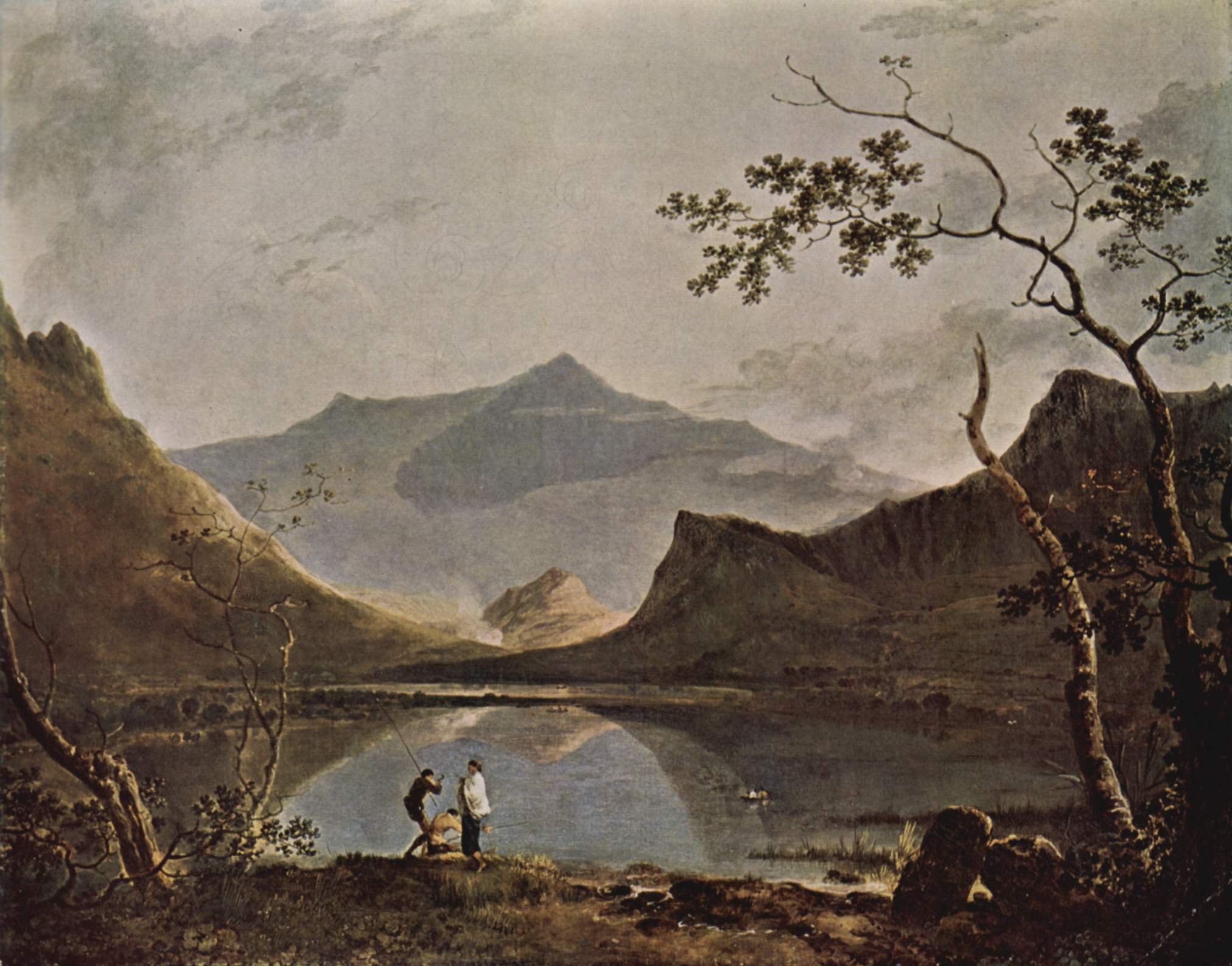
    In addition to the nation's most celebrated gardens, Wedgwood and Bentley used images of famous country houses, although Bentley wrote that 'we have purposely omitted to represent the most modern buildings, considering them unpicturesque'.  Picturesque landscapes accounted for a good number of the designs: ruined abbeys, castles (150 of these) and even some early remains: Stonehenge, Kit's Coty House, a Cornish Dolmen and the Roman ruins of Silchester.  Wedgwood and Bentley were also up-to-date with tastes in the Sublime, including various views of the Lake District, the Peak Cavern, the Giant's Causeway and Fingal's Cave.  There is a letter from Wedgwood to Bentley in 1773 asking about Richard Wilson's landscapes: 'Pray have you Wilson's Views from different places in Wales? If you have not, Mr. Sneyd will lend them us'.  Alison Kelly writes that 'after reading this letter it is pleasant to recognise on a dish the unmistakable outlines of Wilson's Snowdon from Llyn Nantlle.'

    Richard Wilson, Snowdon from Llyn Nantlle, c1766

    Given their role in the Industrial Revolution it is interesting that a few of the pieces feature such scenes as Papermills at Rickmansworth, a Colliery and Pump near Bristol and the Dock at Plymouth.  However, urban views are largely absent, with the notable exception of London.  You can see a plate from the dinner service showing Somerset House on the Hermitage website (there don't seem to be any non-copyright images available to put up here).  Other obvious London highlights included Kensington Palace, the Mall and Horseguards Parade but there were also a few views from the fringes of the city - Erith, Sunbury, Shepperton.  Mention of Shepperton made me wonder what a contemporary 952 piece Ballardian dinner service might look - traffic islands, car parks, terminal beaches, abandoned hotels...

    Eventually Wedgwood and Bentley had got together all 1,244 views and the completed service went on show in London before being sent to Russia.  Apparently this was a great social success, as people were came to see whether one man's country estate featured more prominently than another's.  When it arrived, Catherine the Great was satisfied and used it for state occasions in the Chesmenski Palace. But after her death it was eventually forgotten about and only rediscovered at the beginning of the last century, when nearly 800 pieces were found to have survived.

    Saturday, January 16, 2010

    The Garden Room at Prima Porta


    Detail of the south wall, 'Garden Room', Prima Porta

    In my recent post about Roman landscape painting I mentioned the 'Garden Room' at Prima Porta, near Rome. In their 2001 OUP survey of classical art, Mary Beard and John Henderson describe this space as 'an impossibly utopian mixture of bright flowers beside laden fruit trees, tidy shrubs before a receding woodland vista, planned garden display within a surround of Italian trees, as if in their natural habitat.'  It is 'an exercise in blue and green. And a celebration of naturalistic technique ... But this is not nature reproduced; instead, a world specially made for us - yet made to do without us. Beyond the balustrade, as no wild birds ever could, these pay not the slightest attention to anyone in the room, impossibly ignoring our proximity. Emblematized by the songbird in its golden cage, art here creates nature, beyond anything you could find in the real world.'


    Detail of a pine tree, 'Garden Room', Prima Porta

    An interesting June 1994 Art Bulletin article by Barbara A. Kellum, 'The Construction of Landscape in Ancient Rome: The Garden Room at the Villa ad Gallinus' describes this painting in the wider context of Augustan Rome, where 'the emperor was quick to establish an arboreal mythology' and the city was punctuated with plants and trees that 'were as protean and mulitvalent in their structures and meanings as the contemporary poetry of Virgil, Horace and Ovid.'  The article's title refers to the villa's ancient name, ad Gallinus; the chicken in question was one which an eagle dropped into Livia's lap, holding a laurel branch in its beak.  This was seen as a good omen for Livia and her new husband Augustus, and they planted the branch, which grew into a laurel grove.  According to Pliny the Elder, subsequent emperors continued the tradition of planting trees in the grove and just before the death of each emperor it was observed that the tree they planted had begun to whither.  Laurel features prominently in the Garden Room, both as trees and low shrubs.


    Detail of a spruce tree, 'Garden Room', Prima Porta

    The room is structured around regularly placed oak, pine and spruce trees, but with a profusion of wild plants in between, order and disorder complimenting each other in a way reminiscent of Virgil's Georgics. According to Kellum, this mixture represents on the one hand the fertility and prosperity of the Augustan state, and on the other 'the underlying order that was an essential part of it ... harmonizing the beneficent world of nature and that of the state under a common rule of organic order.'  The individual plants and trees could all of course be associated with symbolic meaning, not to mention the birds.  For example, laurel, pine and cypress trees, nightingales, partridges and magpies all appear in Ovid's Metamorphoses, and the process of metamorphosis itself was, as Ovid knew, central to the mythology of Augustus.  Thus the design of this garden room can be read in terms of the wider symbolic landscape of Augustan Rome.