Saturday, July 19, 2014

New Western Landscapes


Rebecca Solnit published two essays on contemporary American landscape photography in Creative Camera magazine, in 1993 and 1998, and they were reprinted together in her collection As Eve Said to the Serpent.  Both begin with some historical context: 'American landscape photography is grounded in both the scenery and ideology of the immigrant's West.'  The photographers who worked for the U.S. Geological Survey were only the first to concentrate on landforms rather than nature.  Carleton Watkins portrayed Yosemite as a virgin wilderness outside time, but his work was partly financed by photographs of the nearby gold mines.  Ansel Adams is also defined by these images of pure, unpeopled landscapes - an aesthetic that 'has dwindled into calendar pictures and coffee-table books'.  Meanwhile, landscape may have featured sometimes in the work of the great twentieth century documentary photographers like Robert Frank and William Eggleston, but their subject was always essentially social commentary.  It was only in the seventies that landscape once again became an important theme in American photography, following the seminal New Topographics exhibition curated by William Jenkins in 1975.  I have listed below the photographers Solnit discusses from the subsequent twenty years with brief comments pertaining to their work in that period.  Perhaps someone could ask her to write an essay* covering the next two decades... 
  • Robert Adams - the major survivor from the New Topographics group whose 'pessimism about culture's impact on nature has evolved into a broader melancholy.'  
  • Mark Klett - part of the Rephotographic Project that returned to document the sites originally photographed for the U.S. Geological Survey; his images are not 'elegies for a raped landscape', instead they show how the West can be Sublime even with modern additions like a TV antenna.
  • Robert Dawson - a documentary photographer whose work describes 'the ecological and social complexity of the California landscape'.  There is a Design Observer article by Mark Klett on the Water in the West project that Dawson founded with Ellen Manchester.
  • Peter Goin - a Water in the West photographer whose 'Nuclear Landscapes is an anthology of deadpan images of nuclear-war production sites.'  Solnit has some reservations about this - the 'captivity' of such work within the art world may undermine its educational value.
  • Richard Misrach - a photographer greatly admired by Solnit and whose work features in another of her essays, 'Scapeland', his 'lush documents of political catastrophe point out that politics has invaded the landscape.'
  • Linda Connor - focusing on 'manifestations of the spiritual on the land', she is, like Misrach, a photogapher with whom Solnit has collaborated (an encounter with Connor's work in 1986 'opened the door' to a new understanding of landscape and representation).
  • Meridel Rubenstein - her Critical Mass project on Los Alamos, the birthplace of the atom bomb, is deeply Solnitesque (is there such a word yet?) and features in another excellent Solnit essay, 'Lisa Meitner's Walking Shoes.' 
  • Masumi Hayashi - her images of the Japanese internment camps comprising mosaics of narrow-angle snapshots 'seem to address the reconstructedness of memory, the fractures of truth'.
  • Zig Rising Buffalo Jackson - his photographs of signs on the borders of Indian reservations expose the arbitrariness of any boundaries, 'testimony that the story is invisible and the sign has only begun to tell you where you are.'
  • Anthony Hernandez - like Misrach, he produces 'gorgeous images of the bleakest parts of American culture' but the focus for Hernandez is on the poor and disenfranchised, as in his series Landscapes for the Homeless   
  • Cynthia Rettig - her photographs of family vacations at an artificial lake near the Hoover Dam, where shooting and gun play was all part of the fun, recall the original conquest of the West: 'people repeating a history they cannot remember at a vast lake that is itself the result of manipulating the landscape.'

* NB: Rebecca Solnit is so prolific that she may have written a new survey on landscape photography somewhere, but if so I can't see it on the list of essays on her website...  Another place to keep up with her writing is the fuck yeah Rebecca Solnit tumblr. 

Saturday, July 12, 2014

Harvest


I have just finished the Jim Crace novel Harvest: 'Sometime in the pre-industrial period, an isolated and self-sufficient English village finds its common fields stolen for enclosure as collective agriculture yields to remotely-owned pasturage: "the sheaf is giving way to sheep."'  This summary of the story's background is from a review in the Independent, which praises Crace for his descriptive powers: 'No writer can match him for pin-sharp specificity in his rapt close-ups of rural life ... yet the village's unanchored quality matters hugely – even though the visiting map-maker "Mr Quill" seeks to sketch and shape it into a place ripe for reason, and for business.  Where are we, and when? Details of clothes, crops and rituals leave a centuries-wide window. But for all its timeless, folk-tale qualities, this village has a solid location. From Tudors to Victorians, land enclosure in England enacted, county-by-county and field-by-field, the "tragedy of the commons", as private interests claimed control of resources once responsibly shared by all.  In England's case, the sheep ate up the men – Thomas More's words in Utopia (1516). So Harvest takes place nowhere, and everywhere.'


In the clip above you can see Crace read a passage in which the book's narrator, Walter, tries to create a garden and finda that the land needs to be worked: 'it does not wish us to stand back and comment on its comeliness or devise a song for it.  It has no time to listen to our song'.  There are many such moments that would interest readers of this blog. One of my favourite moments in the book is a description of the making of maps.  Walter is helping out by preparing and stretching vellum and is fascinated by the sketches that the man the villagers call Mr Quill has 'ennobled' with colour, 'just shapes and lines and colouring' with no lettering added as yet.  In the absence of language, they remind Walter of the natural patterns in nature.
'I've seen equally compound patterns, no less ineffable than these, when I've peeled back bark on dying trees, or torn away the papering on birches. I've seen them sketched by lichens on a standing stone, or designed by mosses in a quag, or lurking on the under-wing of butterflies.  I've found these ordinary abstracts in the least expected places hereabouts: I have only to lift a stone, or turn some fallen timber in the wood, or reverse a leaf.  The structures and the ornaments revealed are made purposeful simply by being found.'
Harvest had a lot of publicity last year because it was up for the Booker Prize.  In an interview in The Guardian Crace described the day his ideas all came together.  It began with a moment of inspiration at the Watford Gap (recognising the extent to which the English landscape is 'drenched in narrative'), continued with a visit to Tate Britain, where there was an early eighteenth century depiction of enclosure, and ended on the train home with a story in the paper about South American soya barons turning people off the land.  I would love to know what the 'watercolour' was that Crace saw in London - presumably it was the inspiration for Mr Quill's sketches.  The clip below shows an old map at one point but what Crace refers to sounds more impressive - it prompted him to wonder how it was possible to gain such a vantage point 'at a time when no one could get higher than a treetop or a steeple'.  Perhaps it was a painting I am now no longer able to recall that Patrick Keiller included in his Robinson Institute exhibition at Tate Britain (reported on here in March 2012 - Harvest apparently took just six months to write and appeared in February last year).  You can let me know in the comments if you know - as it is, I'm torn between thinking it is probably something obvious and the feeling that, like the village in Harvest, it may not be real at all.

Monday, July 07, 2014

Chinese Landscape - Tattoo

Looking at players in the World Cup this month I have wondered whether those reports last year that we have reached 'peak beard' can be right, and, if they are, whether we nonetheless still have some way to go before reaching 'peak tattoo'.  Sadly I have not spotted any landscape tattoo designs so far on the footballers' arms and torsos (although a quick Google tells me that a couple of years ago VfB Stuttgart's Julian Schieber got inked with a view of his home village of Weissach).  In contemporary art, Huang Yan has specialised in this kind of thing, although his work, beginning with Chinese Landscape - Tattoo (1999) is actually a form of body painting.  Here's how the Met describes that series: 'Huang covers his torso and arms with traditional landscape scenes, presenting his “reincarnation” of literati-style painting. The composition, modelled in ink and colors on a white ground by Huang’s wife, the artist Zhang Tiemei, follows the natural form of Huang’s body. In the photos, the artist’s face is cropped away and Huang’s anonymous torso becomes an emblem of the Chinese everyman who cannot be separated from his cultural heritage, which, like his racial identity, is as indelible as a tattoo.'


Over the last fifteen years Huang has produced numerous variations on this theme.  What happens when a landscape is painted onto a face?  In Four Seasons (2005) the model is expressionless under each seasonal view, although in two of them his eyes are open, making it much harder to regard his face as merely a blank canvass.  In Pine Landscape Dyptich (2007), a nude woman takes the leaves and branches painted on her body into the boughs of a real pine tree.  Dismantle Landscape (2005) begins with a photograph of another tree-covered model, posed against a landscape backdrop painted in more of a 'Western style'; as the camera zooms out we see her standing on what looks like the floor of a building site and in the last image she is surrounded by construction workers.  You can see others in the YouTube clip I have embedded above.  Huang has also made sculptural work in this vein: a ceramic landscape skull, busts of Mao decorated with traditional motifs (including a Landscape with Figures and a Boat, 2004), and Pork Landscape 1 (2001), which is, as the title indicates, a piece of pork - the fat redolent of swirling mist and the meat a backdrop for blue hills and a tree covered in pink blossom.

Wednesday, July 02, 2014

A Prospect of Wales


Last year I asked here 'why isn't the art of Recording Britain better known?'  Well Sheffield's Millenium Gallery is currently hosting a touring exhibition devoted to Recording Britain, with some of the original paintings from the 1940s set alongside earlier topographical watercolours and recent landscape art by people like Richard Long, Keith Arnatt and Ingrid Pollard.  A display case has books from the period, including A Prospect of Wales (1948), one of the old King Penguins (like John Piper's book on Romney Marsh which I described in  another post last summer). This book has illustrations by Kenneth Rowntree, whose contributions to the Prospect of Britain project were often quite unusual, e.g. The Smoke Room, Ashopton Inn, Derbyshire (1940) - a rather unprepossessing interior with dartboard, wall calendar and a fish mounted in a case. The accompanying essay is by Gwyn Jones, who founded The Welsh Review, wrote novels and translated Icelandic sagas.  Seeing this in the exhibition, and having just booked a week's holiday in Wales this summer, I thought I would get hold of a copy.

The title, A Prospect of Wales, sounds paradoxical - how is it possible to see the whole country?  To some extent Gwyn Jones' essay represents a kind of landscape writing I've mentioned here previously, the imaginary prospect which begins with the local and then spreads out far beyond the limits of sight.  Jacquetta Hawkes does this in A Land, which was published three years later than a A Prospect of Wales; as I wrote in an earlier post here, 'the book ends with 'A Prospect of Britain', from the city streets round her home in Primrose Hill to the different landscapes of Britain described in the order they were created: the chalk Downs, the Cotswold's, the West Riding, the Lake District.'  Another example: Virginia Woolf's Orlando (1928), whose hero/ine is able to climb a hill so high 'that nineteen English counties could be seen beneath; and on clear days thirty or perhaps forty, if the weather was very fine.'  And another, which I have not mentioned here before because it takes the reader completely beyond 'some landscapes': Olaf Stapledon's vision of the cosmos in Starmaker (1937), a book that begins with a view of suburbs and the sea's level darkness, and the opening sentence: 'One night when I had tasted bitterness I went out on to the hill.'  A Prospect of Wales begins, by contrast, 'I have just come down from the hill fronting my house in mid-Cardiganshire', but a few pages later he is asking us to ascend again to a point where 'we may survey with swinging glance the western counties of Wales.'


In my photograph above, the book is open at two of Kenneth Rowntree's illustrations of Pembrokeshire, which is where we will be heading next month.  'This is a coast,' Jones writes, 'soaked in colour and radiant with light.'  He quotes Graham Sutherland's essay 'A Welsh Sketchbook', which had appeared in Horizon in 1942: 'The quality of light here is magical and transforming - as indeed it is in all this country.  Watching from the gloom as the sun's rays strike the further bank, one has the sensation of the after tranquillity of an explosion of light; or as if one had looked into the sun and had suddenly turned away.'  I will no doubt have more to say about Sutherland and his Pembrokeshire paintings after we've explored this landscape. I'll conclude here with four lines of Welsh poetry quoted at the end of A Prospect of Wales which encapsulate what Jones sees as the real essence of the country, to be found 'not in the famed vistas ... but in some corner of a field, a pool under a rock, in a bare sheep-walk or a cottage folded in a gulley.'  The poem is by Hedd Wyn and Jones translates these lines as follows: 'Only the purple moon at the edge of the bare mountain, and the sound of the old river Prysor singing in the valley.'
Dim ond lleuad borffor
Ar fin y mynydd llwm,
A sŵn hen afon Prysor
Yn canu yn y cwm 

Thursday, June 26, 2014

The River Duddon

The valley of the River Duddon

In 1820 William Wordsworth published The River Duddon, A Series of SonnetsAs Stephen Gill points out in his essay, 'Wordsworth and the River Duddon', reviewers were bemused that a famous poet should choose to write about this ‘insignificant river’ with a ‘barbarous name’:
‘What would he not have written had the majestic Thames employed his muse’, exclaimed the Literary Chronicle and Weekly Review, getting the matter exactly wrong. The lines from Burns quoted at the close of the ‘Postscript’ to the River Duddon sonnet sequence ought to have alerted the reviewer to Wordsworth’s poetic intent. In the verse letter ‘To William Simson, Ochiltree’, Burns declares that, ‘Illisus, Tiber, Thames, an’ Seine’ having all been celebrated in ‘monie a tunefu’ line’, he and his fellow poet should now rather seek the Muse ‘Adown some trottin burn’s meander’ in their own locality, to ‘gar our streams and burnies shine / Up wi’ the best’.  Wordsworth read this poem almost as soon as it was published in 1786, quoted from it throughout his life, and adopted its forthrightness as he began his celebration of the river with the barbarous name.'
In The Song of the Earth, Jonathan Bate suggests that the choice of the Duddon for a sonnet sequence over, for example, those other Wordsworthian rivers, the Wye and the Derwent, may have had something to do with its location, rising near the confluence of Westmoreland, Cumberland and Lancashire.  Standing in three counties at once is to feel both connected to the local and in touch with a much wider geography.  Wordsworth believed in a nationalism rooted in the regions, a country of small Anglican parishes where the periphery was as important as the centre, the Duddon as worthy of literature as the Thames.  A couple of years ago I wrote here about Wordsworth's sonnet Composed Upon Westminster Bridge, Sept. 3, 1802, in which the poet stood looking out over the Thames.  Here I will give a brief summary of the River Duddon sequence, from source to sea.
  1. Wordsworth's first sonnet announces his theme - not the spring of Bandusia, not some Persian fountain, not an Alpine torrent, but 'long-loved Duddon'.
  2. This river is 'remote from every taint / of sordid industry' and has remained unchanged, long after the surrounding forests have vanished 'where stalked the huge deer to his shaggy lair / through paths and alleys roofed with darkest green.'
  3. Wordsworth sits and prepares to 'paint' the river in words.  No monument marks its birthplace but instead the river itself has 'shed a gleam / of brilliant moss, instinct with freshness rare.'  
  4. The Duddon is like a snake, threading 'with sinuous lapse the rushes, through / dwarf willows gliding, and by ferny brake.'  
  5. After the solitude of 'sullen moss and craggy mound' the river becomes shaded by green alders, ashes and 'birch-trees risen in silver colonnade'.
  6. He describes the flowers that grow by the side of the river: wild strawberries, thyme and 'trembling eyebright ... sapphire blue'.
  7. A 'love-sick Stripling' might envy the plucked rose lying on his lover's breast, or imagine himself her caged bird singing, but those with 'calmer mind' would rather be an 'unculled floweret or darkling wren / that tunes on Duddon's banks her slender voice.'
  8. The poet wonders what kind of man first came upon this stream.  Whatever his ancient beliefs, the river's role was then as it is now, to heal, restore, soothe and cleanse.
  9. There are some stepping stones in the river.  Crossing here, when a flood runs 'fierce and wild', the Child puts 'his budding courage to the proof', whilst 'Declining Manhood learns to note the sly / and sure encroachments of infirmity.'
  10. The stepping stones again, and this time two young lovers cross, she blushing and holding out her hand, he teasingly withdrawing it, and then both of them feeling the thrill when their hands touch.  
  11. A flight of fancy in which tiny dancing elves are imagined dancing by their 'sunless cleft' and stealing a baby.
  12. As if realising that this sort of thing will try our patience, he exclaims: 'On, loitering Muse--the swift Stream chides us--on!'  It is all too easy for the river's features to become the 'toys of Fancy.'
  13. We zoom out to an open prospect of fields and a hamlet under a green hill.  Wordsworth imagines the pleasures of a warm hearth here in cold weather, 'when bleak winds roar / through the stiff lance-like shoots of pollard ash'.
  14. The river seems to seek its own solitude, attended only by its own voice, leaving behind the solitary shepherd and his cottage.
  15. From a 'deep chasm, where quivering sunbeams play', he sees a kind of 'gloomy niche' in the rock where some ancient statue might have been placed, sculpted by men perhaps, or fire, or the waters of the Deluge.
  16. A continuation of the theme, in which Wordsworth describes the caves and rock drawings of Native Americans.
  17. He hears the croak of a raven on a blasted yew and an eagle 'shedding where he flew / loose fragments of wild wailing.'  Sheep sleep by the remains of the old Roman fort and the ancient stone circle of the Druids.
  18. The sonnet is entitled 'Seathwaite Chapel' and suggests that the vale of the River Duddon protects 'Truth's holy lamp', alluding to the ministry of the Reverend Thomas Walker of whom Wordsworth wrote a short memoir, appended to the poem sequence.
  19. A tributary: 'waters, from their aery height / hurrying, with lordly Duddon to unite.'  Its musical murmur announces a source of refreshment to the thirsty fields.
  20. On the flowery plain of Donnerdale, the waters are slow and serene, but further on the course is rougher and the river dances from rock to rock.  
  21. 'The cloudy stall / of Time, breaks forth triumphant Memory' and Wordsworth recalls those he once roved with on the banks of the River Duddon.
  22. In a sonnet called 'Tradition' the story is told of a love-lorn Maid who yearns for a primrose reflected in a clear, blue pool and, it is implied, drowns there.
  23. Banishing such sad thoughts, he recalls the 'blithe cheer' of boys shouting and dogs barking whilst sheep are washed in a pool formed where bands of rock check the stream.
  24. Now he finds a good place to rest, 'with woodbine hung and straggling weed ... half grot, half arbour', enclosing both the body and the mind.
  25. Here he can imagine 'the One for whom my heart shall ever beat / with tenderest love' being brought.  But without her, 'the waters seem to waste / their vocal charm.'
  26. Memories of childhood: 'fondly I pursued, / even when a child, the Streams--unheard, unseen; / through tangled woods, impending rocks between.'  He has learnt much from the river.   
  27. He describes a ruined castle, 'quietly self-buried in earth's mould'. 
  28. He rises to continue his onward journey, while cattle avoid the heat of the day by crowding together 'under rustling trees / brushed by the current of the water-breeze.'  
  29. There are no stories of battles fought over this landscape, but to those who lie buried and unremembered,'the passing Winds memorial tribute pay'.
  30. In life, Wordsworth suggests, it is best not to yield to sudden temptations or swerve away too far from innocence.  He is content to 'saunter o'er the grassy plain' here, chained loosely to the river, knowing when he leaves that he will always return to it.
  31. The 'Kirk of Ulpha' is a welcome sight and he imagines reclining among its graves or marking the distant moonlit mountain summits, faintly shining, 'soothed by the unseen River's gentle roar.'  
  32. This penultimate sonnet is pure landscape: a description of the lower reaches of the river, 'gliding in silence with unfettered sweep'.
  33. The original sequence ends with the sea that the Duddon flows into - here there are no warships, just humble sailing boats.  Wordsworth would like to end his days like the river, 'prepared, in peace of heart, in calm of mind / and soul, to mingle with Eternity!'
Postscript: Wordsworth later added a thirty-fourth sonnet in which, as Jonathan Bate says, 'the poet deconstructs, then reconstructs, the analogy between human life and the life of the river.'  It can be read at The Poetry Foundation.

The stone circle referred to in Sonnet 17

[In one of his endnotes Wordsworth says that 'the country people call this circle Sunken Church'.  We visited Sunkenkirk, as it is now known, on our recent trip to the Lakes.  In The Modern Antiquarian, Julian Cope calls it 'perfect from all angles ... this Sunkenkirk is a place for the most righteous devotion.']

Tuesday, June 17, 2014

The Enclave

We looked in on the Photographers Gallery yesterday to see the Deutsche Börse Photography Prize contenders.  I was particularly interested in The Enclave series by Richard Mosse (which has won him the prize), documenting the conflict in the Democratic Republic of Congo.  He hit upon the inspired idea of using discontinued infrared colour film, which was formerly used by the military to identify camouflaged targets.  The infrared light reflected by grass and trees appears in lurid but strangely beautiful shades of pink. Mosse hopes his work will help to bring exposure to a conflict that goes largely unreported in the media, just as the infrared film was designed to make the invisible visible.  In the video below, he talks about the film he made as part of this project - more visceral, proximate and scary than the "beautiful" landscape photographs you can see behind him as he talks.


The photograph I was initially drawn to in the exhibition, Men of Good Fortune (2011), is a picturesque composition of gentle grassy slopes, pastoral figures and trees that might have been artfully placed by a Capability Brown.  These hills were originally inhabited by Congolese tribes who grew crops and hunted for bush meat, until they were driven out by pastoralists who cut down the forest for grazing.  Richard Mosse's camera renders this landscape's history of intimidation and human rights abuses in shocking pink, like superficially healthy teeth subjected to a plaque disclosing tablet.  Nowhere to Run (2010) shows another vista of unearthly pink hills, which seem to have undergone the kind of transformation J. G. Ballard described in The Crystal World. This rose quartz-coloured terrain is, according to the caption, 'rich in rare earth minerals like gold, cassiterite and coltan, which are extracted by artisanal miners who must pay taxes to the rebels.'

Of course one question these photographs raise is whether the aesthetic pleasure they provide is a distraction from what is really happening in The Enclave.  Would direct documentary images be more shocking or informative?  In the interview below, Mosse says that one of the difficulties he encountered was that the the deep wounds inflicted by rape 'lack a visible trace' (last week's End Sexual Violence in Conflict conference here in London, which my wife took part in, was designed to raise the profile of this issue).  His images may be beautiful on the surface, but, he suggests, beauty is effective - 'the sharpest tool in the box.  If you can seduce the viewer and you can make them feel aesthetic pleasure regarding a landscape in which human rights violations happen all the time, then you can put them into a very problematic place for themselves - they feel ethically compromised and they feel angry with themselves and the photographer for making them feel that.  That moment of self awareness is a very powerful thing.'

Wednesday, June 11, 2014

The Broken Road


The latest New York Review of Books carries a piece by Daniel Mendelsohn on Patrick Leigh Fermor and the posthumous publication of The Broken Road: From the Iron Gates to Mount Athos.  Apparently Lawrence Durrell once referred to the 'truffled style and dense plumage' of Leigh Fermor’s prose and Mendelsohn suggests that 'what you think of his writing, and indeed what you make of the final instalment of his most beloved work, depends on your taste for truffles and feathers.'  Well I'm certainly not averse to them now and again, and I found myself as entranced by this volume as I had been by the earlier two (which have been mentioned here before).  Some feathers feature in this landscape description, which comes towards the end of the book, in December 1934, when PLF is just days away from his final destination and has reached the wooded slopes on the edge of the Black Sea.
'Downhill at the end of plunging tunnels of trunks and branches and over the foliage of the ledges, the lowest stems of which seemed almost rooted in the sea, the European continent fell to fragments in spikes and small tufted islets far below, standing in translucent, pale green water, which darkened as it receded from the rocks to bottle green and the blue of peacock's neck feathers and fled away to the skyline.  The almost still water was stirred by incoming creases as slight as a breath on silk, just enough to hem the join of rock and water with a thin bracelet of white, but too little to interfere with the symmetry of the semi- and three-quarter circles that the rocks sent spinning slowly out to sea again.  Only the ghost of their sigh floated up through the mews and the wheeling sunlit wings of the seagulls.'
As he continues through these woods, the late afternoon sun strikes them at an angle parallel to their slope, 'filling the clearings and striking the tree-boles and the foliage with layers of wintry gold, hanging rafts of light in the leaves, falling through the wood in long spokes and breaking up the loops of shadow over the surface of the water with horizontal windows of radiance.'  This perfect moment of solitude and peace in the 'celestial light' is full of the promise of what he imagines he will soon experience in the islands of the Aegean.  Later that day however, after the sun has set, he becomes lost among the rocky headlands, slips into a freezing pool, drops his torch and almost gives up hope before stumbling upon a cave where a group of shepherds and seamen revive him with fish, lentils and raki.  As Neil Ascherson points out in his LRB review, the description of what follows - a 'night of mighty bardic song, feasting and ancient dances' - may not be literally true to what happened on the journey, but it constitutes one of the book's most memorable set pieces. The evening finally ends with firelight ebbing on the walls and the stalactites while this extraordinary young traveller, unable to sleep, lies looking up at a high gap in the cave's wall where the stars of Orion are visible, blazing 'like a slanting lozenge of ice-crystals.'

Friday, June 06, 2014

Ea


We were at St Luke's on Sunday, the converted church near the Barbican which we last visited to hear Terje Isungset play his ice instruments.  This time we had come to see Richard Skelton and the Elysian Quartet perform music they devised together at Aldeburgh earlier this year.  I have described Richard's landscape-inspired music here several times before; live performance with a classical string quartet is a new departure for him.  The Elysian Quartet have a pretty cool CV, having performed Stockhausen's Helicopter Quartet and worked with people like Meredith Monk, Simon Fisher Turner and Damo Suzuki.  What I have included below are the programme notes describing the three sections of the St Luke's concert, along with a few brief reflections on what we heard.
EA performed by Richard Skelton and the Elysian Quartet: Rivers have occupied much of Richard’s recorded work, including the fledgeling moorland streams of ‘Landings’, the narrow, quick Cumbrian rills and becks of ‘Limnology’, and the tidal-bore of ‘From Which the River Rises’. ‘EA’ continues this fascination with a study of Suffolk’s river Alde as it slows and widens past Snape on the final, estuarine portion of its journey to the sea. It is perhaps his most delicate and lyrical invocation of a waterway. The word ‘ea’ itself is Anglo-Saxon for ‘river’.
Everyone I talked to afterwards found this slow, meditative piece particularly moving.  The string quartet, with Richard sitting beside them bowing an adapted bouzouki, gradually brought the music to an emotional pitch and gently let it fall again, before taking its themes up once more and finally bringing everything quietly to a close.  The riverine wash of the strings was punctuated by some insistent sounds like the cries of birds that at first I assumed were on a loop, until I realised everything was being produced by the five acoustic instruments.  As the references to his earlier work above suggest, Ea felt close in sound and feel to the music in Landings and other more recent releases.  The next piece was very different.
Above / Below performed by the Elysian Quartet: During his residency at Snape last December, Richard spent much of his time wandering along the Alde and through the nearby marshland towards Iken. Over the ensuing winter he began writing a textual score based on the names of birds and plants he observed in-situ, found referenced in public information signage, or discovered during later research by consulting books such as W.M. Hind’s The Flora of Suffolk . The Elysian Quartet selected eight species from the score and began working with Richard to develop a musical vocabulary that engages with them, hinting at the diversity of plant and avian life in Snape and its surroundings. The result is a series of miniatures, shifting focus from one species to another, from the earth-bound and air-borne – a sensitively observed journey through a specific environment. The species they chose were: common sorrel, curlew, heron, nettle, oystercatcher, redshank, yarrow and yellow flag. 

For Above / Below Richard left the stage and looked on as the quartet interpreted his score, beginning with an irregular patter of notes from one of the violins that sounded like rain but was, I think, an interpretation of the motion of an oystercatcher.  As the music progressed it was clear they were avoiding anything too obvious like the simple imitation of bird calls or other natural sounds.  Instead the four instruments, plucked and bowed, sometimes alone and sometimes in concert, were channelling elements of the Suffolk landscape in more subtle ways.  There is no recording available to listen again and try to identify any species, so the music will become a memory, like the recollections of impressions of a walk by the reed beds of the Alde.
Mimesis performed by Richard Skelton and the Elysian Quartet: ‘Mimesis’ is informed by Richard’s experience of the intense tidal surges of early December 2013, during which Snape Maltings itself was nearly inundated. Intimations of this flood-violence are found in the following public information sign along the marshland boardwalk: ‘The River Fights Back: In places along the banks of the river Alde, land was once claimed from the river to create farmland. Defences were built to protect this claimed land. Over the centuries the river has broken through again. The remnants of the defences are still visible, stretching out into the estuary.’ During his stay in December, Richard produced a collection of charcoal drawings, the majority of which seemed to describe the same river-like form undergoing a series of contortions. The ensemble have used these images as a kind of graphic score, producing a new work which evokes a river undergoing violent transformation.
Richard returned to the stage for this final piece.  By now the light outside was fading but still strong enough to illuminate the natural backdrop of leaves, visible through the large church windows behind the musicians and stirring softly in the wind.  Mimesis started softly too, but grew louder and more turbulent, becoming a roiling torrent that had the kind of surging force that reminded me of seeing Godspeed back in the day.  Richard's bow took some punishment and towards the end there were fine broken hairs curling from it, illuminated in the stage lights like electrical filaments or the spiralling seed heads of rose bay willow herb.  It was over all too soon: the music drained away, the musicians left the stage and we all remained in silence for a minute, until the lights came on and it was time to make our way out through the darkening churchyard.


Postscript: After the concert it was good to meet Hannah Devereux, whose ink drawings feature in the second edition of Lintel, an art journal published by the Corbel Stone Press which Richard runs with his partner Autumn. They are purely abstract but suggestive of fine rock strata or expanses of calm water stretching away to the horizon.

Wednesday, May 28, 2014

Landscape with a Man Killed by a Snake

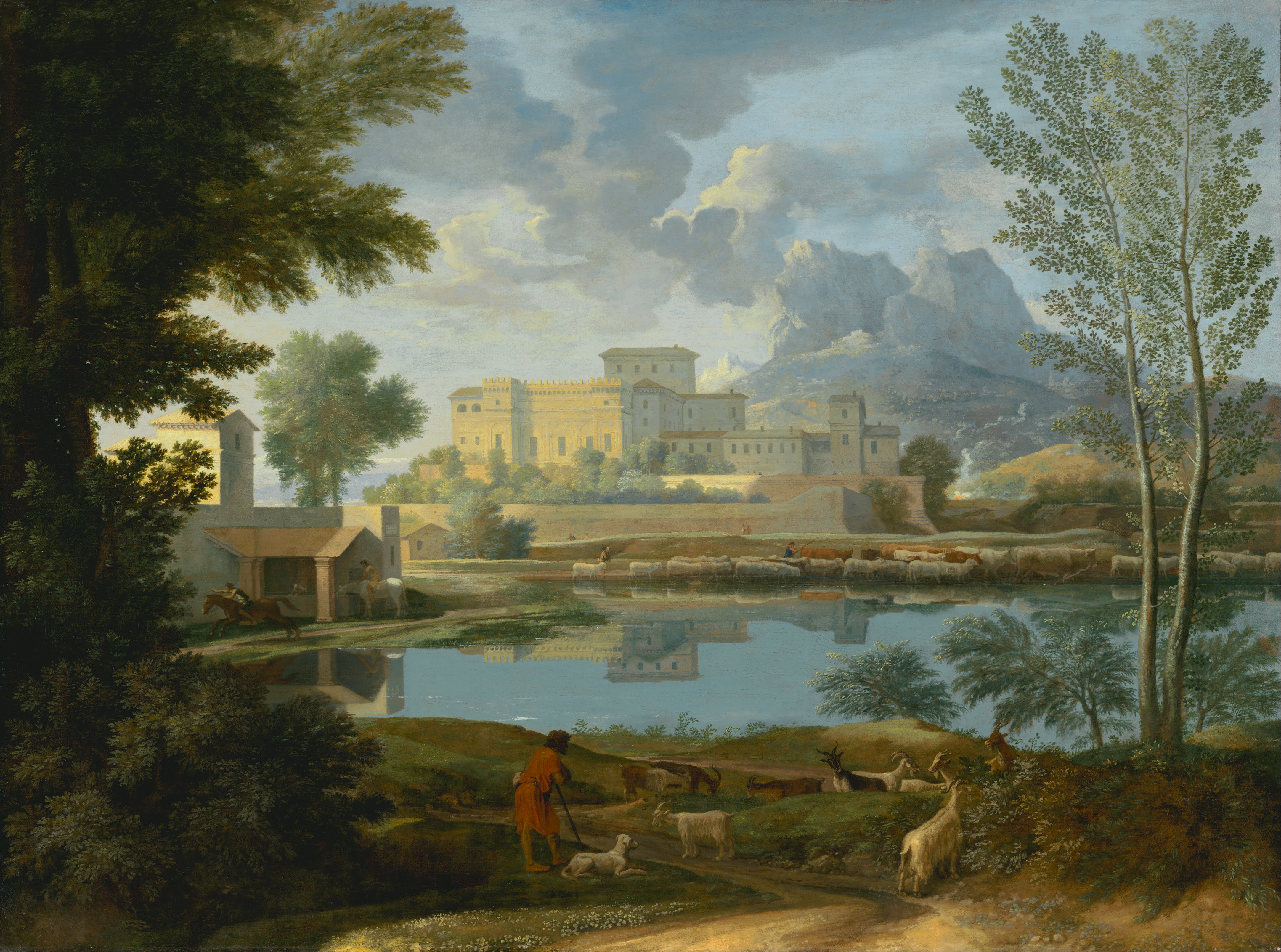
Nicolas Poussin, Landscape with a Calm, 1650-1
Source: Wikimedia Commons

Alain de Botton's recent ideas for making art more popular have not gone down well with the critics: 'pointless''smarmy and banal', 'merely stupid or simply patronising'.  Perhaps an alternative to trying to engage with 'Art as Therapy', would be for more people to take a lead from T. J. Clark's unpromisingly-titled but highly rewarding book The Sight of Death.  The idea behind it was a simple one: to return repeatedly to an art museum (the Getty) and look at the two Poussin paintings I've reproduced here, engaging with them as paintings and writing down each day's discoveries.  Clark deliberately did not research them in advance, he just looked at them closely, in a way that any of us could.  The result, as writer/psychotherapist Adam Philips wrote in his 2006 review, is more than just a detailed account of these landscapes, it is a book 'about what having a good look might mean at a time when most contemporary imagery, by showing us everything, doesn't want us to see too much'. 

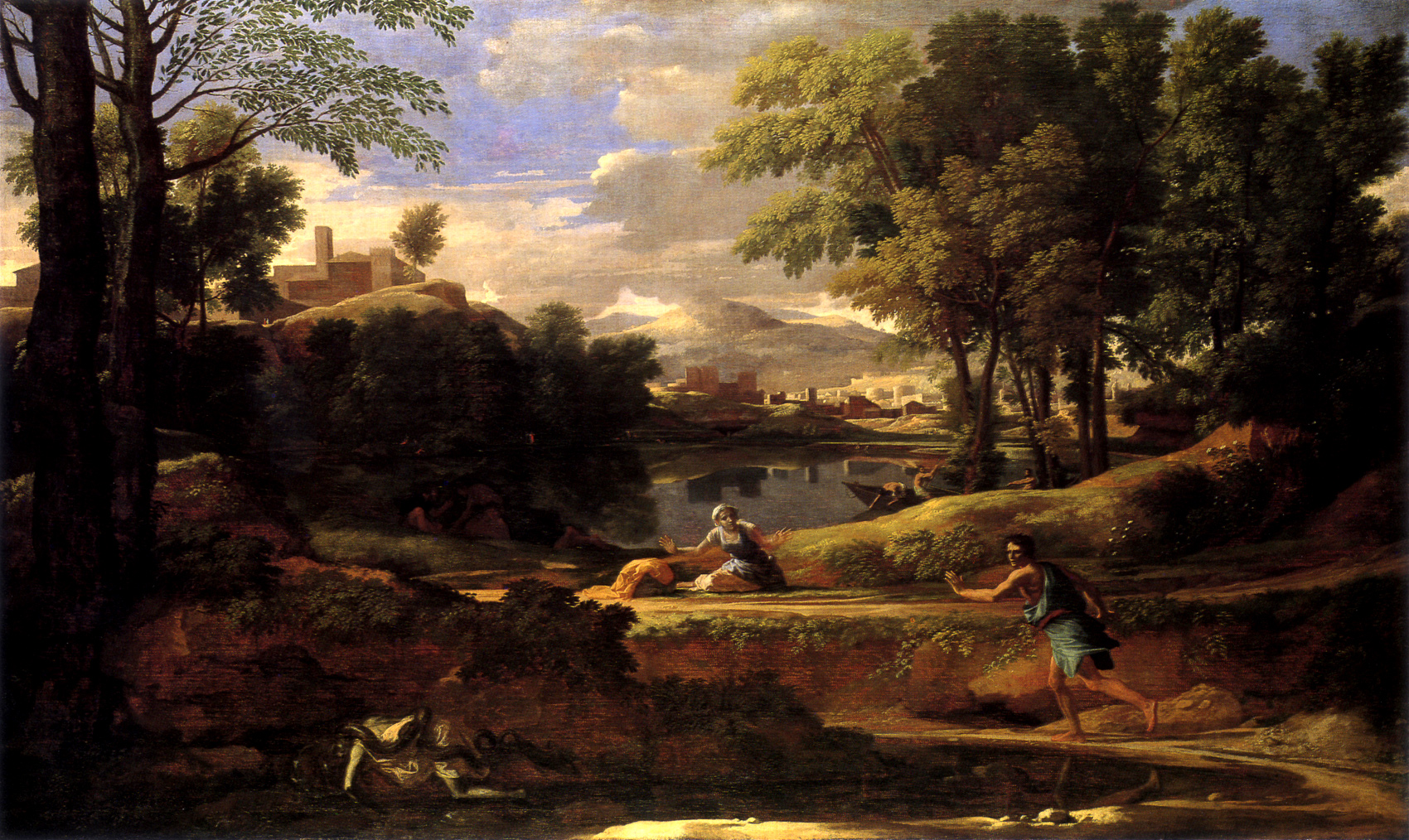
Nicolas Poussin, Landscape with a Man Killed by a Snake, 1648
Source: Wikimedia Commons

When you attend closely to a painting you start to appreciate all the choices the artist made - in Poussin, for example, there are his tiny details, like the two figures talking on the brow of the hill in Landscape with a Man Killed by a Snake.  This part of the painting is discussed in The Sight of Death (in the entry for 13 April 2000) and I will quote a few sentences to exemplify the way Clark writes about it.  Here he is thinking about the extent to which Poussin's details relate to the painting's overall structure:
'Right in the middle of the crisscross of greenery here Poussin suddenly interjects a partial opening into the sky, and not content with the offer of a roofline and white light that this enables, he puts a marvelous tiny square of white into the architecture, as if finally we are looking at the sky through an empty (ruined?) window.  Or maybe somehow a pane of glass is glinting in the sun.  The blip of white connects with one or two others close by, picking out the sky higher up in the foliage.  But the window is essentially gratuitious - profoundly unnecessary, un-structural.  It is pure delight.'

Clark's final entry in November 2003 is rather dispiriting.  Snake had been returned from the Getty, where it was on loan, to the National Gallery.  There he encountered it hung right near the exit, in the Yves Saint Laurent Room, under 'lighting apparently borrowed from an indoor swimming pool in Tooting Bec'.  He describes sitting, 'miserable and stupefied for an hour or so, listening to the songs played by the cell phones', along with the 'mild hysteria of twelve-year-olds' and their shushing teachers in the assembly area for school visits next door.  He estimates that thirty-plus people a minute stream past Poussin's painting, 'one or two of whom give it a passing glance.'  But, then, he reflects, this painting has suffered many indignities over the centuries, from the darkening effect of smoke to the pressure of a restorer's iron.  He ends on note of optimism: 'one of these days Snake will go on its travels again - back to Room 20 would be a start - daylight will catch it, and new viewers stop at the sight of death.'

Although not a new viewer, I did go and have a long look at Snake on a rainy Bank Holiday afternoon this week, to see what new things I could see in it.  I am happy to report that it is no longer in the Yves Saint Laurent room -  that unfortunate spot now seems to be taken by Claude's Landscape with Cephalus and Procris reunited by Diana.  Instead it can be found in Room 19, surrounded by other Poussins and directly opposite the extremely sexy Nymph with Satyrs.  Of course I was not able to sit contemplating it undisturbed, but it was possible to ignore the groups of teenagers wondering through the room chatting.  At one point an insistent ring tone was finally answered by a woman standing right in front of Snake, but she was ushered away fairly quickly by an attendant.  The National Gallery may not be as tranquil as the Getty, but I still spent a satisfying half hour in the company of Snake.

The longer I looked the more I found to think about, and despite having read T. J. Clark's 260 pages I came away convinced I had seen one or two things he doesn't mention (for instance, that the postures of the three fishermen seem to rhyme with the running man, the washerwoman and her bag).  Perhaps those visitors walking past me and ignoring all this would have been detained by a philosophical or therapeutic post-it note, like those Alain De Botton has had placed around the Rijksmuseum, although I like to think they really just needed persuading to stop for a while and look.  As Anita Brookner points out in her review of The Sight of Death, Poussin himself is usually seen as a ‘peintre-philosophe’, but Clark shows us how he was also a pure maker.  What the book demonstrates 'is that the best antidote to reading is looking.' This, she concludes, 'is the way to see pictures.'

Monday, May 26, 2014

Coniston Water


During our trip to the Lake District last week we stayed in Coniston and went to visit Ruskin's old home at Brantwood (above).  There was much of interest there, although Mrs Plinius expressed some disappointment that the decor, objects and furniture were not more beautiful.  Ruskin, it seems, cared little for interior decoration.  In the 1883 Preface to Modern Painters he wrote that he had often been asked 'by the æsthetic cliques of London' (maybe that's people like us) why
'in the pictures they have seen of my home, there is no attempt whatever to secure harmonies of colour, or form, in furniture. My answer is, that I am entirely independent for daily happiness upon the sensual qualities of form or colour; that, when I want them, I take them either from the sky or the fields, not from my walls, which might be either whitewashed, or painted like a harlequin’s jacket, for aught I care; but that the slightest incident which interrupts the harmony of feeling and association in a landscape, destroys it all to me, poisoning the entire faculty of contemplation. From my dining-room, I am happy in the view of the lower reach of Coniston Water, not because it is particularly beautiful, but because it is entirely pastoral and pure. Were a single point of chimney of the Barrow iron-works to show itself over the green ridge of the hill, I should never care to look at it more.'
Happily, as you can see in the photograph I took below from The Coniston Steam Yacht Gondola, the view from Brantwood is still 'pastoral and pure'.  There was even a cow posing obligingly for me at the edge of the lake.

Friday, May 23, 2014

Yellow & Blue

A poetry reading by Thomas A. Clark is a rare and special occasion, so we took leave this week and headed up to Grasmere to hear him.  Earlier this year Carcanet published a new collection, Yellow & Blue - 'a series of small acts of attention, repeated attempts to step outside the circle of human concern and into a wider responsibility to the natural world.'  It begins in an empty landscape, as a scree slope tumbles unregarded into a green lochan, but signs of human activity soon become apparent - in a dripping rope, plastic piled up by a storm, the remnant of a net clinging to a teasel head. And whilst this book, like his earlier collections, suggests ways of being in the world and attending to rocks and water, trees and flowers, light and shadow, it does not neglect the history of the Highlands and Islands, imagining moments in the lives of those whose abandoned homes are only occupied now by the sheep.  'Bending down / by the burn / to pick fresh / water mint / did they pause / for a moment / out of the wind.'  As we listened to these poems in the comfortable book-lined reading room of the Jerwood Centre, thunder could be heard gathering outside over the darkening fells.  The storm died away, the reading came to an end and we headed off into the night.  Yellow & Blue ends in two forms of illumination... 'a lamp of fish oil / with a wick of rushes / gathered by the light / of the full moon.'

Postscript: Before the reading began we saw staff at the Jerwood setting up a new exhibition, 'Wordsworth and Basho: Walking Poets', which will feature new work by contemporary artists.  It was a pity to miss this - it starts this weekend and runs until November - but we managed one or two other things in the Lake District that I might mention here.  The photograph above is from a walk we did near Coniston Water on the morning of the reading.

Friday, May 09, 2014

Atmosphere


We were in Margate recently and saw the new installation by Edmund de Waal, atmosphere.  As usual in his recent work, the vitrines and their arrangement in space are as important as the small porcelain vessels they contain.  The title comes from Turner's remark to Ruskin, "atmosphere is my style" and the vitrines floating in the gallery correspond to Thomas Forster's poetic cloud classifications (the lists above are part of an accompanying text piece).  One of these vitrines is fully transparent but the pots in the others are only partially visible as shadowy forms behind clouded glass.  "When thinking about the changing landscape of clouds," De Waal writes, "I remember Constable's beautiful letter about lying on his back and doing 'a great deal of skying.'" The gallery provides cushions to encourage you to look up at the vitrines from below and do some indoor skying, although for me this emphasised how unavoidably static these sculptures are compared to the real cloudscape outside. 


Monday, May 05, 2014

Blood Meridian

'Blood Meridian is also a novel about place, about the landscape of Texas and Chihuahua and Sonora; a kind of anti-pastoral novel in which the landscape looms in its leading role, imposingly—truly the new world, silent and paradigmatic and hideous, with room for everything except human beings. It could be said that the landscape of Blood Meridian is a landscape out of de Sade, a thirsty and indifferent landscape ruled by strange laws involving pain and anesthesia, laws by which time often manifests itself.' 
- Roberto Bolaño, Between Parentheses, quoted in The Paris Review.
There is extraordinary landscape writing in every chapter of Blood Meridian, although given the accumulation of bloody events described in Cormac McCarthy's novel it is perhaps not too surprising to see this went unremarked in the original New York Times review.  Nevertheless, in a recent Guardian article the Alaskan writer David Vann concludes that because 'we have no access to the thoughts or feelings of any of the characters ... the landscape and human violence in the landscape come to the fore.  Blood Meridian is the Inferno of our time, though the architecture has changed. Hell here is an open desert landscape, an endless journey past demonic shapes and beings living and dead.'  In fact this desert does come to an end eventually, but when the novel's protagonist finally reaches the ocean at San Diego there is no real respite.  He stands by the tideline, contemplating a single horse, dark against the darkening sky, 'watching, out there past men's knowing, where the stars are drowning and whales ferry their vast souls through the black and seamless sea.'

It is hard to convey the quality of McCarthy's metaphorical landscapes without quoting directly from the text.  Here then are a few sentences from the beginning of Chapter XIV, descriptions of the journey taken by the scalphunters after leaving Chihuahua, from where they turned west and headed, 'infatuate and half fond toward the red demise of that day, toward the evening lands and the distant pandemonium of the sun.' 
They ascended through a rocky pass and lightning shaped out the distant shivering mountains and lightning rang the stones about and tufts of blue fire clung to the horses like incandescent elementals that would not be driven off.

They crossed a flooded plain with the footed shapes of the horses reflected in the water among clouds and mountains and the riders slumped forward and rightly skeptic of the shimmering cities on the distant shore of that sea whereon they trod miraculous.
They climbed up through rolling grasslands where small birds shied away chittering down the wind and a buzzard labored up from among bones with wings that went whoop whoop whoop like a child's toy swung on a string and in the long red sunset the sheets of water on the plain below them lay like tidepools of primal blood.

They passed through a highland meadow carpeted with wild-flowers, acres of golden groundsel and zinnia and deep purple gentian and wild vines of blue morninglory and a vast plain of varied small blooms reaching onward like a gingham print to the farthest
serried rimlands blue with haze and the adamantine ranges rising out of nothing like
the backs of seabeasts in a devonian dawn.

They rode through the long twilight and the sun set and no moon rose and to the west the mountains shuddered again and again in clattering frames and burned to final darkness and the rain hissed in the blind night land.

Friday, May 02, 2014

The Agony in the Garden

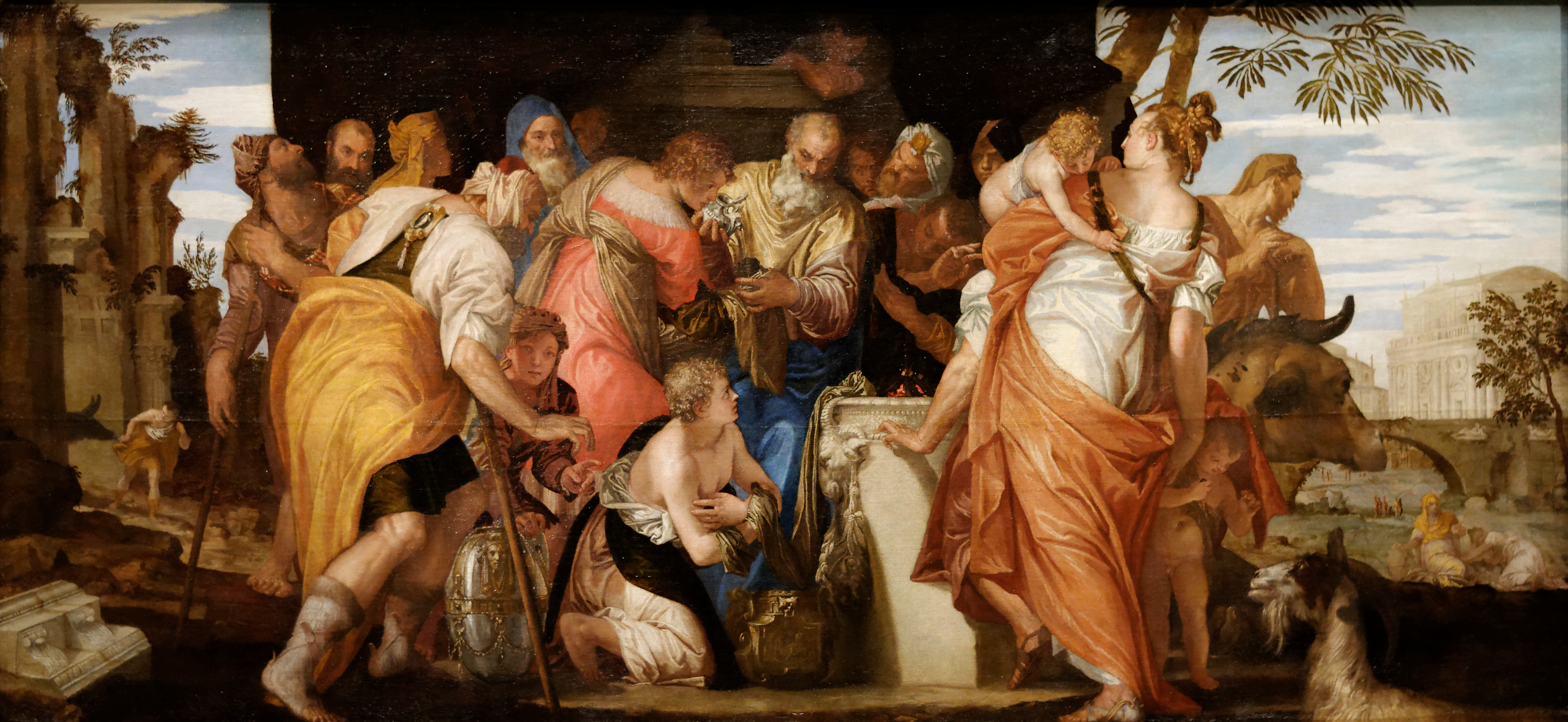
Paolo Veronese, The Annointing of David, c. 1550
During the spiritualism craze that swept Victorian London in the 1860s, John Ruskin would occasionally allow himself to be brought along by fashionable ladies to complete the circle at séances. On one such evening, Ruskin and a group of earnest seekers had seated themselves around an elegant table in a darkened Mayfair drawing room. They were trying to access "the other side" when the medium in charge suddenly announced in a quavering voice: "John Ruskin! John Ruskin! Do you wish to speak to your grandmother?"
"I do not," Ruskin replied with alacrity, "I wish to speak to Paolo Veronese."
- Dave Hickey in Art in America, November 2000.
Ruskin's admiration for Veronese is one good reason for visiting the National Gallery's impressive retrospective of the great Venetian (which begins with a striking quotation from Bernard Berenson: “It may be doubted whether, as a mere painter, Paolo Veronese has ever been surpassed.”)  Given Ruskin's importance for landscape art, I think it's fascinating that he was so inspired by an artist who rarely includes any scenery at all.  And yet many of Veronese's theatrical figure paintings are set outside - what Veronese does is create sheltered spaces that occlude the wider landscape almost entirely: the dark side of a ruin in The Annointing of David (above) for instance, or the rocky hillside in Mary Magdalene in the Wilderness.  The low viewpoint in The Resurrection of Christ leaves us looking up, like the soldiers shielding their eyes, at the ascending figure in a haze of heavenly light, but it also means that we can see no distracting scenery beyond the open tomb and ruined wall.  The National Gallery's Saint Helena sits at a window but all we can see outside is a grey sky and the figures in her dream.  At last, near the end of the exhibition I came to The Agony in the Garden, where landscape takes up half the painting, but it is a night scene and the closer I got to try to see into it, the more the features of the garden lost their form and revealed themselves to be merely the strokes of paintbrush.

Sunday, April 27, 2014

The Ruins of Hohenbaden

 
Carl Philipp Fohr, The Ruins of Hohenbaden, (1814-15)

Today was the last day to see A Dialogue with Nature, an excellent little exhibition at The Courtauld which included works from New York's Morgan Library & Museum that I'd not seen before, like Carl Philipp Fohr's 'jewel-like watercolour', The Ruins of Hohenbaden (1814-15).  I was particularly fascinated to see German paintings and drawings like this alongside those by familiar British names (Cozens, Girtin, Turner etc.).  Three more examples: Caspar David Friedrich's The Jakobikirche in Greifswald as a Ruin (c. 1817), the kind of nineteenth century 'anticipatory ruin' highlighted in the Tate's current Ruin Lust exhibition; Theodor Rehbenitz's strange little Fantastic Landscape with Monk Crossing a Bridge (c. 1826-30), a throwback to the style of Dürer's woodcuts; and the composer Felix Mendelssohn's sketchbook for 1837-9 open to show that popular Romantic trope, the view from a window.  Although there were few surprised in these British and German artists' subject matter, the exhibition conveyed a wonderful sense of technical creativity in the means used to engage in 'a dialogue with nature'.  I left with a mental list of ways in which an innovative artist of the period might demonstrate a distinctive landscape vision...

  • Use stylised strokes...  I have written here before about the vocabulary of marks used by Chinese landscape painters and named after the natural phenomena they resembled, like tan wo ts’un – 'eddies of a whirlpool'. The Courtauld curator drew attention to the foliage in Johann Georg Wagner's Wooded landscape with stream and oxcart on road (1760s), depicted using 'whirls and coils in a lively, almost calligraphic manner', a device which 'imbues this tranquil scene with vitality and movement.'  Wagner didn't have a chance to develop his style, dying at the age of just twenty-two (the same age at which Carl Philipp Fohr was killed, after an accident swimming in the Tiber). 
  •  
  • Use a 'stump'...  This was how Thomas Gainsborough, in Wooded Upland Landscape with Cottage, Figures and Cows (c. 1785), created subtle shades of grey on the road leading into the picture, the walls and the trees beyond and the distant hills and clouds in the background.  By rubbing a tightly rolled stump of leather or paper over the surface he left areas of soft shadow that contrast satisfyingly with the grainy texture of the unsmoothed chalk elsewhere in the landscape. 
     
  • Add gouache and gum arabic...  Mainly self-taught, Samuel Palmer also used distinctive ways of applying ink and paint, like the stippled trees in The Haunted Stream (c. 1826).  But what's really striking about another experiment, Oak Tree and Beech, Lullingstone Park (1828), are the different materials used. The extraordinary fiery evening light in the depths of the trees is 'yellow watercolour over white gouache, to which he applied gum arabic, imparting shine, and occasional dots of red watercolour.'
     
  • Choose coloured paper... The exhibition included one of Constable's cloud studies in which, it appears, he had insufficient time to record all the gradations of colour.  Nearby is one of the 150 cloud studies made by his German contemporary Johann Georg Dillis, executed with white chalk on blue paper so that he could avoid the issue of colour and concentrate on pure form.  I would love to see a large selection of these all on display together.

  • Leave a hole...  The moon must present a particular challenge for landscape painters and Turner makes it look easy in the Courtauld's On Lake Lucerne, looking towards Fluelen (1841).  Hung next to this in the exhibition was Friedrich's Moonlit Landscape (1808) in which he made no attempt to paint the moon itself: instead a circular hole was left so that a blank piece of paper behind shines through. In fact this was originally designed to be illuminated by lamplight and viewed to the accompaniment of music.
  • Tuesday, April 22, 2014

    The Third Paradise


    Earlier this month at the Baths of Caracalla we saw this spiral arrangements of Roman stone - like a Richard Long sculpture re-imagined by Ian Hamilton Finlay.  It is in fact an installation by Michelangelo Pistoletto, one of the leading lights of sixties Arte Povera, who is still active and making work based on his concept of the 'Third Paradise', a fusion of nature (the first paradise) and culture (the second).  This is symbolised by a new form of infinity sign - the pattern used to lay out the stones at the Baths of Caracalla.  You can read various descriptions of the Third Paradise online and I suspect something tends to get lost in translation - this for example makes it sound frustratingly vague and over-ambitious:
    'The idea of the Third Paradise is to lead artifice—that is, science, technology, art, culture and political life—back to the Earth, while engaging in the reestablishment of common principles and ethical behaviour, for on these the actual success of the project depends. The Third Paradise is the passage to a new level of planetary civilization, essential to ensure the human race's survival. The Third Paradise is the new myth that leads everyone to take personal responsibility at this momentous juncture.'  
    The fragments of ruined buildings used in this piece obviously recall the fragility of culture but they felt to me more elegiac than hopeful.  Placed on this carefully mown lawn they increase the sense that this ruin is itself a carefully curated museum, rather than a place of mystery and poetry.  Resting in the sunshine and contemplating Pistoletto's work reminded me of the very different approaches and strengths of Richard Long and Ian Hamilton Finlay, the former avoiding any overt meaning in his stone circles, the latter investing his work with complex and often troubling iconography. 

    In 2010 Pistoletto created the Third Paradise symbol on a larger scale, planting 160 olive trees in woodland near Assisi.  A photograph to accompany an interview shows him actually ploughing the soil himself.  Asked about how people should experience the work, he said: 'when spectators come to the large clearing that accommodates the Third Paradise (dominated by the Rocca Maggiore di Assisi) having walked through the woods along the Tescio (stream), they start out on a ritual course leading to awareness of a new relationship between humans and nature that we must all help create.'  Again I find myself somewhat sceptical, and reminded of a post I did here last year on the ethics of land art.  Wouldn't visitors prefer to wander through unspoiled, unmanaged woodlands finding their own inspiration?  In fact, inevitably, no such 'first paradise' exists, as the Saint Francis Woodlands website explains.
    'In 2011, the San Francesco Woodland was opened to the public and walking paths allow visitors to experience the beauty of Assisi's forest, [which was] neglected for centuries.  Its restoration is not aimed at purely environmental conservation, but an attempt to reconstruct for visitors the area's traditional rural landscape in the context of the Franciscan and Benedictine religious orders. To this end, the woodland's 1.5 and 2 kilometer-long walking paths are color-coded--with corresponding explanatory notes, an audioguide, and mobile app--into three thematic routes: the landscape route, illustrating the history of the rural landscape in Italy; the historical route, which recounts the area's historic architecture; and the spiritual route, with reflections on the relationship between nature and mankind.'

    Wednesday, April 16, 2014

    Ruin lust

    The Colosseum seen from the ruins on the Palatine Hill

    In my last post I said we were about to head off for Rome and now I am back with a camera full of images of ruins.  Just before we left, I had a look round the Ruin Lust exhibition at Tate Britain, which begins in the eighteenth century with Piranesi and the Picturesque landscape painters and ends with more recent studies of war-torn buildings and urban decay.  Of course we did not travel to Italy to look for modern ruins, although sometimes they were unavoidable (the bus ride to Tivoli took us through Rome's edgelands and I imagined Michael Symmons Roberts and Paul Farley excitedly hopping off there to explore the building sites, waste ground and low rise sprawl, rather than staying on to see the gardens of the Villa d'Este.)  Instead, as you can see from these photographs, our itinerary of Roman sites was a well-trodden one, catering as it did for young boys interested in Asterix and Horrible Histories as well as parents inspired by art and classical literature.

    A wall at the Baths of Caracalla

    The image used to promote Ruin Lust is Azeville (2006), Jane and Louise Wilson's imposing black and white photograph of a massive Nazi coastal defence structure that has weathered into something that resembles a basalt cliff overhanging a dark cave.  The ruins of Rome have long since taken on the characteristics of landscape.  Looking up from the Forum we saw successive walls of crumbling brick forming steep slopes and crevices.  At the Baths of Caracalla, isolated fragments of wall stood out against the blue April sky like the peaks of the Dolomites.  At Ostia Antica we wandered away from the main path to explore fields of overgrown stone that were once rooms - home now to small lizards and carpeted with grass and daisies.  The ruins are to some extent subterranean landscapes too, with underground passages that are not always accessible (the guide at the Catacombs tells you that its name meant 'near the caves', referring to the abandoned quarry that the tombs were built into).  Even after years of archaeology, parts of the ruins still remain buried and uncovered.

    Arches and tree on the Palatine Hill

    Standing beneath the towering walls of the Baths of Caracalla it was easy to imagine, like the author of the 'The Ruin' - the Anglo-Saxon poem that describes the crumbling remains of Roman Bath - that these were 'buildings raised by giants.'  But when I sat down to sketch them it was apparent that even the tallest structures are themselves dwarfed by pines and poplars, and that the marble colonnades are no taller than olive trees.  The old walls tended to recede into the background as I focused instead on the spring blossom (another potent symbol of transience).  The bricks themselves have an abstract beauty and there is a fascination in the way stone is configured at different scales, from tiny tessarae to great blocks of marble. But the more they sink into the landscape, the more they operate as setting rather than subject, a neutral background of cool grey and warm terracotta.  The ruins' arches and columns also provide natural frames: in Claude's paintings they stand in the foreground to one side in partial shadow, so that the eye travels on into the distant blue landscape suffused with golden evening light.  

    Old stone and spring blossom at the Baths of Caracalla

    Stone fragment on the Palatine Hill

    All connoisseurs of ruins appreciate the multifarious ways in which plants overgrow them.  Sometimes I was struck by the juxtaposition of living flowers with their petrified form on old stonework.  The city has so many Corinthian capitals it is a surprise to come upon a bank of real acanthus leaves stirred by the wind.  The flowers, trees and birds we saw can be encountered in fading wall paintings, and in the extraordinary garden room of Livia (which I have written about here before) they create an immersive space seemingly more perfect than nature itself.  But frescoes and carvings, like my photographs, are silent, and cannot convey what for us was an overriding impression of the ruins of Rome: the ever changing accompaniment of birdsong. That and the scent of herbs, some growing naturally, some planted, like the rosemary bordering the rectangular pond in the Pecile at Hadrian's Villa.

     Hadrian's Villa near Tivoli: the rectangular pond

    Having mentioned the birdsong, I must be honest and admit that the soundscape of the ruins in Rome is as much about car horns and emergency sirens, tour parties, maintenance workers, and some very noisy grass cutting.  The Forum, which I remembered fondly from previous visits, is hellishly crowded by the middle of the day - I found myself thinking of John Piper's chaotic and unappealing depiction of it that features in Ruin Lust (a 'vile painting' according to Brian Sewell). 'If stones could talk,' the tourist sites say, but at the Forum you would be hard pressed to hear what they were trying to say.  This encouragement to imagine the voices of the past made me wonder whether anyone has tried writing a Dart-style poem, drawing on the thoughts of those who inhabit the ruins today: the conservators deciding which areas to restore, the labourers building their scaffolding, the guides with their well-worn stories, the bored looking young women (with, you imagine, PhDs in ancient history) who take your money at the entrance, the recent immigrants selling jewellery just outside the main gate and the mounted policemen who come to intimidate them away.

    Exploring Ostia Antica

    We found a lot of the ruins out of bounds to visitors (I was particularly disappointed not to see the view from Hadrian's belvedere, the Roccabruna).  No explanations were given but it is obvious that a lot of work is going on to secure the sites for the ever increasing demands of mass tourism.  The problems of conserving Pompeii are well documented and at Ostia one of the finest floor mosaics was covered with a tarpaulin for protection.  Tourists cannot be left to do what they like, or behave like the peasants shown hanging out their washing amid the remains of Hadrian's Villa in a c1765 painting by Richard Wilson included in Ruin Lust.  It is a pity, because one of the joys of ruins is tracing your own path in and out of buildings, entering bedrooms and temples and swimming pools in a way that would be impossible in real life.  I have referred here before to Christopher Woodward's view that there is now too much emphasis on archaeology and not enough on the poetry of ruins.  Metal fences at the Baths of Caracalla prevent you from sitting on the stones where Shelley wrote 'Prometheus Unbound'.

    Fenced off: the Baths of Caracalla

    There is ample evidence in Ruin Lust of the attraction of aerial perspectives - from what Laura Cumming's review calls Piranesi's 'devastating vision of the Colosseum as it might be seen from the air, dangerously broken and overgrown, tiny figures tangled in the weeds and wreckage of this dead civilisation', to Joseph Gandy's imagining of The Bank of England as a ruinWe actually passed by both these edifices on our journey home.  Our flight took us over the Alps and across what was once just a small part of the Roman Empire.  As we descended towards Gatwick, the outline of London emerged in the distance with the Shard clearly identifiable, rising unfeasibly high over the city, lit by the rays of the low sun.  I thought then of W G Sebald's words in the Ruin Lust exhibition: 'somehow we know by instinct that outsize buildings cast the shadow of their own destruction before them, and are designed from the first with an eye to their later existence as ruins.' 

    Friday, April 04, 2014

    The Garden of Music

    'I love gardens.  They do not reject people.  There one can walk freely, pause to view the entire garden, or gaze at a single tree.  Plants, rocks, and sand show changes, constant changes.' -  Tōru Takemitsu, 'The Garden of Music' (1975)
    We're off to Rome next week and I was remembering our last visit there and a trip to the water gardens of the Villa D'Este, which got me thinking about Liszt's Les jeux d'eaux à la Villa d'Este and then other music inspired by gardens, like John Cage's Ryoanji and Tōru Takemitsu's In an Autumn Garden.  In a 1984 lecture Takemitsu spoke of wanting the orchestra itself to resemble a landscape garden, where 'things sparkle in the sunlight, become somber when it is cloudy, change colour in rain, and change form in the wind' (see Confronting Silence: Selected Writings trans. Yoshiko Kakudo and Glenn Glasow).  He describes experimenting with the organisation of instruments as if they were features in a garden: in Dorian Horizon for example, the oboe is played at the front of the stage while the shō can be heard from some way behind, so that they create a sense of space and distance.


    When Takemitsu came to compose Arc for Piano and Orchestra in 1963 he divided the orchestra into four groups ranging from the most fluid, mobile sounds to the most enduring and stable, corresponding to (1) grass and flowers, (2) trees, (3) rocks and (4) sand and earth.  Takemitsu drew two diagrams to illustrate the concept (which you can see reproduced in an online essay), one showing the organisation of these landscape elements, the other showing how the solo piano, which takes the role of the walker in the garden, moves through them.  The pace of the walker (the tempo of the piano) is up to the performer.  However, the content of the garden is planned - 'there are no chance elements as in a shakkei garden, which includes outside features [i.e. borrowed scenery - distant views from outside the garden itself].'  Nevertheless, he concludes, 'some of my works may resemble the shakkei in that natural sounds may be heard with the composed music.' *  This suggests an interesting way of thinking about the use of field recording in modern composition - as akin to the shakkei concept in Japanese gardens. 

    *  David Toop quotes this in his book Haunted Weather (2004) and goes on to reflect ruefully on his own Japanese-influenced garden's borrowed scenery - 'a slab of brutalist red brick - sheltered housing that once featured in a television series called Neighbours from Hell.'