Monday, April 30, 2007
Rain drops on maple leaves
The Nikki format is highly selective and Lady Sarashina chooses to record beautiful or poignant moments in a landscape rather than dwell on domestic detail or the rituals of court and religion. The way she remembers various pilgrimages makes them seem a form of nature worship rather than Buddhist retreats. Her trip to Kurama for example (section 21 in the Lewis translation) begins with recollection of an earlier spring visit when mists veiled the mountainside. Returning in the autumn she admires the crystal streams and the mountain slopes coloured like rich brocade. And when she reaches the presbytery she is overcome by the beauty of rain drops on maple leaves.
Friday, April 27, 2007
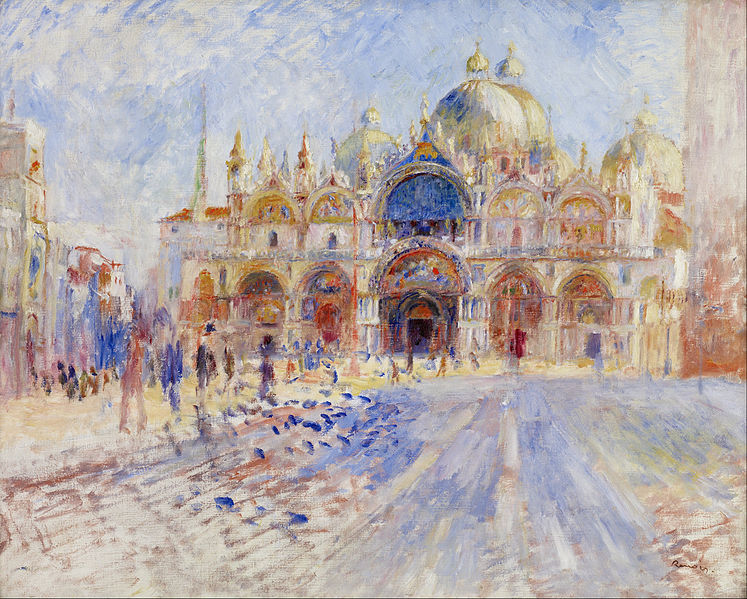
Piazza San Marco, Venice
Some artists seem hard to like initially, but you grow to appreciate them over time: Rubens for example. With others, the praise given them always remains mystifying. For me, Renoir remains the one Impressionist that I’ve never been able to fathom. The best I think I can say for him is that the scenes in his paintings can evoke a sense of their time and that the brushwork can give a pleasing sense of wind blurring the foliage and light shimmering over people’s clothes. I was therefore only mildly intrigued by the idea of the National Gallery’s Renoir Landscapes exhibition, and not sufficiently interested to want to pay to see it (especially at the unbelievable price of £12). Fortunately I have the chance of getting in free, but I’m still hesitating. Might the exhibition be so poor that the opportunity cost of attending is too high, even though the actual cost is nothing? The reviews are not exactly encouraging...
Brian Sewell (whose views I do not normally agree with) is pretty persuasive in his review, which includes some marvelous invective that I can’t resist quoting: ‘In restricting the exhibition to landscapes, these directors and their appointed curators have dealt Renoir an almost mortal blow. Most of these landscapes are appalling... Smudge, smear and ineptitude is the best that can be said of them; greasy too, and occasionally dollopy, for Renoir's handling of paint in these landscapes is often physically repellent. The kindest thing that the curators could have done for his reputation would have been to abort the exhibition when they realised how dire and dreadful it would be; that they did not, suggests that such a realisation dawned on not one of them, nor on their associated essayists, nor on their directors, none of whom, it seems, has the slightest eye for quality. Had LS Lowry set out to forge a late Utrillo, he could not have matched the sheer nastiness of Renoir's Piazza San Marco, Venice, of 1881...’ And so it goes on!
Tuesday, April 24, 2007
The Road from Orizaba to Acultzingo
The book describes the travels of German painter Johann Moritz Rugendas (1802-58) and centres on the moment in 1837 when he suffers a disfiguring accident while sketching in Argentina. I know little about Rugendas and therefore spent most of the book wondering where the line between fact and fiction had been drawn, a question that might be applied to the paintings of Rugendas. According to Aira, Rugendas was influenced by the theories of Alexander von Humboldt, in particular the aim of depicting nature in its ‘physiognomic totality’ (which I suppose is ironic in view of the fracturing of the artist’s own physiognomy). Humboldt believed that artists like Rugendas could uncover the unity of a landscape. Furthermore, as Aira says, the Humboldtian naturalist was ‘not a botanist but a landscape artist sensitive to the processes of growth operative in all forms of life.’
An Episode in the Life of a Landscape Painter is interesting but left me feeling slightly unsatisfied, perhaps because of its brevity and the way even the two central characters remained somewhat sketchy. There are some full reviews on-line, e.g. here, here and here. The paperback has as its cover both the original drawing and the oil painting of The Road from Orizaba to Acultzingo (1831). Here is one of the Rugendas images freely available on-line, a landscape in Chile.

Johann Moritz Rugendas, Two Riders Resting
Source: Wikimedia Commons
Friday, April 13, 2007
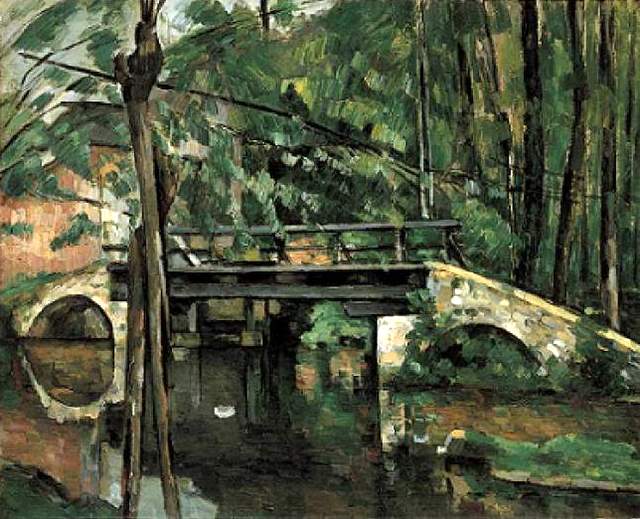
The Bridge at Maincy
Cézanne famously aimed to ‘re-do Poussin over again according to nature’. Comparing the two painters, Richard Verdi has written that Poussin’s classicism ‘evolved in the studio, through the joint efforts of the intellect and imagination, Cézanne’s had to be won directly from nature. In this respect it was a kind of instinctive – or ‘spontaneous’ – classicism, one which was found rather than made.’ In The Bridge at Maincy (1879) for example, the vividness of the foliage is matched by the solid structure of bridge and trees.
Paul Cézanne, The Bridge at Maincy, 1879
Source: Wikimedia Commons
Monday, April 09, 2007
Dreamer in a Landscape
Malcolm Yorke’s The Spirit of Place: Nine Neo-Romantic Artists and Their Times (1988) discusses the art of Paul Nash, John Piper, Graham Sutherland, John Minton, Michael Ayrton, Robert Colquhoun, Keith Vaughan, Prunella Clough and John Craxton. He begins the book by discussing the label Neo-Romantic, which was already being used in the 1940s, e.g. by Raymond Mortimer (for whom it covered Piper, Sutherland, Henry Moore, Frances Hodgkins and Ivon Hitchens). Yorke writes that a 1983 exhibition, ‘The British Neo-Romantics 1935-1950’, attempted to include Bacon and Freud, both of whom refused to be included. He questions this exhibition’s inclusion of Hitchens, who did paint the English landscape but in a style far removed from the influence of original Romantics like Palmer, and of David Jones, who could be seen as too idiosyncratic to be part of a movement. A later Barbican Art Gallery exhibition, ’A Paradise Lost: The Neo-Romantic Imagination in Britain 1935-1955’, included various minor figures and two more artists that Yorke considers too individual to be part of a movement: Cecil Collins and Ceri Richards (the latter’s ‘explorations of the sexualisation of landscape were rightly given prominence’).
All this goes to show that beyond Piper and Sutherland there is no real consensus as to who was a ‘Neo-Romantic’. Which is why I suppose it is not surprising to find the on-line Encyclopedia of British Neo-Romanticism has such a wide coverage... Although you have to wonder about a site that manages to include under this term Genesis P. Orridge, Vivienne Westwood, J.R.R. Tolkein and Peter Ackroyd. Strange bedfellows!
The Tate site has a definition that is close to Malcolm Yorke’s conception of Neo-Romanticism. They illustrate this with John Craxton’s Dreamer in a Landscape (1942), noting his explanation for including shepherds or poets: 'as projections of myself they derived from Blake and Palmer. They were my means of escape and a sort of self protection. A shepherd is a lone figure, and so is a poet'. This notion of self-protection recalls the point made by Andrew Motion, that English poetic landscapes have a ‘defended’ feel to them.
Saturday, April 07, 2007
Visions of little dells
In The Guardian today Andrew Motion writes about the exhibition ‘Poets in the Landscape: The Romantic Spirit in British Art’, at Pallant House Gallery, Chichester. In discussing William Blake’s illustrations to Virgil’s Eclogues, he cites a beautiful description by Samuel Palmer, who saw the woodcuts as "visions of little dells, and nooks, and corners of Paradise; models of the exquisitest pitch of intense poetry. I thought of their light and shade, and looking upon them I find no word to describe it. Intense depth, solemnity, and vivid brilliancy only coldly and partially describes them. There is in all such a mystic and dreamy glimmer as penetrates and kindles the innermost soul, and gives a complete and unreserved delight, unlike the gaudy daylight of this world."
However, Andrew Motion wants to emphasise the darkness lurking in these pastoral visions, many of which were made in time of war and political uncertainty. They are ‘not so much escapist as defended’, a ‘form of opposition to the threats that circle them’. He cites, for example, John Piper’s set designs for the ballet Job (1948), which on the surface seem to be simple pastoral landscapes, but in which he sees ‘an optimism that is too determined to be entirely convincing.’ These set designs are, incidentally, a nice example of the interconnectedness of the English Romantic landscape traditions. The ballet is based on Blake’s illustrations to the Book of Job and composed by Ralph Vaughan Williams, following a proposal by Geoffrey Keynes (essayist and brother of the economist) and wood engraver Gwen Raverat (who was related to both Keynes and Vaughan Williams, and whose prints, including various landscapes, can be seen on-line here).
Tuesday, April 03, 2007
The Cliffs at Etretat
In 1885 Monet drew several pastel landscapes of the rocks at Etretat which have a Symbolist feel to them, enhanced by the medium and choice of colours: dove grey and fading purple. Evening light softens the rock formations and illuminates the sea. The exhibition describes Etretat, the Needle Rock and Parte d’Aval as reflecting ‘his introspective mood. This unique vertical scene framed by shadows and cloud, with the famous ‘needle’ and rock arch beyond, is sombre and slips into reverie.’ Although some of the well-known oil paintings made at Etretat resemble these pastels, others, like The Cliffs at Etretat (below) are quite different, full of the sparkling light of Impressionism.
Incidentally, Etretat is one of those landscapes that have been seen as a challenge to artists. The Royal Academy site notes that: ‘Etretat had already been painted by both Delacroix and Courbet; Monet in fact owned a Delacroix watercolour of the area. The Courbet retrospective at the Ecole des Beaux-Arts in 1882 featured a group of Etretat seascapes. Monet visited Etretat in 1883 with plans to create his own Normandy seascapes: “I reckon on doing a big canvas on the cliff of Etretat, although it’s terribly audacious of me to do that after Courbet who did it so well, but I’ll try to do it differently.”’
Monday, April 02, 2007
On Quantock’s grassy Hills
The latest The New York Review has an article on the friendship between Coleridge and Wordsworth. You might think this would be a worthy but dull read on a pretty well-worn topic, but here’s how it starts: ‘Coleridge once said that people should take time to lean on gates. There is a wooden gate above a field in Dorset which is well worth leaning on...’ Ah... unmistakably Richard Holmes, who has never written a dull essay.
The gate in Dorset was the one Coleridge vaulted in his enthusiasm to see the Wordsworths. ‘Coleridge’s impetuous arrival that afternoon – exuberant, bounding, breaking the barriers, “leaping through the corn”’ presaged a three week period in which their friendship was formed, and eighteen months of discussion and composition that culminated in the lyrical ballads. It was a time recalled by Wordsworth in The Prelude: ‘that summer, when on Quantock’s grassy Hills / Far ranging, and among the sylvan Coombs, / Thou in delicious words, with happy heart, / Didst speak the Vision of that Ancient Man, the bright-eyed Mariner...’ (The equivalent lines from the 1850 Prelude are reprinted, with photographs of the Quantocks, on the appropriately named Friends of Coleridge site).
(Incidentally, I’m typing this in Word and its grammar checker has just said to me “Fragment – consider revising”, which made me smile: Holmes says that Coleridge’s ‘idea of the creative fragment became one of his greatest contributions to the aesthetics of Romanticism.’)
Holmes speculates on the nature of literary partnerships and suggests an interesting twentieth century parallel: Ted Hughes = Wordsworth, Sylvia Plath = Coleridge. He also reproduces an Irish joke noted by Coleridge in 1833 and recently published in the Coleridge Bulletin (Winter 2006). It could be seen as a surreal allegory of the friendship between the two famous poets:
Dan Hennesay’s story – passing over Black Friar’s whom should I see (coming from t’other end of the Bridge) but my old Chum, Pat Mahoney – and at the same moment he saw me – We ran towards each, & when we met, just in the middle of the Bridge – by Jasus! – it was neither of us.
Sunday, April 01, 2007
Hare, Blood and Snow
Some recent newspapers have had big features on Andy Goldsworthy, coinciding with his new retrospective at Yorkshire Sculpture Park. They seem to be very positive reviews and often make an effort to convince the wary reader by addressing the potentially embarrassing fact that Goldsworthy is extremely popular and makes work with appeal to children (like the daughter of The Observer’s Tim Adams) and those with no knowledge of contemporary art. This quote from Sue Hubbard’s review in the New Statesman is interesting in this respect, implying that the ‘art establishment’ are missing the environmental importance of Goldsworthy’s brand of landscape art:
‘For some years now British landscape artists such as Goldsworthy, David Nash and Richard Long have been looked down upon by many in the art establishment. They have been regarded, despite their wide appeal and international success, as latter-day 1960s renegades, too metaphysical, too intense, too lyrical and unapologetically moral. This is an age that is more comfortable with cynicism than with the stench of dung and death. Yet never has there been a time when these artists' work was more resonant, as the planet warms and old landscapes are destroyed.’
I probably won’t get to go to this retrospective but I would be interested to see the new works that incorporate blood and human hair, which seem less reminiscent of the beautiful ephemeral images in his ‘coffee table books’ and closer to post pastoral art that acknowledges and incorporates the real violence in nature. For example, there is Hare, Blood and Snow, made from a dead hare by mixing its blood with snow and putting this into ‘the hare's stomach, hanging the animal up so that the melting liquid dripped from its mouth and nostrils on to sheets of paper’. Sue Hubbard thinks these works relate to ‘the cycles of death, putrefaction and renewal, with an uncompromisingly elemental beauty. Goldsworthy is to environmental art what Ted Hughes was to poetry.’