Sunday, July 30, 2006

A View of the Boulevards of Paris

The early photographers framed landscape views but ended up provided images that highlight the small un-regarded details of nature and modern life. For example, in ‘The Apse of Notre-Dame, 8 December 1852’, one of the photographs in Album photographique de l’artiste et de l’amateur (produced by the firm of Blanquart Évrard in 1852), the eye is drawn not to the cathedral but to the row of delivery carts in the foreground. As Ian Jeffrey points out in his book Photography, ‘the anonymous photographer intent on Notre-Dame has ended up with evidence of routine commercial life in the city’. Looking at this image, my eye glances over the familiar shape of the cathedral and I am moved instead by the punctum created by those carts, a particular transitory detail of life in nineteenth century Paris.

William Fox Talbot, A View of the Boulevards at Paris, 1844

Even at the time, William Henry Fox Talbot was fascinated by this chance aspect of photography, describing such mundane details in his book The Pencil of Nature (1844). For example, in presenting ‘A View of the Boulevards at Paris’ to the reader he describes the pattern of water on the road surface and the proliferation of chimneys: ‘The weather is hot and dusty, and they have just been watering the road, which has produced two broad bands of shade upon it, which unite in the foreground because, the road, being partially under repair (as is seen from the two wheelbarrows, etc. etc.), the watering machines have been compelled to cross to the other side. By the roadside a row of cittadines and cabriolets are waiting, and single carriage stands at a distance a long way to the right. A whole forest of chimneys borders the horizon: for, the instrument chronicles whatever it sees, and certainly would delineate a chimney-pot or a chimney-sweeper with the same impartiality as it would the Apollo Belvedere.’

Saturday, July 29, 2006

The drifting white downy clouds

There are a growing number of blogs based on the journals of old, out of copyright authors. From a landscape perspective, the Henry David Thoreau blog is of obvious interest and in fact I would go further and highly recommend it. As you would expect, the entries are poetic and insightful, and they range from specific observations of plants and animals to general reflections, like this extract from the entry for 24 June 1852:
The drifting white downy clouds are to the landsman what sails on the sea are to him that dwells by the shore,—objects of a large, diffusive interest. When the laborer lies on the grass or in the shade for rest, they do not much tax or weary his attention. They are unobtrusive. I have not heard that white clouds, like white houses, made any one’s eyes ache. They are the flitting sails in that ocean whose bound no man has visited. They are like all great themes, always at hand to be considered, or they float over us unregarded. Far away they float in the serene sky, the most inoffensive of objects, or, near and low, they smite us with their lightnings and deafen us with their thunder. We know no Ternate nor Tidore grand enough whither we can imagine them bound. There are many mare’s-tails to-day, if that is the name. What would a man learn by watching the clouds? The objects which go over our heads unobserved are vast and indefinite. Even those clouds which have the most distinct and interesting outlines are commonly below the zenith, somewhat low in the heavens, and seen on one side. They are among the most glorious objects in nature. A sky without clouds is a meadow without flowers, a sea without sails
On reading this passage today, we are perhaps less likely to think about the clouds, which drift on as they ever did, than of the disappearance of white sails from the coastal landscape.

Monday, July 24, 2006

The Mountain Where Hui-pao Meditated

Wang An-shih

Speculation on the future role of Tony Blair has not so far considered the option of his retiring from public life to compose exquisite four-line landscape poems. This was the course followed by Wang An-shih (1021-1086), who resigned from the role of Chinese prime minister in 1074. Wang An-shih had devised an extensive social reform programme which formed the basis of the New Laws (Hsin-fa) instituted by Emperor Shen-tsung in 1069. However, opposed by both conservatives and pragmatists, he eventually lost the support of the emperor. Leaving office disappointed, he retired to the countryside near Chiang-ning on the south shore of the Yangtze, devoting himself to Ch’an Buddhism and writing short poems, many of them in the rivers-and-mountains genre.

Interestingly there is a description written by the young Wang-An-shih in 1054, of an expedition to a cave at the Mountain Where Hui-pao Meditated (Hui-pao was a seventh century Buddhist monk), which seems to prefigure symbolically his thwarted future plans as prime minister. On entering the cave, ‘the deeper we advanced, the more difficult our progress, but the more fantastic the sights’. Unfortunately, ‘one person grew tired’ so the party decided to go back. Reflecting on this later, Wang An-shih writes that ‘the most unique magnificent, fabulous, strange, and extraordinary scenery in the world is usually found in these dangerous and distant places that people rarely reach. Therefore only those with ambition can reach them… However, he who exhausts his ambition, even if he cannot go further, can still be without regrets. Who could ridicule him then? This is the insight I obtained from this journey.’ (Richard E. Strassberg’s translation in his anthology Incribed Landscapes: Travel Writing from Imperial China).

Saturday, July 22, 2006

Surfacing on the Thames

The Canadian experimental filmmaker and photographer David Rimmer made his name with works relating to the contemplation of landscape, most obviously Landscape (1969), which compressed compresses 15 hours of footage into eight minutes of sea, mountains, and sky, but also Surfacing on the Thames (1970), Seashore (1971), Canadian Pacific (1974) and others. Surfacing on the Thames has been described by Donald Richie as ‘a beautiful, mysterious yet satisfying optical illusion…celebrates the early passing of a steam on the Thames. Using freeze-frame techniques, elaborate dissolves, and most of the resources on the optical table, this picture is, amongst other things, a Turner come to life. Rimmer’s concern with the surface nature of the film is most evident in this work which, in spite of its filmic complexity, is incredibly simple.’ In his essay ‘David Rimmer: A Critical Analysis’, Al Razutis writes that ‘Surfacing presented the viewer with a completely unique view of what a cine-landscape could be.’ Happily, Surfacing the Thames (1970) can be downloaded from Ubuweb... but sadly the AVI file doesn’t seem to work on my PC (no picture), so I would be interested to know if anyone else can view it.

Postscript: the film is now available on Vimeo:
 

Friday, July 21, 2006

Before Storm

The approach taken in paintings like Ying Yu-Chien’s ‘A Mountain Village in Clearing Mist’ has sometimes been compared to the method proposed by Alexander Cozens in A New Method of Assisting the Invention in Drawing Original Compositions of Landscape (1785). Cozens showed how, for example, an almost random collection of marks could be converted into a mountain landscape composition. There is no need to posit a connection between Cozens and Chinese art (Cozens did grow up in Russia, where his father worked for Peter the Great, but eighteenth century Russia was hardly Song dynasty China). The idea that random blots might resemble landscapes had, after all, already occurred to Leonardo da Vinci, who wrote ‘you should look at certain walls stained with damp, or at stones of uneven colour. If you have to invent some backgrounds you will be able to see in these the likeness of divine landscapes, adorned with mountains, ruins, rocks, woods, great plains, hills and valleys in great variety…’ (quoted from Ernst Gombrich’s Art and Illusion).

Alexander Cozens. Plate 2, 'Blot' Landscapes for A New Method of Assisting the Invention in Drawing Original Compositions of Landscape, 1785

In a 1997 article in ‘Art Bulletin’ (which can be found on-line) Charles A. Cramer notes how the temptation to view the blots as proto-Romantic or proto-Expressionist makes it hard to locate Cozens in the world he actually inhabited, the world of Reynolds and the Royal Academy. However, Cramer argues that the main aims of Cozens’ technique are rooted in eighteenth century classical landscape ideas. Rather than naturalistic description or artistic expression, the painter uses the blots to suggest new ways of designing landscapes that convey the general principles of nature. The blot is only the starting point and requires "embellishment and consolidation". Far from being a window to the unconscious, the blots were, for Cozens, a means of training the eye to see the general rather than the particular. This can be seen in some of Cozens’ paintings, like Tate’s Before Storm (c1770-80), which does not show any particular landscape. And yet, it has to be said, a painting like this is still very easy to see as an early work of Romanticism.

Wednesday, July 19, 2006

A Mountain Village in Clearing Mist

One of the most mysterious images reproduced in Michael Sullivan’s book Symbols of Eternity: The Art of Landscape Painting in China is one of the thirteenth century monk Ying Yu-chien’s eight views of Hsiao and Hsiang (subject matter discussed in this earlier posting). Sullivan calls the particular view ‘Returning Fishermen’, although as far as I can see a more common title is ‘A Mountain Village in Clearing Mist’. Yu-Chien created the effect of a landscape dissolving in the haze by ‘smearing and splashing ink onto the paper in a state of high excitement and then, like the late T’ang eccentrics, adding a few deft touches with the brush that not only transformed his gestures into a picture of countrymen coming home to their village at dusk but also created a marvellous pictorial analogy to the Zen experience in which form is manifest out of the formless, unifying Void.’
 
The ‘late T’ang eccentrics’ were earlier painters whose approach Sullivan likens to that of the New York Action Painters. Although none of these T’ang eccentrics’ work survives, there are accounts of them dipping their hair in ink, painting while dancing to music, or using the brush whilst facing away from their work. ‘A T’ang text tells of Ink Wang, who would get drunk and then, laughing and singing, spatter ink onto the silk and stamp it with his feet and smear it with his hands.’ Having created these abstract patterns, the T’ang painters would take a few strokes of ink to turn them into landscapes. Incidentally, similar stories are told about the finishing touches added by Turner at the Royal Academies varnishing days prior to their exhibitions.

There is some discussion of Yu-Chien’s ‘A Mountain Village in Clearing Mist’ in the context of Zen (Ch’an) Buddhism on-line in Aspen magazine.

Sunday, July 16, 2006

Studies by the Sea

One of the pleasures of reading Charlotte Smith’s landscape poetry comes in consulting her endnotes, which give the Latin names of the flora and fauna she mentions and convey a sense of her intellectual engagement with nature. Here for example are two stanzas from the posthumously published poem ‘Studies by the Sea’ (1807) – these lines follow a description of the hushed beauty of a calm sea at sunset.
‘Forgotten then, the thundering break
Of waves, that in the tempest rise,
The falling cliff, the shatter'd wreck,
The howling blast, the sufferer's cries;
For soft the breeze of evening sighs,
And murmuring seems in Fancy's ear (1)
To whisper fairy lullabies,
That tributary waters bear
From precipices, dark with piny woods,
And inland rocks, and heathy solitudes.
The vast encircling seas within,
What endless swarms of creatures hide ,
Of burnish'd scale, and spiny fin !
These providential instincts guide,
And bid them know the annual tide,
When, from unfathom'd waves that swell, (2)
Beyond Fuego's stormy side,
They come, to cheer the tribes that dwell
In Boreal climes; and thro' his half year's night
Give to the Lapland savage, food and light.’

And here are the two endnotes, which almost give a sense of someone straining against her own poetic diction to convey a clear picture of nature:
‘(1) Whoever has listened on a still summer or autumnal evening, to the murmurs of the small waves, just breaking on the shingles, and remarked the low sounds reechoed by the distant rocks, will understand this.
(2) The course of those wonderful swarms of fishes that take their annual journey is, I believe, less understood than the emigration of birds. I suppose them, without having any particular ground for my conjecture, to begin their voyage from beyond the extreme point of the southern continent of America. Many of the northern nations live almost entirely on fish. Their light, during the long night of an arctic winter, is supplied by the oil of marine animals.’
There are of course many other examples that could be cited, as can be seen from the e-text of her collection Beachy Head: With Other Poems, which includes ‘Studies by the Sea’.

Thursday, July 13, 2006

A painstaking description of the Grampian Hills


In Three Men on the Bummel (1900), the sequel to Three Men in a Boat (1889), Jerome K. Jerome avoids describing the landscape of Germany through which his three men cycle because
‘Nothing is easier to write than scenery; nothing more difficult and unnecessary to read. When Gibbon had to trust to travellers’ tales for a description of the Hellespont, and the Rhine was chiefly familiar to English students through the medium of Caesar’s Commentaries, it behoved every globe-trotter, for whatever distance, to describe to the best of his ability the things that he had seen. Dr Johnson, familiar with little else than the view down Fleet Street, could read the description of a Yorkshire moor with pleasure and with profit. To a cockney who had never seen higher ground than the Hog’s Back in Surrey, an account of Snowdon must have appeared exciting. But we, or rather the steam-engine and the camera for us, have changed all that. The man who plays tennis every year at the foot of the Matterhorn, and billiards on the summit of the Rigi, does not thank you for elaborate and painstaking description of the Grampian Hills. To the average man, who has seen a dozen oil-paintings, a hundred photographs, a thousand pictures in the illustrated journals, and a couple of panoramas of Niagara, the word-painting of a waterfall is tedious.’
Jerome sees the problem not just as a symptom of modernity but of the basic fitness of language to convey landscape. ‘An American friend’ loved poetry but gained a better idea of the Lake District from ‘an eighteenpenny book of photographic views than from all the words of Coleridge, Southey and Wordsworth put together.’ This friend also said ‘that he would thank an author as much for writing an eloquent description of what he had just had for dinner’ (what would he think of today’s food writing?)

Jerome seems to be voicing here a typically jaded metropolitan post-Romantic view of landscape writing. But ironically, the lack of topographical description – whether witty or poetic – is one of the main defects of Three Men on the Bummel. You get no real sense of the journey through the Black Forest as you do the trip up the Thames in Three Men in a Boat. Shorn of a sense of landscape the sequel fails to come alive and exists more as a collection of loose anecdotes and ideas about the German people.

Monday, July 10, 2006

Six milestones

Ian Hamilton Finlay has said: “A milestone is poetical though it only tells the way” (‘Six Milestones’, 1992). For those of us encountering milestones in the context of project planning they are anything but poetical (just as ‘slippage’ conjures up no images of scree slopes or crumbling river banks and ‘gateways’ never open onto interesting paths). But to encounter a real milestone in the landscape is always poignant, the eroded surface signifying all those years of journeys briefly punctuated.

Ian Nairn and many others have criticised the excessive signage obliterating the countryside and milestones are the antithesis: simple, functional, almost ‘natural’. They now seem as ancient as runic stones, but milestones are never really more than a few centuries old. The first ones appeared on the Dover Road in 1663 and milestones gradually becoming more prevalent until they were made compulsory on the turnpikes in 1773.

There are some poetical milestone photographs on this Oxford history site and some links on this milestones site. Ian Hamilton Finlay’s proposed milestones were realised and temporarily installed along the banks of the Floriade lake in the Hague in 1992. They were then acquired by Zoetermeer council, although sadly according to this SKOR site “one of the six stones has disappeared”, a fate that has overtaken many of the milestones that once marked the English landscape.

Sunday, July 09, 2006

A View of Darwentwater &c

In his book The Pleasures of the Imagination, John Brewer traces the interest in Lakeland scenery through the growing popularity of prints in the eighteenth century:
  • In 1752 William Bellers’ Six Select Views in the North of England contains the first published images of Windermere, Derwentwater and Ullswater. 
  • In the 1760s Thomas Smith of Derby published two series of Lakeland views, following up his earlier success with prints of Derbyshire and Staffordshire landscapes.
  • In 1789 Joseph Farington published a folio of twenty prints, Views of the Lakes, which Brewer describes as the first ‘coffee table’ book of the Lake District.
  • In 1791 Peter Holland published the first series of Lakeland aquatints.

William Bellers’ print, A View of Derwent Water, Towards Borrodale (1752) appears artificial when compared to later artists’ impressions, but is much more realistic than the strange landscape depicted in Thomas Smith’s, A View of Darwentwater &c from Crow-Park (1767 - see above). As Malcolm Andrews points out in The Search for the Picturesque, ‘It has been suggested that Smith deliberately distorts shapes to satisfy contemporary tastes for chinoiserie – the mist-wreathed, conical mountains made to look like Chinese landscape forms.’ This is an intriguing alternative to the picturesque filters through which landscapes were usually seen in the eighteenth century - Salvator Rosa, Poussin, Claude. Andrews thinks it is possible that Smith may also have been inspired to exaggerate the mountains in response to a description of Derwentwater by Dr John Brown (William Gilpin’s old drawing master) published in 1767:
‘On the opposite shore you will find rocks and cliffs of stupendous height, hanging broken over the lake in horrible grandeur, some of them a thousand feet high, the woods climbing up their steep and shaggy sides, where mortals never yet approached… a variety of water-falls are seen pouring from their summits, and tumbling in vast sheets from rock to rock in rude and terrible magnificence: while on all sides of this immense amphitheatre the lofty mountains rise round piercing the clouds in shapes as spiry and fantastic as the very rocks of Dovedale.’

Friday, July 07, 2006

Mount Athos Carved as a Monument to Alexander the Great

In Landscape and Memory Simon Schama follows his discussion of Mount Rushmore and its sculptor, Gutzon Borglum, with an account of Borglum’s classical exemplar Dinocrates, architect to Alexander the Great. According to Vitruvius (De architectura book 2) Dinocrates arrived from Macedonia and came to the notice of Alexander by dressing himself as Hercules and stationing himself within sight of the camp tribunal where Alexander was giving judgement. Dinocrates proposed to Alexander a Herculean project, the conversion of Mount Athos into a statue of a giant man which would have a city in one hand and a bowl in the other containing waters from all the rivers of the mountain. Alexander was impressed, but pointed out that on this mountain the city would not have sufficient supplies of grain to feed its people. The young architect was therefore set instead to survey and design the city of Alexandria.

 
This story in Vitruvius has been used by various architects and artists. Pietro da Cortona, in his drawing Pope Alexander VII Shown Mt Athos by Dinocrates c1655, linked the new pope to the Alexander of antiquity. Another illustration of ‘The Mount Athos Colossus’ appeared in Baroque architect J. B. Fischer von Erlach’s Sketch of Historical Architecture (1721). And then there is a landscape painting by Pierre-Henri de Valenciennes, Mount Athos Carved as a Monument to Alexander the Great (1796) (the Art Institute of Chicago’s site only has a tiny illegible thumbnail image, but someone has put up a snap here). As Simon Schama points out, Valenciennes’ painting ‘is a benevolent reworking of Poussin’s Polyphemus, whose Cyclopean eye is hidden by the rear view of the geological giant, and had first been tried out by Valenciennes in a chalk drawing done during his obligatory trip to Italy almost twenty years before. The painting was shown at the salon of the Republican Year VIII, when enthusiasms were running high for both Hellenic “purity” and the cult of nature. Shrewdly marrying the two together, Valenciennes produced the perfect icon of benevolent republican sovereignty, where the exquisite landscape, verdant and gently watered, is shown directly dependent on the mountainous authority of the paternal state.’

Monday, July 03, 2006

Landscape with an obelisk and the Imperial coat of arms

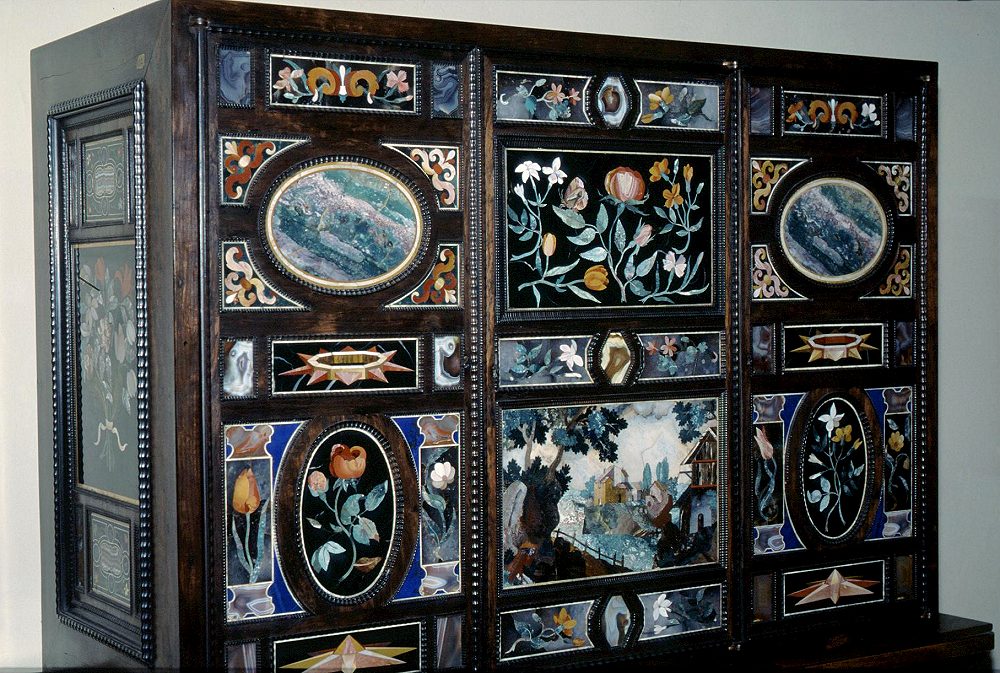
Norwich Castle Museum and Art Gallery currently have an exhibition ‘Art At The Rockface: The Fascination of Stone’. In addition to the work of artists like Turner and Henry Moore, it has other types of stone object, including a collector’s cabinet produced by the Castrucci workshop in Prague in about 1610. In this and other designs, like this cabinet in Vienna, the workshop created miniature stone landscapes embedded in furniture. As the website of the Liechtenstein Museum puts it, “the impressionistic reproduction of an idealised landscape through colour patches and the natural pattern of the stones is typical of Castrucci style.” The workshop was founded by the Florentine Cosimo Castrucci and continued after Cosimo’s death with his son Giovanni. There is an entry on pictorial stones in the Giornale Nuovo blog, which discusses the Castruccis’ commessi di pietre dure and includes two nice images. Seen in isolation as a view of a town, the Landscape with an obelisk and the Imperial coat of arms has a very distinct and strange quality to it.

Postscript: a couple of examples can now be found on Wikimedia Commons so I am embedding them below.  
The second is in the Kunsthistorisches Museum, Vienna and dates from 1596:


Friday, June 30, 2006

Dutch fields

Hollandse Velden (Dutch Fields), Hans Van Der Meer’s collection of photographs of Dutch football, includes several poignant landscapes. The photographs are discussed in David Winner’s engaging book about the ‘neurotic genius of Dutch football’, Brilliant Orange, in which he links the spatial awareness of Dutch teams to national creativity in land use and landscape. For example, with the birth of Total Football in the late sixties: ‘just as Cornelis Lely in the nineteenth century conceived and executed the idea of creating giant new polders and altering the physical dimensions of Holland by dyke-building and exploiting the new technology of steam, so Rinus Michels and Johan Cruyff exploited the new breed of players to change the dimensions of the football field.’


In seeking connections between the spatial awareness of footballers and artists, Winner talks to Rudi Fuchs, then director of the Stedelijk Modern Art Museum in Amsterdam. Fuchs argues that the Dutch have a natural instinct for measuring distance and selecting details – something that can be seen in their landscape painting and football. He says “there is a Dutch way of seeing space, the landscape. Cruyff sees in that Dutch way and he is admired for his innate understanding of the geometry and order of the pitch.”

Of course this may seem rather far-fetched, particularly given the Dutch team’s recent exit from the World Cup in an ill-tempered game that demonstrated little Dutch artistry (in Brilliant Orange Rudi Fuchs likened Marco Van Basten to Jan Vermeer – but that was Van Basten as a player, not a coach). Nevertheless this kind of argument reminds me of the way Michael Baxandall, for example, has sought to explain the art of Piero della Francesco in relation to the relatively sophisticated understanding of volume among the people of fifteenth century Florence.

In his career as director of the Stedelijk Rudi Fuchs was known for making interesting juxtapositions (as this article explains), so was no doubt open to the idea of considering Cruyff alongside other Dutch artists. Fuchs is also, incidentally, the author of a book about Richard Long, an artist whose straight-line approach I am tempted to compare to some of England’s “route one” play when they seem too nervous to pass the ball around and use space creatively.

Thursday, June 29, 2006

Thicket No. 1

Tate Modern’s re-hang includes their Roni Horn piece, Thicket No. 1 (1989-90), an aluminium slab which incorporates a line from Simone Weil’s Gravity and Grace: ‘To see a landscape as it is when I’m not there’. What you first see is a minimalist object with some black bar-code markings on two sides. Inspection of these reveals the text on the sides of the slab, text which was there all along but not visible, like a landscape when you are not there. As Roni Horn has said in an interview with Jan Howard in 1994, “Thicket No. 1 gives the viewer an inkling of not being present. The contradiction lies in the instinctive weighing of that inkling against the reality, the certainty, of one’s physical presence in that same moment.”

Roni Horn also used this quotation in her book To Place – Book I: Bluff Life (1990) which featured drawings made at Dyrhólaey in Iceland. There she was trying “to be present and to be a part of a place without changing it” whilst knowing that “such a desire can only be thwarted”. It may be literally impossible, but somehow to see a landscape as it is when we are not there seems a valid motivation for landscape art in a world where our presence is increasingly felt everywhere.

[Incidentally, Thicket No. 1 was presented to Tate Modern by art collector Janet Wolfson de Botton, wife of the late Gilbert de Botton, the wealthy chairman of Global Asset Management, whose hobbies apparently included an attempt to ‘recreate the private library of the French philosopher Montaigne, tracking down and acquiring the books that were dispersed after his death in 1592’ (Paul Lewis in The New York Times, August 30, 2000, as mentioned here).]

Wednesday, June 28, 2006

Landscape with Red Spots

The title of Tate Modern’s new exhibition Kandinsky: The Path to Abstraction indicates the direction in which we are encouraged to read his paintings. For example, after seeing some colourful works depicting Murnau in the Bavarian Alps, we arrive at Landscape with Red Spots (1913), a more abstract work that retains elements of the landscape at Murnau but no longer explicitly refers to it. Stopping before the referent disappears altogether and looking back at Kandinsky’s early paintings we see landscapes infused with Russia’s folklore and Asiatic culture (a fashionable concern, but Kandinsky had actually studied the Komi people in his brief period as an anthropologist in 1889). In mood these earlier works recall turn of the century symbolist landscapes. However, to get a sense of how far Kandinsky had already travelled one might compare his Boat Trip (1910) with Nesterov’s Silence (1903) (one of the most memorable paintings in the National Gallery’s recent ‘Russian landscape in he age of Tolstoy’ exhibition). Kandinsky (1866-1944) and Nesterov (1862-1942) were almost exact contemporaries but took different paths.

Mikhail Nesterov, Silence (1903)
(Kandinsky's painting are still in copyright)

Monday, June 26, 2006

Egdon Heath

“A Saturday afternoon in November was approaching the time of twilight, and the vast tract of unenclosed wild known as Egdon Heath embrowned itself moment by moment. Overhead the hollow stretch of whitish cloud shutting out the sky was as a tent which had the whole heath for its floor…”

Thus begins Thomas Hardy’s The Return of the Native (1878). In his short 1895 preface to the novel, Hardy wrote “Under the general name of "Egdon Heath," which has been given to the sombre scene of the story, are united or typified heaths of various real names, to the number of at least a dozen; these being virtually one in character and aspect, though their original unity, or partial unity, is now somewhat disguised by intrusive strips and slices brought under the plough with varying degrees of success, or planted to woodland. It is pleasant to dream that some spot in the extensive tract whose southwestern quarter is here described, may be the heath of that traditionary King of Wessex—Lear.”


The fictional landscape of Egdon Heath can be experienced in a multitude of ways. There are Hardy’s own descriptions and the sketch map he made in 1878. Hardy’s friend, the photographer Herman Lea, provided a photograph of the fictional landscape as the frontispiece for the 1912 re-issue of The Return of the Native. There are more recent illustrations and media adaptations of the novel (Catherine Zeta-Jones once took the role of Eustacia Vye). One can visit the remains of the real landscape that inspired Hardy (being preserved in the Hardy’s Egdon Heath Project). Or one can turn to works inspired by the idea of Egdon Heath, most obviously Gustav Holst’s 1927 composition.


An Edwin Evans article from 1934 available on-line in the Musical Times archive speculated on why Egdon Heath had not yet then been sufficiently appreciated. “Its chromaticism verges on the atonal – there are many passages to which it is difficult to assign a definite tonality. Yet the effect is not vague in the musical sense. It is the emotion that sets the ear guessing. It is one more frequently expressed by painters. One is reminded of those landscapes which at the first glance present a flat, monochrome surface and come to life gradually as the eye probes into them.”

Of course there are many different recordings of Holst’s Egdon Heath, further multiplying the variations on Hardy’s landscape. The one constant is Holst’s score, the original manuscript version of which might be compared to Hardy’s original sketch map. However, in the article by Evans just quoted, he complains “I have little patience with those who profess inability to arrive at an opinion of a piece of music until they have studied the score. It is the ear, not the eye, that is the arbiter on matters of sound… Musically ‘Egdon Heath’ is not intricate, but its mood is elusive, remote, and an audience that has spent all the hours of the day in the turmoil of modern life is not attuned to it.”

Sunday, June 25, 2006

Many thousand views


I was recently given a reproduction of an ‘Endless Landscape’ ‘closely based on one published in Leipzig in the 1830s’. This is an example of a myriorama, a pack of cards depicting slices of landscape which can be rearranged to create different panoramic views. The word myriorama derives from Greek myrias, “ten thousand”, and refers to the different combinations possible with a relatively small number of cards. The myriorama was invented in 1802 by Jean-Pierre Brés (1760-1834) and developed in England by John H. Clark (1771-1863). Stephan Oettermann’s comprehensive book on the Panorama includes the advertisement for Clark’s myriorama that was published in the brochure for the Regent’s Park Diorama in 1825:
Picturesque Scenery / Just Published, The Myriorama; or, many Thousand Views, Designed by Mr. Clark. The Myriorama is a movable Picture, consisting of numerous Cards, on which Fragments of Landscapes, neatly coloured, and so ingeniously contrived that any two, or more, placed together, will form a pleasing View; or if the whole are put on a table at once, will admit the astonishing Number of 20,922,789,888,000 Variations: it is therefore certain, that if a person were occupied night and day, making one change every minute, he could not finish the task in less than 39,807,888 years, and 330 days. The cards are fitted up in an elegant box, price 15s.
The Myriorama (second Series) consisting entirely of Italian Scenery, Designed by Mr Clark. The Second Series is capable of even greater variation thn the First, as the number of cards is increased from 16 to 24. The changes or variations which may be produced by the 24 Cards, amount to the astounding and almost incredible number of 640,448,401,733,239,360,000. Price 1 L. 4s. in an Elegant Box.
There is a photograph of a myriorama at the Bill Dougas Centre site. The term myriorama later came to be used for moving panoramas – Poole’s Myriorama is mentioned in the ‘Penelope’ chapter of Joyce’s Ulysses. The concept of a myriorama could be adapted to contemporary art in various ways: one example on-line is this installation by the Australian artist Tony Clark.

Saturday, June 24, 2006

Under a beech tree

Virgil’s first Eclogue opens with the farmer Meiliboeus addressing Tityrus, who is reclining under a sheltering beech tree, playing his reed pipe. Meliboeus is envious of Tityrus, who has the leisure to sit in the shade and teach the woods to repeat his song ‘Fair Amaryllis’ and is amazed that Tityrus can be so relaxed when the countryside is full of troubles (the land confiscations following the Battle of Philippi). But Tityrus has recently been granted his freedom by Augustus and can afford to sing of love and celebrate the pastoral scene. Tityrus takes pity on Meliboeus and invites him to stay the night for a meal of apple, cheese and chestnuts.

Tityrus reappears in Paul Valéry’s ‘Dialogue of the Tree’ (1943), this time in conversation with the philosopher-poet Lucretius, author of On the Nature of the Universe. Valéry contrasts the desire of Tityrus to celebrate a simple unreflective idea of nature, with Lucretius’s search for a more profound underlying truth. Lucretius finds Tityrus gazing at the beech tree, drawn upward to the ‘leaf-woven air’ and inspired to give this beautiful moment a musical form. Tityrus only wants to know the tree in its ‘happy moments’ and fuse its fleeting nature and the voices of leaves, birds and animals into a single form. Lucretius by contrast seeks the Nature of Things and has a more profound understanding of the tree. He feels that Tityrus only loves his own song, not the true beech tree that is its source. Lucretius sees through fleeting appearance to the hard wood of a thirsty plant, gripping its rock and drawing sustenance from the earth. In meditating on the natural order, Lucretius goes so far as to liken himself to the tree it in its structured growth and natural rhythms. Tityrus sings of the tree, but for Lucretius the tree itself is a song. They feel the cool of evening approaching and part with Lucretius lost in radiant rapture.

Lucretius might be seen in this guise as reflecting some of the attitudes of modern post-pastoral poetry. And yet at the end of the dialogue there is something almost too serious and profound in his words, and the reader feels like leaving Lucretius under the tree to follow the modest shepherd Tityrus, as he goes to gather his flock.

Incidentally, the beech tree that Tityrus sits under in both dialogues was native to north Italy, where Virgil was born. It was not known in Greece and therefore it had no established poetic resonances when Virgil was writing: beech trees were mentioned by Catullus but do not appear in Greek poetry like Virgil’s model, the Idylls of Theocritus. It would seem that Virgil drew it from his own landscape experience. After the Eclogues the beech tree would often be associated with the artificial landscape of pastoral poetry. As in Valéry’s dialogue, the beech tree can seem real or poetic, depending on the poet.

Friday, June 23, 2006

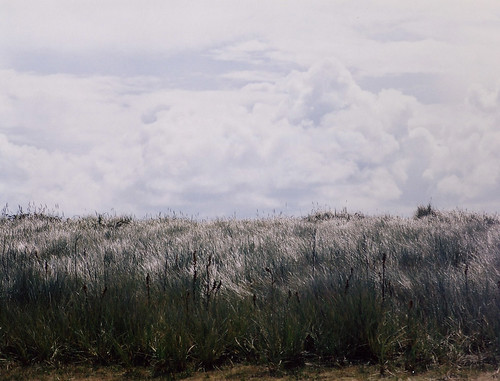
Waking in the marram grass

The photograph here shows some silver marram grass we saw on the island of Bryher a couple of summers ago. It was swaying invitingly and reminded me of Thomas A. Clark’s short poem on falling asleep in marram grass, a poem that can be seen on his website. As the Scottish poetry library site’s page on him explains, Clark runs the Cairn gallery which has recently re-located to Pittenweem. I have not visited the new version, but the earlier gallery in Nailsworth was a special place with the feeling of a sanctuary: above an old post office, quiet, white rooms hung with minimalist art works and, here and there, small poetic inscriptions. We last went there in 2002 when there was an exhibition that made a connection between Novalis and Ian Hamilton Finlay’s book The Blue Sail. In the midst of Finlay’s poems this book includes Novalis’s statement on the importance of romanticising the everyday. The title of the anthology also recalls Novalis’s symbol of the blue flower.


Wednesday, June 21, 2006

Arctic wind

An earlier entry (Ice Lens) described the Cape Farewell project, which has now arrived at the Natural History Museum as The Ship: The Art of Climate Change. One of the artists in this exhibition, Gautier Deblonde, has made a series of landscape photographs of Svalbard (the archipelago that includes Spitsbergen). His website has a range of these images, some of which are quite striking, like this photograph of a flock of birds.

There is an article about the Cape Farewell trip on the Open Democracy site. It includes a sound recording made by Max Eastley of the Arctic wind: “moderated through Aeolian flutes (simple tubes strapped to the rigging of the schooner Noorderlicht)”. At the Natural History Museum, Eastley has installed a kinetic sculpture which taps out sounds on ice-like blocks of glass.


It will be interesting to see the afterlife of the exhibition in these artists’ work. Was this a stimulating holiday from their normal subjects, allowing Gary Hume to paint a polar bear and Antony Gormley to cast himself in ice, for example, or will the Cape Farewell artists continue to draw attention to global warming and the plight of the Arctic?