Wednesday, April 12, 2006

Light floating like fog

The English version of Instant Light: Tarkovsky Polaroids is now available in paperback (Thames & Hudson). Andrei Tarkovsky took to using a Polaroid camera in the late seventies and these images of Vermeer-like interiors and landscapes of memory are a distillation of the particular atmosphere that some of us find compelling in his films. The Guardian site has some of these photographs alongside some brief commentary by Andrei Tarkovsky’s son (this commentary would have been welcome in the book – instead there are quotations from the director’s writings).

Instant Light includes an essay by photographer Giovanni Chiaramonte which is available at the excellent Tarkovsky site Nostalghia.com. Chiaramonte draws attention to the way these photographs capture different aspects of the light of Italy and Russia. There is ‘a soft, suffused light floating like the fog over the fields of the immense plain around Myasnoye’, Tarkovsky’s house in the country, ‘low, raking light given off by the grass in the woods’, and ‘evening light reflected, lighter than the sky, in the water along the bank of the Parà River’. For me, the small Polaroid photographs of the Bagno Vignoni, with steam rising from the water in a golden haze, are almost as affecting as the slowly moving images in the film Tarkovsky’s made there, Nostalghia.

Tuesday, April 11, 2006

Study of sunlight

I’ve just been to the Sir John Soane Museum to see The Tragic Genius of Joseph Michael Gandy. It is a small exhibition (free entry) prompted by a new Brian Lukacher book, Joseph Gandy: An Architectural Visionary in Georgian England. Here are some links to articles about the exhibition: Christopher Woodward, Deyan Sudjic, Kevin Jackson.

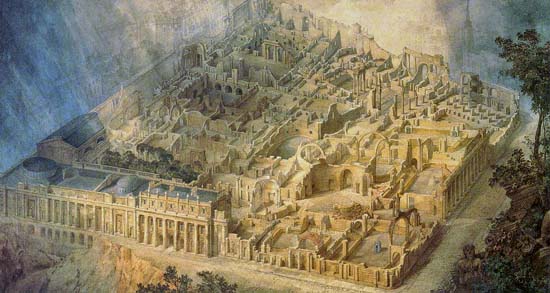
Joseph Gandy, cut away perspective drawing of the Bank of England as a ruin, 1830

Joseph Gandy (1771-1843) is probably most famous for being the first European artist to depict contemporary architecture in the form of future ruins, in his paintings of Soane’s designs for the Bank of England. In focusing on Gandy rather than the work of Soane, the exhibition reveals the latter’s qualities (and defects) as a painter in his own right. Perhaps the most interesting quality of his work is the varied use of light to create atmosphere. Soane called the magical light effects in Gandy’s architectural interiors ‘lumière mysterieuse’, and the exteriors often employ soft warm light that flatters Soane’s designs. The exhibition has a few small landscape watercolour sketches, some of which are exercises in light effects. One of them, for example, a Study of sunlight (March 1827) includes a note describing a parhelion: ‘this Phenomenon was an inverted Iris its colour vivid & Pure’.

Monday, April 10, 2006

Crystal-like rain-screens


‘I think the smoky, sooty surfaces of the walls of most London buildings do not bear close examination, but look beautiful behind the crystal-like rain-screens, which give them lustre.’ This is from Chiang Yee’s The Silent Traveller in London (1938), a travel book in which he sees the city with the eyes and sensibility of a Chinese landscape painter. ‘As I walk, the typical drizzle sometimes accompanied by gusts is blown in my face and brings an indescribable feeling…’ Reading this kind of thing almost makes the dismal spring weather acceptable: it’s possible to see beyond the wet wind stinging your face and sapping your energy and appreciate the city as if walking inside a misty watercolour.

It is not just the rain that brings Chiang Yee pleasure. He says ‘I have enjoyed the London fog in many circumstances.’ On one occasion a bemused Londoner tries to assure Chiang that he would be wasting a shilling to look at the view from Westminster Cathedral on a foggy day, but the ‘silent traveller’ makes the ascent anyway. From the top of the tower he looks out on a sea of mist, feeling as if he is in heaven, far away from the street and its traffic. He quotes an anecdote from Lin Yutang’s book The Importance of Living (1937) in which an American lady is taken to the hills of Hangchow to ‘see nothing’. As they climb she asks “what is there?” and is reassured that there are wonderful sights at the top. ‘Finally they reached the summit. All about them was an expanse of mists and fogs, with the outline of distant hills barely visible on the horizon.’

Sunday, April 09, 2006

The spring of Khosrow

Looking at images of a carpet at Sacramento Airport by Seyed Alavi, with its design showing satellite views of the Sacremento River, reminded me that one of the most famous of all carpets was made to illustrate a landscape. This was The Spring of Khosrow, a vast silk Persian carpet (84 x 35ft) depicting a royal garden. According to Penelope Hobhouse ( in The History of Gardening), it “used golden threads to represent the earth, shimmering crystal for the rills, and pearls for the gravel paths. Fruit trees in the geometric plots had trunks and branches shaped in silver and gold with precious stones representing flowers and fruit.”  It was also known as The Winter Carpet because it could be used when the weather was too bad to experience real gardens.  Sadly in 637, when the invading Arab army found the carpet at Ctesiphon, they cut it up and divided the pieces among themselves. However, the tradition of depicting gardens on Persian carpets has continued.

Friday, April 07, 2006

The black rocks of Brittany

In The Franklin’s Tale Chaucer describes the sadness of Dorigen as she stands on the high cliffs of Brittany looking out at the ships, thinking about her husband who has left her to win renown in England. The sight of the black rocks reminds her of the dangers of such a journey:

But whan she saugh the reisly rokkes blake,
For verray feere, so wolde hir herte quake
That on hire feet she myghte hir noght sustene.
Thanne wolde she sitte adoun upon the grene,
And pitously into the see biholde…

She cannot understand why God created such a beak, treacherous landscape and concludes

“… wolde God, that alle thise rokkes blake,
Were sonken into helle for his sake!
Thise rokkes sleen myn herte for the feere!”
Thus wolde she seyn, with many a pitous teere.
Hir freendes sawe that it was no disport
To romen by the see, but disconfort,
And shopen for to pleyen somwher elles;
They leden hir by ryveres and by welles,
And eek in othere places delitables.

So she avoids the black rocks in favour of more pleasant places, but she cannot forget them, and when a suitor, Aurelius, declares his love for her, the faithful Dorigen dismisses his attentions with a comment that he would have to destroy the coastal rocks before she could be his. Dorigen is then reunited with her husband, but in the meantime Aurelius has found a magus who can help cast a spell to create the illusion of a changed landscape. Dorigen is horrified when she sees that the rocks have disappeared, but eventually all ends well, with Aurelius accepting that Dorigen truly loves her husband and releasing her from the pledge.

Real and illusionary landscapes of Brittany play a central role in this beautiful story. The image of Dorigen standing on the headland seems to come from the Romantic period, but her attitude to the black rocks reflects a very pre-Romantic distrust of such dangerous landforms, whose very appearance suggests that they would be better “sonken into helle”.

Edward Burne-Jones, Dorigen of Bretagne longing for the safe return of her husband, 1871

Wednesday, April 05, 2006

Tree Mountain

Greenmuseum is a virtual space for environmental art with a lot of useful material. Among the featured artists is Agnes Denes, who is probably still best known for ploughing two acres of Manhattan with wheat in her 1982 work Wheatfield – A Confrontation (see below). A year later she designed Tree Mountain-Proposal for a Forest, a work that remained conceptual until the Finnish government announced at the 1992 Earth Summit that it would build the mountain. It would include 11,000 trees, planted by volunteers from around the world. Construction was finished in 1996, but of course the work continues to change: the site is legally protected for four hundred years. Each tree is owned by the person who planted it and their descendents, which means that ownership of an art work is also custodianship of nature. Whilst the trees will outlive their current owners and change hands, the forest itself cannot be owned by anyone. Images from the construction of Tree Mountain are available here and there are more recent photographs of the project illustrating a short essay by Agnes Denes, ‘What it Means to Plant a Forest’. 

Postscript 2023: 

This post originally included a single image of Wheatfield but the online link has long since disappeared. In November this year though I saw this set of photographs at the Barbican's Re/Sisters exhibition. As it's possible to take photographs in art museums these days, I am including my phone picture here.


Tuesday, April 04, 2006

Clear breeze and bright moon

The cycle of the seasons is celebrated in The Angler’s Calendar (1651), forty songs by the Korean sijo poet Yun Sondo (1587-1671). The spring section begins in early morning with fog on the stream and sunlight illuminating the black hills. The fisherman delights in the cries of cuckoos and the sight of blue willows on the riverbank and peach blossoms floating on the water. These petals remind him of the Chinese story of the Peach Blossom Spring, far away from earthly cares. This theme of joy and escape is maintained to the end of the poem, where winter’s clouds screen the poet from the world and roaring waves drown out its sounds.


Another evocation of spring in The Columbia Anthology of Traditional Korean Poetry is In Praise of Spring by Chong Kugin (1401-1481), translated by Peter H. Lee. Here again, petals on a stream suggest to the poet that he is near the source of the Peach Blossom Spring. He climbs between the pine trees to a hilltop and surveys the landscape of scattered villages, with mist glowing in the sunlight and spring colours covering the fields. Although he is without fame and rank, the poet is happy to have friends in “the clear breeze and bright moon.”

Monday, April 03, 2006

April at the Chateau of Dourdan


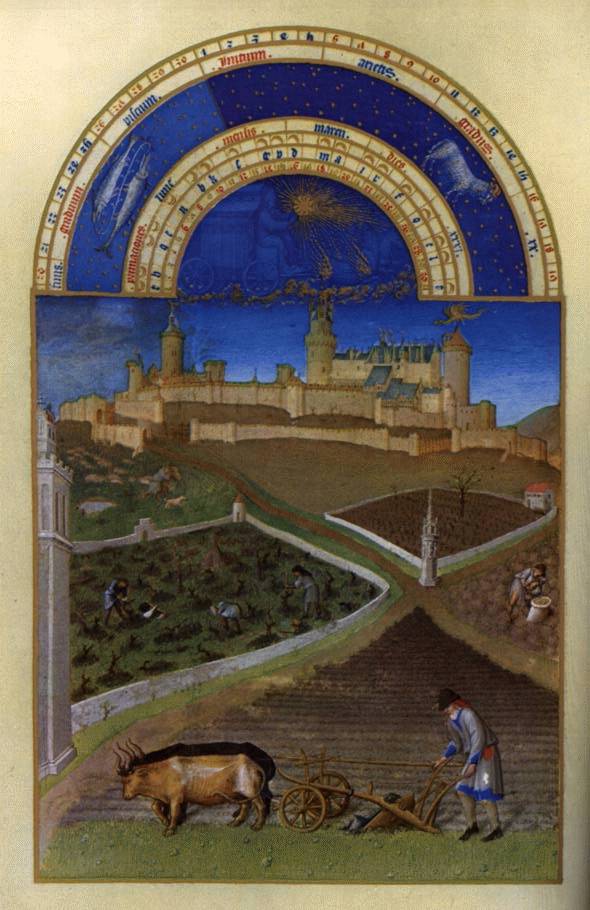
In the Limbourg Brothers’ Les très riches heures du Duc de Berry, April (above) is symbolised by a newly betrothed couple standing in a green landscape, with the Duc’s chateau of Dourdan dominating the background. March also features a castle, Lusignan, but the foreground is taken up with agricultural work: sowing and ploughing fields. In contrast April seems to convey the delights of spring - full of pleasure and hope for the future. Two maidens are picking flowers. The trees are in full leaf and new blossoms are visible in the orchard.

The miniatures were painted by the Limbourgs in 1413-16 and completed later by Jean Colombe. There are landscape elements in every month, ranging from February’s scene of winter snow to November’s detailed view of ploughing in fields near the Louvre. However the Hours also include many other illustrations of scenes from the Bible and these too display an interest in landscape: for example a plan of Rome, the Annunciation to the Shepherds in the hills near Bethlehem, and an unusual night scene at Gethsemane. Sadly the Limbourgs were not able to paint the Flight into Egypt, always a stimulating subject for landscape painters, and so it was left to Jean Colombe to execute this particular miniature.

Saturday, April 01, 2006

Fallen blossom

Spring seems at last to be with us. Here are twenty landscape-related season words (kigo) that are traditionally used in Japanese poetry set during the spring:

hibari - skylarks
kasumi – the springtime haze
kawazu – frogs
kigan – departing geese
ko no me – tree buds
oborozuki – hazy moon
ryuujo – willow fluff
saezuri – the twittering of birds
sakura - cherry blossoms
shirauo - whitbait
shunchoo – spring tide
shundei – spring mud
shunkoo – spring light
shunran – spring orchid
tanemaki – sowing seed
tsumikusa – herb gathering
uguisu - the bush warbler
ume - plum blossom
wasurejimo – last frost
zansetsu – lingering snow


For more kigo see the list of 500 Essential Season Words on the Renku Home site. There is a nice spring haiku by Arakida Moritake (1473-1549) in which he sees a fallen blossom returning to the bough, only to realise it is a butterfly:

rakka eda ni / kaeru to mireba / kocho kana

Friday, March 31, 2006

Splice garden

In Anne Whiston Spirn’s book The Language of Landscape there is an entertaining chapter in which she thinks up landscape equivalents for figures of speech: alliteration, anachronism, cliché, euphemism, litotes, metonym, synecdoche etc. etc. Some are more obvious than others. Looking for the more obscure figures of speech I was interested in her discussion of meiosis. Meiosis is defined here as a “reference to something with a name disproportionately lesser than its nature”, and their example, in Monty Python and the Holy Grail, is the Black Knight’s dismissal of the loss of both his arms in a fight with King Arthur as “just a flesh wound”. In landscape design, Spirn associates this kind of belittling understatement with the work of Martha Schwartz. Schwartz’s playful, conceptual gardens reject the ‘Nature Fantasy’ that underlies traditional landscape design. She aroused fierce criticism when Landscape Architecture Magazine featured her Bagel Garden on its cover in January 1980 and she remains a controversial figure. In a recent article by Tim Richardson in the Telegraph, for example, he says “it is surprising what fury Schwartz's work arouses among some horticulturists - in the past weeks, several contributors to this newspaper have told me they think that Schwartz is a trickster.”

The designs of Martha Schwartz can also be used to illustrate other figures of speech. Spirn discusses her Splice Garden (Cambridge Massachusetts) as an exemplification of paradox, oxymoron and conceit. This rooftop space (the location itself to some extent paradoxical) includes plastic flowers and witty juxtapositions, like a formal French clipped tree encircled by the raked gravel of a Zen garden.

Update 2015: Since writing this a lot more material has become available online and it has become possible to embed video clips in blog posts, so here is a Martha Schwartz lecture from Vimeo..

Tuesday, March 28, 2006

Utah Beach

It is now fifty years ago that J.G. Ballard published his first short stories. Rereading one of these, ‘Prima Belladonna’, recently I was surprised how much of the story is rooted in the form of fifties British SF, forgetting how much his work and the issues he writes about have changed, even though his preoccupation with surreal landscapes has always been there. Ballard’s vision of Vermillion Sands, the near future desert resort populated by idle dilettantes, first described in ‘Prima Belladonna’ remains pertinent, although perhaps its location would now have shifted to Dubai.


Another constant in Ballard’s work is his interest in landscapes transformed by military technology. In The Guardian last week, he was describing the strange Modernist structures of Utah Beach, which resemble those blockhouses of a nuclear testing site that feature in his story ‘The Terminal Beach’ (1964). Ballard implies in his article that few tourists visit Utah Beach, although surely it is only a matter of time before there are guide books to such sites, following the example of Robert Smithson’s essay ‘A Tour of the Monuments of Passaic’. There is already a J.G. Ballard group on Flickr, where seekers of the Modernist picturesque can view and deposit photographs of decaying military installations, abandoned hotels, failed utopias and entropic ruins.

Sunday, March 26, 2006

Wooden boulder

There is an interview with David Nash in Sculpture Magazine where he says “I think Andy Goldsworthy and I, and Richard Long, and most of the British artists’ collectives associated with Land art would have been landscape painters a hundred years ago. But we don’t want to make portraits of the landscape. A landscape picture is a portrait. We don’t want that. We want to be in the land.”

From a landscape perspective, one of Nash’s most interesting works is Wooden Boulder. This 25 year project is the subject of a documentary film, Boulder, by Pete Telfe, and various photographs and drawings by Nash. It began in 1978 when Nash was asked to fell an oak tree, for safety reasons, that overhung a cottage at Bronturnor, North Wales. Nash cut part of the tree into a large wooden ‘boulder’ with the aim of taking it back to his studio as a wood ‘quarry’. However, he decided instead to push it into the nearby stream, where it became wedged between rocks beneath a waterfall. This, Nash felt, was the right place for it. However, the wooden boulder’s journey had only just begun and in March 1979 it was washed into the pool beneath the waterfall. Nash then decided to give it a helping hand, pushing it over the next waterfall to another pool, where it rested eight years, taking on the appearance of a real boulder. What had originally been intended as the source of a sculpture had become a work of environmental art. The boulder remained in the stream whilst the landscape changed around it, but it continued to move intermittently when the river swelled.

By 1994, Wooden Boulder was resting below the road bridge just before the stream meets the river Dwyryd. David Nash has described the subsequent course of the boulder (see the Annely Juda Fine Art site): “I did not expect it to move into the Dwyryd river in my lifetime. Then in November 2002 it was gone. The ‘goneness’ was palpable. The storm propelled the boulder 5 kilometres, stopping on a sandbank in the Dwyryd estuary. Now tidal, it became very mobile…. The wooden boulder was last seen in June 2003 on a sandbank near Ynys Giftan. All creeks and marshes have been searched so it can only be assumed it has made its way to the sea. It is not lost. It is wherever it is.”

Saturday, March 25, 2006

Dry and verdant branches

In the July 2005 edition of Apollo Magazine, Clovis Whitfield describes the Arcadian landscapes of Francesco Cozza (1605-82). Whitfield is an expert on this period and a dealer in Old Masters (Whitfield Fine Art). The article reflects the connoisseurial importance of identifying Cozza’s landscapes and distinguishing them from more famous contemporaries and influences such as Claude, Poussin, Gaspar Dughet and Domenichino. For example, in discussing two paintings in the style of Claude, Whitfield says that “it is the figures in particular that suggest Cozza’s authorship, but the definition of the trees and foliage also reveals his handwriting.” From a landscape perspective it is perhaps these small differences in the natural elements that are most interesting. It is tempting to imagine that even fairly derivative work can hide a distinctive view of nature, even though Cozza’s trees and foliage are more likely simply to reflect his method of applying paint in the pursuit of idealised landscapes.

Here is a description of the way Cozza paints nature, in Clovis Whitfield’s discussion of a painting in the Rijksmuseum: “the dry and verdant branches of the trees, crossed trunks and sprouting mullein-like foliage on a dry and stony ground in the Amsterdam Hagar and Ishmael are a distinctive language. The trunks of the trees criss-cross the canvas in a way that recalls Poussin in his so-called ‘Silver Birch’ phase, with a dappled light catching the uneven bark. The branches seem to be laid out flat, like fern fronds, while it is the colouring that gives the foliage variety of appearance and depth.” Cozza’s landscape sounds caught between art and nature, both lifeless and alive, like those “dry and verdant branches”, or the “sprouting foliage on a dry and stony ground”.

Francesco Cozza, Hagar and Ishmael in the Wilderness, 1665
Source: Wikimedia Commons

Tuesday, March 21, 2006

Singing sands

Landscapes can be more or less musical. Desert sands have been known to sing and beaches that are silent when wet, can sound underfoot like Japanese koto music. David Toop mentions these phenomena in his book Ocean of Sound (1995). He refers to the researches of Shigeo Miwa into the gradual disappearance of singing sands across the world. A sample from Pensacola Beach in Florida was restored to voice by being boiled in water for 40 minutes to remove the pollutants. The sample is now in the Nima Sand Museum in Japan.

Since David Toop’s book there has been further research into the phenomenon of singing sounds. New Scientist reported last year that ‘Stéphane Douady of the French national research agency CNRS and his colleagues shipped sand from Moroccan singing dunes back to his lab to investigate. They found that they could play notes by pushing the sand by hand, or with a metal handle.’ You can hear impressive sounds of sands recorded by Doady at his website.

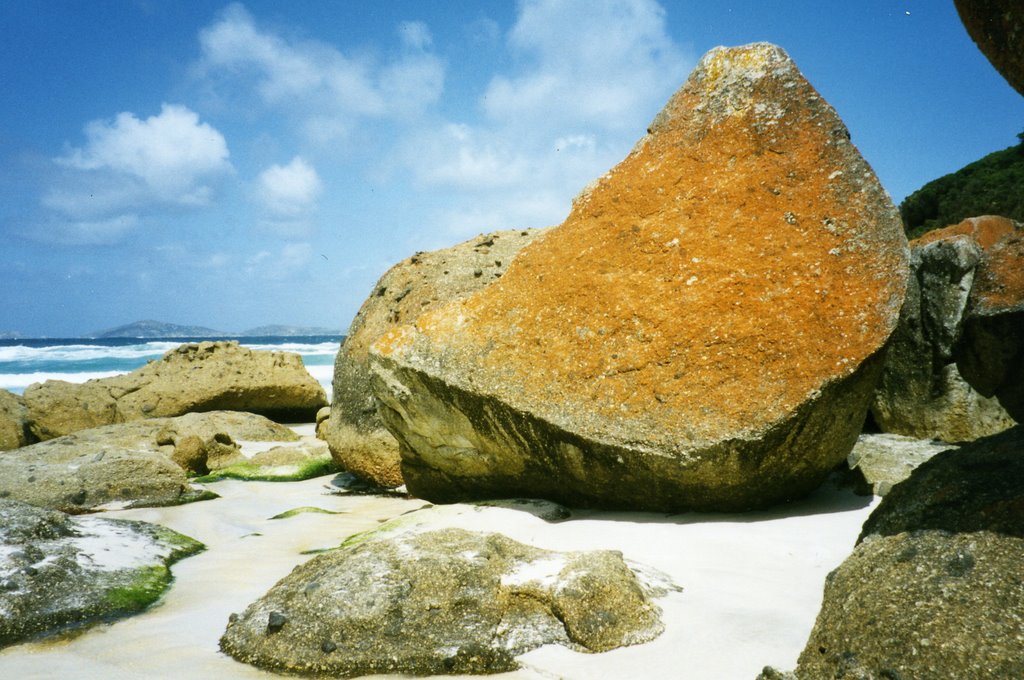
Singing sands are now being utilised by composers like Pippa Murphy (‘Voix du Sable’). The most famous British site for singing sands is on the Isle of Eigg. My only experience of a sand soundscape was Squeaky Beach, Wilson’s Promontory, Australia: the photograph below was taken there in 1996.


Sunday, March 19, 2006

Deer in snow

Ronald Hepburn’s essay ‘Trivial and Serious in the Aesthetic Appreciation of Nature’, argues that whilst it is ‘trivial’ to engage in an unreflective superficial reading of a landscape, it is just as trivial to resort to an ‘ironical, anti-Romantic, belittling, levelling reaction’ to the idea that landscapes can be beautiful. There is a balance to be struck. Nature needs to be respected and seen on its own terms, but this does not mean that only a detailed or objective ‘scientific’ reaction is acceptable. It is valid to appreciate natural landscapes in terms of metaphor, as long as we do not simply fall back on dead metaphors. Aesthetic appreciation of a landscape will involve the viewer in shaping the disparate elements into a unified whole, but serious appreciation means at the same time not losing site of the arbitrariness and otherness of nature.

In another essay reprinted in The Reach of the Aesthetic (2001), ‘Data and Theory in Aesthetics’ Hepburn continues this theme. He uses the example of a view of deer moving across a hillside in the snow. Here it is not essential to keep in mind the facts of ‘forestry as commerce or animals as food’ but, it is necessary to attend to the reality of this natural event rather than automatically experience it selectively according to pre-existing aesthetic criteria. Must an awareness of environmental concerns colour our appreciation of nature? “Certainly our cherishing of aesthetic experience must not be allowed to displace practical efforts to reduce environmental threats and dangers. But neither do these dangers have to dominate all our approaches to nature. There is room – and great need – for both.”

Hepburn also disagrees with Stan Godlovitch, who has argued for an aesthetic appreciation that recognises the categorical otherness of nature, implying a sense of being outside oneself. For Hepburn we do belong in nature and therefore the partial understanding we possess, conditioned by our culture, is a legitimate starting point for aesthetic appreciation. This appreciation should be is a synthesis that simultaneously encompasses nature’s mutability and stability, the landscape’s present appearance infused with a sense of its past.

Saturday, March 18, 2006

Somerset Place, Bath

There is a good essay by Julian Stallabrass, originally published in New Left Review, available on-line at the Courtauld Institute site, ‘Success and Failure of Peter Fuller’. Stallabrass says “for most of his career Fuller was beyond the pale of the art establishment; initially for his materialism, then for the accessibility of his writing, which at points threatened to puncture art's divine, money-spinning mystery, and later for his conservative debunking of the avant-garde. There was however a period in the mid to late eighties when it seemed as though Fuller might actually succeed in his task of turning the tide in favour of a conservative, specifically English art.”

Fuller promoted painters of the School of London and an interest in neo-Romantics like John Piper. Piper was interviewed in the second edition of Fuller’s magazine Modern Painters (Summer 1988). Fuller starts the article with a discussion of the post-war fate of Bath, whose ruins were bombed and painted by Piper, e.g. in Somerset Place, Bath (1942). He sees the possible re-birth of art after Modernism paralleled in the gradual healing of Bath after the horrors visited upon it by insensitive sixties architects. Fuller views Piper as a progressive force and argues that Piper’s work had actually been at its weakest when it tried to accommodate modernism and the influence of contemporary artists like Richard Hamilton (a friend of Piper’s).

It is interesting now to look back at the sort of artists Fuller praised. Later in the same issue of Modern Painters, Fuller reviews and defends the work of two landscape painters, Paul Hempton, who is “not nostalgic”, and Michael Williams, who is “not ashamed” to be a water-colourist. Fuller writes that the current (1988) “remarkable revival” of landscape painting may eventually be recognised as “one of the most significant developments in British art of the current decade”. I think it’s safe to say that this recognition hasn’t happened yet…

Friday, March 17, 2006

Corsons Inlet


A. R. Ammons’ ‘Corsons Inlet’ is one of the best known twentieth century landscape poems and has generated much discussion about poetic form since its publication in 1965. The poem evokes the movement of a walk in its shapes and rhythms. Here, for example, are the opening lines

I went for a walk over the dunes again this morning 
to the sea, 
then turned right along 
   the surf 
              rounded a naked headland 
              and returned 
    along the inlet shore:

There are a series of critical reflections on the poem in the useful Modern American Poetry site. Five examples:

  • Richard Grey (in American Poetry of the Twentieth Century) discusses the form of the poem as a field rather than a closed object, “There are, Ammons suggests, 'no / ... changeless shapes': the poet-seer must invent structures that imitate the metamorphic character of things. The organisms he creates must respond to life as particularity and process; they must be dynamic, unique to each occasion; above all, they must be open.”
  • Paul Lake (‘The Shape of Poetry’ in Poetry after Modernism. Ed. Robert McDowell) thinks that modern developments in chaos theory go against the idea that landscape lacks formal structure. By analogy, there may be more promise in formal poetry than is suggested by the organic natural form Ammons was writing in ‘Corsons Inlet’.
  • Bonnie Costello (‘The Soil & Man's Intelligence: Three Contemporary Landscape Poets’, Contemporary Literature 30:3) notes that for Ammons the "mirroring mind" is “not mimetic so much as congruent, finding coordinates to match, not copy, the particulars of the landscape.”
  • Steven P. Schneider (in A.R. Ammons and the Poetics of Widening Scope), echoing Harold Bloom, writes that in ‘Corsons Inlet’ Ammons “finds "direct sight" more liberating than the contemplation of the Sublime. In Ammons's universe, the apperception of physical, manifest phenomena and processes yields pleasure and sometimes pain. Despite the lure of the Transcendent, he resists it.”
  • John Elder (Imagining the Earth: Poetry and the Vision of Nature) says that in Ammons’ poetry the “sequence of natural shifts and the path of human consciousness” provide “an ecologically balanced art”.

Tuesday, March 14, 2006

Land of Darkness

Thomas Jones is renowned for his Italian oil sketches, but should be just as well known for his memoirs, which are often cited by historians of eighteenth century landscape painting, but, bafflingly, remain out of print. They can be read in Volume 32 of the proceedings of the Walpole Society (for 1946-48). In this extract Thomas Jones and Francis Towne find that Nature can occasionally be just too Picturesque...
June 2nd 1781 This day crossing the Mola piccola I saw a large crowd of People assembled round two circular vacant Spots about ten or twelve pases asunder - in each of these lay a man extended on his back with a knife in his hand - dead - It seems two of the Sbirri or guard of the Place had a quarrel, stabbed each other, and both fell - getting through the multitude as well as I could I proceeded to meet Pars, according to appointment at an Osteria in the road to S'a M'a de Monti - In this hollow Way is a most beautiful Series of picturesque Objects, which I discovered by Accident in one of my perambulations - Here may be visibly traced the scenery that Salvator Rosa formed himself upon - Only taking away the Pinetrees, which were, perhaps, a planted since his time, and which indicate a State of Cultivation not suited to his gloomy mind, with the addition of Water & a few Banditti - And every hundred yards presents you with a new and perfect Composition of that Master - When Towne was in Naples, I took him with me to this romantick place, with which he seemed much delighted - but the following whimsical Incident put a stop to further explorations at that time and which I forgot to mention in its proper place - Proceeding up the valley whose boundaries contracted more and more as we advanced, increasing in proportion the Gloominess of the Scene; We arrived at a Spot, which might very properly have been termed the Land of Darkness and the Shadow of Death - This sequestered place was environed on all Sides, with hanging Rocks here and there protruding themselves from behind dark masses of a variety of Wild Shrubs, and overshadowed by branching Trees - Here, says I, Mr Towne, is Salvator Rosa in perfection we only want Banditti to compleat the Picture - I had scarcely uttered these words, when turning round a Projection of Rocks, we all-at once pop'd upon three ugly-looking fellows dressed in the fantastic garb of the Sbirri di Campagna, with long knives, cutting up a dead jackAss… Towne started back as if struck by an electric Shock… "I'll go no further" says he, with a most solemn face, adding with a forced smile, that however he might admire Scenes in a Picture - he did not relish them in Nature, - So we wheeled about and returned to the more cultivated environs of the City.

Sunday, March 12, 2006

Distant View of Lowestoft

Thomas Kerrich, Distant View of Lowestoft from the South (possibly 1794)

In looking at early oil sketches from nature there is a sense that they are pure views unencumbered by picturesque formulae, not only fresher than academic landscapes, but also offering some kind of direct window on the past. This is particularly true when the painting is a simple objective study of a hill, a clump of trees or some scattered buildings, rather than familiar tourist views such as Tivoli, Posillipo, or the Baths of Caracalla. Eighteenth century sketches pre-dating photography are particularly interesting in this respect and the works of Thomas Jones (1742-1803), Pierre-Henri de Valenciennes (1750-1819) and Simon Denis (1755-1812) have grown in reputation over the last fifty years.

Collectors have also discovered more obscure painters, like Thomas Kerrich (1748-1828), a Cambridge antiquarian and librarian who was best known as a draughtsman. One oil sketch by Kerrich is on long term loan to the National Gallery, a Distant View of Lowestoft from the South (possibly 1794), part of the Gere collection of oil sketches. It is a simple view of a bay on a rather grey English day, with broad expanses of sand, sea and sky and very little topographical detail. As Christopher Riopelle noted in the catalogue to A Brush with Nature: The Gere Collection of Landscape Oil Sketches (1999), ‘the simplicity and directness of this image suggest a precocious and original approach to landscape. The work of a trained artist, but not essentially a painter, it is at the same time remarkably unfettered by a reliance on conventional landscape formulae.’ 

Pompeo Battoni, Portrait of Thomas Kerrich, c. 1774
Source: Wikimedia Commons

Saturday, March 11, 2006

The Hudson Valley in Winter from Olana

Frederic Edwin Church, Winter Twilight from Olana, 1871
Source: Wikimedia Commons

The National Academy Museum in New York is currently hosting the touring exhibition ‘Treasures from Olana: Landscapes by Frederic Edwin Church’. Olana is the Persian style home Church built overlooking the Hudson (see the Olana website). Chuch made sure that after his death in 1900 the house and its contents would remain together.
 
In his review of the exhibition in the New York Review of Books, John Updike points out the irony that this crowded oriental fantasy house crammed with Victorian bric-a-brac should also house Church’s freshest works: rapid oil sketches that the artist kept and framed. The Hudson Valley in Winter from Olana (c 1871-2, 13 x 20 ¼ inches) for example is praised by Updike for the “dashing dabble of rapid brown strokes that does for winter foliage”, “the boldly crude splatter of white clouds scattered on the blue sky overhead” and snow “more creamy, and drifts more sweepingly indicated” than can be found in the landscapes of almost any other American painters.
 
It is of course a familiar story - the oil sketches of a celebrated artist appealing more to modern tastes than the large scale finished works. It will be interesting to see how this theme is addressed in the forthcoming Constable show at Tate Britain. Another British parallel to Church is Lord Leighton, whose vivid oil sketches are often much more appealing than the paintings that brought him fame and the presidency of the Royal Academy. Like Church, Leighton was fascinated by the Near East and created for himself an idealised oriental space in Leighton House (this interior photograph dates from about 1879). It too is open to the public and is, I am told, an excellent party venue.