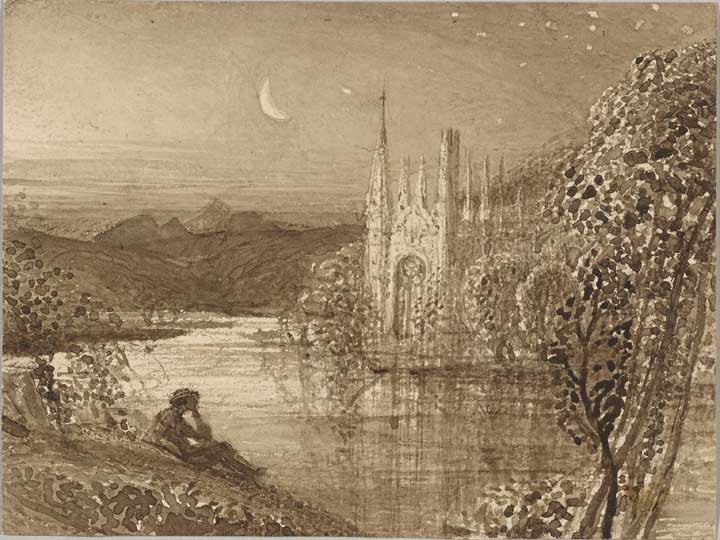
Showing posts with label Thomas Gainsborough. Show all posts

Saturday, December 04, 2021

Trees, possibly beside a lake

 Thomas Gainsborough, A View in Suffolk, c.1746

In 2017 Lindsay Stainton discovered that an album of 25 drawings in the Royal Collection were the work of the young Thomas Gainsborough. They are currently on show at York Art Gallery. These views may have been influenced by Dutch painting but they also reflect a deep engagement with the patterns and shapes of trees and paths near Gainsborough's home. I particularly enjoyed seeing his experimentation with different techniques. In the example below, he uses black and white chalk, sharpened and held in a porte-crayon. The curators note that 'he blended the chalks into the paper with a wad of tightly rolled leather, called stump, to create smoother tones and more subtle light effects. He employs this technique extensively to depict the soft outlines of the clouds and the misty pool.' In a finished painting (above) you still feel he's experimenting with ways of animating a simple view, with hazy light through mobile clouds creating interesting effects in every turn of the road and slope of the dunes.

 
Thomas Gainsborough, Trees, possibly beside a lake, c.1746 - 48 

It was a pleasure to leave the congested streets of York for the tranquillity of this exhibition, with its peaceful wooded vistas only occasionally interrupted by a distant figure or a donkey. In addition to the Gainsboroughs the exhibition includes a video installation, Clay, Peat, Cage (2015) by Jade Montserrat and Webb-Ellis, described as 'a contemporary counterpart to Gainsborough’s landscape practice.' Gainsborough mentally immersed himself in the details of his local woods and heathland. In 'Clay' Montserrat physically immerses herself in the soil, squatting naked, digging and smearing herself with earth. 'Clay' also provides a thematic link to the ceramics on display upstairs, which have become a speciality of the museum. If you are near York I would recommend popping in as you may have the exhibition almost to yourself as I did (see photo below). And Gainsborough's landscapes are a great tonic for the spirit in these difficult days. As John Constable once said, 'on looking at them, we find tears in our eyes and know not what brings them.'
Sunday, April 27, 2014

The Ruins of Hohenbaden

 
Carl Philipp Fohr, The Ruins of Hohenbaden, (1814-15)

Today was the last day to see A Dialogue with Nature, an excellent little exhibition at The Courtauld which included works from New York's Morgan Library & Museum that I'd not seen before, like Carl Philipp Fohr's 'jewel-like watercolour', The Ruins of Hohenbaden (1814-15).  I was particularly fascinated to see German paintings and drawings like this alongside those by familiar British names (Cozens, Girtin, Turner etc.).  Three more examples: Caspar David Friedrich's The Jakobikirche in Greifswald as a Ruin (c. 1817), the kind of nineteenth century 'anticipatory ruin' highlighted in the Tate's current Ruin Lust exhibition; Theodor Rehbenitz's strange little Fantastic Landscape with Monk Crossing a Bridge (c. 1826-30), a throwback to the style of Dürer's woodcuts; and the composer Felix Mendelssohn's sketchbook for 1837-9 open to show that popular Romantic trope, the view from a window.  Although there were few surprised in these British and German artists' subject matter, the exhibition conveyed a wonderful sense of technical creativity in the means used to engage in 'a dialogue with nature'.  I left with a mental list of ways in which an innovative artist of the period might demonstrate a distinctive landscape vision...

  • Use stylised strokes...  I have written here before about the vocabulary of marks used by Chinese landscape painters and named after the natural phenomena they resembled, like tan wo ts’un – 'eddies of a whirlpool'. The Courtauld curator drew attention to the foliage in Johann Georg Wagner's Wooded landscape with stream and oxcart on road (1760s), depicted using 'whirls and coils in a lively, almost calligraphic manner', a device which 'imbues this tranquil scene with vitality and movement.'  Wagner didn't have a chance to develop his style, dying at the age of just twenty-two (the same age at which Carl Philipp Fohr was killed, after an accident swimming in the Tiber). 
  •  
  • Use a 'stump'...  This was how Thomas Gainsborough, in Wooded Upland Landscape with Cottage, Figures and Cows (c. 1785), created subtle shades of grey on the road leading into the picture, the walls and the trees beyond and the distant hills and clouds in the background.  By rubbing a tightly rolled stump of leather or paper over the surface he left areas of soft shadow that contrast satisfyingly with the grainy texture of the unsmoothed chalk elsewhere in the landscape. 
     
  • Add gouache and gum arabic...  Mainly self-taught, Samuel Palmer also used distinctive ways of applying ink and paint, like the stippled trees in The Haunted Stream (c. 1826).  But what's really striking about another experiment, Oak Tree and Beech, Lullingstone Park (1828), are the different materials used. The extraordinary fiery evening light in the depths of the trees is 'yellow watercolour over white gouache, to which he applied gum arabic, imparting shine, and occasional dots of red watercolour.'
     
  • Choose coloured paper... The exhibition included one of Constable's cloud studies in which, it appears, he had insufficient time to record all the gradations of colour.  Nearby is one of the 150 cloud studies made by his German contemporary Johann Georg Dillis, executed with white chalk on blue paper so that he could avoid the issue of colour and concentrate on pure form.  I would love to see a large selection of these all on display together.

  • Leave a hole...  The moon must present a particular challenge for landscape painters and Turner makes it look easy in the Courtauld's On Lake Lucerne, looking towards Fluelen (1841).  Hung next to this in the exhibition was Friedrich's Moonlit Landscape (1808) in which he made no attempt to paint the moon itself: instead a circular hole was left so that a blank piece of paper behind shines through. In fact this was originally designed to be illuminated by lamplight and viewed to the accompaniment of music.
  • Saturday, October 05, 2013

    Matlock Tor by Moonlight

    Joseph Wright of Derby, Matlock Tor by Moonlight, 1777-80

    The lure of landscape painting was described by Joseph Wright of Derby in a letter to the textile manufacturer and art collector John Leigh Philips: ‘I know not how it is, tho’ I am engaged in portraits and made a dead colour of a half length yesterday, I find myself continually stealing off and getting to Landscapes.’ This was in 1792, fifteen years after returning from Italy to his native county, where he could paint views like Matlock Tor by Moonlight.  Such picturesque scenery was in Thomas Gainsborough's mind when he wrote from Bath in 1768 to his friend James Unwin in Derbyshire: ‘I suppose your Country is very woody – pray have you Rocks and Waterfalls! For I am as fond of Landskip as ever.’ But like Joseph Wright he felt constrained by the demand for portrait painting: a trip to Derbyshire would be fine if only ‘the People with their damn’d Faces could but let me along a little...’  And in a similar vein the witty and rueful passage below, in a letter Gainsborough wrote to William Jackson, may resonate with any reader who feels they cannot spend enough time away from the pressures of work, out in the landscape.
    ‘I’m sick of Portraits and wish very much to take my Viol da Gamba and walk off to some sweet Village where I can paint landskips and enjoy the fag End of Life in quietness and ease. But these fine Ladies and their Tea drinkings, Dancings, Husband huntings and such will fob me out of the last ten years, & I fear miss getting Husbands too – But we can say nothing to these things you know Jackson, we must jog and be content with the jingling of the Bells, only damn it I hate a dust, the Kicking up of a dust, and being confined in Harness to follow the track, whilst others ride in the wagon, under cover, stretching their Legs in the Straw at Ease, and gazing at Green Trees & Blue skies without half my Taste, that’s damn’d hard.’
    Thomas Gainsborough, Portrait of Miss Evans, 1786-90

    Saturday, May 21, 2011

    The Mountain That Had to Be Painted

    Contemporary artist Iwan Gwyn Parry tackling Arenig in
    'The Mountain That Had to Be Painted'

    This week I've been unable to do more than collapse in front of the TV after long days at work, so I have appreciated the fact that BBC4 has been showing a Landscape Season.  There has been a lot of outdoor stuff - lakes (Wainwright), mountains (Munro), the golden age of canals and even a documentary on the A303 ('Highway to the Sun').  They repeated Alice Roberts 'titillating middle-aged men' (according to The Guardian) with her wild swimming, and in 'The Great Outdoors' they took 'a nostalgic look at life for campers, twitchers, ramblers and metal detectors'.  I missed the programme on R. S. Thomas (on too late...) but caught another one set in the Welsh landscape, 'The Mountain That Had to Be Painted'.  This was an account of the time Augustus John and James Dickson Innes spent in the Arenig Valley painting 'a body of work to rival the visionary landscapes of Matisse.'  Whilst it did little to dispel the impression that Auguston John's life is more interesting than his art, the programme provided a valuable introduction to the work of Innes, who died (like some old country singer) at the age of 27 from a mixture of TB and wreckless living.  For more on Innes and the Arenig school, see a recent post on the Footless Crow mountain writing blog. 

    Earlier in the week there was an hour-and-a-half long history of English landscape painting, 'This Green and Pleasant Land.'  The programme discussed a sequence of paintings from the time of Charles I (Rubens and Van Dyck) down to World War Two (Paul Nash and the patriotic posters of Frank Newbould), with a final leap forward to David Hockney's recent iPhone sketches. As it started we wondered who the extraordinarily plummy-voiced narrator was - Brian Sewell my wife thought, but it turned out to be Simon Callow.  Fearing a rather conservative survey we nevertheless ended up enjoying the eclectic mixture of people they had invited to talk about each painting - from the 'editor at large' of Country Life, who suggested that Gainsborough's Mr and Mrs Andrews could easily be imagined in his magazine today, dressed in Barbour jackets and Hunter wellies, to a foundry manager who said he had a reproduction of Coalbrookdale by Night hanging up at home in the hallway.  It was worth enduring Peter York explaining his fascination for Atkinson Grimshaw in order to see John Virtue discussing Constable and sketching the sea. Will Self was on amusing form recalling the horror of growing up, as the son of a theoretician of garden suburbs, while actually living in a garden suburb ("that'll do things to a child!").  The programme generally covered the key works you would expect, although I was surprised they missed out Samuel Palmer and spent so much time on Stubbs (who I see I've never mentioned here).  All in all, well worth watching if you have access to the BBC iPlayer - available for 6 more days as I write this...
     
     Will Self discusses William Ratcliffe's