Showing posts with label war landscapes. Show all posts

Friday, August 15, 2025

Balcony in the Forest

I recently read this beautiful novel and will mention it here for the way it evokes the Ardennes forest landscape during the winter of 1939-40. Its hero, Grange, is a lieutenant in the French army posted to a concrete bunker on the Belgian border. 

Ostensibly readying for war, Grange instead spends his time observing the change in seasons, falling in love with a young free-spirited widow, and contemplating the absurd stasis of his present condition. This novel of long takes, dream states, and little dramatic action culminates abruptly in battle, an event that is as much the real incursion of the German army into France as it is the sudden intrusion of death into the suspended disbelief of life.

At the start of the book, Grange takes up his appointment and travels in an empty train along the River Meuse. "A train for the Domain of Arnheim", he thinks, referring to the Poe story with its uncannily perfect landscape which I wrote about here some years ago. The forest has a different quality of strangeness. As he is driven up to the blockhouse in an army truck, Grange observes the denseness of the trees, with just an occasional path like an animal trail. On this watershed there are no streams but at one point 'a thread of clear water ran: it added to the silence of the fairy-tale forest.'

The dreaminess of this world is partly down to the way Grange experiences the landscape on night patrol. Here is an example: 

There was a powerful charm in standing here, so long after midnight had sounded from the earth's churches, deep in this placeless gelatin masked by pools of fog and steeped in the vague sweat of dreams, at the hour when the mist floated out of the forest like spirits. Grange gestured to Hervouët and both men held their breath for a moment, listening to the great respiration of the woods around them that made a kind of low and intermittent music, the long, deep murmur of an undertow that came from the groves of firs near Les Fraitures; over this tidal undulation they could hear the crackle of branches along some nocturnal creature's course, the trickling of a spring, or sometimes a dog's high-pitched howl roused by the moon, such sounds rising at one moment or another out of the smoking vat of the forest. As far as the eye could reach a fine blue vapor floated over the forest - not the dense fumes of sleep but rather a lucid, quickening exhalation that disengaged the mind, making all the paths of insomnia dance before it. The dry and sonorous night slept with its eyes wide open; the secretly wakened earth was full of portents once again, as in the age when shields were hung in the branches of oaks.

I looked up reviews of the NYRB reprint (the translation was first published back in 1959), but couldn't find much online. There is one in the TLS that says 'for all its oneiric qualities, A Balcony in the Forest presents Grange’s fantasies in prose that is lyric, yet precise; Richard Howard’s translation of 1959 still seems fresh. Unfortunately…' - and unfortunately at this point the paywall kicks in so I cannot see what the caveat is! It might concern the young widow Mona, who has been criticised as a male fantasy figure, although I confess I was captivated by her and reminded of the women in Nerval's Sylvie, a book whose admirers included Julien Gracq. There are some excellent articles on Gracq online, for example, Seth Lerer's in the Yale Review and Paul Dean's in Literary Matterswhich has a detailed discussion of Balcony in the Forest (which would spoil the story if you want to read it). I have written briefly here before about Gracq's 1976 book of fluvial reveries, The Narrow Waters.

Finally, I will mention that the NYRB paperback has an excellent cover that uses a detail from Peter Doig's etching Concrete Cabin (1996). Doig's cabin is surrounded by trees but very different to the bunker Grange and his four men inhabit. It is Le Corbusier's Unité d'Habitation in Briey-en-Fôret, northeast France (further south than the setting for the novel), partly derelict when Doig visited it in 1991. As an essay on the Christies site puts it, 'the strange, displaced nostalgia that haunts so many of his landscape paintings has here been transferred from the isolated barns and houses of Canada to a large building in France.' Doig's paintings and etching now preserve a memory of Le Corbusier's building before it's renovation (and perhaps also prefigure a time when it will fall into ruin again).

Tuesday, May 27, 2025

Der Rhein

Some landscapes in the Ashmolean's exhibition Anselm Kiefer: Early Works, with quotes from the accompanying wall texts. 

Der Rhein (The Rhine), 1982 

'The Rhine has been a German national symbol while also providing a border to France. During the Romantic era of the early 19th century, countless travelogues by writers such as Friedrich Hölderlin and paintings by J.M.W. Turner helped develop a fascination with the beauty of Rhine landscapes. The river also played a major role in Wagner's opera cycle, The Ring. Kiefer's woodcut collage, however, is equally concerned with the political connotations of the Rhine, merging its landscape with National Socialist architecture.'

The building in Der Rhein relates to a series paintings showing Nazi architecture Kiefer made in the early eighties - the exhibition included a watercolour, Innenraum (1982) of Albert Speer's New Reich Chancellery, destroyed in 1945. Christie's sold a similar woodcut to Der Rhein for £313K in 2012 and their description includes this quote from Kiefer: ''I grew up on the banks of the Rhine. France was on the other side. As a child, I saw the river as an insuperable obstacle, something you couldn't swim across. It thus acquired a mythical status for me. When you came to this barrier you could turn left or right but not go straight ahead, except in your imagination." The Rhine (Melancholia) is the name of an Anselm Kiefer installation I wrote about in 2014, 'a collage of black-and-white woodcuts on canvas with acrylic and shellac compiled over more than two decades, between 1982 and 2013.' 


Unternehmen 'Trappenfang' (Operation Bustard Hunt), 1976 

'The title of this painting references a WWII military codename, 'Unternehmen Trappenjagd' ('Operation Bustard Hunt'). The words summon the aftermath of an attack, a landscape scarred by the treads of troop movements and tanks. In May 1942, Germany bombed the easternmost tip of Crimea, the Kerch Peninsula, amplifying the destruction by artillery and tank divisions. Looming above Kiefer's scene is not a bustard but a large painter's palette, linking war memory with an emblem of artistic identity.'

Kiefer often uses high horizons with paths heading towards them, invoking ideas of motion through time. This horizon has a snow covered village, a dark church spire and a bleak grey sky. Looking here at how he was painting fifty years ago, I thought how similar it is in many ways to Kiefer's most recent work, which we have seen in shows at the White Cube gallery. His Superstrings for example, which I discussed here in 2019, are 'desolate landscapes of earth, snow, muddy water, stubble, straw and leafless trees.' I said then that I could see a connection between such paintings and Van Gogh's ploughed fields, something that may well be apparent in the forthcoming Royal Academy exhibition that will pair the two artists. 


Ausbrennen des Landkreises Buchen (Burning of the Rural District of Buchen), 1974 

'This book features photographs of Buchen, where the artist's studio was located, and carbonized sections of former paintings. The photos initially focus on farmland and streets, before showing staged explosions. The final pages present charcoal-encrusted paper. Devoid of people, the photographs allude to the economic decline of Buchen. The explosions also reference the presence of the German armed forces.'
Matthew Biro's Phaidon monograph on Kiefer has a section on this work. 'Leafing through the book engenders a sense of moving through Kiefer's rural environment', but what starts as apparently simple representations of specific geographic regions end up with images overpainted in black wash, singular 'originals' rather than repeatable photographic reproductions. At this time Kiefer was interested in ideas of destruction: 'in addition to burning a town, as it were, Kiefer also flooded Heidelberg in two volumes from 1969 and covered the Brandenburg Heath with sand in four tomes from 1976'. The Ashmolean exhibition had the original 1974 Buchen book, but Kiefer made seven more on the same theme the following year. I referred to one of these in a previous post and quoted Martin Gayford: 'this is how the traditions of Friedrich and Schinkel looked and felt to Kiefer in the aftermath of the Third Reich: burnt out, haunted by overpowering, terrible events.'

Stefan I, 1975

Poet and translator Stefan Anton George was embraced by the Nazis as a hero, despite his criticism of National Socialism and self-imposed exile to Switzerland. In Kiefer's surreal paintings he appears to be resting on his death bed. The works allude to the charged complexities of German cultural heritage and present an attempt to redeem George from political exploitation. 
I can never resist a giant figure in a landscape (see various previous posts) and the exhibition had two watercolours of Stefan George as a mountain. In the other one a sun is setting behind slopes that incorporate his head, and there is an inscription 'aller Tage Abend, aller Abende Tag' (the Evening of All Days, the Days of All Evenings). This is a reference to Ernst Bloch's Principle of Hope, which encourages positive social change, a book with a utopian message that was influential when these paintings were made.

Die Kunst geht knapp nicht unter (Art Will Survive its Ruins), 1975 

'Kiefer travelled to Norway's North Cape, where summer sunlight appears never ending. The location was associated with a 1943 battle, when a German battlecruiser was sunk by a British ship. Over 1900 people drowned. Kiefer's title refers to German post-war discourse on art which had been censored, denunciated or misused to propagate Nazi ideologies. As the German title of Kiefer's work suggests, art almost 'drowned'. The North Cape, however, shaped through several ice ages, is representative of survival.'
I have written here before about the North Cape, subject of some eerie nineteenth century landscape paintings by the Peder Balke. Kiefer visited in 1974 and described the experience in an interview with Klaud Dermutz. 'I’d spent some time that summer on North Cape and there you have that phenomenon in which the sun barely sets. It grazes the horizon and then rises again. This made a deep impression on me, the way the sun at first appears to set but then doesn’t. On the watercolour Nordkap [North Cape, 1975], I wrote ‘die Kunst geht knapp nicht unter’ [art just barely avoids going under or just barely survives]. It’s very difficult to define art, impossible, in fact. It can’t really be grasped. Art is like a fish you pull out of the water that then slips away from you. Art is always very endangered, constantly under threat.'

Saturday, October 12, 2024

Lost in the sand


I've been on an Irish culture kick over the last month: first the film Kneecap, then Juno and the Paycock with Mark Rylance and then Arán & Im, a performance in which Manchán Magan talked about the origins of Irish words while making sourdough bread (very tasty). Magan is the author of Thirty-Two Words for Field: Lost Words of the Irish Landscape so there was a lot that evening of relevance to this blog. However, I'm going to focus here instead on my fourth Irish cultural event, a trip today to Matt's Gallery to see Remnant, Willie Doherty's new exhibition of black and white photographs and video footage. There were foggy woods (see below), dead leaves and branches, empty streets, blank walls, peeling paint, stains, graffiti, broken bricks and roadside puddles. The videos (shot in Derry, Donegal and by the River Boyne) also showed a moon seen through bare black boughs, a stretch of fast flowing water, rocks slowly dripping and flat waves covering and uncovering a small stretch of sand.  


I've not really kept up closely with Willie Doherty's work since discovering it many years ago when I first got into Hamish Fulton and Richard Long, who were also combining landscape photography with text. The curators note that images like the one I've included above resemble his early work, but instead of having text imprinted on them - words like 'undercover', 'shifting ground' or 'the other side' drawing links to recent political history - Doherty installs them here alongside three videos that contain relatively little movement and words read aloud by Stephen Rea. In the course of this monologue he says things like "fear trapped in the gaps where men and women were displaced" and "the living and the dead side by side" and "all traces lost in the sand, absorbed into the sea". It is all pretty gloomy, but Rea's quiet voice made me want to keep listening.

The gallery has copies of an interview Doherty did with Tim Dixon and I'll end here by quoting something interesting in this about the woods he photographed.

These forests which sprung up all along the border, [are] usually in places where the land is not really of any great agricultural value. These forests were planted, I don't know when they started really, probably sometime in the seventies and eighties. And they're kind of horrendous because they're just very generic pine forests, which are planted in rows and not really maintained or looked after very well, so they become a bit of an eyesore really. But significantly, at least one of the people who was assassinated and then buried by the IRA in the early seventies, one of 'the disappeared', Columba McVeigh, whose body has never been recovered, was buried in a remote border area somewhere between a bog and one of these forests. So it has a significance in that respect, and the first section of one of the strands of dialogue in the work refers to a figure who's dead—a kind of ghost who talks about being in the wrong place at the wrong time.

Friday, November 03, 2023

The Airfields of Lincolnshire

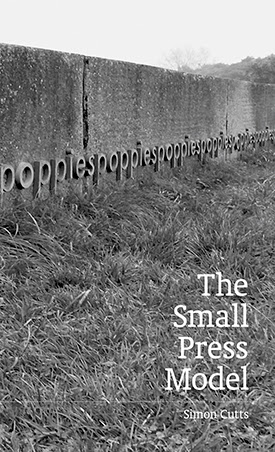
The cover of Simon Cutts' The Small Press Model is a photograph of his 'forgotten one-word poem' which can be found outside Skellingthorpe, 'A History of the Airfields of Lincolnshire'. It comprised seven slabs of concrete taken from RAF Sinderby with letters in orange anodised aluminium, glued on 'with the fiercest epoxy and a contraption that allowed it to set'. You can read a description at Simon's blog. Within the book is a the script for a talk he gave in New York called 'The Metaphor Books' which describes the book version of this poem and a later version where the word 'flax' is used to evoke the image of flak and the blue flowers that were becoming more prevalent on the old airbase. I doubt I'll ever visit Skellingthorpe, but I did have a look on Google Earth and found the sculpture - see my screenshot below (there is a visual glitch where the software has joined up photographs). Presumably that's the photographer's bicycle, well chosen to match the orange lettering.

The Small Press Model discusses artists and writers that I have written about here over the years, like Ian Hamilton Finlay, Richard Long and Jonathan Williams. Of particular interest for my theme is the introduction to The Unpainted Landscape, a 1987 exhibition that featured Finlay, Long, Thomas Joshua Cooper, Roger Ackling, Hamish Fulton, Andy Goldsworthy and Chris Drury (I've linked these names here to different Some Landscapes posts). The only artist Simon Cutts describes that I've not mentioned before is David Tremlett, who was up for the Turner Prize back in 1992 with his wall drawings. The Tate owns one of his early works, The Spring Recordings, comprising short soundscapes collected during 1972 in all 81 counties (there is a detailed description on their website). The tapes should ideally be heard when the work is on show, but in The Unpainted Landscape they were lined up on a shelf as 'a silent wallwork, referring to its source and potential replay.'

The Small Press Model was reviewed a few months ago on Caught by the River by Sukhdev Sandhu. 'Like its publisher Uniformbooks, The Small Press Model celebrates the local, the non-metropolitan, those who have a ‘resolve for a critical alternative to mainstream publishing’. ... It’s a model that stands for the dignity of production, the importance of collaboration, the need for alternative networks—and alternative publics.' The book's short texts range over five decades and the cumulative effect of reading them is to feel moved by lives 'built and lived' to support the idea of poetry - as words, objects, spaces and projects, carried out with serious attention to detail and a playful, questioning creativity.

Sunday, May 07, 2023

Atlantic Flowers


Last year I bought the latest New Arcadian Journal, Atlantic Flowers: The Naval Memorials of Little Sparta. 'The upland garden of Little Sparta is evocative of distant seas. Atlantic Flowers offers fresh insights into the poetic gardening of Ian Hamilton Finlay (1925-2006) by acknowledging that the warship sculptures are simultaneously naval memorials.' This makes it sound like quite a specialised study but the pleasure of reading the journal (essentially a beautifully illustrated book), is that it conveys a lifetime's engagement with the garden as a whole and Patrick Eyres' long friendship with Finlay. An appendix provides a bibliography of ten previous NAJs and eleven New Arcadian Broadsheets devoted to Little Sparta and IHF. Photographs show how garden features have evolved over time, since Patrick's first visit in 1979. Paintings, drawings and artworks are reproduced on almost every page, based on the work of Finlay and NAJ collaborators and friends like Chris Broughton, Catherine Aldred and former-Mekon Kevin Lycett.

The last artwork discussed in Atlantic Flowers was installed in 2001, not long before Finlay's death: Camouflaged Flowers. This was conceived as a monument to the men of the wartime Flower Class corvettes, ships that had been given incongruously pastoral names like Begonia, Larkspur and Heartsease. Some of them were transferred to the US Navy during the war and renamed; in 'Ovidian Flowers' Finlay highlighted these metamorphoses: Begonia became Impulse, Larkspur Fury and Heartsease Courage. Nicholas Monsarrat wrote about life on board a corvette in The Cruel Sea. In his memoir he described these boats as 'cramped, wet, noisy, crowded, and starkly uncomfortable.' They may have had lovely floral names but they were all the same: 'wallowing cages for eighty-eight men condemned to a world of shock, fatigue, crude violence and grinding anxiety' (It Was Cruel, 1970). Finlay's Camouflaged Flowers was the culmination of his interest in the Flower Class corvettes, following printed works, wall plaques and an obelisk. It consists of seven brick plinths with bronze plaques commemorating five ships: Lavender, Campion, Polyanthus, Montbretia and Bergamot. Three of these survived, two were torpedoed. Polyanthus sunk with total loss of life.

I'll conclude here with Patrick Eyres' description of Camouflaged Flowers, which Finlay located 'high on the hillside at the edge of moorland, where they are exposed to wind and the vagaries of weather.'

'Here this monumental artwork is an epic composition that embraces the 'disparate elements' of garden and landscape, planting and sculpture, weather and seasons, and which is animated by leaf, blossom and berries. Now that it has matured, we can appreciate that the moorland swell and undulating horizon are evocative of Atlantic seascapes. The plantings can be imagined as the waves, through which the corvettes plough their way. Sea states are intimated by the foreground grasses, whether windblown or swaying in the breeze.'

Thursday, December 31, 2020

Rock and Brook


The Coat of Arms of Alland, Lower Austria

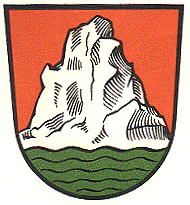
I like the way that when you look somewhere up on Wikipedia you tend to get given its coat of arms and I've noticed over time that the heraldry for particular places and regions occasionally includes landscape features. Rivers are an obvious example. Wikimedia includes a whole category 'rivers in heraldry' which range from the subtle - just wavy lines or patches of blue - to complete symbolic landscapes like the one above, for the market town of Alland in Austria. 

Although my father is a heraldry buff, I know little about it and so I will have to quote here from the International Heraldry site. They explain how landscape symbols ('charges') have been used over the years:

The oldest geological charge is the mount, typically a green hilltop rising from the lower edge of the field, providing a place for a beast, building or tree to stand. Natural mountains and boulders are not unknown, though ranges of mountains are differently shown. An example is the arms of Edinburgh, portraying Edinburgh Castle atop Castle Rock. Volcanos are shown, almost without exception, as erupting, and the eruption is generally stylised. In the 18th century, landscapes began to appear in armoury, often depicting the sites of battles. For example, Admiral Lord Nelson received a chief of augmentation containing a landscape alluding to the Battle of the Nile. 

Lord Nelson's coat of arms - note the landscape above the shield.

If you take a particular European region and look at its heraldry you will mostly see lots of lions and eagles and crosses, but there will also be a few clues to the local topography. Taking a pretty much random example, consider the state of Rhineland-Palatinate in Germany, which has twenty-four districts. River symbols representing the Rhine appear on the arms of the districts of Ahrweiler, Germersheim and Rhein-Pfalz-Kreis. A wavy white line in the arms of Mayen-Koblenz represents both the Rhine and the Moselle. The district of Südliche Weinstraße is named after the tourist wine route and has a white bar representing the route and grapes representing the wine. As this shows, such designs are not ancient, although they can incorporate older motifs - the Rhein-Pfalz-Kreis shield includes water lilies which were used in earlier Rhineland heraldry. The best one from a landscape point of view is shown below. The jug represent the ceramic industry, the green band refers to forests and the basalt columns symbolise the Westerwald's volcanic rock.    

The Coat of Arms of Westerwald District, Rhineland-Palatinate
 
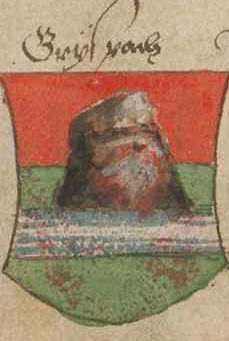
If it seems reductive to think of place as mere landscape, for example by representing a complex four dimensional environment within a two-dimensional painting, then an image like this goes a stage further. Here we have an icon signifying a whole district of Germany made of just three colours and three shapes. It has to be said that modern heraldry like this can seem no more interesting than corporate branding. I am sure though that there are fascinating examples of landscape in the history of heraldry if you dig into the subject (which I've not done). I did a quick search and came up with one: Bad Griesbach in Bavaria, which has a design canting on the name of the town (Gries = rock, Bach = brook). The Heraldry Wiki includes the modern arms but also an image from a manuscript of 1599. This is rather lovely and could almost be a fragment of an early landscape painting. 
 
The Coat of Arms of Bad Griesbach im Rottal, Bavaria

Friday, February 21, 2020

Mirages of landscapes leaping upwards


In July 1942, Filippo Tommaso Marinetti and Tullio Crali published in Rome a Futurist Manifesto entitled 'Plastic Illusionism of War and Perfecting the Earth'.  It was inspired by Crali's work on camouflage projects and it suggests that the 'plastic illusionism' used in Futurist painting could be used both to deceive enemy pilots and confuse them with 'visions of accelerated fractured cityscapes' and 'mirages of landscapes leaping upwards'.  And it goes further, arguing that the landscape itself could be altered - giving 'a volumetric character to plains', for example, by raising up artificial mountains.  These points read like a manifesto for Land Art and indeed Crali himself later argued that he had 'anticipated the interventions of American artists in this sphere by thirty years.'  In their vision for 'perfecting the earth', Marinetti and Crali wanted to 'refine the severe rugged aspects of wartime landscapes and cityscapes and their brutal masses.'  They would both 'virilise' and 'feminise' war-torn Italy, spirtualising and purifying it through the interventions of aeropainters, aeropoets, aeroarchitects and aeromusicians.

The aeropaintings of Tullio Crali are currently on display at the Estorick Gallery - their earlier exhibition devoted to the aeropainter Gerardo Dottori was the subject of a post I wrote here back in 2014.  Crali was much younger than Futurists like Dottori and Marinetti; he was only born in 1910, the year of the first Futurist Manifesto, and he lived until 2000, long after Futurism had become part of art history.  By the time the American Land Artists were coming to attention, Crali was a step ahead, thinking about extraterrestrial artworks.and writing his Futurist Manifesto of 'Orbital Art' (1969).  Some examples of his ideas are below - I particularly like the idea of the 'message-trains of audiovisual poetry' heading out into the cosmos like the Voyager golden record.


Another of Crali's artistic projects at that time (for which he had written a Manifesto in 1959) were the Sassintessi, compositions of stones mounted on neutral black or white backgrounds.  These were originally inspired by trips to Ploumanac'h where he saw the rocks that had fascinated earlier artists like Eileen Agar (her photographs have been admired, in turn, by Tacita Dean - see my earlier post, 'Rocks at Ploumenac’h, Brittany').  In her review of the Crali exhibition, Laura Cumming notes the novelty of the Sassintessi and thinks that 'every now and again they hit the mark, when Crali takes some sea-carved rock and twists it out of kilter, so that it suddenly looks like a rushing futurist figure.'  I was intrigued by the idea and by some examples, like Future Fossil of the Mechanical Civilisation (1963) which would fit right into a contemporary Anthropocene-themed exhibition.  Crali's rock collecting also inspired his son Massimo, who became a geologist.  Massimo's wife, Anna, was partly responsible for the exhibition and has been interviewed about it for a piece in the Telegraph.  

Finally, I should mention Tullio Crali's paintings.  After the war, he made various aerial views that combine abstract space with details of lakes or mountain peaks.  They reminded me a bit of Peter Lanyon's later works, particularly in the way they convey the intense blue of the sky.  Even as a nineteen-year old, Crali was making interesting compositions of intersecting clouds and planes of light, expressing the excitement of his first flight in 1928 ("the rebelliousness of the wind, air pockets, steep climbs: everything was wondrous...")  Arcs of overlapping colour are used to great effect in Lights at Sunset in Ostia (1930).  As Laura Cumming writes, this captures a moment when 'the shadows of hill and vale deepen, and rays of dying light arch between earth and sky. Translucent green patches stand for trees and clouds, and everything meets at the vanishing point of the ocean, radiant and serene – perhaps the most beautiful scene Crali ever painted.'

Saturday, November 02, 2019

Chateau d'If


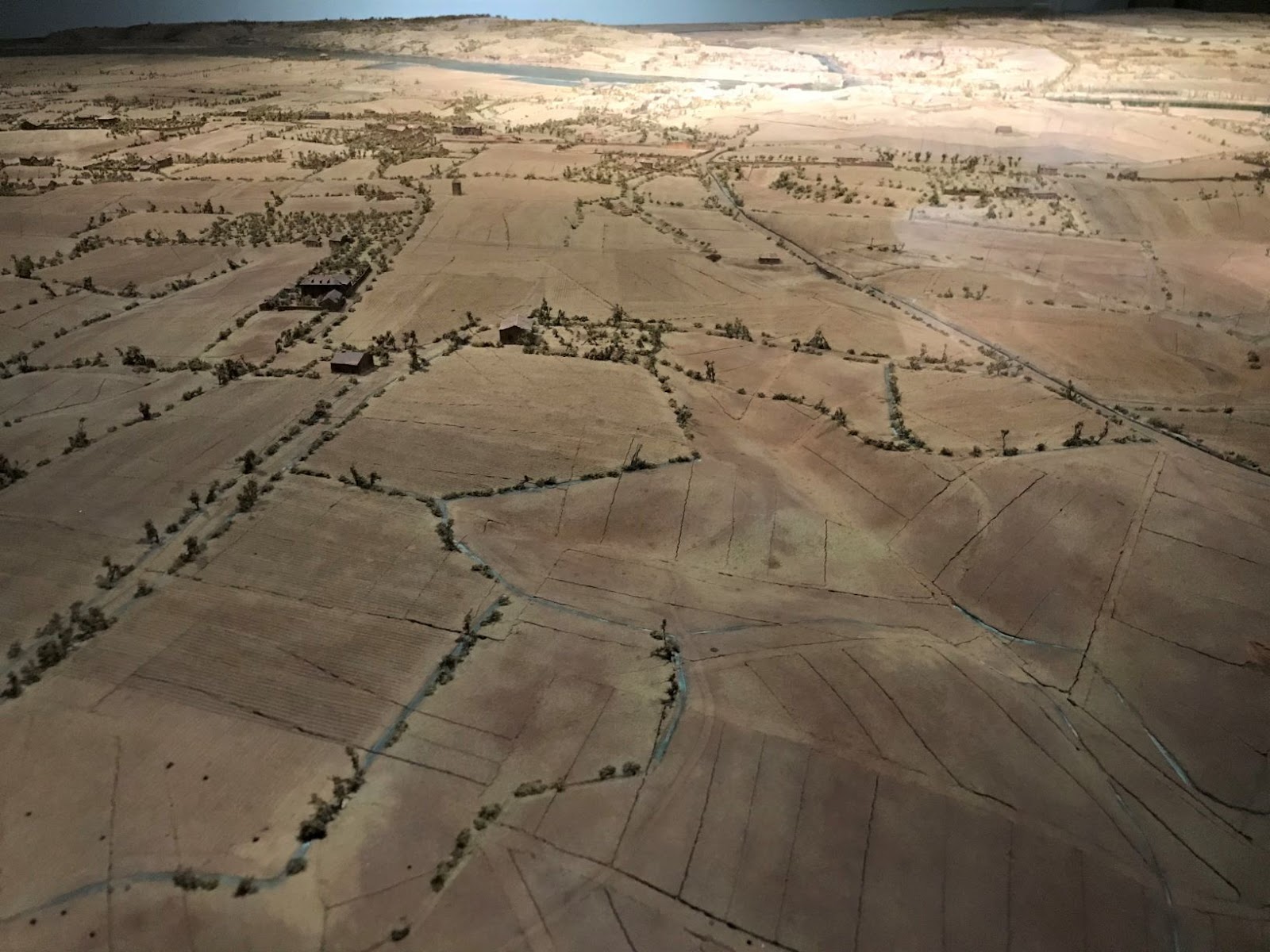
Two years ago I wrote here about the plans-reliefs that Andrew Graham-Dixon visited for a TV documentary - he described them as 'a collection of extraordinary but largely forgotten' table-top landscapes. I mentioned that some of them remain in Paris and last weekend I got to see them - they are on display in Les Invalides.  I framed the photograph above so that this example resembles a real aerial landscape.  However, it is eerily empty - there are roads and buildings but no sign of actual human life: no figures in the fields, no cattle or horses or any other animals.  None of the relief maps show anything happening in these landscapes.  They are quite different from the models we are used to seeing in museums that recreate a key historical event or evoke everyday life at some date in the past.  The plans-reliefs represent a rather bleak vision of the world, as mere terrain to be defended or fought over.  Seeing a relief map of Saint-Tropez in this context was a particular shock - a place that conjures ideas of life at its most joyous - sun, sea, wine, music and Brigitte Bardot on the beach...


Near the glass cabinet dedicated to St Tropez, there is another one containing the Chateau d'If.  I remember that when I first began reading The Count of Monte Cristo I didn't realise that this place, a strangely-named island fortress near Marseilles, was a real location (or that Monte Cristo is an actual island).  But as this relief map from 1681 shows, the Chateau d'If was a key French fortification long before Dumas wrote his novel and the fictional Edmond Dantès was wrongly imprisoned there. Chateau d'Ifs have subsequently multiplied in the many adaptations of Dumas' novel: plays, films and, most recently, video games.  Sometimes other islands have stood in for it - Saint Mary's Tower on Comino, for example, was used in a 2002 film.  Dumas himself would later create another kind of model of the Chateau d'If.  In 1846 he bestowed the name on a grand writer's studio that he had built in the grounds of his country home.  But Dumas spent a lot less time there than Dantès spent in the Chateau d'If - just two years later, short of money, he had to sell it.

Friday, April 12, 2019

The Living Stones


The Living Stones (1957) is one of two illustrated travelogues written by surrealist Ithell Colquhoun in the mid 1950s and recently re-published by Peter Owen. They now come with a foreword by comedian and Colquhoun fan Stewart Lee (who, funnily enough, doesn’t mention the negative view of jokes and comedy she expresses on p212 of The Living Stones).  It is easy to see why they have been reprinted now, in a period where so many people have been delving into folk rituals, ancient stones and hidden landscapes.  The Living Stones is an exploration of what we would now call the psychogeography of West Cornwall.  Ithell Colquhoun may be most familiar as an artist (her 1938 painting Scilla in the Tate is a well known example of bodily forms as landscape - two rocks like a woman’s thighs and a patch of seaweed resembling pubic hair), but she was also prominent in esoteric circles. Lee calls her a gnostic travel guide and says that her drawings and cryptic titles originally drew him to buy these volumes, as part of ‘the long-standing folk-mystic second-hand book bender I’m still on.’

I will quote here from the penultimate chapter, ‘Hills of Michael’, in which Colquhoun describes what she calls ‘the ancient centres of Michael-force.’  One Michaelmas Day she climbed a hill to find Chapel Carn Brea, only to find that ‘the summit was littered with dismal reminders of the war, when a radar station had been established here.’
Disused defences collect about them a miasma-like aura which infects them almost physically; this happens to no other buildings in the same degree. Whether this emanation is due to the residues of hatred, fear, boredom and sex-frustration left by the servicemen who have been stationed in them I do not know, but they constitute a centre of astral pestilence. For this reason alone they should be destroyed, but since a plea for their liquidation based on such grounds would be disregarded, one can only point out their deleterious effect on amenity, which is serious enough.  
Turning from this ‘unsavoury debris’ she looked towards a small granite carn and felt drawn to it as ‘the chief remaining vortex of the Michael-force on this much impaired centre’.
Here, perhaps, was the site of that Chapel of St Michael de Bree, which was granted in 1396 by the Mount’s prior to the hermit Ralph de Bolouhal. He kept a light burning in it for the guidance of travellers and fisherman by night, While during the hours of light its whitewashed walls would serve, like those of many coastal shrines, as a day mark. Leaning against the massive boulders or reclining in the shelter they afforded from a wind which otherwise would have made me cough, I mused for an hour, enveloped in air, space and sunlight.

Wednesday, February 13, 2019

A view of Magdala

Watercolour World is a new online database of documentary watercolours painted before 1900 which launched at the end of January.  You can use filters and search by a keyword, e.g. 'waterfall', which brings up waterfalls in South Australia, Japan, Italy, French Polynesia and so on.  Enter 'Cozens' and you get a selection of watercolours by Cozens (although the first one is a Turner painting 'after J. R. Cozens').  But perhaps the main attraction is a map which you can zoom around and look for specific landmarks or places.  The distribution of watercolours on the map shows that this is a British initiative - there are over 25,000 watercolours for the British Isles but only around 50 for Japan (and those Japanese images are by late nineteenth century British illustrators).  They do have global ambitions, but the emphasis on 'documentary' images means that there is bound to be a bias towards cultures which valued topographic accuracy (either as art or as part of some branch of science).


Why watercolours and not, say, oil sketches?  Well non-watercolours are allowed in - they include aquatints and pencil sketches, for example, 'at our discretion'.  Perhaps surprisingly, they are happy to have images where the location is unknown, tagging these to the home of the artist.  How do they choose the images?  'We try to select images that have a clear connection to a real person, place or event, that the artist could plausibly have known first-hand. A painting of a battle that happened years before the artist was born would not be included, but an artist's satirical painting of Londoners in a pub would stay.'  As this last comment indicates, the website goes beyond landscape and covers all kinds of subject matter.  I am not sure how they would feel about, artists who were moving away from simple representation, a Cézanne watercolour of Mont Sainte-Victoire, for example.  There are none of these in the database; the only image from this part of Provence is a view of Aix-en-Provence by William Callow dating from 1836.

William Simpson, Untitled (Magdala), 1868
British Museum

I thought I would check out a a part of the world I don't recall featuring before here - Ethiopia.  In addition to a few archaeological drawings, I came upon the view above. It shows 'a vast stretch of bare tableland with winding gullies, and three figures in the foreground on the spur of a hill'.  There is no further context - the website refers you to the British Museum for more information.  In fact William Simpson had gone to Abyssinia as an illustrator for the London Evening News, covering the British Army's punitive campaign against the Ethiopian Emporer, who had captured British hostages.  Simpson arrived at Magdala after the fighting was over - those tiny figures are therefore looking out over a landscape that had recently seen a siege and bombardment.  Before leaving Magdala, the troops were permitted to loot it and some of the artifacts they took found their way eventually into London museums like the British Museum.  An Association For the Return Of the Magdala Ethiopian Treasures was formed in 1999 to lobby for their return to Ethiopia.

Friday, July 06, 2018

The Lake of Ashes


Claude Lanzmann died this week - obituaries can be read here, here and here.  For all the praise that Shoah received, it can still feel as if the film is underrated, perhaps because to praise Lanzmann's settings and use of sound would seem like trivialising his subject.  I have considered trying to write here about landscape in Shoah but felt I could not really do the subject justice.  Shoah seems to demand a response as long and complex as the film itself, and its methods raise many questions about documentary methods and ethics.  However, Lanzmann's approach to landscape can be stated very simply.  Eschewing archive material, he let much of his interviews play out against footage of the sites the victims were talking about, shown as they appeared nearly four decades later: the remnants of concentration camps, rail tracks through dark forest trees, village streets revealing nothing of their past. Lanzmann's style can be seen in the context of other European films from the period that made use of atmospheric long takes - Stalker, Kings of the Road, The Enigma of Kaspar Hauser - but I can't think of anything remotely as powerful.  And Shoah still looks extraordinary in comparison with the imagery of contemporary filmmakers, such as Tacita Dean whose work I was discussing here last month.  If you have never watched the whole of Shoah, I cannot recommend it too highly.


Saturday, October 28, 2017

Dresden in Ruins


Earlier today I was looking at these images while listening on headphones to a recording the BBC reporter Wynford Vaughan Thomas made during an air raid on Berlin.  His voice was clear over what he described as the constant noise of the Lancaster bomber's engines, though his oxygen mask made speaking difficult.  These masks "reduced to uniformity" the individuals in the crew, men like the plane's bomber who before the war had been "a Sussex farmer".  As I listened, I imagined "the enemy coastline" looking something like the first of these two ambiguous images.  Then I began to see them as clouds the aircraft passed through as it approached the city.  Once the attack began, they came to resemble explosions of flack surrounding the bomber as it dodged the German searchlights.  Finally I thought of the dust, smoke and debris that would be left behind by the bombing mission.  These two drawings, chalk on slate, are by Tacita Dean and were specially made for this exhibition, Melancholia: A Sebald Variation.  The recording of the air raid is described in W. G. Sebald's book, On the Natural History of Destruction.


For me, one of the highlights of this small show was being able to see a selection of photographs from the W. G. Sebald archive in Marbach.  In addition to the two examples above, there were images of Vesuvius erupting, a man on a bicycle, a rocking horse, a young girl, a prosthetic leg, an isolated building and a group of people attending to something we cannot see.  Some of Sebald's photographs are reproduced in the small catalogue you can pick up for free (see below).  In another room there were photographs of the ruins of Dresden and a vitrine containing books on the Allied bombings, including Der Untergang by Hans Erich Nossack which Sebald particularly praised in his 'Air War and Literature'.  Two of Wilhelm Rudolph's ink drawings from the series 'Dresden in Ruins' looked at first glance like sixteenth century prints.  You come to them immediately after looking at the etching that gives this exhibition its title, Albrecht Dürer's Melancholia (1514).


In addition to Tacita Dean's drawings, there were works by other contemporary artists I have discussed on this blog before: Anselm Kiefer, Susan Hiller, Dexter Dallwood, George Shaw.  After seeing these - all of which I thought well chosen - I pushed open a Sebaldian black velvet curtain to watch a video work by Guido Van der Werve.  I was instantly confronted with the sight of a man on fire, running past an orchestra and into a canal; this was followed by a sequence in which a dark figure (the same man?) swam purposefully down various rivers for reasons that were a mystery.  I was just thinking how effective this was when the figure got out of the water and onto a bike (see below).  It transpired that he was doing an epic triathlon across Europe, which seemed a disappointingly unSebaldian pursuit, even if it did involve carrying some soil from the Polish church where Chopin's heart is buried.  I left him to it and returned through the curtain.  Before leaving, I spent a few minutes watching footage of Sebald himself, in an interview with Susan Sontag filmed two months before his death.  Then I headed out, back past the images of ruin and Dürer's Melancholia.  'For Sebald,' the curators write, 'melancholy was the only possible response to the brutality of the past.'  


Saturday, October 21, 2017

Red Cliff

Unidentified artist in the style of Sheng Mou, 
Fan painting illustrating Su Shi's 'Second Ode on the Red Cliff', 
late 14th/early 15th century 
Source: The Met, public domain

Earlier this year I wrote about the Battle of Red Cliff, focusing on landscape in the poetry of Cao Cao, the warlord whose army was defeated there by the combined forces of Sun Quan and Liu Bei.  The battle's most famous literary retelling is in The Romance of the Three Kingdoms, one of the Four Great Classical Novels of China (I discussed one of the others, Dream of the Red Chamber, here five years ago).  There is no dwelling on natural scenery in The Romance of the Three Kingdoms - the focus is entirely on the action, one of hundreds of battles in this vast novel covering an extraordinarily turbulent historical period.  But The Romance of the Three Kingdoms is only one lens through which the conflict has been remembered, as you can see in A Thousand, Thousand Churning Waves - The Legendary Red Cliff Heritage, an online exhibition at the Taiwan National Palace Museum.  Here I want to focus on the influence of Su Shi's two Red Cliff Odes, written in 1082, three centuries before The Romance of the Three Kingdoms.  These two poems have themselves been the inspiration for artworks in many forms; I mentioned one - a stone seal - 1,002 posts ago, and have included some others here: a fan, a vase, a scroll, a plate and another stone seal.

 Square form vase decorated with Su Shi's Odes on the Red Cliff, c. 1662–1722
Source: The Met, public domain 

The two 'Odes' Su Shi wrote were in the wen fu form - fu were prose poems, and the wen fu was more prose than poem.  Burton Watson includes translations in his wonderful Selected Poems of Su Tung-p'o (Tung p'o means Eastern Slope and was the literary pseudonym Su assumed after building a residence on a Huangzhou hillside in 1081, thus incorporating a landscape feature into his actual name).  I will summarise the two poems here, with the knowledge that this can't really do them justice - they are very beautiful even in translation, so it does not seem surprising that they have been so admired in China over the last thousand years.  Just one thing to note though: the landscape that so moved Su Shi was not really the place where Cao Cao's forces were defeated in 208 CE (the precise location is still disputed).  As Burton Watson writes, 'because of its fame, many other spots on the Yangtze came to be called Red Cliff; the one where the poet and his friends are the spending the evening is not the actual site of the battle but considerably farther down the river.'

 Zhao Mengfu, The First Red Cliff Ode of Su Shi and His Portrait, 1301
Source: Wikimedia Commons 

The First Ode.
On an autumn night, Su Shi and some friends ventured out in a small boat to the foot of Red Cliff, drinking wine and admiring the moon.  'White dew settled over the river, and its shining surface reached to the sky.  Letting the boat go where it pleased, we drifted over the immeasurable fields of water.'  Inspired by the wine and the scenery Su composed a song while one of his friends played mournful notes on the flute.  They remembered the poem Cao Cao composed (see my earlier post) and his vast army on the river, 'yet where is he now?'  Su Shi suggested that they should take comfort in the changelessness of things - the river water never ceases to flow and the moon always rises.  Realising they had nothing left to eat, the friends lay down in the boat to sleep, 'unaware that the east was already growing light'.

Silver plate showing a scene from the First Ode, 13th century
Source: Minneapolis Institute of Art, public domain 

The Second Ode.
Later that autumn, with the trees bare and frost on the ground, Su Shi was joined at his home by two guests.  They decided to make another trip to Red Cliff but when they got there Su realised the landscape had changed.  'The river raced along noisily, its sheer banks rising a thousand feet.  The mountains were very high, the moon small.  The level of the water had fallen, leaving boulders sticking out.'  Su begun to climb the embankment, leaving his friends trailing behind.  At the summit he gave a shrill whoop and the trees and grass swayed.  A wind suddenly rose and he felt a chill of fear.  He returned to his friends and they got back into the boat, letting it drift on the water.  A single crane flew in from the east, swooping low over the boat.  That night, back at home, Su dreamed that a Daoist immortal in a feather robe came to him and asked whether he had enjoyed his outing to Red Cliff.  Su recognised him as the crane.  The immortal just turned and laughed and when Su woke up, he was gone.

Tianhuang Seal showing Su Shi beneath Red Cliff, first half of the 19th century
Source: The Brooklyn Museum, public domain 

Saturday, April 22, 2017

The voice of the north wind sad

Zhang Fengyi as Cao Cao in John Woo's Red Cliff (2008-9)

In a post earlier this month I referred to the musical duel in Red Cliff, John Woo's epic film about  events at the end of the Han dynasty, based on 'the Iliad of China', The Romance of the Three Kingdoms.  The composer/writer I discussed there, Cai Yong, only briefly features in The Romance of the Three Kingdoms and doesn't appear in Red Cliff, but here I want to focus on Cao Cao, the great warlord at the heart of the story, whose army is defeated spectacularly in the movie.  Cao Cao was himself a renowned poet and wrote a famous poem just before the Battle of Red Cliff.  You can see him recite it in the clip from YouTube below - a scene from the 95-episode Chinese TV dramatisation Three Kingdoms.  This moment has often been depicted in art - there is a painting in the Long Corridor of the Beijing Summer Palace, for example, and I have reproduced below a Japanese ukiyo-e print showing Cao Cao composing the poem in a boat, with the moon rising and crows wheeling in the sky.


Tsukioka Yoshitoshi, Moon rising over Mount Nanping, contemplated by Cao Cao, 1885

The real reason for mentioning Cao Cao on this blog is not his eve-of-battle composition, but a beautiful short poem 'Viewing the Ocean', which is an early example in world literature of pure landscape poetry.  Here are the first six lines in Burton Watson's translation; the Jieshi (Chieh-shi) mountains overlook the Bohai Gulf.
East looking down from Chieh-shih,
I scan the endless ocean:
waters restlessly seething,
mountained islands jutting up,
trees growing in clusters,
a hundred grasses, rich and lush.
Other translations of the full poem can easily be found online (there are two on a Chinese Poems site for example).

Another poem of Cao Cao's that has stayed with me over the years (since reading it in Burton Watson's The Columbia Book of Chinese Poetry) is the 'Song on Enduring the Cold'.  This was probably written in 206 when Cao Cao was leading his troops across the Tai-hang mountains to attack a rival.  Taken out of context though, it could simply be a description of an arduous mountain journey - 'stark and stiff the forest trees, the voice of the north wind sad.'  The poem ends with a literary allusion, to 'that song of the Eastern Hills', a 'troubled tale that fills me with grief.'  It is a reference to a song in the Classic of Poetry (No. 156), attributed to the Duke of Zhou.  He had also been on a military campaign in the East, over a thousand years earlier, c. 1040 BCE (as distant from the time of Cao Cao as we are from Charlemagne).  I'll end here with the refrain from this ancient poem, repeated at the start of each verse (trans. Stephen Owen):
We marched to those eastern mountains,
streaming on and never turning.
And now we come back from the east,
in the pall of driving rain.   

Friday, February 24, 2017

Plans-Reliefs


If you have access to the BBC iPlayer you can see Andrew Graham-Dixon's latest series, an attempt to tell the story of the Art of France in three hours.  The first episode stretches over the centuries from L'abbé Suger to Chardin.  During the course of this, he visits Versailles and looks down on its gardens, with their panoptic design of paths radiating out from the palace of the Sun King.  But he also finds time for a visit to the basement of the Palais des Beaux-Arts in Lille where he wanders among 'a collection of extraordinary but largely forgotten' table-top landscapes, made at the behest of Louis XIV.
"They were all made for the king, these great tables.  Each one is a town - a representation of a town that he had fortified.  This is Ypres.  This is Tournai.  There were originally a hundred and forty-four of these objects.  They occupied 8,000 square meters of the Louvre - nearly a mile to walk past all of them.  And what they represented I think for Louis was a tangible demonstration of the extent to which he had expanded and secured France's borders.  They also served a very practical purpose because when he came here with his generals or his advisers he could plan strategy.  He could literally feel with his hand the lie of the land.  And he could enjoy, as no-one else in the world could do, a bird's-eye view of these strategically important cities.  I think the Plans-Reliefs as they are called (it's extraordinary - goodness knows how many man hours went into their creation) - I think what they represent is a making good of the promise that Versailles holds out.  That, yes, the king's eye stretches to the very end of the realm."
This collection of relief maps has a complicated history.  Having been only accessible to Louis XIV and his staff, they eventually came to be seen as works of art, on show once a month to the public during the nineteenth century.  A new set of relief plans were made for Napoleon, seventeen of which were taken by the Prussians to Berlin after his defeat.  These were almost all destroyed during World War Two, but one of them, the map of Lille, was restored and returned to France.  Of the original seventeenth century plans, some are still in Paris and some have been transferred to Lille, where Andrew Graham-Dixon saw them. 

Earlier, smaller relief plans were made in sixteenth century Venice and Bavaria.  The Bavarian plans were the work of Jakob Sandtner (fl. 1561-79) who seems to have made the first one himself, which then came to the attention of Duke Albrecht, who bought it and commissioned others.  But these were city plans - what I like about the French Plans-Reliefs is that they show the surrounding terrain.  The inclusion of woods and fields was consistent with their use as a military tool.  But their usefulness declined as technology 'improved'.  Eventually, as the director of the Paris musée des Plans Reliefs explains in an interview, the range of cannon fire was too great for maps on this scale.  It is tempting though to imagine modellers trying to keep up, at work on ever larger constructions, eventually covering the whole of France and fitting together like a jigsaw.

Friday, October 14, 2016

The Khyber Pass in Hull

'There are few sights in England that can quite equal the absurd charm of the imitation Khyber Pass in Hull's East Park.  This slice of South East Asia in the East Riding sits just a short stroll away from an animal house that is home to alpacas from Peru and a lake where oversized swan pedalo boats bob about.  Seeing it now is to feel, not unlike Lewis Carroll's Alice, that you have fallen into a dreamland where normality has been temporarily suspended.' - Travis Elborough, A Walk in the Park: The Life and Times of a People's Institution, 2016
I have never visited this park (or indeed Hull, next year's City of Culture), although I am familiar with Victoria Park in Hackney, where Travis was based during the writing of his new book.  In the chapter covering the Victorian period he describes how the landscape of Empire influenced the design of our urban green spaces.  After the Crimean war, captured Russian guns began to appear: in Bath, Salford, Bradford, Blackburn, Halifax, Sunderland, Derby and Glasgow (where, during the Second World War, the gun in Kelvingrove Park was melted back down and turned into munitions).  A realistic model of Sebastopol was constructed in Surrey Zoological Gardens, a private park, which charged visitors to come and see a troupe of invalided troops reenacting the battle.  Meanwhile bandstands were designed in emulation of the kiosks of India and the Ottoman Empire. There is still one of these in Victoria Park and it is still used, although we now tend to prefer our music amplified from a big stage (the last time I went to a concert there, in 2015, it was to hear Patti Smith doing the whole of Horses).

Hull's East Park opened in 1887, with a ceremony on the day of Queen Victoria's Golden Jubilee. As Travis describes it, the event seems not quite to have lived up to the occasion.
'In London, an Indian cavalry, headed up by the Maharao of Kutch in a diamond- and ruby-encrusted turban, and the no less resplendent Maharajar of Holkar, escorted Victoria to a special Service of Thanksgiving in Westminster Abbey.  Up in Hull, the park-opening was preceded by a somewhat more disorganised parade.  Led by the Knights of the Golden Horn and featuring Albert Loud Lodge of the United Order of Druids and a horse-drawn float carrying basket-weaving members of the local institute for the blind, it was branded the 'Jubilee Jumble' by a local newshound in the Hull Daily Mail, who deemed it a disgrace to the town and the Queen.'
East Park, Hull, 1914
Source: Wikimedia Commons

Sunday, September 11, 2016

Bus de la Lum

In 'The Eeriness of the English Landscape' Robert Macfarlane wrote about a growing interest in landscape and the uncanny, with recent books, music and art all exploring places that seem to hide dark secrets.  But if, as he says, this relates to our anxieties about conflict and globalisation it would not be surprising to see non-English artists in other countries pursuing a similar path. In Italy, for example, there is Nico Vascellari, punk musician and visual artist (Macfarlane describes the field as 'a mutated cultural terrain that includes the weird and the punk').  Studio International's description of Vascellari's imagery reminds me of some of the artists referred to by Macfarlane, recent work by Richard Skelton for example: it 'draws on archaic folkloric traditions and animism. He layers both the chaotic and destructive elements of nature with their lush, more abundant counterparts. His pieces suggest or incorporate pelts, leaves, bones, animal parts, rocks, plants and fruits. Items may be charred or distorted, evoking the burning votive figures of his region’s enduring archaic folk rituals.'
 

I was in Manchester this week and visited The Whitworth where Vascellari has installed a forest of screens and projections based on an eerie landscape he knew as a child.  Here's the gallery's summary:
'Bus de la Lum (which means ‘hole of light’) is a natural cavity located in woodland of the Cansiglio plateau. Shrouded in mystery, the void emits a strange light that has long been associated with magic and satanic legend. During World War II it acquired a less mythical but equally terrifying reputation as a death pit for hundreds of prisoners and casualties of war.  Vascellari also connects us to another place, Darvaza (‘Door to Hell’) a vast, burning crater in the desert of Turkmenistan. The stories of these two magical places are interwoven by light, shadow and an extraordinary soundtrack created in collaboration with Turkish-born musician Ghédalia Tazartès.'
I had not heard of either of these places before and looking further into their history it is not hard to see why they might exert a dark fascination.  Bus de la Lum, a limestone sinkhole, may have gained its reputation for emitting fire from the vapour coming off the carcasses of dead animals thrown into the pit.  According to Vascellari, the people living outside the forest 'would see these flames and fantasise that a witch was living inside that hole and burning kids.'  In the Second World War it was the partisans rather than the fascists who pushed people to their death in this pit: civilians as well as German and Italian soldiers were killed - exactly how many is not known.  As for Darvaza, I have embedded a clip of it from Youtube below. Here's what Vascellari told Studio International about it.
'Around 40 years ago, they were drilling to look for gases and, all of a sudden, the ground under the drill collapsed, creating a large hole. And the gas that was coming out of the ground was found to be poisonous. They didn’t know what to do about this, so some geologists were contacted who suggested burning those gases. They expected that, if there was a lot of gas, most likely it would have burned out in four or five days. The reality is that the fire is still burning 40 years later. The name Darvaza, in the local language, means gate of hell.'


Friday, April 22, 2016

The Black World


I did a post here back in 2010 about Trevor Paglen, the artist-geographer who has explored the 'black world' of US military and intelligence agencies.  I focused then on his 'limit telephotography' in which restricted landscapes, cut-off and unseeable with the naked eye, can be glimpsed using high-powered telescopes.  Today I popped into an excellent small exhibition of his work to coincide with the Deutsche Börse prize (like the exhibition of Richard Mosse photographs I described here two years ago).  Three exhibits of particular interest from a landscape perspective:
  • They Watch the Moon (2010), which you can see above in the window of the Photographers Gallery, is a beautiful vista of hills completely covered in rich green vegetation.  At their centre, a constellation of artificial lights and the dishes of telescopes arranged in a circle like orbiting moons.  In an essay on Paglen's work, 'Visiting the Planetarium: Images of the Black World', Brian Holmes has written of this photograph that whilst we may see in it something grand, an image of the cosmic relation of earth and sky, in fact 'the radio telescope depicted is devoted to banalities: it picks up stray cell-phone conversations bouncing off the lunar surface from halfway around the globe.'
  • Untitled (Reaper Drone) 2010, is just as visually stunning: a late-Turner swirl of yellow light - the desert sky near Las Vegas - and caught in the image the tiny silhouette of military drone.  This series of photographs, the curators explain, are achieved with a large-format camera trained on the sky: 'when the film is developed, small insect-like drones are peppered throughout the images.'  There is another, Untitled (Predators), not in the exhibition, which could be a high cirrus sky over Suffolk - an ominous contemporary version of Constable's cloud studies.
  • NSA-Tapped Fiber Optic Cable Landing Site, Marseilles, France (2015) partly comprises another large-scale landscape photograph, juxtaposed with a nautical map onto which various diagrams and images have been pinned like the visual prompts on a crime investigation board.  The view of rocky islands in the bay of Marseilles inevitably brings to mind The Count of Monte Cristo, a novel that features surveillance, secret locations, political plots and, here where the NSA-tapped cable came ashore, the fortress prison where the novel's hero is cut off from all communication with the outside world. 

Paul Cézanne, The Bay of Marseilles from L'Estaque, c. 1885
(a postcard of this painting is one of the items Paglen has attached to the map of Marseilles)

Having written this I see that the Photographers Gallery have just today posted an interview with Paglen on their website.  In this clip, embedded here, he talks in front of the map of Marseille about the way his work aims to make visitors look at the world more closely and more suspiciously.