Behind the old pines rimming like hedgesI scan a ten-mile long beachlike ironed and stretched white silk;the water is calm and clear,I can count the grains of sand.
We just got back from Prague, where there is a lot of interesting landscape-related art I could talk about. When I last went there photography in museums was prohibited; now I find my phone full of images and snaps of the accompanying wall texts. I thought here I would highlight three nineteenth century Czech artists in the National Museum, none of whom I've mentioned before: Antonín Mánes, Julius Marák and Otakar Lebeda. Here are the images, the curators' brief explanations and a few additional thoughts prompted by them.
Antonín Mánes, Landscape with Temple Ruins, 1827-8
Text: Mánes is considered to be the founder of Czech landscape painting. During 1836-1843, he was the professor of the landscape school at the Academy of Fine Arts in Prague and prepared his three children, Josef, Quido, and Amalie, for careers in painting. Landscape with Kelso Abbey Ruins was inspired by the popular poem Elegy Written in a Country Church-Yard by Thomas Gray, translated into Czech by Josef Jungmann with the title Elegie na hrobkach veskych in 1807. The view of the landscape with the abbey ruins is a symbolical reminder of ephemerality and death - memento mori; therefore, the painter placed his signature 'Antonius Manes Bohemus' on the tombstone.
I was intrigued by the idea of a Czech landscape painting in the classical style (which we associate with Italian scenery) based on a ruin in Scotland but also (according to the above), derived from a poem written about a Buckinghamshire churchyard. Of course Gray's Elegy (1751) was so influential that the general idea of writing about the passing of time in a landscape with ruins quickly caught on and spread to other sites - John Langhorne's Written among the ruins of Pontefract Castle in 1756, to name just one example. The Elegy was also quickly translated into many languages - in a 2013 study Thomas N. Turk found at least 266 versions in forty languages (he mentions the Jungmann Czech translation but has it down as 1886 - maybe he's referring to a later edition).
There are several notable families of painters in the history of Czech art. Mánes's daughter Amálie Mánesová actually specialised in landscape (see for example Landscape with a Figure, 1843) although appranently this was because her father thought portrait painting inappropriate for women.
Julius Marák, Sumava Virgin Forest in a Storm, 1891-2
Text: In 1887, Julius Marák, who was in Vienna at that time, was called to the Academy of Fine Arts in Prague to be in charge of the landscape painting studio. In 1891, he received a commission from the Ministry of Culture and Education to paint two large canvases of old-growth forests. Marak created the preparatory sketches in Boubin Virgin Forest, which was designated as a protected area as early as 1858. He first completed Sumava Virgin Forest in the Storm while he worked on the counterpart canvas Sumava Virgin Forest in the Sun (today in possession of Ceská sporitelna bank) until 1897. The delay was caused by Marak's health problems and his full-time position at the Academy, where he educated many young landscape artists such as Antonin Slavicek, Frantisek Kaván, and Otakar Lebeda.
This is a large canvas showing trees engulfed in darkness and swirling strands of mist with what light there is illuminating broken stumps and moss but barely penetrating the depths of the forest. It feels like a primal scene with no hint of human activity. It woud be interesting to see the companion piece owned by the Česká spořitelna (Czech Savings Bank) - I can't see this online. What's particularly interesting here is the idea of art being commissioned as part of the effort to preserve old-growth forests. This sounds quite progressive. Sumava is now a National Park, on the southern border with Bavaria. It stretches northwest of Horní Planá, the town where Adalbert Stifter was born, and it was in this region that he set many of his stories. The park website explains that when the prtected area began in 1858 it extended to 143.7 hectares, but 'the wind and subsequent bark beetle calamities, especially in the areas affected by wood extraction on Pažení mountain and in vicinity of Boubín peak' reduced this to less than fifty.
Otakar Lebeda, Mountain Lake in the Krkonoše Mountains, 1896
Text: Otakar Lebeda painted this canvas during his last holiday stay in September 1896. Lebeda painted the two glacial lakes, Small and Big, today in Poland, several times, always choosing an unusual view from above to the depth. The realistic depictions of steep stone hillsides sloping down to the water may also be interpreted as a view into a soul, or as a symbol of death. In June 1897, Lebeda graduated from the landscape painting studio of Julius Marák at the Academy of Fine Arts in Prague where he was one of the most talented students. Four years later, he prematurely ended his life and promising career by shooting himself with a revolver as a result of depression and physical exhaustion.
Otakar Lebeda was only twenty-three when he died and during his final months he was working on a large painting Killed by Lightening, 'inspired by a true event that took place in the Chodsko region' (NGP). What to make of the idea that a landscape like this mountain lake reflects a depressed mental state? Is there anything documented that supports this or is it over-interpretation? It certainly is a gloomy scene.
I wrote here in 2016 about the affect of mental health on the landscapes of Lars Hertervig, where the painting style does seem clearly disturbed. (Last year's Nobel Prize winner for literature Jon Fosse has written two novels about Hertevig, Melancholy I and II, but I haven't felt like wanting to read them). There are other examples where we are tempted to look for signs of depression in landscape painting, most obviously Vincent Van Gogh, whose last painting was Wheat Field with Crows (1890)... Except it actually wasn't, as the Van Gogh Museum explains. 'It is often claimed that this was his very last work. The menacing sky, the crows and the dead-end path are said to refer to the end of his life approaching. But that is just a persistent myth. In fact, he made several other works after this one.'
West Lake, Hangzhou
Source: Wikimedia
I've just read Love & Time: The Poems of Ou-Yang Hsiu, a slim volume of J. P. Seaton translations published by the Copper Canyon Press in 1989. It includes Ou-Yang's series of ten poems entitled West Lake Is Good, which popularised the tz'u form (ci in pinyin) where verse is fitted into the form of a pre-existing song. His West Lake poems (the lake is in Hangzhou - see my earlier post on it) were written to the tune Picking Mulberries. I guess it would be like someone writing a set of poems about Windermere using the rhythms and rhyme scheme of 'Scarborough Fair'. Ouyang also wrote some beautiful landscape poems in the short shih (shi) style, like 'Drifting at I-Ch'uan' in which a stream grows in a gorge and rapids turn a tiny boat. 'Birds on the sand turn too: / away from me / and fly, to the grove's green tips.'
Ouyang Xiu (1007-72 - I'm swapping now to pinyin spelling) had the Zuiweng Pavilion constructed at Langya Mountain near Chuzhou. It was built to his design by a Buddhist priest of
the mountain, Zhi Xian, and you can now build one yourself – I see that a Lego set is available to buy! Ouyang called it The Pavilion of the Old Drunkard, but as Richard Strassberg writes in Inscribed Landscapes, what Ouyang ‘cares about is
to be amid mountains and streams. The joy of the landscape has been
captured in his heart, and wine drinking merely expresses this.’
Ouyang’s calligraphy was engraved at the pavilion in 1048 but because it was
difficult to make rubbings, Su Shi (1037-1101) rewrote it in larger
characters (rubbings of this still exist). Inscribed Landscapes includes
a further text on another pavilion ordered near here by Ouyang Xiu: The Pavilion
of Joyful Abundance, which is by a spring at the foot of Mount Abundance,
Fengshan.
In 1070 Ouyang wrote his ‘Account of the Pavilion on Mount Xian’ (1070), an early description of the ‘principle whereby a place becomes known through a particular person’, as Stephen Owen says in his Anthology of Chinese Literature. ‘Mount Xian looks down on the river Han', Ouyang wrote. 'when I gaze at it, I can barely make it out. It is surely the smallest of the major mountains, yet its name is particularly well known in Jingzhou. This is, of course, because it of the persons associated with it. And who are those persons? None other than Yang Hu and Du Yu.’ Yang Hu and Du Yu were governors during the Jin Dynasty and Mount Xian, near Xiangyang (formerly Xiangfan) had a ‘stele for shedding tears’ dedicated to Yang Hu.
Of course Ouyang himself created sites of future literary pilgrimage - not just the pavilions near Chuzhou. Pingshan Hall was built in 1048 when he was prefecture chief of Yangzhou. Su Shi was again on hand to commemorate the older poet, writing a poem after Ouyang’s death on an occasion when he revisited the hall. It can still be visited today - it is in the western part of Daming Temple, on
the middle peak of Shugang Mountain near Yangzhou - but it has been
destroyed and re-built many times over the years. Stephen Owen’s
anthology includes ‘An Account of the Reconstruction of Level Mountain
Hall’ written in the seventeenth century by Wei Xi (1624-80). Pingshan means ‘Level Mountain’ and comes from the fact that the mountains from this viewpoint all appear at the same level. J. P. Seaton translated one of Ouyang's poems on this landscape. He looks out and leans into 'sunlit emptiness, / the mountain's colours in the mist / now there, now gone.'
Dora Carrington, Tidmarsh Mill, c. 1918
I recently read the new Frances Spalding book The Real and the Romantic: English Art Between Two World Wars. This painting is included in the chapter 'Landscape and Places of the Mind' which mainly discussed the Nash brothers. Paul was at the Slade with Carrington and John became her close friend. 'He taught her wood engraving and she shared with him her enjoyment of authors such as Gilbert White, William Cobbett and Richard Jefferies.' Tidmarsh Mill was influenced by Carrington's love of the Pre-Raphaelites. Spalding praises another painting from 1921 and suggests 'Carrington might have achieved further success with the painting of landscape had her personal life been less fraught and her artistic interests less diverse.' Interesting, although I've always liked the Tate's Spanish Landscape with Mountains (c. 1924), which Spalding doesn't mention, one of two paintings completed at Tidmarsh Mill but begun in Spain
In a survey like the Real and the Romantic it's always fascinating to see who gets included and who doesn't. She mentions for example that Eric Ravilious's 'reputation has soared' - he was completely ignored in Charles Harrison's 1981 book English Art and Modernism 1900-1939'. Her chapter 'Landscape and Places of the Mind' begins with realist street scenes painted by the East London Group. These paintings have started drawing attention recently for the way they capture a city that has undergone huge changes since the war - she cites the recent book by Spitalfields blogger The Gentle Author. Spalding says 'actual talent within the group was uneven' but reproduces a nice painting by Elwin Hawthorne, Cumberland Market (1931), and suggests that empty scenes by artists like Harold Steggles have an Edward Hopperish quality.
Other landscape art covered in The Real and the Romantic:
I have been looking back at some books I read before starting this blog and have never got round to mentioning. One of these is Simplicissimus, the picaresque novel by Hans Jakob Christoffel von Grimmelshausen, written in 1668 and translated for Dedalus by Mike Mitchell. Near the end of the book, its hero Simplicius hears various tales told about 'the Mummelsee, a supposedly bottomless lake on one of the highest mountains in the neighbourhood.' (Wikipedia's entry on this Black Forest lake begins, disappointingly: 'the Mummelsee is a 17-metre-deep lake...') The stories told to Simplicius concern disappearing animals and sightings of water sprites. On one occasion, he learns, a Duke of Württemberg tried to measure the depth of the lake with a length of twine but his boat started to sink and he had to abandon the attempt. Curious about this strange place, Simplicius decides to set off to see it for himself.
When he arrives with his companion after a walk of less than six hours, the two of them polish of the food and drink they brought and then proceed with some scientific observations, drawing a map and tasting the water to see if it would explain why some trout that had been introduced on one occasion all died. They then locate a spot 'where the water, otherwise as clear as crystal, seems to be pitch black on account of its awesome depth'. Ignoring his companion's advice, Simplicius throws stones into the lake. Storm clouds begin to gather and, looking into the water, he sees creatures swimming up from the depths, bringing back the stones. One of them, the Prince of Mummelsee, comes to the surface and takes Simplicius back down with him. Eventually they reach the centre of the earth where they discuss politics, religion and geography. He doesn't spend long there before returning to the surface, but he does give a memorable short description of the way this land of the sylphs is lit by the lakes of the world.
'While I was there I observed how the sun shone on each lake in turn and sent its rays down to these awesome depths, making it as bright in this abyss as on the surface and even casting shadows. The lakes were like windows for the sylphs through which they received both light and warmth. Even if they didn't always come directly, because the sides of some lakes were twisted, they were transmitted by reflection because nature had set whole slabs of crystal, diamonds and rubies where necessary in the angles of the cliffs.'
The magical lake of Mummelsee also appears in a poem by Eduard Mörike, who I wrote about here last month. 'The Ghosts of Mummelsee' is one of his poems later set to music by Hugo Wolf. There is a New York Festival of Song blog post on this Lied, which gives an English translation by Charles L. Cingolani. The narrator, hiding in some bushes, sees a funeral procession for the king of the lake. The ghosts walk over the water and then enter it through a sparkling gate. However, there is a twist at the end when they realise they have been watched...
How lovely the fires glow on the water!
They flare and then turn green;
Fog moves in clusters along the shore,
The pond is turning into a sea—
Be still!
Is there something stirring out there?
In the middle a twitching—For heaven’s sake! Help!
They come back again, they are coming!
A bellowing in the reeds, a crunching in the rushes;
Make haste, take flight!
Away!
They sense trouble, they are on my tracks!
In these interminable lockdown days it is easy to get sick of walking the same streets over and over again. Of course there is always Google Earth, although I always suspect I may not always be looking at wha tI think I am. I thought I would travel in the footsteps of my blog namesake, Pliny the Younger, to the small lake 'called Vadimon'. According to Wikipedia its waters have now almost evaporated - 'the lake is almost completely underground and fed by sulphurous springs that pour milky waters into it'. But is there anything really still to see? Google Maps does show a small blue circle but Google Earth doesn't seem to allow you any closer than the image above (photograph taken in 2011). I think the 'lake' is to the right of the road, somewhere in that field.
Pliny begins his letter by observing that one doesn't have to travel far to see natural wonders, sometimes they are practically on our doorstep. It is a point always worth bearing in mind, although I think I've seen all there is to see within a short Covid-restricted walk from our home. He then describes 'one of these curiosities', a lake
'perfectly circular in form, like a wheel lying on the ground; there is not the least curve or projection of the shore, but all is regular, even and just as if it had been hollowed and cut out by the hand of art. The water is of a clear sky-blue, though with somewhat of a greenish tinge; its smell is sulphurous, and its flavour has medicinal properties, and is deemed of great efficacy in all fractures of the limbs, which it is supposed to heal. Though of but moderate extent, yet the winds have a great effect upon it, throwing it into violent agitation. No vessels are suffered to sail here, as its waters are held sacred; but several floating islands swim about it, covered with reeds and rushes, and with whatever other plants the surrounding marshy ground and the edge itself of the lake produce in greater abundance.'
Pliny then explains how these islands sometimes move in a cluster and sometimes get dispersed, seeming to race each other. Grazing sheep from the surrounding fields board the islands, seemingly oblivious to the fact they have left dry land. The lake empties into a river which,'after running a little way, sinks underground, and, if anything is thrown in, it brings it up again where the stream emerges.' He signs off the letter by saying: 'I have given you this account because I imagined it would not be less new, nor less agreeable, to you than it was to me; as I know you take the same pleasure as myself in contemplating the works of nature.'
‘The only way one can understand landscape is through time.’ - James Benning
‘The Jetty is a barometer for both daily and yearly cycles. From morning to night its allusive, shifting appearance (radical or subtle) may be the result of a passing weather system or simply the changing angle of the sun. The yearly seasonal shifts and water level changes alter the growing salt crystals, the amount of algae in the water, and the presence of wildlife. The water may appear blue, red, purple, green, brown, silver, or gold. The sounds may come from a navy jet, wildlife, splashing water, a distant car radio, converging thunderstorms; or be a silence so still you can hear the blood moving through the veins in your ears.'
Departure for Hsieh was hard when all he could see beyond the city was upsurging hills and a sea of dashing waves.Wavering and hesitant, I pine over the capital;
With dragging steps, I tread up to the storied loft.
Seen from a height, the palace grounds and gate towers seem close by,
But as I peer into the distance, windblown clouds are many.
Hsieh T'iao did not make it into our sixth century - he died in prison in 499. It was a sad echo of the fate of his predecessor Hsieh Ling-yün, who was executed following a third and final banishment from court. A year before his death, Hsieh T'iao wrote a 'Poetic Essay Requiting a Kindness', addressed to his fellow poet Shen Yüeh (it is the subject of a 1990 article by Richard Mather). After Hsieh's death, Shen wrote a lament for him. 'His melodies resound in tune with bells and lithophones; / His thoughts soar high above the winds and clouds.'The green canals of the city stretch on and on
And its high towers stretch up and up.
Flying gables lean over the bridle-road:
Drooping willows cover the Royal Aqueduct.
In his introduction, Chaves highlights Yang's 'obsession with capturing the momentary changes in natural phenomena'. This is from a poem recording his impressions as he crossed between Zhedong and Yongfeng on a spring day in 1179.I sit watching the sun set over the lake.
The sun is not swallowed by mountains or clouds:
it descends inch by inch, then disappears completely,
leaving no trace where it sinks into the water.
The sunlight must be moving the waves by itself;
the sky is calm, and there is no wind.
As our boat lacing mists angles off the cove's willow shores,
cloud mountains appear and disappear among the willows.
And the beauty of climbing a mountain while adrift on a lake?
It's this lake's mind - that gaze holding the mountain utterly.
O'er every vine of gold and purple hue
The sun its animating lustre threw;
And every curling branch, whose friendly shade
Waved o'er his cot, beneath the zephyr play’d.
Clear was the sky, o'er all the valley's bed
The low-land vapours like a lake were spread;
Amidst whose floating surface lightly rear'd
The mountain tops, like little isles appear'd;
Where smoaking huts and fruitful groves were seen
In autumn's richest vest of gold and green.
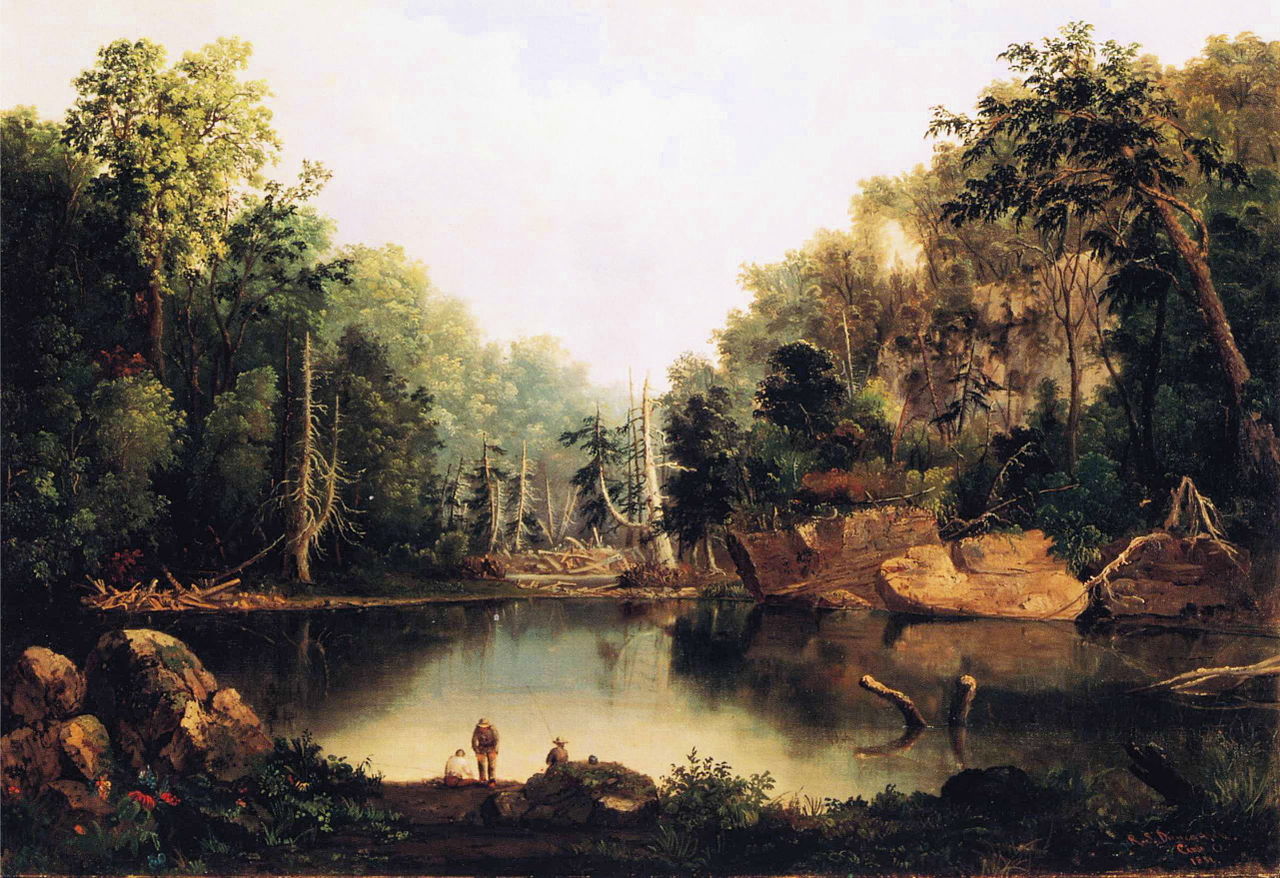
'For more than a century, his body has remained in Monroe, about 40 miles south of Detroit, with nothing but grass growing over his grave. Now, a small foundation marks the site of his burial awaiting the arrival of a tombstone.
“No one has asked about him — not in my lifetime,” said Michael Huggins, 55, the manager of the Historic Woodland Cemetery for the past two decades, and the person who helped find the exact location of Duncanson’s burial plot.
[... Now] nearly a century and a half later, Monroe resident Dora Kelley is looking to rewrite a chapter of Duncanson’s life. Kelley worked with LeClair Monuments in Lambertville to design a sleek black granite tombstone for Duncanson complete with his full name, the year of his death and an etched version of his Ellen’s Isle painting from the DIA’s collection. Kelley also chose a quote from the late artist to grace the monument, which speaks to Duncanson’s unprecedented position as a freeborn artist in the era of slavery: “I have no color on the brain; all I have on the brain is paint.”
'Also Merlin let make by his subtilty that Balin's sword was put in a marble stone standing upright as great as a mill stone, and the stone hoved always above the water and did many years, and so by adventure it swam down the stream to the City of Camelot, that is in English Winchester.'This sentence also illustrates again the way Malory's text might be unpacked and reimagined more fully - that magical stone heading downstream in a manner reminiscent of David Nash's Wooden Boulder. As you read Malory you start to imagine an Arthurian Britain just below the surface, even in the Home Counties. At one point he has King Arthur stay at the castle of Ascalot 'that is in English Guildford' - an identification probably due simply to its location between London and Arthur's intended destination, Winchester.
Often have I witnessed the feelings of my fond parent, whilst gazing upon the last gleams of the setting sun, - the deep mellow shades breaking upon the view, 'ere night shed silence and repose upon all earthly things; and often has grey morning, the sweet harbinger of another day, brought vigour and renewed exertion to his enthusiastic and unwearied mind. At length, after many solitary wanderings, and anxious efforts, I became a Picture. Then, again, new fears and anxieties arose. - What was to be thought of me, amongst the thousands of connoisseurs, amateurs, artists, and critics, whom I should be compelled to face?The painting was right to be anxious. It imagines being neglected like the 'unobtrusive works' of Richard Wilson, put into the shade by the flash and fire of Loutherbourg. For a long time it hangs unregarded on a London wall, while the painter accumulates a body of work, and is then taken to be exhibited in Manchester, but remains unsold. People praise it but, because the artist is not a big name, nobody will buy it. More exhibitions and an auction follow, without success, and eventually the painter becomes so poor that he sells all his possessions, including the landscape painting. Then, at the low point of the story, the painting gets 'carried into a back garret, to answer all the purpose of a chimney board.' However, after the poor artist dies in a debtors prison, his work starts to become sought after. Found and restored, the painting becomes highly praised and ends up decorating 'the mansion of nobility.'
'A party of English artists meeting together in Italy, for the purpose of making studies from nature. The weather proving very sultry, the members proposed that all should take off their coats, which was strongly objected to by one of the party, but at last submitting to the others, a Waterfall was discovered on his back, his waistcoat having been made out of a picture of that subject.'Harriet Gouldsmith was painting during the Golden Age of British landscape painting. She first exhibited at the RA in 1807 and was elected to the Water Colour Society in 1813. The painting below is a late work and can be found in the Egham Museum, which purchased it in 1985. I wonder how its 'life' played out over the preceding 140 years... Its subject, Magna Carta Island, was itself put up for sale four years ago, with an asking price of £3,950,000 (see the BBC's report). This island includes a Grade II-listed house, built a few years before Gouldsmith's painting, that features a specially-built Charter Room to house the stone on which the charter is supposed to have been signed. Perhaps someone should write A Voice from an Island, to relate the history of its owners since that day in 1215 when Runnymede took its place in the story of England. The Times reported that as a result of the sale, Magna Carta Island has been acquired by a Chinese family.
'Kuwasseg frequently includes illuminated corridors - rivers, paths, or gaps in the trees - framed by darker houses, rocks, or foliage. He incorporates these same visual tunnels in his prehistoric vistas, leading the viewers into carboniferous swamps as though they were inviting stretches of the Austrian countryside.'
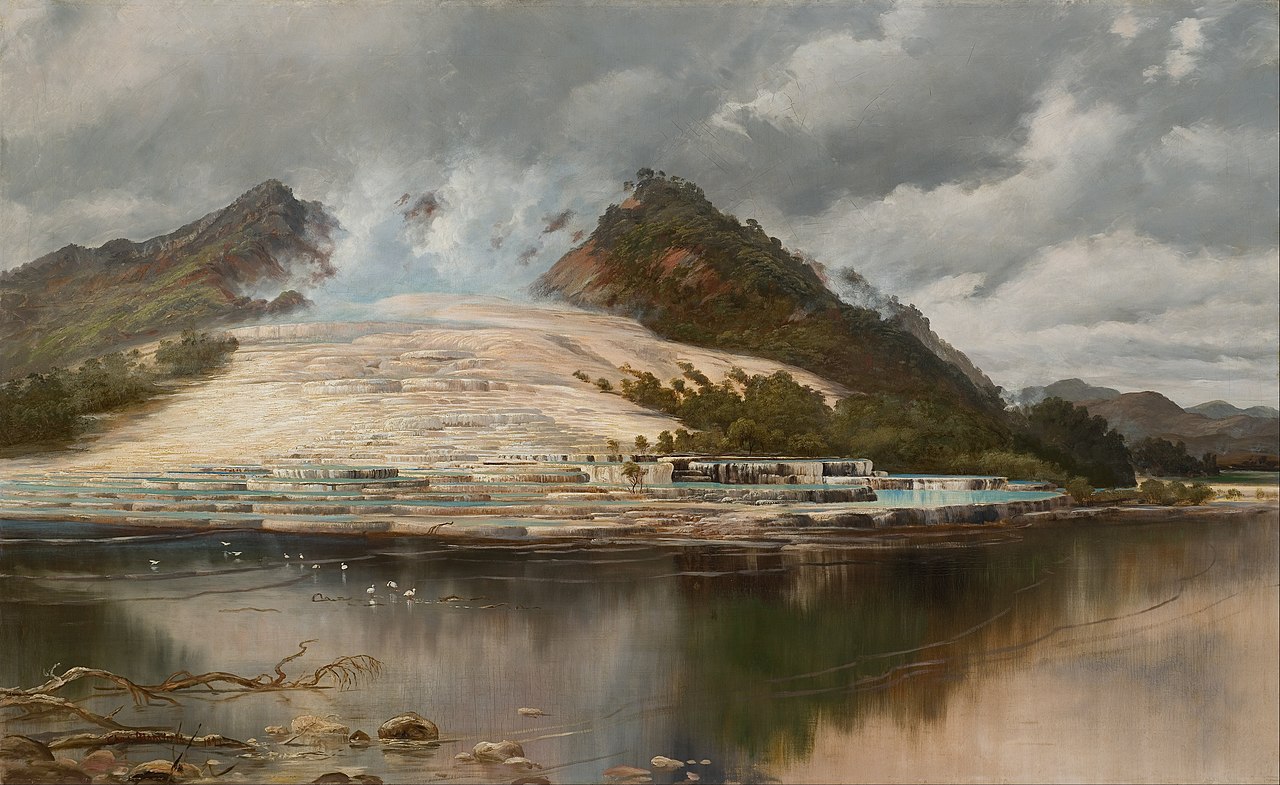
'Rock and water are alike smooth and warm and pleasant, and you can prolong the delight of the bath to any extent, passing from one pool to another, sometimes receiving a gentle shower as the sparkling drops trickle from the overhanging rim of a pool, perhaps eight or ten feet above you, or else lying still in passive enjoyment, and watching the changing lights that flit across lake and hill, and all the time the kindly water is coating you with a thin film of that silica which makes the bath so smooth and the bather so silky'I will conclude here with another description of this experience from perhaps the most famous visitor to the terraces, Anthony Trollope. He was there in 1873 and remarked on the shell-like appearance of these natural pools, in which 'four or five may sport ... each without feeling the presence of the other.'
'In the bath, when you strike your chest against it, it is soft to the touch. You press yourself against it, and it is smooth. You lie upon it, and though it is firm, it gives to you. You plunge against the sides, driving the water over your body, but you do not bruise yourself. ... I have never heard of other bathing like this in the world.'