In his poem 'On a Winter Morning before Sunrise', the twenty-one year old Eduard Mörike (1804-75) wrote of his emotions on seeing the first light-as-down light of dawn: 'my soul is like crystal'. He felt his mind still as still water, opened to wonder by a ring of clear blue sky. A perfect way to start the day, certainly better than listening, as I do, to the latest grim news on the radio. The editor/translators of this poem, David Luke and Gilbert McKay, link it to 'Urach Revisited’ (1827), another 'major expression of the poet's youthful sensibility.' Bad Urach is a spa town at the foot of the Swabian Alb where Mörike studied at the evangelical seminary. His nostalgic return as a young man is reminiscent of Wordsworth’s poem on Tintern Abbey. A stream flows heedlessly past without any sorrow at the flux of time and the poet questions the landscape surrounding him:
Here you all are, ancient and new, Bare sunlit hills uprearing, summits made
For cloud-thrones, woods where scarcely noon breaks through,
Where balmy warmth mingles with deepest shade:
Do you still know me, who once fled to you,
Whose heavy head sweet-slumbrously was laid
Here in cool moss to hear the insects humming –
Do you know me, and shrink not at my coming?
Eduard Mörike wrote one of the stories most special to me, 'Mozart's Journey to Prague' - one I have re-read before in bleak times and found myself reaching for again recently. Although tinged with sadness, because we and the narrator know what will happen eventually to Mozart, it is a story of a brief, idyllic encounter, a moment (in the words of the translators) of 'festivity and conviviality, badinage and Lebenslust, memories of an earlier golden age of culture.' This sparkling novelle is not really about landscape although it begins with Mozart and Constanze journeying through the Moravian mountains. They then descend into a valley and stop at a village and Mozart decides to take a short walk. He enters the park of a local Count, sits down by some orange trees and, with his mind on his music, inadvertently picks one, an action which sets in train the events of the story.
I will end this brief post on Mörike by mentioning a couple more poems on the subject of spring. In 'Frühlingsgefühle', translated as 'Intimation of Spring', violets wake and dream their time is near. It puts me in mind of the crocuses I saw on my lockdown exercise walk yesterday. 'In the Spring' find the poet lying on a hill: clouds drift, rivers flow and sunlight enter his veins. And yet he still feels a yearning, 'for what I cannot say'. It makes him wonder what memories are woven into 'this twilight of the gold-green leaves? / - The nameless days of long ago!'
A couple of days ago I read inThe Guardianthat 'police have warned young people not to attend illegal raves this weekend, promising a tougher approach after two “quarantine raves” attracted 6,000 people last Saturday.' It made me think of the final chapters of Richard King's book The Lark Ascending which discuss the outdoor rave scene's emergence thirty years ago, followed by opposition that led to the introduction of the Criminal Justice Bill. Jeremy Deller told a similar story last year in Everybody in the Place (although the participation of children in his film meant he left out some of the drug history). King describes an early rave organised by Cymon Eckel and the Boys Own network which culminated in dawn breaking over a misty Sussex reservoir. One of them would later describe seeing 'a flock of geese descend from the sky to make a perfect landing at the water's edge.
And here in the early hours of a perfect English summer's day, five hundred people sitting, or collapsed, on hay bales, grew energised by the dawn and looked out onto the water of Weir Wood Reservoir that borders Ashdown Forest, the location that inspired A. A. Milne's '100 Aker Wood', and the haven Eckel and his friends had created was experienced by all those present as their private Acid House Pooh Corner.'
Last year I saw Richard King give an interesting talk on his
book at the Stoke Newington Literary Festival. He began with his view that the popularity of
Ralph Vaughan Williams' composition comes from the way it conveys musically a sense of
freedom and at the same time connectedness to an unspecified British
landscape. The full subtitle of The Lark Ascending on my paperback edition is 'People, Music and Landscape in Twentieth Century Britain', making clear that this is not merely a study of music inspired by nature. In fact there is little in the book about music written to convey a spirit of place - from Vaughan Williams he skips over British landscape composers like Ireland, Bax and Finzi, moving instead to Ewan MacColl's 'The Manchester Rambler' (in a discussion of the Kinder Scout trespass) and then forward to Stan Tracey'sjazz suite inspired by Under Milk Wood. Later chapters discuss the music of Donovan, Gavin Bryars, Kate Bush, Penguin Cafe Orchestra and Ultramarine. It got me listening anew to some of this on Spotify, though I have to admit I find the late sixties Donovan albums pretty hard going...
The book ends in the 1990s, although there is a brief epilogue featuring Rob St John (it mentions Surface Tension, a piece of music I described here five years ago). In the new century, issues of ownership and access to land have become ever more complicated, and now the age of coronavirus has raised a whole new set of questions. The idea of assembling at a rave by a Sussex reservoir this summer would come up against ethical choices around social distancing, pitting hedonism and personal freedom against the interests of the more vulnerable in society. It is however still possible to go for a ramble, and so, given the reference to Manchester in that piece about an illegal rave, I'll end here with the closing lines of Ewan MacColl's song:
So I'll walk where I will over mountain and hill
And I'll lie where the bracken is deep
I belong to the mountains, the clear running fountains
Where the grey rocks lie ragged and steep
I've seen the white hare in the gullies
And the curlew fly high overhead
And sooner than part from the mountains
I think I would rather be dead
I was very tempted this week to go to Cafe Oto for Brunhild Ferrari in conversation with David Grubbs, but it was on 14 February and I didn't think this proposal would go down very well. I did though enjoy reading her 'Epiphany' at the back of February's Wire Magazine, which recalls how she met and started making music with Luc Ferrari (1929-2005). Apparently they bonded over a love of rocks - she loved painting them, he was fascinated by the geology of Corsica, where his father came from. In the paragraph below she describes their experiments in field recording and mentions two famous landscapes that I have featured here before (in connection with Petrarch and Monet). I have embedded above a clip of the composition she mentions, Presque Rien No. 1 (1967-70).
A couple of years ago Ferrari's four 'Presque Rien' ('Almost Nothing') compositions were reissued by Editions Mego. Here, from a review by John Kealy, is a description of the fourth.
Presque Rien No. 4: La Remontée du Village (Almost Nothing No. 4: The Ascent to the Village)
seemingly returns to bare elegance of the original work. This is the
sound of Ferrari and his wife Brunhild ascending the hill to the Italian
town of Ventimiglia and it is remarkably similar to the moods and
feelings of the first piece. However, the sleepy isolation of the 1960s
countryside has been lost as sounds from nearby televisions and passing
scooters permeate the air around Ferrari’s microphones. Gradually,
evidence of Ferrari’s tinkering becomes more and more noticeable as he
slowly blends the sounds as they were recorded into something more akin
to musique concrète. The climax of this is the powerful intrusion of a cow, preposterously embellished by Ferrari to sound super-real.
Another landscape-related piece reissued by Editions Mego was Petite symphonie intuitive pour un paysage de printemps (1973–1974). Ferrari's notes explain that this too was based on a walk with his wife.
'Brunhild and I were in the Gorges du Tarn area. We chose to take a
small path that was going up a rocky mountain for about ten kilometres.
After a last turn, a totally unexpected landscape opened before my eyes.
It was sunset. Before us, a vast plateau spread open with soft curves
up to the horizon, up to the sun. The colours ranged from dry grass
yellow to purple, in the distance, with the darkness of a few small
groves punctuating the space. The almost bare nature was presenting
itself to the eye, free from any obstacle. We could see everything.
Later, when I recollected this place and the sensations I had
experienced there, I tried to compose a music that could revive this
memory.'
The reviewer for Pitchfork thought initially that this sounded like Boards of Canada, but then decided it 'feels more complex than that. For as alien as musique concrète
can be, in the hands of Ferrari, he was able to render it into something
that felt warmly familiar. Here he paints a stunning vista at dusk,
capturing the expansive horizon with sound rather than sight.'
Anon (once attributed to Guo Xi), Mount Emei under Heavy Snow, 17th century
Mount Omei, or Emei, in Sichuan province, is one of the Four Sacred Buddhist Mountains of China and has often featured in Chinese poetry. Li Po spent the early part of his life (before 725) in Sichuan and wrote a 'Song of Mount Omei's Moon', that would later be quoted by Su Shi in one of his own poems. Su Shi was actually born near the foot of the mountain, in 1037, but spent his life being moved from one post to another, getting further and further away until he eventually found himself living on the island of Hainan (he died, back on the mainland, four years later). Fan Ch'eng-ta, one of the 'Four Masters of Southern Sung Poetry', specialising in the field-and-gardens genre, described Mount Emei in his Diary of a Boat Trip to Wu (1177). The higher he got, the colder it was - intensely so at night. Reaching Brilliant Cliff he looked down into the clouds and glimpsed halos of coloured light. Further on he could see the mountain range that stretches West, until it eventually becomes the Himalayas:
'Lofty, rugged, carved, sliced; scores, perhaps a hundred peaks in all. When the rising sun first illuminates them, the snow glistens like shiny silver, shimmering in the light of the dawn. From antiquity to the present, this snow has never melted. These mountains extend all the way to the land of India and to tributary kingdoms along the border for a distance of I don't know how many thousands of li. It looks like it is spread out on a table before one. This spectacular, unique, unsurpassable view was truly the crowning one of my entire life.'
Last month I was surprised to encounter a fragment of Mt Emei, perched on the summit of a mountain in Switzerland. This 8 ton lump of basalt, the Emei Stone, was installed on the top of Mt. Rigi in 2015, a year after a Rigi Stone was 'inagurated' on Mt Emei. They are meant to 'symbolise the cultural and touristic collaboration' between the two mountains. An explanatory board refers to these landscapes like global corporations, with the exchange symbolising 'the valuable and long-standing partnership between RIGI and EMEI.' I had not been to Switzerland for a while and was surprised by the number of Chinese tour groups. There are visitors too from other parts of Asia. At the bottom of Mount Titlis, a high, snow-capped peak near Rigi, you encounter the inviting smell of Indian street food on sale at the Spice Bistro. And at its summit, you can take a selfie with cardboard cutout stars of the famous Bollywood film Dilwale Dulhania Le Jayenge (1995), which was set in Switzerland (though not actually on Titlis). The appeal of the Alps for Bollywood directors is discussed in an article for The Smithsonian and the Indian fascination with Switzerland is explored in an interestingpieceby Anuradha Vikram's for Hyperallergic.
Mount Rigi became a major tourist destination in the nineteenth century, in part because it is easy to get to from Lucerne. A Telegrapharticle on this phenomenon made the connection with Turner's Blue Rigi, a centrepiece of the Tate's 2014 Late Turner show (looking back I see I wrote at the time about Turner's Italian landscapes rather than the exhibition's views of the Alps). Rigi developed a special appeal, and
'so great was this charisma, that within a couple of decades of Turner’s
visit, a stay in Lucerne and an ascent of The Rigi were among the most
desirable experiences for any traveller to Continental Europe. In 1857 the first grand hotel opened at the summit, and by 1860 there
were 1,000 horses and numerous guides and sedan chairs stationed at the
foot of the mountain in Weggis. The highlight of Thomas Cook’s first
group tour to Switzerland, in 1863, was an ascent of The Rigi to watch
the sunrise, and in 1868 Queen Victoria herself came here, to be carried
up to the hotel in a chair, and woken before dawn for the same view.
J.M.W. Turner, The Blue Rigi, Sunrise, c. 1841-42
Source: Wikimedia Commons
Mount Emei has a much longer tradition of tourism than Mount Rigi, centred on its temples and the 'silver world' - a sea of clouds - visible from its summit. In the Qing Dynasty, the poet Tan Zhongyue named ten scenic attractions, including 'Blue Sky After Snowfall on the Great Plateau', 'Crystal Waters and Autumn Winds', and 'Felicitous Light on the Golden Summit'. Today, the UNESCO World Heritage site acknowledges the threat posed by visitor numbers ('there are numerous drink stands
and souvenir stalls which detract from the natural atmosphere of the
mountain'), but also notes that 'as a sacred place, Mount Emei has benefited from a long-standing and traditional regime of conservation and restoration.'
A thousand years ago, back in the Song Synasty, Fan Ch'eng-ta's does not mention encountering any other sight-seers. Perhaps he had the view to himself. Turner never tried making the ascent of Rigi, possibly put off by the prospect of tourists. In J. M. W. Turner: A Wonderful Range of Mind, John Gage suggests that 'it may be that he felt the Rigi was already too popular a vantage point, and he did not want to share his experiences with the two or three hundred other tourists who were said to congregate daily on the summit for the dawn.' Gage quotes an earlier traveller, Henry Matthews, who did make the ascent and what he saw is reminiscent of Fan Ch'eng-ta's vision of dawn on Mt. Emei. Matthews found it a 'magnificent spectacle' and concluded that experiencing a sunrise on Rigi 'forms an epoch in one's life, which can never be forgotten.'
When in the past I have added extra features to Some Landscapes, I have tried to include some new material at the same time. What follows was going to be appended to my last post, introducing a new Chronology, but I decided it would be better kept separate (its relevance was that it concerns how a view, in this case a cityscape, has changed through history). The quotation below, from Victor Hugo, is a great piece of Romantic prose but particularly interests me as an evocation of landscape through sound. I checked back to see if it was referred to in R. Murray Schafer's classic book The Tuning of the World; it isn't - probably because Hugo was writing a work of historical recreation rather than direct observation. Whether Paris ever sounded anything like Hugo's idea of the city in 1482 would be difficult to say.
The novel this description is taken from, Notre-Dame de Paris (in a nineteenth century translation on
Project Gutenberg) is, like many nineteenth century historical novels, about history. It was written partly to draw attention to the way contemporary Parisians were neglecting their architectural heritage. Hugo suggests in it that before the invention of the printing press, poetry was manifested in architecture: cities were like great texts. He stops the action of the story in order to devote the whole of Book Three to a description of medieval Paris from its cathedral. Centring on the small island of the City and 'trapezium' of the university, the view would have encompassed a vast semicircle of the Town and, beyond this, the
immense plain, 'patched with a thousand sorts of cultivated plots, sown
with fine villages', ending at the hills on the horizon. 'Such was the Paris which the
ravens, who lived in 1482, beheld from the summits of the towers of
Notre-Dame.'
'And if you wish to receive of the ancient city an impression with which
the modern one can no longer furnish you, climb—on the morning of
some grand festival, beneath the rising sun of Easter or of Pentecost—climb
upon some elevated point, whence you command the entire capital; and be
present at the wakening of the chimes. Behold, at a signal given from
heaven, for it is the sun which gives it, all those churches quiver
simultaneously. First come scattered strokes, running from one church to
another, as when musicians give warning that they are about to begin.
Then, all at once, behold!—for it seems at times, as though the ear
also possessed a sight of its own,—behold, rising from each bell
tower, something like a column of sound, a cloud of harmony. First, the
vibration of each bell mounts straight upwards, pure and, so to speak,
isolated from the others, into the splendid morning sky; then, little by
little, as they swell they melt together, mingle, are lost in each other,
and amalgamate in a magnificent concert. It is no longer anything but a
mass of sonorous vibrations incessantly sent forth from the numerous
belfries; floats, undulates, bounds, whirls over the city, and prolongs
far beyond the horizon the deafening circle of its oscillations.
'Nevertheless, this sea of harmony is not a chaos; great and profound as it
is, it has not lost its transparency; you behold the windings of each
group of notes which escapes from the belfries. You can follow the
dialogue, by turns grave and shrill, of the treble and the bass; you can
see the octaves leap from one tower to another; you watch them spring
forth, winged, light, and whistling, from the silver bell, to fall, broken
and limping from the bell of wood; you admire in their midst the rich
gamut which incessantly ascends and re-ascends the seven bells of
Saint-Eustache; you see light and rapid notes running across it, executing
three or four luminous zigzags, and vanishing like flashes of lightning.
Yonder is the Abbey of Saint-Martin, a shrill, cracked singer; here the
gruff and gloomy voice of the Bastille; at the other end, the great tower
of the Louvre, with its bass. The royal chime of the palace scatters on
all sides, and without relaxation, resplendent trills, upon which fall, at
regular intervals, the heavy strokes from the belfry of Notre-Dame, which
makes them sparkle like the anvil under the hammer. At intervals you
behold the passage of sounds of all forms which come from the triple peal
of Saint-Germaine des Prés. Then, again, from time to time, this mass of
sublime noises opens and gives passage to the beats of the Ave Maria,
which bursts forth and sparkles like an aigrette of stars. Below, in the
very depths of the concert, you confusedly distinguish the interior
chanting of the churches, which exhales through the vibrating pores of
their vaulted roofs.
'Assuredly, this is an opera which it is worth the trouble of listening to.
Ordinarily, the noise which escapes from Paris by day is the city
speaking; by night, it is the city breathing; in this case, it is the city
singing. Lend an ear, then, to this concert of bell towers; spread over
all the murmur of half a million men, the eternal plaint of the river, the
infinite breathings of the wind, the grave and distant quartette of the
four forests arranged upon the hills, on the horizon, like immense stacks
of organ pipes; extinguish, as in a half shade, all that is too hoarse and
too shrill about the central chime, and say whether you know anything in
the world more rich and joyful, more golden, more dazzling, than this
tumult of bells and chimes;—than this furnace of music,—than
these ten thousand brazen voices chanting simultaneously in the flutes of
stone, three hundred feet high,—than this city which is no longer
anything but an orchestra,—than this symphony which produces the
noise of a tempest.'
The artwork on the cover of this January 2008 edition of Art in America is by Spencer Finch: Sunlight in an Empty Room (Passing Cloud for Emily Dickinson, Amherst, MA, August 28, 2004). Emily Dickinson once famously wrote of 'a certain Slant of light' - 'when it comes, the Landscape listens...' On his visit to her home, Finch took precise measurements of the level of sunlight and then tried to recreate the effect using a cloud of blue gels suspended in front of two rows
of fluorescent lights. Finch is fascinated with light and has made various similar cultural pilgrimages to record it: heading, for example, to Ingmar Bergman’s Stockholm residence at the ‘magic hour’ when the director did much of his filming, to Time Square, the inspiration for Mondrian’s Broadway Boogie Woogie, and to Giverny where he was looking for a shadow similar to the one Monet captured in the painting reproduced below. Things don't always go to plan: in 1996 he travelled to Rouen only to find that the cathedral Monet had painted in different lights was under scaffolding; undaunted, he did a piece instead based on the colours of his
hotel room. The artworks arising from these trips range from drawings to sculptures and installations. Eos (Dawn, Troy, 10/27/02), for example, resembles a Dan Flavin light piece, but is designed to match the measurements Finch took at Troy during the hour of
Homer's ‘rosy-fingered Dawn’.
Claude Monet, Grainstacks at Sunset (Snow Effect), 1890-91
The Art in America review by Stephanie Cash describes two works Finch had recently completed that were inspired by Thoreau. The first of these concerns wind rather than light - I have drawn a diagram below to show how the gallery installation worked. ‘For about two hours the fans periodically create a gentle, intermittent
breeze from various directions and at various speeds, determined by
Finch’s measurements using a digital anenometer and weathervane while
standing on the shore of Walden Pond, where Thoreau spent two years, two
months and two days. Viewers standing at the work’s centre can
experience the approximate breeze that Finch, and presumably Thoreau,
did.’ Not having experienced this work I can only
imagine it from Cash's description, another level of mediation which only goes to emphasise the impossibility of feeling the wind that rippled the surface of the water during the years 1845-7.
Diagram showing Spencer Finch's
Two hours, Two minutes, Two seconds (Wind at Walden Pond, March 12, 2007)
The other work, Walden Pond (morning effect, March 13, 2007), sounds less appealing because it mixes together Thoreau and Monet, although it is hard to tell from photographs. The finished work was
'a wall collage comprising 139 reproductions, arranged in the shape of
the pond, of aqueous paintings by Monet. From 20 spots around the
pond’s perimeter, Finch noted the hues of the water and ice, then
located their matches in the Monet reproductions. Each image bears a
notation with an arrow pointing to the particular colour, and the time,
location on the shore and direction he was facing. It’s a rather
complicated enterprise, and visually and intellectually engaging, but
atypically for Finch, it doesn’t present a coherent, unified effect.’
There was a Spencer Finch show at Turner Contemporary in 2014, which regrettably I didn't get to see. In the video clip above he talks about the influence of Turner and installs a sculpture which resembles the Emily Dickinson one, called Passing Cloud (After Constable). [Incidentally, I did get to go to the previous exhibition at Turner Contemporary in 2014 - which was also inspired by clouds, including Constable's - and wrote about it here.] Finch has done cloud studies himself, as well as drawings of ice, wind, sunlight and water. The colours of the surface of the Hudson River were his raw material for The River That Flows Both Ways, an installation on New York's High Line that could be seen last year. His website has some other examples of recent work but I will end here with a piece he made some time ago, described in the Art in America article. It sounds preposterous but also rather magical.
‘Resembling an amateur science project, an early installation that also looks to the cosmos, Blue (One second brainwave transmitted to the star Rigel), 1993, comprises a tattered orange armchair, a TV set, an old Apple computer, electrodes, an antenna and a tripod-mounted transmitter. Using these jury-rigged components, Finch recorded his brain wave for one second as he watched the huge blue wave in the opening sequence of the 1970s TV show Hawaii Five-O, a still of which appears on the TV screen. His brainwave was then translated by the software and projected into space by the transmitter. It should reach its destination, the bluest star in our sky, in the year 2956. With the ‘real’ work supposedly somewhere in the cosmos, modern-day viewers are left with a scrappy installation that belies the beauty of the concept.’
Sara Wheeler's Terra Incognita was published twenty-one years ago, before the hundredth anniversaries of the expeditions led by Scott, Shackleton and Amundsen. Reading it recently, I wondered if we have been living through a golden age of artistic exploration, with a new series of 'firsts', as writers, filmmakers, sound artists and photographers have followed in the footsteps of the explorers and scientists, recording the environment or making site-specific work on the ice. Perhaps this pioneering period can be said to have come to an end with the first Antarctic Biennale. According to an article in Slate, 'the current plan is for the artists to construct installations in
Antarctica that will be documented and removed, and then to show some of
the works later in Venice. The culturati have officially reached the
end of the world.'
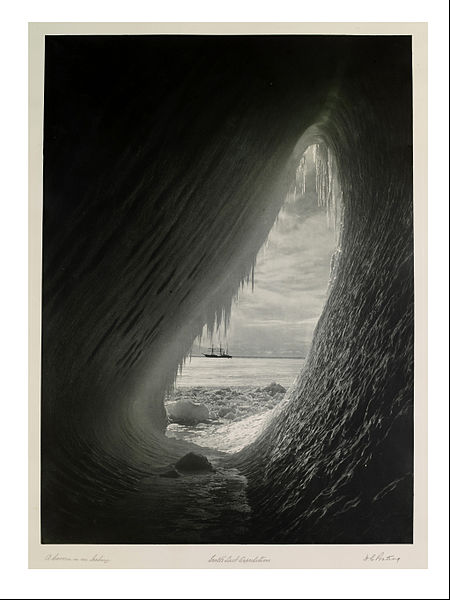
For most of her stay in 1994-5, Sara Wheeler was hosted by the US National Science Foundation's Antarctic Artists & Writers Programme. Their website provides a fascinating insight into the range of cultural work that has taken place under its auspices. There are very few household names - the most famous is Werner Herzog, who made his enjoyable documentary Encounters at the End of the World there in 2006 (the shot of a penguin walking in the wrong direction to certain death has become famous). Herzog's musical collaborator Henry Kaiser had already been there and it was footage he had taken on his trip that persuaded Herzog to take on the project.
The list of people who preceded Sara Wheeler on the program is not long - some historians and science writers, illustrators and photographers (who must all go south highly conscious of the heroic efforts of Ponting and Hurley) and one poet, Donald Finkel, who wrote two books about Antarctica. Barry Lopez went too - the program's website lists two articles, published in 1989 and 1994, and "future book." Wheeler mentions Lopez once or twice in Terra Incognita. She recalls how Ranulph Fiennes had scoffed at the idea that the Antarctic can provide a transcendental experience: "I prayed for help there, but I would have done so in Brixton. Mr Lopez writes about it but he's hardly been there at all." Wheeler's footnote to this: 'Lopez is an established and highly respected author who has visited Antarctica five times. His trips were not exercises in seeing how dead he could get - he went to see, and to learn.'
Herbert Ponting, A Cavern in an Iceberg, 1910
Source: Wikimedia Commons
Interestingly, according to the list, Kim Stanley Robinson was in Antarctica at the same time as Sara Wheeler. I rather wish they had encountered each other because she is quite amusing on cultural differences between America and Britain. Her book was conceived and written in the tradition of British travel writing (her favourite is The Road to Oxiana) whilst Robinson was researching his science fiction novel Antarctica. The one other artist she did spend time with on her second trip, which coincided with the end of the Antarctic winter, was a watercolourist called Lucia deLeiris. They shared a hut on the frozen sea and there, she writes, 'the landscape spoke to me so directly that it no longer seemed to be made of corporeal ice.'
At the end of the book, before leaving Antarctica, Wheeler returns to the Dry Valleys where she had experienced a memorable hike the previous summer. On that earlier occasion she had been visiting scientists studying Lake Fryxell, its surface 'filled with tiny white bubbles
and twisted into apocalyptic configurations - a fall might land you face
down on a sword reminiscent of Excalibur.' The opportunity arose to take a walk up the valley, the passing Suess and Canada Glaciers, where she noted a mummified seal on the moraine, and coming eventually to Lake Bonney, where 'ribboned crystals imprisoned in the ice glimmered like glowworms. It
was swathed in light pale as an unripe lemon.' Now, months later, after the long polar night and a brief return to England, she was back.
'I knew this landscape, but I had never seen the pink glow of dawn over the
Canada Glacier, or the panoply of sunset over the Suess, or in between,
sunlight travelling from one peak to the next and never coming down to
us on the lake. We lived in a bowl of shadow during those days. One morning the sun appeared for ten minutes in the cleft between Canada and the mountain next to it, and everyone stopped working to look up. The lake was carpeted with compacted snow, and from the middle, where the Canada came tumbling down in thick folds, the Suess was cradled by mountains like a cup of milky liquid.'
Nicholas Poussin, Blind Orion Searching for the Rising Sun, 1658
I write this surrounded by piles of books with a couple of pictures propped against them. This would be pleasant except that they've all been brought upstairs to be out of the way of some imminent building work. Sadly there's too much I've got to do here in the house to spend time writing anything very thoughtful about landscape and art. So here instead I will just give you a couple of beautifully written passages from an essay by William Hazlitt, 'On a Landscape of Nicholas Poussin.'
'Orion, the subject of this landscape, was the classical Nimrod; and is called by Homer, 'a hunter of shadows, himself a shade.' [...] Mists rise around him, and veil the sides of the green forests; earth is dank and fresh with dews, the 'gray dawn and the Pleiades before him dance,' and in the distance are seen the blue hills and sullen ocean. Nothing was ever more finely conceived or done. It breathes the spirit of the morning; its moisture, its repose, its obscurity, waiting the miracle of light to kindle it into smiles; the whole is, like the principal figure in it, 'a forerunner of the dawn.' The same atmosphere tinges and imbues every object, the same dull light 'shadowy sets off' the face of nature: one feeling of vastness, of strangeness, and of primeval forms pervades the painter's canvas, and we are thrown back upon the first integrity of things. [...] To give us nature, such as we see it, is well and deserving of praise; to give us nature, such as we have never seen, but have often wished to see it, is better, and deserving of higher praise. He who can show the world in its first naked glory, with the hues of fancy spread over it, or in its high and palmy state, with the gravity of history stamped on the proud monuments of vanished empire,--who, by his 'so potent art,' can recall time past, transport us to distant places, and join the regions of imagination (a new conquest) to those of reality,--who shows us not only what Nature is, but what she has been, and is capable of,--he who does this, and does it with simplicity, with truth, and grandeur, is lord of Nature and her powers; and his mind is universal, and his art the master-art!'
Poussin's Blind Orion Searching for the Rising Sun is now owned by the Met but when Hazlitt saw it, the painting was 'one of a series from the old masters, which have for some years back
embrowned the walls of the British Gallery, and enriched the public eye.' His essay praises what were the world's first regular temporary exhibitions of Old Master paintings. Pictures, he concludes, 'are scattered like stray gifts through the world; and while they remain, earth has yet a little gilding left, not quite rubbed off, dishonoured, and defaced.' I don't think Hazlitt would have thought much of the Alexander Calder lithograph I'm about to pack away in an old sheet for a few months. But he would have agreed that to take pleasure from art it is unnecessary to have pictures hanging on the walls around you.
'Pictures are a set of chosen images, a stream of pleasant thoughts
passing through the mind. It is a luxury to have the walls of our rooms
hung round with them, and no less so to have such a gallery in the mind,
to con over the relies of ancient art bound up 'within the book and
volume of the brain, unmixed (if it were possible) with baser matter!' A
life passed among pictures, in the study and the love of art, is a
happy noiseless dream: or rather, it is to dream and to be awake at the
same time; for it has all 'the sober certainty of waking bliss,' with
the romantic voluptuousness of a visionary and abstracted being.'
After many leaden days in London there was a bright sun rising over the rooftops this morning. It seemed a good moment to listen to Alice Oswald's dawn poem 'Tithonus' on the BBC iPlayer (still available for another four weeks). This was a shortened version of the performance we went to see back in October at the Queen Elizabeth Hall:
'The world premiere of a specially commissioned new poem, read by the poet herself.
In Greek mythology, the Dawn fell in love with Tithonus and asked
Zeus to make him immortal, but she forgot to ask that he should not grow
old. Unable to die, he grew older and older, until at last Dawn locked him
in a room where, several thousand years later, he still sits babbling
to himself. This is an account of his babbling, written in real time, through a
series of dawns from spring to midsummer 2014. It is a poem about
survival.
The performance begins in darkness and lasts 46 minutes (the length of dawn in midsummer).'
Looking back on Twitter for my instant verdict then, I see I said "Alice
Oswald performing her dawn poem Tithonus last night reminded me of
Patti Smith (if she'd done Classics and lived in Devon)." I was thinking about the similarities in the way they perform their poetry over music, holding you from the start and building to a point where language starts to overflow and key phrases turn into a refrain (I wrote here a few years ago about a Patti Smith performance like this, a tribute to W. G. Sebald). At the same time I was conscious of the differences - Patti Smith's rock & roll romanticism and New York drawl contrasting with Alice Oswald's classical learning and precise diction. The comparison feels less obvious with this new radio version, which had slightly less time for the impressive nykelharp accompaniment of Griselda Sanderson and cut the later part of the poem where poor babbling Tithonus repeats the same lines over and over. However, listening to it rather than experiencing the performance focused my attention much more on the words of the poem itself. Here are a few from 12 minutes in (I am transcribing from the broadcast so do not have the line breaks); a vision of the coming dawn:
'...the wood still lost in its inmost unable. And mist forms an orderly queue for the horizon. Green ropes of wind. White silks of field. And buried under several feet of colour, the eyes can never quite see out, but it is glittering now in the gaps between things. And a thistle begins to be properly named and certain of its spikes. What a chandelier of dock flowers dangles from the ground inverted. So the morning and I meet up again, but not on talking terms.'
'By the time dawn was coming we had scraped two peepholes in the frost on the panes; and we stood quiet to watch the winter sunrise. The radiant peaks of the Driftwoods, cut like white icing into pinnacles and rims against the apple-green sky, were brushed with pink, that, even as we watched, spread down and down and turned to gold. Rays of the rising sun, coming between the pointed firs of the east shore, stretched straight across the white lake, and as they touched it huge crystals, formed by the intense cold, burst into sparkling, scintillating light. The snow-bowed trees of the south and west shores were hung with diamonds; and finally the willows, around our cabin, were decked with jewels as large as robins' eggs that flashed red and green and blue. No Christmas trees decorated by human hands were ever so exquisite as the frosted trees of this northern forest. The sky turned to deep, deep blue, and the white world burst into dazzling, dancing colors as the sun topped the forest. The dippers, undismayed by a cold that froze dumb all other living things, broke into their joyous tinkling melody by the open water patch below the bank. And our first Christmas Day in the wilderness was upon us.'
This is from Theodora Stanwell-Fletcher's account of her months studying plants and animals in north-central British Columbia, Driftwood Valley (1947). You can read a fuller extract in Lorraine Anderson's Sisters of the Earth anthology.
Yesterday’s autumn sunshine gave the views on Hampstead Heath a harmonious classical beauty. At Kenwood, where the grass slopes lead the eye down to the tree-fringed lake and its pair of swans, it seemed easy to gaze over the prospect with the eyes of an eighteenth century landscape connoisseur. Inside Kenwood, the famous Rembrandt and Vermeer paintings are accompanied by a Gaspard Dughet Landscape with Hunters (c1639). However, on first sight the painting looks like a dull expanse of murky brown, a shadow of the sunlit vista outside. Poor Dughet’s paintings often seem to be tucked away, unfashionable and unloved; this one is hung high on the wall so that the title on the frame is actually not even visible. He seems as unappealing to modern tastes as some other great enthusiasms of the eighteenth century, like James Thomson’s poem The Seasons (which Michael Schmidt’s history of English poetry describes as ‘dead pastoral’). The brown-ness of old landscape paintings went out of fashion in the nineteenth century as Constable and others altered the way they underpainted to create more vivid colours. But the Landscape with Hunters is a dawn scene and therefore naturally full of shadows. Paintings that strive for subtle light effects may be most harmed by the passage of time (the same may be true of photographs and films we currently admire). What did Dughet’s painting look like 350 years ago?
Apparently the Louvre does not own a single painting by Dughet. However, there is at least one place where Dughet is honoured: Rome’s Doria Pamphilj Gallery. There they have a Poussin Room entirely full of his paintings (Dughet is also known as Gaspard Poussin after his better known brother in law). It is an amazing space - a total immersion in classical landscape.
Postscript: January 2014 Kenwood has recently re-opened after refurbishing. The Dughet Landscape with Hunters is still high up but better lit than when I wrote this post in 2006...
To Dulwich today for the Adam Elsheimer exhibition, a welcome break from computing woes which are partly to blame for infrequent postings at the moment. The Dulwich Picture Gallery is a good place for classical landscape painting anyway: Claude, Canaletto &c. but also less renowned artists like Herman Saftleven, painter of a lovely misty View on the Rhine. Adam Elsheimer fits perfectly in this company – a forerunner who is, according to the exhibition leaflet, ‘little known today’, but was ‘recognised in his own time as a genius.’ There still doesn’t seem much danger of him suddenly becoming very popular and the exhibition was relatively quiet even on a Saturday. Three highlights:
The series of Saints and Figures from the Old and New Testaments from the Egremont Collection at Petworth House show Elsheimer’s amazing gift for creating poetic landscapes on a tiny scale. The pictures are 9 x 7 cm each (like playing cards) and the landscape details are much smaller. An example is Saint John the Baptist (c. 1605), which can be seen on the National Galleries of Scotland site (the exhibition was on in Scotland before coming to Dulwich).
Aurora (c. 1606) started as one of Elsheimer’s paintings after Ovid but was left as a nearly pure landscape. A print of it made by Hendrick Goudt was an influence on later Dutch landscape painting. As you look at the painting your eye drifts away from the figure and off into the distant vista of a golden morning in the Roman Campagna.
The Flight Into Egypt (1609) is the last painting in the exhibition and is extraordinary for the realistic full moon and stars. There is an ongoing discussion about the extent to which Elsheimer was painting a particular night sky - astronomers have examined the position of the stars and suggested it was painted on 16 June 1609. It is thought Elsheimer may have used a telescope – he was in contact with scholars in Rome who were familiar with the new methods and ideas pursued by astronomers like Galileo . In some ways the sky is almost too accurate to seem realistic and the figures, glimmering by the light of a torch and a fire, have an unreal quality to them. Rembrandt’s Flight into Egypt (1647) is similar in composition but much more believable, although it is difficult to imagine it without the example of Elsheimer's original vision.
In Greek drama, before the invention of the skene (a scene building), the open air theatres had no sets beyond what was provided by the stage and the sky. It is possible to identify moments where the landscape was brought into play: references to the rising sun which would have coincided with the dawn, when some performances started. For example, at the start of Euripides play Iphigenia at Aulis,Agamemnon tells an attendant
Away! already the dawn is growing grey, lighting the lamp of day yonder and the fire of the sun's four steeds...
Another play that starts before dawn is Aeschylus’ Agamemnon, where a watchman waits for news of the capture of Troy. Reading these lines now can take you directly to a sense of the time and space in which these plays were first performed...