Showing posts with label panoramas. Show all posts

Sunday, June 04, 2023

Rheinterrasse


Photograph of the Rheinterrasse on the third floor of the Berlin Vaterland building, with its view overlooking the river between Sankt Goar and the Lorelei rock.
(Source: Wikimedia)

In July 1930 Antonin Artaud was in Berlin, where he was to play a beggar in the French version of G. W. Pabst's The Threepenny Opera (you can see him in the finished film on YouTube). Antonin wrote a letter from the city to psychoanalyst René Allendy which concludes with a description of Haus Vaterland in Potsdamer Platz (translation by Helen Weaver):  

'There is an amazing building here called the Vaterland-- Paris contains nothing like it. It is a kind of pleasure house five stories high. On each story there are one or two café-restaurants, each evoking a different country, and at the back of each café is a theatrical landscape in relief, representing in one the Bosporus (the Turkish café), in another the mountains of the Tyrol, in a third Vienna, in another Spain, in another Hungary, in another America. And each serves the drinks and dishes of that country. The most amazing is the café of the Rhine, which contains a kind of overhanging balustrade with a view of the Rhine and its castles. And suddenly the sky covers over with clouds, thunder growls, it grows dark, and a torrential rain falls while lighting effects simulate a thunderstorm with absolute realism. The thunder especially bears no relation to theatrical thunder. You hear the slightest rumbles with meticulous precision. It's extraordinary.'


Haus Vaterland at night in 1932.
(Source: Wikimedia)

Haus Vaterland opened as Haus Potsdam in 1912 and was the headquarters of German filmmakers UfA, with a huge cinema in the lower floors. It was transformed and relaunched as Haus Vaterland in 1928 and features in Weimar era paintings, films and novels. Bombed in the war, it was reopened and became the haunt of spies before being torched in the East German strike and protest of 1953. It was then left in ruins - according to a 1966 Der Spiegel article: 'kestrels nest in the burned-out Haus Vaterland and hunt down rats that crawl out of barred S-Bahn entrances.' 


The burned out ruin of Haus Vaterland in 1975.
(Source: Wikimedia. More photos at Getty Images)


When it comes to restaurants with views in Berlin, I immediately think of the revolving restuarant on the Fernsehturm tower (subject of a film by Tacita Dean). As it turns it you can look west towards Potsdamer Platz, still undeveloped when I first had a meal there in 1993. But at that height you are lifted above the reality of the city, even as it stretches out before you. 

I can see why other restaurants have provided escapism with murals of idealised or fantastic landscapes, transporting diners far away from the surrounding streets. One of the best known examples in London was the Tate restaurant's Rex Whistler's painting The Expedition in Pursuit of Rare Meats, a capriccio painted in 1927 but now judged offensive (visitors are still able to see it but cannot dine surrounded by its exotic landscapes). Unsurprisingly the Vaterland Haus, dating from the same period was pretty dodgy too, with rooms influenced by Germany's changing political situation and allegiances (there were no British or French scenes, reflecting continuing animosity over Versailles). There is some remarkable UfA footage of Sidney Bechet playing in the Haus Vaterland's Palm House ballroom, with a couple of paintings visible that would not be acceptable today. This film was shot in June 1930, just a month before Artaud experienced the building.

I am fond of restaurants with landscape views that try to give you a flavour of some distant sunny location. Of course they are often hackneyed picturesque scenes, but does it matter? 'Sparkling sky-blue body of water? Check. Rolling hillsides? Check. Rounded archways with marble columns? Check and check. This is Italy as viewed through rose-colored glasses, and it’s likely painted right on the wall at your favorite red sauce joint.' For this article, art critics were asked their views on these restuarant pictures. "This art fits very well with the American version of Italian food. I mean, Italians find spaghetti and meatballs totally alien, so it’s fitting that it be eaten beneath murals that are very much American remixes of an idea of the Italian landscape.” I suppose the Vaterland Haus was doing something similar on an ambitious scale. But it also went beyond the purely visual with those Rheinland thunder effects and you can see why this would have appealed to Artaud, with his ideas of theatre as spectacle. 

I'll conclude here with another reference to Haus Vaterland and its Rheinterrase. This is from Irmgard Keun's The Artifiical Silk Girl, translated by Kathie von Ankum, in an extract published at Brooklyn Rail.

The Vaterland has spectacularly elegant staircases like a castle with countesses in stride, and landscapes and foreign countries and Turkish and Vienna and summer homes of grapevine and that incredible Rhine valley with natural scenarios that produce thunder. We are sitting there and it’s getting so hot that the ceiling is coming down—the wine makes us heavy—

“Isn’t it beautiful here and wonderful?” It is beautiful and wonderful. What other city has this much to offer, rooms and rooms bordering on each other, forming a palatial suite? All the people are in a hurry—and sometimes they look pale under those lights, then the girls’ dresses look like they’re not paid off yet and the men can’t really afford the wine—is nobody really happy?

Friday, January 24, 2020

Goethe's oak

 
 Paintings in the Goethe House, Frankfurt

I was on something of a Goethe pilgrimage last weekend, with five stops, beginning in his childhood home in Frankfurt.  This was where he began Faust and wrote Werther before moving to Weimar at the age of twenty-six.  The house itself was destroyed in an Allied bombing raid but has been reconstructed; the contents were all kept safe during the war.  What you see when you look round is essentially the home Goethe's father created, including his pictures - some of them landscapes - all framed in black and gold.  I particularly liked two circular landscape views in the music room either side of a pyramid piano. There is no readily accessible information on who painted these, which is a pity because I would love to know more.  The website refers to paintings 'in the Dutch tradition (Trautmann, Schütz the Elder, Juncker, Hirt, Nothnagel, Morgenstern), and by the Darmstadt court painter Seekatz'.  Schütz the Elder was a landscape specialist, so perhaps they are by him.

The music room in the Goethe House, Frankfurt

From Frankfurt I travelled to Weimar and the Park an der Ilm, landscaped from 1778 under the influence of Goethe.  It was based on the Wörlitzer park, Germany's first English-style landscape garden, which also inspired the setting for Goethe's novel Elective Affinities (which I will write about in my next post).  In the park you can look round Goethe's Garden House, his first Weimar residence, bought for him in 1776 by Duke Carl August.  Here he could write while listening to the water running over a weir in the river.  Among Goethe's landscape sketches on the wall are three he called 'My Moonlights'.  "Gazing at the moon from his cottage," the audioguide says, "Goethe was frequently inspired to bathe in the Ilm River by moonlight."  One of Goethe's best known poems is 'An der Mond' ('To the Moon'), a poem he sent in a letter to Charlotte von Stein in March 1778.

Goethe's Garden House, Weimar

Goethe returned to this garden house near the end of his life to work on the Italian Journey (this account of his travels in 1786 has always been one of my favourite books, in the classic translation by W. H. Auden and Elizabeth Mayer).  To help remember the topography of Rome he had two large panoramas of the city put up in the dining room.  The print I photographed below is Giuseppe Vasi’s view of modern Rome as seen from the Janiculum Hill (1765).  Turn round and on the opposite wall you see Pirro Ligorio’s bird’s-eye view of ancient Rome, originally published in 1561.

 A panorama of Rome inside the Garden House

From the Garden House I moved on to the main Goethe House and Museum in Weimar, where you start to get an idea of the extraordinary range and depth of his collections.  There are, for example, cases he had specially made for Majolica, which he wrote about in an 1804 essay.  But the true breadth of Goethe's interests was really underlined at my fourth stop, the Schiller House, which was hosting a superb exhibition called 'Adventure of Reason: Goethe and the Sciences around 1800'.  Here there was evidence of his interest in many branches of knowledge that relate indirectly to landscape, from botany (the 'urplant'), fossils and vulcanism to light and colour theory.  He was clearly a key node in the era's overlapping intellectual networks and among his many correspondents, as I've mentioned here before, was the landscape painter Carl Gustav Carus.  Goethe owned this painting by Carus, which reminded me of the chalk cliffs I wrote about in Frozen Air.

 Carl Gustav Carus, Chalk cliffs at Cape Arkana on Rügen, after 1819

The drawing below by Goethe below looks at first sight like a view of cliffs, but is actually a Hypothetical Depiction of a Mountain. It is a good example of his interest in morphology and archetypal structures.  Goethe had a professional interest in geology through his involvement in mining, but it was evidently an absolute passion for him.  His geological collection eventually numbered 18,000 items.  I loved this quote about his collection of tin specimens:
'For many years, especially after 1813, Goethe was occupied by stannous (tin) rock formations.  He collected them in Bohemia and Saxony and had them sent to him from all over Europe.  He called it his "tin pleasure".  He considered tin to be the primeval metal, as it marked the end of the granite age.  Despite years of study, he only published one short article on the subject of tin.'
Goethe's Hypothetical Depiction of a Mountain (probably 1824)
Goethe died in 1832.  Just a century later the Nazis were on the verge of power and five years on they were constructing a concentration camp on the beautiful wooded hill overlooking Weimar. The camp was originally going to be called Ettensburg, but because this place name had such strong associations with Goethe and enlightenment, it was decided to use the name Buchenwald, 'Beech Wood'.  Trees were cleared for the building of the camp, but one oak tree was left standing.  The inmates began to call it Goethe's oak, a living symbol of a better Germany.  The tree was damaged by bombing in 1944 and then felled, but its base has been preserved as part of the Buchenwald memorial.  You can see it in my photograph below under last weekend's grey winter sky.  The dark shape among the trees behind it is the tower of the crematorium.
  
Buchenwald

Sunday, December 23, 2018

Liquid landscapes

George Lambert, Box Hill with Dorking in the Distance, 1733
Images: Wikimedia Commons

Yale University's British Art Studies is a completely open access journal and its Autumn issue is dedicated to 'Landscape Now'.  In addition to various articles, including the Tim Barringer piece I referred to earlier this month, there is a 'Conversation Piece' coordinated by Alexandra Harris.  She refers to the current popularity of books about nature, but suggests that 'while readers are offered new ideas about landscape writing at every festival (several festivals are devoted to the subject) and with every Amazon click and with each week’s Caught by the River newsletter, it can be harder to get much purchase on developments in contemporary visual arts and art history. Work by art historians is not always being brought to the common table...'  Unsurprisingly (given what I wite about here), agree with this.  She also gives an insight into what she has been researching recently (I have written about here before about her previous books on landscape and culture, Weatherland and Romantic Moderns). 
I've been trying in my own research to get closer to an understanding of what places have looked like to different kinds of people living in them. I want to find evidence for what “views” have looked like to people, other than the makers and consumers of landscape art. It’s hard: I’ve been reading for two years—parish registers, local histories, antiquarian guides, court proceedings, wills and inventories, tithe maps, a very occasional diary; I’ve been wondering at the skill and sensitivity of local historians like Margaret Spufford and many who followed her lead—yet still I’m baffled by the difficulty of reaching the landscape feelings of the past. [...] Whether we are reaching back to life before (or without access to) the grammars of Western landscape painting, or looking again at Lambert, Wootton, and Wilson, or thinking about contemporary artists, it may be fruitful to reunite landscape with local knowledge and local people, from the airy prospects to make out local habitations and names.
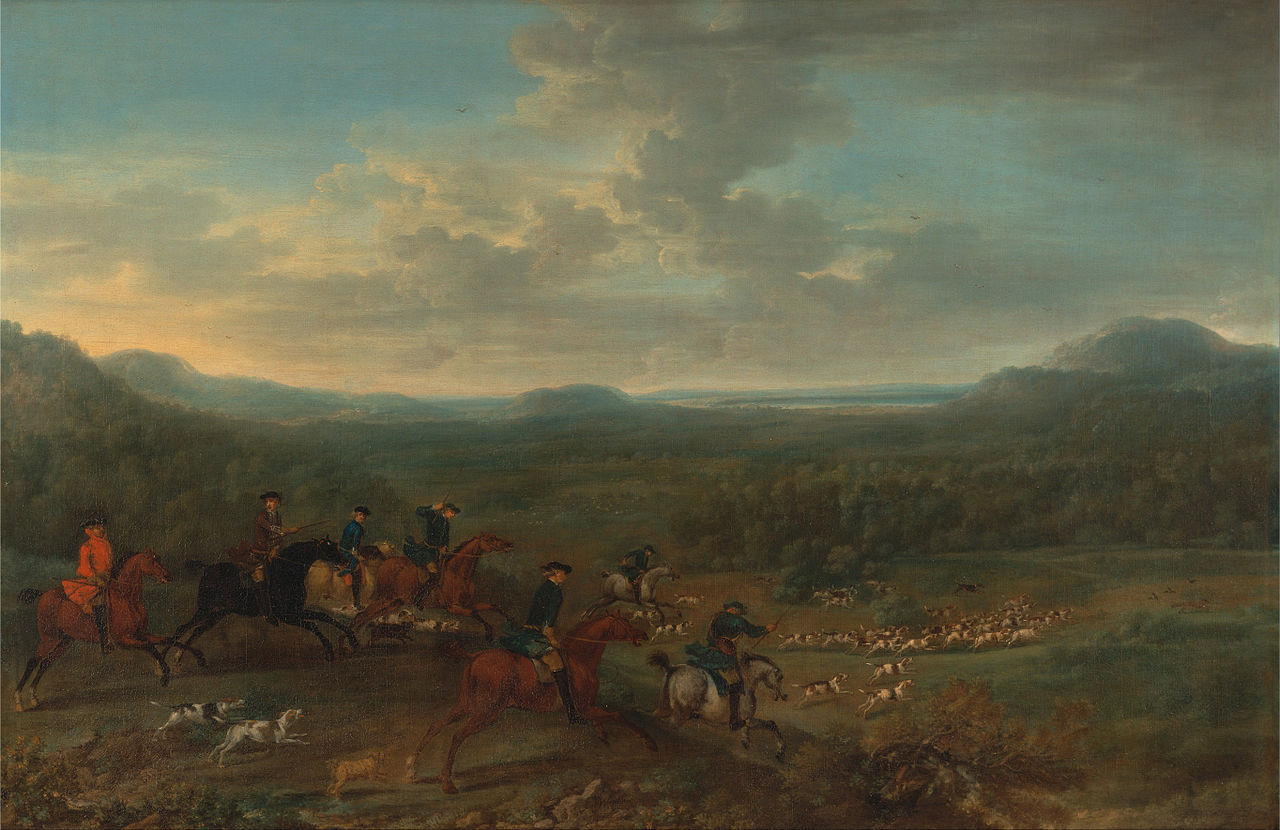
John Wootton, A Fox Hunt, c. 1735

Several responses follow Alexandra Harris's introduction, some more informative than others.  Rachel Hewitt for example, tells us that at present 'there is important work being done, by Hayley Flynn among others, on [William] Blake’s interactions with, and subversions of, the eighteenth-century British landscape tradition' (I wonder if this new scholarship will surface in the Tate's Blake exhibition, scheduled for autumn next year). Emily Hayes writes about the influence of the Royal Geographical Society's magic lantern lectures, including those by Vaughan Cornish, a 'chemist turned geographer' who specialised in the study of waves, before turning later 'towards eugenics and landscape heritage activism'.  The intention is that this Conversation 'will develop as more respondents enter the debate. Readers can also join in by adding a response at the bottom of the page.'  There are no responses yet - I hope there will be, but I've learnt here that in the age of Twitter you can't really expect people to go to the trouble of adding written comments.

Vaughan Cornish, Breaker and Bores on a Flat Shore, 1910  

I will conclude here by pointing you to three other articles in the journal, each about landscape artists I have discussed here before.

  • Greg Smith takes a fresh look at Thomas Girtin's panorama, The Eidometropolis, drawing on material that has become available only in recent years;
  • And in 'Liquid Landscapes', Stephen Daniels juxtaposes a series of pond photographs by Jem Southam with Constable's depiction of Branch Hill Pond in his pictures of Hampstead Heath.


 John Constable, Hampstead Heath, with Pond and Bathers, 1821

Monday, December 03, 2018

La Mer Pacifique

Jean-Gabriel Charvet and Joseph Dufour,
 Sauvages de la Mer Pacifique wallpaper, before 1829

A new article in British Art Studies by Tim Barringer provides a history of recent trends in landscape art history. In this century, he explains, there has been a strong focus on art and empire, influenced by Edward Said’s Orientalism, and analysis of paintings made far from Europe, which reveal 'the impediments offered to the totalizing “colonial picturesque” by local geographies'.  He then describes a recent artwork that I was looking at only this weekend:
'The work of contemporary indigenous artists increasingly offers critical reflections on the continuing power of landscape as a contested space open to multiple interpretations, and as a site of historical and contemporary violence. Lisa Reihana’s in Pursuit of Venus [infected], (2015–2017), on display at the time of publication in the exhibition Oceania at the Royal Academy of Arts in London, responds to the historical provocation of Les Sauvages de la Mer Pacifique, a scenic coloured wallpaper in twenty panels, created in 1804 by Joseph Dufour on the basis of imagery from the Pacific voyages of James Cook (Les Voyages du Capitaine Cook was proposed as an alternative title for the paper). Reihana’s panoramic video spanning 26 metres embraces the “monarch of all I survey” viewpoint of the painted panoramas of the late eighteenth century, but inserts speaking, singing, and moving figures to contest the silent, stereotypical representations of indigenous people in eighteenth- and nineteenth-century sources.'


At the Royal Academy, you encounter this video panorama towards the end of the exhibition and I found it quite hard to drag myself away.  Figures like Captain Cook, Joseph Banks and Chief Kalani'opu'u are seen in various moving tableaux as the viewpoint pans steadily round.  The original wallpaper was not on display in the exhibition (the National Gallery of Australia has an example) - perhaps it would have been out of place among so many beautiful objects from the islands.  In an interview in the Guardian, Lisa Reihana describes its design as
'“a concoction, a fabulation invented in someone else’s elsewhere”.  The greenery, for example, was transplanted not from Polynesia but from South America, which Jean Gabriel Charvet, the Frenchman who designed the wallpaper, had recently visited. Similarly, the idealised, pale-skinned locals are dressed in neoclassical costumes inspired more by what had recently been dug up at Pompeii than by anything from Hawaii or Tahiti.'
In Pursuit of Venus was previously shown at the Venice Biennale and has its own website (it even has an Instagram feed, although there are no posts on it yet...)  Tim Marlow, the RA Director, calls it 'stupendous' in an interview with Lisa Reihana, viewable on the RA's site.  Excellent as it is, there are many more wonders in the show which I could mention but which go beyond the remit of this blog, from the Brancusi-like male deity sculpture tino aitu to a Tobi Island necklace of sea-urchin spines.  As Jenny Uglow wrote in her review, 'Oceania is a powerful demonstration of art’s capacity to fight the tide of loss, honoring tradition, reclaiming places, histories, and identities, and opening the way to the future.'

Monday, August 21, 2017

The Panorama of Thun


Whilst it is obviously true that any landscape painting loses something in reproduction, this is especially true of a panorama.  It is not just a question of losing the aura of the original artwork; there is the simple optical fact that a rectangular image in a book can give no idea of the experience of a large-scale panorama.  At the Thun Panorama, now housed in a purpose-built building in Schadau Park on the edge of Lake Thun, you can buy a framed reproduction for 95 Swiss Francs that is shrunk to such an extent it barely resembles the 360-degree view you have just seen.  And there is definitely an aura too that no postcard could convey.  This panorama may not have been considered High Art, but it is completely unique as a precious record of the city of Thun at the beginning of the nineteenth century.  It took Marquard Fidelis Wocher (1760-1830) four years to paint and survived the passage of two centuries only with some luck.  It is the oldest surviving panorama in the world.


The modern visitor can feel a connection not just with the original artist as they surveyed a scene now long gone, but with all the viewers who came to see it, in its purpose-built building in Basel.  Many views of Thun and the surrounding Alps were painted for tourists to take home as personal souvenirs, but this single work, intended as a destination in its own right, was as unique as the landscape it depicted.  More so perhaps, because it shows one moment, frozen in time.  Some panorama painters like Thomas Girtin tried to avoid including human activity since the immobility of figures would reduce the verisimilitude of the illusion.  Wocher had no such qualms.  According to Bernard Comment in his book The Panorama, 'no fewer than 360 figures are shown' (was this number deliberate?)  Wocher's people going about their business on the streets and his cats sitting on the rooftops add to the charm of the painting.  This is the sort of town you can imagine a young wanderer coming to in a Romantic story, pausing for a moment as the late afternoon sun begins to gild its towers and soften the outlines of the distant mountains.


The Thun rotunda, built in 1961 to display this panorama after its rediscovery, is criticised by Bernard Comment for bringing the spectator too close to the canvas and failing to screen off the artificial light source.  However, these defects do allow you to see the details of Wocher's painting more clearly.  In Stephen Oettermann's book The Panorama, he notes that its original dimensions were smaller than became customary later in the nineteenth century.  Apparently some visitors to the first panoramas felt dizzy: 'observers adjusted their eyes to the illusion of distant vistas, and then when they walked around on the platform, it seemed as if they were wearing seven-league boots and covering vast distances with each step.  People became disorientated and likely to stumble.  (This effect can still be experienced at the panorama at Thun ... it has a diameter of only thirty-seven feet).'  This recalls to mind the famous Romantic novella Peter Schlemihl's Miraculous Story, published in 1814, the year Wocher completed his panorama.  Schlemihl, shunned by society after selling his shadow to the devil, seeks solace in nature, wandering the world in seven-league boots.  Perhaps if you look carefully enough you will see a shadowless figure somewhere in the Panorama of Thun.  

 
Images from my own visit to the Thun Panorama
this month - photography is permitted

Sunday, July 17, 2016

A Panorama of the Engadine

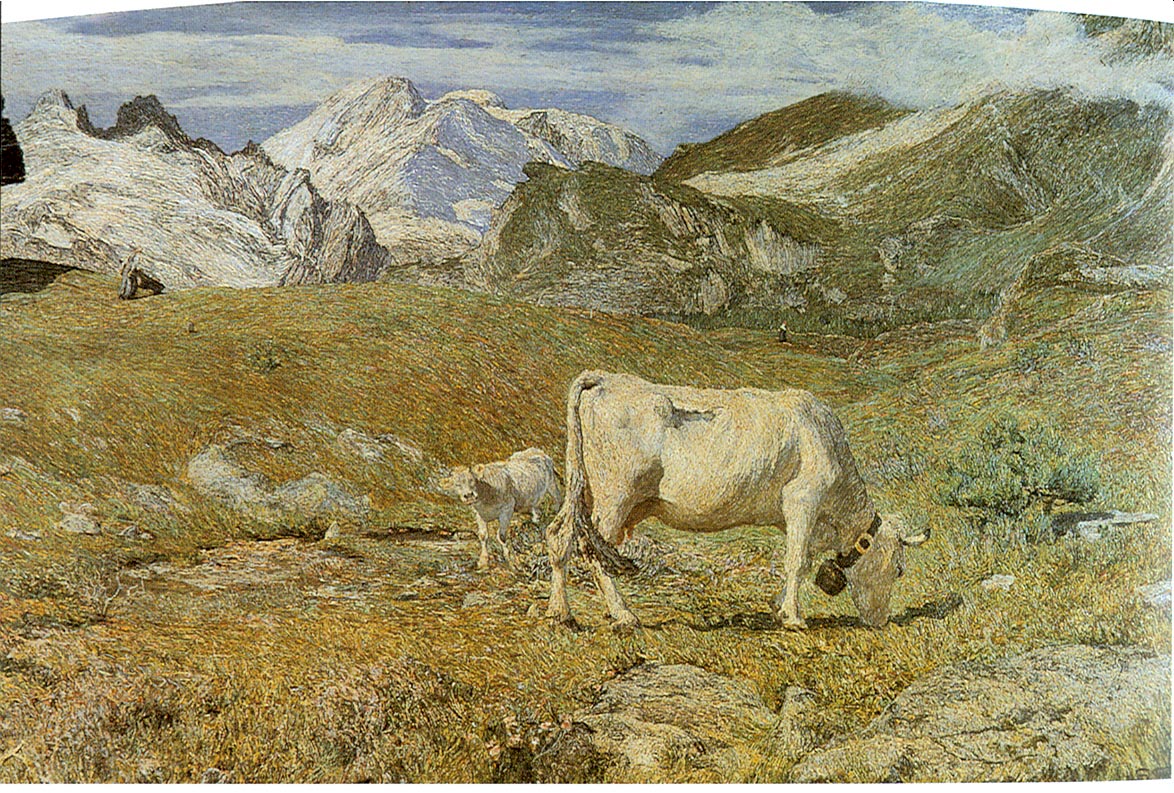
Giovanni Segantini, Spring Pastures, 1896
Source: Wikimedia Commons

In Journey to Mount Tamalpais, Etel Adnan's book that I discussed here a fortnight ago, she looks backwards to the mountain-haunted art of Hokusai and Cézanne.  Hans Ulrich Obrist mentions these artists too in the course of the interview transcribed in Etel Adnan in all her Dimensions, but he also refers to another painter of mountains, Giovanni Segantini, who ‘lived higher and higher up and when he died he was at 2500 metres in his cabin.’  This ascent was parallelled by his growing fame at the end of the nineteenth century, as the Segantini Museum in St. Moritz points out.  Segantini's search for ever higher places to paint en plein air was influenced in part by his reading of Nietzsche and he chose to work in the Swiss Engadine mountains that had inspired Thus Spake Zarathustra.   He was only 41 when he died in 1899, whilst painting the middle section of his Alpine Triptych, his health having been affected by working at altitude on the mountain of Schafberg.

 Giovanni Segantini, Alpine Triptych: Death, 1898-99
Source: Wikimedia Commons

A year after Segantini's death, the Universal Exposition in Paris might have contained his extraordinary panorama of the Engadine region.  In the event it was never painted, despite having initial financial support from a group of hotel owners inspired by Segantini's 'proclamation', which is quoted in Stephan Oettermann's book The Panorama: History of a Mass Medium.
Men of the Engadine!
       The project I have the honour of submitting to you, dear Engadiners and sons of the Alps, is a bold one, but as clear as the sunlight that shines on the mountains.  The world knows me as a painter of Alpine scenes.  My art was born amidst the solemn majesty of these peaks and here achieved the heights of its form. [...]  My panorama will have nothing in common with previous products of this genre. I intend to capture this portion of the Alps on canvas, the quality of its light and the clarity of its air; I will create the perfect illusion that the observer is high in the mountains, in a green meadow, surrounded by jagged peaks and sparkling glaciers, which feed our woody slopes with never-failing streams of fresh water and lave the smiling, fruitful valleys like emeralds in the hollows....
But this painted vista, stretching over 40,000 square feet, was by no means the summit of his ambition.

Segantini's 1897 sketch for the rotunda to contain his panorama (Segantini Museum).
This original design echoed the architecture of the Engadine's old Alpine houses.

As the proclamation goes on to explain, visitors would enter the building through a 'gallery hewn in rock' and ascend until they emerged on a craggy prominence 50 feet high with fir trees, 'mossy stones, little bridges, streams and gorges, wild flowers and fragrant herbs'.  Electrical ventilators would provide fresh air (his original idea had been to include giant ozone-producing machines) and a realistic atmosphere would be provided by lighting and hidden acoustic and hydraulic devices.  Between this viewing place and the wall of the panorama Segantini pictured 'barns full of fragrant hay, grazing cattle, and various geological features as well as the most important botanical and zoological specimens of our region.'  The building's facade would include symbolic representations of villages in the Upper Engadine, but also provide 28,000 square feet for advertising purposes.  Oettermann concludes that the withdrawal of support for the project 'spelled the end for a project that would have resulted in the most ambitious panorama of all time, in quality as well as sheer size.  It was also the death knell of the age of panoramas.'

Friday, November 15, 2013

Clouds and Mist in the Mountains

Ten landscape highlights from the V&A's exhibition Masterpieces of Chinese Painting 700-1900
(1) Possibly Yan Wenghui - Landscape with Pavilions (early 11th century)
There is an aura of great age about this scroll, although its exact date and the authenticity of its signature are in doubt.  Peering through the mist of fine grey ink and sepia-coloured paper you can discern little figures with umbrellas: it is a landscape in bad weather.  The catalogue describes the sky as 'dark and leaden' - 'as one moves towards the last section, the mountains become increasingly steep and rugged; a swiftly moving stream appears, and bent trees tell of the power of the wind and rain.'  The painting's fine details draw you into its world: you feel that with a magnifying glass it would be possible to enter even further into the past.  The Song Dynasty critic Liu Daochun found in Yan Wengui's paintings that 'the ship is like a leaf and the figures are like seeds of millet ... A thousand miles in a single foot - such was his subtlety!'
(2) Unidentified Artist - Reading the Memorial Stele (14th century or earlier)
This is a remarkably atmospheric painting, darkened by age (although not as dark as it appears in the catalogue, which is either badly printed in places or aiming to convery what these ancient silk hanging scrolls would look like in the shadows of an old library; fortunately it is much easier to see online.) Skeletal trees surround the stele and you wonder how the two travellers have the courage to linger there to decipher the inscription.  The warlord Cao Cao remains baffled as they ride away, but his attendant realises immediately that it commemorates a famously filial daughter of the Han Dynasty.  Another inscription to one side of the stele identifies the artists as Wang Xiao (the rather stylised figures) and Li Cheng (the extraordinary trees and rocks).  Li Cheng (Li Ch'eng, 919-967) was the great early Song Dynasty painter but sadly this scroll is probably from a later date, executed in his style.
(3) Mi Youren - Cloudy Mountains (1140s)
This painting has been impressed with the red seal marks and colophons of collectors and admirers over the course of 800 years, and yet it seems to be nothing more than an empty landscape of a few trees and distant peaks, brushed in thin dabs of watery grey ink.  It is owned by the Met who explain the appeal of the 'cloudy mountain' genre developed by Mi Fu and his son Mi Youren: 'referred to by scholar-artists as "ink play," the style suggests the importance of the painter's psychological expression, thereby raising the status of painting to that of poetry and calligraphy.'  The Mi style became popular again in the early Yuan dynasty, when the calligrapher and scholar Xianyu Shu wrote in his colophon to this painting (quoted in the exhibition catalogue) that 'an artisan's painting is short in ideas but long on representative likeness, but the opposite is true with the works of lofty souls and superior scholars.'  The vagueness of the view is such as to leave the viewer free to imagine 'a choice stretch of river shore lying far beyond the actual brushwork.'

(4) Qiu Ying - Saying Farewell at Xunyang (early 15th century)
Leaping forward from the early Song Dynasty due to my self-imposed limit of choosing just ten, and passing over works like Ni Zan's Woods and Valleys of Mount Yu (which you can see in an earlier post here), I come to this scroll, which is still 600 years old, although its colours remain as vivid as enamel. You can see it at the Google Art Project and even from the small reproduction above, it should be evident that this is a beautiful example of 'green and blue' landscape painting, the style that had arisen in the Tang dynasty when the subject of this scroll, Bai Juyi (Po-Chü-i) was writing his poetry.  In the middle a small group of men can be seen in a boat, listening to a woman playing a pipa, the Chinese lute.  It is a scene from Bai's famous poem 'Song of the Lute', written in 816.  Hearing the the sound of a pipa, Bai and his friends ask the musician to join them, but after playing some selections she puts down her plectrum and lapses into silence.  Then she tells them of the sad contrast between her youth as a beautiful courtesan in the capital and her current lonely existence.  Bai, who had been exiled from the capital the year before, is moved to tears.  There is a lovely translation of this poem in Burton Watson's Po Chü-i: Selected Poems.
(5) Wen Zhengming - Garden of the Inept Administrator (1551)
I have chosen this one partly for its amusing title: 'Inept' is rather different from 'humble', the usual translation of the name for this famous garden in Suzhou.  In 1535 Wen Zhengming painted aspects of it in a 31-leaf album for Wang Xianchen, its owner and designer.  This exhibition includes a different, later set of eight views, drawn in a 'humble' style so understated that the garden architecture has been diminished in size. The artist himself might be described as an inept administrator, having first sat the civil service exam in 1495 and failed another nine times before at last being granted an honorary position in 1522 (extraordinary to think that Wen, China's most famous sixteenth century artist, spent the whole period of the Italian High Renaissance failing to become a government administrator).  Having finally made it into the elite Hanlin Academy he resigned, disillusioned, after just three years and devoted the rest of his life to painting and calligraphy.  
(6) Fan Qi - Yangzi Riverscape (1660s)
'Fan Qi was one of the first artists in Chinese art history to paint a true horizon, namely a horizontal line separating heaven and earth.  In earlier and most later Chinese painting, including most landscapes by Fan Qi himself, the meeting of earth or water with the sky is ambiguous and blurred by clouds and a misty vagueness.  In fact, in the revolutionary horizon line here, which is about 75 centimetres long, there are only two short stretches of about 5 centimetres where sky and water really touch: at the three boat sails, and to the right of the tip of the tallest tree.  Everywhere else, shoals and clifs in pale grey and brown washes without contour lines appear behind the horizon, as if floating on it.  It is as if Fan Qi was afraid to show directly the full implications of his line: the earth is round, and even the tallest mountain, if far enough away, sinks beneath the horizon.'  (Kure Motoyuki, writing in the exhibition catalogue). 
(7) Wang Jian - Landscapes in the Manner of Old Masters (1669-73)
Twelve large scrolls in a row, each showing mountains and rivers in a different style but composed in a similar way: as the catalogue points out, 'from the stones and banks to the soaring peaks near the apex: a ridge almost like the undulating backbone of a dragon runs through each work.'  This ought to be a fascinating lesson in the history of Chinese landscape painting but neither the exhibition or the catalogue explain whose work Wang was imitating.  All we are told is that 'while some of the original paintings on which this set was based remain obscure to us today, others are instantly recognisable' (Fan Kuan's famous Travellers amid Streams and Mountains is clearly one of them).  Wang Jian was one of 'The Four Wangs', influenced by Dong Qichang (who I mentioned here last year), working in the lineage of literati-painters going back to Wang Wei.  The exhibition contrasts their more orthodox work nicely with the individualistic styles of Shitao and Bada Shanren.
(8) Fa Ruozhen - Clouds and Mist in the Mountains (c. 1690)
Fa Ruozhen is known now for cloud and mountain paintings in which the mist and rock are hard to distinguish.  The Met has one: ' like a great cumulonimbus cloud, the landscape billows upward in roiling layers of earth punctuated by misty vales harbouring half-concealed groves of trees.'  For this exhibition the V&A have borrowed a hanging scroll from Stockholm, and, as the catalogue says, 'it is sometimes difficult to decide whether cliffs and rocks are protruding or receding.  The space is relatively constricted, he clouds and mist failing to create any sense of depth.  The crags reaching almost to the top of the painting contribute to an almost claustrophobic atmosphere.'  Entering this place you would encounter cumulus boulders and trees like dark rain clouds; ascending through the mist you could never be sure how far the mountain extended.  If you kept on going you might realise you had left solid ground behind some time ago without ever having reached a summit.
(9) Bada Shanren - Flowers on the River (1697)
This painting of lotus flowers is so long, 14 metres, that following it feels like walking by a real riverbank.  What you can't really appreciate from reproductions is the sense of joyous freedom in Bada Shanren's gestural brushstrokes.  His poem at the end concludes: 'Happily singing my way, I immerse myself in the splashes of spring water and the sprays of flowers.  East and west, south and north after all are the same.'  A contemporary wrote that the artist's colophons 'were so strange that no one could understand them.  His brushwork was impulsively reckless; he did not stick to any established method, but worked in a firm and thorough and often unrestrained manner.' Michael Sullivan quotes this in his book Symbols of Eternity and goes on to wonder how Bada Shanren (Pa-ta Shan-jen) would have explained another landscape scroll which I have reproduced to the right.  'He might (if he were sober) have spoken of the Tao, or of the Void out of which form is manifest and into which it dissolves again.  This picture, executed with no preconceived composition in a kind of aesthetic ecstasy, carries us to the outer limits of pictorial art, to the edge of Void, stopping just short of the point of pure abstraction.'
(10) Xu Yang - Prosperous Suzhou (1759)
Finally, in complete contrast, this scroll is similar in length to Flowers on the River, but so detailed it seems to contain a whole world.  On reaching it, visitors to the exhibition stop and become immersed in its detail, edging along the display case from the morning light on Lingyan Hill past wharves and workshops, streets and shops, to the evening mist over the outskirts of the city.  It was commissioned by the Qianlong Emperor, whose own paintings and poetry I have described on this blog before.  Five years after completing it, Xu Yang and his assistants were asked to create scrolls depicting the Emperor's southern tours.  Six years and a hundred and fifty metres later they finished in time for his sixtieth birthday.  Art historians (and David Hockney) have compared these unfavourably with a similar set of scrolls painted in the 1690s by Wang Hui, attributing a certain stiffness in Xu Yang's work to the deleterious influence of new Western pictorial conventions that had arrived with the Jesuits.
NB: for copyright reasons I have not included images here beyond what is on Wikimedia Commons, although I have added links where possible.

Sunday, April 28, 2013

The Jardin Monceau


Among the distant ancestors of television, the eighteenth century rouleaux transparents of Louis Carrogis (known by the name of Carmontelle) have a particular interest for landscape historians.  As the handles of the box were turned, viewers were taken on a stroll through a succession of scenes with titles like The Four Seasons, Landscapes of France and The Banks of the Seine.  The clip embedded above shows a surviving example, Figures Walking in a Parkland, which featured in the Getty Museum's 2006 exhibition, Carmontelle's Transparency: An 18th-Century Motion Picture.  Carmontelle, a cobbler's son, was employed as tutor, engineer and master of entertainments by various French aristocrats - the Duc de Chevreuse, the Duc de Luynes, the Comte Pons de Saint-Maurice, and from 1763, Louis Philippe I, Duke of Orléans.  He wrote plays, designed sets and painted portraits of illustrious guests, including Rameau, d'Holbach, Sterne and the young Mozart.  In the 1770s Carmontelle was given the opportunity to create a real landscape, when he was commissioned to design the Jardin Monceau for the Duc de Chartres, Louis-Philippe's son.  The resulting garden was, according to Carmontelle, 'a land of illusions.'

Carmontelle, Carmontelle Giving the Keys of the Parc Monceau to the Duke of Chartres, c. 1790

The spectacle of the Jardin Monceau is conveyed by John Dixon Hunt in his book The Picturesque Garden in Europe.  'There was, according to Carmontelle's own commentary in Jardin Monceau près de Paris (1779), a specific itinerary through its 'quantity of curious things', and later commentators have plausibly attributed to his route a Masonic subtext.  Visitors entered by a Chinese gateway, next door to a gothic building that served as a chemical laboratory, and passed through greenhouses and coloured pavilions.  Upon pressing a button, a mirrored wall opened into a winter garden painted with trompe-l'œil trees, floored with red sand, filled with exotic plants, and containing at its far end a grotto in which summer parties were held while music was played in the chamber above.  Outside was a farm.  Then there were a series of exotic 'locations': a Temple of Mars, a winding river with an island of rocks and a Dutch mill, a dairy, two flower gardens, a Turkish tent poised, minaret-like, above an icehouse, a grove of tombs (still there today), and an Italian vineyard with a classical Bacchus at its centre, regularly laid out to contrast with an irregular wood that succeeded it.  The final stretches of the itinerary included a Naumachia or Roman water-theatre (still there), more Turkish and Chinese effects, a ruined castle, yet another water-mill, and an island on which sheep grazed.' 

Sunday, February 17, 2013

In the Field


I spent Friday and Saturday at In The Field, a symposium on the art and craft of field recording. During the two days we heard about a diversity of methods - from undersea hydrophone recordings made by Jana Winderen to impressions of the Hong Kong soundscape written for Salomé Voegelin's Soundwords project - and approaches ranging from the collective educational audio projects Claudia Wegener develops in Africa to the solo expeditions made by Simon Elliott to capture the intimate sounds of ospreys and peregrines.  Chris Watson came along briefly to talk about an installation he created at the London Children's Hospital in which patients remixed recordings he made on each of the seven continents.  He also mentioned In Britten's Footsteps, a collaboration with cellist Oliver Coates performed at Aldeburgh last week, which involved 'twenty speakers, split between the floor, head height and ceiling, developed to give an accurate spatial representation of the environment in which Watson had recorded the sounds' (The Liminal).  I think the weekend's highlight for me was a presentation by Christina Kubisch, whose Electrical Walks I wrote about here in 2010.  A recording she played of the beats made by different security gates sounded like the kind of music Chris Watson was making with Cabaret Voltaire all those years ago.

Reverberant flats on Peter Cusack's favouritesounds.org site

The most relevant talks from a landscape perspective were those that dealt with sound mapping, a subject I wrote about here last year, following a Wire Salon.  That event featured Ian Rawes, who modestly took on the job at this symposium of roving microphone holder, a role he could be seen as holding for the city itself in his work compiling the London Sound Survey.
  • Peter Cusack started his talk with a quote from The Peregrine: 'the hardest thing to see is what is really there', and suggested that the same is true for sound.  He therefore focused on just one recording: children playing in a reverberant space created by a semi-circle of flats, which would surely leave its residents with "a particularly strong sonic memory".  The block of flats' shape reminded me of the garden designed to produce echoes that John Evelyn observed in Paris and I wondered if Cusack had sought it out deliberately for its acoustic properties.  But  he had been there as part of a project to document sounds under the flight path to Tegel Airport: every four minutes the children's voices have to compete with the noise of aircraft overhead.  This too will be form part of their memory of living in these flats, a sound that will disappear when the airport is eventually closed.
  • Udo Noll, who has recorded sounds with Peter Cusack in Germany, talked about radio aporee, his global soundmap project. Various contributors had mentioned the importance of striving for the highest possible fidelity in their recordings but radio aporee is participative and welcomes all recordings of a reasonable standard.  Noll has now developed a radio aporee app, although he remains somewhat sceptical: "I don't like phones much and apps even less".  Is this augmented reality experience really progress?  Well, if artists don't work in this space, he argued, other commercial interests will.  Given that the non-mediated world is increasingly "a lost country", it seems better to have the option of coming upon a GPS-generated poem than some piece of corporate marketing.  This is also a way of inscribing a landscape without altering it - better, perhaps, to have the option of tuning in to a Simon Armitage stanza as you walk over the West Yorkshire moors, than coming across it carved into a rock.
  • Francesca Panetta described the creation of a similar sound app, Hackney Hear.  This sadly doesn't stretch as far as Stoke Newington, otherwise I could hear it as I type this, but it can't be long before we get one - she has also created Soho Stories, Kings Cross Streetstories and, most recently, an app to accompany Rachel Lichetenstein's Diamond Street.  Users of Hackney Hear have actually preferred its field recordings to the interviews and commissioned texts (Iain Sinclair, inevitably).  The talk concluded with an introduction to The Guardian's new interactive panorama from the top of the Shard, which incorporates clips from The London Sound Survey.  As she zoomed out, the sound of swirling wind and distant sirens gave way to more immersive soundtrack.  She clicked on various sound samples across the city to show us how it worked, but time was running short.  The final sound we heard was 'Land of Hope and Glory' emanating from the Albert Hall and for a moment it seemed as if the whole symposium was about to end with an echo of the Last Night of the Proms.  
 
 The Guardian's interactive view from the top of the Shard

Finally I should mention that In the Field is also the title of a new book of interviews with field recordists, edited by Cathy Lane and Angus Carlyle, who co-organised the weekend's event with Cheryl Tipp.  I may have more to say about this in a future post. 

Friday, November 09, 2012

Rive Oriental du Nil

'He would like to travel, if he could, stretched out on a sofa and not stirring, watching landscapes, ruins and cities pass before him like the screen of a panorama, mechanically unwinding.'  
Thus, thirty years later, Maxime du Camp recalled the attitude of his travelling companion, Gustave Flaubert, on their journey down the Nile to Thebes. 'This journey, which he had so cherished as a dream and whose realization had seemed to him impossible, did not satisfy him.' However, as Alain de Botton pointed out in The Art of Travel, Flaubert's youthful attraction to Egypt had not been misconceived, 'he simply replaced an absurdly idealised image with a more realistic but nevertheless still profoundly admiring one, he exchanged a youthful crush for a knowledgeable love.'  Writing to his mother, Flaubert said that his experience of Egypt had in fact extended far beyond the narrow idea he had held of it.  'I have found, clearly, delineated, everything that was hazy in my mind.'  This clear delineation can be seen in Flaubert's travel notes, which include the kind of luminous realistic details he would seek to write into Madame Bovary.  And in addition, Flaubert and du Camp had promised the Institut de France photographs of monuments and casts of inscriptions obtained by applying wet paper (a tedious process Flaubert often complained about in his travel notes). The image below seems to capture a sense of the country coming into focus.  


Maxime du Camp, Rive Oriental du Nil, Nubie, 1849-50
Source: Lee Gallery

[A footnote in Francis Steegmuller's wonderful compilation of letters and journals, Flaubert in Egypt, suggests that Maxime De Camp's reference to a panorama in the quotation above may reflect the fact that they encountered in Egypt the renowned panorama painter, Colonel Jean-Charles Langlois (1789-1870).  Langlois is a fascinating figure - a former student of Horace Vernet and an officer under Napoleon, whose rotunda in Paris opened with a panorama of the Naval Battle of Navarino featuring imitation terrain, gas lighting to simulate fire and ventilation to convey the breeze off the sea.  In 1839 a new grander rotunda was built and panoramas like The Burning of Moscow were a huge success, although profits were declining by the time du Camp and Flaubert met Langlois on the Nile.  Langlois used his Egyptian drawings for Battle of the Pyramids (1853) but two years later the rotunda was taken over and Langlois returned to active military service in the Crimea.  The connection between art and war continued even after his death: in 1944, during the Battle for Caen, half the paintings that had been housed in a special Langlois museum were destroyed.]

Sunday, May 15, 2011

Tortoise above the Venetian lagoon

A year ago in the LRB Marina Warner wrote a fascinating review of Erik Fischer's monumental four-volume catalogue devoted to the work of Melchior Lorck. Born in Danish-controlled Schleswig-Holstein in 1526 or 1527, he trained as a goldsmith but produced maps, medals, heraldry, portraits and landscape drawings.  Lorck travelled to Italy and then, in 1555, following in the footsteps of Gentile Bellini, to the Turkey of Suleiman the Magnificent in the company of humanist scholar Ogier Ghiselin de Busbecq.  Before leaving he produced the drawing below in which 'a large tortoise is placed on the sheet as if paddling through the air above the Venetian lagoon. Lorck added the sly inscription, ‘Made in Venice from Life’, as if daring the viewer to see the colossal creature flying overhead, a reptilian version of the Rukh, the huge raptor from The Arabian Nights who lifts Sinbad, but is also capable of carrying off an elephant.'

 Melchior Lorck, Tortoise above the Venetian Lagoon, 1555

Arriving in Constantinople, Lorck sketched the view from his window (rather like the wall in Naples painted by Thomas Jones). Marina Warner quotes Busbecq as saying that the view was blocked by bars and parapets, 'in deference to the complaints of the neighbours, who declared that they had no privacy from the gaze of the Christians. Lorck was probably trying to overcome these constraints when he looked out of the window, or perhaps his curiosity was aroused by them, because, in spite of all the attempts to prevent the gaze of Christians, he captures a tiny vignette of a couple making love on a terrace screened by rushes.'  This drawing wasn't in the LRB article but is readily available on Wikimedia Commons - see below.  Warner says that 'if I hadn’t gone to Copenhagen to look at Lorck’s work, I wouldn’t have noticed these figures, squirming like a sea anemone' (a simile that reminded me of Sebald's couple resembling 'some great mollusc washed ashore' in The Rings of Saturn).  'Lorck,' she says, 'doesn’t draw attention to the lovers’ presence in his roofscape, he doesn’t show or refer to erotic couplings from the Renaissance repertory. He simply sets down what he saw. His sepia ink records one tile as being as interesting as the next, in the manner of a surveyor measuring and recording. This mode was very radical for its time, and it would be hard to date the work accurately without further context. Apart from Rembrandt’s tender intimacies – and occasional frank scatology – I can’t think of another artist who makes so little fuss about looking at sex.' 

Melchior Lorck, View over the rooftops of Constantinople, 1555
Source: Wikimedia Commons

Lorck stayed in Constantinople until 1559 and in that year drew a vast panorama of the city from the heights of the fortifications in Galata, overlooking the Golden Horn. 'In the foreground Lorck shows himself at work; the scroll and a chalice for his ink and paint – there are washes of green and pink on the drawing – are being held for him by a seated Ottoman grandee who is wearing the huge rolled turban that marked a mufti or emir, both important definers and upholders of the law. ... The visiting artist is able to record the city, its layout, its dwellings, its fortifications, its trade and shipping, but only because he has been given permission, and that permission was granted because the Ottoman Empire has nothing to fear from being revealed to foreigners, so confident are its citizens, the official proclaims, in what they have achieved and what they are. So The Prospect is triple-faced: an act of intelligence-gathering by a visitor from a hostile power, a reverent homage to a munificent and enthralling country, and a message to the neighbouring European empire about what it has to reckon with.'  

Friday, December 03, 2010

Edinburgh from the Calton Hill

I have recently been wondering if the reason I've focused more on landscapes than nature is the want of a decent pair of binoculars.  A few weeks ago, inspired by my reading of The Running Sky and watching a flock of birds in motion, I was lecturing my wife on how we should pay more attention in autumn to the massing of starlings on the roofs of Stoke Newington.  She agreed, but pointed out that what I was looking at was a group of pigeons.  So I've resolved to get some binoculars for myself for Christmas (does anyone have any tips?)  Armed with these I shall be full of New Year's resolutions to get out and study the birds of the Lee Valley, the flora of Clissold Park and the architectural details of Hackney.

J. Wells after Robert Barker, Panorama of Edinburgh 
from the Calton Hill (detail), c. 1800

There is a great essay in Kathleen Jamie's book Findings called 'Skylines' in which she takes a telescope up to Calton Hill in Edinburgh to study the city from above, looking at the spires and domes, inscriptions and statues, clocks and weather vanes.  'The city sends up noise and fumes, and also the symbols of the day, the zeitgeist cast in shining brass and lifted skyward.'  Among the roofs she sees an eight-pointed star, an arrow, a trident, a moon, a red lion, a pelican, five different cockerels.  In the old days of the city, 'before every scrap of land was built on and cities became slums, what was raised up high were cockerels.'  Later generations would elevate allegorical sculptures, great Victorian crosses, aerials and telephone masts.  Now, after centuries of urban development, the newest building visible from Calton Hill has on its roof (invisible from the ground) a garden.

Thursday, December 03, 2009

The Liverpool Cityscape

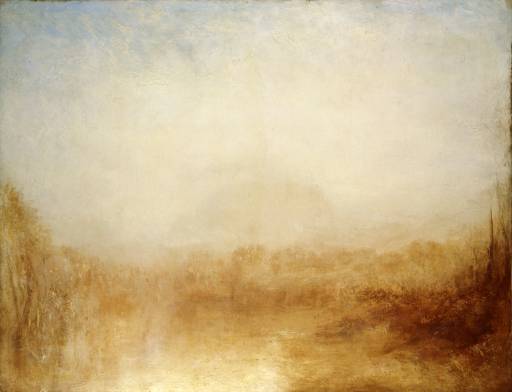
I've been in Liverpool this week and managed to squeeze in a trip to the Walker Art Gallery.  I think my favourite painting in their collection is Simone Martini's Christ Discovered in the Temple (reminiscent of the attitude my son assumes when he's done something wrong), but there are some great landscape paintings too.  In Poussin's Landscape with the Ashes of Phocion (1648), for example, with its contrast between the serene classical architecture and the wild rock formation towering above, you can almost hear the wind blowing menacingly through the trees.  Much wilder still is John Martin's The Last Man, a rendering of Thomas Campbell's apocalyptic poem, and there is a dramatic view of The Ruins of Holyrood Chapel (c. 1824) by Louis Daguerre, painter of dioramas, inventor of the daguerrotype.  However, for me the most striking landscape painting in the museum (and you really have to see it rather than peer at a jpeg) is this:


J.M.W. Turner, Landscape, c1845

Leaving the permanent collection, I came to an exhibition celebrating the John Moores Painting Prize.  In 2006 this was awarded to Martin Greenland for Before Vermeer's Clouds.  The painting uses the sky from Vermeer's A View of Delft and according to the artist's statement, it was originally to be titled 'A Vision of Heaven', designed to have 'the same appearance of stability and unhurried peace as Vermeer’s, and incorporate as many elements of the stable or perpetual as could be organised.'  It's quite a risky strategy, as the borrowed sky and 'perpetual' landscape elements could seem nothing more than dull pastiche.  You can see other examples of Greenland's imagined landscapes on his website.

Last year, during Liverpool's turn as European City of Culture, the artist Ben Johnson was in residence at the Walker completing his Liverpool Cityscape.  Seeing it up close this week, I thought it quite strange to be described as a "celebration" of Liverpool (as in the video clip below), because it shows an lifeless city, emptied of people and traffic.  The background is painted with the naturalistic realism you would expect in a panorama, but the foreground buildings resemble a computer generated architectural model with their dimensions oddly distorted.  Everything is pristine and well lit and the dominant colour is the dead beige of recent urban regeneration.  Still, according to the Liverpool Echo, 'Ben Johnson's painstaking and wondrous Liverpool cityscape – the distillation of team work referencing 3,000 photographs and occupying 24,000 man hours – is the definitive visual statement of our 2008 renaissance.'


Saturday, March 07, 2009

Panorama of Scheveningen


Hendrik Willem Mesdag, Segment of the Panorama of Scheveningen, 1881

By 1881 the panorama form was almost a hundred years old. Although many of the panoramas in the latter part of the nineteenth century were executed by relatively well-known Salon artists, such works were far removed from the concerns of cutting edge landscape painters - the Impressionists, Post-Impressionists and Symbolists. A possible exception was Hendrik Willem Mesdag, whose panorama of the beach and village of Scheveningen I saw on my trip to The Hague recently. Mesdag was a leading Hague School painter and his motivation for agreeing to work in this relatively disreputable format may have been the desire to work on such a large scale in his own speciality – the seascape.’ Petra Halkes (‘The Mesdag Panorama: Sheltering the all-embracing view’, Art History, Vol. 22, No.1, March 1999) suggests that Mesdag’s panorama can be compared to other landscape art produced at this time in that it responded to ‘a need to screen out the shattering forces of industrialisation and enclose a gentle arcadia within an endless universe.’ This view of Scheveningen may function as nostalgia for the ‘all-embracing view’, the panoramic vision of nature that at the time of the earliest panoramas was only just beginning to be challenged by the fragmentation of industrial society and the new visual modes of modernity.

Visiting the panorama now imposes another century's worth of nostalgia. The building has been restored but feels very much like a time capsule: you walk through a short dark corridor and come up a Victorian wooden stairway into the middle of the panorama, surrounded by a frameless view of the Dutch coast. (The absence of a frame is all the more noticeable because as you enter the museum you go past several Mesdag seascapes which sit within heavy, ornate gilt frames.) The realism is initially disconcerting as your eyes become accustomed to seeing the world in through the medium of paint. But after a while some details do start to seem a little odd, for example soldiers on the beach that look rather like toy soldiers (they are just doing some drill, but reminded me that panoramas had long been associated with battle scenes). And to the left of the view shown above, there is a slightly surreal pavilion with statues that reminded me of De Chirico and some goats visible in the grass outside. It's a reminder that the more realistic a landscape, the stranger some of the details may seem.

Thursday, August 31, 2006

Red Arch Mountain, Utah

In Berlin Childhood around 1900 Walter Benjamin relates his childhood immersion in watercolours to the story of an old Chinese painter. The old man invited friends around to see his most recent picture. They were shown a landscape with a footpath leading along a stream and through a grove to a small cottage. When they turned around and looked for the painter, he had gone. They saw that he had entered the picture and was walking up the path to the door, where he paused ‘quite still, turned, smiled and disappeared through the narrow opening.’

Reading Benjamin’s book it is difficult not to reflect on one’s own childhood memories. Benjamin describes the streets, parks and monuments of Berlin but he also dwells on the landscapes of furniture and household objects that a child negotiates. He remembers the power of postcards and the old Imperial Panorama where ‘one afternoon, while seated before a transparency of Aix, I tried to persuade myself that, once upon a time, I must have played on the patch of pavement that is guarded by the old plane trees of the Cours Mirabeau.’ On reading this I went down to our cellar and found my father’s old stereoscope which had enchanted me as a child. The image below, for example, is Red Arch Mountain, Utah, probably photographed in about 1947 (some of the discs have this date). An anonymous photographer’s tiny image in Kodachrome “natural colour”, it now has the time capsule qualities of a miniature landscape in a Book of Hours. What seemed a strange, distant mountain to me as a child is now potentially accessible, but the world that produced the stereoscope is irretrievable, along with the imaginative space of childhood.

Sunday, June 25, 2006

Many thousand views


I was recently given a reproduction of an ‘Endless Landscape’ ‘closely based on one published in Leipzig in the 1830s’. This is an example of a myriorama, a pack of cards depicting slices of landscape which can be rearranged to create different panoramic views. The word myriorama derives from Greek myrias, “ten thousand”, and refers to the different combinations possible with a relatively small number of cards. The myriorama was invented in 1802 by Jean-Pierre Brés (1760-1834) and developed in England by John H. Clark (1771-1863). Stephan Oettermann’s comprehensive book on the Panorama includes the advertisement for Clark’s myriorama that was published in the brochure for the Regent’s Park Diorama in 1825:
Picturesque Scenery / Just Published, The Myriorama; or, many Thousand Views, Designed by Mr. Clark. The Myriorama is a movable Picture, consisting of numerous Cards, on which Fragments of Landscapes, neatly coloured, and so ingeniously contrived that any two, or more, placed together, will form a pleasing View; or if the whole are put on a table at once, will admit the astonishing Number of 20,922,789,888,000 Variations: it is therefore certain, that if a person were occupied night and day, making one change every minute, he could not finish the task in less than 39,807,888 years, and 330 days. The cards are fitted up in an elegant box, price 15s.
The Myriorama (second Series) consisting entirely of Italian Scenery, Designed by Mr Clark. The Second Series is capable of even greater variation thn the First, as the number of cards is increased from 16 to 24. The changes or variations which may be produced by the 24 Cards, amount to the astounding and almost incredible number of 640,448,401,733,239,360,000. Price 1 L. 4s. in an Elegant Box.
There is a photograph of a myriorama at the Bill Dougas Centre site. The term myriorama later came to be used for moving panoramas – Poole’s Myriorama is mentioned in the ‘Penelope’ chapter of Joyce’s Ulysses. The concept of a myriorama could be adapted to contemporary art in various ways: one example on-line is this installation by the Australian artist Tony Clark.