Showing posts with label Paul Cezanne. Show all posts

Saturday, October 25, 2025

Fireworks in the Himalayas

I was curious to see the White Cube's Cai Guo-Qiang exhibition but conflicted after the recent controversy surrounding his firework performance in the Himalayas, The Rising Dragon, sponsored by an outdoor clothing company called Arc’teryx. According to Artnet, Cai thought he was bringing "energy, awe, blessings and hope to the world,” but there was a swift backlash over a work 'threatening one of the planet’s most fragile ecosystems and for showing cultural insensitivity, as the Tibetan plateau and its mountains are sacred in Tibetan Buddhism.' It sounds like the worst possible kind of art-in-the-landscape. Two days after the fireworks Cai and Arc'teryx were issuing apologies and explanations. Cai said his fireworks were biodegradable and had passed environmental standards when used for the Beijing Olympics, but scientists 'warned that the damage could be irreversible, given the plateau’s fragile ecosystem' and 'pointed out that standards designed for urban settings do not apply at such high altitudes.' An official investigation was launched. Artnet point out that Cai got into more trouble recently for a drone performance in Quanzhou which 'ended in chaos when drones, unregistered with local authorities, were shot down en masse during the event', and four months earlier an event in Los Angeles caused ash to rain down on spectators and unexpected noise disruption for surrounding neighborhoods. 


Cai Guo-Qiang, Mountain, 2019  

Aware of all this I nevertheless decided to have a look at the gunpowder canvases on display at White Cube, where flower and bird forms emerge from attractive and colourful abstract swirls to create 'cosmic gardens'. The curators wax lyrical: 'amber collides with ash-grey in fevered bursts; diffusions of cerulean are flecked with inky lapis; whirlpools of fuchsia and blue converge and dissolve.' The example above is much less colourful; Mountain (2019) was 'conceived in response to Cézanne yet reframed within a broader horizon that unsettles the paradigm of Eastern and Western art histories, advancing instead a vision of heritage as shared experience.' I'm not sure how far it achieves this, but it's true that it resembles both Cézanne's Mont Sainte-Victoire and the misty contours of a Chinese landscape painting. Cézanne was actually the source for Cai’s controversial fireworks in Tibet, via an early unrealised project for a firework display over Mont Sainte-Victoire, Ascending Dragon: Project for Extraterrestrials No 2 (1989). According to Artnet, 'Cai had originally sought to realize the piece both at Mount Fuji, in Japan, and at Mont Sainte-Victoire in France, but was reportedly denied permission by local authorities due to environmental concerns.'

Sunday, January 22, 2023

House near Gardanne

Paul Cézanne, Montagne Sainte-Victoire, c. 1890

This is a photo I took on my phone of a painting in the Tate's superb Cézanne exhibition. I won't attempt to discuss this exhibition (you can read Laura Cumming); instead I will talk about T. J. Clark's book about the artist, If These Apples Should Fall: Cézanne and the Present which I recently read. I thought I might try to distil here some of what he says about the landscape paintings, although as ArtForum's reviewer Joseph Henry points out in his review, the book 'confirms that Clark should rarely be read for his “takeaways” or “arguments.” ... What drives If Apples Should Fall is less the task of scholarly exposition than the swelling momentum of interpretation itself.' Condensing down the flow of his prose, written in 'a tone both chatty and always-already erudite', risks leaving nothing but the most familiar observation about landscape painting - that it is both an image of the world and a performance of marks on canvas. Nevertheless I'll briefly summarise some of the paragraphs from the book's concluding chapter, which mainly discusses a painting in Indianapolis, House near Gardanne.


Paul Cézanne, House near Gardanne, c. 1886-90

Clark begins by noting that the painting is not large but its landscape has 'a formidable implied scale ... The ordinariness of the house and surroundings is accompanied by a kind of distance.' In Cézanne at his strongest 'nearness and apartness' coexist.

He then starts looking closely at some of the oddities in the painting - the kind of thing we always find in Cézanne. But none of this 'ends up robbing us of 'world' and putting 'painting' in its place'.  

Next he goes back into art history to contrast a Ruysdael landscape, where the viewer is invited to follow a path into the scene, with a more depthless image by Rembrandt. Cézanne's painting resembles the latter. His house fits into the landscape 'like a piece in a jigsaw, not a thing on the earth'. 

House near Gardanne is an example of a kind of picture that seems 'to be interested in the world, or not-quite-world, that crops up between places...' In this it resembles the Rembrandt (Goldweigher's Field) or the paintings of Jan van Goyen. The scene is not empty - it is packed with things, but the viewer can be left mystified as to why this particular stretch of nature's continuum was chosen.

Clark then returns again to a close examination of the marks making up the house, which stands out as an intervention in nature but at the same time seems porous at its edges, opening into its surroundings. That house is itself like a painting, both closed and open to the world.

Finally he shifts to a painting of Montagne Sainte-Victoire and finds in it a counter-allegory to House near Gardanne. 'The mountain is the picture, not the four-square house. And the picture, it follows, is not a closed thing', it is 'the world we are in.'

Thursday, June 30, 2016

View of Auvers-sur-Oise


I have been reading A Burglar's Guide to the City by BLDGBLOG's Geoff Manaugh which has interesting things to say about buildings, street patterns and the way urban space is used.  With its focus on illegally entering enclosed structures there is little directly about 'landscape', although I did learn that a popular lock picking tool is a kind of landscape in miniature: the Bogotá rake, 'named because its waves and bends apparently resemble the mountains surrounding Bogotá, Columbia, where the tool was invented.'  Also that there is a thorny plant, trifoliate orange, popular with security conscious landscape designers because it 'is so dense and fast-growing that it can stop speeding vehicles; it is used by the U.S. military to help secure the perimeters of missile silos and armories.'  And that there was a burglar in Oregon
'who dressed up in a ghillie suit, a tangled mass of fake vegetation woven into nets, originally meant to camouflage military snipers by making them indistinguishable from plant life.  Disguised as a plant, he then slipped into his target, which, of all things - because you couldn't make this up, it would be impossible to take seriously in a work of fiction - was a museum of rocks and minerals.  He was after their gold and gemstones.  Simulating one kind of landscape, he broke into a museum of another...'

Stories like this got me thinking about landscape art in a different way, as a target for burglary. A Cézanne painting, View of Auvers-sur-Oise (c. 1879-82) that I've always liked (the postcard I'm holding above was purchased just after I did my A-levels) can no longer be seen because it was stolen on millennium night.  Here's how The Guardian reported the burglary on 3 January 2000.
'The theft of a £3m painting by Paul Cézanne in Oxford on millennium night was carried out by a professional burglar who created a smokescreen to foil security cameras, it was disclosed yesterday.  With the noise of his break-in masked by celebratory fireworks, the burglar cut a hole in the roof of the Ashmolean museum and descended to its art gallery by rope ladder.  He had a holdall containing a scalpel, tape, gloves, a smoke canister and a small fan. He set off the canister, and used the fan to spread the smoke and obscure the view of the gallery's closed circuit cameras. In less than 10 minutes, he had seized the painting, View of Auvers-sur-Oise, climbed up the ladder, and gone.'
There are apparently suspicions that this painting was stolen to order by a collector, obviously not a person to be satisfied with an Ashmolean Museum postcard.  Fortunately art thefts are too rare to consider any prevailing aesthetic in the landscapes targetted.  There's the painting that gave a name to an art movement - Monet's Impression, soleil levant - stolen in Paris by a yakuza gangster; Nebelschwaden by Caspar David Friedrich, taken along with two Turners by thieves who had hidden overnight in a Hamburg gallery; Govaert Flinck's Landscape with an Obelisk, lifted along with other Dutch masterpieces in Boston by a gang dressed up as policemen (one wearing a fake wax mustache); and Marine by Claude Monet, owned by a museum in Rio de Janeiro, which disappeared with its burglars into the carnival crowd, melting into the city like the thief who got away with his Cézanne while millennium fireworks created the perfect diversion.

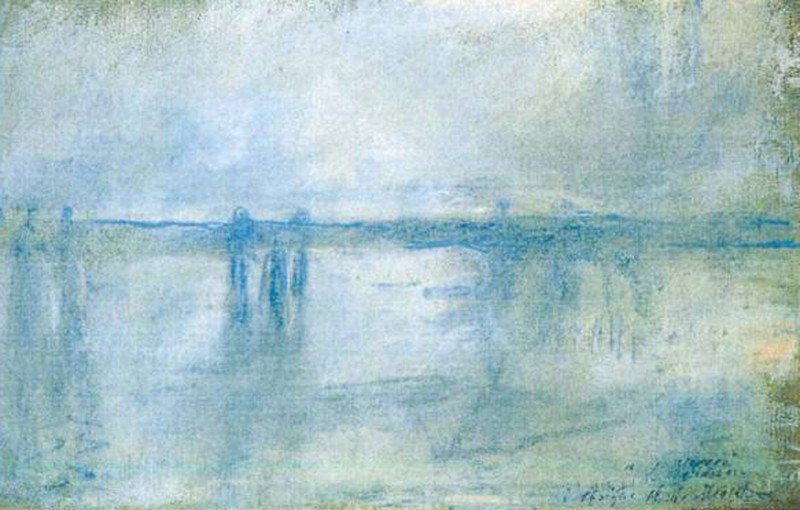
Claude Monet, Charing Cross Bridge, 1901
Image: Wikimedia Commons, via Rotterdam Police

I will end here with a quote from A Burglar's Guide to the City concerning the role of architecture in a theft involving two more Monet paintings.  The following paragraph is reprinted on the Fast Company website:
'One of the most spectacular art heists of the last decade is thought to have succeeded precisely because of a flaw in a museum’s architectural design, which inadvertently allowed the general public to study the internal patterns of the security guards and visitors. The Kunsthal in Rotterdam, designed by Rem Koolhaas’s firm OMA, was robbed in the middle of the night back in October 2012; seven paintings were stolen, including works by Matisse, Gauguin, Monet, and Picasso. Ton Cremers, founder of the Museum Security Network, an online forum, put some of the blame for this on the building itself: the museum’s expansive floor-to-ceiling windows offered a clear and unobstructed view of many of the paintings hanging inside. More important, they also allowed a constant, real-time surveillance of the internal workings of the museum for anyone passing by—the patterns of visitors and the comings and goings of the guards were effectively on public display. Thus thieves could have sat outside in a nearby park, watching until they found the right moment to strike. The museum had its own internal rhythm of events that the burglars interrupted with a perfectly timed counter-event: the heist. This is the rhythmic spacetime of burglary.'

Friday, April 22, 2016

The Black World


I did a post here back in 2010 about Trevor Paglen, the artist-geographer who has explored the 'black world' of US military and intelligence agencies.  I focused then on his 'limit telephotography' in which restricted landscapes, cut-off and unseeable with the naked eye, can be glimpsed using high-powered telescopes.  Today I popped into an excellent small exhibition of his work to coincide with the Deutsche Börse prize (like the exhibition of Richard Mosse photographs I described here two years ago).  Three exhibits of particular interest from a landscape perspective:
  • They Watch the Moon (2010), which you can see above in the window of the Photographers Gallery, is a beautiful vista of hills completely covered in rich green vegetation.  At their centre, a constellation of artificial lights and the dishes of telescopes arranged in a circle like orbiting moons.  In an essay on Paglen's work, 'Visiting the Planetarium: Images of the Black World', Brian Holmes has written of this photograph that whilst we may see in it something grand, an image of the cosmic relation of earth and sky, in fact 'the radio telescope depicted is devoted to banalities: it picks up stray cell-phone conversations bouncing off the lunar surface from halfway around the globe.'
  • Untitled (Reaper Drone) 2010, is just as visually stunning: a late-Turner swirl of yellow light - the desert sky near Las Vegas - and caught in the image the tiny silhouette of military drone.  This series of photographs, the curators explain, are achieved with a large-format camera trained on the sky: 'when the film is developed, small insect-like drones are peppered throughout the images.'  There is another, Untitled (Predators), not in the exhibition, which could be a high cirrus sky over Suffolk - an ominous contemporary version of Constable's cloud studies.
  • NSA-Tapped Fiber Optic Cable Landing Site, Marseilles, France (2015) partly comprises another large-scale landscape photograph, juxtaposed with a nautical map onto which various diagrams and images have been pinned like the visual prompts on a crime investigation board.  The view of rocky islands in the bay of Marseilles inevitably brings to mind The Count of Monte Cristo, a novel that features surveillance, secret locations, political plots and, here where the NSA-tapped cable came ashore, the fortress prison where the novel's hero is cut off from all communication with the outside world. 

Paul Cézanne, The Bay of Marseilles from L'Estaque, c. 1885
(a postcard of this painting is one of the items Paglen has attached to the map of Marseilles)

Having written this I see that the Photographers Gallery have just today posted an interview with Paglen on their website.  In this clip, embedded here, he talks in front of the map of Marseille about the way his work aims to make visitors look at the world more closely and more suspiciously.

Saturday, December 20, 2014

Factory chimneys across the River Eden


When we visited Aix-en-Provence and Mont Sainte-Victoire, a couple of years before France adopted the Euro, it was mildly gratifying to be able to pay for things using Paul Cézanne banknotes.  At that time the 50 Franc notes honoured another of my heroes, Antoine de Saint-ExupéryThe 20 Franc Debussy notes featured landscapes on both sides: a stormy sea representing La Mer, and scenery for Pelléas et Mélisande (1902), originally painted by Lucien Jusseaume and Eugène Ronsin.  I suppose the Euro notes that replaced these might be seen as having a tangential landscape association, but the bridges on them are really generic symbols rather than specific landmarks (unlike the original designs which included the Rialto Bridge in Venice and the Pont de Neuilly in Paris).  Bridges are popular currency motifs - outside the Eurozone Denmark uses them and here in Britian we can spend five different Bank of Scotland notes, ranging from the 14th century Brig O'Doon (£5) to the Kessock Bridge, completed in 1982 (£100).


Another landscape painter honoured on a banknote is Edvard Munch - he appears with his painting, The Sun on Norway's 1000-kroner note.  There has been a lot of praise this year for the new Norwegian note designs ('the world's coolest currency' according to Slate).  The original Snøhetta Design idea was to pair black and white coastal photographs with pixelated colour versions.  The Norges Bank has kept the pixels but gone for more traditional images on the obverse.  Personally I am even more envious of the new Norwegian passports, designed by Neue, which the Guardian described as 'beautifully simplified depictions of Norway’s natural landscapes drawn with fine lines in pastel shades ... When shone under UV light, the landscapes within the pages transform to show the northern lights in the night sky, a magical touch that adds a deeper sense of intrigue to the already striking document.'


Of course there are many examples of landscapes on banknotes, from the dramatic mountains of Guilin on China's 20 yuan, to the Ulster Bank's vignette's of the Mourne Mountains, Giant's Causeway and Queen Elizabeth Bridge (another one...)  There was a time when individual banks in England as well as other parts of the British Isles issued their own notes. The British Museum site explains how these became increasingly sophisticated in the nineteenth century with the use of steel engraving:
'Printers such as Perkins and Heath in London and W.H.Lizars in Edinburgh exploited this potential to produce exquisite banknote designs combining dazzling machine-engraved patterns – a trademark of Perkins’ firm – with delicate hand-engraved figures and rural scenes that reflected a growing taste for romantic landscape, evident in the popularity of topographical prints, watercolours and poetry. A wonderful note of the Carlisle City and District Banking Company carries a panoramic view of the city with its castle, cathedral, houses and factory chimneys across the River Eden; people stroll in fields in the foreground, while on the far bank cattle are wading and a line of washing is hanging out to dry.' 
This kind of local pride expressed through banknotes seems remote in the era of e-commerce and bitcoins.  Will physical money last any longer than passports or stamps?  I have written here before about landscapes on stamps, which represented the beauty and productive potential of far flung imperial territories.   It would be interesting to compare the iconography of banknotes, which represent financial geography, with stamps that link territories together.  Clearly a lot of thought goes into what they show as well as the ways in which they resist counterfeiters.  The Bank of Canada museum, for example, quotes an internal memo from 1954: 'the traditional ornamentation of bank notes reflects a ‘Victorian’ taste in design….derived from times associated with an immature, colonial status.'  Instead,
'officials at the Bank wanted the notes to feature images of Canadian landscapes that showed little or no evidence of human activity. They chose the final 8 images from over 3,000 photographs supplied from the collections of railways, archives and news agencies. From the Maritimes, through Eastern Canada, the Prairies, the Rockies and the North, what resulted was an extended portrait of The Great Lone Land vision of Canada. This vision was already out-dated, but served as the natural starting point for an evolving manifestation of official identity that would be played out on all future bank notes.'
Bank of Canada 1954 note showing Okanagan Lake in British Columbia, 
engraved by William Ford of the American Bank Note Company

Earlier this year the Huffington Post reported on calls to have a woman on Canadian notes for the first time - their suggestions include Margaret Atwood, Emily Carr (the subject of a retrospective at Dulwich Picture Gallery that I'll probably be writing about here soon) and, er, Shania Twain ("Canadian country and pop music star, famous for hits such as 'Man! I Feel Like a Woman.'")  Over here there was controversy recently at the announcement that a man (Churchill) would replace a woman, Elizabeth Fry, on the £5 note, until the Bank of England said it was planning to balance things out with Jane Austen on the next £10.  I'll end here on an Icelandic note with another landscape painter, Johannes Sveinsson Kjarval, depicted on the 2000 Kronur.  Björk, who will surely feature on the Icelandic currency herself before too long, named an instrumental after him on the album she recorded as an eleven-year-old in 1977.

Wednesday, September 17, 2008

Mont Sainte-Victoire

Cézanne's definition of a motif: 'You see, a motif is this...' (He put his hands together, drew them apart, the ten fingers open, then slowly, very slowly brought them together again, clasped them, squeezed them tightly, meshing them.) 'That's what one should try to achieve. If one hand is held too high or too low, it won't work. Not a single link should be too slack, leaving a hole through which the emotion, the light, the truth can escape. You must understand that I work on the whole canvas, on everything at once. With one impulse, with undivided faith, I approach all the scattered bits and pieces. Everything we see falls apart, vanishes, doesn't it? Nature is always the same, but nothing in her that appears to us, lasts. Our art must render the thrill of her permanence along with her elements, the appearance of all her changes. It must give us a taste of her eternity.'

This comes from Joachim Gasquet's recollections (for a fuller quotation see the Webmuseum). Cézanne was clear that there was a difference between a motif like this and a 'beautiful view'. Richard Verdi, in his book on the artist, illustrates the difference by comparing early scenic views of the Gulf of Marseilles (painted in 1879-82) with later landscapes where trees frame a tighter composition. But the great example of a motif is of course Mont Sainte-Victoire, and the example way tree and mountain combine to structure the view in the painting below recalls the metaphor of the interlocking hands that Gasquet quoted.


Paul Cézanne, Mont Sainte-Victoire, 1885-87
Source: Wikimedia Commons

Sunday, June 22, 2008

The Forest of Fontainebleau

Here's a movie quote you'll remember...
"Well, all right, why is life worth living? That's a very good question. Well, there are certain things I guess that make it worthwhile. Uh, like what? Okay. Um, for me... oh, I would say... what, Groucho Marx, to name one thing... and Willie Mays, and... the second movement of the Jupiter Symphony, and... Louis Armstrong's recording of 'Potatohead Blues'... Swedish movies, naturally... 'Sentimental Education' by Flaubert... Marlon Brando, Frank Sinatra... those incredible apples and pears by Cézanne... the crabs at Sam Wo's... Tracy's face..."

Among many reasons why Woody Allen might consider L'Éducation sentimentale one of the things that make life worthwhile are Flaubert's beautiful, precise descriptions of people, things and places. Douglas Parmée has listed some of the landscapes Flaubert includes: Nogent (dull and domesticated), Auteuil (pretty but with a touch of autumn melancholy) and various views of The Seine, which 'flows through throughout the novel, sometimes beautiful but indifferent, sometimes charmingly delicate.' However, the most striking example in the book is the extended sequence describing a brief time of happiness for Frédéric and Rosanette in the Forest of Fontainebleau. According to Parmée it 'has all the immediacy of notes taken on the spot: solemnity and exhilaration, painterly chiaroscuro with cinematic long shots and close-ups, lurking danger (monstrous rocks, smells of decay, leafless branches in midsummer), the delicacy of gossamer and butterflies, glittering water and greenery of every shade, sun and sudden showers, hills and valleys, low bushes and towering trees...' This extract from the French text describes the effect of light on the forest trees:
'La lumière, à de certaines places éclairant la lisière du bois, laissait les fonds dans l'ombre ; ou bien, atténuée sur les premiers plans par une sorte de crépuscule, elle étalait dans les lointains des vapeurs violettes, une clarté blanche. Au milieu du jour, le soleil, tombant d'aplomb sur les larges verdures, les éclaboussait, suspendait des gouttes argentines à la pointe des branches, rayait le gazon de traînées d'émeraudes, jetait des taches d'or sur les couches de feuilles mortes ; en se renversant la tête, on apercevait le ciel, entre les cimes des arbres. Quelques-uns, d'une altitude démesurée, avaient des airs de patriarches et d'empereurs, ou, se touchant par le bout, formaient avec leurs longs fûts comme des arcs de triomphe ; d'autres, poussés dès le bas obliquement, semblaient des colonnes près de tomber.

Cette foule de grosses lignes verticales s'entrouvrait. Alors, d'énormes flots verts se déroulaient en bosselages inégaux jusqu'à la surface des vallées où s'avançait la croupe d'autres collines dominant des plaines blondes, qui finissaient par se perdre dans une pâleur indécise.'

And here's a depiction of the forest trees by one of Woody Allen's favourite artists...

Paul Cézanne, The Forest of Fountainebleau, 1879-82

Source: Wikimedia Commons

Friday, April 13, 2007

The Bridge at Maincy

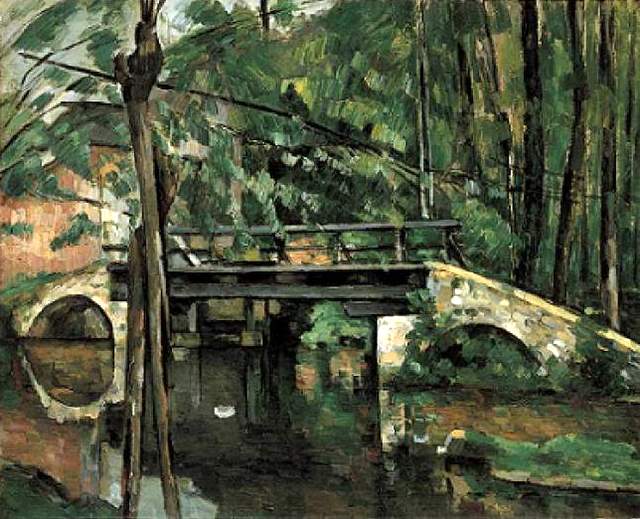
Cézanne famously aimed to ‘re-do Poussin over again according to nature’. Comparing the two painters, Richard Verdi has written that Poussin’s classicism ‘evolved in the studio, through the joint efforts of the intellect and imagination, Cézanne’s had to be won directly from nature. In this respect it was a kind of instinctive – or ‘spontaneous’ – classicism, one which was found rather than made.’ In The Bridge at Maincy (1879) for example, the vividness of the foliage is matched by the solid structure of bridge and trees.

Paul Cézanne, The Bridge at Maincy, 1879
Source: Wikimedia Commons

Last week I was in Hampstead and thought I would take a look at the Vale of Health, a poetically named cluster of houses on the Heath where various famous writers have lived, including Tagore and D. H. Lawrence. It was a quiet morning and I felt a bit like a trespasser – it was a almost a relief to turn off the road and wonder down to a bench looking out over the pond which some of the houses back onto. The trees framed the lake in angles that reminded me of the triangular compositions of landscape painters like Cézanne. I found myself thinking that what often seems to be order imposed by an artist may simply be the natural angles assumed by trees growing from the same slopes and subject to the same winds. Then again maybe I was just instinctively classicising. After all, someone probably chose to position that bench in such a way that the diagonals of the birch trunks would strike the viewer just so...

Saturday, October 07, 2006

Lac d’Annecy

Paul Cézanne, Lac d’Annecy, 1896
Source: Wikimedia Commons

I first saw the paintings at the Courtauld Institute when they were still in their old location, stuck out of the way on the top floors of the Warburg Institute building. I went unprepared for the shock of so many outstanding works, in these grey, unimpressive surroundings but the one moment I will never forget was seeing Cézanne’s Lac d’Annecy (1896). Richard Verdi (in Cézanne) has described this painting, simple in form but highly complex in its prismatic colours, ‘with no two strokes of blue or green appearing exactly the same in size hue or direction’. Verdi notes, for example, that ‘while house and château on the distant shore are clearly delineated, the landscape around them appears in an inchoate state, as though still awaiting further resolution.’ This illustrates a general feature of the artist’s approach: rather than distinguishing foreground from background through the degree of detail applied to forms, Cézanne concentrated attention on objects at different points in space. While Cézanne saw in this his difficulty in realizing the full complexity of nature, the result was paintings that have ‘an unparalleled vitality and lay bare the formative process of painting as few other works of art do.’

Monday, April 17, 2006

Mountains and clouds, reflected

Charles Tomlinson, a poet who has always drawn inspiration from landscapes and landscape painting, once wrote a review (Modern Painters Spring 1989) in which he described his discovery of Cézanne through books. This intellectual journey began during the war, when it was not possible to view any actual paintings, with a tiny black and white illustration of a view of Gardanne in Eric Newton’s European Painting and Sculpture. However, the first significant book was Adrian Stokes’ Cézanne, which Tomlinson read in 1948. Stokes likened Cézanne’s treatment of form to ‘trees reflected by slightly undulating water’, a metaphor that Tomlinson links to these lines of Wordsworth (The Prelude Book IV) that, like the paintings, focus our attention on the process of perception itself:

As one who hangs down-bending from the side
Of a slow-moving boat, upon the breast
Of a still water, solacing himself
With such discoveries as his eye can make
Beneath him in the bottom of the deep,
Sees many beauteous sights--weeds, fishes, flowers,
Grots, pebbles, roots of trees, and fancies more,
Yet often is perplexed, and cannot part
The shadow from the substance, rocks and sky,
Mountains and clouds, reflected in the depth
Of the clear flood, from things which there abide
In their true dwelling…


Who else did Tomlinson go on to read? Merleau-Ponty’s 1948 essay Le Doute de Cézanne is described quite rightly as a ‘wonderful fifteen pages’. Tomlinson was also stimulated by the discussion of Cézanne’s painting The Abandoned House in André Breton’s L’Amour Fou. Then there were the writings of William Rubin (‘Cézanne and the beginnings of Cubism’, 1977), Theodore Reff (‘Painting and Theory in the Final Decade’, 1978) and Meyer Shapiro (various books). However, Tomlinson ends the review recommending the ‘necessary’ book, Cézanne: A Biography by John Rewald.

A postscript to this list was a letter Tomlinson wrote in the next issue explaining that he regretted having had to exclude Kurt Badt’s ‘remarkable’ The Art of Cézanne (1965), as well as D.H. Lawrence’s ‘Introduction to these Paintings’ (1929), Rilke’s letters on Cézanne and Charles Biederman’s The New Cézanne (1958)… So, to summarise, here were Tomlinson’s favourite Cézanne writers, 17 years ago: Stokes, Merleau-Ponty, Breton, Rubin, Reff, Shapiro, Rewald, Badt, Lawrence, Rilke and Biederman.

Tomlinson mentions the Modern Painters piece on Cézanne in a 1991 interview with David Morley in The North. For more on Tomlinson see The Charles Tomlinson Resource Centre. His new book Cracks in the Universe appears next month.

Friday, January 27, 2006

Millstone in the Park of Château Noir

John Rewald (1912–1994) was the author of the classic study Cézanne: A Biography (1986), a book that had its origins fifty years earlier in research for his prize-winning thesis Cézanne et Zola (1936). Rewald’s efforts were not appreciated by his Sorbonne professor, who ‘felt that Cézanne was not yet “ripe”’, but he received support from various people who had known the artist and when it came to the public defence of Rewald’s thesis, Zola’s daughter and son-in law sat in the front row of the amphitheatre. One of the pleasures of the subsequent book is the inclusion of photographs taken at the site’s of Cézanne’s landscapes (often labelled “c1935”, as Rewald presumably took no precise record of the dates in his wonderings round Provence). These are obviously a valuable historical record of places that have changed, but they have their own beauty. Although the photographs are composed as precisely framed documents, they distil a powerful sense of nostalgia, both for the artist and his times and now, more generally, for that lost idyllic pre-War rural France. Like Cézanne’s paintings, they seem to reflect both the transience of Impressionism and the timeless forms of rocks, trees, mountain. They are also moving mementos of a time when it was still possible for a young researcher to visit Provence and learn about Cézanne by talking to his son Paul and elderly artists like Signac and Denis.

The photographs are now owned by the National Gallery of Art in Washington (which is holding a centenary exhibition of ‘Cézanne in Provence’). A few small images can be seen here, for example Mont Sainte Victoire seen from Les Lauves, which was the subject of a painting of 1904-6. However, the ideal way to look at these photographs is in the context of Rewald’s book. I have just been looking at it again and became lost in thought over the Millstone in the Park of Château Noir, a photograph that catches the original painting’s slanting summer light and shows the millstone just as it lies in Cézanne’s landscape, an abandoned object returning to nature.

Paul Cézanne, Mont Sainte-Victoire Seen from Les Lauves, 1904-6
Source Wikimedia Commons