Showing posts with label food. Show all posts

Sunday, June 04, 2023

Rheinterrasse


Photograph of the Rheinterrasse on the third floor of the Berlin Vaterland building, with its view overlooking the river between Sankt Goar and the Lorelei rock.
(Source: Wikimedia)

In July 1930 Antonin Artaud was in Berlin, where he was to play a beggar in the French version of G. W. Pabst's The Threepenny Opera (you can see him in the finished film on YouTube). Antonin wrote a letter from the city to psychoanalyst René Allendy which concludes with a description of Haus Vaterland in Potsdamer Platz (translation by Helen Weaver):  

'There is an amazing building here called the Vaterland-- Paris contains nothing like it. It is a kind of pleasure house five stories high. On each story there are one or two café-restaurants, each evoking a different country, and at the back of each café is a theatrical landscape in relief, representing in one the Bosporus (the Turkish café), in another the mountains of the Tyrol, in a third Vienna, in another Spain, in another Hungary, in another America. And each serves the drinks and dishes of that country. The most amazing is the café of the Rhine, which contains a kind of overhanging balustrade with a view of the Rhine and its castles. And suddenly the sky covers over with clouds, thunder growls, it grows dark, and a torrential rain falls while lighting effects simulate a thunderstorm with absolute realism. The thunder especially bears no relation to theatrical thunder. You hear the slightest rumbles with meticulous precision. It's extraordinary.'


Haus Vaterland at night in 1932.
(Source: Wikimedia)

Haus Vaterland opened as Haus Potsdam in 1912 and was the headquarters of German filmmakers UfA, with a huge cinema in the lower floors. It was transformed and relaunched as Haus Vaterland in 1928 and features in Weimar era paintings, films and novels. Bombed in the war, it was reopened and became the haunt of spies before being torched in the East German strike and protest of 1953. It was then left in ruins - according to a 1966 Der Spiegel article: 'kestrels nest in the burned-out Haus Vaterland and hunt down rats that crawl out of barred S-Bahn entrances.' 


The burned out ruin of Haus Vaterland in 1975.
(Source: Wikimedia. More photos at Getty Images)


When it comes to restaurants with views in Berlin, I immediately think of the revolving restuarant on the Fernsehturm tower (subject of a film by Tacita Dean). As it turns it you can look west towards Potsdamer Platz, still undeveloped when I first had a meal there in 1993. But at that height you are lifted above the reality of the city, even as it stretches out before you. 

I can see why other restaurants have provided escapism with murals of idealised or fantastic landscapes, transporting diners far away from the surrounding streets. One of the best known examples in London was the Tate restaurant's Rex Whistler's painting The Expedition in Pursuit of Rare Meats, a capriccio painted in 1927 but now judged offensive (visitors are still able to see it but cannot dine surrounded by its exotic landscapes). Unsurprisingly the Vaterland Haus, dating from the same period was pretty dodgy too, with rooms influenced by Germany's changing political situation and allegiances (there were no British or French scenes, reflecting continuing animosity over Versailles). There is some remarkable UfA footage of Sidney Bechet playing in the Haus Vaterland's Palm House ballroom, with a couple of paintings visible that would not be acceptable today. This film was shot in June 1930, just a month before Artaud experienced the building.

I am fond of restaurants with landscape views that try to give you a flavour of some distant sunny location. Of course they are often hackneyed picturesque scenes, but does it matter? 'Sparkling sky-blue body of water? Check. Rolling hillsides? Check. Rounded archways with marble columns? Check and check. This is Italy as viewed through rose-colored glasses, and it’s likely painted right on the wall at your favorite red sauce joint.' For this article, art critics were asked their views on these restuarant pictures. "This art fits very well with the American version of Italian food. I mean, Italians find spaghetti and meatballs totally alien, so it’s fitting that it be eaten beneath murals that are very much American remixes of an idea of the Italian landscape.” I suppose the Vaterland Haus was doing something similar on an ambitious scale. But it also went beyond the purely visual with those Rheinland thunder effects and you can see why this would have appealed to Artaud, with his ideas of theatre as spectacle. 

I'll conclude here with another reference to Haus Vaterland and its Rheinterrase. This is from Irmgard Keun's The Artifiical Silk Girl, translated by Kathie von Ankum, in an extract published at Brooklyn Rail.

The Vaterland has spectacularly elegant staircases like a castle with countesses in stride, and landscapes and foreign countries and Turkish and Vienna and summer homes of grapevine and that incredible Rhine valley with natural scenarios that produce thunder. We are sitting there and it’s getting so hot that the ceiling is coming down—the wine makes us heavy—

“Isn’t it beautiful here and wonderful?” It is beautiful and wonderful. What other city has this much to offer, rooms and rooms bordering on each other, forming a palatial suite? All the people are in a hurry—and sometimes they look pale under those lights, then the girls’ dresses look like they’re not paid off yet and the men can’t really afford the wine—is nobody really happy?

Friday, January 08, 2016

The sound of wind in the pines

'The innkeeper had lent him an old Kyoto tea-kettle, skilfully inlaid in silver with flowers and birds, and from it came the sound of wind in the pines.  He could make out two pine breezes, as a matter of fact, a near one and a far one.  Just beyond the far breeze he heard faintly the tinkling of a bell.'
-Yasunari Kawabata, Snow Country, 1947 (trans.  Edward G. Seidensticker)

A quote that links my last two posts on wind in the trees and the snow in Japan. I first read this novel at university and scenes from it have stayed with me ever since, like the opening in which the protagonist travels north to the Snow Country, looking at the reflection of a woman superimposed on a snowy landscape in the mirror of his train compartment.  This quote comes towards the end and it is referred to by R. Murray Schafer in an essay on 'Music and the Soundscape' as an exemplification of the music of the Japanese kettle which Okakura describes in this passage from The Book of Tea.
'The host will not enter the room until all the guests have seated themselves and quiet reigns with nothing to break the silence save the note of the boiling water in the iron kettle.  The kettle sings well, for pieces of iron are so arranged in the bottom as to produce a peculiar melody in which one may hear the echoes of a cataract muffled by clouds, of a distant sea breaking among the rocks, a rainstorm sweeping through a bamboo forest, or of the soughing of pines on some faraway hill.'
- Kakuzo Okakura, The Book of Tea, 1906
That last sentence suggests a level of expertise on behalf of the tea master in adjusting the inside of a kettle like a prepared piano so as to evoke a particular feeling in nature.  No need of music or poetry to suggest these things when the process of making the tea creates its own soundscape.  I wonder if any modern sound artists have attempted to manipulate recordings of boiling water, or augmented them with field recordings to recreate these effects, or tried to pursue the original idea of simply using 'pieces of iron'?  I would love to know more about the landscape music of Japanese kettles; whilst the whisper of the boiling water is named Matsukaze after the sound of wind in the pines, the idea that different effects - sea, rain, a cataract - could be produced by manipulating the kettle is intriguing.  But perhaps there was some poetic licence in Okakura's account, written in English for an eager audience of Boston aesthetes (T. S. Eliot would later picture him in an art gallery, 'bowing among the Titians', as 'Hakagawa' in his poem 'Gerontian').


Sen Sōtan, grandson of the great Sen no Rikyū, wrote that the essence of the tea ceremony, Cha-no-yu, could be described as 'the sound of wind-blown pines in a painting.'  In his book Zen Landscapes Allen S. Weiss points out that the kettle-wind sonic trope could be reversed, as it is at the end of an account of Hideyoshi's great Cha-No-Yu at Kitano in 1587.  Hideyoshi was Japan's most powerful politician and Sen no Rikyū was among the tea-masters at Kitano (four years later Hideyoshi would order Rikyū to commit ritual suicide for reasons that remain mysterious). The account of the gathering at Kitano is told in A. L. Sadler's Cha-no-yu: The Japanese Tea Ceremony (a copy of which I bought many years ago in the book section of that much-missed emporium near Covent Garden, Neal Street East).
'Toyotomi Hideyoshi, Kwanpaku, was a dilettante who always liked to do things on a large scale.  He conceived the idea of assembling all the Tea masters in the country and collecting all the rare tea vessels for a huge Cha-no-yu. ... 
And so the meeting was held as arranged, and everywhere in the wide open space under the pines at Ukon-no-baba at Kitano tea-enclosures were made in a setting of plum trees and rocks and pools of water, and all the tea lovers flocked thither and did their utmost to see who could produce the most interesting and recherche effect.  The whole extent of the gathering was about a mile square.  Fortunately the day was a fine one, and Hideyoshi with all his nobles and retainers set out at daybreak to find some five hundred and fifty tea-masters assembled, while immense crowds of spectators appeared from all over the country, and the number of the fires that were lighted under the kettles seemed greater than that of the stars in the autumn heaven. ...
Very great was the joy and enthusiasm of the people, and the display would have continued for ten days as arranged, but unfortunately a rebellion broke out in Higo, and Hideyoshi had to break up the meeting after one day only, so that all the carefully prepared tea-booths were soon taken down and the glade resumed its wonted quiet.  And only the sound of the wind in the pines, which again resumed their sovereignty over the landscape, remained to recall the bubbling of a thousand kettles.'
 - A. L. Sadler, Cha-no-yu: The Japanese Tea Ceremony, 1933

Friday, October 16, 2015

A formed handful of earth as mountain and atmosphere

 Hon'ami Koetsu, Fujisan, 17th century
Source: Wikimedia Commons

In his book Zen Landscapes Allen S. Weiss discusses the way Japanese connoisseurs have seen natural forms in the surfaces of pottery.  Two famous examples are Fujisan and Seppo, tea bowls made by the great artistic polymath Hon'ami Koetsu (1558-1637).  On Fujisan the white glaze is said to resemble the snow on Mt. Fuji.  Seppo ('Snow Peaks') is a renowned example of kin-zukuroi (repairing with gold) in which the filled cracks resemble water flowing through melting snow.  Other pots by Koetsu include Amagumo (Rain Cloud) and Shigure (Drizzle).  Weiss observes that 'in Fujisan the pottery surface recasts a formed handful of earth as mountain and atmosphere.'  He writes about the importance of the foot of a vessel, where the unglazed clay is revealed to the drinker, a trace of the earth from which the bowl came. 'This appreciation of clay flavour is not unlike the sense of terroir in French gastronomy, signifying those site-specific characteristics of taste so often evoked in wine connoisseurship.'

There are other ways in which bowls can become a kind of landscape art.  I have mentioned here before for example the music of suikinkutsu, those reverberant vessels placed in Japanese gardens, and made a connection with Wallace Stevens' poem 'Anecdote of the Jar'.  Weiss suggests that pottery objects are subject to the same viewing conventions as other art forms in Japan, and therefore it is relevant to consider the the idea familiar from Japanese gardens of the 'borrowed view'.  He discusses a contemporary sake bowl (guinomi) by Satoshi Sato which has bamboo forms on the exterior and mountain shapes inside.  'In a greatly reduced sense, the guinomi 'landscape' may exhibit such a borrowed view every time it is examined and drunk from.  As the cup is raised, its lip serves as the 'horizon' that links the proximate scene on the front to the 'distant' landscape beyond the lake of sake within, as is the case for the cup by Sato Satoshi, where the bamboo branch forms the proximate field for viewing the distant mountains.  That the sake is transformed into a cascade as the elbow is bent and the guinomi is tilted is rarely an unwelcome effect.'

Friday, July 31, 2015

Toward the sea’s edge

Reading sad news this week of the death of Lee Harwood, I remembered an unfinished post I began a few years ago on one of his books and its inspiration, Raymond Roussel's poem, 'La Source'.  I will return to this shortly, but it seems fitting to say a few things first about Harwood's own landscape-related poetry.  According to the Poetry Archive, 'his work is ... as much in the traditions of John Clare and Wordsworth as the 20th century avant-garde poetics of DADA, the Black Mountain poets and the British Poetry Revival.'  He wrote of the Welsh mountains, the Northlands of Canada, the coast of California and the Sussex landscape in and around Brighton, where he mainly lived from 1967 (I wonder whether, growing up in Brighton, I ever encountered him there in his day jobs as a postal clerk or bus conductor).  His verse was embedded with intriguing and eclectic cultural references (such as Roussel) and often took inspiration from specific paintings.  In an Argotist interview he said, 'I hope my work isn’t full of art references, but equally it would be stupid to believe that we’re some kind of Gary Snyder backwoodsman and that we never listen to music or look at paintings or read difficult books. That’s part of life too.'  He would have enjoyed the Royal Academy's Joseph Cornell exhibition, which I visited with two poet friends last week.  In his poem ‘Days and Nights: Accidental Sightings', Harwood wrote 'A Bundle of 50 Sticks For Joseph Cornell and Others’. This is the last one:
The white box contains a landscape – bare branches, a night sky
set with stars, a window, a figure, curious objects.
We look in from outside.


The photo above shows the title page of a short collection called simply Landscapes that Harwood published in 1969.  The poems do not have precise locations and places are remembered only haltingly.  In ‘Question of geography’ he half recalls somewhere, ‘green     a rich brown     as the sun shone / turned to slate grey     at times a soft blue smudge/ with dusk or rain clouds     the detail obscured.’  These broad strokes remind me of Howard Hodgkin’s paintings, slowly worked on over the years whilst memories become overlaid and blurred. ‘You paint over the picture & start on / the new one     but all the same it’s still there beneath the fresh plains of colour.’ Several poems in this book are ‘for Marian’ and sometimes the loved body and the landscape fuse: ‘When the sea is as grey as her eyes / On these days for sure     the soft white / mist blown in from the ocean     the town dissolving / It all adds up     her bare shoulders…’  He writes about painting out in the landscape but can sound weary of the ‘the whole routine of bare / canvas & all the paints all squeezed out’. Next to the experience of another person, a seascape can seem superficial: ‘Sea coves & cliffs, the deserted beach - / they all mean so little / You are there & that is what it is.’ ‘When the geography was fixed’ begins with a view from a room of distant hills, which turns out to be a painting, so delicately done that it is almost a bare canvas. ‘The hill & the room are both in / the white. The colours are here / inside us I suppose.’

The book I had intended to write about here was 'Wine Tales', a collaboration with Ric Caddel.  I was intrigued by its premise, to write short texts based on the images in wine labels.  The wines chosen – Muscadet, Claret, Liebfraumilch – take me back to the time when my parents would choose a bottle from a Brighton supermarket to drink together a the weekend.  I started making tasting notes and still have them, including one for Sainsbury's Rosé d'Anjou (£1.69, "pleasant, if undistinguished"), which was the source for one of the 'Wine Tales'.  In a book of interviews Harwood described the genesis of the book:
'Ric was visiting me in Brighton and we were talking about the wonderful labels you used to get on wine bottles and the stories you could make up to go with them. I'd already done one from a Claret label.  So we decided on a collaboration where one of us would choose a wine label, start a piece, send that to the other who would complete that piece. ... The idea was sparked by a poem by Raymond Roussel called 'La Source'. It's a long poem in strict verse form.  A narrator is sitting in a restaurant with a bottle of mineral water and there's a scene, a landscape, on the bottle. He walks into the landscape. It's a long description of what he sees. Right at the end, he comes out of the label, back to the table in time for the waiter to arrive with his lunch.'


←  part of a page from 'Wine Tales' (Galloping Dog Press, 1984)


my Rosé d'Anjou tasting notes from 1985  →


The reason I never finished my post on Lee Harwood and 'La Source' was that I did not have an English version of Roussel's poem.  However, there is an English translation by Anthony Melville of 'La Vue', which Roussel published together with 'La Source' (and a third poem 'Le Concert') in 1904.  'The View' is a description over 2000 lines long of a tiny beach scene set into the lens of a pen-holder.  The poet's eye focuses in on this seascape and begins to explore the view, encountering a fishing boat and a yacht with people standing about on deck, whose attitudes suggest their inner emotions and motivations.  Returning to the beach he alights on a couple who are themselves gazing at the water – ‘their thoughts are far from the world; they are rapt before / The profound feelings they have poeticised.’  There is a dog chasing a stick, a kite up in the sky, walkers on the boardwalk, beach huts, rocks and a natural arch which perhaps resembles the one at Etretat, so popular with nineteenth century artists.  Indeed there is a painter at work by this arch, oblivious to everything but a decision to be made over one precise spot in his picture.

The poem moves inland, up a road and into the villas that look out to sea, where a boy gazes at a lighthouse through a pair of opera glasses. Below the lighthouse there are more groups of people, lost in thought or watching the beach, like the poet, and his reader. ‘Their eyes are turned / Toward the sea’s edge, if not for the beauty / Of the waves, at least to watch some incident.’  They are like characters in Proust, whose narrator would recall similar scenes in À la recherche du temps perdu. Now as I write this, seeing that old wine label again, I am taken back to my own memories of the seaside at Brighton.  Lee Harwood wrote 'yet another Brighton poem' in praise of its beach, which made him feel 'good and happy and so at ease in the world'.  In Raymond Roussel's poem, the light finally goes down on the view, and the poet is left with his own ‘latent memories of a summer / Now dead, now far from me, fast blown away.'

Monday, July 07, 2014

Chinese Landscape - Tattoo

Looking at players in the World Cup this month I have wondered whether those reports last year that we have reached 'peak beard' can be right, and, if they are, whether we nonetheless still have some way to go before reaching 'peak tattoo'.  Sadly I have not spotted any landscape tattoo designs so far on the footballers' arms and torsos (although a quick Google tells me that a couple of years ago VfB Stuttgart's Julian Schieber got inked with a view of his home village of Weissach).  In contemporary art, Huang Yan has specialised in this kind of thing, although his work, beginning with Chinese Landscape - Tattoo (1999) is actually a form of body painting.  Here's how the Met describes that series: 'Huang covers his torso and arms with traditional landscape scenes, presenting his “reincarnation” of literati-style painting. The composition, modelled in ink and colors on a white ground by Huang’s wife, the artist Zhang Tiemei, follows the natural form of Huang’s body. In the photos, the artist’s face is cropped away and Huang’s anonymous torso becomes an emblem of the Chinese everyman who cannot be separated from his cultural heritage, which, like his racial identity, is as indelible as a tattoo.'


Over the last fifteen years Huang has produced numerous variations on this theme.  What happens when a landscape is painted onto a face?  In Four Seasons (2005) the model is expressionless under each seasonal view, although in two of them his eyes are open, making it much harder to regard his face as merely a blank canvass.  In Pine Landscape Dyptich (2007), a nude woman takes the leaves and branches painted on her body into the boughs of a real pine tree.  Dismantle Landscape (2005) begins with a photograph of another tree-covered model, posed against a landscape backdrop painted in more of a 'Western style'; as the camera zooms out we see her standing on what looks like the floor of a building site and in the last image she is surrounded by construction workers.  You can see others in the YouTube clip I have embedded above.  Huang has also made sculptural work in this vein: a ceramic landscape skull, busts of Mao decorated with traditional motifs (including a Landscape with Figures and a Boat, 2004), and Pork Landscape 1 (2001), which is, as the title indicates, a piece of pork - the fat redolent of swirling mist and the meat a backdrop for blue hills and a tree covered in pink blossom.

Friday, January 21, 2011

From the canyons to the stars...

As I write this I'm listening to the London Sinfonietta recording of Messiaen's Des canyons aux étoiles..., which was inspired by various locations in Utah - Cedar Breaks, Bryce Canyon and Zion Park (movements 5, 7 and 12 respectively).  'Cedar Breaks', writes Alex Ross in The Rest is Noise, 'is the music of the bedrock.  Orations for brass in unison alternate with pulsing dissonant chords, rugged writing for piano and quasi-jazzy episodes, replete with wah-wah trumpet and glissando trombone. "Bryce Canyon" recycles certain of those motifs of geological violence, but they give way to a series of mighty chorales, in which the splendor of the canyon resonates within the observer's mind.'

Bryce Canyon, Utah
Photo: Luca Galuzzi

In the photograph above the canyon looks like a huge natural organ.  The red-orange rock formations are evoked in the music itself - Messiaen associated the colour red with E major. In a 1979 interview he said “Bryce Canyon was of special interest to me. That’s because it had all those wonderful colours, and I wanted to put them into music. So, the piece I composed about Bryce Canyon is red and orange, the colour of the cliffs.”  Quite a lot has been written about Messiaen's synaesthesia - if you're interested, check out the three dimensional maps of Messiaen's colour space in a paper by Paul E. Dworak. 

Des canyons aux étoiles... was composed after Messiaen's trip to Utah in 1972 and premiered in 1974.  According to Alex Ross the New York arts patron Alice Tully had 'asked Messiaen to write a work in commemoration of the upcoming American bicentennial.  It was an unlikely assignment, since Messiaen had little love for American culture and a special antipathy for New York.  His reluctance gave way when Tully, well briefed on the composer's vulnerabilities, served him a sumptuous repast capped with "an immense cake crowned with pistachio frogs spewing crème Chantilly."'  Here is an example of the celestial music facilitated by this delicious-sounding cake, the third movement of Des canyons aux étoiles..., 'Ce qui est écrit sur les étoiles' - 'What is written in the stars'.


Postscript 2016: Alex Ross has just posted a story about the St. Louis Symphony orchestra's principal horn Roger Kaza who in 1982 played the solo-horn movement in a branch of the Grand Canyon and sent a recording to the composer. Here's a short extract describing the performance out in the landscape made with a group of friends including trumpeter Tim Morrison.
'Fern Glen Canyon is a tributary of the Colorado, with hundred-foot vertical walls thirty to fifty feet across. Dripping springs create grottoes of ferns, greenery, and delicate wildflowers. Tim and I hiked up the canyon, played a few notes, and immediately reveled in the lush echo resounding off the ancient stone. This was the place to record the Messiaen.  [... ]
[The following day they assembled to perform it.]  By now it was dark and the crickets were chirping. The strange tritone-infused music, with its weird lilting rhythms, seemed perfectly suited to this hallowed place of rock and time. Because my chops were weak, I had to record it piecemeal. Fortunately, the music contains many long pauses and lends itself to such an approach. After an hour or two of retakes, I decided that everything should be covered. We packed up the sand-infested Walkman and hiked back to camp.'

Thursday, January 21, 2010

1,244 real Views of Great-Britain

In 1772 Catherine the Great wrote to Voltaire, saying that she loved gardens in the English style: ‘the curving lines, the gentle slopes, the ponds in the forms of lakes, the archipelago on dry land, and I scorn straight lines and twin allées.’  Catherine invited John Busch to Russia to work at Pulkova and then on Tsarskoye Selo, near St Petersburg, where he collaborated with the architect Vasily Neyelov.  It must have been quite a  leap from Hackney, where Busch owned a nursery off Church Street that he sold on to Conrad Loddiges in 1771 (it became famous for its rare plants in the early nineteenth century).  Another landscape architect who went to Russia and contributed to the design of Tsarskoye Selo was Charles Cameron, who later worked for Alexander I and became Architect-in-Chief to the Admiralty.  But perhaps the most extraordinary example of Catherine's anglophile taste in landscapes was the order she placed with Josiah Wedgwood, for a 'Table and Dessert Service, consisting of 952 pieces and ornamented in enamel with 1244 real Views of Great Britain'.

Now 1,244 is not a trivial number and Wedgwood was understandably concerned: 'why all the gardens of England will scarcely furnish subjects sufficient for this sett, every piece having a different subject'.  How he did it is explained by Alison Kelly in 'Wedgwood's Catherine Services', an article for The Burlington Magazine (August 1980).  Wedgwood and his partner Thomas Bentley started with the famous landscape gardens that Catherine was particularly interested in, basing designs on published engravings like Beauties of Stowe, by George Bickham (1750-56) and Chambers's Description of the Gardens and Buildings of Kew (1771), as well as views sent in by sympathetic friends, like Mr Anson of Shugborough.  Stowe, unsurprisingly, provided more views (43) than any other landscape garden.

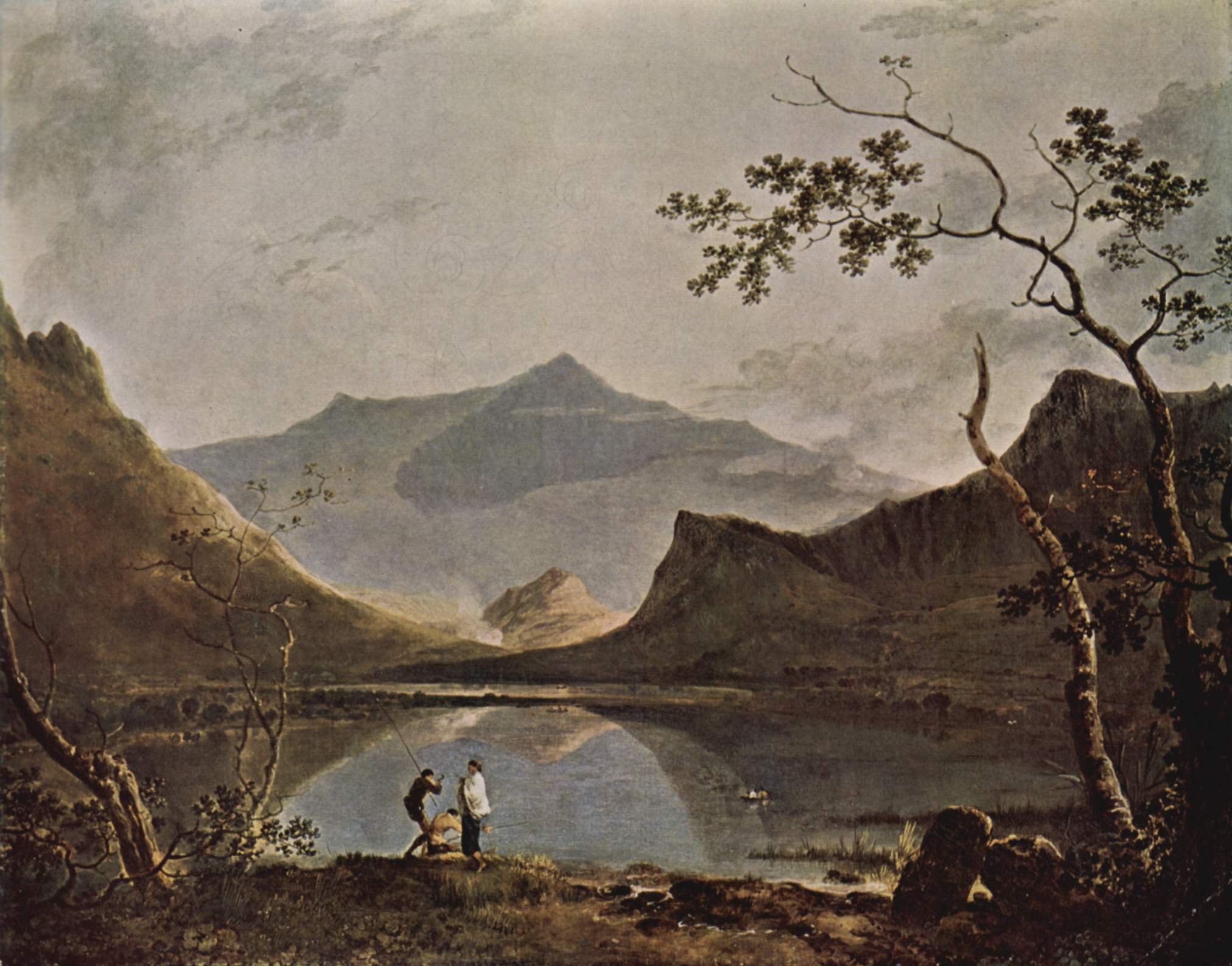
In addition to the nation's most celebrated gardens, Wedgwood and Bentley used images of famous country houses, although Bentley wrote that 'we have purposely omitted to represent the most modern buildings, considering them unpicturesque'.  Picturesque landscapes accounted for a good number of the designs: ruined abbeys, castles (150 of these) and even some early remains: Stonehenge, Kit's Coty House, a Cornish Dolmen and the Roman ruins of Silchester.  Wedgwood and Bentley were also up-to-date with tastes in the Sublime, including various views of the Lake District, the Peak Cavern, the Giant's Causeway and Fingal's Cave.  There is a letter from Wedgwood to Bentley in 1773 asking about Richard Wilson's landscapes: 'Pray have you Wilson's Views from different places in Wales? If you have not, Mr. Sneyd will lend them us'.  Alison Kelly writes that 'after reading this letter it is pleasant to recognise on a dish the unmistakable outlines of Wilson's Snowdon from Llyn Nantlle.'

Richard Wilson, Snowdon from Llyn Nantlle, c1766

Given their role in the Industrial Revolution it is interesting that a few of the pieces feature such scenes as Papermills at Rickmansworth, a Colliery and Pump near Bristol and the Dock at Plymouth.  However, urban views are largely absent, with the notable exception of London.  You can see a plate from the dinner service showing Somerset House on the Hermitage website (there don't seem to be any non-copyright images available to put up here).  Other obvious London highlights included Kensington Palace, the Mall and Horseguards Parade but there were also a few views from the fringes of the city - Erith, Sunbury, Shepperton.  Mention of Shepperton made me wonder what a contemporary 952 piece Ballardian dinner service might look - traffic islands, car parks, terminal beaches, abandoned hotels...

Eventually Wedgwood and Bentley had got together all 1,244 views and the completed service went on show in London before being sent to Russia.  Apparently this was a great social success, as people were came to see whether one man's country estate featured more prominently than another's.  When it arrived, Catherine the Great was satisfied and used it for state occasions in the Chesmenski Palace. But after her death it was eventually forgotten about and only rediscovered at the beginning of the last century, when nearly 800 pieces were found to have survived.

Monday, December 01, 2008

Dessert in the form of a winter landscape

I've recently been reading to my son Charlie and the Chocolate Factory, with its chocolate waterfall and minty grass, and so was tempted by a link on Arts & Letters Daily to look at the food landscapes of photographer Carl Warner. Apparently 'the images can take up to two or three days to build and photograph and then a couple of days retouching and fine-tuning them to blend together all the elements, such as parmesan cliffs with sweet potato boulders and cress and savoy cabbage foliage under a red cabbage sky.'

The subject of foodscapes puts me in mind of the Manifesto of Futurist Cooking (1930). Marinetti's section on sculpted meat highlights a recipe devised by Futurist painter Fillia for rissole of minced veal stuffed with eleven kinds of green vegetables provided 'a symbolic interpretation of all the varied landscapes of Italy'. Marinetti also refers to Enrico Prampolini's Equator + North Pole - 'an equatorial sea of poached egg yolks' surrounding 'a cone of firmly whipped egg white'.

Back in 1600, the marriage in Lyon of Marie de' Medici and Henry IV involved (according to Roy Strong in his book Feast) 'every kind of late mannerist fantasy. On the high table were two oak trees seemingly made of snow with white leaves and silver garlands. Beneath their branches a hunt was in progress.' At a certain moment, 'from beneath the floor arose a table bearing dessert in the form of a winter landscape.' The meal ended with a sugar garden full of birds, fruit and flowers. Such sugar sculptures form a whole subgenre of the foodscape - the engraving reproduced below shows a sugar collation from the wedding of Johann Wilhem, heir to the duke of Jülich-Cleve, in 1587.