Showing posts with label aerial landscapes. Show all posts

Thursday, August 13, 2026

Prehistory from the Air


In the late 1930s comparisons were often made between new art and ancient landscapes. In British Art: Ancient Landscapes Sam Smiles cites an essay by John Piper which refers to the work of Ben Nicholson, Henry Moore, who 'has landed us back in the stomach of pre-history' and Paul Nash, who 'leaves us with the bare sea-washed bones of it.' A Barbara Hepworth catalogue compared her work to menhirs and in an article about her work in Circle, the journal that promoted 'constructive art', she included photographs of Stonehenge. One of these images was taken by Carola Giedio-Wecker, who had recently written a study of contemporary sculpture featuring Stonehenge, the Table des Marchands and the stone alignments of Carnac. Perhaps the best frequently cited example of this is 'Prehistory from the Air', the article Piper wrote for the Winter 1937 edition of Axis, edited by Myfanwy Evans (his new wife). This can be read online, so I thought I'd quote from it here, beginning with his thoughts on flight and landscape art: 

Because flying has not created any new consciousness about spaces or vistas or anything else, it has simply served the new consciousness, and has been forced on in its development by it. It has grown up with it in fact, which is the only reasonable way for an invention to work. So the horizon line vanishes, from the air. It has also vanished (nearly) from painting. Instead of being the end-all of landscape, it is now there on sufferance. It is not really strange that air photography began in the '80's, and that about the '80's the horizon in landscapes (with Courbet or Cézanne) was getting much less conscious of itself—no more self-conscious than the foreground, or the background, or the middle distance, ail of which were becoming parts of the same consistent parcel. For contrast, think of Claude's skyline castles in the scenery of his wonderful natural theatre. At its simplest, the change is one from elevations to plan. The picture has tipped over backwards on to the floor, and in being raised again it has brought part of the floor with it. Picasso, Braque, Klee, Matisse have painted elevations of wineglasses, gardens and windows at Nice which have the added richness and meaning of plan-patterns.

Piper's essay is followed by a colour reproduction of a Miró painting and in the composite image above I've juxtaposed it with what he put on the previous page, two images of Silbury Hill - very different but equally interesting. The top one is from William Stukeley 1724 publication Stonehenge and Avebury

Stukeley, above all, wanted to record the effort and the feeling for shape of the men who built it. Size and contour are all-important. The story of the size is well told, and as to the shape to jump, run, walk, or struggle up each slope with Stukeley in his drawing is as real and as sharp an experience as to take a journey round a wineglass with Picasso. The air-photograph is flat and subtle. The effect of suddenness that the mound gives in the plain, and the sense of size that the surroundings try to contradict, is as strong as that of ail Stukeley's fold-explorations. Both these representations of Silbury Hill are beautiful—and together they give a very fair idea of this large and curious mound— but so different that it is hard to realise that each gives a reasonable account of the same monument.

Piper doesn't talk about that Miró painting, but the Spanish artist does feature in a later article in this issue of AxisAnthony West's 'No Revolution.' In talking about abstract art he mentions an early painting done in a vary different style.

Hemingway writes about Miró's picture, The Farm,"It has in it all that you feel about Spain when you are there and ail that you feel when you are away and cannot go there." Perhaps it was possible to give this reading to the picture and to think about happy days in the sun instead of looking at the picture. Perhaps Miró thought so too, for his paintings are no longer like postcards to hold in your hand while you think about the days when you were younger. It is the design in his mind not the memory in yours which he wants to express.  


Joan Miró, The Farm, 1921-22

It is always fascinating to leaf through an old journal or magazine (if I can say 'leaf through' about an online PDF) and here it was impossible not to be drawn to a review by the artist Robert Medley of Hitler's degenerate art show in Munich. Medley found modern paintings by Klee and Kandinsky had been badly hung, without frames, and packed in with second-rate work. Meanwhile, the Approved Art show nearby was full of pictures of Hitler, all hung in a line, along with 'boys and maidens beating drums and waving banners. Gigantic sculptures of nude men striding forward, the artist taking so much care that they should not look pansy that they ceased to be men at all— symbolism had made them inhuman. Pictures telling you what a fine thing war is...' There were also more unassuming paintings, but these were monotonous. 'I had the impression of a number of artists pleased to work quietly, with their minds relieved from having to cope with modem aesthetic or social problems. ... I was pleased to leave.'

Saturday, November 25, 2023

Salt Island

 Mónica de Miranda, Salt Island, 2022 (detail)

I recently went to look around RE/SISTERS A Lens on Gender and Ecology, at the Barbican. In this exhibition the politics goes well beyond environmentalism and feminism, encompassing work that reflects on sexuality, race and the history of colonialism. And yet it would be possible in some cases to wilfully ignore all these strata of meaning and admire a work as landscape art, like Salt Island, a sequence of five photographs embroidered with green thread. We are told by the wall label that Mónica de Miranda's work 'considers the complex experience of Afrodiasporic lives and Europe's colonialist past through a Black ecofeminist lens, drawing on ideas of matrilineal relationships, kinship, migration, slavery and African liberation movements.' However it's hard to get all this from Salt Island and the exhibition would ideally have displayed more of the multimedia project of which this is just a part, The Island. There is a good description of this in a text by Ana Nolasco on the artist's website, including historical background on the “Ilha dos Pretos” (Island of Blacks) which inspired it - stories of an eighteenth century settlement of people of African origin by the Sado River. 


Agnes Denes, Wheatfield - A Confrontation: Battery Park Landfill, Downtown Manhattan, 1982

The addition of new ways of understanding our relationship with the planet make it increasingly hard to position art in this field. Agnes Denes, for example, is included for her famous Manhattan Wheatfield project, but she is now being criticised for using wheat, a Eurocolonial industrial cereal crop, 'implicated in the displacement of Indigenous people and indigenous plants over much of the continent for at least two centuries' (Catriona Sandilands). Today, artists need to think intersectionally. They have to create arresting work while steering (if I can use a mythological gendered landscape metaphor) between the Scylla of 'Mother Earth' attitudes, that equate women too closely with nature, and the Charybdis of panoramic or abstracting viewpoints, associated with power and possession

Back in 1986, Tee A. Corinne's Isis photomontages placed vulvas in the landscape of Oregon. Did this go too far in equating the female body with nature? Context is important: Corinne is well known for her books and images celebrating lesbian lives and these 'landscapes' were just one small project in a prolific lifetime's work. It is hard to criticise artists like Corinne, Ana Mendieta, Laura Aguilar and others for positioning themselves as part of their environments, as an alternative to the disembodied vistas of landscape painters or large-scale interventions of land artists. They were 'performing ground' - locating 'the self not merely in the world but of it' (Lucy Bradnock). Writing about Corinne's work, Tamsin Wilton argues that her 'celebration of woman in the woodland focuses on women's sexuality, the seat of female sexual pleasure. In other words, precisely what is most often erased in the women-as-landscape genre.' 

Symrin Gill's aerial photographs of open-pit mines can be seen as avoiding the industrial sublime by 'alluding to the corporeal' (the series is called Eyes and Storms), emphasising the landscape's 'bodily textures' by allowing shadows to disrupt a two-dimensional 'extractivist viewpoint.' By contrast, Sim Chi Yin does provide a beautiful abstract aerial view (below) as part of her Shifting Sands project. But this aestheticisation of the 'infrastructural' gaze' is juxtaposed with other photographs ('the human gaze') that show the impact of erosion in poorer areas of the Global South. Another artist, Mary Mattingly is represented by some striking unpeopled 2016 photographs: Mineral Seep, where a cliff is transformed into a drip painting by black and brown stains, and Ore Transport, where an uncanny, unfathomable concrete structure, framed by grey water and pale sky, draws you into its shadowy interior. But these too are contextualised with a chalk board Cobalt Map showing the complex system that supports its production and distribution, 'a network of violence that percolates outward from the original site of extraction.'

Sim Chi Yin, Shifting Sands #2, 2017-ongoing

Saturday, November 04, 2023

The Eight Mountains

I recently watched The Eight Mountains which I'd been looking forward to since reading Peter Bradshaw's review in The Guardian:

This rich, beautiful and inexpressibly sad film is about the friendship between men who can’t talk about their feelings and about winning and losing at the great game of life. It is set in the breathtaking and wonderfully photographed Italian Alpine valley of Aosta, which includes the slopes of Mont Blanc and the Matterhorn. But the “eight mountains” of the title refers to the eight highest peaks of Nepal: a mysterious symbol of worldly ambition and conquest. Belgian film-makers Felix van Groeningen and Charlotte Vandermeersch have adapted the award-winning 2016 novel by Italian author Paolo Cognetti and have created a deeply intelligent meditation on our capacity for love, and how it is shaped by the arbitrary, irreversible experiences of childhood, and by our relationship with the landscape. The Aosta valley is depicted with magnificent sweep, and van Groeningen and Vandermeersch find a stratum of sadness under it, a kind of water table of tears.

Unfortunately, although I did quite enjoy it, I was disappointed - my view of the film was closer to Richard Brody's review in The New Yorker. In this he describes a scene that echoes a central dilemma of landscape appreciation I've referred to often on this blog. 'By far the best scene in the film is one in which the adult Pietro (Luca Marinelli) brings a trio of Turin friends to the mountains; in response to their rapturous enthusiasm for “nature,” Bruno (Alessandro Borghi) explains that the people who live in the mountains never use that “abstract” word but rather speak lovingly of the physical specifics—“forest, meadow, river, rock, path: things you can point at, things you can use.”' 

However, 

that line of dialogue conveys more of the essence of the movie’s alpine setting than does the cinematography. Much of the action there takes place outdoors; Pietro’s father (Filippo Timi) is an enthusiastic hiker and climber who takes the two boys with him on his expeditions, and Pietro, in his many returns to the region, delights in the peaks, in the clear water of the lake, in the rock formations. The movie presents these landscapes as cinematic abstractions, with drones and Steadicams and cameras perched on high to show the small figures of humans overwhelmed by, yes, nature, and to show the spectacular sights that surround the characters. But it stints on the visual point of view of the characters, voids itself of contemplative poise and analytical precision, hardly stays still long enough, looks in detail long enough. It doesn’t pay enough closeup, hands-on attention to soil and stone and water and snow, to wood and fire, to flesh and fabric, to suggest that the characters have any more of a physical connection to the settings than they have a perceptual one.

We used to exclaim "oh no, not a drone shot!" whenever they appeared on TV documentatries or movies, until they became almost ubiquitous. But complaining about the drone shot cliché has itself become a cliché, so I won't labour the point here. A New York Times article on the phenomenon did note some highly effective examples - Werner Herzog 'opens his remarkable 2016 picture “Into the Inferno” with an astounding aerial sequence that soars up a mountain and then into the volcano at its center.' Maybe we could just have some more drone shots that are grainy or misty or flawed in some way, rather than being taken on smooth glides over perfect landscapes that are not as awe-inspiring as they should be, because they look almost computer-generated. 

Another review of The Eight Mountains notes that 'some obvious drone shots are included, but much of the hiking sequences appear to have been done with Steadicams, following the men through their treacherous treks. Andrea Rauccio is listed as the Steadicam operator, but the credits for camera operators are lengthy, and the entire crew deserves credit.' Richard Brody may be being a bit harsh on all this, but I do know what he means when he says that in these scenes it's hard not to 'hear and see the crew, the walkie-talkies, the muffled clamor that goes into turning raw experience into overcooked and denatured images.' 

I feel I should end on a more positive note though. So here are a few more quotes from reviews (ending back with Peter Bradshaw), where the temptation to use mountain metaphors has proved irresistible.

  • 'Stately and serene from a distance, but up close riven with the fissures and follies of a friendship that costs both men so much but gives them even more, the movie, too, is a mountain.' (Variety)
  • 'Luca Marinelli and Alessandro Borghi put in mountain-sized performances to offset the film’s silences and propensity for postcard shots, bringing heart and guts to the chilliest scenery. A worthwhile hike through many obstacles to friendship.' (Irish Times)
  • 'A movie that seems to grow before your eyes, leaping across continents as years go by, all the while slowly accruing power. By the end it has scaled a peak, offering a bracing perspective on life experience.' (FT)
  • Much like climbing a mountain, the two-and-a-half-hour runtime may occasionally feel arduous, but the emotional release is worth it once you reach the peak.' (Time Out)
  • 'This film has mystery and passion, it climbs mountainous heights and rewards you with the opposite of vertigo: a sort of exaltation.' (The Guardian) 

Friday, June 17, 2022

Chessboard fields


I remembered how from the air the valleys, hills and rivers gained a certain distinction but wholly lost that quality which is perceived by a countryman whose day's travel is bounded by the earth of three of four meadows, and whose view for most of his life may be constricted by some local rising of the ground. In the air there is no feeling or smell of earth, and I have often observed that the backyards of houses or the smoke curling up through cottage chimneys, although at times they seem to have a certain pathos, do as a rule, when one is several thousand feet above them, appear both defenceless and ridiculous, as though infinite trouble had been taken to secure a result that has little or no significance.

This is a paragraph from Rex Warner's novel about the arrival of an aerodrome in the middle of the English countryside. It was published in 1941 and I am sure there must be many other stories from this period with Nietzschean pilots who look down on historic landscapes that can no longer contain them. In John Cowper Powys's A Glastonbury Romance (1932) the industrialist Philip Crow purchases his own aircraft to fly to Wookey Hole, the extraordinary cave system that he wants to fill with modern electric lights and then transform with a tin mining operation.

As he watched down upon the earth, that clear March evening, and watched the chess-board fields pass in procession beneath him, and watched the trees fall into strange patterns and watched the villages, some red, some brown, some grey, according as brick or stone or slate predominated, approach or recede, as the plane sank or rose, Philip's spirit felt as if it had wings of its own ... How small and unimportant Wells cathedral had looked from up there. ... His brain whirled with the vision of an earth-life dominated absolutely by Science, of a human race that had shaken off its fearful childhood and looked at things with a clear, unfilmed, unperverted eye.

But at the end of the novel a flood inundates Glastonbury. Mayor Geard, who has tried to create a new spiritual centre drawing on the town's legendary past, feels his earthly work is done and heads off in a small boat. He comes upon his antagonist Philip Crow, who is keeping his head above water by standing on his submerged plane. Geard surprises Crow by asking to swap places. Crow needs little persuading and Geard leaves the boat to rest on the plane as it gradually sinks. At one point he kicks it to help it on its way. Eventually the wing beneath him disappears and Geard, with one final glimpse of Glastonbury Tor, follows it down.

Friday, February 21, 2020

Mirages of landscapes leaping upwards


In July 1942, Filippo Tommaso Marinetti and Tullio Crali published in Rome a Futurist Manifesto entitled 'Plastic Illusionism of War and Perfecting the Earth'.  It was inspired by Crali's work on camouflage projects and it suggests that the 'plastic illusionism' used in Futurist painting could be used both to deceive enemy pilots and confuse them with 'visions of accelerated fractured cityscapes' and 'mirages of landscapes leaping upwards'.  And it goes further, arguing that the landscape itself could be altered - giving 'a volumetric character to plains', for example, by raising up artificial mountains.  These points read like a manifesto for Land Art and indeed Crali himself later argued that he had 'anticipated the interventions of American artists in this sphere by thirty years.'  In their vision for 'perfecting the earth', Marinetti and Crali wanted to 'refine the severe rugged aspects of wartime landscapes and cityscapes and their brutal masses.'  They would both 'virilise' and 'feminise' war-torn Italy, spirtualising and purifying it through the interventions of aeropainters, aeropoets, aeroarchitects and aeromusicians.

The aeropaintings of Tullio Crali are currently on display at the Estorick Gallery - their earlier exhibition devoted to the aeropainter Gerardo Dottori was the subject of a post I wrote here back in 2014.  Crali was much younger than Futurists like Dottori and Marinetti; he was only born in 1910, the year of the first Futurist Manifesto, and he lived until 2000, long after Futurism had become part of art history.  By the time the American Land Artists were coming to attention, Crali was a step ahead, thinking about extraterrestrial artworks.and writing his Futurist Manifesto of 'Orbital Art' (1969).  Some examples of his ideas are below - I particularly like the idea of the 'message-trains of audiovisual poetry' heading out into the cosmos like the Voyager golden record.


Another of Crali's artistic projects at that time (for which he had written a Manifesto in 1959) were the Sassintessi, compositions of stones mounted on neutral black or white backgrounds.  These were originally inspired by trips to Ploumanac'h where he saw the rocks that had fascinated earlier artists like Eileen Agar (her photographs have been admired, in turn, by Tacita Dean - see my earlier post, 'Rocks at Ploumenac’h, Brittany').  In her review of the Crali exhibition, Laura Cumming notes the novelty of the Sassintessi and thinks that 'every now and again they hit the mark, when Crali takes some sea-carved rock and twists it out of kilter, so that it suddenly looks like a rushing futurist figure.'  I was intrigued by the idea and by some examples, like Future Fossil of the Mechanical Civilisation (1963) which would fit right into a contemporary Anthropocene-themed exhibition.  Crali's rock collecting also inspired his son Massimo, who became a geologist.  Massimo's wife, Anna, was partly responsible for the exhibition and has been interviewed about it for a piece in the Telegraph.  

Finally, I should mention Tullio Crali's paintings.  After the war, he made various aerial views that combine abstract space with details of lakes or mountain peaks.  They reminded me a bit of Peter Lanyon's later works, particularly in the way they convey the intense blue of the sky.  Even as a nineteen-year old, Crali was making interesting compositions of intersecting clouds and planes of light, expressing the excitement of his first flight in 1928 ("the rebelliousness of the wind, air pockets, steep climbs: everything was wondrous...")  Arcs of overlapping colour are used to great effect in Lights at Sunset in Ostia (1930).  As Laura Cumming writes, this captures a moment when 'the shadows of hill and vale deepen, and rays of dying light arch between earth and sky. Translucent green patches stand for trees and clouds, and everything meets at the vanishing point of the ocean, radiant and serene – perhaps the most beautiful scene Crali ever painted.'

Monday, May 06, 2019

Roden Crater


I thought I would follow up my last post on Katie Paterson with something about James Turrell, whose light works I was reminded of when looking at her Light Bulb to Simulate Moonlight (2008).  I have been reading James Turrell: A Retrospective, a sumptuously produced book which I should think gets as close as possible to giving a sense of what his artworks look like, even though they are nearly impossible to describe in two dimensional photography and words on a page. It is interesting how often the word 'landscape' is used in the book, even though what is usually being described is a perceptual environment or spaces from which to observe the sky.  Of course Turrell is a contemporary of the American land artists and it is easy to relate his magnum opus, Roden Crater, to their more monumental earthworks.  Turrell himself has said, 'I am not an Earth artist, I'm totally involved in the sky.'  But works like Observatory by Robert Morris (1971) and Nancy Holt's Sun Tunnels (1973-6), which are aligned with the solstice, can be seen as precursors to Roden Crater.

Roden Crater
Source: Wikimedia Commons

It was clear from the book that Turrell's career hinges on that famous flight in 1974 when he located the setting for what has become his life's work. An experienced pilot, Turrell used a Guggenheim Foundation to fuel his plane and scoured the western states to find 'a solitary cinder cone or a butte' that would allow him to create the perfect space from which to experience the phenomenon of 'celestial vaulting'.  Work continues at Roden Crater - there are plans for a Fumarole, for example, which will look like a giant eye.  A pool will act as a lens and light from the sky will pass over it through an aperture.  'At night, the still water will focus images of the stars onto a floor of black volcanic cinder underneath such that a visitor might have the experience of walking on light from the stars.  The bowl shape of the bath's bronze-and-glass bottom is complemented by a small invisible antenna on the aperture's edge that effectively turns it into a simple radio telescope.  Bathers will be able to submerge their ears under the water to hear the ancient static radio noise emitted from the portion of the sky visible through the aperture.'

Some of the inspirations for Turrell's work, and some of the phenomena he has explored in his art:
Skyspaces - Antoine de Saint-Exupéry - blackout curtains - the desert landscapes drawn by George Herriman in his 1940s Krazy Kat cartoons - the view from the Apollo spacecraft - Plato's Cave - Ganzfelds - Minimalism - Perceptual Cells - Blake's 'doors of perception' - Quakerism - the temple at Borobudur - Mesoamerican pyramids - emblemata depicting effects of light in a 1636 book by Guilielmus Hesius - Jun'ichirō Tanizaki's In Praise of Shadows - Buddhism's 'embrace of the void'...
Of course Turrell is familiar with the ways light has been used in the history of art, but his whole practice has been to work with light, rather than merely representing it.


According to the Christine Y. Kim in James Turrell: A Retrospective, there are now more than seventy-five Skyspaces around the world, enclosed chambers with an opening that lets visitors contemplate the sky.  You can find photographs of these online - the one I have included below is in Switzerland and actually shows the view out through its door (I guess if the spectacle of the sky starts to pall, you can still contemplate the Alps).  There are some spectacular looking Skyspaces in sunny places like Napa Valley, California.  Photographs of the Skyspace in Yorkshire Sculpture Park (which I mentioned here once before) show a damp patch of floor where the rain has entered.  Another British example is Cat Cairn (2000), in Northumberland, built with natural stone to blend into the landscape (the Kielder website explains that Turrell has recently upgraded the lighting system for this work).  Back in 2000 Monty Don wrote in The Observer about his experience of Cat Cairn.  'The experience of sitting quietly (albeit freezing) is enormously satisfying and enriching, even though sensation is stripped down and pared back as far as it will go without being diminished. All superfluities are abandoned. I would love this in my garden.'


James Turrell, Skyspace, Piz Uter, (inside) - 2005
Source: Wikimedia Commons: Kamahele

Thursday, April 18, 2019

Apotheosis


It could be argued that John and Yoko made a form of landscape art in Apotheosis (1970), their seventeen minute experimental film of the view from an ascending balloon.  It was shot in December 1969, on a snowy day in Lavenham, Suffolk.  At the beginning you hear the balloon being inflated and see John and Yoko in hooded outfits.  It then becomes clear that the camera is mounted in the balloon, which rises out of the market place until you can see white fields and black trees that could have come from a Bruegel  painting.  This landscape gets progressively whiter and more indistinct until it eventually disappears.  After several minutes, the balloon emerges above the clouds which, in the words of Jonas Mekas, 'opened up like a huge poem, you could see the tops of the clouds, all beautifully enveloped by sun, stretching into infinity.'


Back in 2010, The East Anglian Daily Times published an article about the film and interviewed people who were there that day, such as Roger Deacon, manager of a local building firm, who remembers helping to lift the famous couple out of their balloon.
'John and Yoko didn’t take off on the flight, climbing out of the basket after the photographs to oversee the launch – to shouts of “chicken!” from the gathered crowd – while their collaborator and cameraman, Nic Knowland (himself a Suffolk man, originally from Debenham), ensured the shoot was carried out to their requirements.'
In his essay 'Walking on thin Ice: The Films of Yoko Ono', Daryl Chin compares Apotheosis to the contemporary work of Michael Snow (La Région Centrale, Snow's celebrated three-hour film of an uninhabited mountainous landscape, made with a robotic camera, was shot in September 1970).  However, The East Anglian Daily Times was not impressed by Apotheosis
'The best thing you could say about it is that it left the people of Lavenham - and Yoko - with some bizarre and brilliant memories (“We always have a laugh about it,” says Roger Deacon. “Not many people can say they’ve had their hands around Yoko Ono!”)
Other than that, it was a lot of hot air.'

Friday, February 24, 2017

Plans-Reliefs


If you have access to the BBC iPlayer you can see Andrew Graham-Dixon's latest series, an attempt to tell the story of the Art of France in three hours.  The first episode stretches over the centuries from L'abbé Suger to Chardin.  During the course of this, he visits Versailles and looks down on its gardens, with their panoptic design of paths radiating out from the palace of the Sun King.  But he also finds time for a visit to the basement of the Palais des Beaux-Arts in Lille where he wanders among 'a collection of extraordinary but largely forgotten' table-top landscapes, made at the behest of Louis XIV.
"They were all made for the king, these great tables.  Each one is a town - a representation of a town that he had fortified.  This is Ypres.  This is Tournai.  There were originally a hundred and forty-four of these objects.  They occupied 8,000 square meters of the Louvre - nearly a mile to walk past all of them.  And what they represented I think for Louis was a tangible demonstration of the extent to which he had expanded and secured France's borders.  They also served a very practical purpose because when he came here with his generals or his advisers he could plan strategy.  He could literally feel with his hand the lie of the land.  And he could enjoy, as no-one else in the world could do, a bird's-eye view of these strategically important cities.  I think the Plans-Reliefs as they are called (it's extraordinary - goodness knows how many man hours went into their creation) - I think what they represent is a making good of the promise that Versailles holds out.  That, yes, the king's eye stretches to the very end of the realm."
This collection of relief maps has a complicated history.  Having been only accessible to Louis XIV and his staff, they eventually came to be seen as works of art, on show once a month to the public during the nineteenth century.  A new set of relief plans were made for Napoleon, seventeen of which were taken by the Prussians to Berlin after his defeat.  These were almost all destroyed during World War Two, but one of them, the map of Lille, was restored and returned to France.  Of the original seventeenth century plans, some are still in Paris and some have been transferred to Lille, where Andrew Graham-Dixon saw them. 

Earlier, smaller relief plans were made in sixteenth century Venice and Bavaria.  The Bavarian plans were the work of Jakob Sandtner (fl. 1561-79) who seems to have made the first one himself, which then came to the attention of Duke Albrecht, who bought it and commissioned others.  But these were city plans - what I like about the French Plans-Reliefs is that they show the surrounding terrain.  The inclusion of woods and fields was consistent with their use as a military tool.  But their usefulness declined as technology 'improved'.  Eventually, as the director of the Paris musée des Plans Reliefs explains in an interview, the range of cannon fire was too great for maps on this scale.  It is tempting though to imagine modellers trying to keep up, at work on ever larger constructions, eventually covering the whole of France and fitting together like a jigsaw.

Sunday, December 18, 2016

Topographia Germaniae


We had a family DVD viewing this weekend: Karel Zeman's Bláznova kronika (A Jester's Tale), a 1964 Czech film about a peasant caught up in the Thirty Years War.  Philip French described it in The Guardian as an 'exquisite black-and-white anti-war comedy' and particularly admired the way 'live action and animation are integrated with wit and elegance into a magical, fantastical world where the winds of change, represented by an animated old soldier puffing away in the heavens, dictate the arbitrary course of history.'  The story itself has some of the charm of an old German novella, with an irrepressible and innocent hero Petr - seen in the images above near the end of the film with Lenka, the pretty country girl he meets on his travels. 

Matthäus Merian, Frankfurt am Main, 1646

The film's visual style was inspired by the 17th-century Swiss engraver Matthäus Merian.  In many scenes it is as if the characters have been able to step into the slightly surreal landscapes and interiors he illustrated.  These engravings are part way between maps and landscape drawings and their magical quality is a result of the way they strain after a kind of ideal realism, picturing the world laid out neatly from an imaginary bird's eye perspectives.  Merian's engravings eventually covered a large part of central Europe: the first volume of his Topographia Germaniae, on Switzerland, appeared in 1642 and the last, on Burgundy, was published twelve years later.  I have been imagining what it would be like to see all these views combined with black and white photography to create a seventeenth century version of Google Earth, in the style of Karel Zeman. And wondering too whether our own topographic art forms will be found as charming in four hundred years time.

Sunday, April 03, 2016

Light on the reservoir


I have not yet read any obituaries in the national media for David Blackburn, whose passing was reported last month in the Huddersfield Examiner.  This may just be a matter of time, although perhaps he is not as well known now as he once was.  There has always been a sense that he was swimming against the main currents of contemporary art, with his visionary abstract landscapes executed in pastel.  Perhaps the praise he received from Kenneth Clark whilst still a student didn't help in this respect, although a quote still appears on the front page of the artist's website. Writing in 1990, Malcolm Yorke pointed out that though Blackburn had achieved a strong international following, he had not 'courted the fickle attentions of the London galleries.'  I used to see small exhibitions of his work at the Hart Gallery, a little oasis among the crowds on Upper Street in Islington (now closed, and recently in the local news when squatters took over the premises).  More recently he has been represented by Messum's, who in 2005 made the hour-long documentary David Blackburn Landscapes of the Mind.  This includes contributions from another famous son of Huddersfield, Simon Armitage, as you can see from the slightly unfortunate thumbnail image below, where he is caught in mid-gesticulation.


Although the Hart Gallery was much more welcoming than a West End gallery, the paintings on sale were sadly beyond my means.  I recall wondering though whether the rich colours that draw you into Blackburn's images might eventually start to pall.  What did intrigue me was the way both individual pictures and composite works were constructed.  Sometimes he would mount a set of landscape studies to form a composite vision of a place, where each view remains ambiguous, poised between abstraction and the actual forms of trees, mountains, bodies of water.  Malcolm Yorke likened these grids to film stills or the panels on an altarpiece.  In this article (published in Modern Painters) he described the process of exploring a David Blackburn picture:
'A landscape can appear domesticated until you notice the tiny sun-dot in the sky, which suddenly throws the scale switch and the fields become vast as prairies.  On the other hand gross, misshapen, orange suns have recently begun to overwhelm the skylines of the hills they are supposed to set behind.  Blue stands for both sky and water, and, since we have no clouds or waves or reflections to guide us here, we might be disconcerted to find that it is water occupying the top third of the picture, not sky.  We must remember the artist's fondness for flying and take off with him.'
These ambiguities appeal to Simon Armitage, who (unlike me) does own some David Blackburns and talks about them in the film I have embedded above. One of these pictures had seemed to him to be an aerial view of fields, but, as he says in the film, "a few months ago I was driving back, not far from David's actually, near Blackmoorfoot Reservoir, almost on eye level with the reservoir, and it was something to do with the light in the evening, on the top of the reservoir, that made me realise that that could well be what's happening in the picture." And so the image changed into a vision of water.  This mutable quality is what Kenneth Clark identified as the essence of David Blackburn's art:
'People ask: What is his work like? I don’t know any artist to whom I can compare him. He is not a landscape painter, not an abstractionist in the ordinary sense of the word. He is a painter of metamorphosis.'

Friday, March 18, 2016

The lake of Como

Francesco Gonin, View of Lake Como, 1840 
(illustration for chapter 1 of Alessandro Manzoni's I Promessi Sposi)
   'That branch of the lake of Como, which extends towards the south, is enclosed by two unbroken chains of mountains, which, as they advance and recede, diversify its shores with numerous bays and inlets.  Suddenly the lake contracts itself, and takes the course and form of a river, between a promontory on the right, and a wide open shore on the opposite side. The bridge which there joins the two banks seems to render this transformation more sensible to the eye, and marks the point where the lake ends, and the Adda again begins—soon to resume the name of the lake, where the banks receding afresh, allow the water to extend and spread itself in new gulfs and bays.
   The open country, bordering the lake, formed of the alluvial deposits of three great torrents, reclines upon the roots of two contiguous mountains...'
- Alessandro Manzoni, The Betrothed, 1827
Thus Manzoni begins his celebrated novel in the manor of a rather dry geography lesson.  According to Umberto Eco, almost all Italians hate the book 'because they were forced to read it at school.'  They also wonder why he spends so long describing the features of Lake Como before getting on with the story.  'Manzoni proceed as if he were filming from a helicopter slowly landing (or as if he were reproducing the way God looks down from the heavens to single out a human individual on the Earth's surface).'  With the third sentence the description moves from geography to topography.  Then, once it has attained a human scale, the landscape begins to be described as it would be experienced by someone walking over it.  And from there Manzoni passes from topography to history before finally alighting on an individual, Don Abbondio, who is making his way along a lane on the 7th day of November, 1628.  

On this blog I have described something similar before: Joseph Conrad's Nostromo, in which the long scene-setting prepares the reader for a book whose story will encompass more than just the activities of its characters.  In The Betrothed, Eco says, 'we are being told not just the story of some poor little human beings but the History of Divine Providence.'  That opening in which Manzoni assumes 'the viewpoint of god, the great Geographer' also tells us something about Don Abbondio.  This is 'not just an exercise in literary self-indulgence; it's a way of preparing the reader straightaway to a read a book whose main protagonist is someone who looks at the way of the world from on high.'  In the portrait I have reproduced here Manzoni is shown in front of Lake Como.  He looks neither towards us or over his surroundings but upwards, to a point somewhere above the world.

Giuseppe Molteni, Alessandro Manzoni, 1835

The Umberto Eco quotations above are from Six Walks in the Fictional Woods, the Charles Eliot Norton Lectures he delivered in 1993.  This post is prompted in part by the sad news of Eco's death last month, which has been marked by many tributes and obituaries, from The New York Times to BLDGBLOG.  The last of his Walks concludes with the story of a visit he had recently made to a planetarium.  There the curator arranged the display so that it showed what the stars would have looked like on the night of 5-6 January 1932, the first night of Umberto Eco's life.
'Perhaps others have had a similar experience.  But you will forgive me if during those fifteen minutes I had the impression that I was the only man, since the dawn of time, who had ever had the privilege of being reunited with his own beginning. ... Perhaps I had found the story that we all look for in the pages of books and on the screens of movie theaters: it was the story in which the stars and I were protagonists. ... That was a fictional wood I wish I had never had to leave.' 

Friday, September 25, 2015

A chromatic view of the Earth


In his history of ballooning, Falling Upwards, Richard Holmes mentions 'the first aerial drawings ever made from a balloon basket'.  He is referring to the engravings accompanying Airopaidia (1785) by Thomas Baldwin, an account of a flight from Chester to Warrington.  In addition to a map of the route there are three of these, each of a different kind.  The most traditional (above) shows a view of the balloon itself, heading over the the Crag of Helsbye.  But this landscape is very different from the flattened prospect Baldwin observed from above, where the 'lofty Summit was apparently reduced to a common Level with the Valley made by the River Wever, and with the adjacent Sea Marsh.  Nor could it have been distinguished by a Stranger, as an Eminence.’


The 'Specimen of Balloon Geography' below gives an idea of what Baldwin actually saw from the balloon.  Having taken a map with him, he was surprised to see how different the landscape appeared, revealing for example the ‘incredible Variety of most beautiful Curves, into which the Stream had worked the Bed of the River Wever in a Course of Time’.  Altitude and a new perspective transformed the colours of familiar landmarks: the River Dee was the ‘Colour of red lead’ and Chester, thanks to its roof slates, appeared blue.  Sunlight on pits or ponds of water gave the ground the appearance of an inverted firmament.  Distance lent clarity to the scene below and reduced the landscape to a simplified range of primary colours.  ‘This unmixed Coloration of Objects, from a vertical Situation only, to be seen without Refraction, is a new singular and pleasing Phenomenon.  A View, taken above the Level of the Clouds, may, from this Circumstance, without Impropriety, be called a CHROMATIC VIEW of the Earth: of which, the Print is an Example.’
 

The final engraving is a curious circular image, slightly reminiscent of Dante's Paradiso.  There are instructions to the reader for viewing this, which might still work if you are looking at this blog post on a mobile device.  Lay it flat on a table and view it through a small opening made by rolling a piece of paper into a tube whilst shutting the other eye.  You will then 'form a very accurate Idea of the Manner, in which the Prospect below was represented gradually in Succession, to the Aironaut; whose Sight was bounded by a Circularity of Vapour.' 


The balloonist has 360 degrees to contemplate in a state of perfect calm and soothing silence.  One can look down at the landscape or around and above at the cloudscape.  Thomas Baldwin saw these choices in terms of the Beautiful and the Sublime, well established categories by this point (Edmund Burke's book on the subject had appeared in 1757).  Early in the voyage he writes of being unable to 'withstand the Temptation of indulging his Eye with a View of the glorious and enchanting Prospect.  But the Beautiful among the Objects below was still more attractive than the Sublime among those around.’  Later though he concludes that a balloon ride offers a synthesis: ‘the BEAUTIFUL and SUBLIME were seen united, in a Manner perfectly novel and engaging.'

Wednesday, September 02, 2015

Falling Upwards

Our balloon ride over the Garrotxa

Whilst in Spain last month we took to the air in a balloon.  I also read Richard Holmes' entertaining history of nineteenth century ballooning, Falling Upwards, which included some details that reminded me of our flight over the volcanic landscape of Garrotxa.  Holmes describes an ascent made by the leading Victorian balloonist Charles Green, accompanied by a wealthy MP and an Irish musician, Monck Mason, who wrote the trip up as Aeronautica (1838).  They set off in the Royal Vauxhall from London on a November afternoon in 1836 and by dusk they were over the Channel and tucking into ‘a huge meal of cold meats and wine’.  I smiled on reading this as it was exactly what we were given to tuck into after we landed.  Whilst aloft we toasted the flight with a glass of pink cava.  Champagne drinking seems to have been de riguer on most nineteenth century balloon trips, although Monck Mason claimed that the lower pressure at altitude made it too frothy, shooting from the bottle and ‘revealing what he called its "natural tendency to flying".  Perhaps under the influence of these refreshments, the landscapes of northern France seen after dusk, with isolated points of candlelight "burning late" in the villages below, seemed infinitely romantic and mysterious.’


Above the Garrotxa we were flying over winding rivers, terracotta-tiled farm buildings and the densely wooded slopes of extinct volcanoes, but it was impossible not to register too the motorway network, ribbon developments and light industrial buildings on the outskirts of every sizable settlement.  Holmes recounts how, when the Royal Vauxhall reached the Meuse, the crew were astonished to realise that the great industrial complex visible below them was the historic city of Liège.  Its surrounding districts "appeared to blaze with innumerable fires … to the full extent of our visible horizon."  At the height we were flying we could not hear the sounds of industry below - perhaps it is relatively silent these days.  Holmes describes what the balloonists could hear as they passed over Liège: 'disembodied shouting, coughing, swearing, metallic banging and sometimes, weirdly, sharp echoing bursts of laughter.  They were being granted a unique, nightmare vision of the new industrial future, a world of ever extending ironworks, where every street was "marked out by its particular line of fires."’

The Royal Vauxhall continued into the night.  "Occasional faint flashes of lightning would for an instant illuminate the horizon ... Not a single object of terrestrial nature could anywhere be distinguished; an unfathomable abyss of 'darkness visible' seemed to encompass us on every turn." 
Holmes observes that Mason's description of night's "cold and dark embrace", like "an immense block of black marble", might have come from Edgar Allan Poe, whose story 'The Unparalleled Adventure of One Hans Pfaall' appeared the year before this flight, and who went on to feature Green and Monck in his newspaper hoax 'The Atlantic Balloon' in 1844.  Eventually the aeronauts recognised the Rhine but continued eastwards and by morning thought they might have reached "the barren and inhospitable Steppes of Russia".  In fact they finally landed in some north German fir trees.  Our balloon flight looked at one point like it might end in some trees too, or even on a small traffic island, but we eventually touched down smoothly on some rocky ground and once the balloon had been furled and loaded onto its trailer we set off back to enjoy our botifarra.

Saturday, May 23, 2015

The questions of the sea


The Royal Academy's Richard Diebenkorn exhibition divides neatly into three rooms, the first covering his early abstract period in Albuquerque and Urbana, the second charting his move into figurative drawing and painting while living at Berkeley, the third focusing on his famous Ocean Park series (1967-88).  Diebenkorn had grown up in the San Francisco Bay area and moved in 1950 to Albuquerque to complete his MA at the University (Agnes Martin, the subject of a respective at Tate Modern opening next month, taught there a few years later).  The city is located on a high plateau of the Chihuahua desert and, as co-curator Sarah C. Bancroft writes, 'the dusty whites, tans, reds, ochres, oranges, yellows and pinks of his environment are seemingly baked onto many of his paintings'.  It was on flight from California to Albuquerque in 1951 that Diebenkorn was first struck by the view of landscape from the air. "I guess it was the combination of desert and agriculture that really turned me on,” he said, “because it has so many things I wanted in my paintings. Of course, the earth’s skin itself had ‘presence’ - I mean, it was all like a flat design - and everything was usually in the form of an irregular grid.”  Diebenkorn's paintings in the 1950s often remind me of the contemporary works of Peter Lanyon who also used an aerial perspective - it is sad to think that Lanyon might have had an equivalent of the Ocean Park series ahead of him if he had not died in a glider accident in 1964.

By the early sixties Diebenkorn was painting more recognisable landscapes like Cityscape #1, which you can see and read about in the RA's Exhibition in Focus PDF.  'The colours and atmosphere of these landscapes are clear, crystalline and bright.'  Too bright, some viewers have apparently felt, although as Bancroft says Diebenkorn himself was struck by the vividness of Northern California when he made a return visit in the 1980s: "God, that is the colour I used to use, when I lived up here!"  Whilst in Berkeley he was also painting interiors with views through windows, influenced to by Matisse, Bonnard and Hopper.  These, Steven A. Nash writes in the catalogue, 'provided a means to compare internal and external light, a way to project attention into the far distance, and a device for exploring the emotional contrasts of near and far, culture and nature, and a sense of confinement versus longing for release and freedom'.  Nash also makes a connection with Caspar David Friedrich's paintings of windows (which I've referred to here before), whose 'reigning mood is serenity tinged with melancholy'.   

Back in 2006 I wrote about the Ocean Park paintings and their relationship to landscape.  Since then an essay by poet and former Ocean Park resident Peter Levitt has appeared called 'Richard Diebenkorn and the Poetics of Place'.  It can currently be read online as a PDF and I will end this post with a quotation from it that conveys the rapture these extraordinary paintings can provoke.  However, I think Laura Cumming is as usual very perceptive in her review, when she notes that up close they 'are stranger than expected, and this paradise is not without shadows – sometimes a grey pall, or a funereal black border edging into the frame.  In fact the Ocean Park series that has given so many people such pleasure arrives out of hesitation, correction, uncertainty, further attempts, frequent cancellations.  How can one tell?  Diebenkorn leaves the workings on show.  The veils of colour that settle on the painting like a misty haar lie over many trials and second thoughts.  The paintings look light, bright, uplifting, slim; but this only comes after long and patient thinking.'  Here then is Peter Levitt, who first visited Ocean Park in 1967 and marvelled 'at the unique and beautiful quality of the light, how from morning to night the sky’s variable shades of blue seemed to retain a moist translucence, as if the colour rose from the nearby sea to cool the heated summer air.'  
'The paintings call forth how it actually felt to live bathed in a wash of such colour and light, to feel the steady, calm, and gradual movement of time reflected in the environment as one lived one’s moments, days, months, and years in a small seaside town (now grown overlarge) whose primary quality was the interaction of this extraordinary light with everything and everyone it fell upon. ...  There is something that moves through me when I stand calmly before this work that doesn’t seem to have a beginning and, equally, may never end.  It may be the way Diebenkorn caught the light I’ve been discussing.  It may be how the shapes are so perfectly drawn and coloured that they call to mind the sound of the nearby ocean, where, as Pablo Neruda wrote, waves repeat the questions of the sea.  How can I know?  Should I even try to comprehend?  To stand in the company of these paintings—where the world I know is one a painter helped to create, and what lies beneath the paint is the common bond of what I call home —is enough.

Sunday, July 20, 2014

Dawn over the Gulf

Gerardo Dottori, Self Portrait, (1928)
Comune di Perugia

This summer at the Estorick Collection you can see a thought-provoking exhibition of aerial landscapes in Gerardo Dottori: The Futurist View.  Dottori was born in 1884 and his early work encompassed Divisionism (Trees of the Wood (1906), where dabs of paint capture the effect of dappled light) and Symbolism (Triptych of the Trees - The Survivors (1909-10), with its dark forms set against an extraordinary swirling sky in green, grey and sulphurous yellow).  He first started painting in a Futurist style around 1912 but really came to prominence in the late twenties as a leading exponent of aeropittura, modernist painting inspired by the speed and motion of flight, celebrating the role of the pilot and depicting the landscape far below in new ways. 'To fly,' he wrote in 1931, 'means to open and to ventilate the imagination.'  At this time the aeroplane was increasingly identified with war and the kind of bombing visited on Guernica, but Dottori developed a spiritual vision in which there is no sign of this destructive power.  Instead the curvature of the earth is exaggerated and rooftops, wooded hills and deep blue lakes are stretched into idealised forms.

Gerardo Dottori, Ascending Forms (or Ascending Forces), 1930
Comune di Perugia

Dawn over the Gulf (1935), Umbrian Lake (1942), Lake-Dawn (1942), Umbrian Spring (1945)...  paintings like these formed a body of work which for all their abstract qualities were intended to celebrate a particular landscape.  In Dottori's 'Umbrian Manifesto of Aeropainting', he described himself as 'a passionate Umbrian who adores his land.'  According to Massimo Duranti, writing in the exhibition catalogue, Dottori's 'aspiration was to transform the terrestrial landscape into paradise by placing it outside time and space, and by elevating it towards the sky - the opposite approach to that of the Umbrian Renaissance painters, who had pulled the sky down to the ground.'  This paradise has no signs of modern life: actual people are invisible from so high up.  Place is reduced to space and then expanded so that we are no longer simply looking into a picture plane.  Dottori saw circles and gentle ascending curves in the Umbrian landscape that suggested the possibility of this all-embracing view.  'I compel viewers to place themselves with me in the centre of the aeropainting in order to dominate it and experience its totalitarian envelopment' ('e viverla nella sua rotondità totalitaria').  Art historians have taught us to see the elevated perspective as an expression of power and Dottori's language certainly sets alarm bells ringing.  Having recently read Lucy Hughes-Hallett's biography of D'Annunzio, The Pike, I found it hard to view this exhibition without wondering how far the paintings expressed strains of mystical idealism that were being exploited by the Fascists.

Gerardo Dottori, Lake-Dawn, (1942) 
Collezione Fondazione Cassa di Risparmio di Perugia

In the exhibition catalogue Massimo Duranti is keen to focus on the paintings rather than the wider politics of Futurism.  'One must briefly consider here the relationship between Dottori and Fascism, which has been analysed in great detail on many occasions,' he writes (this extensive analysis will not be familiar to many British readers I suspect).  He goes on to say that whilst Dottori 'painted a number of apologetic works for the regime', his adhesion to Fascism 'may be described as 'dispassionate' and not uncritical on occasion.'  Duranti complains that some critics still equate Fascism and Futurism ('expecially in the United States') and of course he is right that this would be too reductive, not least because any equation would need to factor in a third term: Flight.  'Flying and Fascism' is discussed at some length in Robert Wohl's wonderfully illustrated book, The Spectacle of Flight, where he quotes Mussolini: 'Flying must remain the privilege of an aristocracy; but everyone must want to fly, everyone must regard flying with longing'.  The Futurist obsession with flight begun before the First World War but became central to its painting poetry in the thirties (the exhibition includes a portrait of poet Franca Maria Corneli, author of L’aeropoema futurista dell’Umbria, 1943).  Dottori's continued to produce aerial landscapes after the war, less experimental as he grew older and less dependent on the idea of flight.  In paintings of Lake Trasimeno from a high vantage point he was returning to views he had first seen as a youth during excursions into the local mountains, long before he knew what it was like to pass over it in an aeroplane.

 
Gerardo Dottori, Virginal Umbria, 1949
Collezione Fondazione Cassa di Risparmio di Perugia
Images used here courtesy of Estorick Collection 

Saturday, July 12, 2014

Harvest


I have just finished the Jim Crace novel Harvest: 'Sometime in the pre-industrial period, an isolated and self-sufficient English village finds its common fields stolen for enclosure as collective agriculture yields to remotely-owned pasturage: "the sheaf is giving way to sheep."'  This summary of the story's background is from a review in the Independent, which praises Crace for his descriptive powers: 'No writer can match him for pin-sharp specificity in his rapt close-ups of rural life ... yet the village's unanchored quality matters hugely – even though the visiting map-maker "Mr Quill" seeks to sketch and shape it into a place ripe for reason, and for business.  Where are we, and when? Details of clothes, crops and rituals leave a centuries-wide window. But for all its timeless, folk-tale qualities, this village has a solid location. From Tudors to Victorians, land enclosure in England enacted, county-by-county and field-by-field, the "tragedy of the commons", as private interests claimed control of resources once responsibly shared by all.  In England's case, the sheep ate up the men – Thomas More's words in Utopia (1516). So Harvest takes place nowhere, and everywhere.'


In the clip above you can see Crace read a passage in which the book's narrator, Walter, tries to create a garden and finda that the land needs to be worked: 'it does not wish us to stand back and comment on its comeliness or devise a song for it.  It has no time to listen to our song'.  There are many such moments that would interest readers of this blog. One of my favourite moments in the book is a description of the making of maps.  Walter is helping out by preparing and stretching vellum and is fascinated by the sketches that the man the villagers call Mr Quill has 'ennobled' with colour, 'just shapes and lines and colouring' with no lettering added as yet.  In the absence of language, they remind Walter of the natural patterns in nature.
'I've seen equally compound patterns, no less ineffable than these, when I've peeled back bark on dying trees, or torn away the papering on birches. I've seen them sketched by lichens on a standing stone, or designed by mosses in a quag, or lurking on the under-wing of butterflies.  I've found these ordinary abstracts in the least expected places hereabouts: I have only to lift a stone, or turn some fallen timber in the wood, or reverse a leaf.  The structures and the ornaments revealed are made purposeful simply by being found.'
Harvest had a lot of publicity last year because it was up for the Booker Prize.  In an interview in The Guardian Crace described the day his ideas all came together.  It began with a moment of inspiration at the Watford Gap (recognising the extent to which the English landscape is 'drenched in narrative'), continued with a visit to Tate Britain, where there was an early eighteenth century depiction of enclosure, and ended on the train home with a story in the paper about South American soya barons turning people off the land.  I would love to know what the 'watercolour' was that Crace saw in London - presumably it was the inspiration for Mr Quill's sketches.  The clip below shows an old map at one point but what Crace refers to sounds more impressive - it prompted him to wonder how it was possible to gain such a vantage point 'at a time when no one could get higher than a treetop or a steeple'.  Perhaps it was a painting I am now no longer able to recall that Patrick Keiller included in his Robinson Institute exhibition at Tate Britain (reported on here in March 2012 - Harvest apparently took just six months to write and appeared in February last year).  You can let me know in the comments if you know - as it is, I'm torn between thinking it is probably something obvious and the feeling that, like the village in Harvest, it may not be real at all.

Saturday, February 23, 2013

Shadow Sites


There are some interesting things in the V&A's current exhibition, Light from the Middle East: New Photography: Tal Shochat's portraits of fruit trees, for example, and Ahmed Mater's Magnetism series in which pilgrims circling the Kaaba turn out to be iron filings surrounding a cube-shaped magnet.  But here I want to draw your attention to Jananne Al-Ani's video installation Shadow Sites II (2011), a sequence of aerial views in which the camera zooms down to reveal unexplained structures in the desert.  The exact history and identity of these sites is deliberately obscure, so that you might be looking at archaeological photography, reconnaissance film, land art documentation or footage from the lunar module descents.  There is a rather ominous soundtrack of wind and some unidentifiable machine hum; human life seem absent until there are a few bursts of distant radio crackle.  The artist's intention had been to explore "the disappearance of the body in the contested and highly charged landscapes of the Middle East.''  In the video talk that I've embedded below, she discusses her archival research, studying, for example, the panoramic vistas photographed a hundred years ago by German archaeologist Ernst Herzfeld.  She shows how he re-touched an image to remove all trace of his own shadow, which had intruded into the frame.


The aerial views of Jordan in Shadow Sites II are very reminiscent of those taken after the Gulf War by Sophie Ristelhueber.  In the video clip below Ristelhueber describes how she wants to play with uncertainties in scale: in one image, tanks are reduced to the size of match boxes, and she juxtaposes this with what looks like a distant grid pattern on a landscape but is in fact a close-up of a camouflage bag.  In a Guardian interview Ristelhueber explained that she did not want people necessarily to connect her photographs with the war: "I don't give any clue that this is Kuwait. When I exhibited it in Johannesburg, people thought it was Africa; they recognised the sand, weapons and trails of violence." She goes on to say how one of these landscapes seemed uncannily similar to Man Ray's famous photograph Dust Breeding (1920), an image of the build up of dust on Duchamp's Large Glass that has created a kind of miniature desert landscape.  Jananne Al-Ani says in the talk that she was influenced by Ristelhueber's aerial photographs, along with Werner Herzog's film Lessons of Darkness. This chain of art historical influence all the way back to Duchamp further distances Shadow Sites II from the reality of the lived landscape being flown over.  I couldn't help wondering as I left the Victoria & Albert Museum whether this installation in this location would be seen as being about "the disappearance of the body", or simply another example of it.

Saturday, July 21, 2012

London's nocturnal beauty vanishes

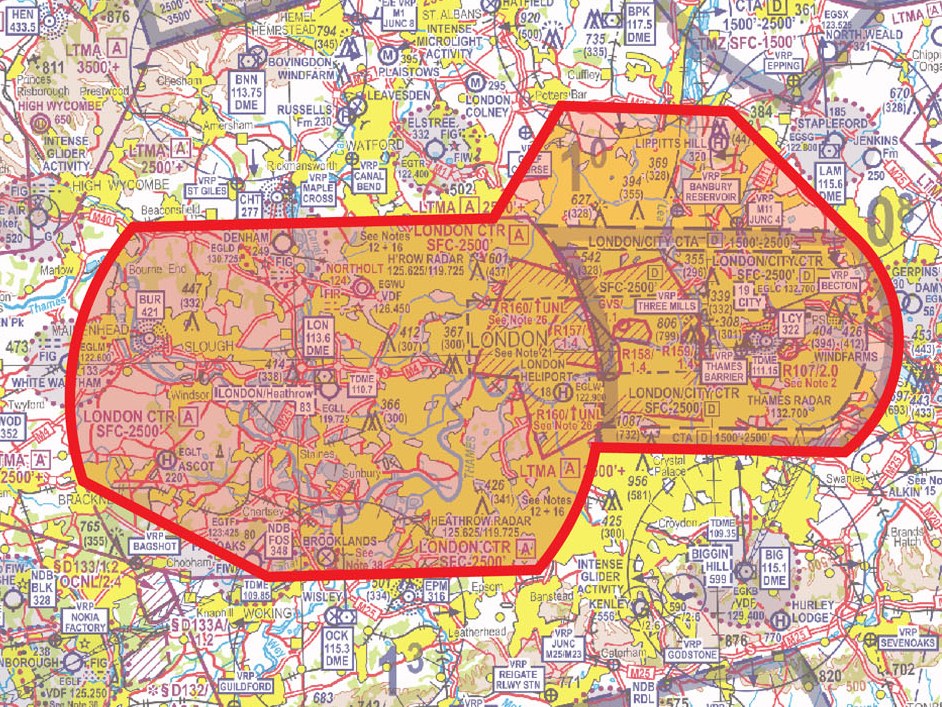
We went along today to see the Olympics torch procession through Stoke Newington, but the big story this week has been around security, with the army drafted in to cover for those G4S guards who have failed 'to materialise'.  Earlier this month residents of a tower block in Leytonstone lost their court case to prevent high velocity missiles being installed on their roof.  There are five other missiles sites, from Epping Forest to Shooter's Hill, along with a helicopter carrier moored on the Thames, Typhoon jets at RAF Northolt, and sniper-carrying Puma helicopters in Ilford. At the Olympics Airspace site you can download a 100-page manual which 'navigates pilots through the various security and operational airspace restrictions in place for the duration of the Games'  A map shows the prohibited zone for model aircraft, which covers the entire city.


All this makes me wonder how the Met's Air Support Unit, the 'avian police' that Sukhdev Sandhu interviewed for Artangel's Night Haunts project, will fit into the Olympics operations.  He asked one of them to describe the most beautiful thing he had seen at night.  "Oh, where do you begin?  The mist lying in the valleys takes your breath away.  The orange glow of the breaking dawn.  Or sometimes when there's a full moon you can see its reflection in the Thames..."  But these visions are reduced to black-and-white heat traces in the thermal imaging cameras used to scour the city for security threats.  'The thermal imagers themselves, though they're designed to help the police protect the city, produce images that resemble Baghdad, Vietnam - bombing zones for Allied troops. For a moment, London's nocturnal beauty vanishes: the forests seem ash-charred, lit-up areas ghostly apparitions.'