Showing posts with label shores. Show all posts

Saturday, May 30, 2026

The distant island of Eimeo

Conrad Martens, HMS Beagle being hailed by native Fuegians, 1832

Following a visit to Charles Darwin's home Down House earlier this year, I read the The Voyage of the Beagle (1845 - the second edition which incorporated extensive revisions and looked forward to his theory of evolution). It really is a fascinating account, in which Darwin experiences an earthquake in Chile, climbs the Andes, meets gauchos, encounters political turmoil in Peru and witnesses the return of Fuegian natives who had been taken to Britain after the captain’s previous voyage. The Galapagos Islands are an obvious highlight but the whole book is interesting. Darwin is admirably critical of slavery, sympathetic to exploited miners and saddened by the impact of diseases brought by Europeans. He is also sympathetic to the efforts of missionaries, who were evidently doing some good, even if the extent of their negative impact was not yet apparent. Overall he comes over as thoroughly admirable and his enthusiasm for the natural world extends well beyond animals and plants to encompass insects, coral reefs, fossils, geological formations and meteorology.

At the end of the book he concludes that 'the pleasure derived from beholding the scenery and the general aspect of the various countries we have visited, has decidedly been the most constant and highest source of enjoyment.' There are descriptions of landscape throughout the journey and I will just quote one example here, from his time in Tahiti, where he reaches for the analogy of a work of art.
From the highest point which I attained, there was a good view of the distant island of Eimeo, dependent on the same sovereign with Tahiti. On the lofty and broken pinnacles, white massive clouds were piled up, which formed an island in the blue sky, as Eimeo itself did in the blue ocean. The island, with the exception of one small gateway, is completely encircled by a reef. At this distance, a narrow but well-defined brilliantly white line was alone visible, where the waves first encountered the wall of coral. The mountains rose abruptly out of the glassy expanse of the lagoon, included within this narrow white line, outside which the heaving waters of the ocean were dark-coloured. The view was striking: it may aptly be compared to a framed engraving, where the frame represents the breakers, the marginal paper the smooth lagoon, and the drawing the island itself. When in the evening I descended from the mountain, a man, whom I had pleased with a trifling gift, met me, bringing with him hot roasted bananas, a pine-apple, and cocoa-nuts. After walking under a burning sun, I do not know anything more delicious than the milk of a young cocoa-nut.

The Voyage of the Beagle mentions a few of his companions but in general Darwin is too busy studying the natural world to focus on them as characters. Of the two artists who accompanied the voyage, there is no mention of Augustus Earle, who shared a cottage with Darwin in Rio, and only one of Conrad Martens: on the occasion he shot an ostrich. 'It was cooked and eaten [but] fortunately the head, neck, legs, wings, many of the larger feathers, and a large part of the skin, had been preserved; and from these a very nearly perfect specimen has been put together, and is now exhibited in the museum of the Zoological Society.' The sketchbooks of Martens were digitised a few years ago by Cambridge University (The Guardian published on article on this at the time). The example below was drawn in Tahiti.

Saturday, May 02, 2026

The Channel of Gravelines


Detail from The Channel of Gravelines: An Evening

The Courtauld exhibition Seurat and the Sea is well worth getting to - not cheap, but of course it gets you access to the splendours of the permanent collection and there are many pictures you would normally have to travel a long way to see. The painting below was borrowed from MOMA, the study for it is usually in the Pompidou Centre and the conte crayon sketch is part of a collection of drawings owned by Jack Shear, the American curator and head of the Elsworth Kelly Foundation. These views were all executed in the last summer before Seurat's untimely death and it is sad to think that if he had lived as long as Matisse or Picasso he would have been around for abstract art and surrealism. One of my favourite paintings in London dates from the same summer, the Courtauld's The Beach at Gravelines, an astonishingly abstract composition, apparently painted for his own pleasure as it serves no purpose as a preparatory study.


Georges Seurat, The Channel of Gravelines: An Evening, 1890

While the other post-impressionists headed for the light and strong colours of the south, Seurat painted Gravelines, near Dunkirk, almost as far north as you can go in France (it is actually slightly further north than Brighton, where I grew up.) The exhibition curators explain that contemporary viewers 'were struck by Seurat's ability to convey atmosphere and by his subtle rendering of the pearly grey light of the Channel coast.'  The Channel of Gravelines: An Evening 'epitomises the contemplative and serene qualities of Seurat's seascapes that were so admired by early reviewers.' Paul Signac said 'this type of painting does not need bright light since it creates its own.' Adrian Searle, in his Guardian review, observes that 'the North Sea light is milky, turned down a notch from his summers farther south. A boat moves down the Channel at evening. There’s no one about in this violet hour, the sun gone, only the man on the boat and, I suppose, the painter following its progress.' 


Georges Seurat, study for The Channel of Gravelines: An Evening, 1890

The stillness in some of these seascapes has a strange, unsettling quality that made me think of artists like Léon Spillaert and Paul Nash. Joe Lloyd in Studio International writes that 'the emptiness and static quality of his scenes renders them stage-like. The grainy gauze of his technique makes them seem antithetical to the clarity with which our eyes perceive the world. The marines are thus simultaneously studied depictions of reality and oddly unreal simulacrums.' Reviewers prefer these paintings unpeopled - as Laura Cumming says 'the pictures go awry when stick figures appear in the foreground'. I agree, although (as in some of the landscapes painted by Claude and Turner) I quite like it when small, stiff and unrealistic figures create a strangeness that would otherwise be much less apparent. I'll leave the last word here to Laura Cumming (sadly, nowadays, often inaccessible behind The Observer paywall), talking about The Channel of Gravelines: An Evening. 'The most beautiful painting in this exhibition, on loan from the Museum of Modern Art in New York, shows Gravelines at twilight, where the waters have quietened to a silvery brightness and the sky above is pink-tinged with dying light.' 


Georges Seurat, Gravelines: An Evening, 1890

Saturday, March 21, 2026

The endless redrawn shoreline

Sean Scully, Aran, 2005

Sean Scully was the subject of a profile in the Guardian earlier this year with a clickbaity headline: ''I’m the product of a smashed-up family': how Sean Scully became the greatest abstract painter alive.' Of course abstract painters often seek inspiration for forms, rhythm and colour from landscape, and Scully is one such artist. You can see this in various ways at the Lisson Gallery's exhibition, The Nature of Art, which I visited last month. Aran (2005), for example, is a grid of the dry stone walls I have explored and photographed myself (see my earlier post 'Sentences on the sea', with quotes from Tim Robinson). He produced a book of these images, Walls of Aran, which has an introduction by Colm Tóibín. Scully was born in Ireland but grew up in London and did manual jobs while training to be an artist - he has talked about how he enjoyed seeing the forms made by stacking cardboard boxes in a factory. It is obvious why these carefully stacked stones of Aran would appeal to him.  

Landscape has most clearly influenced Scully's art in the Landlines series. An article in the Smithsonian magazine explains the origin of these works. 

It was 1999 when the artist Sean Scully approached the edge of a grassy cliff in Norfolk, England, out to the blue-green of the North Sea and the steely gray sky above it. “I saw a beautiful cliff and a very unusual possibility for a composition,” he says. The resulting photograph Land Sea Sky presented those three elements in roughly equal stripes across the pictorial space. ... “I try to paint this, this sense of the elemental coming together of land and sea, sky and land, of blocks coming together side by side, stacked in horizon lines endlessly beginning and ending,” he says, “the way the blocks of the world hug each other and brush up against each other, their weight, their air, their color, and the soft uncertain space between them.”

I have taken many photographs over the years of land, sea and sky forming bands of colours - I imagine we all have. I like the way you can vary the components - in Sussex you can also look back from the shoreline to photograph beach, cliffs and sky: grey, white and blue. The Lisson exhibition includes some of Scully's photographs, like Landline 1999 (brown, white, blue - land, surf, sea) and Landline (Lima Sunset) (2019) where, like Hiroshi Sugimoto, he just has two rectangles of sea and sky. Artists have been painting these bands of colour on the coast since The Monk and the Sea - on this blog I've mentioned Strindberg's Coastal Landscape II (1903) and Spilliaert's, Seascape Seen from Mariakerke (1909), but there was also Seurat at Gravelines, Richard Diebenkorn at Ocean Park, Patrick Heron at St. Ives, Brice Marden's Sea Paintings and Gerhard Richter's Seascapes. You could design a fascinating exhibition bringing images like these together. A few years ago Scully was invited to show new work at the National Gallery and his exhibition 'Sea Star' also included a near-abstract canvas by Turner, The Evening Star (1830).

Sean Scully, Natured (the endless redrawn shoreline) 12.22.25, 2025

Today I was in town again on my way to a Bernd and Hilla Becher show (excellent, but not really landscape art so I can't discuss it here) and walked through Hanover Square, where I took the photo below. This is a sculptural version of the Landline series, made from five blocks of marble. I guess it is always hard to write about art like this convincingly - when it was installed Scully explained that "marble is a natural material that is taken from the ground and has, as a consequence, a profound relationship with Nature." Hmm. Maybe he was partly thinking that it contrasts with the manufactured bronze used to cast the statue of William Pitt that stands across the road from it? The press release explained that 'the selected marbles translate the layered landscape of Hanover Square itself, the new gardens and surrounding buildings - the grey, sand and ochre of the footways and buildings, and the greens and blue- greens of the trees.' And you can see this in my image below, if you focus on the buildings and imagine more foliage and a more typical grey London day. Scully has simplified a complex townscape into a layering of colours resembling the naturally abstract views we experience on the edge of the sea.    


Sean Scully, Landline, 2023

Friday, February 28, 2025

Pine River and Lone Peak


I've been looking in this 1991 anthology for any interesting landscape-related poems that Peter H. Lee didn't include in The Columbia Anthology of Traditional Korean Poetry, a book I discussed here nineteen years ago. I soon found one - the first poem in the book is a 1580 kasa by Chŏng Ch'ŏl (1537-94) which Lee calls The Wanderings (1580). Its Korean title is Kwandong pyŏlgok* - sometimes rendered as the Song of Diamond Mountain or Song of the East Coast. Kwangdong is the name of the region that contains the spectacular Diamond Mountains (Geumgangsan), which I have discussed here before in relation to the artists they inspired. Chŏng Ch'ŏl's poem begins in Seoul where the king appoints him governor. He heads north and endures a sleepless night at Chorwon, a town which is now right on the North Korean border. After encountering magpies chattering on an old royal tomb (at least metaphorically), he sets off for the mountains, letting 'my staff lead me'. He walks through Hundred Rivers Canyon to Myriad Falls Grotto, and admires the falling water: 'there silver rainbows, / dragons with jade tails, / turning and coiling, spurt cataracts.' 

In an ideal world someone would have written an illustrated guide to the Diamond Mountains, detailing all the most famous scenic spots, arranged alphabetically or geographically, and illustrating them with literary quotations, paintings and contemporary photographs. One reason my ideal library contains no such volume is that it would be a little hard to write this now, since many of the beauty spots are in North Korea. And, of course, while the mountains and sea might have been familiar to Chŏng Ch'ŏl, specific sites he visited have gone. Early in the poem he passes through Pyohunsa Temple which is still there, but it is the only one of the Diamond Mountains' four great temples that survived the Korean War - American bombers destroyed Singyesa, Jangansa and Changansa. Another temple, Naksansa, was devestated by fire in 2005, although most of its buildings only dated from the fifties, when it was rebuilt after having been reduced to rubble in the war. Chŏng Ch'ŏl visited Naksana, where he got up at dawn to watch the sun rise over the sea. Naksana is one of the Gwandong Palgyeong, eight scenic spots along the eastern coast of Korea which became famous in the sixteenth century. 


Gim Hongdo, Lake Samilpo 
from an album of late 18th century Landscapes Around Mt. Geumgangsan 
Source: Google Art

Lake Samilpo is another famous landscape. It sounds lovely but is now inaccessible, north of the border. Chŏng Ch'ŏl visited and found six red letters on a cliff commemorating the four knights of Silla. 'After three days here / where did they go?' Legend has it that these four Hwarang stayed for three days and nights because they were captivated by the beautiful scenery (Samilpo means Three Days Cove). The Hwarang were Korea's elite male warriors, the 'flowering youth' schooled in Buddhism who visited mountains to train and try to receive supernatural guidance. They flourished as fighters between the mid-6th and mid-7th centuries, after which they became more of a social elite (they feature in later poems like the mid-8th century 'Ode to Knight Kipa': 'Knight, you are the towering pine / That scorns frost, ignores snow.') These four had been in the Diamond Mountains and were on their way down the coast to take part in a martial arts competition. Chŏng Ch'ŏl wonders where the four would have stayed next: 'Were they sitting at Clear Torrent Arbor / or on Myriad View Terrace?' 

Peter H. Lee discusses Chŏng Ch'ŏl's poem in his History of Korean Literature. He says 'the reader feasts on a continuous unfolding of scenes described from various perspectives, encompassing both the sky and sea, and engaging all the senses ... Chŏng’s bold descriptions show great skill in conveying a magnificent scene of nature in simple but carefully chosen words.' I will end here with the poet's description of Mirror Cove, which is northeast of Gangnung and was another of the Eight Scenes of Gwandong.  
Behind the old pines rimming like hedges
I scan a ten-mile long beach
like ironed and stretched white silk; 
the water is calm and clear, 
I can count the grains of sand.


Thursday, December 26, 2024

Gathering Grounds


I have been reading Harriet Tarlo’s Gathering Grounds (2019), described by publishers Shearsman as a ‘collection of place-based work emerging from three collaborative projects that took place between 2011-2019 in Yorkshire and Lincolnshire.’ Her collaborator was artist Judith Tucker, who tragically died last year in a car accident. An obituary by Griselda Pollack explains that she was returning from Lincolnshire, where the couple had worked together for many years, painting, drawing and writing poems. They also learned 'from the people living on the climate-threatened plotlands of the North-East Lincolnshire coast where working-class communities of the North have long built fragile holidays chalets, locally named Fitties, around the originally Viking village of Humberston.' Judith Tucker co-founded the LAND2, 'a national network of artist/lecturers and research students with an interest in landscape/place-oriented art practice.' She talked about her 'Night Fitties' work in a 2023 interview and drawings used in Gathering Grounds can be seen on her website

I have never been to the Humberston Fitties, or indeed to Lincolnshire (I've a feeling it's the only English county I've not been to). How much of the local landscape can be conveyed by these sequences of poems to someone who has never walked along Humberston Beach and Creek? As you can see from the image above, Judith Tucker's drawings are very detailed, like stills taken with grainy black and white film. Harriet Tarlo's poems, in contrast, isolate individual words and short phrases, set within white space which the imagination can fill in. Her texts create the visual effect of following the course of a walk, or they suggest the pattern of a beach, the shape of a valley, the fall of water or the flight of a swallow. I suppose you could try to get a feel for the place by focusing on references to specific birds and plants: an egret, a skylark, an oystercatcher, geese, sandpipers, curlews, purslane and samphire, thrift, lavender and cow parsley. Maybe with this kind of data a naturalist could narrow down the location and picture an environment, but they don't seem particularly distinctive to me. What lingers instead is an impression of mud and sand, shaped and eroded by local conditions into a series of scenes lit by the changing sky, reflections in the creek and silver left by waves on the beach. Here is a brief extract from 'July PM':

                        dark trees above                      silvery marram                           wind-drift

                                 grasses dune- making                straggling over

                                             fence stake|reflections   downbank

                                                                                                shadows  

The Gathering Grounds projects were supported by Sheffield Hallam and at the end of the book three academic articles are cited which describe the couple's practice-based research. In one of these, 'Poetry, Painting and Change on the Edge of England', they explain that their fieldwork in the Fitties drew on Iain Biggs' notion of deep mapping 'as a hybrid activity in which artistic, geographical and ethnographic practices interweave', with 'poetic ambiguity in dialogue with academic discourse.' They cite various writers of the edgelands and note that England's ad hoc coastal settlementshave particularly interested artists recently, e.g. 'Clio Barnard’s performance work Plotlands, 2008, Karen Guthrie and Nina Pope's documentary, Jaywick Escapes, 2012 and Julia Winckler‘s community engagement exhibition Lureland: Peacehaven Project.' 

The interviews Tarlo and and Tucker carried out with residents of the Fitties included recollections of a landscape now radically changed, with the sea now much closer inland. "Years ago it was way out, the dunes were 8 or 10 foot deep. Yep, we’ve lost a lot." 

The dunes referred to here have long lost their glory, being replaced by sand banks and gabions, the stones in these probably imported from Norway. The creek, saline lagoons and “pioneer saltmarsh” is spreading beyond Tetney marshes and onto Humberston Beach. The spaces humans value most highly and invented groynes to protect, sandy beaches, are being “colonised” by muddy marshland and an increasingly dangerous creek. Is the saltmarsh returning, re-establishing itself and how far will it go? Perhaps over time, regardless of the decisions human beings make about the Fitties plotland, the original saltmarsh fitties will indeed return... 


*These places were the subject of a classic study Arcadia for All: The Legacy of a Makeshift Landscape by Dennis Hardy and Colin Ward. The centenary of Ward's birth this year was marked by a new collection of essays 

Saturday, February 03, 2024

Cloud tracks and tide-ripples


Last weekend I went to Cambridge to see the Kettle's Yard exhibition Making New Worlds: Li Yuan-chia and Friends. Laura Cumming wrote in her review last November 'I can hardly think of a more uplifting show for the dying days of autumn' and I felt the same way on a cold day in January. 'Everything about it,' she goes on to say, is bright, beautiful, hopeful and as amiable as the subtitle suggests. For the Chinese artist Li Yuan-chia (1929-94) had many friends, and attracted so many more to his extraordinary “museum” in Cumbria in the 1970s that over 300 artists eventually came to work in Banks, a remote village beside Hadrian’s Wall. This show is filled with their spirit.' There's a lot to say about Li Yuan-chia and his gallery space YLC, so if you're not familiar with it I'd recommend reading that review or an article Nicholas Wroe wrote for The Guardian, '"There’s a story of racialised exclusion": the forgotten Chinese artist who transformed Cumbria'.

Li himself wasn't primarily a landscape artist, although there are abstract ink drawings he made before arriving in England that could be imagined as referencing the shapes of roads, fence posts, waves or tree forms. However, deciding to live in Cumbria and establishing the YLC in 'a landscape of farmland, fells and forestry, of uncultivated moors and unpredictable mires' (Ysanne Holt) unsurprisingly brought him into contact with artists working locally with natural materials like David Nash and Andy Goldsworthy. And some of his work did draw on the history of these borderlands - there is a photograph of him in the LYC in front of an artwork based on a map of Hadrian's Wall that resembles the gallery works made by contemporary land artists. A catalogue essay by Elizabeth Fisher compares his decision to work away from urban art centres to Kurt Schwitters in his Merz Barn and Ian Hamilton Finlay creating Little Sparta.

Li Yuan-chia's friends and associates included people I have referred to here before, like Winifred Nicholson, Frances Horovitz, Delia Derbyshire and Elsa Stansfield. The exhibition also includes Nash and Goldsworthy, Naum Gabo, Ian Hamilton Finlay (The Land's Shadows) and a Cumbrian artist I hadn't encountered previously, Donald Wilkinson (an etching/aquatint of The Greta Joining the Tees/Winter). They are among the long list of LYC Museum artists on the Li Yuan-chia Foundation website. There were also several examples of concrete poetry by Dom Sylvester Houédard (dsh), including SANDROCKTIDE, shown in my photograph below. The correspondence between dsh and Li is referred to in Amy Tobin's interesting essay 'Friendship as Method' and I'll end with a nice quote from this. 'dsh said his work was akin to 'dual-space probes of inner & outer' that should be read like 'cloud tracks and tide-ripples, lichen patterns and gull flights, or simply as horizons or spirit levels.''


Friday, April 28, 2023

Sussex Waters


I had been looking forward to 'Sussex Landscape: Chalk, Wood and Water' at Pallant House but was sadly too ill to go down and see it. The catalogue is interesting though, with an overview of the exhibition and essays on photography, engraving, chalk and flint. Some of the artists I discuss in Frozen Air were included - Frank Newbould, Eric Ravilious, John Piper, Bill Brandt and Jem Southem. Other famous artists associated with places in Sussex featured - William Blake (Felpham), John Constable (Brighton), Vanessa Bell (Charleston), Lee Miller (Farleys) - along with art by people I have discussed on this blog before - Roger Fenton, Paul Nash, Graham Sutherland, Andy Goldsworthy. I imagine the exhibition's centrepiece would have been Turner's stunning Chichester Canal (c. 1828) which includes the hazy silhouette of the cathedral, located just a street away from Pallant House.  

I'll mention here a few less well known works from the catalogue:    

  1. A View of East Dean and Mr. Dipperay's House from the Hills on the East Side of the Village, 1785 by Samuel Hieronymous Grimm. One of the views commissioned for a planned history of Sussex, this is closer to documentation than art but is fascinating now as a record of what could be seen from a specific spot at the end of the eighteenth century. The British Library has 866 of these topographical watercolours.
  2. View of the Sussex Weald. c. 1927 by C.R.W. Nevinson. If I'm ever in Reading I'll have to visit their museum to see this delightful view through a window, strikingly different to the 'angular views of the war-scarred Western Front' we associate with Nevinson. 'A flourishing genre of images of the Sussex landscape framed by the domestic window is testament to the many artists who made the area their home for short or long periods during the inter-war years.'
  3. The Wave, 1966 by Gluck. This one is in a private collection and the catalogue's reproduction is a bit small and dark so it's hard to tell what it is really like. A small cropped view in an unusual frame: the whitewater and face of a breaker emerging from a turquoise-grey sea. It was painted when Gluck was living at Chantry House in Steyning with Edith Shackleton Heald.   
  4. Track with Sheep (Near Lewes) c. 1983-87 by John Holloway. 'Holloway began photographing the landscape in 1978, and over the next twenty-five years would provide a unique view of the land by taking photographs at a height of 1,500 feet from a small aeroplane. He would work at two specific times of the year - either side of the spring and autumn equinox - when the angle of the sun reveals the textures of the Downs.' You can see examples of his work in The Guardian's obituary.
  5. Solar, Seven Sisters, 2019 by Jeremy Gardiner. This combines a familiar (to me) view of the cliffs and buildings at Cuckmere Haven with abstract planes reminiscent of St Ives painters or Richard Diebenkorn. The relief surfaces 'represent both pictorially and conceptually the geological strata of the coastline.'

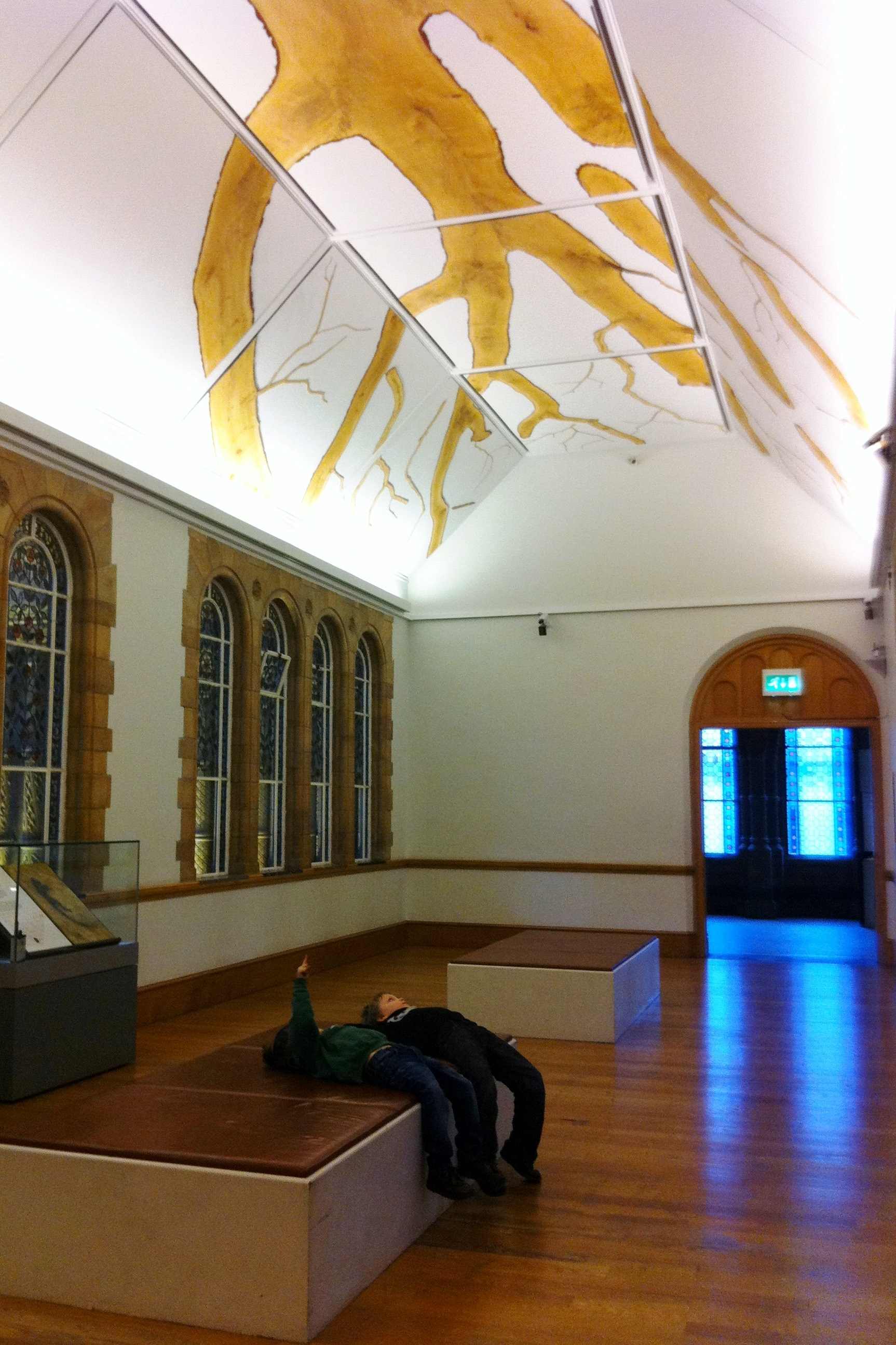
Before concluding I will just mention one of the book's essays as it's by an artist I'm surprised I haven't mentioned here before, Tania Kovats. I remember going to see her Darwin-inspired artwork TREE at the Natural History Museum back in 2011 (see photo below!) For Sussex Waters in this exhibition she installed bottles of water taken from the county's rivers. The idea of collecting and exhibiting water samples isn't new - Roni Horn's Library of Water in Iceland is more dramatic and directly addresses climate change in preserving glacial meltwater. But if you come from Sussex, the list of rivers Kovats visited is evocative in itself. They have some beautiful, resonant names - Cuckmere of course, and Cowfold, Woodsmill, Adur, Arun, Rother, Uck, Ouse. Glynde evokes an image of well-healed highbrow culture, Gatwick Stream a remnant of a landscape built over for a 'London' airport. There are quite a few I've never heard of but would like to visit. As she says, 'even naming rivers opens us up to connection.'

Sunday, July 17, 2022

Sea and Sand Dunes

Here's what you see when you enter the Royal Academy's new exhibition, a view of a bay with oddly sketchy waves, scattered black buildings and stick trees like Chinese characters. In Jonathan Jones' Guardian review he says

'Avery is sometimes hyped as an American Matisse but he is much stranger, and better, than that. Far from simply emulating Matisse, he translates the pleasures of beach life and summer days the French fauve painted into the brooding land and seascapes of America with wild results. Little Fox River, from 1942, seems joyous and summery at first sight, with its butter-yellow landscape surrounded by blue waves, but then you notice how big and inhuman the waves are, how tiny the swell of the sea makes the frail houses and church look.'

 Milton Avery, Little Fox River, 1942

The first room of the exhibition begins with some of Avery's early, unremarkable Impressionist-style landscapes and a range of later ones which can seem wilfully ugly in their choice of thin paint, dull colours and awkwardly drawn animals and buildings. But he could also hit on a combination of forms that seems wonderfully original and appealing, like Blue Trees (below - available to buy as a jigsaw in the RA shop!) My favourite works in the exhibition weren't the landscapes or his snapshots of city life, but domestic scenes which he painted in increasingly simplified forms, like Reclining Blonde (1959). Here's Laura Cumming describing his technique in another five-star review:

'Avery thinned his oil paint to the diaphanous consistency of watercolour so that it lay on the surface in floating patches and veils. Sometimes he scribbled upon it – the outline of a pencil or a pipe, a fleet of horizontal nicks that somehow manifest as leaves on a rust-coloured autumn tree. Sometimes the brushstrokes of one colour merge into those of another to produce a soft frisson, as in the snow-white nude against a black background, where the overlap glimmers.'

Milton Avery, Blue Trees, 1945

I first came across Avery years ago when I was reading a lot about his friend Mark Rothko, but I've never seen an exhibition devoted to his work - unsurprising as there hasn't been one in Europe. This one was a real pleasure and, despite the glowing reviews, not too busy with other visitors. It ends with paintings from 1957 inspired by Cape Cod, where, as the curators explain, 'Avery spent four consecutive summers, often in the company of Rothko and Gottlieb. These later works, with their larger scale and more abstracted forms, reveal the influence of the younger painters. Intensifying what he had striven towards over the previous five decades, Avery omitted detail, distorted forms and used non-associative colours.' These non-associative colours are evident in the painting I photographed below, Sea and Sand Dunes, a truly weird landscape in shades of red, white and mauve. A painting like this actually looks more contemporary than the abstract expressionists, reminding me of Alex Katz or Peter Doig. Jonathan Jones concludes that after visiting this exhibition 'you’ll never be able to see a Rothko again without picturing a seashore at dusk where the red blazing sky is layered above the wine dark sea, in an apocalyptic revelation.'

Milton Avery, Sea and Sand Dunes, 1955

Tuesday, April 19, 2022

The Sea View Has Me Again

The 'Sea View' of Patrick Wright's recent book was actually the name of one of the two pubs Uwe Johnson frequented during his final decade, living in Sheerness and almost failing to complete the fourth volume of his novel Jahrestage (Anniversaries). Johnson did have a sea view from his house on Marine Parade, although it was almost blocked by a defensive flood wall that was still under construction at the time of his death in 1984. Wright notes that 'views over water mattered greatly to Johnson', and windows feature in his novel as a device for framing the vistas of New York visible to his protagonist Gesine, providing a surface on which she pictures scenes from her youth. Looking out towards the icy New Jersey shore she is reminded of a winter morning on Lake Constance, but the moment this happens both memory and present view begin to 'corrode'. Instead of regaining a complete image of an earlier landscape, she can only experience scraps and shards of it. The streets of New York can suddenly be transformed, smog covered houses recalling 'a soft rolling landscape, forest meadows', but the memory remains partial, like somewhere seen from a boat and then obscured from view, although 'reachable not far past the shoreline cliff.'

In his chapter 'Beach, Sea and 'the View of Memory'' Wright discusses the importance of lakes and rivers for Uwe Johnson. Indeed 'Anniversaries itself comes to resemble the geography of Mecklenburg', where Johnson and Gesine grew up: 'sea-edged and filled with marshes, inland canals and lakes as well as rivers and the occasional swimming pool.' When I read Anniversaries I found this unfamiliar and complicated geography further confused by Johnsons' references to both real and imaginary places. I am no more familiar with Sheerness, never having been there, although any reader of Wright's book will learn a lot about its history. At several points it touches on resemblances between Sheerness and Mecklenburg, which could offer some explanation for Johnson's puzzling decision to move to this unloved corner of Kent. 

Wright concludes his exploration of Sheerness with the story of a Second World War ship full of explosives that has never been removed - Johnson wrote an essay about it entitled 'An Unfathomable Ship'. This essay suggests that Johnson saw the sea as 'a non-human force that is nevertheless the witness and even bearer of the murderous history that keeps troubling the surface of Gesine Cresspahl's consciousness.' It features in Johnson's books not as a unified force, resembling simplified political narratives of the historical tides that swept over Germany, but as discrete waves, 'singular and yet interconnected', like the 365 days that make up the chapters of Anniversaries. The first paragraph in the first volume of Johnson's novel describes the action of waves on the beach at New Jersey, and this sea view reminds Gesine of her childhood by the Baltic.

'Long waves beat diagonally against the beach, bulge hunchbacked with cords of muscle, raise quivering ridges that tip over at their greenest. Crests stretched tight, already welted white, wrap round activity of air crushed by the sheer mass like a secret made and then broken.'     
(translation by Damion Searls. For more information on The Sea View Has Me Again see Patrick Wright's website).

Friday, December 31, 2021

The waves were like agate


Eugène Delacroix, Sunset, c. 1850

I have been reading the Journals of Eugène Delacroix in a lovely, pristine Folio edition I found in a secondhand bookshop in York (the selections were originally translated by Lucy Norton for Phaidon in 1951). Most of what Delacroix writes about concerns art - how to achieve the effects he wants and admires in great artists of the past like Rubens and Titian. Landscape art as such was not a particular concern for him, although he was always looking at the way other artists painted skies, trees and waves. The appeal of the journals is the way they mix his ideas on aesthetics with everyday concerns - health, relationships, conversations, travel. I thought here I would just extract a few moments where he writes about walks in nature and describes views with the eye of a great painter. In 1849 he was fifty-one and dividing his time between Paris and Champrosay, now in the city's southern suburbs, with holidays on the Normandy coast near Dieppe.

Champrosay, 24 June 1849

In the morning it had been thundery and oppressive, but by the afternoon the quality of the heat had changed and the setting sun lent everything a gaiety which I never used to see in the evening light. I find that, as I grow older, I am becoming less susceptible to those feelings of deepest melancholy that used to come over me when I looked at nature, and I congratulated myself on this as I walked along.

Valmont, 9 October 1849

We went down to the sea by a little path on the right which was unfamiliar to me. There was the loveliest greensward imaginable, sloping gently downwards, from the top of which we had a view of the vast expanse of sea. I am always deeply stirred by the great line of the sea, all blue or green or rose-coloured - that indefinable colour of a vast ocean. The intermittent sound reaches from far away and this, with the smell of the ozone, is actually intoxicating.

Cany, 10 October 1849

Magnificent view as we climbed the hill out of Cany; tones of cobalt in the green masses of the background in contrast to the vivid green and occasional gold tones in the foreground.

Champosay, 27 October 1853

Went for a stroll in the garden and then stood for a long time under the poplars at Baÿvet; they delight me beyond words, especially the white poplars when they are beginning to turn yellow. I lay down on the ground to see them silhouetted against the blue sky with their leaves blowing off in the wind and falling off about me.

Paris, 5 August 1854

A lump of coal or a piece of flint may show in reduced proportions the form of enormous rocks. I noticed the same thing when I was in Dieppe. Among the rocks that are covered by the sea at high tide I could see bays and inlets, beetling crags overhanging deep gorges, winding valleys, in fact all the natural features which we find in the world around us. It is the same with waves which are themselves divided into smaller waves and then subdivided into ripples, each showing the same accidents of light and the same design.

Dieppe, 25 August 1854

During my walk this morning I spent a long time studying the sea. The sun was behind me and thus the face of the waves as they lifted towards me was yellow; the side turned towards the horizon reflected the colour of the sky. Cloud shadows passing over all this made delightful effects; in the distance where the sea was blue and green, the shadows appeared purple, and a golden and purple tone extended over the nearer part as well, where the shadow covered it. The waves were like agate. 

Dieppe, 17 September 1854

A rather miserable dinner. However, when I went down to the beach, I was compensated by seeing the setting sun amidst banks of ominous-looking red and gold clouds. These were reflected in the sea, which was dark wherever it did not catch the reflection. I stood motionless for more than half an hour on the very edge of the waves, never growing tired of their fury, of the foam and the backwash and the crash of the rolling pebbles.

Friday, December 18, 2020

Beach at Low Tide

In between the first and second waves of coronavirus I managed to get to an art exhibition - the Royal Academy's Léon Spilliaert retrospective. It was a strange experience, trying to enjoy paintings while wearing a mask (steaming up my glasses) and keeping a safe distance from other people. Laura Cumming had written a preview in February which made it sound great. 'This is a vital opportunity, then, to catch sight of his dark and startling art in all its precise originality, and to understand him as more than a painter of the cold North Sea'. He certainly was a fascinating artist, but here, in keeping with the blog's focus, I will focus on his sea paintings, with quotes drawn from an essay by Anne Adriaens-Pannier and Noémie Goldman. Here is a page from the catalogue, open to show a remarkable early work, now in a private collection: Seascape with Beacons (c. 1900).

'The sea appears in his earliest works like a lightly coloured patch of life, gentle and calm, betraying an aesthetic borrowed from the Impressionists. The pastel is applied in shapeless strokes, the delicate colours creating muted harmonies sometimes brightened by tiny spots of light.'


Léon Spilliaert, Seascape Seen from Mariakerke, 1909

'When Spillaert wanted to enhance the intensity of the sea, he introduced a disturbing nocturnal atmosphere and put greater emphasis on the horizon, where the silhouette of the urban coastline can sometimes be made out. In this series of  'sombre seascapes' ... the water , waves, currents, clouds and light evoke constant motion, the uncertainty of life and the suffering of a tormented character...' 

 
Léon Spilliaert, Beach at Low Tide, c. 1909

'Spillaert then abandoned these broader horizons to look at something closer to hand, at the water's edge on the beach ... The narrowing of his gaze led him to simplified forms, images stripped bare. Subtly sinuous, the waves take possession of a sandbank, tracing an organic, almost abstract shape on the damp, dark beach.'

I will conclude here with three more quotes about Spilliaert's Ostende beach scenes, taken from reviews of the exhibition.

'A longing to escape – or at least to have the option – is palpable in many of Spilliaert’s land- and seascapes. In a 1908 gouache and watercolour of Ostend’s Hofstraat, a towering street leads to a lantern in the sea, an inviting will-o’-the-wisp in the murk. Spilliaert’s beaches often surge towards the ocean beyond' - Joe Lloyd

'His beachscapes depict the breakwater as an advance, an invasion, while poles, pillars, lighthouses, masts, lampposts are all ranged precariously against the relentless horizontality of the sea. The vertical is temporary – the horizontal always wins.' - Patrick McGuiness 

'With a work such as Seascape Seen from Mariakerke (1909), you peer into the layers of India ink – shade upon shade of black – as though into mist, until a stray brushstroke or a scrub-mark that reveals the paper beneath reminds you that you’re looking at a two-dimensional surface. The immediate physical sensation is a kind of retinal whiplash – but as the process is repeated in seascape after seascape it amounts at last to something more like yearning: wishing yourself into another world while unable to forget where you are.' - Samuel Reilly

Saturday, June 06, 2020

Wrapped Coast

The passing of Christo has prompted various articles and obituaries - I have included some links below.  The Guardian published one about Wrapped Coast (1969), where Christo and Jeanne-Claude used 90,000 square meters of erosion-control fabric and 56 kilometres of polypropylene rope to transform a craggy shoreline south of Sydney into something that more closely resembled a chalk cliffscape.  I wrote about this work in my book about chalk cliffs, Frozen AirWrapped Coast had its own unique qualities, moving with the wind, creating a cliff surface in constant motion, but it also obscured and smoothed over the irregularities of real earth and rock. Something like this happens when we view cliffs at a distance, as a landscape composed of shapes and simple colours. I wondered how this fake coastal feature might have changed people’s experiences of being there.
For some it must have de-familiarised a place they had known for years. Perhaps in covering over the natural backdrop to their experiences it brought old memories back into focus. For others, with no prior knowledge of that coastline, the reality of the landscape could only be imagined, hidden under a vast dust sheet. 

Screenshot from the Kaldor Public Art Project film (below) of Wrapped Coast, 1969


The Guardian article quotes Australian collector John Kaldor, who released a statement following Christo’s death. “It wasn’t an easy task to find a coastline close to Sydney and get permission to wrap it,” Kaldor recalled. “The reaction was mostly disbelief and ridicule.”  One of the volunteers who helped assemble it, Ian Milliss, recalled how the artists seemed very glamorous. 
"They would fight all the time but she was the organiser. There was a very clear division of labour: he was up in the studio putting it all together in his mind, but she made sure everything happened on the ground.”
“Little Bay wasn’t just a beautiful object in the landscape. It was a total work. You looked at it like you look at the pyramids, as a huge piece of embodied labour and organisation. To me that was the thing that was most impressive about it – more than the scale of it, more than the beauty.”


Some additional Christo links:

Obituaries: The Guardian, Dezeen, BBC, LA Times, Vogue.

Christo's relationship with landscape and nature is not straightforward - Running Fence, the 44.5 mile-long white nylon fence they stretched across California in the mid-70s, required a 450-page environmental impact report.  I wasn't surprised to find a short notice of his death in Plastics News...

Here are three more appreciations.
  • Lynne Hershman Leeson: 'I worked in the office for the two weeks while Running Fence remained on view. (Meanwhile, Jeanne-Claude operated the secret decoy unit—something she learned from her father, who was a general in the French army, so that no one would interrupt her work.) On the very last day the work was up, I took a helicopter ride over the landscape. Only from that distance could I see its entire expanse. It was breathtaking.'
  • Adrian Searle:  'Surrounding a group of small islands near Miami with floating pink fabric in 1983, and extending floating, interconnecting piers or pontoons covered in yellow fabric across a huge Italian lake in 2016, the artists transformed these places, albeit briefly, into a kind of gorgeous abstraction.'
  • Jerry Saltz: 'Today, the week of his death, amidst the extended three and a half years of this terrible long American night, I wish we could enlist them to wrap the White House in black fabric shroud, a hyper-lucid mummified metaphor for the ghost ship of current pain and racism. Instead we can only mourn them, as we grieve for ourselves.' 

Sunday, March 22, 2020

Driving with Greenland Dogs


In these days of forced isolation, lots of people are turning to film streaming sites.  If you are interested in silent movies, I can highly recommend the Danish Film Institute's new site which so far has 64 good quality videos from the Golden Age of Danish cinema, including classics like The Abyss and A Trip to Mars.  The first Danish film, Peter Elfelt's Driving with Greenland Dogs (1897), can also be seen there in all its 40-second glory.  It is like a haiku in its brevity, single memorable incident and strong seasonal imagery.  Of course this film's original viewers would have been amazed by the way motion is captured, but viewing it now, what I like is the moment of stillness half way through, after the sled has left the shot and before it enters again from the other side (see image above).  For a second or so you just see a winter landscape with a line of trees like musical notes on the high horizon and fresh tracks written in the snow.


Another film you can see on Stumfilm.dk is Løvejagten (The Lion Hunt, 1907) made by Ole Olsen's Nordisk Film and directed by Viggo Larsen.  It is an extraordinary eleven minutes - a catalogue of tasteless moments that I can't really do justice to in a short description (do all hunters enjoy a sort of post-coital cigarette with the carcass?)  Attitudes change, but even back then the film caused an uproar because the two lions (bought by Olsen from Hamburg Zoo) were actually killed.  Even before these poor creatures and the film they starred in were shot, the Danish Society for the Prevention of Cruelty to Animals was protesting in vain to the Minister for Justice.  The publicity just helped the film become a success. 

Most stories from the early years of cinema with external scenes were set somewhere easy to simulate with local scenery.  But Denmark is not well-endowed with jungles and so one was recreated in Jægersborg Dyrehave near Copenhagen, a beautiful deer park (as I recall from visiting it once) but not an obvious setting for a lion hunt.  There's something a bit Douanier Rousseau about the scenes filmed there, with unnatural looking tropical plants sticking out of woodland paths.  The shore on which the lions met their end (see above) doesn't exactly bring to mind a tropical beach either - this scene was filmed on the island of Elleore in Roskilde fjord and watching it you can almost feel the cold wind whipping off the sea.


I will end here with something more uplifting, two lovely tinted photographs which can be found in an article on Danish art cinema by .  He speculates that early non-dramatic travelogue films (now lost) may have had 'atmospheric exteriors' resembling picturesque postcards,
'as could possibly be demonstrated by one of the two Nordisk films Fiskerliv i Norden [literally: Being a Fisherman in the Nordic Countries] (Viggo Larsen, 1906) or Ved Havet [literally: By the Sea] (Ole Olsen, 1909). These two fisherman tales only survive in a Swedish distribution copy in which the two were cut together, but what remains contains two beautiful tinted atmospheric inserts of a moonlit and sunset seascape though it is unclear in which of the two these are featured.'
This footage is not yet available on Stumfilm but perhaps under current circumstances the Danish Film Institute will be able to add more titles like this soon.

Saturday, May 25, 2019

The Shore of Sumiyoshi

Tawaraya Sōtatsu, The Beach at Sumiyoshi,
from the 'Tales of Ise', c. 1600-40
The Cleveland Museum of Art

In the highly refined Heian dynasty culture of ninth century Japan, landscape was admired in ways that would not be seen in the West for nearly a thousand years.  Consider the 68th episode of The Tales of Ise (c. 900), concerning the journey to Izumi of the poet Ariwara no Narihira (825-80).  At Sumiyoshi beach, 'he was so moved by the scenery that he dismounted from his horse and sat down again and again to enjoy the lovely views.  One of his party proposed: 'Compose a poem with the phrase "the shore of Sumiyoshi" in it.'  The resulting poem in its five brief lines combines autumn and spring imagery, chrysanthemums, wild geese and the sea.

Katsukawa Shunshô, Snow Scene Like a Flowering Grove
from the series 'Tales of Ise in Fashionable Brocade Prints', c. 1770-73 
Museum of Fine Arts, Boston

Peter Macmillan's recent (2016) translation of The Tales of Ise is a pleasure to read and includes fascinating explanatory material.  He notes, for example, that 'Episodes 66, 67 and 68 are all set along the shores of Osaka Bay and feature beautiful poems on the local scenery.'  In the 66th tale, 'The Sea of Life', Narihura stops with his friends by the shore and composes a poem on the boats in the bay, 'carrying us across / the sorrow-filled sea of life.'  And in the 67th, 'Snow Blossom', they see Mount Ikoma, revealed when the sky cleared.  Only then were he and his friends able to see 'the woods in snow blossom', the 'pristine white snow ' on the branches of the trees. I have included an eighteenth century illustration of this scene above.

Tawaraya Sōtatsu,  Noblemen Viewing the Nunobiki Waterfall,
 from the 'Tales of Ise', c. 1600-40
Minneapolis Institute of Art

Another episode involving admiration of scenery is 'Travels in Ashiya' (no. 87) - its theme, according to Peter Macmillan, is 'how excursions and the pleasures of the landscape can fill the heart with delight.'  The hero and his companions decide to climb the mountain to see the Nunobiki Waterfall. 
'The rock face was a good two hundred feet high and fifty feet wide, and the water pouring over it made it look as if its whole surface was covered in rippling silk.  A rock the size of a round straw mat jutted out from the top of the falls, and water cascaded over it in huge drops the size of chestnuts and mandarin oranges.  The man invited everyone there to compose a poem on the waterfall...'  
The resulting poems are good, but not as beautiful as the poem composed on their way home, as night fell and they could see firelight on the sea:
Are those stars on a cloudless night
or fireflies on the riverbank,
or are they the lights
of the fishermen's fires
in the direction of our home?

Sunday, December 23, 2018

Liquid landscapes

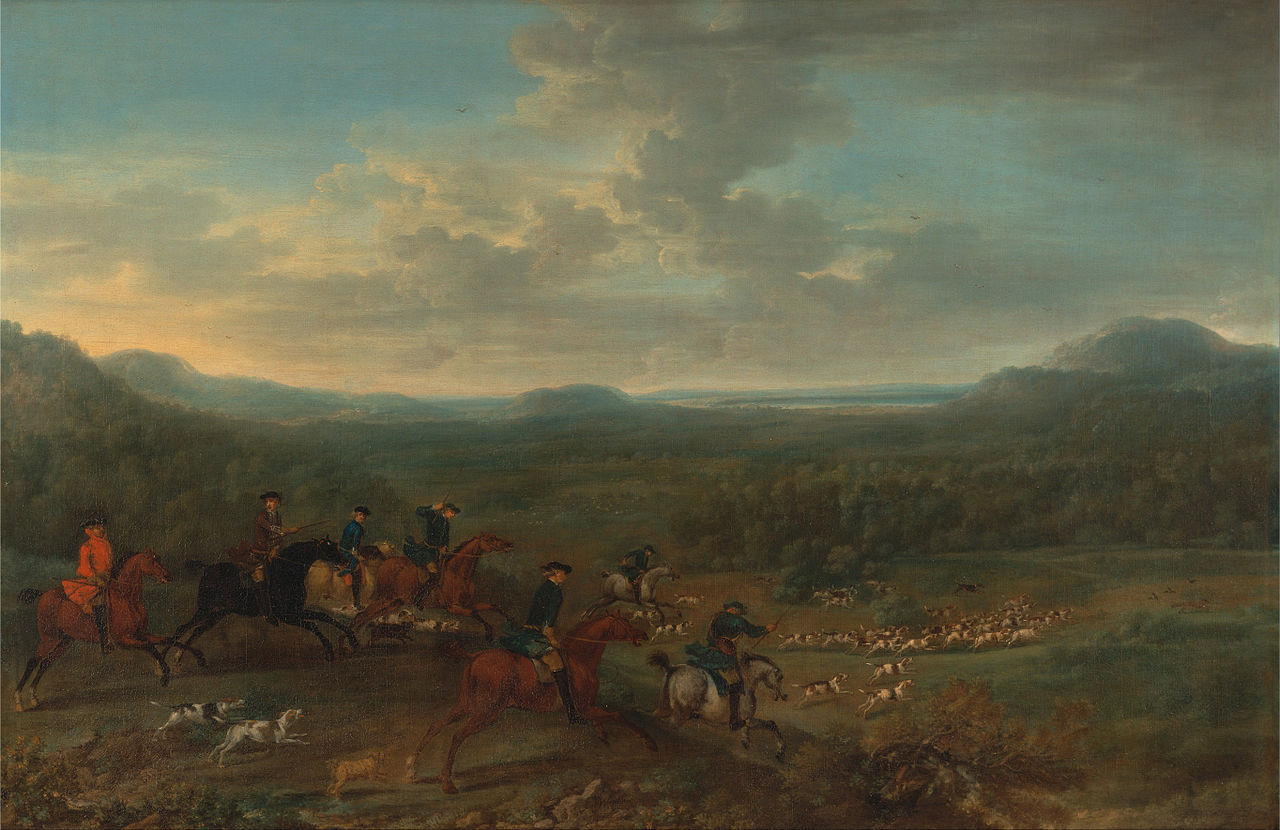
George Lambert, Box Hill with Dorking in the Distance, 1733
Images: Wikimedia Commons

Yale University's British Art Studies is a completely open access journal and its Autumn issue is dedicated to 'Landscape Now'.  In addition to various articles, including the Tim Barringer piece I referred to earlier this month, there is a 'Conversation Piece' coordinated by Alexandra Harris.  She refers to the current popularity of books about nature, but suggests that 'while readers are offered new ideas about landscape writing at every festival (several festivals are devoted to the subject) and with every Amazon click and with each week’s Caught by the River newsletter, it can be harder to get much purchase on developments in contemporary visual arts and art history. Work by art historians is not always being brought to the common table...'  Unsurprisingly (given what I wite about here), agree with this.  She also gives an insight into what she has been researching recently (I have written about here before about her previous books on landscape and culture, Weatherland and Romantic Moderns). 
I've been trying in my own research to get closer to an understanding of what places have looked like to different kinds of people living in them. I want to find evidence for what “views” have looked like to people, other than the makers and consumers of landscape art. It’s hard: I’ve been reading for two years—parish registers, local histories, antiquarian guides, court proceedings, wills and inventories, tithe maps, a very occasional diary; I’ve been wondering at the skill and sensitivity of local historians like Margaret Spufford and many who followed her lead—yet still I’m baffled by the difficulty of reaching the landscape feelings of the past. [...] Whether we are reaching back to life before (or without access to) the grammars of Western landscape painting, or looking again at Lambert, Wootton, and Wilson, or thinking about contemporary artists, it may be fruitful to reunite landscape with local knowledge and local people, from the airy prospects to make out local habitations and names.
John Wootton, A Fox Hunt, c. 1735

Several responses follow Alexandra Harris's introduction, some more informative than others.  Rachel Hewitt for example, tells us that at present 'there is important work being done, by Hayley Flynn among others, on [William] Blake’s interactions with, and subversions of, the eighteenth-century British landscape tradition' (I wonder if this new scholarship will surface in the Tate's Blake exhibition, scheduled for autumn next year). Emily Hayes writes about the influence of the Royal Geographical Society's magic lantern lectures, including those by Vaughan Cornish, a 'chemist turned geographer' who specialised in the study of waves, before turning later 'towards eugenics and landscape heritage activism'.  The intention is that this Conversation 'will develop as more respondents enter the debate. Readers can also join in by adding a response at the bottom of the page.'  There are no responses yet - I hope there will be, but I've learnt here that in the age of Twitter you can't really expect people to go to the trouble of adding written comments.

Vaughan Cornish, Breaker and Bores on a Flat Shore, 1910  

I will conclude here by pointing you to three other articles in the journal, each about landscape artists I have discussed here before.

  • Greg Smith takes a fresh look at Thomas Girtin's panorama, The Eidometropolis, drawing on material that has become available only in recent years;
  • And in 'Liquid Landscapes', Stephen Daniels juxtaposes a series of pond photographs by Jem Southam with Constable's depiction of Branch Hill Pond in his pictures of Hampstead Heath.


 John Constable, Hampstead Heath, with Pond and Bathers, 1821

Friday, October 19, 2018

Ground Work


Tim Dee has edited a new collection of place writing called Ground Work.  His introduction recalls an earlier version of the same idea, Ronald Blythe's Places (1981), which featured people like John Betjeman, Susan Hill, Alan Sillitoe and Jan Morris; it's mood was 'wistful and elegiac'.   few years later, Richard Mabey's Second Nature (1984), made for Common Ground, included big names like John Fowles, Fay Weldon and John Berger alongside art by Henry Moore, Richard Long, David Nash and others.  It too was predominantly backward looking.  Ground Work aims to look beyond the picturesque and pretty, at places that are not famous but mean something special to the authors.  However, this degree of attachment means that you will still encounter idylls of various kinds, though some have disappeared or have come under threat.  It is a little hard not to envy some of these writers their childhoods out in nature or the time they have to spend in agreeable places (the Bodleian Library, a wilderness retreat in Finland, an old garden in the Cevannes...)  There are authors who have been able to beautify a ninety-acre Sussex farm, buy a thirty-one foot sloop 'for a book project', or acquire a wood in order to restore it from neglect.  I have to say though that this last example, in an essay by Richard Mabey, was a highlight of the book: his reflections on the moral quandaries of landscape management are fascinating.


Richard Huws, Piazza Waterfall ('Tipping Buckets'), 1967
Photograph taken on my phone, earlier this week.

Given my interest in art, I particularly enjoyed 'Tipping Buckets', the contribution by poet and edgelends explorer Paul Farley, which finds different metaphors in a piece of urban sculpture.  The work in question can be found in a small square near the waterfront in Liverpool.  As I was in Liverpool on Monday I popped down to see it, but sadly there was no sign of life - the buckets were not even 'chugging away in their backwater', they were still and the 'piazza' was empty.  A lot of the writing in Ground Work focuses in on small sites like this - an allotment plot, a bridge, a back garden, a bird hide.  However, in order to justify mentioning the book on this blog I will end here by highlighting an essay that features both landscape and poetry.  'At the Edge of the Tide' is by Michael Viney, a journalist and nature writer originally from Brighton, where I grew up, but resident in Ireland since before I was born. It describes the beach by his home, 'an acre on the wilder coast of County Mayo'.

Viney has explored the strand in the company of two close friends, an ornithologist called David Cabot and the poet Michael Longley, who comes down from Belfast to 'immerse himself in the landscape'. Back in 1993 they even made a film together - sadly I can't find this online.  Over the years, watching birds and looking for rare plants, they have seen the place change - most recently in the interests of promoting tourism.  He quotes a poem by Michael Longley:
'Now that the Owennadornaun has disappeared
For you and me where our two townlands meet,
The peaty water takes the long way round
Through Morrison's fields and our imaginations.
The Owennadornaun was the little river whose ford near the bottom of the boreen was so rich in the spirit of place. A sill of rock made a shallow waterfall just above the crossing, with the sun above the mountain to catch each ripple and splash.  It was here I saw my first dipper, walking under water, and where, in summer, sand martins came to nest in holes in the bank.  There were pied and grey wagtails dancing at the edge and, once or twice, a sandpiper.
This has all gone. [...] A car park behind the strand, with a summer loo, was clearly essential to setting up the Wild Atlantic Way. It meant diversion of the little river and a road bridge built above its bed, this now remaining dry and quite birdless.'