Showing posts with label locus amoenus. Show all posts

Friday, April 21, 2017

In the mist of the secret and solitary hill

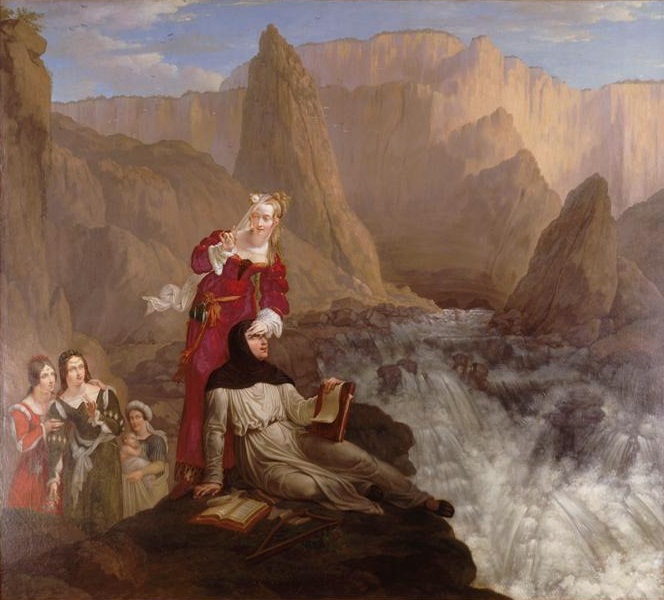
"I have given you the trouble of walking to this spot, Captain Waverley, both because I thought the scenery would interest you, and because a Highland song would suffer still more from my imperfect translation were I to introduce it without its own wild and appropriate accompaniments. To speak in the poetical language of my country, the seat of the Celtic Muse is in the mist of the secret and solitary hill, and her voice in the murmur of the mountain stream. He who woos her must love the barren rock more than the fertile valley, and the solitude of the desert better than the festivity of the hall."
An illustration to Sir Walter Scott's Waverley, from an edition of 1893

In my last post I wrote about the Chinese poetic ideal of hearing a guqin played in the landscape.  Here in Waverley (1814), the enchanting Flora McIvor is speaking to the eponymous hero, newly arrived in the Highlands, having led him to this perfect location to hear her 'imperfect translations' of Gaelic poetry, to the accompaniment of a harp.  This place of barren rocks and murmuring water might just as easily be the setting for a Chinese 'mountains and rivers' poem.  Making his way there, Waverley had found
'the rocks assumed a thousand peculiar and varied forms. In one place a crag of huge size presented its gigantic bulk, as if to forbid the passenger’s farther progress; and it was not until he approached its very base that Waverley discerned the sudden and acute turn by which the pathway wheeled its course around this formidable obstacle. In another spot the projecting rocks from the opposite sides of the chasm had approached so near to each other that two pine-trees laid across, and covered with turf, formed a rustic bridge at the height of at least one hundred and fifty feet. It had no ledges, and was barely three feet in breadth.'
From this vantage point Waverley had watched Flora cross the bridge, feeling all the emotions we associate with the Sublime.  The editor of the OUP edition of Waverley (Clare Lamont) notes that a similar bridge appeared in Scott's The Lady of the Lake (1810), that an actual bridge of this kind existed, spanning Keltie Water, and that there had been other examples of heroines of sensibility crossing Alpine bridges in slightly earlier novels written by Ann Radcliffe and Jane Porter.  Passing under the bridge, Waverley found himself in 'a sylvan amphitheatre, waving with birch, young oaks, and hazels, with here and there a scattered yew-tree. The rocks now receded, but still showed their grey and shaggy crests rising among the copse-wood. Still higher rose eminences and peaks, some bare, some clothed with wood, some round and purple with heath, and others splintered into rocks and crags.'  Then, turning the path, he came to the secluded spot where Flora would sing him her Highland song.

He found Flora gazing at 'a romantic waterfall.  It was not so remarkable either for great height or quantity of water as for the beautiful accompaniments which made the spot interesting.'  The description that follows is based on the falls of Ledard, as Scott explained in his own footnote.  Interestingly, the novel makes clear that this setting was not entirely wild.  'Mossy banks of turf were broken and interrupted by huge fragments of rock, and decorated with trees and shrubs, some of which had been planted under the direction of Flora, but so cautiously that they added to the grace without diminishing the romantic wildness of the scene.'  Here, with the sun stooping in the west, Waverley gazes at Flora, thinking 'he had never, even in his wildest dreams, imagined a figure of such exquisite and interesting loveliness. The wild beauty of the retreat, bursting upon him as if by magic, augmented the mingled feeling of delight and awe with which he approached her, like a fair enchantress of Boiardo or Ariosto, by whose nod the scenery around seemed to have been created an Eden in the wilderness.'

Reading this, you have the impression that the native Sublimity of the Highlands has somehow been infused with the light of Italy.  In the 1814 edition Scott described Flora by the waterfall as 'like one of those lovely forms which decorate the landscapes of Claude'.  I have mentioned here before the awkwardness of Claude's figures; soon after publication a correspondent pointed out to Scott that 'Claude's figures are reckoned notoriously bad, & indeed he only used them as vehicles for a little blue, red or yellow drapery to set of his gradation of tints & throw his landscape into distance.'  Scott took his advice and substituted Poussin for Claude in subsequent editions.

Flora begins to sing, sitting on a mossy fragment of rock, 'at such a distance from the cascade that its sound should rather accompany than interrupt that of her voice and instrument [...] A few irregular strains introduced a prelude of a wild and peculiar tone, which harmonised well with the distant waterfall, and the soft sigh of the evening breeze in the rustling leaves of an aspen, which overhung the seat of the fair harpress.'  But her song is not dedicated to Nature, though it begins with the mist on the mountains.  The year is 1745, Flora is an ardent supporter of Bonnie Prince Charlie and the Highlanders are about to rise and fight for the Jacobite rebellion.  Waverley, without firm political convictions, a lover of literature, is as yet unaware that the Young Pretender has landed at Glenaladale and raised his standard at Glenfinnan.  About to be caught up in the conflict (like one of those Chinese poets interrupted from their retreat in the mountains by political strife and war), for now he listens innocently, with a 'wild feeling of romantic delight', as Flora sings: 
"  ... the dark hours of night and of slumber are past,
The morn on our mountains is dawning at last;
Glenaladale’s peaks are illumined with the rays,
And the streams of Glenfinnan leap bright in the blaze..."

Saturday, November 05, 2016

The source of the Sorgue

 Philippe-Jacques van Brée, Laura and Petrarch at Fountaine-de-Vaucluse, 1816
Source: Wikimedia Commons

In 1337, a year after his ascent of Mont Ventoux, Petrarch travelled to Rome. On his return to Avignon he found that the city's decadence still disgusted him.  In his 'Letter to Posterity' he says that 'seeking some means of escape, I fortunately discovered a delightful valley, narrow and secluded, called Vaucluse, about fifteen miles from Avignon, where the Sorgue, the prince of streams, has its source.  Captured by the charms of the place, I transferred myself and my books there' (trans. Mark Musa).  Elsewhere he wrote a wonderful description of his home at Fountaine-de-Vaucluse.  The translation of this passage below is in The Wind and the Source by Allen S. Weiss.  
'Here I have acquired two small gardens perfectly suited to my skills and taste. To attempt a description for you would be too long. In short, I believe that no similar spot exists in all the world, and, to confess my unmanly fickleness, I regret only that it is not in Italy. I customarily call it my transalpine Helicon. The one garden is very shady, suitable only for study and sacred to our Apollo. It overhangs the source of the Sorgue, and beyond it lies nothing but ravines and cliffs, remote and accessible only to wild beasts or birds. The other garden, near the house, appears more cultivated, and it is a delight to Bacchus. This one, astonishing as it may seem, is in the midst of the very beautiful and swift-running river. Nearby, divided from it by a very small bridge on the further side of the house, hangs a curved vault of native rock that now provides shelter against the summer heat. It is a place that inspires studies, and I suspect is not too dissimilar to the little hall where Cicero used to declaim his orations, except that he did not have a Sorgue flowing alongside. Under this vault, therefore, I spend my afternoons, and my mornings on the hillsides; the evenings I spend in the meadows or in my less cultivated garden at the source where my efforts have conquered nature and cleared a spot under the high cliff in the midst of the waters, narrow indeed but very inspiring, in which even a sluggish mind can rise to the noblest thoughts.'
As Weiss points out, this description suggests a perfect balance between the Apollonian and Dionysian temperaments which Nietzsche would make famous in his writings on aesthetics. Petrarch was influenced by both Christian and Pagan traditions, by Saint Augustine and Cicero.  In a letter to Cardinal Colonna, he described his creation of a garden as a war with the Nymphs, who try to chase away his Muses, but when he thinks of erecting an altar it is to Mary, rather than to the gods of rivers and springs.  It sounds like a delightful retreat, where Petrarch could concentrate on his writing 'amidst the sound of birds and nymphs, and accompanied by few servants but many books.'  It was also a base from which Petrarch could wander the countryside, 'roving over the meadows and mountains and fountains, living in the woods and in the countryside, fleeing human footsteps, following the birds, loving the shadows, enjoying the mossy caves and the blooming meadows...' 

Thursday, April 11, 2013

The island of Cytherea


The strange and beautiful Hypnerotomachia Poliphili, published by Aldus Manutius in Venice in December 1499 and written by the monk Francesco Colonna (if we are to believe an acrostic formed by the first letters of each chapter), narrates the dream journey of Poliphilo and his quest to gain the love of Polia.  As Joscelyn Godwin writes in the introduction to his translation - the first complete one in English, completed to mark the book's 500th anniversary - Poliphilo's name indicates that he is a lover of many things, including architecture, gardens and sculpture.  'He has a passion for rich, colourful fabrics, especially when they are worn by nymphs; he revels in music, pageantry, ritual, and any other spectacle that induces a heightened state of consciousness.  ... When Poliphilo stands agape before the stupendous buildings of Antiquity, he seems to enjoy the same state of arousal as when he voyages to Cytherea in the company of Cupid, Polia and six exquisitely seductive sailor-nymphs.  At every opportunity he indulges in enumeration of detail that one might call fetishistic when he applies it to clothing or footwear, but which is no less obsessive when the object is an elaborate fountain or an emblematic obelisk.  This polymorphous eroticism is what gives the Hypnerotomachia its intensity and its atmosphere, saturated with the desire to gaze, to taste, and to consume.'


The dream begins at dawn with Poliphilo wandering, lost, on a broad silent plain, after a sleepless night lamenting his unrequited love.  In these early pages of the book, the landscapes he encounters are natural but empty of people - it is only once he has emerged from a maze of dark tunnels into a pleasant country of fruitful fields that he meets five nymphs who bathe him and take him to their Queen.  In this locus amoenus there is a sense of perfection and exquisite artifice in everything, including two remarkable gardens - one made of glass, the other of silk.  When he is eventually ready to be taken to the island of Cytherea (a journey that might be compared to that taken in Edgar Allan Poe's 'The Domain of Arnheim' which I described recently) he finds a shore 'washed by friendly tides and pebbled with strewn gemstones that shone in various forms and colours.  There was also abundant evidence of the fragrant coitus of monstrous whales, brought up by the fruitful tides.'  This is 'no place for mountains or deserts; all unevenness had been eliminated'  It is a perfect circle, three miles round, with an outer ring containing twenty groves of trees and inner rings featuring a succession of meadows, knot gardens, emblem gardens and finally an arena containing the fountain of Venus.  The book's ekphrastic descriptions and line drawings of topiary, statuary and buildings had a wide influnce on the design and planting of formal gardens in subsequent years, from the canals and colonnades of Versailles to the Villa d'Este's fountain of the sleeping nymph.


Although the Hypnerotomachia Poliphili imagines a pristine classical world, it contains within it a few poignant reminders of the ruins and fragments that were all that remained of the temples and monuments of antiquity.  Waiting for the arrival of Lord Cupid's 'speedy hexireme' and their embarkation for Cytherea, Polia and Poliphilo contemplate an ancient building, built upon the 'wave-resounding shore of the ebbing sea.  What remained of it was a great ruin of walls and enclosures, structures of white marble, and nearby a broken and sea-dashed mole of the nearby harbour.  In the fissures thereof I saw growing the salt-loving littoral cock's-crest, in some places ox-eye, much saltwort and the fragrant sea-wormwood, and on the sandbanks iringo, purslane, sea-colewort and other well-known simples, characias and myrtites.'  They sit on the grass talking, but gradually Poliphilo starts to feel a pleasurable heat as he gazes at her tightly fitting shoes - 'fine instruments for disturbing one's life and for the excessive torment of a heart aflame' -  and then at her 'dazzling bosom and delicious breast, where two rounded apples stood forth, resisting their clothing and striving obstinately against it.'  It is Polia who rescues the situation by suggesting that he go off and explore the ruins: "take your pleasure in looking at these, and examine the noble fragments that remain, which are worthy of our admiration.  And I will wait for you, contentedly sitting in this place, watching for the arrival of our Lord, who shall take us to his mother's holy and desirable realm." 

Tuesday, February 05, 2013

The Domain of Arnheim

"The usual approach to Arnheim was by the river. The visitor left the city in the early morning. During the forenoon he passed between shores of a tranquil and domestic beauty, on which grazed innumerable sheep, their white fleeces spotting the vivid green of rolling meadows. By degrees the idea of cultivation subsided into that of merely pastoral care. This slowly became merged in a sense of retirement — this again in a consciousness of solitude. As ­the evening approached, the channel grew more narrow; the banks more and more precipitous; and these latter were clothed in richer, more profuse, and more sombre foliage. The water increased in transparency. The stream took a thousand turns, so that at no moment could its gleaming surface be seen for a greater distance than a furlong. [...]  The windings became more frequent and intricate, and seemed often as if returning in upon themselves, so that the voyager had long lost all idea of direction. He was, moreover, enwrapt in an exquisite sense of the strange. The thought of nature still remained, but her character seemed to have undergone modification; there was a weird symmetry, a thrilling uniformity, a wizard propriety in these her works. Not a dead branch — not a withered leaf — not a stray pebble — not a patch of the brown earth was anywhere visible. The crystal water welled up against the clean granite, or the unblemished moss, with a sharpness of outline that delighted while it bewildered the eye." - Edgar Allan Poe, 'The Domain of Arnheim', 1847
This uncannily perfect landscape is the work of the narrator's friend Ellison, now deceased, but a man who had been borne from cradle to grave by 'a gale of prosperity'.  Having inherited a fortune, he spent four years searching for a site that he could re-shape according to his aesthetic ideals.  Ellison believed it would be possible to unite the beautiful and the sublime, to combine vastness and definitiveness, to design 'a landscape whose united beauty, magnificence, and strangeness' would resemble 'the handiwork of the angels that hover between man and God.'  There is something godlike in the way he controls the traveller's passage and manipulates their mood like a poet, passing from the georgic to the bucolic, before they enter the silent gorge as the sun begins to set.  The boat then emerges into a clear basin of water, its surface reflecting steep hills of flowers that resemble a 'cataract of rubies, sapphires, opals and golden onyxes, rolling silently out of the sky.'

At this point the visitor must descend into a light canoe of ivory and proceed alone, past wooded slopes that display 'not one token of the usual river débris' and through another winding channel until a gate of burnished gold is reached.  The story is nearly at an end and, this being Poe, one expects some kind of dark revelation, perhaps a sepulchral vision like  Böcklin's Isle of the DeadThe boat descends rapidly into a vast amphitheatre. 'There is a gush of entrancing melody; there is an oppressive sense of strange sweet odor; - there is a dream-like intermingling to the eye of tall slender Eastern trees - bosky shrubberies - flocks of golden and crimson birds - lily-fringed lakes - meadows of violets, tulips, poppies, hyacinths, and tuberoses - long intertangled lines of silver streamlets - and, upspringing confusedly from amid all, a mass of semi-Gothic, semi-Saracenic architecture, sustaining itself as if by miracle in mid-air, glittering in the red sunlight with a hundred oriels, minarets, and pinnacles; and seeming the phantom handiwork, conjointly, of the Sylphs, of the Fairies, of the Genii, and of the Gnomes.'

Poe wrote another story two year's later, 'Landor's Cottage: A Pendant to "The Domain of Arnheim"', in which a walker, travelling through 'one or two of the river counties of New York' comes upon another magical vista.  This vale, emerging from the mist, with its crystal clear lakelet, emerald grass and triple-stemmed tulip tree, is described in (rather laborious) detail, as is the house itself.  Eventually the reader is led inside and shown the interior decoration of Landor's cottage.  The simple furniture has 'evidently been designed by the same brain which planned 'the grounds': it is impossible to conceive anything more graceful.'  Hopes of meeting the designer of all this beauty are disappointed however, as the narrator ends abruptly at this point: 'it is not the purpose of this work to do more than give, in detail, a picture of Mr. Landor's residence - as I found it.'  To what extent the narrator has projected his own dream landscape onto the New York countryside remains unclear.

Harry Clarke, Landor's Cottage, 1919
Public domain

'Landor's Cottage' and 'The Domain of Arnheim', along with Poe's essay about an ideal room, 'The Philosophy of Furniture', form the basis of a "study of the inner refuge" made by a character in Paul Auster's novel The Brooklyn Follies.  Taken together, he says, they comprise "a fully elaborated system of human longing."

Wednesday, October 26, 2011

The Valley of the Ladies

"Do not hold back," I cried, "I beg you, by Zeus and by Eros himself!  It will give me all the more pleasure if your tale is indeed like fiction."
And with these words, I took him by the hand and led him to a neighbouring grove, where the plane trees grew thick and plentiful, and the water flowed by cool and clear, just as it comes from freshly melted snow.  I sat him down there on a low bench, and sat myself next to him.
"Well, it is time to hear your story," I said, "A setting such as this is delightful, and just right for erotic fiction."
- Achilles Tatius, Leucippe and Clitophon, Book 1, 2nd century CE (trans. Tim Whitworth)
What is the best kind of landscape in which to listen to a story?  I suppose it may vary according to genre, as Achilles Tatius implies, but a grove like the one Clitophon is led to, a locus amoenus of comfort, privacy and natural beauty, would seem ideal.  Here landscape is a gentle backdrop, not a distraction or a subject for discourse itself. 


In Plato's Phaedrus Socrates is taken to a similar location, but makes a point of reminding Phaedrus as they walk there: 'I am a lover of knowledge, and the men who dwell in the city are my teachers, and not the trees or the country.'  He is nevertheless very pleased with the quiet location they find by the cooling water of the Ilissus, 'full of summer sounds and scents. Here is this lofty and spreading plane-tree, and the agnus castus high and clustering, in the fullest blossom and the greatest fragrance; and the stream which flows beneath the plane-tree is deliciously cold to the feet. Judging from the ornaments and images, this must be a spot sacred to Achelous and the Nymphs. How delightful is the breeze:--so very sweet; and there is a sound in the air shrill and summerlike which makes answer to the chorus of the cicadae. But the greatest charm of all is the grass, like a pillow gently sloping to the head. My dear Phaedrus, you have been an admirable guide.'

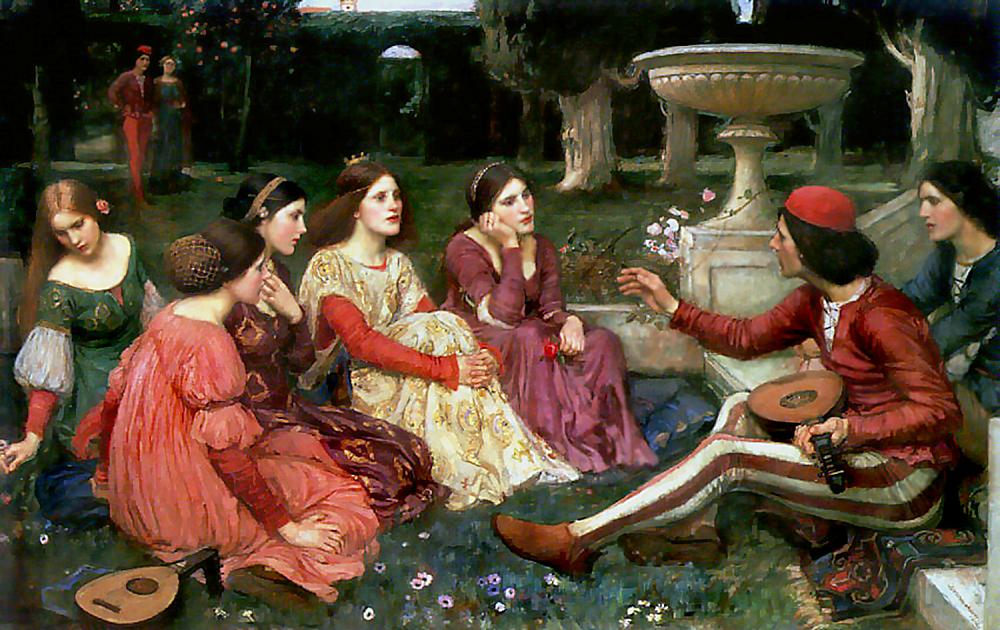
John William Waterhouse, A Tale from the Decameron, 1916

The history of literature is full of frame stories but the most famous to be set in a locus amoenus is surely The Decameron.  In fact Boccaccio's ten young Florentines find refuge from the plague in three such locations: two gardens, described on the first and third days, and then a garden-like landscape, The Valley of the Ladies, which they explore on the sixth.  Despite being outside the protecting walls of country villa, this valley has the essential element of seclusion - the only means of entry is a narrow path, beside which flows a clear stream.  The valley floor is so circular it seems to have been drawn with compasses, 'though it seemed the work of nature', and the valley's sides are terraced like a natural amphitheatre.  Vines and fruit trees grow on the south side, thick trees on the north.  The stream feeds a tiny lake so transparent that you can count the stones in it.  On discovering it the ladies are unable to resist a swim, the water concealing 'their chaste white bodies no better than a thin sheet of glass would conceal a pink rose.'  You can well imagine one of them echoing the words of Achilles Tatius, "a setting such as this is delightful, and just right for erotic fiction."  And it is on a grassy spot by this lake that they resume their storytelling the following day.

Wednesday, February 22, 2006

The Valley of the Princes

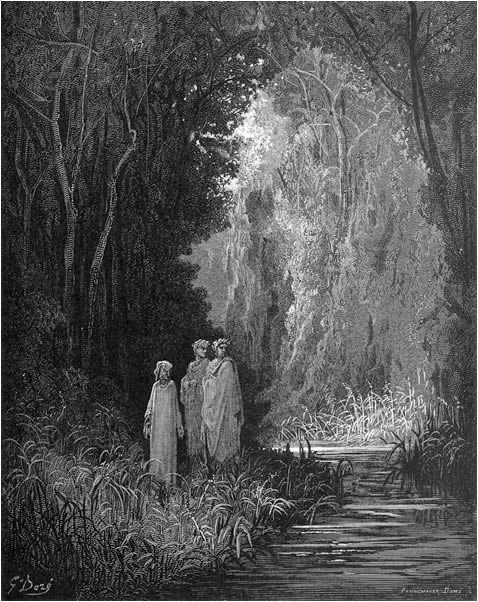
In Dante’s Purgatory (Canto VII), the shade of Sordello leads his fellow poets Dante and Virgil to the Valley of the Princes. This is the description of what they see there, taken from the 1815 Henry Cary translation that is freely available on Project Gutenberg:
Betwixt the steep and plain a crooked path
Led us traverse into the ridge's side,
Where more than half the sloping edge expires.
Refulgent gold, and silver thrice refin'd,
And scarlet grain and ceruse, Indian wood
Of lucid dye serene, fresh emeralds
But newly broken, by the herbs and flowers
Plac'd in that fair recess, in color all
Had been surpass'd, as great surpasses less.
Nor nature only there lavish'd her hues,
But of the sweetness of a thousand smells
A rare and undistinguish'd fragrance made.
According to Mark Musa, Dante creates a locus amoenus here that is unique in classical and medieval literature. Such a place would normally be described to the reader in terms of its natural features and living creatures, but here the valley is likened to precious stones, metals, dyes and pigments. As Musa says, “thanks to the list of metaphors, we are offered artificial opulent beauty, not the pure beauty of nature” (see notes to Musa’s translation). It is a fitting place for the souls of Negligent Rulers and contrasts strongly with the Garden of Eden which Dante reaches at the top of Mount Purgatory.
 
Musa notes that John Ruskin thought the description of Eden in Canto XXVIII “the sweetest passage of wood description which exists in literature”. Musa’s translation is indeed striking and makes it easy to understand why Ruskin thought this (the Cary version with its ornate English is less easy to appreciate, although the atmosphere is well conveyed by Gustave Doré’s 1867 illustration). For more about Ruskin’s reflections on Purgatory in his book Modern Painters see the Victorian Web.

Sunday, December 18, 2005

Locus amoenus

The Latin poet Tiberianus, who flourished about 335, composed a nature poem, ‘Amnis ibat inter arua ualle fusus frigida…” Called in English by various titles (‘A Woodland Scene’, ‘The River’) it is a classic depiction of the locus amoenus, a pleasant place. Its components are a broad river, flower-sprinkled grass, mossy caves, a shady grove, singing birds and a soft zephyr, all of which, the poet says, would delight whoever strayed there. The poem is given in Latin below. There is a translation in The Penguin Book of Latin Verse (ed. Frederick Brittain) - unfortunately out of print. I would have a go myself but sadly, despite calling myself Plinius here, I know no Latin.
AMNIS ibat inter arua ualle fusus frigida,
luce ridens calculorum, flore pictus herbido.
caerulas superne laurus et uirecta myrtea
leniter motabat aura blandiente sibilo.
subter autem molle gramen flore adulto creuerat:
et croco solum rubebat et lucebat liliis
et nemus fragrabat omne uiolarum suspiritu.
inter ista dona ueris gemmeasque gratias
omnium regina odorum uel colorum Lucifer
auriflora praeminebat, flamma Diones, rosa.
roscidum nemus rigebat inter uda gramina:
fonte crebro murmurabant hinc et inde riuuli,
antra muscus et uirentes intus myrtus uinxerant,
qua fluenta labibunda guttis ibant lucidis.
has per umbras omnis ales plus canora quam putes
cantibus uernis strepebat et susurris dulcibus; hic loquentis murmur amnis concinebat frondibus,
quis melos uocalis aurae musa zephyri mouerat.
sic euntem per uirecta pulcra odora et musica
ales amnis aura lucus flos et umbra iuuerat.
This ideal landscape is simply described: the poem has no gods, no singing shepherds, no wandering poet. Rather than provide an empty stage for us to project imaginary actions and encounters, it sketches a natural objective correlative for a sense of peacefulness and perfect happiness.
 
As far as I know there is still little biographical information about the poet Tiberianus. The Oxford Book of Latin Verse (1912) had five verses ascribed to him.