Showing posts with label place names. Show all posts

Monday, February 29, 2016

Wanderings through the Mark Brandenburg


Reading the new translations of Walter Benjamin's radio broadcasts, made between 1929 and 1932, you are aware of how quickly the world in which they went out would disappear.  The final set of programmes about the catastrophes of history now seems to point towards the disaster that would shortly engulf Germany and eventually Benjamin himself.  The broadcaster was, in Benjamin's imagination, a guest in people's homes but, as Peter Conrad wrote in his review of Radio Benjamin, 'when the Nazis took control of Germany’s airwaves, such polite protocols were suspended.  A welcome guest no longer dispensed sage advice or told cautionary stories; instead, one man harangued a crowd, shouting tirades at top volume.'  How many Berlin Youth Hour listeners, you wonder, would grow up to fight in the Wehrmacht ten years later?  
 
The programme I want to highight here, 'Fontane's Wanderings through the Mark Brandenburg', begins with the idea that the landscape surrounding the city was 'discovered by the youth of Berlin'.  This Wandervogel movement would soon be outlawed, along with other groups distinct from the Hitler Youth.  However, as its title indicates, the main subject of Benjamin's broadcast was not these young walkers, or the wider groups of Bündische Jugend.  What he proceded to talk about was a remarkable topographical project, conceived one day in 1858 on Loch Levan in Scotland, by Theodor Fontane.
'In the middle of the loch lies an island, and on the middle of the island, half hidden behind ash trees and black firs, rises an old Douglas castle, the Loch Levan Castle of song and legend.  On returning to land by boat, the oars rapidly engaged, the island became a strip, finally disappearing altogether, and for a while, only as a figure of the mind, the round tower remained before us on the water, until suddenly our imagination receded further into its memories and older images eclipsed the images of this hour.  They were memories of our native land, an unforgotten day.  It was the image of Rheinsberg Castle that, like a Fata Morgana, hovered over Loch Levan...'
In that moment Fontane realised that the landscape made famous by Walter Scott was really no more beautiful than the sandy terrain of his native Mark Brandenburg.  And so he began his wanderings, selecting material to write about like 'a walker picking individual ears of grain'.  In 1860 he wrote to his friend Theodor Storm that the result might run to twenty volumes; in the event it was published in five, between 1862 and 1889.  The result was, as Benjamin told his listeners, 'far more than tedious descriptions of landscapes and castles, these books are full of stories, anecdotes, old documents, and portraits of fascinating people.'  It is not hard to imagine this appealing to Benjamin.  It sounds as if it would be enjoyed by English readers too if a modern selection were published, perhaps by an editor/translator looking, like Benjamin, to illuminate our understanding of culture and social change.  Although Fontane's novels have appeared in English (Before The Storm is one of my father's favourite books), I've not come across a translation of the Wanderings through the Mark Brandenburg, either in full or abridged form.

Carl Blechen, Rural Landscape in the Mark Brandenburg, c. 1831-8

Benjamin concluded this broadcast with his own description of the broad, expansive landscape of the Mark - quoted below again in the translation by Lecia Rosenthal - and some verse by Fontane that hardly needs to be translated.
'Its sandy, marly soil does not lend itself to strong shapes; however, one is occasionally surprised to come across a steep precipice, or a gorge ripped into the earth.  But the plain of the Mark, with its birch forests and cast acres of fields stretching to the horizon like a broad sea of gray and green, is the landscape's most beautiful feature.  It is so shy, subtle, and unobtrusive that sometimes, at sundown, on the water amid pillars of pine, you think you're in Japan, and other times, in the limestone hills of Rüdersdorf, you imagine yourself in the desert, until the names of the villages here call you back to reality.  Fontane strung some of these names together in a few light and airy lines, which we close with today.

And on this tapestry's flourishing seam
the laughing villages prosper and teem:
Linow, Lindow,
Rhinow, Glindow,
Beetz and Gatow,
Dreetz and Flatow,
Bamme, Damme, Kriele, Krielow,
Petzow, Retzow, Ferch am Schwielow,
Zachow, Wachow and Groß-Behnitz,
Marquardt-Ütz at Wublitz-Schlänitz,
Senzke, Lenzke and Marzahne,
Lietzow, Tietzow and Rekahne,
And lastly a garland of lively haunts:
Ketzin, Ketzür and Vehlefanz.'

Landscape view in the 1986 TV adaptation
Theodor Fontane, Wanderungen durch die Mark Brandenburg


Footnote: Michael Rosen's excellent programme on the Benjamin broadcasts can be heard on the BBC archive.  Although he doesn't explore the countryside of the Mark Brandenburg, he visits the Benjamin archive in Berlin and locations described in the original programmes .

Friday, January 27, 2012

Water flows inward underneath a cottonwood tree


In the video clip embedded above the environmental philosopher David Abram talks about the way landscape no longer speaks directly to us.  In his book The Spell of the Sensuous, he writes that in oral cultures, ‘human eyes and ears have not yet shifted their synaesthetic participation from the animate surroundings to the written word.  Particular mountains, canyons, streams, boulder-strewn fields, or groves of trees have not yet lost the expressive potency and dynamism with which they spontaneously present themselves to the sense.  A particular place in the land is never, for an oral culture, just a passive or inert setting for the human events that occur there.  It is an active participant in those occurrences.’  These conclusions come after a description of the importance of location for Western Apache storytelling.  An ‘agodzaahi narrative always begins and ends with a statement explaining where it happened, using one of the language’s evocative place names (which read like compressed poems).  Abram cites the work of linguistic anthropologist Keith Basso, who found that these place names occur with remarkable frequency in Apache discourse.  I was intrigued by this, so I looked up the original Basso article (in Cultural Anthropology, May 1988), where photographs of specific locations are reproduced to demonstrate how well their Apache place names fit: “Water flows inward underneath a cottonwood tree”; “White rocks lie above in a compact cluster”; “Water flows down on top of a regular succession of flat rocks.”

According to Basso, ‘the great majority of Western Apache place names currently in use are believed to have been created long ago by the “ancestors” (nohwizá) of the Apache people.  The ancestors, who had to travel constantly in search of food, covered vast amounts of territory and needed to be able to remember and discuss many different locations.  This was facilitated by the invention of hundreds of descriptive place names that were intended to depict their referents in close and exact detail.’  What's particularly interesting about these names (for readers of this blog) is that they assume a specific point of view, like a landscape:  'Western Apache place names provide more than precise depictions of the sites to which the names may be used to refer.  In addition, place names implicitly identify positions for viewing these locations: optimal vantage points, so to speak, from which the sites can be observed, clearly and unmistakably, just as their names depict them.  To picture a site from its name, then, requires that one imagine it as if standing or sitting at a particular spot, and it is to these privileged positions, Apaches say, that the images evoked by place names cause them to travel in their minds.’ This travel is both “forward” (bidááh) into space, and, following the memory of their ancestors' wanderings, “backward” (t’ aazhi) into time.

Saturday, November 19, 2011

The kill of New York is a brook in New England


BRANCH – RUN – FORK – BROOK – KILL – STREAM – BAYOU – SWAMP – SLOUGH – WASH – CAÑADA – ARROYO - RIO 

I came across Derek Watkins' excellent map, showing the distribution across America of different toponyms for 'river', on the Spatial Analysis blog (where James Cheshire has added his own UK version).  It reminded me that I have been meaning for some time to do a post here about Home Ground: Language for an American Landscape, edited by Barry Lopez and Debra Gwartney and compiled by a team of writers between 2002 and 2006.  Robert Macfarlane described this book in a wonderful essay published last year ('A Counter-Desecration Phrasebook'): 'Its ambition was to retrieve, define and organise nearly 1,000 terms and words for specific spects of landscape.  Its ethical presumption was that having a language for natural places is vital for two reasons: because it allows us to speak clearly about such places, and because it allows us to fall into the kind of intimacy with such places which might also go by the name of love or enchantment, and out of which might arise care and good sense.'

So what does Home Ground have to say about these river terms?  For the first one, BRANCH, the reader is referred to FORK and the entry, written by Bill McKibben, describes some of the geographical variation evident in Derek Watkins' map.  Easterners are likely to call forks branches, tributory is used elsewhere, 'and those in west Texas would call smaller forks prongs.'  His example of a 'prong' is the North Prong of the Little Red River Fork in Briscoe County Texas.  RUN, according to Kim Barnes, always denotes movement and 'can refer to any small stream, brook, creek, rivulet, channel, overflow, or swiftly flowing watercourse.'  Early Virginian settlers, naming the landscape, came to think in terms of a hierarchy by size: rivers > creeks > runs.  BROOK needs no explanation, but KILL?  It is the Dutch word for brook and appears in the name of landforms of the Hudson and Deleware Valleys, most famously the Catskill Mountains.  The term is not seen in the lower Hudson Valley, probably because, as Jan DeBlieu explains in Home Ground, the Dutch colony was subsumed into the surrounding English speaking culture after the capture of New Netherland in 1644.

Often the authors of Home Ground include illustrative quotations from American literature, like the 'dark stream shooting along its dismal channel' in Melville's Typee.  Gretel Ehrlich's entry on STREAM describes it as a dynamic force that 'receives, and thus reflects, the abuses that have taken place on the land.'  The next few terms, BAYOU, SWAMP and SLOUGH, sound aything but dynamic.  'The bayous are spaces of open water, sluggish or stagnant' and a slough 'is a narrow stretch of sluggish water in a river channel'. The city of Chicago is built on filled sloughs. The word bayou is derived from the Choctaw word for a small stream, bayuk.  Okefenokee Swamp gets its name from a Creek Indian word meaning 'Land of the Trembling Earth'.  A Harry Crews quote explains why: 'most islands in the swamp - some of them holding hundreds of huge trees growing so thick that their roots are matted and woven as closely as a blanket - actually float on the water; and when a black bear crashes across one of them, the whole thing trembles.'

With the word WASH we move into the American Southwest : Carrizo Wash in Arizona, Hunter's Wash in New Mexico. These are areas of land over which 'subtle contours allow water to flow, or "wash", from elevated to lower zones.'  ARROYO can be used to describe the same general feature, or, more specifically, a steep-walled, flat-bottomed creek.  Either way it is ephemeral, 'carrying water only briefly during such events as spring runoff or the summer monsoons.'  Two more Spanish terms complete the map: RIO and CAÑADA, 'a wetland rich with river reeds'.  The words RIVER and CREEK are also included but, are so common that they have been coloured grey.  Here in Britain, a creek is a saltwater inlet or the estuary of a stream.  In the entry for 'creek' in Home Ground, novelist Charles Frazier explains that the term spread to mean any flow smaller than a river.  'In a few places, though, a distinction was retained.  M. Schele DeVere, in his 1872 Americanisms: The English of the New World, put it succinctly: "The kill of New York is a brook in New England, a run in Virginia and alas! a crick or creek, almost everywhere else."'

Sunday, March 20, 2011

Threads Across the River

Richard Skelton is interviewed by Clive Bell in the latest issue of The Wire, talking about landscape and loss and photographed on Anglezarke Moor, standing alone by a dry stone wall near a recumbent (dead?) sheep. There is a fascinating discussion of Skelton's music making en plein air, as they walk the moors and visit places that feature on Landings - an album I discussed here in an earlier post.  The clip below features 'Scar Tissue', which was 'the result of a single encounter with a particular place', and 'Threads Across the River', 'an accretion of different times and different places ... a weave of sounds recorded in the two ruins which straddle the river Yarrow: Old Rachel's and Simms.'


The interview moves on to talk about ways in which the landscape has permeated Skelton's musical instruments - grasses and leaves intertwined around a fretboard, balsam leaves threaded into the sound hole of a mandola, bits of bark used as plectra.  "Because I was using really cheap instruments, I could leave them out in the wood and cover them in leaves.  It didn't matter if they got knackered.  I was coming to terms with a process of decay."  I've written here before about Ross Bolleter's pianos, left exposed in the landscape until 'all the damp and unrequited loves of Schumann, Brahms and Chopin dry out, degrading to a heap of rotten wood and rusting wire'.


The article also touches on a third way in which Skelton makes direct connections with the West Pennine Moors, in addition to exposing his instruments to the elements and recording himself in the wider soundscape (you can hear birdsong at the end of the clip above - 'Pariah', another track from Landings).  Discussing Box of Birch, Skelton says he has sometimes tried to play the environment directly: bowing barbed wire and playing trees to get a 'grating, rattling undercurrent'. "The barbed wire stretched across the landscape was like the strings on an instrument" he says, a comment that reminded me of my recent post on the aeolian telephone wires of Australia. I suppose the trouble with attempting to 'play a landscape' is the risk of seeming to possess and use it, rather than amplify its natural sounds. Of course it should be possible to making sounds from a living tree without harming it, and yet I wonder if the clip below (which I came upon via Twitter) would seem less acceptable if it involved a tree located out in some 'wild' location. 


Finally, I should return to Richard Skelton and mention his latest release, Wolf Notes, which was 'inspired by the landscape, place-names, flora and fauna of Ulpha, in Cumbria'.  There is a useful review at The Liminal which describes Skelton's use of 'the place names, the roots, of Cumbria ...  Wolf Notes derives from the etymological root of ‘ulpha’, understood to mean “the hill frequented by wolves,” from the Old Norse ulfr, “wolf”, and haugr, “hill or mound.”' The limited first edition (now sold out) came with a book of poems, a glossary and a 'phial of specially prepared, hand-mixed incense made from birch leaves, yarrow, wild grasses and a selection of resins.'

Friday, July 17, 2009

The Overlook

Another short post on a contemporary artist drawing imaginary landscapes: Frank Magnotta.  According to Dominic Molon in Vitamin D, Magnotta's drawings reflect 'the staggeringly constant turnover of the contemporary American landscape in the past fifty years, resulting from the heightened cycles of real estate development and relentless urban gentrification' leading to 'a national sense of perpetual unsettledness'.  Many of these feature architectural fantasies set against an empty background, like Post (2007), which can be seen accompanying an interview in Fecal Face magazine, where Magnotta says 'in the U.S. I'm not sure that we really build monuments any more, but in a way popular culture is the great ephemeral American monument. I'm interested in giving form to that.'

Sometimes he'll draw in a surreal landscape background, as in the recent Grand Optimist. In The Overlook (2004) buildings are entierly absent.  This drawing 'features a vast snowy landscape with such phrases as as HERITAGE HILLS, CRYSTAL LAKE, and GOLDEN ROSE placed at various points within the image.  Divorced from the assumed villaages that the phrases herald, the names become empty signifiers, meaningless ascriptions of perceived exclusivity and privelege that speak more to our desire for the trappings of wealth and prestige than the actual ability of language or objects to provide such bounty' (Dominic Molon).

Friday, May 15, 2009

Anahorish

I've talked before about the way the names of certain landscapes have particular resonance for poets and artists (e.g. Edward Thomas). In his poem 'Anahorish', Seamus Heaney says that this place name evokes the past - 'after-image of lamps / swung through the yards / on winter evenings'. In describing its physical characteristics, he refers to the meaning of Anahorish in Irish, a "place of clear water". But interestingly he goes further still, likening the structure of the word itself to the landscape it describes: 'Anahorish, soft gradient / of consonant, vowel-meadow...' There's an interesting post by Thomas O'Grady which discusses Heaney's use of place names. He mentions 'Anahorish' and highlights the poem 'Broagh' (riverbank), in which 'the shower / gathering in your heelmark / was the black O / in Broagh.'

The writer I most associate with place names is Proust. In Swanns Way his narrator remembers that 'I did not then represent to myself towns, landscapes, historic buildings, as pictures more or less attractive, cut out here and there of a substance that was common to them all, but looked on each of them as on an unknown thing, different from all the rest, a thing for which my soul was athirst, by the knowledge of which it would benefit. How much more individual still was the character that they assumed from being designated by names, names that were only for themselves, proper names such as people have... The name of Parma, one of the towns that I most longed to visit, after reading the Chartreuse, seeming to me compact and glossy, violet-tinted, soft, if anyone were to speak of such or such a house in Parma, in which I should be lodged, he would give me the pleasure of thinking that I was to inhabit a dwelling that was compact and glossy, violet-tinted, soft, and that bore no relation to the houses in any other town in Italy, since I could imagine it only by the aid of that heavy syllable of the name of Parma, in which no breath of air stirred, and of all that I had made it assume of Stendhalian sweetness and the reflected hue of violets.'

Monday, March 02, 2009

The stranger's bright city

I've been reading the beautifully produced Enitharmon Press anthology, Branch-Lines: Edward Thomas and Contemporary Poetry, in which 56 writers and critics pay tribute to the enduring influence of Thomas's poems. The review in The Guardian notes that 'Old Man' is the Thomas poem that receives most mentions, 'and it's easy to see why, as its insistence on the manifold bewilderments of utterance and reference give it a strikingly contemporary ring.' In the poem Thomas wonders whether his small daughter will remember picking the herb Old Man - a thought made additionally poignant by the death of the poet soon afterwards and the fact that his daughter, Myfanwy, lived on until 2005. Charles Tomlinson's poem 'Old Man, or Lad's Love' recalls meeting Myfanwy Thomas and being given by her a sprig of old man from the bush Thomas wrote about. Tomlinson has grown from this four plants of his own, which stand at the door in the Cotswolds opening up a landscape 'into space and time.'

Branch-Lines is a fascinating and often rather moving book, as many of the poets look back to their own formative years and memories. The contributions often have no direct connection to nature or landscape, but I'll highlight here one that does. U. A. Fanthorpe writes that Thomas comes naturally 'to writers in English, like grass growing' and talks about Thomas's love of place names, as in these lines:

If I should ever by chance grow rich
I'll buy Codham, Cockridden, and Childerditch,
Roses, Pyrgo, and Lapwater,
And let them all to my elder daughter.

Fanthorpe contributes her own poem 'Strong Language in South Gloucestershire' (2000) in which the old names (Sodbury, Nympsfield, Ozleworth, Doughton, Slimbridge, Gloucester) are seen to preserve landscapes from the distant past: 'Soppa's tinpot two acres, / Something holy, a good place for blackbirds, / Dock farm, bridge over mud, / The stranger's bright city.'

Monday, September 22, 2008

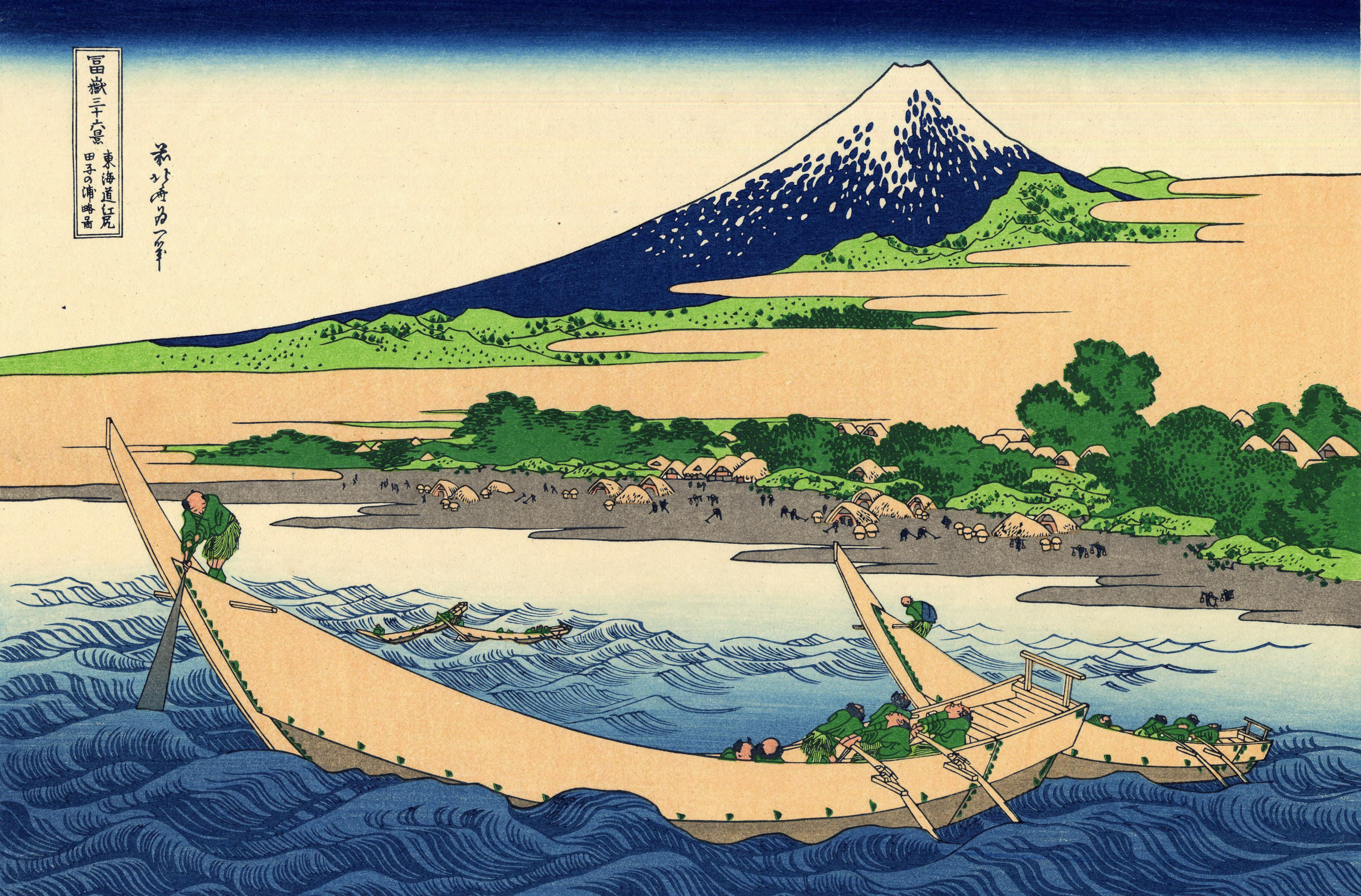
Mount Fuji seen from the beach at Tago

In Japanese literature certain place names, utamakura, have specific poetic associations. 'To mention Miyagino was to imply hagi, bush clover. Yoshinoyama implied cherry blossoms. Tatsuta(gawa) implied brightly coloured autumnal leaves. There were obviously such coloured leaves in autumn not only at Tatsuta, [both] in nearby Yoshinoyama and in far away Miyagino. But to speak of coloured leaves at Miyagino or cherry blossoms at Tatsuta violated decorum, or the hon'i of the place' (The Princeton Companion to Classical Japanese Literature). I have described here before references to Tatsuta and Yoshinoyama. Miyagino was visited by Basho on the Narrow Road to the Deep North, where he saw fields of bush clover, and there is a typical poem in The Tale of Genji: 'Hearing the wind sigh, burdening with drops of dew all Miyagi Moor, my heart helplessly goes out to the little hagi frond.'

Photographer John Tran has undertaken an Utamakura project to photograph these poetic places as they appear now. His photograph of Yoshino, for example, shows a bus parked by a dirty road. 'Utamakura were celebrated for their beauty, their literary associations, their emotive connotations, or some purely associative quality. Generations of poets visited and wrote about these sites, adding layer upon layer of depth and complexity to their mystique. Some survive as beauty spots in contemporary Japan, others have changed irrevocably in the intervening centuries. The former beauty spot of Tago no Ura, for example, on the Pacific coast south of Mount Fuji, is now notorious for pollution caused by paper mill effluent. Sites that are preserved as a consequence of their association in the public mind with historical culture draw such huge numbers of visitors that the attraction of the place itself is often supplanted by the overwhelming human activity that occurs there. The massive disparity between the high culture of uta and haiku sensibility and the everyday culture of advertising, cigarette butts and commuter trains forms the basis of the Utamakura Sites series.'

Tago no Ura was formerly famous for its white strand, wisteria and view of Mt Fuji. It was visited (at least in the imagination) by poets following in the footsteps of Yamabe no Akahito, the Nara period court poet whose famous poem in th Man'yoshu anthology depicts the mountain, seen from Tago Bay, under a flurry of snow.


Tago Bay near Eijiri on Tokaido, Katsushika Hokusai, c1830
Source: Wikimedia Commons

Saturday, February 02, 2008

North Country Sketches

Publisher and poet Jonathan Williams has often written about music. There is A Celestial Centennial Reverie for Charles Edward Ives, for example, which draws on Emerson and Thoreau ('the poet's flute / is heard / out over / the pond'). There are his epitaphs for composers like Ives, Elgar, Poulenc, Satie, Charlie Parker... some of these connect music to landscape, e.g. Jean Sibelius: 'the drone of overtones in / a rye field by / a river'. And in 1978 came The Delian Seasons, a sound poem inspired by Frederick Delius's North Country Sketches (1913-14).

Williams explains in a note to The Delian Seasons that ‘North Country Sketches is Delius’s only composition evoked by the Pennine Dales of the West Riding of Yorkshire, the landscape of his growing up... Following Delius’s passion for wordless choruses, I have restricted my words (except for three in ‘The March of Spring’) to place names found on four Ordnance Survey maps… Nouns are made to work harder than merely be places. The way they are sounded and placed in the poems owes ‘something’ to incessant listening to North Country Sketches.’ To give you a limited idea of the result, the first one, ‘Autumn: the wind soughs in the trees’ starts as follows 'whins end / whins end / arrant lattera carlin / whins end...'

I suppose this doesn't make a great deal of sense... you really need to see the original poem in its visual arrangement and read the entire thing. I have noticed that Williams has tended to suffer a bit from having his poems republished away from the original settings. For example, Blues & Roots, Rue and Bluets: A Garland from the Appalachians, in its original 1971 edition, had photographs by Nicholas Dean on almost every page and some of Williams' found poems were literally photographs of road signs etc. A 1985 reprint dropped the images and, I think, lost a lot of the impact.

Incidentally, did you know that Frederick Delius has a MySpace site? And that he numbers Beethoven and Schubert among his friends? He doesn't seem to be posting a blog though...