Showing posts with label huts. Show all posts

Wednesday, April 20, 2022

I leave my door open when spring days get longer


I've discussed Red Pine's translations from Chinese poetry before (see 'No Trace of Cold Mountain' and 'A terrace of incense lit by the dawn'). His enthusiasm for tracking down and exploring the landscapes experienced by the ancient poets is particularly relevant to this blog. In 1991 Red Pine visited the mountain on which the Zen monk and poet Stonehouse (Shihwu, 1272-1352) had lived. Five years earlier he had self-published a set of translations, having discovered this relatively obscure poet whilst working on Han Shan. Now he and a couple of friends were heading up Hsiamushan in a battered Skoda, having stopped on the way at a temple Stonehouse knew that had been almost completely destroyed in the Cultural Revolution. Near the summit of the mountain they encountered soldiers at a radar station. The commander kindly cut a path through the bamboo and they reached a farm that had once been a temple. This was where Stonehouse had made his home in a simple hut - the spring he mentions in his poems was still there, along with slopes of tea and bamboo, although the pines had disappeared. Twenty years later Red Pine returned and found better roads, a water bottling plant in place of the military blockhouses, and the farmhouse replaced by a new temple. Stonehouse's stupa must be somewhere in the mountain cemetery, where the inscriptions are no longer legible. His memorial stone has now merged into the hillside.

To give a sense of this place through poetry, I've chosen ten elements of the landscape. First I'll quote couplets from Stonehouse's poems, then in italics some information from Red Pine's explanatory notes. 


Bamboo

'a trail through green mist red clouds and bamboo / to a hut that stays cold and dark all day'

Bamboo grows so thick on Hsiamushan, trails don't last long. When I first visited the mountain in 1991, the army officer who led me to the area where Stonehouse first lived needed a machete to reach it.

Drifting clouds

'As soon as a drifting cloud starts to linger / the wind blows it past the vines.'

Clouds are often used as metaphors for thoughts, while vines represent convoluted logic. Drifting clouds can also refer to monks.

Flat-topped rock

'sometimes I sit on a flat-topped rock / late cloudless nights once a month'

The flat-topped rock is still there, just up the slope from the water-bottling plant. Local farmers call it "chess-playing rock".

Gibbon howls

'gibbons howl at night when the moon goes down / few visitors get past the moss by the cliffs'

Gibbons and their eerie howls were once common throughout the Yangtze watershed but are now found in the wild only in a few nature reserves in the extreme south.

Hibiscus

'a winding muddy trail / a hedge of purple hibiscus'

The hibiscus is found throughout the southern half of China, where it is often grown to form a hedge.

Orange tree

'down by the stream I rake leaves for my stove / after a frost I wrap a mat around my orange tree.'

The Yangtze watershed is the earliest known home of not only the orange but also such citrus fruits as the tangerine, the kumquat, and the pomelo. Apparently Stonehouse's orange tree (or "trees," as Chinese is ambiguous when it comes to number) didn't make it. He never mentions it again.

Paulownia

'I leave my door open when spring days get longer / when paulownias bloom and thrushes call'

The paulownia is one of China's most fragrant trees. It blooms in late March and early April and is the only tree on which the phoenix will alight - should a phoenix be flying by.


Pine pollen

'when Solomon's seal is gone there is still pine pollen / and one square inch free of care.'

The root of Solomon's seal, or Polygonatum cirrhiflium, contains a significant amount of starch. It is usually dug up in early spring. Pine pollen is slightly sweet and also has nutritional value. It is gathered in late spring by placing a sheet under a pine tree and knocking the branches with a bamboo pole. The "square inch" refers to the mind.


Thatch

'mist soaks through my thatch roof / moss covers up the steps on the trail'

A thatched covering of grass or rushes is still the most common roofing in the mountains. However, hermits who can afford them use fired clay tiles. 

Tiger tracks

'dried snail shells on rock walls / fresh tiger tracks in the mud' 

Until recently, hermits in China often reported encounters with the South China tiger, which is much smaller than its Siberian and Bengali cousins but still dangerous.

Monday, December 20, 2021

Dosso di Trento

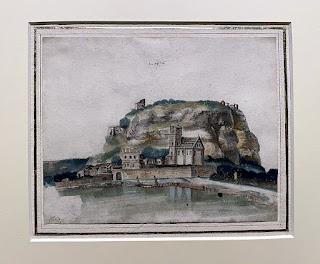
Albrecht Dürer, Trintberg - Dosso di Trento, 1495


I recently visited the National Gallery's Dürer’s Journeys: Travels of a Renaissance Artist, which I had been looking forward to all year, although I was forewarned that it would be a disappointment by Laura Cummings' Guardian review. She notes that 

There is no clear chronology and barely any discernible narrative. The show feels on the one hand congested – too many passengers on board – and on the other, lacking in the forcefield presence of the German master. A humdrum portrait medal of Dürer, instead of a single one of his many self-portraits in ink, chalk, silverpoint or paint – so spectacular, so pioneering, so original – can only mean inevitable bathos. Still, there are marvels by Dürer along the way. He is up there in the Alps getting an image of the shelter down on paper: noticing the fragility of the ruined roof and the weirdly human profile of the foreground rocks...

I let that quote run on to the comment about the shelter because I too was struck by this incomplete sketch. I had been hoping to see in this exhibition some landscape sketches like the wonderful View of the Arco Valley in the Tyrol owned by The Louvre. There was just one - see my photo above: a simplified view of Trento outlined against what appears to be a blank sky. In reality Trento is surrounded by green hills and mountains. This erasure of the landscape is even more striking in his sketch of the mountain shelter from twenty years later. It's almost as if the wider view is too vast and beautiful to capture in paint and so the artist turns his back on it, ignoring the towering rocks and trees around him and electing instead to draw the crumbling stone walls and roof beams of a vulnerable human structure.


Albrecht Dürer, Ruin of an Alpine Shelter, 1515

Sunday, October 20, 2019

Rising sun over the landscape of Mount Paektu

Last week I discussed here the way artists over the centuries have depicted Korea's Diamond Mountains, but these extraordinary peaks are are not the most revered landscape in this part of the world.  The great stratovolcano, Mount Paektu, features in both North and South Korea's national anthems and has always been considered a sacred site - the birthplace of Dangun, founder of the first Korean kingdom, whose father was the Son of Heaven.  Mount Paektu is in what is now North Korea and has become inextricably linked with ideas of the country's leaders, a process that began with an epic poem, Cho Ki-chon's 'Mt. Paektu' (1947).  A recent example is 'We Will Go to Mount Paektu', a song which Laibach wanted to cover on their controversial visit to North Korea in 2015.

Heaven Lake, Mount Paektu

For his 2016 documentary Into the Volcano, Werner Herzog visited Mount Paektu with volcanologist Clive Oppenheimer.  In the film they note how frequently it appears in official iconography as a backdrop to images of North Korean leaders.  They are also shown another pilgrimage site, Kim Il-sung's secret log cabin where, according to his official biography, Kim Jong-il was born in 1941.  Herzog says in his voiceover that "in the Christian World, this would be like visiting the birthplace of Jesus - the stable in Bethlehem".  I have featured the humble retreats of poets and artists many time on this blog in the past; here again we have an example of the cultural significance of a solitary hut in a mountain landscape. 


The film goes on to show images of this log cabin in the snow and Mount Paektu at sunrise.  These represent a form of landscape art that requires vast numbers of people all obeying strict instructions, neither creating or seeing the image but themselves forming a human canvas.
"In the country's biggest stadium, more than 100,000 people participate in creating a unique artform.  The picture of the hut in the snow is not a painting.  It is made of human pixels.  And this is how it's done.  A prearranged pattern of coloured cards is held and flipped over in sync.  Here: the rising sun over the landscape of Mount Paektu." 
We often think of the way nature is reshaped in response to our dreams and desires, or the way artists have painted mountains as an expression of their individuality and subjective experience.  Here, in a setting that approaches the scale of a real landscape, there are no individuals and only one official story. 
  

Saturday, February 10, 2018

Sleeping Dragon Ridge

 
Yosa Buson, Liu Bei visited Zhuge Liang in his hermitage three times, 18th century
Source: Wikimedia Commons

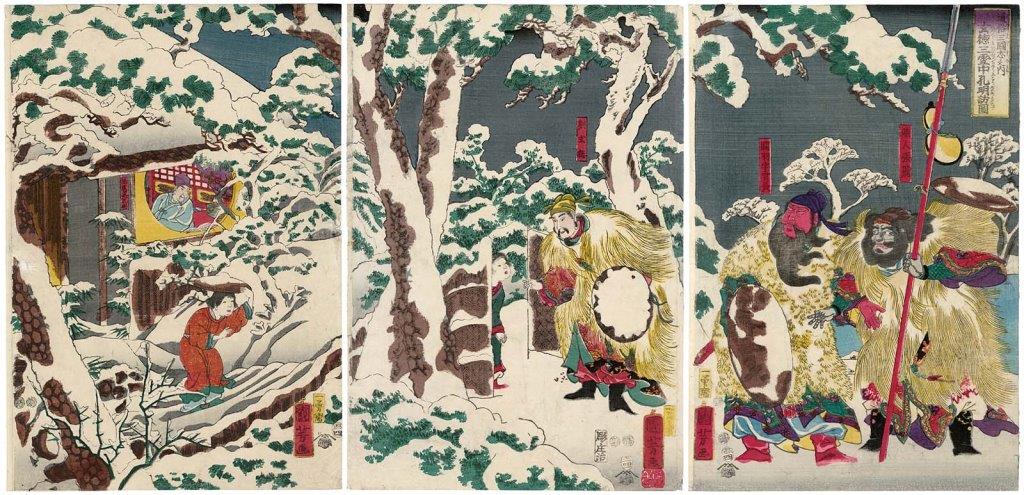
This beautiful winter scene was painted by the great Japanese haiku poet and artist, Yosa Buson.  It depicts a famous moment in Three Kingdoms, the epic Chinese novel describing real events at the end of the Han Dynasty.  The warlord Liu Bei has come to the 'thatched hut' of Zhuge Liang, the 'Crouching Dragon', to ask whether he will join him as an advisor.  Liu Bei is accompanied in this painting by his two oath brothers, Guan Yu (traditionally depicted with a red face and luxurious beard) and Zhang Fei.  These three and Zhuge Liang (also known as Kongming) have been depicted over and over again in books, plays, films, comic books and video games, along with their adversary Cao Cao (whose poetry I wrote about here last year).  Zhuge Liang was revered as a Chinese Ulysses, a great tactician, minister and inventor.  Moss Roberts, the translator of Three Kingdoms, describes him as a combination of Machiavelli, Clausewitz and Leonardo da Vinci.  But when Liu Bei came to call on him in the year 207, he was just a young scholar with a brilliant reputation.

Dai Jin, Looking Three Times at the Thatched Hut, Early Ming Dynasty
Source: Wikimedia Commons

The painting above, is by Dai Jin (Tai Chin) and dates from roughly the same period as the Three Kingdoms. Dai Jin's hanging scroll shows the same three characters being met at the gate by a boy, while Kongming can be glimpsed inside.  The titles of these pictures refer to the fact that Liu Bei made three trips to the thatched hut before Kongming made an appearance.  The first time he was told by the young boy that the master was not around and that his movements were uncertain.  On the second attempt, in the dead of winter, he encountered Kongming's brother but again was told that the master was away.  On the third, Liu Bei and his brothers were kept waiting while the scholar slept, but finally got to talk to him.  They found him to be a tall man 'with a face like gleaming jade and a plaited silken band around his head.  Cloaked in crane down, he had the buoyant air of a spiritual transcendent.'
 
 
Utagawa Kuniyoshi, Xuande (Liu Bei) Visits Kongming Three Times in the Snow, 1853

This story is as well known in Japan and Korea as it is is in China, as can be seen by two more Japanese images of Liu Bei's journey.  The woodblock print above is by Utagawa Kuniyoshi, from a series called A Popular Romance of the Three Kingdoms.  The one below is by the last great master of the ukiyo-e print, Tsukioka Yoshitoshi ('Gentoku' and 'Kômei' are the Japanese versions of  Liu Bei and Zhuge Liang).  The Fitzwilliam curators note that Kongming is shown by Yoshitosi 'on the right poring over learned texts: in the absence of lamps, diligent scholars in ancient China were supposed to have read by the light of fireflies or by the reflected luminescence of snow, which they brought in from outside.' 

Tsukioka Yoshitoshi, Gentoku visits Kômei in the snow, 1883

I will end this post with some lines from the novel itself, in Moss Roberts' translation.  On their first journey, Liu Bei and his brothers are directed to Sleeping Dragon Ridge:
'The twisting, turning ridge bears heavy clouds;
The frothing, churning stream is liquid jade.
Caught between the rocks, this dragon winds;
Shadowed by the pines, this phoenix hides.
A wattle gate half-screens a thatched retreat:
Undisturbed the recluse sits within.'
On their second journey, 'dense, somber clouds covered the sky.  The brothers rode into a cutting northern wind.  A heavy snow made the mountains gleam like arrowheads of white jade and gave the wood a silvery sheen.'  After being disappointed again, Liu Bei sets off back.
'Pear-petal flakes descending from the skies,
Antic willow puffs darting at his eyes,
He turns and halts to view the scene behind:
Banked with snow, the silvered ridges shine.'
On the third visit, he finally gains admittance and talks to Zhuge Yiang, who describes to him a three stage plan to reunite the Han empire.  Liu Bei rises from his mat and joins his hands together in gratitude, saying 'Master, you have opened the thicket that barred my view and have made me feel as if clouds and mist have parted and I have gained the blue sky.'

Friday, December 01, 2017

Withert vines, auld trees, derknin crows


I bought this book at the recent Small Publishers Fair: a selection of classical Chinese verse translated into Scots, with English versions provided as well to help non-Scots speakers.  It was hard to resist this purchase once I had read on the back of it W. N. Herbert's description of the way China's great writers appear in Brian Holton's Scots.  'His roistering Li Bai comes with more than a hint of Burns, while his Qiao Ji seems as rooted in landscape as Hogg is in Holton's beloved Borders.  The oldest named Chinese poet, Qu Yuan, comes across here as one of the aureate makars, Dunbar or Douglas, crossed with something of the shaman.  But it is with the subtle master Du Fu that a deep authentic note of melancholy emerges.'  Here is the first stanza of one of those Qiao Ji poems 'rooted in landscape'.  It is on the theme of scholarly retreat - 'Contented in Idleness', or, in Holton's Scots, 'Fine in Idleset':

Awa in the hills, ablow the wuids
there's a theikit shed wi rashie windaes,
bieldit, lown an bonnie;
green bamboo, emerant pines -
it's fair a pictur.

Reading this book made me wonder whether there is Chinese poetry translated into Welsh, Gaelic, Cornish...  Holton writes that he is currently the only Chinese-Scots translator and would welcome some company.  However, on the St. Andrews University website I came across a cross-cultural translation project that also involved making Scots versions of old Chinese poems.  The participants came up with a version of 'Autumn Thoughts', the most famous short poem by Ma Zhiyuan (c. 1250–1321), a contemporary of Qiao Ji who lived in what is now Beijing.  I have included their translation and a video clip below. 


An auld sauch, an corbies in the mirk
that haps the burn, the brig, the loan,
traivelled by a shilpit cuddie, gaun
efter the sun that fa's intae the dark
further and further fae hame.

Ma Zhiyuan is a true poet of autumn - his best known play, 'Autumn in the Han Palace', expresses the emperor's sorrow through autumnal imagery.  His poem 'Autumn Thoughts' is a condensed landscape in nine parts - withered vines, old trees, twilight crows, a small bridge, flowing water, people's homes, an ancient road, the west wind and a gaunt horse.  These are followed by an image of the sun sinking, and of a broken-hearted figure on a distant horizon.  Brian Holton includes some of Ma Zhiyuan's autumn poetry in Staunin Ma Lane.  His version of 'Autumn Thoughts' has each element on a line by itself: 'withert vines / auld trees / derknin crows...'  Then the 'gloamin sun / gaun westlins doun' and the man stands alone. 'Hairt sair, hairt sair / she's hauf the warld awa.'

Friday, November 24, 2017

Shy Sculptures

Rachel Whiteread, Chicken Shed, 2017

This post can be read as a sequel to one I wrote nine years ago on Rachel Whiteread's move to making art for the landscape.  In 'Ebbsfleet Landmark' I described her proposal for a monumental sculpture, which would have taken the form of the cast of a house on a mountain of recycled rubble (the winning proposal by Mark Wallinger was never built).  In a postscript I referred to one of her 'Shy Sculptures', casts of sheds and similar structures, the latest of which has been installed in front of Tate Britain as part of their excellent retrospective exhibition.  Last week I went to a talk at the gallery which covered her entire career but touched briefly on these recent works.  She told us that she sees the 'Shy Sculptures' now as an ongoing lifelong project, already encompassing works in Norway, Norfolk and the California desert.  She made a direct comparison with Robert Smithson's Spiral Jetty and Walter De Maria's Lightning Field, saying she'd like it if people tried to seek them out, travelling to remote locations like those cultural tourists who head for the American West to experience first-hand the foundational works of land art.

 Rachel Whiteread, Shack, 2016
Tate wall display - photography permitted

Whiteread has described sheds as beautiful things with their own poetry, “they are furniture for people to dream away their lives in.”  Sheds and cabins have fascinated contemporary artists, from Cornelia Parker to Tracey Emin, and they have a long cultural history.  I have often referred here to similar modest structures out in the landscape -  studios, retreats, hermitages. The 'Shy Sculptures' Whiteread made in California preserve the negative space of two 1950s cabins that were abandoned in the desert.  They took five years to make and were commissioned by Jerry Sohn, who is creating a collection of site-specific art that also includes works by Lawrence Weiner and Richard Long.  Whiteread described them in her talk as 'shotgun shacks' which (at least to a British listener, less used to the term) instantly brought to mind Talking Heads' song Once in a Lifetime.  David Byrne's lyrics, like Rachel Whiteread's sculptures, refer to transience and timelessness.


In interviews Whiteread has said she dislikes 'plop art', 'making things and just putting them in places for the sake of it.'  Her 'Shy Sculptures' have to be in the right locations.  It would be interesting to know more about how she thinks they affect the surrounding landscape.  Presumably they will be left to slowly weather into their locations, unlike House, which was bulldozed in 1994.  At the Tate, Whiteread talked again about the huge controversy surrounding House, as well as her bureaucratic struggles over the Vienna holocaust memorial (she is returning to the city this month for the first time since it was finally installed).  I now live in a property rather like House and wish it was still there to visit.  It prompted the best thing I've read by Iain Sinclair, his essay 'The House in the Park: A Psychogeographical Response'.  The villain of this piece, Lib Dem councillor Eric Flounders, reemerged briefly from obscurity ten years later in a Guardian story about the launch party for Cunard's QM2 (where Jimmy Savile 'was sporting an NHS swipe card in the name of Al Pacino alongside his gongs.').  I doubt that Flounders has any regrets.  Rachel Whiteread said she might consider doing another whole-house cast, but it would be pointless to try to recreate House.  Once in a lifetime...

Sunday, October 23, 2016

Ten Views from a Thatched Hut

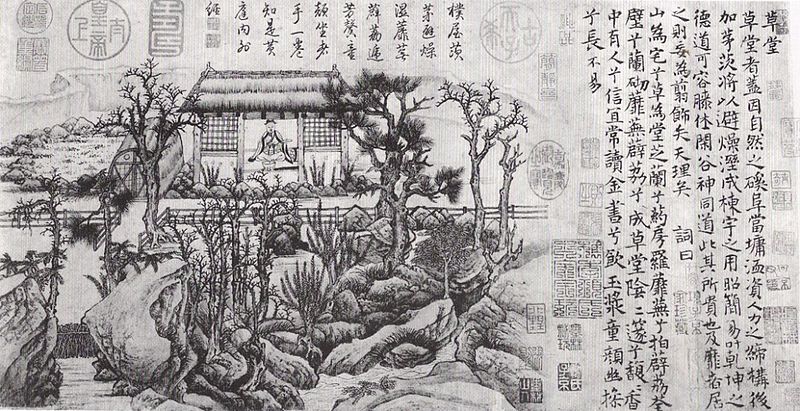
Lu Hong, View 1 of Ten Views from a Thatched Hut (copy of 8th century original)
Source: Wikimedia Commons

When we look at Chinese landscape paintings, we are seduced not just by their rivers and mountains, but by the idealised life of landscape contemplation they often portray.  The image above is one example, attributed to the Tang dynasty painter Lu Hong.  According to Wu Hung (in Yang Xin et al's Three Thousand Years of Chinese Painting) this work, Ten Views from a Thatched Hut, may be 'the first work in Chinese art history that we could call a scholarly painting, in a style that would dominate Chinese painting after the Song, for its main features are all related to the self-identity of the scholar-artist.'  Wu identifies four characteristics that it shares with later work of this kind:
  1. The landscape is neither imaginary or a famous beauty spot, it is the country estate of the painter himself.
  2. The artist himself appears in most of the scenes, 'listening to the sound of a stream, standing on top of a small hill, conversing with a fellow hermit inside a cave, or cultivating longevity techniques inside his thatched hut.'
  3. This is not an illustration of someone else's writings - Lu Hong was the author of text and painting, the words identifying the site portrayed and describing the artist's response to it.
  4. As a monochrome painting, the text could be appreciated in its own right as calligraphy.
Lu Hong lived in the early eighth century and is usually bracketed in histories of Chinese art with his contemporary Wang Wei.  Wang was a Buddhist, Lu a Daoist.  It was the Emperor Minghuang who gifted Lu Hong his thatched hut on Mount Song, after Lu had declined the official post of Censor Counsellor.  Lu lived there in scholarly retreat, an ideal I have touched on here in many posts over the last ten years - a dream of poets drawn to nature and solitude in Tang Dynasty China, Augustan Rome, Heian Dynasty Japan, Eighteenth Century Europe and post-War California.

Saturday, April 16, 2016

Composing in the Wilderness


This week I thought I would highlight a website called Landscape Music and the associated Landscape Music Composers Network.  They are run by a Brooklyn-based artist and composer, Nell Shaw Cohen, who writes of having tried 'to achieve the sonic equivalent of what visual artists accomplish with landscape art. I coined the term “Landscape Music” to communicate this ideal and philosophy.'  Among the projects on her CV is an app, Explore John Muir’s Yosemite.  Looking through the biographies of the Network composers on her site it becomes clear that California, the American National Parks and John Muir are recurring interests.  The soundcloud above, for example, is Jenni Brandon's The Sequoia Trio, 'inspired by the Big Trees in Sequoia National Park and the words of John Muir'. 


In this video clip you can see Rachel Panitch, another of the Network composers, playing the fiddle in Zion National Park.  The film also provides an insight into the way the National Parks' artist-in-residence programmes facilitate this kind of work.  Such schemes are welcome and it will be interesting to see what kind of music they give rise to in future.  I can't help thinking though that the way the park authorities pay for an artist to reside in a cabin is a little reminiscent of the way wealthy eighteenth-century landowners employed hermits to occupy huts on their estates.  These hermits would sometimes have to make themselves available to speak to visitors, just as the modern artist in residence needs to give occasional talks or performances.  One composer, Stephen Lias, has been taking advantage of several of these residencies to build up a body of work that responds to the parks' rivers, forests, mountains and storms.  Some of this music has been collected on a CD, Encounters.


Stephen Lias calls himself an 'adventurer-composer' and some of his research sounds quite arduous.  For the Gates of the Arctic National Park residency he was required to prove his fitness beforehand on a 10-day backcountry patrol.  He has led a regular field seminar with other composers in Alaska, 'Composing in the Wilderness'.  Its website advises applicants that they'll have to make do with pen and paper (no electricity) and notes that 'it is important that all participants are comfortable “roughing it” in close quarters for a few days.' Another Network composer, Justin Ralls has described being a participant on the first of these trips, reflecting on his need to get away from city life and wondering to what extent he was being a 'creative tourist' in the wilds of Alaska.  It would be easy to find historical precedents for this kind of activity too in the Romantic period.  Nowadays, wilderness expeditions organised for the benefit of artists are an alternative to the residency model - I have referred here more than once to the Cape Farewell trips which included composers and sound artist like Jarvis Cocker and Max Eastley.

John Muir & Theodore Roosevelt above Yosemite Valley, California.
Source: Wikimedia Commons

When it came to making a work about Yosemite, Range Light, Stephen Lias chose to work from photographs by Ansel Adams rather than his own direct experiences of the National Park.  Justin Ralls has written an environmental chamber opera, Two Yosemites, about the famous camping trip that President Theodore Roosevelt took with John Muir.  His Tree Ride, for orchestra, was 'inspired by Muir, backpacking, and listening to the breath of the world in California.'  He has also composed a string quartet, Tree Wavings, which derives from a beautiful passage in John Muir's The Mountains of California.
“We all travel the milky way together, trees and men; but it never occurred to me until this storm-day, while swinging in the wind, that trees are travellers in an ordinary sense. They make little journeys, not extensive ones, it is true; but our own little journey, away and back again, are little more than tree-wavings—many of them not so much.”

Friday, October 30, 2015

What the rocky mountain tells me

Mahler's hut at Steinbach

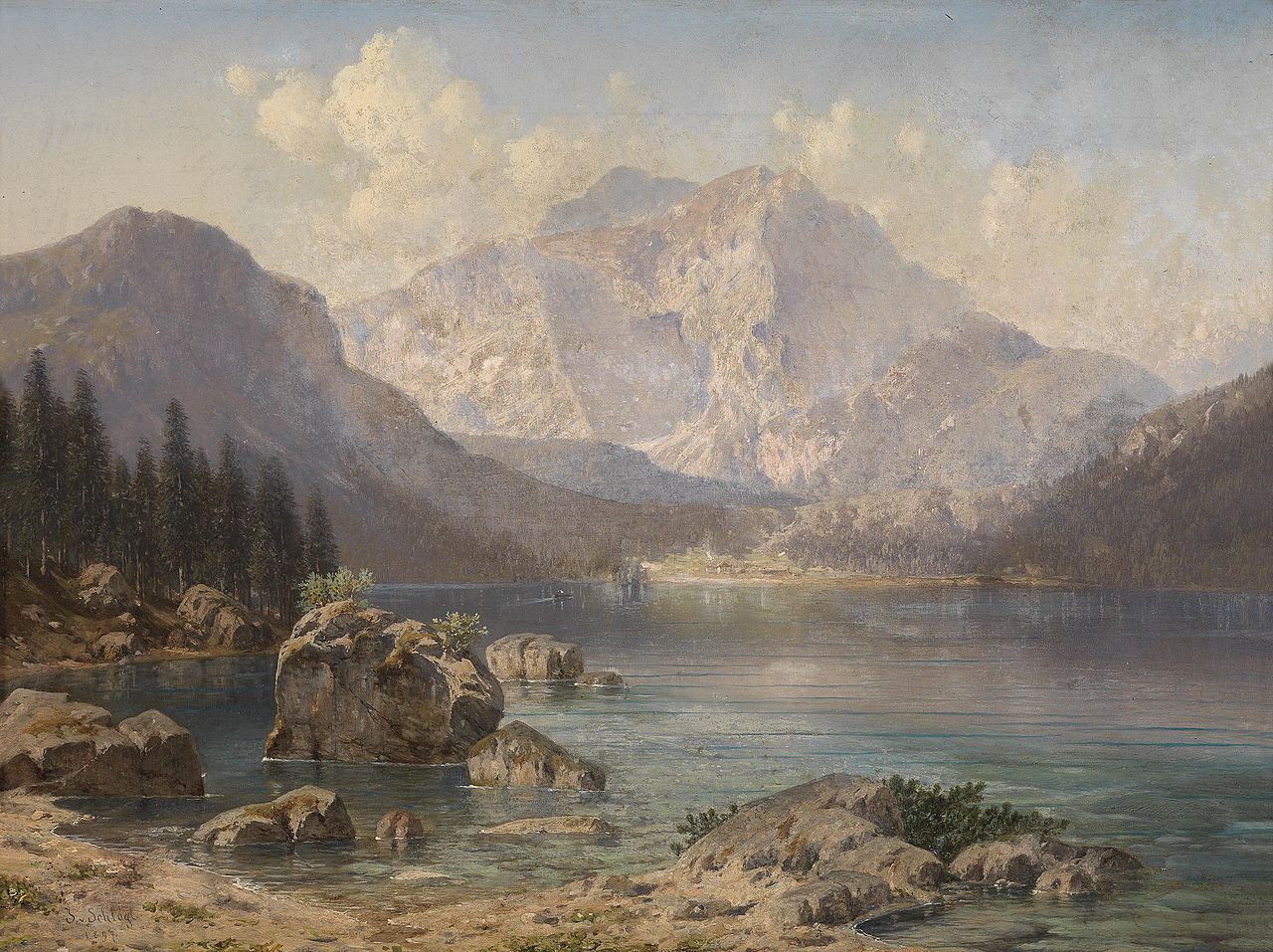
I have often written here about writers' huts but said nothing about composer's retreats, apart from one reference to a Tomas Tranströmer poem on Grieg in his work-cottage, 'shut in with silence.'  Gustav Mahler had three composing huts: in the Salzkammergut at Steinbach, further south at Maiernigg, and in Toblach (now Dobbiaco, in Italy).  They are all in spectacular settings and can form the basis of a tourist itinerary, although it is questionable how far we can still experience the landscapes Mahler knew.  Ten years ago, visiting the hut at Steinbach which Mahler had built in 1893 to avoid noise in the inn where he was staying that summer, Alex Ross suspected that his 'unquiet ghost is no doubt upset by the fact that his idyllic lakeside retreat is surrounded by an RV site and campground, where kids squeal all day long and German rap pumps from boomboxes.'  Nevertheless, 'if you look up to the colossal rockface of the Höllengebirge, which towers hundreds of feet above the lake, you can get a sense of why Mahler found this site so inspiring.'  Ross quotes 'Bruno Walter's memoir of Mahler: "As on our way to his house I looked up to the Höllengebirge, whose sheer cliffs made a grim background to the charming landscape, he said: 'You don't need to look — I have composed all this away!" The rockface became the introductory theme of the Third Symphony, the unison chant for eight horns, which he dubbed in one sketch "What the rocky mountain tells me."'


On that trip to Steinbach in 2005 Ross was accompanied by the critic Jeremy Eichler.  Earlier this month in the Boston Globe Eichler described a return trip.  (The article's picture caption refers to 'Gustav Mahler’s conducting hut' which leads me to imagine somewhere built because his family got fed up with him waving his baton around in their holiday inn).  Eichler writes that 'the walk had changed since my last visit. In Mahler’s time, meadows covered with wildflowers led down to the lake. Later, livestock were kept here. Eventually the site was converted into a campground. On this visit, the mobile homes I had recalled at the periphery seemed to have multiplied to the point that the area had the feeling of a full-fledged camping village.'  Apparently the hut itself had been attached to camp bathrooms until its restoration in the eighties, and prior to that it had been used as a slaughterhouse.  Leaving the hut, Eichler wonders whether more great works of art 'should have their own tiny huts, physical places you could visit that symbolize their very essence. Of course someone is always fixing their generator nearby, or wanting to turn the hut into a bathroom. But maybe the impulse to seek out these places nonetheless is not naively literal-minded so much as it is part of how we make the works our own, the way we locate their cosmic expressions on a more humble map of lived experience.'

Friday, October 17, 2014

Sweeney's Bothy

Sweeney's Bothy

One of Alec Finlay recent projects, Sweeney's Bothy, was built last year on the Isle of Eigg as part of The Bothy Project.  'The bothy belongs within a new contemporary movement – identified by Finlay as ‘hutopian’ – in which artists create huts and viewing platforms in the Scottish wilderness, proposing them as ecological, technological, architectural, and social models.'  Some interesting artists and writers have already stayed there, as you can see from the Bothy blog: Kathleen Jamie, Hannah Devereux, Oran Wishart.
'The bothy is based on Finlay’s design, inspired by the 7th Century Gaelic King Sweeney (Shuibhne). Cursed, Sweeney fled into a wilderness, surviving for a decade among the trees and birds, living on sorrel, berries, sloes and acorns, and enduring ‘the pain of his bed there on the top of a tall ivy-grown hawthorn in the glen, every twist that he would turn sending showers of hawy thorns into his flesh’ (Flann O’Brien, At Swim, Two Birds). Sweeney’s poetry from that period describes the austere beauty of the remote glen where he lived naked, communed with animals, and existed beyond convention. The myth of Sweeney conceals remnants of shamanic animism within pre-Christian culture. Like Han Shan, Basho, and Thoreau, Sweeney is a visionary hermit rejecting ‘feather beds and painted rooms,’ engaging with nature, the irrational, overturning accepted knowledge.'

View from Sweeney's Bothy with thorn bowl

Residents at Sweeney's Bothy can enjoy 'sorrel, berries, sloes and acorn' from bowls with a scratched thorn decoration, made by my wife.  The original poem Buile Shuibhne gives a vivid sense of the way Sweeney was able to live off the land.  I have written here before about the wonderful English version by Seamus Heaney, which was inspired by Kenneth Jackson's earlier translations.  Jackson's first book, Studies in Early Celtic Nature Poetry (1935), has recently been reprinted and it contains this marvellous description of natural foods in Irish poetry (the numbers refer to poems translated in the first part of the book).
'The variety of the plants and animals found in the countryside and eaten by the early Irish on the testimony of the poems is quite astonishing to a twentieth-century town-dweller, to whom "living on berries and nuts" seems such an improbable kind of existence.  No. V mentions apples, yew-berries, rowan-berries, sloes, whortleberries, crowberries, strawberries, haws, hazel-nuts, mast, acorns, pignuts, water-cress, herbs, wild marjoram, onions, leeks, eggs, honey, salmon, trout, water, milk and beer.  No. XVI speaks of deer, swine, mast, hazel-nuts, blaeberries, blackberries, sloes, trout.  No. XV has cress, brooklime, mast, trout, fish, wild swine, stags, fawns.  In no. XIX are blaeberries, blackberries, apples, sloes, strawberries, acorns, nuts, pig fat, porpoise steak, birds, venison, badger fat, fawns, salmon, fish.  No. XVII mentions blackberries, haws, hazel-nuts, bramble shoots, "smooth shoots", garlic, cress, meadhbhán, dilisk, birds, martens, woodcocks, otters, salmon, eels, fish.  Suibhne Geilt gives his "nightly sustenance" as blaeberries, apples, berries, blackberries, raspberries, haws, cress, watercress, brooklime, saxifrage, seaweed, herbs, sorrel, wood-sorrel, garlic, wild onions and acorns ... The diet is then one of flesh of animals and birds, fruit, berries, nuts, herbs, shoots, and waterplants, eggs, honey and fish, an impressive and intriguing menu.'


Earlier this year the Corbel Stone Press published Alec's Sweeney on Eigg which 'leaps off' from Seamus Heaney's version of  Buile Shuibhne.  It imagines the outcast Suibhne wandering as far as the island of Eigg.  Fleeing over crags and burns, sheltering among sheep, passing over moss and moorgrass, through birch and tares, blackthorn and brambles, he comes at last to a stop. 
I will sing
with peewits, cuckoos, & throstles
making the moor ring
from Druim na Croise.

I will hide Rum
with my hand
and stroke the fine down
on my arms.

Then, when the sunsets
drive me mad
with their beauty,
Suibhne will be gone.

Friday, February 07, 2014

Sea of Ink

Bada Shanren, Fish and rocks, 1696

In Meer der Tusche (2005), Swiss writer Richard Weihe tells in 51 short chapters the life story of the great seventeenth century Chinese painter Bada Shanren.  Sea of Ink, an English translation by James Bulloch, is available from Peirene Press, a recently established 'boutique publishing house' that runs literary salons in north London.  In the Peirene Experience clip below you can see Weihe talking about one particular incident in the childhood of Zhu Da (Bada Shanren, 'man on the mountain of the eight compass points', was one of the many names he assumed in later life).  Zhu's father, also an artist, 'made him step barefoot into a bowl full of ink and then walk along the length of a roll of paper.  To begin with, Zhu's footprints were wet and black; with each step they became lighter until they were barely visible any more.'  This reminded me of the Bada Shanren scroll I mentioned here last year, and naturally too of Richard Long.  Next to Zhu's footprints his father wrote these words: 'A small segment of the long path of my son Zhu Da.  And further down: A path comes into existence by being walked on.'


Sea of Ink is punctuated with vivid descriptions of the artist creating his work, the paintings emerging as a short sequence of inspired brushstrokes.  We read about the composition of Fish and Rocks (above) for example, whilst Bada Shanren is living alone on the shore of a lake.  It is a work that the Met website describes as 'profoundly unsettling. Were it not for seven tiny fish that swim beneath the two rock forms, transforming the blank paper into a body of water, the image would be unrecognisable. Six of the fish are shown in profile, but the seventh appears as if seen from above, leaving the viewer disoriented; the absence of a horizon line adds to the unsettling effect.'  In Sea of Ink, Bada hangs this finished work from his ceiling beams and watches as a gust of wind catches it, so that the fish seem to be floating in the air.

A few years later Bada was returning in the rain to his fisherman's hut when he senses his life fading away.  Wiehle imagines him looking at the view that will become Landscape with hut (1699): 'Was it the trees dripping in the mist which made the world appear like that, or was it the tears in his eyes?  No sooner was he back in his abode than he took a large piece of paper and wiped it with the wet sleeve of his robe.  He hurriedly poured water into the rubbing stone and prepared the ink...'  First, he described his hut in seven vertical and diagonal strokes.  Then he took a new brush with cropped bristles and transformed the damp paper into a landscape of half seen hills.  The small solitary house had the appearance of having turned its back to the world.  'Fine streams of ink ran down the mountain; indeed the entire mountain seemed to flow away as if it were nothing more than a large wound of the world.'

Friday, October 05, 2012

A Shaded Path

Next month Tate Britain will feature a new display of its works by Ian Hamilton Finlay.  Meanwhile in Edinburgh there are still a few more weeks of 'Ian Hamilton Finlay: Twilight Remembers' at the Ingleby Gallery.  It is worth finding your way there (through the confusion of construction work in and around Edinburgh Waverley) if only to see Carrier Strike!, a short film in which a sea battle a fleet of irons and an ironing board aircraft carrier.  Climb the stairs and you encounter a line of bricks called A Shaded Path, each one stamped with the word 'Virgil' - a pastoral version of Carl Andre's Equivalent VIII. The room contains examples of Finlay's garden sculptures: Three Inscribed Stones bearing the names of Japanese war planes, a stile inspired by De Stijl, a pairs of benches Glade / Grove and a 'milestone' which says simply 'MAN / A PASSERBY'.  Downstairs there is a whole wall devoted to prints and postcards of Finlay's concrete and experimental poetry.  These poems can also be read, along with early verse and prose, later texts and 'detatched sentences', in Ian Hamilton Finlay: Selections, a new anthology edited by Alec Finlay.  I thought I would include here a few extracts from the Introduction that give a sense of Ian Hamilton Finlay's engagement with landscape over the years.


late 1940s: Finlay left Glasgow with his first wife for the Highlands, where they lived in a whitewashed cottage resembling his later home at Stonypath.  'Druim-na-Cille was "an extraordinary landscape of pines and mountains which I still owe many poems to," and "bittersweet, like a mixture of Heine and Trakl."  ... In these glens he had a dream of 'young men engaged in learned discourse', a vision that would eventually become the garden where the thought of Hegel, Schelling and Heidegger was actualised in herm, stile and wood-path.  ... The more one reflects on his biography the more clear it is that each new landscape of home became, in time, a created landscape, shaped by the memory of a lost idyll.'

mid 1950s: 'In a rite familiar to Scottish writers, Finlay found refuge on an island, Rousay, one of Orkney's smaller islands.  ... For all its wildness, Rousay has a platonic perfection, its constituent parts - loch, mill and farms; the single road, upon which he worked as a labourer; the rugged coast - were, "being on an island ... like a concrete poem, very particular, very realised."'

late 1960s: After some years in Edinburgh Finlay wrote to George Mackay Brown that he had found a new home with his partner Sue: "STONYPATH ('Of life' being understood in brackets, no doubt).  I am looking forward to the wildness very much." 'The area around the house was wild, except for an overgrown walled garden at the front, with lilac trees, currant bushes and an old ash - this last Finlay celebrated with a stone plaque 'MARE NOSTRUM' ('Our Sea'), after the Roman Mediterranean: "except on very calm days [...] the ash fills the garden with its sea-sound.  When people ask why so many poems refer to the sea, or comment that it is odd to find so many sea-references so far from the sea itself, I often point to the Ash Tree and say, That is our sea."'

1970s: The garden at Stonypath took shape. 'Year by year the composed landscape distinguished itself from the wild hillside and the broad waste of the moor.  Finlay extolled the 'slow excitement' of his new art.  His imaginative fancy conjured Stonypath as a belated episode in the English landscape garden tradition - those "quite extraordinary PURE SYMPHONIC creations', in which nature is poeticized, abstracted: pond as Pool, grass as Lawn, sundial gnomon dividing shadow into measure and order.'

1980s: By 1982 Finlay had renamed his garden 'Little Sparta' and transformed his gallery into a Garden Temple dedicated 'To Apollo: His Music, His Missiles, His Muses.' 'For Finlay, poetics now became secondary to the lightning flash of incitement, which found its apotheosis in Robespiere's protégé Saint-Just, a Spartan Rimbaud or Young Apollo, identified by his flute and blade. ... Balancing the insurrectionary mood are the poet's sober meditations, as the era of rebellion gradually gives way to an era of contemplation, and the garden itself matures to enclose the still shadows of a cypress grove.'

late 1990s: 'There unfolded a last long autumnal decade whose emblems were the wild flower and the fishing-boat, and whose ideal literary form was the proverb.  Sometimes Finlay expressed puzzlement that he had lost the energy for battles.  In truth his imagination had returned to the pastoral, in poems which recalled the early days at Stonypath, celebrating the moor, with its larks and bog-cotton, and the wild roses that grew by the burn.'

Friday, July 06, 2012

No trace of Cold Mountain


Cold Mountain, Red Pine, Copper Canyon.  The Copper Canyon Press publish a beautiful edition of  the complete poems of Cold Mountain (Han-shan) by Bill Porter, who translates Chinese literature under the name Red Pine. Nobody knows Han-shan's real name, but it is said that he called himself after the location of the cave which he made his home.  In his introduction Red Pine describes visiting this cave, 'located in Chekiang province at the base of Hanyen, or Cold Cliff, a two-day walk from the East China Sea ... Even now, Cold Mountain's old home attracts few visitors.  In May of 1989 and again in October 1991, Layman Fang of Kuoching Temple arranged for a motorized rickshaw to take me and two friends there.'  The road was poor and when they got there they found a roofless hut inside the cave, owned by an old farmer.  After sharing with them his lunch of noodles and red pepper paste, the farmer guided them around the area.  'In the centuries that followed Cold Mountain's disappearance, Buddhists built a monastery just beyond the base of the cliff.  It had since been replaced by terraced field of corns and peanuts but our host told us he still dug up the occasional temple tile.'

Red Pine's search reminded me of Gilbert Highet, seeking traces of Poets in a Landscape (1957): guided by the descriptions in Virgil, Pliny and Sextus Propertius, for example, he finds the Springs of Clitumnus still a source of 'cool copious fresh water, absolutely clean, rising out of dry earth under a hot sun' but is drawn back to the present when he notices 'in one of the fountain-beds, half a dozen Coca-Cola bottles set to cool for possible sale to tourists.'  Robert Macfarlane has just written an article about artistic pilgrimage, including his own attempt to follow W. G. Sebald (seemingly not yet abandoned when I did a post called The Printed Path in 2007).  In his new book The Old Ways, the guiding spirit is Edward Thomas, but he also travels in the footsteps of Eric Ravilious and Nan Shepherd.  Macfarlane's experience of the pine forests of the Siete Picos (described in my last post) reminded me of Richard Holmes on the trail of Robert Louis Stevenson in Footsteps (1985): 'I slept out that night under an outcrop of pines, facing east on a slight incline, with the light of the Costaros far way to my left. The turf was springy, and the pine needles seemed to discourage insects. As I lay in my bag, a number of late rooks came winging out of the gloaming, and settled in the pine branches, chuckling to each other. They gave me a sense of companionship, even security: nothing could move up through the trees below me without disturbing them. Once or twice I croaked up at them (it was the wine) and they croaked back: 'Tais-toi, tais-toi.' This night I fell asleep quickly. Only once, waking, I drank two ice-cold mouthfuls of water from my can and, leaning back, saw the Milky Way astonishingly bright through the pine tops, and felt something indescribable - like falling upwards into someone's arms.'

I seem to have become side-tracked...  'People ask the way to Cold Mountain,' Han-shan wrote, 'but roads don't reach Cold Mountain / in summer the ice doesn't melt / and the morning fog is too dense...'  In a footnote to this poem, Red Pine observes that a road does reach Cold Mountain, even though it is only wide enough for one cart and its condition is very variable, depending on the rain.  Furthermore, although the fog can drift inland from the nearby ocean in spring, 'ice and snow appear only briefly during the winter.  But then, this poem is about a different mountain.'  Han-shan's mountain poems are no more topographically specific than Petrarch's spiritual narrative, The Ascent of Mount Ventoux.   Petrarch descends after reading this passage in St. Augustine: 'And men go about admiring the high mountains and the mighty waves of the sea and the wide sweep of rivers and the sound of the ocean and the movement of the stars, but they themselves they abandon.'  Han-shan took the opposite path, abandoning himself to the landscape and remaining in the Tientai Mountains writing poems until one day, it is said, he disappeared into the rocks themselves, squeezing into a crevice which then closed around him.  Red Pine is shown this spot by the old farmer.  'Several vines led down from the spot, and we pulled ourselves up to a fine view of the hills to the south but no trace of Cold Mountain.'

Friday, September 10, 2010

The Woods of Raasay

Alec Finlay and Ken Cockburn have now reached Raasay on the Road North.  Their most recent post pays tribute to Sorley MacLean (Somhairle MacGill-Eain), the great poet of Raasay, and his poem 'Hallaig'.  They include a map, a Borgesian signpost and three hokku labels pinned to trees - 'she is birch', 'she is rowan', 'she is hazel'.  These  refer to the lines 'tha i 'na beithe, 'na calltuinn, / 'na caorunn dhìreach sheang ùir'.  Maclean translated these lines into English as 'she is a birch, a hazel, / a straight slender young rowan' and Seamus Heaney's version has 'A flickering birch, a hazel, / A trim, straight sapling rowan'.

In a 2002 lecture Heaney wrote about how impressed he had been by 'Hallaig', a poem that arose 'out of MacLean's sense of belonging to a culture that is doomed but that he will never deny. It's as local as anything in Thomas Hardy and as lambent as Rilke's Sonnets to Orpheus'. 'Hallaig' is a landscape emptied by the Highland clearances.  The poem is 'set at twilight, in the Celtic twilight, in effect, at that time of day when the land of the living and the land of the dead become pervious to each other, when the deserted present becomes populous with past lives, when the modern conifers make way for the native birch and rowan, and when the birch and rowan in their turn metamorphose into a procession of girls walking together out of the 19th-century hills. The poem tells us that in Hallaig there is something to protect, and goes on to show that it is indeed being protected, which is the reason for the uncanny joy a reader feels at the end.'


'Hallaig' is this month's featured poem on the Sorley MacLean Trust website.  They quote John MacInnes, who says that in 'Hallaig' 'both the Gaelic sense of landscape, idealised in terms of society, and the Romantic sense of communion with Nature, merge in a single vision, a unified sensibility.’  The same could be said of another Sorley MacLean poem, 'Coilltean Ratharsair' ('The Woods of Raasay'), which begins like a Gaelic version of The Prelude  (as Terry Gifford says in Green Voices: Understanding Contemporary Nature Poetry).  In its early verses the poem recalls the woods in motion, in blossom, in sunlight and shade, many-coloured, many-winded, serene and humming with song.  But the imagery becomes darker ('O the wood! / How much there is in her dark depths!') and there is a growing recognition that idealised woods are as unattainable as perfect love.  'What is the meaning of worshipping Nature / because the wood is part of it?'  In the end, wood itself is simple - 'the way of sap is known' - but 'there is no knowledge of the course of the crooked veering of the heart' or 'of the final end of each pursuit.'

Sunday, August 01, 2010

Lu Mountain's true face

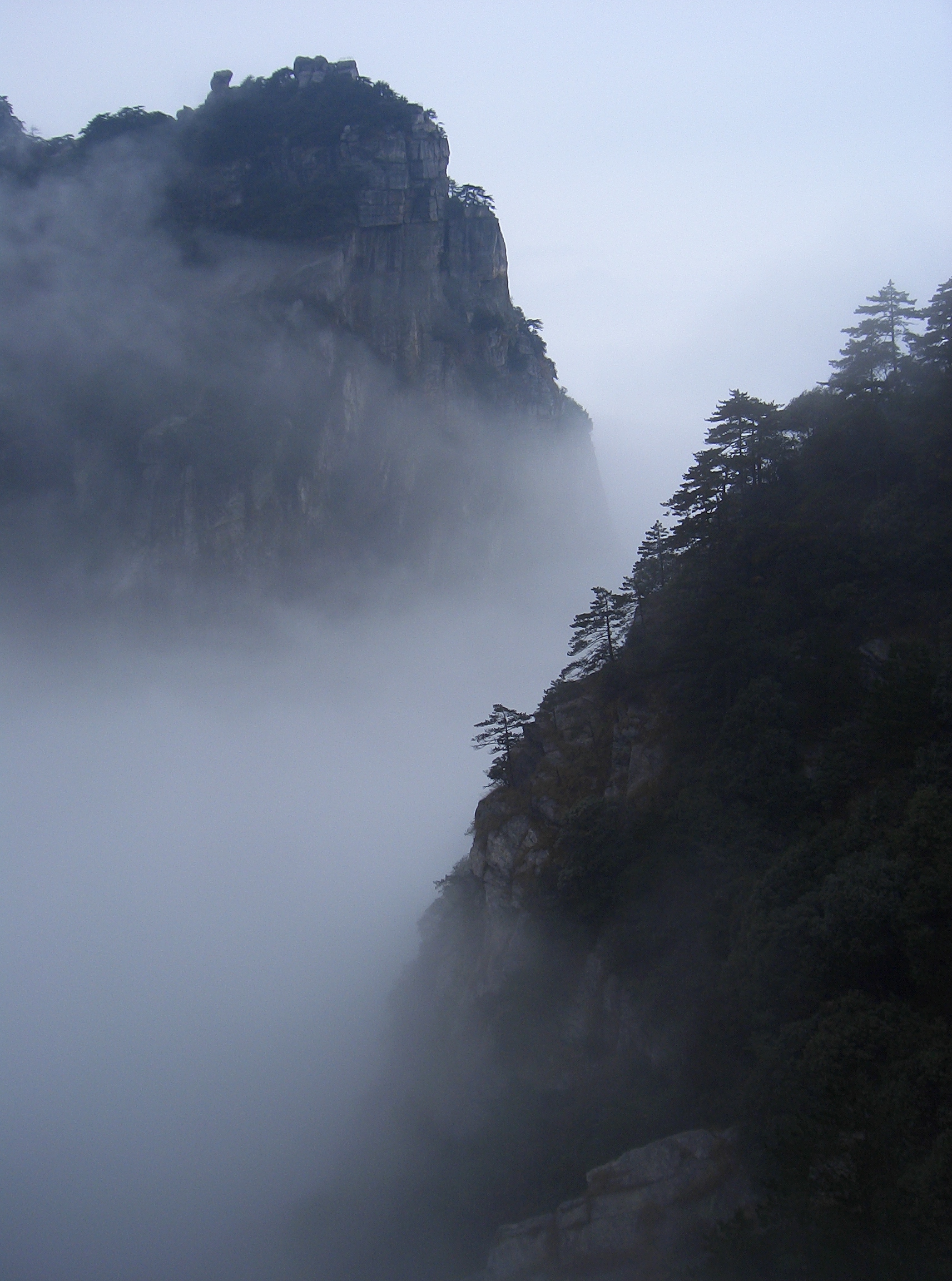
Mount Lu

Lu Mountain (Lu-shan or Hermitage Mountain), at the juncture of the Long River and Lake P'o-yang in China, must be a contender for the most inspirational landscape in literature.  It became established as an important religious centre with the arrival of Hui-yung (332-414), for whom the West-Forest Monastery was rebuilt in 377, and Hui Yüan (334-416) who taught Pure Land Buddhism at the East-Forest Monastery.  The poet T'ao Yüan-ming (365-427), founder of the fields-and-gardens tradition (see my earlier post here) knew Hui Yüan and lived on a farm near the mountain.  Hsieh Ling-yün (385-433), whose mountains-and-rivers poetry I discussed here earlier, was influenced by the teachings of Hui Yüan and wrote about Lu-shan, with its 'jumbled canyons', 'thronging peaks' and 'dragon pools.'

Three hundred years later the T’ang Dynasty poet Meng Hao-jan (689-740) had his own mountain home further west in Hsiang-yang and made Deer-Gate Mountain there famous through his poetry.  But on one of the many journeys he made as an official he wrote about Incense Burner Peak, the most spectacular in the Lu Mountain range, and the distant sound of the bell from East-Forest monastery.  Li Po (701-62) stayed at the monastery and wrote of the silence and emptiness that could be found there away from the city. Climbing towards Incense-Burner Peak, he gazed at the waterfall, three thousand feet high, and wrote a celebrated poem which I have discussed here previously.

Po Chü-i (772-848) composed poems about the mountain and a famous prose account of the thatch hut he built in 817 facing Incense-Burner’s north slope. From this place he could experience 'the blossoms of Brocade Valley' in spring, 'in summer the clouds of Stone Gate Ravine, in autumn the moon over Tiger Creek, in winter the snows on Incense Burner Peak' (trans. Burton Watson). I particularly like his description of the way water was channeled around the hut, with a small waterfall that in twilight and dawn had 'the color of white silk' and at night made 'a sound like jade pendants or a lute or harp'  A bamboo trough led water from a spring in the cliff, across the hall into channels that fell from the eaves to wet the paving, giving 'a steady stream of strung pearls, a gentle mist like rain or dew, dripping down and soaking things or blowing far off in the wind.'

By the Sung Dynasty, the mountain was almost overburdened with poetic tradition.  In An Anthology of Chinese Literature Stephen Owen writes that Su Tung p’o (Su Shi, 1037-1101) resolved to visit the mountain as 'an "innocent traveler", wanting to experience the mountains without writing poems (as a modern tourist might resolve to travel without taking photographs).'  But he was unable to restrain himself and ended up composing several, writing his own reputation into the landscape with perhaps the best known of all the mountain's poems, a quatrain 'Inscribed on the Wall of West Forest Monastery', stating the impossibility of ever knowing Lu Mountain's true face.

Friday, July 23, 2010

The Road North

When Basho and Sora set off in 1689 on the Narrow Road to the Deep North, they were traveling into the past, to re-visit landscapes with long held poetic associations.  As Haruo Shirane says in Traces of Dreams: Landscape, Cultural Memory and the Poetry of Basho, these places (utamakura) had traditionally served as 'cultural nodes in the poetic tradition', where travelers could hope to compose poems that would match the famous examples of their predecessors.  Shirakawa Barrier for example, features in a tenth century poem by Taira Kanemori and is then treated by Priest Noin in 1025, by Minamoto Yorimosa in 1170, and by later poets like Saigyo and Sogi (whose account of his journey to the Shirakawa Barrier in 1468 is a precursor of The Narrow Road to the Deep North).  Interestingly Basho seems to have been more easily inspired to compose haikai where an utamakura disappoints his expectations - at Shinobu Mottling Rock, for example, where he and Sora find the renowned rock lying face down, half buried in the grass.  And as he made his way north Basho established new haimakura, haikai places that do not appear in the work of earlier poets like Saigyo and Sogi.  As Basho's follower Kyoriku wrote, "travel is the flower of haikai. Haikai is the spirit of the traveler.  Everything that Saigyo and Sogi have overlooked is haikai.'

A new sequence of hamaikura is now being established in Scotland by artist-poets Alec Finlay and Ken Cockburn, who are making their own journey inspired by Basho and Sora.  As their blog The Road North explains, they are creating a word-map 'as they travel through their homeland, guided by the Japanese poet Basho, whose Oku-no-Hosomichi (Narrow Road to the Deep North) is one of the masterpieces of travel literature. Ken and Alec left Edo (Edinburgh) on May 16, 2010 – the very same date that Basho and his companion Sora departed in 1689 – and when they return, on May 16, 2011, they will publish 53 collaborative audio and visual poems describing the landscapes they have seen and people they have met.'  So far they have reached seven of the stations on Basho's journey - Scotland's equivalent of the rock at Shinobu and Shirakawa Barrier lie ahead (see map).  Nor have they yet got to a version of Nikko where, as I mentioned in an earlier post, I once made my own literary pilgrimage to see a station on Basho's journey north.  A few days ago they were at their Cascade of Silver Threads (Shiraito-no-taki) - the Falls of Bruar - and there, like Japanese poets, they were conscious of their own poetic predecessors, in this case Robert Burns, who wrote about the Falls in 1787:

Here, foaming down the skelvy rocks,
In twisting strength I rin;
There, high my boiling torrent smokes,
Wild-roaring o'er a linn:
Enjoying each large spring and well,
As Nature gave them me,
I am, altho' I say't mysel',
Worth gaun a mile to see.

from 'The Humble Petition of Bruar Water'

Wednesday, June 30, 2010

The Wanderer's Night Song

There is a great tradition of poets contemplating the landscape from mountain huts.  I've talked here before about Gary Snyder 'looking down for miles / through high still air' from his hut on Sourdough Mountain.  One of the most famous Japanese examples is Kamo-no-Chomei who in the early thirteenth century built his own modest hut (like Thoreau) above a valley thick with trees, with a view of the Western heavens.  Earlier still, in China, there was Hsieh Ling-yün's retreat on Stone-Gate Mountain (although most of the time he lived 'in a comfortable mountain-side house, which included an enormous library and vast landscape gardens').  But it is not necessary to live in a mountain hut - a fleeting visit can suffice for a poet to make a permanent imprint on the landscape:

                          Über allen Gipfeln
                          Ist Ruh,
                          In allen Wipfeln
                          Spürest du
                          Kaum einen Hauch;
                          Die Vögelein schweigen im Walde.
                          Warte nur, balde
                          Ruhest du auch.

In September 1780 Goethe wrote these lines on the wall of a mountain hut in Ilmenau. 'The Wanderer's Night Song I' is now one of the best known German poems and has been set to music many times, by composers such as Schubert, Liszt, Schumann and Ives.  Here is a recent version by Peter Viereck which can be found at the Poetry Library site.  Viereck says that 'along with Pushkin’s ‘On the Hills of Georgia’, this is the simplest great poem in history.'

                     To every hill crest
                     Comes rest.
                     In every tree crest
                     the forest
                     scarcely draws breath.
                     Each bird-nest is hushed on the heath.
                     Wait a bit; soon you
                     will find rest too.


Goethe revisits the mountain hut
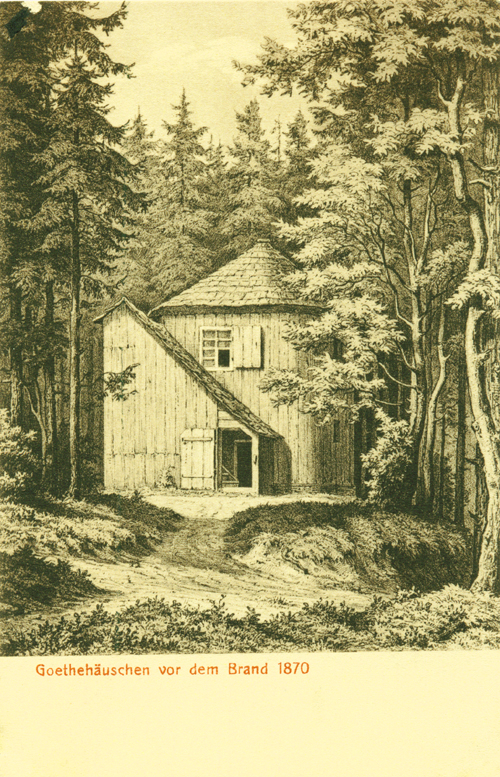
Goethe didn't return to Ilmenau until August 1831, seven months before his death, but was then moved to tears to see his poem still there.  During the nineteenth century, the hut became a place of literary pilgrimage - you can see a collection of old postcards like the one shown above at the Goethezeitportal.  According to David Luke (who has translated the poem for Penguin Classics) 'in the nineteenth century a forester is said to have discovered a literary English tourist attempting to saw the poem out of the wooden wall, and this led to a photographic record being made.  The hut was burnt down in 1870, and later exactly restored; Goethe's lines are there again, engraved on a brass plate.'

 The restored hut today
Source: Wikimedia Commons

You can see a recent interior image of the hut in a post on Goethe's poem at the Poemas del rio Wang blog.  As mentioned there, Goethe drew inspiration for 'The Wanderer's Night Song' from a fragment by the Spartan poet Alcman, which had been published in 1773.  Alcman does not address the listener, unlike Goethe's Wanderer; he simply describes all of nature asleep - the mountains, the ocean, the birds and beasts.  Nor, in what we have of Alcman's verse, does he contrast the hushed landscape with the busy activities of people, a poetic theme which (as C. M. Bowra points out) begins with Euripides' Iphigenia at Aulis:

  Agamemnon: The birds are still at any rate and the sea is calm; hushed are the winds, and silence broods o’er this narrow firth.

  Attendant: Then why art thou outside thy tent, why so restless, my lord Agamemnon?

The restlessness of men like Agamemnon was gladly left behind, far below, by Goethe and the other poets seeking rest and tranquility in a simple hut high up in the mountains.

Saturday, February 13, 2010

A lake beneath the weightless morning sky

'Why do we wish to see a charming landscape reproduced in a picture?  Is it just for the sake of pleasure?  No, we are hoping this image will explain something - but this is a something that will surely always remain inexplicable.'  - Robert Walser, The Tanners, 1907 (Der Geschwistern Tanner, trans. Susan Bernofsky)

I think I first heard about Robert Walser through an interview in March 1992's Sight & Sound with the Brothers Quay, who went on to film Walser's novel Jakob von Gunten.  About the same time I bought The Walk and other Stories, with its introduction by Susan Sontag, in Camden's much-missed Compendium Bookshop.  After enjoying the Quay Brothers' film Institute Benjamenta (1995) at the ICA (which may soon be going the way of Compendium), I taped it when it came on TV and remember showing it to one or two people, none of whom seemed as impressed as I was.  I thought that both Walser and the Quays would remain a minority taste, but now we seem to be in the midst of what one review calls a miniature Walser renaissance.  New translations are appearing and I have just finished reading Susan Bernofsky's translation of The Tanners (you can read an excerpt at The Brooklyn Rail).  I'm once again going round trying to tell people how great Walser is - it would be a marvellous book anyway but it also happens to have a cool cover design and Sebald essay for an introduction.


Google The Tanners and you'll find plenty of reviews, so I won't say much here about the novel itself.  My excuse for mentioning it at all is Kaspar Tanner, a landscape painter, brother of the book's main character Simon.  The quote above comes from a passage where Simon is looking at his brother's pictures.  He goes on to say: "It cuts so deeply into us when we, lying at a window, dreamily watch the setting sun; but that's nothing at all compared to a street when it's raining and the women are daintily raising their skirts, or to the sight of a garden or lake beneath the weightless morning sky or to a simple fir tree in winter or to a boat ride at night, or a view of the Alps."  These images made me think of haiku, and a few sentences further on Simon refers to his sister's friend, a poet thus: "people are saying he's built himself a hut up in the high pastures so he can worship nature undisturbed, like a Japanese hermit."  Sadly we don't get to see this hut (if indeed it exists) in the novel.

Susan Sontag wrote that Walser's stories and sketches reminded her of 'the free, first person forms that abound in classical Japanese literature.'  The story that most impressed me in that first Walser anthology I read was 'Kleist in Thun' (1913), about the great German writer who took his own life in 1811.  In it, Walser (to quote W. G. Sebald) 'talks of the torment of someone despairing of himself and his craft, and of the intoxicating beauty of the surrounding landscape.'  'Time and again I have immersed myself in the few pages of this story' wrote Sebald, in the essay 'Le Promineur Solitaire: A Remembrance of Robert Walser' which appears as the introduction to The Tanners.  He quotes Walser's description of the lake and the Alps dipping 'with fabulous gesture their foreheads into the water.'  At another point in the story Walser pictures Kleist on a skiff, looking out at the clear morning lake.  'The mountains are the artifice of a clever scene painter, or look like it; it is as if the whole region were an album, the mountains drawn on a blank page by an adroit dilettante for the lady who owns the album...'  (trans. Christopher Middleton).


Thun c. 1900 (source: Wikimedia Commons)

I visited Thun once as a child (see photograph below), on a family holiday to Switzerland, and I still have the travel diary I kept.  "Today it was even wetter than yesterday, really pouring.  So we went to Thun by train.  At Thun Mum and Dad bought a cow bell and we went in a castle/museum - boring."  Oh dear.  In the afternoon, from Thun, we took a boat trip to Spiez - "it was freezing...  The scenery spoilt by the weather."  Walser closes the story with his own recollection of Thun, "the region is considerably more beautiful than I have been able to describe here, the lake is twice as blue, the sky three times as beautiful".  He says that Thun is visited every year by thousands of foreigners who can read if they wish the words carved onto a marble plaque commemorating Heinrich von Kleist.  I don't think we went to look at this (if it still exists).  The long last paragraph of Walser's story begins in Kleist's mind - music and radiant shafts of light flickering about his senses - and ends Walser's comments on Thun. Susan Sontag thought it 'an account of mental ruin as grand as anything I know in literature.'

Saturday, January 24, 2009

Scenery and a Music Box

'I am prepared to meet my death / In this excessively lucid landscape' wrote Kenji Miyazawa in his poem 'Scenery and a Music Box.' In the notes to his translation of this poem, Roger Pulvers suggests that it beautifully illustrates Kenji's vision. Dated 16 September 1923, the poem describes a walk along the Toyosawa River to cut down trees in the early evening. Kenji ends up imploring the hill to be still, expecting nature to take from him something in return for the trees he has felled.

The poem has landscape motifs that Kenji used repeatedly: the river, the wind, clouds, stars. There is the figure of a farmer fused with the landscape set alongside signs of modernity like the electric wires which whistle in the wind and become a 'music box'. As this wind dies down into a gentle breeze, Kenji sees it as a symbol of eternity (he uses the Buddhist term kalpa). The focus of the poem sometimes zooms in on luminous detail, like the raindrops on the bridge, and includes striking images drawn from science and geology, like the clouds that are 'crystal-rimmed' and then 'chalcedonic'.

Kenji's 'active engagement with nature, and his seeing himself as its faithful chronicler and recorder, was sufficient to set him apart from virtually all other Japanese poets, who tended to use nature as a springboard for their own musings and lamentations.' Roger Pulvers talks about the way Japan's industrialisation overwrote its traditional love of nature. In a passage that reminds me of remarks by Alex Kerr I discussed in an earlier posting here, he says 'most of Kenji's contemporaries would have believed - as Japanese still tend to believe today - that the Japanese love nature virtually more than do the people of any other nation. This belief is held despite the fact that preservation of nature is a very low priority for those people in Japan who hold the future of the country in their hands. Nature itself has become nothing more than a figment of nostalgia to most Japanese people.' In 'Scenery and a Music Box' the poet observes that the bridge over the river provides a view 'seething with nostalgia'. Kenji wanted nature cherished, but he also wanted to promote the science of modern agriculture and reduce rural poverty. Kenji's ideal life is described in his last and best known poem, 'Strong in the Rain': a strong man, free from desire, living in 'a little thatched-roof hut / In a field in the shadows of a pine tree grove.'

It may just be coincidence, because I've been reading both writers recently, but Miyazawa seems to me to share much in common with Henry David Thoreau. They both rejected convention (and their own fathers' lives) in favour of a life lived according to their own beliefs. They shared a poetic vision of nature alongside a practical interest in the process of farming. Miyazawa's desire to live 'Strong in the Rain' reminds me of the kind of life aspired to by Thoreau at Walden Pond. Neither of them married and their asceticism was seen by others as extreme. Neither was as physically robust as they would like to have been: Thoreau died of tuberculosis at the age of 44, Miyazawa of pneumonia at the age of 37 - his last request was for a thousand copies of the Lotus Sutra to be printed and distributed among his friends and acquaintances.