Showing posts with label Quay Brothers. Show all posts

Saturday, April 05, 2025

Dormitorium

Yesterday I went to see Dormitorium | The Film Décors Of The Quay Brothers at the Swedenborg House - wonderful stuff. John Coulthart has written about it and included photographs on his site (he also has previous articles on the Quay Brothers). I took these shots of a mysterious landscape used in their film The Comb (1990). On the BFI site Michael Brooke called this 'one of the most inexplicably compelling of all the Quays' creations.'  

The most deliberately dreamlike of the Quay Brothers' films, The Comb is bookended by (and intercut with) a black-and-white live-action sequence of a woman asleep in bed, the implication being that these disconcerting, dislocating impressions of fairytale landscapes populated by decrepit puppets and an endless series of ladders (shot in colour) are taking place in the darker recesses of her mind. However, this is the only aspect of the film that's in any way easy to grasp, the rest setting out to wrong-foot the viewer at every turn, and the result wilfully defies verbal analysis. ...  Distortions visible in the background décor imply the existence of hidden images. At times it appears to be a discarded theatrical set, an impression given further credence by a camera pull-back to reveal what appear to be stage flats and a proscenium arch - though it could just as easily be a forest. 


In the film you never see the 'landscape' as it is presented in this case, so that undulating shape is rather surprising. The grain of wood is transformed into pools, shadows and bands of cloud. The painted trees here look like details in old German topographical prints or copper plate paintings, or Hercules Segers' 'mysterious landscapes'. I have mentioned on this blog before the Quay Brothers' cover design for Cosmicomics which appears to be a grisaille version of The Comb's wooden sculpture (see below). The literary source for The Comb is a fragment by Robert Walser, but I'm not aware of a precise text that might provide a literary equivalent for this landscape. Writing in Sight & Sound (1992), Jonathan Romney said 'the film is set to his work, rather than derived from it—so much so that the extracts from his texts, balefully whispered and muttered in several languages simply become part of the soundtrack, along with various drips, owl hoots, and strident orchestrations of string and wood by the Brothers' regular collaborator Leszek Jankowski.'

Monday, February 11, 2013

Anamorphic landscape in the form of Saint Francis of Paola

Emmanuel Maignan, Saint Francis of Paola (detail), 1642

I have talked here before about landscapes that are transformed into bodies, and vice versa.  Another example can be found at the top of the Spanish Steps in Rome, in a corridor of an old convent building, part of the Trinità dei Monti.  There on the wall is a fresco, painted in 1642, showing a landscape with figures, buildings and small boats.  But there is something slightly uncanny about the dark shadows of the hills and certain incoherent shapes encroaching into the view.  As you walk away, towards the form of a large tree framing the view, and then look back, the landscape is no longer readily apparent: it has been replaced by the bearded figure of Saint Francis of Paola, founder of the Order of the Minims to which the convent belongs.  The painting is explored in Anamorphosis, or De Artificiali Perspectiva, a 1991 film by the Brothers Quay.  'Anamorphosis thrives on mystery, and its masters rarely give away their secrets', the narrator says.  But the film includes an animated demonstration using thread and paper figures: 'a peep at the apparatus which Emmanuel Maignan supposedly used to construct his anamorphic fresco of Saint Francis.'

Emmanuel Maignan, Saint Francis of Paola, 1642

The Brothers Quay, Anamorphosis, or De Artificiali Perspectiva, 1991

Friday, March 04, 2011

Without Colours

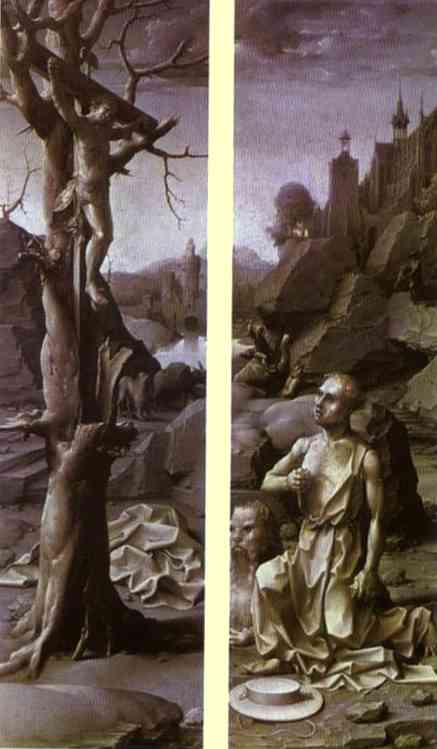
The exterior panels of Northern Renaissance altarpieces were sometimes painted in what my computer would call 'grayscale' but what art historians refer to as 'grisaille' (a term invented in the seventeenth century to describe stained glass in different shades of grey).  As Susie Nash points out in her book Northern Renaissance Art, these grey panels would also have provided a 'suitably less materially-rich image for Lent and ordinary feast days, and a more durable protective covering, easier to repaint and with no colours to fade.'  Typically these would show Biblical figures as if they were statues and would contrast dramatically when opened with the 'real' figures painted inside.  No wooden altarpiece could have supported the weight of actual stone sculpture and so painting 'made possible the impossible, and painters developed and complicated the idea further by representing sculpture that would have been near-impossible to carve, or in which there is ambiguity about whether what is represented is a sculpted or living form.'  Once artists had developed this practice of painting disconcertingly life-like stone figures, it was not too great a step to replace their sculptural niche with a natural setting - a grisaille landscape.

Jan Gossaert, Saint Jerome Penitent, ca. 1510

The panels above showing Saint Jerome in the wilderness have clearly left the idea of painted sculpture behind - but for the grisaille they are fairly traditional depiction of the story (showing two earlier episodes in the saint's life in the background).  In other media, frescoes and illuminated manuscripts were also being produced at this time in monochrome or with deliberately reduced palettes, emphasising form over colour.  But looking at this painting on a grisaille winter's day last week, in the National Gallery's new exhibition Jan Gossaert's Renaissance, I was still struck by the scene's uncanny resemblance to a world turned to stone. Perhaps it is because Saint Jerome himself is holding a rock, as he kneels in the rocky landscape with a great stone city in the background, whilst on the other panel, the statue-like figure of Christ is set on a petrified tree beneath an ash-coloured sky.    

Hieronymus Bosch, The Garden of Earthly Delights outer wings, c1490-1510

Possibly the best known grisaille outer panels from this period are those of Hieronymus Bosch and those for The Garden of Earthly Delights show the earth as it was on the third day of creation.  This is a world before colour, where land is only just emerging from the misty sea under dark rain clouds, and newly formed trees are seen alongside other stranger growths, half-vegetable, half-mineral.   Italo Calvino's story 'Without Colours', in Cosmicomics, describes the the beauty of the grey earth before an atmosphere has formed to filter the light of the sun.  Here 'trees of smoke-colored lava stretched out twisted branches from which hung thin leaves of slate.  Butterflies of ash flying over clay meadows hovered above opaque crystal daises...' Calvino's hero Qfwfq, who yearns for contrast, colour and sound, falls in love with the beautiful Ayl, 'a happy inhabitant of the silence that reigns where all vibration is excluded'.  When the world begins to change Ayl takes fright at the disruption to her beloved neutral landscape and they are parted.  As Qfwfq looks sadly out on the 'canary-yellow fields which striped the tawny hills sloping down to a sea full of azure glints, all seemed so trivial...'  He realises Ayl could never have been happy here among 'those gilded and silvered gleams, those little clouds that turned from blue to pink, those green leaves that yellowed every autumn, and that Ayl's perfect world was lost forever.' 

The Brothers Quay, cover for Italo Calvino's Cosmicomics, 
 a photographic collage grisaille landscape.

Saturday, February 13, 2010

A lake beneath the weightless morning sky

'Why do we wish to see a charming landscape reproduced in a picture?  Is it just for the sake of pleasure?  No, we are hoping this image will explain something - but this is a something that will surely always remain inexplicable.'  - Robert Walser, The Tanners, 1907 (Der Geschwistern Tanner, trans. Susan Bernofsky)

I think I first heard about Robert Walser through an interview in March 1992's Sight & Sound with the Brothers Quay, who went on to film Walser's novel Jakob von Gunten.  About the same time I bought The Walk and other Stories, with its introduction by Susan Sontag, in Camden's much-missed Compendium Bookshop.  After enjoying the Quay Brothers' film Institute Benjamenta (1995) at the ICA (which may soon be going the way of Compendium), I taped it when it came on TV and remember showing it to one or two people, none of whom seemed as impressed as I was.  I thought that both Walser and the Quays would remain a minority taste, but now we seem to be in the midst of what one review calls a miniature Walser renaissance.  New translations are appearing and I have just finished reading Susan Bernofsky's translation of The Tanners (you can read an excerpt at The Brooklyn Rail).  I'm once again going round trying to tell people how great Walser is - it would be a marvellous book anyway but it also happens to have a cool cover design and Sebald essay for an introduction.


Google The Tanners and you'll find plenty of reviews, so I won't say much here about the novel itself.  My excuse for mentioning it at all is Kaspar Tanner, a landscape painter, brother of the book's main character Simon.  The quote above comes from a passage where Simon is looking at his brother's pictures.  He goes on to say: "It cuts so deeply into us when we, lying at a window, dreamily watch the setting sun; but that's nothing at all compared to a street when it's raining and the women are daintily raising their skirts, or to the sight of a garden or lake beneath the weightless morning sky or to a simple fir tree in winter or to a boat ride at night, or a view of the Alps."  These images made me think of haiku, and a few sentences further on Simon refers to his sister's friend, a poet thus: "people are saying he's built himself a hut up in the high pastures so he can worship nature undisturbed, like a Japanese hermit."  Sadly we don't get to see this hut (if indeed it exists) in the novel.

Susan Sontag wrote that Walser's stories and sketches reminded her of 'the free, first person forms that abound in classical Japanese literature.'  The story that most impressed me in that first Walser anthology I read was 'Kleist in Thun' (1913), about the great German writer who took his own life in 1811.  In it, Walser (to quote W. G. Sebald) 'talks of the torment of someone despairing of himself and his craft, and of the intoxicating beauty of the surrounding landscape.'  'Time and again I have immersed myself in the few pages of this story' wrote Sebald, in the essay 'Le Promineur Solitaire: A Remembrance of Robert Walser' which appears as the introduction to The Tanners.  He quotes Walser's description of the lake and the Alps dipping 'with fabulous gesture their foreheads into the water.'  At another point in the story Walser pictures Kleist on a skiff, looking out at the clear morning lake.  'The mountains are the artifice of a clever scene painter, or look like it; it is as if the whole region were an album, the mountains drawn on a blank page by an adroit dilettante for the lady who owns the album...'  (trans. Christopher Middleton).


Thun c. 1900 (source: Wikimedia Commons)

I visited Thun once as a child (see photograph below), on a family holiday to Switzerland, and I still have the travel diary I kept.  "Today it was even wetter than yesterday, really pouring.  So we went to Thun by train.  At Thun Mum and Dad bought a cow bell and we went in a castle/museum - boring."  Oh dear.  In the afternoon, from Thun, we took a boat trip to Spiez - "it was freezing...  The scenery spoilt by the weather."  Walser closes the story with his own recollection of Thun, "the region is considerably more beautiful than I have been able to describe here, the lake is twice as blue, the sky three times as beautiful".  He says that Thun is visited every year by thousands of foreigners who can read if they wish the words carved onto a marble plaque commemorating Heinrich von Kleist.  I don't think we went to look at this (if it still exists).  The long last paragraph of Walser's story begins in Kleist's mind - music and radiant shafts of light flickering about his senses - and ends Walser's comments on Thun. Susan Sontag thought it 'an account of mental ruin as grand as anything I know in literature.'