Friday, February 26, 2010

Polis Is This


Here's something really good if you haven't already seen it: Polis Is This: Charles Olson and the Persistence of Place (the film, in six parts, is embedded below).  It includes reflections on the way Olson wrote about space and place, interviews with poets like Robert Creeley, Amiri Baraka and Jonathan Williams, and Olson's own words spoken by John Malkovich and sung by Ed Sanders of the Fugs.  It's not an experimental film - in some ways it's a fairly typical documentary, with talking heads, archive footage and scenic shots synced to the soundtrack.  The film's website, with a nice sense of humour, describes it's subject in heroic terms: 'Charles Olson the "original aboriginal" fights to save his town from so-called progress as the bullzoder of change rumbles down Main Street USA.  His challenge to us? We must either rediscover the earth or leave it. Have we all become estranged from that which is most familiar? See Polis Is This before the cultural wetlands are completely drained and maybe you can save the place where you live.'

One of the interviewees in Polis Is This is John Stilgoe from Harvard University who says that “the local environment is the prism through which anyone’s understanding of the cosmos is filtered; to look at the outer world from a vantage point in the local. For many people the local landscape was very uninteresting and ordinary, but for him, it was the threshold to the world.”  The documentary actually begins by addressing the viewer on the subject of landscape, asking whether we really see "not just the present surface, but what came before".  Charles Olson wrote about Gloucester, Massachusetts as it was in the fifties and sixties, as it had been in his childhood, and how it had developed and changed since the seventeenth century. His Maximus Poems contain a lot of detail on 'what came before' - some of it rather hard going if you are not that interested in New England history, although another interviewee, poet Robin Blaser says that Olson told him not to bother trying to get his head round all the local detail: "don't do that... this is my place.  Go do it for yours."  (Maybe I will... "I, Plinius of Stoke Newington, to You" etc. etc.)


The complete Maximus Poems that we now have consists of three volumes: The Maximus Poems, published in 1960 (see picture above), Maximus Poems IV, V and VI which appeared in 1968, and The Maximus Poems: Volume 3, published posthumously in 1975.  As you read through them you build up a strong visual picture of Gloucester, past and present, from fragments of description, but it's not really until the very end of the Volume VI that you get what might be called an actual landscape poem: 'The River Map and then we're done'.  It is a fine poem to read and look at, tracing the river like an old chart (Olson based it on a 'Plan of Squam River from the Cut to the Lighthouse' drawn up in 1822), and ending at a seeming oxymoron: 'Rocky Marsh'.  This is Volume VI's penultimate poem: the last consists of just two lines ('I set out now / in a box upon the sea').

It is in Volume 3 of  The Maximus Poems that you'll find some landscape poems reminiscent of others I've discussed here before (Olson sometimes reminds me, for example, of Lorine Niedecker and Guillevic).  On August 6th 1964, Olson wrote a short poem I could imagine stenciled onto the wall of Thomas A. Clark's Cairn Gallery: 'the sky, / of Gloucester / perfect bowl / of land and sea.'  On December 22nd 1965, he described a winter view with high tide and light snow, 'rocks melting into the sea', '... the whole / full landscape a / Buddhist / message...'  Two poems further on he writes of the late afternoon sun and its effects on the landscape - whitening out parts of the view, glistening on the water, bestowing a 'split second of monumentalness' on Stage Head and Tablet Rock. And so it goes on, through the winter of 1966, with Olson meditating on the view out to sea:  Ten Pound Island, Shag Rock, Dog Bar, Half Moon, Round Rock Shoal.  The rest of the sequence returns mainly to history and myth, 'Time's / unbearable complexity', the landscape's deep past: 'Gloucester herself when Earth Herself was One / Continent'.  But in these last poems Olson also continued to write about what he saw and the sad alterations that had made Gloucester 'a mangled mess' - 'now indistinguishable from / the U.S.A.'



Friday, February 19, 2010

Pruitt-Igoe Falls

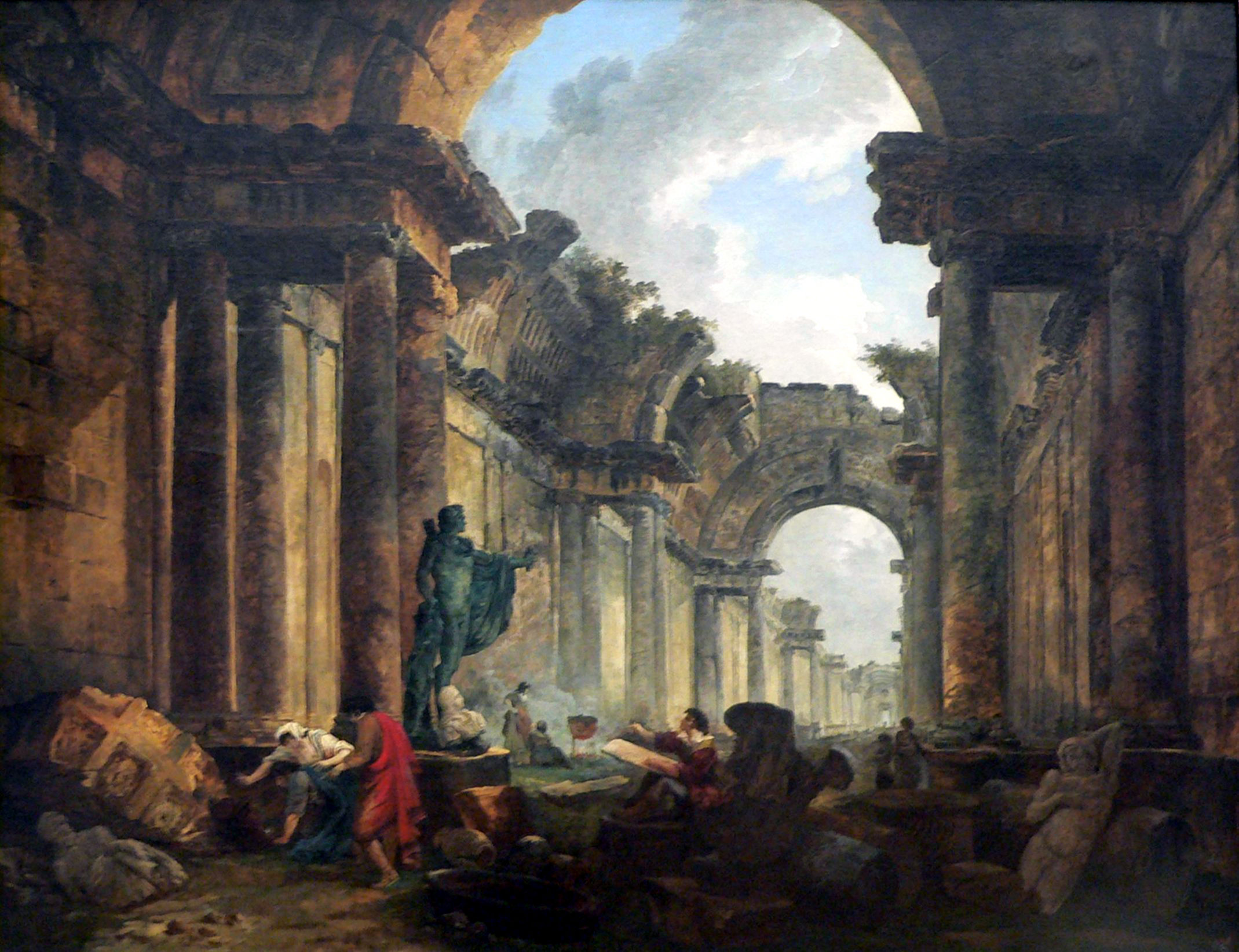
Cyprien Gaillard's art seems to be getting quite a lot of attention at the moment.  I see that one of his works is included in the new Gagosian Gallery exhibition of art inspired by J. G. Ballard, along with other artists I've discussed here before like Ed Ruscha, Tacita Dean and Dan Holdsworth. Gaillard specialises in showing contemporary architecture as ruins - in this respect the Bugada and Cargnel gallery compares him to '18th century French 'ruiniste' painter' Hubert Robert.  'Whether he commissions a traditional landscape painter to paint colourful views of housing projects in Swiss suburbs, surrounded by their luxurious natural environment (Swiss Ruins, 2005), or introduces a view of a tower-block into a 17th Century Dutch landscape etching (Belief in the Age of Disbelief, 2005), Gaillard shows contemporary architecture as a modern ruin on the verge of being taken over by nature'.


Hubert Robert, Imaginary View of the Grand Gallery of the Louvre in Ruins, 1796

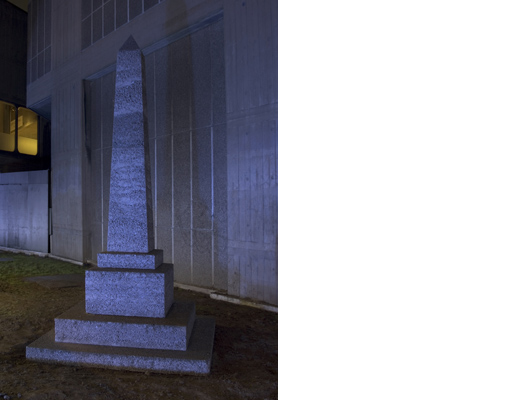
This gallery site goes on to describe his ongoing project for a 'parc aux ruines', scattering monuments across the world: 'a monumental bronze sculpture of a duck taken from a derelict Modernist neighbourhood of high rise buildings in Paris' taken to the terrace of Berlin's Modernist Neue Nationalgalerie, 'crushed concrete remains of a tower block from the suburban city of Issy-les-Moulineaux laid out on the main ally of a Renaissance castle' and the concrete from a demolished social housing project in Glasgow, 'recycled into a 4 meter high obelisk (Cenotaph to 12 Riverford Road, Pollokshaw, Glasgow, 2008)'.

In an interview with Alix Rule, Gaillard said "You know how the London bridge or some French castles have been moved, rock by rock, and reconstructed? My main project, the work of my life, is to do the same for towerblocks. I mean, they cost a fortune to demolish - if I could somehow use the money (and then find more money), I would relocate them on a big piece of land in the south of France and create a park. There would be a few from Glasgow and Sheffield, and a few from Paris and from Marseille, and a few from Kiev, the same way Piranesi would make a caprice. The place would become a 21st-century park of ruins as well as my sculpture park."

I've included a link below to the video Pruitt-Igoe Falls (2009) which shows the destruction of a Glasgow tower block along with a nocturnal view of Niagara Falls.  Gaillard is quoted in Interview as saying: "When the building fell, the dust from the destruction made its way through the graveyard below us like a ghost, slowly coming to the camera until everything went black. It becomes a natural monument, just like Niagara Falls at night-both subjects are falling, both slowly bring you to obscurity."  The title comes from the failed urban housing project, Pruitt-Igoe in St Louis, which was completed in 1955 and demolished in 1972.

Tuesday, February 16, 2010

Garden in Sochi

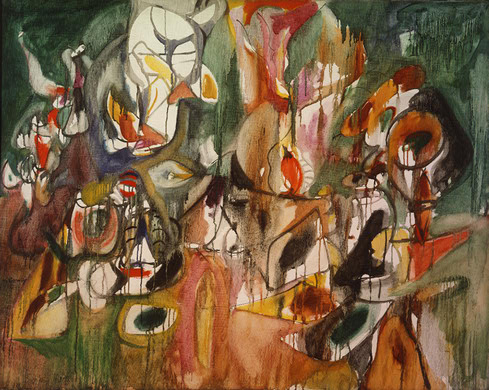
Arshile Gorky, One Year the Milkweed, 1944
Image added here in 2019 following expiry of copyright

The Tate's impressive and moving new Arshile Gorky retrospective includes a room entitled 'Landscape', with paintings like One Year the Milkweed and Cornfield of Health (both 1944).  AndrĂ© Breton said of these works (for which he provided some of the titles) that they reveal the rhythm of life through Gorky's way of decoding nature.  Gorky had begun working in the Connecticut and Virginia countryside in the early 1940s, improvising drawings and developing his abstract paintings, like the Tate's own Waterfall (1943).  The exhibition guide says of these paintings that they 'combine the immediate with buried memories of childhood.'  I think it is these buried memories (rather than our knowledge of Gorky's suicide in 1948) that give the paintings in the exhibition such poignancy - whether indirectly in paintings like One Year the Milkweed or directly in The Artist and His Mother, that remarkable memorial to his mother who had fled with the rest of the family from the pograms in Armenian Turkey only to starve to death in Russia in 1919.

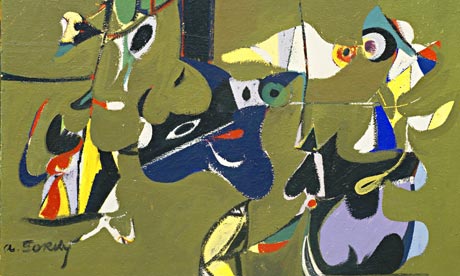
Arshile Gorky, Garden in Sochi Motif, 1942
Image added here in 2019 following expiry of copyright

Earlier in the exhibition there is a room devoted to the Garden in Sochi series.  This is based on Gorky's memories of childhood, specifically his father's orchard at Khorkom.  He said in 1942 that "there was a ground constantly in shade where grew incalculable amounts of wild carrots, and porcupines had made their nests.  There was a blue rock half buried in the black earth with a few patches of moss placed here and their like fallen clouds."  This description (which reminds me of Bruno Schulz) provides an obvious starting point for a biomorphic composition in the style of Arp or MirĂ³, which is what the Garden in Sochi works resemble.  However, William Feaver quotes another more extravagant explanation for these paintings, where Gorky relates them to The Garden of Wish Fulfillment:  "Often I had seen my mother and other village women opening their bosoms and taking their soft and dependable breasts in their hands to rub them on the rock. Above all this stood an enormous tree all bleached under the sun the rain the cold and deprived of leaves. This was the Holy Tree. I myself did not know that this tree was holy but I had witnessed many people whoever did pass by that would voluntarily strip off their clothes and attach this to the tree."

Saturday, February 13, 2010

A lake beneath the weightless morning sky

'Why do we wish to see a charming landscape reproduced in a picture?  Is it just for the sake of pleasure?  No, we are hoping this image will explain something - but this is a something that will surely always remain inexplicable.'  - Robert Walser, The Tanners, 1907 (Der Geschwistern Tanner, trans. Susan Bernofsky)

I think I first heard about Robert Walser through an interview in March 1992's Sight & Sound with the Brothers Quay, who went on to film Walser's novel Jakob von Gunten.  About the same time I bought The Walk and other Stories, with its introduction by Susan Sontag, in Camden's much-missed Compendium Bookshop.  After enjoying the Quay Brothers' film Institute Benjamenta (1995) at the ICA (which may soon be going the way of Compendium), I taped it when it came on TV and remember showing it to one or two people, none of whom seemed as impressed as I was.  I thought that both Walser and the Quays would remain a minority taste, but now we seem to be in the midst of what one review calls a miniature Walser renaissance.  New translations are appearing and I have just finished reading Susan Bernofsky's translation of The Tanners (you can read an excerpt at The Brooklyn Rail).  I'm once again going round trying to tell people how great Walser is - it would be a marvellous book anyway but it also happens to have a cool cover design and Sebald essay for an introduction.


Google The Tanners and you'll find plenty of reviews, so I won't say much here about the novel itself.  My excuse for mentioning it at all is Kaspar Tanner, a landscape painter, brother of the book's main character Simon.  The quote above comes from a passage where Simon is looking at his brother's pictures.  He goes on to say: "It cuts so deeply into us when we, lying at a window, dreamily watch the setting sun; but that's nothing at all compared to a street when it's raining and the women are daintily raising their skirts, or to the sight of a garden or lake beneath the weightless morning sky or to a simple fir tree in winter or to a boat ride at night, or a view of the Alps."  These images made me think of haiku, and a few sentences further on Simon refers to his sister's friend, a poet thus: "people are saying he's built himself a hut up in the high pastures so he can worship nature undisturbed, like a Japanese hermit."  Sadly we don't get to see this hut (if indeed it exists) in the novel.

Susan Sontag wrote that Walser's stories and sketches reminded her of 'the free, first person forms that abound in classical Japanese literature.'  The story that most impressed me in that first Walser anthology I read was 'Kleist in Thun' (1913), about the great German writer who took his own life in 1811.  In it, Walser (to quote W. G. Sebald) 'talks of the torment of someone despairing of himself and his craft, and of the intoxicating beauty of the surrounding landscape.'  'Time and again I have immersed myself in the few pages of this story' wrote Sebald, in the essay 'Le Promineur Solitaire: A Remembrance of Robert Walser' which appears as the introduction to The Tanners.  He quotes Walser's description of the lake and the Alps dipping 'with fabulous gesture their foreheads into the water.'  At another point in the story Walser pictures Kleist on a skiff, looking out at the clear morning lake.  'The mountains are the artifice of a clever scene painter, or look like it; it is as if the whole region were an album, the mountains drawn on a blank page by an adroit dilettante for the lady who owns the album...'  (trans. Christopher Middleton).


Thun c. 1900 (source: Wikimedia Commons)

I visited Thun once as a child (see photograph below), on a family holiday to Switzerland, and I still have the travel diary I kept.  "Today it was even wetter than yesterday, really pouring.  So we went to Thun by train.  At Thun Mum and Dad bought a cow bell and we went in a castle/museum - boring."  Oh dear.  In the afternoon, from Thun, we took a boat trip to Spiez - "it was freezing...  The scenery spoilt by the weather."  Walser closes the story with his own recollection of Thun, "the region is considerably more beautiful than I have been able to describe here, the lake is twice as blue, the sky three times as beautiful".  He says that Thun is visited every year by thousands of foreigners who can read if they wish the words carved onto a marble plaque commemorating Heinrich von Kleist.  I don't think we went to look at this (if it still exists).  The long last paragraph of Walser's story begins in Kleist's mind - music and radiant shafts of light flickering about his senses - and ends Walser's comments on Thun. Susan Sontag thought it 'an account of mental ruin as grand as anything I know in literature.'

Tuesday, February 09, 2010

Alpine Symphony

Apparently, 'the first commercial CDs pressed were The Visitors by Abba and a recording of Herbert von Karajan conducting the Alpine Symphony by Richard Strauss'. I'm afraid we're not interested in Abba here, but Strauss is another matter - as his tone poem (not really a symphony) is a famous example of landscape programme music (following others I've mentioned here before like Beethoven's Pastoral Symphony and Mendelssohn's Hebrides Overture.)  It was completed in 1915 (an earlier version, written in memory of Swiss portrait painter Karl Stauffer, was begun and abandoned in 1899).  The Alpine Symphony is divided into twenty-two sections as follows:

1. Nacht (Night)
2. Sonnenaufgang (Sunrise)
3. Der Anstieg (the Ascent)
4. Eintritt in den Wald (Entry into the Woods)
5. Wanderung neben dem Bache (Walking along the Brook)
6. Am Wasserfall (at the Waterfall)
7. Erscheinung (a Visual Feature)
8. Auf blumigen Wiesen (on Flowery Meadows)
9. Auf der Alm (on the Pasture)
10. Durch Dickicht und GestrĂ¼pp auf Irrwegen (Wrong Path through the Thicket)
11. Auf dem Gletscher (on the Glacier)
12. Gefahrvolle Augenblicke (Moments of Danger)
13. Auf dem Gipfel (at the Summit)
14. Vision (Vision)
15. Nebel steigen auf (the Fog Rises)
16. Die Sonne verdĂ¼stert sich allmählich (the Sun is Gradually Obscured)
17. Elegie (Elegy)
18. Stille vor dem Sturm (Calm before the Storm)
19. Gewitter und Sturm, Abstieg (Thunder and storm, Descent)
20. Sonnenuntergang (Sunset)
21. Ausklang (the Journey Ends)
22. Nacht (Night)

Here are some of the landscape motifs (I'm basing this on an article in Wikipedia that draws on Norman Del Mar's Richard Strauss: A critical commentary on his life and works and on Marc Mandel's 'Richard Strauss: An Alpine Symphony, Op. 64,'):
  • The mountains - a solemn motif played by trombones and tuba; the 'peak motive', is shaped like a mountain (upward leaps of fourths and fifths) and resembles Strauss' Also Sprach Zarathustra
  • The sun - this has its own theme, a descending A Major scale
  • Woods -the 'instrumental tones deepen as thick foliage obscures the sunlight'
  • Birdsong - heard in the upper woodwinds and a solo string quartet leads the transition into the next musical section
  • Brook and waterfall - a rushing passage gives way to cascading scale figures in the winds and strings and marks the beginning of the section which takes place 'At the Waterfall'
  • Flowering Meadows - suggested by a gentle backdrop of high string chords, with a marching theme heard softly in the cellos and isolated points of color (short notes in the winds, harp, and pizzicato in the violas) 
  • Alpine Pasture - cowbells, bird calls, a yodeling motive, and the bleating of sheep (depicted through flutter tonguing in the oboe and E-flat clarinet) 
  • Rain and storm - a drum roll, isolated raindrops (short notes in the upper woodwinds and pizzicato in the violins), flashes of lightning (piccolo) and then the storm itself, using a thunder machine and organ
It is interesting to think how far this kind of composition can reasonably be taken.  Birdsong, thunderstorms and flowing water are pretty standard, but the attempt to convey musically an alpine meadow is more unusual.  The orchestra offers a wonderful range of possibilities - just looking at the list above we have variations in instrumentation, tone, volume, duration, rhythm, pitch and so on, in any possible combination.  But would it be possible to move away from the sublime and the picturesque, to convey more unusual settings or simply nondescript landscapes through purely orchestral sound?


Friday, February 05, 2010

Music with Roots in the Aether


In the early seventies, Robert Ashley produced and directed a 14-hour television opera/documentary about the work and ideas of seven American composers, Music with Roots in the Aether, which premiered at the Festival d'Automne Ă  Paris in 1976. It comprises seven films, each two hours long, most of which have a live performance preceded by an interview in a 'landscape':
  • Landscape with David Behrman
  • Landscape with Philip Glass
  • Landscape with Alvin Lucier
  • Landscape with Gordon Mumma
  • Landscape with Pauline Oliveros
  • Landscape with Terry Riley
  • Landscape with Robert Ashley
Robert Ashley is quite self deprecating about the interviews, saying they were "casual and desultory. They had to be, because of the manner in which they were made. They were made in front of a video camera, with the rule that there would be no video editing." But the landscapes more than compensate for this (some of them are interior landscapes) - the location and natural sounds integral to each conversation.  As I write this I'm watching Terry Riley on another part of my screen, bathed in sunlight, on a grassy slope above a pond. The camera sometimes gets distracted by the surroundings - see for example 35 minutes into Landscape with Terry Riley, where he is talking about Indian ragas whilst we watch a bird washing its feathers.

In an article about Music with Roots in the Aether, Arthur J. Sabatini notes the importance of Philip Makanna's camerawork, which 'functions to structure, comment upon, and provide an alternative take on the conversations and musical performances. He handles the camera gracefully and settles it in on telling images, settings, and moments of dialogue during the performances. With noticeable still photographic technique, he frames scenes and selects perspectives and angles that metaphorically enhance the conversations. For example, as Ashley and David Behrman stand on a hillside overlooking the San Franciso Bay remarking on music across cultures and history, Makanna leaves their voices in the background and pans the Golden Gate Bridge from shore to shore. At another point, when the discussion turns to technology, he follows the microphone wires and video cables trailing the speakers. Thus, Makanna's cinematography and camerawork underscores the musicality of each composers' voicings and their relationship to the landscape.'

Kenneth Goldsmith (the poet who runs Ubuweb) has written a short piece for The Brooklyn Rail about Robert Ashley's films.  It includes an interesting digression on aether with which I'll conclude this post, well off the topic in question but sailing into fascinating waters... "Aether, then, is a loaded word, full of dreams and secrets— a fluid, transmissive medium, ready to heap its treasures upon those who approach her with the right state of consciousness. Antiphanes told of a certain city where words congealed with the cold the moment they were spoken, and later, as they thawed out, people heard in the summer what they had said to one another in the winter. Similarly, Rabelais, writing in 1532, alludes to this phenomenon in his frozen-sounds episode of Gargantua and Pantagruel, where out at sea, with little in sight, a strange assortment of sounds are heard. The captain of the boat explains that the boat is passing by the Frozen Sea, which was the site of a bloody battle between the Arimaspians and the Nephelibates. During the battle, it was so cold that the sounds froze and the whole battle was silent. Now that it is springtime, all these sounds— long inaudible— are being released and creating a racket, although not in their original temporal sequences of action."

Sunday, January 31, 2010

I like a fine prospect, but not on picturesque principles

Talking of William Gilpin (as I was in my previous post), I remember years ago looking in vain for his books in various second hand bookshops and eventually giving up (I still don't own any).  Now it is possible to read them all online in digitised form:
I was thinking of him this week because I've been listening to Sense and Sensibility on my iPod and it includes a well-known exchange on the Picturesque.  I've mentioned Jane Austen's satire of Picturesque taste here before, but it's worth noting that, according to her brother's memoir, she was "at a very early age enamoured of Gilpin on the Picturesque; and she seldom changed her opinions either on books or men."  
Edward returned to them with fresh admiration of the surrounding country; in his walk to the village, he had seen many parts of the valley to advantage; and the village itself, in a much higher situation than the cottage, afforded a general view of the whole, which had exceedingly pleased him. This was a subject which ensured Marianne's attention, and she was beginning to describe her own admiration of these scenes, and to question him more minutely on the objects that had particularly struck him, when Edward interrupted her by saying, "You must not enquire too far, Marianne—remember I have no knowledge in the picturesque, and I shall offend you by my ignorance and want of taste if we come to particulars. I shall call hills steep, which ought to be bold; surfaces strange and uncouth, which ought to be irregular and rugged; and distant objects out of sight, which ought only to be indistinct through the soft medium of a hazy atmosphere. You must be satisfied with such admiration as I can honestly give. I call it a very fine country—the hills are steep, the woods seem full of fine timber, and the valley looks comfortable and snug—with rich meadows and several neat farm houses scattered here and there. It exactly answers my idea of a fine country, because it unites beauty with utility—and I dare say it is a picturesque one too, because you admire it; I can easily believe it to be full of rocks and promontories, grey moss and brush wood, but these are all lost on me. I know nothing of the picturesque."


"I am afraid it is but too true," said Marianne; "but why should you boast of it?"

"I suspect," said Elinor, "that to avoid one kind of affectation, Edward here falls into another. Because he believes many people pretend to more admiration of the beauties of nature than they really feel, and is disgusted with such pretensions, he affects greater indifference and less discrimination in viewing them himself than he possesses. He is fastidious and will have an affectation of his own."

"It is very true," said Marianne, "that admiration of landscape scenery is become a mere jargon. Every body pretends to feel and tries to describe with the taste and elegance of him who first defined what picturesque beauty was. I detest jargon of every kind, and sometimes I have kept my feelings to myself, because I could find no language to describe them in but what was worn and hackneyed out of all sense and meaning."

"I am convinced," said Edward, "that you really feel all the delight in a fine prospect which you profess to feel. But, in return, your sister must allow me to feel no more than I profess. I like a fine prospect, but not on picturesque principles. I do not like crooked, twisted, blasted trees. I admire them much more if they are tall, straight, and flourishing. I do not like ruined, tattered cottages. I am not fond of nettles or thistles, or heath blossoms. I have more pleasure in a snug farm-house than a watch-tower—and a troop of tidy, happy villagers please me better than the finest banditti in the world."

Marianne looked with amazement at Edward, with compassion at her sister. Elinor only laughed.
Gilpin would have preferred banditti to happy villagers, and on aesthetic grounds favoured a landscape peopled by those not actively interfering with it.  As he wrote in his tour of the Lakes, 'in a moral view, the industrious mechanic is a more pleasing object than the loitering peasant.  But in a picturesque light it is otherwise.'

    Friday, January 29, 2010

    Grongar Hill

    So how do you describe a landscape?  Normally by selecting the most interesting features to which the reader's attention should be drawn, and this after having selected that particular view in the first place. Plus there's the time dimension - describing the landscape at a particular time on a particular day, describing temporal phenomena like the wind in the trees, referring to the landscape's history and future.  But what if your aim is more restricted or objective - to try to describe literally what is in front of you, like a photograph?  Where do you start?  How much detail do you include?  Do you give each arbitrary section of the visual field equal weight?  How do you convey relative distance?  Do you include ephemeral effects?  How much time is encapsulated in this 'snapshot'?

    In The Search for the Picturesque Malcolm Andrews describes some of the difficulties eighteenth century tourists encountered in trying to record in writing their impressions of the landscape.  He quotes one J. Grant, writing his 'Journal of a Three Weeks Tour, in 1797, Through Derbyshire to the Lakes': "About to enter on the most beautiful scenery, I shall, hereafter, in describing, fix one spot in a landscape, whence the best bird's eye view of the whole is to be had, and beginning in front, shall go round to the right hand, and returning by the left, make a complete sweep."  Andrews sees the influence here of advice for painters, e.g. William Sanderson's Graphice (1658), which recommended that the painter of landskip take his station on high ground, divide his tablet into three sections and then start drawing in the middle before turning first to the right and then the left.  But the extent to which a writer followed the practice of an artist would influence the choice of details in a landscape description.  Andrews provides an interesting case: William Gilpin's criticism of John Dyer's poem Grongar Hill (1726).

    Below me trees unnumber'd rise,
    Beautiful in various dyes:
    The gloomy pine, the poplar blue,
    The yellow beech, the sable yew,   
    The slender fir, that taper grows,
    The sturdy oak, with broad-spread boughs;
    And, beyond, the purple grove,
    Haunt of Phyllis, queen of love!
    Gaudy as the op'ning dawn,   
    Lies a long and level lawn,
    On which a dark hill, steep and high,
    Holds and charms the wandering eye!
    Deep are his feet in Towy's flood,
    His sides are cloth'd with waving wood,  
    And ancient towers crown his brow,
    That cast an aweful look below;
    Whose ragged walls the ivy creeps,
    And with her arms from falling keeps;
    So both a safety from the wind
    In mutual dependence find.

    In the extract above Dyer (who trained as a watercolourist under Jonathan Richardson) clearly describes the foreground trees and their colours, as you would expect in a landscape painting.  But Gilpin was worried about what comes next, the 'purple grove' in the middle ground - purple objects ought to imply distance - and criticised the detail apparently visible on the distant castle.  Instead of being fainter than the purple grove, 'you see the very ivy creeping upon the walls.'  He contrasts this with a famous couplet from Milton's L'Allegro, 'Towers, and battlements he sees / Bosomed high in tufted trees', where the colouring is indistinct and 'we do not see the iron-grated window, the portcullis, the ditch or the rampart.  We can distinguish a Castle from the tree; and a tower from a battlement' (Observations on the River Wye, and several parts of South Wales, &c. relative chiefly to picturesque beauty; made in the summer of the year 1770, 1782).  For Gilpin the picturesque description was not a simple inventory of what was before the tourist, it had to express the character of the place.  But rather than make use of the power of language to shift focus and capture the view in three or four dimensions he aimed to emulate the effects of landscape painters. 

    Nobody has cracked the problem of describing a landscape in words, but it's a challenge that can lead to interesting experiments.  Colin Sackett made a book last year called Spate in which a panoramic photograph is translated into text - simple words (Field, Trees, Submerged Fence) placed on the white page in place of their image, with successive pages tracking the progress of the floodwater near Exeter.  A picturesque version might have more detail down in the foreground with vague phrases at the top of the page (not to mention variations in typography with faint purple text in the distance...)  Grongar Hill could be rewritten in all sorts of ways.  As a text picture it might look something like this (Gilpin may have been right about the purple grove which seems a bit hard to place...)

                                          ancient tower
                                              dark hill
                                      dark hill   dark hill
                             dark hill    dark hill    dark hill
                a             long              and         level        lawn
                                        the purple grove
    gloomy pine poplar blue yellow beech sable yew slender fir sturdy oak
    gloomy pine poplar blue yellow beech sable yew slender fir sturdy oak
    gloomy pine poplar blue yellow beech sable yew slender fir sturdy oak

    Thursday, January 21, 2010

    1,244 real Views of Great-Britain

    In 1772 Catherine the Great wrote to Voltaire, saying that she loved gardens in the English style: ‘the curving lines, the gentle slopes, the ponds in the forms of lakes, the archipelago on dry land, and I scorn straight lines and twin allĂ©es.’  Catherine invited John Busch to Russia to work at Pulkova and then on Tsarskoye Selo, near St Petersburg, where he collaborated with the architect Vasily Neyelov.  It must have been quite a  leap from Hackney, where Busch owned a nursery off Church Street that he sold on to Conrad Loddiges in 1771 (it became famous for its rare plants in the early nineteenth century).  Another landscape architect who went to Russia and contributed to the design of Tsarskoye Selo was Charles Cameron, who later worked for Alexander I and became Architect-in-Chief to the Admiralty.  But perhaps the most extraordinary example of Catherine's anglophile taste in landscapes was the order she placed with Josiah Wedgwood, for a 'Table and Dessert Service, consisting of 952 pieces and ornamented in enamel with 1244 real Views of Great Britain'.

    Now 1,244 is not a trivial number and Wedgwood was understandably concerned: 'why all the gardens of England will scarcely furnish subjects sufficient for this sett, every piece having a different subject'.  How he did it is explained by Alison Kelly in 'Wedgwood's Catherine Services', an article for The Burlington Magazine (August 1980).  Wedgwood and his partner Thomas Bentley started with the famous landscape gardens that Catherine was particularly interested in, basing designs on published engravings like Beauties of Stowe, by George Bickham (1750-56) and Chambers's Description of the Gardens and Buildings of Kew (1771), as well as views sent in by sympathetic friends, like Mr Anson of Shugborough.  Stowe, unsurprisingly, provided more views (43) than any other landscape garden.

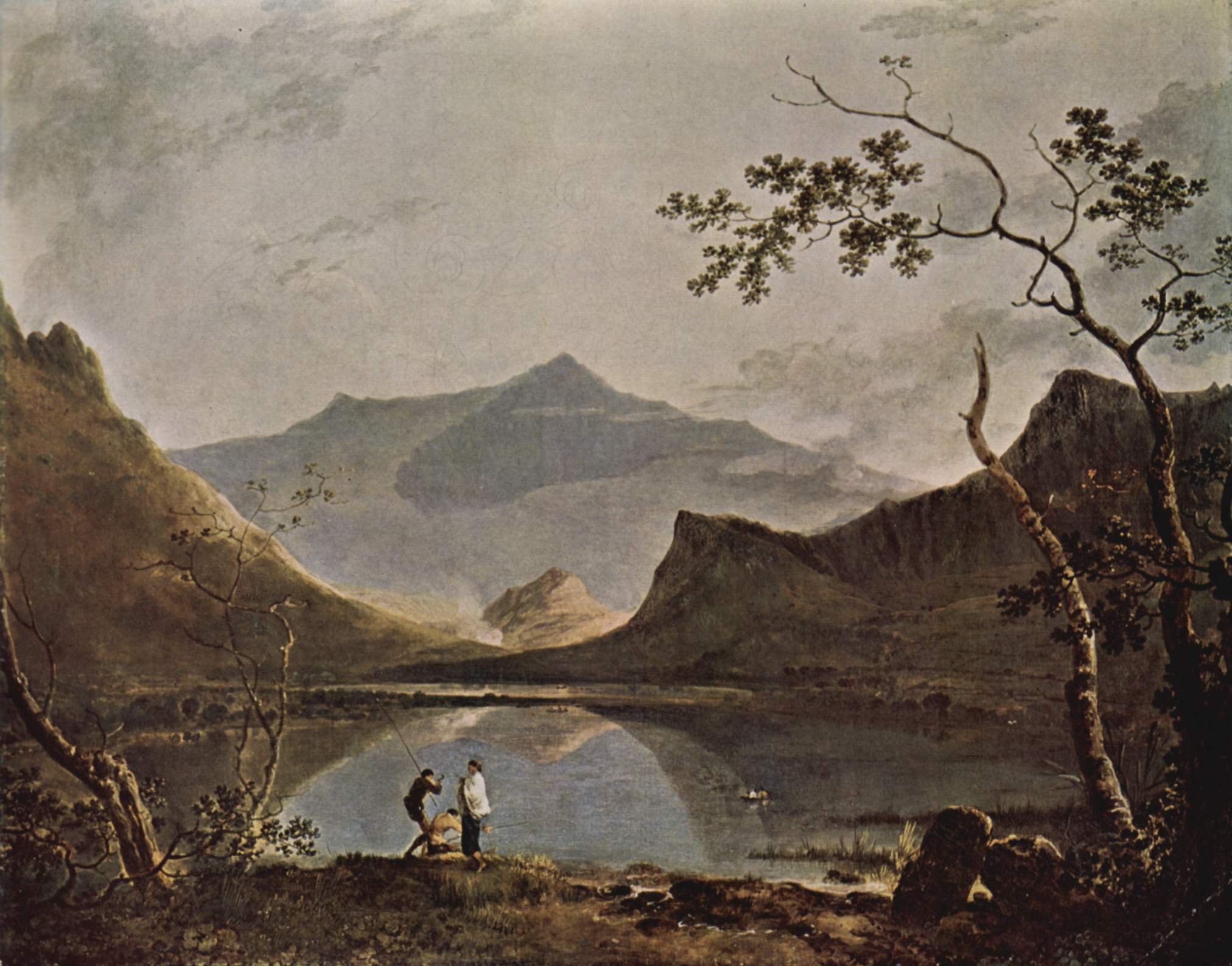
    In addition to the nation's most celebrated gardens, Wedgwood and Bentley used images of famous country houses, although Bentley wrote that 'we have purposely omitted to represent the most modern buildings, considering them unpicturesque'.  Picturesque landscapes accounted for a good number of the designs: ruined abbeys, castles (150 of these) and even some early remains: Stonehenge, Kit's Coty House, a Cornish Dolmen and the Roman ruins of Silchester.  Wedgwood and Bentley were also up-to-date with tastes in the Sublime, including various views of the Lake District, the Peak Cavern, the Giant's Causeway and Fingal's Cave.  There is a letter from Wedgwood to Bentley in 1773 asking about Richard Wilson's landscapes: 'Pray have you Wilson's Views from different places in Wales? If you have not, Mr. Sneyd will lend them us'.  Alison Kelly writes that 'after reading this letter it is pleasant to recognise on a dish the unmistakable outlines of Wilson's Snowdon from Llyn Nantlle.'

    Richard Wilson, Snowdon from Llyn Nantlle, c1766

    Given their role in the Industrial Revolution it is interesting that a few of the pieces feature such scenes as Papermills at Rickmansworth, a Colliery and Pump near Bristol and the Dock at Plymouth.  However, urban views are largely absent, with the notable exception of London.  You can see a plate from the dinner service showing Somerset House on the Hermitage website (there don't seem to be any non-copyright images available to put up here).  Other obvious London highlights included Kensington Palace, the Mall and Horseguards Parade but there were also a few views from the fringes of the city - Erith, Sunbury, Shepperton.  Mention of Shepperton made me wonder what a contemporary 952 piece Ballardian dinner service might look - traffic islands, car parks, terminal beaches, abandoned hotels...

    Eventually Wedgwood and Bentley had got together all 1,244 views and the completed service went on show in London before being sent to Russia.  Apparently this was a great social success, as people were came to see whether one man's country estate featured more prominently than another's.  When it arrived, Catherine the Great was satisfied and used it for state occasions in the Chesmenski Palace. But after her death it was eventually forgotten about and only rediscovered at the beginning of the last century, when nearly 800 pieces were found to have survived.

    Saturday, January 16, 2010

    The Garden Room at Prima Porta


    Detail of the south wall, 'Garden Room', Prima Porta

    In my recent post about Roman landscape painting I mentioned the 'Garden Room' at Prima Porta, near Rome. In their 2001 OUP survey of classical art, Mary Beard and John Henderson describe this space as 'an impossibly utopian mixture of bright flowers beside laden fruit trees, tidy shrubs before a receding woodland vista, planned garden display within a surround of Italian trees, as if in their natural habitat.'  It is 'an exercise in blue and green. And a celebration of naturalistic technique ... But this is not nature reproduced; instead, a world specially made for us - yet made to do without us. Beyond the balustrade, as no wild birds ever could, these pay not the slightest attention to anyone in the room, impossibly ignoring our proximity. Emblematized by the songbird in its golden cage, art here creates nature, beyond anything you could find in the real world.'


    Detail of a pine tree, 'Garden Room', Prima Porta

    An interesting June 1994 Art Bulletin article by Barbara A. Kellum, 'The Construction of Landscape in Ancient Rome: The Garden Room at the Villa ad Gallinus' describes this painting in the wider context of Augustan Rome, where 'the emperor was quick to establish an arboreal mythology' and the city was punctuated with plants and trees that 'were as protean and mulitvalent in their structures and meanings as the contemporary poetry of Virgil, Horace and Ovid.'  The article's title refers to the villa's ancient name, ad Gallinus; the chicken in question was one which an eagle dropped into Livia's lap, holding a laurel branch in its beak.  This was seen as a good omen for Livia and her new husband Augustus, and they planted the branch, which grew into a laurel grove.  According to Pliny the Elder, subsequent emperors continued the tradition of planting trees in the grove and just before the death of each emperor it was observed that the tree they planted had begun to whither.  Laurel features prominently in the Garden Room, both as trees and low shrubs.


    Detail of a spruce tree, 'Garden Room', Prima Porta

    The room is structured around regularly placed oak, pine and spruce trees, but with a profusion of wild plants in between, order and disorder complimenting each other in a way reminiscent of Virgil's Georgics. According to Kellum, this mixture represents on the one hand the fertility and prosperity of the Augustan state, and on the other 'the underlying order that was an essential part of it ... harmonizing the beneficent world of nature and that of the state under a common rule of organic order.'  The individual plants and trees could all of course be associated with symbolic meaning, not to mention the birds.  For example, laurel, pine and cypress trees, nightingales, partridges and magpies all appear in Ovid's Metamorphoses, and the process of metamorphosis itself was, as Ovid knew, central to the mythology of Augustus.  Thus the design of this garden room can be read in terms of the wider symbolic landscape of Augustan Rome.

    Sunday, January 10, 2010

    Wonderland

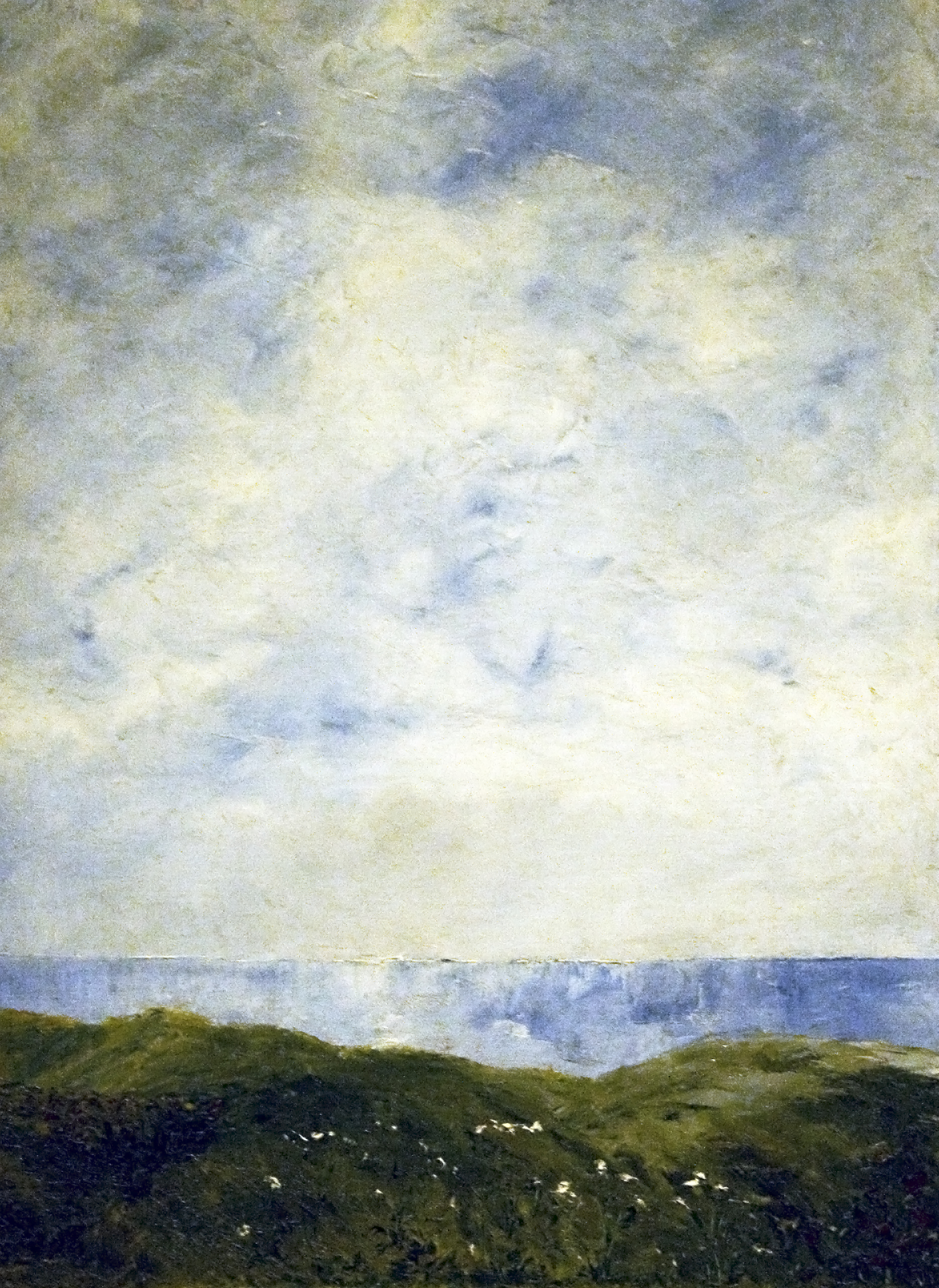
    August Strindberg, Coastal Landscape II, 1903

    In the midst of all this snow and cold weather I feel in the mood to write about some Nordic landscape art and August Strindberg fits the bill.  His paintings have always fascinated me and there was an excellent exhibition of them, along with his experiments in photography, at the Tate in 2005.  It's a pity his novels are hard to get in English translation (his plays are much easier to find), but this post concerns his visual art, starting with a chronology of Strindberg the landscape artist (based on Per Hedström's survey in Strindberg: Painter and Photographer, Yale, 2001):

    1849 August Strindberg born.

    1872 Strindberg, in a state of crisis (not for the last time!), turned to painting - a few landscape sketches survive from this year.  In his novel Son of a Servant Strindberg compared the painting of a ruined as making him "indescribably happy - as if he'd just taken hashish."

    1873 Having tried and failed as a journalist, Strindberg again turned to art, painting relatively unoriginal landscapes in the Stockholm archipelago.  He then concentrated on writing until the early 1890s.

    1876 In Paris Strindberg saw Impressionist paintings for the first time.

    1889 The novel By the Open Sea from this year includes passages that could be describing some of Strindberg's subsequent paintings, e.g. the "awful volcanic formation of SvartbĂ¥den" with its navigation mark, depicted in The Vita Märrn Seamark II (1892).

    1890 Strindberg travelled through Sweden and some sketches survive that he made on the island of Runmarö.

    1892 In the spring and summer he was sketching on Dalarö in the Stockholm Archipelago and this year he painted many of his best landscape paintings.  Strindberg had his first exhibition of paintings (a reviewer thought his depiction of Pack Ice resembled a plate of bread and margarine, or a dish of grilled veal trotters in veal sause). In the autumn he went to Berlin and fell in with a group of painters and writers who included Edvard Munch.

    1893 Night of Jealousy (1893), a stormy seascape, was given by Strindberg to his future second wife (the marriage did not last...)

    1894 Strindberg published 'The new Arts! Or the Role of Chance in Artistic Creation' (see below) and moved to Dornach on the Danube where he painted further works.  He moved to Paris and continued painting seascapes, possibly influenced by Turner.  For the rest of the decade he concentrated on writing and experiments in science.

    1901 Another crisis and another return to painting - he continued sporadically until 1905.  This year he also collaborated with Arthur Sjögren on a book Sveriges natur (Sweden's Countryside), with Sjögren's illustrations based on thirteen sketches by Strindberg.

    1902 His short story 'Fairhaven and Foulstrand' refers to the kind of landscape seen in his paintings of shores with isolated plants: "the long, shallow creeks with the finest of writing-sand ... a home for purple Loosestrife, golden-yellow Pimpernel, mauve Asters and white Sea Radish."

    1906 As part of his scientific interest in meteorology, Strindberg photographed cloudscapes and wrote about his theory of recurrent cloudscapes.

    1907 The sets for Strindberg's experimental theatre in Stockholm were based on pictures by one of his favourite artists - Böcklin's Island of Death and Island of Life.

    1912 Death of Strindberg.

    Some of the most striking landscapes painted by Strindberg in the later period show the view from a cave (or, a variation, the view of a landscape framed by leaves).  These derive from an earlier work, Wonderland, which was composed, in proto-Surrealist, proto-Abstract Expressionist style, in accordance with the principles of randomness that he described in his 1894 essay.  Beginning with a 'shaded forest interior, from which you see the sea at sunset', the painting evolved until the forest looked like a cave and cliffs in the foreground appear to be covered in lichen.  The cave motif interested Strindberg, who was fascinated by a landscape I wrote about here last year, Fingal's Cave.  One of the scenes of A Dream Play is set there and it also features in his short story 'The Romantic Sexton on Ränö', where Strindberg likens the cave to a natural organ.

    August Strindberg, Wonderland, 1894

    Friday, January 08, 2010

    Rainbows, showers, partial gleams of sunshine


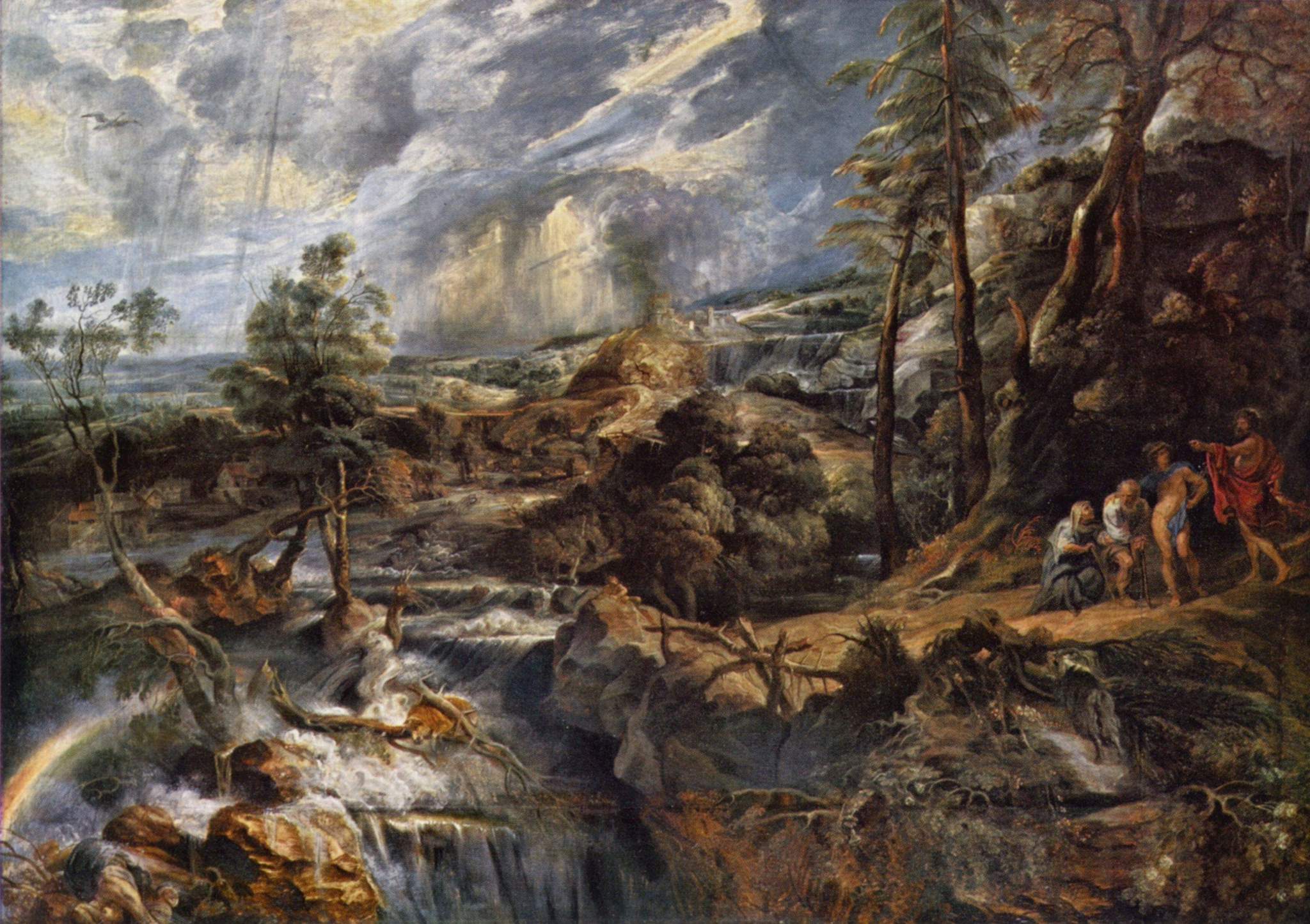
    Peter Paul Rubens, Philemon and Baucis, c1630

    In 1822 William Hazlitt compared Rubens with Claude: 'I imagine that Rubens's landscapes are picturesque: Claude's are ideal. Rubens is always in extremes; Claude in the middle. Rubens carries some one peculiar quality or feature of nature to the utmost verge of probability: Claude balances and harmonises different forms and masses with laboured delicacy, so that nothing falls short, no one thing overpowers another. Rainbows, showers, partial gleams of sunshine, moonlight, are the means with which Rubens produces his most gorgeous and enchanting effects: there are neither rainbows, nor showers, nor sudden bursts of sunshine, nor glittering moonbeams in Claude. He is all softness and proportion: the other is all spirit and brilliant excess. The two sides (for example) of one of Claude's landscapes balance one another, as in a scale of beauty: in Rubens the several objects are grouped and thrown together with capricious wantonness. Claude has more repose: Rubens more gaiety and extravagance.'


    Claude Lorraine, Landscape with Acis and Galatea, 1657

    According to Kenneth Clark, 'no great painter ever lived so completely within his resources as Claude.  Unlike such prodigals as Rubens, his pictures always suggest a tactful and far-sighted economy.'  In Landscape into Art, Clark praises the earlier writing on Claude of Hazlitt and of Roger Fry, whose essay on the artist appeared in the Burlington Magazine in 1907.  Fry also praised Claude (rather faintly), whilst comparing him with more vital, colourful artists and writers.  For example, he says that 'Robert Bridges, in his essay on Keats, very aptly describes for literature the kind of beauty which we find in Shakespeare : "the power of concentrating all the far-reaching resources of language on one point, so that a single and apparently effortless expression rejoices the aesthetic imagination at the moment when it is most expectant and exacting." That, ceteris paribus, applies admirably to certain kinds of design. It corresponds to the nervous touch of a Pollajuolo or a Rembrandt. But Claude's line is almost nerveless and dull. Even when it is most rapid and free it never surprises us by any intimate revelation of character, any summary indications of the central truth. But it has a certain inexpressive beauty of its own. It is never elegant, never florid, and, above all, never has any ostentation of cleverness.'

    Monday, December 28, 2009

    A delightful style of decorating walls

    For my last post of the decade I'm going to discuss some words of the writer who provided my nom de blog, 'Plinius'.  In his Natural History, Gaius Plinius Secundus (Pliny the Elder) mentions many artists, but the nearest he gets to discussing landscape art is in Book XXXV:  'Nor must I neglect Studius, a painter of the days of Augustus, who introduced a delightful style of decorating walls with representations of villas, harbours, landscape gardens, sacred groves, woods, hills, fishponds, straits, streams and shores, any scene in short that took the fancy.'  He then describes some of the people included in these scenes - often humorously depicted.  'He also brought in the fashion of painting seaside towns on the walls of open galleries, producing a delightful effect at a very small cost.'  But for Pliny such frescoes were not the business of great painters (the celebrated Apelles had no wall paintings in his house).  No artists 'enjoy a real glory unless they have painted easel pictures' (something for this year's Turner Prize winner, Richard Wright, to think about!)

    This short text is all we know about Studius, but Roger Ling published an interesting article back in 1977, in the Journal of Roman Studies, that tried to infer more about the kind of paintings he could have been responsible for ('Studius and the Beginnings of Roman Landscape Painting').  Ling begins by discounting some landscape-related genres that don't seem to correspond to Pliny's description: (1) mythological landscape as in the famous 'Odyssey landscapes' of the Esquiline; (2) the beautiful, naturalistic garden painting in the Villa of Livia at Prima Porta; (3) architectural illustration, as in the bedroom of the villa at Boscoreale; or (4) details of rustic shrines like those in the Palatine's Room of the Masks. He then argues against the view that Studius focused on 'villa landscapes', in contrast to the more pastoral scenes which seem to be described in the brief reference Vitruvius makes to landscape painting: 'in corridors because of the length of the surface they created decorations with varieties of landscape, drawing images from specific characteristics of places; for they paint harbours, promontories, shores, rivers, springs, canals, shrines, groves, mountains, cattle, shepherds.'  By looking at the available physical evidence, Ling concludes that Studius must have painted landscapes that could fit both the descriptions of Vitruvius and Pliny, and that the latter discussed him specifically because he had brought 'to perfection' peopled architectural landscape wall-painting in the Augustan period.


    Painted landscape from the Red Room, Villa of Agrippa Postumus, Boscotrecase

    Ling discusses three sites which could contain the kind of landscape painting Studius was renowned for, and even suggests that they could be the work of Studius himself or his workshop.  These are
    • The Yellow Frieze in the House of Livia, Rome, which has architecture and figures corresponding to the kind of scene described by Pliny
    • Certain panels and vault decorations in the Farnesina house, in which Ling detects 'Studian echoes', e.g. 'whimsical figures like the woman leaning disconsolately against a wall'
    • Landscape panels in the Boscotrecase villa's Red Room, with another humorous detail: a shepherd talking to hs dog.    
    His article concludes by attempting to characterise the landscape style of Studius.  The paintings were above all 'charming', blending everyday life with exotic settings.  They have a relatively realistic treatment of distance, without employing linear perspective, and the figures are quite small, although larger than they would be in real life.  The paintings deploy a range of colour effects but tend to have a restricted palette and the brushwork appears to be relatively quick and sketchy.  Of course a lot of this is deliberately speculative; and looking for the real Studius is perhaps as fruitless as searching for the real Homer or the real Odysseus...  But I'd be interested to know if any more recent scholarship has shed further light on Pliny's brief description of the mysterious Studius.

    Saturday, December 26, 2009

    Anonymous backdrops for the drama of words

    Ed Ruscha: Fifty Years of Painting at the Hayward is a good exhibition, but a depressing experience for any believer in the inspirational possibilites of landscape art.  Room 2 is entitled 'Words as Landscape' and here is what it says on the wall: 'Ruscha often speaks of his word paintings as 'landscapes', and describes their backgrounds as 'anonymous backdrops for the drama of words'.  Pointing out that he is not part of any landscape tradition, he says of The Back of Hollywood, where the word (in reverse) is literally an object in landscape: "my approach to this kind of vista came out of travelling on highways - hitchhiking and driving ... I see things as a moving panoramic landscape, maybe in the same way you might see a movie."'

    The landscapes in The Back of Hollywood and similar works like A Particular Kind of Heaven (1983) are just a sky and a horizon, painted as empty cinematic clichĂ©s rather than images of the sublime. Ruscha's more recent 'Mountain' paintings were inspired by the old Paramount Pictures mountain and many of them are backdrops to text taken from a commercial or urban context - see for example the Tate's Pay Nothing Until April (2003).  The exhibition shows them near paintings that illustrate more directly the banality of the industrial landscape, like Blue Collar Tech-Chem (1992).  In paintings like Pay Nothing Until April, Ruscha shows us the distance between real life and the idea of the mountain.  He overlays The Mountain (1998) with just one word, 'The', as if to emphasise the landscape's role as mere signifier.  One reviewer has likened this enigmatic painting to Giorgione's La Tempesta; far-fetched, but Ruscha himself has said that he wants this work to 'toy with your mind'.

    Tuesday, December 22, 2009

    Landings

    Probably too late now to ask for these for Christmas: the new limited edition LPs of Richard Skelton's Landings... The latest Wire magazine includes a review of the music by Keith MolinĂ© from which I'd like to quote a paragraph (you'll see why): 'All Skelton's work, whether under the name of A Broken Consort, Carousell or Clouwbeck, is intimately connected to the landscape.  He treats the act of creation as a form of site-specific ritual in which the sense of place imprints itself on the work.  Indeed, Landings originally involved a reciprocal arrangement with the land, with Skelton secretly depositing individual CD-Rs back into locations in which the recording had taken place.  Unlike field recordists like Jez riley French, Skelton aims for a distillation of the emotional resonance of a particular locale mediated through instrumental work, rather than recontextualising location sounds as music itself.  His approach is closer to that of the Jewelled Antler Collective's Blithe Sons, whose recordings document the sonic characteristics of their chosen locations by sounding them with the music they improvise.  Skelton's dialogue with the landscape is at once more nebulous - it borders on a weirdly private kind of gestural performance art - and less esoteric; it's geared towards producing personal, emotionally resonant music rather than investigating sonic phenomena.'


    The landscape Skelton explores in this work is that of the Pennines, centering on Anglezarke.  In an interview at The Line of Best Fit, Skelton says he "felt compelled to play music in this landscape – I’d get up at 5 or 6am, drive out to the moor and play guitar, violin or concertina in the ruins of old farmhouses, as the morning light began to blush over the moor. ...  I was initially quite dogmatic about making all my Landings recordings in the field. I felt that the connection between the landscape and the music was only valid if the recordings were made in situ. I somehow wanted the landscape to impress itself onto the recordings directly, and felt that simply adding a flavour of the environment (bird song, river sounds etc) to studio recordings would be a kind of trickery. But after a few years of recording in this way, I became increasingly dissatisfied with the results themselves. My memory of events often conflicted wildly with the recorded documents, and what’s more, many of them were marred by the intrusion of unwanted sounds, such as wind or traffic noise."
    "I then began to observe how my writing about the landscape wasn’t contingent on proximity, and that, if anything, I could write more clearly when away from the place of inspiration. Increasingly, I began to visit the moor without instruments, simply to experience it. I began to realise that my music making had mediated my previous experiences of the landscape – that in some ways it was an intrusion, and that I needed to witness these places alone, devoid of the props of my art. Furthermore, I realised that I could still represent Anglezarke in my recordings – in miniature, by using the small stones, bark and other natural ephemera which I’d collected from my previous visits. These things could act as a synecdoche for the landscape, as well as physically colluding with my instruments, by being used as plectra, or as sound sources in their own right."
    The accompanying book, described on Skelton's website, 'is a loose-fitting collection of writings that obliquely articulate ideas about memory, mark making, proximity and loss, a sense of place and the landscape (its voices, history and folklore). Along with diary entries, the book gathers together word lists, poetry and prose fragments from 2004 to 2008'  He includes a sample chapter - from which I've extracted a few lines below:
    The shifting half-light briefly traces ghost tracks across the fields. I
    look out towards Alance Bridge and the mouth of the Yarrow, retracing
    its course back up the tree-lined channel towards Anglezarke
    Moor. And somewhere far up there. Beyond sight. Old Rachel’s.

    I suffuse this place with the sounds recorded at that ruin, near the
    head of the river, many months ago.

    Stones dislodged from a bitter and brittle dam.
    A well of music and memory.
    Alluvium and fragments of melody.
    Stirring in the still water.
    Finally flowing downstream.

    Sunday, December 20, 2009

    The Pavilion of Prince T'eng

    Almost all you will learn about the poet Wang Bo (called Wang Po in the Wade-Giles system) from the brief stub on Wikipedia is that he was 'one of the Four Literary Eminences in Early Tang' whose 'forward way of thinking is reflected in the quote "friendships across the world make near neighbours of far horizons"' (an appropriate sentiment for a blog).  However, if this makes him sound like a saintly sage it is rather misleading, for Wang Po seems to have been a poet of the live-fast-die-young type.  According to Richard E. Strassburg (Inscribed Landscapes: Travel Writing from Imperial China), Wang was a child prodigy, recommended to the court as a teenager, entering service in 666 CE.  Expelled two years later for satirical writing, he was reinstated as an administrator in 672 but then sentenced to execution for the crime of killing a government slave.  Although pardoned, Wang was struck from the list of government officials and his father was demoted and exiled to a remote region that covers parts of modern north Vietnam.  Wang Po made the long journey to visit him but was drowned on the way: a promising poet, dead at the age of twenty-six.

    On October 3rd 675, probably whilst on that journey to visit his father, Wang Po was invited to a feast at the Pavilion of the Prince of T'eng.  This Pavilion stood 105 feet high, facing the Kan River, and it was there that Wang wrote his famous Preface, introducing poems to be composed at the feast.  This naturally includes a description of the surrounding landscape, which begins: 'The swollen waters have subsided, and the cold lakes are clear.  The mist hangs thickly, so the mountains appear purple in the twilight; horses and carriages are neatly lined up along the high road while we visit the scenery of this imposing hill.'  Wang goes on to mention sandbanks with cranes, islets with wild ducks, mountains and planes, river and marshes.  'A pure breeze arose when lively flutes sounded; the white clouds were halted by the strains of a languid song.'

    Wang summed up the occasion by saying that 'the four excellent conditions were present, and the two rarities came together.'  What were these?  According to Richard Strassberg's footnote, the four excellent conditions were a fine day, beautiful scenery, a delighted heart and a happy occasion, as described in an earlier poetic preface written by Hsieh Ling-yĂ¼n ('Preface to Eight Poems Written in Imitation of the Poetry Gathering of the Crown Prince of Wei at Yeh').  The two rarities were: a worthy host and elegant guests.

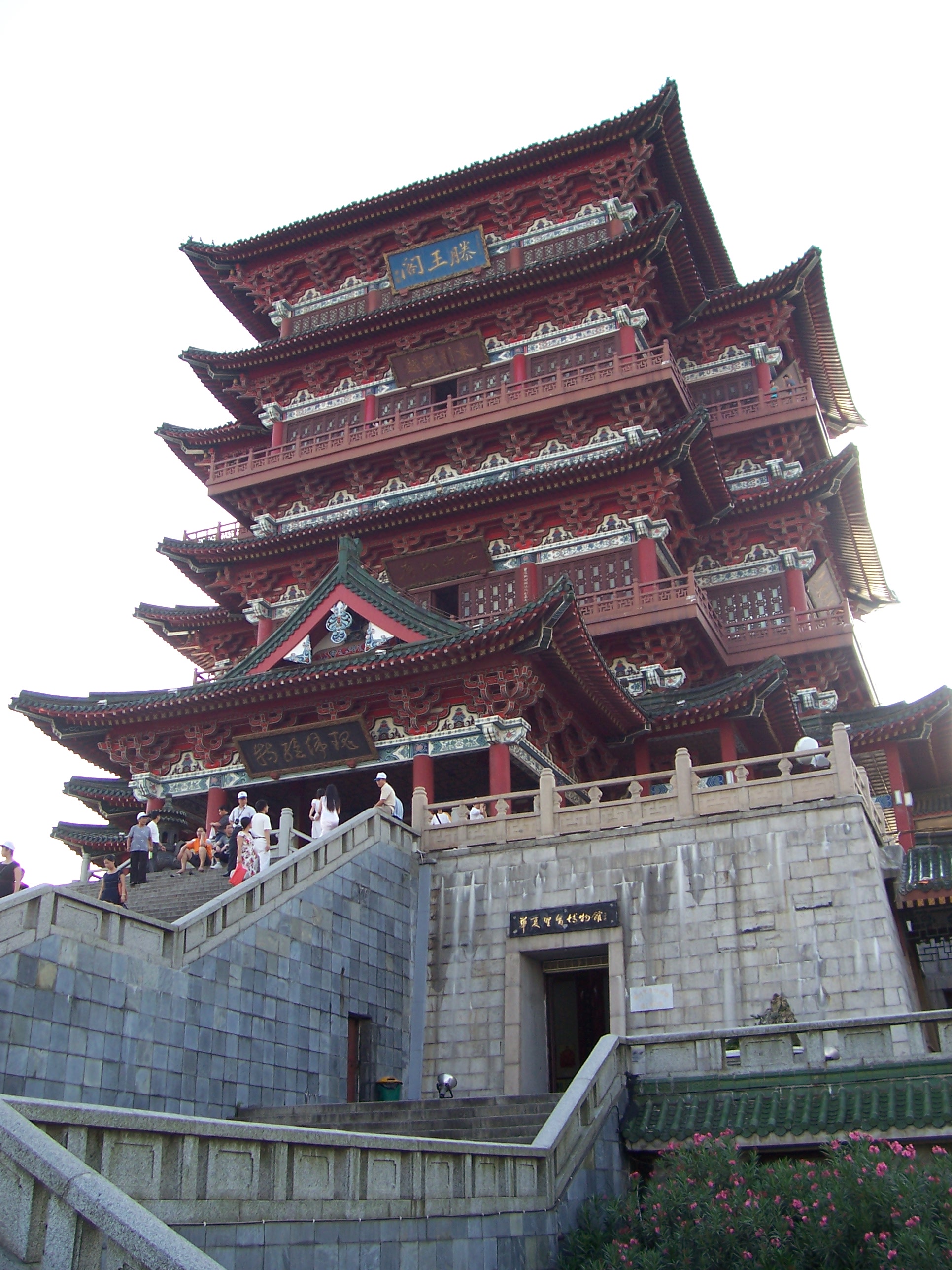
    Nevertheless, Wang Po's Preface ends on a melancholy note: 'Alas!  Scenic places do not endure; sumptuous feasts rarely occur twice.'  Wang's actual poem following the Preface describes the landscape around the Pavilion whilst evoking the passage of time: soaring clouds followed by rain, stars shifting in the sky, successive autumns passing and the river flowing ever onwards.   The Pavilion itself had been built in 653 and was constantly being restored, eventully becoming a shrine to Wang Po's prose.  According to Strassberg, it lasted 'for almost thirteen hundred years before its final destruction by a northern warlord in 1926'.  However, a new replica (below) has now been built in reinforced concrete and, according to Wikipedia, "mainly serves tourism purposes."


    Thursday, December 17, 2009

    The Starry Night

    Much has been written this autumn about Van Gogh's letters, following publication of the vast new six-volume collected edition.  Among those queuing up to praise them have been Andrew Motion, Julian Bell and Richard Shone.  And rightly so I'm sure - for what it's worth, the considerably cheaper Penguin edition in our house remains the most moving, stimulating and beautiful set of letters I have ever read.

    I have talked about the letters here before and quoted from one that described the landscape at Zweeloo.  You can see this letter on the new Van Gogh Letters site, with links to a facsimile and comprehensive notes. In the letter Van Gogh writes "I passed a little old church, just exactly, just exactly the church at GrĂ©ville in Millet’s little painting in the Luxembourg" and you can click on the link to see this painting. It's an amazing site and it would be great to see someone do the same kind of thing here for Turner or Palmer, or writers like Gerard Manley Hopkins.

    Some of the sketches Van Gogh included in his letters were landscapes - see for example his letter to Emile Bernard of 19 June 1888 ("Herewith another landscape... I painted it at the height of the mistral.")  Earlier in this letter he says "To be honest with you, I have absolutely no objection to the countryside, since I grew up in it - I am still enchanted by snatches of the past, have a hankering after the eternal, of which the sower and the sheaf of corn are the symbols.  But when shall I ever get round to doing the starry sky, that picture which is always in my mind?" 


    Vincent Van Gogh, The Starry Night, September 1888

    However, with so many reviewers earnestly urging people to read the letters I'm tempted to recall an alternative take on them - 'If the Impressionists Had Been Dentists' by Woody Allen.  In these letters Vincent writes to Theo, for example, that 'my old friend Monet refuses to work on anything but very, very large mouths and Seurat, who is quite moody, has developed a method of cleaning one tooth at a time until he builds up what he calls a “full, fresh mouth.” It has an architectural solidity to it, but is it dental work?'

    Wednesday, December 09, 2009

    The Cerne Abbas Giant

    In what ways can landscape archaeology be considered a form of landscape art?  Matthew Johnson's Ideas of Landscape (2007) traces the roots of the discipline (at least in its English version) to Romanticism and draws parallels between W.G. Hoskins (whose The Making of the English Landscape I've mentioned here before) and Wordsworth.  They were both solitary walkers, interested in the local (the genius loci) and the national, combining direct bodily experience with intuitive understanding, traveling in imagination into the past, gazing on the landscape from a social and physical distance and with a degree of expert knowledge, viewing the landscape aesthetically and translating it into text.

    Johnson argues that landscape archaeologists working on prehistoric (rather than historic) sites have tended to operate more objectively and certainly in the US have been more open to theory.  One could perhaps draw parallels here with English and American land artists - Richard Long shares many of the Romantic characteristics listed above, in contrast to, say, Robert Smithson.   Johnson discusses some of the tools of landscape archaeology - maps, aerial photography and the hachured plan.  Ostensibly objective and empirical, they are 'complicit in a Romantic view of the world - each invites the observer to gaze down on the landscape like Wordsworth in the Lakes.'  Land artists have used photographs and maps extensively to document their earthworks but this book made me think there's some untapped potential in hachured plans...

    In contrasting the attitudes of archaeologists to history and prehistory, Johnson discusses the Cerne Abbas Giant.  This mysterious work of art in the landscape has been taken to be prehistoric, since it could not be linked to Christian imagery and there were no historic documents relating to its creation.  But neither of these factors precludes a later date - 'Ronald Hutton (1999) has argued convincingly that it in fact sits longside a 17th century landscape of politics and conflict between king and Parliament.'  A third view has been put forward by Barbara Bender (an academic who, fifty years ago, was a college friend of my mother's.)  She suggests that the specific date of origin does not matter - 'the Giant has to be scoured and re-scoured every generation; it takes its place, and its historical importance, as part of a continuing tradition that links the past to the present.'


    The Cerne Abbas Giant
    Source: Wikimedia Commons

    Saturday, December 05, 2009

    The trenchéd waters run from sky to sky

    The latest New York Review has arrived and it includes a critical article on Jane Campion's film Bright Star by Christopher Ricks.  The problem with the film for Ricks is that it tries to illustrate Keats's poems - he sees this as ridiculous and as unnecessary as adding perfume or sound effects.  Keats's imagination and his words alone are able to create the most vivid imagery.  To assist his argument Ricks quotes some lines about Tennyson which I thought worth recording here (from William Allingham's diary):

    "As to visualising," he said, "I often see the most magnificent landscapes."
    "In dreams?"
    "Yes, and on closing my eyes. To-day when I lay down I saw a line of huge wonderful cliffs rising out of a great sweep of forest — finer than anything in nature."
    Other gifts he has, but T. is especially and pre-eminently a landscape-painter in words, a colourist, rich, full and subtle.

    I'll end this post with some poetry by Tennyson; the lines below are praised in the final chapter of Francis Turner Palgrave's Landscape in Poetry from Homer to Tennyson: With Many Illustrative Examples (1897). Palgrave says of "the trenchéd waters run from sky to sky" that it illustrates Tennyson's ability to fix a scene, "characteristic of the Lincolnshire Marshland, in a few perfect words." So there's clearly no need here for any accompanying footage to help us visualise the landscape...
    Whether the high field on the bushless pike,
    Or even a sand-built ridge
    Of heapéd hills that mound the sea,
    Overblown with murmurs harsh,
    Or even a lowly cottage whence we see
    Stretch'd wide and wild the waste enormous marsh,
    Where from the frequent bridge,
    Like emblems of infinity,
    The trenchéd waters run from sky to sky...