Showing posts with label Peter Paul Rubens. Show all posts

Friday, September 06, 2024

Refulgent light in the Sonian Forest


Jan Brueghel the Elder and Peter Paul Rubens, The Vision of Saint Hubert, 1617-20

I have been reading Woodland Imagery in Northern Art c. 1500-1800 by Leopoldine van Hogendorp Prosperetti, published with beautiful illustrations by Lund Humphries two years ago. It is written in a slightly eccentric, charmingly old-fashioned and accessible style with short chapters covering various artists and genres of sylvan imagery, from van Eyck to Rubens. The iconography of trees is linked to an interesting range of sources in Latin vocabulary, religious traditions, pastoral poetry and the wider influences of politics, patrons and print technology. A chapter on Dürer includes sketches made in Nuremberg and a linden tree on the bastion of the castle that I mentioned here last month, I could discuss this or other interesting topics I found interesting, but I'll focus here on a painting by the artist Leopoldine Prosperetti has specialised in, Jan Brueghel the Elder. 

The Vision of Saint Hubert (1617-20), now in the Prado, was one of Brueghel's collaborations with Rubens. It shows one of the two famous saints who had a conversion experience while out hunting - he is not to be confused with Saint Eustace, the Roman general who features in the Canterbury Cathedral wall hanging and Russell Hoban's Riddley Walker. Hubert (c. 656-757) was the 'Apostle of the Ardennes' and the two Flemish artists may have chosen this subject to please their patrons, Archduke Albert and Archduchess Isabella. This quote is from Prosperetti's chapter that focuses on woodland imagery associated with the Sonian Forest on the edge of Brussels. The passage includes two words you don't often come across: reflexy-const and talud.

The finishing touches in these pictorial settings would be passages of light that enhanced the scenery. The term in art theory is reflexy const (the art of reverberated light), which assigns to bounced-off sunlight the function of bringing scenery to life. In classical paintings, these areas of luminosity appeared on the smooth facets of grottoes, rockeries or ruins, to scatter the light to neighboring surfaces. In a sylvan setting, where there would be no resplendent surfaces other than leaves, painters would focus their attention on patches of sand, which, with the right amount of sunlight falling through the gaps in foliage or the opening of a clearing, would create pools of refulgent light. One such opportunity is provided by the talud, the sloping shoulder of a sunken path that is typical of the traveled road in age-old forests. An example of this curious land formation rises above Saint Hubert, bearing a slanted oak barely holding on to the sandy soil. It pairs visually with an illuminated sandy patch below the group of oaks on the other side of the path, which serves as a platform for the stag. 

The deer's antlers and the broken branch on the highlighted patch of ground form another pair: forked forms which Prosperetti finds frequently in Brueghel's paintings and which suggest the forking path of a decision. The cross which Hubert will choose is hovering above the antlers, so small you probably can't see it on your screen... Prosperetti suggests that the hart (cf. heart) at the centre of the forest was like the ducal court at the heart of the Duchy. Isabella's grandfather Charles V, whose hunts in the Sonian Forest are depicted in tapestries that now hang in the Louvre, chose as his motto a verse from the Psalms: 'As the hart panteth after the water brooks, So panteth my soul after thee, O God!'

Saturday, September 09, 2017

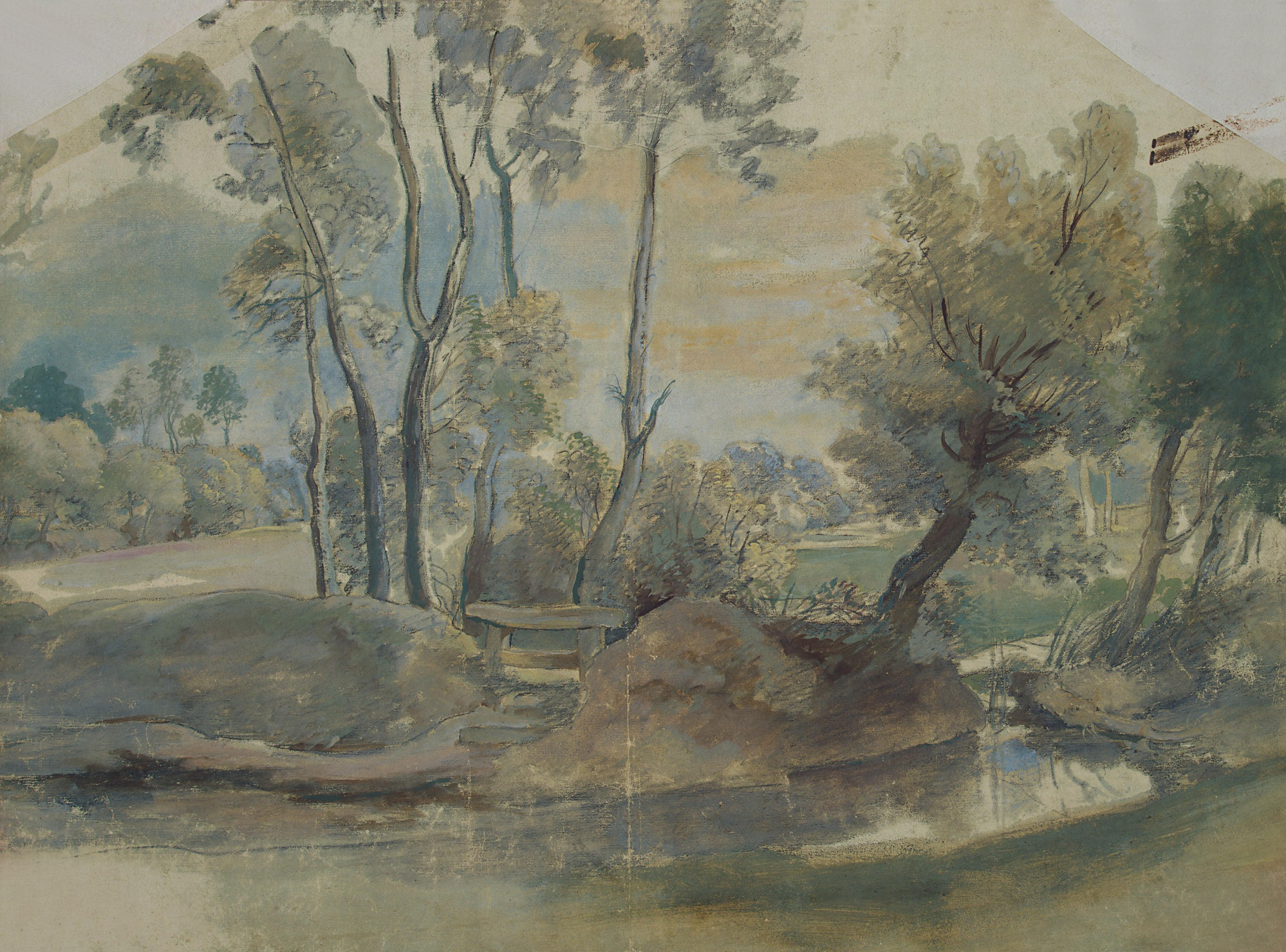
Landscape near Malines


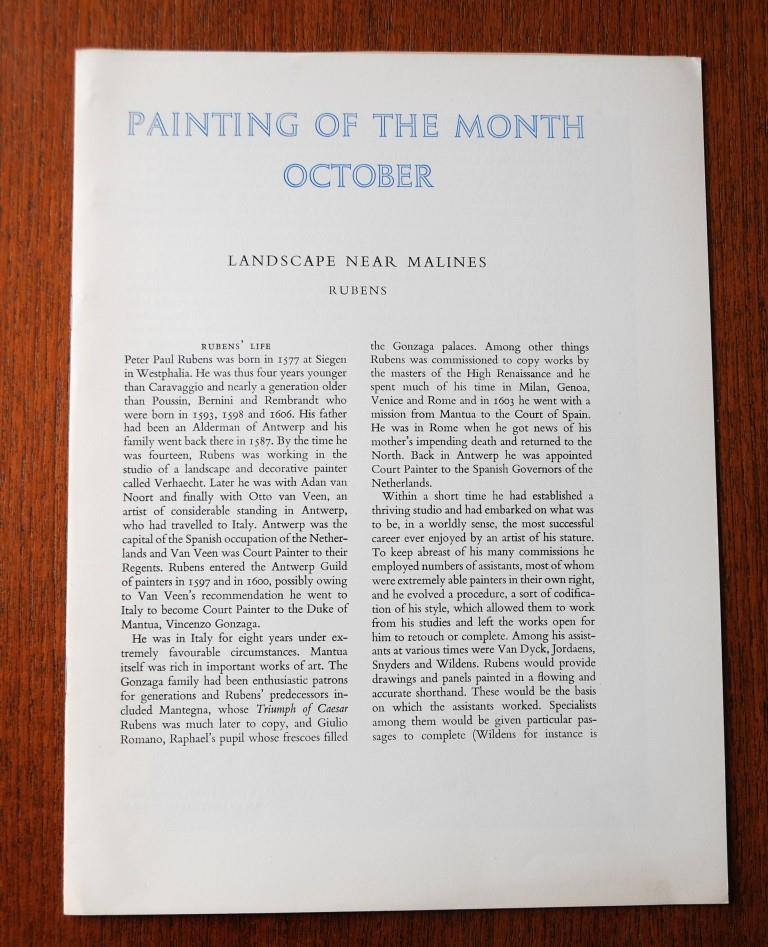
The Listener magazine, founded by John Reith as a cultural supplement to the BBC's Radio Times, folded in 1991.  I think I remember some sadness when it ended, but it doesn't seem to have been much missed.  'It gradually declined after 1960 as British society changed, the BBC became more plural, and other sources of information became more readily available' (Wikipedia).  There is a digital archive but, perhaps surprisingly for a Reithian product, it is not freely accessible to the public.  Back in the early sixties, the Listener featured essays on art, first broadcast as part of a Home Service series called 'Painting of the Month'.  In each programme, an art expert would discuss in an accessible way a work that could be found in a British museum.  The aim was 'to contribute to the listener's understanding of what the artist is trying to convey, and in this way to increase his enjoyment of painting.'  In addition to the programmes and Listener articles, you could collect separate illustrated supplements each month with notes on the paintings, and keep them in special folders.  My parents still have complete sets of these and the accompanying Listener articles for four years, covering 1962-5.  The example above is for October 1962, when Andrew Forge discussed a landscape by Rubens which hangs in Birmingham University's Barber Institute of Fine Arts.

Peter Paul Rubens, Landscape near Malines, 1630s
See The Barber Insitute, where it is now called A Landscape in Flanders 

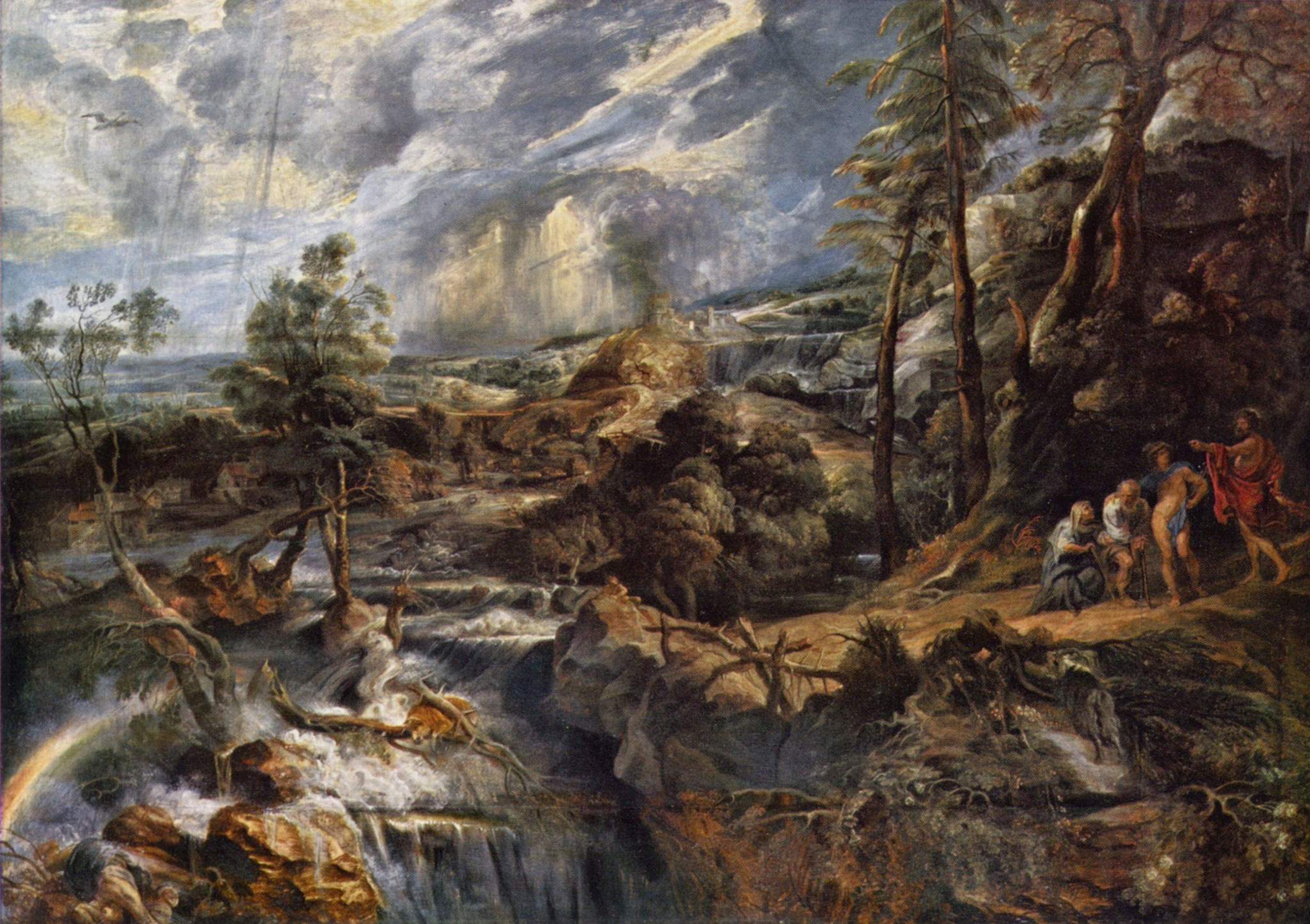
The talk on this painting sets it in the context of the great allegories and mythological scenes for which Rubens was famous, and spends some time discussing two of his more famous landscapes.  'The Rainbow Landscape and its great companion the Chateau de Steen in the National Gallery are in a sense no less public utterances than Rubens' figure pieces.'  However, these late works do convey more of a feel for his surroundings than was evident in Rubens' earlier compositions.  Mr Forge (as The Listener calls him) describes the Rainbow Landscape, for all its drama, as inconsistent in its design.  It is only the distant part that looks real - 'here all the busyness of separate incidents is resolved: everything is unified and calm.  Arrived here, one feels suddenly released - no longer tied to categories of things and no longer involved in watching events.'  And it is just this quality that we find in Landscape near Malines.  'The whole landscape turns in front of us, not with the coiling artifice of the earlier pictures but with the simple single unfolding that our own movement brings to landscape.'

Peter Paul Rubens, Rainbow Landscape, c. 1636
Source: Wikimedia Commons 

Over the course of 1962 Andrew Forge discussed two more landscapes, Constable's Leaping Horse and Matisse's Tree near Trivaux Pond.  Other speakers did three programmes each on still life, figure painting and portraits.  In 1963 the entire series was devoted to Renaissance art, which meant landscape was only touched upon, e.g. in Bryan Robertson's talk on Leonardo's The Virgin of the Rocks.  I have to admit to being fascinated by some of the advertisements in the old Listener magazines - turning from Leonardo you come to a full page ad for the British Iron and Steel Federation ('Britain needs more homes fast.  Steel shows the way in multi-story flats...')   In 1964 the series had twice as many paintings and included landscapes by Canaletto and Turner.  In 1965 the focus was on British art and there were landscapes by Gainsborough, Crome, Constable and Turner.  Perhaps I will draw on some of these essays in future.

I can't resist a list, especially a chronological one, so I was interested to see in the introduction to the 1962 series a table of 'Some Important Paintings in Europe in the Four Categories covered by the Talks.'  There are sixty in the landscape list, beginning with Lorenzetti's Good and Bad Government (which I wrote about here nine years ago) and ending with the Matisse I mentioned above.  Nothing more recent than Matisse and only five on the list by artists born in the nineteenth century.  This was the BBC that would soon commission Civilisation so the skew towards Old Masters is not surprising (nearly half the artists on the landscape list were born before 1500).  There is no mention of Caspar David Friedrich - as I have noted here before, he was barely known in Britain before the 1970s.  Here are the works on this list I have featured here before - just a fraction of them, because even though this is my 996th post on Some Landscapes, I have only scratched the surface of the history of landscape art.

Sunday, November 23, 2014

Watermeadows at Salisbury

John Constable,  Landscape with goatherd and goats, 1823
Source for all images: Wikimedia Commons

The V&A's Constable: The Making of Master exhibition provides a fascinating survey of the way Constable was influenced by other artists throughout his career.  He admired the early Gainsborough and it is easy to see why: the Landscape with Pool (1745-6) which Constable would have seen in Ipswich is absolutely exquisite.  Rubens was another stimulus: Constable's Moonlit Landscape with Hadleigh Castle uses effects he took from Rubens' Landscape by Moonlight.  I was fascinated by another Rubens in the show, Summer, with its sunlit plain and turquoise distances (Mrs Plinius dismissed it as "garish").  Also on display are direct copies of seventeenth century masters - the 'facsimile' of a Claude painting (above), and the version (below) of a Ruisdael winter scene owned by Sir Robert Peel, who insisted that Constable include a small dog to distinguish it from the original (I wonder which version is worth more now?)  This added dog inevitably reminded me of the cruise missiles inserted by Peter Kennard into his 1980 version of Constable's The Haywain, a work now owned by the Tate.

John Constable, A winter landscape with figures on a path,
a footbridge and windmills beyond, 1832
  Inscribed on the stretcher 'Copied from the Original Picture by Ruisdael in the possession of Sir Robt Peel Bt by me John Constable RA at Hampstead Sep. 1832 P.S. color (...) Dog added (...) only (...) Size of the Original (...) and Showed this pictures to Dear John Dunthrone Octr 30 1832 (...) this was the last time I (...)' and further inscribed 'Poor J Dunthorne died on Friday (all Saints) the 2d of November. 1832-at 4 o clock in the afternoon Aged 34 years.'

Constable was also interested in the methods and advice of earlier artists.  The exhibition juxtaposes Twenty Studies of Skies after Alexander Cozens (1823) with a copy of Cozens' own examples.  Constable drew these at Coleorton Hall, home of the great collector Sir George Beaumont, where (as I read on the NGA site) Constable 'also studied Cozens’s list of twenty-seven types of ‘Circumstance’ in nature, consisting of accidents (wind, rain, storm etc.), seasons (spring, autumn etc.) and characters (time of day such as ‘rising-sun’, ‘setting-sun’, and ‘close of day’'.  There is something both seductive and reductive about the idea that landscape can be classified in this way, like the tags used to label internet images.  Constable also took heed of Leonardo's advice on a means of achieving accurate perspective whilst out sketching directly from nature, a method demonstrated in this exhibition with a drawing for Watermeadows at Salisbury.
'Take a glass as large as your paper, fasten it well between your eye and the object you mean to draw, and fixing your head in a frame (in such a manner as not to be able to move it) at the distance of two feet from the glass; shut one eye, and draw with a pencil accurately upon the glass all that you see through it. After that, trace upon paper what you have drawn on the glass, which tracing you may paint at pleasure, observing the aerial perspective.' - Leonardo da Vinci - A Treatise on Painting
John Constable, Watermeadows at Salisbury, 1820 or 1829

The most interesting room in this excellent exhibition is the least colourful, devoted to Constable's collection of prints.  As the curators explain, over his career Constable amassed '59 oil paintings by ‘Old and Modern Masters’ and over 5000 prints, 250 drawings, 37 books of prints and 39 framed prints and drawings.'  This enthusiasm reminds me of Van Gogh, whose letters vividly convey his pleasure in acquiring prints (and also photographic reproductions, an option not yet available to Constable).  The small selection of Constable's collection displayed at the V&A amounts to a history of Western landscape art in its diverse forms: Dürer, Titian, Claude, Rubens, Rembrandt, Rosa, Waterloo.  It was only a few years ago that I too would need to have owned a reproduction of one of these images to study it here in the comfort of my home.  Now they are available to me instantly wherever my phone can get a signal.

Google Image Search: Rembrandt's The Three Trees (1643),
an etching owned by Constable.


Postscript

Earlier this week, at the LRB bookshop event mentioned in my last post, I met Chris from pastoral punk duo Way Through, who told me that they had been in Constable Country this summer for a Field Broadcast project called Scene on a Navigable River.  As part of this they reworked the track 'Dedham Vale' which appeared on their 2013 album Clapper Is Still.  Field Broadcast is 'a live digital broadcasting platform led by artists Rebecca Birch and Rob Smith. After downloading a special Field Broadcast app, the software waits quietly until the artist’s work is ready for transmission, when a live video stream opens unannounced on the recipient’s computer, tablet or mobile phone desktop.'  I am now imagining what would have happened if Way Through's dissonant music had suddenly activated while I was in an important meeting - I suppose this element of surprise is a way of countering the sheer availability of art online.  Two hundred years ago there was only Constable, leaving his room full of prints to walk out into the landscape his paintings were in the process of 'creating' for us.  He could reproduce an old painting but in working from nature he held up a small screen of glass the size of a modern tablet device and tried to trace what he could see.  'When I sit down to make a sketch from nature,' he wrote, 'the first thing I try to do is to forget that I have ever seen a picture.' 

John Constable, Dedham Vale, 1802 

Saturday, February 22, 2014

What soever delightfull view the Eye takes pleasure in

Paul Bril, Self-Portrait, c1595-1600
Source for images: Wikimedia Commons

Edward Norgate's Miniatura; or The Art of Limning, composed probably in the late 1620s and revised two years before his death in 1650, contains an interesting early account of landscape painting.  Landscape, he writes, is 'an Art soe new in England, and soe Lately come a shore, as all the Language within our fower Seas cannot find it a Name, but a borrowed one, and that from a people that are not great Lenders but upon good Securitie, the Dutch'.  And in addition to giving us the word 'landscape', the Dutch (Flemish) provided the best examples of this new kind of art: 'viz. Paulo Brill, a very rare Master in that Art, Liveing in Trinita del Monte in Rome and his Contemporary, Adam Elshamer, termed by the Italians Diavolo per gli cose piccole [a devil for little things], Momper, Bruegel, Coningslo, and last but not least Sir Peter Rubens, a Gentleman of great parts and abilities (over and above his Pencill) and knighted by the best of Kings or Men.'

 Peter Paul Rubens, Landscape, c. 1635-40

Rubens was actually knighted twice, by both Philip IV of Spain and Charles I of England, but we can safely assume Norgate was referring to the latter since he was the King's adviser on art.  He started out as a calligrapher and limner and may have worked in the studio of Nicholas Hilliard.  Subsequently, as the editors of Art in Theory explain, 'he was to earn his living as a cultured civil servant' and became a herald at the College of Arms.  His knowledge of Flemish landscape painting would have come partly from visits to the Low Countries on behalf of the King and the Earl of Arundel, who were each building up great art collections.  Norgate defined 'landscape' as 'nothing but a picture of Gli belle Vedute, or beautifull prospect of Feilds, Cities, Rivers, Castles, Mountaines, Trees or what soever delightfull view the Eye takes pleasure in.'  The examples he gives suggest a taste for what later writers would see as aspects of the Sublime: inaccessible mountains, precipices and 'Torrents about the Alpes that with a roaring noise make hast to breake their necks from those fearfull Rocks into the Sea'.  In earlier times such scenes had been used only to set off the figures in history painting or in 'filling up the empty Corners'.  But this new art, though 'a Noveltie', was 'yet a good one, that to the Inventors and Professors hath brought honour and profit.' 

 Joos de Momper, Rocky Landscape, c 1610-30

I will conclude here with the story Norgate says he heard abroad about the creation of the very first independent landscape painting:
'A Gentleman of Antwerpe being a great Liefhebber [Lover of Art] returning from a long Journey he had made about the Countrey of Liege and Forrest of Ardenna, comes to visit his old friend, an ingenious painter of that Citie, whose House and Company he useually frequented. The Painter he finds at his Easill - at worke - which he very dilligently intends, while his newcome friend, walking by, recountes the adventures of his long Journey, and with all what Cities he saw, what beautiful prospects he beheld in a Country of a strange Scitiation, full of Alpine Rocks, old Castle, and extrordinary buildings &c. With which relation (growing long) the prompt and ready Painter was soe delighted as, unregarded by his walking friend, he layes by his worke, and on a new Table begins to paint what the other spake, describing his description in a more legible and lasting Character then the others words. In short, by that time the Gentleman had ended his long Discourse, the Painter had brought his worke to that perfecton, as the Gentleman at parting, by chance casting his eye that way, was astonisht with wonder, to see those places and that Countrey soe lively exprest by the Painter as if hee had seene with his eyes or bene his Companion in the Journey.'
Adam Elsheimer, Landscape with Wayfarer, unknown date

Friday, January 08, 2010

Rainbows, showers, partial gleams of sunshine


Peter Paul Rubens, Philemon and Baucis, c1630

In 1822 William Hazlitt compared Rubens with Claude: 'I imagine that Rubens's landscapes are picturesque: Claude's are ideal. Rubens is always in extremes; Claude in the middle. Rubens carries some one peculiar quality or feature of nature to the utmost verge of probability: Claude balances and harmonises different forms and masses with laboured delicacy, so that nothing falls short, no one thing overpowers another. Rainbows, showers, partial gleams of sunshine, moonlight, are the means with which Rubens produces his most gorgeous and enchanting effects: there are neither rainbows, nor showers, nor sudden bursts of sunshine, nor glittering moonbeams in Claude. He is all softness and proportion: the other is all spirit and brilliant excess. The two sides (for example) of one of Claude's landscapes balance one another, as in a scale of beauty: in Rubens the several objects are grouped and thrown together with capricious wantonness. Claude has more repose: Rubens more gaiety and extravagance.'


Claude Lorraine, Landscape with Acis and Galatea, 1657

According to Kenneth Clark, 'no great painter ever lived so completely within his resources as Claude.  Unlike such prodigals as Rubens, his pictures always suggest a tactful and far-sighted economy.'  In Landscape into Art, Clark praises the earlier writing on Claude of Hazlitt and of Roger Fry, whose essay on the artist appeared in the Burlington Magazine in 1907.  Fry also praised Claude (rather faintly), whilst comparing him with more vital, colourful artists and writers.  For example, he says that 'Robert Bridges, in his essay on Keats, very aptly describes for literature the kind of beauty which we find in Shakespeare : "the power of concentrating all the far-reaching resources of language on one point, so that a single and apparently effortless expression rejoices the aesthetic imagination at the moment when it is most expectant and exacting." That, ceteris paribus, applies admirably to certain kinds of design. It corresponds to the nervous touch of a Pollajuolo or a Rembrandt. But Claude's line is almost nerveless and dull. Even when it is most rapid and free it never surprises us by any intimate revelation of character, any summary indications of the central truth. But it has a certain inexpressive beauty of its own. It is never elegant, never florid, and, above all, never has any ostentation of cleverness.'