Showing posts with label William Morris. Show all posts

Saturday, October 18, 2025

Lovely is the hillside


It could be said that a landscape view provides a crucial turning point in Njál's saga. Gunnar, the reluctant warrior, is drawn into a cycle of violence which leads the Althing assembly to order him to go abroad for three years. Gunnar's friend, the wise Njál, warns him not to break this agreement and Gunnar promises not to. But as Gunnar is about to sail away from Iceland, the site of his farm makes him realise he cannot bear to depart. We know this will lead to his killing, which makes the scene all the more poignant. 
‘They rode towards the Markarfljot river, and then Gunnar's horse slipped, and he sprang from the saddle. He happened to be facing the hillside and the farm at Hlidarendi, and spoke: “Lovely is the hillside - never has it seemed so lovely to me as now, with its pale fields and mown meadows, and I will ride back home and not leave.”’ 

Another way in which the saga relates to landscape is through the places that became known for their association with the story, such as Bergþórshvoll, the farm where Njál himself becomes the victim of an escalating blood feud and is burned alive with his family. I have only been to Iceland once and had no time to visit these places, but was aware as we crossed the Markarfljot river in a minibus on our way to Vik that we had been passing through Njál Country. As I've mentioned before, Fiona MacCarthy’s William Morris biography describes his journey to Iceland where he delighted in encountering connections with the saga. 

'Here was Flosi's Hollow, the place where he and the hundred Burners tethered their horses before firing Njál's house. There was the ditch into which Kári Sölmundarson leapt, to douse himself, after leaping from the building in his blazing clothes. And nearby was the slope where he lay down to recover. They were told by the farmer who guided them around that, only recently, in the excavation of a site for a new parlour, a bed of ashes had been found buried deep in the ground.’

The unknown author of Njál's saga was, as translator Robert Cook says, fascinated by law, and many important 'courtroom' scenes take place at Thingvellir (Þingvellir). Towards the end of the story there is a legal battle (somewhat tedious) followed by an actual battle, shockingly taking place at the Althing, with men fleeing for safety across the Oxara river and hoping to reach shelter in the Almannagja gorge. This gorge is the meeting point of the Eurasian and North American tectonic plates and one of the most spectacular landscapes I have ever seen. After the battle, the two sides are reconciled at the Law Rock, the precise location of which is no longer known, because the geography of the rift valley has not been stable over the course of a thousand years. 

Almannagjá photographed by me in 2019

Sunday, September 09, 2018

The road plunged at once into a beautiful wood


Because News From Nowhere is a dream vision of the future I have found myself wondering sometimes if certain details I recall are really in it, or whether I dreamed them myself.  After a trip to Hammersmith last weekend, when we walked past William Morris's old house on the Thames, I had an urge to go back to the text, to check whether he really had name-checked Stoke Newington, the part of London where I live.  In Morris's future London, I recollected, it was possible to walk all the way here from Hammersmith along a forest path.  And indeed it was as I remembered it - the description comes in Chapter 5, which begins with the narrator at Hammersmith Broadway (now a shopping centre from which the Thames can be reached only by negotiating a complex system of noisy roads round the Hammersmith Flyover).  'Past the Broadway there were fewer houses on either side.  We presently crossed a pretty little brook that ran across a piece of land dotted over with tree...'  Presently they reach Kensington, where the urban woodland begins.
"People are apt to gather here rather thick, for they like the romance of the wood; and naturalists haunt it, too; for it is a wild spot even here, what there is of it; for it does not go far to the south: it goes from here northward and west right over Paddington and a little way down Notting Hill: thence it runs north-east to Primrose Hill, and so on; rather a narrow strip of it gets through Kingsland to Stoke-Newington and Clapton, where it spreads out along the heights above the Lea marshes; on the other side of which, as you know, is Epping Forest holding out a hand to it..."
They walk on and
'The road plunged at once into a beautiful wood spreading out on either side, but obviously much further on the north side, where even the oaks and sweet chestnuts were of a good growth; while the quicker-growing trees (amongst which I thought the planes and sycamores too numerous) were very big and fine-grown.
'It was exceedingly pleasant in the dappled shadow, for the day was growing as hot as need be, and the coolness and shade soothed my excited mind into a condition of dreamy pleasure, so that I felt as if I should like to go on for ever through that balmy freshness.  My companion seemed to share in my feelings, and let the horse go slower and slower as he sat inhaling the green forest scents, chief amongst which was the smell of the trodden bracken near the wayside...'
A constant delight in the natural world is central to life in this future London.  As Fiona MacCarthy writes in her biography of Morris, there is no real dividing line between country and town life. 'Morris's visionary landscape is both decorous and lavish, mysterious and homely, an extraordinary and deeply imagined image of urban possibility. We can see its effects as the Garden Cities burgeoned early on in the next century...'   The narrator of News From Nowhere eventually leaves London for a journey up the river by boat, arriving at an old house resembling Kelmscott Manor, Morris's home in Oxfordshire.  Here the dream has to end and after a period of darkness he finds himself back in 'dingy Hammersmith.'  We left Hammersmith in bright sunshine and walked along the Thames Path and over the bridge, eventually reaching the Wetland Centre, with its otters and sand martins and dragonflies.  It is almost possible there to imagine a city partially reclaimed for nature.  Meanwhile, News from Nowhere continues to inspire readers across the world - I read just yesterday that Korean artists Moon Kyungwon and Jeon Joonho will be using the title for a new exhibition, coming to Tate Liverpool later this year.

Dante Gabriel Rosetti, Water Willow, 1871
Jane Morris with Kelmscott Manor in the background

Friday, October 09, 2015

An eagle, a mountain, a ship

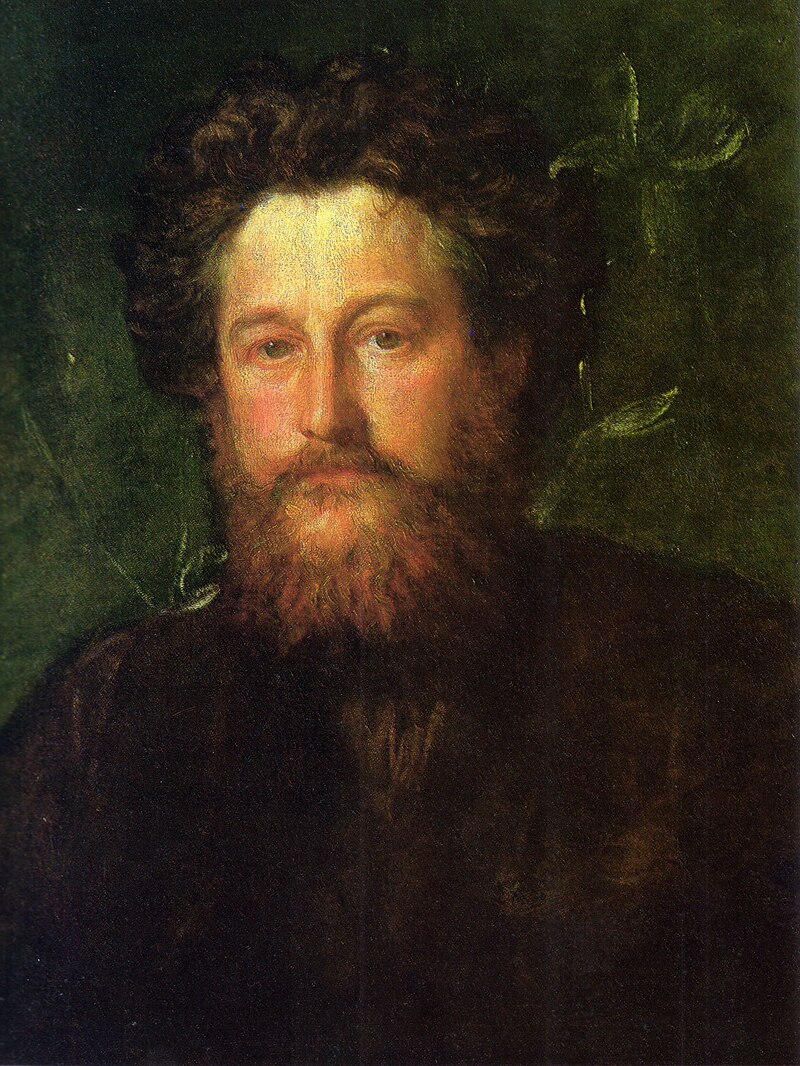
George Frederic Watts, Portrait of William Morris, 1870

When, in the summer of 1996, the V&A held an exhibition to mark the centenary of the death of William Morris, it seemed rather out of tune with the times - Cool Britannia, the YBAs and all that.  This was years before Jeremy Deller used the heroic figure of Morris in his Venice Biennale exhibition and then juxtaposed the output of Morris and his company with Andy Warhol and The Factory.   Making my way round that V&A exhibition, I felt rather pleased and vindicated when I spotted Brett Anderson from Suede peering into a display case just in front of me.  Perhaps Jeremy Deller was there too, unknown to me then (as The Guardian explained, he 'was of the same generation as Damien Hirst and the YBAs, went to the same parties, but never made any money'.)  Now it occurs to me that perhaps it was Jeremy Deller I saw, as he does bear a certain resemblance to Brett Anderson.  Writing this I am painfully aware that 'seeing Brett Anderson' has become what I most remember about the exhibition, despite having enjoyed it and come home with the catalogue.  I probably knew at the time that this moment was something that would unavoidably 'strengthen into memory'...
— Getting clearer now as it wears

The worn-down landscape.  Torn and bald and filled.

You know what will strengthen into memory: an eagle, a mountain, a ship.

As a place becomes somewhere you are starting to remember, it empties out and becomes more absolute.

It becomes the map.

Is it after all you who studies the map?
Lavinia Greenlaw, Questions of Travel: William Morris in Iceland
The Map: William Morris's 1871 Journey to Iceland
There is a full size version at the William Morris Archive

In her book Questions of Travel, Lavinia Greenlaw extracts particular phrases in William Morris's Icelandic Journal and uses them to formulate brief observations on the nature of journeys.  The examples above are also questions of landscape: how we regard it, how we remember it afterwards.  They were prompted by the page in which Morris describes a ride across the plain of Helgafell:
.... The mountains we look back on, toothed and jagged in an indescribable but well-remembered manner, are very noble and solemn. As we rode along the winding path here we saw a strange sight: a huge eagle quite within gunshot of us, and not caring at all for man, flew across and across our path, always followed by a raven that seemed teazing and buffeting him: this was the first eagle I had ever seen free and on the wing, and it was a glorious sight, no less; the curves of his flight, as he swept close by us, with every pen of his wings clear against the sky was something not to be forgotten. Out at sea too we saw a brigantine pitching about in what I thought must be a rough sea enough. The day has been much like yesterday throughout, and is getting clearer now as it wears.
Edward Burne Jones, William Morris in Iceland

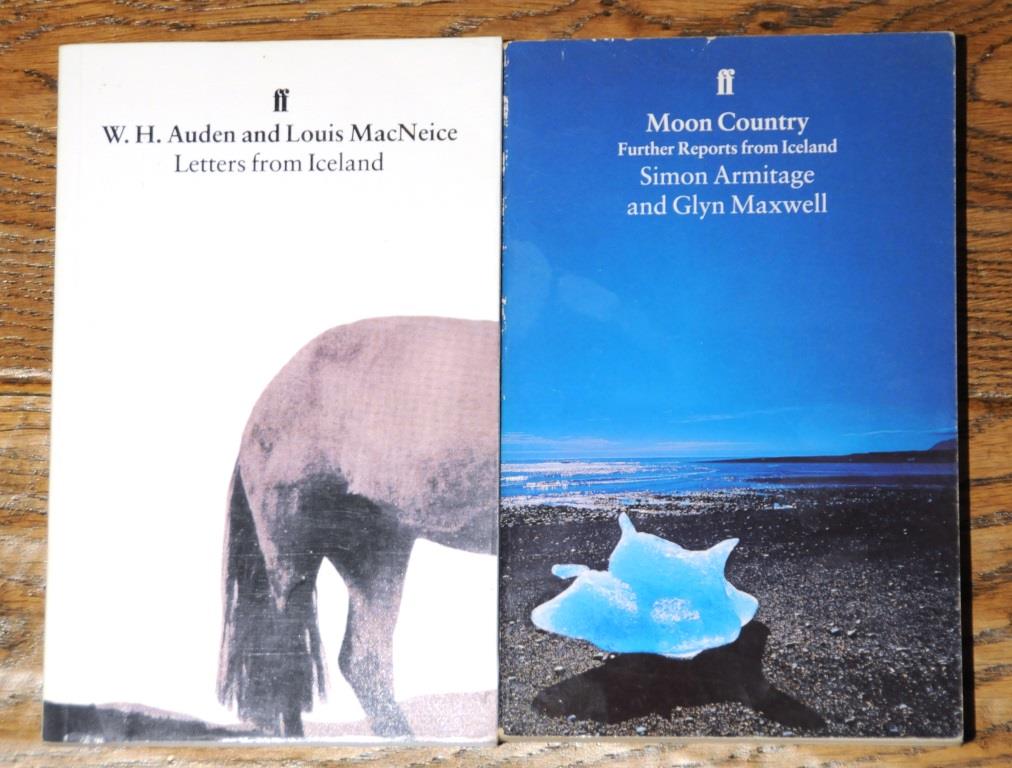
When I picked up Questions of Travel (one of those appealing little hardbacks published by Notting Hill Editions), I recognised the title as a reference to the Elizabeth Bishop poem, but was expecting an account of a journey in the footsteps of William Morris.  I was probably thinking of Moon Country (1996) in which Simon Armitage and Glyn Maxwell travelled to Iceland in emulation of Auden and MacNiece.  However Lavinia Greenlaw says she was not on the trail of an earlier poet: 'I didn't go to Iceland because of Morris but, like him, because of my idea of the place.'  Morris, nonetheless, was very much inspired to travel by his reading - something that comes over clearly in the Iceland chapter of Fiona MacCarthy's wonderful 1994 Morris biography.  She describes him as 'certainly the first Englishman in Iceland who arrived with such a knowledge of its language and literature'.  Shortly after leaving Rejkjavik he was already noting the locations of Njáls saga and towards the end of the trip he tried out the hot-spring bath beside the house of Snorri Sturluson.  Helgafell is where the Laxdœla saga's extraordinary heroine Guðrún Ósvífursdóttir lived and was buried.  Morris also described this 'terrible place' in a letter home to his wife Janey.  His first impression was of 'a great sea of terribly inky mountains tossing about' but, he continued, 'there has been a most wonderful sunset this evening that turned them golden.'


William Morris is quoted in Letters from Iceland and mentioned in Moon Country: at one point Armitage and Maxwell add their names to a visitor's book Morris had signed.  Shortly afterwards they find a piano Auden and MacNiece had played and sit down to attempt 'the one song they both knew, 'Perfect Day' by Lou Reed.'  In 1936, Auden had complained about the sameness of Icelandic music but 'got some gramophone records of more primitive local music, including an amazing one of a farmer and two children who yell as if they were at a football match.'  Simon Armitage brought his own supply of tapes, including Talking Heads, The Fall, The Smiths and, naturally, Björk.  Lavinia Greenlaw is reticent in the introduction to Questions of Travel about her own experiences of Iceland but one might guess, based on her extensive writings about music, that she took a pretty fine selection on the iPod.  Back in 1871, William Morris had to be happy with what music he encountered on the way.  One morning a 'little maiden' played a langspil - the ancient Icelandic fiddle - for him, 'but it was sadly out of tune.'  
   

The Icelandic Journey has itself now been turned into music: a composition for chorus and orchestra, Earthly Paradise, by Ian McQueen.  Fiona MacCarthy wrote about in an article for The Guardian that also mentions Lavinia Greenlaw's then work-in-progress.  Morris's original poem 'The Earthly Paradise' 'was the work that brought him real fame. In this poem he develops one of his great themes: the ruination of the land. Morris had been watching with increasing horror the rampant industrialisation of Britain and the damage caused to the environment by uncontrolled factory production: poisoned air, polluted rivers, tracts of industrial waste. Iceland, by contrast, was purity itself, and his travels through the mountains braced him and inspired him for the years of environmental campaigning ahead.'  MacCarthy concludes her piece by wondering why it is that Morris retains his appeal to new generations of admirers.  'It has something to do with his peculiar, irascible, enchanting personality, still vivid in our age of triviality and blandness. At a time of endless half-truths and moral shilly-shallying, Morris's eccentric integrity shines out.'