Showing posts with label James McNeill Whistler. Show all posts

Friday, December 05, 2014

Wall of Treasures

Frans Francken II, Preziosenwand (Wall of Treasures), 1636

Detail

A whole book could be devoted to the history of landscape paintings within paintings (not a potential best seller perhaps, but I'd read it).  The art collection genre might be a place to begin - rooms crowded with paintings, not just on the walls but propped up on the floor and furniture.  The rocky mountain scene above is one of six different landscapes in the Wall of Treasures, first painted around 1610 by Frans Francken who 'may be considered the father of the genre' (Vlieghe, Flemish Art and Architecture 1585-1700).  Within a few decades, artists like Gonzales Coques and Gaspar Jacob van Opstal were doing art collection scenes whose miniature works of art were painted in by the actual artists who had created the full scale originals.  Thus the depiction of a collection was itself a collection of art works.  It makes you wonder whether any artists thought of including the gallery painting itself, anticipating its own arrival into the collection, to create a mise en abyme in which  landscape paintings would be repeated on a smaller and smaller scale ad infinitum. 

Gonzales Coques, Picture Gallery, 1671

Detail

What you are looking at here is the reproduction of a photograph of a painting of a painting of a landscape. And that last term might be broken down still further, since at this date a painting of a landscape was not really a painting of a landscape, but an imaginary construct based on observation of actual places and scenes from other paintings.  Just to the right of Francken's Wall of Treasures a 'real' tree can be glimpsed through a window, in what at first looks like a separate room until you realise it is presumably the reflection in a mirror, so that even within the world of the painting we are again only seeing the image of nature.  Galleries often have no windows, for practical reasons of course but aesthetic ones too - actual views might distract us from those the artists have projected onto rectangles of canvas.  Willem van Haecht's The Picture Gallery of Cornelis van der Geest (1628) depicts a high ceilinged room full of art and a group of connoisseurs intent on studying it, but you feel that one or two will eventually tire of this close study and wander over to the tall window visible on one side to gaze out instead on the distant green parkland.  
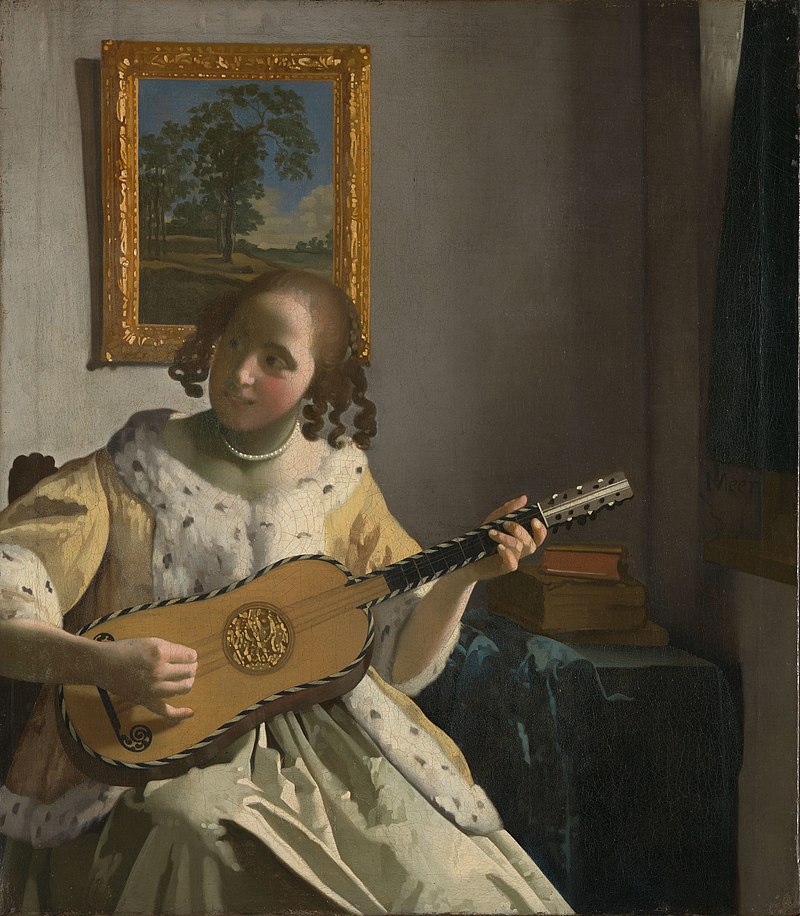
Jan Vermeer, The Guitar Player, 1672

Willem Pieterszoon Buytewech's The Merry Company, 1622-4

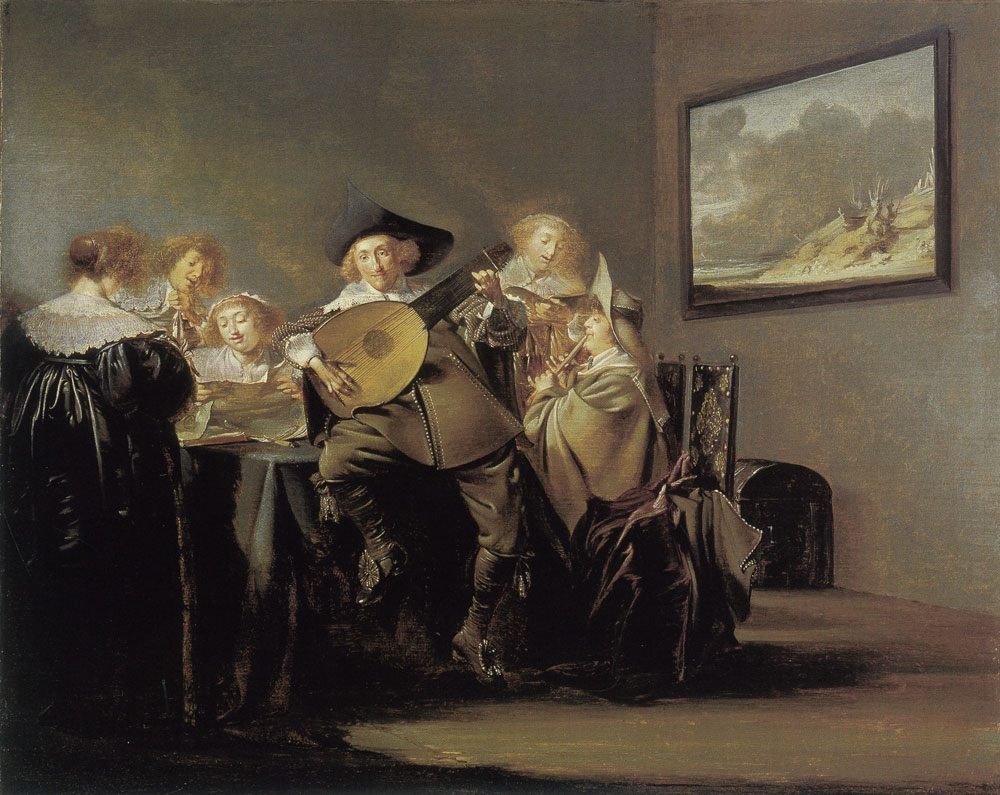
Of course landscape paintings were collected on a more modest scale throughout Europe and are a natural component of interior scenes by artists like Pieter de Hooch, Dirck Hals, Gillis van Tilborch and David Teniers.  They can be found in some famous Vermeers: The Glass of Wine, The Love Letter and The Concert, where there is both a landscape painting on the wall and a landscape painting on the inside cover of the harpsichord.  One that is especially familiar to me from visits to Kenwood House at Hampstead Heath is The Guitar Player (above) - a simple view of a tree that could be a snapshot of the heath that surrounds the house.  The tree's foliage resembles the girl's hair, a kind of compositional echo you often find in these paintings.  Another example (above) is the lacy clouds and plume-like trees in Willem Pieterszoon Buytewech's The Merry Company.  And here is Amy Powell's description of another Merry Company, painted by Pieter Codde (c. 1633):
'Lit from the upper left and painted mostly in white, grey, and sandy flesh tones, the musicians lean and look in various different directions, the men’s hats ending in sharp little points. Lit from the upper left and painted in the same sandy colours, the decaying vegetation in the landscape likewise leans in various different directions and ends in sharp little points, as if the landscape painting had somehow magically adapted itself to the attitudes of its viewers. Thin on iconography (a brewing storm at most), the landscape would have little to recommend itself as a moralising allegory if not for its funny way of resembling the merry company of musicians, who are of course happily oblivious to their inevitable disappearance.'
In this Oxford Art Journal article, Powell notes that paintings in Dutch interiors are often dark or indistinct, subordinate to the surrounding furniture.  She draws a modern parallel with Alan McCollum's Surrogate Paintings (blank images hung in groups) and his Perpetual Photos - blurry blow ups of paintings glimpsed in black and white TV movies. To these I would add the Polish artist RafaƂ Bujnowski's Framed painting (Whistler), 2002-3, which is a version of the painting hanging beside Whistler's mother repainted 'life size' so that it looks like a radically abstract landscape.  (Of course I'm conscious in writing this that I am only actually seeing it reproduced here on my screen, at a scale smaller than Whistler's).  In an earlier post here I mentioned Gerhard Richter's Details, extreme close-ups of paint that 'appear like fictitious landscapes.'  If you were to enlarge a landscape painting-within-a-painting sufficiently you would reach a scale where a new view seems to emerge in the patterns of its pigments.

James Abbot McNeill Whistler, Portrait of the Artist's Mother, 1871

Detail

Monday, December 23, 2013

Sketch of Anacapa Island

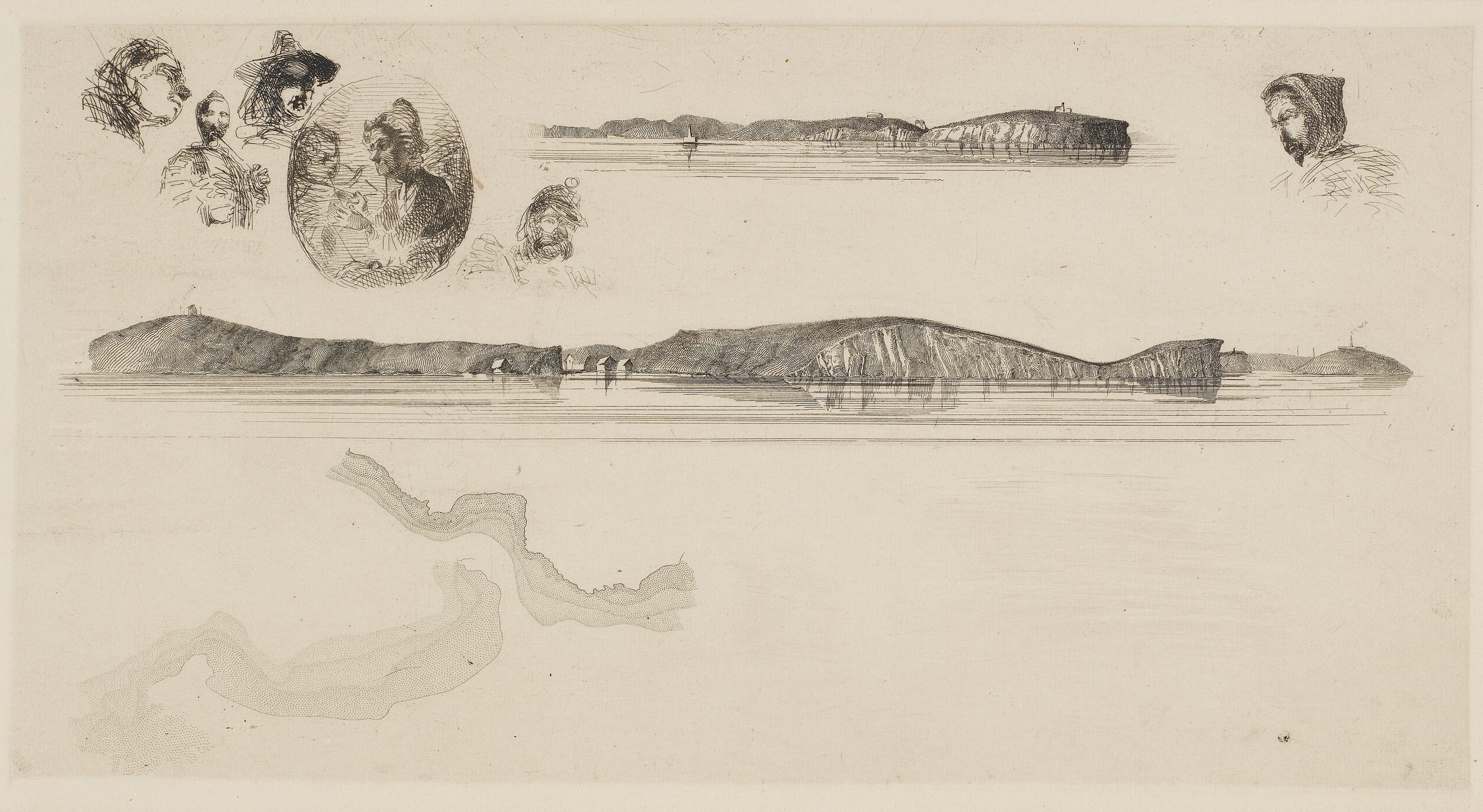
James McNeill Whistler, Sketch of Anacapa Island, 1854

It could be said that we owe those vivid etchings currently on display in the Dulwich Picture Gallery's exhibition Whistler and The Thames to the United States Coast Survey, who employed the young artist as a draftsman on $1.50 a day for two months in the winter of 1854-5.  It was there that he made his first etching under the eye of a 'kindly, genial Irishman' Mr McCoy, as John Ross Key another young artist employed by the Survey recalled years later.  Whistler at that time 'was a slender young man of medium height, with dark, curly hair and a small mustache. A Scotch cap was set well forward over his eyes, and he wore a shawl of dark-blue and green plaid thrown over his shoulders, as was the fashion of the day. He was assigned to a room on the third floor, adjoining the one where I was employed as a draftsman, and we soon became good friends. It was reported about the office that Whistler had been at West Point, and that his disinclination to obey rules, chief of which had been his lack of promptness, had led to his retirement.'  Whistler did not readily appreciate the drier aspects of his new work and so 'when, after many trials, it was plain that he would not take to map-drawing, it was suggested that he might etch the little views of entrances to harbors that were then engraved upon the lower part of coast-maps' (Recollections of Whistler, Century Magazine, April 1908).

Key describes Whistler's first experiment in etching.  'I watched him with unabated interest from the moment he began his work until he completed it, which took a day or two.  At intervals, while doing the topographical view, he paused to sketch on the upper part of the plate, the vignette of "Mrs. Partington" and "Ike," a soldier's head, a suggestion of a portrait of himself as a Spanish hidalgo, and other bits, which are the charm of the work.'  These characters, contrasting oddly with the precise landscape below them, were drawn from a humorous story by Benjamin Penhallow Shillaber, the Life and Sayings of Mrs Partington (1854).  'I have heard it stated that he lost his position because of the drawings on this plate, but there is no foundation for this report. As I have explained, this plate was merely an experiment, intended as such.'  Key later found this plate and kept it, intending to return it to Whistler when he was in London, but they never managed to meet again.  The rocky coastline with its doodled characters can be seen in engravings made from this plate; the other sketch surviving from Whistler's time with the survey, showing Anacapa Island, is reproduced above. 

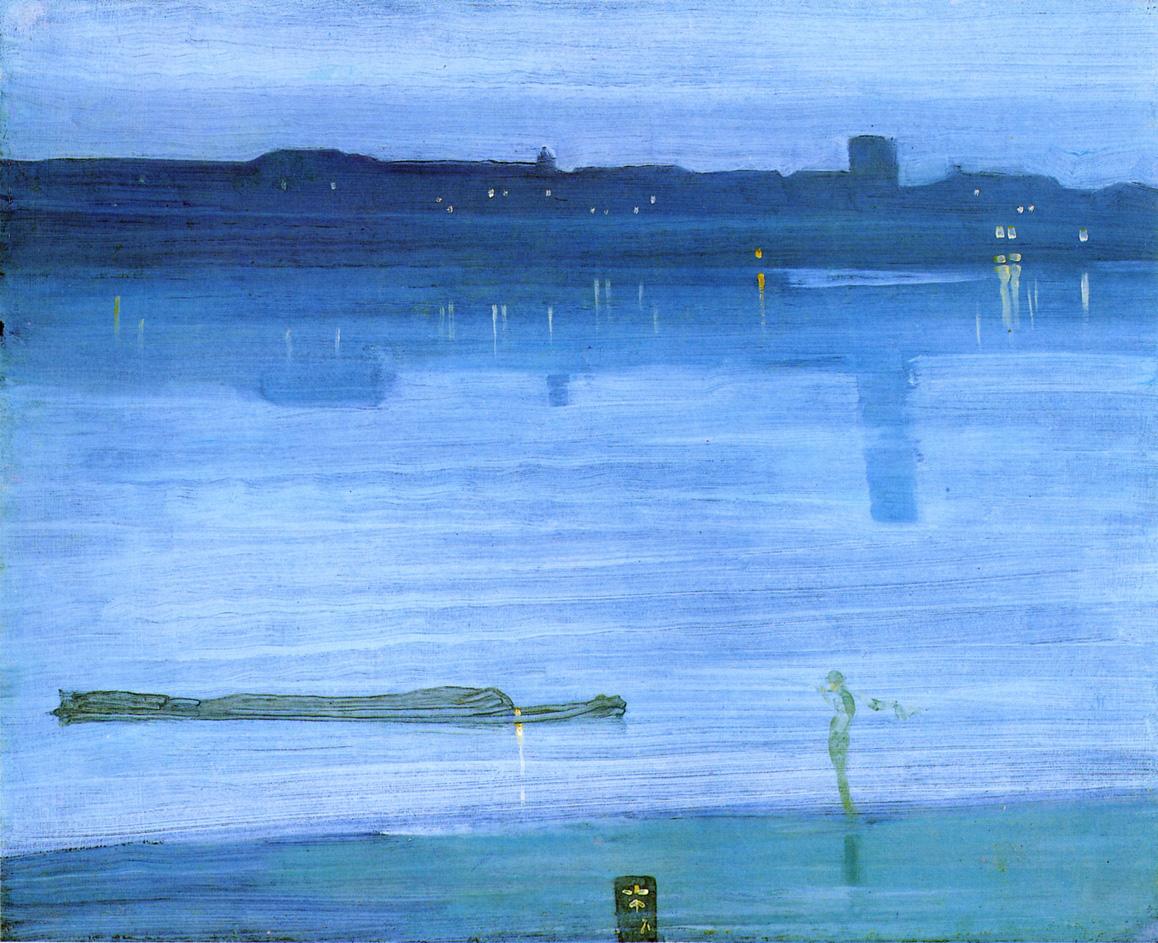
Key's recollections of Whistler are disappointingly short of good anecdotes.  'He had no bad habits, and did not smoke. His manners were quiet and sedate ... and he was not interested in young ladies.'  His evident facility in portraying coastal features was not motivated by an enthusiasm to explore and understand the surrounding landscape.  It is easy to imagine here the future painter of Nocturnes, exercises in atmosphere and colour inspired more by the Japanese prints in Whistler's room than the precise topography of the river outside.  Key remembered that 'one of the draftsmen, an old Englishman, was then in the habit of taking long walks to sketch the woods and to fish in the streams near the city. I often went with him, and did my best to persuade Whistler to join us, but he could not be induced to make the exertion. He was the most indolent young man I have ever known.'

James McNeill Whistler, Nocturne in Blue and Silver: Chelsea, 1871

Saturday, May 01, 2010

Moons of the Iapetus Ocean

'Empty peaks, silence: Among sparse stars,/ not yet flawed, it drifts.'  Tu Fu's short poem 'Full Moon' describes the strange effect of a landscape at night, 'all light'.  In David Hinton's translation the 'twice-sized moon ... scatters restless gold across waves' and it transforms the garden and house in which Tu Fu sits - 'on mats, it shines richer than silken gauze.'


Ando Hiroshige, Autumn Moon on Ishiyama Temple, c. 1834

Hiroshige used moonlight for landscapes, as above, for figure scenes like Trout Fishing in the Tamagawa in the Autumn Moonlight, and for animal paintings, such as Two Rabbits under a Full Moon.  His prints were an inspiration for Whistler's Nocturnes.  As a post about this at the Princeton blog says, 'Whistler’s Nocturne in Blue and Gold: Entrance to Southampton Water bears striking similarity to Night View of Kanazawa under the Full Moon, depicting a moonlit bay done in a binary color scheme of blue and gray.'  Whistler got the idea of calling his moonlit scenes 'nocturnes' from a Chopin-admiring patron.  He wrote ‘I can’t thank you too much for the name ‘Nocturne’ as a title for my moonlights!...You have no idea what an irritation it proves to the critics and consequent pleasure to me – besides it is really so charming and does so poetically say all that I want it to say and no more than I wish.’

Among contemporary artists, Darren Almond has shown a particular interest in the way landscapes look under a full moon.  For his Fullmoons series he has traveled the world photographing the landscape at night, using a 15 minute exposure so that they shine with a strange luminosity.  A couple of years ago he exhibited some of these photographs, taken around Britain, in a show called ‘Moons of the Iapetus Ocean’.  The title is reference to the sea between England and Scotland 400-600 million years ago; Almond's frozen moonlight takes these places outside measurable time.  All these sites take on an unreal quality and, as a Times review said, images like Fullmoon@Gairloch or Fullmoon@Wester Ross seem to show 'the mossy, ferny landscapes of bygone British folklore.'  More recently, at the Tate's Altermodern exhibition, Almond showed three full moon images that recall the poem by Tu Fu: still, misty views of the mountains of Huang Shan - 'empty peaks, silence...'

    Saturday, September 27, 2008

    On the Great Fog in London


    Walking by the Thames this morning, I found myself, like a tourist, taking this photograph, beguiled by the autumn mist that had turned the river into a Whistler painting. On the rare occasions when fog descends on London, you feel yourself walking through a city of the collective imagination. I suppose the most famous description of London fog is at the start of Bleak House:

    'Fog everywhere. Fog up the river, where it flows among green aits and meadows; fog down the river, where it rolls defiled among the tiers of shipping and the waterside pollutions of a great (and dirty) city. Fog on the Essex marshes, fog on the Kentish heights. Fog creeping into the cabooses of collier-brigs; fog lying out on the yards, and hovering in the rigging of great ships; fog drooping on the gunwales of barges and small boats. Fog in the eyes and throats of ancient Greenwich pensioners, wheezing by the firesides of their wards; fog in the stem and bowl of the afternoon pipe of the wrathful skipper, down in his close cabin; fog cruelly pinching the toes and fingers of his shivering little ’prentice boy on deck. Chance people on the bridges peeping over the parapets into a nether sky of fog, with fog all round them, as if they were up in a balloon, and hanging in the misty clouds.'

    Unlike Dickens, James Eyre Weeks has been rather lost in the mists of time. He wrote a poem 'On the Great Fog in London, December 1762' which describes the transfiguration of the city brought about by the 'black curtain drawn across the sky'. 'The trees, / as we approach 'em seem, seem like hanging webs / spun by the spider - even the great St. Paul, / with his huge dome and cupola, appears / A craggy precipice, rude, uninformed; / Or, like the ruins of an ancient fort / Upon a hill, when twilight shuts the day.' Thus the weather could reduce this city of the Enlightenment into something more primitive, and Wren's cathedral into an old 'uninformed' ruin.

    As we walked closer to Tower Bridge, the mist started to lift (as did the Bridge) and the city came more to resemble Wordsworth's, 'all bright and glittering in the smokeless air. / Never did sun more beautifully steep / In his first splendour valley, rock, or hill; / Ne'er saw I, never felt, a calm so deep! / The river glideth at his own sweet will: / Dear God! the very houses seem asleep; / And all that mighty heart is lying still!'

    Monday, February 25, 2008

    The Artist on the Seashore at Palavas


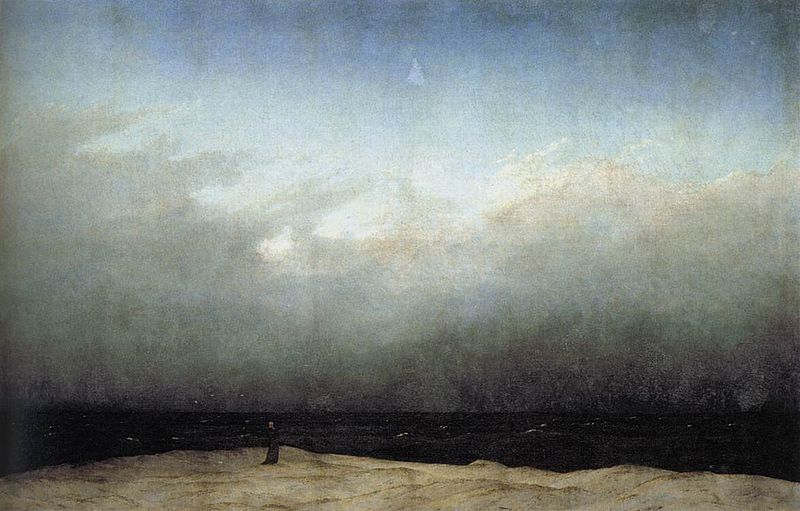
    Caspar David Friedrich, Monk by the Sea, 1809
    Source: Wikimedia Commons

    Robert Rosenblum’s book Modern Painting and the Northern Romantic Tradition: From Friedrich to Rothko traces a lineage from Monk by the Sea (1809) to Green on Blue (1956) by way of ‘Romantic’ paintings by Blake, Runge, Van Gogh, Munch, Kandinsky, Ernst, Mondrian... Rosenblum’s thesis was first elaborated in a set of lectures delivered in 1972. It is interesting to think of some of the ‘Northern’ artists from the last fifty years that a revised version of the book written today might include. Andreas Gursky perhaps? Olafur Eliasson? Peter Doig? A look through the index to this site suggests quite a few other possible names.

    And what of the other kind of non-Northern, non-Romantic artist? Rosenblum provides a couple of interesting contrasts with the aesthetic of Monk by the Sea. Gustave Courbet’s The Artist on the Seashore at Palavas (1854) combines the same basic elements as Friedrich’s painting. ‘Yet far from suggesting silent absorption into some spiritual beyond, the figure appears strangely earthy and self-assertive. It is no surprise to read Courbet’s comments on this self-portrait: “Oh sea! your voice is tremendous, but it will never succeed in drowning out the voice of fame as it shouts my name to the whole world!”’ Great stuff! For more on Courbet’s ego, see the article by John Golding in a recent New York Review of Books (the same issue has an article about blogs: “Blog writing is id writing—grandiose, dreamy, private, free-associative, infantile, sexy, petty, dirty” - hmm... I’m not sure how many of these adjectives I recognise. But it makes me think Courbet would have written an entertaining blog.)

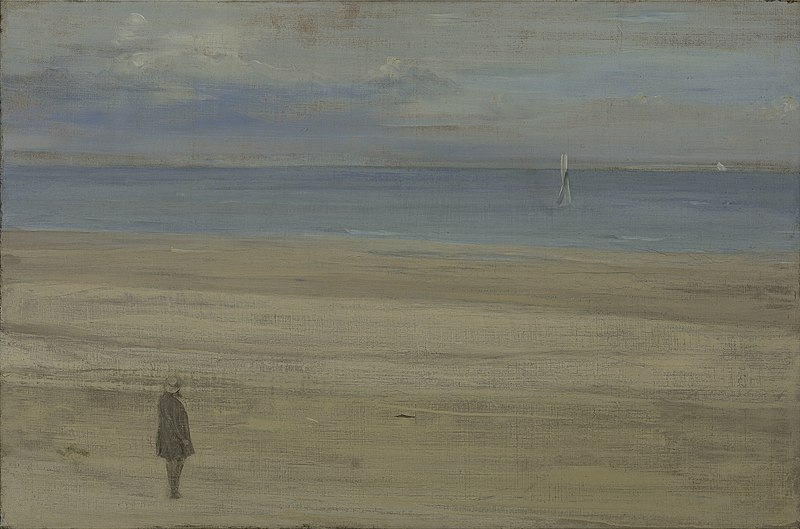
    ‘Eleven years later,’ Rosenblum continues, ‘in 1865, Whistler, by then thoroughly steeped in the art pour l’art ambience of Paris, also painted a picture of Courbet, who now stands on the beach at Trouville, once more turned to the unbroken stretch of sand and sea. This time, Courbet’s swollen ego has vanished in favour of a ghost of a figure, hardly discernible as anyone at all. Yet if the presence of this lone figure as the only human element on a deserted beach can evoke some whisper of mood, the painting nevertheless imposes itself primarily as an exquisite tour de force of muted tonalities arranged in horizontal tiers.’ Whistler originally called the painting Harmony in Blue and Silver, thus emphasising its abstract qualities over any sense of sublime mystery. And so both Courbet and Whistler, working in France, represent for Rosenblum a different way of painting landscapes to the Northern Romantic tradition.


    James Abbott McNeill Whistler, Harmony in blue and silver: Trouville (1865)
    Source: Wikimedia Commons

    In contemporary art it is no doubt possible, though perhaps not easy, to find similar comparisons. How about Francis AlĂżs versus Richard Long for example? Any others? It’s appealing to think that the ‘Northern Romantic tradition’ might still be possible to trace, partly because the whole idea seems so old-fashioned, partly because it is so easy to imagine that today’s global art world would make even such broad generalisations seem, in reality, quite implausible.

    Friday, May 11, 2007

    View of KĂłsciuszko Mound, Krakow

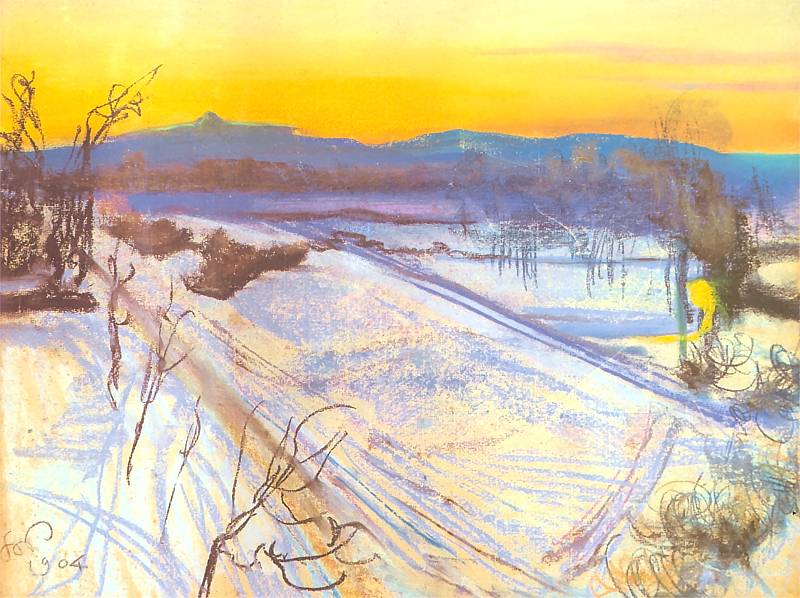
    Looking through the Polish landscape paintings in Warsaw’s Muzeum Narodowe there are examples of topography, Claudian idyll, the sublime (a dramatic Mountain Landscape with Waterfall (c1820) by Franciszek Ksawery Lampi), Impressionism, Symbolism... It’s difficult to get very excited about some of these and perhaps a Polish visitor to Britain would feel the same about paintings by, say, Richard Wilson. There seems to be more scope for unfamiliar artists to leave a distinct impression when you reach the late nineteenth century, even when they’re relatively derivative, e.g. JĂłzef Pankiewicz’s striking Whistler-style Nocturne – Swans in the Saski Garden in Warsaw at Night, 1894. I am thinking here in particular of the pastel landscapes drawn by Stanislaw Wyspianski (1869-1907), like his View of KĂłsciuszko Mound, Krakow (1905). These have a certain calm harmony but at the same time a creeping sense of unease in the slightly discordant colours and shadowy, skeletal trees; you have a sense of someone trapped in their studio and looking out with a sense of quiet desperation. 
     
    Stanislaw Wyspianski is actually much better known as a writer and ‘founder of modern Polish drama’, so has much in common with that other painter of strange landscapes, August Strindberg. The excellent Adam Mickiewicz Institute which I visited in Warsaw has an article about him. (Incidentally, among the fascinating artefacts on display at the Institute was a volume of Byron poems given with a dedication by Mickiewicz to his friend Pushkin – ah, heady times...) There is a Wyspianski museum in Krakow and an image of one of the pastel landscape views at a Katowice museum site.

     Stanislaw Wyspianski, View of KĂłsciuszko Mound, Krakow (1905)
    Source: Wikimedia Commons


    Postscript, July 2023

    We have just been to Krakow and from its royal castle, the Wawel, were able to look over the river and beyond the city centre to the distant Kósciuszko Mound (see first photograph below). Intrigued to see it up close, we took a tram and climbed a hill until we emerged at what appeared to be a nineteenth century brick fortress. Rising above its walls was the mound itself, a monument to Polish national leader Tadeusz Koƛciuszko. With its artificial shape and winding path it looks like a work of land art or something Charles Jencks might have considered for his Garden of Cosmic Speculation. As you can see below, the Ukrainian flag, yellow and blue like Wyspianski's drawing, was flying alongside two Polish ones.

    Sunday, August 06, 2006

    Hurricane before Saint Malo

    The BBC website has an enjoyable virtual exhibition, ‘Painting the Weather’, with an audio tour in which you can hear the soothingly authoritative voice of Neil MacGregor describing some of the pictures. However, the site also has some no-nonsense comments by weather forecaster, Bill Giles, which are well worth a listen. Looking at Canaletto’s Old Walton Bridge Over the Thames (1754), for example, Giles imagines himself there with his family, forecasting a rain shower on the evidence of the cloud pattern above the bridge. Whistler’s Green and Silver: The Great Sea (1899) reminds him of winter walks after a big Sunday lunch. Sometimes he is a doubtful about the artists’ meteorological accuracy: Louis-Gabriel-EugĂšne Sabey’s Hurricane before Saint Malo (1860) actually shows a storm giving “hurricane force winds” rather than an actual hurricane (these tropical revolving storms not being found off the Brittany coast).

    My favourite Bill Giles contribution is his analysis of Courbet’s L’EternitĂ© (c1865). This painting is described on the site as ‘intense and melancholy… painted over a dark ground (or underlayer) which explains its sombre tone; as Courbet himself said: ‘Nature without the sun is also dark and black. I do as the light does, I illuminate the parts that project and the picture is done’. The title (Eternity) draws our attention to the vast expanse of sea and sky, its timelessness and our own relative inconsequence.’ In splendid contrast, here’s how Bill Giles describes this brooding seascape.