Showing posts with label Gustave Courbet. Show all posts

Friday, January 22, 2016

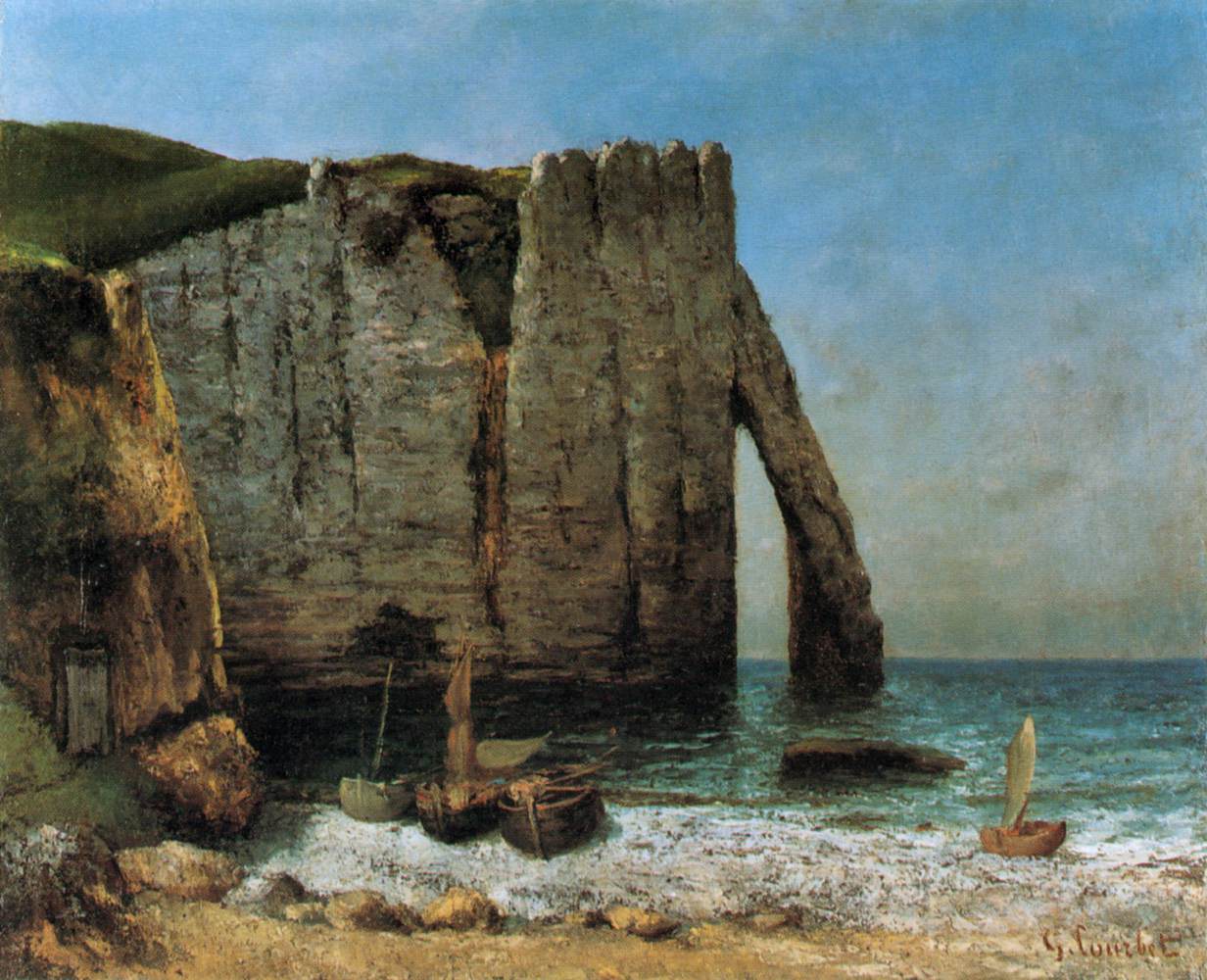
Rocks at Mouthier

Gustave Courbet, The Painter's Studio, 1855

I have been reading the new anthology of John Berger's art writing, PortraitsIt is arranged in approximate chronological order from the Chauvet cave paintings to some recent sculptures by a young Palestinian artist. Where Berger has written more than once about an artist, the pieces are spliced together and you have to look to the end of the book to see when the component parts were written.  Although there are risks of repetition in this (e.g. reading twice a story about Monet painting his wife on her death bed) it actually works rather well.  On Gustave Courbet, for example, there is a 1953 essay defending his critical reputation and concluding that socialism was expressed in his work 'by its quality of uninhibited Fraternity'.  This is followed by something written twenty-five years later, by which time a new generation of art historians had written major studies reassessing Courbet's art.  I will quote from this second piece, 'Courbet and the Jura', below.

Five hundred pages long, Portraits is a rich source of ideas and insights on a wide range of artists, all written in Berger's marvellous, clear prose.  One small gripe though: for a book about art, it has surprisingly poor black and white images.  I couldn't help comparing them with the beautiful small colour reproductions in Robert Walser's Looking at Pictures, another set of essays published last year (a book I highly recommend).  This was a deliberate choice: Berger says in the Preface that 'glossy colour reproductions in the consumerist world of today tend to reduce what they show to items in a luxury brochure for millionaires' (which may be true, but one would have more sympathy with this if Verso weren't charging £25 for the book).  In the case of Courbet though, no reproductions in book or web page or smart phone would be able to do justice to a monumental painting like A Burial at Ornans, which is nearly 8m wide and covers a whole wall in the Musée d'Orsay.

Gustave Courbet, A Burial At Ornans, 1849-50

Berger is fascinating on the geographical origins of Courbet's art. In 'Courbet and the Jura' he writes that 'the region in which a painter passes his childhood and adolescence often plays an important part in the constitution of his vision. The Thames developed Turner.  The cliffs around Le Havre were formative in the case of Monet. Corbet grew up in – and throughout his life painted and often returned to – the valley of the Loue on the western side of the Jura mountains.'  The heavy rainfall in this region sinks into the karst landscape's underground channels and gushes out powerfully as the river Loue.  'On the horizontal strata of limestone there are often marl deposits which allow grass or trees to grow on top of the rock. One sees this formation – a very green landscape, divided near the sky by a horizontal bar of grey rock – in many of Courbet's paintings, including A Burial at Ornans.' But this environment offered more than just background scenery, according to Berger it influenced the forms Courbet's paintings took.

Gustave Courbet, The Stonebreakers, 1849

  • Darkness - in paintings like The Stonebreakers there is little visible sky.  'Due to its folds, the landscape is tall; the sky is a long way off.'  In the shadowy spaces of valleys and forests light is only partial and the painter develops the eye of a hunter.  In The Painter's Studio the only light seems to emanate from the woods in the painter's canvas.  Sometimes it is as if Courbet's scenes take place underwater, where light plays tricks with perspective.
  • Water - it frequently occurs in his art (I've written here more than once about Courbet's paintings of the sea) and even when absent, 'the foreground forms are frequently reminiscent of the currents and swirls of running water.'  His objects have the brilliance of pebbles seen in a clear river. Rocks at Mouthier, colour glistening on its surface, might be a reflection in a pond.  His palette knife was like 'a stream of light passing over the broken surface of leaves, rocks, grass...'
  • Rocks - they are 'the primary configuration of this landscape.  They bestow identity, allow focus.'  Rocks do not take on a particular form and in them the painter finds something arbitrary and lawless, but at the same time irreducibly real.  Courbet, the great realist painter, painted everything as if it were a rock face, without interiority, but in amazement because 'to see, where there are no laws, is to be constantly surprised'.

Gustave Courbet, Rocks at Mouthier, c. 1855
Images from Wikimedia Commons
Sunday, August 05, 2012

Above the sea and sea-washed town

Claude Monet, Étretat, la porte d'Aval: fishing boats leaving the harbour, c1885

This post begins with Claude Monet at Étretat, a subject I've covered here before in 'The Cliffs at Etretat' and 'Agitated Sea at Etretat'.  Guy de Maupassant watched the artist in action there in 1885 and described what he was like to the readers of Paris periodical Gil Blas. 'At Étretat I often followed Monet about.  He was not so much a painter as a hunter.  He stalked on ahead, followed by his children and Madame Hoschedé, who carried his canvases, sometimes as many as five or six, representing the subject at different times of the day and with different effects.  He took them up and put them aside in turn, according to the changes in the sky.  Face to face with his subject, the painter lay in wait for the sun and shadows, capturing in a few brushstrokes the ray that fell or the cloud that passed.  I have seen him seize a glittering shadow of light on the white cliff and fix it in a flood of yellow tone which strangely rendered the surprising and fugitive effect of that elusive and dazzling brilliance.  On another occasion he took a downpour beating down on the sea into his hands, and dashed it on the canvas - and succeeded in really painting the rain as it seemed to the eye' (Bernard Denvir, The Encyclopedia of Impressionism).

 Claude Monet, Sunset at Étretat, 1883

Maupassant lived in Étretat as a child and in 1883 built himself a house there (where, the following year, he finished writing there that most enjoyable novel, Bel Ami).  Just before this return, Maupassant published a sketch in the Gaulois called 'The Englishman of Étretat'.  This described his youthful encounter with the poet Algernon Charles Swinburne at the house of 'a young Englishman of unknown origin' who was rumoured in the village to diet 'exclusively upon monkey (whether, sautéed, roasted, boiled or preserved; no matter)'.  Maupassant was invited to lunch by this eccentric individual after taking part in 'a rescue party formed for a friend of his, carried out to sea'.  The friend was Swinburne, and he proceeded to dazzle Maupassant: 'His words issued forth with a shimmering vitality, galvanised by an imagination both clear and quick, but also hypersensitive and fantastical ... The house where these two men resided was a pleasant, if peculiar abode. The walls were replete with astonishing and strange paintings, veritable expressions of insanity. For instance, if my memory serves me correctly, one watercolour depicted a pink seashell carrying afloat a human skull upon an endless sea, beneath a moon of human form. Here and there were scattered skeletal remains. Particularly of note was a flayed hand; its desiccated skin intact, blackened muscles exposed and ancient traces of blood upon the bright white bone...'

Gustave Courbet, Cliffs at Étretat, 1870 

I first came across this story in Charles Sprawson's The Haunts of the Black Masseur: The Swimmer as Hero, a wonderful book published in 1992 which seems to have been rather overshadowed in recent years by Roger Deakin's Waterlog. Iris Murdoch's review of it sounded to me then charmingly eccentric: 'On hot days in the Oxford summer my husband and I usually manage to slip into the Thames...' Sprawson refers to Iris Murdoch as 'one of the last of the English river swimmers' and twenty years ago it would have been hard to believe that a whole movement would take off and there would be an Outdoor Swimming Society (whose founder was, according to my wife, impressively outdoorsy even when they were studying at Oxford).  Swinburne's passion for wild swimming began long before he went up to Baliol.  Growing up on the Isle of Wight he would float in the sea, 'lapped in the blue waters and the languid summer tides, as though in the Aegean of his Hellenic dream-world'.  Schooldays at Eton fostered a sado-masochistic association between flogging and swimming which surfaces in his later letters: Sprawson quotes one to Lord Houghton (who had already 'corrupted Swinburne by opening up to him his vast pornographic library'), regretting that the Marquis de Sade had not been aware of the punishment to be experienced in the waves of the North Sea.  Swinburne enjoyed some 'delicious bathes in the most dangerous seas in the world' off Guernsey, having travelled there to meet his hero Victor Hugo only to find that he had left three years before.  It was with some exciting passages from Hugo's novel Toilers of the Sea that Swinburne entertained the fishermen rowing him back to safety at Étretat.

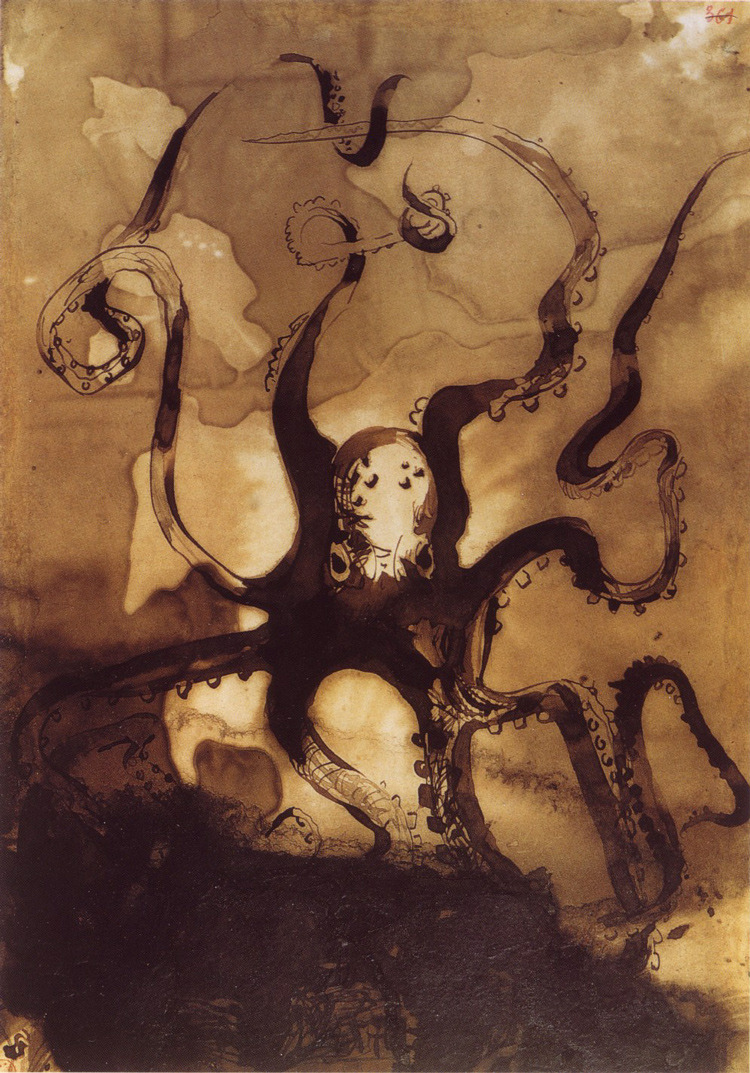
Victor Hugo, The Octopus,
a creature that appears in his novel, Toilers of the Sea, 1866

The lunch Swinburne and his strange friend, George Powell, invited Maupassant to on that memorable day is the subject of an article by Julian Barnes in the excellent Public Domain Review. You can read there fuller details of the English couple's S&M activities with monkeys and servants, based on an account Maupassant gave to Edmond de Goncourt.  Swinburne himself, by contrast, 'memorialised his time on the Normandy coast in two ways. For the rest of his life he kept the “outsize garments” (outsize because he was so tiny) in which the rescuing fishermen had dressed him. And in his 1883 collection, A Century of Roundels, he published a poem called “Past Days”:
Above the sea and sea-washed town we dwelt,
We twain together, two brief summers, free
From heed of hours as light as clouds that melt
Above the sea.
The poem is partly a lament – for the dead Powell, and for passing time; also an idyll recreating “the days we had together” among “The Norman downs with bright grey waves for belt” and the “bright small seaward towns”. It is singularly lacking in references to monkey meat or Sadeian practices.'

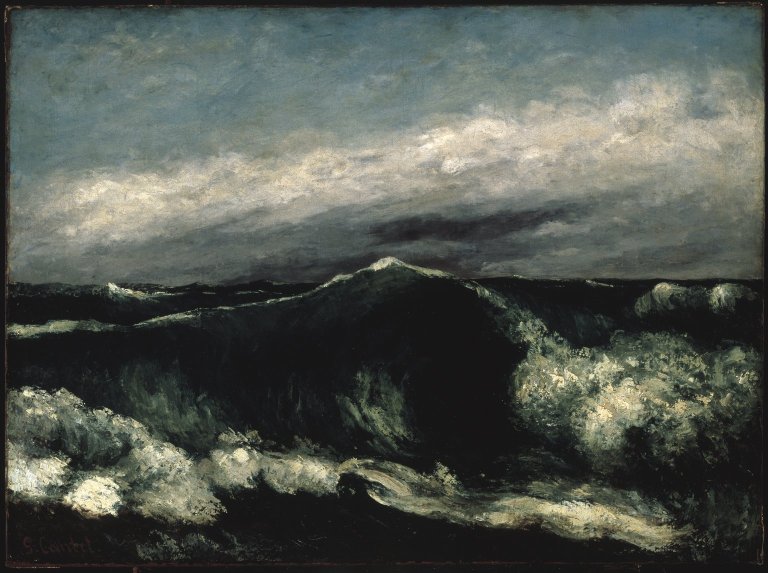
Gustave Courbet, The Wave, c. 1869
 
In 1869, a year after he helped rescue Swinburne from the waves, and long before he was an established writer ,spending time with Monet and his family, Maupassant encountered another visitor to Étretat, Gustave Courbet, and watched him at work in his studio. "In a big empty room, a huge man, corpulent and grubby, was using a kitchen knife to smear gobs of white paint on a big bare canvas. Every so often, he'd go and put his face to the window and stare at the storm. The sea came so close that it seemed to assail the house, covering it in spray and noise. The salt water beat like hail against the window panes and streamed down the walls. On the chimney a bottle of cider next to a glass half full.  From time to time Courbet went and drank a few drops, then he came back to his work.  Now, that work became The Wave, and it created quite a stir in the world."  William Feaver refers to Maupassant's description in a review entitled 'Sea Power' and notes that 'being a romantic, Courbet took the wave personally. "In her fury," he told Victor Hugo, "she reminds me of a caged monster who can devour me. One feels carried away."'

Friday, May 06, 2011

Landscape with a Natural Arch and Waterfall

Claude Lorrain, Perseus and the Discovery of Coral, c1671
(preparatory drawing for the Holkham Hall painting,
Metropolitan Museum of Art)

In Helen Langdon's catalogue for last year's Salvator Rosa exhibition she refers in her notes on his painting Landscape with a Natural Arch and Waterfall to the art history of a specific landform, the rocky arch.  These were painted more frequently after 1626, when an ancient Roman landscape painting with a rocky arch was discovered in a nymphaeum near the Barberini palace.  It was a favourite motif of Rosa's - either inland, as in the Detroit Finding of Moses, or by the sea, as in the Doria Pamphilj's Coastal Scene. In the Palazzo Pitti's Landscape with a Bridge the form of the rocky arch is echoed below by the arches of a crumbling bridge.  Peering at small online images of picturesque landscapes, as I have just been doing, it is sometimes hard to distinguish ruined architecture from natural rock formations.  Both feature in the work of Northern artists working in Italy in the seventeenth century, like Paul Bril and Jan Breughel I. Rosa was probably influenced by his fellow Neapolitan, Filippo Napoletano, who included the rocky arch in his frescoes for the Palazzo Rospigliosi Pallavicini, and by Claude Lorrain who 'worked numerous variations on it.'  It would be fascinating to write a proper history of rock arches in art, covering these imaginary scenes and later works where artists sought to paint or photgraph real examples, like the cliffs at Etretat.  We have recently had cultural histories of mountains, forests etc. and now I think it is time to focus on particular geographical features... 


Gustave Courbet, La falaise d'Étretat après l'orage, 1870
Source: Wikimedia Commons

Monday, February 25, 2008

The Artist on the Seashore at Palavas


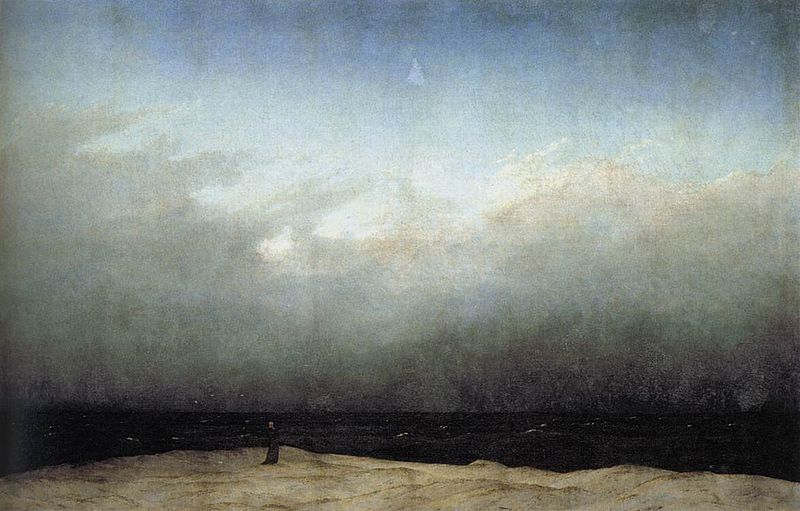
Caspar David Friedrich, Monk by the Sea, 1809
Source: Wikimedia Commons

Robert Rosenblum’s book Modern Painting and the Northern Romantic Tradition: From Friedrich to Rothko traces a lineage from Monk by the Sea (1809) to Green on Blue (1956) by way of ‘Romantic’ paintings by Blake, Runge, Van Gogh, Munch, Kandinsky, Ernst, Mondrian... Rosenblum’s thesis was first elaborated in a set of lectures delivered in 1972. It is interesting to think of some of the ‘Northern’ artists from the last fifty years that a revised version of the book written today might include. Andreas Gursky perhaps? Olafur Eliasson? Peter Doig? A look through the index to this site suggests quite a few other possible names.

And what of the other kind of non-Northern, non-Romantic artist? Rosenblum provides a couple of interesting contrasts with the aesthetic of Monk by the Sea. Gustave Courbet’s The Artist on the Seashore at Palavas (1854) combines the same basic elements as Friedrich’s painting. ‘Yet far from suggesting silent absorption into some spiritual beyond, the figure appears strangely earthy and self-assertive. It is no surprise to read Courbet’s comments on this self-portrait: “Oh sea! your voice is tremendous, but it will never succeed in drowning out the voice of fame as it shouts my name to the whole world!”’ Great stuff! For more on Courbet’s ego, see the article by John Golding in a recent New York Review of Books (the same issue has an article about blogs: “Blog writing is id writing—grandiose, dreamy, private, free-associative, infantile, sexy, petty, dirty” - hmm... I’m not sure how many of these adjectives I recognise. But it makes me think Courbet would have written an entertaining blog.)

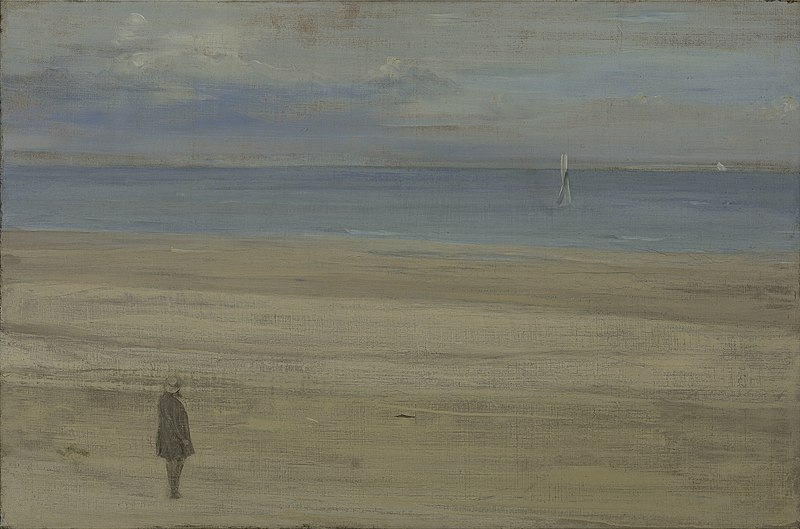
‘Eleven years later,’ Rosenblum continues, ‘in 1865, Whistler, by then thoroughly steeped in the art pour l’art ambience of Paris, also painted a picture of Courbet, who now stands on the beach at Trouville, once more turned to the unbroken stretch of sand and sea. This time, Courbet’s swollen ego has vanished in favour of a ghost of a figure, hardly discernible as anyone at all. Yet if the presence of this lone figure as the only human element on a deserted beach can evoke some whisper of mood, the painting nevertheless imposes itself primarily as an exquisite tour de force of muted tonalities arranged in horizontal tiers.’ Whistler originally called the painting Harmony in Blue and Silver, thus emphasising its abstract qualities over any sense of sublime mystery. And so both Courbet and Whistler, working in France, represent for Rosenblum a different way of painting landscapes to the Northern Romantic tradition.


James Abbott McNeill Whistler, Harmony in blue and silver: Trouville (1865)
Source: Wikimedia Commons

In contemporary art it is no doubt possible, though perhaps not easy, to find similar comparisons. How about Francis Alÿs versus Richard Long for example? Any others? It’s appealing to think that the ‘Northern Romantic tradition’ might still be possible to trace, partly because the whole idea seems so old-fashioned, partly because it is so easy to imagine that today’s global art world would make even such broad generalisations seem, in reality, quite implausible.

Tuesday, April 03, 2007

The Cliffs at Étretat

The Royal Academy’s exhibition, ‘The Unknown Monet’, generally avoids oil paintings and focuses on pastels and drawings, which form a small but interesting part of the artist’s oeuvre. The drawings are not particularly striking but there are several pastel landscapes which are worth seeing, with similar qualities to Monet’s Impressionist paintings. For example, Waterloo Bridge, Fog (1901) which is barely more than a haze of grey and turquoise, executed in pastels, is as atmospheric as the unfinished painting Charing Cross Bridge (c1900), with its curls of pink smoke that unfurl like flowers, pointing forwards to Monet’s pastel-like water lily paintings, two of which are positioned opposite it in the exhibition.
  
In 1885 Monet drew several pastel landscapes of the rocks at Etretat which have a Symbolist feel to them, enhanced by the medium and choice of colours: dove grey and fading purple. Evening light softens the rock formations and illuminates the sea. The exhibition describes Etretat, the Needle Rock and Parte d’Aval as reflecting ‘his introspective mood. This unique vertical scene framed by shadows and cloud, with the famous ‘needle’ and rock arch beyond, is sombre and slips into reverie.’ Although some of the well-known oil paintings made at Etretat resemble these pastels, others, like The Cliffs at Etretat (below) are quite different, full of the sparkling light of Impressionism.

Claude Monet, The Cliffs at Etretat, 1885
Source: Wikimedia Commons

Incidentally, Etretat is one of those landscapes that have been seen as a challenge to artists. The Royal Academy site notes that: ‘Etretat had already been painted by both Delacroix and Courbet; Monet in fact owned a Delacroix watercolour of the area. The Courbet retrospective at the Ecole des Beaux-Arts in 1882 featured a group of Etretat seascapes. Monet visited Etretat in 1883 with plans to create his own Normandy seascapes: “I reckon on doing a big canvas on the cliff of Etretat, although it’s terribly audacious of me to do that after Courbet who did it so well, but I’ll try to do it differently.”’

Sunday, August 06, 2006

Hurricane before Saint Malo

The BBC website has an enjoyable virtual exhibition, ‘Painting the Weather’, with an audio tour in which you can hear the soothingly authoritative voice of Neil MacGregor describing some of the pictures. However, the site also has some no-nonsense comments by weather forecaster, Bill Giles, which are well worth a listen. Looking at Canaletto’s Old Walton Bridge Over the Thames (1754), for example, Giles imagines himself there with his family, forecasting a rain shower on the evidence of the cloud pattern above the bridge. Whistler’s Green and Silver: The Great Sea (1899) reminds him of winter walks after a big Sunday lunch. Sometimes he is a doubtful about the artists’ meteorological accuracy: Louis-Gabriel-Eugène Sabey’s Hurricane before Saint Malo (1860) actually shows a storm giving “hurricane force winds” rather than an actual hurricane (these tropical revolving storms not being found off the Brittany coast).

My favourite Bill Giles contribution is his analysis of Courbet’s L’Eternité (c1865). This painting is described on the site as ‘intense and melancholy… painted over a dark ground (or underlayer) which explains its sombre tone; as Courbet himself said: ‘Nature without the sun is also dark and black. I do as the light does, I illuminate the parts that project and the picture is done’. The title (Eternity) draws our attention to the vast expanse of sea and sky, its timelessness and our own relative inconsequence.’ In splendid contrast, here’s how Bill Giles describes this brooding seascape.