Saturday, February 24, 2018

Jones Beach Piece


Next month a Joan Jonas retrospective is due to open at Tate Modern - you can read an interview in Tate Etc.  I should probably wait and see this before writing about her work here, but I just found the beginnings of a blog post I started years ago on her Jones Beach Piece and it got me looking online again to see what there is to be read about her work.  My original interest in Jones Beach Piece was an idea that it might have constituted a new form of landscape art, one in which the landscape is used to separate the art from the audience.  The beach was not just the setting for a performance, it was a medium through which the art had to be perceived.  The performers were deliberately situating themselves in a subordinate role to the landscape, like those small figures of shepherds in seventeenth century pastoral paintings.  Here's how she described her early outdoor performances in Interview Magazine.
'The first performance outdoors happened at Jones Beach [Jones Beach Piece, 1970]. It was based on the idea of how our perception of image and movement is altered by distance. A group of us performed a series of choreographed movements and signals with simple props such as a six-foot metal hoop, a ladder, a rope, a bag of shells, and a shovel. For instance, Susan Rothenberg, tied into the hoop, was rolled about by George Trakas and John Erdman. The audience was a quarter of a mile away. Performers stood at different distances from the audience and clapped blocks of wood together over their heads. The farther away, the greater the sound delay.
We next performed this work on the empty lots and the docks of the Lower West Side. It was called Delay Delay [1972]. We performed similar actions signaling to each other and the audience—who was situated on what is now the roof of Richard Serra’s loft building—from the farthest ends of the docks and the edges of the lots. Carol Gooden and Gordon Matta-Clark spent the entire performance painting a big circle and a line in the street below. Their dog sat nearby watching. Cars would slowly approach, slow down, and drive by carefully. During these performances, we were never interfered with. It was a different time.'
Ah, would that we could all have experienced New York City in the seventies!  That Interview interview is worth reading in full for quotes like this: "I remember Gordon Matta-Clark liked to wrestle..."


Among the more recent works Joan Jonas has made, there are two worth mentioning here which were inspired by Iceland. Volcano Saga was originally narrated by the artist but then turned into a video piece, with Tilda Swinton in the role of Guðrún from the thirteenth century Laxdaela Saga.  More recently she has developed Reanimation, a work inspired by the Halldór Laxness novel Under the Glacier.  Neither of these source books has much about Iceland's landscape, although the sites of Laxdaela Saga have become landmarks and there are some brief descriptions in Laxness.  It is hard though to imagine making art about Iceland that does not feature its glaciers, lava flows and sea cliffs, and both Jonas installations included scenes shot around the island.  You can watch Volcano Saga in the embedded clip above, and here is a description in The New Yorker of 'Reanimation.'
'What began as a lecture-performance at M.I.T., in 2010, has evolved into a multiscreen extravaganza surrounding a sculpture of dangling prismatic crystals, which sends flashes of light darting onto projections of glacial landscapes and the occasional seal, filmed in an archipelago in the Arctic Circle. Jonas also appears onscreen, drawing with black ink and with ice. The spellbinding piece is non-narrative, with no sense of beginning or end. As long as you remain in this world, Jonas seems to suggest, you’re still just passing through.'
My copies of Laxdaela Saga  - a Folio edition of the Magnusson/Pálsson translation with Peter Pendrey wood-cuts - and Under the Glacier, with one of those evocative Louisa Matthíasdóttir paintings that Vintage use for the covers of their Laxness translations.

Sunday, February 18, 2018

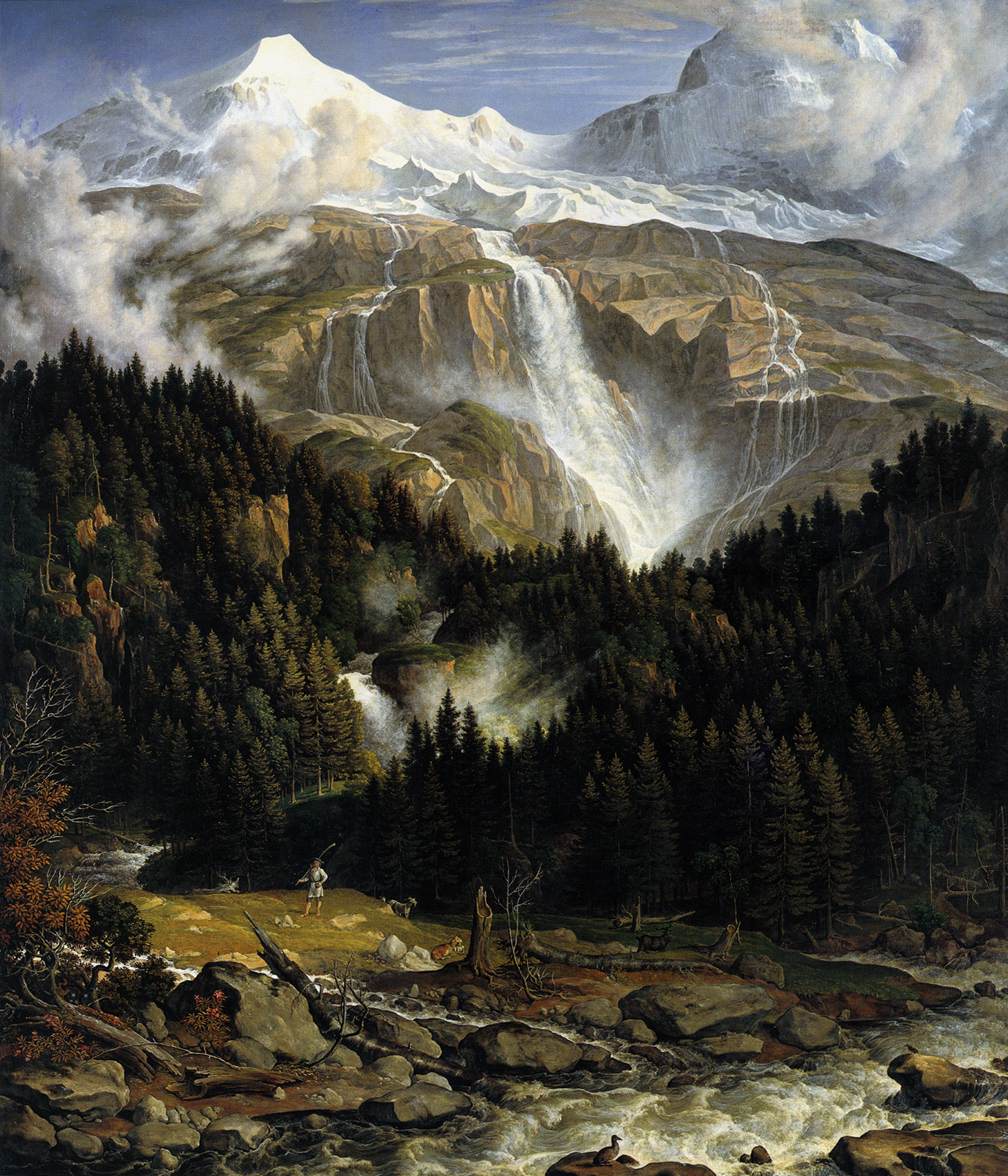
The Schmadribach Falls

Joseph Anton Koch, The Schmadribach Waterfall above Lauterbrunnen, c. 1793

Last month the Evening Standard carried a headline saying that 'The British Museum just bought a drawing for £68,000'.  The article (illustrated with a later painting rather than the actual pen and ink sketch) explained that 'an 18th-century drawing by Austrian Romantic artist Joseph Anton Koch — forgotten for over a century until it was discovered by the Standard’s late art critic Brian Sewell – has been bought by the British Museum for £68,750.'  Following its sale at Christies, a temporary export ban was put in place.  This means that you can read online various government statements about it, including one from the Arts Minister himself: 'This striking study for Joseph Anton Koch’s most celebrated landscape shows why this leading Romantic painter was so highly regarded by British artists.'

 Joseph Anton Koch, The Schmadribach Falls, 1821-22

There is an Arts Council PDF of the expert's report, which discusses Koch's drawing in relation to the export ban Waverley criteria.  Here is its explanation of the particular significance in art historical terms of The Schmadribach Waterfall, which Koch developed into two oil paintings, one now in Munich, the other in Leipzig.
'Koch’s Schmadribach Waterfall fundamentally revised the previously accepted norms of landscape. Seemingly inspired by Albrecht Altdorfer’s Battle of Alexander (1529, Munich, Alte Pinakothek), he envisaged a panoramic ‘world landscape’ embodying the entirety of nature’s system as well as man’s place within it. Koch’s interpretation of Alpine scenery was more influential on the next generation of artists than the formulations of C.D. Friedrich or J.M.W. Turner. For example, Ludwig Richter (1803-84) paid direct homage to The Schmadribach Waterfall in his The Watzmann (1824, Munich, Neue Pinakothek).
Adrian Ludwig Richter, The Watzmann, c. 1824

I would love to know more about how Brian Sewell came upon this sketch.  The expert report notes only that 'the provenance of this drawing is unknown prior to its ownership by the well-known art critic Brian Sewell (1931-2015).'  A bit more information can be found in an article by Christies chairman Noël Annesley from the time of the posthumous sale:
'A notable discovery of Brian’s, and a demonstration of his flair for spotting rarities, is a meticulously drawn view from 1794 of the Schmadribach waterfall near Lauterbrunnen in Switzerland, a favourite subject of Joseph-Anton Koch. I do not know how it was previously described, but Brian recognised its authorship because of his interest in German Romantic art. This had been quickened many years before at the Courtauld, and then through visiting an extensive Arts Council exhibition in 1963 devoted to Koch and other members of the so-called Nazarene School which had previously been neglected in Britain.'
Looking at what else was on sale from his collection, I see there was a whole range of landscape sketches costing a lot less than £68,000.  If I'd had £10,000 to spare I might have been able to pick up a couple myself...  One can dream, although I have to admit that such valuable objects wouldn't really be safe in our house, where they would be at risk of being knocked off the wall during a lightsaber fight, splattered with Warhammer paint or hit by a flying emoji cushion.

Saturday, February 10, 2018

Sleeping Dragon Ridge

 
Yosa Buson, Liu Bei visited Zhuge Liang in his hermitage three times, 18th century
Source: Wikimedia Commons

This beautiful winter scene was painted by the great Japanese haiku poet and artist, Yosa Buson.  It depicts a famous moment in Three Kingdoms, the epic Chinese novel describing real events at the end of the Han Dynasty.  The warlord Liu Bei has come to the 'thatched hut' of Zhuge Liang, the 'Crouching Dragon', to ask whether he will join him as an advisor.  Liu Bei is accompanied in this painting by his two oath brothers, Guan Yu (traditionally depicted with a red face and luxurious beard) and Zhang Fei.  These three and Zhuge Liang (also known as Kongming) have been depicted over and over again in books, plays, films, comic books and video games, along with their adversary Cao Cao (whose poetry I wrote about here last year).  Zhuge Liang was revered as a Chinese Ulysses, a great tactician, minister and inventor.  Moss Roberts, the translator of Three Kingdoms, describes him as a combination of Machiavelli, Clausewitz and Leonardo da Vinci.  But when Liu Bei came to call on him in the year 207, he was just a young scholar with a brilliant reputation.

Dai Jin, Looking Three Times at the Thatched Hut, Early Ming Dynasty
Source: Wikimedia Commons

The painting above, is by Dai Jin (Tai Chin) and dates from roughly the same period as the Three Kingdoms. Dai Jin's hanging scroll shows the same three characters being met at the gate by a boy, while Kongming can be glimpsed inside.  The titles of these pictures refer to the fact that Liu Bei made three trips to the thatched hut before Kongming made an appearance.  The first time he was told by the young boy that the master was not around and that his movements were uncertain.  On the second attempt, in the dead of winter, he encountered Kongming's brother but again was told that the master was away.  On the third, Liu Bei and his brothers were kept waiting while the scholar slept, but finally got to talk to him.  They found him to be a tall man 'with a face like gleaming jade and a plaited silken band around his head.  Cloaked in crane down, he had the buoyant air of a spiritual transcendent.'
 
 
Utagawa Kuniyoshi, Xuande (Liu Bei) Visits Kongming Three Times in the Snow, 1853

This story is as well known in Japan and Korea as it is is in China, as can be seen by two more Japanese images of Liu Bei's journey.  The woodblock print above is by Utagawa Kuniyoshi, from a series called A Popular Romance of the Three Kingdoms.  The one below is by the last great master of the ukiyo-e print, Tsukioka Yoshitoshi ('Gentoku' and 'Kômei' are the Japanese versions of  Liu Bei and Zhuge Liang).  The Fitzwilliam curators note that Kongming is shown by Yoshitosi 'on the right poring over learned texts: in the absence of lamps, diligent scholars in ancient China were supposed to have read by the light of fireflies or by the reflected luminescence of snow, which they brought in from outside.' 

Tsukioka Yoshitoshi, Gentoku visits Kômei in the snow, 1883

I will end this post with some lines from the novel itself, in Moss Roberts' translation.  On their first journey, Liu Bei and his brothers are directed to Sleeping Dragon Ridge:
'The twisting, turning ridge bears heavy clouds;
The frothing, churning stream is liquid jade.
Caught between the rocks, this dragon winds;
Shadowed by the pines, this phoenix hides.
A wattle gate half-screens a thatched retreat:
Undisturbed the recluse sits within.'
On their second journey, 'dense, somber clouds covered the sky.  The brothers rode into a cutting northern wind.  A heavy snow made the mountains gleam like arrowheads of white jade and gave the wood a silvery sheen.'  After being disappointed again, Liu Bei sets off back.
'Pear-petal flakes descending from the skies,
Antic willow puffs darting at his eyes,
He turns and halts to view the scene behind:
Banked with snow, the silvered ridges shine.'
On the third visit, he finally gains admittance and talks to Zhuge Yiang, who describes to him a three stage plan to reunite the Han empire.  Liu Bei rises from his mat and joins his hands together in gratitude, saying 'Master, you have opened the thicket that barred my view and have made me feel as if clouds and mist have parted and I have gained the blue sky.'

Sunday, February 04, 2018

Mundus Subterraneus


I have been immersed in Athanasius Kircher's Theatre of the World, a (literally) wonderful and wittily-written book about the great seventeenth century polymath.  Its author Joscelyn Godwin is something of a polymath himself but has written mainly about music and the occult (he has featured on this blog before as translator of the Hypnerotomachia Poliphili).  The book discusses Kircher's inventions, some of which were housed in his museum at the Jesuit Roman College, and covers his extensive writings in Latin on language, religion, geography, science, music and many other topics.  There have been numerous books on Kircher in recent years and Godwin was the author of one of the first of these (in 1979); his aim in this subsequent volume was to focus attention on Kircher's illustrations. These, in contrast to the some of the original texts, 'have a quality of ingenuity and strangeness that are particular to his century, and of singular appeal to ours.'

Pieter Bruegel the Elder, The Tower of Babel, c. 1563

The engravers worked from Kircher's designs which were either his own inventions or adaptations from other sources, sometimes mere sketches sent by travellers and correspondents.  The Tower of Babel reproduced on the cover of this book comes from Turris Babel (1679) and was obviously inspired by the famous Breugel painting.  It was actually drawn by Coenraet Decker and engraved by Lievin Cruyle.  The tower differs from Bruegel's in having 'a system of crossing ramps from one of Kircher's favourite ancient buildings, the Temple of Fortune in Praeneste'.  Bruegel's tower looks like it is being built in the Flemish countryside, but Kircher's is surrounded by ancient monuments, including numerous pyramids and obelisks, subjects he treated extensively in Oedipus Aegyptiacus (1652-4) and Obeliscus Aegyptiacus (1666).  His fascination with the obelisks of Rome made me want to revisit the city and spend a day tracking them all down, from the Flaminian obelisk now in the Piazza del Popolo to the Sallustian obelisk at the top of the Spanish Steps.

 Athanasius Kircher, The Earthly Paradise, from Arca Noë (1675)

Kircher's depictions of ancient sites as they might once have appeared range from the Roman villas that he could visit around Tivoli to places for which he had to rely on ancient texts: the Hanging Gardens of Babylon, the citadel of Atlantis and the Garden of Eden (above).  For China Illustrata (1667) he made use of the Travels of Marco Polo and more recent information sent back by his fellow Jesuits.  It includes depictions of the Mountain of Fe, shaped either naturally or artificially (Kircher puts arguments for both possibilities) into the resemblance of a Chinese god; the Seven Peaks, which seem to correspond to the configuration of the Great Bear; and Lake Chin, on the surface of which float waterlilies and, more strangely, a child on a piece of wood, the sole survivor of a city destroyed by an earthquake.  In this volume Kircher also illustrates Dragon and Tiger Mountain with the creatures themselves about to fight each other.  Although sceptical of some mythical creatures, Kircher believed in the existence of dragons, even in Europe.  'It may surprise the reader', Joscelyn Edwards observes, 'to learn that dragons were nowhere more prevalent than in Switzerland.'  The idea of a dragon on Mt Pilatus terrorising Lucerne inevitably recalled for me Smaug's destruction of Lake-town in The Hobbit.

Athanasius Kircher, Dragons of Lake Lucerne, from Mundus Subterraneous (1664-78)

Some of Kircher's most famous 'landscape' drawings are in Mundus Subterraneus where they illustrate his theories of geography, geology and the movement and actions of fire and water.  His notion of the hydrological cycle required underground mountain reservoirs and subterranean channels connecting the seas.  At the North and South Poles, as yet unknown, he imagined the global flow of water governed by a vast whirlpool and spring.  I have included here before his image of Mt Vesuvius, a volcano Kircher explored himself.  Inside the crater he 'perceived the groaning and shaking of the dreadful mountain, the inexplicable stench, the dark smoke mixed with globes of fire which the bottom and sides of the mountain continuously vomited forth from eleven different places, forcing me at times to vomit it out myself...'

 Athanasius Kircher, The Loudspeaker System at Mentorella, from Phonurgia Nova (1673)

Kircher wrote a topographical study, Latium (1671) about the region around Rome.  He was particularly drawn to the sanctuary of Mentorella, which he helped preserve, and it was here that he performed some of his acoustic experiments, with loudspeakers directed at the surrounding hills (see above).  This sacred place had witnessed the conversion of St Eustace, when the figure of Christ appeared between the antlers of a stag (see illustration below).  Kircher's book Historia Eustachio-Mariana (1665) contains a memorable description of his discovery of the sanctuary and I will end this post with it.  As Joscelyn Godwin remarks, 'the eighteenth century did not invent the Sublime, nor the Romantic era the melancholy attraction of ruined choirs.'
 'In 1661, while I was exploring the mountains of Polano and Praeneste, I started in Tivoli and passed through wild mountains and rocks.  Around noon I came to a horrid, solitary place, hemmed round with rocks like a crown.  It really was a place filled with horror, where the stony pyramids seemed to scrape the heavens, and, falling from hanging rocks in formidable vortices, seemed to express infernal motion.  In the midst of all this, among dark trees and rocks, I came across the remnants of a roof: it was a church, all but collapsed.  But how could there be a church in this place of terror and solitude?  I asked the guide.  Going in I saw the pictures and sculptures of the saints.  Everything breathed the devotion of ancient piety.'
 Athanasius Kircher, The Conversion of St. Eustace, from Latium (1671)

Saturday, January 27, 2018

Body of Ice


In 2011, Australian harpist Alice Giles got the opportunity to follow in the footsteps of her geologist grandfather Cecil Madigan, who has been a member of Mawson's First Australasian Antarctic Expedition a century earlier.  At Davis Station she left her instrument by the shore as an aeolian harp, as you can see in the clip from her website embedded above. "The sound of the wind through the strings was incredibly clear and concentrated,'' she told the Sydney Morning Herald.  On her return she composed Alice in Antarctica, mixing music and extracts from Madigan's expedition diary.  She also participated in a conference about the Antarctic and music, the papers for which can be read (open access) in  Antarctica — Music, Sounds and Cultural Connections (Australian National University Press, 2015).  Here are some other things covered in this book that seemed worth noting on this blog.

Gilbert Kerr playing bagpipes to an indifferent penguin
on the Scottish National Antarctic Expedition
Unknown photographer. Source: Royal Scottish Geographical Society

  • Music made by explorers and scientists.  Various kinds of instruments and music making equipment were taken on the polar voyages, from hand organs on Franklin's expedition to the pianola used by Scott. One of the book's essays concerns a well-known photograph of Gilbert Kerr and his bagpipes (above) - the pipes themselves were later taken to the war and lost during the Battle of the Somme.  A piano on the Morning, a relief ship sent to Scott's first expedition in 1902, was used to compose what is probably the first published music written on an Antarctic polar journey.  Gerald S. Doorly wrote a small collection of songs, including 'Ice King', written as they searched the coastline looking for Scott's ship Discovery.  Most intriguing for me though is the idea that a Japanese flute may have been played over the ice on the Shirase Antarctic Expedition (1910-12).  Research by Rupert Summerson, himself a Shakuhachi player, polar explorer and scholar (a pretty cool job description), suggests that the player would have been Keiichi Tada, who also wrote tanka inspired by his journey to the Antarctic:
Looking back
Looking back again
Looking back
All I’ll see are mountains
And mountains of snow (trans. Amelia Fielden)
  • Compositions inspired by the Antarctic. The earliest example of a composition based on experience of the continent may be James Dwight Dana's musical setting of lines from Thulia: a Tale of the Antarctic, a narrative poem written by James Croxall Palmer, who was assistant surgeon to the United States Exploring Expedition of 1838–42.  Dana was an eminent geologist and part of the same expedition, though not on the ship that sailed down to the edge of Antarctica. Of course there are numerous more recent examples of music directly inspired by encounters with the Antarctic - I have mentioned here before the work of Peter Maxwell Davies for example.  An essay in the book by Patrick Shepherd refers to his own experience and that of three other New Zealand composers who have been to Antarctica: Chris Cree Brown, Gareth Farr, and Phil Dadson, who experienced a kind of epiphany while out on the ice:
'I was recording ice cracks for one entire night (without too much luck I have to say) and during this time sat motionless, simply watching and listening, much of the time focused on my relationship with the planet and to the sun. Instead of watching the sun slowly creeping along the horizon line, I could literally sense the earth turning around the sun. It was a simple and profound sensation and it has stayed with me.'
  • Sound art made on the continentPure field recording may be rarer now than it was when Douglas Quin made Antarctica twenty years ago.  Instead it tends to be a component of projects that combine different kinds of sound or used it to accompany other media.  Philip Samartzis provided field recordings for Body of Ice, a dance piece by Christina Evans, who contributes an essay to the book describing how she worked with her dancers to imitate the movements of ice - rolling, crumbling, melting and freezing.  When Cheryl E. Leonard visited the Antarctic she collected material to make natural instruments: limpet shells, the bones of adelie penguins, igneous rock slabs forming a scale of tones and glossy rock shards that chimed like glass.  She is now able to play these instruments to the accompaniment of her own field recordings, of seals, meltwater and the Antarctic ice, cracking and drifting in the sea. 
 

Saturday, January 20, 2018

Frail songs by torrents


Yesterday evening I listened yesterday to a recent episode of 'Late Junction' in which Anne Hilde Neset was taken by Jana Winderen to a snowy forest just outside Oslo to discuss field recording. I have embedded a clip of this below, although I'm not sure how long it will be available.  I would actually recommend listening to the whole programme while you can (among other things it includes a wonderful Morton Feldman tribute on what would have been his ninety-second birthday, David Fennessy's 'Piano Trio - Music for the pauses in a conversation between John Cage and Morton Feldman').  Winderen talks about the way the sounds of the forest change completely day by day - sound like light has to be captured instantly or it is gone forever.  She has been waiting many years to catch a particular lake when it is just about freezing.  At that moment the ice is like a drum skin and if you tap it you can hear the sound flying over the surface.  But on the rare occasions when the lake has been in this state, she has happened to be without her equipment. "Then I just have to listen to it with my ears and remember that, recorded in my memory".


After listening to this programme I took up a book, the latest collection of Thomas A Clark's poems, Farm by the Shore.  As I read it, I kept thinking of the deep listening and close attention to landscape that Jana Winderen describes.  Poems refer to the drone of the wind, the water song in leaves, the lapping of little waves, unquiet on quiet.  A small brown bird hidden in glancing light seems to vanish when it stops singing.  There is often a focus on such moments, when what is observed offers an insight into the processes of thought.  'Quicker than tadpoles / in pools the shadows / of tadpoles in pools / or the notion of shadows / of tadpoles in pools.'  There are places, these poems suggest, to which you can retreat to tune the mind or simply find repose in the shadows of trees.  Jana Winderen's recording includes the sound of tadpoles at rest, hibernating in their cold winter pools, waiting for spring.  Waiting is essential for her too, as she "concentrates into the environment" and begins to notice small things or experience chance phenomena like snow falling from a tree.  It is easy to picture Thomas A Clark walking the winter woods and listening to them with similar quiet patience: 'snowflakes on eyelashes / frail songs by torrents.'

Saturday, January 13, 2018

Lichens and Ferns on a Rock Face

Gherardo Cibo, Men Collecting Specimens on a Hillside, 16th century

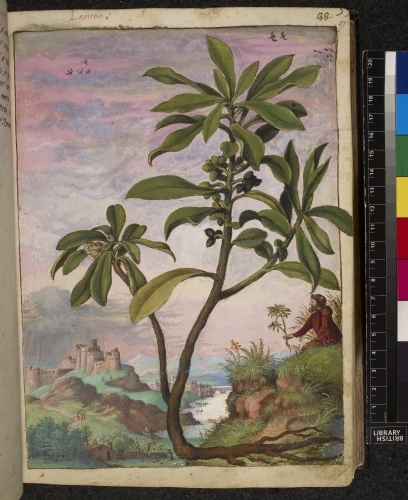
This illuminated manuscript page shows specimen hunters on an Italian hillside, equipped with sickle, mattock and sack.  They are so intent on their work they seem oblivious to the beautiful sunset behind them.  It was painted by the amateur botanist Gherardo Cibo (1512-1600) who illustrated his own researches in Urbino and incorporated elements of the surrounding landscape into his botanical illustrations.  The example below is one of several that can be seen at the British Library page for 'Additional MS. 22332'.  In addition to the Daphnoides it shows 'a botanist gathering plants on a mountainside and a fortified town and river in the background.'  In other paintings of specimens we see a countrywoman gathering plants, a man sitting on a fallen column, people harvesting olives, a person reading a book and a man hitting a snake with a branch.  But it his distant views that are particularly appealing - a flock of sheep, a weir and watermill, a fortified town, a port, a rocky island, a mountainous landscape.  Cibo's people are in scale with these landscapes; it is the plants that have grown to giant proportions, like a Fumewort under which two young girls are able to sit in the shade and chat.

Gherardo Cibo, Daphne Laureola (Spurge-laurel), 16th century 

I came upon the painting of specimen hunters last week in the 'Herbology' section of the British Library's exhibition Harry Potter: A History of Magic.  There is clearly something magical about the other pictures in the MS too, as Cibo transforms herbs into plants the size of trees.  J. K. Rowling's treatment of landscape is something I can't really discuss as I've not read her books (though I have caught the gist of the story while Mrs Plinius was reading them to our kids and seen bits of the Harry Potter movies). The exhibition is excellent though, whether you're bothered about Harry Potter or not, with many interesting objects and books in addition to the Gherardo Cibo herbal.  However, one manuscript that wasn't on display was the second one by Cibo that the Library owns, 'Additional MS. 22333'.  The images on the British Library page include two seascapes and a landscape, along with the delightful view below, which at first appears to be a typical sixteenth century depiction of the Italian countryside, until you see the outsize lichens and ferns growing over the surface of the rocky hillside.

 Gherardo Cibo, Lichens and Ferns on a Rock Face, 1584

Saturday, January 06, 2018

The sea like a vortex


"The sixth storm, rain. Just barely saved the boat. The sea like a vortex, the surf like cannon fire. The tent broke. Wonderfully beautiful." - Tove Jansson
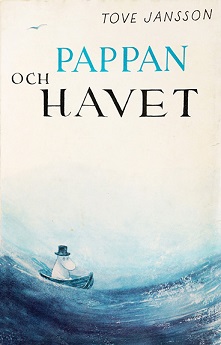
In the middle of the Tove Jansson exhibition, which is on for a few more days at Dulwich Picture Gallery, there are three large paintings of waves: Abstract Sea (1963), Weathering (1965), Eight Beaufort (1966).  You can see the first of these reproduced in the Telegraph's review, 'Revelatory show about the Moomins creator'. They were painted after she had returned to painting, in the wake of abstract expressionism and after having spent two decades creating the world of the Moomins.  As Tuula Karjalainen writes in the catalogue, Jansson was at this point 'so committed to storytelling that she usually included a figurative element even in her abstract works.  As subjects, she often selected motifs that in themselves already appeared abstract', hence these studies of the sea.  It was also at this time that she was planning and building her cottage on Klovharun island - the quotation above describes her experience camping there before construction began.  The islands of the Finnish archipelago appear through her art and have become part of the imaginative world of anyone who has loved Moominpappa at Sea or The Summer Book.


Thirty years before these abstract sea paintings, at the beginning of her painting career, Tove Jansson painted landscapes in strong colours which are reminiscent of early twentieth century Primitive, Symbolist and Surrealist artists (looking at them I thought of Rousseau, Munch and Nash).  These inevitably prefigure the later Moomin illustrations, like a set of watercolours in this exhibition showing scenes from The Dangerous Journey (1976).  The most striking of her early landscape compositions is actually called Mysterious Landscape and has no precise date.  Mostly painted in cold shades of blue, it shows ghostly trees lining a path to a white building that reminded me of what I saw last year at dusk in Stockholm's woodland cemetery.  Paths of light lead up dark mountains, bare trees burn bright red, and in the distance there is a moonlit fjord.  It seems to be part of a strange and magical story that at the time, before Moomintroll came along, she was still just telling to herself.

Monday, January 01, 2018

There Lies the Temple


Today I launched a new initiative, to post 365 landscapes on Twitter over the course of 2018.  In doing this I am using a format (see above) which will usually include a telling detail in addition to the main image, in this case a dark idol just beyond the brow of the yellow hill.  Whether people on twitter will find this interesting I am not sure, but it is giving me a chance to look across the whole field of landscape art and share the things I find most interesting.  And by allowing myself only one landscape per artist, it is possible to cover quite a lot of ground in 365 tweets.  I have pretty much planned the selections out already so am able to say now that they are all interesting and (mostly) beautiful artworks - there's been no need to include dull canvasses by second-rate Impressionists or attempt full coverage of all the minor Dutch landscape painters.  The one key rule I am setting myself is only to include artists who died before 1948.  This is obviously for copyright reasons, but also helps restrict the field a bit; in addition to nothing post-war, it means I will not be including anything by artists like Georges Braque, Georgia O'Keeffe or Giorgio de Chirico.  I will mainly focus on painting but will include some work in other media - drawings, photographs, tapestry, stained glass, mosaic.  The coverage will be worldwide, though with an inevitable focus on Western art (the other main tradition is Chinese painting).

One thing that struck me from the outset in doing this was how difficult it would be to achieve adequate representation of women artists.  In Europe, before the late nineteenth century, women painters did not generally specialise in landscape.  One of the images I have lined up for later this month illustrates the point.  It is a pastel sketch of an Alpine lake, made during a summer holiday, by Élisabeth Louise Vigée-LeBrun, who was renowned throughout Europe as a portrait painter (subjects included Marie Antoinette, Lady Hamilton and Lord Byron).  Another of my selections is by Berthe Morisot, whose best known subjects are her domestic interiors, even though her first appearance at the Paris Salon, in 1864, was with two landscapes.  It is only towards the end of the period that you find professional women landscape painters whose work really stands out, and some of these could be better known - Zdenka Braunerová (1858-38) for example, who will also be featuring in January.  I'd love one day to see an exhibition gathering together a whole range of pre-twentieth century landscape art by women artists.  A fourth one on my list for January is Emily Carr, whose work I featured here following a retrospective at Dulwich Picture Gallery.  The next post on this blog will be about a more recent artist whose work I saw at Dulwich last week, Tove Jansson.

I will conclude here with a few more words about Paul Gauguin's painting (sometimes called 'Sacred Mountain'), which shows a marae, or sacred enclosure, in the Marquesas Islands.  It is, like most (perhaps all?) of the landscapes I'll be tweeting about, a product of the artist's imagination.  Gauguin was inspired to paint and sculpt images based on Tahitian traditional religion and the gods that had been suppressed by Chirstian missionaries.  However, as Joseph J. Rishel explains (see the Philadelphia Museum site), 'the fence with its decoration of skulls, the idol on the hill, and the evocation of sacrifice in a thread of smoke ascending before the demanding god have no basis in Tahitian culture, Gauguin has created another kind of paradise in the opulence of his colour and the splendid sensuality of his images.'  Robert Goldwater (Gauguin, 1957) wrote that the artist had painted a kind of 'Olympus bathed in light, somewhere above the world of men. The baleful fence tells us we are shut out from it, and mortal, but the bright flowers remind us that this is still a world of life and lovely colour.'

Thursday, December 28, 2017

Primeval world

 
Josef Kuwasseg, The Period of the Muschelkalk, c. 1850

This remarkable vision of a prehistoric shoreline was painted by an Austrian landscape painter, Josef Kuwasseg (1799-1859).  The paleobotonist Franz Xaver Unger who commissioned a series of lithographs from him said that such paintings had "that mysterious charm which belongs to the contemplation of the distant past, and to the memory of our dreams."  This painting is reproduced in a sumptuously illustrated (and pricey) new book that I was given for Christmas, Paleoart: Visions of the Prehistoric Past.  It traces the ways artists have portrayed scenes from the distant past over the last two centuries, incorporating stylistic elements from Romanticism, Impressionism, Fauvism and Art Nouveau.  The author, New York art critic Zoë Lescaze, also reads into these old pictures of dinosaurs, flying reptiles and neanderthals the politics of paleontology (ongoing battles between rival scientists) and our wider anxieties about war and apocalypse. 

Josef Kuwasseg, Primeval world, c. 1850

I have referred briefly here before to paleoart, in describing an exhibition of John Martin's paintings at Tate Britain.  Martin imagined plesiosaurs attacking an ichthyosaur as if they were engaged in fierce naval combat.  But, 'if Martin's vision of prehistory is a nightmare, Kuwasseg's is a subtle and mysterious dream.  Water appears in every painting, not as a seething arena for reptilian combat, but in flowing rivers, mangrove deltas, jungle waterfalls, and luminous green lagoons.'  It is easy enough to find examples of Joseph Kuwasseg's 'real' landscape painting online, like the one I have included below, a view of the Leopoldsteinersee, a mountain lake in Styria.  Zoë Lescaze writes that in his more conventional landscape art,
'Kuwasseg frequently includes illuminated corridors - rivers, paths, or gaps in the trees - framed by darker houses, rocks, or foliage.  He incorporates these same visual tunnels in his prehistoric vistas, leading the viewers into carboniferous swamps as though they were inviting stretches of the Austrian countryside.'

Josef Kuwasseg, Leopoldsteinersee, no date
Source: Wikimedia Commons

Another landscape painter featured in Paleoart is Heinrich Harder (1858-1935), who designed the remarkable mosaics for the aquarium at Berlin Zoo which were destroyed by Allied bombing in 1943 and then painstakingly restored in 1982.  Examples of his paintings of the German countryside on various auction websites give no indication of the Jugendstil influence in his mosaic designs, with their Hokusai waves and Hodler skies.  The painting of sea lilies below is from a set of collectible cards, 'Animals of the Prehistoric World' (it is atypical as most show examples of megafauna wandering through ancient landscapes).  Several paleoartists have worked on such cards - Harder's were made for a chocolate manufacturer.  When I was growing up we used to get PG Tips tea for the cards, so one of the sources of my own knowledge on dinosaurs was their series Prehistoric Animals (1972). 

Heinrich Harder, Sea Lilies, c. 1920
Source: Wikimedia Commons

Recalling now my childhood fascination with dinosaurs, I would say it was stimulated by a range of sources, from films like The Land That Time Forgot to trips to see the skeletons at the Natural History Museum and Benjamin Waterhouse Hawkins' wonderful old sculptures in Crystal Palace Park (see below).  When it came to paleoart though, my main inspiration was Dinosaurs and Other Prehistoric Reptiles (1960), illustrated by Rudolph Zallinger, an artist best known for The Age of Reptiles, a fresco for the Peabody Museum's Great Hall.  There are scanned images from this book at the blog Love in the Time of Chasmosaurs (I try not to include in copyright stuff here).  By the 1960s Zallinger was working on a new fresco for the Peabody, completed the year I was born, called The Age of the Mammals.  'In this sixty-foot mural,' Zoë Lescaze writes, 'the pumpkin-orange earth crackles against a brilliant blue sky. Trees run the autumnal gamut with red, green and golden foliage.  The animals, pounce, stalk, scavenge, forage, and flee.'
 
Benjamin Waterhouse Hawkins, Iguanadons at Crystal Palace, 1854
My own photograph from a visit in 2008

Tuesday, December 26, 2017

Landscape of the Megaliths

Lucas de Heere, Stonehenge, c. 1572
Images: Wikimedia Commons

In British Art: Ancient Landscapes, a catalogue published last year for an exhibition at The Salisbury Museum, Sam Smiles describes the history of artistic engagement with Britain's ancient stone circles and chalk figures.  It goes roughly as follows:
  • In the late sixteenth and seventeenth centuries, illustrations to accompany the writings of early antiquarians like William Stukeley.  The first known painting was by a Flemish artist, Lucas de Heere.
  • From the mid eighteenth century, topographical engravings and watercolours by artists like Thomas Hearne and Samual Prout.
  • Romantic era paintings of Celtic bards and druids, along with the stone circles in William Blake's vision of Albion.


William Blake, Milton: a Poem, c. 1811
"All things begin & end in Albion's ancient Druid rocky shore: But now the Starry Heavens are fled from the mighty limbs of Albion."  

  • Also at this time, dramatically composed paintings of Stonehenge with Sublime, stormy skies by the great figures in British landscape art: Girtin, Turner, Constable.
  • Then relatively few Victorian paintings, but a revival of interest among the Neo-Romantics - Paul Nash, John Piper, Henry Moore - who drew on Surrealism, Primitivism and abstract art, but also took an interest in the findings of twentieth century archaeology.
  • In the inter-war years, sights like Stonehenge, The Long Man of Wilmington were celebrated in Shell posters and their strong, simple forms made them ideal subjects for prints and watercolours by contemporary artists like Eric Ravilious.
  • After the war attention turned to urban subjects but there was a revivial of interest in the late sixties and new forms of engaging with the monuments: the walks of Richard Long, Derek Jarman's film, Journey to Avebury.  
  • Finally, the present day, and it is surprising that the exhibition couldn't find more recent artworks shaped by psychogeography, hauntology and modern antiquarianism.  The story currently ends with Jeremy Deller, whose bouncy Stonehenge I featured here back in 2012.

    John Constable, Stonehenge, 1835


Postscript 27/12/17

After putting a link to this post on Twitter, the excellent @BL_prints alerted me to a Sam Smiles piece on their blog, which tells the story above up to the early nineteenth century.  Here's a brief extract for you, his final two paragraphs, with an image from the BL website
The aesthetic presentation of prehistoric structures was most successful when their massiveness and monumentality was heightened by the artist’s approach. The topographer John Britton recruited very capable artists to illustrate his numerous publications: the title page of the third volume of his survey The Beauties of Wiltshire (1825) includes an engraving of 1812, based on a drawing by John Sell Cotman. The subject is the cromlech on Marlborough Downs known as the Devil’s Den and the impact of the image relies on close focus, a low horizon and a stormy sky.
This tendency to exaggerate the sublimity associated with these monuments, concentrating on their enigmatic, even weird presence in the landscape, ran the risk of removing them from topography completely. The key instance of this approach is probably JMW Turner’s watercolour of Stonehenge, engraved in 1829 for Charles Heath’s Picturesque Views in England and Wales (1827–38). Turner had visited the site at least twice, in 1799 and 1811, and had studied it carefully. His watercolour, however, sacrifices detail for theatrical effect as Stonehenge becomes the setting for a spectacular thunderstorm, with sheep killed by lightning, their shepherd struck down and his dog howling at the sky. Here, then, topography’s ideal of the accurate record surrenders almost completely to the artistic impulse.

Saturday, December 16, 2017

A winding river and a bridge

Jan Van Eyck, The Madonna of Chancellor Rolin (detail - full picture below), c. 1435-7
Source: Wikimedia Commons

Earlier this year I discussed a miniature in Christopher de Hamel's Meetings with Remarkable Manuscripts.  Here I want to share a quote from his earlier book, A History of Illuminated Manuscripts (1986, revised 1994).  Its subject, way a landscape is transmitted and through successive works of art, is one I have touched on before in connection with Albrecht Dürer.  The way repetition introduces change is something that has fascinated modern artists, from Warhol's screen prints to Basinski's Disintegration Loops, although in this case the alterations are more deliberate.  The quote is quite long but it it conveys what is so appealing about de Hamel's writing, both highly accessible and rigorously scholarly.  (Incidentally, my parents saw him deliver a talk earlier this month, where he described his discovery of what may be the actual book Thomas Becket was carrying when he was assassinated.)  Here, de Hamel is discussing a Paris-based illuminator called the Bedford Master, named for two books he made for the Duke of Bedford, Henry V's brother and regent of France following the victory at Agincourt.  But the story (probably) begins with one of the greatest fifteenth century paintings, Jan van Eyck's The Madonna and Chancellor Rolin, now in the Louvre.

 
'In the background, seen over the rampart and battlements of a castle, is a marvellous distant view of a winding river and a bridge with people hurrying across and (if one peers closely) a castle on an island and little rowing boats and a landings stage.  It was painted about 1435-7.  The view is now famous as one of the earliest examples of landscape painting.  The Bedford Master must have admired it too, perhaps in Rolin's house where the original was probably kept until it was bequeathed to the church at Autun.  The same landscape was copied almost exactly, even to the little boats and the bends in the river, into the backgrounds of several miniatures from the circle of the Bedford Master such as the former Marquess of Bute MS. 93, fol. 105r, and the mid-fifteenth century Hours of Jean Dunois in the British Library (Yates Thompson MS 3, fol. 162r).  It was adapted slightly for Bedford miniatures such as Malibu, J. Paul Getty Museum, MS. Ludwig IX.6, fol. 100r, where the fortified bridge has contracted into part of a castle.  Nicolas Rolin has been transmogrified into David in penance.  In this case, one can assume that Jan Van Eyck had invented the design, unless, of course, he was consciously copying a Bedford Master Book of Hours and was depicting Rolin as penitent.  The scene gets gradually transformed in other manuscripts into the usual view from the palace of King David in the miniature to illustrate the Penitential Psalms in northern France and then in Flanders.  The battlements stay on but the river becomes a lake and then a courtyard (still with little people hurrying to and fro) in the Ghent/Bruges Books of Hours of the sixteenth century.  The Bedford Master's sketch of a detail in a portrait that interested him was transformed remarkably, over a hundred years, as one illuminator after another duplicated and adapted the original pattern.'
 
The circle of the Bedford Master, Idleness in the Penitential Psalms, mid 15th century

I have found online one of the examples quoted above, the British Library MS, but cannot find images of the others (they are in private collections).  I will end here instead with another painting, less closely copied but still clearly inspired by Van Eyck.  This is Rogier van Der Weyden's wonderful Saint Luke Drawing the Virgin, painted just a few years later in around 1440.  The original is in the Museum of Fine Arts in Boston and would be one of the first things I'd head for if I ever get to go there (I can't write this without thinking of Jonathan Richman's song 'Girlfriend'...)  But there are three other versions of it, in Bruges, Munich and St Petersburg.  The figures looking out over the landscape, it's been suggested, refer to the paragone debate, drawing our attention to the ability of painting to convey a vista like this, in a way that sculpture, the art of three dimensions, cannot.  It is as if they are admiring the artistry of Van der Weyden in creating the world they themselves inhabit.  In Van Eyck's painting, the figure looking over the parapet on the right may be the artist himself - the man in the National Gallery's possible-self-portrait is wearing a similar red turban.  In the British Library MS. there is only one man gazing onto the landscape; the second is riding along on a donkey, the personification of idleness with his head in his hand.  But both are wearing versions of Van Eyck's red turban.  


Rogier van Der Weyden, Saint Luke Drawing the Virgin, c. 1440
Source: Wikimedia Commons

Saturday, December 09, 2017

Streams, falling from the heights

'Cliffs stand on both sides like parallel walls.  Here it is so narrow, so very narrow, writes one traveller, that one not only sees but actually feels the narrowness, it seems.  A patch of blue sky appears like a ribbon above one's head.  Streams, falling from the heights of the mountains in thin spurts of spray, reminded me of The Abduction of Ganymede, that strange painting by Rembrandt.  Moreover, the pass is illuminated entirely in his taste.  In some places the Terek is eroding the very feet of the cliffs, and rocks are piled high on the road, like a dam.  Not far from the post a small bridge has been boldly thrown across the river.  Standing on it is like being on a mill.  The whole bridge shakes, while the Terek roars, producing a sound like wheels driving a millstone.'
- Alexander Pushkin, A Journey to Azrum at the Time of the 1829 Campaign, trans. Ronald Wilks
This description of Sublime scenery can be found in the Penguin edition of Tales of Belkin and Other Prose Writings, a book I recall really enjoying when it came out in 1998.  I always seem to be drawn to Russian literature as winter closes in (this month I've been reading Vladimir Nabokov and Svetlana Alexievich); the freezing wind yesterday felt like it had come straight off the Siberian steppes.  John Bayley wrote in his introduction that A Journey to Azrum, a valuable fragment of Pushkin's autobiographical writing, had hitherto been 'impossible to find in translation.'  In five short chapters, Pushkin describes his journey south with the Russian army, who were fighting Turkey at the time.  He was not officially allowed to travel beyond Tiflis but ignored this, much to the annoyance of the Tsar.

Rufin Sudkovsky, Darial Gorge, 1884
Source: Wikimedia Commons

Darial Gorge, which Pushkin describes in his book, is a key site in Russian Romanticism.  In Lermontov's poem 'Demon', the River Terek is compared to a roaring lioness, heard by all the mountains beasts and 'eagles in the azure heights.'  This valley, with its mists and menacing crags, is contrasted with the beautiful fertile plain where the Demon first lays eyes on the Georgian princess, Tamara.  Such contrasts were fundamental to Romantic appreciation of nature and had been theorised with reference to great art, so that travellers in search of the picturesque could relate what they saw to, for example, Salvator Rosa (the Sublime) or Claude Lorrain (the Beautiful).  This habit had became the subject of satire by the end of the eighteenth century and Pushkin was clearly aware of it when he refers to Rembrandt.  If you were unfamiliar with Rembrandt's The Abduction of Ganymede, you might think Pushkin was writing in all sincerity of a heroic landscape painting, one in which Zeus, the eagle, swoops on Ganymede from the azure heights, past cliffs and waterfalls.  Instead, well, one can only say that Pushkin, with typical light-heartedness, was taking the piss. 
Rembrandt, The Abduction of Ganymede, 1635
Source: Wikimedia Commons

Friday, December 01, 2017

Withert vines, auld trees, derknin crows


I bought this book at the recent Small Publishers Fair: a selection of classical Chinese verse translated into Scots, with English versions provided as well to help non-Scots speakers.  It was hard to resist this purchase once I had read on the back of it W. N. Herbert's description of the way China's great writers appear in Brian Holton's Scots.  'His roistering Li Bai comes with more than a hint of Burns, while his Qiao Ji seems as rooted in landscape as Hogg is in Holton's beloved Borders.  The oldest named Chinese poet, Qu Yuan, comes across here as one of the aureate makars, Dunbar or Douglas, crossed with something of the shaman.  But it is with the subtle master Du Fu that a deep authentic note of melancholy emerges.'  Here is the first stanza of one of those Qiao Ji poems 'rooted in landscape'.  It is on the theme of scholarly retreat - 'Contented in Idleness', or, in Holton's Scots, 'Fine in Idleset':

Awa in the hills, ablow the wuids
there's a theikit shed wi rashie windaes,
bieldit, lown an bonnie;
green bamboo, emerant pines -
it's fair a pictur.

Reading this book made me wonder whether there is Chinese poetry translated into Welsh, Gaelic, Cornish...  Holton writes that he is currently the only Chinese-Scots translator and would welcome some company.  However, on the St. Andrews University website I came across a cross-cultural translation project that also involved making Scots versions of old Chinese poems.  The participants came up with a version of 'Autumn Thoughts', the most famous short poem by Ma Zhiyuan (c. 1250–1321), a contemporary of Qiao Ji who lived in what is now Beijing.  I have included their translation and a video clip below. 


An auld sauch, an corbies in the mirk
that haps the burn, the brig, the loan,
traivelled by a shilpit cuddie, gaun
efter the sun that fa's intae the dark
further and further fae hame.

Ma Zhiyuan is a true poet of autumn - his best known play, 'Autumn in the Han Palace', expresses the emperor's sorrow through autumnal imagery.  His poem 'Autumn Thoughts' is a condensed landscape in nine parts - withered vines, old trees, twilight crows, a small bridge, flowing water, people's homes, an ancient road, the west wind and a gaunt horse.  These are followed by an image of the sun sinking, and of a broken-hearted figure on a distant horizon.  Brian Holton includes some of Ma Zhiyuan's autumn poetry in Staunin Ma Lane.  His version of 'Autumn Thoughts' has each element on a line by itself: 'withert vines / auld trees / derknin crows...'  Then the 'gloamin sun / gaun westlins doun' and the man stands alone. 'Hairt sair, hairt sair / she's hauf the warld awa.'

Friday, November 24, 2017

Shy Sculptures

Rachel Whiteread, Chicken Shed, 2017

This post can be read as a sequel to one I wrote nine years ago on Rachel Whiteread's move to making art for the landscape.  In 'Ebbsfleet Landmark' I described her proposal for a monumental sculpture, which would have taken the form of the cast of a house on a mountain of recycled rubble (the winning proposal by Mark Wallinger was never built).  In a postscript I referred to one of her 'Shy Sculptures', casts of sheds and similar structures, the latest of which has been installed in front of Tate Britain as part of their excellent retrospective exhibition.  Last week I went to a talk at the gallery which covered her entire career but touched briefly on these recent works.  She told us that she sees the 'Shy Sculptures' now as an ongoing lifelong project, already encompassing works in Norway, Norfolk and the California desert.  She made a direct comparison with Robert Smithson's Spiral Jetty and Walter De Maria's Lightning Field, saying she'd like it if people tried to seek them out, travelling to remote locations like those cultural tourists who head for the American West to experience first-hand the foundational works of land art.

 Rachel Whiteread, Shack, 2016
Tate wall display - photography permitted

Whiteread has described sheds as beautiful things with their own poetry, “they are furniture for people to dream away their lives in.”  Sheds and cabins have fascinated contemporary artists, from Cornelia Parker to Tracey Emin, and they have a long cultural history.  I have often referred here to similar modest structures out in the landscape -  studios, retreats, hermitages. The 'Shy Sculptures' Whiteread made in California preserve the negative space of two 1950s cabins that were abandoned in the desert.  They took five years to make and were commissioned by Jerry Sohn, who is creating a collection of site-specific art that also includes works by Lawrence Weiner and Richard Long.  Whiteread described them in her talk as 'shotgun shacks' which (at least to a British listener, less used to the term) instantly brought to mind Talking Heads' song Once in a Lifetime.  David Byrne's lyrics, like Rachel Whiteread's sculptures, refer to transience and timelessness.


In interviews Whiteread has said she dislikes 'plop art', 'making things and just putting them in places for the sake of it.'  Her 'Shy Sculptures' have to be in the right locations.  It would be interesting to know more about how she thinks they affect the surrounding landscape.  Presumably they will be left to slowly weather into their locations, unlike House, which was bulldozed in 1994.  At the Tate, Whiteread talked again about the huge controversy surrounding House, as well as her bureaucratic struggles over the Vienna holocaust memorial (she is returning to the city this month for the first time since it was finally installed).  I now live in a property rather like House and wish it was still there to visit.  It prompted the best thing I've read by Iain Sinclair, his essay 'The House in the Park: A Psychogeographical Response'.  The villain of this piece, Lib Dem councillor Eric Flounders, reemerged briefly from obscurity ten years later in a Guardian story about the launch party for Cunard's QM2 (where Jimmy Savile 'was sporting an NHS swipe card in the name of Al Pacino alongside his gongs.').  I doubt that Flounders has any regrets.  Rachel Whiteread said she might consider doing another whole-house cast, but it would be pointless to try to recreate House.  Once in a lifetime...