The catalogue to the Richard Long exhibition Heaven and Earth, which I discussed here recently, draws attention to Long's early career at art school, when he first developed the ideas that have motivated his art ever since. Long has recalled one important influence at the time was John Cage. He saw Cage lecture at the Saville Theatre in November 1966: 'It was all about chance and eccentric lateral thinking and humour - all sorts of John Cage ideas which were new to me.' A year later he experienced a recorded lecture, Indeterminacy, in which Cage told sixty stories in sixty minutes, varying the pace according to the length of the story. As Clarrie Wallis points out, this procedure is similar to that used in Long's map work A Walk of Four Hours and Four Circles (1972), where concentric circles were each walked in one hour (the smallest circle slowest, the largest fastest).
Thinking of avant garde composers in this context, I was reminded of La Monte Young's Compositions 1960 - an early example of conceptual art as instructions, e.g.
#2: Build a fire in front of the audience…
or
#5: Turn a butterfly (or any number of butterflies) loose in the performance area. When the composition is over, be sure to allow the butterfly to fly away outside…
One of these compositions sounds like a Richard Long walk:
#10: Draw a straight line and follow it
You could imagine one of Long's early map works re-written in this way as instructions for an imaginary walker:
A Ten Mile Walk, England, 1968
1. Pick a starting point x
2. Pick a round number y
3. Draw a straight line from x of length y in a direction that it is possible to walk
4. Walk the line
Of course the fact that Long has done his walks is the whole point. It is his landscape experience that we are presented with, even though we can accompany him in our imagination (just as we can join Gary Snyder on the riprap trail, or Basho on the narrow road). His work is not participative in the style of contemporary relational aesthetics. Still, while I'm on this road not taken, here are four more Richard Long walks recast as instructions. They might come in useful if you are short of ideas this summer, and, adapted for cities, they could even be used as the basis for some Situationist dérives...
A Walk of Four Hours and Four Circles, England, 1972
1. Draw a circle a on the map of diameter x
2. Superimpose a second circle b centred on the same spot with diameter 3x
3. Superimpose 2 more circles c and d with diameters 5x and 7x
4. Spend exactly an hour walking each of the four circles
A Hundred Tors in a Hundred Hours, Devon, England, 1976
1. Pick a distinctive common land form
2. Locate a round number of them, x
3. Walk to all of them in exactly x hours
A Five Day Walk, England, 1980
1. Choose a route that is x miles
2. Walk 1/15 of this distance x on the first day
3. On the second and subsequent days walk 2/15, 3/15, 4/15 and 5/15 of the distance
Straight Miles and Meandering Miles, England, 1985
1. Choose a long distance walk
2. Map out a certain number of locations where it is possible to walk a straight mile
3. Walk the route by, alternatively, normal paths and straight lines
Monday, June 29, 2009

Friday, June 26, 2009
The horizon of Holland

Back in 1965 the ICA organised an exhibition called 'Between Poetry and Painting' which included work by Ian Hamilton Finlay. Forty-four years later the ICA now has a similar exhibition entitled 'Poor. Old. Tired. Horse.', named after Ian Hamilton Finlay's magazine of that title. In addition to Ian Hamilton Finlay, the new exhibition includes work by two other artists I've discussed here before, Robert Smithson and Carl Andre. I've just taken the photo above which shows the catalogue for the 1965 exhibition next to the catalogue for the current show (which takes the form of a magazine called 'Roland'). The earlier exhibition took place before I was born but I think my uncle must have been to it and so the catalogue has found its way into my library. At that time Ian Hamilton Finlay had not yet moved to Stonypath to start work on the garden that would become Little Sparta - the catalogue says simply that he 'has lived in Perthshire, Orkney and Edinburgh, and now lives in the north of Scotland.'
On Tuesday Stephen Bann came to the ICA to give a talk about Ian Hamilton Finlay. He focused on the pre-Stonypath period and included some never-published colour photographs that he had been unable to use in an Architectural Review article (it was only printed in black and white in those days). One of these photographs showed THE HORIZON OF HOLLAND IS ALL EARS, a concrete poem made into a wooden structure and placed in the garden of Finlay's home in Ross-shire. This is the first of Finlay's interventions in the landscape, the ancestor of the sculptures at Little Sparta.
There were several references in the talk to Finlay's poetic interests and links with contemporaries like Lorine Niedecker. Finlay wrote to Bann saying that the landscape of Orkney was equivalent to a Wallace Stevens poem. He also said that Orkney resembled concrete poetry, whilst Perthshire seemed more like the writing German poets like Trakl. The less particularised landscape of Ross-shire on the other hand required more effort to make a poem out of the place... the kind of effort Ian Hamilton Finlay put there into making his first artist garden and his first poem in the landscape.
Tuesday, June 23, 2009
Design for an artificial echo
In a previous post here I quoted an extract from Gilbert White's A Natural History of Selborne, which included a proposal: "Should any gentleman of fortune think an echo in his park or outlet a pleasing incident, he might build one at little or no expense. For whenever he had occasion for a new barn, stable, dog-kennel, or the like structure, it would be only needful to erect this building on the gentle declivity of an hill, with a like rising opposite to it, at a few hundred yards distance; and perhaps success might be the easier ensured could some canal, lake, or stream, intervene. From a seat at the centrum phonicum he and his friends might amuse themselves sometimes of an evening with the prattle of this loquacious nymph..."
Back in the late seventeenth century, John Evelyn had the same thought and provided a design in his unpublished Elysium Britannicum, "to instruct you how to produce an Artificial Echo and by an innocent magick & without superstition, to raise up & deprehend that vocal & fugitive Nymph." The illustration below is reproduced from John Dixon Hunt's Greater Perfections, in which it is used to illustrate the point that Evelyn, generally a proponent of natural gardens, was nevertheless happy to recommend artificial effects where nature had not provided them.

In John Evelyn's "Elysium Britannicum" and European Gardening Therese O'Malley describes this as a sketch of the artificial echo at the Tuileries in Paris. The excellent Gardenvisit.com includes an extract from Evelyn's diary from 4 February 1644: "I finished this day with a walk in the great garden of the Tuileries, marvelously contrived for privacy, shade, or company, by groves, plantations of tall trees, especially that in the middle, being of elms, the other of mulberries. It has a labyrinth of cypresses; not omitting the noble hedges of pomegranates, fountains, fish-ponds, and an aviary; but above all, the artificial echo, redoubling the words so distinctly; and, as it is never without some fair nymph singing to its grateful returns; standing at one of the focuses, which is under a tree, or little cabinet of hedges, the voice seems to descend from the clouds; at another, as if it was underground..."
Evelyn's experience in Paris is referred to in a 1995 survey of artificial soundscapes by Joseph Dillon Ford, 'From Vocal Memnon To The Stereophonic Garden, A Short History Of Sound And Technology
Back in the late seventeenth century, John Evelyn had the same thought and provided a design in his unpublished Elysium Britannicum, "to instruct you how to produce an Artificial Echo and by an innocent magick & without superstition, to raise up & deprehend that vocal & fugitive Nymph." The illustration below is reproduced from John Dixon Hunt's Greater Perfections, in which it is used to illustrate the point that Evelyn, generally a proponent of natural gardens, was nevertheless happy to recommend artificial effects where nature had not provided them.

In John Evelyn's "Elysium Britannicum" and European Gardening Therese O'Malley describes this as a sketch of the artificial echo at the Tuileries in Paris. The excellent Gardenvisit.com includes an extract from Evelyn's diary from 4 February 1644: "I finished this day with a walk in the great garden of the Tuileries, marvelously contrived for privacy, shade, or company, by groves, plantations of tall trees, especially that in the middle, being of elms, the other of mulberries. It has a labyrinth of cypresses; not omitting the noble hedges of pomegranates, fountains, fish-ponds, and an aviary; but above all, the artificial echo, redoubling the words so distinctly; and, as it is never without some fair nymph singing to its grateful returns; standing at one of the focuses, which is under a tree, or little cabinet of hedges, the voice seems to descend from the clouds; at another, as if it was underground..."
Evelyn's experience in Paris is referred to in a 1995 survey of artificial soundscapes by Joseph Dillon Ford, 'From Vocal Memnon To The Stereophonic Garden, A Short History Of Sound And Technology
Sunday, June 21, 2009
Woods

The BBC has recently been running a Poetry Season. I didn't get to see all of it, but made a point of watching Simon Armitage on Gawain and the Green Knight. Unfortunately it was marred by some desultory attempts at popularisation - instead of discussing the poem with literary scholars Armitage was filmed trying on a suit of armour with a couple of medieval re-enactors, one of whom was called Gandalf. We saw Armitage walking in the landscape, dressed for the British weather, but there was no sense of the extremes of winter experienced by Gawain in the poem (see my earlier post on this). Still, we know Armitage is a music fan and the programme afforded my wife and I a good opportunity to play 'name that tune' with the soundtrack... "Always great to hear Joy Division..." "Isn't that a bit of Nick Drake?..." "Goodness, he's put in 'Sheela-Na-Gig'!" "'A Forest'... nice touch."
In marked contrast to this, Owen Sheers' series ‘A Poet’s Guide to Britain’ was exemplary - completely accessible but no dumbing down. He clearly felt no need to jazz up the poetry with snatches of post-punk and his interlocutors were all interesting and relevant. Each programme lasted half an hour and circled round one poem, so that by the end you felt you really knew it. As can be seen, the list was an eclectic mixture of the famous and the not-so-famous:
- ‘Composed Upon Westminster Bridge’ by William Wordsworth – May 4th
- ‘Wuthering Heights’ by Sylvia Plath – May 11th
- ‘Hamnavoe’ by George Mackay Brown – May 18th
- ‘Dover Beach’ by Matthew Arnold – May 25th
- ‘Poem from Llanybri’ by Lynette Roberts – June 1st
- ‘Woods’ by Louis MacNeice – June 8th
I liked the way he didn't choose the most obvious landscape poets (Edward Thomas, say) or the most renowned poems by each writer ('Woods' is not I think that well known). The programme that opted to feature Sylvia Plath on Yorkshire instead of Ted Hughes worked really well. The poems in this list are not 'just' about the landscape - George Mackay Brown and Louis MacNeice talk about their fathers, for example; it seems to me that Owen Sheers' own poetry often combines landscape and personal memory in this way ('My Grandfather's Garden').
Louis MacNiece's poem 'Woods' was new to me. It reflects on the fact that his father, 'found the English landscape tame' - for him Escape meant an Irish landscape of 'bog or rock'. But MacNiece himself had another choice, experienced first as a schoolboy in Dorset, 'a kingdom free from time and sky'. These English woods were the landscape of 'Malory's knights, Keats' nymphs or the Midsummer Night's Dream'. 'So in a grassy ride a rain-filled hoof-mark coined / By a finger of sun from the mint of Long Ago / Was the last of Lancelot's glitter...'
This Father's Day post is dedicated to my father (who has never 'found the English landscape tame').
Saturday, June 20, 2009
Ruined
To imprint the landscape on a work of art somehow, rather than copy it in paint or describe it in words, seems a natural instinct for a landscape artist. Photography does this of course, but there are other approaches, like Roger Ackling's traces of concentrated sunlight on driftwood. The grains of sand embedded in beach paintings by plein air painters like Manet suggest a next step that might have been to leave the canvases outside for a time to weather before adding paint to them. Artists painting found objects, like the driftwood used by Alfred Wallis, may feel that they are soaking up the spirit of a place through their materials. A musical analogy to this would be the approach Ross Bolleter and the World Association for Ruined Piano Studies take, in finding and making music on old abandoned pianos. Bolleter writes:
"A piano judiciously left in the open and exposed to all weathers will ruin. All that fine nineteenth-century European craftmanship, all the damp and unrequited loves of Schumann, Brahms and Chopin dry out, degrading to a heap of rotten wood and rusting wire. The piano returns to aboriginality, re-enters the earth where the chirrup of its loose wires blown about by the desert Easterly is almost indistinguishable from the cicadas' long electric blurt.
"In which case it's not necessary (or desirable) to burn or bury a piano in order to ruin it. A Ruined Piano should be an object trouve. However, I cannot eradicate the fantasy of a piano theme park - ancient Ronischs and Bechsteins hidden in the reeds at the edge of Camel Lake or behind the Banksia being lovely watered through the long harsh West Australian summer, nurtured gently towards ruin by members of WARPS."
A sanctuary for ruined pianos has now actually been created at Wambyn Olive Farm near Perth.

Alison Croggan has a good review at the Theatre Notes blog of Bolleter's concert / installation Ruined in Tasmania earlier this year (source for the photograph above). If you want to hear a ruined piano, the WARPS website has some examples of Bolleter's music, e.g. Myo Sei / Dark Sky.
"A piano judiciously left in the open and exposed to all weathers will ruin. All that fine nineteenth-century European craftmanship, all the damp and unrequited loves of Schumann, Brahms and Chopin dry out, degrading to a heap of rotten wood and rusting wire. The piano returns to aboriginality, re-enters the earth where the chirrup of its loose wires blown about by the desert Easterly is almost indistinguishable from the cicadas' long electric blurt.
"In which case it's not necessary (or desirable) to burn or bury a piano in order to ruin it. A Ruined Piano should be an object trouve. However, I cannot eradicate the fantasy of a piano theme park - ancient Ronischs and Bechsteins hidden in the reeds at the edge of Camel Lake or behind the Banksia being lovely watered through the long harsh West Australian summer, nurtured gently towards ruin by members of WARPS."
A sanctuary for ruined pianos has now actually been created at Wambyn Olive Farm near Perth.

Alison Croggan has a good review at the Theatre Notes blog of Bolleter's concert / installation Ruined in Tasmania earlier this year (source for the photograph above). If you want to hear a ruined piano, the WARPS website has some examples of Bolleter's music, e.g. Myo Sei / Dark Sky.
Thursday, June 18, 2009
A Line Made by Walking

Earlier this week we took a day off work and went to see the new Richard Long exhibition at Tate Britain, Heaven and Earth. I was prepared to be a bit disappointed, wondering what he'd been doing in the years since 'Walking in Circles', the last big Richard Long retrospective in 1991. Since the rise of the young British artists, Long's walks have seemed somewhat out of step with the times. In recent years it has almost seemed as if Hamish Fulton (who had a big solo show at Tate Britain and a mural in the Tate Modern cafe) was coming to overshadow Richard Long - the walking land artist equivalent of Manchester City finishing above Manchester United... I'm also not sure how much he has benefited from the growing interest in outdoor, green pursuits. Long doesn't document global warming, reclaim poisoned sites or dramatise ecological issues and, as I've discussed here before, his approach to walking in distant wilderness areas can be criticised.
Well, regardless of what Long has done recently, you can't help being struck in this exhibition by the range and creativity in his early work...
- A Ten Mile Walk 1968 - map with route
- A Line in Ireland 1974 - sculpture: in situ
- Stone Line 1980 - sculpture: on the gallery floor
- River Avon Mud Circle 1982 - mud wall painting
- A Walk of the Same Length as the River Avon 1977 - photo/text conceptual walk
- Mountains to Mountains 1980 - text: instructions
- A Straight Northward Walk Across Dartmoor 1979 - text: impressions
- From Along a Riverbank 1971 - a pamphlet
- A Hundred Stones 1977 - a book
- Campfire Ash 1972 - a trace of the journey
But what of Long's work over the last twenty years? Like Hamish Fulton, he has been making larger work with colour photographs and bolder messages, but they do not seem loud or overstated. He still does his stone circles, his text works describing simple walk-generating procedures, and his photographs of minimal grey rock piles (which can make Andy Goldsworthy's sculptures look unnecessarily laborious). Long is treading a familiar path, but the landscape is constantly changing and I found myself admiring many of these recent works as much as his older ones. Here, to conclude, are some extracts from Jonathan Jones' highly complimentary review in The Guardian:
'Richard Long's day has come, and the controlled note of triumph in his new Tate Britain exhibition, Heaven and Earth, suggests he knows it.... An exhibition by an artist of his vintage ought by rights to be a yawn - yet another retrospective by yet another pillar of the establishment. But this is more like the birth of a new artist than the affirmation of an old one...
Long takes us back to the origins and innocence of conceptual art. The reason so much British art of the last 15 years has disappointed is not that it is "conceptual" - that it treats ideas as forms - but that so much of it is weakly conceived: pastiche conceptualism. Encountering Long again is like a great blast of fresh Dartmoor air. This is a masterclass in what an art of ideas can be, from the simple declarative prose to the grandeur of a wall that seems to seep mud. There is modesty, but no false modesty. There is reticence, but no inarticulacy.
There are criticisms to make of Long. Perhaps he is too pure, too clean an artist - not visceral enough. Perhaps his simplicity lacks nuance and depth. But, to be honest, in this deeply attractive and moving exhibition, it's hard to remember what potential reservations there might be. Today he seems like a wonderful British visionary, heir to Blake as much as to Constable.'
Saturday, June 13, 2009
Vatnajoküll
In his most recent Guardian column Charlie Brooker reminisced about compiling C90s for friends and mentioned that something similar was possible using the playlist option on Spotify. 'If you're not familiar with it [Spotify], it's effectively a cross between iTunes and a customisable online radio station. I'd heard people raving about it and didn't grasp why, until suddenly I realised you could compile a playlist, then generate a URL for it that others can click on. It's like being able to mass-produce a compilation tape in minutes. OK, so it's broken up with irritating adverts now and then, but hey, it's easy to use and it seems to work.'
Here, then, is a Some Landscapes playlist featuring some of the music I have discussed on the blog:
http://open.spotify.com/user/plinius/playlist/1hSMm6tNhRU62No0rUWgov
I hope this works... you'll need to install Spotify first. (And apologies - I realise that Spotify is not yet available in some parts of the world, e.g. Canada and the USA).
I've listed the 20 tracks below with links to earlier posts. Some things I would like to have included aren't yet available on Spotify - for example, you can't hear Jonathan Richman singing 'Twilight in Boston', although you can listen to a rather mediocre cover version. Spotify are also a bit short on soundscapes and sound art, although I've included a Chris Watson track here. They don't have Gavin Bryars' 'The South Downs', but I've put in a Roxy Music instrumental of the same title instead (a B-side from 1980). The list features composers I haven't yet discussed here in detail, e.g. Vaughan Williams (I picked his 'Norfolk Rhapsody') and Mahler, from whose Das Lied von der Erde I've selected 'Der Einsame im Herbst' ("The lonely one in Autumn"), based on a poem by Chang Tsi. A few other tracks not yet covered on this blog are Cage's 'Imaginary Landscape', one of Moondog's evocations of the New York cityscape and a Durutti Column track that seemed appropriate.
Here, then, is a Some Landscapes playlist featuring some of the music I have discussed on the blog:
http://open.spotify.com/user/plinius/playlist/1hSMm6tNhRU62No0rUWgov
I hope this works... you'll need to install Spotify first. (And apologies - I realise that Spotify is not yet available in some parts of the world, e.g. Canada and the USA).
I've listed the 20 tracks below with links to earlier posts. Some things I would like to have included aren't yet available on Spotify - for example, you can't hear Jonathan Richman singing 'Twilight in Boston', although you can listen to a rather mediocre cover version. Spotify are also a bit short on soundscapes and sound art, although I've included a Chris Watson track here. They don't have Gavin Bryars' 'The South Downs', but I've put in a Roxy Music instrumental of the same title instead (a B-side from 1980). The list features composers I haven't yet discussed here in detail, e.g. Vaughan Williams (I picked his 'Norfolk Rhapsody') and Mahler, from whose Das Lied von der Erde I've selected 'Der Einsame im Herbst' ("The lonely one in Autumn"), based on a poem by Chang Tsi. A few other tracks not yet covered on this blog are Cage's 'Imaginary Landscape', one of Moondog's evocations of the New York cityscape and a Durutti Column track that seemed appropriate.
- Brian Eno - Unfamiliar Wind (Leek Hills)
- John Cage - Imaginary Landscape No. 1
- Beethoven - Pastoral Symphony (I: 'Awakening of cheerful feelings upon arrival in the country')
- Frank Bridge - The Sea (I: Seascape)
- Benjamin Britton - Four Sea Interludes (I: Dawn)
- Charles Ives - The Housatonic at Stockbridge
- Aaron Copland - 8 Poems of Emily Dickinson (I: Nature, the Gentlest Mother)
- Frederick Delius - North County Sketches (II: Winter Landscape)
- Einojuhani Rautavaara - Cantus Arcticus (I: Suo - The Marsh)
- Gerald Finzi - A Severn Rhapsody
- Handel - L'Allegro, il Penseroso ed il Moderato ("Straight mine eye...")
- John Cage - Ryoanji
- Mahler - Das Lied von der Erde (II: 'Der Einsame im Herbst')
- Hamish MacCunn - Land of the Mountain and Flood
- Moondog - Street Scene
- The Durutti Column - English Landscape Tradition
- Roxy Music - South Downs
- Toru Takemitsu - Rain Tree Sketch
- Ralph Vaughan Williams - Norfolk Rhapsody No. 1 in E Minor
- Chris Watson - Vatnajoküll
Sunday, June 07, 2009
Scenery that retains its wild poetry and bucolic charm

We watched Eric Rohmer's The Romance of Astrea and Celadon last night. As Peter Bradshaw wrote in his review last year: 'it is an adaptation of the 1607 pastoral fantasy by Honoré d'Urfe about a lovelorn shepherd in fifth-century Gaul. There are absolutely no modern twists or inventions. The actors wear flowing robes and speak in earnest classical language. The movie is performed largely in the open air, and the wandering camera follows the players unobtrusively, keeping largely a stone's throw away. The action takes place on sunny, blowy days in an unspoilt rural landscape that could belong to any century, and filmed in such a way that it could have been made at any time in the past 30 years.'
The film has divided opinion and I'm with those like Jonathan Romney who like it. In pastoral literature, landscape is of little importance, love is all. But in filming the shepherds and shepherdesses of Honoré d'Urfe, Rohmer gives them a real backdrop, where their dialogue competes with the sounds of birdsong, water and wind in the trees. The film's opening text explains that they chose to film in a location which retains its bucolic charm (the Auvergne) - see below (the final words of this paragraph are "et de leur charme bucolique.") It makes you wonder what the film would have looked like if they had filmed it in the Forez plain, where the book was set, but I am glad Rohmer took the less obvious option of playing it straight rather than devising a post-pastoral update on the story.

Friday, June 05, 2009
Third nature
In Garden Perfections: The Practice of Garden Theory, John Dixon Hunt identifies the cultural landscape (agriculture, urban development, roads etc.) with Cicero's 'second nature.' In De natura deorum Cicero wrote "We sow corn, we plant trees, we fertilize the soil by irrigation, we dam the rivers and direct them where we want. In short, by means of our hands we try to create as it were a second nature within the natural world." 'First nature' - wilderness - is the realm of the gods, but it is also the raw material for second nature. John Dixon Hunt thinks that Cicero's formulation would have been in the mind of Jacopo Bonfadio when he wrote in 1541 to a fellow humanist that gardens make a 'third nature, which I would not know how to name.' Later in the century, another humanist Bartolomeo Taegio also used the term 'terza natura' in describing gardens.

Frontispiece to l'Abbé de Vallemont's Curiositez de la nature et de l'art (1705)

Frontispiece to l'Abbé de Vallemont's Curiositez de la nature et de l'art (1705)
The illustration here shows a distant mountain (first nature) giving way to cultivated agricultural land (second nature) and then a formal garden (third nature). The transition is reversed in the foreground - garden, regularly planted trees, waste ground. Gardens have usually, as here, been contiguous with second nature, but sometimes they have been created directly from first nature - early American gardens carved out of the 'wilderness' for example, like Middleton Place in South Carolina. According to John Dixon Hunt, gardens have tended to represent within their own areas aspects of the three natures. In the garden above, for example, the fountain echoes the mountain spring and the cultivated garden beds can be related to the fields beyond the hedge.
Charles Jencks suggests that underneath these three natures there is 'what I have called 'zero nature', the planet, that level of nature that interests me particularly--the cosmos, its laws, the underlying physics.... The Nobel Laureate, the chemist Ilya Prigogine, often spoke about the new sciences of complexity as being 'in a dialogue with nature' because they revealed the dynamic processes of feedback and change over time. This transformation is the essence of a garden, and those I am constructing are chiefly engaged with presenting zero nature in conversation with the others. Often this discourse is carried out, literally, with letters, phrases, a rebus, and unfolding DNA codes in short, an iconography referring to zero nature built with non-living matter, or sculpture.'
Charles Jencks suggests that underneath these three natures there is 'what I have called 'zero nature', the planet, that level of nature that interests me particularly--the cosmos, its laws, the underlying physics.... The Nobel Laureate, the chemist Ilya Prigogine, often spoke about the new sciences of complexity as being 'in a dialogue with nature' because they revealed the dynamic processes of feedback and change over time. This transformation is the essence of a garden, and those I am constructing are chiefly engaged with presenting zero nature in conversation with the others. Often this discourse is carried out, literally, with letters, phrases, a rebus, and unfolding DNA codes in short, an iconography referring to zero nature built with non-living matter, or sculpture.'
Saturday, May 30, 2009
Ditchling Beacon
In Landscape and Western Art, Malcolm Andrews mentions 'The People's Choice' project in which Alex Melamid and Vitaly Komar have created the world's 'most wanted' paintings from a set of responses to a questionnaire. Andrews notes that 'of the 15 countries whose results appear on the Internet pages, 11 produce, as their most wanted painting, a landscape. In these 11 landscapes the proportion of water surface to mountainside to trees to level ground is remarkably consistent... Could it be that these results vindicate Kenneth Clark's convictions about the consensus over a good view? They demonstrate a striking consistency, not only in the proportioning of the fundamental landscape components, but also in their disposition.'
This seems a bit of a leap from the results of a simple survey - the artists themselves have, after all, designed the resulting paintings. I've reproduced below (hope this is OK) the image Melamid and Komar came up with for the USA and one of their charts showing responses by Americans to the questions about their preferences for 'outdoor scenes'. It's good fun, but it would be interesting to test aesthetic preferences out a bit more scientifically (focusing just on landscape). You could have more categories of 'outdoor scene' or landscape feature and a range of fuller descriptions. You could also look at the results overall and then control for particular characteristics of the respondents, e.g. whether they live in a city, in suburbia or somewhere amid lakes and mountains.
 Vitaly Komar and Alex Melamid, America's Most Wanted Painting, 1994

I was reminded of the Melamid and Komar experiment while looking round the opening exhibition at Eastbourne's newly relocated Towner Gallery, The People's Choice. To celebrate the gallery's relaunch, people were asked to vote on their favourite works from a selection of 200 in the permanent collection, with the winners being displayed. Landscape is 'one of the collection's gretest strengths' and the winner in the landscapes category was Charles Knight's Ditchling Beacon (c1930s), a Cotman-like painting of a local landmark, bringing out in soft sunlight the planes and curves of the South Downs. The Towner has a large collection of Eric Ravilious paintings and I wouldn't disagree with the popular vote for Cuckmere Haven (1939), another famous Sussex view where the natural forms seem well suited to the 1930s modernist style.
Melamid and Komar haven't included the UK in their 'People's Choice' project. However, Radio Four found that Britain's greatest painting (as voted for by their listeners) is Turner's The Fighting Temeraire. It is not a pure landscape, but a work in which the sun setting on the sea is just as much the subject as the old ship being tugged to its berth.
This seems a bit of a leap from the results of a simple survey - the artists themselves have, after all, designed the resulting paintings. I've reproduced below (hope this is OK) the image Melamid and Komar came up with for the USA and one of their charts showing responses by Americans to the questions about their preferences for 'outdoor scenes'. It's good fun, but it would be interesting to test aesthetic preferences out a bit more scientifically (focusing just on landscape). You could have more categories of 'outdoor scene' or landscape feature and a range of fuller descriptions. You could also look at the results overall and then control for particular characteristics of the respondents, e.g. whether they live in a city, in suburbia or somewhere amid lakes and mountains.
 Vitaly Komar and Alex Melamid, America's Most Wanted Painting, 1994
I was reminded of the Melamid and Komar experiment while looking round the opening exhibition at Eastbourne's newly relocated Towner Gallery, The People's Choice. To celebrate the gallery's relaunch, people were asked to vote on their favourite works from a selection of 200 in the permanent collection, with the winners being displayed. Landscape is 'one of the collection's gretest strengths' and the winner in the landscapes category was Charles Knight's Ditchling Beacon (c1930s), a Cotman-like painting of a local landmark, bringing out in soft sunlight the planes and curves of the South Downs. The Towner has a large collection of Eric Ravilious paintings and I wouldn't disagree with the popular vote for Cuckmere Haven (1939), another famous Sussex view where the natural forms seem well suited to the 1930s modernist style.
Melamid and Komar haven't included the UK in their 'People's Choice' project. However, Radio Four found that Britain's greatest painting (as voted for by their listeners) is Turner's The Fighting Temeraire. It is not a pure landscape, but a work in which the sun setting on the sea is just as much the subject as the old ship being tugged to its berth.
Saturday, May 23, 2009
The Wood
Much has been written about the return to comfort brands in this recession (promoted by retro advertising) and an increase in English holidays is forecast for this summer. Penguin's new English Journeys series can probably be seen in this light. The Stoke Newington Bookshop had a display of them when I popped in this morning, placed alongside Roger Deakin and other recent environmental / nature books. On a nearby table they had another nostalgic set of book designs, Faber Firsts (including rather bizarrely a 1950s-style cover for Orhan Pamuk's The White Castle which I own in its original 1990s cover). Despite my reservations I couldn't resist buying one of the English Journeys and sat down to read it in the garden this afternoon.
 The Penguin blurb for The Wood says: 'An academic and writer, during the Second World War John Stewart Collis was put to agricultural work. Clearing and thinning an Ash wood, he found a meditative peace and an earnest pleasure in the use of axe and bill-hook. The Wood contains his beautiful, thoughtful writing on the joys of nature and of a life of activity, how a love of the sun affects a man, and the progression of nature that sees each plant - hawthorn, honeysuckle, larch, elder - have its hour.' From my garden chair it was easy to take vicarious pleasure in the author's account of his work chopping trees in the sun. His rhapsodic descriptions reminded me of that famous section of Anna Karenina where Levin sharpens his scythe and goes to help the peasants with their mowing, experiencing the intense joy to be had in manual labour. The Wood's author John Stewart Collis would later write a biography of Tolstoy.
There is a critical review of the series by Owen Hatherley in New Statesman which notes that 'there is only one of these slim books that has any obvious political axe to grind – From Dover to the Wen, a despatch from William Cobbett’s Rural Rides. Cobbett is a remarkable and odd writer, a sort of proto-blogger, whose notes veer suddenly from descriptions of landscape to cranky proofs of the existence of God, to satirical dialogues, to ferocious class war calls-to-arms.' The review concludes: 'we have a series of “journeys”, focused on a semi-mythical England, with no Pylon poet, no Ian Nairn or Iain Sinclair allowed to sully the view. The England we live in is largely uncharted. As a now mainly rural Conservative Party is likely to win the next election by default, the myths of rural England urgently need debunking, but these English journeys are more about escape from an urban country in deep crisis. Lie back and think of England.'
 The Penguin blurb for The Wood says: 'An academic and writer, during the Second World War John Stewart Collis was put to agricultural work. Clearing and thinning an Ash wood, he found a meditative peace and an earnest pleasure in the use of axe and bill-hook. The Wood contains his beautiful, thoughtful writing on the joys of nature and of a life of activity, how a love of the sun affects a man, and the progression of nature that sees each plant - hawthorn, honeysuckle, larch, elder - have its hour.' From my garden chair it was easy to take vicarious pleasure in the author's account of his work chopping trees in the sun. His rhapsodic descriptions reminded me of that famous section of Anna Karenina where Levin sharpens his scythe and goes to help the peasants with their mowing, experiencing the intense joy to be had in manual labour. The Wood's author John Stewart Collis would later write a biography of Tolstoy.
There is a critical review of the series by Owen Hatherley in New Statesman which notes that 'there is only one of these slim books that has any obvious political axe to grind – From Dover to the Wen, a despatch from William Cobbett’s Rural Rides. Cobbett is a remarkable and odd writer, a sort of proto-blogger, whose notes veer suddenly from descriptions of landscape to cranky proofs of the existence of God, to satirical dialogues, to ferocious class war calls-to-arms.' The review concludes: 'we have a series of “journeys”, focused on a semi-mythical England, with no Pylon poet, no Ian Nairn or Iain Sinclair allowed to sully the view. The England we live in is largely uncharted. As a now mainly rural Conservative Party is likely to win the next election by default, the myths of rural England urgently need debunking, but these English journeys are more about escape from an urban country in deep crisis. Lie back and think of England.'
Wednesday, May 20, 2009
Reflected landscapes

Zora Palova, Virtual Reality, 1999
I took the photograph above at Goodwood Sculpture park a few years ago. The Cass Sculpture Foundation website describes Palova's sculpture thus: 'These five double-sided mirrors rotate around central pivots within their frames. They move in response to the wind or by being pushed or brushed against. The reflections render the form almost invisible when static, but in effect Palova has cut out sections of nature and framed them precisely. The framework remains the same but the pictures change almost continually.'

Anish Kapoor, C-Curve, 2009
I was reminded of Palova's work when shown a picture of Anish Kapoor's mirror, C-Curve, installed on the South Downs for the Brighton Festival. A relative of mine has noticed the similarity of this piece to optical display mirrors used on flight simulators and expressed concern in an email that "a huge amount of power can be concentrated at the focal point of the mirror – e.g. enough to boil a kettle full of water within seconds!" There don't seem to have been any singed spectators, but I see from the Evening Argus that the mirror itself was cracked by high winds.
This is not the first mirror sculpture Anish Kapoor has installed - his Cloud Gate for example reflects the urban landscape of Chicago. And artist-installed mirrors in the landscape go back at least as far as Robert Smithson's Yucatan Mirror Displacements (1-9) (1969). Here are some other recent examples:
- Michel de Broin's Superficial (2004): 'Upon invitation to reflect on the notion of transparency, that led me into the forest to envelop the contour of a large stone with fragments of mirror. The large stone, tucked away deep in the woods, became a reflective surface for its surroundings. In this play of splintered radiance, the rock disappears in its reflections. Because it reflects one cannot be mislead by its presence, yet we cannot seize it, rather it is the rock that reflects us.'
- Julia Davis's Meniscii (2008): 'Sydney artist Julia Davis' Meniscii is so uncomplicated that its materials are listed as "mirror, sky, landscape". ... The work was intended to float on a lake in the gardens, but the biting drought caused the lake to recede and necessitated moving the Meniscii on to dry ground. "Water restrictions have gone up," Davis recalled being told in a January telephone call from the organisers. "You're going to have to re-think your work."'
- Steve Messam's Drop (2008): 'Drop will be moving about the Lake District, taking up residence at some of the "viewing stations" nominated by Thomas West in his 1778 book "Guide to the Lakes". Drop will act like another 18th Century device when inflated, the "Claude Glass" a small shaped mirror that early tourists would use to view the beauty of the Lakes through! But unlike the Claude Glass, which was held at arms length, this modern version can be touched and flexed allowing people to create their own reflected landscapes.'

Friday, May 15, 2009
Anahorish
I've talked before about the way the names of certain landscapes have particular resonance for poets and artists (e.g. Edward Thomas). In his poem 'Anahorish', Seamus Heaney says that this place name evokes the past - 'after-image of lamps / swung through the yards / on winter evenings'. In describing its physical characteristics, he refers to the meaning of Anahorish in Irish, a "place of clear water". But interestingly he goes further still, likening the structure of the word itself to the landscape it describes: 'Anahorish, soft gradient / of consonant, vowel-meadow...' There's an interesting post by Thomas O'Grady which discusses Heaney's use of place names. He mentions 'Anahorish' and highlights the poem 'Broagh' (riverbank), in which 'the shower / gathering in your heelmark / was the black O / in Broagh.'
The writer I most associate with place names is Proust. In Swanns Way his narrator remembers that 'I did not then represent to myself towns, landscapes, historic buildings, as pictures more or less attractive, cut out here and there of a substance that was common to them all, but looked on each of them as on an unknown thing, different from all the rest, a thing for which my soul was athirst, by the knowledge of which it would benefit. How much more individual still was the character that they assumed from being designated by names, names that were only for themselves, proper names such as people have... The name of Parma, one of the towns that I most longed to visit, after reading the Chartreuse, seeming to me compact and glossy, violet-tinted, soft, if anyone were to speak of such or such a house in Parma, in which I should be lodged, he would give me the pleasure of thinking that I was to inhabit a dwelling that was compact and glossy, violet-tinted, soft, and that bore no relation to the houses in any other town in Italy, since I could imagine it only by the aid of that heavy syllable of the name of Parma, in which no breath of air stirred, and of all that I had made it assume of Stendhalian sweetness and the reflected hue of violets.'
The writer I most associate with place names is Proust. In Swanns Way his narrator remembers that 'I did not then represent to myself towns, landscapes, historic buildings, as pictures more or less attractive, cut out here and there of a substance that was common to them all, but looked on each of them as on an unknown thing, different from all the rest, a thing for which my soul was athirst, by the knowledge of which it would benefit. How much more individual still was the character that they assumed from being designated by names, names that were only for themselves, proper names such as people have... The name of Parma, one of the towns that I most longed to visit, after reading the Chartreuse, seeming to me compact and glossy, violet-tinted, soft, if anyone were to speak of such or such a house in Parma, in which I should be lodged, he would give me the pleasure of thinking that I was to inhabit a dwelling that was compact and glossy, violet-tinted, soft, and that bore no relation to the houses in any other town in Italy, since I could imagine it only by the aid of that heavy syllable of the name of Parma, in which no breath of air stirred, and of all that I had made it assume of Stendhalian sweetness and the reflected hue of violets.'
Monday, May 11, 2009
Kenilworth Castle's Elizabethan garden
I couldn't help being reminded a bit of Bouvard and Pécuchet (see previous post) while watching on Friday an entertaining documentary about the recreation of Kenilworth Castle's Elizabethan garden. In the Bouvard and Pécuchet role of enthusiasts determined to landscape a garden and ending with a bit of a mess were the head of English Heritage, Simon Thurley, and his wife Anna Keay. I felt a bit sorry for them because the documentary makers were clearly not there to provide a flattering portrait (just as Flaubert can be pretty merciless at times and one ends up having some sympathy for Bouvard and Pécuchet). Nevertheless, I'm worried that Bryan Appleyard is right in his view that mistrusting TV documentaries is 'all very well, but it is clear that the Kenilworth Garden is an EH folly. “The most ambitious garden restoration of its type ever to have taken place in this country,” says Thurley on television. But no restoration is involved. The garden is an invention based on a single contemporary letter.'
The English Heritage site has extracts from the Langham Letter which starts 'Unto this, his Honour’s exquisite appointment of a beautiful garden, an acre or more in quantity, that lieth on the north there: Wherein hard all along by the Castle wall, is reared a pleasant terrace, ten feet high, and twelve feet broad, even under foot, and fresh of fine grass; as is also the side thereof towards the garden: In which, by sundry equal distances, with obelisks, and spheres, and white bears, all of stone upon their curious bases, by goodly shew were set...' The documentary showed the English Heritage team building the 'pleasant terrace' but finding the dimensions in the letter made it too steep to grow grass without the aid of some plastic stuff buried in the turf. Similarly an aviary was due to be built in wood but had to be reinforced with steel to comply with health and safety (the extra cost was the subject of legal dispute). The whole project raises lots of familiar questions about authenticity, not least because Lord Robert Dudley's original garden was itself a piece of artifice, designed as a temporary display for a royal visit.
Perhaps I should suspend judgement until I've visited the new gardens, although I talked a bit about it to my neighbour Nick Higham, who went for the rainy press launch, and it didn't sound terribly enticing to me. Now the garden has been finished, I just hope, as Nick says in his report, that the £2.1million of public funds will be recouped by increased visitor numbers.
The English Heritage site has extracts from the Langham Letter which starts 'Unto this, his Honour’s exquisite appointment of a beautiful garden, an acre or more in quantity, that lieth on the north there: Wherein hard all along by the Castle wall, is reared a pleasant terrace, ten feet high, and twelve feet broad, even under foot, and fresh of fine grass; as is also the side thereof towards the garden: In which, by sundry equal distances, with obelisks, and spheres, and white bears, all of stone upon their curious bases, by goodly shew were set...' The documentary showed the English Heritage team building the 'pleasant terrace' but finding the dimensions in the letter made it too steep to grow grass without the aid of some plastic stuff buried in the turf. Similarly an aviary was due to be built in wood but had to be reinforced with steel to comply with health and safety (the extra cost was the subject of legal dispute). The whole project raises lots of familiar questions about authenticity, not least because Lord Robert Dudley's original garden was itself a piece of artifice, designed as a temporary display for a royal visit.
Perhaps I should suspend judgement until I've visited the new gardens, although I talked a bit about it to my neighbour Nick Higham, who went for the rainy press launch, and it didn't sound terribly enticing to me. Now the garden has been finished, I just hope, as Nick says in his report, that the £2.1million of public funds will be recouped by increased visitor numbers.
Saturday, May 09, 2009
The garden of Bouvard and Pécuchet
Encouraged by Geoff Manaugh's defence of the practice, I have followed the example of some of my favourite blogs and started a Some Landscapes twitter (not sure I've mastered the idiom yet, can the word be used as a noun like 'blog'?) The idea is to include a few quick quotes and links and comments as they arise - some will get incorporated in later posts here, others won't. The 140 character constraint is a challenge to write with almost Flaubertian concision. Here's the sort of thing I've twittered: One of Flaubert's 'Accepted Ideas' - 'Landscapes (painted): always look like a mess of spinach.'

This quotation comes from a newly translated edition of Flaubert's Bouvard and Pécuchet. Among the numerous projects of these two misguided enthusiasts, Flaubert describes a disastrous attempt at landscape gardening. After reading Boitard's The Garden Architect (see above) they consider the various options: the Melancholic or Romantic garden with its ruins and tombs; the Dreadful garden with hanging rocks, shattered trees, and burnt-out shacks; the Exotic garden 'to inspire memories in the colonist or traveller'; the Pensive garden with 'a temple to philosophy, as at Ermenonville'; the Majestic (obelisks); the Mysterious (moss and grottoes); the Meditative (a lake); or the Fantastic garden - a hermit, wild boars, 'several sepulchers, and a skiff departing from the banks on its own power to bring you into a drawing-room, where spurts of water drench you as you recline on the sofa'. They decide to adopt an eclectic approach...
The garden had previously been devoted to vegetables. Bouvard and Pécuchet 'sacrificed the asparagus and in its place built an Etruscan tomb', erected 'a kind of Rialto' over another part of the vegetable garden and contrived to evoke a Chinese pagoda by placing a tin cap with its corners curled up over six squared-off trees. 'In the middle of the lawn rose a boulder that looked like a giant potato.' The finishing touch was a linden tree, felled and lain across the entire length of the garden, 'making it look like it had been washed away by a flood or struck down by lightning'. But the garden fails to impress their neighbours, whose disparagement Bouvard and Pécuchet see as being due to 'the blackest envy.' "They barely even noticed the pagoda!" "Saying the ruins aren't clean is plain idiotic!" "And the tomb inappropriate! Why inappropriate? Don't we have the right to build one on our own property? I'd even like to be buried there!"

Source: The Whispering Crane Institute

This quotation comes from a newly translated edition of Flaubert's Bouvard and Pécuchet. Among the numerous projects of these two misguided enthusiasts, Flaubert describes a disastrous attempt at landscape gardening. After reading Boitard's The Garden Architect (see above) they consider the various options: the Melancholic or Romantic garden with its ruins and tombs; the Dreadful garden with hanging rocks, shattered trees, and burnt-out shacks; the Exotic garden 'to inspire memories in the colonist or traveller'; the Pensive garden with 'a temple to philosophy, as at Ermenonville'; the Majestic (obelisks); the Mysterious (moss and grottoes); the Meditative (a lake); or the Fantastic garden - a hermit, wild boars, 'several sepulchers, and a skiff departing from the banks on its own power to bring you into a drawing-room, where spurts of water drench you as you recline on the sofa'. They decide to adopt an eclectic approach...
The garden had previously been devoted to vegetables. Bouvard and Pécuchet 'sacrificed the asparagus and in its place built an Etruscan tomb', erected 'a kind of Rialto' over another part of the vegetable garden and contrived to evoke a Chinese pagoda by placing a tin cap with its corners curled up over six squared-off trees. 'In the middle of the lawn rose a boulder that looked like a giant potato.' The finishing touch was a linden tree, felled and lain across the entire length of the garden, 'making it look like it had been washed away by a flood or struck down by lightning'. But the garden fails to impress their neighbours, whose disparagement Bouvard and Pécuchet see as being due to 'the blackest envy.' "They barely even noticed the pagoda!" "Saying the ruins aren't clean is plain idiotic!" "And the tomb inappropriate! Why inappropriate? Don't we have the right to build one on our own property? I'd even like to be buried there!"
Friday, May 08, 2009
River Axe Crossings
One more riverine post before I leave the subject for a bit...

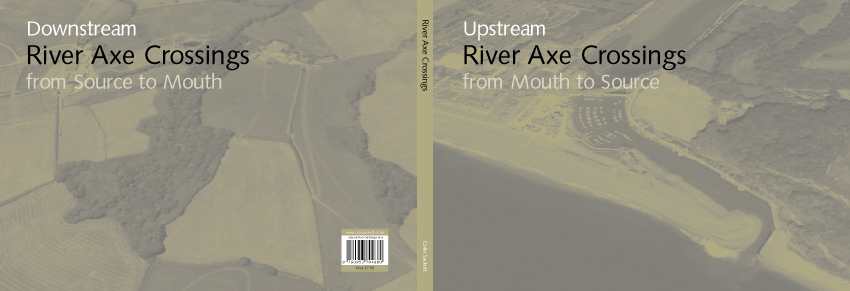
Colin Sackett has kindly sent me his River Axe Crossings, a visual survey that pairs photographs taken up and downstream at each of the river's forty-one crossings - from two wooden sleepers laid across the stream near the river's source, all the way down to Axmouth Bridge, near where it meets the sea. The book has a symmetrical design and each double page spread contains, in addition to the images, some text describing the crossing and what can be seen there. These texts resist the temptation to poeticise the landscape and are instead simple and factual, e.g. for crossing number four, Axe Ford:
- downstream - 'As the name suggests, once a crossing by shallow ford, now a plain concrete slab across the stream.'
- upstream - 'The river channel winding amongst the wooded banks and the small-scale meandering of erosion and deposition.'
Saturday, May 02, 2009
The pale green Thames lies like a rod of rippled jade
 Having mentioned last time Alice Oswald's poem for the Severn Project, I'm going to talk here about The River's Voice, a whole anthology that came out of another funded initiative: Common Ground's Confluence. They secured an Arts Lottery Arts 4 Everyone grant in 1998 for 'a three year project to help and encourage people to create new music for the River Stour. Confluence was a national project with a local focus. It offered participatory music projects, workshops, courses, concerts and events for people living in the catchment area, from Somerset and Wiltshire, where the Stour rises, through Dorset to the sea at Christchurch.'
The anthology has a beautifully written introduction by Roger Deakin, who had just recently published Waterlog. The cover is by Clifford Harper, the anarchist print maker whose appealing woodcut-like illustrations for The Guardian have been appearing over the last few years (many depict landscapes). The contents are a mix of old and new poems, with only one or two related directly to the Confluence project. This makes for a good anthology - it avoids the problem I found, for example, with Wild Reckoning: An Anthology provoked by Rachel Carson's Silent Spring (2004), where the commissioned poems didn't match up to the older works collected for the anthology.
When is a river poem not a landscape poem? Almost always, I suppose, since it's rare to find a poet simply looking at a river without walking, charting or imagining its whole course, reflecting on its history, describing its wildlife, or simply relating an anecdote shaped by the river. Some of this anthology's rivers are abstract or unspecific, as in J. H. Prynne's 'Along Almost Any River'; eight of the poems are just called 'River', 'A River' or 'The River'. Still, here is a partial list of some real rivers and associated poets -
- The River Avon - David Wright
- The Charles River - Robert Lowell
- The Derwent River - William Wordsworth
- The River Duddon - Norman Nicholson
- The River Idle - Phoebe Hesketh
- The Liffey - William Oxley
- The Moscow River - Osip Mandelstam
- The River Otter - Samuel Taylor Coleridge
- The River Severn - Charles Tomlinson
- The Tay - Douglas Dunn
Symphony in Yellow
An omnibus across the bridge
Crawls like a yellow butterfly,
And, here and there a passer-by
Shows like a little restless midge.
Big barges full of yellow hay
Are moored against the shadowy wharf,
And, like a yellow silken scarf,
The thick fog hangs along the quay.
The yellow leaves begin to fade
And flutter from the temple elms,
And at my feet the pale green Thames
Lies like a rod of rippled jade.
Thursday, April 30, 2009
A Sleepwalk on the Severn

I have just read Alice Oswald's new book, A Sleepwalk on the Severn. I've written here before about her earlier river poem, Dart, a work which seems to gather new admirers with every passing year (Germaine Greer apparently thinks Alice Oswald should be the next poet laureate). Dart, according to The Observer, 'was the result of three years of locally recorded conversations and her new work, A Sleepwalk on the Severn, is likewise grounded in footslogging research. The poem gives voice to a slippery crew of real river folk, among them a birdwatcher, a vicar and an articled clerk, who haunt the Severn estuary. Sleepwalk is a weird dream of a poem, set at night over five different phases of the Moon. Though a note tartly informs the reader that "this is not a play", the work it most often recalls is Under Milk Wood, with its counterpointed voices and ardent attentiveness to place.' I found it much less accessible than Dart and will need to give it some time to sink in I think. You can hear some of it at the end of a slightly stilted Woman's Hour interview, and read some lines on the website of Jeanette Winterson (another Oswald fan).
Sleepwalk was commissioned by Gloucestershire County Council. I have talked here before about art that is commissioned to consider particular landscapes, such as the photographs (Jason Orton) and text (Ken Worpole) of 350 Miles, An Essex Journey. It is easy to see how money could be found for books that generate interest by exploring aspects of a locality, or for site specific artworks that draw new visitors. And in these days of 'relational aesthetics', landscape art which invites participation or involves local people should be even more attractive. Sleepwalk, like Dart, is a collage that uses real voices and actual history (in this it is partly in the tradition of earlier poems of place, like Paterson, or Charles Olson's Maximus Poems which centre on Gloucester, Massachusettes). The poem is also being given back to the people of the Severn catchment in the form of a theatre piece that is on tour this spring.
Saturday, April 25, 2009
Gentle airs and murmuring brooks
Beethoven wrote his Pastoral Symphony in 1807-8, but as Elizabeth Schwarm Glesner writes on the Classical Music Pages, 'this was certainly not the first time that nature found its way into concert music. Baroque composers were fond of hunting scenes and bird calls. Leopold Mozart produced a bit of fluff called A Musical Sleighride, complete with barking dogs, and Haydn's The Seasons, which dates from 1801, is filled with scenes from country life. Although these examples are familiar, one probable influence on Beethoven is often overlooked. In 1784, the publisher Bossler issued a set of piano trios by Beethoven. He advertised the works in the newspaper, and, on the same page, listed another composition, also published by Bossler, a five-movement symphony by the now-forgotten Justin Heinrich Knecht, a work entitled A Musical Portrait of Nature. Each movement of that symphony carried a descriptive title, remarkably similar to those used a dozen years later by Beethoven, who also made the same unusual choice of five movements. Beethoven almost certainly knew of this precedent for his own symphony and for his titles, but, since the secret to successful plagiarism is to be better known than your source, Beethoven was never questioned.'

Beethoven's five movements were (in English translation):
(1) Awakening of cheerful feelings upon arrival in the country
(2) Scene by the brook
(3) Happy gathering of country folk
(4) Thunderstorm; Storm
(5) Shepherd's song; cheerful and thankful feelings after the storm
An article on the Bach Cantatas site, explains that the earlier Knecht composition, Le Portrait Musical de la Nature, was 'a grand symphony for two violins, viola and bass, two flutes, two oboes, bassoons, horns, trumpets and drums ad lib., in which is expressed:
(1) A beautiful country, the sun shining, gentle airs and murmuring brooks; birds twitter, a waterfall tumbles from the mountain, the shepherd plays his pipe, the shepherdess sings, and the lambs gambol around.
(2) Suddenly the sky darkens, an oppressive closeness pervades the air, black clouds gather, the wind rises, distant thunder Is heard, and the storm approaches.
(3) The tempest bursts in all Its fury, the wind howls and the rain beats, the trees .groan and the streams rush furiously.
(4) The storm gradually goes off, the clouds disperse and the sky clears.
(5) Nature raises its joyful voice to heaven in songs of gratitude to the Creator (a hymn with variations).'

Beethoven's five movements were (in English translation):
(1) Awakening of cheerful feelings upon arrival in the country
(2) Scene by the brook
(3) Happy gathering of country folk
(4) Thunderstorm; Storm
(5) Shepherd's song; cheerful and thankful feelings after the storm
An article on the Bach Cantatas site, explains that the earlier Knecht composition, Le Portrait Musical de la Nature, was 'a grand symphony for two violins, viola and bass, two flutes, two oboes, bassoons, horns, trumpets and drums ad lib., in which is expressed:
(1) A beautiful country, the sun shining, gentle airs and murmuring brooks; birds twitter, a waterfall tumbles from the mountain, the shepherd plays his pipe, the shepherdess sings, and the lambs gambol around.
(2) Suddenly the sky darkens, an oppressive closeness pervades the air, black clouds gather, the wind rises, distant thunder Is heard, and the storm approaches.
(3) The tempest bursts in all Its fury, the wind howls and the rain beats, the trees .groan and the streams rush furiously.
(4) The storm gradually goes off, the clouds disperse and the sky clears.
(5) Nature raises its joyful voice to heaven in songs of gratitude to the Creator (a hymn with variations).'
Monday, April 20, 2009
The End of Summer

When I think of ECM records I tend to imagine covers showing snowy landscapes, like this one. This is probably because I tend to associate ECM with north European composers and performers, Jan Garbarek for instance, whose music often gets described as 'glacial' and 'icy'. In fact the covers and music are very varied. Landscape imagery is usually used when the title seems to demand it, like this shadow falling over the sea for Julia Hulsmann's recent album, The End of Summer.
 A couple more examples from ECM's New Series: Erkki-Sven Tüür's Exodus shows a sunlit road and, in a similar vein, it is no surprise to see a work by his fellow Estonian Arvo Pärt's entitled 'Misterioso' illustrated with sun breaking through clouds.

Reading a discussion thread on ECM cover art I see that someone is complaining about the fashion for blurred photographs on recent releases. Jon Hassell's return to the ECM label, Last night the moon came dropping its clothes in the street (the title is taken from a Rumi poem) exemplifies this. More Gerhard Richter than Caspar David Friedrich, it has a bit more edginess than one might expect from an 'ECM landscape'.

Subscribe to:
Posts (Atom)