Thursday, April 30, 2009
A Sleepwalk on the Severn
I have just read Alice Oswald's new book, A Sleepwalk on the Severn. I've written here before about her earlier river poem, Dart, a work which seems to gather new admirers with every passing year (Germaine Greer apparently thinks Alice Oswald should be the next poet laureate). Dart, according to The Observer, 'was the result of three years of locally recorded conversations and her new work, A Sleepwalk on the Severn, is likewise grounded in footslogging research. The poem gives voice to a slippery crew of real river folk, among them a birdwatcher, a vicar and an articled clerk, who haunt the Severn estuary. Sleepwalk is a weird dream of a poem, set at night over five different phases of the Moon. Though a note tartly informs the reader that "this is not a play", the work it most often recalls is Under Milk Wood, with its counterpointed voices and ardent attentiveness to place.' I found it much less accessible than Dart and will need to give it some time to sink in I think. You can hear some of it at the end of a slightly stilted Woman's Hour interview, and read some lines on the website of Jeanette Winterson (another Oswald fan).
Sleepwalk was commissioned by Gloucestershire County Council. I have talked here before about art that is commissioned to consider particular landscapes, such as the photographs (Jason Orton) and text (Ken Worpole) of 350 Miles, An Essex Journey. It is easy to see how money could be found for books that generate interest by exploring aspects of a locality, or for site specific artworks that draw new visitors. And in these days of 'relational aesthetics', landscape art which invites participation or involves local people should be even more attractive. Sleepwalk, like Dart, is a collage that uses real voices and actual history (in this it is partly in the tradition of earlier poems of place, like Paterson, or Charles Olson's Maximus Poems which centre on Gloucester, Massachusettes). The poem is also being given back to the people of the Severn catchment in the form of a theatre piece that is on tour this spring.
Labels:
Alice Oswald,
rivers,
the moon
Location:
River Severn, Gloucsetershire
Saturday, April 25, 2009
Gentle airs and murmuring brooks
Beethoven wrote his Pastoral Symphony in 1807-8, but as Elizabeth Schwarm Glesner writes on the Classical Music Pages, 'this was certainly not the first time that nature found its way into concert music. Baroque composers were fond of hunting scenes and bird calls. Leopold Mozart produced a bit of fluff called A Musical Sleighride, complete with barking dogs, and Haydn's The Seasons, which dates from 1801, is filled with scenes from country life. Although these examples are familiar, one probable influence on Beethoven is often overlooked. In 1784, the publisher Bossler issued a set of piano trios by Beethoven. He advertised the works in the newspaper, and, on the same page, listed another composition, also published by Bossler, a five-movement symphony by the now-forgotten Justin Heinrich Knecht, a work entitled A Musical Portrait of Nature. Each movement of that symphony carried a descriptive title, remarkably similar to those used a dozen years later by Beethoven, who also made the same unusual choice of five movements. Beethoven almost certainly knew of this precedent for his own symphony and for his titles, but, since the secret to successful plagiarism is to be better known than your source, Beethoven was never questioned.'

Beethoven's five movements were (in English translation):
(1) Awakening of cheerful feelings upon arrival in the country
(2) Scene by the brook
(3) Happy gathering of country folk
(4) Thunderstorm; Storm
(5) Shepherd's song; cheerful and thankful feelings after the storm
An article on the Bach Cantatas site, explains that the earlier Knecht composition, Le Portrait Musical de la Nature, was 'a grand symphony for two violins, viola and bass, two flutes, two oboes, bassoons, horns, trumpets and drums ad lib., in which is expressed:
(1) A beautiful country, the sun shining, gentle airs and murmuring brooks; birds twitter, a waterfall tumbles from the mountain, the shepherd plays his pipe, the shepherdess sings, and the lambs gambol around.
(2) Suddenly the sky darkens, an oppressive closeness pervades the air, black clouds gather, the wind rises, distant thunder Is heard, and the storm approaches.
(3) The tempest bursts in all Its fury, the wind howls and the rain beats, the trees .groan and the streams rush furiously.
(4) The storm gradually goes off, the clouds disperse and the sky clears.
(5) Nature raises its joyful voice to heaven in songs of gratitude to the Creator (a hymn with variations).'

Beethoven's five movements were (in English translation):
(1) Awakening of cheerful feelings upon arrival in the country
(2) Scene by the brook
(3) Happy gathering of country folk
(4) Thunderstorm; Storm
(5) Shepherd's song; cheerful and thankful feelings after the storm
An article on the Bach Cantatas site, explains that the earlier Knecht composition, Le Portrait Musical de la Nature, was 'a grand symphony for two violins, viola and bass, two flutes, two oboes, bassoons, horns, trumpets and drums ad lib., in which is expressed:
(1) A beautiful country, the sun shining, gentle airs and murmuring brooks; birds twitter, a waterfall tumbles from the mountain, the shepherd plays his pipe, the shepherdess sings, and the lambs gambol around.
(2) Suddenly the sky darkens, an oppressive closeness pervades the air, black clouds gather, the wind rises, distant thunder Is heard, and the storm approaches.
(3) The tempest bursts in all Its fury, the wind howls and the rain beats, the trees .groan and the streams rush furiously.
(4) The storm gradually goes off, the clouds disperse and the sky clears.
(5) Nature raises its joyful voice to heaven in songs of gratitude to the Creator (a hymn with variations).'
Monday, April 20, 2009
The End of Summer

When I think of ECM records I tend to imagine covers showing snowy landscapes, like this one. This is probably because I tend to associate ECM with north European composers and performers, Jan Garbarek for instance, whose music often gets described as 'glacial' and 'icy'. In fact the covers and music are very varied. Landscape imagery is usually used when the title seems to demand it, like this shadow falling over the sea for Julia Hulsmann's recent album, The End of Summer.
A couple more examples from ECM's New Series: Erkki-Sven Tüür's Exodus shows a sunlit road and, in a similar vein, it is no surprise to see a work by his fellow Estonian Arvo Pärt's entitled 'Misterioso' illustrated with sun breaking through clouds.

Reading a discussion thread on ECM cover art I see that someone is complaining about the fashion for blurred photographs on recent releases. Jon Hassell's return to the ECM label, Last night the moon came dropping its clothes in the street (the title is taken from a Rumi poem) exemplifies this. More Gerhard Richter than Caspar David Friedrich, it has a bit more edginess than one might expect from an 'ECM landscape'.
Sunday, April 19, 2009
The Drowned World
The death of J. G. Ballard is very sad news - a writer I've loved since reading his disaster novels and short stories as a teenager.
From the many riches of the Ballardian website, I'm linking here to a piece on Flooded London, with some great photos by Squint/Opera and a quotation from The Drowned World (1962):
'The bulk of the city had long since vanished, and only the steel-supported buildings of the central commercial and financial areas had survived the encroaching flood waters. The brick houses and single-storey factories of the suburbs had disappeared completely below the drifting tides of silt. Where these broke surface giant forests reared up into the burning dull-green sky, smothering the former wheatfields of temperate Europe and North America. Impenetrable Mato Grossos sometimes three hundred feet high, they were a nightmare world of competing organic forms returning rapidly to their Paleozoic past, and the only avenues of transit for the United Nations military units were through the lagoon systems that had superimposed themselves on the former cities. But even these were now being clogged with silt and then submerged...'
From the many riches of the Ballardian website, I'm linking here to a piece on Flooded London, with some great photos by Squint/Opera and a quotation from The Drowned World (1962):
'The bulk of the city had long since vanished, and only the steel-supported buildings of the central commercial and financial areas had survived the encroaching flood waters. The brick houses and single-storey factories of the suburbs had disappeared completely below the drifting tides of silt. Where these broke surface giant forests reared up into the burning dull-green sky, smothering the former wheatfields of temperate Europe and North America. Impenetrable Mato Grossos sometimes three hundred feet high, they were a nightmare world of competing organic forms returning rapidly to their Paleozoic past, and the only avenues of transit for the United Nations military units were through the lagoon systems that had superimposed themselves on the former cities. But even these were now being clogged with silt and then submerged...'
Wednesday, April 15, 2009
The Beth Chatto Gardens
The other week I finally got round to looking at the revamped Museum of Garden History in Lambeth (now called the Garden Museum). At first it is rather disconcerting - you pay your £6, step in and then look around - where has the museum gone? It is now upstairs on a sort of landing space, with the ground floor now a big empty area that can be used for talks (and presumably commercial events?) It is some years since I last went and I don't remember the permanent collection being very large, but now it seems so small it reminded me of the kind of museum you put together as a child (like Anne Fadiman's 'Serendipity Museum of Nature'). What they have, like the display on lawns above, is nice, but it barely touches the surface of such a large subject (and that's just lawns, let alone gardens...)
There is a new space for exhibitions and I looked round their Beth Chatto retrospective. Her garden in Essex, designed to work with the limitations of an 'unpromising landscape', is very close to my mother-in-law so I've been there several times (the photo below is from a few years ago). We've bought some of her plants for our modest patch here in Stoke Newington - artemisia ludoviciana, tiarella cordyfolia and omphalodes capadocia 'Cherry Ingram', which is out at the moment.

Geoff Manaugh, who writes the superb BLDBLOG, did an article on the new Garden Museum for Dwell. You can see from his photos how empty the building looks - although as the article says, it's all done very stylishly. I must get to a talk there... the museum's curator is Christopher Woodward who wrote the excellent In Ruins, so we can expect an interesting programme which should cover landscape topics (the schedule for spring and summer isn't announced yet). They have already been hosting a series of conversations with Tim Richardson and Noël Kingsbury, authors of Vista: The Culture and Politics of Gardens, and although these are not open to the public (invitation only) some of them are available as MP3s at Gardens Illustrated.
Tuesday, April 14, 2009
To the snow-covered island
There's a Tomas Tranströmer poem called 'From March 1979' that I was thinking of mentioning in the previous posting, but didn't because there seems to be a difference in the way it describes writing in the landscape. Tranströmer comes across tracks in the snow - a natural sign, rather than something that happens to remind the poet of linguistic signs. The poem starts with Tranströmer weary of words, 'words but no language'. He goes to a snow-covered island, which resembles unwritten pages, and in the tracks of the deer sees 'language but no words.'
In an article for Poetry Review Jay Parini says that 'this archetypal poem forms a tiny myth, describing a literal journey with symbolic dimensions, thus extending the metaphor in various directions. Most of us who read a good deal are sick of those “who come with words, words but no language.” This revulsion often propels a poem into being, as in Yeats’s “I will arise and go now, and go to Innisfree.” One arrives in the land of silence: “Wilderness has no words.” The metaphor rapidly becomes a conceit, as the unprinted fields of snow become “unprinted pages.” The sleight of mind in the last stanza is, again, typical: Tranströmer deepens the image unexpectedly, giving a literal level – the deer’s footprints in the snow – and a range of associations, as we are left contemplating this “language without words” – which (in my own association) is akin to Chomsky’s Universal Grammar – which underlies speech, underwrites silence itself.'
Location:
Stockholm
Friday, April 10, 2009
A fugitive inscription on the pages of the earth
Sometimes I think that an ideal landscape poetry would be written by the landscape itself. How? Some examples from Philippe Jaccottet's poetry (see Under Clouded Skies & Beauregard and my earlier post): wind on water is 'a fugitive inscription on the pages of the earth,' darkness is 'thin and threatening ink', the flight of birds 'calligraphy in the sky'. Eugenio Montale is another poet who sees writing in nature - a translation of 'Quasi una Fantasia' by David Young reads 'with joy I’ll read the black / figures of the branches, stark against the white, / an esoteric alphabet'. Similarly, William Carlos Williams writes in 'The Botticellian Trees' of the thin letters that spell winter and the alphabet of trees. I'd be interested in other examples...
I'd also love to know more about Jean-Pierre Richard's Pages paysages (Mark Treharne mentions it in his introduction to Jaccottet's poems). Apparently it develops the idea of the page as a landscape, which would mirror the poems I've just mentioned... The book seems hard to get hold of even in French and I don't think it's been translated.
China: Empire of Living Symbols (see my previous post) includes an illustration that shows how close the pattern of leaves can come to writing. It comes from the famous Mustard Seed Garden Manual of Painting, the first part of which was published in 1679. Calligraphy and painting seem almost to merge here and suggest the possibility of a kind of landscape art suspended somewhere between poetry and painting.
I'd also love to know more about Jean-Pierre Richard's Pages paysages (Mark Treharne mentions it in his introduction to Jaccottet's poems). Apparently it develops the idea of the page as a landscape, which would mirror the poems I've just mentioned... The book seems hard to get hold of even in French and I don't think it's been translated.China: Empire of Living Symbols (see my previous post) includes an illustration that shows how close the pattern of leaves can come to writing. It comes from the famous Mustard Seed Garden Manual of Painting, the first part of which was published in 1679. Calligraphy and painting seem almost to merge here and suggest the possibility of a kind of landscape art suspended somewhere between poetry and painting.
Tuesday, April 07, 2009
Climbing Omei Mountain
China: Empire of Living Symbols is a book I've been recommending to anyone with even a passing interest in China. A collection of rather tired adjectives come to mind which don't really do it justice: charming, fascinating, beautiful. The book discusses the origins and evolution of all kinds of Chinese ideographs, but here I'm focusing on landscape. The cover of the book shows the characters for 'mountain' and 'water' - the smaller symbols are the early versions of these characters found on Shang dynasty bronzes, which resemble more closely the corresponding natural features. 'The character for water is the picture of a river with its currents, whirlpools, and sandbanks, as one sees when standing on the riverbank looking over the course of the river.' The character for mountain resembles China's sacred mountains - Taishan, Songshan and Huashan.Cecilia Lindqvist juxtaposes the character for mountain written by the great painter-calligrapher Mi Fu (or Mi Fei) (1051-1107) with some of the mountains he painted. 'Despite the difference in technique, there is an unmistakable similarity between the character for mountain and the mountain peaks in the painting, not only in their outward form but most of all in the strength they convey.' Mi Fu and his son Mi Youren originated the cloudy mountain style of landscape painting in China.
The book discusses some other 'landscape' characters: 'island' which seems to derive from a picture of sandbanks in a river, 'valley' which looks like the opening to a valley, 'cliff' (included in Chinese compound characters) which clearly depicts a cliff, and 'rock' which seems to show a boulder that has fallen from a cliff.It is all very reassuring to a reader like me who knows little about the Chinese language but whose imagination was caught long ago by Ernest Fenollosa's The Chinese Written Character as a Medium for Poetry and the 'ideogrammic' poems of Ezra Pound that it influenced. There have been many articles explaining how wrong Fenollosa was, e.g. in giving the impression that many Chinese characters have pictorial origins. Lindqvist's book, whilst clearly focusing on the primitive characters which have an iconic quality, shows how these occur throughout the whole of Chinese culture.
Fenollosa's notion that Chinese characters contain an inner energy and convey strong verbal actions may have been fanciful, but there is still something very appealing in the idea that a poem in Chinese can relate directly to what it signifies (a mountain) through the shape of a signifier, and that such a poem can be written out with all the artistry of a landscape painting.
There are numerous Chinese mountain poems on a site I've mentioned before, Mountain Songs, such as 'Climbing Omei Mountain' by Li Bai (Li Po). The character written by Mi Fu and reproduced above can be seen here in the poem's title,
and Li Bai's description of Omei mountain resembles a 'cloudy mountain' painting: 'The blue mists support me / the sky opens out; / Colors commingle / is it a painted picture?'
Location:
Mount Emei, China
Friday, April 03, 2009
Olive trees
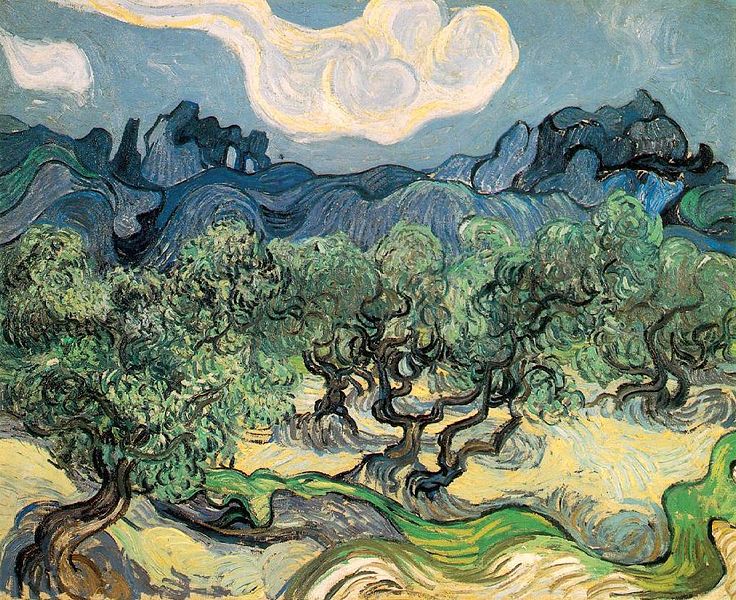
D. H. Lawrence was not 'profoundly interested in landscape'. In a 1929 essay 'Introduction to these pictures', he praises artists like Titian, Velazquez and Rembrandt, who depict real people, and criticises lesser painters like Reynolds and Gainsborough, for whom the clothes were more important than the body. He then goes on to say that 'landscape seems to be meant as a background to an intenser vision of life, so to my feeling painted landscape is background with the real subject left out... It doesn't call up the more powerful responses of the human imagination, the sensual, passional responses... It is not confronted with any living procreative body.'
The fact that landscape painting avoids dealing with the body is the reason, according to Lawrence, why the English have excelled at it. 'It is a form of escape for them, from the actual human body they so hate and fear, and it is an outlet for their perishing aesthetic desires... It is always the same. The northern races are so innerly afraid of their own bodily existence... that all they cry for is an escape. And, especially, art must provide that escape.' This would be one way of interpreting the northern 'Romantic tradition' of landscape painting (which I've discussed here before). And whilst these comments seem almost stereotypically Lawrentian, they point to a real concern that landscape art can represent a refusal to engage with humanity - an accusation that could still be levelled at land artists like Richard Long, walking in the wilderness.
Lawrence goes on to describe the impressionists' escape into light and then the post-impressionists who 'still hate the body - hate it. But, in a rage, they admit its existence, and paint it as huge lumps, tubes, cubes, planes, volumes, spheres, cones, cylinders, all the "pure" or mathematical forms of substance. As for landscape, it comes in for some of the same rage. It has also suddenly gone lumpy. Instead of being nice and ethereal and non-sensual, it was discovered by van Gogh to be heavily overwhelmingly sensual.'
The fact that landscape painting avoids dealing with the body is the reason, according to Lawrence, why the English have excelled at it. 'It is a form of escape for them, from the actual human body they so hate and fear, and it is an outlet for their perishing aesthetic desires... It is always the same. The northern races are so innerly afraid of their own bodily existence... that all they cry for is an escape. And, especially, art must provide that escape.' This would be one way of interpreting the northern 'Romantic tradition' of landscape painting (which I've discussed here before). And whilst these comments seem almost stereotypically Lawrentian, they point to a real concern that landscape art can represent a refusal to engage with humanity - an accusation that could still be levelled at land artists like Richard Long, walking in the wilderness.
Lawrence goes on to describe the impressionists' escape into light and then the post-impressionists who 'still hate the body - hate it. But, in a rage, they admit its existence, and paint it as huge lumps, tubes, cubes, planes, volumes, spheres, cones, cylinders, all the "pure" or mathematical forms of substance. As for landscape, it comes in for some of the same rage. It has also suddenly gone lumpy. Instead of being nice and ethereal and non-sensual, it was discovered by van Gogh to be heavily overwhelmingly sensual.'
Saturday, March 28, 2009
Beauregard
Philippe Jaccottet is described by Roger Cardinal in the Oxford Companion to Literature in French as follows. 'Swiss by birth, Jaccottet settled in a French village in the Drôme, a region of wooded hills and mountainous prospects from which he derives a landscape poetry of non-specific and universal resonance. ... Trees and birds, rain and snow, moon and stars are the archetypal features of a world dense with intimations of harmony and transfiguration. Inspired by Hölderlin, Rilke and Ungaretti, each of whom he has translated, Jaccottet celebrates those rare moments of participatory insight when contingent phenomena, lyrically voiced, accede to the status of metaphor or metaphysical symbol.'
Beauregard (1981) is a set of five prose pieces, the first of which was inspired by the poet's chance discovery of a remote, 'insignificant' village, in the Drôme called Beauregard. I read it in the Bloodaxe translation by Mark Treharne, who describes Beauregard as a collection of 'landscapes in prose', 'place reassembled as text.' Jaccottet writes of both the physical setting and his own interior landscape, something Treharne sees as inevitable - 'endemic in the whole business of inscribing landscape in the referential system of words'. However, the approach is something particularly associated with certain poets: Eugenio Montale for example (whose writing on the Cinque Terra I have described here before). Jaccottet cites Montale's poem Tempi di Bellosguardo in his own poem - they both contain 'the same word'.
I found Mark Treharne's general introduction to Jaccottet interesting, touching as it does on some of the difficulties of dealing with landscape in the arts today. Here are some of the points made in it:
Beauregard (1981) is a set of five prose pieces, the first of which was inspired by the poet's chance discovery of a remote, 'insignificant' village, in the Drôme called Beauregard. I read it in the Bloodaxe translation by Mark Treharne, who describes Beauregard as a collection of 'landscapes in prose', 'place reassembled as text.' Jaccottet writes of both the physical setting and his own interior landscape, something Treharne sees as inevitable - 'endemic in the whole business of inscribing landscape in the referential system of words'. However, the approach is something particularly associated with certain poets: Eugenio Montale for example (whose writing on the Cinque Terra I have described here before). Jaccottet cites Montale's poem Tempi di Bellosguardo in his own poem - they both contain 'the same word'.I found Mark Treharne's general introduction to Jaccottet interesting, touching as it does on some of the difficulties of dealing with landscape in the arts today. Here are some of the points made in it:
- Jaccottet elected to live in the Drôme to avoid distractions, not to write regional verse or nature poetry. The landscape provides 'a point of focus for sensory, affective and meditative response.'
- His poetry represents attentiveness pushed to its limits. But 'scrutiny should not be too intense, too keen for the capture, or it will kill its object.'
- The eyes, according to Jaccottet, drink in the world and 'contribute to its metamorphosis into immaterial images.' In his poetry, 'objects become images and ultimately figures of language.'
- But landscape is not just a static image, it changes constantly and Jaccottet reflects this (particularly the play of light and seasonal change).
- One of Jaccottet's prose works is called Paysages avec figures absentes, which sounds like a collection of landscape paintings that have lost their 'figures' (in connection with this, see my earlier post on artworks entitled 'Landscape with...') In this, he describes intense encounters with a landscape that sound like epiphanies, but is reluctant to make too much of them. 'Occasionally, as if our movements had crossed - like the encounter of two glances that can create a flash of illumination and open up another world - I have thought I had glimpsed what I should have to call the still centre of the moving world. Too much said? Better to move on...'
- As a modern landscape poet, Jaccottet finds it important to stress the distance between nature and human cycles: 'landscape can appear ordinary and familiar, but also alien, full of uneasy distances, a foreign language.'
- Finally, the introduction to the Bloodaxe translation begins with discussion of a brief poem that contemplates the sight of snow on a mountain. It is from Airs: poèms 1961-64, a collection inspired by haiku. The poem is an 'enigmatic verbal landscape' - its lack of detail leaves the reader unsure how specific or real it is. For Treharne, 'the laconic style provokes an involvement with the poem that a more explicit formulation would not have done.'
Wednesday, March 25, 2009
Under cherry trees

Cherry blossom forecast (see Neil Duckett's blog)
It looks from the latest cherry blossom maps as if the blossom should have reached Tokyo by now. Here in London the blossom is already out. A few years ago we had a small blossom viewing party in our garden and I could not resist pinning up some Japanese poems in translation, like this one by Kobayashi Issa: Under cherry trees / there are / no strangers.
Of course blossom viewing in Japan is no longer an occasion for reverential nature worship, and in many ways it never was, as is clear from this passage in The Tsurezuregusa of Kenkō: 'The man of breeding never appears to abandon himself completely to his pleasures; even his manner of enjoyment is detached. It is the rustic boors who take all their pleasures grossly. They squirm their way through the crowd to get under the trees; they stare at the blossoms with eyes for nothing else; they drink sake and compose linked verse; and finally they heartlessly break off great branches and cart them away. When they see a spring they dip their hands and feet to cool them; if it is snow, they jump down to leave their footprints. No matter what the sight, they are never content merely with looking at it' (Kenkō, ‘Essays in Idleness’ (1330-32), translated by Donald Keene).
Monday, March 23, 2009
Thames: Sacred River
Roni Horn (discussed in my previous post) is one of many sources for Peter Ackroyd's Thames: Sacred River. He describes her book Another River (2000) as one of the most interesting published on the Thames in recent years. However, his chapter on Thames art, discussing the likes of Richard Wilson, Canaletto, Turner, Whistler and Stanley Spencer, only covers painting and doesn't extend to Roni Horn's Still Water or other recent work like Mark Dion's Thames Dig. I was also a bit disappointed with Ackroyd's 'The Song of the Thames', a chapter that starts with Handel's Water Music but goes no further in discussing music related to the river, describing instead the work of poets like Spenser, Milton, Pope and Shelley. I suppose this imbalance does reflect the general view of the relative strengths of English culture.
Percy Bysshe Shelley was, according to Ackroyd, a poet 'haunted by the river.' Here are some of the connections described in the book:
- Shelley growing up by the river at Syon House Academy, Eton and Oxford
- In the summer of 1815, living on the borders of Windsor Forest, like his predecessor as river poet, Alexander Pope
- That same year, a journey up the river in a wherry with Thomas Love Peacock (already the author of a poem on The Genius of the Thames); Peacock would write about the experience in his novel Crotchet Castle (1831)
- The poem 'A Summer Evening Churchyard' inspired by the fifteenth century church Shelley saw at Lechlade (where there is now a path, Shelley's Walk, a fact which, taken with my recent comments on the causeways at Hangzhou named after Chinese poets, makes me reflect on the way writers have impressed themselves onto the landscape...)
- Still in 1815, Alastor, or the Spirit of Solitude in which 'he compares the true pilgrimage of a poet to a journey upriver'
- In 1818, a house rented at Great Marlow and writing 'much of The Revolt of Islam in Bisham Woods, or while floating under the beech groves of Bisham-on-the-Thames in a boat called Vaga'
- And finally, Yeats' view of Shelley that 'a single vision would have come to him again and again, a vision of a boat drifting down a broad river...' and the fact that Shelley eventually died 'in the watery element to which he had dedicated his life.'
Labels:
psychogeography,
rivers
Location:
Lechlade-on-Thames
Friday, March 20, 2009
Becoming a landscape
I have been asked by another Roni Horn enthusiast whether I'm going to post about the Tate's 'Roni Horn a.k.a. Roni Horn' exhibition... Well, here goes, although as I start to write this I can't help recalling that the subject of landscape barely featured at the discussion of her work at Tate Modern, and wondering if I've therefore already given her disproportionate attention here (with The dark river, Thicket No. 1, Hot Pot at Strútur, To Place: Verne's Journey and Frequently the woods are pink). And yet I think my earlier posts have so far only touched on a few aspects of what seems a fundamental connection.
The two-volume exhibition catalogue has a Subject Index which includes entries on 'desert', 'rocks', 'island', 'trees', 'water', 'weather'. These were written by Roni Horn and other commentators like Tacita Dean and Hélène Cixous (some previously unpublished). There's one entry for 'landscape': 'The point at which something becomes too complex to be itself only. This is the place where a thing becomes a landscape'. So for Roni Horn, landscape is more than just a view. This is a quotation from notes accompanying a set of photographs, Becoming a Landscape (1999), which connects close-up portraits with shots of geothermic pools in Iceland. I'm intrigued by the way she blurs landscape with other forms like 'portraiture', as in You are the Weather about which she has said "I did have a very specific idea that I wanted to see if I could elicit a place from her face—almost like a landscape."
In connection with You are the Weather, Roni Horn has made a collection of 'adjectives that apply to humanity and the weather equally'. Bad, balmy, beautiful, bitter, breezy, bright, brisk, brutal etc etc. These words were embedded in the floor for an exhibition in Munich (1996) and the same thing has been done this year at Tate Modern (in the room which showcases her artist books). They are also selling Roni Horn T-shirts with some of these adjectives on them: balmy, moist, dull. Hm... not sure what I think of these... but I do love the exhibition and would highly recommend it.
The two-volume exhibition catalogue has a Subject Index which includes entries on 'desert', 'rocks', 'island', 'trees', 'water', 'weather'. These were written by Roni Horn and other commentators like Tacita Dean and Hélène Cixous (some previously unpublished). There's one entry for 'landscape': 'The point at which something becomes too complex to be itself only. This is the place where a thing becomes a landscape'. So for Roni Horn, landscape is more than just a view. This is a quotation from notes accompanying a set of photographs, Becoming a Landscape (1999), which connects close-up portraits with shots of geothermic pools in Iceland. I'm intrigued by the way she blurs landscape with other forms like 'portraiture', as in You are the Weather about which she has said "I did have a very specific idea that I wanted to see if I could elicit a place from her face—almost like a landscape."
In connection with You are the Weather, Roni Horn has made a collection of 'adjectives that apply to humanity and the weather equally'. Bad, balmy, beautiful, bitter, breezy, bright, brisk, brutal etc etc. These words were embedded in the floor for an exhibition in Munich (1996) and the same thing has been done this year at Tate Modern (in the room which showcases her artist books). They are also selling Roni Horn T-shirts with some of these adjectives on them: balmy, moist, dull. Hm... not sure what I think of these... but I do love the exhibition and would highly recommend it.
Monday, March 16, 2009
The West Lake of Hangzhou
An article in February's Landscape Architecture by Carl Steinitz is entitled ‘Landscape Planning A History of Influential Ideas’. Reading it reminded me a bit of those Medieval chronicles which start with a brief history of the world before proceeding seamlessly to a detailed account of much more recent events. His list begins in Song Dynasty China, races forward past the Medicis' villas and English landscape gardens before slowing down in the late nineteenth century and then dwelling on a range of American landscape architects and related figures. These include Eisenhower, who makes the list for coming up with interstate highways, and Lady Bird Johnson (more positively) for adding aesthetic considerations to the US National Environmental Protection Act’s criteria.
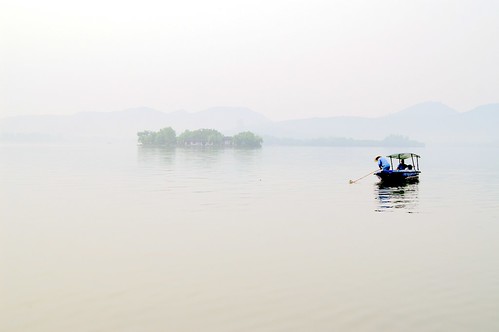
The first in his list of great ideas is the West Lake of Hangzhou: ‘important because it is the result of a decision made in the eighth century to build a very large lake - a deliberate act to create a new landscape on a large scale. This landscape was made primarily for reasons of defense, water supply, aquaculture, and agriculture. In the Song Dynasty it was rebuilt under the direction of the poet and governor of Hangzhou, Su Shi (1037-1101). Over time, it has become considered 'natural', a place of great scenic beauty and cultural importance. Emperor Qianlong's Ten Scenes of the West Lake, poems composed in the 18th century, is learned by all Chinese schoolchildren today. Too many people believe landscape planning is only conservation and reaction, but the West Lake shows that landscape planning includes action with foresight. The big idea embodied by the West Lake is that a landscape built for practical reasons can be designed and transformed over time into a highly valued cultural landscape, and even one that is primarily assumed to have been the result of natural processes.'

The first in his list of great ideas is the West Lake of Hangzhou: ‘important because it is the result of a decision made in the eighth century to build a very large lake - a deliberate act to create a new landscape on a large scale. This landscape was made primarily for reasons of defense, water supply, aquaculture, and agriculture. In the Song Dynasty it was rebuilt under the direction of the poet and governor of Hangzhou, Su Shi (1037-1101). Over time, it has become considered 'natural', a place of great scenic beauty and cultural importance. Emperor Qianlong's Ten Scenes of the West Lake, poems composed in the 18th century, is learned by all Chinese schoolchildren today. Too many people believe landscape planning is only conservation and reaction, but the West Lake shows that landscape planning includes action with foresight. The big idea embodied by the West Lake is that a landscape built for practical reasons can be designed and transformed over time into a highly valued cultural landscape, and even one that is primarily assumed to have been the result of natural processes.'
Source: shenxy
This account misses out Su Shi's predecessor as governor of Hangzhou, Bai Juyi (who I still think of in Wade-Giles terms as Po Chü-i). Bai Juyi was prefect of Hangzhou in 822-24 and rebuilt the dyke that previous governors had neglected. He ordered 'the construction of a causeway connecting the Broken Bridge with the Solitary Hill, to facilitate walking on foot, instead of depending on boat. Then he planted coolabah trees and willows trees along the dyke, making it a beautiful landmark'. The causeway is now known as Bai Causeway (another one, the Su Causeway, was built later by Su Shi). One of Bai Juyi's poems about the West Lake (called in earlier times Qiantang) can be found here: 'The water's surface now is calm, the bottom of the clouds low. / In several places, the first orioles are fighting in warm trees, / By every house new swallows peck at spring mud.'
Here is the list of Emperor Qianlong's Ten Scenes:
Dawn on the Su Causeway in Spring
Curved Yard and Lotus Pool in Summer
Moon over the Peaceful Lake in Autumn
Remnant Snow on the Bridge in Winter
Leifeng Pagoda in the Sunset
Two Peaks Piercing the Clouds
Orioles Singing in the Willows
Fish Viewing at the Flower Pond
Three Ponds Mirroring the Moon
Evening Bell Ringing at the Nanping Hill
Curved Yard and Lotus Pool in Summer
Moon over the Peaceful Lake in Autumn
Remnant Snow on the Bridge in Winter
Leifeng Pagoda in the Sunset
Two Peaks Piercing the Clouds
Orioles Singing in the Willows
Fish Viewing at the Flower Pond
Three Ponds Mirroring the Moon
Evening Bell Ringing at the Nanping Hill
Location:
West Lake, Hangzhou
Wednesday, March 11, 2009
In May the days were pink like Egyptian stamps
'In May the days were pink like Egyptian stamps', writes Bruno Schulz in Sanatorium Under the Sign of the Hourglass. 'There sailed across the sky the great corvette of Guiana, exploding with all its sails... Then the scenery changed in the sky: in massed clouds three simultaneous pink eclipses occurred, shiny lava began to smolder, outlining luminously the fierce contours of clouds (Cuba, Haiti, Jamaica), and the center of the world receded, its glaring colors became deeper. Roaring tropical oceans, with their azure archipelagos, happy currents and tides and equatorial and salty monsoons made their appearance. With the stamp album in my hand, I was studying the spring. Was it not a great commentary on the times, the grammar of its days and nights?' (trans. Celina Wieniewska)
Saturday, March 07, 2009
Panorama of Scheveningen

Hendrik Willem Mesdag, Segment of the Panorama of Scheveningen, 1881
Visiting the panorama now imposes another century's worth of nostalgia. The building has been restored but feels very much like a time capsule: you walk through a short dark corridor and come up a Victorian wooden stairway into the middle of the panorama, surrounded by a frameless view of the Dutch coast. (The absence of a frame is all the more noticeable because as you enter the museum you go past several Mesdag seascapes which sit within heavy, ornate gilt frames.) The realism is initially disconcerting as your eyes become accustomed to seeing the world in through the medium of paint. But after a while some details do start to seem a little odd, for example soldiers on the beach that look rather like toy soldiers (they are just doing some drill, but reminded me that panoramas had long been associated with battle scenes). And to the left of the view shown above, there is a slightly surreal pavilion with statues that reminded me of De Chirico and some goats visible in the grass outside. It's a reminder that the more realistic a landscape, the stranger some of the details may seem.
By 1881 the panorama form was almost a hundred years old. Although many of the panoramas in the latter part of the nineteenth century were executed by relatively well-known Salon artists, such works were far removed from the concerns of cutting edge landscape painters - the Impressionists, Post-Impressionists and Symbolists. A possible exception was Hendrik Willem Mesdag, whose panorama of the beach and village of Scheveningen I saw on my trip to The Hague recently. Mesdag was a leading Hague School painter and his motivation for agreeing to work in this relatively disreputable format may have been the desire to work on such a large scale in his own speciality – the seascape.’ Petra Halkes (‘The Mesdag Panorama: Sheltering the all-embracing view’, Art History, Vol. 22, No.1, March 1999) suggests that Mesdag’s panorama can be compared to other landscape art produced at this time in that it responded to ‘a need to screen out the shattering forces of industrialisation and enclose a gentle arcadia within an endless universe.’ This view of Scheveningen may function as nostalgia for the ‘all-embracing view’, the panoramic vision of nature that at the time of the earliest panoramas was only just beginning to be challenged by the fragmentation of industrial society and the new visual modes of modernity.
Visiting the panorama now imposes another century's worth of nostalgia. The building has been restored but feels very much like a time capsule: you walk through a short dark corridor and come up a Victorian wooden stairway into the middle of the panorama, surrounded by a frameless view of the Dutch coast. (The absence of a frame is all the more noticeable because as you enter the museum you go past several Mesdag seascapes which sit within heavy, ornate gilt frames.) The realism is initially disconcerting as your eyes become accustomed to seeing the world in through the medium of paint. But after a while some details do start to seem a little odd, for example soldiers on the beach that look rather like toy soldiers (they are just doing some drill, but reminded me that panoramas had long been associated with battle scenes). And to the left of the view shown above, there is a slightly surreal pavilion with statues that reminded me of De Chirico and some goats visible in the grass outside. It's a reminder that the more realistic a landscape, the stranger some of the details may seem.
Location:
Scheveningen, The Hague
Monday, March 02, 2009
The stranger's bright city
I've been reading the beautifully produced Enitharmon Press anthology, Branch-Lines: Edward Thomas and Contemporary Poetry, in which 56 writers and critics pay tribute to the enduring influence of Thomas's poems. The review in The Guardian notes that 'Old Man' is the Thomas poem that receives most mentions, 'and it's easy to see why, as its insistence on the manifold bewilderments of utterance and reference give it a strikingly contemporary ring.' In the poem Thomas wonders whether his small daughter will remember picking the herb Old Man - a thought made additionally poignant by the death of the poet soon afterwards and the fact that his daughter, Myfanwy, lived on until 2005. Charles Tomlinson's poem 'Old Man, or Lad's Love' recalls meeting Myfanwy Thomas and being given by her a sprig of old man from the bush Thomas wrote about. Tomlinson has grown from this four plants of his own, which stand at the door in the Cotswolds opening up a landscape 'into space and time.'Branch-Lines is a fascinating and often rather moving book, as many of the poets look back to their own formative years and memories. The contributions often have no direct connection to nature or landscape, but I'll highlight here one that does. U. A. Fanthorpe writes that Thomas comes naturally 'to writers in English, like grass growing' and talks about Thomas's love of place names, as in these lines:
If I should ever by chance grow rich
I'll buy Codham, Cockridden, and Childerditch,
Roses, Pyrgo, and Lapwater,
And let them all to my elder daughter.
Fanthorpe contributes her own poem 'Strong Language in South Gloucestershire' (2000) in which the old names (Sodbury, Nympsfield, Ozleworth, Doughton, Slimbridge, Gloucester) are seen to preserve landscapes from the distant past: 'Soppa's tinpot two acres, / Something holy, a good place for blackbirds, / Dock farm, bridge over mud, / The stranger's bright city.'
Labels:
Charles Tomlinson,
Edward Thomas,
place names
Location:
Sodbury, South Gloucestershire
Friday, February 27, 2009
View of Delft
Last week I saw the most beautiful painting in the world, according to Proust. Vermeer's View of Delft is in the Mauritshuis, opposite the Girl with the Pearl Earring, the 'Dutch Mona Lisa', which was surrounded by onlookers like the Mona Lisa itself. The View of Delft also seemed popular but nobody looked sufficiently moved to expire in the manner of Proust's character, the writer Bergotte:
'The circumstances of his death were as follows. A fairly mild attack of uraemia had led to his being ordered to rest. But, an art critic having written somewhere that in Vermeer's View of Delft (lent by the Gallery at The Hague for an exhibition of Dutch painting), a picture which he adored and imagined that he knew by heart, a little patch of yellow wall (which he could not remember) was so well painted that it was, if one looked at it by itself, like some priceless specimen of Chinese art, of a beauty that was sufficient in itself, Bergotte ate a few potatoes, left the house, and went to the exhibition. At the first few steps he had to climb, he was overcome by an attack of dizziness. He walked past several pictures and was struck by the aridity and pointlessness of such an artificial kind of art, which was greatly inferior to the sunshine of a windswept Venetian palazzo, or of an ordinary house by the sea. At last he came to the Vermeer which he remembered as more striking, more different from anything else he knew, but in which, thanks to the critic's article, he noticed for the first time some small figures in blue, that the sand was pink, and, finally, the precious substance of the tiny patch of yellow wall. His dizziness increased; he fixed his gaze, like a child upon a yellow butterfly that it wants to catch, on the precious patch of wall. "That's how I ought to have written," he said. "My last books are too dry, I ought to have gone over them with a few layers of colour, made my language precious in itself, like this little patch of yellow wall." Meanwhile he was not unconscious of the gravity of his condition. In a celestial pair of scales there appeared to him, weighing down one of the pans, his own life, while the other contained the little patch of wall so beautifully painted in yellow. He felt that he had rashly sacrificed the former for the latter. "All the same," he said to himself, "I shouldn't like to be the headline news of this exhibition for the evening papers." He repeated to himself: "Little patch of yellow wall, with a sloping roof, little patch of yellow wall." Meanwhile he sank down on to a circular settee whereupon he suddenly ceased to think that his life was in jeopardy and, reverting to his natural optimism, told himself: "It's nothing, merely a touch of indigestion from those potatoes, which were undercooked." A fresh attack struck him down; he rolled from the settee to the floor, as visitors and attendants came hurrying to his assistance. He was dead.' (from The Captive)

Where is the patch of yellow? It seems to me to be this section of roof. With apologies for another longish quotation, here's a discussion of the issue by Tom Lubbock.
'There are several possibilities in the cluster of buildings at the right end of the far shore. The most obvious is the glimpse of yellow roof (not wall) to the left of the turreted building. The next is the strip of bright wall (not especially yellow) to the right of the turreted building. When he wrote, Proust was probably working from memory – or a black- and-white reproduction.
But let's assume it's the oblong of roof. There's a question you can ask about any famous detail. Does it work by itself, or does it only work in the context of the whole picture? If you extracted the detail, would it be a strong picture in its own right, or would it be hard to see what the fuss was about?
The passage suggests that the little patch all by itself, the sheer precious substance of its painting, so dense and luminous, is what transfixes Bergotte. But the picture suggests otherwise. It's only within the whole view that this patch – suddenly brighter and purer than you'd expect, and with its yellow animated by the adjacent reds and blues (Vermeer always a great one for the primaries) – blazes out. It's not a self-sufficient and extractable gem. It's an integrated effect, a climactic note.
In other words, Bergotte dies under an illusion. His illusion is normal enough. With any climactic note, we tend to feel that it can be isolated and extracted – that its power and preciousness lie somehow within itself, rather than depending on that to which it is a climax.Postscript 2019
But this is why it's such a good image of the man's fading consciousness and will to live. Bergotte wants to see this detail as a separately precious thing, something he can isolate and grasp in his hand. Yet he can't – any more than can hold on to this last precious moment of his life.'
Proust's treatment of Vermeer in his novel is discussed in a review of 'Vermeer and the Masters of Genre Painting: Inspiration and Rivalry' be Joseph Leo Koerner in the New York Review of Books.
'On a May morning in 1921 Marcel Proust ventured from his bed, where he spent most of his time, to see an exhibition of Dutch painters at the Jeu de Paume. ... So famous were Proust’s reflections on Vermeer that the 1921 exhibition included The View of Delft just so the ailing novelist could behold his favorite painting one last time. ... A photograph survives of Proust’s excursion. The last taken of the writer before he died, it shows him standing erect and elegant outside the Jeu de Paume. Before leaving his bed he confided that he didn’t want to ruin the exhibition by dying in the galleries.'
Labels:
Johannes Vermeer,
Marcel Proust
Location:
Delft, Netherlands
Friday, February 20, 2009
Belle Isle, Windermere
William Wordsworth described this building in a letter of 1844 as 'the first house that was built in the Lake District for the sake of the beauty of the country.' Belle Isle had already been identified as a Picturesque 'station' from which to view the surrounding landscape, e.g. by Arthur Young in his tour through the North of England in 1768, and the house itself was started in 1774 and completed in the 1780s. In a recent essay for The Georgian Group Journal, Peter Leach has discussed this 'house with a view' in relation to evolving tastes in landscape. Such a location would have been hard to imagine a generation or so earlier, nevertheless, the house seems poised midway between classical and Romantic tastes. Leach includes an engraving of the landscape around Belle Isle by John 'Warwick' Smith, in which the house resembles one of Claude's circular temples, and notes that the wilder, more Salvator Rosa parts of the Lake District were built on at a later period.
Some contemporaries saw buildings like Belle Isle as graceful additions to the landscape, enhancing the view for others as well as providing a viewpoint for their owners. Others disagreed - Leach quotes Richard Warner's condemnation of the 'miserable buildings' Joseph Pocklington erected on Pocklington's Island in 1778-80 which destroy 'the effects of those scenes of Nature... which the general voice have pronounced to be beautiful.' However, after 1800 houses in the Lake District tended to be more discreet, and about this time Picturesque theorists were emphasising the importance of the view of the house rather than simply the view from the house. Richard Payne Knight, in his Analytical Inquiry into the Principles of Taste, sums this up nicely:
'In choosing the situation for a house ..., which is to be a principal feature in a place, more consideration ought to be had of the views towards it, than of those fromwards it: for, consistently with comfort, which ought to be the first object in every dwelling, it very rarely happens that a perfect composition of landscape scenery can be obtained from a door or window; nor does it appear to me particularly desirable that it should be; for few persons ever look for such compositions or pay much attention to them, while within doors. It is in walks or rides through parks, gardens, or pleasure grounds, that they are attended to and examined, and become subjects of conversation...'
Location:
Belle Isle
Thursday, February 19, 2009
Judgment shall dwell in the wilderness
This is the first of three (probably) postings on art in The Hague, which I visited earlier this week. The Mauritshuis has two side panels from a triptych painted by Gerard David c1510-15 which at first sight appear to be sections of an early independent landscape painting. However, the animals that can be seen by the pond - an ass and an ox - may refer to verses in the Bible (Isaiah 32): 'Upon the land of my people shall come up thorns and briers; yea, upon all the houses of joy in the joyous city: Because the palaces shall be forsaken; the multitude of the city shall be left; the forts and towers shall be for dens for ever, a joy of wild asses, a pasture of flocks; Until the spirit be poured upon us from on high, and the wilderness be a fruitful field, and the fruitful field be counted for a forest. Then judgement shall dwell in the wilderness, and righteousness remain in the fruitful field... Blessed are ye that sow beside all waters, that send forth thither the feet of the ox and the ass.' On Feast Days the doors of the triptych would be opened to reveal the fulfilment of this prophecy. This interior can be seen at The Met: The Nativity with Donors and Saints Jerome and Leonard.
Source: Casa in Italia
According to the Met website, Friedländer thought these landscapes originally included the figures of Adam and Eve; 'however, no trace of such figures is visible with the naked eye, and, as many authors have observed, there is hardly room for them in the landscape as it is.'
Subscribe to:
Posts (Atom)